




Abstract
Despite victimological interest in the impacts of different types of criminal victimisation, there is little empirical work that examines the effects of sub-criminal behaviour on victims. This article begins to redress the balance by reporting the findings from a qualitative research project in England that investigated the effects of long-term anti-social behaviour victimisation. Semi-structured interviews explored victims’ accounts of the long-term anti-social behaviour they experienced and the resultant effects it had on their lives. The research uncovered that victims experience a range of mental and physical health effects as well as behavioural changes and has provided the first in-depth insight into the impact of this type of victimisation. The findings suggest the cumulative harms associated with anti-social behaviour need to be better acknowledged, understood and addressed, with greater support made available to victims.
Introduction
In England and Wales, anti-social behaviour (ASB) is legally defined as ‘conduct that has caused, or is likely to cause, harassment, alarm or distress to any person’ (Anti-Social Behaviour, Crime and Policing Act 2014, Section 2 (1a)). In reality, this subjective definition translates into a broad spectrum of behaviours ranging from noisy neighbours to vandalism and fly-tipping. Much ASB is sub-criminal, which means the behaviours are neither illegal nor subject to criminal proceedings. However, ASB is sanctionable through a range of tools and powers provided by the Anti-Social Behaviour, Crime and Policing Act (2014). As a result of the flexible definition, the nature of ASB victimisation is varied. However, it is generally characterised by persistent and/or repeated incidents that increase in severity over time (Heap, 2016a). An example is continuing noise nuisance that evolves into additional name calling, then harassment and threats. Taken alone, the incidents may not be considered harmful, but the cumulative nature of ASB victimisation can have a significant effect on people’s lives. The impact of the victimisation is exacerbated because many incidents take place in a residential neighbourhood context, where victim and perpetrator regularly interact (Millie et al., 2005). To date, there is scant empirical evidence about what victims of ASB feel and experience during and after victimisation in relation to their mental and physical health, as well as how the victimisation affects behavioural routines.
Our lack of understanding of ASB victims’ experiences is in stark contrast to victims of crime where a substantial amount of research has been undertaken, as detailed by Shapland and Hall (2007). Research into the effects of criminal victimisation has chiefly focused on violent crimes. For example, Coker et al. (2002) found that intimate partner violence victimisation was associated with an increased risk of poor current heath and developing a chronic disease, depressive symptoms, developing chronic mental illness and substance use. Similarly, Parsons and Bergin (2010) also found that victims of violence suffer persistent emotional and mental health problems. Van Wijk et al. (2017) examined the effects on surviving relatives of murder and homicide victims and explained how they experience practical, emotional, psychological and legal difficulties. Property crimes have also drawn attention, with Mawby and Walklate (1997) detailing how victims of domestic burglary reported suffering from shock, fear and sleeplessness. These effects were not confined to the respondents, with children in the household also noted as experiencing the impact of victimisation, with fear being the most common effect. The majority of studies into the effects of criminal victimisation utilise quantitative research strategies through the application of large-scale victimisation surveys that measure the impact of a discrete crime incident, rather than a pattern of multiple victimisation that ASB reflects. Qualitative research by Korkodeilou (2017), examining the psycho-social effects of stalking, is most comparable to the types of experiences faced by victims of ASB because of the chronic nature of both types of victimisation. She found victimisation effects including the disruption of everyday life, a reduction of social life, economic harms and interpersonal and emotional harms. The vast array of effects of criminal victimisation demonstrate that an understanding of sub-criminal victimisation is also required.
This paper reports the first, and to date only, research into the effects of long-term ASB victimisation. The work presented here uses a qualitative research strategy to explore participants’ lived experiences of long-term ASB cases to assess the effects of this victimisation on mental and physical health, and the commission of daily routines. Drawing on an analytical framework of radical victimology, as conceptualised by Green and Pemberton (2018), the purpose of this paper is to critically assess the effects of ASB victimisation and establish a victimological understanding of this phenomenon. By doing so, the implications for policy reform will be highlighted with a view to addressing how enforcement and support practices can be changed to improve ASB victims’ quality of life.
Defining ASB
Experiences of ASB victimisation take place within a different, albeit similar, context to criminal victimisation. The commission of ASB is not a criminal offence per se. However, legislation such as the Crime and Disorder Act (1998) and the Anti-Social Behaviour, Crime and Policing Act (2014) in England and Wales have created a range of tools and powers that can criminalise behaviour that is considered to cause, or be likely to cause, harassment, alarm or distress (see Ashworth et al. (1998) for more about the criminalisation of non-criminal behaviour). To blur the boundary between crime and ASB even more, the term ‘low-level crime’ is often used by the police and local councils when describing the types of behaviours that constitute ASB. This is further complicated by the Metropolitan Police referring to ASB as ‘minor crime’ (Metropolitan Police, 2019). As early as 2004, the Home Office recognised this conflation, suggesting ‘there is a general acceptance that some low-level crimes can also be classed as anti-social behaviour but a clear explanation of when a behaviour is criminal and when anti-social has not been provided’ (Home Office, 2004: 5). Despite the confusion the definition of ASB causes (Heap, 2010), referring to ASB as ‘low-level’ gives the impression that ASB victimisation is not as serious as criminal victimisation. The former Victims’ Commissioner Baroness Newlove said in her final report that: ‘I find it infuriating and quite frankly disrespectful to hear ASB being referred to as “low-level crime”. That description illustrates very neatly how ASB is often treated as a series of isolated incidents, rather than taking into account the cumulative effect that it has on its victims’ (Newlove, 2019: ii). Consequently, attempting to accurately define and measure ASB has been a long-standing issue.
What we know about ASB victimisation
It is well established that the extent of ASB in England and Wales is ‘empirically contested’ (Donoghue, 2013: 808). Most data are quantitative and derived from sources such as police-recorded crime statistics and the Crime Survey for England and Wales (formally known as the British Crime Survey). Prevalence data indicate that ASB is a considerable problem, with 1.4 million incidents recorded by the police in 2018/19 (Office for National Statistics (ONS), 2019). Police-recorded crime statistics for ASB have been reported since 2007/08, but due to changes in recording practices only data from 2011/12 onwards are comparable to the present day. According to the ONS (2012), police-recorded ASB is contentious because these incidents could still be considered crimes in law but have not been considered severe enough to warrant recording as a notifiable offence. For this reason, ASB statistics are not accredited National Statistics and do not carry the same authority as the published crime statistics (ONS, 2012). However, the figures do provide an insight into prevalence, which shows the number of recorded ASB incidents is decreasing, from 2.3 million in 2011/12 to 1.4 million in 2018/19 (ONS, 2019). This compares to 4.4 million crimes in 2011/12 and 5.8 million in 2018/19 (ONS, 2019). The decline in ASB could be the result of budget cuts to the services that record ASB, nevertheless the figures demonstrate that ASB is still a high-volume problem.
Incident data are supplemented by victim survey findings from the Crime Survey for England and Wales, with the latest annual sweep showing that 39.6% of people experienced or witnessed ASB where they live, a record high (ONS, 2020). The Crime Survey for England and Wales has collected ASB-related perceptions on ‘problem behaviours’ since 1992, with seven core questions used as a proxy measure for assessing the extent of ASB. The so-called ‘seven-strand index’ provides a combined perceptions measure of ASB, which the Home Office felt was more appropriate to measure ASB than a single question (Upson, 2006). The behaviours included in the measure are: noisy neighbours or loud parties, teenagers and young people hanging around, rubbish or litter, vandalism and graffiti, people using or dealing drugs, people being drunk or rowdy and abandoned or burnt-out cars. The percentage of respondents perceiving high levels of ASB through the seven-strand index has varied over time, from a record high of 21% in 2002/03 to the most recent score of 7% (ONS, 2020). There has been limited additional analyses of these data with the most recent conducted by Upson (2006), who explored ‘emotional reactions’ to five types of ASB victimisation (noisy neighbours or loud parties, teenagers and young people hanging around, vandalism and graffiti, people using or dealing drugs, people being drunk or rowdy). It was reported that 96% of victims experiencing noisy neighbours had an emotional reaction, most commonly annoyance; 32% experienced a ‘serious emotional reaction’ to this behaviour, which included emotions of shock, fear and stress. Victimisation survey data are helpful to understand long-term perception trends, but there are some inherent problems with the data collected that make it unsuitable for assessing the extent of ASB or its effects. For example, counting ASB is more complex than crime due to its subjective definition and the number of agencies to which victims report ASB; typically, a mixture of the police, local council and registered providers of social housing. Plus, even when considering the Crime Survey for England and Wales’ experiential data, only a series of five incidents are captured, which can greatly underestimate the extent of victimisation being experienced. Therefore, qualitative data are required to appreciate the lived experience of ASB victimisation.
Academic research has touched upon ASB victimisation experiences. Innes and Innes (2013) focused on vulnerability and examined a dataset compiled by IPSOS-MORI in 2011 (n=9311) and Her Majesty’s Inspectorate of Constabulary’s assessments of police responses to ASB. They discovered more detailed information about the characteristics of ASB victims, for example, vulnerable victims are more likely to experience poor socioeconomic circumstances, and identified a range of ways the police could better meet the needs of victims. Their work provides some significant insights, based on robust data, but despite mentioning the negative and/or harmful impact of ASB, never defines what these effects might entail. Donaghue (2013) also discusses ASB victims’ vulnerability, but from the perspective of developing a victim-oriented risk-based approach to better meet victims’ needs. Again, this does not delve into the consequences of what being vulnerable to ASB might mean from an experiential perspective. Millie et al. (2005) considered a range of factors relating to responses to ASB. In terms of the effects on victims, they suggest neighbour disputes can cause fear and intimidation, which has a greater impact on victims because they feel scared in their own homes. The effects of victimisation were discussed and labelled as severe, but only the notion of fear was discussed without any details of how this manifested. Subsequently, we know little about the day-to-day experiences of those living with this type of victimisation, which the research in this paper addresses.
Responses to ASB
Specific powers to tackle ASB were first introduced by the New Labour government through the Crime and Disorder Act (1998). The underlying rationale for this legislative development is contested terrain. Burney (2005) suggests it was a move to deal with perceived inefficiencies within the criminal justice system, whereas others, such as Garrett (2007), contend the focus was the re-moralisation of the cultures associated with socially and economically marginalised communities. However, the crucial point in relation to ASB victimisation was that these initial powers were focused on providing a range of punitive tools to tackle perpetrators (Burney, 2009). During the period of time New Labour were in government, successive acts such as the Police Reform Act (2002) and Anti-Social Behaviour Act (2003) created an unwieldy suite of 19 ASB-related powers, which were criticised for being ineffective (Burney, 2009) and too slow to implement (Home Office, 2012).
When the Conservative-Liberal Democrat Coalition came into government in 2010, they set about streamlining ASB provision and replaced all existing legislation with six new powers. This move was accompanied by a fresh policy emphasis to ‘put victims first’ (Home Office, 2012; Heap, 2016b). Introduced by Part 6 of the Anti-Social Behaviour, Crime and Policing Act 2014; the Community Trigger is the flagship victims’ measure. It enables victims of ASB to request a review of their case if they perceive they have not received a satisfactory response to their complaints. The review is premised on the case meeting a locally determined reporting threshold, which Home Office guidance (2019) dictates should be no more than three complaints in a 6-month period, with each incident having to be reported within 1 month of it taking place. If the case meets the threshold, a formal multi-agency case review meeting is arranged to discuss the problem and create an action plan to resolve it. The relevant authorities involved in this review meeting are the district/unitary or London borough council, the police, the relevant clinical commissioning group and co-opted social housing providers (Home Office, 2019).
Part of the rationale for creating the Community Trigger was to respond to a number of high-profile fatalities associated with long-term ASB victimisation in the United Kingdom over the past 15 years (Heap, 2016b). For example, Fiona Pilkington took her own life and that of her disabled daughter Francecca Hardwick as a result of sustained and persistent bullying and harassment in her own home in 2007 (Independent Police Complaints Commission, 2011a). Similarly, Suzanne Dow committed suicide in 2011 following months of abuse from her neighbours who were using and dealing drugs in the adjacent property. She made nearly a dozen reports to the local council, who did not address the ASB in question (Telegraph, 2013). There was also David Askew, a 64-year-old with learning difficulties, who died of a heart attack in 2010 after being bullied and harassed by young people over a 10-year period (Independent Police Complaints Commission, 2011b). These cases illustrate the significant consequences of experiencing long-term ASB victimisation, but alone they do not provide an in-depth understanding of the lived experiences and effects of being a victim of ASB. The participants featured in this paper have all activated the Community Trigger case review because of the long-term and persistent ASB they experienced, which was not adequately addressed by the authorities despite them reporting it. Consequently, this research offers a valuable insight into the impact of ASB on such victims.
Theoretical framework
To capture the effects of ASB victimisation, Green and Pemberton’s (2018) notion of radical victimology is utilised as a theoretical lens. Radical victimology is traditionally associated with structural oppression and a focus on overlooked groups. Spalek (2006: 39) notes that ‘radical perspectives challenge ideologies that work to present the law as being partial and just, rather, legal processes that can be linked to the perpetuation of power hierarchies’. Green and Pemberton (2018: 97) propose a new form of radical victimology that seeks to understand criminal harm ‘without recourse to ideological dogma or institutionally given definitions that is grounded in distinctive qualities of criminal harm and injustice as experienced, recounted and owned by the victims themselves’. They assert that victimology should account for the deliberate intention to cause harm and as such reject the claim by zemiologists, such as Hillyard and Tombs (2004), that crime has no ontological reality and is socially constructed. Thus, Green and Pemberton’s (2018) work prioritises victims’ lived experiences above competing definitions of crime and victimisation.
Green and Pemberton’s (2018) innovative approach is helpful here for two principal reasons. First, it appreciates the value of qualitative inquiry when attempting to identify the effects of victimisation. Importance is placed on victims’ narratives in a way that ‘seeks to understand the victim on his or her own terms, in which he or she is the lead actor in the narrative under construction’ (Green and Pemberton, 2018: 93). It advocates for the approach undertaken in this research that pursues an in-depth exploration of the effects of chronic ASB victimisation, rather than narrowly quantifying incidents as much previous victimisation effects research has done before. Second, despite being created with criminal victimisation in mind, this version of radical victimology prioritises the personal nature of victimisation experiences, which affords its use in an ASB context. Resultantly, it neatly aligns with the subjective definition of ASB because priority is given to the ‘individual, idiosyncratic experience of those suffering social evil’ (Green and Pemberton, 2018: 77–78). This is achieved by focusing on the core concept of ‘interpersonal grievance’, with the suggestion ‘it is the perception of intent by the victim that governs how they experience harm’ [original emphasis] (Green and Pemberton, 2018: 89). This relates well to ASB because much of the behaviour experienced is committed with the intention to cause personal upset, for example, name-calling and harassment. Using Green and Pemberton’s (2018) approach will enable the effects of ASB victimisation to be explored in depth, which will allow comparisons to be made to the previous research undertaken with victims of ASB and crime. Further, uncovering narrative accounts will provide an opportunity to assess the effects of ASB victimisation in relation to the social construction of their victimisation, which can encompass wider social and economic concerns.
Methodology
The study comprised a qualitative exploration, which had the purpose of assessing victims’ experiences of activating the Community Trigger case review. The research was commissioned by a Community Safety Partnership (CSP) in England and the research questions focused on the Community Trigger process to assess victim experiences and satisfaction levels. However, themes detailing the effects of ASB victimisation were generated through the data-analysis process. Despite not being the main focus of the research project, the effects of victimisation communicated by the participants highlighted a range of tensions that exist when considering how ASB is responded to. These factors were so pervasive in victims’ accounts that they required further reflection and consideration, which prompted this paper.
The qualitative research strategy was employed to elicit detailed information about participants’ experiences. Data were collected through semi-structured telephone interviews with 10 participants, which took place during October and November 2017. The interviews were audio recorded, transcribed and thematically analysed using Braun and Clarke’s (2006) framework, where their six-phase process was followed. This approach facilitates searching ‘across’ the dataset, enabling the location of repeated patterns and meaning. Ethical approval was obtained through the author’s institution and all facets of the British Society of Criminology Statement of Ethics (2015) were adhered to. All names presented in this paper are pseudonyms. Special care was taken to ensure participants were aware of the right to withdraw or refuse questions due to their victim status and they were signposted towards a range of supporting organisations through the information sheet and debriefing materials. Most participants explained how they felt the interview was a positive experience because they were given opportunity to tell their story in their own way, which did not occur when reporting their ASB to the authorities.
The sample contained a range of socio-demographics, for example different genders, housing tenures, and some vulnerable people resulting from their physical and/or mental health conditions. All participants detailed severe, long-term cases of ASB. Eight out of 10 participants were experiencing neighbour-related ASB that constituted a variety of behaviours, which were targeted and sustained. This involved multiple repeat incidents such as bullying, name calling and criminal damage. In addition, many faced what they considered to be false or vexatious counter-allegations from the perpetrator(s) involved. When non-neighbour-related incidents were described, such as those that occurred in public spaces, which were apparent for two participants, there were still significant effects on the victims with the main problem being noise nuisance. All participants had experienced the ASB for a prolonged time that ranged between 1 and 12 years, which for the purpose of this paper is defined as ‘long term’. All participants had spent considerable time and effort reporting the ASB to a variety of authorities without success, which led them to activate the Community Trigger.
The main limitation of this work is the sample size. Recruitment was extremely challenging for two reasons. First, this research was commissioned by a CSP and so recruitment relied on the funder obtaining permission from ASB victims to pass their details to the research team under data-protection rules. The involvement of the CSP at this stage may have discouraged participation due to victims’ pre-existing dissatisfaction with the authorities dealing with their case. Second, when contact details were received, a number of potential participants were too fearful to take part due to the concern it would precipitate further ASB, despite reassurances about confidentiality and anonymity. Further, support networks, such as charities, which can facilitate access to a top-up sample of victims of ASB, are scarce, especially when compared to the resources available for victims of domestic violence or hate crime. Overall, a larger number of participants would have provided a greater breadth of victims’ experiences; however, the qualitative nature of the work enables the rich accounts collected to stand alone and make a significant contribution to an as-yet unexplored field. Furthermore, the occurrence of all 10 participants discussing mental health-related effects as a result of their victimisation experience demonstrates the achievement of conceptual density within the sample (Nelson, 2016).
Findings
Green and Pemberton (2018) highlight the importance of victims’ narratives. To help set the scene for the themes that were generated through the data analysis, two short summaries of the ASB cases detailed by the participants are presented. These brief examples provide an indication of both the extent and types of ASB that were being typically experienced by the sample and clearly demonstrate the behaviour in question is not ‘low level’.
Claire’s story
Claire experienced ASB victimisation for 3 years. It began when her neighbour threatened to buy a gun and shoot her cats or get a dog to ‘rip them apart’. This was followed by the neighbour’s partner threatening to beat her up, with threats also made to attack Claire’s partner with a hammer. Following the initial incident, a catalogue of ASB followed, including: cat faeces being thrown into their garden and driveway, stones thrown into the garden, BB pellets shot at the cats, verbal abuse directed towards all visitors to the property (e.g. family members), an allegation of racism against her that was considered vexatious, intimidation, continuing threats of violence, banging on the door, loud music, banging on the walls and verbal abuse when in the garden and when at the local shops. Claire’s partner was eventually physically attacked, which resulted in a civil injunction. However, Claire was fearful the ASB would return when the order came to an end.
Lyn’s story
Lyn had lived in her property with her husband for more than 40 years and had experienced ASB victimisation for the past 12 years. The most recent case began 3 years ago when a new tenant moved in next door and noise nuisance from loud music started to be problematic within a week. The tenant purchased a dog, which was left alone for long periods of time, resulting in it barking and whining. He also had someone staying with him at the property who Lyn believed to be dealing drugs, which led to the front door and an internal door opening and being banged shut throughout the night that made the house shake. The tenant also neglected the garden to the point it was overgrown and littered with dog faeces, with Lyn also stating there were rats and a flea infestation resulting from a mattress that had been left there. He was served an abatement order for the noise that was breached. Lyn believed the tenant was a drug user, who she understood went to residential rehabilitation for periods of time that gave them respite from the ASB. When the tenant was living next door, the ASB escalated to include: name calling, verbal abuse, threats, vexatious complaints, criminal damage to the participant’s car, the adjoining hedge being set on fire, washing being stolen from the washing line, flower pots taken, flowers pulled out of the ground and growing cannabis in the garden.
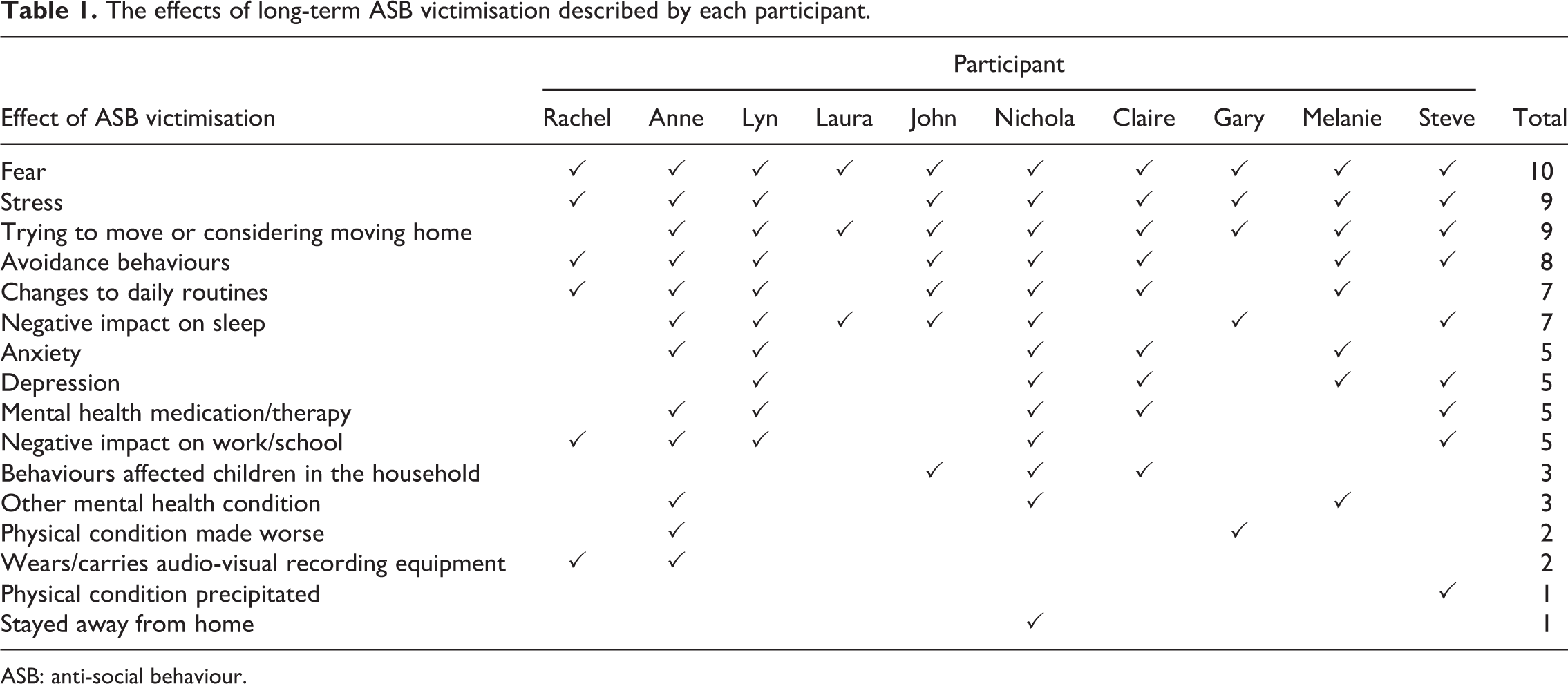
Both cases outlined above demonstrate how ASB manifests as an accumulation of incidents that vary in severity, but usually get worse over time. Table 1 details the breadth and frequency of responses given about the range of effects associated with long-term ASB victimisation, ranging from fear to staying away from home. These experiences can be broadly categorised into two themes covering the range of impacts: mental and physical health and behaviour change and the quality of life. As the interview data show, the impacts of long-term ASB are not discrete, but cumulative.
The effects of long-term ASB victimisation described by each participant.
ASB: anti-social behaviour.
Mental and physical health
The overwhelming majority of participants explained how the ASB victimisation they experienced had negatively affected their mental health. This manifested in a number of different ways. Fear was frequently discussed by the participants, an effect previously noted by Millie et al. (2005) and Heap (2010). This was generally expressed as being a constant state of expecting victimisation to occur, for example, thinking the perpetrator (neighbour) was back every time a banging door was heard (Lyn). In addition to being fearful of potential victimisation experiences, participants also detailed how they were afraid of reporting incidents to the authorities, again similar to Heap’s (2010) findings. Reporting was commonly known to make matters worse because of reprisals from the perpetrators who would confront the participant to demonstrate their annoyance that a report had been made. Anne, Lyn and Nichola explained: I know that is going to backfire on me. That is why I cannot step out with my dog because every single time I report…it gets backfired because they come home, and they start on me. (Anne) Once he had the letter come from the noise team, the first letter, he came into the garden waving it at us saying ‘What?! Are you trying to get me fucking evicted?’ (Lyn) He threatened me because he found out that I had gone to the council and the police. (Nichola) I contacted the council recently because [the injunction has] only got about six months to go and I know what will happen, as soon as those six months are up he’ll start getting aggressive again and I cannot put my kids through this anymore […] her education is paramount, she wants to be a teacher and living in the environment, hostile environment that we’re living in, it’s no way for a child to learn. You can’t. When you’ve got kids shouting through the walls, loud music, banging, drilling at all hours, no one can cope and put up with that, let alone when you’re studying for your exams. (Claire) My husband was really, really bad. I couldn’t do a thing with my husband, he went to nothing, do you know what I mean? And now he’s still on the very, very high doses of two different anti-depressants. His mental health, the doctor got hold of a mental health assessor man to come out and see him. I suppose he was here an hour, a very nice chap and by the time he left here he said to me, he said you’re both suicidal. The times I’ve sat here – I lost my dad a few years ago and the times I’ve sat here and laid in bed and thought if dad’s waiting for me, because I can’t take no more of this. (Lyn) It’s awful. I’m now on medication for anxiety and depression because it’s just getting too much. I’m here on my own with four children, one of which is one, one’s three, one’s 12 and one’s 14, it’s horrific. Well it brought up a lot of stuff for me because I was bereaved at school, so it actually sent me back, every time it would happen, it would send me back to quite a bad place. So I have really struggled, sometimes for weeks to get to where I feel stable again and even now talking about it, it was horrible and I would be in tears on the day and sometimes my daughter would be in tears as well if she was there and we would come in the house, phone the police, be like crying and I would just hide in the house for the rest of the day and then spend the next few days coming in and out like almost sneakily, and it would affect – in the initial week or so after each thing I would feel scared, I would feel threatened I would feel very wobbly, emotionally.
The effects of ASB victimisation on physical health were mentioned less frequently than mental health. However, two participants, both with heart conditions, believed the ASB they experienced had a negative impact on them physically. For example, Anne had an existing heart condition that she thought had been made worse by the stress and anxiety caused by the victimisation. In Steve’s case, he was taken to hospital with a suspected heart attack because of the situation, which resulted in letters from the doctor being sent as evidence to the local council to act about the noise incidents being experienced. This demonstrates how two of the victims displayed multiple vulnerabilities.
Behavioural routines and the quality of life
The ASB victimisation experienced by the participants was also found to affect behavioural routines and have a negative impact on the quality of life. Three themes were generated that encapsulate the difficulties experienced: avoidance behaviours, changing routines and effects on the quality of life. The most common way that ASB victimisation was conveyed to affect everyday life was through the participants ceasing certain behaviours to prevent bumping into and/or confrontation with the perpetrator(s). Many of these actions related to going outside their property, for example being too frightened to leave the house, not going outside to wash the car, being watched or followed when they went out, not able to hang the washing outside, children too scared to play in the back garden and not cycling anymore because of verbal abuse. At the most extreme end of the scale, Anne said: I don’t go out. I don’t let my dog out in the garden. He messes inside the house because I am afraid to step out from my front door. Well I won’t let my children go out to the green, to the park; obviously, never let them go up there. I am different to my family, I will try and deal with it myself, so I will deliberately walk through the park and ask them politely to move on but it makes it quite stressful. You shouldn’t feel trapped in your house so we could feel quite trapped in our house because of what’s going on outside. I’ve got to wear body cameras and a voice recorder just in case he comes up and starts shouting again if I am out. [I have worn it for] about two years now. It’s not very nice because I get looked at, but it’s placing my security and my safety and any time I go out cycling I always check up and make sure where CCTV cameras are so I only got a certain way where I know there is always CCTV watching me every move I make.
All participants mentioned how the ASB they were experiencing had a negative effect on a range of factors that diminished their quality of life. Almost every participant explained how the ASB affected their ability to sleep, either through noise nuisance, anxiety or a combination of the two. This mirrors Mawby and Walklate’s (1997) work that found sleeplessness affected victims of domestic burglary. For participants, the resultant sleep deprivation was held responsible for further damaging consequences, such as making it difficult to get up in the morning to go to work (Lyn and Laura). Nichola explained how tiredness was affecting their whole family, which has caused additional stress and anxiety: I’ve been very, very stressed at work. I actually work as a [redacted] so my work is quite important obviously and it affected my performance. I actually got called in by my manager three times…She [daughter] was obviously falling – not so much falling asleep but she was very tired at school because she would be woken up at 4 am not being able to go to sleep until 10.30pm because of music, banging or the dog barking. I’m very, very sleep deprived. I’m slowing catching up on that because what I have had to do in the past is actually sleep at hotels because I know that they’re not going to be in for the weekend…I was having to pay nearly £90 just for one night because obviously it was like a Saturday night, they’re a lot more expensive which meant, you know, borrowing money from my boyfriend or my mum or, you know, if I had – obviously particularly for a holiday, I had put money to the side so we would be able to do things and unfortunately I had to take money out of that kitty to pay for petrol to go backwards and forwards from [the hotel].
Discussion
The findings demonstrate the cumulative and severe impact of harm caused by long-term ASB victimisation. The effects were reported by the participants to have had a significant impact on their daily lives, highlighting that the mental, physical and behavioural change effects of being a victim of long-term ASB are substantially debilitating for them and their families. These findings are comparable with and expand Upson’s (2006) quantitative data analysis from the Crime Survey for England and Wales, which showed that 96% of victims experiencing noisy neighbours had some kind of emotional reaction. What distinguishes this research from Upson’s (2006) and existing quantitative studies into the effects of criminal victimisation is that the qualitative nature of this work has generated significant insights into the severity of the impacts being felt. The added value has been achieved through the exploration of the cumulative impact of multiple effects being experienced by an individual at a single point in time, which was facilitated by utilising Green and Pemberton’s (2018) inclusive and narrative-driven radical victimology as a theoretical framework. Every participant discussed experiencing a combination of the different effects presented in Table 1, which reflects the multitude of incidents that are typically contained within an ASB case, as highlighted by Claire’s and Lyn’s stories.
The magnitude of harmful effects that occur as a result of long-term ASB victimisation demonstrates the fallacy that ASB is a ‘low-level’ concern. This research has shown that victims of long-term ASB experience a wide-range of negative effects that have a significant impact on their health and quality of life, which are comparable to victims that have experienced violent crime (Coker et al., 2002; Parsons and Bergin, 2010). Further, because the effects are not experienced in isolation from one another, the participants’ accounts illustrated that the combined, cumulative impact of the effects were greater than the sum of the individual effects. This greater depth of understanding further emphasises the value of the qualitative approach taken here, which has allowed for a holistic exploration of victims’ experiences. The regularity of participants detailing a cumulative impact indicates that the high-profile fatalities where ASB victims committed suicide (Pilkington and Dow), were not isolated ‘bad’ cases. There is a burden of victimisation that is bubbling beneath the surface, and in many cases it is unaddressed by the authorities; an assertion that can be made here due to the sample in this study being drawn from those who had activated the Community Trigger case review process. Consequently, a better understanding of victims’ experiences is required to provide suitable support to combat the effects of ASB victimisation.
At this juncture it is pertinent to reconsider the blurry distinctions between the definitions of crime and ASB, given the effects of long-term ASB victimisation demonstrated by this research are seen to mirror the effects of criminal victimisation. Due to the impact of the effects of ASB victimisation highlighted here, it seems unhelpful for the bulk of victims’ support to be centred around black letter law definitions of crime. For example, ASB Help (2014) have found that only 23% of the population in England and Wales have access to specialist ASB services through Victim Support. Therefore, the evidence presented in this paper adds traction to the idea that a social-harm approach would be better than the current narrow definition of crime, despite Green and Pemberton’s (2018) criticisms of the associated ideology surrounding the ontological reality of crime. From an ASB victim’s perspective, a zemiological approach would afford a focus on chronic victimisation rather than discrete events, thus enabling a wider interrogation of who and/or what is responsible for ASB victimisation in the first instance (Hillyard and Tombs, 2004). This supports Green and Pemberton’s (2018) call for the concepts of intent and interpersonal grievance to be central to our understanding of victimisation. It would also enable victim support resources to be allocated based upon harms incurred, rather than narrow definitional thresholds.
Participants’ experiences also highlight the failure of the Community Trigger policy to ‘put victims first’. Every respondent took the initial step to report their victimisation, which was not resolved to a satisfactory degree. Following the activation of the Community Trigger to initiate a case review, their victimisation either continued as before or was made worse by additional threats made as a result of the reporting. Where actions were put in place to address the ASB there was a feeling that their victimisation was merely ‘on pause’ for the duration of the intervention, with the fear that it would eventually return. Participants subsequently felt helpless and trapped in a cycle of victimisation. Therefore, the Community Trigger appears to be failing as a policy response to address the issue of repeat victimisation, which was the very thing it was conceived to tackle. Consequently, the deficiencies of the policy contributed to victims experiencing the continuing harmful effects of ASB victimisation.
A range of policy implications result from the findings. The extent of harmful effects uncovered here reaffirms the need for the authorities to respond effectively to initial reports of ASB, a sentiment echoed elsewhere (Heap, 2016b). Call handlers and frontline officers still require better training to adequately identify repeat victims of ASB despite calls for this in 2010 and 2012 (HMIC, 2010; 2012). Also, in cases where there are perceptions of counter/vexatious allegations, greater investigation is required to determine the aggressor, with sufficient support given to the victim. Further, the effects of victimisation that are being experienced need to be assessed and addressed, alongside providing an enforcement response to stop the ASB in question. At least in the short-term, any policy developments will not be as radical as adopting a social harm approach. However, the direction of travel should focus on better acknowledging and counteracting the harmful effects of long-term ASB victimisation. Failure to act in policy terms will ultimately mean that victims will continue to experience a range of effects of victimisation that have a significant impact on their quality of life.
Conclusion
This paper has sought to develop our understanding of the effects of long-term ASB victimisation, adding to the body of victimology that examines criminal victimisation by extending it into the sub-criminal domain. The research has shed important new light on victims’ experiences of long-term ASB, demonstrating that the victimisation is not ‘low-level’ and that it has similar negative effects to the effects on those who have experienced violent crimes (Coker et al., 2002; Parsons and Bergin, 2010), and domestic burglary (Mawby and Walklate, 1997). The depth of the findings produced by this study, particularly around the cumulative effects of ASB victimisation, provide an evidence base to refute the policy position that ASB is ‘low level’. The work also reaffirms the importance of adopting a qualitative approach to prioritise victims’ narratives as a means of highlighting their experiences, as per Green and Pemberton’s (2018) new radical victimology.
The limited literature available that discusses the experiences of ASB victims necessitates future empirical research. There is the need for further qualitative data collection to better comprehend the lived experiences of ASB victimisation, with research required to explore the dimensions of becoming a victim of ASB and examining the effects this has on the trajectory of a person’s life and their identity. A greater understanding is also required of practitioner perspectives towards the effects of ASB victimisation to determine what, if any, barriers inhibit how ASB victimisation is responded to. Without assessing the experiences of all the actors engaged in the phenomenon of ASB victimisation we cannot hope to create meaningful solutions.
Footnotes
Acknowledgements
Thank you to the participants that took the time to share their experiences. Thanks to the research team comprising Jennifer Herrera from ASB Help, Rebecca Hamer and Adam Mama-Rudd and to the CSP that funded this research. Finally, thank you to the anonymous reviewers for their helpful suggestions and Catrin Andersson and Jake Phillips for their encouraging comments on an earlier version of this article. This research was funded by a CSP in England.