



Abstract

Keywords
Background
Approximately 1 million people of working-age die in Europe each year. 1 Compared to older populations, this cohort is more likely to face financial challenges related to loss of income, cost of childcare, and mortgage and rent costs. 2 Many choose to continue working after a terminal diagnosis and employers have an important role in supporting people to remain in work and to leave with dignity when the time is right. Good support can include offering flexibility and adjustments to roles for example through job crafting,3,4 managing sickness absence outside of standard reporting systems, and providing an open and supportive culture. 5 Yet, survey evidence from the UK has highlighted an overall lack of targeted support and an “employer lottery” with wide variation in support between employers. 2
The university sector is a major employer across the globe; in the UK it employs over a quarter of a million people. 6 To understand more about how staff with terminal illness are supported in the higher education sector, we undertook a review of policies across the 24 leading Russell group universities in the UK, to explore variation in provision and make recommendations for improvements. Our study focused on the research-intensive Russell Group universities in the UK as a barometer for circumstances in the rest of the sector.
Methods
We obtained sickness policies and related documents from university websites and through Freedom of Information requests. We extracted data on key features of policies based on guidance for provisions for staff with terminal illness recently developed by the Chartered Institute for Personal Development (CIPD), the professional body for Human Resources in the UK. 7 We present the data by institution and provide a summary of best practice examples.
Results
We obtained data for all 24 universities. Table 1 provides a summary of key aspects of policies and Table 2 highlights examples of best practice.
A summary of sickness and terminal illness policies at UK research-intensive universities.
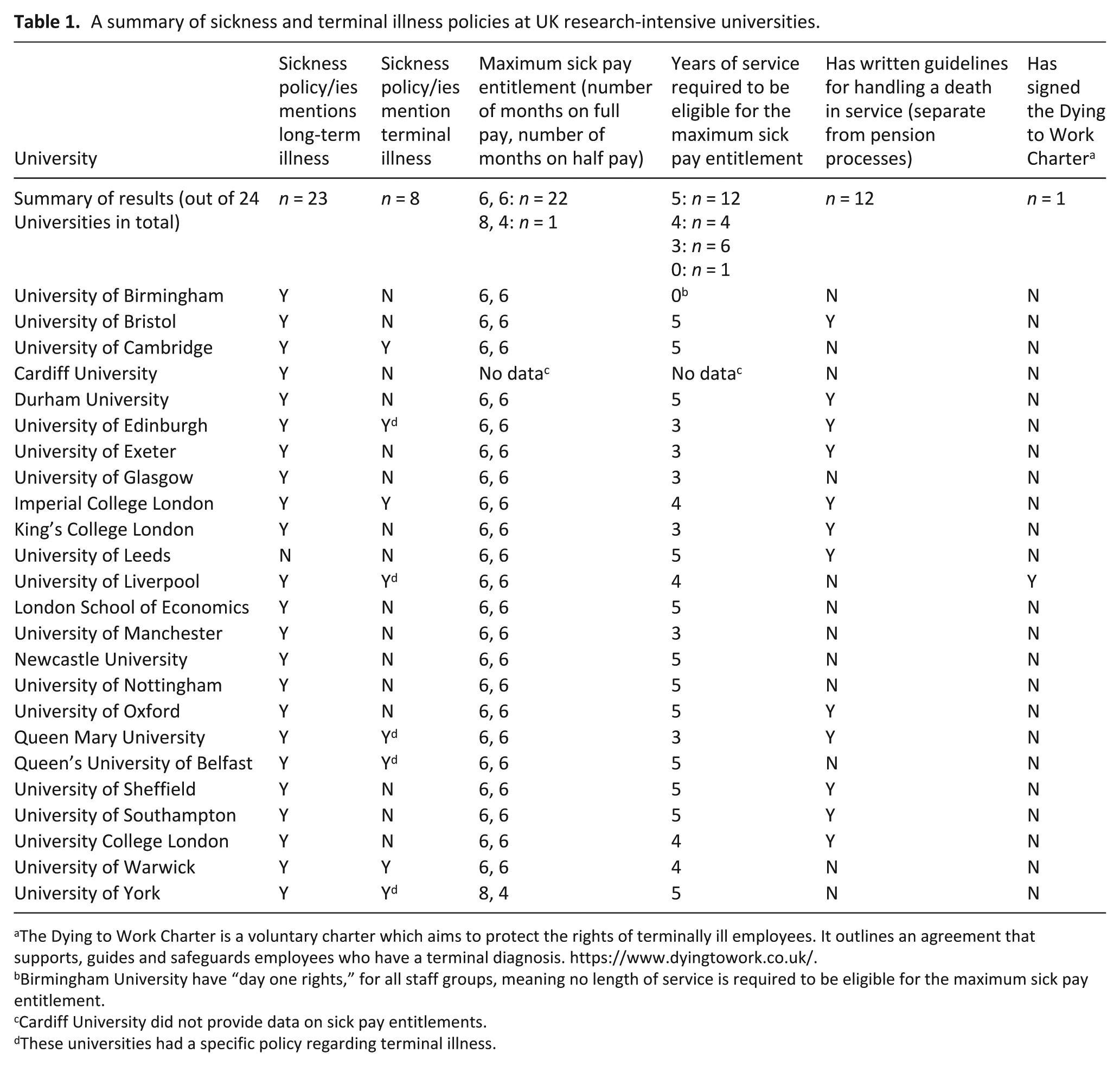
The Dying to Work Charter is a voluntary charter which aims to protect the rights of terminally ill employees. It outlines an agreement that supports, guides and safeguards employees who have a terminal diagnosis. https://www.dyingtowork.co.uk/.
Birmingham University have “day one rights,” for all staff groups, meaning no length of service is required to be eligible for the maximum sick pay entitlement.
Cardiff University did not provide data on sick pay entitlements.
These universities had a specific policy regarding terminal illness.
Best practice examples from sickness or terminal illness policies at research-intensive universities, aligned with Chartered Institute for Personal Development (CIPD) guidelines.
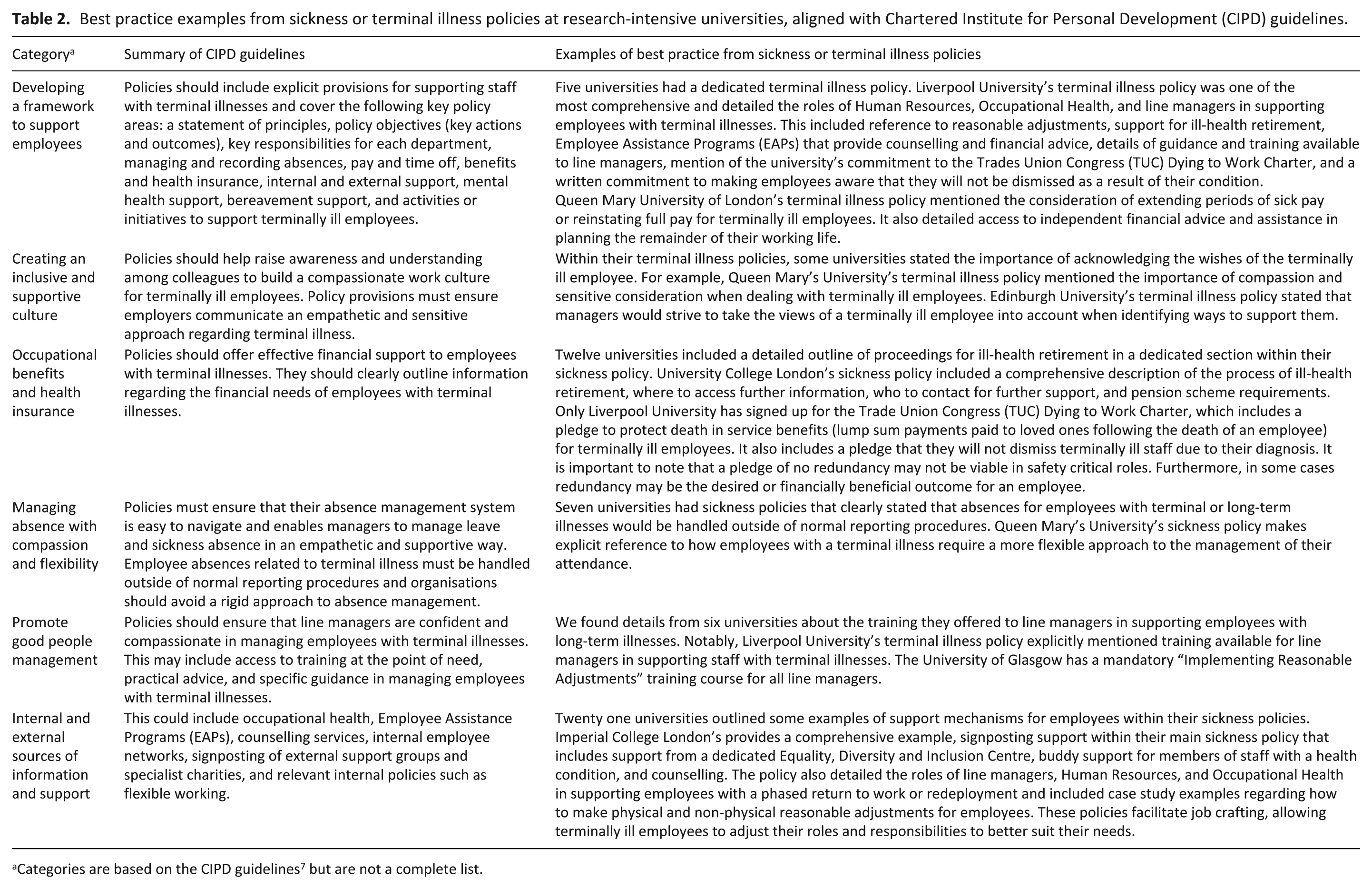
Categories are based on the CIPD guidelines 7 but are not a complete list.
Discussion
In this review of the 24 research-intensive UK universities, we found that most (19) do not have special policy provisions for staff with terminal illness. While 23 mention long-term illness in their policies, only 8 refer to “terminal illness” and just 5 universities have a dedicated terminal illness policy. Despite an overall lack of dedicated support, we did find examples of best practice, including 7 universities that have a policy to manage absences outside of normal practices, 6 that signpost training for line managers, and 14 that provide clear examples regarding the implementation of reasonable adjustments.
A recent survey of over 1000 HR professionals 2 found that 44% of organisations had policies in place for terminal illness and 43% of organisations managed absences for an employee with terminal illness outside of standard reporting processes. Comparatively, only 21% and 29% of Russell Group Universities had similar provisions, respectively, suggesting that the HEI sector may be lagging behind other employers in supporting staff with terminal illnesses.
The Dying to Work Charter is a voluntary charter which aims to protect the rights of terminally ill employees, including a pledge of no redundancy for terminally ill staff. Given that the higher education sector overall employs 33% of staff on fixed-term contracts, 8 a commitment to no redundancy may be challenging to align with and could explain why only one university in the Russell Group has signed up to the Charter. Worryingly, none of the university policies we reviewed detailed specific provisions for fixed-term contract staff who are living with terminal or serious illness. For these staff, a lack of clear information about how the end of their contract will be handled is likely to exacerbate their financial insecurity and represents a serious gap in the current policy provision in this sector. Only one university offered “day one rights” for enhanced sick pay provisions. This contrasts with a growing trend towards offering “day one rights” for other provisions such as maternity pay, which is better aligned with a sector reliant on transient, fixed-term contract workers. 9
Support for working-aged people living with terminal illness is an important and often neglected area of policy and provision in many countries across the globe. This study offers a snapshot of evidence about one sector of employment, revealing a lack of support and identifying ways to improve provision. Our review was limited by focussing only on Russell Group universities. It provides an indication of provision and support in the higher education sector but may miss examples of best practice in other universities. Our findings contribute to international evidence highlighting significant gaps and variation in support offered to employees living with a serious illness. 10 We encourage universities to review their sickness policies in line with the CIPD guidance, and as part of this consider how practical approaches including absence management, role adjustments, and job crafting can be used to maximum effect. Universities should also ensure equality of provision for staff on fixed-term contracts who make up a large proportion of the higher education workforce.
Footnotes

Ethical considerations
This study was conducted in line with the ethical standards of King’s College London. As the research involved publicly available documents and did not involve human participants, formal ethical review was not required. All data collection was compliant with relevant institutional and legal requirements, including the Freedom of Information Act.
Author contributions
All authors made substantial contributions to the concept and design of the study. RH collected and analysed the data with supervision from JMD, IT, and JS. All authors contributed to interpretation of data. All authors contributed to drafting and revising the article, approved the final version and have participated sufficiently in the work to take public responsibility for appropriate portions of the content.
Funding
The authors disclosed receipt of the following financial support for the research, authorship, and/or publication of this article: This research was supported by the King’s Undergraduate Research Fellowship (KURF) scheme at King’s College London, which provided funding for the student researcher.
Declaration of conflicting interests
The authors declared no potential conflicts of interest with respect to the research, authorship, and/or publication of this article.
Availability of data and materials
All policy data used in this study were obtained from publicly available university websites or through Freedom of Information requests. Summary data are available from the corresponding author upon reasonable request.