




Abstract
Entrepreneurship support organisations (ESOs) support entrepreneurs with the provision of knowledge, resources, and training. They are a popular economic development tool for promoting entrepreneurial activity. However, the large number of ESOs has led to criticisms of oversaturation. We investigate this claim by analysing the ESOs in the entrepreneurial ecosystem in Glasgow, Scotland. We draw on publicly available documentary data to map the ESOs landscape and adopt the organisational thickness lens to analyse and interpret our findings from a holistic perspective. Although the literature largely presents ESOs as homogenous, we find a large number of heterogeneous ESOs that provide a wide range of support activities which can cater to different needs. However, they do not clearly target a specific segment of entrepreneurs which makes it difficult for the clients to differentiate between them and find the most suitable ESO. This is likely the explanation for the perception of a ‘cluttered landscape’ with too many players. Considering that entrepreneurs draw on different support providers over the course of their entrepreneurial journey, a key implication of our study is that the issue of clutter is likely to improve with greater segmentation rather than reducing the number of ESOs.
Keywords
Introduction
The concept of entrepreneurial ecosystems seeks to explain the existence of geographical variations in entrepreneurial activity (Brown and Mason, 2017), specifically in high-growth start-ups. Entrepreneurial ecosystems are place-based phenomena that comprise a wide range of actors, including current and exited entrepreneurs, investors, advisors, governments, and non-governmental organisations, who provide the services and resources that ambitious entrepreneurs need to create and grow businesses. Entrepreneurs are best able to access these resources in environments characterised by a supportive culture, networks, and trust (Mason and Brown, 2014; Spigel, 2017; Neumeyer et al., 2019). A critical feature of entrepreneurial ecosystems is that their effectiveness in supporting ambitious and innovative start-ups is the relational interactions between these different actors (Spigel, 2016, 2017). The association between entrepreneurial ecosystems and productive entrepreneurship has led to ecosystem building becoming a key focus amongst national and sub-national governments across the world (Mason and Brown, 2014).
‘Entrepreneurship support organisations’ (ESOs) are a core component of entrepreneurial ecosystems. ESOs provide assistance to entrepreneurs as they seek to initiate and progress their ventures through the provision of information, knowledge, and resources (Spigel, 2016; Motoyama and Knowlton, 2017; Roundy, 2017a; Bergman and McMullen, 2022). This assistance is both tangible (e.g. finance, workspace) and intangible (e.g. advice, mentoring) and is differentiated between different stages of the entrepreneurial process (pre-startup, startup, and growth). ESOs can be broadly defined as ‘organization[s] whose primary purpose is to support individuals and collectives, through (in)direct and (im)material assistance, as they seek to initiate and progress through the stages of the entrepreneurial process’ (Bergman and McMullen, 2022: 690). ESOs are typically open to entrepreneurs across sectors; however, some focus on broad industries or sectors, such as tech (Spigel, 2016). They include public, private, and quasi-private organisations (Kauffman Foundation, 2019). Although ESOs are typically funded by government, they are frequently delivered by non-government organisations. There are also many organisations (such as government, universities, financial providers, lawyers, accountants) that offer entrepreneurial support and assistance but not as their primary role – in other words, ‘while all ESOs are organisations that support entrepreneurs, not all organisations that support entrepreneurs are ESOs’ (Bergman and McMullen, 2022: 690). The most appropriate focus is therefore on organisations whose primary focus is to support entrepreneurial activity. Moreover, whereas the definition of ESOs emphasises their breadth and diversity, research has mostly focused on specific types of ESOs, notably incubators, science parks, accelerators, maker spaces, and co-working spaces (Yusuf, 2010; Theodoraki and Messeghem, 2017; Breznitz et al., 2018; Clayton et al., 2018; Bellavitis et al., 2020; Biru et al., 2021; Oh et al., 2022).
As Bergman and McMullen (2022: 689) observe, ESOs are ‘ubiquitous and number in the tens of thousands worldwide’. As an example of this ubiquity at the level of the individual ecosystem, Spigel (2016) identified 43 ESOs targeting technology entrepreneurs in Edinburgh, Scotland, one of Europe’s leading tech hubs. This has resulted in a widespread perception that the support landscape is ‘cluttered’, creating confusion amongst users about access, criteria for eligibility, and the type of support available, and putting pressure on government to ‘de-clutter and simplify’ the landscape to create a more integrated and focused delivery of support (Scottish Government, 2018). This view is captured in the following quote from a participant in the Scottish scaleup ecosystem enquiry: ‘There is a widely shared feeling that Scotland’s ecosystem of support is cluttered and overfocused on startups’ (Kennedy and Inns, 2022: 12). This paper examines the validity of these criticisms by studying the role of ESOs and their activities in the entrepreneurial ecosystem in Glasgow, Scotland. We ask the following questions: What types of support are provided? Who is this support provided for? How much variety of support is provided; specifically is there evidence of over-provision of particular types of support and support for particular types of entrepreneurs, and are there gaps in the support that is available?
Research on ESOs is criticised for being siloed, focusing on limited types of ESOs, describing their activities, the individuals and ventures that engage with them, and their sponsors (Bergman and McMullen, 2022). We address this criticism by taking a holistic perspective on ESOs, which allows us to not only engage with the policy debates on cluttered support but also demonstrate that ESOs are a much more heterogeneous phenomenon than the literature suggests. By adopting the ecosystem approach we build on Spigel’s (2020: 80) proposal that ‘instead of looking at the impact of individual initiatives or policies, we need to see each policy or programme as a node in the broader network of public and private support’. Entrepreneurs have differing support needs, reflecting their sector and demographic characteristics. Their needs also vary according to their stage of development (pre-start-up, start-up, and growth). Entrepreneurs will not receive support from a single ESO for their entire entrepreneurial journey but will engage with various ESOs as their needs change (Mason et al., 2020). What matters is therefore not the number of ESOs in an entrepreneurial ecosystem but their diversity and complementarity. This requires taking the entrepreneurial ecosystem rather than the individual ESOs as the unit of analysis. This approach enables us to critique the view in government that assumes that the large number of ESOs must involve duplication and therefore requires ‘rationalisation’.
The paper is organised as follows. First, we review the literature on entrepreneurial ecosystems and focus on the ESOs phenomenon. Second, we discuss the concepts of institutional and organisational thickness and their usefulness in examining the coherence and effectiveness of entrepreneurial ecosystems. Third, we outline the methodological approach of data collection and analysis. Fourth, we use the concept of organisational thickness as a framework to present our findings. Fifth, we discuss a series of theoretical and practical implications before concluding the paper.
Literature review
Entrepreneurial ecosystems
An entrepreneurial ecosystem is ‘a set of interconnected entrepreneurial actors, organisations, institutions and entrepreneurial processes which formally and informally coalesce to connect, mediate and govern the performance within the local entrepreneurial environment’ (Mason and Brown, 2014: 5) by supporting entrepreneurial activity in a particular area at local, regional, and national levels (Brown and Mason, 2017). The field of entrepreneurial ecosystems has grown rapidly over the past decade, with much of the focus on identifying the main ecosystem elements (Isenberg, 2011; Mason and Brown, 2014; Spigel, 2017; Stam and Van de Ven, 2021). There is now a recognition that entrepreneurial ecosystems are heterogeneous with fundamentally different configurations (Brown and Mason, 2017; Wurth et al., 2022). From a policy perspective, this means that there is no ‘one-size-fits-all’ solution to developing entrepreneurial ecosystems (Feldman, 2001) and tailored strategies are required (Audretsch, 2015). However, it is not the mere presence of ecosystem elements but rather the interactions between them that determine the success of the ecosystem in supporting entrepreneurial activity (Stam, 2015; Stam and Van de Ven, 2021). The resulting combination of elements presents a source of competitive advantage for the entrepreneurs in the ecosystem which is not readily available for those outside of the ecosystem (Spigel, 2016).
To be effective, it is essential that the ecosystem elements also exhibit sufficient coherence – the degree of association between the elements – through which otherwise siloed ingredients coalesce into an interconnected ecosystem (Roundy et al., 2017: 101). As we shall discuss later, ecosystem coherence can be achieved through institutional and organisational thickness – in other words, a unique combination of and interactions among local institutional or organisational factors that contribute to economic development (Coulson and Ferrario, 2007: 610). In this paper, we specifically focus on organisational thickness amongst ESOs which is especially important for the coherence of the ecosystem (Roundy et al., 2017: 101).
Entrepreneurship support organisations
Entrepreneurship support is often used as a broad umbrella term for a wide range of organisations and activities that support the creation and growth of businesses (Ratinho et al., 2020), including ESOs, commercial professional service providers, large firms, higher education institutions, research and innovation centres, as well as various local, regional, and national public sector bodies (Theodoraki and Messeghem, 2017: 12).
ESOs typically provide services and resources – especially information, connections, and training – that mitigate the common challenges that entrepreneurs and their businesses may encounter (Spigel, 2016; Roundy, 2017a). This lowers entry barriers for new entrepreneurial projects and reduces the time to bring innovations to market (Stam and Van de Ven, 2021: 6), thereby alleviating their liability of newness (Stinchcombe, 1965). Additionally, ESOs help strengthen the connections among entrepreneurs and various ecosystem actors and create a sense of community (Roundy, 2017a; Breznitz et al., 2018). Therefore, by ensuring a healthy rate of self-sustaining entrepreneurial activity (Isenberg, 2011: 6), ESOs contribute to a continuous renewal of the ecosystem itself (Malecki, 2018: 14).
However, ESOs are not homogeneous (Cohen et al., 2019; Bergman and McMullen, 2022). Although they share a common objective of promoting productive entrepreneurship (Biru et al., 2021), there is significant diversity amongst ESOs and the types of activities they provide (Roundy, 2017a). ESOs can be private or public entities, for profit or not, and operated by various ecosystem actors, including entrepreneurs, charities, corporate organisations, universities, and government. Typically, they function as standalone entities but, if part of another organisation, are clearly differentiated from their parent with their own dedicated staff and resources (Spigel, 2016). Nevertheless, given that early-stage ventures typically lack the financial resources to pay for entrepreneurial support services, or are unwilling to pay for such support because they are unable to assess its value, governments frequently subsidise the activities of ESOs to compensate for this market failure.
Summary of previous typology of ESOs activities.
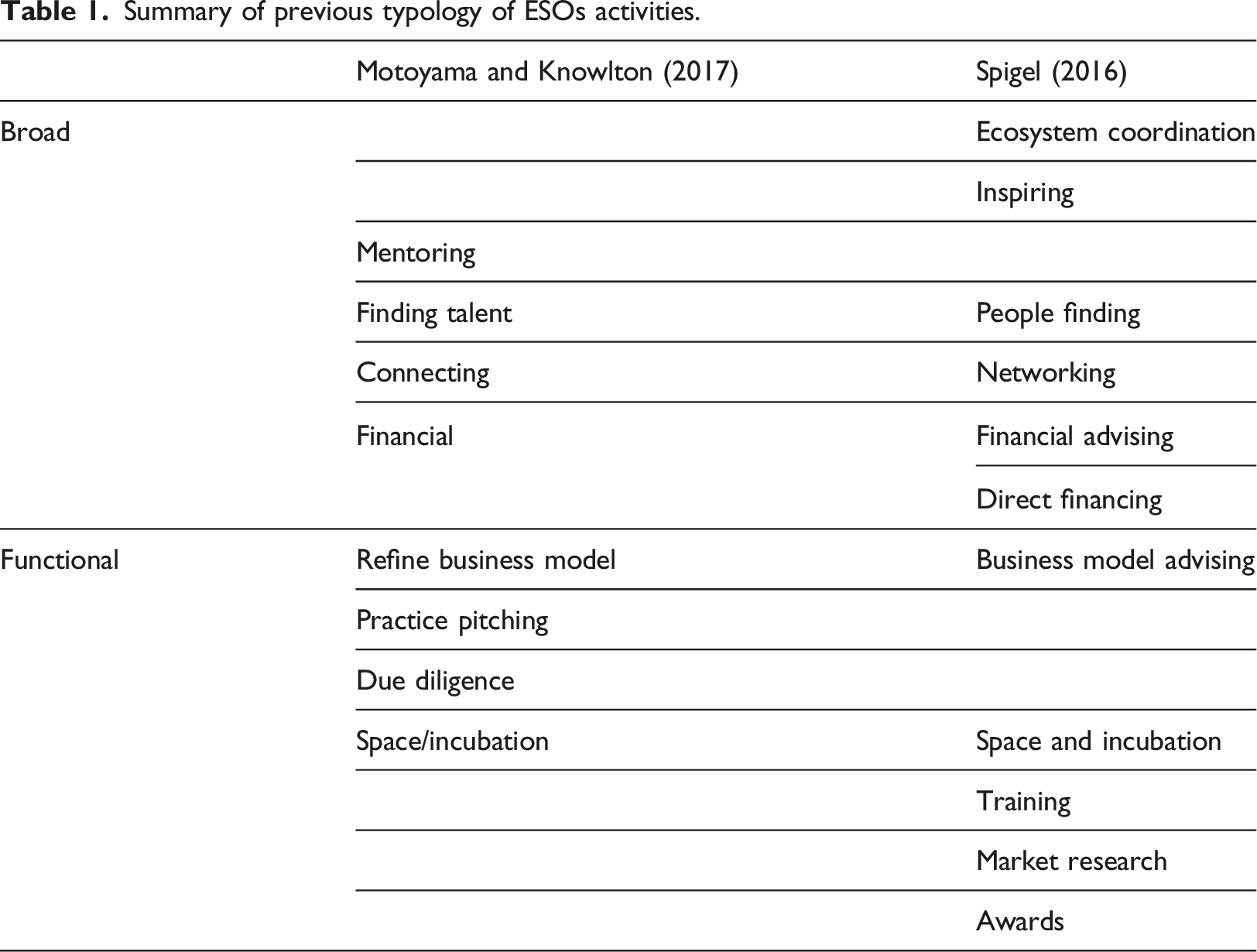
Nevertheless, these studies do not arrive at a clear-cut definition of ESOs, possibly due to the ambiguity of the phenomenon (Bergman and McMullen, 2022). Also, they are narrow in scope: one study focuses on a small cohort of start-ups that engaged with one ESO (Motoyama and Knowlton, 2017); the other focuses exclusively on tech ESOs (Spigel, 2016). Thus, the typologies of ESOs activities developed in these papers are incomplete, as illustrated by the gaps in Table 1. Moreover, entrepreneurial ecosystems are systemic and typically sector-agnostic phenomena which means that in order to understand their constituent elements, such as ESOs, it is important not to limit the scope of inquiry to a particular type of ESOs or sector. In this paper, we overcome the limitations of previous studies by investigating ESOs and their role in supporting entrepreneurial activity at the (eco)systemic level across all sectors. However, given our earlier point about the importance of ESOs coherence for the effective functioning of ecosystems, we need to first introduce the concepts of institutional and organisational thickness, which we later use as the analytical framework to analyse the ESOs landscape.
Institutional and organisational thickness
The concept of institutional thickness focuses on the institutional structure of a region, particularly its unique combination of, and interactions among, local institutional factors that contribute to economic development in that area (Coulson and Ferrario, 2007: 610). A local economy can be deemed institutionally thick – and hence conducive to economic development – when it meets four conditions: critical amount and diversity of institutions, along with interactions, the notion of hierarchy, and awareness of an overarching agenda (Amin and Thrift, 1994). Related to this is the concept of organisational thickness, which recognises that ‘[a] strong local institutional presence refers to the existence of a variety of different organizations’ (Zukauskaite et al., 2017: 329). Although institutional and organisational thickness have been conflated in the literature in the past (Coulson and Ferrario, 2007: 594, 610), including in Spigel’s (2016) ESOs study, they are not the same. Institutions refer to the ‘rules of the game’ – values, norms, and regulations (North, 1990) – whereas organisations are the ‘players’ – businesses, universities, or support organisations – who abide by the rules (Zukauskaite et al., 2017: 331). Given our explicit focus on entrepreneurship support organisations and their role in the entrepreneurial ecosystem, we thus use the more precise concept of organisational thickness to understand the ESOs landscape and its coherence. Specifically, the four conditions of organisational thickness that will be used to analyse the Glasgow ecosystem are: critical amount and diversity of organisations, interactions among organisations, hierarchy among organisations, and overarching agenda.
In the context of studying entrepreneurship support, the thickness lens recognises that companies benefit from being embedded in support networks through which they can access the various forms of capital required (Granovetter, 1985). It helps us study the configuration of the ESOs infrastructure as important actors in enabling local entrepreneurial activity, although the cause-and-effect relationship between thickness and entrepreneurship is unclear because ESOs may be the cause of thriving startup activity or perhaps they may be the outcome (Coulson and Ferrario, 2007: 594). It also acknowledges the role of the wider context and how it shapes the unique configuration of the ESOs landscape in an ecosystem (Rodríguez-Pose, 2013). Overall, the thickness lens helps us understand not only how each individual ESO contributes at the micro level, but also how the different support activities are distributed at the macro level, as will be evident in our findings.
Methodology
The objective of this paper is to examine the provision of entrepreneurship support by ESOs to better understand their role in entrepreneurial ecosystems. In order to study the ESOs phenomenon at an (eco)systemic level, we adopted the case study methodology of the entrepreneurial ecosystem in Glasgow, Scotland. The Glasgow city-region, with about 1.8 million residents, is the largest urban concentration in Scotland. Once a major centre for heavy engineering and shipbuilding, the city’s economy went into long-term decline in the 20th century, the ‘upas tree’ effect of these dominant industries a barrier to diversification (Checkland, 1981). But over the last few decades, Glasgow has developed a diverse economy with strengths in a variety of sectors and sub-sectors, including banking and financial services, creative and digital industries (both the BBC and Channel 4 have bases in the city), energy, and space (Patrick et al., 2019). And as host of COP26 the city achieved a global profile linked to action on climate change. The city has the ambition to become ‘Britain’s Northern Superpower’. 2 However, the city’s political leadership recognise that although its business start-up rate is good, it does not have a sufficiently large company stock and it performs poorly on generating scale-ups. 3 Nevertheless, with its start-ups and scale-ups spread across a range of sectors, including the creative industries, cleantech, fintech, life sciences, and food (Beauhurst, 2022; Tech Nation, 2022), the ecosystem’s broad sectoral diversity makes it particularly suitable for our study of ESOs across sectors and industries. Overall, Glasgow ranks sixth among UK ecosystems, just behind Edinburgh (Startup Blink, 2020).
This study is based on secondary data. Using publicly available documentary data, similar to other ESOs focused papers (Spigel, 2016; Oh et al., 2022), we mapped every ESO in the ecosystem and logged key information about each of them into a database, including the nature of its activities. Our starting point was the development of an initial set of criteria for the operationalisation and identification of ESOs which was based on Spigel’s (2016) study of tech-oriented ESOs, but we amended them to better reflect the sector-agnostic scope of this study. The following criteria were used: • the ESO is a distinct entity with dedicated resources and staff; • the ESO supports entrepreneurs and/or their business in any sector, allowing for sector-specific as well as sector-agnostic ESOs; • the nature of support provided is broadly defined to allow for a wide range of activities; • the ESO currently operates in Glasgow – the ESO can be headquartered in Glasgow, have a branch in the city, or there is clear evidence that Glasgow-based entrepreneurs and businesses can access its services.
It needs to be emphasised that this operationalisation explicitly excludes organisations that undertake entrepreneurship support activities but not as their primary activity – specifically, commercial professional service firms, private and public investors (including banks, business angels, and venture capital), higher education institutions and their technology transfer offices, research and innovation centres, as well as local, regional, and national public sector bodies such as the City Council. This reflects the consensus in the literature that such organisations do not constitute ESOs (Bergman and McMullen, 2022: 690).
At the beginning of data collection, ESOs were identified via an online search, the Scotland Can Do Directory, 4 and the Scottish Entrepreneurial Ecosystem Guide. 5 We then drew on a range of online data, which is an increasingly popular approach in ecosystem research (Spigel et al., 2020: 9). Our primary source of data were websites but also occasionally brochures and annual reports that described the background and activities of each ESO in detail. Whilst this approach has limitations due to the self-reported nature of the documents, a key benefit is that it reflects the authentic practice of entrepreneurs, who are likely to search for support in the same way.
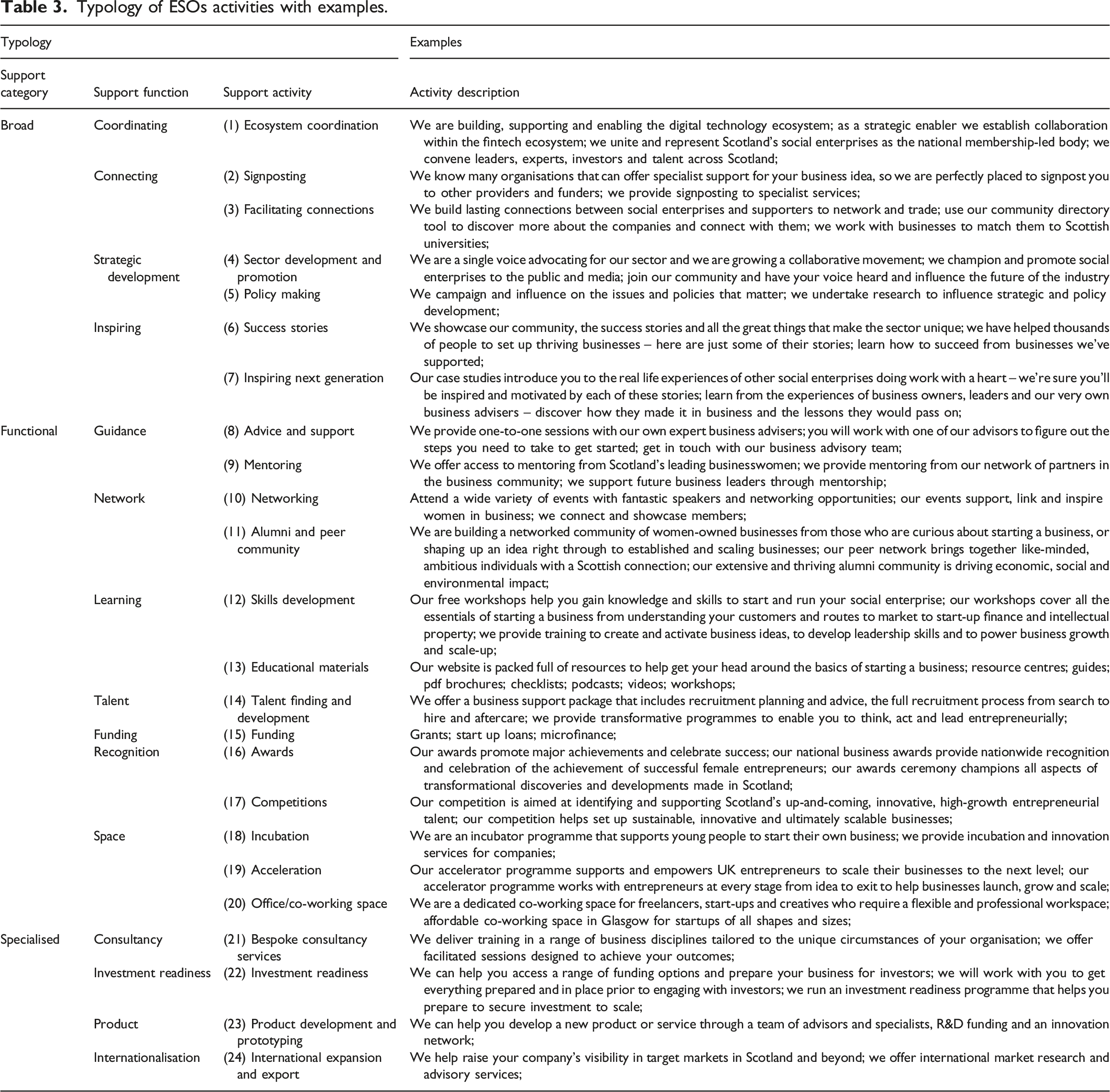
We perused each ESO’s website in detail and noted in our database any references to activities that, either directly or indirectly, assisted the entrepreneurs or their ventures with any aspect of the entrepreneurship process. We deliberately used this broad definition of ‘support activity’ due to the exploratory nature of the study and our aim to capture the diversity of support provided by ESOs. During the process of data collection, we searched for information about each ESO’s services. They were typically listed either on the home page or in a dedicated section. In a few cases, support was bundled into a package, but we noted each activity separately. Examples of data are included in Table 3. Data were collected at two points in time, approximately 30 months apart – in July 2017 and January 2020 – to identify temporal changes in the ESOs landscape. In the second data collection period, we checked whether each of the ESOs identified in 2017 was still in operation – and if so whether its support provision had changed – and searched for new ESOs. Overall, we identified 91 ESOs in 2017 and 84 in 2020.
An abductive approach to data analysis was adopted because we expected that we would need to revise previous theoretical insights into the relatively new phenomenon of ESOs in light of our empirical data. It combines a back-and-forth approach between data and theory and is particularly suitable for concept discovery and theory development (Dubois and Gadde, 2002). In practice this meant that we first separated the data about different support activities and then classified them into the most appropriate categories. We were initially guided by the activities typology previously devised by Motoyama and Knowlton (2017) and revised by Spigel (2016) (see footnote 1), but it was gradually amended in an iterative manner using in-vivo terminology from the data (examples shown in Table 3). Thus, the revised typology better captures the diverse nature of ESOs activities and reflects the language used by ESOs themselves to describe their services to clients.
Findings
In this section, we use the analytical framework of organisational thickness to understand the role of ESOs in the entrepreneurial ecosystem in Glasgow. Specifically, we use this framework to assess how conducive the ESOs landscape is to supporting entrepreneurial activity (Zukauskaite et al., 2017: 336). We draw on the work of Isaksen and Trippl (2016) to differentiate between organisationally thick and diversified ecosystems, which comprise numerous industries and have a diverse ESOs infrastructure, thick and specialised ecosystems, which specialise in a particular industry or industries and have a number of specialised ESOs, and thin ecosystems, which lack coherence. The longitudinal perspective also allows us to consider the relative change of thickness over time within the same context.
Critical amount and diversity of ESOs
The first condition of organisational thickness refers to a critical amount and diversity of ESOs. These will be discussed in turn, first by analysing the changes to the ESOs landscape in relation to the number of support organisations that operate in the ecosystem, and then by analysing their diversity in terms of the support activities they offer. As part of the process, we also revise the existing typology of ESOs activities.
Comparison of ESOs between 2017 and 2020.
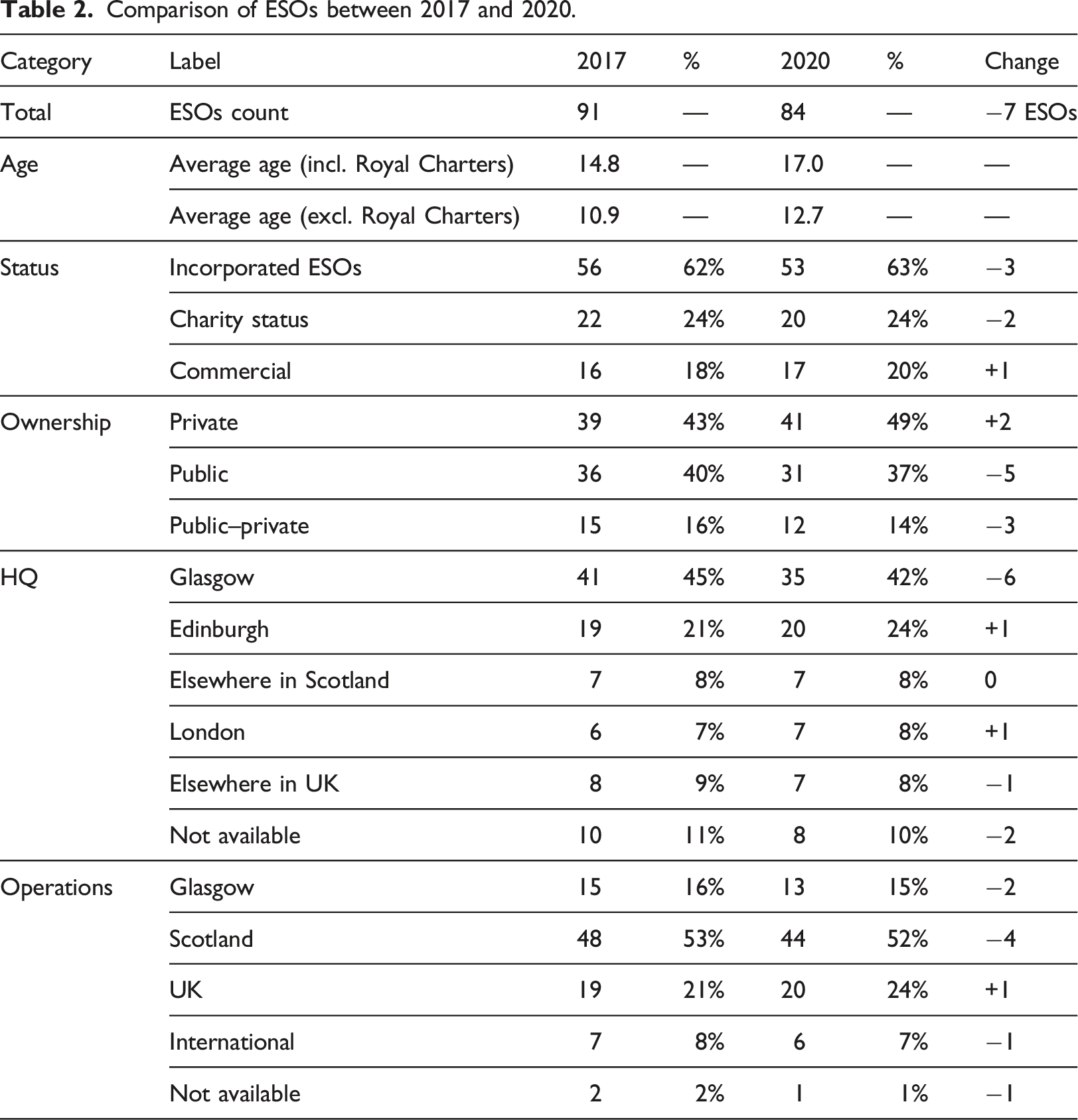
The net loss of just 7 ESOs over the 30-month period suggests that the ESOs landscape exhibited little change in terms of its makeup. However, the actual level of change was greater: 10 ESOs closed down, two new ESOs were established, and one ESO, which had previously run flagship ecosystem events in the neighbouring ecosystem in Edinburgh, extended its operations to Glasgow. In addition, four ESOs restructured their operation – including a change of name, ownership, business model, or shift in focus – but continued operating in the ecosystem, and one ESO expanded its services.
However, it is also necessary to consider the diversity of ESOs and their activities. The number of ESOs alone is not a sufficient indicator of a healthy ecosystem (Mason and Hruskova, 2019). It is also necessary to consider how ESOs support founders on their entrepreneurial journey and whether they account for their evolving needs, which change as the venture grows from start-up to scale-up. The implication is that a variety of ESOs are required to provide a range of support activities at various stages of growth (Mason et al., 2020). In recognition of the fact that one ESO may provide multiple types of support and that the same type of support activity may be provided by different ESOs (Hanlon and Saunders, 2007), we focused on examining the types of activities that they undertake rather than attempting to devise a typology of ESOs themselves.
Typology of ESOs activities with examples.
The actual provision of entrepreneurship support in the ecosystem comprised 484 activities in 2017 and 469 activities in 2020. In between the two data points, there was a net loss of 15 support activities, which represented 3% of all support activities provided in 2017. In particular, there was a considerable decrease in showcasing success stories as a means of inspiration (−8) and skills development opportunities (−8). On the other hand, there was an increase in the strategic development and promotion of some sectors (+4) and the facilitation of connections to other players in the ecosystem (+5). There were no changes in the various alumni and peer communities that were present in the ecosystem, networking opportunities, or the provision of educational materials. The change in each support type is shown in Figure 1. In both years, approximately 60% of all support activities were in the functional category, 33% in the broad category, and 5% in the specialised category, demonstrating that the composition of support types was stable in between the two time periods. Furthermore, this shows that whilst the majority of entrepreneurship support is, unsurprisingly, provided to individual/organisational clients (i.e. to entrepreneurs and/or their businesses via activities under functional support), there is also considerable ESOs activity at the ecosystem level (i.e. broad support). Finally, specialised support was minimal. Changes in ESOs activities.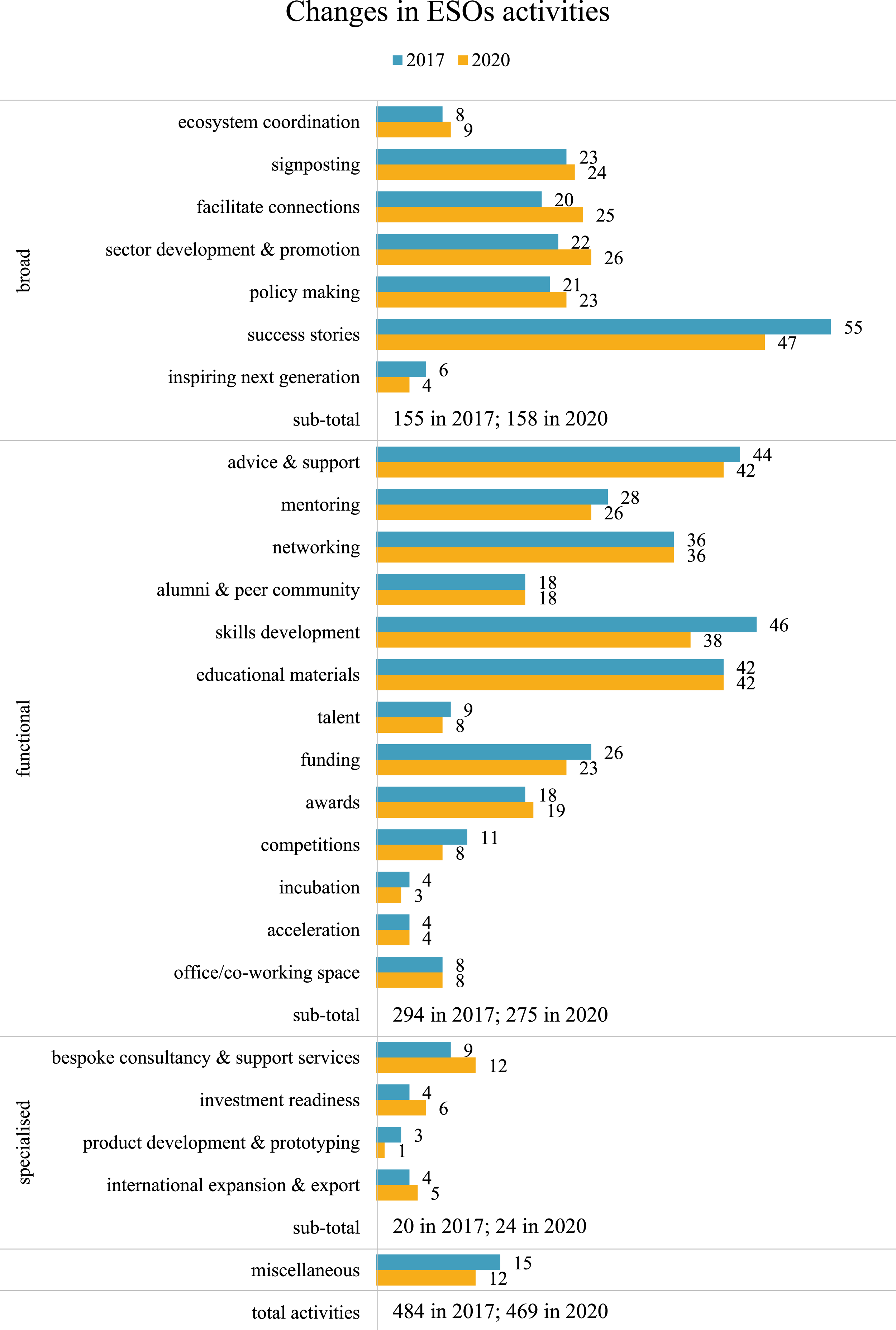
The majority of ESOs (55% in 2017, 50% in 2020) were sector agnostic, providing support to clients regardless of the sector or industry in which they operate. Amongst those ESOs that targeted specific types of businesses, there was a significant focus on social enterprises and the third sector in general (approximately 17% of all ESOs in both years). Support for creative businesses and women in business accounted for approximately 5% of all ESOs in both years.
There was also a notable lack of specialisation on any particular stage of business development (i.e. start-up vs scale-up). The majority of ESOs (78% in 2017, 74% in 2020) did not specialise at all, but a few (14% and 18% of all ESOs in 2017 and 2020, respectively) claimed to specialise in support for both the start-up and growth stages. Amongst the minority of ESOs that targeted a specific stage, most focus on the start-up stage (approximately 6% of all ESOs in both years). There were only two ESOs in 2017 that specifically focused on growth, decreasing to one in 2020.
Since this is the first study to holistically map all ESOs operating in a single ecosystem, we cannot make definitive claims about whether a critical mass of diverse ESOs had been reached. The challenge is twofold: not only do we lack comparable benchmarks, but the organisational thickness approach generally lacks clear metrics to measure the thinness or thickness of ecosystems. Nevertheless, we can use the following proxies to determine when an ecosystem becomes thick: density of diverse organisations with a commitment to supporting entrepreneurial activity, ownership structures, spatial scales of ESOs activity, and accountability to the local ecosystem (Coulson and Ferrario, 2007). We make the following observations regarding these proxies.
Most ESOs in our study operated for more than a decade and had a relatively balanced split between public and private ownership structures, which indicates that both the public and private sectors are committed to supporting entrepreneurship. We find that only approximately 15% of ESOs operated exclusively in Glasgow, meanwhile 52% were available Scotland-wide. Similarly, we also find that approximately 42% of ESOs were headquartered in Glasgow, which means that the majority of ESOs were actually based outwith Glasgow. This suggests that due to their spatial scales, ESOs’ accountability to the local ecosystem was limited, which is a claim that we will revisit later.
As for the density of diverse ESOs, although we cannot provide a clear-cut answer, we can ask whether there are any obvious gaps in our findings (Coulson and Ferrario, 2007)? Considering the downward trend in the number of ESOs as well as the number of support activities over time, it seems that some degree of saturation had been reached. Though, this was rather concentrated in the broad and functional categories of support, with a limited provision in the specialised category. Nevertheless, there appears to be little need for new ESOs in terms of quantity, but this does not necessarily guarantee a sufficient quality of services. Most ESOs did not claim to specialise in any sectors or particular types of entrepreneurs, although there was some sectoral specialism for social enterprises and women in business. However, there was a relatively surprising lack of focus on tech, which is dominant in the neighbouring ecosystem in Edinburgh (Spigel, 2016). Similarly, there was a considerable lack of focus on a specific stage of business development, which suggests that ESOs do not segment their clientele but rather attempt to cater for both start-ups and scale-ups. This begs the question whether they are actually sufficiently equipped to support the evolving needs of companies as they grow.
Overall, there are no obvious gaps in the ESOs landscape in terms of the types of support provided, but there is a lack of convincing evidence of sufficient support for scale-up companies. We therefore conclude that the ecosystem is progressing towards thickness and that whilst the overall range of support activities is diverse, the ESOs landscape is nevertheless undiversified with respect to its ability to support the different stages of the entrepreneurial journey.
Interactions and interconnectedness among ESOs
The second condition of organisational thickness refers to interactions among organisations. A significant connector for both ESOs and non-ESOs entrepreneurship support actors is the Scotland Can Do movement (see Spigel et al., 2020), which was established in 2013 to promote the vision for Scotland ‘to become a world-leading entrepreneurial and innovative society’ (Scotland Can Do, 2021). In 2017, only 27% of ESOs were members of Scotland Can Do but this increased to 60% in 2020. For clarity, it should be noted that the majority of the Scotland Can Do membership base are entrepreneurship support providers – including ESOs, economic development agencies, universities, corporates, and government – from across Scotland, including local, regional, and pan-Scotland ESOs. Therefore, there was a notable improvement in ESOs interconnectivity, but it was limited to Scotland Can Do. This makes it a major connector among ESOs themselves as well as between ESOs and non-ESOs support providers within the ecosystem, albeit not all ESOs are members. Furthermore, some degree of interaction occurred directly from the activities of ESOs in the form of signposting and facilitating connections for clients, with just over 40% ESOs providing these services in 2017. These activities increased over time, with nearly half of all ESOs (48%) offering these services in 2020. Moreover, ESOs frequently worked in partnership with other ESOs and non-ESOs organisations, especially local universities and corporations, which were commonly listed as official partners on their websites.
Given the lack of ESOs segmentation and differentiation, it is important for ecosystem effectiveness that all ESOs – but particularly those funded by the public sector – are well-connected so that they can pass on entrepreneurs to more appropriate ESOs. From the ecosystem perspective, ESOs cannot operate in isolation but need to recognise that they each play a part in supporting entrepreneurs on their journey (Mason and Hruskova, 2019; Mason et al., 2020). The overall effectiveness of ESOs depends on their interactions and interconnectedness with other ESOs and other actors in the ecosystem. Admittedly, our methodology did not capture the intensity of interactions and it may have overlooked other, more informal inter-ESOs interactions, but Scotland Can Do membership, signposting and connecting services, and official partnerships were deemed to be sufficient proxies to assess this condition of organisational thickness. Overall, the Glasgow entrepreneurial ecosystem is moving towards greater interconnectedness, and whilst more data are required to fully assess ESOs’ interactions, our evidence suggests that ESOs are currently not fully interconnected.
Governance of ESOs through overarching agenda and hierarchy
The remaining two conditions of organisational thickness focus on the shared agenda and hierarchy among ESOs which impact the governance of the support infrastructure in entrepreneurial ecosystems. The rapidly growing Scotland Can Do movement represents a shared agenda and vision for its members (Scotland Can Do, 2021). As such, it helps mobilise the various actors towards a common goal although it does not have power over individual members. However, it is important to note that the common agenda is set for the entire Scottish ecosystem and we found little evidence of a Glasgow-specific agenda. This means that Glasgow currently does not, and perhaps cannot, set its own strategy that would allow it to capitalise on its strengths or address any potential gaps in the provision of entrepreneurship support. Nevertheless, given that the majority of ESOs operate across Scotland rather than exclusively in Glasgow, we conclude that the Scotland-wide movement represents a common national agenda.
The Scotland Can Do movement is important because it is grounded in the philosophy of collective impact (Kania and Kramer, 2011), which is based on the various ecosystem actors working together to achieve their shared vision through mutually re-enforcing actions (MIT REAP Team Scotland Initiative, 2014: 5). This implies a lack of hierarchy in the ecosystem. We found that 9% of ESOs were undertaking some ecosystem coordination activities (i.e. support activity type 1 in Table 3) and 25% of ESOs were involved in the strategic development of their sector and influencing policy (i.e. support activity types 4 and 5, respectively), with nearly all of these ESOs operating on the national scale rather than locally. In summary, there is little hierarchy, but there is some evidence of governance and coordination at the national level.
Summary
The key indicators suggest that the Glasgow ecosystem is progressing towards exhibiting organisational thickness but currently does not meet the ideal-case indicators developed by Isaksen and Trippl (2016). Our analysis suggests that there is a diverse range of ESOs and support activities available in the ecosystem that provide their clients with a wide range of resources and services, but there is little evidence that they sufficiently differentiate between support for start-ups versus scale-ups despite their different needs. However, their interactions and interconnectedness improved over time. Additionally, the notion of a shared agenda became more pervasive in the ecosystem, but with little hierarchy among the ESOs. Finally, the ESOs landscape remained relatively stable over the course of the study. Overall, this suggests that the Glasgow entrepreneurial ecosystem is embryonic, meaning it has cohesive internal interactions but lacks diversity of actors and depth of connections (Brown and Mason, 2017: 23–24).
Discussion
ESOs play a critical role in entrepreneurial ecosystems but are insufficiently understood, both theoretically and empirically. As a consequence, policymakers and ecosystem builders have a limited evidence base upon which to inform their interventions and ecosystem building activities. Using organisational thickness as a theoretical framework, our study offers several insights that contribute to addressing the gap in our understanding of the role of ESOs in entrepreneurial ecosystems that have practical and conceptual implications.
ESOs are a complex phenomenon. They take on different forms and operate on multiple scales with strong local and regional ties to the other ecosystems in the wider area. ESOs comprise not only formally incorporated organisations but also programmes and various informal initiatives. They play an important role in entrepreneurial ecosystems by not only supporting their clients (through activities in the ‘functional’ and ‘specialised’ support categories) but also through nurturing the ecosystem as a whole (through ‘broad’ support activities). It has already been recognised that ESOs contribute to creating an ecosystem with a sense of community (Roundy, 2017a; Spigel, 2017), but our findings specifically identify their ecosystem building activities that involve coordinating, connecting, and developing the overall ecosystem, as well as inspiring others to start and scale their own business. This means that ESOs operate on three levels: institutional, which affects the ecosystem itself; organisational, which targets companies; and individual, which targets entrepreneurs (Ratinho et al., 2020). However, there were very few ESOs in our study that made a distinction between the organisational and individual beneficiaries. This is likely to reflect the focus of most ESOs on the start-up stage, when the entrepreneur and their venture are largely indistinguishable, hence there is little need for ESOs to clearly differentiate between them.
The client-oriented activities of ESOs are multi-faceted and centred around the entrepreneurship process rather than support for specific sectors. This is in line with existing literature, which recognises that ESOs predominantly focus on the entrepreneurship process from start-up to scale-up and the associated challenges through the provision of training, advising, and resources (Spigel, 2016; Roundy, 2017a) rather than by focusing on business functions, such as marketing, finance, or accounting (Motoyama and Knowlton, 2017). This reflects the common view that the general process of starting and growing a business holds across sectors, with the key principles of product validation, market segmentation, and market penetration being largely sector-agnostic. Incubation, acceleration, and co-working – which are frequently considered synonymous with ESOs (Yusuf, 2010; Theodoraki and Messeghem, 2017; Clayton et al., 2018; Bellavitis et al., 2020; Biru et al., 2021; Oh et al., 2022) – are, in fact, only three out of 24 types of ESOs activities and therefore should not be conflated with ESOs.
Together these three insights lead us to propose a revised definition of ESOs to guide future research: entrepreneurship support organisations are any distinct entities, programmes, and initiatives with dedicated resources and staff that support entrepreneurs and/or their businesses by assisting them with the process of starting, consolidating, and scaling their venture, either directly through functional or specialised support or indirectly by broadly developing the entrepreneurial ecosystem in which they operate.
The literature acknowledges that ESOs need to recognize the evolving needs of entrepreneurs and their ventures as they develop (Spigel, 2016; Mason et al., 2020). However, this requires (eco)systemic thinking which is only possible if we consider the collective contribution of ESOs – or better yet, consider all ESOs and non-ESOs sources of entrepreneurship support – in the ecosystem. In our study, by mapping the entire ESOs landscape in Glasgow, we were able to identify a lack of segmentation of start-up versus scale-up support within the ecosystem. This lack of focused support in the entrepreneurial ecosystem in Glasgow – and Scotland more broadly – may reflect its lack in start-ups that are currently seeking to progress onto to the scale-up stage (Logan, 2020), resulting in insufficient demand for more targeted scale-up support. However, the causality could work in the opposite direction with the lack of scale-up support being an inhibiting factor for scaling firms as they are unable to access the specialist support required to catalyse or accelerate their growth.
A further implication of the data is that the segmentation and positioning of ESOs within the ecosystem is crucial to ensuring that their clients can navigate the support infrastructure with ease. If the ESOs landscape is not sufficiently diversified in terms of its market positioning, this may lead to the appearance of a ‘cluttered’ and undiversified landscape that creates confusion for entrepreneurs about which ESO is most appropriate for their needs (Scottish Government, 2018). Hence, the problem may not be that there is an over-abundance of ESOs, but rather a failure of ESOs to clearly articulate their positioning and specialisation to potential clients and to ensure that other ecosystem actors understand and recognise their specific offering so that they can signpost appropriate clients (Theodoraki and Messeghem, 2017: 13).
There is a limit to the extent to which generalist ESOs can support more specialist needs. It therefore follows that ecosystems benefit from a greater number of ESOs that focus on specific segments of the ‘market’ and on specialist types of support (Theodoraki and Messeghem, 2017: 13). Indeed, the presence of specialised ESOs is a sign of ecosystem maturity (Oh et al., 2022). However, specialism amongst ESOs requires good inter-ESOs connectivity and their ability to work together in a complementary manner. This requires that ESOs should not need to see themselves in competition with one another, for example, to justify ongoing funding by claiming the credit for successful ventures, but instead they need to recognise that such successes are created by the ecosystem as a whole (Mason and Hruskova, 2019; Mason et al., 2020).
Moreover, the composition of the ESOs landscape has important signalling effects that may impact the nature of entrepreneurial activity and even lead to unintended consequences (Biru et al., 2021). The types of entrepreneurs and businesses that are being targeted by ESOs – for example, early-stage start-up entrepreneurs as opposed to high-growth businesses – and the overall balance of support within the ecosystem imply that it is these types of entrepreneurial activity that are explicitly encouraged (Roundy, 2017a). A greater number of ESOs that focus on scale-ups may therefore encourage more high-growth entrepreneurial activity in the ecosystem. However, too much focus on one specific type of entrepreneurial activity, entrepreneur, or sector is likely to decrease the resilience of the ecosystem (Roundy et al., 2017: 103).
It therefore follows that the effective functioning of the entrepreneurial ecosystem requires some degree of coherence and governance among ESOs (Roundy et al., 2017: 101). A large number of ESOs in an ecosystem may hinder its cohesion and overall effectiveness if there is a lack of awareness and networking amongst them (Mack and Mayer, 2016). However, it can also be argued that a large number of ESOs can lead to healthy competition and improved performance. It is nevertheless beneficial to have coordinated efforts among ecosystem actors (Mack and Mayer, 2016) to increase complementarity (Motoyama and Knowlton, 2017). Some form of leadership is likely to also be beneficial. Although entrepreneurial ecosystems do not tend to have one single, obvious leader (Feld, 2012; Roundy, 2020) some degree of leadership, typically from ‘a collection of entrepreneurs and support organizations’ (which is evident in some entrepreneurial ecosystems) ‘can be critical for advocating for resources and building the networks necessary to give structure to the ecosystem’ (Roundy, 2017b: 251). Among other things, it helps ensure that the ESOs jointly and collectively provide an appropriate mix of entrepreneurship support activities (Mason and Hruskova, 2019).
Conclusion
This paper has investigated the role of ESOs in entrepreneurial ecosystems. It engages with the perception by policymakers and practitioners that the ESOs landscape is too cluttered as well as the pressure on governments at all levels in the present economic context to make spending cuts. We used publicly available documentary data, collected at two points in time, which allowed us to capture the full spectrum of ESOs activities in Glasgow, Scotland. We found that there are a large number of ESOs that provide a wide range of entrepreneurship support but do not differentiate between support for start-ups and scale-ups or clearly target specific segments of entrepreneurs. This makes it difficult for their potential clients to differentiate between them and find the most suitable ESO. This creates the perception of a cluttered landscape that has too many players. Considering that entrepreneurs draw on different support providers over the course of their entrepreneurial journey (Mason et al., 2020), a key implication of our study is that the issue of clutter is likely to be addressed by greater segmentation of ESOs rather than necessarily reducing their numbers.
This study is not without limitations. We used self-reported data, often produced for marketing purposes, which may have been biased. The secondary data in some instances lacked nuance about the activities of ESOs which limited the depth of our analysis. By its nature, mapping ecosystems inevitably only captures a static snapshot and whilst we aimed to mitigate this issue by looking at two points in time, more nuanced developments may have been missed. Further, we acknowledge that by focusing on the formal ESOs landscape, we explicitly excluded more informal, peer-to-peer sources of support, which are also very important. Finally, we were unable to study the effectiveness of ESOs’ support for their clients and thus cannot comment on how changes in the ESOs landscape impact the rates of entrepreneurial activity. Nevertheless, by studying an ecosystem and its elements in a systemic, sector-agnostic manner, this study makes an important step towards better understanding the role of ESOs in entrepreneurial ecosystems.
We recommend that future studies examine the functioning of the ESOs infrastructure using more dynamic data to investigate the interactions among ESOs and their collective functioning within an ecosystem. We also recommend investigating the impact of ESOs on entrepreneurial activity and their joint effectiveness and synergies in relation to nurturing start-up and scale-up rates. Additionally, there is a need to identify suitable measures of ESOs performance to allow for ecosystem benchmarking, including determining the critical mass threshold. Last but not least, we recommend adopting an entrepreneur-centric perspective to examine how they engage with the support infrastructure as they evolve from the pre-start-up, to start-up, early growth, and scale-up stages, as well as how different support activities impact their progress. This should also capture the extent to which entrepreneurs are now seeking support that is offered online which may have gained importance since the pandemic.
Footnotes
Acknowledgements
We would like to thank the reviewers from the Institute for Small Business and Entrepreneurship (ISBE) 2019 Conference and Australian Centre for Entrepreneurship Research Exchange (ACERE) 2020 Conference for their feedback. We are also grateful to the anonymous reviewers who have provided us with valuable feedback.
Declaration of conflicting interests
The author(s) declared no potential conflicts of interest with respect to the research, authorship, and/or publication of this article.
Funding
The author(s) disclosed receipt of the following financial support for the research, authorship, and/or publication of this article: This study was supported by the Economic and Social Research Council (grant reference number ES/J500136/1). For the purpose of open access, the authors have applied a Creative Commons Attribution (CC BY) public copyright licence to any Author Accepted Manuscript version arising from this submission.
