



Abstract
Higher Education Institutions (HEIs) are recognised as generators for innovative solution relevant for shaping socio-economic transformation processes, for which knowledge transfer plays a crucial role. However, innovation studies demonstrate that innovative solutions, for example, in form of social innovation are generated by a wide variety of creative, social, or cultural actors with little or no integration of HEIs. Several regions and countries, therefore, recently set up innovation strategies that foster new forms of collaboration among societal actors and HEIs. The German Ministry for Education and Research developed the ‘Innovative Hochschule’ programme for initiating and testing new knowledge transfer instruments of HEIs to reach out to and interact with a broader society. Within this scope we developed ‘Innovation Salons’ as an instrument for dialogical knowledge transfer that helps regional HEIs to tie in with and unfold agency in ongoing regional (social) innovation processes. This paper introduces a pilot Innovation Salon as a potential approach for how HEIs may reach out to a-typical innovation actors for shaping social and problem-centred regional innovation processes. Key conclusions underline the importance of scouting for ongoing processes of generating novel regional solutions and of curating the interaction between social society actors and HEIs.
Introduction – Extending perspectives on knowledge transfer
The transformation processes towards knowledge and innovation societies very much depend on the capacities of societies to continuously generate novel, valuable as well as useful solutions to societal challenges. Policies rooted in territorial innovation models (Moulaert and Sekia, 2003; Jeannerat and Crevoisier, 2016) aim at improving the interaction among various organisations that generate innovation (such as Higher Education Institutions [HEIs] and other public as well as private research and innovation organisations) and those that introduce innovative solutions to markets (such as spin-out and spin-off companies, start-up entrepreneurs). Even though interactive innovation models (e.g. Alhusen et al., 2021) suggest that innovation processes might be disrupted and may require feedback loops, the underlying assumption in territorial innovation models nonetheless differentiates between organisations generating knowledge, organisations transferring and others applying new knowledge and innovation.
This assumption, however, needs to be challenged, especially with regards to social and societal innovation processes as well as problem-centred innovation processes. Here, key actors such as social entrepreneurs, pioneers, volunteers, welfare organisation, or local communities are stakeholders that initiate and shape processes of generating novelty rather than research and development organisations such as HEIs. In the German context, new policy programmes and schemes try to acknowledge such innovations processes, with programmes such as WIR! (Wandel durch Innovation in der Region – Transformation by regional Innovation, translated by authors), T!Raum (TransferRäume für die Zukunft von Regionen – TransferSpaces for the Future of Regions, translated by authors), REGION.innovativ or the recently launched programme ‘Society of Innovations - Impact Challenge at Universities - Application-oriented Research of University-related Further and Continuing Education on Social Innovations and Social Entrepreneurship’. These initiatives also challenge the so-called third mission of HEIs (Trencher et al., 2013; Berghaeuser and Hoelscher, 2020; Compagnucci and Spigarelli, 2020) because their role in regional innovation systems might change and require new instruments, tools, and organisational solutions to actively engage with regional innovation processes. Third mission activities thereby increasingly comprise a transdisciplinary approach to the co-creation of knowledge with a diverse set of stakeholders as well as the social engagement of higher education as important elements in addition to teaching and research.
Against this backdrop, this paper first identifies new challenges to third mission activities in HEIs by briefly reflecting on time-spatial processes of innovation. We continue by introducing ‘Innovation Salons’ as a potential tool to foster societal innovation processes by curating interactive, dialogical exchanges among societal groups as well as members of HEIs. Based on the results of one out of three piloting Innovation Salons on a Brandenburg-based health centre, we reflect upon the potential impact an event may have on ongoing processes of change (Lange, 2021) and discuss how such an instrument may be integrated into third mission activities of HEIs. We consider the above from the perspective of a project which aims at strengthening the innovativeness of small and medium sized universities and thereby focusses on regionally relevant problems as a possible starting point for innovation processes and the role of HEIs in mission-oriented innovation ecosystems.
Challenging dialogical knowledge transfer
Time-spatial dynamics of innovation processes
Transfer strategies of HEIs are primarily interested in how to create fruitful regional and transregional links to induce novel solutions developed at the HEIs into local, regional, or transregional applications. This implies that HEIs are core generators for innovation. However, taking a closer look at how processes of novelty and innovation unfold across time and space (Brinks et al., 2018; Hautala and Ibert, 2018), we need to recognise three particularities.
Usually, unsatisfactory situations, local problems, and challenges provide starting ramps for innovation processes (Jeppesen, 2021; Schrock and Lowe, 2021; Wyrtki et al., 2021), such as seeking local mobility solutions, developing digital applications to foster exchange and communication in rural areas, or unsatisfactory working routines. Such innovation contexts may be described as problems seeking solutions which contrast with newly developed innovative ideas in HEIs seeking problem applications in societal spheres.
This implies, secondly, that all societal actors can be involved in innovation processes as drivers, initiators, supporters, and promotors of innovation processes (Von Hippel, 2005). Such drivers may, for instance, be smart villagers (Zerrer and Sept, 2020), diverse communities (Müller and Ibert, 2015; Brinks, 2016; Lombardi et al., 2020; Martinus, 2022), social entrepreneurs (Richter et al., 2020), or government agents (Mascarenhas et al., 2020; Wolf et al., 2021). These social actors do not necessarily regard themselves as innovators, but nevertheless generate innovations, sometimes, for example, in the form of social innovations (Domanski et al., 2020; Richter and Christmann, 2021)
Thirdly, recent studies on the time-spatial dimensions of innovation processes reveal the multi-local nature of such processes (Schmidt et al., 2018). Multiple actors are engaged in finding novel solutions to practical problems at different sites, in different organisations and in different social settings. Against this backdrop, the role of HEIs might change in such innovation ecosystems. Of course they remain important drivers of innovation processes, but they might simultaneously take on other functions in innovations processes too, such as supporters and promoters. Instead of controlling an entire innovation process, HEIs might engage in ongoing processes of change and creating novelty, which, in consequence, might be reflected in the third mission strategies of HEIs as well.
Challenging the third missions of HEIs
Many universities have developed a ‘third mission’ that comprises strategies and tools for knowledge transfer activities. The ‘third mission’ thus seeks to create multiple (societal, economic, or cultural) regional contributions (Zomer and Benneworth, 2011; Trippl et al., 2012). Third missions and their implementation are of increasing interest to political as well as to scientific discourses (Audretsch, 2014; Krainer and Winiwarter, 2016; Berghaeuser and Hoelscher, 2020). The importance of HEIs’ third missions is reflected in policy programmes, such as regional quadruple-helix approaches or in large scale national programmes such as the ‘Innovative Hochschule’ (Innovative University, translated by authors) programme of the German Federal Ministry of Education and Research. It is the aim of this programme to generate creative knowledge transfer solutions for addressing urgent contemporary challenges. 1 As such, HEIs are supposed to take up ideas and regional challenges to collaboratively develop innovative solutions, which implies that knowledge transfer activities need be regarded as two-way, dialogical processes. This also means that HEIs need to broaden their traditional focus on industrial and entrepreneurial partners in transfer activities (Kloke and Krücken, 2010) in order to establish systematic ways of knowledge transfer with civil society too. This poses particular challenges to the organisational structure of HEIs for organising third mission activities as well as for identifying suitable metrics to depict the regional impact of third mission activities. If the dialogical nature of knowledge transfer is taken seriously, for instance, third missions’ activities need to identify transfer channels and practices that allow for creating a change within HEIs as well. So far, despite seemingly opening the mission towards a broader understanding of the impact on the broader society, many efforts still focus on collaborations between universities and economic actors and on supporting spin-offs and start-up entrepreneurs (Erikson et al., 2015; Breznitz et al., 2018; Billström, 2020; McGee et al., 2021). Actively engaging with civil society still plays a subordinate role (Berghaeuser and Hoelscher, 2020). Especially in Germany, the third mission is mainly interpreted as knowledge and technology transfer (Göransson et al., 2009). An open understanding of knowledge transfer which perceives HEIs as knowledge sending as well as receiving entities that participate in circular, co-creative processes of knowledge generation (Trencher et al., 2013) is still rare. Transferring knowledge to a broader society and actually generating new knowledge collaboratively with civil society actors may not only promote entrepreneurial skills, but also enhances the social capacity to generate novelty and innovative solutions to practical regional problems and challenges. Furthermore, collaborative forms of co-creation may also contribute to social welfare (Compagnucci and Spigarelli, 2020).
Against this backdrop, we argue that the third missions of universities and other public research organisations need to be further supported with new instruments that help to improve the local embeddedness of HEIs and that take into account the role of social sciences and humanities in third mission strategies (Compagnucci and Spigarelli, 2020). For instance, if third mission activities are supposed to engage with ongoing regional transformation processes by tying in with problem-centred innovation processes, a strategic scouting for problems and regional ‘problem solvers’ as drivers of innovation processes is necessary. In a further step, interaction needs to be fostered by organising opportunities for exchanges and collaborative knowledge generation. Within the context of the innovative university initiative ‘Innovation Hub 13’, 2 we developed and piloted a potential instrument that we labelled ‘Innovation Salon’, which aims at fulfilling these functions.
Introducing the Innovation Salon
General idea
Taking up insights from innovation studies seriously – namely, that innovation processes are prompted by regional challenges and problems and are generated by all kinds of societal actors – it might be necessary to reconsider practices of collaborative knowledge generation involving HEIs in these processes. If third mission activities regard knowledge transfer not as a one way street from HEIs to regional stakeholders, but instead involve engagement in ongoing processes, key challenges rest in (1) identifying these ongoing innovation processes and (2) in creating a fruitful context for potential knowledge transfer activities. The latter seems to be particularly important because actors from very diverse backgrounds and with very specific knowledge need to find an environment that supports a meaningful conversation among them.
We purposefully use the term ‘Salon’, because a ‘Salon’ may have diverse meanings. A salon can be regarded as a particular place/location for social gatherings and receptions. Salons were cultural occasions, discussions, exchanges, and conversations. A salon invites a particular audience, thus curating the exchanges and conversations. Against this backdrop, an Innovation Salon thus invites a set of (initially unconnected) actors interested in solving particular challenges and problems. The core aim of Innovation Salons is to make ongoing regional innovation processes and the involved actors visible and connect them with actors from regional HEIs and other actors from the quadruple-helix framework (the university-industry-government-public-environment interactions within a knowledge economy). The Innovation Salon thereby opens up new perspectives on regional problems and challenges by encouraging heterogeneous groups of actors, often strangers to each other, from equally heterogeneous backgrounds to work together to find collective solutions. The approach is inspired by elements of action research (Kindon et al., 2007). Building on practical knowing (Reason and Bradbury, 2008) framed as regional innovation potentials for addressing pressing concerns, Innovation Salons are thought of instruments that support especially early stages in innovation processes (e.g. incubating and idea generating (Christmann et al., 2020)).
Setting up an Innovation Salon
In attempting to develop an Innovation Salon as a third mission instrument we had to operationalise ‘identifying ongoing innovation processes’ as well as ‘creating an atmosphere for a meaningful exchange’. The conceptualisation of the Innovation Salon was oriented at the conceptualisation of innovation phases (Ibert and Müller, 2015). Each phase is characterised by a clear transition between phases. Most notably, defining the problem marks the transition from an incubation phase (exposure to an unsatisfactory situation) to a validation phase (experimenting with ideas). The validation phase then ends with a proof of concept – when ideas take on the characteristics of early pilots or prototypes of solutions. Therefore, the Innovation Salon was developed as a tandem of two related events. The first event brings together relevant societal actors and members of HEIs with the clear aim of developing a shared problem definition. The event was thus meant to create a shared understanding of a solution to be further developed and to create spaces with a shared meaning and a shared language. The second event of the Innovation Salon then was used for rapid prototyping activities. Based on the shared problem perception, the participants created early and rough potential solutions for the problems and challenges jointly defined in the first event. Ideally, groups of participants overlap in the two events, which further supports community building.
Both events are thoroughly curated and need to be carefully prepared. Before setting up an Innovation Salon, fuzzy problems of regional relevance and ongoing initiatives of problem solving need to be identified and analysed, for example, based on a desktop research (including investigating regional social media channels and regional newspapers), participatory observations (e.g. of local and regional events), as well as interviews with local stakeholders such as regional developers, local voluntary groups, or social collectives. Within this context, we defined ‘relevant problem’/relevant regional challenge as an economic, ecologic, technologic, or social situation (Schneider and Janning, 2006) that is commonly perceived as a deficit (Ecker-Ehrhardt and Wessels, 2008) or as a barrier (Dörner, 1979). Such situations are frequently legitimised through a process of objectivation and of high salience, meaning a critical mass of people in the respective region is aware of this problem (Ecker-Ehrhardt and Wessels, 2008). Based on the analysis we proceeded by identifying key stakeholders (drivers, participants, and supporters of regional solution finding), identifying collectives elsewhere with similar problem perceptions and potential early solutions, and identifying groups of scientists at the regional HEIs. These stakeholders were then invited to the first event of the tandem. Based on the nature of the potential innovation, interactive methods were organised for developing the shared problem definition, stimulated by influences (impulses) from stakeholders outside the immediate regional context (see Figure 1). Innovation Salon Phases Source: own.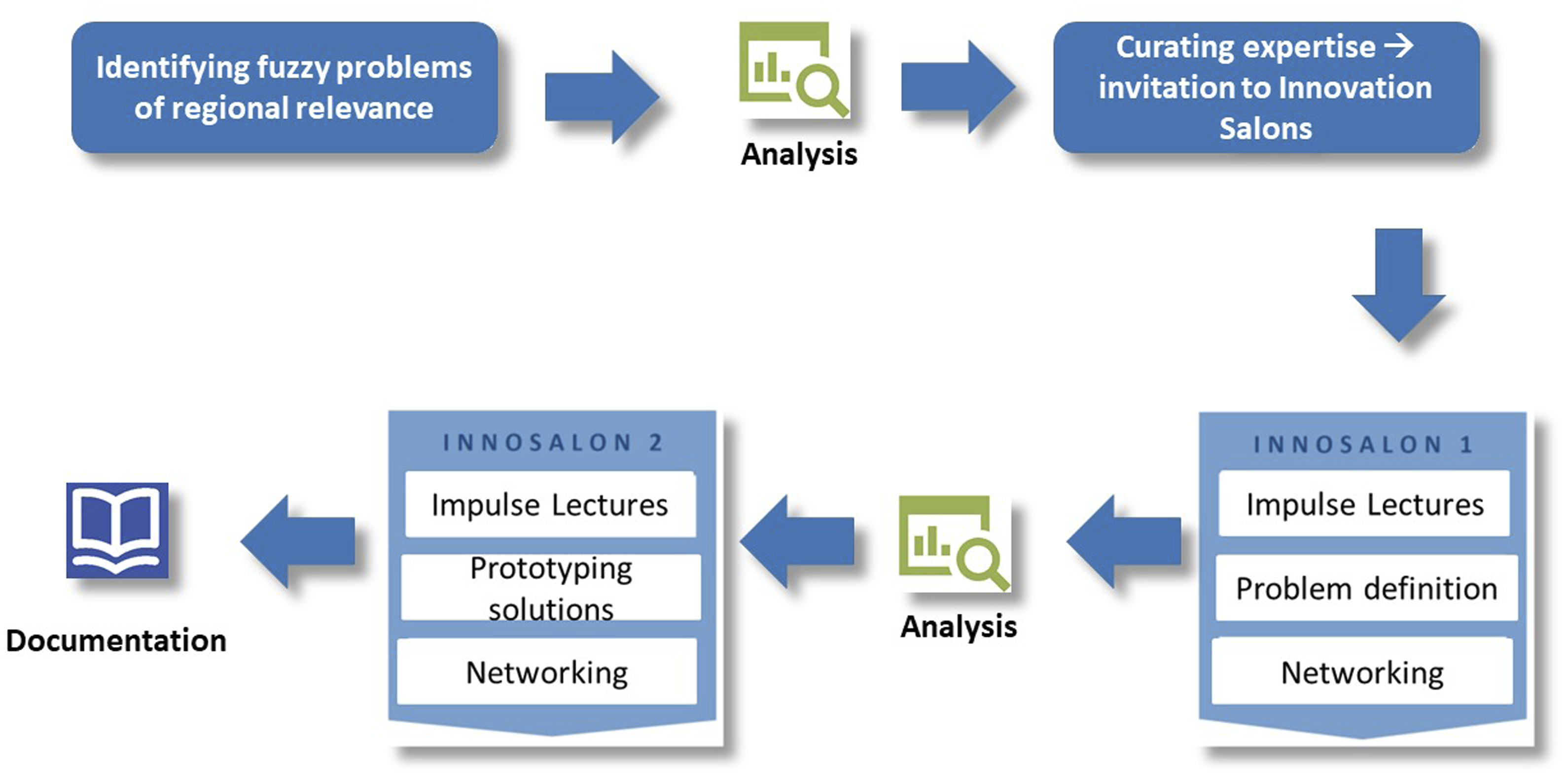
The event organisers participated as active participants, documenting results, observing conversations and interactions, and analysed the collected material. Based on these results in the form of sense making and reflections, the second event of the tandem was prepared. For sharpening and adjusting the fuzzy problem towards a problem definition, the first workshop’s outcomes were clustered and related to expert knowledge. If the first event of an Innovation Salon, for instance, pointed at fields of expertise that would be needed to concretise solution prototypes and no expert for this field is part of the Innovation Salon yet, this expertise was to be invited to the second event.
Furthermore, based on the analysis we developed (in cooperation with experts in design thinking and moderation) interactive tools for the second event of the Innovation Salon. Mirroring the first event, the organisers participated as active observers – meaning the event itself was a space for collecting data by observing, interacting, and briefly interviewing participants. Eventually, based on the two events and the intensive analyses phases, the Innovation Salons were closed with a comprehensive documentation made available to the participants, but also to a broader readership through the publication online. 3
Within the context of the BMBF-funded Innovative Higher Education Institution ‘Innovation Hub 13’ of which we were a part of, we implemented three Innovation Salons, namely, Baruth Health Centre’, ‘Instruments for multi-directional knowledge transfer’, and ‘Media pedagogy in the context of youth work’. The remaining part of this paper will introduce first insights from the Innovation Salon the ‘Baruth Health Centre’ before discussing indicative lessons learned for third mission instruments for dialogical knowledge transfer of HEIs. It should be noted that the three Innovation Salons were planned to take place on site as local events with personal face-to-face activities. However, due to the pandemic situation, we had to adjust our initial planning transferring the interactive format into an online environment. This changed the options for creative, interactive collaboration as well as limited the chances for serendipitous offline encounters.
Example: Innovation Salon ‘Baruth Health Centre’
The regional challenge: Health care in rural regions
Baruth/Mark is a small town of about 4300 inhabitants in the district of Teltow-Fläming in rural Brandenburg. It takes about 70 min from Berlin central station to Baruth by public transport or by car (80 km). During our first analysis of regional development and potential active groups engaged in addressing regional challenges, we became aware of a group of people initiating citizen dialogues in this small city in Brandenburg. An informal exchange with the local stakeholders and five additional interviews with the participants of the citizen dialogues in Baruth brought our attention to the local idea of creating a health centre as a local solution to the critical situation of medical care in rural regions by combining conventional with complementary medicine and health tourism. This constituted a suitable starting ramp for the first Innovation Salon because it met our criteria of a regionally relevant problem. The local initiative identified the social situation of insufficient health care infrastructure as being a commonly shared problem for the whole population of the city and surrounding villages – similar to other rural regions elsewhere in Germany. This problem was perceived as a barrier that contributed to preventing new people from moving into the region. Furthermore, we found a relatively stable and committed group of actors from the civil society with a clear motivation of tackling the perceived challenging situation.
Setting up the Baruth Innovation Salon
Following the first identification of a potential Innovation Salon, a number of meetings with members from the local health centre initiative were organised for documenting the status quo of the local agenda. Additionally we reached out to the knowledge transfer offices and transfer scouts 4 (Noack and Jacobsen, 2021) of the Innovation Hub 13 initiative to promote the topic of the Innovation Salon and to activate academics and transfer stakeholders for participating in the Innovation Salon. We paid particular attention to the selection of the participants because online interaction cannot build on spontaneous and serendipitous encounters. Therefore, we invited all potential participants personally via an individualised email, sometimes accompanied by telephone calls to explain the purpose of our Innovation Salon.
The first Innovation Salon event (problem definition) was set up as a 3 hour online meeting. We first introduced the core ideas of the Innovation Salon, the regional – still fuzzy – problem of insufficient medical infrastructure in the region and the local key actors (the health centre initiative and communal political representatives). A short impulse presentation of a related project (Gesundheitshaus Mirow, https://www.gesundheitshaus-mirow.de/) created a thematic frame for the second part of the workshop. The group of participants was separated into four breakout sessions addressing selected facets of the fuzzy problem on medical care. Each sub-group discussed the potential for (innovative) solutions, seeking processes that evolved from a combination of knowledge about this problem and the respective expertise of the group’s participants. The results were gathered on a digital whiteboard.
The analysis of the first workshop led to five related problem clusters out of which three were selected for further elaboration in the second workshop. Based on the clustering, additional experts were invited that could contribute with complementary expertise and knowledge (e.g. on the topic of fundraising). During this analysis phase, we also moved from only inviting people personally and decided to also have an openly accessible registration, in order to allow spontaneous and voluntary participation.
The second workshop of the Innovation Salon (likewise organised as a 3 hour online session) was kicked-off with a presentation of the interim analysis as a basis for the following interaction. For inspiration and for learning from other initiatives, an impulse presentation from another health centre project (Ärztezentrum Büsum, https://aerztezentrum-buesum.de/) framed the workshop. Similar to the workshop the group was parted into three break outs, each of which developed a prototype solution for one of the three problem clusters. Eventually, each group presented a raw version of its prototype to the plenum.
We initiated an informal feedback meeting (online again) some weeks after the second Innovation Salon event to allow for an extra space for further networking and exchange. Furthermore we provided a digital brochure with a summary of the Innovation Salon and core results from the two workshops. The organising team did not become an active part of the health centre project nor did it participate in any other actual attempts to implement solutions for the health centre. However, it stayed in contact with several participants for more than a year and with some participants, the contact is still ongoing. The team also acts as a networker connecting people who have heard of the salon and the health centre project with the involved actors, presented the Innovation Salon at a citizen dialogue in Baruth and participated in one of the health centre initiative’s meetings.
Indicative outcomes and impact of the Innovation Salon ‘Baruth Health Centre'
As the example above indicates, Innovations Salons – consisting of a tandem of ‘just’ two events – involve quite an intensive and careful preparation, implementation, and analysis. The question arises, if and in what regard do such events deliver an impact at the local or regional scale because only if we can witness valuable contributions to local and regional processes, investing in time and effort for such dialogical knowledge transfer instruments as part of third mission measures of HEIs is justified. The following section summarises the outcomes and tentative impact of the Baruth based Innovation Salon. Outcome and impact were identified and collected with the help of an impact canvas 5 (Fryirs et al., 2019; Daldrup et al., 2022). This tool provides an overview of the challenges addressed by transfer activities (in this case Innovation Salon), identifies the target group(s) and stakeholders involved or influenced by the respective activities and documents the different stages of the impact chain, consisting of input, output, outcome, impact (Fryirs et al., 2019). Data for this impact canvas were collected by follow-up interviews with the Innovation Salon participants, own observations, and written feedback of the participants to the organisers. Even a year after implementing the Innovation Salon tandem participants still get back to the organisers with remarks, questions, and feedback reflections – which can be interpreted as a success too, because it signals trust.
As an outcome (results as follow-up activities to the transfer initiative) of the Innovation Salon ‘Baruth Health Centre’ participants from the local health centre initiative reflect that they are more motivated to work on their project. Generally, participants from transdisciplinary backgrounds that did not know each other before, met, started to interact and eventually even to cooperate. Furthermore, participants that had loose contact beforehand intensified their cooperation (e.g. the City of Baruth and the Competence Centre for Dementia in Brandenburg). Also, first ideas from the workshop have been actually implemented, such as forming a virtual health centre on a website that demonstrates the health centre network and other local infrastructures connected to it (https://www.gesund-in-baruth-mark.de/). Another important outcome is the close contact with the different actors from the city of Baruth full of openness and mutual interest for the respective project activities that resulted from the workshop. In particular, one participant is fully supportive and engages in events where the concept and general format of the Innovation Salon are introduced and acts as an active discussant, networker, and promoter.
Impact (regarded as long-term impact, benefits of transfer activities, changes in society) can hardly be described based on a single measure and needs quite some time to unfold. However, we do identify some tentative changes. For instance, from our perspective the Innovation Salon contributed to capacity building for the participants. Some participants, for instance, reflected they would have never considered working together with HEI actors without the Innovation Salon. Meaning, the Innovation Salon contributed to establishing a broader perspective on potential participants, supporters and promoters for their health centre initiative. We also observe that participants of the Innovation Salon act as multipliers as they continue to talk about their Salon experiences. For instance, participants reflect on the Salon in other regional citizen dialogues. Others initiated a health day festival in Baruth where they talked about the Innovation Salon. Based on these experiences, potentially future local processes and actors from civil society can profit from the knowledge that the health centre team gained in the Innovation Salon and use the already established connections to regional HEIs and other participants of the workshops.
The impact canvas (Daldrup et al., 2022) also seeks to identify surprising and/or unintended effects of a knowledge transfer initiative – which we can also reconstruct in our case. One of the participants in the Innovation Salon is a transfer office at one of the participating HEIs. As a follow-up to the Innovation Salon, this officer became a meditation teacher in the health centre project – thereby kicking-off a new chain of transfer activities by directly engaging in regional activities. Another surprise was how well the online format worked out. Working collaboratively on an online whiteboard turned out to be a very good way of creating new ideas. A physical whiteboard would not have worked in the same way, because there is always a limit to how many people can stand in front of such a whiteboard, let alone how many people could write on it in parallel.
Conclusions and take-ways
The Innovation Salons introduced in this paper were pilot actions embedded in the ‘Innovative Hochschule’-initiative ‘Innovation Hub 13 – fast track to transfer’ (InnoHub13 6 ). This initiative was funded by the German Ministry for Education and Research for 5 years between 2018 and 2022. 7 Compared to the many other newly developed knowledge transfer instruments (such as transfer scouts, showrooms, testbeds, digital platforms, InnoLabs, InnoRadars, and others), Innovation Salons tie in with other event-based interactive transfer formats, for example, InnoMixe, InnoTalks, and InnoX-conferences. Compared to the other solutions, Innovation Salons, from our perspective, might offer a promising knowledge transfer approach at early societal innovation phases, helping to sharpen problem definitions and to arrive at early prototypical (creative, innovative) solutions that may function as motivations in the continuation of the local activities. In contrast to existing established forms of knowledge transfer that are primarily trying to send or transfer knowledge, expertise, or technology from HEIs to external contexts, the Innovation Salon put a dialogical understanding of knowledge transfer centre stage. This has clear consequence for knowledge transfer practices and structures.
The success of Innovation Salons depends on structures that continuously scan ongoing regional processes of societal change and engagement, actively seeking to relate and reach out to these processes and their stakeholders. This monitoring process is work-intensive as it requires ongoing media analyses, frequent communication with regional stakeholder, and targeted interviews. In the case of the Innovation Salons, this task was taken over by the authors of this paper – external project partners in the InnoHub13 initiative. The challenge now lies in finding solutions for continuing and stabilising these activities within HEIs’ transfer structures.
Knowledge transfer formats tying in with regionally relevant problems and solution processes driven by civil society seem to support these processes, accelerate them and influence their development into new directions with insights from scientific expertise. Benefits for HEIs stemming from the activities of the Innovation Salon are not visible at first glance. However, such formats are relevant for HEIs because we see growing political, but also societal expectations to include civil society into third mission activities and actively address societal challenges. Innovation Salons offer one out of many other interactive and dialogical approaches and can therefore be integrated into the innovation ecosystem of HEIs as well. For the moment, we cannot report any direct effect on the involved academic participants. However, one participant started to get more involved in the citizen dialogues as a teacher and the authors have already further developed the idea of Innovation Salons in the form of Policy Labs.
Finally, we would like to stress the importance of selection and curation: identifying, approaching, activating topics and participants for the Innovation Salons. Curation also implies that each event needs its own methods for collaborative knowledge generation. And – similar to a curated collection catalogue in museums – all results need to be carefully documented and made available to the participants. Documented results function as an externalised memory of the event that the participants (at least) of ‘our’ Innovation Salons refer to frequently.
Footnotes
Acknowledgements
The authors wish to thank all participants of the three Innovation Salons. They knew they are part of a pilot action and were willing to test out new forms of interacting with – in many cases unknown and unfamiliar – academic expertise. We are also very grateful for the support of the InnoHub13 transfer scouts without whom we would not have been able to match-make the problem solving processes with scientific experts at the BTU Cottbus-Senftenberg and TH Wildau. Last but not least we would like to thank our student assistants Giuliana Schaffert and Benjamin Kashlan who offered tremendous support in organising and implementing the Innovation Salons.
Declaration of conflicting interests
The author(s) declared no potential conflicts of interest with respect to the research, authorship, and/or publication of this article.
Funding
The author(s) disclosed receipt of the following financial support for the research, authorship, and/or publication of this article: The work reported here has been funded by the German Federal Ministry of Education and Research within the programme “Innovative Hochschule”. This funding scheme supports third mission activities at German universities to boost knowledge transfer and innovation. The Innovation Salons are part of the initiative “Innovation Hub 13” Bundesministerium für Bildung und Forschung and 03IHS022D.
