




Abstract
The UK Government’s Industrial Strategy White Paper, published in November 2017, focuses on several key technologies of the future, in order to promote innovation and future economic performance. Universities play a key role in the delivery of the strategy, marking the culmination of nearly two decades of policy reviews that have continually promoted ‘third stream’ activities of commercial engagement with industry. Given the spatial focus of the strategy, this paper seeks to assess the regional distribution of competitive public research funding within the strategy’s priority sectors. The paper contributes to debates on the effectiveness and spatial implications of the Industrial Strategy through arguing that while the funding landscape for research in the priority sectors is spatially uneven across the UK, this could provide an opportunity for a place-based strategy to be implemented which builds on the strengths of each region.
Keywords
Introduction
The UK Government’s Industrial Strategy White Paper, published in November 2017, focuses on securing the UK’s position in what are seen as the key technologies of the future. Central to this is the identification and promotion of several priority sectors deemed to be crucial to the future development of the economy including driverless car, batteries, clean energy, medicine, healthcare, space technologies, robots, and artificial intelligence. Under the current strategy, the UK government seeks to bring spending on research and development as a proportion of UK GDP up to the average for OECD economies by 2027. The current figure for the UK is 1.7% and that for the OECD is 2.3% (OECD, 2018), while the UK also lags far behind the US (2.7%) and Germany (2.9%) in terms of R&D expenditure as a proportion of GDP, but compares more favourably in terms of the relative numbers of researchers employed or patent activity (OECD, 2018).
In monetary terms, the strategy also commits to increasing public funding for science from £9.5 billion in 2016/17 to £12.5 billion by 2021/22, in part as its central policy tool for achieving a more innovative economy is the promotion of collaborative partnerships between industry and academia (HM Government, 2017). As the main recipients of UK government science funding, universities are playing a key role in the delivery of the strategy. The Industrial Strategy White Paper also has an explicitly spatial dimension. The terms ‘region’ or ‘regional’ appear over 150 times in the document, highlighting the focus on promoting economic development across the entire UK. The strategy, therefore, also recognises the current policy discourse around ‘re-balancing’ the economy to promote even growth across the country (Gardiner et al., 2013; Pike and Tomaney, 2009).
It is unsurprising that universities have been singled out as key actors in the Industrial Strategy. Indeed, interest in the role of universities in the regional economic development process by both policymakers and academics has increased markedly over the past two decades, particularly in light of the prominence of both human capital and knowledge in the promoting development (Guerrero et al., 2015; Harrison and Turok, 2017; Huggins et al., 2008; Valero and Van Reenen, 2019). Furthermore, in a UK context, the positioning of universities at the centre of the process marks the culmination of nearly two decades of policy reviews that has pushed universities towards the ‘third stream’ activities of commercial engagement with industry (Dowling, 2015; Lambert, 2003; Wilson, 2012).
Using data covering a 10-year period on the allocation of UK science funding, namely competitive grant schemes allocated through the UK’s Research Councils and by Innovate UK, this paper identifies projects worth over £3.6 billion within the sectors identified by the Industrial Strategy as a priority. A priori, the allocation of science funding is spatially blind; the main requirements of the funding bodies are that the underpinning science is the best possible, the research has an impact, and that the funding represents value for money. Nonetheless as one of the goals of the Industrial Strategy is that all places in the UK should benefit and that it should serve to rebalance the economy, both in terms of developing manufacturing sectors but also in terms of supporting the economic base beyond London and the South East, the paper examines the following questions:
What is the regional distribution of research funding in terms of the priority sectors of the Industrial Strategy? What are the implications of these findings for a place-based Industrial Strategy?
The paper makes a new contribution to the literature through arguing that while the funding landscape for research in the priority sectors is spatially uneven across the UK, this provides an opportunity for a place-based strategy to be implemented which builds on the strengths of each region. Consequently, the uneven funding landscape requires that policymakers should ensure that an equality of opportunity is created in terms of access to this knowledge throughout the country.
This paper is structured as follows. The next section outlines and discusses the UK Government’s Industrial Strategy, briefly assesses its coherence as an industrial policy. Following this, we critically appraise the literature on the role of universities. The ‘Methodology’ section then outlines in detail our methodology for assessing the spatial implications of the Industrial Strategy. The ‘Findings’ section then presents the key findings from our analysis together, followed by ‘Discussion and conclusions’ section which provides a discussion of their implications. Finally, ‘Discussion and conclusions’ section concludes by discussing the coherence of the Industrial Strategy from a regional economic development perspective and what additional approaches may be needed to achieve the UK government’s ambitions.
Contextual and theoretical background
The (re-)emergence of industrial policy
Over the last 20 years there has been growing interest in industrial policy at international (Barca et al., 2012; Lee, 2010), national (Fagerberg, 2018), and regional levels (Bailey et al., 2018). There are at least four elements to this debate. The first strand is a technological one and is redolent in arguments that we are going through a fourth industrial revolution: one where future economic activity (and indeed the ordering of society) will be shaped by the convergence of technological advances in information technology, materials engineering, and medicine. Examples include technologies as diverse as artificial intelligence, robotics, nanotechnology, and genomic medicine. The clearest policy responses come in proposals such as that of the German Federal Government to stimulate an Industrie 4.0 (Schwab, 2017; Lepore and Spigarelli, 2020).
The second strand is essentially a corporate one around the organisation of economic activity both in terms of production and consumption. Exponents of the fourth industrial revolution (Bailey et al., 2015) thesis suggest that the convergence of technologies will reshape how economic activity is currently organised (Andreoni and Chang, 2016). In the vanguard of such changes have been the internet and the way in which certain economic relations have been transformed.
A third strand in the industrial policy debate is at an institutional level and is probably the level of most regional and urban studies scholarship. The simple case is that underpinning the fourth industrial revolution are a range of institutions, and that these typically are tied to specific locations. For some (Bailey et al., 2018; Block and Keller, 2011) these institutions may anchor an array of economic activities. In a related vein, authors such as Foray (2015), McCann and Ortega-Argilés (2015), and Rodrik (2004) suggest that the configuration of certain economic activities, whether in the form of sector-mix or skills availability, allows certain places to reap advantages of smart specialisation and their attendant agglomeration benefits (Foray, 2016; McCann and Ortega-Argilés, 2015; Rodrik, 2004). Examples from Block and Keller (2011), Andreoni and Chang (2016), and Bailey et al. (2018) suggest that the location of hugely expensive research focused capital facilities serves to lock in economic activities and opportunities to certain places. Examples which might be cited include CERN or the Rutherford Appleton Laboratories and the array of facilities both establishments are home to.
A final, and perhaps, neglected strand in the industrial policy debate is a political one and in particular the role industrial policy plays in international relations. One argument for national interest in industrial policy, and a focus on future technologies, is that these matter for future economic and strategic positioning. This is not simply about securing a share of new international markets but that the control of certain technologies may bring strategic benefits (Gamble, 2008). The recent debates around the role of Huawei in the UK’s 5G network put this in stark relief.
Furthermore, it is notable that current academic debate and some international policy arguments see new industrial policies being intertwined with regional economic development. This is most evident in the European Commission’s Barca Report (Barca, 2009) and more recent work such as that of Bailey et al. (2018), Foray (2015), and McCann and Ortega-Argilés (2015) whose accounts of industrial policy are synonymous with place-based economic development. This, however, is not the only position, as work by Coombes et al. (2005) and to some extent Krugman (1991) make clear. For them regional benefits are secondary to the effective delivery of national horizontal policies in areas ranging from R&D and tax credits to skills and infrastructure (Barca et al., 2012).
In contrast, it is argued that place-based policy making allows a greater focus on the characteristics, capabilities, and location advantages of individual regions (Barca et al., 2012; Hildreth and Bailey, 2013). As a result, this approach sees smart specialisation as the key to equitable development (Foray, 2015, 2016), whereby regional policy aims to deliver solutions to the individual problems faced in a region that are tailored to its strengths and address its weaknesses. Accordingly, smart specialisation can be more effective where there already exists pre-existing knowledge within a field (Montresor and Quatraro, 2019) or where regions possess the knowledge stocks and knowledge creating capacity that is relevant to the sectors identified as the focus of policy interventions to promote growth. As such, the key to success involves working in partnership to combine public entrepreneurship among policymakers, identifying key sectors in which to specialise, with academic entrepreneurship from universities, developing the knowledge base to promote innovation (Bailey et al., 2018; Etzkowitz, 2014; Fini et al., 2018).
Current UK Industrial Strategy
UK industrial policy over the last four decades has tended towards a spatially blind approach, entailing a one-size-fits-all-approach across the regions (Bailey et al., 2018; Bailey and Tomlinson, 2017; Fothergill et al., 2019; Hildreth and Bailey, 2013). However, the existence of persistent regional imbalances in both growth and employment that have endured in the UK in this period (Gardiner et al., 2013; Johnston and Huggins, 2017) suggests that these policies have not been sufficient to tackle this.
If there is a leitmotif of the UK Industrial Strategy document, it is that universities need to work in partnership – with business, with industry organisations, with innovation organisations, and with government – to promote R&D and innovation. This suggests the UK government’s pre-Covid view of itself was more a ‘partner’ in the service of economic growth rather than actively responsible for delivering growth. Consequently, it is noted that the strategy explicitly recognises the prominence of open innovation in the development of and commercialisation of new technologies, products, and processes, by placing inter-organisational knowledge networks, particularly those comprised of both firms and universities, at the heart of the innovation process. As such, its vision of innovation partnerships between businesses and universities, enabled by local, devolved and national governments, essentially pursuing smart specialisation through a ‘triple helix’ approach to economic development (Etzkowitz, 2003; Pugh et al., 2016; Ranga and Etzkowitz, 2013).
This approach, in combination with the identification of six priority sectors and a willingness to address regional imbalances, suggests the semblance of a place-based strategy lies at the heart of the strategy. The four elements outlined in the ‘The (re-)emergence of industrial policy’ section are clearly visible. The focus on priority sectors reflects the technological priority to identify new and growing sectors, coupled with the political element of realising strategic benefits from these. The corporate dimension is visible through an ambition to reshape economic activity through a focus on new technologies. Finally, the institutional element is reflected in the aspiration to address regional imbalances.
The White Paper singles out universities as an important resource for knowledge generation and sets out an unambiguous ambition to develop ‘innovation clusters’ around universities to bring together ‘world-class research, business expertise, and entrepreneurial drive’ (67). Yet, what is perhaps missing in debates on industrial policy is an explicit discussion of the role of universities. At a regional level, universities have been found to play a key role in the supply of highly qualified labour, the provision of commercially exploitable knowledge, and the transfer of technology (Charles, 2003, 2006; Trippl et al., 2015). Universities are also recognised as anchors of the regional innovation system (Goddard et al., 2012) and this has increased the drive for them to further engage in industrial collaboration (Huggins et al., 2008; Thursby and Thursby, 2002).
Within the document reference is made to universities in three of the six themes:
ideas: this is where the additional funding for science is announced, the grand challenges which universities and other partners need to address, and some of the particular barriers which may be faced (for instance in shifting from research to development-based approaches); business environment: a key theme is with how better to commercially exploit the science base through better performance technology transfer functions in universities and the role universities might play in supporting particular government initiatives for particular sectors or high growth firms; places: universities are seen to play key roles in the development of ‘local innovation ecosystems’ and that specific funding streams (the Higher Education Innovation Fund) should be used to the end of working with Local Enterprise Partnerships, local businesses, and other partners.
A (sympathetic) critique of the role of universities in the Industrial Strategy and regional development
When considering the potential for universities to drive Industrial Strategy and promote regional development, it is important to highlight two important strands of criticism which underline potential limitations. First, the Industrial Strategy, in line with many studies in this area, treats universities as an isomorphic construct when they are in fact diverse organisations (Kitagawa et al., 2016). Second, despite the benefits of U–I links, the engagement of business with universities is typically lower than for other actors such as customers and suppliers (Hughes and Kitson, 2012; Laursen and Salter, 2004).
While typically treated as isomorphic in nature, universities are in fact diverse organisations which vary in terms of their size, resources, specialisms, research capacity, and engagement capabilities (Fuller et al., 2017; Hewitt-Dundas, 2012; Huggins et al., 2012; Laursen et al., 2011; Wright et al., 2008). Therefore, some universities may have an ethos that is more focussed on industrial collaboration and commercialisation activities than others (Siegel et al., 2007) and will vary according to the types of technology transfer activities in which they engage (Fuller et al., 2017; Rossi and Rosli, 2015). Accordingly, some universities may focus their activities on what have been termed ‘soft’ engagement with industry, such as lectures to the business community or engaging in consultancy work, as opposed to ‘hard’ activities such as technology licensing and the creation of spin-off firms (Caldera and Debande, 2010; Philpott et al., 2011).
Given this diversity, a triple helix approach to industrial policy may only work for regions that are endowed with many high performing universities alongside innovative firms (Pugh, 2017). Indeed, weaker regions tend to be more dependent upon universities for innovation but within weaker regions universities underperform compared with those in more competitive regions (Huggins and Johnston, 2009). While universities vary according to their research ethos and intensity, their orientations, knowledge stocks, expertise, and particular strengths, there is evidence that the prominence of a university in terms of its research intensity does have an important bearing on its impact on regional economy (Hewitt-Dundas, 2012).
Another criticism centres on a lack of engagement between universities and businesses. On the university side, around 40% of academics report that they engage with private sector firms in the course of their work (Hughes and Kitson, 2012). In addition, engagement among firms is far from uniform, particularly with smaller firms being less likely to engage in collaborative links (Laursen and Salter, 2004). Low levels of university engagement may also be compounded by a lack of information regarding capabilities and trustworthiness of partners, which has been cited as a potential explanation for the lack of engagement in the open innovation process in general (Hewitt-Dundas and Roper, 2017). Consequently, while the supply side may be strong, demand may be lacking. Therefore, just because universities have a stock of knowledge does not mean that firms are either aware of it, able to access it, or utilise it effectively.
This disconnect may suggest a fatal flaw in a place-based strategy that specialises in sectors in which its universities have developed a strong knowledge base. Utilising this knowledge may seem a sensible starting point for picking the sectors to support but may be undermined by the fact that regional universities and businesses do not engage.
Finally, the direction of causation is not always clear in terms of whether the university influences the development of the region or vice versa. It has been argued that while the competitiveness of the regional environment does not appear to have a direct bearing on the intensity of U–I links, as levels of engagement appear to be uniform across core and peripheral regions, there is evidence that it does influence the performance of these links (Zhang et al., 2016). Therefore, there may be a level of endogeneity to the process; within a ‘competitive’ regional environment, collaborations between universities and industry outperform those in ‘uncompetitive’ regional environments, thereby promoting a virtuous cycle (Zhang et al., 2016). Conversely, others have suggested that it is not the physical location per se, but the position of the university as a central node of a network which determines its effectiveness in terms of knowledge creation and transfer (Huggins et al., 2016, 2019). Thus, this argument suggests that the socio-economic landscape of the region is less important than the overall entrepreneurial ethos of a university and its ability to position itself at the heart of the innovation system.
In light of these arguments, the danger is that industrial policy simply assumes that universities in all regions can fulfil the role of anchor institution within the innovation system. It is argued that this universalism is not necessarily a useful approach as universities may fulfil different roles within a region (Uyarra, 2010). Therefore, given the institutional focus of the Industrial Strategy as evidenced by stated importance of universities to its successful implementation, as well as its explicit mission to tackle regional disparities, the paper examines the following questions:
What is the regional distribution of research funding in terms of the priority sectors of the Industrial Strategy? What are the implications of these findings for a place-based Industrial Strategy?
Methodology
To assess these questions the following methodology was followed. The first step involved establishing the levels of funding granted to research projects within the priority areas by UK Research and Innovation (UKRI), the Government body responsible for coordinating public research grants in the United Kingdom. To do so, data were collected from the UKRI’s Gateway to Research web portal, which provides details of all publicly funded research projects in the UK from 2007 to 2017, on funded projects in the following areas: driverless car, batteries, clean energy, medicine, healthcare, space technologies, robots, and artificial intelligence. The Gateway to Research portal contains information on research projects including the lead and co-investigators; a description of the project; the organisations involved, i.e. university or firms; the outcomes of the project in terms of development of technology or creation of a spin-out firm; publications from the project; the value of the grant; dates of commencement and completion; and the funding council and funding stream associated with the project.
While the priority sectors of the Industrial Strategy were revealed in 2017, this paper examines patterns of research and innovation funding in the decade prior to this date to get a clear picture of the underlying trends. This recognises the fact that research and innovation in these fields did not begin in 2017 with the unveiling of this strategy but had been ongoing prior to this. Indeed, one criticism levelled at studies of innovation policy has been the atemporal approach that ignores changes over time (Flanagan and Uyarra, 2016). Therefore, through using data covering a decade, the paper presents a thorough overview of the extent of the knowledge base in each of these sectors.
Projects were categorised according to their funding stream. Projects were classified as pure research projects if they were funded via funding streams that emphasise knowledge creation that is explorative in nature, e.g. research projects, fellowships, and doctoral studentships. Projects were categorised innovation focussed if they were centred on the exploitation of knowledge: these included funding schemes such as proof of concept, collaborative R&D funding, Knowledge Transfer Partnerships, and the Small Business Initiative.
In terms of total research funding, it is recognised that these competitive funding programmes do not represent the total value of research being carried out by UK universities. The UK Higher Education sector also receives a block grant for research, or ‘QR funding’, based on the performance of each university in research assessment exercise. The aim of this funding is to provide a grant to follow curiosity-led research, which may include work related to these priority sectors. However, as it is not possible to directly attribute this to the priority sectors, the analysis presented here focuses on projects funded through competitive schemes.
For projects involving firms, their regional location was established using Companies House Data. This was recorded as the location at the time the project was started if the firm had subsequently moved. A project’s region was thus classified as the location of the lead partner, given that they are the coordinators of the project and responsible for its inception, application, and maintenance. Once the location of the lead partner for every project had been classified, the levels of funding could be aggregated first on a university basis and then on a regional basis. This allowed the establishment of a baseline highlighting where in the UK research in these priority areas was being undertaken as well as who is collaborating with whom.
Findings
This section presents our data on public research funding in the priority sectors of the Industrial Strategy. These findings are organised into four separate themes: the first examines the distribution of funding for research and innovation across the UK regions. The second examines these allocations on a per-capita basis; the third explores the engagement of firms with universities on a regional basis. Finally, the fourth examines regional specialisms with respect to the priority sectors of the Industrial Strategy.
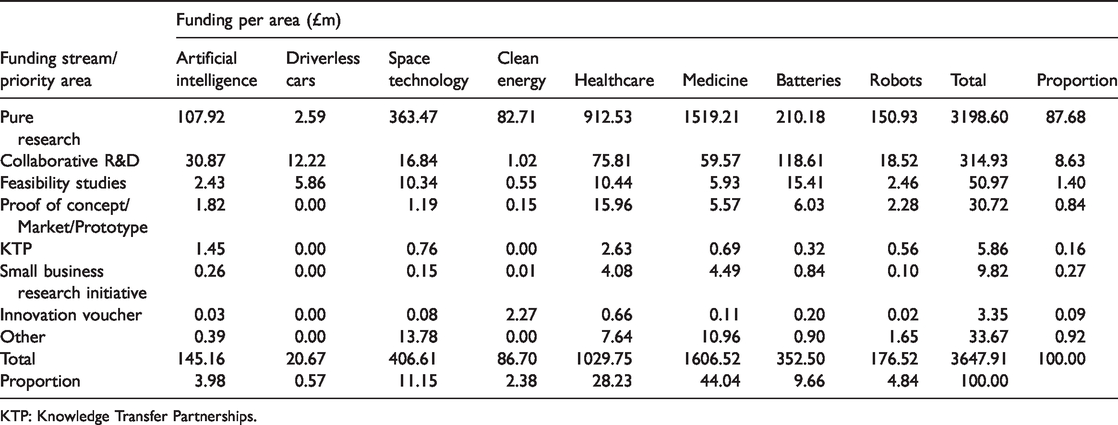
Table 1 presents an overview of funding in terms of the eight priority areas and the different funding streams through which grant monies are channelled. In total, £3.6bn of funding was awarded to research projects in these areas between 2007 and 2017. The data show that funding for research far outstrips that for innovation with projects that are focused on discovery type activities designed to develop new knowledge. Over £3.2bn was invested in research in the priority areas between 2007 and 2017, accounting for over 87% of all funding in these areas. Furthermore, the monies were not distributed evenly across the sectors, with healthcare and medicine accounting for the majority of the grants (70%), or over £2.6bn. In contrast, technologies such as driverless cars and clean energy accounted for around 3% of funding.
Research funding in the priority areas of the industrial strategy (2007–2017).
KTP: Knowledge Transfer Partnerships.
Approximately £420m of funding was allocated to innovation focused projects in the priority sectors of the Industrial Strategy between 2007 and 2017. In addition, slightly different sectoral patterns were observed, with the batteries sector accounting for the largest proportion, followed by medicine and healthcare. This distribution of funding clearly highlights the importance of universities to the priority sectors as research projects receive over seven times more money than innovation projects.
Characteristics of regional funding in the priority areas
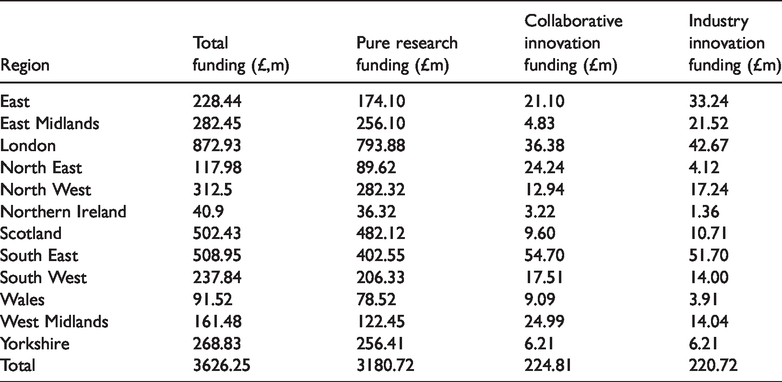
Table 2 presents data on the sums invested in research in the priority sectors of the Industrial Strategy by region and highlights distinct differences in its spatial distribution across the UK. First, the data illustrate the dominance of the London and South East regions, with universities and businesses located in these regions receiving £1.38bn, or over one-third (38%), of total funding in this period. Scotland also performed well on total research funding, ranked as the third highest region with over £500m in grants.
Regional distribution of project funding (2007–2017).
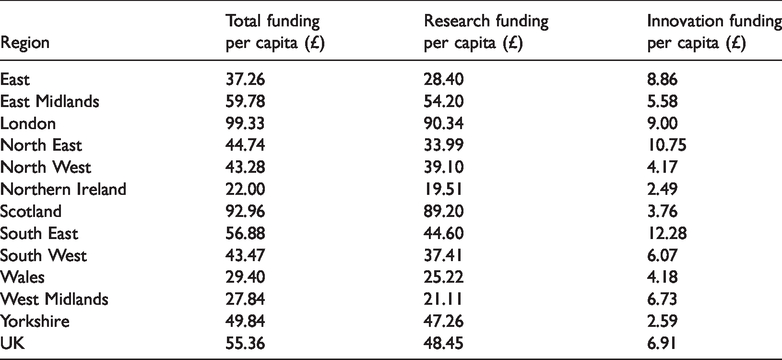
Per capita research funding in the priority sectors by region (2007–2017).
In addition, several regions lag behind, for example firms and universities in Northern Ireland, Wales, and the North East together received around £250m, or 7%, of total research funding. Accordingly, for every £1 of research income received by these three regions, London and the South East receive nearly £5.50. Therefore, clear regional disparities exist in the spatial distribution of research funding in the priority sectors, with more competitive regions such as London and the South East accounting for a large proportion of this investment.
Separating the projects into pure research, university-led, projects, collaborative innovation projects, led by firms and involving a university partner, and industry innovation projects, involving just a firm or firms, highlights a slightly different spatial pattern of funding. First, in terms of funding for pure research projects, the dominance of London and the South East regions is maintained, particularly as these projects accounted for the bulk of the funding. However, in terms of funding for firm-led projects (with and without a university partner), their dominance is increased as the two regions account for around 42% of this type of funding. Also noted is the fact that there are regions such as the East and East Midlands where industry research funding is substantially higher than collaborative research funding. Conversely, for the North East and West Midlands the opposite is true. As such, these results suggest that university engagement, which accounts for around half of funding for firm-led projects overall, varies from region to region.
Regional funding inequalities
Through normalising research funding per region on a per capita basis, a different perspective of its spatial distribution is highlighted (see Table 3). The analysis establishes a baseline average of funding for research in the priority sectors per region of £55.36 per capita. However, when normalising by population a different pattern is observed: first, while the dominance of London is maintained, where overall funding per capita of £99.33 is nearly double the UK average, Scotland outperforms other regions to a similar level. Second, the South East region fares less well on a per capita basis, where funding of £56.88 is only slightly above the UK average, despite accounting for the second highest level of overall funding; and third, on a per capita basis, regions such as Wales and Northern Ireland still exhibit a significant lag compared with the rest of the UK as per capita funding is less than half that of the average.
When differentiating between pure research funding and innovation funding, a different pattern emerges. In terms of pure research funding, the dominance of London and Scotland is maintained. In addition, the East Midlands and South East regions are the only others that outperform the UK average. With respect to innovation funding, the analysis shows a different pattern, where on a per capita basis, the South East and North East are the best performing regions with respect to innovation funding followed by London and the East.
In light of the regional disparities in funding for research and innovation projects in the priority areas, Table 4 showcases the funding gap in terms of how much each region were to receive if funding per capita were equal across the UK. The data suggest that London and Scotland exceed their share by £386m and £203m, respectively. Furthermore, while the South East region accounts for a large proportion of total funding, the data suggest this is roughly commensurate with its population as the funding only exceeded its share by £14m. The East Midlands region is in a similar position.
Regional funding gaps.
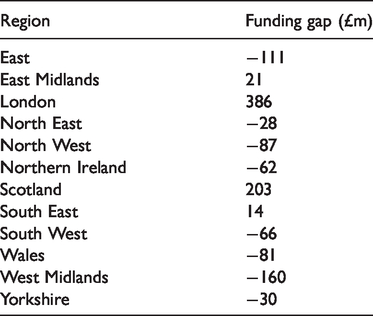
Conversely, the West Midlands and East regions face a significant shortfall in their funding based on their population, with funding gaps of £160m and £111m, respectively. Regions such as Northern Ireland and Wales that lagged in terms of overall funding fare a little better in per capita terms and record shortfalls of £81m and £62m, respectively.
Firm engagement with universities
As funding streams for innovation projects are firm-led, and may or may not involve collaborating with a university partner, these data provide a useful opportunity to examine the propensity for innovative firms to develop collaborative linkages with universities. Table 5 highlights regional patterns of the proportion of firms that did engage a university partner in their funded project, showing that the propensity of firms to engage with a university varies considerably across the regions.
Firm-led projects: regional engagement with universities.
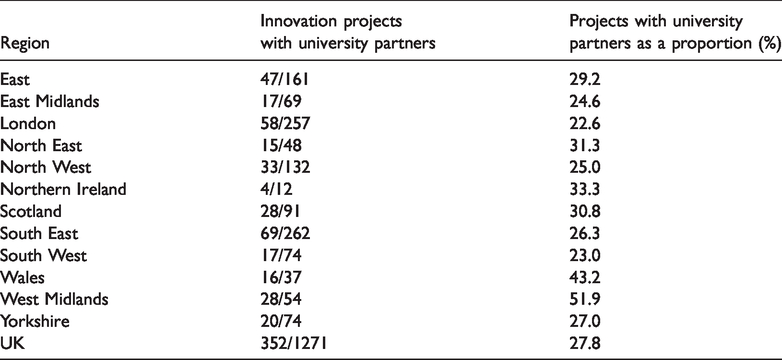
The key finding is that, on average, approximately 28% of firm-led projects involve a university partner, reinforcing previous findings firms are more likely to work with other partners than universities (Hughes and Kitson, 2012). Only in Wales does the proportion of projects involving universities exceed one half. As well as Wales, firms in the East North East, Northern Ireland, Scotland, and West Midlands regions have a higher than average rate of engagement with universities. Conversely, there are a number of regions where firm engagement lags the rest of the UK.
Regional specialisms
The final element of the analysis assesses potential specialisms in terms of the funding profile of the regions. Indeed, while the Industrial Strategy White Paper suggests that addressing regional imbalances is a priority, it appears to suggest that the focus on these sectors in their entirety is important for all regions. Alternatively, it may be more useful for regions to focus on their strengths in terms of the make-up of their science base. Figure 1 highlights the profile of each region in terms of the proportion of funding received in each of the priority sectors, compared to its overall proportion of funding received. The data suggest that there are clear patterns of regional specialisms, i.e. where a region’s funding for research in a particular sector outstrips its overall funding. For example, despite Northern Ireland receiving a low proportion of overall funding, it has relative strengths in space technology and clean energy. In addition, the West Midlands has a clear advantage in driverless cars research, and the East has an advantage in battery technology.
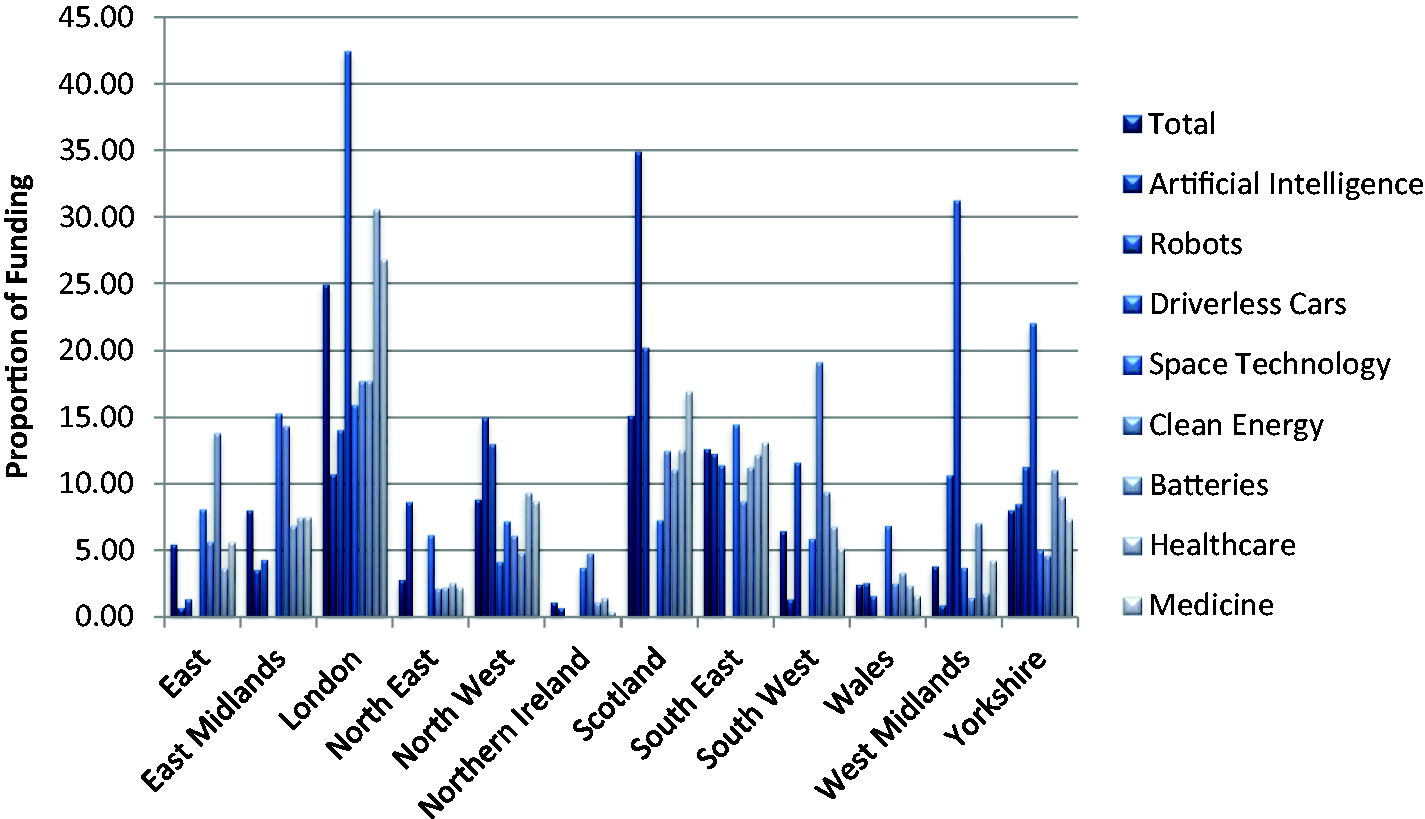
Regional funding profiles.
The data suggest that regional research specialisms exist in terms of the proportion of funding received in each sector. Thus, these results suggest that the Industrial Strategy, at least for innovation funding, would be best adopting a place-based approach in order to take advantage of these strengths.
Discussion and conclusions
The analysis highlighted a number of key findings: (1) research funding in the priority sectors is spatially unbalanced, with a bias towards London and the South East; (2) funding for collaborative projects with firms also varies from region to region; and (3) the funding patterns reveal several regional specialisms among universities, suggesting that a one-size fits all approach may be inappropriate. In synthesising and discussing the results, we frame the discussion round three key questions: (1) does the spatial distribution of research funding in the priority sectors merely reinforce the status quo? (2) Does the observed spatial pattern of funding reflect distinct regional capabilities? (3) To what extent can regional demand for university knowledge match its supply?
The results clearly show the overall dominance of London and the South East regions as recipients of funding for research in the priority sectors. On one hand, this may reflect the fact that these regions are the centre of university expertise and knowledge in the priority sectors of the Industrial Strategy. Yet, with these being the two leading regions of the UK in terms of overall competitiveness (Huggins and Thompson, 2010), it would appear that this result does merely reinforce the current regional disparities.
This result suggests two directions for policy: the first approach would be ensuring a spatially even distribution of funding through encouraging a dispersal of research funds away from London and the South East through possibly ring-fencing a portion of funds for research in the rest of the UK. However, the danger of this type of affirmative action is to restrict the research capabilities of leading universities in order to enable others. Given that the current funding regime is (or should be) spatially blind and decided on merit not location, then this policy option may promote lower quality outcomes. Moreover, this approach would potentially disadvantage researchers in these regions. An alternative approach would be to target higher levels of research and innovation funding to the poorest regions.
Further policy options involve focussing on the mobility of university knowledge to ensure equality of opportunity across the UK’s regions. Therefore, patterns of research and innovation funding need not be the focus of policy interventions, instead the regional transfer of knowledge should be encouraged. In order to do so, flexibility and agility within knowledge networks is necessary in order to avoid an outcome whereby research in the priority sectors becomes spatially ambidextrous (Geerts et al., 2018), i.e. where exploration and exploitation can be undertaken in different places. Policymakers could facilitate this through pursuing a spatially flexible approach, whereby the knowledge can be created in one location but accessed and utilised across the entire country. Regions that form the core of the knowledge creation must be firmly linked to regions within the periphery to ensure equal opportunities in terms of accessing and exploiting university knowledge for the entire UK.
For such a policy to succeed, an effective signpost mechanism is required to ensure that firms are indeed able to access the appropriate university knowledge. Given the importance of spatial proximity of partners to U–I collaborative links (D’Este et al., 2013; Johnston and Huggins, 2016), measures to encourage collaboration over distances will be necessary to break down the barriers that may preclude firms from accessing and exploiting non-local university knowledge. Here policymakers may wish to first consider information deficiencies, whereby firms simply do not know which university possesses the required knowledge and expertise necessary to address their problems (Hewitt-Dundas and Roper, 2017). Adopting such an approach also suggests that local and regional policymakers may need to encourage firms to look beyond their own locale for solutions and expertise. Second, policymakers may wish to consider the facilitation of non-local connections between universities and firms and the instruments which may develop these networks. Firms located throughout the UK can then be directed towards the regions where universities focus on the knowledge and expertise required.
The results highlight distinct specialisms for each region, for example artificial intelligence research in Scotland or healthcare research in London. Therefore, a nuanced approach to the Industrial Strategy may be more appropriate to ensure that it reflects regional knowledge bases and capabilities, promoting strengths rather than reinforcing inequalities.
Accordingly, these observed differences in regional capabilities and the existence of regional specialisms support the idea of a place-based regional policy to support the Industrial Strategy (Barca et al., 2012). Therefore, the Industrial Strategy has the scope to allow a smart specialisation approach to be adopted through the pursuit of a place-based approach that builds on each region’s individual strengths in specific priority sectors. Consequently, promoting the priority sectors should not be undertaken in a spatially blind manner, but further developed at a regional level so that it reflects the knowledge base, strengths, and expertise within each region’s universities. However, while this is important, the key will be to ensure that it does not result in a spatial fix (Harvey, 2001; Jessop, 2006), leaving regions with a narrow focus and potentially exposed to future structural changes in the economy that may result in their knowledge base becoming obsolete.
The third discussion point relates to the regional rates of university collaboration across the UK. While Zhang et al. (2016) report even levels of university engagement across the UK, the spatial pattern of university engagement among firms shows clear differences in their propensity to involve a university in their project. This raises a pertinent point, if university collaboration is a central theme of future innovation efforts across the UK will these only benefit regions with an established culture of engaging in such projects? Yet, as the analysis presented in this paper has highlighted, every UK region possesses universities that are engaging in research relevant to the priority sectors of the Industrial Strategy, therefore the potential supply of knowledge exists. Accordingly, potential university partners exist both locally and nationally for firms to utilise in the course of their innovation activities, suggesting that the issue is not the supply of university knowledge but a lack of demand. Therefore, the potential to promote a place-based policy and encourage smart specialisation across the regions based on research and innovation strengths of universities could be undermined by a lack of engagement between universities and firms.
Given these points, we advocate a place-based approach to implementing the Industrial Strategy in the UK as each region has a clear research specialism within their universities. This could also be accompanied by a focus on regional resources such as the Advanced Manufacturing Park (Yorkshire), Cambridge Science Park (East), and the Advanced Manufacturing Research Centre (West Midlands) that will draw together universities and the industrial community. However, care must be taken to understand the characteristics and strengths and roles of each university in order that their resources may be effectively utilised. This means that the Industrial Strategy should refrain from proposing a universal role for universities and treating them as isomorphic (Kitagawa et al., 2016; Uyarra, 2010).
While a place-based approach is feasible, it is important that while regional strengths are supported, firms seeking to collaborate with universities are encouraged to do so on a national level. Thus, if universities in Eastern England have a strength in battery technology, firms from the rest of the UK should be encouraged to collaborate with them. Conversely if firms in that region are seeking to collaborate in other areas, they should seek to partner with universities from outside the region. Therefore, policy is place-based in that it builds on regional research specialisms of universities but not at the expense of national goals in that the knowledge is confined to the regions in which it is created.
Finally, in terms of this paper’s limitations, we note that the analysis only considers the spatial distribution of public funding for research in the priority sectors on the basis of competitive funding schemes. As such, it omits research funding through the UK’s Research Evaluation Framework process. Of course, there are multiple sources of funding from the business sector that has not been considered; however, detailed data on this are not freely available. The paper also focuses on the specific case, which provides important insights into the role of universities in implementing an Industrial Strategy. The authors would like to thank the Editor, Andrew Jones, and two anonymous referees for their support for, and comments on, earlier drafts of the paper. Their guidance has allowed us to strengthen the paper immeasurably. Any errors, however, remain our own.
Footnotes
Declaration of Conflicting Interests
The author(s) declared no potential conflicts of interest with respect to the research, authorship, and/or publication of this article.
Funding
The author(s) disclosed receipt of the following financial support for the research, authorship, and/or publication of this article: The paper draws on data collected in the course of the project 'Industrial Strategy and University-Industry Linkages' funded through the Higher Education Innovation Fund (HEIF).
