




Abstract
This paper argues that EU structural policy administered through the European Regional Development Fund (ERDF) and the European Social Fund (ESF) had a relatively limited impact in addressing competitiveness and productivity weaknesses in the English regions due to the emphasis on supply-side policies and deficiencies within the institutional framework for governing economic development. By analysing projects supported by the ERDF and the ESF in England from 2007 to 2013, we demonstrate that funding was used to shape self-organising networks of private and public sector actors, notably local councils, to encourage the development of entrepreneurship, research and development, the creative industries, transport services, and universities and educational providers. In the absence of an overarching strategic vision, and given long-standing socio-economic and political weaknesses, the effect of EU structural funding on the English regions was nonetheless marginal at best. Our case-study highlights that England’s path-dependent and ungrounded statism combined with a neoliberal supply-side logic Structural Funds to create an empty signifier of regional development that failed to adequately respond to the structural needs of less affluent regions. Meanwhile, the post-Brexit approach to regional development, namely the levelling up agenda, represents a continuation of this empty signifier rather than a significant break with the past.
Keywords
Introduction
Within UK regional policy, EU structural funding has played a significant role since the 1970s. Forged in the context of UK demands during the first renegotiation of membership in 1974, they are one of several redistributive tools the EU has deployed to counterbalance the effects of de-industrialisation and reduce regional disparities within the member states. EU structural policies are underpinned by two separate funding streams: the European Regional Development Fund (ERDF) and the European Social Fund (ESF). The ERDF focuses on investment in physical infrastructure, while the ESF addresses supply-side policies: employment, education and skills, alongside reducing poverty and social exclusion. The UK has been a major beneficiary of the funds. Between 1975 and 2020, it was allocated a total of £66 billion. Given that public and private sector co-financing was a requirement of the programmes, the funding invested in UK projects exceeded £100 billion (Bachtler and Begg, 2017). After the 2004 enlargement, the EU focussed on economically disadvantaged member states in Eastern Europe. Nevertheless, the contribution of the funds to the UK’s regions remained significant, not least because in the wake of fiscal austerity post-2010, local authorities were otherwise constrained in their ability to raise revenue, to borrow to fund infrastructure projects and to address sub-regional economic inequalities (Bachtler and Begg, 2017: 750).
Within the UK, there are of course important differences across the four nations. Relative to the other three jurisdictions – Scotland, Northern Ireland and Wales – one of the most striking features of English governance is the absence of a distinctive sub-national regional tier of government. England has not yet experienced significant political devolution, other than the incremental introduction of mayors in city-regions, notably in the West Midlands, the North-East, West Yorkshire and Greater Manchester, with limited powers negotiated through ad hoc deals with the centre. During the life-span of the 2007–2013 Structural Funds, the nine English Regional Development Agencies (RDAs) introduced by the Labour Government after 1997 were replaced by 39 Local Economic Partnerships (LEPs) intended to drive local economic development. After 2010, the then Department of Communities and Local Government (DCLG) published a report that highlighted the virtues of economic de-centralisation (Tomaney and Pike, 2020). It was claimed LEPs would reinforce those advantages and deliver stronger economic growth. Yet, DCLG’s Analytical Programme Study (2014: 6) admitted that ‘the quality and range of local political and administrative institutions in an area is linked to stronger economic performance’. DCLG’s study openly acknowledged that LEPs are not political or administrative institutions. As such, there was an emerging governance deficit in English sub-national economic development.
The issue of regional disadvantage and spatial inequality in economic performance across the UK, in particular England, has gained political traction since the 2016 Brexit referendum (Jennings and Stoker, 2019; Tomaney and Pike, 2020). In the 2019 General Election, the Conservative Party under Boris Johnson made ‘levelling up’ across the UK (particularly England) a key feature of its manifesto, helping it to gain traditional Labour seats in the Midlands and the North of England. Moreover, as the UK formally left the EU and exited the transition period on 31 December 2020, the Westminster Government was required to formulate a replacement for the Structural Funds to tackle long-standing regional economic divides. To do so, it had to confront the long-term legacy of regional economic under-performance in England.
Against that backdrop, the aim of this paper is to interrogate the ideological and institutional underpinnings of the Structural Funds within England while analysing the efforts of subsequent governments to address geographical disparities in economic performance. At the core of our analysis is the role of institutions in addressing regional economic inequalities, a neglected theme in the literature in economics on productivity and competitiveness (Ostrom, 1990; Stough, 2001; Pabst and Westwood, 2021). Our contribution to theory in this article relates to institutionalism in governance and the policy-making process. According to March and Olsen (2006: 46), ‘an institution is a relatively enduring collection of rules and organized practices, embedded in structures of meaning and resources that are relatively invariant in the face of turnover of individuals and relatively resilient to the idiosyncratic preferences and expectations of individuals and changing external circumstances’. Institutionalism arises in our analysis in two distinctive ways. Firstly, we argue that institutions play a decisive role in shaping outcomes in regional and local economic performance (Pabst and Westwood, 2021). Institutions set the context and rules of the game in which regional and local economic actors operate; they are as much ideologically driven as organisational. Secondly, we aver that the past approaches and legacies of institutions play a significant role in affecting present and future performance, an approach known as ‘historical institutionalism’. Historical institutionalism makes visible ‘and understandable the overarching contexts and interacting processes that shape and reshape states, politics, and public policy-making’ (Pierson and Skocpol, 2002: 234). The weakness of sub-national economic institutions in the UK is a long-standing issue, an aspect of English governance stretching back several centuries. The development of the British state since the mid-19th century has been characterised by ‘ungrounded statism’ (Dunleavy, 1989). Successive Government extended their responsibilities into multiple spheres of the economy and civil society during the 20th century, but invariably lacked the capacities and instruments to alter the trajectory of economic and social developments. The argument of this paper is that from the 1980s onwards, England’s path-dependent and ungrounded statism combined with a neoliberal supply-side logic through the Structural Funds to create an empty signifier within regional development that failed to adequately respond to the structural needs of less-affluent regions. Meanwhile, at the time of writing, the emerging details of the post-Brexit arrangements for regional development, namely the levelling up agenda, suggest a likely continuation of the empty signifier within regional economies rather than a significant break with the past.
This paper proceeds in the following way. In the second section, we examine the current literature and debates on the political economy of regional development within England to situate our research. In the third section, we outline our methodology which comprises a content analysis of the UK’s structural fund projects for the period 2007–2013, as well as a qualitative analysis of the primary documentation from the programmes. In the fourth section, we present our findings. In the final section, we reflect on the implications for regional economic development and the levelling up agenda.
The political economy of regional development in England contextualised
The regional disparities that afflict the UK economy have been analysed extensively in the political economy literature. The 2016 EU referendum result shone a spotlight on the structural problems that afflicted the UK in the last four decades (Watson, 2018). During this period, regional inequality within the UK and thereby England increased significantly. London and the South-East had much higher levels of GDP per capita than the rest of the UK. Analysts have noted that in 2016, support for Brexit was highest in regions that were the largest net beneficiaries of EU Structural Funds after Britain joined in 1973 (Crescenzi et al., 2020; Huggins, 2018; Willett et al., 2019). Yet, in an influential contribution to the literature, Bachtler and Begg (2017) claim that although European funding amounted to less than 0.1% of UK GDP, Britain had been a major beneficiary of structural policy since accession in the 1970s and that its loss would be a significant blow to regional development. The most economically deprived regions (Cornwall, South Wales, North-West England, the West Midlands and Scotland) were the largest recipients of EU Structural Funds. Bachtler and Begg (2017: 750) maintain that EU funds led to ‘important achievements’, stimulating investment from local authorities and businesses in infrastructure and human capital. They cite an official evaluation report produced for the European Commission which demonstrates that between 2007 and 2013, structural funding created 152,000 jobs across the UK: 29,000 in SMEs alongside 3000 in R&D, boosting overall UK GDP by 0.1%. Structural programmes were believed to be particularly effective in improving employability amongst the working-age population. Moreover, Bachtler and Begg argue that structural funding helped to improve UK economic governance. The funding required governments to strengthen the regional tier that had been neglected since the early 1970s. After 1997, the incoming Labour Government created Regional Development Agencies (RDAs) in England which aimed to deliver ‘sustainable improvements in the economic performance of all English regions by 2008, and over the long term (reducing) the persistent gap in growth rates between the regions’. The shift reflected Michael Keating’s concept of the ‘new regionalism’ in Europe: the EU had a coherent strategy for addressing regional economic inequalities that the UK had hitherto lacked. Yet, while RDAs were established and there was a reallocation of public expenditure towards relatively deprived regions in the North of England, Wales and Scotland, Labour’s strategy remained wedded to the dominant model of UK political economy, consolidating the liberalisation of financial services (Lavery, 2017). Ironically, for all the talk of private sector competitiveness, the Labour Governments’ greatest success in increasing the employment rate in depressed regions occurred through creating public sector jobs, and raising aggregate demand by increasing net public sector investment (Coutts et al., 2007). In practice, New Labour dealt with the consequences of rapid economic change by expanding public sector–funded employment (Tomlinson, 2017).
The obvious problem that these efforts highlighted was that such policy approaches struggled to counter deep-seated structural deficiencies in the UK’s political economy. The long-term restructuring of the UK economy from manufacturing to high-value (financial) services from the late 1970s onwards does much to explain growing regional disparities. This was reinforced by the replacement of the Keynesian policy consensus with neoliberal policies which saw the withdrawal of the state from direct ownership and intervention in the economy. As Bob Jessop (2018) observed, the dominant themes of UK political economy since the 1970s have been de-industrialisation and financialisation. The processes of de-industrialisation and financialisation were interconnected: successive governments sought to position the UK as the world’s leading financial centre through policies of deregulation and by maintaining a strong pound. Yet, the consequent strength of sterling inflicted sustained damage on the export-sensitive manufacturing sector. As a result, the economy was increasingly polarised between the prosperous core in London and the South-East, and the de-industrialised periphery in the North and the Midlands (Jessop, 2018). The regional productivity gap that measures the difference in output per worker grew markedly in that period (Rosamond, 2019). Even public investment still favoured London due to the model of cost/benefit analysis adopted by the UK Treasury which predominantly supported infrastructure projects in the South-East of England. That approach was yet another strategic advantage for the City of London.
The disparities in regional economic performance were exacerbated by the institutional deficiencies of the British state. The state machinery had been ‘hollowed-out’ since 1979, while fragmentation was accompanied by top-down centralisation reflecting the Westminster model–style of governance (Rhodes, 2005; Richards and Smith, 2016). There was a paradoxical combination of a more ‘differentiated polity’ where Whitehall relied on sub-regional organisations and actors to deliver its policy goals through a power dependency relationship, combined with ongoing adherence to the main postulates of the Westminster model, namely the belief in ministerial responsibility and parliamentary accountability at the centre. The highly centralised nature of the politico-administrative regime in the UK (and more particularly England) had serious consequences for English sub-regional economic development. The institutional character of the state reinforced the UK’s inability ‘to pursue a serious economic strategy’ over the last decade. We agree with Professor Richard Jones (2021) that structural funding and sub-regional economic development programmes made relatively little impact in England due to endemic weaknesses in the institutional architecture:
Important culprits may be fragmented decision-making and the absence of broad, well-functioning ecosystems involving business, government and research institutions at local, regional and national level in the UK, which operate in a coherent, coordinated and long-term manner. Many policy initiatives suffer from over-centralisation, top-downism, short-termism linked to the electoral cycle, silos and the absence of effective joined-up government, as well as lack of meaningful engagement with stakeholders (both governmental and non-governmental) beyond Westminster and Whitehall, and a disjointed, constantly changing approach to both policy-making and policy-delivery (Cited in Van Ark, 2021: 16).
Moreover, governments had already given up levers previously used to intervene in the UK economy due to sectoral deregulation and privatisation in the 1980s and 1990s. The absence of capacity meant there was no concerted effort to modernise society and the economy, attempting to overcome the forces of ‘neo-liberalisation’ (Jessop, 2018). Collier and Kay (2020) note that the UK subsequently became the most spatially unequal economy in Western Europe. New Labour’s policies after 1997 did little to reverse the prevailing pattern of spatial disadvantage. Ministers abandoned Keynesian approaches previously focused on raising effective demand in under-performing regions pursued in the 1960s and 1970s. Regional policy was thought to be an outdated concept, while it was believed that government incentives to invest in under-performing regions were ineffective. Labour Ministers believed that regional development should be market-orientated, ensuring the UK could benefit from the globalisation of production and its supply chains (Jessop, 2003a; Theodore, 2007; Watson and Hay, 2003). The Blair and Brown Governments did not address the state’s underlying weaknesses as an economic actor. They advocated ‘supply-side activism’, largely focussing on improving skills and retraining through the private sector. The New Labour administrations emphasised ‘the centrality of work’ in their economic and social policies (Powell, 2000). Globalisation would be made acceptable to voters through measures that enabled the transition for workers who lost out from industrial restructuring, primarily through spending on education and training. Consequently, the institutional framework for economic governance in England remained weak, a reflection of deeply embedded legacies of ‘ungrounded statism’.
Given the institutional vulnerabilities in economic governance already noted, seeking to reverse regional inequality through EU structural funding was like trying to push water up a hill. This was despite the EU’s best efforts to fashion a credible structural programme that was consistent with the ideological orientation of the Brown and Blair Governments focussing on workfare and supply-side policies. Bachtler and Begg (2017: 748) note that during the 1980s, the focus of structural policies shifted from compensating poorer regions through the redistribution of public spending to investing in ‘the efficient use of endogenous resources in all regions through support for the start-up of new firms, SME development and innovation’. Social policy had to focus on tackling social exclusion and raising the employment rate among ‘vulnerable groups’. Although structural funding sought to recognise the centrality of ‘place’ by making resources available to particular regions and localities, it invariably promoted ‘spatially blind’ policies that aimed to strengthen individual mobility, notably through retraining, lifetime learning and skill development. Other analysts, notably Rodríguez-Pose (2018), argue that the balance between investing in ‘people’ and ‘places’ shifted too far away from acknowledging that the resources available to particular localities are decisive in shaping patterns of growth and economic inclusion. The evidence for that claim is afforded by studies which show that structural funding has the greatest impact in regions that already had a relatively high level of economic and social development: funding could be invested in knowledge infrastructure that was largely in place already (Willett et al., 2019: 1347). This empirical finding underlines that the impact of structural programmes varied significantly depending on the local institutional context.
Methodology
To address the policy impact and implications of EU structural funding for economic governance, 1538 projects funded in England in the 2007–2013 programme were coded by the authors. The raw data for the projects was obtained from the Ministry of Housing, Communities and Local Government (MHCLG). MHCLG does not categorise the projects according to the EU’s thematic priorities. The data includes the title of the project, the city/region and the funding allocated. Structural funding is then matched from other sources, either local, regional or national funding streams. The EU’s categorisations were subsequently used to code the dataset of projects totalling £2,522,415,181 of funding. In this period, there were four thematic aims of the Structural Funds creating sustainable jobs, investing in infrastructure, supporting the local economy and SMEs, and providing technical assistance. The aims were to be achieved through 11 objectives: research and technological development (R&TD), innovation and entrepreneurship; information society; environment; risk prevention; tourism; culture; transport; energy; education; health and social infrastructure; and direct assistance for investment in SMEs. We used these categories as the baseline for the coding framework but introduced modifications in the context of the case study.
Many of the projects could be relatively easily categorised from their title. To ensure the accuracy of the coding, we cross-checked them with the Annual Implementation Reports produced by MHCLG. The latter provided sufficient detail on the funded projects in England’s nine regions, although did not categorise them. Reporting of the funded projects required modifications to the 11 objectives stated by the EU. We separated ‘research and technological development’ (R&TD) and ‘innovation and entrepreneurship’ into two categories – ‘research, technological development’ and ‘entrepreneurship’. In England, they were reported separately. Three of the categories – environment, risk prevention and energy – were combined into a single category. Funded projects invariably contained two or more of the categories. Energy projects, for example, focussed on sustainable development and hence the environment. Finally, we included an additional categorisation focussing on feasibility studies for infrastructure projects, masterplans and technical support which the dataset included.
Both authors then coded the dataset. To ensure consistency and reliability, we separately classified the first 100 projects and compared results. Thereafter, we cross-checked the completed datasets by taking random samples for comparison between the two coders. The result is the first complete dataset categorising structural funding projects in England between 2007 and 2013, alongside the location and resources received from EU structural funding.
Results and analysis
Figure 1 illustrates the distribution of the 1538 projects supported under Structural Funds between 2007–2013. The largest number of funded projects related to ‘entrepreneurship’: 550 projects in total (35.8%). That was followed by ‘research, technological development and innovation’ with 229 projects (14.9%). If we include the 42 projects funded for direct investment in assistance for SMEs, the three categories account for approximately 53% of funding received from EU Structural Funds totalling £1,334,454,584. The next highest number of funded projects was ‘tourism and culture’ with 11.4%, which includes the re-development of town centres. They account for 14.9% of funding, a total of £376,219,454. This allocation was closely followed by energy, the environment and risk protection at 10.9%, receiving £236,249,754 and 9.4% of funding. Percentage of structural funding allocated to policy priorities in England between 2007 and 2013.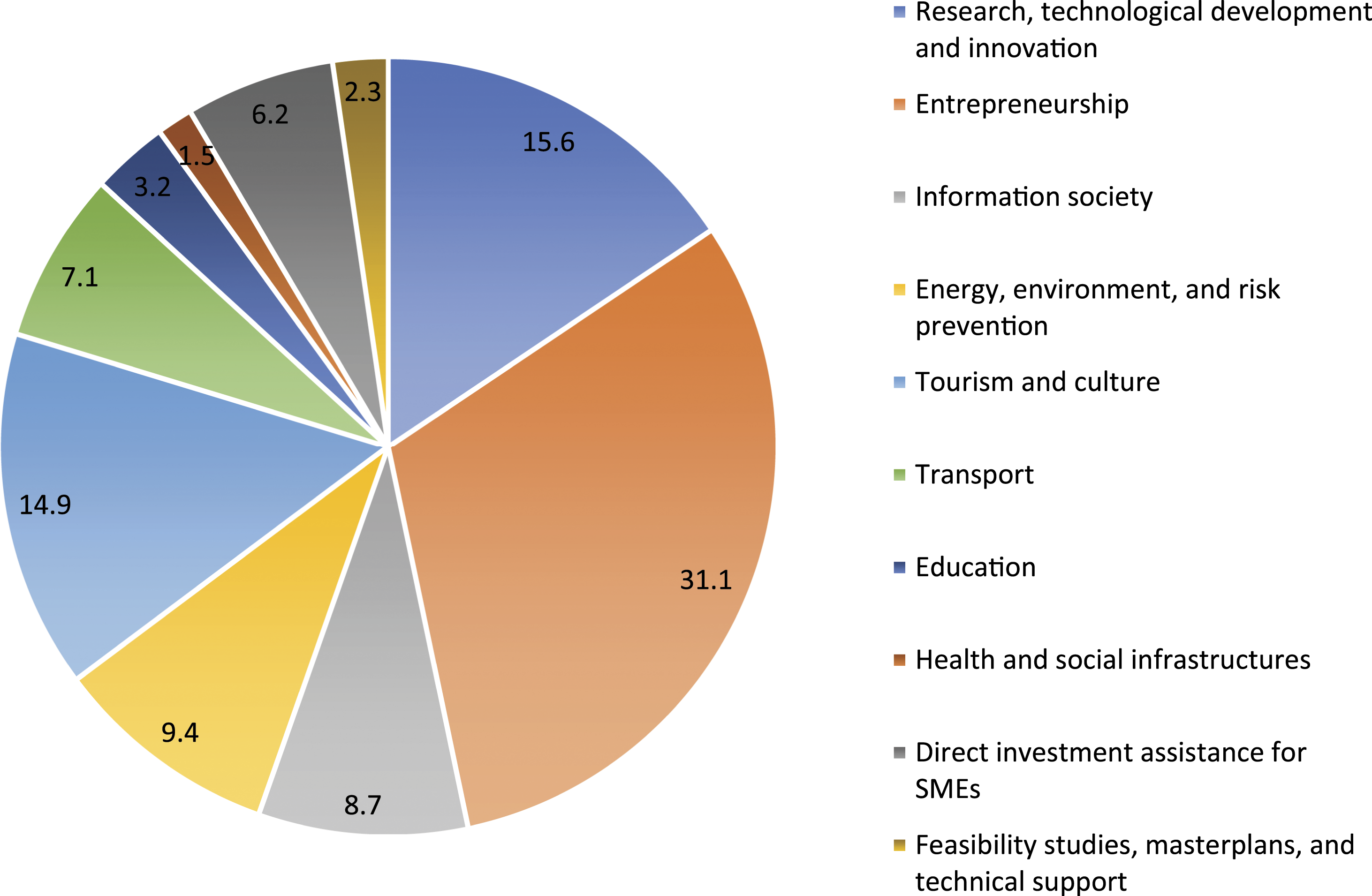
Distribution of the structural funding in England 2007–2013.
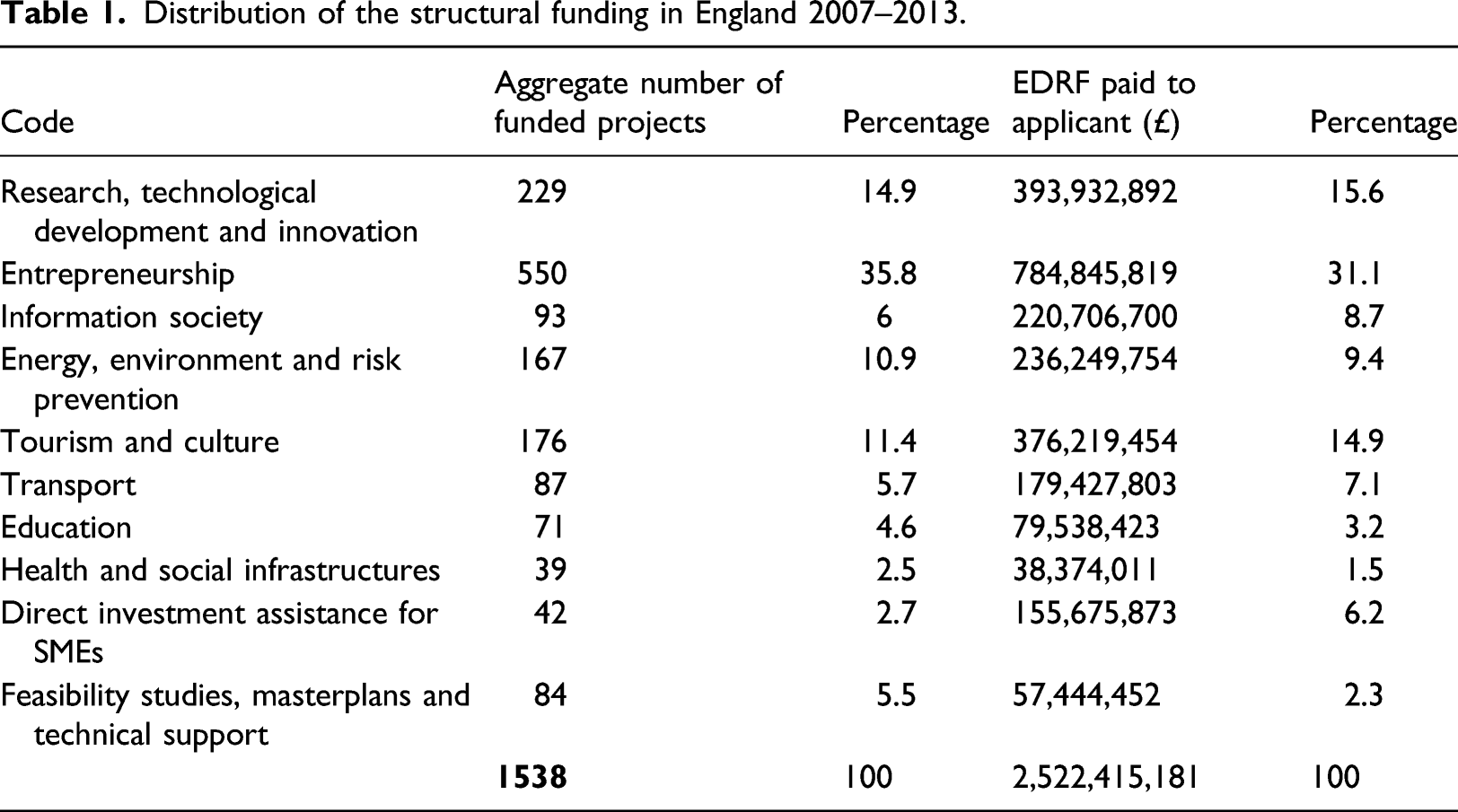
The findings from the dataset provide a comprehensive overview of the distribution of EU structural funding for English regional economic development between 2007–2013. The three dominant categories – research, entrepreneurship and investment for SMEs – exemplify the supply-side orientation of regional development in England. Evaluation reports subsequently produced by MHCLG clarify the specific aims. For example, the 2014 report for the North-East of England claims that structural funding was used to create a ‘modern, innovation focused economy’ that would ‘strengthen the region’s entrepreneurial culture and grow the region’s business base resulting in an outward facing regional economy and society that is self-reliant’ (MHCLG, 2021). A report produced by the Communities and Local Government House of Commons Select Committee summarised examples of key projects supported under the Structural Funds
An environmental programme for small businesses in the North-West
The Eco SMARTER scheme provides small businesses with a ‘free green makeover’ worth more than £1000, helping to cut bills and carbon emissions. Businesses that sign up to the scheme have a free electricity monitor installed as well as receiving environmental support from a sustainability expert. ERDF is contributing half of the project’s £1 million cost.
A programme to promote enterprise in West Yorkshire
£5 million of ERDF funding is being used in Bradford to support the growth of new enterprises in deprived communities and helping third-sector organisations to identify opportunities for growth. In Halifax, the project links established companies to emerging community businesses and social enterprises in a mentoring programme.
A fund to support small businesses in Shropshire and Herefordshire
The Shropshire and Herefordshire Business Fund provides capital grants to start-ups and existing small- and medium-sized businesses. So far, 176 businesses have been supported, assisting the creation of 105 full-time jobs and 60 new businesses. This scheme has secured £1 million of ERDF funding.
Another report for MHCLG claimed that structural funding in 2007–2013 delivered the following outcomes across England: ⁃ ‘8,700 gross jobs created, and an additional 16,462 gross jobs safeguarded; ⁃ Support to enable 2,813 businesses, 4,945 SMEs and 374 social enterprises to start up or expand; ⁃ a gross increase in the value of goods or services provided by each area, or Gross Value Added (of) £124.2 million; and ⁃ a net increase in Gross Value Added (of) £0.9 million’ (House of Commons, 2012).
The Committee noted that structural funding was made available to address ‘the fundamental economic and social weaknesses of the least-developed regions of the EU’. However, aggregate data indicates that in England, the fund delivered marginal improvements rather than driving any sustained breakthrough in regional economic performance. Delving deeper into the project specifics, the focus on entrepreneurship emphasised the growth of ‘hubs’ where entrepreneurs could gain access to workspaces, specific support services and training. In accessing investment, the Structural Funds in conjunction with those from the European Investment Bank and venture capital, were rolled into investment funds to provide interest-bearing loans for entrepreneurs and SMEs. Finally, the projects for research, technological development and innovation focused on bolstering ‘research capabilities’ within and around educational institutions, notably universities, science parks and incubators. It was believed that through HEIs, research and innovation would be spun off into enterprise and new businesses. An evaluation report for Tees Valley in the North-East of England, for example, found that the Business Support Package under the Structural Funds created 365 jobs, safeguarded 115 and helped to establish 116 SMEs. Meanwhile, £2 million of funding for Teeside University delivered 269 graduate jobs in local SMEs (Tees Valley Combined Authority, 2016). Another point relates to the difficulties of SMEs accessing finance for investment. Again, government leadership was noticeably absent. It was the European Bank for Investment, and Venture Caoiral rather than the Treasury, that effectively supported the investment. When it came to education and training, the relatively small number of funded programmes focussed on graduate and postgraduate internship opportunities, while supporting entrepreneurship programmes to get the low skilled back into work.
Tourism and Culture represented the second largest number of projects with a particular focus on creative hubs and the regeneration of town centres as well as buildings of cultural significance. The logic was that the growth of tourism and culture, and the revitalisation of town centres, could have a similar effect to the prized European Cities of Culture Programme. Yet the investment allocated to towns and cities for their creative industries was relatively small. Manchester, for example, received funds to support its museums and galleries, while Blackburn was awarded funding to regenerate one of its main high streets. While these projects were significant in their own right, the relatively low level of funding meant the contribution to the regeneration of towns was marginal; the interventions were unlikely to have much significant long-term impact.
The continuing reliance on market forces to correct regional disparities and the minimal role played by public institutions was evident too in energy, environment and risk prevention projects. This category mainly comprised small-scale projects across towns and cities to retrofit buildings to higher environmental standards, improve recycling schemes, and the creation of environmental hubs and innovation in the energy sector to drive market change. As occurred elsewhere, siloisation, weak leadership, poor co-ordination and the absence of local political and administrative institutions had a major impact. As anticipated, the funded projects were scattered across the English regions, while a national strategy to coordinate them was absent, particularly in the context of the national approach to renewable energy and carbon reduction programmes.
Projects relating to transport including the creation of bus corridors and improvements to bus and railway stations followed a similar pattern. The transport projects were overwhelmingly small-scale and locally specific. For example, in Liverpool, they focussed on railway station improvements, a pilot for real-time transport information and advancing green transport plans. Projects relating to the information society entailed infrastructure improvements to provide high-speed broadband to areas with poor connectivity. Finally, under health and social infrastructure, the projects were targeted at the third sector with additional funding for social enterprises.
The overall pattern across the Structural Funds is one that emphasised the centrality of private sector–led investment and growth as a mechanism to improve local prosperity, consistently prioritised by the Treasury (Warner et al., 2021). Meanwhile, the emphasis on supply-side policies, particularly those emphasising entrepreneurship capacities in England’s poorest regions, is all too evident. England’s poorest regions were to be regenerated, catching up with London and the South-East, by producing their own entrepreneurs. That was to be achieved within the socio-economic context of relative deprivation and in-work poverty, weak infrastructure, lower levels of education and training and higher incidences of ill-health (Tomaney and Pike, 2020: p. 44). The Structural Funds enabled both the EU and the UK government to demonstrate they were addressing regional inequality, but in reality, the emphasis on supply-side policies created an empty signifier as the strategy was ill-suited to England’s poorest regions. In addition, the projects analysed in the 2007–2013 programme generally lacked strategic direction and co-ordination from national and locally embedded institutions with steering capacities. In England, governance structures at the local and sub-regional level were inadequate to support ambitious strategies for long-term growth. Achieving policy outcomes generally relied on self-organising governance networks often characterised by fragmentation and segmentation. There was very little emphasis on collaboration between the public and private sectors and consequently, joining-up initiatives at the local level proved difficult. The decision-making structures of LEPs gave priority to local business leaders: policy networks in sub-regional economic development were shaped by the priorities and rules of the game that the centre and the Treasury defined (Bailey and Wood, 2017; Pabst and Westwood, 2021; Warner et al., 2021). The Treasury Green Book stipulates that investment decisions by local areas must reflect the strategic priorities stipulated by the centre in Whitehall, directly undermining the autonomy of sub-regional actors (Coyle and Sensier, 2019). The literature on ‘meta-governance’ alludes to the manner in which central government creates mechanisms that ensure the preferences of the core executive in Westminster are prioritised, regulating the actions of local actors and networks (Bailey and Wood, 2017). The weaknesses and absence of genuine autonomy in the institutional architecture of English regional governance are evident in the oversight of the ERDF programme which reinforces problems of financing and innovation diffusion. Financial support for regional SMEs and larger companies is inadequate, for example, while there is insufficient diffusion of new ideas and technologies to the rest of the economy which undermines productivity growth.
MHCLG emphasised that the Structural Funds captured the benefits of economic de-centralisation given that they were allocated through 39 sub-regional LEPs. They argue that local actors knew more about what was happening on the ground than Whitehall Departments and that LEPs would mobilise networks of public and private sector participants. Yet, in the former industrial urban areas and towns where the majority of the projects were located, political and administrative institutions remained weak compared to regions in other Northern European countries. The structural funding programme in England was structured such that sub-regional and local actors must continue to accommodate priorities stipulated by Whitehall (Bailey and Wood, 2017; Jessop, 2003b; Marsh, 2011). Meanwhile, funded projects were delivered on the ground through diffuse networks loosely co-ordinated by agencies such as LEPs. These networks are ultimately controlled by the central state, and characterised by a high rate of institutional churn underlined by the shift from the RDAs under Labour after 1997 to LEPs under the Coalition Government (2010–2015); the ad-hoc deal-making of city-region devolution, and the constant development of new funding streams and initiatives for local authorities (Pabst and Westwood, 2021; Van Ark, 2021). To underline the point, the current government recently announced plans to scrap many LEPs and radically overhaul the remaining partnerships (Financial Times, 2021).
We contend that EU structural funding was distributed through, ‘self-organising inter-organisational networks characterised by inter-dependency (and) resource exchange’ still overseen by the central state that controlled funding arrangements (Pemberton, 2004: 11). While political scientists generally assume that a key shift took place in the UK after 1979 away from top-down statism and bureaucracy, governance in England has remained highly fragmented and differentiated. It is recognised that English governance remains highly centralised, and that public institutions outside the core executive at the sub-regional level lack capacity and are generally weak. In so far as regional and local institutions are able to undertake economic governance tasks, they are more often sectorally and functionally fragmented. As a consequence of the legacy of ‘ungrounded statism’ in English governance, the Structural Funds were implemented in a context of: • No established track record of effective tripartite co-operation between labour, capital and the state. • Weak and under-developed collaboration and partnership between the public and private sectors at the regional level. • No coherent reinforcing industrial policy overseen by Whitehall. • No effective sub-national regional tier of government. • Moreover, the institutional framework remained brittle, while England was a long way from fashioning a developmental state capable of arresting long-standing regional economic disparities.
The state has continued to play a major role in UK economic and social policy, while 1979 was less of a decisive break than some scholars have assumed. Nevertheless, UK and English statism is ‘ungrounded’ because government focusses on exercising financial control from the centre (notably through the Treasury and central departments) rather than positively driving policy change and innovation at the regional and local level. The long-standing weaknesses of the institutional framework for sub-regional governance in England, combined with the ongoing ideological focus on supply-side policies, serve to explain the superficial impact of EU Structural Funds on English regional economic performance and productivity over the last decade.
Levelling up and the future of English regional development
In the context of our analysis, it is worth reflecting on the current Government’s replacement for EU Structural Funds given the UK has now formally left the EU – the ‘levelling up’ agenda. From the announcements made so far, it appears that the current government is committed to levelling up across the whole of the UK to ensure that ‘no community or locality is left behind’, particularly as the country recovers from the COVID-19 pandemic. In March 2021, the Johnson Administration launched three programmes under the broad umbrella of levelling up and community investment: the UK Community Renewal Fund, the Levelling Up Fund and the Community Ownership Fund. The UK Community Renewal Fund provides £220 million of funding. It is designed to support pilots and feed into the UK Shared Prosperity Fund. The Community Renewal Fund has the following priorities with which projects must align: • Investment in skills: work-based training, retraining or reskilling, promoting digital skills and inclusion. • Investment for local business: access to specialist support, innovation, and supporting de-carbonisation. • Investment in communities and place: net zero local energy projects, culture-led regeneration, improving green spaces, and promoting rural connectivity. • Supporting people into employment: multi-agency teams to support individuals into employment, schemes to enable people to return to the labour market, support for basic skills, and funding for experimentation.
The Levelling Up Fund is intended to invest in local infrastructure that has a direct impact on citizens and their communities. That includes a number of high-value local investment priorities, notably local transport schemes, urban regeneration projects and cultural assets. The emphasis, however, is on physical infrastructure. The UK Government has committed an initial £4 billion for the Levelling Up Fund for England up to 2024–2025 and £800 million for Scotland, Wales and Northern Ireland. Priorities include: • Transport investment: bridge repairs, bus priority lanes, local road improvements and major structural maintenance, alongside accessibility improvements. • Regeneration and town centre investment: bringing public services and safe community spaces into town and city centres. • Cultural investment: maintaining, regenerating or repurposing museums, galleries, visitor attractions and heritage assets.
The Community Investment Fund offers £150 million to support communities across the UK. From summer 2021, community groups can bid for up to £250,000 matched funding to help them buy or take over local community assets at risk of being lost or to run a community-owned business. The Fund will ensure pubs, sports clubs, theatres and Post Office buildings can continue to play a key role in the life of towns and cities. In April 2022 the UK Government launched the Shared Prosperity Fund, a flagship programme to deliver its commitment to levelling up the country. The investment will target places most in need across the UK. It will focus on specific domestic priorities while seizing the opportunities that come from leaving the EU and the attendant bureaucracy of structural funding.
At the time of writing, there is nonetheless considerable ambiguity surrounding the Levelling Up programme. In a recent speech intended to clarify his agenda, Prime Minister Boris Johnson gave levelling up a catch-all meaning to include not just the priorities of the three programmes of the Levelling Up and Community Investment Funds, but also tackling the social determinants of health, fighting crime and advancing the green economy (Johnson, 2021). Much remains uncertain about the levelling up agenda. Moreover, so far, there has been little effort to learn key lessons from the EU-funded programmes in designing new initiatives. The most important lesson concerns overcoming the myopic emphasis on supply-side policies and the fundamental importance of institutions for economic development at the sub-regional level. On the ideological content of levelling up and community investment, the priorities of the different funds have too many similarities with EU Structural Funds. Although the successors to the funds put less emphasis on fostering entrepreneurship, post-Brexit English (and UK) regional development emphasises investment in human capital, the re-development of town centres, the promotion of the cultural economy, alongside investment in transportation. There is a refusal to acknowledge that the socio-economic context of relative deprivation, weak infrastructure and relatively poor education and training performance within England’s poorest regions are hardly fertile grounds for such policies.
It appears as if levelling up funding is designed to better distribute public spending across England, rather than genuinely creating a series of economic powerhouses outside London and the South-East that can challenge the dominance of high-value financial services in the economy. There is continuing ambiguity as to whether levelling up is concerned with narrowing the productivity gap between the South-East and the North of England, or between core cities and peripheral areas such as post-industrial towns (Pabst & Westwood, 2021). Although the current government argues its initiatives will be better focussed and organised than the implementation of EU Structural Funds, ironically it appears as if these programmes will repeat many of the same mistakes and have a relatively superficial impact on the overall trajectory of the UK political economy. Both approaches distribute funding thinly across a wide area, and there are attendant problems of a lack of joining-up, weak co-ordination and siloisation among public agencies. Both the Structural Funds and the Levelling Up Funds compel local actors to bid for funding which leaves them at the mercy of priorities defined by the centre (Warner et al., 2021). This counter-productive ‘bid culture’ has been endemic in English governance (Sandford, 2019). It is unlikely to lead to any fundamental shift in the balance of economic and political power. Meanwhile, commentators have criticised the emergence of ‘pork barrel’ politics where public funding is channelled to Conservative-held parliamentary seats in the Midlands and the North of England under cover of levelling up (Hanretty, 2021). Fundamentally, not only is the sub-regional institutional framework in England under-developed, but the Treasury’s grip over borrowing through financial control and economic management greatly diminishes the discretion and room for manoeuvre of local actors. Levelling up funding is heavily centralised and controlled by the Treasury alongside the MHCLG (Jennings et al., 2021). The Westminster system of government is more generally characterised by centralisation, top-down decision-making, and hierarchy accompanied by the fragmented administrative landscape at the sub-regional level with a multiplicity of organisations divided by overlapping responsibilities and powers – as this study of the Structural Funds and regional economic development has demonstrated (Rhodes, 2005; Warner et al., 2021).
Conclusion
The problem of inadequate institutions and governance in English regions is hardly new, stretching back throughout the post-war decades. The historical legacy of ‘ungrounded statism’ and the empty signifier of supply-side policies ensures that the government’s role has paradoxically remained both regulatory and arms-length, but also highly controlling. The centre seeks to prevent local actors from pursuing initiatives that deviate from Whitehall’s priorities. Consequently, while the UK was a member of the EU, English regional development failed to adequately address the structural needs of less-affluent regions. Structural funding was used to reinforce self-organising networks of private and public sector actors in the absence of any overarching strategic framework or national industrial policy. EU Structural Funds were distributed in the context of an ill-defined system of English governance. In more effective multi-level governance systems, ‘supranational, national, regional, and local governments are enmeshed in territorially overarching policy networks’ (Marks & Hooghe 2004: 15-17). Yet, in England, economic development and the policy-making process are characterised by fragmentation and segmentation accompanied by the absence of institutional capacity at the sub-regional level. Not surprisingly, EU Structural Funds proved to be most effective in regions in which there was already an embedded legacy of economic and social development, with strong knowledge infrastructure largely already in place. The regions in which structural funding was primarily targeted in England were already characterised by weak infrastructure, poor skills, poor health and high levels of poverty and social exclusion. The emphasis on entrepreneurship capacities, piecemeal regeneration of town centres and small-scale infrastructure projects was wholly inadequate to address deep-seated structural problems in the economy and society.
The Johnson Administration is due to release its White Paper on Levelling Up later this year, which will provide further clarification and details of the Government’s approach to regional inequality. Nevertheless, at the time of writing and on the basis of our study, there is little evidence that the current approach of levelling up English regions will create an alternative model of economic and political development. The levelling up agenda continues the ideological logic of supply-side policies, even if the importance of ‘entrepreneurship’ is less pronounced. Moreover, there is the striking absence of an adequate institutional framework at the sub-regional level (Kleinman, 2021). City-region Combined Authorities (CAs) provide a partial solution, but they are hardly established throughout England. Whitehall generally prefers a more ad-hoc, pragmatic and bespoke approach where individual deals are negotiated with CAs. Moreover, CAs and local councils lack the resources and powers to permanently increase the level of economic performance and productivity in their locality. It is striking that the Treasury still maintains strict controls over business rates and infrastructure borrowing, for example. Since 2010, the performance management framework for local authorities has been altered to place less emphasis on targets. However, financial controls have actually been tightened in the context of fiscal austerity, while targets have reappeared as performance indicators in public services.
As a consequence, despite the rhetoric of levelling up, the risk is that post-Brexit, the UK and England more particularly continues the historic pattern of relying erroneously on fiscal redistribution from growth in London and the South-East. The attendant policy problems, resentment and conflicts that this model of the political economy creates are well documented. These structural weaknesses reflect deeply embedded institutional legacies that are, of course, hard to shift (Dunleavy, 1989). Unless the UK is prepared to break with the legacy of ungrounded statism and empty signifiers to forge a more de-centralised and developmental state, it is hard to foresee how these historical patterns will be overcome in the foreseeable future.
Footnotes
Declaration of conflicting interests
The author(s) declared no potential conflicts of interest with respect to the research, authorship, and/or publication of this article.
Funding
The author(s) received no financial support for the research, authorship, and/or publication of this article.
