




Abstract
The introduction of the devolved administrations (DAs) in the UK in 1999 was based on specific legal powers for this new scale of governance which included control of national and local priorities for expenditure within devolved matters. The legal powers conferred on these administrations included freedoms to determine expenditure within budgets which, in the case of DAs, included specific allocations linked to the Barnett Formula ensuring proportional allocations of UK state expenditure in a range of policy areas and later in the DAs, powers were provided to allow direct access to borrowing and raising funding through a range of means. In the period 1999–2014, DA powers were gradually increased, first in Scotland then in Wales and Northern Ireland. However, since 2014, in the DAs, UK Central Government has been using the provision of local and sub-regional ‘deal’ funding models, controlled by Whitehall, to gradually undermine this devolved decision making. This article discusses the role devolution and deals within the context of increasing EU principles of subsidiarity and the exercise of the UK Government’s de facto and de jure powers in response. It examines the role of deals in the DAs and their lack of accountability within the UK state.
Keywords
Introduction
The introduction of the Devolved Administrations (DAs) for Scotland, Wales and Northern Ireland in 1999 was based on specific legal powers for this new scale of governance which included control of national and local priorities for expenditure within those matters devolved from the United Kingdom (UK) Parliament (Mitchell, 2003). These matters included transport, planning and local economic development. As new institutional arrangements, the DAs provided a challenge to the British constitution with Parliamentary sovereignty in Westminster (Trench, 2007; Leyland, 2002) but which appeared to mark a new turn in central-local relations. The DAs also had their funding linked to the Barnett Formula (Midwinter, 2006) that makes it proportional to UK state expenditure for devolved responsibilities. The DAs were given control over the implementation of EU defined programmes, including selection of priorities for any associated funding, although they were not permitted to engage directly in EU negotiation, which was a reserved power (Hogwood et al., 2000).
In this article, there is an examination of the ways in which devolution has evolved from a ‘devolve and forget’ model in Whitehall (Greer, 2008) to a period of more active engagement in the return of devolved powers to the centre including through the role of deals between local and UK central government. This discussion is set within the wider challenge to DA powers that have been reduced or returned to Whitehall through a range of means by the UK Government. This has included through post-Brexit legislation (Morphet, 2021), the reduction in the use of the Sewel Convention (McEwen, 2022), Miller 2 (Hasz, 2019) and the use of s35 powers to remove powers of decision making on devolved matters in 2023. In Westminster, Prime Minister May introduced the Dunlop Review (2019) which indicated how Westminster could have a more interventionist role in the DAs and introduced policy on new intergovernmental relations which established machinery for regular and closer working together with a range of inter-ministerial groups for different areas of responsibility with a secretariat located within the Cabinet Office (Cabinet Office, 2022). Prime Minister Johnson’s period of leadership is said to be characterised by more ‘muscular unionism’ (Andrews, 2021; Saunders, 2022; Arnott, 2023) and the approaches for Levelling Up in the UK White Paper (DLUHC, 2022). This approach has also been continued by Prime Minster Sunak through the introduction of UK Investment Zones policy in the 2023 Budget. In this paper, a specific policy tool that has been applied as part of the remaking of relationships between Whitehall and the DAs is considered, that is through the use of ‘deals’ which operate between HM Treasury and local authorities, albeit on matters that are devolved. While deals between the UK government, the DAs, Mayoral Combined Authorities (MCAs) and local government in England are described by the use of this single generic term, with a similar intention of central control of local funding, their forms vary. The deals in the DAs, as will be discussed here, are described as City and Growth deals (DLUHC, 2022), span longer time periods, include no commitments to further devolved powers, require the commitment of funding devolved to the DAs and contributions from local authorities (Audit Scotland, 2020; van Den Zwet et al., 2020). In England, the funding provided through deals is regarded as additional and associated with fixed-term devolved powers (O’Brien and Pike, 2015). Through the use of agreed funding programmes, HM Treasury has used soft power (Nye, 1990) to take de facto responsibility for funding, project choice and approval which are de jure the responsibility of the DAs.
These changing power relationships between the UK Government and the DAs are considered within the context of Multi Level Governance (MLG) and the UK’s membership of the EU. There is an examination of the potential stimulus for change in UK Central Government practice towards devolution (Johnson, 2008) to a period of central recovery of devolved powers (Morphet, 2021). The use of ‘deals’ in changing these central/local relationships has not been discussed as a potential strategy for restoring more centralisation over DAs other than in their specific occurrences in the sites of their delivery (Van der Zwet et al., 2020). This paper discusses the role of these soft power methods in a period prior to the use of a more formalised post-Brexit process of the return of devolved powers that is now more apparent in UK government statecraft than when these DA deals were first introduced in 2014.
Multi-level governance and its operation within the UK
The principles of MLG are based on the assumptions that some aspects of the state’s functions are better delivered at different levels of national, sub-national and local government for reasons of democracy, efficiency and effectiveness (King, 1984). This ‘nested’ distribution of responsibilities is also regarded as having beneficial consequences for the state (Anderton, 2017). The use of the principles of MLG within the European Union (EU) emerged as it expanded through its Accession programme after 1992. The European Commission (EC) was already concerned about charges of democratic deficit and remote decision making (Inman and Rubinfeld, 1998) in addition to the relative balance of powers between member states, the EC and citizens. In adopting a more decentred principle of engagement, particularly through sub-national government, the EU offered an opportunity for knowledge and networks to evolve (Bache et al., 2016) while creating a voice within the EU that might sometimes have views that differed from member state governments. It also suggested greater integration of decision making and government (Rosamond, 2000; Wiener, 2019). The development of the Committee of the Regions as an allied but not incorporated body within the EU was also an indication of this trend (Loughlin, 1996).
Where MLG turns from being a de facto model of integration between central and local government levels within the state to a de jure principle is through the application of subsidiarity, which places decision-making as close as possible to the citizen (Scott et al., 1994: 48). In the EU, this principle was used by the EU to create a legal basis for sharing responsibilities between member states, the EC and the European Parliament and extended its reach to include the principle and legal means of determining how the functions of member states are distributed within and between their levels of government. This was particularly important within the UK, where sub-national government has no place within its constitution and any sub-state levels of government, including local authorities and DAs can have their powers removed by the UK Parliament (Scott, 2001; Leyland, 2002; Morphet, 2021). This differs from all other members of the OECD (2019) and represents the UK as a strongly centralised state. Thus, within the UK, the adoption of the principle of subsidiarity by the EU and its application within the state was of considerable importance, challenging the way that power was distributed between the tiers of government (Kelly, 1999: 188–89). In other EU member states, the basis for subsidiarity was constitutional although its interpretation was enhanced by the development of the subsidiarity principle in the 1992 Maastricht Treaty and consolidated into the Treaty for the EU (TfEU) (Kersbergen and Verbeek, 2004). The EU further extended the application of subsidiarity in 2009 where Article 5 of the TfEU was revised to explicitly include regional and local levels (Arribas and Bourdin, 2012; Schneider, 2019).
Within the UK, the application of the principle of subsidiarity in the Maastricht Treaty was identified as an issue of potential conflict with the UK constitution from the outset and was a concern to the EU (Scott et al., 1994). However, the implementation of the devolved settlement for Scotland and Wales and the Good Friday Agreement in Northern Ireland could be undertaken with a degree of EU treaty protection. The DAs were introduced through the use of concordats, which are not legally enforceable. Changing the British constitution was seen to be either too difficult (Bogdanor, 1999) or unnecessary when they were protected by the TfEU (Scott, 2001). While the introduction of DAs offered de facto power over decision making, de jure powers for the decentralised power of decision making within the UK constitution were not implemented, creating a reliance on the provisions of the TfEU to maintain the institutions of devolution in perpetuity.
The effects of increasing regional and local subsidiarity on UK devolution
Consideration of extending the principle of subsidiarity in the TfEU (CEC, 2001) between 2001 and 2009 coincided with a period when the Westminster Government continued to increase the powers of the DAs, first in Scotland (McGarvey and Kerley, 2022), then Wales (Jones, 2012) and Northern Ireland (Mackinnon, 2015). New localism (Miliband, 2006), introduced in England, delivered through local authority freedoms and flexibilities, was seen to be a positive approach to decentralising the state. Research and advice from the OECD concerning the extent to which more devolved governance models support national economic growth (OECD, 2007) was also developed and practical applications were discussed with the EU (Dijkstra and Poelman, 2012). This was focussed on the role of cities and their wider functional economic areas as a means of promoting economic growth and dealing with climate change. The leadership role and encouragement of policy transfer by the OECD (2007) and the interrelationship between the EU and OECD on urban policy has grown since 2000 (Dijkstra et al., 2019) resulting from the initial work of Krugman (1991). This has been extended by the UN, through the New Urban Agenda, agreed as part of Sustainable Development Goal 11 UN 2015). These urban policies are national in their adoption and operation, with self-determination and local leadership the motor of their economic success (Anderton, 2017). In this context, HM Treasury published papers on the ways in which devolved decision making could support the UK economy (HMT, 2004; HMT, 2006).
Further discussion on extending practical subsidiarity within the EU member states (Barca, 2009; Craig, 2012), indicated a probable increase in the transfer of power from Westminster to sub-national scales of government that would be apparent in future EU Cohesion programmes from 2014 (Ferry, 2021). This suggested a new turn for central-local relationships in the UK. In response to this likely shift in powers over sub-state decision making, UK Central government introduced programmes that conformed to a devolution narrative (Newman et al., 2021) that was less apparent in practice. In England, more power was exerted by the centre through the control of specific financial resources within the wider context of austerity (Lowndes and Pratchett, 2012; Gray and Barford, 2018) and in the deals. The introduction of a new policy tool of deals that were structured as fixed-term programmes. In the deals, detailed project control by the Westminster Government over matters which local authorities already had powers but could not implement within an austerity context was a core component (NAO, 2014). Through city deals in 2012 (Sandford, 2017; Van der Zwet et al., 2020), these used the OECD and EU favoured scale for economic governance, the functional economic area (Dijkstra and Poelman, 2012). In 2014, deals were extended from England to Scotland when introduced as an institutional arrangement directly between the Westminster government and Glasgow City Council (Audit Scotland, 2020). Since then, deals have now been agreed for all parts of the territory of the DAs (DLUHC, 2022) although not yet for all parts of England which is considered next.
Deals as a new method of managing central local relations in England
The introduction of deals in England provided a mechanism through which UK Central Government could overtly demonstrate a stated commitment to devolved decision making. The reduction in funding for local authorities in England through austerity and removal revenue support grant (Sandford, 2016) increased the dependency of local government on centrally provided bid and deal related funding (Lowndes and Pratchett, 2012; Gray and Barford, 2018). It also coincided both with the election of the Coalition Government in 2010 and the need to apply the increased principles of subsidiarity set out in the TfEU (Craig, 2012; Arribas and Bourdin, 2012; Medeiros and Rauhut, 2020). The change of UK government provided a window for a policy reset (Kingdon and Stano, 1984; Goetz and Mayer-Sahling, 2009) and deals became part of the narrative to implement the Government’s commitments agreed in the EU Cohesion Programme Partnership Agreements, which operated between 2014 and 2020 (Purkarthofer and Schmitt, 2021; Ward, 2020b).
Deals in England (source the author).
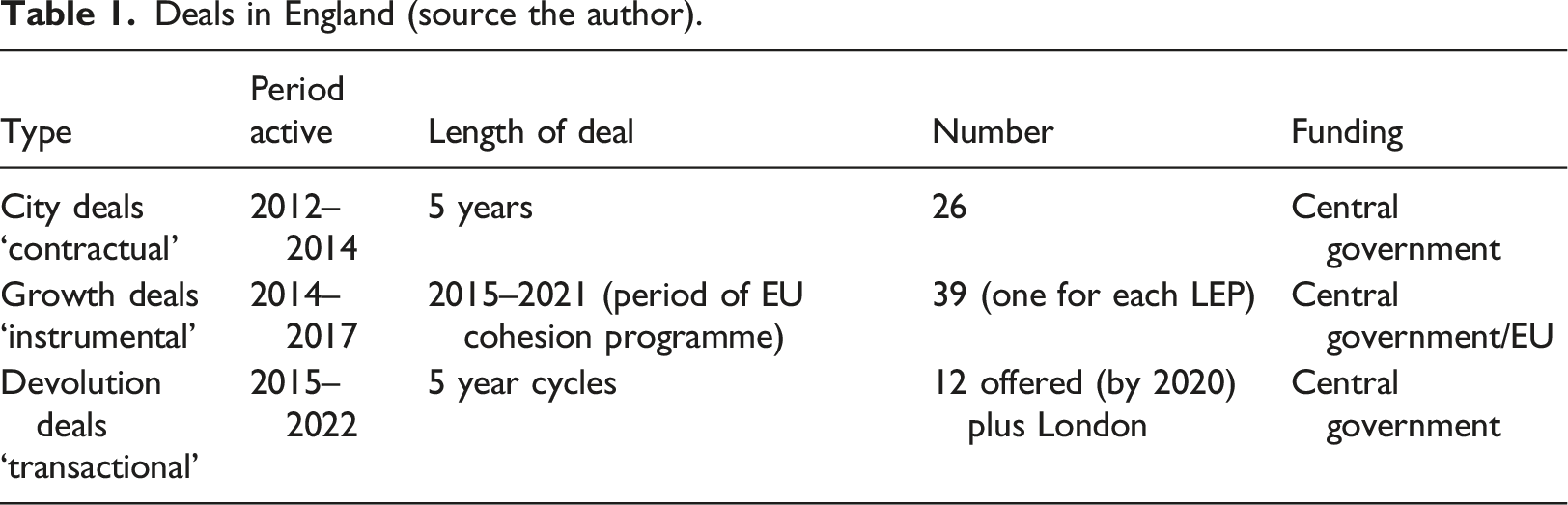
The first deals in England, were introduced in 2012, conceptualised as ‘contractual’ city deals between local and central government (Ward, 2020a), where both were described as being equal partners with the menu of initiatives and funding described as being bespoke. The UK Government (2013) stated that these deals would ‘give the city and its surrounding area certain powers and freedom to: • take charge and responsibility of decisions that affect their area • do what they think is best to help businesses grow • create economic growth • decide how public money should be spent’.
In practice, city deals were better described as fixed menus rather than table d’hote (Sandford, 2020) although there were a few exceptions to this such as the 5-year housing programme for Cambridge City Council (Jones et al., 2017a). This form of city deal was within the typology of EU territorial pacts (van Den Brande, 2009) promoted by the EU’s Committee of the Regions and introduced as part of a package to counter the 2008 economic crisis (CEC, 2010). These territorial pacts were intended to be a new model of economic governance for smart, sustainable and inclusive growth (Antonescu, 2015) that related to all parts of the EU’s territories and beyond those primarily engaged in Cohesion programmes for lagging and cross border areas. The pacts were meant to work with the other existing EU funding regimes but also marked a shift away from silo approaches to decision making at the local level by taking an integrated approach. These pacts foreshadowed the Partnership Agreements between member states and the EC in the 2014–2020 Cohesion programme (Piattoni and Polverari, 2016) and that reinforced the role of subnational government within an MLG framework.
The second type of English deal was a local growth deal which government offered to Local Enterprise Partnerships (LEPs) (MHCLG et al., 2014) in three rounds. These deals can be characterised as being ‘instrumental’ in their role in accessing EU Cohesion Funding. LEPs, created by central government in 2010, covering England’s territory, were invited to bid for ‘local growth deals’ which included the delivery of EU’s Cohesion programme 2014–2020 (Sandford, 2020), although this was not explicit at the time (Pemberton and Morphet, 2014). These LEPs were seen by government as practical replacements for the Regional Development Agencies (RDAs) (BIS Select Committee, 2013), which had operated 1998–2010 to undertake the same role on government’s behalf. In these growth deals, the parameters for expenditure together with the detailed programmes of projects were set by central government departments with a strong role exercised by the Treasury and Cabinet Office, in addition to the more operational departments. LEPs had no legal basis and their boards were not subject to principles of public life in their appointment. From 2014, the EC refused to give funding to LEPs as they were not democratically accountable (Ahmad, 2015). However, where the government subsequently agreed the establishment of Mayoral Combined Authorities (MCAs) and in the GLA, these became intermediate bodies for EU cohesion funds, with local decision making (Sandford, 2020).
The third type of deal that was introduced in England was ‘transactional’. These devolution deals offered more ‘freedoms’ for local self-government, with bespoke funding programmes in return for changes in governance arrangements, primarily focussing on a directly elected mayor and the creation of a combined authority (Sandford, 2020) (MCA) within the terms of the 2009 Local Democracy, Economic Development and Construction Act supplemented by the 2016 Cities and Government Devolution Act. MCAs are not local authorities. The twelve deals agreed 2014–2022 comprise a range of initiatives including a number of common components together with one bespoke element for each deal. The potential for further English devolution deals was opened by Prime Minister Johnson in 2021 with a direct link between the government’s approval of the governance structure with the scale of the deal being offered. MCAs are created through secondary legislation with each one being sui generis and their mayors have competencies rather than powers. There is also evidence that these deals do not reflect local authority priorities for their areas (Smith et al., 2021).
The three types of deal in England had similar characteristics. They were conducted with no transparency. The deal narrative was of devolution of power with funding incentivising change. Funding for deals was provided by central government and there appears to be no suggestion that the councils should be contributing from their own budgets. The structures of the three types of deal are similar, with a project mix from a specified menu of priorities (Sandford, 2020) and individual projects required to be approved by central government. While there were some devolved powers made available, these were specific and time limited rather than being a generic change in de jure decision making for sub-national government in England.
The role of central government deals in the devolved administrations
The introduction of deals in the DAs in 2014 had some aspects in common with those in England – a lack of transparency, a menu driven approach, with programmes and projects signed off by the Westminster government but there were no associated devolution incentives. The emerging deals within the DAs had some common aspects.
Scotland
Deals in Scotland (source the author).
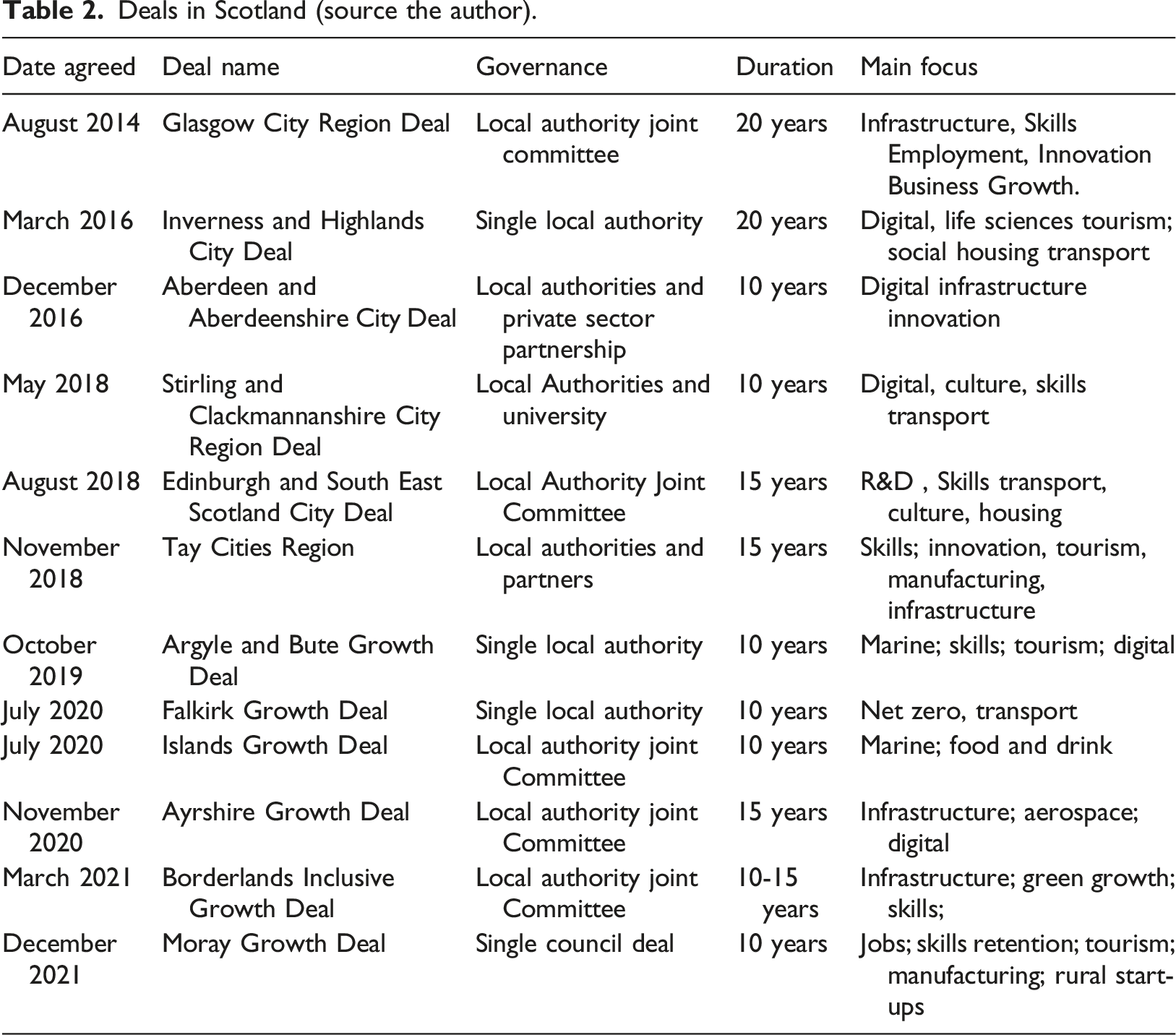
The introduction of these deals remains problematic for MLG in Scotland by creating competing policy agendas, which local authorities hope to exploit (Audit Scotland, 2020). The underlying political dimensions are not apparent within the opaque negotiating arrangements (Jones et al., 2017b; Van der Zwet et al., 2020). The issue which emerged from the initial Glasgow City Deal and has been consistent for all that followed, but rarely discussed, is the extent to which these deals cut across the devolved settlement. The priorities, programmes and projects in the deals are devolved matters in Scotland and the effect of the deal structure is to give Westminster control over them and undermining, indeed replacing, devolved decision-making. The deals provide a double bonus to a Westminster recentralising agenda, (Dunlop, 2019; HMG, 2022) as the Scottish Government provides 50% funding and so reduces its capacity to spend these funds on projects to deliver their own priorities (Audit Scotland, 2020). As the deals in Scotland are typically 10–15 years, the level of control over DA decisions on their budgets runs for much longer than any UK government commitment to English local authorities which are characterised by their short termism.
The deals are managed by the Scottish City Region and Growth Deal Delivery Board. The members of this board include three representatives of the Westminster government and one from the Scottish government while the remit of the Board includes overseeing the business cases for the component projects and coordinating their relevant approval (UK Government and Scottish Government, 2019; Scottish Government, 2019). The issues of undermining devolution through Whitehall decision making on specific projects together with pre-committing funding for the deals, where the decisions are outside the Scottish government’s control, were raised at the time of the Glasgow City Deal (Audit Scotland, 2020). The contributions to deal funding are taken from the Scottish government’s block grant which is devolved and results in a reduced budget for the Scottish Government. Although there were promises by the UK government that devolution would not be undermined again in this way, it has been said to be flexible in the application of this agreement (Audit Scotland, 2020: 20). Another issue of public accountability has emerged in the use of deals as Audit Scotland has the power to audit the Scottish government and public bodies but not the UK government’s activities in Scotland. The National Audit Office (NAO) has responsibility for the UK government’s activities but their reviews have been for deals in England (NAO, 2015, 2016, 2022). The lack of provision for audit accountability for UK funds spent in the DAs on devolved projects appears to be loophole in the devolved settlement. While these deals do not cover a major component of DA funding, their cumulative impact over future decision making may be significant.
Wales
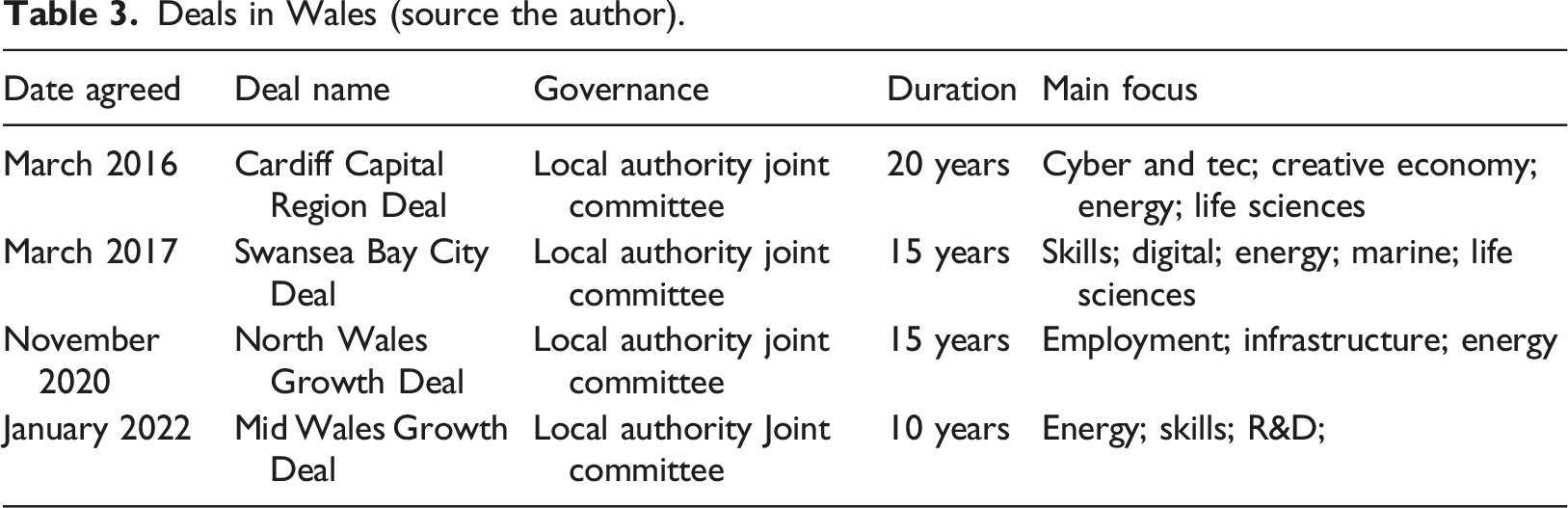
Deals in Wales (source the author).
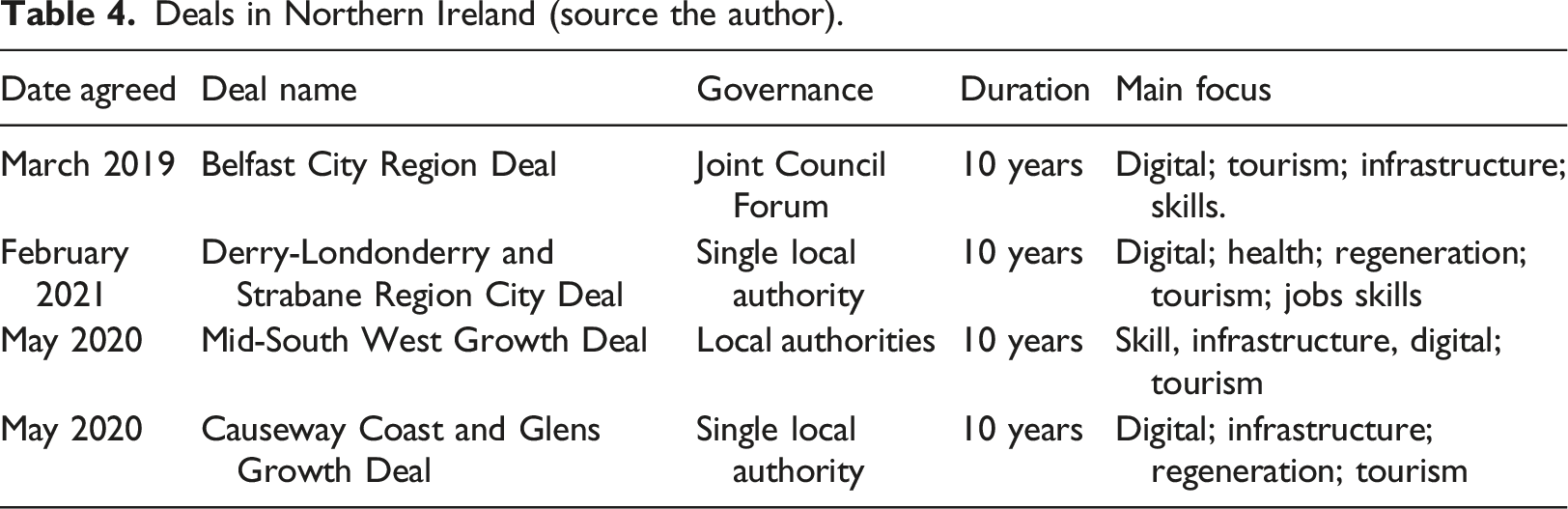
Deals in Northern Ireland (source the author).
Northern Ireland
Northern Ireland deals comprise two urban and two rural areas. The Causeway Coast and Glens growth deal is with a single local authority and the funding contribution is shared between Westminster and Northern Ireland Assembly. It has an economic focus (Grant Thornton, 2020a) and in assessing projects for this deal, each proposal has been evaluated against the priorities from Westminster and the Northern Ireland Executive as well as locally (Grant Thornton, 2020b). Like Wales, the deals in Northern Ireland are governed by local authorities and last for 10 years as shown in Table 4.
The details of the mechanisms for the deal funding governance between the DA and Whitehall (Belfast City Council, n.d) make it clear that while the NI government and the local deal area will be able to submit their priorities for projects, the final decisions for each project will be undertaken by Whitehall. By 2022, there were deals for the whole of the Northern Ireland territory although it is interesting to note that in 2020, the NI Assembly was not considering such an extension, but rather only an approach for its two major urban areas (Ward, 2020b).
Discussion
In considering the deals that have been agreed by the Westminster government across the UK, it is possible to see a number of similarities and differences in their development, structure and governance. The first common factor is that the term ‘deal’ is seen to be temporary and negotiated (Pemberton and Morphet, 2014) and is used in place of mainstream funding available to local authorities for local determination before 2010. Second, all deals, of whatever type and territory, have been conducted with a lack of transparency. There has been no public engagement or espousal of community priorities despite their narratives of responding to local needs. Further, all the deals appear to be menu driven within their category, with common priorities and associated delivery programmes. The deals appear to have a common structure within these priorities, of programmes and projects. The criteria based assessment of the projects is set by Westminster in all deals. The selection of the projects for inclusion appears to have some local elements within them, but, as well as Westminster setting the terms of the assessment, it also gives final approval to the projects included within each deal. Lastly, in all deals, there has been little attempt to monitor their outcomes or success in achieving their objectives – either for devolution or economic growth (NAO, 2022; Audit Scotland, 2020).
The governance of the deals also varies. In Wales, the deals are managed by local government joint committees. In England, the first wave of deals were between local authorities and the government, with a smaller role for partners and set out in a contractual format. Subsequent growth deals have included economic and social partners. The deals are all promoted as being bespoke and responsive to their areas but there is little or no community engagement and each deal appears to have a boilerplate format with marginal local variation (Sandford, 2017). A further difference between the English and DA deals is the role of economic geography in defining the deal areas. In England, the economic geography is a stated driver for the city and devolution deal areas while the role of functional economic areas was a determinant of the boundaries of the LEPs (Bentley et al., 2010). In the DAs, economic geography appears to have been a starting concern but was replaced by ‘filling in’ the DA’s territory in all three nations.
It is in the issue of funding where there is the greatest difference between the deals in England and the DAs. In England, funding was seen as a secondary outcome within a transactional framework for economic objectives as in the city and growth deals or changes in governance in the devolution deals, although all were set within a devolution overlay. In Scotland, the deals were promoted as a means of providing additional funding from the Westminster government but this was provided only if the DAs committed their own funding to the deals where the UK government took the power over final project agreement. At present, this may not represent a significant proportion of DA budgets but over time the deal commitments may erode funding available for DA priorities. As there was no intervening tier of government in England, the narrative of devolving more powers can be contrasted with the de facto removal of devolved decision making in the DAs through these deals (Scottish Parliament, 2018). Finally, there is a continuing concern about the accountability for these deals which appears to fall between the Audit Services for the DAs and the NAO and can be described as operating within a devolution loophole
Although these deals have now been implemented across the UK, there has been no assessment of their success in promoting the objectives for growth or devolution (NAO, 2015). These deals have no legal basis and, in effect, provide funding for specific projects that deliver central government priorities or reward political supporters (Walker and Allegretti, 2021). While Whitehall’s de jure powers to direct local authorities were being reduced by the TfEU, it was using de facto incentivised funding powers to increase control over local decision making (Dahlstrom et al., 2011; Jonas and Moisio, 2018). It is difficult for the governments of the DAs to refuse UK central government funding to their local authorities, despite this removing their ability to control project approval in line with their own objectives (Van der Zwet et al., 2020; Audit Scotland, 2020).
Conclusions
The extent of the use of deals across the territories of the DAs was confirmed in the Levelling Up in the UK White Paper (DLUHC, 2022 CP 604), where an increase in the Whitehall role for all formerly devolved matters is reiterated. The role of deals in increasing control over local and combined authorities in England has been discussed (Waite et al., 2013; Pike, 2015; Jones et al., 2017a) but this is less the case in the DAs, where the focus has been on the processes of negotiation (Beel et al., 2020; O’Brien and Pike, 2015) rather than the changing levels of Whitehall control over local decision making.
While an outward dimension of this policy implementation in the UK might be seen as a display of compliance to meet these shifting international policy norms, as expressed through the OECD and EU, (Jonas and Moisio, 2018), these emerging arrangements sit within the cracks of formal and informal governance spaces (Bowden and Liddle, 2018) and are frequently described as soft or fuzzy (Haughton et al., 2009). In these informal arrangements in the UK, local authorities have been financially incentivised to work together, through the application of austerity. These arrangements for joint working have been horizontal (O’Brien and Pike, 2015) for common economic geographies and vertically between these localities and the state (Crespy et al., 2007). However, despite the narratives of devolution and more local control of decision making, these new patterns of MLG in the UK operate more de facto centralised forms of detailed decision making and a return to greater interventionism from the state within the locality (Morphet, 2021). Jonas and Moisio (2018) argue that by enrolling the devolved and subnational governments within these deals, the state is orchestrating a new form of national economic narrative.
This article contributes a discussion of the context, operation, decision making formats between types of deal in England and the DAs. It has demonstrated the lack of accountability for the deals within current frameworks for audit in the UK. It has discussed the stimulus for the changing relationships provided by the TfEU, between deals and the UK government’s culture and practices on devolution including specific agreement by Whitehall of individual projects within deal programmes. It has discussed the role of soft power methods to create a de facto means of returning local decision making to Whitehall prior to the de jure return of devolved powers in the post-Brexit period. The use of these soft power methods of returning devolved powers are more apparent in UK government statecraft than when these DA deals were first introduced. While the development of policy within the subsidiarity principles of the TfEU and the OECD’s research on the economic role of city regions has provided an operational context for the development of MLG initiatives within the UK, it has also offered a mechanism to reduce existing powers of local decision making across the UK whether in English local authorities or DAs. Reports of both the NAO and Audit Scotland (2020) indicate that neither has the power to consider these deal agreements within their powers. As Audit Scotland (2020) states, it is exceedingly difficult to hold any public bodies accountable for the outcomes of these deals other than in the completion of specific projects. In England, the NAO has made similar comments on the way in which the deals have been operated (NAO, 2022).
Within the UK constitution, the powers that were devolved to the DAs after 1999 could always be recovered by the centre through the determination of the UK Parliament. However, the inclusion of the principle of subsidiarity within the TfEU meant that if any UK government attempted this, it could be challenged by Judicial Review 1 . After Brexit, the EU treaty principle for subsidiarity can no longer be relied upon and the failure to change the UK constitution in 1999 means that the UK government can remove devolved powers as it has done in a range of ways (Morphet, 2021). While the role of the ‘deals’ made with local authorities in the DAs is frequently mentioned as an issue in the changing relationship with Whitehall (McGarvey and Kerley, 2022), they are rarely considered for their role in recentralisation of the UK state. They also highlight a policy vacuum (Beel et al., 2020) that has been opened up since the UK left the EU in 2020. This has been filled in part through the narratives by ‘muscular unionism’ (Saunders, 2022; Arnott, 2023), levelling up or increased clientelism between Westminster, local authorities and the electorate (Hanretty, 2021). In England, deals have become more aligned to local electoral outcomes with no transparency on criteria based funding allocations (Walker and Allegretti, 2021). In Scotland, the deals exploited an inherent tension in the devolution arrangements that were recognised from the outset.
The deals have created a form of MLG which is specific and circumscribed in its character which the Government wishes to make more uniform across the UK (DLUHC, 2022). For local government, the deals provide the promise of access, influence and additional funding. Whitehall flatters the locality by emphasising this role by appointing former senior Whitehall leaders or advisers to each deal area in a form of coercive monopoly (Gibson et al., 2022). While the Scottish and Welsh governments have been politically obliged to engage in these deals, they have increasingly been seen as mechanisms to undermine devolution (Keating, 2021; Andrews, 2021). These actions on the part of the Westminster government showed an early intention to change the devolution project before this became more explicit in the post-Brexit agenda (McHarg, 2018; McEwen, 2022; Andrews, 2021). The increased centralising role of the state appears to run counter to the economic evidence of the extent to which devolved power can support increases in national GDP (OECD, 2015). While deals create an opportunity for local government to make the case to their electorates that they are working on their behalf, they also create a similar narrative for central government on the doorstep (Hoole and Hincks, 2020). The combination of Westminster government initiatives to reduce the role of the DAs is now accumulating. Control by Westminster of DA priorities, programmes and projects at the local level, as represented in these deals will continue for up to 20 years and reduces de facto devolution while post-Brexit legislation reduces the de jure devolved powers of the DAs. It demonstrates the power of Whitehall to use temporality, narrative and incentives to manage longer term policy intentions. It also contributes to the wider discussion about the future of devolution and the constitution of the UK.
Footnotes
Declaration of conflicting interests
The author(s) declared no potential conflicts of interest with respect to the research, authorship, and/or publication of this article.
Funding
The author(s) received no financial support for the research, authorship, and/or publication of this article.
