




Abstract
Current transport strategy in the UK is strongly urban-focused, with assumptions that technological advances in mobility will simply trickle down into rural areas. This article challenges such a view and instead draws on rural development thinking aligned to a “Smart Countryside” which emphasises the need for place-based approaches. Survey and interview methods are employed to develop a framework of rural needs associated with older people, younger people and businesses. This framework is employed to assess a range of mobility innovations that could most effectively address these needs in different rural contexts. In presenting visions of future rural mobility, the article also identifies key infrastructure as well as institutional and financial changes that are required to facilitate the roll-out of new technologies across rural areas.
Keywords
Introduction
Across Europe, the economic contribution of rural and peripheral economies is attracting considerable attention. In particular, their resilience and recovery since the global financial crisis identified the need for policy to invest in rural economic growth (Dijkstra et al., 2015) and, in the wake of Covid-19, regional economic recovery must once again be a key focus for policymakers. Continuing trends of counterurbanisation confirm the ongoing appeal of rural community life (Bosworth, 2010; Hansen and Aner, 2017; Stockdale, 2014) but emerging climate challenges and new working styles highlight the need for sustainable rural communities to develop around reduced dependence on fossil-fuelled personal mobility. Therefore, this article examines the potential for more innovative means of staying connected, both physically and virtually, based on new mobility technologies across the digital communications and transport sectors. Specifically, we examine the opportunities for rapid technological advances in mobility to address rural social and economic needs and consider the associated risks of some rural areas being left behind. The core research questions that emerge are: How, and to what extent, will the essential needs of rural communities and businesses be served (or not) by new mobility innovations?
In England, rural economies contribute a significant share of the nation’s economic output, estimated to be approximately 16% of Gross Value Added and worth an estimated £261 billion (Department for Environment, Food and Rural Affairs (DEFRA), 2019). There is significant scope for growth, however, as the untapped potential of England’s rural economy has been estimated to be anything up to £347 billion (Burgess, 2008). The need to realise this potential remains a central theme in the House of Lords Select Committee on the Rural Economy Report (2019: 6) which notes that, “Once dominated by agriculture, they [rural economies] are now as economically diverse as urban economies, contributing a significant amount to the national economy with the potential to flourish and contribute even more to our wellbeing and prosperity.” Unleashing this growth potential in rural areas demands that rural assets are leveraged in ways that can empower communities and enhance their social, economic and environmental well-being (Organisation for Economic Co-operation and Development (OECD), 2018).
A future rural mobility strategy, supported by emerging digital and transport technologies, can facilitate and drive rural growth in the context of a “Smart Countryside” analogous to, but different from, the “smart city” (Naldi et al., 2015; Slee, 2019). Specifically, the article challenges the view of the UK Department of Transport’s Future of Mobility strategy which states that: “Using our towns and cities as testbeds for innovation, we will trial and improve upon products and services that can be adapted across the country and across the world” (Department for Transport, 2019: 15). This statement assumes that whatever works in cities are transferable to rural areas but overlooks the potential for innovative solutions to be based on rural needs and developed to fit rural places.
Research findings are taken from a larger study into rural mobility that was carried out for Midlands Connect in Summer–Autumn 2019. The remit of Midlands Connect is to research, develop and recommend transport projects which will provide the biggest possible economic and social benefits for the Midlands and the rest of the UK, so our study focused on rural needs across this region, with recommendations intended to be applicable at a wider geographical scale.
Place-based development and mobility in a Smart Countryside
The concept of a Smart Countryside is based on combinations of digital technologies and community-based human and social capital to support business innovation and wider community development (Slee, 2019). This emphasises the “place-based” focus of contemporary rural development thinking (Horlings and Marsden, 2014; OECD, 2018), whilst simultaneously appreciating the scope for digital and technological advances to support innovation, extend connectivity and enhance wellbeing. A smart countryside should therefore include community-based transport solutions alongside new provision made possible by technological advancements. The parameters of a Smart Countryside will continue to evolve to reflect new technologies and distinctive rural challenges, meaning we cannot simply translate smart cities research into a rural context (Cowie et al., 2020). The growth of home-working and the emergence of new digital activities based around local schools and community organisations, accelerated by the impact of Covid-19, have identified latent energy and talent that can make a difference to rural community wellbeing and strengthen local entrepreneurial ecosystems. The rural context is frequently presented as a relatively sparse environments for entrepreneurship, characterised by fewer resources and institutions, less economic diversity and poorer access to large markets, finance, government support programs, and information spillovers (Miles and Morrison, 2018; Roundy, 2019; Xu and Dobson, 2019). However, digital access beyond the locality combined with internally cohesive community activities offers an alternative foundation for economically and socially sustainable rural communities. In line with neo-endogenous development (Bosworth and Atterton, 2012; Ray, 2006), community groups and businesses can capture the local opportunities of a “smart countryside” in parallel to accessing external markets and services. To deliver rural development that builds on local distinctiveness and addresses local needs, connectivity both within and beyond the locality is essential.
For the purposes of this article, mobility is broken down into three broad domains: (1) Personal mobility: moving people to the sites of physical goods exchanges and social interactions; (2) Freight: moving goods to people; and (3) Interaction-space mobility: moving the sites of exchange and interaction to facilitate access by people – for example bringing banking facilities closer to rural residents through innovative partnership working or supporting GP surgeries in village halls with the upgrading of their facilities. A fourth related domain is Telecommunications which enable social and service interactions without physical movement – essentially replacing the need for mobility. New technologies are enabling different types of interaction to switch between these domains. For example, provision of higher education services traditionally take place via (1), but can also be delivered by moving physical teaching provision to a rural satellite campus as in (3), or by online learning as in (4).
While new technology enhances the mobility of some people, it can heighten the immobility of others (Sheller and Urry, 2006). For those less able to benefit from independent mobility, changing patterns of movement and communications can increase isolation with “hypermobility” widening inequalities between elite or professional travellers and those left behind (Cohen and Gössling, 2015). This resonates with Goodhart’s (2017) description of “somewhere” and “anywhere” people, where the latter are the form a new social class of hypermobile individuals whose mobility is based on academic qualifications and professional networks that are transferable across global workplaces. By contrast, “somewhere” people retain strong place attachment, are less frequent travellers and are less likely to migrate (Goodhart, 2017) and for these people who see the world change around them, hypermobility can lead to greater isolation. It is those sections of rural society whose feeling of being “left behind” is most exacerbated by poorer physical and digital connectivity that present a key challenge for any future rural mobility strategy.
Contemporary global issues including the Covid-19 pandemic and the climate emergency are likely to bring about significant changes in attitudes and practices around mobility, which may no longer be “glamorised” among professional classes (Cohen and Gössling, 2015). If this is true, rural areas in particular will have the opportunity to recapture some of the more positive features of im-mobility, such as community cohesion, family and social capital attached to places (Milbourne and Kitchen, 2014). A place-based approach must be resilient and adaptable to external changes as, by definition, the sparse nature of rural areas means that more things happen beyond the local area and more change occurs as a result of external factors (Bosworth and Venhorst, 2018; Slee, 2005). This confirms the significance of a “smart countryside” being built around connectivity. It is ironic then, that one such external threat to rural areas comes from heightened mobility and connectivity developing more quickly in urban regions. Therefore, prior to examining the scope for new technologies to contribute positively to rural development objectives, we proceed with some brief horizon-scanning to determine emerging trends that continue to shape the rural context.
Trends: Economic and technological drivers of change
Economy. The automation of work (Frey and Osborne, 2017) is predicted to continue to reduce the need for physical work and physical presence and drive more workers up the value chain to these office-style jobs. The desire to reduce CO2 emissions has led to increased transport costs and incentivised home-working. Although the world’s oil resources are depleting, the “peak oil” debate remains contentious (Bardi, 2019), partly due to the rapid development of renewable energy technologies. Reports now show that solar and wind costs are falling so fast that they are now cheaper than fossil fuels in many developed economies (International Renewable Energy Agency, 2020; Whitlock, 2019). The collapse in the oil price during the Covid-19 reflects this trend with many experts expecting oil prices never to reach the same heights as 10 years ago because renewables and shale in the US have effectively capped prices (McKinsey, 2020).
In parallel to oil price movements, portable energy storage technology (namely lithium-based batteries) has improved rapidly due initially to high demand from the mobile phone market, and more recently by government incentives to replace fossil fuels with renewable energy storage. This further accelerates the shift away from fossil fuel dependency across the economy.
Telecommunications. Advances in wired and radio telecommunications bandwidth (Djordjevic, 2018) have enabled high-quality video streaming and teleconferencing. Rapid increases in online shopping, e-learning and e-health have also evolved as a result of widespread connectivity. It has been estimated that 19% of the UK’s retail spend was already online by 2019 and this jumped to 33.4% in May 2020 as a result of the Covid-19 restrictions imposed on society (Office for National Statistics (ONS), 2020). Only around 5–6% of food purchasing is online – rising to 11% during Covid-19 (ONS, 2020) – so it remains to be seen how the supermarket sector will continue to develop its online sales in the years ahead, and the implications of increasing online consumption for more rural communities.
Data science. “Big data” collection, storage and processing, requiring the use of parallel computing tools to handle data (Fox, 2018), are facilitated by cheaper sensors, computation, power storage and communication technologies. Modelling from big data has become known as “data science” or “data analytics” and differs from traditional statistics by including “predictive analytics” which is the prediction of individual future behaviours rather than of aggregate populations. For example, data collected from sensors covering a motorway can include the personal identity and location of individual drivers, and used to infer the most probable route of a particular vehicle based on previous routes taken by similar drivers (Fox et al., 2010). Currently this technology has much greater urban coverage demanding more inferential techniques to be applied to rural transport analytics (Kottayil et al., 2019).
Vehicles. Price falls in sensors and computation together with wider and faster telecommunications coverage have enabled gains in performance of autonomous vehicles (AVs) in recent years, with systems in the 2007 DARPA Urban Challenge delivering successful navigations around an urban environment, and “big tech” companies now developing competing prototypes based upon them (Bentley, 2019). As well as self-driving cars, the category of AVs also includes the automation of smaller “last-mile” delivery and personal transport vehicles, and of rail and air-based vehicles. Urban autonomous trains such as the Docklands Light Railway have operated successfully for decades. Advances in battery technology have also enabled new classes of electric micro-mobility vehicles including electric scooters, mobility scooters and e-bikes. In the rural space drones, harvesting robots and self-driving tractors are technological realities (Duckett et al., 2018), but as with many advances in this space, the legal requirements for AVs using public roads or airspace remain a barrier to their widespread adoption.
Methodology
Following the principle of place-based rural development, the study began by identifying rural needs before progressing to examine the scope for emerging transport and connectivity technologies to address those needs. A combination of secondary sources, qualitative enquiry within the Midlands region and a nationwide survey of rural stakeholders conducted online through the Rural Services Network (RSN) 1 was carried out in the summer of 2019. There were 172 usable responses to the survey, with the majority representing Local Authorities (102) although the third sector (27) and other community-based, education, health and housing groups also participated. Recognising that these responses were less representative of businesses, the research ensured to capture their views and experiences through the telephone interview and workshop phases of data collection.
The qualitative work included 28 interviews with rural employers and a combination of public and private sector representative organisations selected to cover key areas of rural need including health, employment, education and community transport as well as broader rural development and transport commissioning functions. This was supplemented by a focus group with students aged between 16 and 18 at a School in rural Lincolnshire and two stakeholder workshops, one focusing on the East Midlands (held in Lincoln with 18 attendees) and one on the West Midlands (held in Hereford with 36 attendees). Workshop delegates included representatives of Local Authorities, Parish Councils, health providers, businesses and business representative organisations, third sector organisations and transport professionals, who were asked to consider how emerging mobility technologies might change rural areas and notes of discussions along with flipchart notes from each table were collated. Primary data analysis combined with academic and policy research sources generated a Rural Needs Framework, onto which potential mobility solutions could be mapped. Combining a national survey with regional qualitative research capturing a range of rural areas (including upland, lowland, coastal, National Park, intensive agriculture and commuter-belts) allowed us to extrapolate findings to the national scale.
Emerging advances in mobility technology were collated through analysis of the latest scientific articles in the fields, supplemented by interviews with five private sector individuals – two bus operators and three transport consultants. The interviews and workshops were designed with two purposes; firstly to capture the latest ideas and expectations from a range of experts, and secondly to assess the degree to which new technologies were appropriate to rural areas. Analysis of the data mirrored this with each new technology ranked according to whether it already existed in rural areas, whether it offered potential in the next 5–10 years or whether it was currently not feasible in rural areas. This helped to identify the extent to which rural regions were being considered within current private sector projects and to understand the commercial barriers that rural areas presented for advanced mobility innovations. Combining the rural needs and technological perspectives allowed the research team to undertake a matching exercise where potential solutions were aligned to different categories of rural needs. Through this process, it was also possible to identify barriers to implementation and other infrastructure or policy changes that would be required.
A rural needs framework
This section draws from the rural studies literature, survey data, rural stakeholder interviews and workshops to present a framework of rural community and business needs. The literature has identified a number of important features that strengthen rural economies, including: digital connectivity (Philip et al., 2017; Salemink et al., 2017), rural skills (Atherton et al., 2010; Charles, 2016; Phillipson et al., 2019), socio-cultural factors to attract entrepreneurial people – sometimes referred to as a rural “creative class” (McGranahan et al., 2011) and networking and meeting spaces to build connections within and across rural economies (Newbery et al., 2016). From a community perspective, the ageing agenda and related issues of health, isolation and social wellbeing are increasingly prominent in the literature, alongside continuing challenges of hidden poverty, inequality and social exclusion (Shucksmith, 2016).
Survey respondents were asked to consider their own organisational role and apply their professional experience to identify the most urgent rural needs, which are summarised in Figure 1.
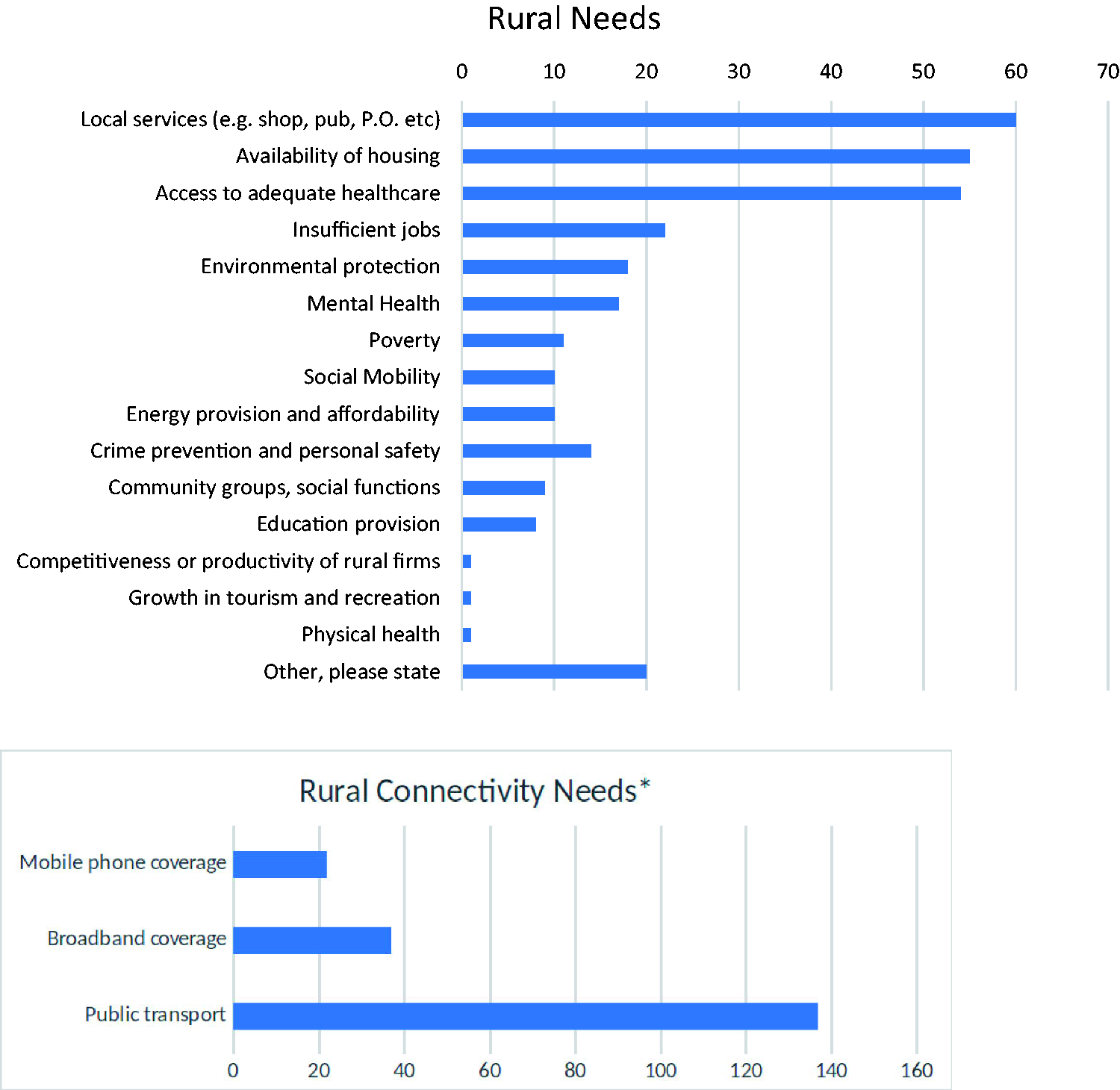
Rural Needs identified by the Rural Services Network survey (n = 172; respondents were asked to select up to three answers from the full list below and the number on the x axis indicates the total count for each response). *These three “rural needs” were part of one list in the survey but are separated out here because these represent the connectivity needs to access other key services and needs above.
The open comments section of the questionnaire along with the other qualitative research allows us to elaborate on these rural needs. To help categorise different categories of rural mobility demand, we focus on younger people, older people and business needs.
Younger people. It is well documented that affordable housing is a problem for many rural communities (RSN, 2019) and this was echoed by a number of concerns that a “lack of affordable housing and job opportunities for younger people” is “stripping young, working people from our communities”. Other responses commented that the problem of affordability is compounded by “a lack of services such as GPs without travelling significant distances” and that in many rural areas “There is no bus service at all in the evenings”.
Our focus group with 16–18 year olds in rural Lincolnshire confirmed the limitations of public transport outside of regular working hours, especially for social journeys where parents were often relied upon for lifts. The group felt that learning to drive was still the only realistic option to overcome the challenges of living remotely. When asked how best to improve transport for their age group, cheaper driving, especially car insurance, was the most popular suggestion. There was also a strong desire to see greater investment in safer cycling routes in rural areas both in terms of the quality and maintenance of roads as well as the provision of safe routes physically separated from fast-moving and large vehicles on rural roads. The ability to cycle safely to the transport interchanges and have the option to securely store their bicycles, or take them on the bus/train, would encourage more people to consider public transport as a realistic option.
For younger people, accessibility is also linked to social mobility. The Social Mobility Commission highlighted that people in rural England, and particularly rural areas of the Midlands, suffer low levels of social mobility, largely as a result of more limited choice of education (Social Mobility Commission, 2017). This is represented in only 13% of disadvantaged young people in former industrial areas and 14% in remote rural coldspots progressing to university compared with 27% in social mobility hotspots. Poor educational outcomes for young people from disadvantaged backgrounds are linked with weaker labour markets, higher shares of low-skilled, low-paid employment and poorer productivity (Atherton et al., 2010) compared to other regions. Where transport is poor, particularly in rural and coastal areas, the opportunities for young people to become socially mobile are further restricted.
Older people. Our findings echoed a lot of rural studies literature (De Koning et al., 2017; Kelly et al., 2019) which shows that “Loneliness is a huge problem” for older rural residents. As a result, “a lot of widows and widowers … rely on non-existent public buses, kindness of neighbours or increasingly community transport to get to the health centre, hospital and shops”. This spills over into other health impacts because “the lack of affordable public transport can prevent people travelling even relatively short distances to access social and medical services”. It was also noted that, “with a higher than average ageing population, it is often difficult for the true residents to access healthcare and basic daily service”. This comment also implies that there are different types of residents and that these “true” residents (presumably longer-term residents who have aged in place and have lower incomes than others who choose a rural retirement retreat) are more severely impacted by loss of services.
Isolation and distance effects for healthcare are far from trivial. Declining local service provision in remote rural areas over the last 10 years can contribute to a downward spiral in health and wellbeing (Skerratt, 2018). The relative inaccessibility of health services in rural areas have been linked with decreasing use of services (Local Government Association and Public Health England, 2017) and reinforce a culture of stoicism (Kilpatrick et al., 2012). Together, these factors result in patients being sicker before they seek help and also to later diagnoses of serious conditions (Campbell et al., 2001; Murage et al., 2017). Many older rural residents do not seek out preventative health care or even acute treatment, and in some cases avoid seeking care even in moments of emergency and health crisis. Amongst the reasons given for this were a “make do” attitude, reluctance to make a fuss and the explicit and implicit fear of emerging age-related health issues (Hart, 2016).
Faced with an ageing population, and more rapid ageing in rural areas, innovations that can provide essential services and sustain health and wellbeing are increasingly needed. The threat of this “demographic time-bomb” (Vettori, 2010) can overshadow some of the more positive aspects of ageing rural populations where individuals offer considerable energy and expertise to community activities, engage in part-time and voluntary work and bring significant disposable income to support local services and leisure businesses. To support this, transport and digital connectivity is important to enable their full participation in local economies, not just to address health needs.
Rural businesses and employment. The rural economy is now home to a wide range of small businesses engaged in multiple networks and supply chains beyond traditional land-based sectors (DEFRA, 2018). Diverse markets and increasingly agile business models require equally flexible mobility and connectivity for rural entrepreneurs, their customers and employees. Factor in the growth of zero-hour contracts and the expansion of the gig economy (Department for Business, Energy and Industrial Strategy, 2018), it becomes clear that more flexible working arrangements will continue to reshape mobility needs across rural areas. The project workshops also identified automation and industrial change along with advances in agri-robotics as major trends that will change both the types and locations of future jobs, with major implications for rural mobility planning.
Research has shown that rural small businesses tend to favour private road transport, identifying the thinness of rural public transport as a barrier to effective recruitment, growth and productivity. In rural areas with relatively high house prices, lower wages and sparse rental sectors, the dependence on private transportation among rural employees is exacerbated. One business representative organisation interviewed told us that, alongside mobility innovations, labour market solutions need to include affordable housing, especially short-term and flexible rental properties.
Interviews also highlighted the importance of social and cultural opportunities for workers to relocate into rural areas. One businessperson commented that “With no trains in the evenings or on Sundays, young people don’t want to work here because they can’t get out to other places where there’s more going on”. While the “Creative Class” literature was traditionally urban-centric (Florida, 2002) more recent studies have charted the emergence of a rural “creative class”, identifying the importance of cultural as well as natural amenities for attracting and retaining creative and skilled individuals (McGranahan et al., 2011). Increasingly, the amenity value of rural places is seen as a critical ingredient for smart specialisation models of economic development in rural areas too, where “smart growth” is based on education, knowledge, research and innovation (Naldi et al., 2015). This can all be strengthened by effective mobility options for rural residents and employees which might go some way to alleviating high levels of youth outmigration that threaten the sustainability of many rural communities (Green et al., 2009).
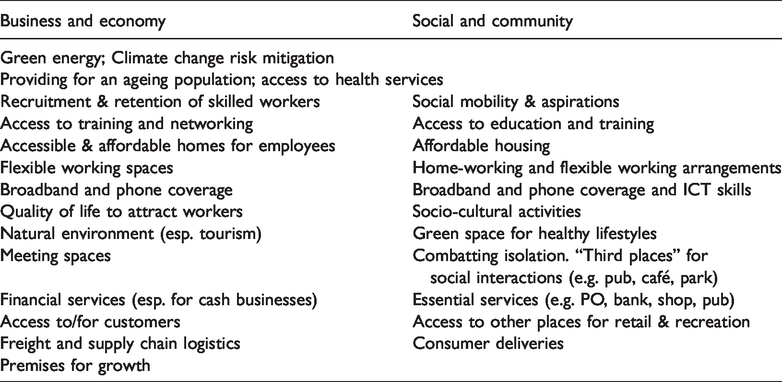
Drawing together these different categories of rural need, it becomes apparent that there are many synergies and distinctions between community and business or old and young may be unhelpful. Rather than fragmenting demand into separate categories, a holistic approach to understanding rural needs, as summarised in Table 1, may be more valuable for shaping future rural mobility strategies.
A framework of rural needs.
Tools for addressing rural mobility demands
This section reports the results of a horizon scanning study informed by public workshop consultations followed up by individual expert interviews and scientific literature review, seeking to determine the most relevant technologies that will affect future rural mobility. While the role of the car will almost certainly remain part of any solution (Bentley, 2019; Shaw and Stokes, 2016) a range of public transport alternatives and greener versions of personal mobility are needed too. The development of future rural mobility will be shaped by social, economic, digital and technological trends (Shaw and Stokes, 2016), all of which are captured in the findings below. It should be noted too that next-generation technologies will have cumulative impact on different places, with the potential to reach all elements of society (Cowie et al., 2020).
Enhancing existing transport: Data science, social and organisational innovations
The project workshops frequently identified opportunities to make more effective use of existing vehicles and infrastructure. Separate public transport budgets including NHS, education, infrastructure maintenance and refuse collection lead to the fragmentation of supply, so many vehicles owned by local community groups sit unused for large periods of time. Social innovation is happening, such a as a Dutch football club redeploying its minibus for community travel in midweek (Dutch academic interview) and new forms of car pools and car share schemes, adopting Uber-style App-based technology. Trials are taking place in rural communities, co-ordinated by Parish Councils (e.g. Forest Row, East Sussex), rural employers (e.g. Kingspan, Herefordshire) or outsourced to social enterprises (e.g. Co-cars in the South West of England) but these remain scarce due the inertia caused by ingrained personal mobility habits.
New technology allows for vehicles to be shared or hired out more easily with real-time tracking, demand prediction and digital scanning to check for damage, reducing handover costs. Humans’ and goods’ locations can be tracked though a transport system. Electronic payments made automatically in response to tracking systems can further reduce transaction costs. Electronic micropayments, as enabled for example by blockchains (Wu et al., 2019), can also “stream payments continuously to pay for services in real time as they are used” (Blockchain trader).
These advances are seeing the emergence of smart timetabling and integrated ticketing to cover full journeys that may encompass two or more modes of travel (e.g. a bus into town and an e-bike hire to the office) under the banner “Mobility as a Service” (MaaS). MaaS has been linked with the potential deployment of AVs as well as the integration of digital information platforms to plan and deliver multimodal mobility options (including car sharing, ride hailing and bicycle hire) for point to point trips including first and last mile travel to public transport journeys together with a single payment platform for the user (Hensher and Mulley, 2020). The likely balance between different modes of transport within MaaS systems remains hotly debated, but it is clear that the sparse transport infrastructure and populations in rural places will bring limitations to the effectiveness of services that can genuinely provide “door-to-door” personal transport solutions. MaaS remains a strongly urban-led system reliant on a high density and frequency of users where the commercial reality means that: “the sparseness of demand and also the car availability make these [shared mobility] solutions less valuable in rural areas compared with cities where the percentage of car owners is smaller” (Transport consultant).
The big advantage of MaaS is that it reduces the need for such widespread private ownership of transport and potentially “improves social inclusion, reduces isolation and improves access to amenities such as health and education, employment, culture and other social institutions for everybody” (European Metropolitan Transport Authorities, 2019). Innovative thinking is needed to design a rural version of MaaS where different forms of rural transport and different interchanges, equipped with suitable digital infrastructure, are integrated into an effective strategy for a smart countryside.
Allied to MaaS, data science can provide more detailed understandings of private and public transport journeys, by fusing data from transport such as ticket data, car number plate and face detections around a transport network with other sources of information such as users’ census, social network and search engine, mobile phone location tracking, employment and medical data to predict likely future journeys (Fox, 2018). Mobile apps also make it easier to ask users explicitly to pay for and provide feedback on services, including immediate requests for personal on-demand transport and longer-term requests for changes to scheduled services.
While traditional transport modelling is heavily based on aggregate traffic flows, predictive analytics enables a finer-grained analysis, such inferring the exact origins, destinations, and routes taken by individual users, and the utility functions of individual users for different journey and journey time options (Kottayil et al., 2019). Once utility functions for all individuals (or a suitable sample) are known, they can be used to inform all kinds of optimisations to the transport system, both in terms of infrastructure and strategies to shift traveller behaviour. Modelling could be used to develop new routes and schedules. One suggestion is to create “small-world” networks that minimise the required number of changes between nodes in a network (Ganis et al., 2016), another is to optimise hierarchical structures with faster, more frequent links between key nodes. Fundamental to such models, however, is the provision of safe, convenient and pleasant sites for transport changes. Social interventions might include the offer of free coffee and Wi-Fi at a transport interchange, targeting individual behaviours, or adjusting shift patterns for public sector workers which could manipulate aggregated demand.
Even where fast internet access is generally available to rural buildings, a smart countryside remains fundamentally different from smart cities due to its sparseness. The smart city concept is based on monitoring and communication with every individual transport user at all times, for example using many cheap sensors and communications relays (known as “internet of things” or “IoT” devices) which can provide complete coverage. In urban areas it can be cost effective to attach such tools to existing infrastructure – for example attaching IoT devices to existing streetlight poles and connecting to their electricity source and a Wi-Fi network. By contrast, the smart countryside will not in the foreseeable future be able to obtain such complete data due to a combination of low density of users and areas of poor electrical and digital connectivity (Transport Consultant). As a result, data science methods for the smart countryside need to be qualitatively different from smart cities and apply more conventional statistical methods to make inferences about what is happening in the un-monitored regions (Kottayil et al., 2019). Add to this the fact that rural councils often have relatively lower budgets for transport infrastructure (Transport Consultant), lagging innovation in rural transport is perhaps not surprising.
Vehicles: Micromobility, electric cars and active transport
New battery technology has enabled a new class of electric micro-mobility vehicles, which can play roles somewhere between traditional cars and active walking and cycling. These include e-bikes, e-scooters and mobility scooters.
The ranges and reliability of these vehicles, together with their integration into IoT infrastructure for tracking and payments to manage their use, has been targeted at urban applications. However, our research identified genuine potential for rural deployment such technology: “The mix of last mile vehicles and hubs could have a major positive effect on the lifestyles of single-car families” (Hereford workshop). “It won’t be too long before passenger version of our micro vehicles could carry people from a farm to the village hall.” (Micro-mobility SME).
It is not yet known how these will translate to rural needs, where journeys may be longer, getting help in a breakdown may take longer, and communications coverage may be patchy. The commercial reality was summed up by one interviewee who commented: “Until now we have focussed on urban areas for commercial considerations. We haven’t pursued rural yet as haven't found a commercially productive option” (Micro-mobility SME).
Related battery technologies have also enabled larger commercial electric cars, which depend on local infrastructure of public charging points. Rural areas have sparser density of users so it is harder to provide this coverage. Synergies with electric micromobility may be useful if a single local charging station could be used by both types of vehicle, for example allowing both local residents and visitors to charge their “first-mile” vehicles or their cars. Cycling, including electric bikes, provides another first-mile option but two major deterrents to cycling among our focus group of 6th form students were the lack of dedicated, safe cycle routes away from traffic, and the poor maintenance of many rural roads.
Autonomous vehicles
Self-driving cars (Urmson et al., 2008), self-driving buses (Madigan et al., 2019) and last-mile delivery vehicles (Buchegger et al., 2018) have all been trialled in urban areas, suggesting that the epicentres of transformative change will be urban rather than rural centres. It should be noted here that self-driving trains already function well in closed networks such as airport terminals but the roll-out of automation in the rail sector encounters many wider political issues that go beyond the scope of this article.
Rural areas are seeing widespread trials of agri-robotics, including self-driving tractors and smaller-scale harvesting robots. As with urban vehicles, these encounter legal barriers when using public roads or footpaths (Basu et al., 2020; Brodsky, 2016) but in controlled and monitored field spaces, their potential to reduce agricultural labour requirements is considerable (Lowenberg-DeBoer, 2020). Focusing on personal mobility and community needs, the scope for other forms of automation in rural areas is limited by commercial realities of scale and rates of return on investment (National Bus Operator) and a range of environmental factors. As one Micro-mobility SME owner explained: The limiting factor is that we have a solution to a distinctly urban problem, pollution and congestion. Rural has different needs, there is less congestion and pollution. We would go back to first principles from a blank sheet rather than tweak existing solutions. Connectivity: As with data science, urban AVs systems may be heavily reliant on complete and continuous connectivity to surrounding infrastructure, such as IoT devices placed around their operating areas and 4G radio. Most urban AVs are not “autonomous” in the sense of operating independently from this support structure, including remote monitoring and potential to take over control by human operators at a base location. Hence the AV task is much harder in rural areas, requiring true autonomy for at least some parts of journeys where communication is lost. Variability of rural space: Rural areas may contain more varied and more unexpected objects and events than more heavily monitored, maintained, and legally regulated urban areas, which require more “common sense” for human drivers to negotiate. On the other hand, rural areas may also be less varied, making navigation harder, for example it is hard to look at a picture of a random rural road and know where it is, unlike urban images which often contain lettering and other helpful landmarks. Distance: “Last mile” robots in urban areas serve routes traversing a small area focused on a central space allowing essential facilities to support the fleet to be co-located nearby. The rural analogue of “first mile” robots – which would transport people and goods between the local village or market town interchange and their local homes and businesses – would have to make do with smaller local facilities at their bases, without full time staff physically on hand to support them. The rural “first mile” may also be significantly longer than a “mile”. In one scenario, these vehicles operate at village level, where the village may have a hinterland of several miles. In another scenario, they operate from the market town and need to cover a larger hinterland including several villages.
During the workshops, the appetite for more aerial solutions was surprising. While completed trials of drone-taxis in Dubai (Lenton, 2018) and Singapore (Ong, 2019) may still feel like science-fiction to most people, the potential for drones to deliver essential small items such as medication was viewed quite positively: “The use of drones in rural areas […] looks like good news!” (Midlands Connect Officer). Rural areas are advantageous for drones as there are fewer people below their flightpaths, and fewer other demands on the airspace compared to urban areas. However, when they need to travel longer distances, they encounter legal problems requiring human line-of-sight to all UAVs operated manually or autonomously. During the recent Covid-19 crisis, drone-deliveries of essential medical supplies were trialled in Scotland and the Isle of Wight, with some relaxation of these legal requirements (Guardian, 2020) which could pave the way for new developments in rural applications.
An interviewee also explained how “Drones may also be particularly useful in the smart countryside as a way to augment static sparse sensor networks with active mobile sensors” (Local Government Transport Planner). Drones can observe traffic both from the sky and from “perching” on the ground around a rural network. The ability to deploy sparse sensors around the network in this way may be cost-effective in cases where complete static coverage of a rural network is not.
Mobility Innovations and their potential for addressing rural needs
In this section, we assess the opportunities and limitations associated with anticipated changes in rural mobility and align them to the needs of different sections of rural society as set out above.
As the fourth domain of mobility, telecommunications present both competing and complementary solutions for rural isolation. Communication tools can reduce the need for personal mobility (e.g. e-health; tele-conferencing, e-retail) and help to overcome the disadvantages of distance (e.g. Kenyon et al., 2003), thus, in a well-connected area they represent substitutes to travel. However, new transport technology also depends upon high-speed, reliable internet connectivity, both wired (e.g. fibre optic cables) and mobile (e.g. 4 G radio) and upon people having the skills and confidence to use it. This exacerbates the “rural penalty” (Malecki, 2003) with poorer transport infrastructure and the slower uptake of innovations such as smart ticketing, real-time bus arrival information, dynamic timetabling, and AVs going hand in hand with under-developed telecommunications infrastructure (Philip et al., 2017; Salemink et al., 2017; Velaga et al., 2012). The stark commercial reality was captured by one interviewee saying, Until we get sufficient [high bandwidth Internet] coverage which may well again be unaffordable compared to the density that you get in a city, a smart countryside will just not happen, it just doesn’t make sense. It will be smarter, but not as smart as cities. (Transport consultant)
Unbalanced development of transport and telecommunications is not simply about equality for rural inhabitants but the rural economic impacts reach across wider supply chains and labour markets – including those firms exporting products out of rural areas. The interdependence of rural and urban regions, where resources, labour, trade and knowledge all flow in both directions (Bosworth and Venhorst, 2018; Lichter and Brown, 2011), demands that effective communication links exist. For rural regions to share in the advantages of networked urban–rural systems, developments in rural mobility must keep pace with, and connect effectively into, urban systems. Interdependent urban and rural regions require integrated systems where the “seam” is invisible to the traveller. This is where MaaS may have a role, but our research identified the need for integrative transport hubs to service peripheral regions. Drawing inspiration from rural transport hub experiments in Belgium (https://mobihubs.eu), our workshop discussions generated considerable enthusiasm for the potential to integrate digital and social facilities within transport hubs. The premise of such hubs is that they might help to address social and community needs, such as providing footfall for businesses and spaces for local social interaction, as well as enhancing transport provision for all sections of rural communities. Therefore, the final component of our “toolkit” (Figure 2) sets out the potential of hubs alongside physical transport and digital connectivity solutions to address rural needs.
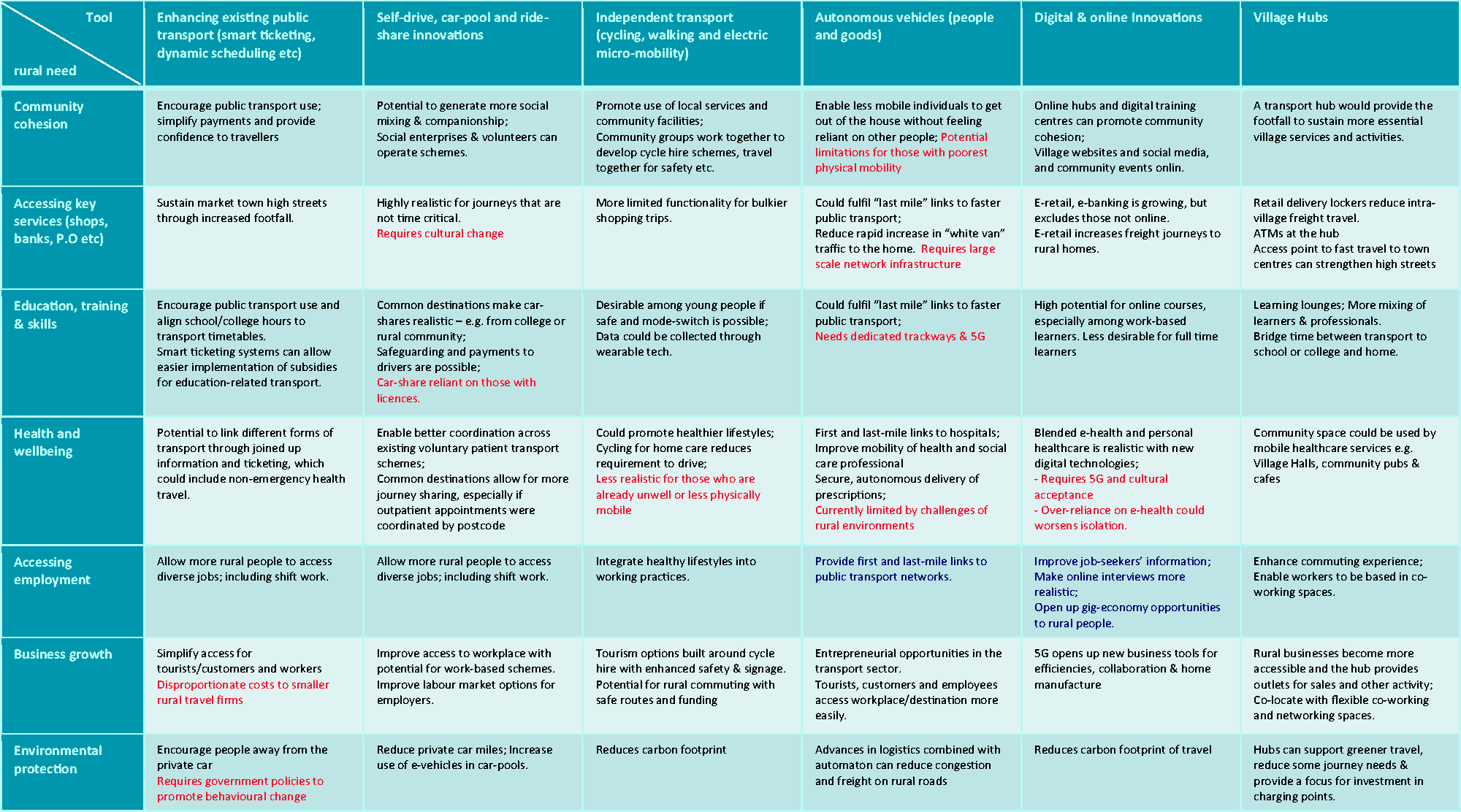
A toolkit aligning rural needs with emerging mobility innovations.
While communication technologies and strategic rural hubs can improve the supply-side infrastructure, the demand side must also adapt. Just as MaaS has been described as “supply-bundling” (Guidon et al., 2020), bringing together different mobility options to simplify the user experience, there is also scope to adopt the idea of “demand bundling” which has proved effective at the community scale for attracting internet providers to service rural areas (Salemink et al., 2017). Bundling demand across the categories of rural need identified above can increase the feasibility of providing transport but it requires action from both local communities and transport providers. Currently the limitations on certain providers only being able to service particular transport needs (e.g. those booking voluntary hospital transport are not able to combine a trip with an essential shopping visiting; community transport may not bypass commercial routes) results in a messy system of provision with vehicles not used to their optimal capacity. This is where data science and mobile Apps offer new opportunities as better knowledge of demand can be gathered much more quickly, allowing car-share travellers to be connected just hours before a journey, or allowing local government and transport operators to design schedules informed by demand.
From a community perspective, bundling together the demand for transport could also facilitate the need for physical spaces where that demand congregates. The Future of Rural Mobility Report (Midlands Connect, 2020) highlights the scope for rural mobility hubs to develop beyond simple transport provision to support other forms of mobility with the provision of a secure retail delivery hub, health triage centre or co-working spaces for commuters and students. Additionally, if other local businesses are able to capitalise on the increased footfall, facilities such as cafés, children’s nurseries or other leisure and retail outlets could become viable due to the increased economies of scale created by the hub. For example, a comfortable, efficient co-working lounge might allow a family to travel together to a rural hub at the time of the children’s school bus, with one parent catching up on emails before the next train scheduled 45 min later and the other parent taking a gym class before his or her bus to work an hour later.
The development of a smart countryside is both social and technological. The findings of this project have strongly emphasised the social context into which new mobility technology may be deployed. To avoid a scenario where the impacts of urban innovations are negative ripple effects that hinder rural mobility and disadvantage rural people, local action is essential. One private sector interviewee commented, “The ‘deep rural’ is just too hard … In some places we might just have to give up and ask people to move a little bit up the transport hierarchy” (Transport consultant). If this is the likely market outcome, it is clear that communities need to act. Therefore, the toolkit in Figure 2 is designed to allow rural actors to consider how new technology might best be employed to meet local needs and to engage in dialogue with mobility providers of all kinds to assess the best solutions for rural areas. In particular, the design of the toolkit encourages local actors to consider how advances in mobility can meet the needs of different groups of people in rural areas – including businesses, workers, young people and retirees.
When considering the needs and options within the Toolkit, it is important to remember the profitability needs of transport operators, especially when advocating costly technological investments. A representative of a national bus company explained that the high proportion of non-fare paying users, the additional distances and the lower rates of use in rural areas all reduce profitability. As a result, larger companies cherry-pick the profitable, mainly urban, routes and leave local providers to fill the rural gaps. These local firms tend to run on lower profit margins without the capacity to invest in the latest technology. This was confirmed by a rural bus operator who explained that they “have to follow the lead of others” and they feared that the costs of having to install smart ticketing technology into their fleet would “practically finish us off” (Rural Bus Operator – SME).
Aside from personal mobility, the rapid developments in home delivery and digital access to services represent a different category of change. It has been suggested that the adoption of digital working methods since the Covid-19 lockdown has brought forward predicted rates of change by up to 10 years, highlighted the glaring need to bridge the digital divide (World Trade Organization, 2020). Similarly, more reliance on home deliveries and the acceptance of e-retail and contactless forms of payment and delivery will have a lasting impact. These developments appear to be ubiquitous across urban and rural space, subject to equality of mobile and internet connectivity, but there remain significant questions at the household level in terms of the affordability and skills needs to be part of a digital economy. The knock-on effect in terms of competition for rural businesses and the means by which both large and small rural producers reach their markets require further exploration.
It remains to be seen whether we will return to an era of multipurpose vehicles that transport goods and people into and out of rural places but once the data-science and physical infrastructure is in place, a number of exciting opportunities will emerge. As one interviewee noted, “There are an awful lot of white vans carrying a few parcels which feels very inefficient” (Transport consultant and former national bus operator employee). He continues to explain that the technology exists to improve efficiency but the co-ordination and “issues around licencing, governance, safety, pricing and those sorts of things” are dependent on politics, markets and legislation. While the fundamental needs of rural people can be served through technology, the higher order social and personal fulfilment needs (Maslow, 1943) require rural community leaders to embrace technology in ways that are inclusive and recognise the impacts that hyper-mobility and ubiquitous digital connectivity will have within their changing communities.
Concluding remarks
Despite the emphasis on digital and communications technology, mobility remains fundamental to a “smart countryside”, to address both functional and social needs. The pace and trajectory of change will depend on both the technological and socio-political infrastructure of different rural areas but, in line with community-led thinking, this study has identified a number of opportunities and resources to empower rural communities to improve their future mobility. Recognising the social value of mobility for different groups of travellers – not just the functionality of accessing goods and services, work, health and education – can help to sustain personal wellbeing. Therefore, we argue that the social function of mobility must be built into any future rural strategy. This falls in line with smart countryside thinking by combining the digital and social realms in ways that avoid excessive reliance solely on digital substitutes such as e-health or e-retail.
In relation to our guiding question, “How, and to what extent, will the essential needs of rural communities and businesses be served (or not) by new transport innovations?” the answer is dependent upon how new markets emerge in this rapidly evolving space. If private firms can choose to serve only the most profitable routes without obligations around inclusivity, it is likely that rural provision will lag behind. However, if innovators recognise the value of connecting rural areas into their networks from the outset, and if rural organisations can work together to better communicate the market potential that they offer, a more optimistic future could be envision. Critically, those representing rural areas need to respond quickly by vocalising future needs and opportunities before the hegemony of “urban-first” innovation logic becomes entrenched in the diffusion of new mobility technologies.
Practical recommendations from this research fall into three categories; the first requires better planning and governance, using data science and analytics to support more cross-sector delivery of transport to meet a wider range of rural needs. The second is to invest in the infrastructure and technology that is most suited to rural environments and will be most effective at meeting rural needs – this includes digital infrastructure to enable transport innovations and to act as a more effective substitute to physical mobility needs. The third is to recognise the need for improved regulation in relation to equality of provision for rural areas and to ensure that new technological advances can be introduced legally to serve rural communities. In each case, more international studies and cross-regional comparison can accelerate learning while more localised feasibilities’ studies need to draw on the growing evidence base to drive forward local changes.
Collective action through a consortium of rural interest groups offers the potential for new mobility technology to transform rural living for the better. Without this, a fragmented approach could leave rural areas trailing in the wake of rapid urban-centric advances in mobility and once again left vulnerable to the uncertain impacts of exogenous change. Further research must therefore draw on international comparisons to gauge the environmental, social and organisational capacity of rural places to adopt a range of mobility and connectivity technologies. The legal, financial and organisational feasibility of hubs and other innovations for rural areas also require analysis. This socio-technological space remains under-explored in a rural community context but must increasingly shift to the centre of attention, not just to support future rural mobility strategies but also as part of a wider appreciation of the dynamics of smart rural futures.
Footnotes
Acknowledgements
The authors thank the support of their partners as well as members of the Rural Services Network for helping us to access data and providing feedback on our work.
Declaration of Conflicting Interests
The author(s) declared no potential conflicts of interest with respect to the research, authorship, and/or publication of this article.
Funding
The author(s) disclosed receipt of the following financial support for the research, authorship, and/or publication of this article: Midlands Connect funded the original study from which this paper is developed.
