



Abstract
In this article it is argued that long-term economic growth can be secured by the continual re-invention of the technological and consequential economic bases of local economies. Starting from the perspective of evolutionary path dependence in the development histories of new technologies, the roles of innovators in the creation of new technological pathways are theorised. Historical case study evidence is then presented of the contributions of pioneering innovators to the ongoing long-term production and employment growth in the local economy of Oxfordshire over the last two centuries. Oxfordshire provides an empirical example of one of the more successful local economies in the UK. It is concluded that much of this success has been based on the activities of a small number of innovators who have used national and international knowledge networks to import cutting edge technologies of their time into the local economy in order to start world leading industries in the County. These have formed the bases of its long-term economic performance.
Keywords
Introduction
Evolutionary economic geography, exemplified by Boschma and Martin (2010), has made significant contributions to our understanding of the historical evolution of technologies and the industries that are based on them, combined with distinctive analyses of why those industries are located in some places rather than others. In these studies, neo-Schumpeterian theories concerning the roles of technological innovation in driving economic evolution have been prominent in providing heterodox understandings of the historical growth and change of real as opposed to neo-classical hypothetical economies (e.g., Dosi et al., 1988; Witt, 1993).
One of the key concepts in evolutionary economics is ‘path dependence’ (Arthur, 1989, 1994; David, 1985, 1986). This model has been influential in explaining why some technologies and the industries based upon them have developed and later declined and, in some cases closed altogether. It has not been so convincing in explaining how and why new technological pathways are created in the first instance. One response to this problem has been to argue that human agency plays a significant role in the initial creation of new technological pathways. Bijker et al. (1987), Garud and Karnøe (2001), Garud et al. (2010) and Simmie (2014) have argued that reflexive agents play a key role in starting the processes of new technological path creation.
This evolutionary path dependence and new path creation approach offers promising ways in which to theorise the long-run development of local economies. It provides possibilities for understanding why some previously successful urban economies, based on the technologies and industries of previous centuries, have subsequently been unable to escape being locked-in to these declining industries. Conversely, it also offers possibilities for explaining why cities in which a series of radical new technological pathways and industries have been created over decades, if not centuries, long-term local economic growth has been maintained. This article focusses on the latter of these two possibilities.
In the light of these remarks, the central question of this article is ‘in conditions of path dependence, what roles do reflexive agents play in the creation of new technological pathways and long-term economic growth in local economies?’ In answer to this question, it is argued that the commercial deployment of new technologies is the result of the actions of human agency in particular inventors and innovators. In this article, inventors are defined as the discoverers of new knowledge and technologies. Innovators are defined as agents who combine new knowledge in the form of technological inventions and discoveries with seed and early-stage capital to create new divisions in existing firms, spinouts or start-ups that bring new or improved products on to the market. These then form the bases of successive waves of local economic growth.
To explore these arguments, the article is divided into three substantive sections followed by some conclusions. In the next section, the theoretical contributions of combinations of new knowledge by innovators to the creation of new technological pathways are discussed. This is followed by a brief section on the methods and sources of the historical information employed in this study. The third section examines the historical roles of specific innovators in the Oxfordshire economy over the last two centuries or so. This provides a case study of the ups and downs of long-term economic growth in one of the most successful local economies in the UK. This is followed by a concluding section.
Theory: Innovators and new technological path creation
According to David (1985, 1986) new technological pathways start because of small ‘historical accidents’, ‘chance events’ or ‘random’ actions. Subsequently one or more of these chance events is contingently selected for reasons not immediately connected with the original event. When that happens path dependence occurs as the original accidental events become progressively ‘locked-in’ as the development pathway through the operation of various autocatalytic ‘network externalities’ (David, 1985, 1986) or ‘increasing returns effects’ (Arthur, 1989, 1994). The final feature of this model is that, once lock-in has occurred, it is assumed that a technology, industry, institution, or industrial location pattern will persist until such time as it is disrupted by an ‘external shock’.
The canonical model of path dependence has been summarised by Vergne and Durand (2010). They define path dependence narrowly as ‘a property of a stochastic process which obtains under two conditions (contingency and self-reinforcement) and causes lock-in in the absence of exogenous shock’ (Vergne and Durand, 2010: 737). The main characteristics of this canonical model are summarised in Figure 1.
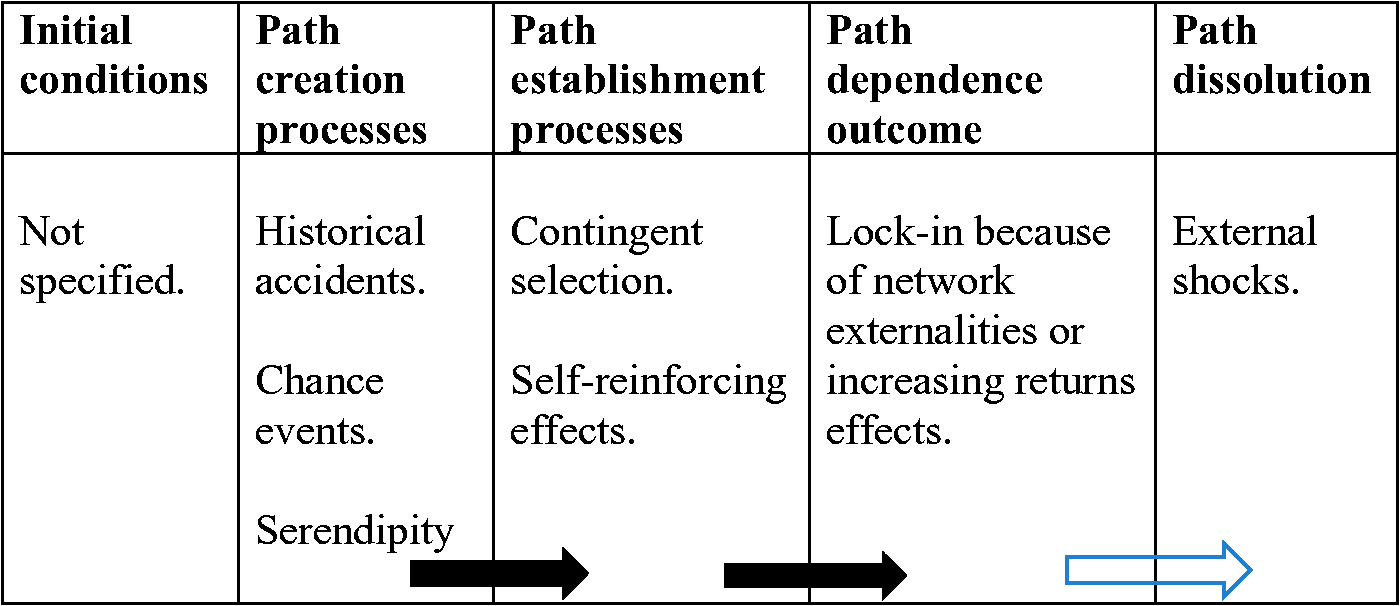
Basic economic model of path dependence. (After Arthur, 1989, 1994; David, 1985, 1986; Vergne and Durand, 2010. Arrows indicate uni-directional evolutionary development of pathway towards lock-in.)
In this model, emphasis is placed on chance and serendipity as the explanation of how new technological pathways start in the first instance. In the classic Schumpeterian (1939, 1942) theory economies are shocked out of their existing development pathways by external events such as recessions and depressions and new technological pathways are started because of processes of creative destruction. Later Arthur (1987, 1994) argued that the deployment of new technologies takes place in spinouts and start-ups, while David et al. (1998) attributed their emergence in particular places to localisation economies. But, as Martin and Sunley rightly point out ‘placing too much emphasis on random accidents as the sources of path creation constrains and undermines such causal explanation’ (Martin and Sunley, 2006: 428).
One theoretical response to this problem has been to argue that human agency plays a significant role in the initial creation of new technological pathways (Bijker et al., 1987; Garud and Karnøe, 2001; Garud et al., 2010; Simmie, 2014). This research adopts a sociological ontology and accords a significant place to the roles of knowledgeable agents and the considered ‘mindful deviation’ of entrepreneurs from established paths in explaining the creation of new technological pathways. Puffert (2000) goes further in arguing that the very existence of established pathways may make actors more eager and motivated to attempt to make their new technologies and ways of doing things the basis of new pathways.
This evolutionary new path creation approach offers promising ways in which to theorise the long-run development of local economies. It provides an understanding as to why, in those local economies in which a series of radical new technological pathways and industries have been created over decades, if not centuries, permanent lock-in to previous industrial structures has been avoided.
The long-term significance of the periodic introduction of ‘bunches’ of new, radical technological innovations in generating new waves of economic growth, was first identified empirically by Kondratieff (1935), who consequently gave his name to such long waves. Subsequent work by the likes of Hall and Preston (1988) and van Duijn (1983) has updated his studies to take account of the introduction of key technologies in the modern era. Two aspects of this work are important for the arguments of this article. The first is the significance of periodic ‘bunches’ of new technological innovations in kick-starting new waves of economic growth. The second is the timescale needed to study the full working out of these waves. This has been shown empirically to be around 50 years composed approximately of 25 years of growth followed by some levelling off as the technology reaches maturity and then, in some cases, lock-in and decline.
In recent times, such new path creation is often indicated by and correlated with significant rates of patent applications from the local economies and various forms of innovation in places like Cambridge, Oxford, Aldershot and Reading (Simmie et al., 2006: 88). In these local economies, declining historical industries have been replaced by the creation of new ones and, as a result, their local economies have maintained their overall long-term economic and employment growth (Swinney and Thomas, 2015: 10).
The connection between urban economic growth and innovation has been theorised by Frenken and Boschma (2007). They argue that local economic growth may be characterised as an evolutionary branching process of product innovations. In this theory, the introduction of radical innovations can lead to the creation of new industries by a branching process either within or out of existing industries. This can take the form of the creation of a new division within an existing industry or the spinout of a new firm from that same industry. One outcome of these processes is local firm growth and therefore local economic growth in the city in which it is located.
New technologies are characteristically based on the invention or discovery of new knowledge. The importance of new knowledge and learning to innovation was recognised in economic geography in the mid-2000s. Seminal work by Asheim and Coenen (2005, 2006) and Asheim and Gertler (2005) started what is known as the ‘differentiated knowledge base’ (DKB) literature. This examines the nature and types of knowledge deployed in innovation together with the ways and geographical extent of how it is shared between innovators.
A taxonomy of different types of knowledge was developed. This identified analytical, synthetic and symbolic knowledge as the key knowledge bases contributing to innovation (Manniche, 2012; Martin, 2012). As ideal types synthetic knowledge can be defined as knowledge to design something that works as a solution to a practical problem. Analytical knowledge can be defined as knowledge to understand and explain features of the universe. Symbolic knowledge is knowledge to create cultural meaning through transmission in an affecting sensuous medium (Asheim et al., 2005: 6)
The first claim of these studies was that these different knowledge bases were correlated with different types of regional innovation systems (Asheim, 1998; Cooke, 1998). Second, it was argued that the structures of the knowledge networks of the different knowledge bases led to differences in knowledge sourcing and its geographical extent (Aslesen and Freel, 2012; Broekel and Boschma, 2010; Coenen et al., 2006; Martin and Moodysson, 2011, 2013; Moodysson, 2008; Plum and Hassink, 2011). Third, it was argued that different types of knowledge tend to concentrate geographically (Martin, 2012), and fourth that knowledge bases concentrate in particular regions (Asheim et al., 2007). And, finally, that the institutional tissue underlying different knowledge bases is different (Asheim and Coenen, 2006; Zukauskaite, 2013; Zukauskaite and Moodysson, 2016).
In an excellent review and critique Boschma (2018) argues that this literature requires further development in at least two major directions. The first is a stronger conceptualisation of the role of history. This ‘… would bring it more closely to an evolutionary approach on regional diversification that is interested in the role of path dependence in particular spatial settings, and the role of pre-existing structures in shaping new growth paths in regions’ (Boschma, 2018: 12). In the second, he argues that a focus on how different knowledge bases are combined would generate new insights on new path development (Boschma, 2018: 14).
The focus in this literature on networks, systems and structures neglects the role of reflexive agents in the creation, maintenance and change of these phenomena. In practice new knowledge is not created by disembodied phenomena such as these but by numerous individual agents’ activities and interactions. The sum of these activities and interactions are what evolve as these intangible features of innovation.
To sum up the arguments of this article, first, human agency, rather than chance and serendipity, plays a critical role in the creation of new technological pathways. Second, empirical studies of long waves have shown the importance of bunches of new radical innovations in driving periodic up-swings in economic growth, and that the historical time scale required to study the full chronology of such waves is around 50 years. Third, the continual long-term economic growth of local economies is based on a succession of long waves each based on the introduction of new technological innovations that are unrelated to those of previous waves. Fourth, the connection between local urban economic growth and innovation is theorised as an evolutionary branching process in which radical technological innovations lead to either the formation of new divisions within existing firms and organisations, or spinouts from them. In this way firm growth is linked to local economic growth. Fifth, new knowledge is a key feature of radical innovation. Different types of knowledge are mobilised through networks, structures and systems. These mainly intangible aspects of innovation are themselves created by the activities and interactions of reflexive agents.
With respect to the important roles of human agency in the creation of new technological pathways, the first inventors and discoverers of new technological knowledge are limited in numbers and localities. In Schumpeter’s early work inventions, defined as the development of something that is entirely new, and which has never been created before, were regarded as generally exogenous to existing firms (Freeman et al., 1982). On the other hand, innovation refers to the introduction of fresh ideas and technology to an already existing product or service. In other words, innovation makes use of an invention in a unique way to make it popular among the customers. In this model, it is creative entrepreneurs who take the risks involved in turning the inventions into commercial innovations (Freeman et al., 1982).
It may take decades before this original knowledge is combined by innovators into commercial innovations. In this article, innovation is defined as ‘The commercially successful exploitation of new technologies, ideas, or methods through the introduction of new products or processes, or through the improvement of existing ones. Innovation is the result of an interactive learning process . . .’ (European Commission DG XIII and XVI, 1996: 54).
From this perspective, innovators are characterised by their capacity to identify and adopt new technologies that are starting to generate structural waves of expansion and growth elsewhere in the international economy. This requires the capacity to engage with international as well as local knowledge networks. Thus, as Bathelt et al. (2004) and Simmie (2003) have argued, for example, cities and regions are open nodes in their respective national and international economies and a combination of both local ‘buzz’ and multiple global, networks or ‘pipelines’ are required for the transfer, acquisition and combination of both new leading edge tacit and codified knowledge from the frontiers of technological and scientific knowledge.
These theoretical arguments are summarised briefly in Figure 2. They lead to the main research question addressed in this article which is ‘what do innovators as reflexive agents contribute to the successive creation of new technological pathways in a local economy?’
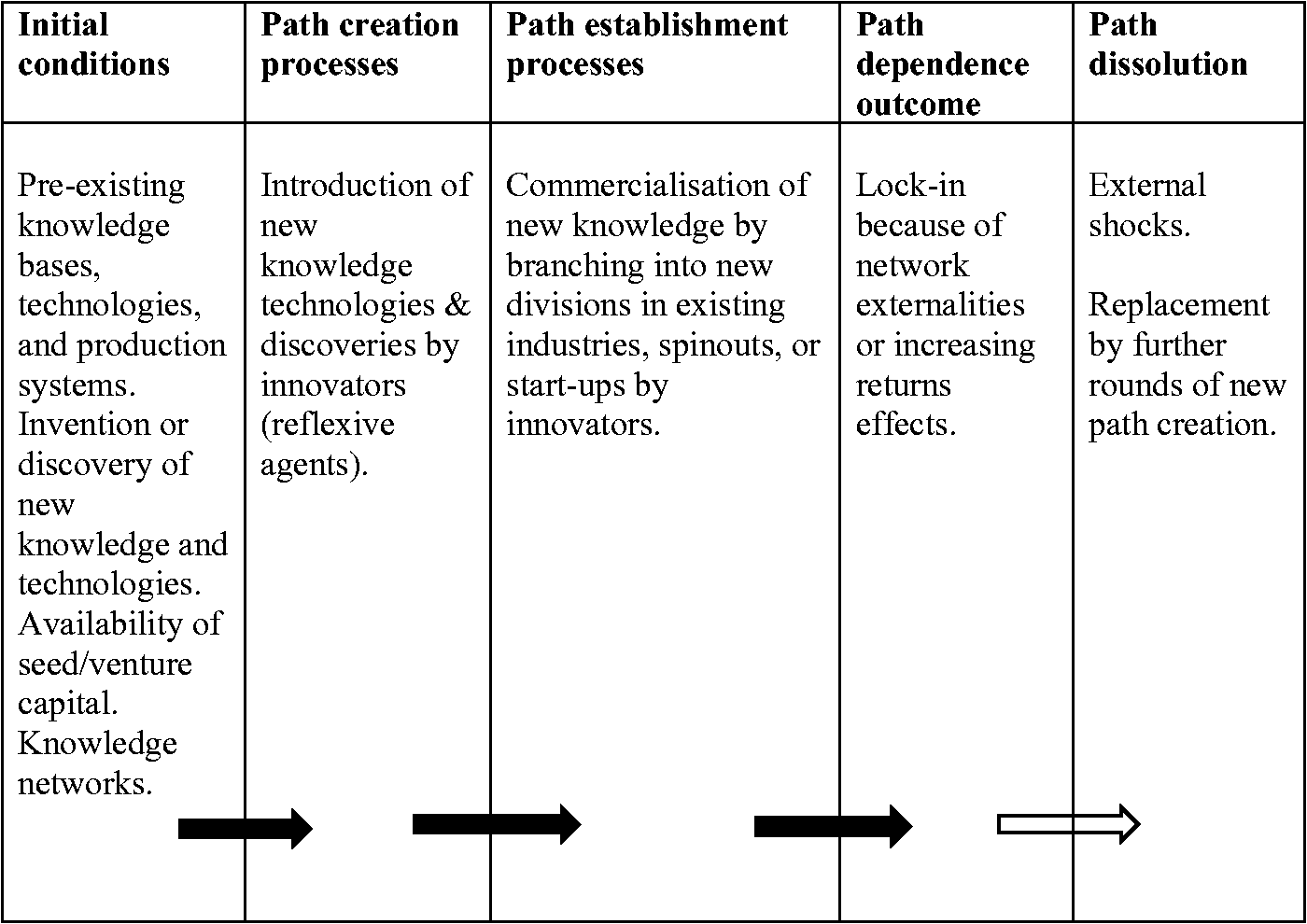
New path creation and path dependence. (Arrows indicate uni-directional evolutionary development of pathway towards lock-in and decline followed by possible replacement with new technologies and industries.)
Methods
Frenken and Boschma (2007) outline the general proposition that radical innovations lead to firm growth in the form of the creation of new divisions within existing firms or spinouts from them that, in turn, lead to urban economic growth. This article seeks to illustrate how such processes operate in the empirical evolution of the long-term economic history of a specific local economy. Long-term is defined here as the periods covered by all five Kondratieff waves starting in the late C18th up to the present day (see Hall and Preston, 1988: 21).
The first problem with this approach is to find examples of significant cities that have adequate records of their economic activities dating back this far, and that have managed to maintain an economic growth trajectory over such a long period of time. Some candidates are suggested by Swinney and Thomas (2015). Looking back only to the beginning of the C20th at the growth of employment in the 57 largest populations of ‘primary urban areas’ in England and Wales, they show that the old cities of Oxford, Cambridge and Reading were among the top six for long-term employment growth (Swinney and Thomas, 2015: 5). It is not possible to assess, without individual case studies, what contribution innovation made to this long-term growth. But Simmie et al. (2006) have shown that, out of a total of 27 Travel to Work Areas (TTWAs) in England and Wales with populations over 125,000, for which patent application data are available for the 1990s, Cambridge, Oxford and Reading were also among the top four cities for patent applications to the European Patent Office (ibid. p. 88). For the illustrative purposes of this research, the local economy of Oxfordshire, which includes the whole of the Oxford TTWA, together with Banbury, was therefore selected for case study analysis.
The local economy of Oxfordshire has never been dominated by a single firm. The second methodological problem is therefore to select which industries to focus on for the analysis of the historical creation of new technological pathways. In this instance three industries have been selected according to their general significance in different Kondratieff waves and their major contributions to economic growth in Oxfordshire particularly through their respective export performance. These industries are blankets to illustrate the first wave introduction of the factory system and water powered machinery. Motor cars provide an example of the third wave Fordist static assembly line production. Finally, superconducting magnets represent the rising significance of analytical science-based knowledge in the fifth wave. As with the technologies and industries driving successive Kondratieff waves, these were unrelated to each other. They have, however, overlapped chronologically.
The final reason for selecting Oxfordshire as a case study is that there are good historical records not only of the evolution to the local economy in general but also of the roles played by specific innovators in the serial creation of new technological pathways. Thus, for the selected industries and innovators key sources include for blankets Oxfordshire Museums Service (2020) and Townley (2004); for motor cars Overy (1976) and Oxford Centre for Global History (2020); and for magnetic technology the wife and co-founder of Oxford Instruments Audrey Wood (2001). These sources are used to track the roles of specific reflexive agents in the creation of new technological pathways and their resulting industries over the period from the late C18th up to the present day.
Case studies and analysis
Blankets
Initial conditions
The economic conditions existing in local economies prior to the introduction of radical new technological innovations are significant in establishing possibilities for new technological path creation. Even when these conditions are similar in different places, they do not, on their own necessarily lead to the introduction of new technologies. The woollen industry is a case in point. By the C17th different regions of England specialised in the production of different types of woollen cloth and products. These regions included the West Country making serges, flannels and broadcloths; the North making coarse and cheap cloth; and East Anglia making worsteds. They all used the domestic, or ‘putting out’ system of production. In this system spinning and weaving were carried out in individual worker’s homes. Despite these similarities, it was mainly in the North where this production system was replaced by the introduction of power-driven machinery concentrated in factories.
After the enclosures of the C18th, commercial agriculture developed in Oxfordshire. This provided possibilities for capital accumulation particularly by the Church, local aristocrats, and the university through its local and national endowments of land. This long-term generation of locally owned capital provided much of the seed and venture capital needed to fund the introduction of radical innovations in the three industries studied in this article.
The woollen industry also had a long history in Oxfordshire dating back to the C17th. Early on the Witney area specialised in the domestic spinning and weaving of wool from the local Cotswold hills into good quality blankets. This domestic production system provided the basis from which the radical new factory system of production using power driven machinery could branch out.
The connectivity of the original woollen industry in Oxfordshire was also significant in the establishment of national and international knowledge and trading networks. By as early as 1670s the local woollen industry had established both national and international markets in North America and Africa. Regular cart loads of blankets were transported to London every week both to sell there and export abroad. In addition to these business networks Witney also had two annual fairs established as long ago as 1202 and 1231. These provided intermittent venues for trade and the exchange of knowledge concerned with the woollen trade.
The streams and small rivers running off the Cotswolds and into the Thames Valley provided the potential source of power for the new machinery being imported into new mills around Witney.
Finally, the chance events that both Edmund Wright and Charles Early were born and bred in Witney. This introduces an element of serendipity into the possible explanations of why the new technological pathway of power driven mechanised blanket manufacturing was introduced in Oxfordshire rather than say East Anglia or the West Country.
The important initial conditions that opened the possibilities for the creation of a new technological pathway in the woollen industry in Oxfordshire therefore included the prior local accumulation of capital that provided seed and venture capital; the long-term existence of the traditional industry from which radical innovations could branch out; the connectivity of this industry through national and international knowledge and trading networks; and, finally, the ready availability of a source of power to drive the new machinery.
Path creation processes
The industrial revolution marked by the introduction of the factory system, and water powered machinery came late to Oxfordshire partly because of its distant location from the North. Richard Arkwright is credited with being the original inventor of the factory system. To accommodate his waterpower driven spinning frame patented in 1769, he built the first true factory at Cromford, near Derby. Further inventions and the subsequent adoption of the factory system and water powered spinning machinery in the woollen industry to accommodate them proceeded slowly but most notably in Yorkshire.
Meanwhile, in Oxfordshire, Edmund Wright and Charles Early were involved in the traditional local woollen industry. Despite its local nature, this industry had developed local, national, and international knowledge and commercial networks over many years. These networks enabled Wright and Early to learn about the potentially catastrophic competition they were facing from the ‘early adopters’ (Rogers, 1962) of the factory system and new powered machinery in the Yorkshire woollen industry. They were able to learn about the combination of new C18th inventions in machinery and waterpower that were being employed in the new factories that were being built in the North. Wright and Early were the key agents in bringing this new knowledge to Oxfordshire and deploying it to create a new technological pathway branching out of the traditional local system of production.
Path establishment processes
Wright introduced the new form of industrial organisation and power-driven technology at ‘New Mill’ near Witney in 1808. Much of the new ‘synthetic’ knowledge introduced there was embedded in inventions such as carding and scribbling machinery that was imported from manufacturers in Rochdale. The new knowledge and technologies that were introduced from Yorkshire and later Lancashire formed the basis of the creation of a new technological pathway marking a radical break from the past. These developments were funded by local seed capital accumulated by the innovators because of their involvement in the previous system of production.
Path dependent outcome
The pathway was developed by the subsequent importation of further new technologies including the spring loom, steam power and the coming of the railway in 1861. As a result, the new pathway experienced a period of positive path dependent development that was based on the development, from as far back as 1681, of a thriving export market in North America facilitated by the Hudson Bay Company. The mechanisation of production in Witney produced increasing returns that moved the industry in the direction of path dependent outcomes.
These increasing returns of the C19th attracted new firms into the development of the maturing pathway during the early C20th. At that time, James Marriott introduced a blanket wholesale business and James Walker, one of the largest blanket making firms in Britain established a new firm in Witney. As the pathway matured local actors sought to reduce competition by the introduction, in 1909, of a regulation that only blankets made in Witney could be labelled as ‘Witney Blankets’.
Path dissolution
By the mid-C20th, however, the industrial pathway in Witney had become locked-in to the manufacture of blankets despite the growing demand for duvets as an alternative form of bedding. Some attempts were made to diversify production, but the main technological focus continued to be locked-in to the faster and cheaper production of blankets. To this end, during the 1950s and 1960s, a second technological revolution introduced further local adaptations along the existing pathway. These adaptations were again based on the importation of new synthetic knowledge embedded in the form of technological innovations from Switzerland, the USA and Germany.
These path dependent technological adaptations along the existing blanket making pathway did not recognise the strength of foreign competition from a different product, the duvet, and cheaper production of blankets in third world economies with much lower labour costs. As a result, the local industry continued to decline. The last blanket making factory in Witney closed in 2002.
This evolutionary economic history from new path creation to dissolution is summarised in Table 1.
The evolution of the blanket industry in Oxfordshire.
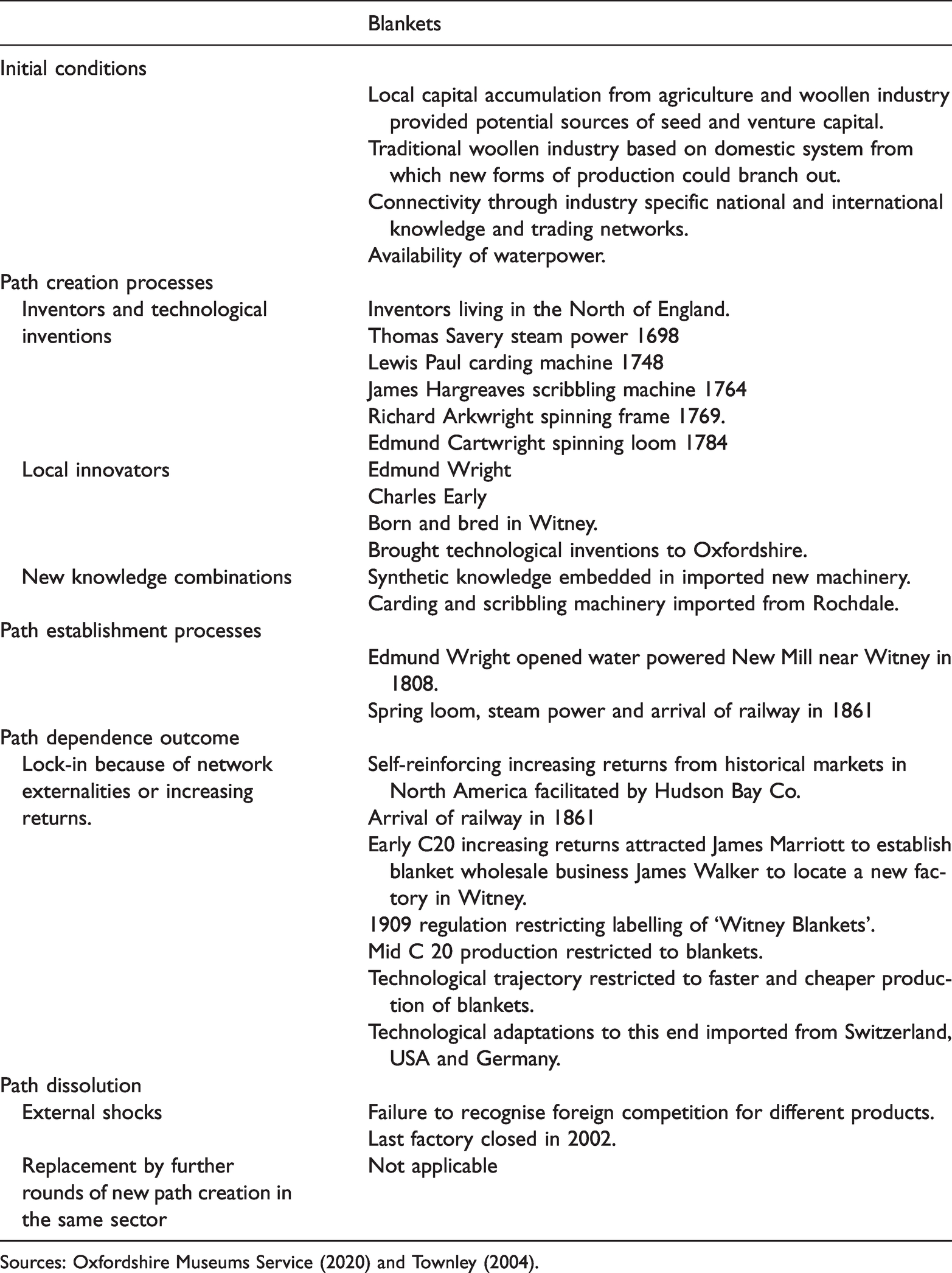
Sources: Oxfordshire Museums Service (2020) and Townley (2004).
Motor cars
Initial conditions
The earliest motor cars seen on British roads were imported from France. Frederick Simms and Evelyn Ellis imported a Daimler engined Panhard & Lavassor in 1895. Sims’s licences and plans to manufacture Daimler motors in Britain were taken over by Harry Lawson in 1896. He bought a disused cotton mill in Coventry where Britain’s first serial production car was made in 1897. Other cars containing French and German components were made by George Lanchester in 1895 and 1896. By 1900 the first all British 4-wheel car had been designed and built by Herbert Austin. Later he started what became Wolseley Motors in Birmingham which, for a time, was the largest UK car manufacturer. By the start of the C20th the new motor car industry had been established in Britain.
In Oxford, William Morris, a keen cyclist started manufacturing bicycles in a shed in the back yard of the family home in Cowley. They were displayed and sold from the front window of the house. He then moved on to the sale, hire and repair of the cars of the day. He started Morris Garages in Longwall Street, Oxford, in 1910. There he sold and serviced cars produced elsewhere in England. This provided the basis from which to branch into local manufacturing. This firm also provided trading and knowledge networks connecting not only to the developing national motor car industry in Birmingham, Coventry, and Manchester but also to international developments in the industry.
As with blanket manufacturing in Witney, local seed and venture capital was available because of previous rounds of capital accumulation in agriculture. In the case of the motor car industry, the Earl of Macclesfield, a major local landowner, provided William Morris with some of his initial capital.
Finally, there is also again the chance event that William Morris was brought up in Oxford. This serendipitous event helps to explain why a new motor car industry started in Oxford rather than many other areas that had both bicycle manufacturers and garages selling and servicing the cars of the day.
Thus, the significant initial conditions that provided the possibility to create the new technological pathway of motor car manufacture in Oxfordshire included the existing activities of the selling and servicing cars made elsewhere that provided branching possibilities into local motor car manufacturing. Connectivity through existing industry specific knowledge and trading networks to national and international inventions and manufacturing activities. The availability of local seed and venture capital arising from previous rounds of capital accumulation from commercial agriculture. And finally, the chance event that William Morris was brought up from an early age in Oxford.
Path creation processes
The key inventors of the new knowledge and technologies, that formed the bases of the new motor car industry, lived and worked in the C19th in Germany, France and the United States. In 1885, Gottleib Daimler patented a successful design for a high-speed petrol engine. Meanwhile, in the US, Henry Ford was experimenting with a self-propelled quadricycle that first ran in 1896.
After various false starts, he formed the Henry Ford Company in Detroit in 1901. This was reincarnated as the Ford Motor Company in 1903. Ford was an early adopter of static assembly line production. In 1908, he introduced the Model T automobile. This was the first affordable mass-produced motor car.
Three years later, the Ford Motor Company opened a car assembly plant in an old tram factory in Trafford Park, Manchester in 1911. It employed 60 people to assemble the Model T from imported chassis and mechanical parts and locally sourced bodies. Using static assembly line production techniques, it produced 6000 cars in 1913.
Also, in 1913, William Morris, using his own capital and that of the Earl of Macclesfield, a major local landowner, started Morris Motors in a former military college in Cowley not far from his old family home. This created the new pathway of static assembly line production of motor cars in Oxford.
Like Edmund Wright and Charles Early for blankets, Morris was not the inventor of the motor car or of assembly line production techniques. But, as an innovator, he did commercialise the knowledge and technologies of previous inventors and imported this radically new way of assembling motor cars through his external national knowledge and business networks.
Path establishment processes
Boschma and Wenting (2007) argue that the British car industry started in specific localities because of the presence of local related knowledge derived from bicycle manufacturing. But in Oxford, William Morris only made bicycles on a very small-scale artisan basis in a shed in the back garden of his parents’ home. More significant than this activity was his first commercial venture starting Morris Garages in 1910. This firm provided him with external knowledge and business networks linked to other car manufacturing localities in Britain. Morris used these external networks to import new knowledge embedded in major components almost all of which were bought in. Even from the early days very few components were manufactured in Oxfordshire. Initially engines were purchased from White and Poppe in Britain. But they were unable to supply the volume that Morris required so he had to import engines from Continental of Detroit. Gearboxes and axles containing embedded new knowledge were also imported from the USA.
One of the self-reinforcing factors that contributed to the path establishment process was also borrowed from Henry Ford. This was that the mass production of motor cars combined with the wages paid to the workforce meant that, for the first time, workers could and were encouraged to purchase their own products. This created some local demand for the new car which, combined with national and international demand, contributed to the development of economies of scale and increasing returns. As a result, by 1924, Morris Motors had become the largest car manufacturer in the UK with some 51% of the home market.
Path dependence outcome
The increasing returns generated by Morris Motors provided its founder with a great deal of surplus cash. So, as part of the path development process, he set about first buying up his suppliers and secondly his British competitors. In a further importation of technological knowledge from the USA, he started a joint venture with Budd International of Philadelphia and founded the Pressed Steel Company next to his factory in Cowley to manufacture car bodies. During the mid-1930s he acquired Wolseley, MG and Riley. Taken together these purchases created the largest vertically and horizontally integrated car plant in Europe at Cowley. By 1939 some 11,000 workers were employed in car manufacturing at Cowley. This rose to a peak of 27,000 in 1965.
After the Second World War a further externality factor contributed to the path dependent development of Morris Motors. At this time there were many raw material shortages in the UK. Steel was one of these. As a result, the Government of the day introduced a regulation that any manufacturers that were provided with steel, from the then nationalised British Steel industry, must focus their production on exports in order to bring down huge current account balance of payment deficits. As a result, by 1950, 75% of British car production was exported mainly into war damaged European markets.
Path dissolution
From the 1950s onwards the car manufacturing pathway in Oxford was subject to several threats and began to move towards path lock-in and decline. Poor management and labour relations were among the most serious of these threats. These were compounded by a series of mergers between, for example, the Austin and Morris Companies, in 1952, to form the British Motor Corporation. This promoted unproductive rivalry and competition between different parts of the new company. Further ‘rationalisations’ took place in 1968 involving a merger with Leyland to form BLMC. The company continued to decline and was eventually nationalised as British Leyland in 1975. Employment in the industry declined from 27,000 in 1965 to 3800 in 2011.
A further externality factor came into play as the long-term decline of the car company continued. This was rising UK land values. This was recognised by British Aerospace who bought the company for less than value of the land that it occupied. It then sold off much of the land including the original Cowley site of Morris motors in 1992.
Meanwhile the car manufacturing pathway in Cowley was renewed by foreign direct investment (FDI) first by Honda in 1979, and then by BMW in 1994. These firms introduced radical new production standards, just in time supply chains, together with modern management and labour relations. BMW has retained the old site of the Pressed Steel Company to revive the car manufacturing pathway in Oxfordshire by launching the new Mini in 2001. New knowledge has been introduced, particularly in the form of state-of-the-art robots from Sweden and Switzerland that make the plant one of the most automated car plants in the world. Some 80% of production is exported so that over a century after William Morris created the new technological pathway of motor car manufacturing in Oxford, it is still contributing to long-run economic growth in Oxfordshire.
The historical evolution of the motor car industry from its creation in 1913 to the present day is summarised in Table 2.
The evolution of the motor car industry in Oxfordshire.
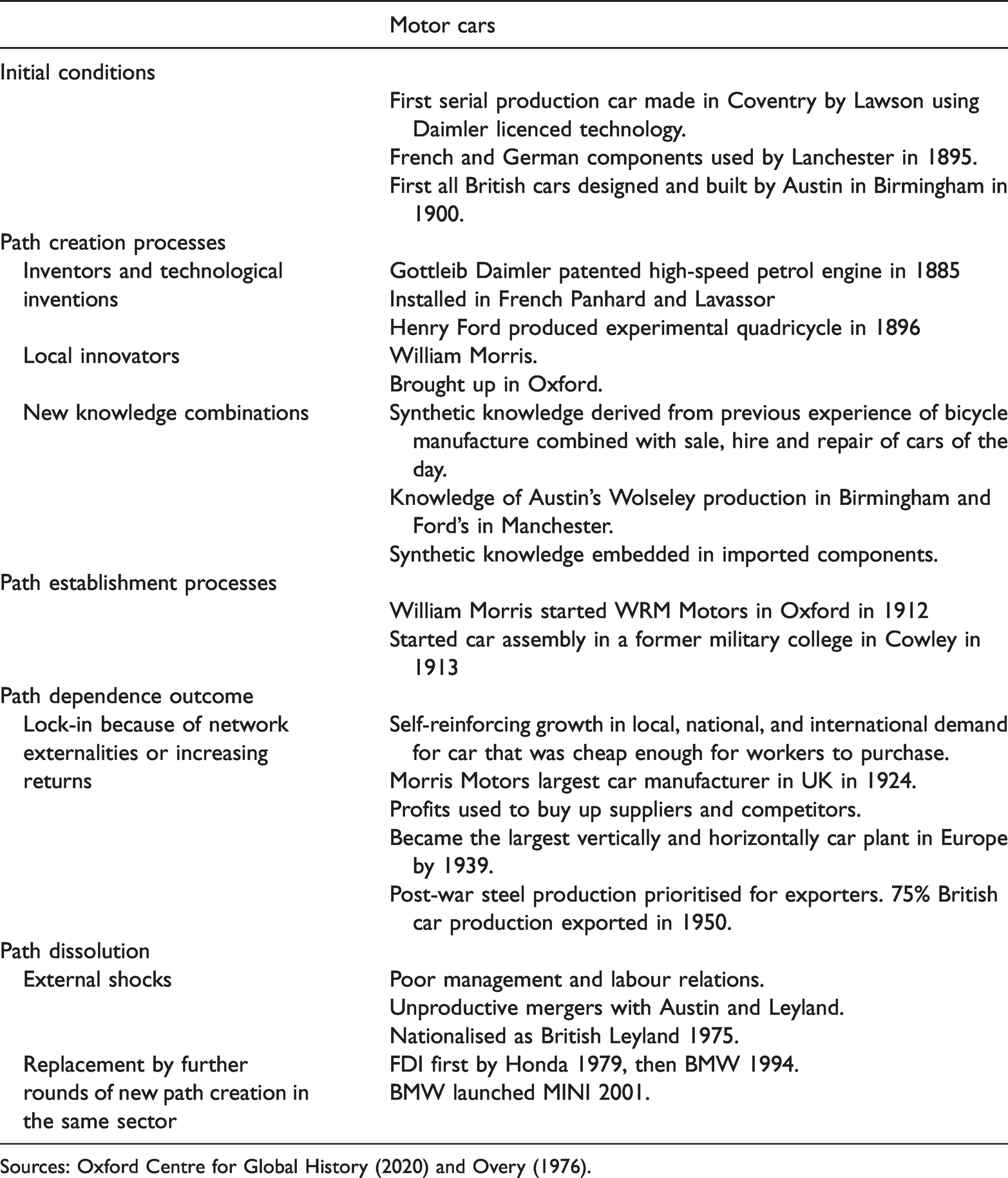
Sources: Oxford Centre for Global History (2020) and Overy (1976).
Superconducting magnets and cryogenics
Initial conditions
The Oxford University Clarendon laboratory for physics, funded by a bequest from the 1st Earl of Clarendon, was opened in 1872. By the C20th it had already established a long-standing interest in magnetism research and its applications. But by the middle of the Century the power requirements of some of this research were so great that many experiments could only be conducted at night when power demand was lower than during the daytime. Nevertheless, research in the laboratory had created a significant reservoir of scientific, analytical knowledge which provided the experience available to underpin the creation of the radical new pathway in magnet technology in Oxford.
The original scientific discoveries of superconductivity were not made in Oxford. Superconductivity itself was first discovered in mercury by Heike Onnes from Leiden University in 1911. For this discovery he was awarded the Nobel Prize for Physics in 1913. This was followed sometime later, in 1957, when Barden, Cooper & Schrieffer proposed a microscopic theory of superconductivity. They were also awarded the Nobel Prize for Physics in 1972. In 1962, Berlincourt and Hake discovered that alloys of niobium & titanium are suitable for magnetic fields up to 10 teslas. Shortly after this commercial production of niobium-titanium wire commenced at the Westinghouse Electrical Co. & the Wah Chang Co.
The research community at the laboratory had also built up extensive international knowledge networks some of which were particularly focused on magnetism. These networks were based around activities such as publication and periodic attendance at specialised academic conferences around the world. These networks provided specialised access to knowledge of the new knowledge in superconductivity being created elsewhere in the world.
Before the 1950s most of the University stood aloof from the commercialisation of new knowledge. It had made little or no contribution to either the blanket or the motor car industry. As a result of this lack of connection between gown and local commerce there was no perceived need to find seed or venture capital to fund new firms outside the University.
Path creation processes
The innovator who created the new superconductivity pathway in Oxford was Martin Wood. He worked at the Clarendon Laboratory where he designed equipment for research scientists. In 1959, he founded Oxford Instruments (Wood, 2001), in a shed in his back garden, to make scientific equipment. As with the first two industries analysed in this article, the initial seed capital was provided from his own resources and those of the University. The company was the first commercial spinout from Oxford University.
Through his work at the University, he had access to external national and international knowledge networks. As a result of these networks, he attended a conference on magnets at MIT in 1961. At this conference, major scientific advances in superconductivity were announced. On his return he decided that Oxford Instruments would focus on the manufacture of superconducting magnets. Thus, again the creator of this new technological pathway in Oxfordshire was not the original discoverer of the new knowledge, but a pioneering early adopter of new knowledge first developed abroad. His company, however, became a world leader in the production of superconducting magnets.
Path establishment processes
The new superconducting magnets pathway was the first to be created in Oxfordshire because of a spinout from publicly funded research. In addition to Oxford Instruments other new firms were spun-out of both the University Clarendon and the Rutherford Appleton laboratories.
Cryogenics requires liquid helium to produce the low temperatures required for superconductivity. This was not readily available in Oxfordshire in the early 1960s. So, as part of the new path establishment process, Martin Wood also started up Oxford Cryogenics to produce liquid helium. Again, critical new analytical knowledge required to do this was imported from Massachusetts embodied in capital equipment.
As the new pathway developed Oxford Instruments diversified into Nuclear Magnetic Resonance and Magnetic Resonance Imaging which is the basis of whole-body scanners. In 1989, Siemens introduced FDI to Oxford Instruments and made Oxford Magnetic Technology a joint venture company. The aim of this move was, in effect, to avoid lock-in and to generate ‘continuous improvement’ and innovation along the technological trajectory within Oxfordshire.
The company adopted the strategy of continuous innovation shown in Figure 3. From the perspective on new path creation adopted in this article, it highlights several key features. These include the importance of new analytical knowledge described as ‘state of the art science/technology’; the significance of seed and venture capital to commercialise ideas into products for which a market can be identified; and finally, the involvement of agents in the practical combination of these phenomenon following a thought through ‘strategy’.
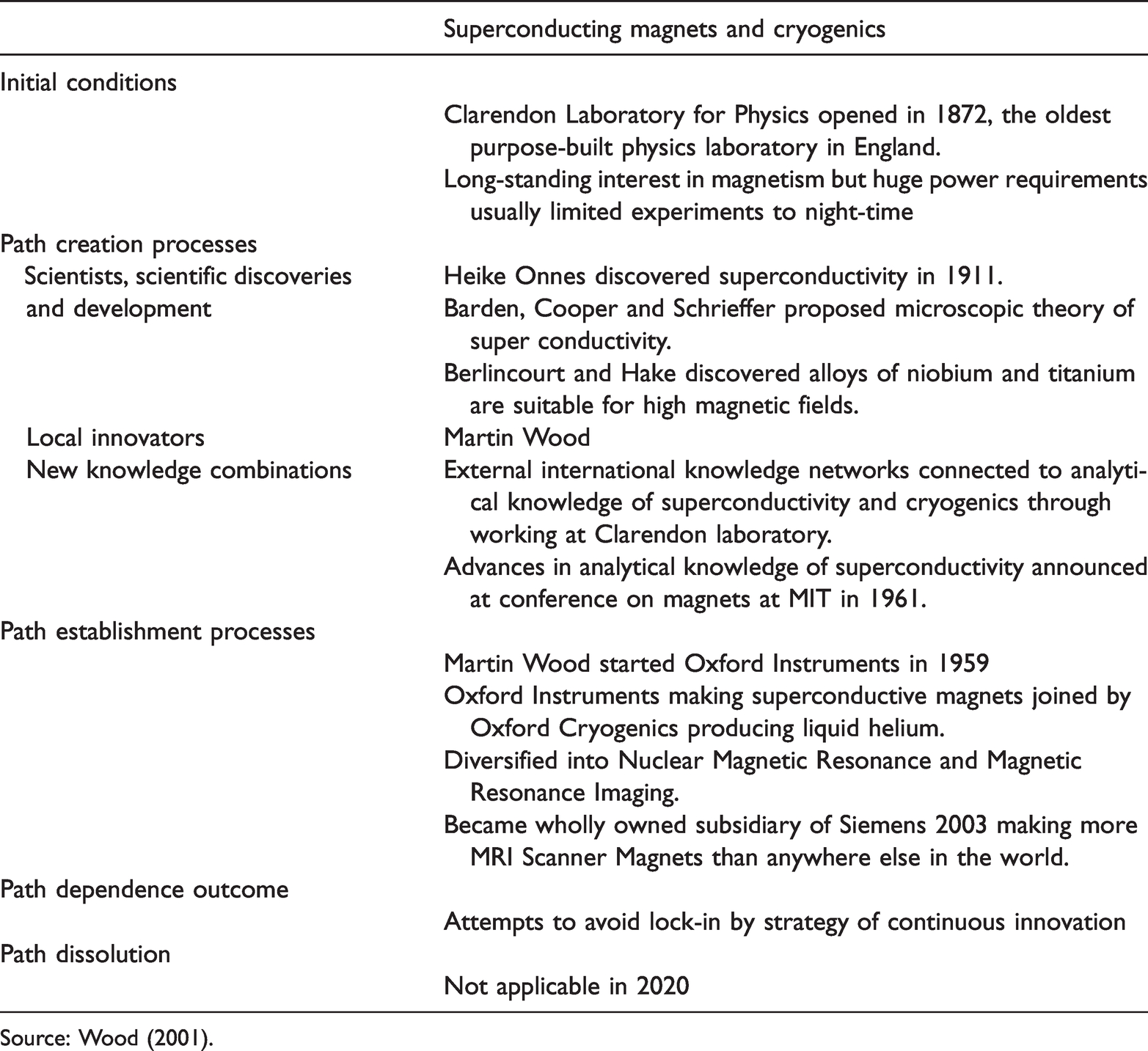
Between 1962 and 1970, Oxford Instruments grew from 0 to 100 employees, and between 1971 and 1982 to 1300 employees. In 2003, additional FDI was introduced when OI sold OMT to Siemens making it a wholly owned Siemens subsidiary. This company currently makes more MRI Scanner Magnets than anywhere else in the World, has the most successful cryocooler technology flown in space, is the world leading source of ‘cryogen-free’ scientific equipment, and is the UK centre for import, distribution and use of helium. The evolution of the superconducting magnets pathway in Oxfordshire is summarised in Table 3.
The evolution of the superconducting magnet industry in Oxfordshire.
Source: Wood (2001).
Analysis
The historical evidence presented above shows that, in the case of Oxfordshire, and the three case study industries, new technological path creation was the result of interactions between three main phenomena. These were:
The initial conditions prior to new path creation in each of the industries resulting from the local economic history of the area. The actions of the key innovators identified for each industry. Interactions between the innovators and other localities through their industry specific knowledge and commercial networks.
With respect to the initial historical conditions specific to the three industries, the long agricultural, sheep farming and particularly woollen cloth making heritage contributed to the possibilities for new path creation in all three industries. Agriculture and woollen cloth making provided early opportunities for the private accumulation of capital which could be used as seed and venture capital in later related and unrelated industries. Previous involvement in the traditional domestic system of woollen blanket production supplied Wright and Early with the seed capital to establish their new water powered and mechanised mill near Witney. The Earl of Macclesfield, a local landowner, provided some of the seed capital for Morris to start assembly line production of motor cars in Cowley. The Clarendon laboratory was funded by a bequest from the 1st Earl of Clarendon, and subsequently received support from long-standing university land endowments some of which are located in Oxfordshire.
A second important initial condition was that all the three case study industries had related prior manifestations. Blankets had been made in the Cotswolds for decades using the domestic system of production. Morris was involved in the sale, hire and repair of other manufacturers’ cars. Research into and experiments with magnets had been conducted for decades at the Clarendon Laboratory. These prior manifestations provided the activities in general and the innovators in particular with national and international knowledge networks through which new inventions and discoveries made elsewhere could be identified.
These initial conditions were not unique to Oxfordshire. The domestic production system of woollen cloth making was found in the West Country, East Anglia and the North. Many cities had both bicycle manufacturing and garages selling and repairing the cars of the day. Most universities had good physics laboratories and research into magnetism. And yet in the majority of them radical innovations in cloth production, motor car manufacturing or superconductivity were not introduced. A key difference, in the case of Oxfordshire, was the chance event that Wright, Early, Morris and Martin were either born and bred in the county or were long-term residents there. In this particular respect the findings in Oxfordshire support the classic path dependence model emphasis on chance in the path creation process.
But, in addition to the chance of the key innovators all having been born, brought up or moved to Oxfordshire, once there, they made conscious decisions to develop or involve themselves in existing, sometimes long-term manifestations of industries or activities. One consequence of these involvements is that the new technological pathways that they created were started by branching processes. The new pathways were spun out of the existing domestic system in the case of mechanised blanket production; Morris Garages to static assembly line car production; and the Clarendon Physics Laboratory in the case of Oxford Instruments. These processes led to continued economic growth in Oxfordshire based on the creation of new firms, employment, Gross Value Added and exports.
The key action of the innovators studied in this article was to assemble new knowledge of inventions and discoveries made elsewhere and to commercialise them into radical new technological pathways in Oxfordshire. This knowledge was acquired through their national and international knowledge and commercial networks. These had been developed over the years because of their past activities.
The bunches of inventions and discoveries combined by the innovators were all made over considerable periods of time elsewhere in England, Europe and the United States. The carding and scribbling machinery brought to Witney by Early and Wright in 1808 had been invented in the North of England around the middle of the previous century. The engine technology and production techniques brought to Cowley by Morris in 1913 had been invented in Germany, France and the United States in the last quarter of the previous century. The discoveries in superconductivity combined by Wood in Oxford in 1959 had begun to emerge earlier in the century in Holland and the United States.
New synthetic, engineering knowledge of machinery and engines, and analytical, scientific knowledge of superconductivity was imported, by the innovators, into the Oxfordshire local economy, embedded in machinery and materials made elsewhere. National and international knowledge networks played a crucial role in how the innovators learned about these numerous and distant inventions and discoveries.
The three main phenomena noted above combined to create the new technological pathways and industries examined in this article. All three industries provide examples of evolutionary branching processes as they were related to and spun out of pre-existing local industries and activities. As with Kondratieff waves, however, the technologies and industries of one era were unrelated to those of successive eras. Indeed, a key feature of the theory is that each new long wave’s growth phase is stimulated by the introduction of radical new technologies and industries unrelated to those of the past. Thus, it is argued here, that while individual technologies and industries may follow path dependent trajectories to lock-in, national and local economies as a whole, can avoid lock-in and decline provided that a succession of new technologies and industries, unrelated to the past, are created there over time.
Over the two centuries or so covered by this research, two of the sample industries have followed path dependent trajectories. Blanket production continued with the same product in the face of foreign competition from low wage countries and declining demand. Over a century this led to lock-in and path dissolution. The motor car industry became locked-in to poor management, labour relations and outdated production systems. It was essentially unable to compete with foreign competition, especially from newer entrants in low wage countries. It was flirting with path dissolution until a new trajectory was created by the introduction of FDI. The pathway was renewed by transforming the remaining factory into one of the most automated plants in the world. This allowed it to compete on better than equal terms with the newer entrants in low wage countries and elsewhere. FDI was also added to magnetic technology during its growth phase. In addition, the new company also recognised the need for continual innovation in order to avoid path dependent outcomes. As a result, it adopted the strategy of continuous innovation outlined in Figure 3.
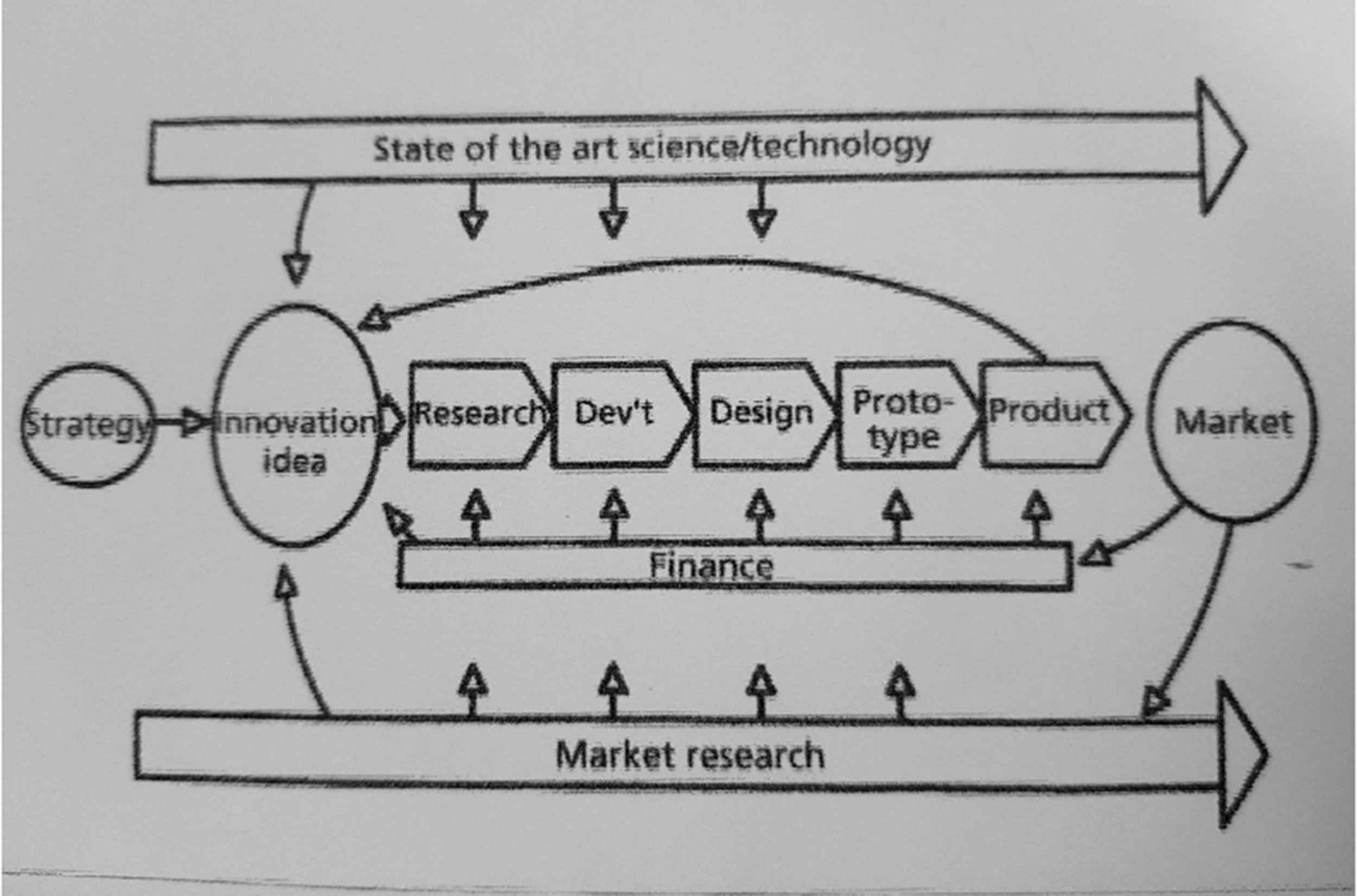
Continuous innovation strategy: Oxford Magnet Technology. Source: Audrey Wood (2001, p 210).
Summary, conclusions and policy
Classic path dependence theory argues that chance and serendipity lead to the creation of new technological pathways in the first instance. In contrast, it has been argued here that new technological pathways are created by the mindful deviation of reflexive agents within the context of initial sets of conditions. These agents bring together previously scattered inventions and discoveries and commercialise them in the form of radical new innovations. These interactions are facilitated by their knowledge and commercial networks. It is accepted, however, that some chance and serendipity are still involved in whether and where such new technological pathways emerge.
In the case of Oxfordshire, the main element of chance involved in the creation of the sample of new technological pathways studied was that the key innovators were either born and bred or long-term residents of the County. Comparable initial conditions to those found in Oxfordshire existed in other localities during the relevant eras but did not, on their own, lead to the emergence of radical new technologies and industries.
Kondratieff wave theory argues that every 50 years or so economies tend to proceed through a four-phase cycle of prosperity, recession, depression and recovery. So far, during the recession and depression phases of this cycle, radical new technologies have emerged that have driven recovery. The development pathways of these new technologies tend to follow an upward sloping S shaped curve from their creation through development and diffusion to maturity. During the latter stages of this development technologies can become locked-in which can eventually lead to their dissolution. Other things being equal, this can also lead to the decline of the local economies in which they are located.
In Oxfordshire, a succession of new technological pathways unrelated to those of previous eras has been created before lock-in and path dissolution of older technologies has taken place. These new pathways have overlapped chronologically but are technologically and industrially unrelated to each other. In the case of motor cars, an industry in terminal decline has been renewed using FDI to overhaul its technological base, management and labour relations. In the case of magnet technology, the need for continual innovation has been recognised and enshrined in firm strategy.
One line of argument in evolutionary economic geography, noted above in the section on theory, is that radical innovations lead to urban growth as a result of branching processes from existing industries. In this argument, branching takes the form of spinouts from existing industries or activities, or the creation of new divisions within existing industries. For these processes to take place some existing firms are needed from which branching can take place. This points to the significance of initial historical conditions prior to the creation of new technological pathways.
In Oxfordshire, there were prior versions or manifestations of all three case study industries from which evolutionary branching took place. Mechanised blanket manufacturing was spun out of the previous domestic system of production. Morris Motors was spun out of the Morris Garages. Oxford Instruments was spun out of magnetic research at the Clarendon Laboratory. Over time, they led to urban and GVA growth at and from Witney, Cowley and Eynsham, respectively. They also developed into major exporting industries contributing to the export base of the county.
The significance of knowledge with respect to innovation and the creation of new technological pathways in geographic space is recognised in DKB theory. Research based on this theory has shown that different types of knowledge are combined in different degrees in different industries. Furthermore, the new knowledge creation process is increasingly reliant on forms of networks and innovation systems.
In Oxfordshire, the significance of knowledge networks in facilitating the creation of new technological pathways was demonstrated in all three case study industries. None of the key inventions or discoveries that provided the new knowledge employed by Oxfordshire’s innovators were invented or discovered in the County itself. As a result, the recognition and acquisition of this new knowledge relied on the sector specific networks of the key innovators.
The type of knowledge base required by innovators in the different industries also changed over time. At the beginning of the C19th synthetic, engineering knowledge of the simple new wool spinning, and weaving machinery was required. By the start of the C20th more complex synthetic knowledge underlying the petrol engine and precision engineering was needed. In the following century more sophisticated combinations of synthetic engineering, analytical scientific and symbolic design forms of knowledge were required as the bases for motor car production. Finally, the production of superconducting magnets was based on extremely sophisticated, Nobel Prize winning, analytical physics.
These conclusions suggest at least three main problems for policy. The first is how to reduce the element of chance in whether or not innovation takes place at all. The second is how to encourage ongoing initial conditions that are conducive to innovation. The third is how to build networks to changing local and international knowledge bases.
Since the 1960s, in Oxfordshire, attempts to address these problems have focused on the development of the local innovation system. In the early days, the rich local knowledge base including universities, government laboratories and hospitals tended to operate as a collection of relatively separate entities. Commercial spinouts from their research were almost unheard of. This changed very slowly until the 1980s. Change accelerated after the foundation, in 1985, of the Oxford Trust by the then Sir Martin and Lady Audrey Wood. Its mission was ‘to encourage the study and application of science and technology’ (emphasis added). The Trust has been a key demonstrator of the benefits of providing conditions that encourage innovation and a significant animateur in stimulating the development of a networked and collaborative local innovation system in Oxfordshire. The main purpose and function of this system is to generate continuous innovation in the local economy.
The conscious development of the local innovation system seeks to reduce the element of chance in new technological path creation by encouraging multiple local innovators to spinout new firms based on their personal research and knowledge. The system is tolerant of failure because it is not so dependent on the success of single heroic innovators as in previous eras.
The system also creates initial conditions that are much more conducive to and focused on innovation than existed in previous eras. These include physical space, such as incubation units, innovation centres, and science parks devoted to innovation. They also include professional and financial services that specialise in assisting and promoting innovation.
Finally, the system aims to network and commercialise the rich local knowledge base. One of the main aims of these activities is to develop channels of technology transfer from local research and development that lead to the formation of new firms. Again, these actions are tolerant of failure because multiple new firm formation means that as long as some of them succeed there is a continual flow of new technological path creation into the local economy.
Some of these new technologies and firms may follow the classic trajectory towards path dependence. But this problem is increasingly recognised at the firm level and addressed by adopting strategies of continuous innovation. At the system and local economy level, path dependence can be avoided by the continual creation of new technological pathways and firms. As long as the rate of new firm birth and growth is greater than the rate of old firm decline and death then lock-in and path dissolution for the local economy as a whole can be avoided. The conscious achievement of this dynamic balance is a key function of the local innovation system.
Footnotes
Declaration of Conflicting Interests
The author(s) declared no potential conflicts of interest with respect to the research, authorship, and/or publication of this article.
Funding
The author(s) received no financial support for the research, authorship, and/or publication of this article.
