



Abstract
Traditionally, public investment for stimulating economic growth has been understood as investment in tangible public infrastructure such as construction. More recently, there is evidence that investment in childcare can stimulate economic growth by increasing parental employment and could pay dividends in terms of closing the educational ‘attainment gap’ for children, particularly at the lower end of the income scale. Policy changes including the expansion of publicly funded childcare places reflect the understanding that childcare supports economic growth through direct, indirect and induced effects. However, investment in childcare as social infrastructure remains classed as consumption expenditure. This article uses input-output modelling to estimate and reflect on the local economic impacts in Glasgow of the Scottish Government’s major expansion of funded ELC from 2018 onwards of 1140 hours per annum for three- and four-year olds as well as eligible two-year olds. This analysis demonstrates that in addition to the direct contributions through increased employment, there are indirect and induced effects which should be considered as key components of childcare expansion as a means of regional and local economic development.
Introduction and background
Scotland’s childcare landscape is a mixed economy of public, private and voluntary sector provision. The last two decades have seen increased national investment in the provision of publicly funded places in Scotland, delivered in partnership with the private and voluntary sectors. Since 2002, local authorities in Scotland have had a statutory duty to provide a funded part-time ELC place for every three- and four-year old (Scottish Government, 2016). At that time, parents were entitled to claim up to 412.5 hours per annum (12.5 hours per week over 33 weeks), delivered directly by the local authority or a private sector or voluntary sector childcare provider in partnership with the local authority. In 2007, the number of hours of free pre-school education increased to 475 per annum (12.5 hours per week over 38 weeks). In 2012, free pre-school education extended to all looked after two-year olds (i.e. those with a kinship care order or parent-appointed guardian). In February 2014 the Children and Young Peoples Act was introduced, and the number of free hours extended to 600 per annum or 16 hours per week over 38 weeks. In November of the same year, the Scottish Government announced that they would be increasing the number of funded hours of ELC from 600 to 1140 per year by 2020, an increase from 16 hours per week to 30 hours per week over 38 weeks (SPICe, 2019). The expansion of ELC was delayed due to the emergence of the COVID-19 virus and the subsequent national lockdowns, with the policy eventually going live in August 2021. In part, this expansion has been driven by the recognition that subsidised childcare could contribute to economic growth by encouraging an increase in economic activity, particularly amongst mothers in deprived areas (Campbell et al., 2013; Davis et al., 2016). As a result, it has been argued that subsidised childcare could play a significant role in reducing inequalities within society particularly in relation to access to the formal labour market (Close the Gap & One Parent Families Scotland, 2023; De Henau et al., 2019; Flynn, 2017). In addition, increased access to childcare could contribute to a reduction in the educational attainment gap evident between children from different social and financial backgrounds, thus narrowing inequalities between children, as well as supporting parental, particularly maternal, employment.
Childcare as investment in social infrastructure
When referring to investments in social infrastructure, the literature highlights that this refers to investments in education, health and care. In contrast to the traditional concept of infrastructure, this does not mean solely the physical infrastructure required for these services but also the services themselves which yield a return through the ongoing provision of the services (De Henau, 2022; De Henau et al., 2017; De Henau et al., 2019; Lapniewska, 2016). Traditionally, expenditure on social infrastructure is classed as a cost, as opposed to an investment, and this is important not only in a Scottish or UK context but also more generally. It is a consequence of how the United Nations System of National Accounts (UNSNA) defines investment and costs (Elson, 2016). Sometimes referred to as ‘the Golden Rule’ of government spending, it is a concept that within fiscal policy government should only increase borrowing to invest in projects that will pay off in the future, with existing expenditures such as day-to-day spending financed through taxation and not new sovereign debt (Lapniewska, 2016). Whilst this rule is often abandoned in times of recession to finance a deficit, it is still widely accepted in mainstream economics during periods of stability and growth. However, the literature highlights that defining public investment is not as straightforward as the ‘Golden Rule’ suggests. The System of National Accounts classifies investment in physical infrastructure as capital stock, in contrast to investments in social infrastructure, which are considered part of governments’ current spending. Thus, physical infrastructure as classified through the UNSNA permits borrowing to fund these projects and does not permit borrowing to fund social infrastructure (Himmelweit, 2016). In addition, as it is a publicly funded investment, the flow of benefits that are characteristic of capital must be a flow of public services, in this case, the provisioning of Early Learning and Childcare (ELC). Pearson (2019) suggests that investing in early childhood education not only supports the reproductive sector to ensure a high degree of well-being and quality of life but also that the flow of public services also leads to positive economic outcomes. Additionally, framing childcare as a means of economic development also strengthens the case for childcare being a social right and promotes gender equality by stimulating maternal employment (Warner and Prentice, 2013). It is therefore considered essential that local services, such as childcare, constitute a key element of policy-driven local economic development (Warner and Liu, 2005). Furthermore, analysis shows that not only can subsidised childcare support these social objectives, but it can also generate returns on investment greater than those offered by the more traditional areas for public investment such as construction (De Henau et al., 2017; Gillespie and Khan, 2016; Lapniewska, 2016; Pearson, 2019). Evidence suggests that potential returns on that investment could be positive through its impact on employment and other indirect and induced effects.
Evidence for Scotland
The Fraser of Allander institute (2022) undertook modelling to determine the impact of large, national level, devolved level policy levers the Scottish Government could use to meet its child poverty targets across three scenarios. Whilst it is a mix of policies, ELC features in each of the scenarios, either as 50 hours for one to four year olds or 30 hours for one to four year olds. The findings suggested there are wider economic benefits, but that if raising taxes to fund the additional spending is required it may reverse the expansionary impact. In each of the scenarios however, even after adjusting for increased taxes, those at the bottom of the income distribution still benefit. It is not possible to draw conclusions from this study with regards to ELC expansion as it contains several other policies and thus it is necessary to assess research focussing on ELC specifically. Lapniewska (2016) uses the Scottish Government’s 2016 input-output tables to estimate modest positive gains from childcare expansion in Scotland. This study found that the total aggregated employment gain closed the gender employment gap by 0.71 percentage points. In addition to estimating the impact on female labour market participation, Lapniewska (2016) conceives ELC as a long-term social investment, which will have the direct effect of boosting GDP but that the wider social and economic benefits are dependent on the provision of quality ELC. Another study by Ramasawmy (2015) focuses on the perspectives of migrant Polish mothers in Scotland and finds that despite more choice and flexibility in Scotland, cultural norms continue to determine their uptake of ELC to a degree. The group was not averse to working or using formal ELC, but believed that in Scotland attitudes towards stay-at-home mothers were more positive, suggesting that cultural norms and traditions play roles in shaping ELC use. A more recent study (Scottish Government, 2021) in Scotland reported on outcomes for parents who were claiming the previous 600 funded hours of ELC entitlement. To examine changes over time, data is collected from parents who had an eligible two-year old and used the funded entitlement. These parents are then revisited when the child is aged three. They found there to be little evidence that economic activity levels had changed significantly for these parents, with 83% of those who were not in work at the outset of the study not in work 1 year later, with an increase of 8% in the proportion working part time (25% to 33%). This is, however, a relatively short time span to focus on the study and does not take into account or note labour market conditions at the time. A larger sample of parents are included in a cross-sectional study at the later point, and it was found only 9% worked at least 30 hours per week if the child was aged two and 28% if the child was aged three. Additionally, they found that 29% of parents whose child was two worked part time and 41% whose child was three, with part-time workers more likely to report they would work more hours if they could afford more childcare. Only 26% of parents with a two-year old and 25% of parents with a three-year old who were not working cited a lack of affordable, good quality childcare as the reason they were not working. Whilst the study finds modest impacts on maternal employment from the 600 hours entitlement at the time, it is worth noting that 600 hours equate to approximately 15 hours per week during term time, which is not sufficient to support full-time work if the costs of childcare outside of the entitlement remain high. The study does not also take in to account or attempt to determine cultural norms or behaviours for those who were out of work for the duration of the study and did not cite a lack of affordable, good quality childcare as the reason they were not working.
In Scotland, the evidence suggests positive but modest impacts on maternal employment from investing in and expanding ELC. Whilst the wider economic benefits highlighted by Lapniewska (2016) and the Fraser of Allander institute (2022) can be questioned when adjusting for increased taxes as the Fraser of Allander Institute (2022) does, their modelling shows that the policies are at least cost neutral and there remains a positive impact for those on lower ends of the income distribution.
Methods
We add to this body of literature by simulating the fiscal and employment effects of the Scottish Government’s investment in social infrastructure through its flagship childcare policy in the local economy of Glasgow, the most populated locality in Scotland. Glasgow had a gross value added (GVA) of £46,383m in 2024, which equates to 31.8% of total Scottish output (Skills Development Scotland, 2024a). Glasgow also has the largest ELC sector in Scotland and has one of the highest numbers of ELC-related job vacancies as of 2024 (Skills Development Scotland, 2024b). Furthermore, Glasgow has a disproportionate share of the social issues which the expansion of funded ELC could potentially tackle. In Scotland in 2025, one in five children are living in relative poverty, but in Glasgow City it is as high as 36% (Birt et al., 2025). With closing the educational attainment gap, increased labour market participation and economic development as clear objectives of the ELC expansion, Glasgow was considered to be the most suitable city in Scotland to model the local economic impacts.
The analysis employs the Scottish Government’s input-output based multipliers to estimate the effects of the spending on the ELC expansion on the Glasgow economy. Specifically, the analytical input-output tables are used which are constructed from the supply and use tables. A developed economy like that of Scotland accommodates four main economic categories. These are production of goods and services, consumption of goods and services, accumulation of capital and international trade. It is these activities that are modelled by input-output tables, and thus give a clear detailing of the relationship between producers and consumers and the interdependencies of different industries in the economy (Scottish Government, 2015).
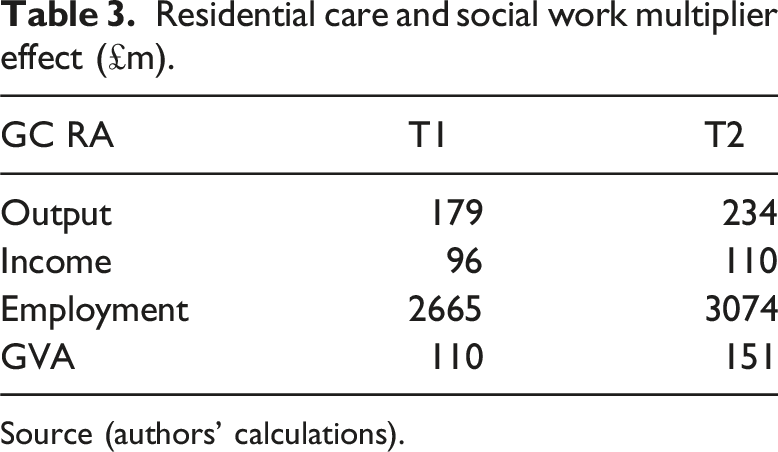
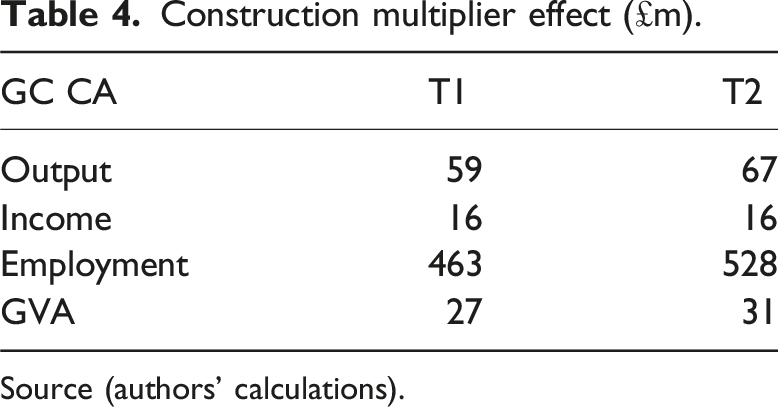
The input-output analysis is twofold, examining first the impact of the Scottish Governments’ investment in ELC in Glasgow with the type 1 and type 2 multipliers for the industry group ‘Residential care and social work’ which is 87-88 in the Standard Industrial Classification used in the input-output tables for Residential care services and Social work services without accommodation. The capital funding is then modelled with the type 1 and type 2 multipliers for the industry group ‘Construction’, which is 41-43 in the Standard Industrial Classification for construction. The use of the type 1 and type 2 multipliers is instrumental in quantifying the overall impact, as it shows not only the direct effect but also the indirect and induced effects, which takes into account the indirect spending of wages and salaries and the induced effects arising from knock-on effects in the supply chains that feed into the childcare and construction industries. The variables to be quantified are economic output, income, employment and gross value added. These will be estimated separately for each industry as the multipliers for each differ, but the cumulative impact will be estimated and emphasised as this will clearly show that if the policy were successful it would pay for itself by generating an amount more than or equal to the Scottish Governments’ overall investment.
The standard multipliers, both type 1 and type 2, are used for the output multiplier, which together estimates the indirect (type 1) and induced (type 2) impacts as a result of a final demand driven change of 1 unit (in £) of industry output. The ‘effect’ multipliers are better suited as opposed to the standard multipliers as the exact investment amounts are available. These multipliers estimate the indirect and induced impact resulting from a final demand driven change in output in the respective industries (Scottish Government, 2015). The income effect multipliers estimate the indirect and induced income change (wages and salaries of employees) because of a direct change in the output of the respective sectors. The employment effect multipliers estimate the indirect or induced number of full-time equivalent employees because of a direct change in the output of the respective sectors. The GVA effect multipliers estimate the indirect or induced GVA change from a direct change in the output generated by the respective sectors.
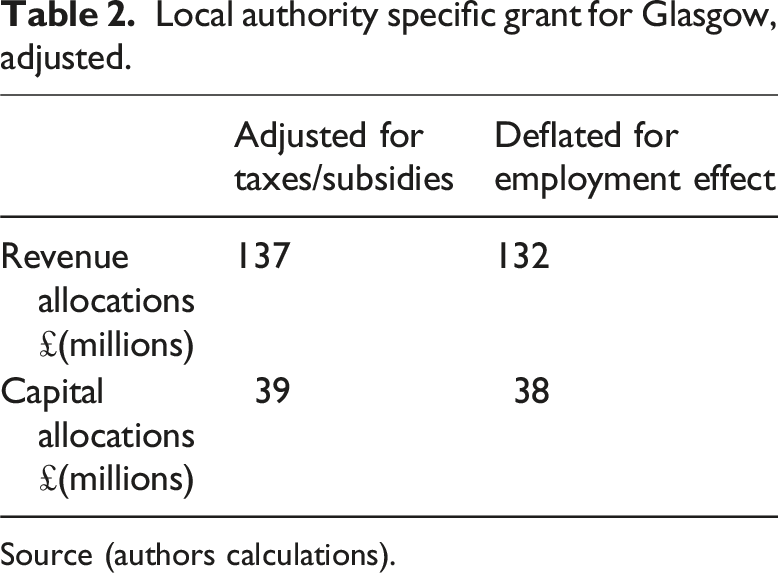
As the input-output table provides an annual overview of the economy, the analysis is adjusted for time effects. The Scottish Government has outlined the investment amounts per year up until 2021 when the policy went live, and the impacts are modelled in line with the timing of the Scottish Government’s investments (SPICe, 2019). The model is also adjusted for basic prices and imports, using the ‘lxl’ tables within the input-output tables, which separate taxes less subsidies on products and imports. The number calculated showed the average proportion of the overall spend on imports and taxes minus subsidies. Once this number was calculated, it was subtracted from the investment amounts prior to modelling the impact. The model also has to be adjusted for current prices when estimating the employment effect. This meant deflating the spending estimates from the prices for the year the money will be spent into the prices for the year of the model. This is only necessary for the employment effect multiplier as outlined by the Scottish Government and was calculated using the HM Treasury GDP deflators (HM Treasury, 2019; Scottish Government, 2023).
The investments take place in four instalments: 18/19, 19/20, 20/21 and 21/22 with the investment amount each year separated between the two industries. For each of the industries, the output, income, employment and GVA multipliers are then used to calculate the respective impacts in each of these areas for each year of the investment. The investment in each category can then be totalled to determine the overall impact in each category over the 4-year period of investment. Finally, the total GVA added to the Glasgow economy from the investment as a whole is calculated. The findings are presented in such a way that overall estimated contribution to the regional economy will be clear.
As the money invested is going into social infrastructure and traditional capital spending, it represents valid final demand for goods and services and thus the use of input-output final demand multipliers is valid. The revenue and capital allocations granted to each local authority alongside the multipliers can estimate the impacts within a specific municipality.
Results
Local authority specific grant for Glasgow, revenue and capital allocations for expansion of ELC.

Local authority specific grant for Glasgow, adjusted.
Source (authors calculations).
Residential care and social work multiplier effect (£m).
Source (authors’ calculations).
Construction multiplier effect (£m).
Source (authors’ calculations).
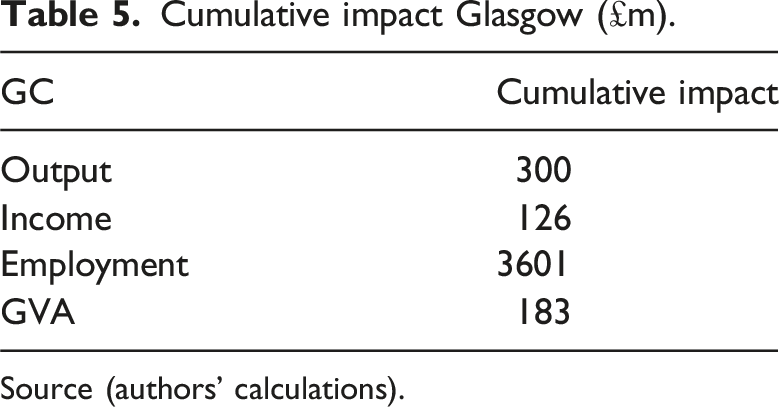
Cumulative impact Glasgow (£m).
Source (authors’ calculations).
As input-output analysis is a largely demand-driven model, assuming there is a sufficient elasticity of supply to meet the increase in demand the expansion will support: • £300 million of additional output in the Glasgow economy, • £126 million of additional income, • 3601 FTE jobs and • £183 million of gross value added.
A total of £183 million of GVA is equivalent to 0.38% of GVA for the region in the year 2022. In regard to labour market impacts, 3601 FTE jobs equate to 0.4% of overall employment for the region, with the increase in the ELC workforce expected to be one of the most significant expansions of an industry's workforce in the region. The short-term economic benefits of the expansion in terms of the investments’ impact on the local economy are shown in the input-output results and demonstrate that in addition to the immediate impacts of increases in employment there are also indirect and induced effects which will contribute to the overall impact in the region.
Conclusion
It has long been argued that there is a link between childcare, urban regeneration, social inclusion and local economic development through the production of sustainable jobs locally and contributions to long-term employability (Scott et al., 2001, 2002). With even very early research on the impacts in Glasgow concluding that childcare expansion improved the employment situation of parents utilising the service locally (McArthur, 1999). Additionally, framing childcare as a means of economic development also has the ability to strengthen the case for childcare being a social right and to promote gender equality (Warner and Prentice, 2013). It is therefore essential that local services, such as childcare, constitute a key element of policy-driven local economic development (Warner and Liu, 2005).
As this paper has shown, investment in ELC will generate significant economic returns able to not only pay for itself over time but also achieve enough of a surplus to generate local and regional sustainable economic growth. Utilising a static demand-driven model of the economy, the effects on output, employment, income and GDP have been demonstrated. The results show that the investment in social infrastructure in Glasgow through the expansion of ELC has generated positive fiscal and employment effects. The modelling has been purposely designed to be conservative by taking all of the necessary measures to ensure there is no double counting within this exercise. These are however modelled estimates, and these economic gains are dependent upon the policy expansion resulting in this level of final demand, which requires the sector to be able to facilitate the increase in demand if the additional output, employment, income and GVA are to be realised. As noted in the literature it is also necessary to analyse the impacts of expanding ELC on the quality of care, particularly in relation to the ELC workforce (Scott et al., 2001, 2002). It is important that staff are not overburdened, underpaid or their training compromised because of expansion (Stewart and Waldfogel, 2017). There are gaps in the knowledge around the impact of the expansion on the ELC workforce, and this is an area that would benefit from further research.
Footnotes

Author contributions
Each author has made substantial contributions to the drafting and conception of the work. Each author has approved the submitted version and agreed to be accountable for their contribution.
Funding
The authors received no financial support for the research, authorship, and/or publication of this article.
Declaration of conflicting interests
The authors declared no potential conflicts of interest with respect to the research, authorship, and/or publication of this article.