




Abstract
The nature of the UK rural social economy is described as an appropriate context in which rural food hubs develop. Through an empirical study of Local Industrial Strategies of the English Local Enterprise Partnerships (LEPs), local area policies are found to provide a sympathetic social economy framework for such development. Rural food hubs are described. A distinction is drawn between producer and community hubs as a means of exploring the second of these more fully. Community hubs are found to address a number of market failures of the growth economy in the areas of community cohesion, voluntary effort, locality, the environment, food waste, health and food poverty. Despite some positive policy signals, dominant national economic policy in the areas of rural GVA productivity, the reform of the LEPs and a national rural strategy, is considered to limit the potential of rural community food hubs because of its ‘growth’ orientation. In this context, conclusions are drawn about survival strategies for such hubs.
Introduction and outline
The purpose of this paper is to examine the potential of community food hubs to make a positive contribution to the development of the social economy (SE) in rural areas. This examination is undertaken in the context of three elements of UK rural economic policy that impact upon the development of rural SEs: the importance of measures of rural GVA productivity, the Local Industrial Strategies of the Local Enterprise Partnerships and the development of a National Rural Strategy. All three are concerned with the performance of local economies. 1
The paper is structured in the following way. Firstly, an anatomy of the SE in the UK rural context is presented, building on elements of the 2019 review of the rural economy by the House of Lords. Local policy support for the development of the rural SE is then explored through an empirical evaluation of SE elements in the Local Industrial Strategies (and other documentation) of the English Local Enterprise Partnerships. The nature of rural food hubs is then, thirdly, seated in this local policy context, with examples of how SE objectives play out in relation to food hubs. Three main strands of contemporary UK economic policy that impact on rural areas are then assessed in terms of the extent to which they facilitate or ‘choke off’ rural community food hub development. The paper concludes with a series of possible actions that might best facilitate rural community food hub development whilst at the same time accommodating local rural economy policy.
The potential of the social economy in rural areas
Pike et al. (2017) note that policy for local and regional development in both the global North and South has placed emphasis on the growth of market mechanisms from the last quarter of the 20th Century. This, coupled with globalisation (Heimberger, 2020), transformations in the geopolitical order (Hameiri, 2010) and the financial crisis of 2007/8 (Van Ark et al., 2010), has provided new challenges for local and regional development policy in terms of environmental impact and the distribution of wealth.
These challenges have included an examination of measures of growth as an indication of economic progress (Coyle, 2014), the use of GVA as a measure of performance (Perrons and Dunford, 2013) and the importance of active communities in development (Sen, 1999). One approach to these challenges is to explore the potential of the SE as an approach to development. The EU’s Social Economy priority, for example, called for the development of national social economy strategies. Scotland’s Social Enterprise Strategy of 2016 has been an early adopter in this context, and the Social Economy Strategy for Spain was produced in 2017, closely followed a regional-level strategy for Madrid. A significant range of others was being finalised by the beginning of 2020 (Curry and Purle, 2020). This section explores such an SE context for English rural areas.
The most recent of the perennial reviews of the UK rural economy was undertaken by the House of Lords reporting in 2019 2 . The report asserts that rural development will be most successful if it is place-based, blending social, community and economic objectives (the LEADER approach is cited several times). Economic development should be ‘bottom-up’ and locally driven, making use of partnerships, collaboration, mutual support, self-help and community leadership (Chapter 3). The report concludes by calling for a new ‘place-based Rural Strategy’, a proposal which secured the support of the broadly based Rural Coalition 3 which launched a roadshow and various elements of publicity to garner public support for such a Strategy.
The House of Lords report characterises the rural economy as having many attributes of the SE which, in large part, stands in counterposition to the market (growth) economy. At its most generic, the European Commission (2020) considers the SE to be concerned with social, societal, environmental and carbon reduction development, employing people inclusively, fairly and with dignity, in pursuit of the public interest, rather than financial return. Janus (2018) asserts that the SE invariably places the individual and social objectives over those of capital: solidarity and sustainability rather than financial surplus (European Commission, 1996).
Scottish Government (2016: 4) has identified the SE as pursuing community, employment and environmental (including carbon reduction) goals, delivered through blended economic and social mechanisms in pursuit of a fairer, more equal society and an inclusive economy. These goals should be delivered through participatory, democratic institutions and whilst goals will be emphasised differently, they concern objectives other than profit maximisation, providing a commitment to use all assets and surpluses for the public good, and to operate for the wider interests of society.
Social economy organisations including voluntary groups, mutuals, charities, land trusts, credit unions, local exchange trading schemes co-operatives (Di Domenico et al. (2010); Paradi et al. (2018); Gullands (2020)) and the Church all invariably engage in some form of trading activity, but this need necessarily only be a small part of their work (Department of Trade and Industry, 2002). Such trading invariably will pursue social rather than market goals within an ‘ecosystem’ involving collaboration, partnership, reciprocity and mutual support (Social Economy Data Lab, 2020) empowered through digital networks.
Indeed, Community Interest Companies (CICs) were introduced in 2005 under the UK Blair administration, explicitly to provide a regulated corporate form for SE organisations that could be set up quickly and easily (Shepherd and Haugh, 2013). They must satisfy two tests: they must be in the interests of the ‘community’ rather than just members or shareholders, and they must ‘asset lock’ to ensure that their assets remain in the benefit of the community in perpetuity (Nicholls, 2010).
Trading amongst all of these organisational forms in the SE might include pursuing social justice through entrepreneurship; pursuing ethical asset acquisition, procurement and commissioning; providing supportive financial and business advice; developing partnerships, establishing an institutional support infrastructure and developing social innovation (Heap et al., 2017). The National Audit Office (2020) considers the ‘third’ sector, ‘not for profit sector’ and ‘civil society’ all to fall into the SE and stresses the critical role of volunteering in their operation.
Economic systems
SEs are built around a range of economic systems rather than firms or sectors 4 . Circular economies are concerned to move from a linear economy – ‘take – make – dispose’ model to a ‘reuse – share – repair – refurbish – remanufacture – recycle’ model, to create a close loop system. This is designed to minimise resource use, waste, pollution and carbon emissions (Geissdoerfer et al., 2017). The Inclusive Economy places emphasis on the way that wealth is distributed rather than created, entailing ‘fair’ work (often for those furthest from the labour market) and tackling discrimination and prejudice (particularly in respect of race, gender, disability and human rights) (Scottish Government, 2016).
The sharing economy prioritises access over ownership (Hossain, 2020) making use of otherwise underused resources, reducing waste and enhancing social capital, through ‘sharing’ (Curtis and Mont, 2020). Place-based development is part of the SE lexicon, too, offering particular distributional benefits in less-developed areas (Duranton and Venables 2018). Sorensen (2018) explores this theme particularly in relation to rural areas. Systems approaches to development also feature in the SE, to develop mutual economic interdependencies in pursuit of collective gain rather than that of the individual units within the system (Sala et al., 2015). Again, such approaches are considered to have particular potential in rural areas (Carnegie Trust Rural Programme, 2010) where economic interdependencies can be high.
Rural significance
There is much research evidence that the above SE systems are particularly advantageous in rural areas (Sorensen (2018); Gkartzios and Lowe (2019); Georgeos et al. (2021)). They have a heritage, too, from the EU Integrated Mediterranean Programmes of the 1970s (Bianchi, 1992) to the LEADER Approach (Dax and Fischer, 2018). They are valuable in developing local assets, local resources, local empowerment and local actors (Bosworth et al., 2015), but SE models are also important in rural areas in the context of the shrinking of the state (Lubelcova, 2012).
In this context, sparse populations do not allow the economies of scale needed for the creation of markets (to displace state provision or for other purposes) to the same degree as urban and metropolitan areas (Valentinov and Larsen, 2010). Inherently higher costs of economic activity in rural areas (because of relative remoteness and low population density) are better absorbed by SE organisations which have objectives other than the ‘bottom line’ (Yates, 2004).
Consistent with this, there are more SE organisations in rural areas than in urban areas, per person (NCVO, 2020), although these tend to be smaller and with a more local reach (Harding (2006). Involving Lincs (2015) notes the critical importance of these very small SE groups to the UK rural economy – commonly self-funded and self-run – because of their ability to work in sparse populations and combat isolation. The SE has a particularly important role to play with rural older people where services and markets for this cohort are less well-developed than for others (Wilson et al., 2017).
There is also more volunteering in rural areas than in urban ones per head ((Yates, 2002) and a much more significant role for the SE in the provision of such services as transport, housing and environmental protection in rural than in urban areas (Blackburn et al., 2003). For Community Interest Companies in particular, their formation is highest, nationally, in the most deprived rural areas (Shepherd J, (2020) pers com).
The rural social economy and the English local enterprise partnerships
Since the demise of the Regional Development Agencies in England in 2010, the principal engines for state intervention in economic and social change at the local level have been the Local Enterprise Partnerships (LEPs) (Broadhurst, 2018). They managed until 2020 (when the UK left the European Union), for example, all of the European Structural Investment Funds, including the LEADER Approach.
An evaluation of SE policies in the context of the 38 LEP Local Industrial Strategies (LIS) was undertaken in 2020/2021 to examine the ways in which they embraced SE principles as described above 5 . The purpose of this was to explore the extent to which this element of local rural economic policy provides a sympathetic context for the development of SE initiatives in rural areas.
An initial letter of enquiry was sent to all 38 LEPs asking for, or reference to, any strategies or documents, (including their LIS where produced) developed by them, that they felt related to the SE within the LEP. They also were asked if there were any organisational structures in the LEP area (committees or groups) that had a specific focus on the SE. A second follow-up letter was sent specifically to chief executives 1 month later and in all, 15 document sets were received as a result, together with a range of written commentary on the way that individual LEPs were accommodating the SE (Figure 1). The English Local Enterprise Partnerships in 2021 (letter of enquiry responses in bold).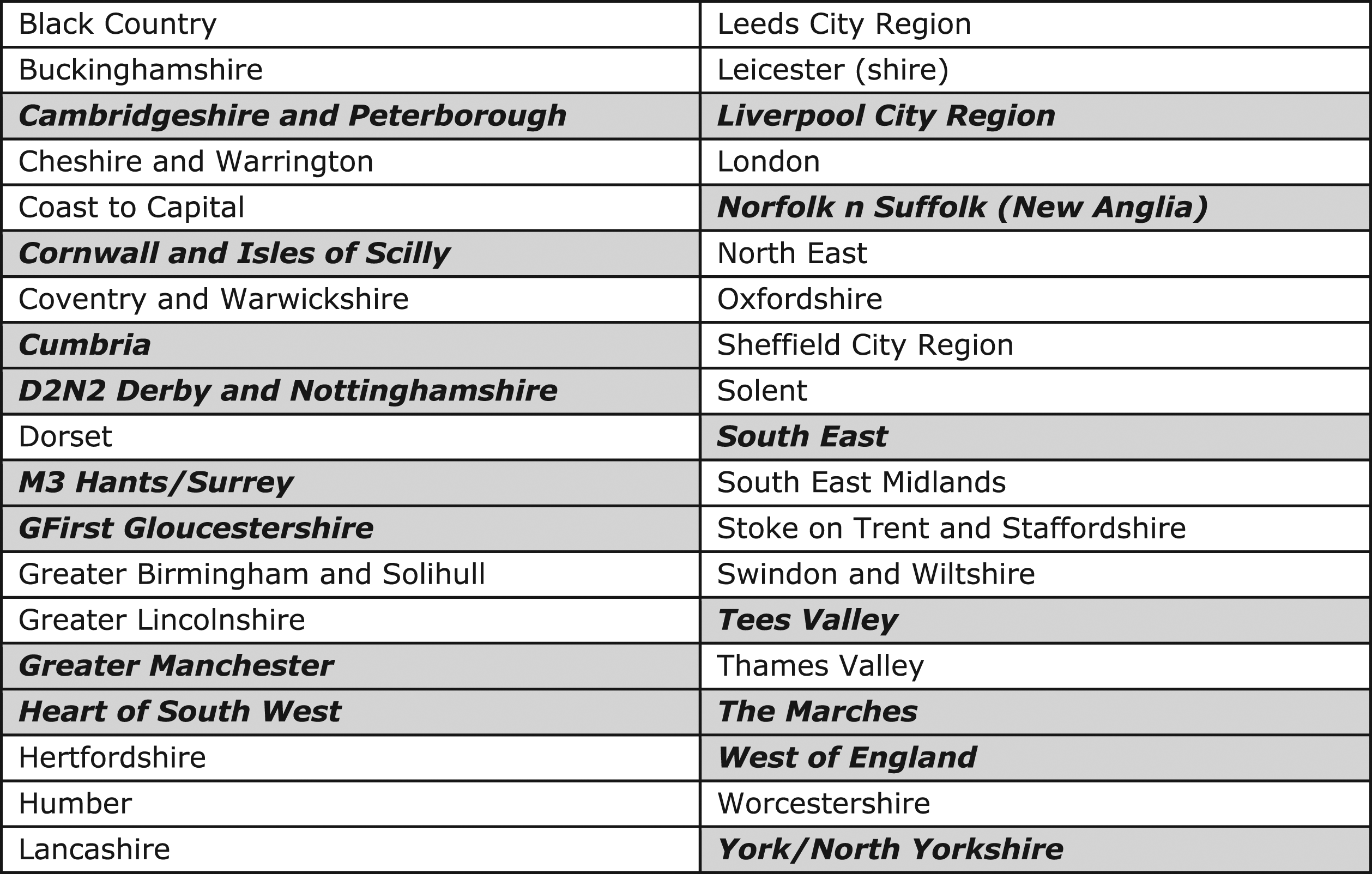
To supplement this, desk assessments were undertaken of all other LEP LISs where they had been produced, together with other LEP supporting documentation available through their web sites, and the web sites themselves. All of this documentary evidence together was subjected to textual analysis and key word searching: sustainability; social economy; inclusive growth/inclusion; circular economy; social enterprise; community; third sector; voluntary action; voluntary and community sector (VCS).
In LEPs covering significant rural areas that responded to the letter, (all except Liverpool, Greater Manchester and London) nearly 70% felt that they embraced SE policies in their strategies and documents. And this proportion is comparable with evidence of SE statements in all available LISs and on all LEP web sites, with rural areas within them.
All LEPs (both shire and metropolitan) overall pay lip service in some form to sustainability (or sustainable growth), most recognising that this requires a balance between social and environmental as well as economic interests. Specifically in terms of SE precepts, the rural LEPs of Heart of the South West, Cumbria, the Black Country, South East Midlands, West of England, Swindon and Wiltshire, Cambridgeshire and Peterborough and New Anglia (Norfolk and Suffolk) all have inclusive growth strategies or commitments. Inclusion in these strategies has various interpretations that embrace: considering all members of the population equally; actively working towards the redistribution of wealth; environmental sustainability; pollution reduction; reducing educational disparities; reducing workless households; improving accessibility to transport; seeking to develop social cohesion; nurturing a sense of place, and addressing youth unemployment.
New Anglia LEP (2017) includes the post-carbon economy, sustainable food production and renewable energy generation within its consideration of inclusiveness, and Cumbria LEP (2019) also seeks to make use of underused assets such as in the retired population (page 80) (similar policies pertain in Cornwall and the Isles of Scilly) and people engaged in social and community activity: ‘Cumbria’s excellence in the voluntary and community sector and the strong nature of many of our communities provides a real launching pad’ (for the strategy) (page 9)
Of other SE precepts, York and North Yorkshire is the leading LEP in developing the circular economy: ‘By creating a Circular Yorkshire, we aim to move our region from a linear economy (take, make, dispose) to a circular economy (where all waste and resources have a value) through this process, we can not only address the challenge of climate change, but we can also add value to the local economy, communities and people’s lives. As the majority of existing circular initiatives are based in cities, the rural nature of our region provides an opportunity to become the UK’s first circular region’ (York and North Yorkshire LEP, 2020).
The York and North Yorkshire LEP has a large number of business-focussed resources to help develop the circular economy (including a circular economy strategy; demonstrator projects; circular guides; business case studies; assessments of natural capital, and a range of funding opportunities). It is recognised that the development of the circular economy requires systems collaboration, and this collaboration requires businesses, local authorities, charities and community groups to work together.
Strategic Priority 3 of the LIS second draft in the Swindon and Wiltshire LEP (2020) also seeks to develop a multidisciplinary research centre to deliver sustainable technologies for a circular economy (page 13) in the context of a zero-carbon economy (page 10).
Cumbria LEP (2019) justifies its focus on the SE because it is a rural area where there are strong networks of support (page 21) and a strong sense of social capital and belonging (page 28). Priorities for place-based development in this context include concentrating on ‘spots of worklessness and social deprivation’ (place priority 1) and supporting local place-shaping programmes (place priority 2). The Black Country LEP (2020) LIS, too, notes that ‘social economy organisations are a major part of ensuring balanced and more sustainable growth’.
Dorset LEP (2018) also has a clear commitment to social enterprise in its Vision for Growth: ‘Encourage business start-ups and social enterprise in difficult to reach and economically inactive communities by working collaboratively with business leaders, social entrepreneurs, universities and civil society organisations’. (Page 19).
The South East LEP (2014) also seeks to add social value through social enterprise development in place-based frameworks, making use of third party funding from, for example, the National Lottery. It has a specific SE rural working group with an emphasis on community-led local housing as part of social enterprise. The Marches LEP (2021) LIS, too, sees social enterprises (and cooperatives in particular) as a key to rural economic growth and has a LEP Board Member with specific responsibilities in this area. The West of England LEP (2019) LIS offers business advice explicitly for social enterprises (page 68) and forums for social innovators (page 67).
In terms of practical action
Cornwall and the Isles of Scilly have Social Enterprise Zones that require specific environmental responsibilities. It also has set up a School for Social Entrepreneurs with an emphasis on community businesses to improve social inclusion.
The motivation behind these polices fully reflects the purposes of the SE. Cumbria LEP sums this up well: ‘Traditional metrics of economic performance, such as GDP or at a regional level GVA, are a poor guide to social and economic welfare. They also do not tell us anything about how the opportunities and benefits of growth are distributed across different spatial areas and social or income groups’ (Cumbria Local Enterprise Partnership (2019), page 12).
Rural food hubs in the rural social economy
There is evidence, then, that the SE has advantages for rural areas and that the development of such economic approaches is promoted at the national level through the House of Lords report and a proposed Rural Strategy. Facilitation is offered at the local level, too, through SE policies in LEP Industrial Strategies. This section examines the potential of community-based rural food hubs as a mechanism through which the SE might be advanced.
Rural food hubs are widely discussed in the literature (Cheng and Seely, 2012; Horst et al., 2011; Lerman et al., 2012; Morley et al., 2008). Commonly a distinction is made between producer food hubs and community food hubs 6 (Berti and Mulligan, 2016). Each type can be physical or virtual (or both), private firms, collectives or partnerships and implementers or advisers in almost any combination and degree.
Producer hubs integrate supply chains and consumption in pursuit of market efficiency (Mikkola (2008), (Fischer et al., 2015)), to achieve economies of scale (Cleveland et al., 2014). Commonly they are built around local places (Wilde (2013), (Matson and Thayer (2013)) where there is cooperation for commercial rather than ideological reasons: they have no necessary social goals (Avetisyan and Ross, 2019). Stevenson and Pirog (2008) assert that they provide a performance counterpoint to large-scale industrial and distant monopsonistic controllers of the food market.
Rural community food hubs, in contrast, have a much broader community purpose and exhibit many of the characteristics of the SE as articulated above, in addressing market failures (Fischer et al. (2015) – but such hubs are less commonly considered in the literature (Berti and Mulligan (2016) page 22). Consistent with the ‘community cohesion’ precepts of the circular economy, Renting et al. (2003) see community food hubs as building communities through (re)connection and collaboration at the grass roots level. In Cambridgeshire UK, for example, CoFarm (as well as others, e.g. in Hexham, Northumberland) developed an organic market garden within 5 months of the 2020 COVID-19 outbreak, on 2 acres of vacant land, to bring people together for food growing, eating and food redistribution (Guardian, 2020).
Such hubs are essentially local and community-based organisations (Le Blanc et al., 2014) driven by, mutual aid, and anti-market food sovereignty (Mikkola, 2008) and commonly stimulated by high levels of volunteering (McKeon, 2015). Incredible Edible in Todmorden UK, for example, uses volunteer effort, to grow food in public open spaces that is free for anyone to consume (Paull, 2011). Such an initiative can lead to developments in community supported agriculture, growing groups, community gardens and city farms as well as addressing food poverty (Sonnino and Griggs-Trevarthen, 2013).
Community food hubs share with the SE, too, a concern for improving the conditions of the disadvantaged. These embrace tackling food poverty, improving access to food, improving diets and nourishment and healthier eating (Berti and Mulligan, 2016). The Lincolnshire Food Partnership (2021), for example, co-ordinates some 49 food banks, embracing remoter rural areas. Rose (2017) also considers that such hubs commonly exhibit a role in championing food justice. In respect of the disadvantaged, many also place an explicit emphasis on education about food (diet and healthy food preparation in particular), both initial and continuing (Blay-Palmer et al., 2013). Hubub (2021) suggests that this should extend to the physical presence of kitchens where cooking skills and nutritional advice can be delivered.
SE environmental precepts are also shared by community food hubs. Explicit purposes such as food waste reduction, shorter food miles (and relocalisation) are common – as objectives rather than by-products (Stroink and Nelson, 2013). Berti and Mulligan (2016) suggest that they also contribute to the development of transitions to organic agriculture. The Tamar Grow Local Food Hub in Cornwall, UK (Davis 2021), for example, has developed the hub around agroecological food production, in tandem with community-centred food supply chains. And the Veritable Vegetable hub had been promoting local organic food in the San Francisco Bay area in the USA since 1974, whilst remaining committed to social justice and building trust relationships with farmers and buyers (Jolly and Kenfield, 2008). More generally, many community food hubs have been triggered by global food concerns such as the increasing complexity of food systems (Weber et al., 2020) and increasing food insecurity (Seekel et al., 2017).
Community food hubs also share SE organisational forms. Largely ‘not for profit’ organisations (in contrast to producer hubs), they commonly seek to be economically viable through a combination of income generation, grant-aid support or both (Yarnit, 2021). In this context, they are invariably social enterprises of some sort with social objectives, commonly reinvesting any surpluses for community ends rather than to maximise profit or shareholder return (Crabtree et al., 2012). Because of this, Colasanti et al. (2018) have characterised community food hubs as flagship models of socially conscious business. Generically, then, community food hubs are defined for the purposes of this paper as local community food collectives that address food market failures such as distributive justice and the environment, invariably through ‘not for profit’ modes of operation making use of volunteers.
Whilst these characteristics define the envelope of interest of community food hubs, they are diverse, and each will necessarily pursue only some of these market failures. For example, some food hubs may contain food banks within them, others may not. Some food hubs as food banks are trying to increase their output of fresh foods for dietary health and others are not.
Indeed, some food hubs provide a blend of community and producer purposes, for example, in the realms of re-localising or re-territorialising food, social innovation (Franks, 2010) and food quality (Franklin and Morgan, 2014). Big Barn, for example, in Huntingdonshire, UK operates as producer food hub whist at the same time having express objectives to improve people’s diets (Big Barn, 2021). Food hubs evolve with changing emphases (Yarnit, 2021), and some explicitly use ‘producer’ characteristics to cross subsidise ‘community’ ones in the context of multiple objectives (Porter and Kramer, 2011).
Colasanti et al.’s (2018) national American survey of food hubs of all types, for example, indicates an overwhelming concern to ensure that where food is sold, producers receive a fair price and good access to markets. But over 90% hubs in the survey report that ‘improving human health’ also has some role in their mission. Environmentally sensitive production practices have a mission role for many of them, too. Cohen and Derryck (2011) report successful hybridisation in this way (fresh local produce to low-income consumers in New York), at the Corbin Hill Road Farm Share project. Similar successes are reported in Vermont (Le Blanc et al., 2014).
The pursuit of community purposes, however, can make community food hubs vulnerable (Le Blanc et al., 2014). Long term viability is often dependent on grants and gifts; volunteers can be unreliable, lacking in skills and exploited (Yarnit, 2021), and difficult trade-offs often have to be made between environmental goals and economic equity (‘environmentally’ produced food is often sold at premium prices) (Mitchel et al., 2015). Because of this, hubs commonly adopt hybrid forms of market and non-market activity in the SE tradition, as survival strategies (Food Research Collaboration, 2021).
Policy progress and policy retrenchment
Policy progress
There have been promising signs in the development of SE policy frameworks for rural areas in the UK as theatres for the development of community food hubs. European exhortation for such frameworks perhaps has origins in its longer tradition of rural (neo) endogenous development (Bosworth et al., 2015). At the national level, in response to this European exhortation, SE strategies have been produced for Scotland (Scottish Government, 2016) and for Spain (Curry and Purle, 2020) where the benefits to sparser rural areas in particular are emphasised. Other European national SE strategies were due by the end of 2021 (Curry and Purle, 2020).
UK city region (with rural hinterlands) SE strategies, too, are being developed for Liverpool (Heap et al., 2017), Leeds (Leeds City Region Enterprise Partnership, 2021) and (Peterborough City Council, 2021), for example, the latter two focussing on the circular economy. And for dominantly rural regions, the York and North Yorkshire Local Enterprise Partnership’s focus on the circular economy provides a good exemplar, and Lincolnshire in the UK has produced a county-level SE strategy, with an emphasis on its rural role (Curry and Purle 2020).
Much of the impetus for these has come from the recognition of the limitations of market (growth) economies and their associated measures of performance – particularly in respect of negative externalities and market failures. Stiglitz et al. (2020), emphasises how Gross Domestic Product (GDP) – growth – and Gross Value Added (GVA) – productivity – are inadequate for measuring physical and mental health, social capital, environmental impacts, education, community participation and the distribution of wealth, all of which chime with community food hub objectives.
These performance ‘alternatives’ are becoming more important in the agendas of national governments, particularly in the light of the profusion of reports signalling the catastrophic market failures in the context of climate change (e.g. the Intergovernmental Panel on Climate Change, 2021), and inexorable economic growth, with its negative consequences for the environment, natural capital and wealth inequalities (Thompson et al. (2017); Joshua (2017); Popkova and Bogoviz (2020)).
Stiglitz et al. (2020) also caution against the seductive nature of increasing GDP and GVA: they are still commonly seen as a good thing, even though the resultant national well-being may be negative because of market failures. SE strategies can work to address these market failures even though performance measures invariably are more subtle.
And such approaches seem popular with the UK population at large. A YouGov poll in May 2020 found that eight out of 10 people would prefer the Government to prioritise health and well-being over economic growth during the COVID-19 Pandemic, and 6 in 10 would still want the Government to pursue health and wellbeing ahead of growth after the pandemic has subsided (Guardian 2020).
Specifically for food, there is increasing articulation of UK policies to address food market failures, beyond just biodiversity – the principal non-market preoccupation of the UK’s post-EU Agriculture Act 2020 (UK Parliament, 2020). Such policies have been produced directly by, or commissioned by, the UK Government in relation to: food poverty and food standards – the National Food Strategy Part 1 (Dimbleby, 2020), diets and obesity – the National Obesity Strategy (Department of Health and Social Care, 2020), the problems of eating meat, (EAT-Lancet Commission, 2019), food waste (Department of the Environment, Food and Rural Affairs, 2020a), environmental impacts of agriculture (UK Parliament 2021) and general food health – the National Food Strategy Part 2 (Dimbleby, 2021). The governmental concern to correct these market failures would appear to place community food hubs in the ascendency, and the SE a means through which to do it.
Policy entrenchment: Government measures of rural performance
A hallmark of food hub performance literature is that all types of hub appear to depart (in both performance and aspiration) from ‘official’ measures, at least of rural productivity in the UK. Gross Value Added (GVA) has been the most commonly used measure of productivity and this has severally pertained to different inputs such as per all factor inputs, per employee or per resident (Boddy et al., 2005). Defra (2005) historically has used earnings per head of working age population measured at ‘place of residence’ as its baseline measure of rural productivity, but this can be distorted by commuter earnings (Webber et al., 2009).
By mid-2021, Defra (2020b) was still using a GVA measure to capture rural productivity. Termed the ‘balanced’ measure, this is a blend of income and production GVA. By this measure, rural productivity in 2018 was lower than in urban areas than in England as a whole, and in both cases, the gap was widening over time. This is consistent with long-term trends (Anderson et al., 2005), despite time-honoured instruments of support to try and redress the imbalance through rural economy growth (see e.g. Defra (2012).
Other measures of performance may be less clear cut. Philipson et al. (2019) suggest that rural SMEs (Small and Medium Enterprises) are smaller and have a lower turnover than urban SMEs but may be more profitable (because of lower input costs, including labour) and more innovative (because of poorer access to input factors and markets) as well as likely to export more. Self-employment also is higher in rural than urban areas, as is employment in SMEs and micro-enterprises (Defra 2018). Environmental services and community services also are higher in rural than urban areas (Bosworth and Turner, 2018), in the latter case often because populations are too diffuse to trigger market provision, or to justify public expenditure (Neumeier, 2012) – so the community steps in, consistent with the precepts of the SE.
The limitations of GVA measures in particular, have led to a range of alternative proposals for the measurement of rural economic performance built around well-being Treasury HM et al. (2007), Commission for Rural Communities (2010), endogenous and neo-endogenous development (Gkartzios and Lowe, 2019), income support (OECD, 2005) and low carbon (Fankhauser and Jotzo, 2017). Despite these, and LEP developments in SE policy, GVA measures remain the official Government yardstick for rural economic success. This does not sit well with either the objects of rural community food hubs or with constructions of the SE.
Policy retrenchment: Review of Local Enterprise Partnerships
But even the LEP moves towards SE, measures of performance have become more fragile. Despite the House of Lords (2019) considering the LEPs to be appropriate vehicles for further developing the rural SE approach (paragraphs 150–171), by late 2021, the role of the LEPs overall was uncertain. A large-scale Whitehall review of the LEPs was announced, to be conducted by the Cities and Local Growth Unit (reflecting, itself, the ‘urban’ and ‘growth’ focus to be required of the LEPs), following the ‘underperformance’ of a number of them (Hill, 2021). The review is to explore how best to ‘transition from the current model to a future structure’ (DWF, 2021), so the ‘do nothing’ solution is not on the agenda. Round table discussions in relation to this review have not included the LEPS themselves (D2N2 LEP (2021), section 2.1i, paragraph 12).
As a result of the review, LEPs are likely to become ‘even more business-led’ (South East LEP, 2021, page 1) and positioned most effectively to ‘support productivity and growth’ (DWF, page 1) in order to develop the HM Treasury’s (2021) Plan for Growth, built around City Regions (Sunak 2021). There will be a smaller number of LEP-style organisations, not dissimilar to the geographies of the former Regional Development Agencies (DWF, 2021). The continued emphasis on the urban/city, and on growth, again does not bode well for rural SE organisations such as community food hubs.
The role of LEPs in allocating development funding also had been curtailed by the beginning of 2021. The £4 billion UK Levelling Up Fund and the £220 million UK Shared Prosperity Fund (UKSPF) (House of Commons Library, 2021), due to be allocated by the LEPs, was pulled back to Central Government approval working through local authorities (Peters, 2021). Amongst other things, this would provide parity for Scotland, Wales and Northern Ireland as there are LEPS only in England. LEPs now will be expected to operate without any underpinning capital programme (South East LEP, 2021).
Again, this is significant for rural areas and community food hubs, as the UKSPF in particular is seen as a replacement for the European Structural Investment Funds (House of Lords report (2019) paragraphs 134–149) which contained a number of rural-specific and food infrastructure-specific streams and a number of SE programmes.
Further, the LEPs Local Industrial Strategies – with a range of SE precepts and an ability to deal with local difference, have been side-lined, and their monitoring abandoned (Hill, 2021). It is possible that LEPs effectively will become membership organisations working at the behest of those larger businesses within their geography that can afford to pay for their ‘growth’ services. And some rural LEPS fear for their very survival: the Marches LEP (Herefordshire, Shropshire and Telford and Wrekin) had been pencilled in for dissolution for September 2021 (Moore, 2021).
Policy retrenchment: Rejection of the rural strategy
The House of Lords’ call for a Rural Strategy, also was roundly rejected. The government response (Gardner, 2019) asserted that it was not necessary, as measures already in place were adequate, particularly the strength of National Planning Policy in providing affordable rural homes (even though this does not have specific rural affordable housing allocations), the Rural Development Programme for England (even though this is being largely dismantled post-Brexit and is largely agricultural anyway), the Future Telecoms Infrastructure Review (even though this acknowledges the non-commercial nature of providing rural broadband to isolated areas) and the monitoring capabilities of rural proofing (even though it is ex-post and there are no consequences for Departments in failing to abide by it).
In a further statement, specifically on the rural economy (Gardner, 2021), the need to increase firm-level productivity (author’s italics) (via mechanisms in the Business Productivity Review of 2019) is stressed, particularly in small firms, which are predominant in rural areas. This will ‘drive growth’ (author’s italics) in rural areas, with support from the Help to Grow initiative announced in the March 2021 Budget. Gardner notes that the UKSPF will replace EU ESIF funds but is ‘growth funding’ (author’s italics) and none will be ring fenced for rural areas. The bulk of state subsidy is likely to go into supporting ‘private’ markets rather than directly into public benefits.
This is despite the Rural Farming Networks’ 7 collective representations to the MHLG via Defra that the UKSPF avoids using GVA as a measure of success in allocating the UKSPF as this unduly favours more productive (urban) areas. A different set of quality outcomes should be used instead. The UKSPF provides, Gardiner says, the opportunity to move away from European models such as LEADER.
Conclusions: Prospects for rural community food hubs
The theatre in which rural community food hubs operate is complex. Because of this, rural food hub formations and conceptualisations are constantly changing and adapting over time (Matson et al., 2014).
The current UK government is committed to GDP/GVA measures of economic performance, and regional/regeneration funding is likely to be allocated consonant with this priority. Because of this, some form of market/non-market melding is likely to be most successful for rural community food hubs, longer term, as part of their strategies for survival. This could allow ‘spoke’ and ‘node’ cross-subsidisation, in line with SE redistributive principles. Stroudco, a food hub in Stroud, UK, for example, whist selling food at premium prices, has cross-subsidised improvements in nutrition in low-income communities (Franklin et al., 2011).
Partnerships also offer longer term potential in pursuit of non-market objectives in a growth market climate. The Cornwall Regenerative Food and Farming food hub in the UK, for example, is working towards regional (county-level) groupings of community food hubs in six towns in the county, to develop economies of scale in purchasing and sales and in publicity. As a rural area this will develop with the help of an online facility. The idea of county-level food hub partnerships here is to ‘smooth’ differences in the quantity and range of food supply from one area to another (Whitelaw, 2021).
Consumer-producer partnerships also provide workable models. The Seikatsu Club Consumers Cooperative Union food hub in Japan (Poirier, 2007), for example, is managed by producers and consumers jointly: their neighbourhood sub-committees are managed in the same way. Producers and consumers also consume food together (with the consumers cooking) at social events.
The Farmer Direct Produce (FDP) food hub in Santa Barbera County in California (Cleveland et al., 2014) also is managed by producers and consumers working in partnership. This, it is claimed, keeps social, environmental and economic objectives comparably on the agenda. Food hubs that are co-managed by consumers and producers, claims Yarnit (2021), tend to provide good prices for consumers at the same time as greater returns for producers.
Broader-based melded food hubs are managed not just by consumers and producers, but also through partnerships with agents concerned directly with food market failures. Many of the food partnerships within the membership of Sustainable Food Places in England, for example, embrace the local state, local health authorities, food banks and community growing groups, as well as producers and consumers (Moragues-Faus and Sonnino, 2019). This also can provide an entrée to the resources of such agents (the public health budget in the UK, particularly, is large), and integration with some of their services (such as social prescribing – being referred by the medical profession to work on a community farm for physical and mental health benefits and to improve diets – and care farming).
But in addition, a number of rural community food hubs have sought to buttress with non-food activity (often addressing non-food market failures) through joint provision, as a survival strategy. These are commonly in the deprivation arena. The Acts Trust (in Lincolnshire, UK), for example, is a hub set up to increase life opportunities, providing opportunities for furniture repair, skills and training, employment for young offenders and advice on benefit claims. Food (they have a food bank, a community café and a membership supermarket) is often a conduit for these more general functions (Acts Trust, 2021) and a spoke in a more generalised hub.
Sustainable Food Cornwall, UK, too, also is to act as a conduit for a range of local non-food craft industries (Whitelaw, 2021) and Liquorice Park (2021), Lincolnshire, UK, community hub has food growing enterprises within its principal purpose of a public amenity space. Stag Vets in South Georgia (US) is a food hub, buttressed with health objectives. It has been developed to train forces veterans into employment, with a particular emphasis on those with PTSD. It is America’s first Acute Veterans Crisis Agriculture Centre (Stag Vets, 2021). Even housing can be an element of food hub development – where food growing hubs can a part of new housing schemes (Taylor and Walker, 2015).
In addition to partnerships, campaigns can garner support, whilst at the same time serve as product marketing. The Sustainable Food Cornwall (2021) hub undertakes a range of active campaigns (e.g. for regenerative agriculture, local organic pasture food, waste management, gleaning) which act to educate but also provide a marketing conduit for produce. Similarly, Tamar Grow Local Food Hub (UK) runs workshops, events and festivals to help get the message across (Davis, 2021). This also builds longer-term consumer pressure for food change.
Whilst cross-subsidisation, partnerships and campaigns can enhance the robustness of community food hubs, their success does require particular value systems to be developed amongst food hub boards. And the not-for-profit and non-market characteristic of community food hubs also means that there will always be some dependence on grant-aid. To develop a food hub that would be financially self-sustaining longer term through the sale of premium products to sit alongside non-market activity, for example, would, it has been estimated, require an initial pump-priming investment of around £500,000 (Yarnit, 2021).
In this context, the Tamar Grow Local Food Hub in Cornwall, UK, for example, has reduced its dependence on public grant-aid, but even today, 8 years since inception, about a third of its income comes from this source, for community projects (Davis 2021). The active use of volunteers can soften this dependency, and crowdfunding can help: Sitopia Farm Community Food Hub in Greenwich, UK (Sitopia Farm, 2021) has raised over £75,000 in 2021 by this means, for example.
But with some dependency on public funds it will be important for rural community food hubs to remain fully briefed on rural SE policy and on the ensuing public funds that pertain in rural areas. The UK Shared Prosperity Fund and the Levelling Up Funds will be important in this respect. The first of these, though, may be increasingly disposed to growth economy projects, and the second will not be available to everybody (and is largely a capital fund where transport projects will be a priority because much of the money is coming from the Department of Transport budget).
The pilot of the Shared Prosperity Fund, too – the Community Renewal Fund – was geographically prioritised but against low productivity rates and ‘low economic resilience’ (sparsity) rather than any kind of social or community need or well-being (Leggett, 2021). And all of these funds will require local authority (and ultimately central government) approval: some authorities may be more sympathetic to community food hubs than others and government is known to favour growth economies in rural development projects.
And community food hubs with non-market objectives in rural areas also operate within confusing and contradictory policy signals. Government recognises the need to tackle food economy market failures, but dominant policies still are to pursue market growth and GVA productivity which do not factor in the capture of such market failures. Some progress had been made with a growing LEP focus on SE models (possibly in recognition of the need for new frameworks to replace ESIF funding) but their functions and resources are likely to be curtailed. And the need for a ‘social economy’ approach to rural development through the production of a new Rural Strategy has been rejected.
It will be of value to explore further the survival strategies of community food hubs, and their relative successes, as they provide good examples of hubs seeking to secure market and non-market goals simultaneously. Such strategies are likely to have wide transferability into other domains concerned to further develop the social economy.
Footnotes
Declaration of conflicting interests
The author(s) declared no potential conflicts of interest with respect to the research, authorship, and/or publication of this article.
Funding
The author(s) disclosed receipt of the following financial support for the research, authorship, and/or publication of this article: This research is supported by Research England (RES/0576/7216).
