




Abstract
We present the analysis of two biographical narratives by an ex-gangster from the Russian city of Kazan. We address the different times in his life – his childhood, youth, and adulthood, his time on the streets, his decision to leave the gang, and his reflections and memories of his past as reconstructed through these different narratives. We analyze the synchronicity of macro, meso, and micro scales of time in his biography and show how his memory of the time in the gang has dramatically changed between the first and second interviews, as he looked retrospectively on his former self from the vantage point of his current law-abiding life. In our analysis, we use the theoretical and conceptual framework of processual sociology and Bakhtin’s concept of chronotope.
In understanding the biographies of gang members, their motivations for joining, their experiences while in the gang, the reasons why they may decide to leave, and their reflections on their past, we need to account for various temporal processes. Gangs are historical actors, and the biographies of their members also take place in time-specific contexts. Time is not merely a matter of chronology or a standard stage in a person’s life course; it is a complex set of temporal flows that carry people through their lives, warping their plans or energizing them to move forward to their intended futures.
‘All time is social time’, as Barbara Adam (1990: 14) famously said, and an individual’s life unfolds within evolving systems of social relations through which they experience time. According to the processual approach to the social world, which emphasizes its dynamic, fluid, and relational nature, wider social and historical processes interact with individual life, often meeting at the meso-level time of a family, community, institutions, and generation (Abbott, 2016; Langley et al., 2013; Neale, 2021; Riley, 1998). At the level of biography, rather than proceeding through a sequence of age-specific and institutionally authorized stages, as presumed in the life course approach (e.g. Shanahan et al., 2016), people physically live in a flow of history. This ‘historicality’ of individuals (Abbott, 2005) is particularly evident during rapid social change. People carry their past experiences and expectations, produced in one historical era, into a present that is already changing, all the while having to reorient themselves toward a new future.
As a person’s position in a system of social relations changes, so do their perceptions of time. The experiences and narratives of time are deeply contingent on where we are now, both as individuals and members of society, a fact that has been seen as an important epistemological premise in social and historical science (Halbwachs, 1992 [1950]; Koselleck, 2018: 58, 185; Zerubavel, 1981). Nevertheless, time in social inquiry is often treated as an implicit, ‘unnoticed’ category, an overarching plane of existence, or a linear sequence of events that evolves regardless of any social context (Adam, 1990; Langley et al., 2013; Neale, 2021).
In this article, we present a processual analysis of the biography of a Russian ex-gang member, a man whose youth was lived at the crossroads of historical eras and in the space of the streets, where life was changing in response to wider macro-societal processes. Tsigan, an ethnic Tatar, used to belong to a large street gang in Kazan, the capital of the Russian Republic of Tatarstan. He was born in 1981 and has lived all his life in this city. We analyze the processes that led Tsigan, a young man from a previously stable Soviet professional background, a law student, to decide to join a gang during a period that he characterized as the ‘time of the streets’, and later led him to leave it, and his experiences and recollections of that time. The first interview took place in 2005, when he was aged 24 and had been in the gang for four years. He left the gang the following year. The second interview was conducted in 2022 when he was aged 40. Since leaving the gang, he married and now has two teenage children. Several years before the interview, Tsigan converted to Islam, a decision that possibly reflects the growing importance of Islam and its ethical values for parts of the urban Muslim population in Tatarstan (Benussi, 2018; Karimova, 2013). The decision to convert was, he says, a transformative event in his life. From this present position, he is now reassessing his past life.
In this article, we address the temporal processes in the life of Tsigan, linking the different scales of time (macro, meso, and micro) and its prospective-retrospective dimension, as both the future and the past are addressed and re-made from a position in the present. In doing so, we also seek to counteract the common tendency in contemporary gang research of viewing gang members as ahistorical actors who join gangs because of individual pathologies or resource deficiencies (Brotherton, 2015; Hallsworth, 2013). Instead, we show them to be reflexive social agents, whose lives unfold not just within local street arenas but wider historical scenes, and whose sense of time is shaped by this while actively shaping their evolving temporal experience.
The article has the following structure. First, we discuss how time has been previously addressed in gang research. Then, we outline our research method, the case study of a gang biography undertaken through recursive interviewing, and our methods of analysis. We address the macro historical processes that led to the massive expansion of street gangs in Russia during the country’s transition to capitalism, and the meso processes, taking place at the level of local social relations. We then analyze the micro-level processes, at the level of biographical decisions and events, involved in Tsigan’s joining and then leaving the gang. We move on to consider the differences between the constructions of time in the first account, when Tsigan was in the gang, and in the second one, long after he left, before concluding the article with some further reflection on the study of temporal processes in biographies.
The temporal dimension of gang trajectories, experiences, and memories
Temporality has long been implicitly present in gang research. In more historically oriented studies, macro-historical time is seen as a major element in tracing the rise of gangs, particularly when associated with political and economic upheavals, catastrophes, and processes leading to extreme poverty and social exclusion (Arias, 2006; Hagedorn, 2008; Rodgers, 2009). At the meso level of community, time is seen through the prism of the local ecology, as different ‘gang careers’ develop in response to the local structures of opportunity (see Abbott, 1997, on the Chicago school’s contribution to the study of space and time). At the micro level of biography, the length of chronological (linear) time spent in a gang is often taken to explain the degree of an individual’s immersion in the life of the group. Life course indicators such as age are associated both with the timing of entry (typically in teenage years) and exit from the gang, often when people mature, get jobs and start families (Carson and Vecchio, 2015; Thornberry et al., 2003).
While time clearly matters for gang studies, time in a gang is still typically seen as linear time which moves at the same speed. In more positivist-oriented research, gang-affiliated individuals are often regarded as fixed entities going through the timeline of various criminal enterprises or leaving the gang after years and moving into new positions in their lives. Similarly, in desistance from crime literature, the synchronicity of historical and biographical continuities and change (Elder, 1974; Neale, 2021: 88) is not sufficiently understood. While some authors have considered how decisions to leave crime could be traced to particular biographical stages, or turning points in one’s life history (i.e. Carlsson, 2012; Laub et al., 1998; Skardhamar, 2010: 15), the intersection of the temporalities of individual life courses and temporal changes in the larger systems of social relations deserves further investigation.
When it comes to the narrative accounts of time in the gang or other criminal group, ethnographers have drawn attention to the situated character of accounts, linked to the current identity, as the subjects revise their past. This is especially relevant to accounts of violence, which often evolve over time. While initial stories about crime and violence frequently emphasize adventure and excitement (Hankiss, 1981; Jackson-Jacobs, 2004), these narratives may shift in later accounts, influenced by official discourses and personal reassessments (Di Marco, 2023; Rodgers, 2021b). However, the temporal aspects of gang experiences have generally been underexplored. 1 Longitudinal biographical research can offer valuable insights into the lived experiences of time within gangs and help us understand how these experiences are contingent upon gang identity and belonging.
In this article, we explore the manifold changes in a person’s narrative account of time as he becomes anchored in a different set of social relations. We start our analysis from the Durkheimian (1915) premise that time is a collective representation that has commonly shared meaning to members of the group. On that basis, we explore the differences in the accounts of gang time produced while the subject was in the gang, and the reconstruction of gang time long after he left it.
Methods
We address Tsigan’s reconstruction of the key temporal processes in his life by using recursive interviewing, a method often employed in longitudinal qualitative research. Recursive interviewing, through which a person is invited to go back and revisit the past, is a powerful tool for understanding chronological change and change in perception and meaning (Neale, 2021: 100–102). Recursive interviews allow us to see how, from the vantage point of the present, the past becomes a territory where new connections need to be made, choices projected into the future, and paths laid out that explain where a person is now. This re-interpretation also occurs within social communication, through dialogue with the interviewer. Because every interaction is symbolic, as a person presents themselves to their interlocutor and, by extension, to society, new meanings emerge (Mead, 2015 [1934]). Tsigan, who read and corrected the transcript of the last interview, and who approved the draft of this article, knew that his story would form part of the output from the international project on the life courses of gang members across the world, and this may have influenced his account.
Both interviews with Tsigan were conducted by Rustem Safin and were based on interview guides the co-authors developed jointly. The interviews can be seen simultaneously as life histories and life stories (Rosenthal, 1989, 1993). Life history refers to the actual sequence and chronology of events as they occur in an individual’s life. It is the factual and experiential record of lived events. A life story, on the other hand, is the narrative or representation of an individual’s life. It is how individuals interpret, organize, and present their experiences, often shaped by the narrator’s current social position, identity, and the intended audience. We investigated the experienced life history and the narrated life story in two separate analytical steps.
In the first step (analysis of the life history), we undertook a processual analysis of the interview data. Using the data from both interviews, we constructed the linear sequence of events in the life course of the interviewee. We focused here on how Tsigan related the factual development of his biography, recounting significant events, turning points, and expected outcomes, and putting them in the context of the processes that were happening in the local ecology and on the larger historical stage (Abbott, 2001; Elder, 1974; Neale, 2021). In our analysis, we also aimed to trace macro, meso, and micro influences on the development of individual life. While this is a theoretically difficult task, we aimed to construct a case-rich and plausible account of the multitude of temporal changes across social relations and spaces that affect a biography, while also acknowledging the provisional character of this account (Cilliers, 1998; Elliott, 2005; Neale, 2019, 2021).
In the second step (analysis of the life story), we analyzed and compared how the subject narrated his time in the gang at two different points in his biography. To deconstruct how the same period is presented in these two narratives, we used Mikhail Bakhtin’s concept of chronotope. Bakhtin developed this concept to account for the experience of time in space as presented in the different narrative genres of European novel. Bakhtin stated that in a chronotope, ‘Time, as it were, thickens, takes on flesh, becomes artistically visible; likewise, space becomes charged and responsive to the movements of time, plot and history’ (Bakhtin, 1981: 84). As an analytical concept, the chronotope offers life course researchers an endogenous view of how people construct the plot of their lives as a journey through spaces, populated by specific characters, while expressing their belonging to a particular community or social category (Agha, 2007; Wang, 2022). 2 We used a comparative analysis of chronotopes in a gang biography to capture how perceptions of time in a gang change as a subject moves to a different position in society. We look at the contemporaneous construction of the time spent in the gang and at how this time is subsequently re-experienced and re-evaluated.
In the next section, we present a short overview of the history of Kazan gangs in the macro- and meso-contexts of the post-Soviet transition.
Kazan gangs and post-soviet transition
The story of Tsigan’s journey into a gang is the story of a person’s response to cataclysmic social change. It seems reasonable to say that Tsigan, together with many other members of his generation who joined gangs in their youth, could have embarked on the standard school-to-work trajectory if the country into which he was born had still existed when they came of age. But in the context of the collapse of the USSR and Russia’s chaotic transition to capitalism that started in 1992, this trajectory became unattractive or simply unavailable. In the 1990s, the Russian economy went through a deep crisis, associated with the start of radical economic reforms that involved economic liberalization and massive privatization. As the Soviet state disintegrated and radical market reforms destroyed millions of livelihoods, Russian society went through some of the most drastic poverty and welfare reversals in the world (United Nations Development Programme (UNDP), 1998). GDP fell by over 40%, and industrial production more than halved (Clarke, 1999). Rapid inflation consumed people’s life savings. State companies made their workforces redundant, or kept them on the books while not paying wages for months on end, and millions of people became officially or unofficially unemployed.
In Kazan, a large industrial city with a significant concentration of chemical, petrol, military production, and food processing companies, the collapse of the Soviet planned economy and the start of radical market reforms led to impoverishment and massive unemployment. Under conditions of growing poverty and the absence of effective law enforcement, crime exploded, particularly youth crime. Between 1985 and 1999, the rate of crimes committed by 16- to 29-year-olds increased 1.7 times (Bushuev, 2009: 41). The police, instead of providing protection, were massively involved in organized criminality, forming their own gangs or cooperating with organized crime structures (Salagaev et al., 2006).
The local ecology was rapidly changing. Various predators emerged on the streets, including disorganized criminals and organized gangs. In this new situation, where criminal opportunities emerged while legal opportunities weakened, many existing street groups started to look to use their violent resource to extract economic profit. The gangs set up various acquisitive schemes in the rapidly privatizing economy, including offering ‘protection’ to small businesses in their territory (Salagaev and Safin, 2014). At a time of economic crisis and the rise of street crime, the gangs began to attract, alongside local working-class delinquents, young men from well-off and educated families, including the families of teachers, doctors, lawyers, and even police officers (Garaev, 2020; Stephenson, 2015: ch. 5). Gang leaders and their associates soon formed their own organized crime networks, loosely linked to the street groups and involved in large-scale protection operations in Kazan and further afield.
Tsigan was a member of a large Kazan street gang that first emerged as a neighborhood fighting group at the end of the 1970s. By 2001, it comprised several hundred young men aged approximately 17 to 30. Those members who stayed in the gang after this age moved into the serious organized crime structures of gang leaders (avtoritety). While the core of the gang was involved in various rackets and acquisitive crime, some members managed to stay on the gang’s periphery. Their key activity – protection of the gang’s parking lots and gaming parlors – was seen as a low-risk operation. They participated in gang fights and wars, paid money into the gang fund (obshchak), and took part in regular meetings but were not routinely involved in serious crime. Tsigan, by his account, belonged to this peripheral part of the gang.
In the next section, we trace how the interlocking processes of macro-, meso-, and micro-social change influenced Tsigan’s decision to join the gang.
On the road to the gang
Tsigan was born in 1981, 11 years before the collapse of the Soviet Union. His childhood was, as he repeated in both interviews, ‘ordinary’, taking place in the relative stability of the last years of the Soviet Union. As with countless generations of boys before him, his free time was spent on the streets in the company of his peers. In these early days of his life, this street time was experienced as a traditional, seasonal sequence of collective play. This was a ritualized time common to the group (Durkheim, 1915: 10–11). As Tsigan said in 2005, remembering his childhood,
For as long as I can remember, I spent all my free time on the street. We had our neighborhood group. In the summer, we played football, tag, and all sorts of sports, and in the winter, we went skiing and sledding and had snowball fights.
Away from the streets, his life was conditioned by the temporalities of school and family life. He did well at school, and by the time he reached his senior years, he was, in his words, ‘practically a straight-A student’ belonging to ‘an ordinary Soviet intelligentsia family’ with educated parents. By the time of our first interview, his mother had retired, and his father was an engineer at a factory. But the family fortunes were changing. Tsigan remembered a period in the 1990s when his father was officially employed, but there was no work at the factory, and he did not get his wages paid. When wages were paid, they were depleted by hyperinflation. A relatively prosperous life, high social status, and expectations of a dignified retirement vanished for the parental generation.
Tsigan’s outlook on the future also changed. His long-term aspirations had been formed by the previous, Soviet-era expectations of a transition into a stable professional job that were becoming rapidly outdated by the time he finished school. His biography reflects these overlapping temporal processes. Tsigan still went to university, choosing a law degree, but he could not see where this future would take him. Well-paid work seemed to be a thing of the past. In the meantime, his everyday life was being seriously affected by what was happening in the space of the streets. Already as he was entering his teenage years, the ‘timescape’ (Adam, 2004) of his life, the predictable temporal patterns of childhood were transformed into a timescape of chaos. The high-crime environment of the 1990s, coupled with the weakness of law enforcement, had a profound impact on the local street ecology. Recounting in 2022 his journeys through the city in his school years, Tsigan remembered how street criminals and members of youth gangs constantly harassed him:
If you go back to the start of the ’90s, when I was still really young, that was a time where there was always somebody trying to get on your case, at least where we lived. Even trying to walk to school and back was troublesome. As I recall (and I only recall those days vaguely), people were constantly picking on me. Sometimes I got into fights. Sometimes it only went as far as an exchange of words. This was back before I was a street lad [patsan, a gang member].
Tsigan struggled to recall that time. He found it hard to deal with the trauma of those years, and his memory of the events was, to use the historian Reinhart Koselleck’s notion, lava-like, an undifferentiated flow of horror, ‘immovable and inscribed’ in his being (Koselleck, 2018: 240).
For young people coming of age in Russia in the 1990s, the futures that their families and schools had promised them were suddenly canceled. However, the social relations that some of them had already built on the streets, in neighborhood peer groups, could promise paths into a different future, both intermediate and distant. These past temporal investments in street social relations could now pay off, offering a new future. Should they join the local criminal gangs, which were expanding and constantly looking for new members, they could be able to get protection and income, gain opportunities to make careers in the gang structures and develop powerful masculine identities at the very time when these young men were making their transitions to adulthood. Culturally speaking, progression into a gang was easy for boys who had already accumulated street social capital and the necessary cultural orientations. They had already learned to stand up for themselves in street altercations and fights and show toughness, bravery, quick wit, and the ability to overcome fear – all qualities that are necessary for the street ‘action’ (Goffman, 1967). Local ecology offered ‘gang careers’ that many young men at the time were keen to pursue, seduced by the prospects of becoming rich and getting ‘respect’ in the territory.
When Tsigan turned 20, he finally decided to respond to his friend’s invitation to join their ‘street’. This was a turning point in his biography, a time when individuals ‘take stock of their circumstances, assess this reality, understand it anew, and conjure a new imaginary future’ (Neale, 2019: 40). In explaining his path into the gang, Tsigan emphasized that he had been brought up on the streets, was well immersed in the street networks, and understood their code of conduct (the so-called poniatiia, understandings). In those dangerous times, gang affiliation could, as he said, ‘solve many problems’.
Simultaneously, Tsigan was in the process of a biographical transition to adulthood. The world of the gangs lured him with promises of ‘becoming’.
3
He explained that he wanted to try to ‘live with the lads’ so that he would become what he was always destined to be: a strong, brave, and loyal man. In 2022, recalling his reflections before joining the gang, Tsigan spoke of his anxiety over whether he would be able to prove himself worthy:
I wasn’t unsure whether I’d make it or not, but I was kind of . . . there was this feeling that I’d taken on extra responsibility before the street and the lads [patsany, gang members]. Now, you’re responsible, first of all, for the people who brought you in, and, of course, for the honor of the street as well because whatever might happen, you can’t lose face.
This biographical transition to manhood was coupled with (somewhat vague) expectations of a more long-term transition to a position of power and prestige that could be achieved through the gang. At the time, gang leaders, themselves former members of street gangs, were, as Tsigan pointed out in the 2005 interview, getting rich from ‘resolving business disputes’ and taking protection money. And as he explained, as far as the street gang members were concerned, ‘every soldier dreams of becoming a general’. His generation’s aspirations, however, were very much based on perceptions of gang opportunity that were already becoming more and more outdated. The gang economy that had developed and thrived during his late childhood and early youth was already dwindling in the early 2000s, with only gang leaders being able to receive substantial returns – and with the depletion of economic opportunities, the gang social order also came under significant strain (Stephenson, 2015: 119–126). But this was something he was yet to discover. At the time of the first interview, he was still beholden to the fantasy.
Our analysis has shown how influences across the micro–meso–macro plane (from changes in personal career aspirations, dreams of becoming a ‘real man’, the continuities in local street relationships, to the changes in macro institutional opportunities and constraints) converge to create the life-changing turning point, as Tsigan decides to join the gang.
In the next section, we trace the process through which Tsigan left the gang.
Leaving the gang
By the time of the second interview in January 2022, Tsigan’s life had changed radically. He had left the gang in 2006, and over the following years had developed a series of small businesses in construction, goods transportation, and housing renovation. Some of these businesses had been started while he was still in the gang – he began doing housing renovations and providing transport services together with his gang mates, whose pickings from the gang business were too low even for bare survival. This diversification of economic activities while in the gang (cf.: Rodgers, 2021a) eventually allowed him to set himself up as a legitimate businessman, again representing an important continuity among the rupture.
Tsigan’s decision to leave the gang needs to be considered within the context of the wider, macro-temporal processes taking place in Russia at the time. During the 2000s, a process of economic and political stabilization was underway. The state was credited with restoring order and re-establishing a monopoly on the legitimate use of violence (Volkov, 2002). The Tatarstan police, which had been very weak in the 1990s and at the start of the 2000s, had started to gain resources, and gradually went on the offensive against gangs and organized crime groups (Stephenson, 2015: 160–164). The police actively conducted raids and arrested gang members in public places, followed by various administrative and criminal charges. Gang members were also registered in a special police database, with such registration creating serious obstacles if a person wanted to ever get state employment. In some cases, the police and state security services took over private protection services while actively prosecuting their criminal rivals.
Local street careers were rapidly changing, as the remaining gangs were forced to move into riskier endeavors, such as the drug trade and protection of illegal businesses (such as underground casinos and sex work networks). Gang membership started to go down, as the mainstream economy now offered better opportunities than the dangerous world of the streets (Stephenson, 2015: ch. 3, Garaev, 2020). Also, the growing presence of drugs changed the relationships in the gang. As Tsigan said in 2022,
At first, I thought that [the gang] would be a second family, all of us having each other’s back, but in practice, that’s not true; when it comes down to it, nobody gives a toss . . . There were times when somebody got hooked [on drugs] and sold out everyone else, ratted them out, took their money, stuff like that, and we’re talking somebody who used to be a good friend. What does that tell you?
The strengthening of state control and repression was reflected in the everyday lives of the gang members. Even going about Tsigan’s daily business while being part of a gang presented serious difficulties. As he told us in 2022, toward the end of his time in the gang:
Sometimes it got to the point where we got taken into the police station, then we left, and as we were walking home, they picked us up again and took us back to the station, because they were looking for some group of lads or other. They picked us up from meets, and during fights, and when we were drunk. Some guys I knew who worked in the police told me that they saw my name in the [police] files, and I was listed as an organized crime group member. . . . It was right by the end, when all this became extremely common, that I got fed up with it.
Much of Tsigan’s narrative about leaving the gang was about the realization that the future described in the first interview, in which he had expected to be always associated with the gang world, had disappeared. The illegal street economy was contracting. The gang, like any other business, demanded a commitment of time, but all the small money-making schemes that members developed (rackets, theft, burglaries, income from illegal parking lots) were spread thinly between many members, resulting in relatively meager incomes. As he explained in 2022,
I found myself not having enough time to combine study, work, and the street, and on top of that I couldn’t see any possibilities for my future, as in, I couldn’t see myself in five years doing the same thing. It became more like a burden, a source of tension . . . It was draining, and there were various angles from which it made me feel pressured: time, but also various ‘fraught’ incidents that happened, that got in the way of working. And slowly, gradually, I began to understand that this was getting in my way more than giving me some kind of benefit.
The decision to leave the gang was not made overnight. This turning point in Tsigan’s life was triggered not as a result of life-changing events or fateful moments, but through a gradual change in his ‘inner biographical disposition’ (Neale, 2021: 75):
It wasn’t like I got smacked upside the head and suddenly opened my eyes, or woke up from a coma, no. It all . . . built up smoothly. It started to change from this initial sense of awe, when you’re getting new experiences, to gradually turn into a sort of dull routine, and then an understanding that maybe I don’t want this that much. And gradually, very gradually, it ended up as a feeling that I don’t really need it . . .
Discussing his decision to leave the gang in the second interview, Tsigan constantly references time. He talks about how the temporal commitments to the gang became impossible to fit in with other commitments as he became older. Gang time, the social time where travel into enemy territory necessarily becomes a time of showdowns with local gangs, interferes with the institutional time of his work. He leaves the gang and does not intend to dedicate any more time to his old gang peers, refusing to respond to requests for help. His journey into the world of gangs is over.
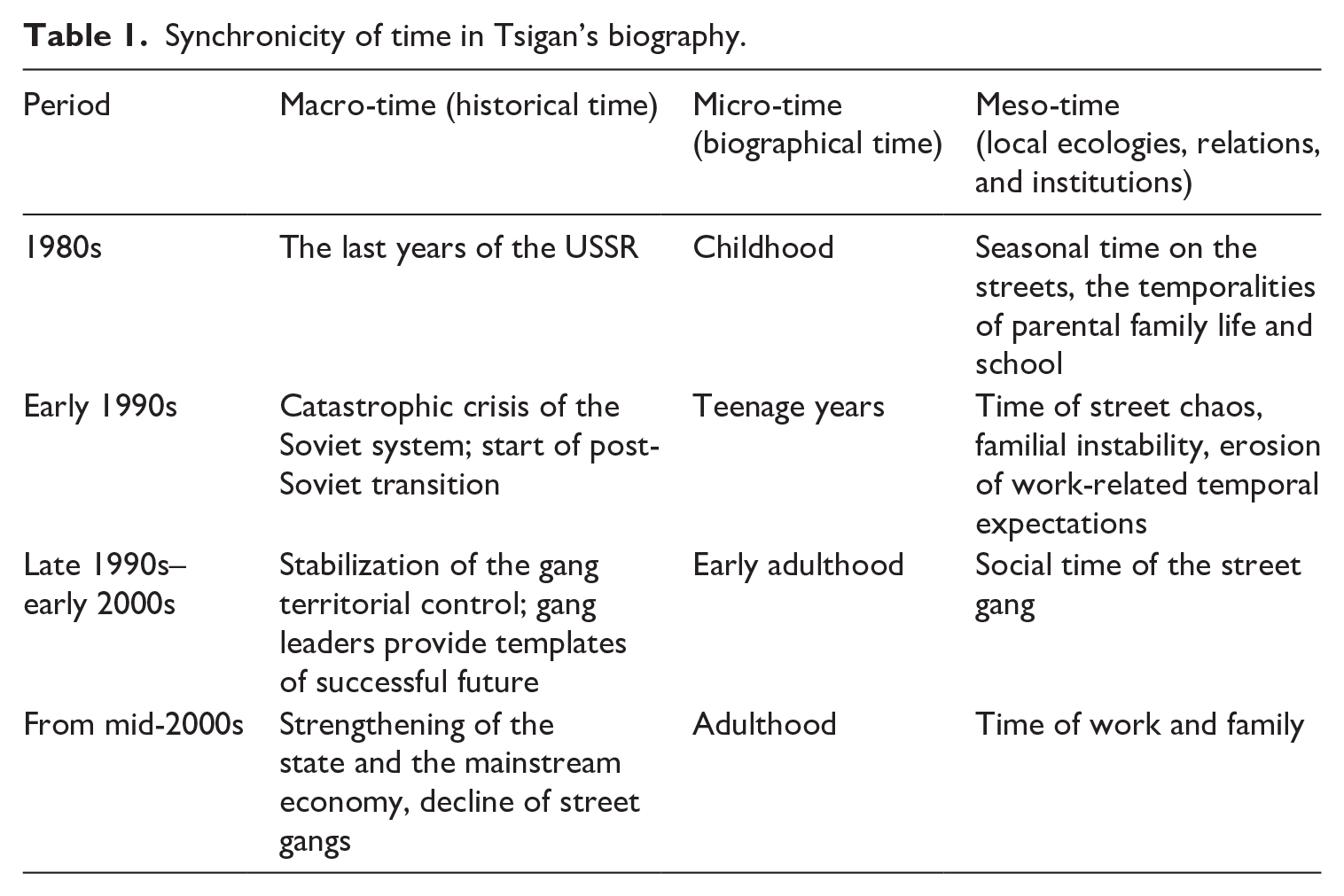
Complex micro–meso–macro temporal processes were involved in the cognitive shift that led to Tsigan’s exit from the gang: a personal disenchantment in the world of the gang ‘brotherhood’, the dwindling gang career opportunities, larger structural processes that led to the strengthening of the state institutions and increasing risks for gang members, as well as better opportunities in the mainstream economy. We present a schematic outline of the synchronicity of different temporal threads in Tsigan’s biography in Table 1.
Synchronicity of time in Tsigan’s biography.
We now move to the comparative analysis of Tsigan’s life stories as he presented them in the two interviews we carried out with him.
From exciting time in ‘Gangland’ to ‘adventure of ordeal’
When we studied Tsigan’s two interviews, it became apparent that they were significantly different in terms of his perception not only of the specific events of his past but of time itself. In the first interview, when Tsigan talked about joining the gang, he emphasized the micro-dimension, his own biographical circumstances, and the meso-dimension, the local structures of opportunity and social relations in the street ecology. When it comes to his current temporal experiences, he always talked about the social time of the group. Researchers have discussed the way in which the performance of ‘gangness’ is steeped in jointly constructed representations and mythologies (cf.: Garot, 2010; Lauger, 2012; Van Hellemont, 2012). However, the experience of time itself is also mediated by the gang. Time is involved in building and maintaining of the gang as a cohesive community, including the need for group members to spend most of their time together to create feelings of belonging.
In his book On Collective Memory, Maurice Halbwachs (1992 [1950]), drawing on Durkheim’s key concepts, argued that our understanding of time is always shaped by collective consciousness and collective representations: ‘perceptions of time, space, and the order of physical and social events as they are established and recognized by the members of our group are imposed on us’ (Halbwachs, 1992 [1950]: 174). Tsigan, who was a fully involved member of the gang at the moment of the first interview, recounted his time in the gang as reflective of the collectively shared tempos, paces, and rhythms of group life.
Tsigan’s account in the first interview expressed an experience of time in the space of the streets which we would call the ‘Gangland’ chronotope. 4 The Gangland is a space of male power, camaraderie, and subversion of the dominant order. The time of individual life here is almost totally subordinated to that of the gang, carving a ‘time out’ from the surrounding reality. As Tsigan said when interviewed in 2005, ‘We try to spend as much time as possible together. After all, we’re not just bratva [criminal fraternity], we’re friends too’. In this space, Tsigan adopts a gang identity that subordinates all other identities (cf.: Lauger, 2012; Rios and Lopez-Aguado, 2012). His other social relations (as a family member, a student, or a friend for his non-gang mates) are set aside, with temporal commitments to them minimized or discarded. In the first interview, Tsigan said that he had problems with his university teachers and that he stopped studying because he would not have enough time to dedicate to the gang (although, as it emerged in the second interview, officially he had remained registered and eventually completed his degree). His relationship with his parents was also not easy. He mentioned rows at home because he was always away and did not want to share his whereabouts.
The account of time in his first interview was centered on group actions, which had almost no adverse consequences for the future. The flow of time was defined by momentary experiences that served as ‘[their] own outcome’ (Abbott, 2016: 90), they are lived through here and now without a thought for the longer-term future. Risk, while present in gang life, is something that is dismissed as insignificant – as long as a person keeps his smarts about him. As Tsigan said at the time, when asked whether he was afraid of imprisonment, ‘I hope I won’t have any reason to be afraid . . . A smart person won’t find themselves behind bars’.
‘Sticky’ situations were quickly resolved, with Tsigan and his friends emerging unscathed and victorious. In his account in the first interview, most events during his time in the gang had a shortened duration, where the members’ bravery, decisiveness, and wit were displayed with a quick tempo. Time on the streets was full of frenetic interactions, and Tsigan described the fast speed of his life in the street space: ‘I had to do some running’, and ‘I ran with the street’. Experiences of boredom when nothing was happening, and the dull routines of the obligatory meetings (mentioned in the second interview), were edited out of the first narrative (cf.: Panfil, 2022: 58).
Sometimes Tsigan zoomed in on particularly memorable episodes of his life in the gang, which typically involved collective violence. Time slowed down and thickened, with the descriptions of violence acquiring an almost cinematic quality. The gang members were the stars of the show, enjoying the carnivalesque atmosphere of violence as transgressive collective fun. Here is one such description from the 2005 interview of a fight taking place in the center of Kazan, where he loses himself in joyful group violence, conducted in a haze of alcoholic inebriation. The whole scene is observed by spectators who also enjoy the performance. Adverse consequences are minimized as just an inevitable part of the exciting action:
On the 9th of May [Russia’s ‘Victory Day’], still being in the first [youngest] age cohort, we went with the lads to celebrate and . . . met our elders, who were also tipsy . . . And several marines were walking down the street and my mate politely asked one of them to give him his cap to try on, to which he received a rude refusal and threats. Words were exchanged and a fight started. We fought without weapons and amid the fight I saw that a crowd had formed, some cops among them, and they were all watching how we were kicking each other. After a while, the cops said, ‘Enough fighting, or we will take you all to the station’, and the fight stopped. There were wounded among us and among them. The elders were pissed off. After leaving the place of the fight, they even suggested that we find some metal rods and take revenge on the marines, but as we were all pissed, we did not manage to do this.
Tsigan’s account of his time while in the gang was centered on living in the present, in a fast adventure time which he shared with the group. He foregrounds meso-time, the social time spent in the local street space. As for his future, it is imagined very vaguely, although he believed it would inevitably be connected with the gang.
By 2022, the cocky young man who once presented himself to the world as a member of a street gang, living in gang time, was gone. Instead, we encountered a different man, whose story of his temporal gang experiences had been radically altered. Now talking about his time in the gang and the reasons why he left, Tsigan abandoned the previous ‘adventure in Gangland’ narrative and constructed a new narrative of his time in the gang, as the time of a journey into a dangerous world full of predators, where his life was at serious risk.
From the vantage point of his current position as a devout Muslim, a businessman, and a father and husband, his time in the gang was now reconstructed as being outside his biography, a ‘time out’ from his life course. His previous identity as a gang member was discarded. The narrative was based on the principle of reversibility. He said that his life would have probably progressed in the same direction even if he had not been in the gang. ‘I reflected later: if I had never joined the street, my life probably wouldn’t have changed in any great way’. Looking back and summing up his past, he saw his time in the gang as largely lost time.
Unlike the previous temporal construction of collective adventure time in Gangland, the new narrative of his story shares many similarities with the narrative genre of the ‘ancient adventure of ordeal’ in early European novel (Bakhtin, 1981: 86). In this chronotope, the world in which the hero endures his past adventures is ‘an alien world’ (102). The hero’s character is tested and he ultimately remains true to himself. As Bakhtin noted, in the adventure of ordeal, the experiences of the heroes ‘affirm what they [. . . ] were as individuals, something that did verify and establish their identity’ (106). Another feature of this chronotope is that this world is ruled by Chance (95ff). Fate ultimately defines the hero’s life. In terms of the future trajectory, ‘adventure time leaves no defining traces and is therefore in essence reversible’ (100, see also 110). Thus, the narrated story takes place in a temporal bubble, unrelated to the present life.
These features of the ‘adventure of ordeal’ chronotope are present in Tsigan’s 2022 narrative about his time in the gang. He now remembers the gang as an alien world. It is populated by people who attract danger to themselves. ‘These people attract these kinds of situations, fights, and so forth’. Instead of violence without consequence, he now describes the world of a constant potentiality of serious injury or death:
I remember that I joined up and a month later, we were already involved in some rigmarole with another street, as in, we had to do a bunch of running away and such. Somebody who walks around with a piece, with one of those gas pistols in his pocket, will shoot someone sooner or later. That is, you carry it for self-defense, and sooner or later, you’ll fire it – when you lose your temper, or when somebody cuts in front of you on the road, you’ll fire, or if you get assaulted for real. If you’re not carrying one, you won’t fire full stop. So if you’re in a gang, there is always the risk that you’ll keep finding yourself in situations that lead to violence.
While in the first interview, he described violent episodes in his gang life with great pride and excitement, in the second interview, he struggled with his recollections of his past violence. Although he acknowledged that he did use violence while in the gang, he claimed that he did not enjoy it and tried to avoid it.
Looking back, Tsigan realized that all the time he was in the gang, his life was on the edge of disaster, and the fact that he survived unscathed was pure chance, pure luck. As he put it in the second interview,
Let me put it this way: I think I was lucky. I was lucky that I got through the whole thing without consequences because there were many cases where deciding to join the street ruined someone’s life. Some people didn’t survive, others became alcoholics or drug addicts, others developed health problems, and others got injured in fights, even crippled. I’ve got this photo showing maybe six of us, and half of them are no longer alive. Those days, the whole thing, it came with a price.
According to Alheit (1994: 305), people seek to interpret their lifetimes within a ‘linearly experienced framework in which we seek biographical continuity and coherence’. Tsigan now tries to reconstruct the linearity of his life via the continuity of his identity and principles. He insists that even while in the gang he tried not to get involved in serious crime because
that’s where criminal law gets real. Again, people started off that way and ended up with hard drugs, and that was completely beyond the pale for me. As for straightforward things, straight-up illegal ones, there were some offers – you know, steal something, get certain items – but none of it was for me.
He claims that he deliberately stayed on the gang’s periphery, which might have saved him from serious consequences. His strength of character, innate business skills, and ethical principles (after all, he never wanted to harm people) had been there all along. He retrospectively discounts his past decisions. They were made in a different era when his generation joined the streets en masse without understanding the future outcomes of their choices. His agency is downplayed. He references the ‘Kazan phenomenon’, the term used in the wider public discourse to talk about the descent of Kazan into the horror of youth gang violence at the end of the 1980s–1990s:
If I could go back in time and [if I was invited again to] join the street, I wouldn’t. Because now I understand that I didn’t need any of it. I think this ‘Kazan phenomenon’ of ours, where people joined the street in droves, happened precisely because it was so ubiquitous. That is, you were going with the flow – everyone was doing it, so you did too.
Explaining why he believes that those young men who now join local gangs make a mistake, he puts their choices (and by implication, his own) in the context of wider social change:
[previously], there was a mess in our country. Now, of course, it’s also difficult, but there are many opportunities for development. If you can work with your hands, you can do so; if you want to work in a factory, go ahead, they need specialists there. If you want to be a businessman, there are also plenty of opportunities, you can become an individual entrepreneur or start a company. If you can do it, then do it.
Having left the closed social world of a gang, Tsigan now presents his individual journey (micro-time) as a linear biographical development toward mainstream respectability (with a temporary blip when he was in a gang). His life is synchronized with the macro-historical processes that led to ‘normalization’ of life in Russia, as legitimate opportunities for success emerged again.
Tsigan now experiences the temporality of his life as a time of steady conventional routines. Since he left the gang ‘everything went in its orderly way: marriage, the birth of children, work in parallel to that’. His is a settled existence, which is how it should be in his time of life: ‘With every year, people become less active, you don’t want to leave your comfort zone, everything is fine in any case’. Discounting a temporary youthful deviation, he believes his life has had a positive outcome so far.
Conclusion
The study of our subject’s biography from two time-related perspectives – as a life history and as a life story – enabled us to identify and follow the key temporal processes that explain why a person whose biographical expectations were formed in one historical era, made a radical, life-transforming decision to join a gang when this era ended, and why he then reversed this decision and left the world of gangs when the larger historical context and the local social relations were changing again. Comparing the two life story accounts, taken at different times, added a new dimension, enabling us to understand how Tsigan’s own constructions of time change in line with his concurrent social position.
Linear time, together with institutionally approved stages in a person’s life course (childhood, years of schooling, transition to adulthood), represents only one of the layers shaping the human temporal experience. As we have seen, Tsigan’s life developed through a multitude of fluid processes, unfolding and intersecting in complex configurations. Staying close to human life through interpretative storytelling, we have seen how time moves through biography and history in intersecting flows of continuity and change, across the micro-, meso- and macro-scales of time.
The study of an individual biography provides an important lynchpin for understanding the relationship between personal lives and wider historical processes, which is the central concern of the sociological imagination (Mills, 1959). This is true of all lives, including, of course, the lives of gang members, often seen as emblematic of non-reflexive ‘opting out’ of the larger society or dedicated to the pursuit of instrumental criminal gains. In addressing the life history of an ex-gang member at two different points of his life, we have shown that time is not just experienced, but reflected upon and re-assessed, as the individual lives and places his own life in a context of specific social relations.
By conducting interviews at different stages of Tsigan’s life, we gained access to the changes in his own representations and recollections of time spent in the street gang world. The use of the concept of chronotope allowed us to ‘put flesh’ on the temporality of life in a gang and identify some of the key changes in the subject’s reconstructions. While a gang member, Tsigan saw himself living a Gangland adventure, in which the rhythms and paces of his life were synchronized with those of the gang. Actions and events had momentary tensed outcomes, happening here and now and perceived as having little adverse consequence. In a subsequent interview, conducted when Tsigan distanced himself from the world of the gang, his perception of time in the gang changes. It becomes a time of life-threatening encounters in an alien world. It is also ultimately reversible, perceived as time out of his life course, which he reconstructs in line with his current social position as a law-abiding member of society living a life of steady routines. Perceptions of time become refracted through different systems of social relations.
In the plot of Tsigan’s life, the exciting time in Gangland becomes, upon reflection and with the passage of time, an adventure of ordeal. Things that were glossed over or submerged in memory are remembered and reassessed, as the ‘time of the streets’ is truly over, both for Russia – at least until the future historical turmoil – and for Tsigan.
Footnotes
Acknowledgements
The authors would like to express their gratitude to Professor Dennis Rodgers, the participants of the Gang Lives workshop (Geneva, March 2023) and the anonymous reviewers for their invaluable feedback on the earlier drafts of this article.
Declaration of conflicting interests
The authors declared no potential conflicts of interest with respect to the research, authorship, and/or publication of this article.
Funding
The authors disclosed receipt of the following financial support for the research, authorship, and/or publication of this article: This research was carried out as part of the project “Gangs, Gangsters, and Ganglands: Towards a Global Comparative Ethnography”, funded by the European Research Council under the European Union’s Horizon 2020 research and innovation program (grant no. 787935), and directed by Dennis Rodgers at the Geneva Graduate Institute.
