



Abstract
The study proposes an integrative model of individual social capital and examines if trust, social networks, and social resources are related across countries. Although trust and social resources were often referred to as social capital or its essential components, the literature lacks empirical verification of whether and how they are associated. Particularly, examining the relationship by a specific measurement of social networks is imperative. The relationship should be identified considering the influences of country-level contingencies. The study applied a multilevel within-between mixed regression method to the International Social Survey Program 2017 data from 30 countries. Using a position generator of social networks, the study found that generalized trust was associated with interpersonal networks primarily through weak ties across countries, accounting for country-level contingencies. Both strong and weak ties were instrumental in embedding social resources. The results supported the integrative model of social capital that connects generalized trust to social resources.
Introduction
Social capital is a crucial concept that has been applied to various research areas such as civil society (Fukuyama, 2001; Peck, 2020; Putnam, 1993, 2000), international development (Cummings et al., 2019; Moshtari and Vanpoucke, 2021), public health (Elgar et al., 2020; Moore and Kawachi, 2017), status attainment (Lin, 2001; Rözer and Brashears, 2018), and online social media (de Zúñiga et al., 2017; Shane-Simpson et al., 2018). It is generally presumed that social capital comprises trust, norms of reciprocity, and social networks (Coleman, 1988; Putnam, 2000). Thus, the literature suggests that social capital has both psycho-social (i.e. norms and trust) and structural (i.e. networks) dimensions. However, little is known about whether they are related and the process by which they produce individual social resources. This study aims to contribute to the literature by bridging the gap between social capital’s psycho-social preconditions and network structural basis in a multinational context.
Specifically, many studies used various social capital measures without clearly distinguishing their probable antecedents and consequences – such as trust (Baliamoune-Lutz, 2011; Fukuyama, 1995) or civic engagement (Kenworthy, 1997; Putnam, 1993, 2000; Shah, 1998). This led Li (2015) to warn that there is ‘a risk that it [social capital] is becoming over-general’ (p. 1). In particular, rare are the studies that examined if and how trust, a psycho-social attribute, is associated with network structure and the resources embedded in them. We therefore propose to identify a sequential relationship among generalized trust, social networks, and social resources using multinational data. Employing multinational data is crucial because it allows the study to consider country-level contingencies that may be associated with social resources when examining the individual-level sequential association.
To examine the relationship, the study suggests an integrative model of individual social capital (see Figure 1). First, the preconditions of social capital are made up of tacit and explicit agreements among individuals. The tacit agreement indicates collective consciousness concerning how trustworthy people in a society may be and how likely they would return favors to others who risked their interests to help them. The explicit agreement denotes the degree of acceptance by people in a society concerning institutional arrangements established to prevent possible breaches of tacit agreement. The exemplary case is the criminal justice system. These agreements help shape particular types of social relations and exchanges among them.
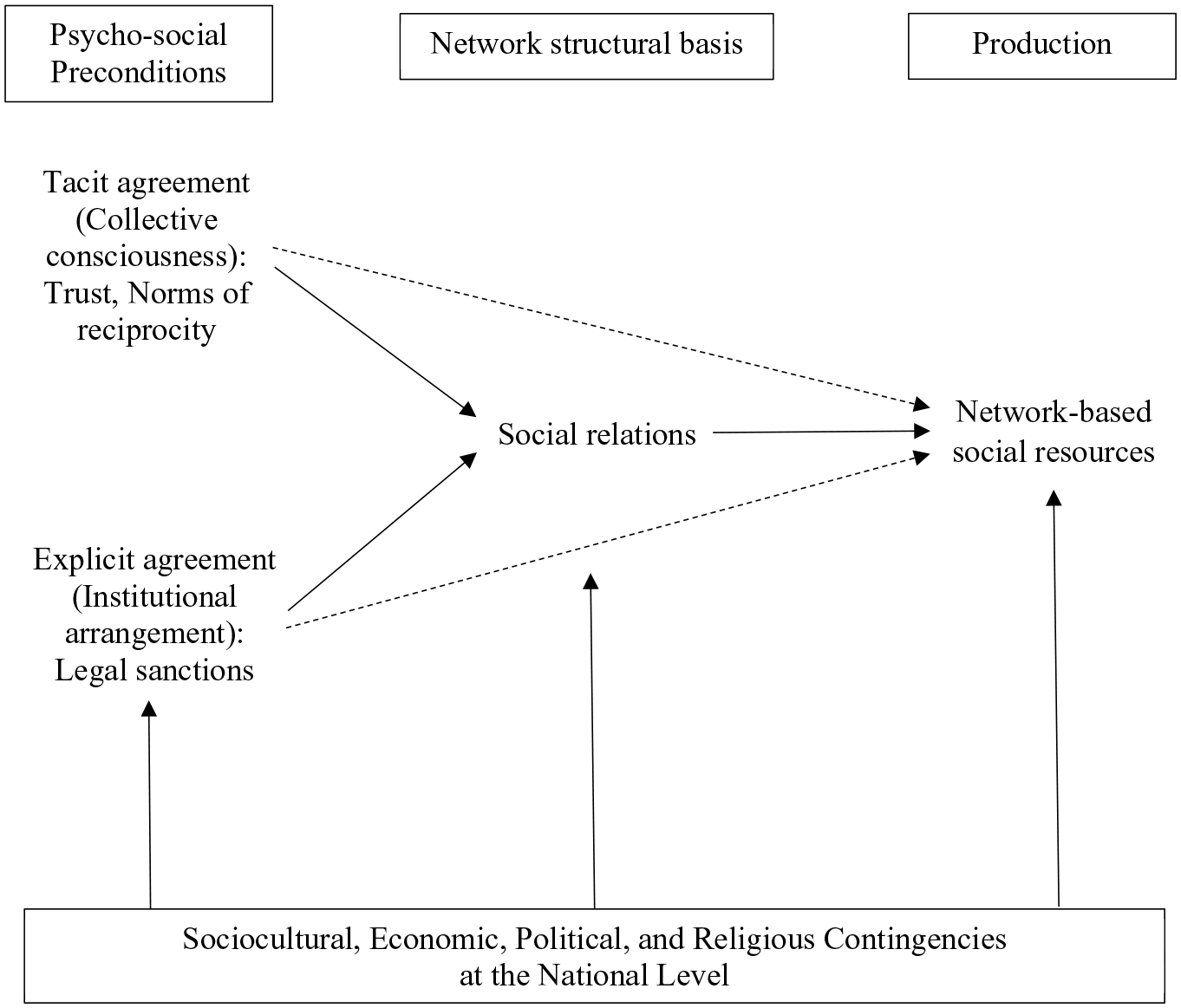
An integrative model of individual social capital: preconditions, network structural basis, and production.
Second, the network structural basis indicates the total number of social ties in an interpersonal network formed significantly by the preconditions. It is called a structural basis because of its potential to embed diverse resources possessed by social ties. In particular, the network structural basis facilitates various exchanges among ties (Homans, 1958) and thus embeds social resources shared by connected people (Lin, 2001). Third, the production of individual social resources indicates various assets owned by those who fill the nodes in a network.
In addition, country-level contingencies may affect the integrative model of individual social capital. The sociocultural, economic, political, and religious organizations at the country level may affect the integrative model. Because the study’s main aim is to check how psycho-social preconditions and network structural basis are associated with the production of social resources, we concentrate on the relationship between country-level contingencies and network-based social resources in the empirical examination.
Following the integrative model of social capital, we propose a mediatory relationship among (1) trust, a psycho-social precondition of social capital; (2) the network structural basis of social relations, including strong and weak ties; and (3) the production of social resources. We used nationally representative data from 30 countries to examine the model’s applicability. While doing so, we accounted for the cross-national variation of social resources by country-level contingencies, including country-level trust and social relations.
In what follows, we describe the integrative model of social capital in detail and present relevant hypotheses. We then introduce the data and present the multivariable regression results. The empirical results showed that (1) the integrative model was verified across nations, and (2) a few country-level contingencies were associated with the production of social resources.
An integrative model of individual social capital
The model illustrates that tacit (psycho-social) and explicit (legal-institutional) preconditions pattern social relations. The tacit agreement indicates informal norms and rules concerning how to form, maintain, or dissolve social ties. This agreement provides a script pertaining to whom to associate with and to what extent one may enter into various exchanges with these ties. It originates from Durkheim’s (1933) collective consciousness shared in a society. The collective consciousness sets a rough boundary of relatable others. Exemplary indicators of the tacit agreement include trust toward most people and norms of reciprocity shared by them.
The explicit agreement exists to support the tacit agreement. That is, the occasional failures of the tacit agreement due to its lack of mandatory force against freeloaders and fraudsters necessitate the existence of the explicit agreement. In short, the explicit agreement denotes the degree of societal acceptance of legal and institutional codes that control those who break the tacit agreement. Despite its auxiliary nature, the explicit agreement is vital in creating, preserving, or revoking exchanges among people. For instance, in societies where the degree of informal trust is low, and the norms of reciprocity are more frequently broken than kept, the legal codes deter illegitimate acts and help sustain social, economic, and political exchanges among individuals. This is why some scholars emphasize the importance of the rule of law (Fukuyama, 2002; Papadimitri et al., 2021). In particular, Fukuyama (2002) maintains, ‘A uniform and transparent rule of law historically allowed modernizing societies in the West to extend the radius of trust and, thus, breed cooperation among strangers’ (p. 33). Ideally, the tacit and explicit agreements go hand in hand to cultivate relational ties and the embedded resources in them.
These preconditions form the network structural basis of social relations, the second phase of the model. Social ties can be either strong or weak based on role relations and the psychological closeness between them (Deshpande and Khanna, 2021; Granovetter, 1973). It is plausible that generalized trust toward most people, a psycho-social precondition of social capital, expands weak social ties. The higher the generalized trust, the more likely one will go beyond the usual network boundary of familiar confidants reaching out to unfamiliar others or strangers. The network structural basis woven by weak and strong ties may hold the pooled resources of those occupying the nodal positions at each end of a tie. Therefore, a structural basis enables the production of network-based social resources. Then, at the third step of the model, these resources can be accessed by its partakers, contingent on voluntary consent from relevant network members. Throughout these steps, inequality in access to individual social capital may structuralize between race, gender, and socioeconomic groups (Bonoli and Turtschi, 2015; Lin, 2000) and by geospatial constraints of local occupational structures (Kuo and Fu, 2021).
The integrative model of social capital generates two hypotheses concerning how individual-level generalized trust and social ties are related to the production of individual social resources after accounting for country-level contingencies. Regarding the relationship between individual social ties and social resources, we presume that the number of either strong or weak ties should be associated with social resources. Due to the lack of data, this study cannot examine the roles of norms of reciprocity and explicit agreement.
Hypothesis 1: Individual-level generalized trust is positively associated with the network structural basis of social relations, mainly through weak ties, considering country-level institutional contingencies.
Hypothesis 2: Both strong and weak ties at the individual level are positively associated with the production of social resources, considering country-level institutional contingencies.
Along with the integrative model of social capital, cross-national and -regional variations of social resources should also be considered.
Cross-national and -regional variation
We propose that country-level institutional contingencies may render cross-national and cross-regional variation in social resources apart from the generalizable within-country association from trust to social ties to social resources. In particular, we consider sociocultural, economic, political, and religious contingencies as critical institutional contingencies (see Figure 1).
Concerning the sociocultural contingency, country-level trust and social ties may shape baseline conditions for social association among individuals. For instance, in a country where trust is rich, individuals are prone to form social ties with unfamiliar others. Similarly, those belonging to a country where people are better connected on average are more likely to access greater social resources, net of individual ability to knit a resourceful network.
As to the economic contingency, more-affluent countries with less economic inequality may allow a higher degree of trust toward others and, thus, more expansive social relations and greater social resources (Paarlberg et al., 2018).
Social distances derived by power differentials in democratic nations may be shorter on average than those in undemocratic polities. A democratic polity not only provides easier access to power elites but may also reduce the general relational gaps among people on the streets and in workplaces, neighborhoods, schools, voluntary associations, and religious congregations (Bekiaris and Daskalopoulou, 2022; Sommerfeldt, 2013).
The religious contingency may constitute a variation in trust, the extensity and range of social relations, and the volume of social resources. For instance, it was reported that Protestantism led its adherents to an emancipatory individualism (Kaasa, 2013) and active involvement in communal life outside religious entities (Ammerman, 2020). Lam (2006) finds that the percentage of the Protestant population was positively related to the number of voluntary associational memberships in 29 countries. Nonetheless, it is uncertain how other religions are associated with the production of individual social capital.
Hypothesis 3: Cross-national institutional contingencies of high trust, rich social connections, affluent economy, democracy, and Protestantism are positively associated with individual social resources.
Data
We used the International Social Survey Program data in 2017 (ISSP Research Group, 2019). Since 1985, the ISSP has administered annual cross-national surveys on such diverse topics as inequality, religion, and health. The ISSP employed a thematic module on social networks and social resources in 2017 (Sapin et al., 2020). The ISSP 2017 comprises nationally representative samples of at least a thousand respondents from 30 countries (15 countries from Europe, 9 from Asia, and the remainder includes the United States, Australia, New Zealand, Israel, South Africa, and Suriname). Each country adopted an optimal probability sampling strategy and used different modes of data collection: face-to-face interviews (computer-assisted or paper-and-pencil), self-administered questionnaires (web-based, paper, or computer-assisted), and telephone interviews. The response rates varied from 22.5% in India to 89.3% in South Africa. The analytic sample comprised 44,492 respondents, after multiple imputation described in the Methods section.
Measures
Individual generalized trust
The integrative model considers generalized trust as a precondition that helps form the network structural basis of social relations. Generalized trust toward most people indicates the tacit agreement that reflects the collective consciousness of a society. It is a moralistic trust held for unspecified and unfamiliar people, whereas particular trust is confined to familiar persons of intimate relations (Uslaner, 2015; Yamagishi and Yamagishi, 1994). Recent literature reports that in-group and out-group trust are more delicate than generalized trust in that the former specifies the targets of trust (Delhey et al., 2011; Glanville and Shi, 2020). This study examines whether generalized trust, despite its lack of specificity, is connected with weak ties across countries. Specifically, a respondent was asked, ‘Generally speaking, would you say that most people can be trusted or that you can’t be too careful in dealing with people?’ with four response categories: (1) people can almost always be trusted, (2) people can usually be trusted, (3) you usually can’t be too careful in dealing with people, and (4) you almost always can’t be too careful in dealing with people. We reverse-coded them so that a higher category denotes a higher level of trust.
Individual social relations
We measured the interpersonal network of a respondent using a position generator (Lin and Dumin, 1986; Verhaeghe and Li, 2015). The position generator in the ISSP 2017 asked if a respondent knew a family/relative, a close friend, or someone else who held any of the 10 occupations, such as a bus/lorry driver, a lawyer, or a nurse (see Table 1).
List of position generator items.
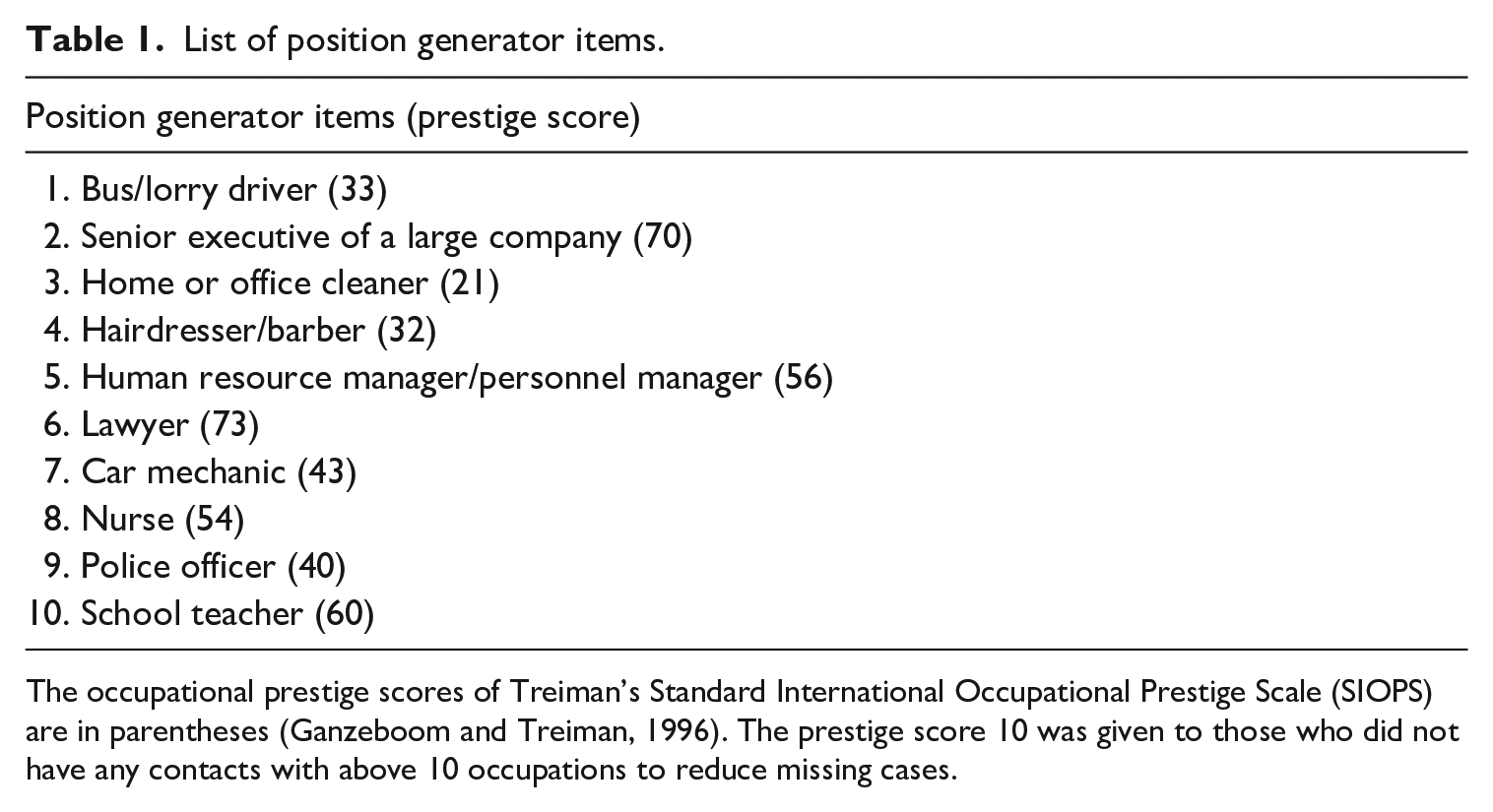
The occupational prestige scores of Treiman’s Standard International Occupational Prestige Scale (SIOPS) are in parentheses (Ganzeboom and Treiman, 1996). The prestige score 10 was given to those who did not have any contacts with above 10 occupations to reduce missing cases.
The surveyors of the ISSP 2017 explained regarding the choice of the 10 positions, ‘We have extensively explored this question by trying to identify the ‘best’ set of occupations and its cross-national variation’ (Sapin et al., 2020: 10). We categorized these social relations into two types: strong and weak ties.
Number of strong ties is a sum of the positions accessed through ‘family or relative’ or ‘close friend’.
Number of weak ties is a sum of the positions accessed through ‘someone else’.
Individual social resources
We assigned a Standard International Occupational Prestige Scale (SIOPS) score from the 1988 International Standard Classification of Occupations (ISCO88) for each of these 10 positions. The prestige scores indicate the resources attached to the occupational positions (Ganzeboom and Treiman, 1996; see Table 1). Two specific indicators of social resources are as follows.
Highest prestige denotes the highest prestige score among all the positions a respondent knew. For example, if a respondent knew a bus/lorry driver (a prestige score of 33), a nurse (54), and a lawyer (73), the highest prestige score in the network was 73. We allocated a purported highest prestige score of 10 to those who knew none of the 10 positions. It is lower than the lowest score among the 10 positions, a home or office cleaner (21). This first accounts for the plausibility that they might know some positions if they encountered another position generator composed of different jobs. Second, it reduces the number of missing cases.
Range of prestige shows the width between the lowest and highest prestige scores among the positions known by a respondent. In the example above, it is 40, the prestige score gap between a bus/lorry driver (33) and a lawyer (73). If a respondent knew less than two positions, the range became 0.
We then constructed a summated measure of individual social resources by averaging the highest job prestige score among known positions and the range of job prestige scores in a network. There were two reasons for this. Using a factor analytic score of these two indicators was an option. However, it would make the mean of social resources 0 and the standard deviation 1 across all the countries, which denies cross-national variation. Also, the average score of the highest prestige and range of prestige accounts for the resourcefulness and diversity of a network.
Individual-level covariates
We considered key demographic and socioeconomic covariates associated with social resources. These include age, gender, marital status, religious service attendance, income, education, employment, and occupational prestige of the respondents (McDonald et al., 2015; Volker, 2020).
Age ranges from 15 to 103.
Female is a dichotomous variable where 1 = female and 0 = male.
Married is a dichotomous variable where 1 = married and 0 = unmarried.
Religious service attendance is an ordinal variable measuring attendance at religious services (excluding special occasions such as weddings or funerals) ranging from 0 = never to 7 = several times a week or more often.
Personal income is an ordinal variable from the lowest to highest income categories. We made a septile income variable because the smallest number of income categories was 7 in India, although the greatest number of categories grew to 26, and some countries used a continuous scale of income.
Education is an ordinal variable indicating a respondent’s highest completed educational level: 0 = no formal qualification, 1 = primary school, 2 = lower secondary, 3 = upper secondary, 4 = postsecondary, nontertiary, 5 = lower-level tertiary, and 6 = upper-level tertiary.
Employed is a dichotomous variable where 1 = currently in paid work and 0 = the rest.
Occupational prestige is a continuous variable showing the relative socioeconomic status of a respondent’s current or last job in the labor market. Each respondent’s position was assigned an occupational prestige score from the SIOPS. To keep those who were never in paid work (n = 4512) in the analytic sample, a score of zero was given to them.
Country-level covariates
Sociocultural contingency (trust and social ties)
Country-mean generalized trust may be associated with social resources, independently from the relationship between individual generalized trust and social resources (Olivera, 2015; Rothstein and Stolle, 2008). Similarly, country-mean strong and weak ties may exert a contextual effect on social resources, independently from the association between individual social relations and social resources. Therefore, the study considered generalized trust and social ties at the country level.
Economic contingency
GDP per capita was from the Penn World Table (PWT) version 9.1 (Feenstra et al., 2015). The PWT provided reliable estimates of real GDP per capita that captured relative living standards across countries, indicating the maturity of the economy that was closely related to the development of occupational structure and resources. Specifically, the PWT calculated real GDP on the expenditure side from the World Bank’s International Comparisons Program. We used the 2015 expenditure-side real GDP at chained purchasing power parities divided by the midyear population. Each country’s GDP was divided by 1000 and logged to prevent right-skewed distribution.
The Gini index measures the income distribution in a country, ranging from 0 (perfect equality) to 1 (perfect inequality). The Gini index in the study was from the Standard World Income Inequality Database (SWIID) version 9.0 (Solt, 2020). Based on the Luxembourg Income Study, the SWIID consolidated Gini indices from multiple sources (e.g. the World Bank and the United Nations) to maximize its comprehensiveness and comparability. We used the Gini index from equivalized household disposable net income in 2015 that considered the number of household members. The SWIID Gini index provided 100 imputed estimates for each country year. We employed the first 30 indices in 2015 and merged them with 30 multiply imputed datasets of the ISSP 2017, respectively.
Political contingency
The level of democracy is an index scale imported from the Varieties of Democracy (V-Dem) project version 9 dataset (Coppedge et al., 2019). The V-Dem project produced the largest and most comprehensive data on electoral, liberal, participatory, deliberative, and egalitarian principles of democracy collected from 2500 local and international experts. We chose the liberal democracy index in 2015, which ranged from 0 (a complete lack of democracy) to 1 (full democracy).
Religious contingency
The four major religions – Protestantism, Roman Catholicism, Islam, and Buddhism – were considered in multivariable analyses. Specifically, the proportions of adherents of a specific religion by country were considered. The proportional measures were extracted from the 2010 World Religion Project (WRP): Global Religion Dataset in the Association of Religion Data Archives (ARDA; Maoz and Henderson, 2013). The WRP-ARDA index scores ranged from 0 (e.g. no Catholic in a population) to 1 (e.g. the whole population practices Catholicism). We also tried to account for Hinduism and Judaism. However, their proportional variation across countries was limited: adherents of Hinduism and Judaism occupied less than 1% of the population in most countries except a single country (e.g. 80% Hinduism in India and 73% Judaism in Israel). Due to this lack of variation, Hinduism and Judaism produced unreliable multivariable analysis estimates. Thus, these two religions were not considered in the analyses.
Methods
We used multilevel within–between linear mixed regression. Multilevel regression allows simultaneous estimation of individual and country-level predictors in their associations with an individual-level outcome while accounting for between-country heterogeneity (Hox et al., 2018). Specifically, within–between modeling with country-mean centering provides reliable estimates of the key individual- and country-level variables by decomposing their within- and between-country variance (Bell et al., 2019; Schunck, 2013).
For an individual i in country j, social resources Yij was predicted by the following equation

where the effects of individual-level variables xs were decomposed into two parts:
In the ISSP 2017, about 33% of the respondents had at least one or more missing values in key variables – for instance, there was about a 15% missing rate in income. The study employed the multiple imputation method to prevent biases due to missing data. The multiple imputation replaces missing values with a set of random values from the posterior predictive distributions, generating datasets with complete observations (White et al., 2011). Each of the multiply imputed datasets produces its own estimates, and all of them merge into a single set of estimates following Rubin’s (2004) rule. We generated 30 imputed datasets close to the percentage of missing data.
In addition, the study conducted a multilevel mediation analysis using a structural equation modeling to test whether the sequential association existed among trust, strong and weak ties, and social resources at the individual level.
Results
Univariate and bivariate description
Table 2 describes all the measures used in the analyses. The average level of individual generalized trust across the 30 countries fell between ‘you usually can’t be too careful in dealing with people’ and ‘people can usually be trusted’, hitting about the midpoint of the range. Social relations are one-on-one ties between a respondent and his or her alters in the 10 position-generator items. The average number of strong ties through family/relatives or close friends was slightly higher than the mean number of weak ties connected by other relations. Individual social resources denote how rich and diverse occupational status these social ties embed. First, the highest job prestige among the known ties was 62.5 on average. Second, the mean range of job prestige from the lowest to the highest scores attached to the positions was 35.9. Finally, the average social resources score between the highest prestige and the range of prestige in the 30 countries was 49.2. Social resources were positively correlated with individual generalized trust (0.10***), strong ties (0.55***), and weak ties (0.52***).
Variables in the analyses.
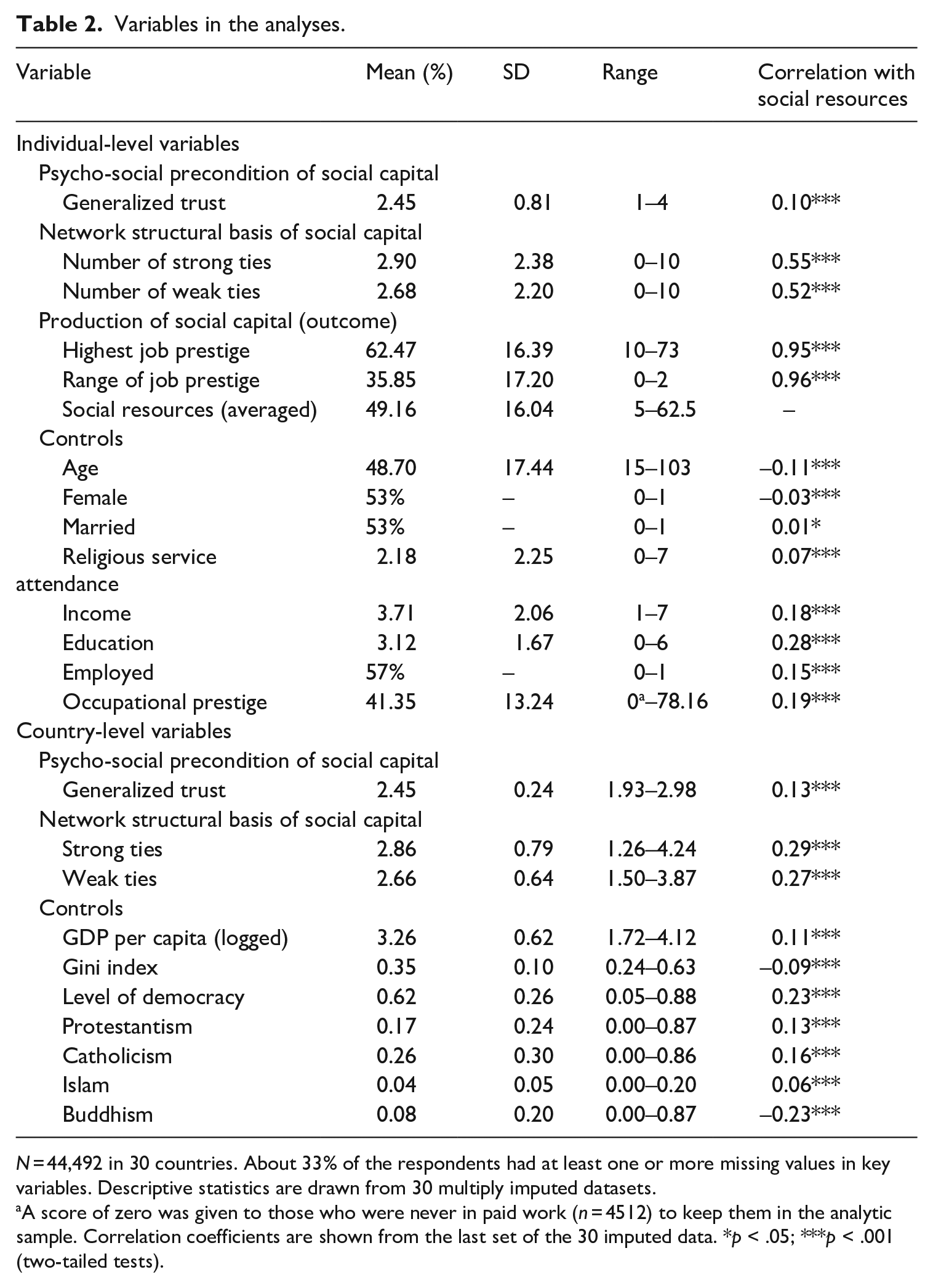
N = 44,492 in 30 countries. About 33% of the respondents had at least one or more missing values in key variables. Descriptive statistics are drawn from 30 multiply imputed datasets.
A score of zero was given to those who were never in paid work (n = 4512) to keep them in the analytic sample. Correlation coefficients are shown from the last set of the 30 imputed data. *p < .05; ***p < .001 (two-tailed tests).
Individual-level control variables show that the respondents in the multinational data were 49 years old on average and 53% were females. Fifty-three percent of them were married. They attended religious services about once or several times a year on average. The mean personal income level of the respondents stood at a little lower than the midpoint in the septile income distribution. The educational level of the average respondent fell between upper secondary and postsecondary school degrees. About three-fifths of them were in paid labor. The average occupational prestige score among the respondents was 41, significantly lower than their social ties’ mean highest job prestige score (62). Among these controls, education, occupational prestige, income, employment status, religious service attendance, and marital status were positively correlated with social resources, whereas being older or female was negatively correlated with the final outcome.
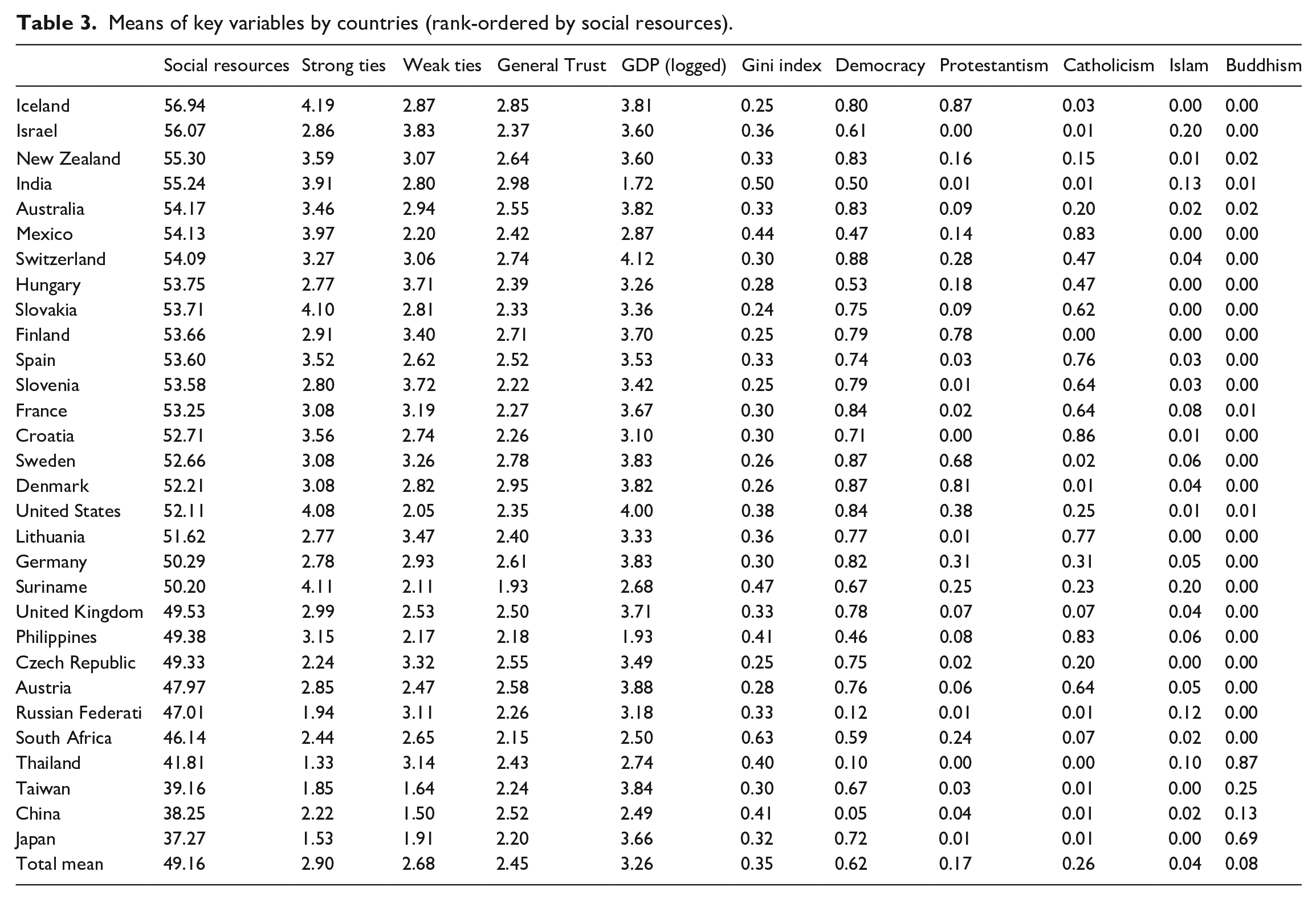
Among the country-level variables, country-mean generalized trust and strong and weak ties were significantly correlated with individual social resources. Also, the level of democracy, GDP per capita, and proportions of Catholics, Protestants, and Muslims were positively correlated with social resources. By contrast, income inequality and the proportion of Buddhists were negatively correlated with the outcome. Table 3 ranks the 30 countries by their average social resources, after which the means of country-level variables are presented.
Means of key variables by countries (rank-ordered by social resources).
Multivariable test of the integrative model
The progressive development of the integrative model from the psycho-social precondition and network structural bases to social resources was subject to examination by multilevel within-between linear mixed regression models. The fixed effects part of the regression estimated reliable parameters across countries. The random effects accounted for country-specific deviations from the fixed parameters. Specifically, ‘Intercept’ under ‘Random Effects’ presents between-country variance, while ‘Residual’ denotes residual variance within countries. The Intraclass Correlation Coefficient (ICC) of the empty model for strong ties, weak ties, and social resources were 0.10, 0.07, and 0.11, respectively, indicating some between-country variability of the outcome measures (Snijders and Bosker, 2012).
Model 2 in Table 4 shows that generalized trust was significantly related to weak ties at the individual level across the 30 countries after accounting for country-level generalized trust and between-country random variance in the intercept and the slope, among other things. This result supports Hypothesis 1 that individual generalized trust is positively related to network structural basis mainly through weak ties. The 95% confidence intervals of the random intercept standard deviations in Models 1 and 2 indicate some variation in the intercepts of individual strong and weak ties across nations. In addition, the 95% confidence intervals of the random slopes of generalized trust show that the association between individual generalized trust and strong and weak ties varied cross-nationally. Also, the 95% confidence intervals of the residual component indicate that unexplained residuals of individual strong and weak ties varied within each country.
Multiply-imputed multilevel linear mixed regression of social resources on trust and social relations.
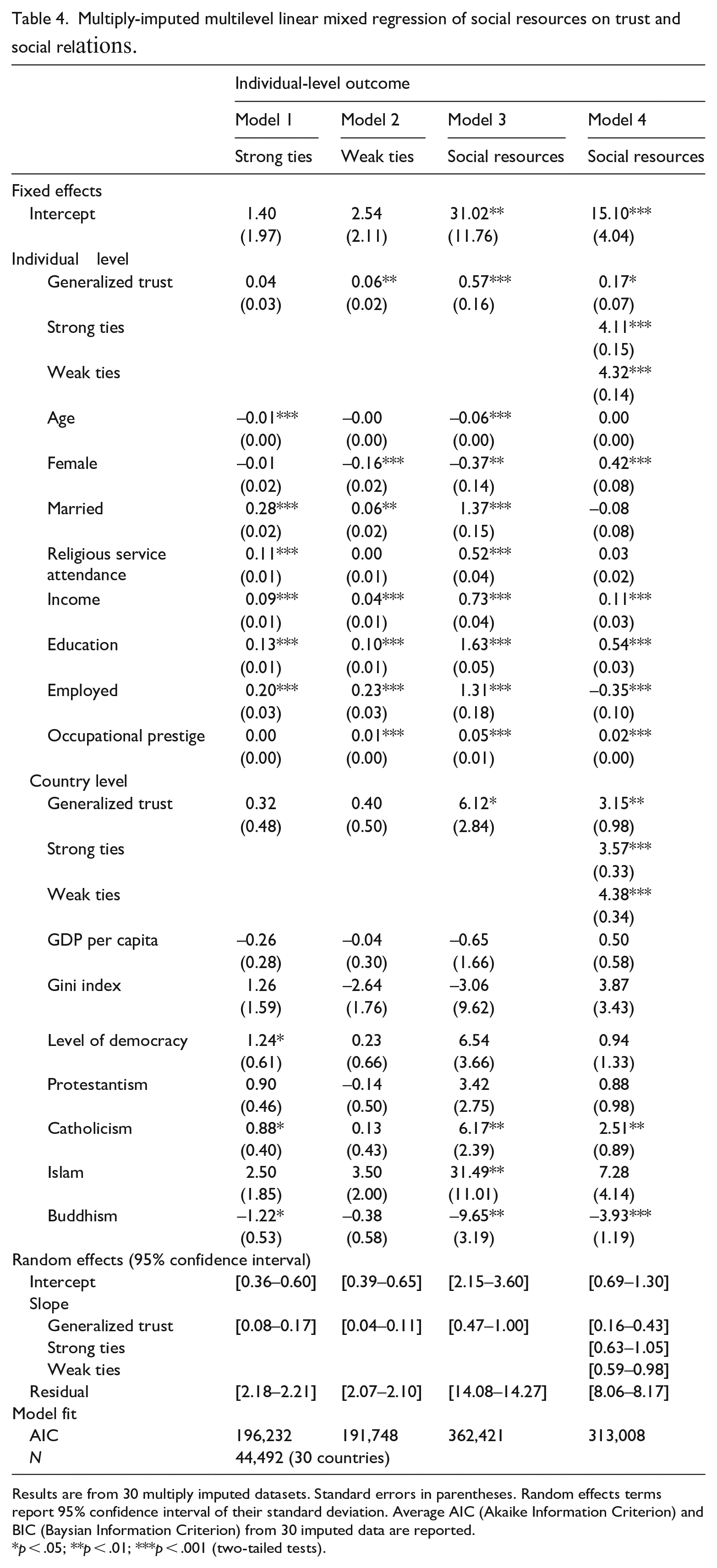
Results are from 30 multiply imputed datasets. Standard errors in parentheses. Random effects terms report 95% confidence interval of their standard deviation. Average AIC (Akaike Information Criterion) and BIC (Baysian Information Criterion) from 30 imputed data are reported.
p < .05; **p < .01; ***p < .001 (two-tailed tests).
Among the individual-level controls, being female was negatively related to the number of weak ties (Model 2). Possessing a higher occupational prestige was positively related to the number of weak ties. Being married, more educated, employed, and earning a higher income were all positively associated with the numbers of both strong and weak ties. The frequency of religious service attendance was positively associated with the number of individual strong ties, whereas being older was negatively related to strong ties (Model 1).
The following models tested if social ties mediated the relationship between generalized trust and social resources at the individual level. The strong relationship between individual generalized trust and social resources in Model 3 denotes a plausible direct association between them. However, the strength of the association between individual generalized trust and social resources attenuated in Model 4. This reduction was due to the inclusion of strong and weak ties at individual and country levels.
Considering that it was necessary to formally examine the mediation mechanism from individual generalized trust to strong and weak ties to social resources, we conducted a separate multilevel mediation analysis using a structural equation model based on Model 4 of Table 4. It confirmed that weak ties were a mediator between generalized trust and social resources (see Table 5). The mediatory path from generalized trust to weak ties to social resources explained 42% of the total association between generalized trust and social resources. In contrast, strong ties provided an insignificant path between individual generalized trust and social resources, although strong ties were directly associated with social resources. After accounting for these two mediatory paths, individual generalized trust was directly related to social resources, explaining 28% of the total association between them. The multilevel mediation analysis identified the mediatory path among generalized trust, social relations, and network-based social resources in Figure 1.
Total, direct, and indirect association among generalized trust, strong/weak ties, and social resources at the individual level.
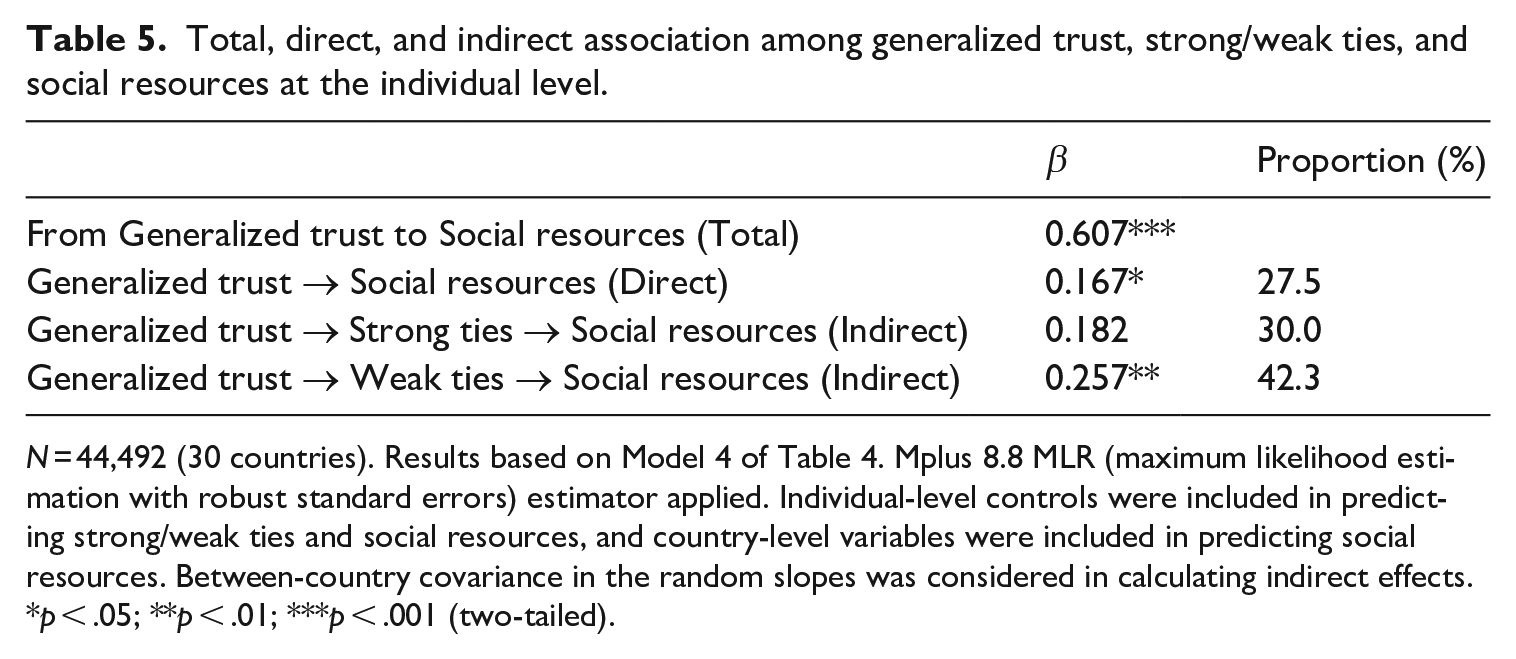
N = 44,492 (30 countries). Results based on Model 4 of Table 4. Mplus 8.8 MLR (maximum likelihood estimation with robust standard errors) estimator applied. Individual-level controls were included in predicting strong/weak ties and social resources, and country-level variables were included in predicting social resources. Between-country covariance in the random slopes was considered in calculating indirect effects.
p < .05; **p < .01; ***p < .001 (two-tailed).
Returning to Model 4 in Table 4, a unit increase in either individual strong or weak ties was matched with about a four-point rise in individual social resources, other covariates being equal. The results are as expected because the greater the number of strong or weak ties in the position generator, the more resources should be embedded in them. Thus, Hypothesis 2 is supported. The AIC (Akaike Information Criterion) shows a 14% reduction between Models 3 and 4, indicating a significant improvement in the model fit due to the consideration of strong and weak ties at individual and country levels.
Some changes due to introducing strong and weak ties at individual and country levels between Models 3 and 4 should be explicated. To begin with, country-level strong and weak ties were significantly associated with individual social resources. Also, country-level generalized trust remained significant, although its magnitude was reduced compared to Model 3. In sum, the higher the country-level generalized trust and the greater the country-level strong and weak ties, the more social resources individuals could access. Therefore, living in a country where people generally tend to trust unspecified others renders an additional benefit in social resources apart from the degree of generalized trust each individual holds. Similarly, some countries where people have greater numbers of strong and weak ties on average than others may offer more social resources to the population as a whole than what individual social ties could bring. The results verified the role of sociocultural contingencies at the country level, controlling for the individual-level estimates.
Considering strong and weak ties at individual and country levels in Model 4 also changed several associations between individual-level covariates and social resources. The negative relationship between being female and social resources turned insignificant. By contrast, the association between employment status and social resources changed from positive to negative. These results may indicate that the degree of social connectedness at individual and country levels explained away the female deficit and the employment advantage in social resources. Similarly, marital status and religious service attendance became insignificant in Model 4. Accounting for the variations in social ties absorbed the influences of connections by marriage and religious engagement. However, the measures of socioeconomic status (i.e. education, income, and occupational prestige) kept their positive associations with social resources, although their magnitudes declined somewhat.
As for other country-level measures, the economic and political contingencies were not significantly associated with social resources in Model 4. Arguably, economically affluent and politically democratic countries may have established within-country inequalities in access to interpersonal ties that canceled their comparative advantage over economically poor and less democratic countries. It is also plausible that individual socioeconomic status measured by education, income, and occupational prestige absorbed the influences of these county-level contingencies.
Still, country-level religious contingency exhibited significant differences in association with social resources. Catholicism was positively related to individual social resources, whereas Buddhism was negatively associated with social resources. It is likely that the significant association between country-level Catholicism and individual-level strong ties in Model 1 was reflected in the relationship between Catholicism and individual social resources. In other words, Catholicism may contribute to individual social resources by expanding strong ties. Contrary to the hypothesized relationship, Protestantism was related to neither social ties nor social resources. Therefore, Hypothesis 3 is only partially supported. Furthermore, the negative association between country-level Buddhism and individual social resources in the multivariable regression was in line with the descriptive statistics in Table 3 that indicated the relative lack of social resources in Asia (i.e. Japan, China, Taiwan, and Thailand).
Discussion
This study examined how social resources are formed using a specific generator of personal social networks from large-scale multinational data. The relationship between trust and social resources has been underexplored in the literature. One study reported a null relationship between generalized trust and network-based social capital (Son and Feng, 2019). However, the study compared only two case countries, the United States and China. Thus, it is uncertain if the finding is widely applicable to other countries. Based on the integrative model of individual social capital, the study tested whether a psycho-social precondition of trust and the structural basis of social relations are organically associated with social resources at the individual level across 30 countries. This model proposes that social relations are the proximal source of social resources while trust helps constitute specific patterns of network structural basis. The multivariable analysis verified that those who believed they could trust most people were likelier to have higher levels of social resources mainly through weak ties, although both weak and strong ties embedded social resources in the networks.
The study also considered country-level contingencies that may yield international and interregional variations in individual social resources. In particular, we found that country-mean trust, strong and weak ties, and religion were significantly associated with social resources. We thus reason that the contextual psycho-social precondition and network structural basis at the country level are related to social resources at the individual level, apart from how individual-level trust and social ties are associated with social resources.
Concerning religious traditions, the positive association between Catholicism and social resources was unexpected. For example, Van Oorschot et al. (2006) found, ‘Catholics tend to have less social capital in terms of . . . friends networking, while Protestants tend to have more’ (p. 163) in Europe. However, the study also identified that Catholics had more family ties than Protestants. Therefore, it is plausible that Catholics utilized their strong ties effectively in accessing various job holders in the position generator despite their relative lack of weak ties. Notably, the social capital literature in the late 1980s and the 1990s emphasized that network closure and strong ties among the Catholics are a necessary condition for stronger cohesion and mutual obligations among them to look after school-aged adolescents in the community (Coleman, 1988; Morgan and Sorensen, 1999; Teachman et al., 1997). Similarly, Catholics may also have a comparative advantage of using strong ties in accessing social resources.
Next, the univariate means across nations (see Table 3) and the multivariable regression analyses (see Table 4) confirmed Buddhist Asia’s relative shortage of social resources. However, this does not mean social resources are irrelevant in the region. On the contrary, the literature reports that social resources are an essential asset without which people suffer in pursuing instrumental goals, such as migration and status attainment. For instance, strong kinship ties are crucial for rural-to-urban migration and the long-term urban adaptation of the migrants in Thailand (Korinek et al., 2005). Even after China liberalized its job market beginning in the 1990s, job seekers still rely on favors from strong ties to obtain positions that pay higher wages while using weak ties to gather job information (Bian et al., 2015). Guanxi, denoting particularistic ties, also promotes the managerial effectiveness of Taiwanese firms in reducing interpersonal conflicts and increasing cooperation within and across suborganizational units (Wong, 2010). In Japan, kankei and jinmyaku, both meaning social relations, play the role of particular ties like Chinese guanxi (Hitt et al., 2002).
To summarize, social resources are scarce assets that are unevenly distributed in Buddhist Asia. Ironically, the literature highlights the importance of social ties in the region (Bian, 2019; Yum, 1988), not because they are abundant and thus easily accessible but because the network closure based on the Confucian social order makes them less available that the access to social resources becomes an exclusive advantage. For example, Susomrith and Suseno (2017) argue that the influence of Buddhism plus particularistic and collectivistic culture shapes exclusive business networks centered around family and intimate social ties in Thailand.
Limitations
This study has several limitations. First, the study could not make a causal argument because it used cross-sectional data, although the integrative model postulated a sequential association among trust, social ties, and social resources. For instance, an inverse relationship – that is, expanded social resources and ties may be associated with greater trust – is also possible. Nonetheless, this study presumed that trust toward generalized others in the social environment is crucial to expanding social networks and their embedded resources.
Second, due to the lack of data, the study could not consider the explicit agreement concerning the degree of acceptance of legal sanctions by people in a society. Thus, it could only consider generalized trust as a measure of tacit agreement under the psycho-social preconditions in the integrative module of individual social capital (see Figure 1).
Third, in- and out-group trust measures could not be used because the survey did not ask about them. Nonetheless, even with a limited measure of generalized trust, the study confirmed that the higher the degree of trust toward unspecified people, the stronger its association with weaker social ties.
Fourth, the position generator does not provide complete information regarding the total social ties in a network. Instead, it sampled only a part of the overall social networks by asking whether a respondent knew 10 job holders in the labor market. Therefore, the social network measures employed in the study may be limited, although this limitation applies to any network generator such as name or resource generator.
Fifth, considering that the study assigned an arbitrary highest prestige score to those who did not know any of the positions, it is necessary to check if this distorted the results. We reran the regression models, expelling the arbitrary score. The results remained similar (Supplemental Material Appendix 1). Among the key predictors, trust at the individual level and country-mean Catholicism lost significance in their associations with social resources in the full model.
Sixth, using the average scores of highest prestige and range of prestige from the position generator to measure social resources might have concealed how each could be associated with the explanatory mechanism. We thus conducted a supplementary analysis employing the highest prestige and range of prestige separately (Supplemental Material Appendix 2). The results were similar to Table 4 with a few differences – that individual generalized trust was related only to the highest prestige, country-mean Catholicism was associated only with the range of prestige, and the Gini index was positively related to the range of prestige. Despite these modest discrepancies, we maintain that both upper reachability (highest prestige) and diversity of social resources (range of prestige) should be concurrently considered in operationalizing social resources.
A notable finding from these supplementary analyses is that the relationship between individual-level trust and social resources is tenuous, losing the significance conditional on how social resources are operationalized. Contrarily, the association between country-mean trust and individual social resources was robust because the changes in the outcome measure did not nullify its statistical significance.
Seventh, it was necessary to check if the multivariable regression estimates differ when using the listwise deletion sample, which eliminated more than 30% of the sample from the analysis. However, the main results remained similar (Supplemental Material Appendix 3); among the country-level covariates, GDP per capita turned significant in its association with social resources, whereas Catholicism lost its significance.
Conclusion
The integrative model of social capital proposed in this study posited that trust is a precondition that helps pattern a network structural basis of social relations, which may embed social resources. Specifically, trust represents a crucial part of collective consciousness, based on which people determine various conditions of socialization and social exchanges with others. The study also confirmed a mediatory relationship among generalized trust, weak ties, and social resources. Future studies need to account for other likely indicators of tacit agreement stemming from collective consciousness, such as norms of reciprocity. Also, they may consider explicit agreement regarding the extent to which people accept legal and punitive institutions.
The study also showed that cross-national sociocultural elements were associated with social resources at the individual level. Namely, countries with higher trust and greater social ties were prone to be with richer individual social resources. Regarding religious traditions, the proportion of Buddhists in countries was negatively associated with individual social resources, whereas the proportion of Catholics was positively related to them. In sum, these country-level contingencies may promote or check the growth of individual social capital independently from the association among trust, social ties, and social resources at the individual level.
In conclusion, the integrative model endorses the procedural relationship among trust, social ties, and social resources. A popular adage, ‘It’s not what you know but who you know’, emphasizes the value of interpersonal relations in achieving instrumental and expressive goals. Nevertheless, the study indicates that ‘who you know’ is not something any actor can unconditionally acquire. Instead, it depends on how much an actor can trust unfamiliar others. Furthermore, it is conditioned by institutional contingencies that vary across countries and regions.
Supplemental Material
sj-docx-1-iss-10.1177_02685809241251770 – Supplemental material for The relationship among generalized trust, social networks, and social resources across 30 countries
Supplemental material, sj-docx-1-iss-10.1177_02685809241251770 for The relationship among generalized trust, social networks, and social resources across 30 countries by Joonmo Son and Pildoo Sung in International Sociology
Footnotes
Declaration of conflicting interests
The authors declared no potential conflicts of interest with respect to the research, authorship, and/or publication of this article.
Funding
The authors received no financial support for the research, authorship, and/or publication of this article.

Supplemental material
Supplemental material for this article is available online.
Author biographies
References
Supplementary Material
Please find the following supplemental material available below.
For Open Access articles published under a Creative Commons License, all supplemental material carries the same license as the article it is associated with.
For non-Open Access articles published, all supplemental material carries a non-exclusive license, and permission requests for re-use of supplemental material or any part of supplemental material shall be sent directly to the copyright owner as specified in the copyright notice associated with the article.
