




Abstract
While previous research has shown that personality shapes social networks, we know very little about the relationship between these important psychological characteristics and the creation of social capital. In this article, we argue that personality shapes individuals’ ability to create social capital, and we predict positive associations between each of the Big Five personality traits and social capital. We tested our hypotheses using the Social Survey of the Networks of the Dutch, 2014, which contains data on about 1,069 respondents, including social capital and Big Five personality measures. Our findings showed that personality and social capital were related such that extraversion and openness predicted instrumental social capital, and extraversion, emotional stability, and agreeableness predicted expressive social capital. Conscientiousness benefited instrumental social capital when respondents were older or when social capital was accessed via weak ties. We discuss these findings in light of existing explanations of the creation of social capital.
Ample research shows that social capital, defined as valuable resources embedded in people’s networks, can be mobilized to improve one’s life chances (Coleman 1988; Flap and Volker 2004; Lin 2001; Lin and Erickson 2008; Van der Gaag, Snijders, and Flap 2008). Social capital comprises instrumental (i.e., wealth, knowledge) or expressive resources (i.e., social support). Research into the creation of social capital has focused primarily on social structural explanations, such as individuals’ positions in the social structure (Burt 2001; Lin 2000).
While a wealth of research demonstrates the importance of social structural explanations, we know relatively little about the role of psychological characteristics, such as differences in personality, for the creation of social capital. This is surprising because existing work on personality and networks has offered insights that might be valuable for our understanding of the creation of social capital. A notable line of research focuses on self-monitoring, which is a personality trait capturing the ability to self-regulate for the purpose of self-presentation and impression management (Snyder 1974). High self-monitors are likely to occupy strategic network positions (i.e., brokerage positions), which facilitate access to unique resources (Kleinbaum, Jordan, and Audia 2015; Mehra, Kilduff, and Brass 2001; Oh and Kilduff 2008). They also are successful at navigating exchange relationships to their advantage because they understand the benefits of strategic giving and receiving for status achievement (Flynn et al. 2006). Despite this important work on self-monitoring and network structure, it is largely unknown how other central personality constructs, such as the Big Five personality traits, relate to resources embedded in networks.
The Big Five consist of five broad and allegedly crucial personality traits, namely, extraversion, openness to experience, conscientiousness, emotional stability, and agreeableness (Costa and McCrae 1998; Goldberg 1993). Self-monitoring and the Big Five differ in important respects. Even though both tap into extraversion, they conceptualize and prioritize extraversion differently. Within the Big Five framework, extraversion is one of the broad personality dimensions, which itself has several subscales (Costa and McCrae 1998), while within the self-monitoring framework, extraversion is but one subscale that is thought to tap into one facet of self-monitoring (Gangestad and Snyder 2000). The largest difference between self-monitoring and the Big Five is that self-monitoring attempts to measure one specific personality trait, enabling very specialized predictions. In contrast, the Big Five attempt to measure personality in terms of broad, comprehensive dimensions, and there is wide consensus that the Big Five are a comprehensive taxonomy of personality (Costa and McCrae 1998; John and Srivastava 1999).
The Big Five are not constrained to a specific domain or theoretical perspective, which becomes apparent in the fact that the Big Five have been linked to a range of important life outcomes, such as occupational attainment (Roberts et al. 2007) and well-being (Steel, Schmidt, and Shultz 2008). Interesting to note, these outcomes are also studied as returns to social capital. The Big Five have additionally been found to shape social network structure (i.e., indegree and brokerage) and thereby help individuals occupy more advantageous network positions (Burt, Jannotta, and Mahoney 1998; Fang et al. 2015; Kalish and Robins 2006). For example, Fang and colleagues show that—similar to high self-monitors—individuals who are high in extraversion, openness to experience, and conscientiousness are more likely to occupy the position of brokers (Fang et al. 2015).
The earlier-mentioned studies link personality to social network structure, but it is still unclear how the Big Five personality traits relate to the extent and quality of resources in people’s individual networks. Such resources are acquired via social networks, but they are not equivalent to social networks. The size or structure of a social network does tell us via which channels resources can flow within a network, but it tells us little about the extent and quality of the resources that are present in a network (Lin 1999a). In this article, we focus on the extent to which the Big Five are related to the amount and quality of resources available to individuals via their direct ties. We examine egocentric networks, which are networks that are mapped from the perspective of a focal individual, the “ego,” who reports their social connections to other individuals, the “alters.” Following Lin and colleagues (Lin 1999a, 2001; Lin and Erickson 2008), we examine social capital in terms of the resources that an individual can potentially access through their personal network of direct contacts.
We focus on two types of resources, namely, socioeconomic resources (i.e., instrumental social capital) and social-emotional resources (i.e., expressive social capital). Availability of instrumental social capital is measured as the personal network composition with regard to alter occupations, and availability of expressive social capital is measured as alters’ willingness to offer social support (Lin 1999a, 2001; Lin and Erickson 2008). We argue that the Big Five affect access to social capital because the Big Five affect personal network composition with regard to resource availability.
To investigate the relationship between personality and social capital, we make use of the Social Survey of the Networks of the Dutch (SSND; Volker, Schutjens, and Mollenhorst 2014), which contains measures of the Big Five personality traits (Gosling, Rentfrow, and Swann 2003) and measures of types of social capital: instrumental social capital as measured by the position generator (Lin and Dumin 1986; Lin, Fu, and Hsung 2001; Van der Gaag et al. 2008) and expressive social capital captured as perceived social support (De Jong-Gierveld and Van Tilburg 1999).
The Creation of Social Capital
Social capital broadly refers to the advantages that individuals have because of some aspect of the social structure in which they are embedded (Coleman 1988). While divergent conceptualizations of social capital have been suggested, we side with the micro-level theory of social capital, which envisions social networks as providing resources that help people achieve goals that they could not have achieved otherwise (Bourdieu 1980; Flap and Volker 2004; Lin 1999a, 2008; Lin and Erickson 2008). Instead of investing in their own individual resources, people can invest in their social ties, borrow the resources of their social ties, and reap their benefits (Lin 2001). Typically, two types of resources are distinguished, namely, instrumental social capital (i.e., wealth, knowledge) and expressive social capital (i.e., social support).
The literature identifies three pathways for the creation of social capital: contact opportunities, ego attractiveness, and trust and reciprocity. Contact opportunities are fundamental for the creation of social capital because forming useful social ties requires people to meet potentially useful others. The pool of available others in a given context constrains the extent to which people are able to create useful ties (e.g., McPherson and Smith-Lovin 1987). The second pathway is ego attractiveness. The more support ego can offer to others, the more attractive people will be to others, and the better ego’s ability to create social capital (Burt 2001; Lin et al. 2001). The attractiveness of ego stems from their possession of instrumental and expressive resources. Egos can access instrumental resources as the result of their positions in the social structure (Erickson 2004; Moren Cross and Lin 2008), while egos’ availability of expressive resources stems from their ability to maintain close, emotionally supportive relationships (Flap and Volker 2004; Lin 2001). The third mechanism refers to reciprocity and trust. Reciprocity and trust are crucial for the creation of social capital because they determine the extent to which alters are willing to share their resources (Coleman 1990). The investment in social ties can be thought of as a trust game (Berg, Dickhaut, and McCabe 1995). When people extend favors, they do not expect an immediate return. Rather, an exchange of favors often is delayed (Flap and Volker 2013), which bears the risk of handing out favors but not receiving anything in return. Since such exchanges are promoted by trust (Balliet and Van Lange 2013) and the amount of reciprocity inherent in a relationship (Berg et al. 1995), those who are better able to promote trust and reciprocity build up more social capital. While we are unable to directly test the three pathways to social capital, they do offer a useful basis for establishing theoretical links between personality and social capital.
Personality and Social Capital
Personality is commonly defined as patterns of thinking, feeling, and acting that are relatively stable over time (John and Srivastava 1999). A widely used taxonomy is the Big Five personality model that was found to comprehensively capture personality regularities within and differences between people (Costa and McCrae 2008; Goldberg 1993).
Extraversion
Extraversion is associated with social visibility and energetic engagement with the social world (Costa and McCrae 2008; Goldberg 1993). Extraverted individuals possess the ability to hold other people’s attention and keep them engaged in conversations, which gives them a striking social presence (Ashton, Lee, and Paunonen 2002). Extraverted individuals are assertive, approach others easily, and prefer social activities over solitary activities (Leary, Herbst, and McCrary 2003).
Regarding the creation of instrumental social capital, extraversion closely links to the mechanism of contact opportunities. When people choose activities to engage in, they are restricted by time and energy budgets, and they have to prioritize one activity over another (Greenhaus and Kossek 2014). Extraverted individuals choose to spend much of their time in social situations because these correspond to their outgoing, talkative, and gregarious personalities. Since more extraverted people require less solitary time and have more social energy to spend, they might experience less competition between different social activities, which increases their contact opportunities.
Research has shown that extraverts report having larger personal networks than introverts (for reviews, see Landis 2016; Selden and Goodie 2018) and that extraverts’ networks are more likely to offer support (Swickert et al. 2002; Zhu et al. 2013). Longitudinal studies on sociocentric networks support this by showing that more extraverted individuals build up larger networks of nonkin (Wagner et al. 2014) and that extraverts are more likely not only to nominate more friends but also to receive more nominations by others (Feiler and Kleinbaum 2015).
Extraversion might be beneficial for the creation of instrumental social capital because their increased seeking of social situations leads extraverts to encounter a large number of people, which makes them more likely to meet desirable acquaintances and friends (Ashton et al. 2002). As a by-product of the large number of contact opportunities inherent in the activities that extraverts choose, extraverts are more likely to meet individuals who can offer valued resources. These considerations lead us to suggest the following hypothesis:
Hypothesis 1a: Extraversion is positively associated with access to instrumental social capital.
With regard to expressive social capital, we argue that extraversion is beneficial because, compared to introverts, extraverts are more likely to maintain their friendships. Previous work shows that extraverts meet their friends at higher frequencies, suggesting that they maintain their existing friendships more actively (Asendorpf and Wilpers 1998), while introverts prefer to spend more time alone (Leary et al. 2003). Not only is tie maintenance an important condition for building up expressive social capital (Lin 2001), but reaching out to one’s friends for support—as opposed to handling distress by oneself—is an important condition for creating a network of trust and reciprocity (Molm 2010). Via the reciprocity mechanism, extraverts not only might be more likely to ask for social support from their friends, but might also be more likely to be asked for support (Klein et al. 2004), which further strengthens their support networks. Following these arguments, we suggest the following hypothesis:
Hypothesis 1b: Extraversion is positively associated with access to expressive social capital.
Openness to experience
Individuals who are high in openness to experience are adventurous, intellectually curious, and interested in new ideas (Costa and McCrae 2008; Goldberg 1993). These characteristics make more open individuals prefer situations that are characterized by novelty and variety. This is supported by research showing that individuals high in openness are more likely to migrate (Jokela 2009) and to have more friends who live farther apart (Laakasuo et al. 2017). Their seeking of novel social settings explains why individuals high in openness have more unconventional friendships and intergroup ties (Laakasuo et al. 2017). Social network studies also show that openness correlates with connecting with new people (Zhu et al. 2013) as well as network heterogeneity and connecting with disconnected subgroups (Gloor et al. 2011).
Openness may be beneficial for instrumental social capital because of an increased diversity of contact opportunities. If openness to experience makes individuals seek out new situations, then more open individuals are more likely to meet individuals who can offer nonredundant instrumental resources. Diversity in instrumental resources is beneficial because access to similar instrumental resources produces only marginal returns. Openness facilitates entering novel social settings, which increases the chance of encountering and connecting with a diversity of others who can offer unique resources. Following these considerations, we suggest the following hypothesis:
Hypothesis 2a: Openness is positively associated with access to instrumental social capital.
While connecting with distant groups and dissimilar people should benefit instrumental social capital, we expect the opposite for expressive social capital. What matters for the creation of expressive social capital is not to reach out but to strengthen existing bonds (Lin 1999a). Individuals who are less open to experiences prefer familiarity, and they are more likely to have relations to similar others who are densely connected (Gloor et al. 2011; Zhu et al. 2013). A preference for similarity is beneficial for expressive social capital because similarity is a powerful pathway to interpersonal trust (Farmer, McKay, and Tsakiris 2014). In short, we argue that individuals who are less open to experiences will channel more of their energy into already existing ties that tend to be similar and therefore a better source of trust and social support.
Hypothesis 2b: Openness is negatively associated with access to expressive social capital.
Emotional stability
People with high emotional stability tend to have a high tolerance for stress, are rarely in a bad mood, and are generally content (Goldberg 1993). People who are more emotionally unstable tend to worry more, experience more negative emotions, and have a more pessimistic outlook on life (Costa and McCrae 2008).
With regard to social capital, emotional stability most closely links to ego attractiveness. The main argument is that maintaining social contacts requires cognitive and emotional resources (Dunbar 1998). Emotionally unstable individuals have fewer cognitive and emotional resources available to spend on others because they invest a lot of their energy in processing unpleasant emotions and worrying about the events that caused these. Emotional stability frees up cognitive and emotional resources that can be invested in others.
Considering instrumental social capital, evidence for a link with emotional stability is scarce (Selden and Goodie 2018). A noteworthy exception is a study showing that emotionally unstable individuals tend to be located at the periphery of teams and to be more centrally located in adversarial networks (Klein et al. 2004). Emotionally unstable individuals experience higher social anxiety, have poorer social skills, and are viewed more negatively by others (Selden and Goodie 2018). Indirect evidence shows that emotionally unstable individuals tend to be less engaged at work and more likely to experience burnout (Langelaan et al. 2006), which limits their ability to build up instrumental social ties. Despite the scarcity of evidence, when emotional stability has been found to be significantly related to instrumental social ties (i.e., in the workplace), it has been in the positive direction. Hence, we formulate the next hypothesis:
Hypothesis 3a: Emotional stability is positively associated with access to instrumental social capital.
Given that emotionally unstable individuals have fewer resources available, their ability to invest in expressive social capital is limited. This is supported by research showing that emotionally unstable individuals report receiving less social support (Swickert, Hittner, and Foster 2010) and experiencing more loneliness and social deprivation (Stokes 1985). Emotionally stable individuals have more emotional resources at their disposal, which they can invest in others. This might make them more attractive friends and thereby increase their ability to create expressive social capital. Following this reasoning we suggest the following hypothesis:
Hypothesis 3b: Emotional stability is positively associated with access to expressive social capital.
Agreeableness
Agreeableness refers to being friendly, compassionate, and considerate. Individuals who are high in agreeableness value social harmony, are helpful, are generous, and are trustworthy (Costa and McCrae 2008; Goldberg 1993).
With regard to instrumental social capital, we argue that the ego attractiveness mechanism explains why agreeableness is beneficial, while for expressive social capital, it is the trust and reciprocity mechanism. Agreeableness makes people attractive exchange partners because they are willing to extend support to others. Agreeable people are better able to respond to the needs of others (Costa and McCrae 2008), which could make them more successful at exchanging their support for other people’s resources. The attractiveness of agreeableness shows in evidence that agreeable individuals receive more nominations for connections compared to less agreeable individuals (Selden and Goodie 2018). In the workplace, agreeable individuals are particularly successful at tasks that involve interpersonal communication and teamwork because they are more cooperative and skilled at conflict resolution (Barrick 2005). More agreeable individuals compared to less agreeable individuals give and receive more support from their coworkers (Bowling, Beehr, and Swader 2005) and are more successful at creating interpersonal trust, which in turn facilitates resource exchange (Mooradian, Renzl, and Matzler 2006). Accordingly, we suggest the following hypothesis:
Hypothesis 4a: Agreeableness is positively associated with access to instrumental social capital.
Considering expressive social capital, agreeableness might be beneficial because agreeableness breeds interpersonal trust. As outlined earlier, trust is crucial for the creation of social capital because investments in social relationships bear the risk of not receiving favors in return. Being invested in social relationships and accommodating other people’s needs is a primary concern of agreeable individuals, and more agreeable individuals were shown to be more likely to engage in prosocial behaviors (Bekkers 2006). They are invested in continuing the relationships they have built, which is reflected in the finding that agreeable individuals tend to have longer-lasting friendships (Laakasuo et al. 2017). Thus, we suggest the following hypothesis:
Hypothesis 4b: Agreeableness is positively associated with access to expressive social capital.
Conscientiousness
People high in conscientiousness are well organized, self-disciplined, and dutiful (Costa and McCrae 2008). They engage in purposeful and planned behaviors rather than acting spontaneously. Conscientious individuals are well able to control their impulses, which allows them to act responsibly.
The trust/reciprocity mechanism suggests that conscientious individuals are more successful at creating both instrumental and expressive social capital. Self-control, one of the strengths of conscientious individuals, breeds trust in social relationships. Self-control enables people to override impulses that bring immediate pleasure but have detrimental consequences in the future (e.g., cheating or free-riding). The extent to which people trust others depends on their perceptions of others’ self-control (Righetti and Finkenauer 2011). Individuals high in conscientiousness not only are perceived as more trustworthy, but actually are more reliable, seeing that they are more likely to reciprocate a previously received favor (Dohmen et al. 2008).
This might explain why conscientious individuals are more likely to occupy central positions in both professional and friendship networks. In the workplace, more conscientious individuals are more likely to be key players, such as leaders or experts (Selden and Goodie 2018). In friendship networks, conscientious individuals were found to have higher degree centrality, which explained why they were better able to reach out to their friends for information (Lee et al. 2010). Their trustworthiness could make it easier for highly conscientious people to increase others’ willingness to invest in them. We expect this mechanism to be relevant for both instrumental social capital and expressive social capital. These considerations lead to the following hypotheses:
Hypothesis 5a: Conscientiousness is positively associated with access to instrumental social capital.
Hypothesis 5b: Conscientiousness is positively associated with access to expressive social capital.
Previous research indicates that associations between personality and social capital could depend on social background characteristics. The positive effect of personality on status attainment was found to be more pronounced for lower social classes (Shanahan et al. 2014). Low emotional stability affected the social status of men more negatively than did the social status of women (Anderson et al. 2001). While evidence is too sparse to formulate hypotheses, we conduct a series of exploratory analyses to test for social background as moderators. Similarly, we explore nonlinear associations because one could argue that scoring too high on a personality dimension has detrimental effects or ceiling effects (Lynam and Widiger 2001). We conduct a series of exploratory analyses to explore nonlinear associations and to test the robustness of our main findings.
Methods
Data
We used wave 3 of the Survey of the Social Networks of the Dutch (Volker et al. 2014). For the first wave of SSND in 2000, a stratified random sample of 40 was drawn from the approximately 500 municipalities in the Netherlands, accounting for the degree of urbanization and number of residents. A random sample of four neighborhoods was drawn within each municipality. Within those neighborhoods, 25 addresses were randomly selected. Interviews were held at eight of these addresses with the person who was to have his or her birthday next. For every subsequent wave, refreshment samples were added to correct for attrition.
Of the 1,007 respondents who participated in the first wave, 800 could be traced back. 1 Of these, 76 percent participated in the second wave in 2008. For the third wave (i.e., 2014), 75 percent of the remaining respondents were retained, and another refreshment sample was added. The refreshment sample was selected such that new participants were similar with regard to place of residence, gender, and ethnicity. Data collection for wave 3 was completed in 2014 and resulted in a total of 1,069 respondents.
Dependent Variables
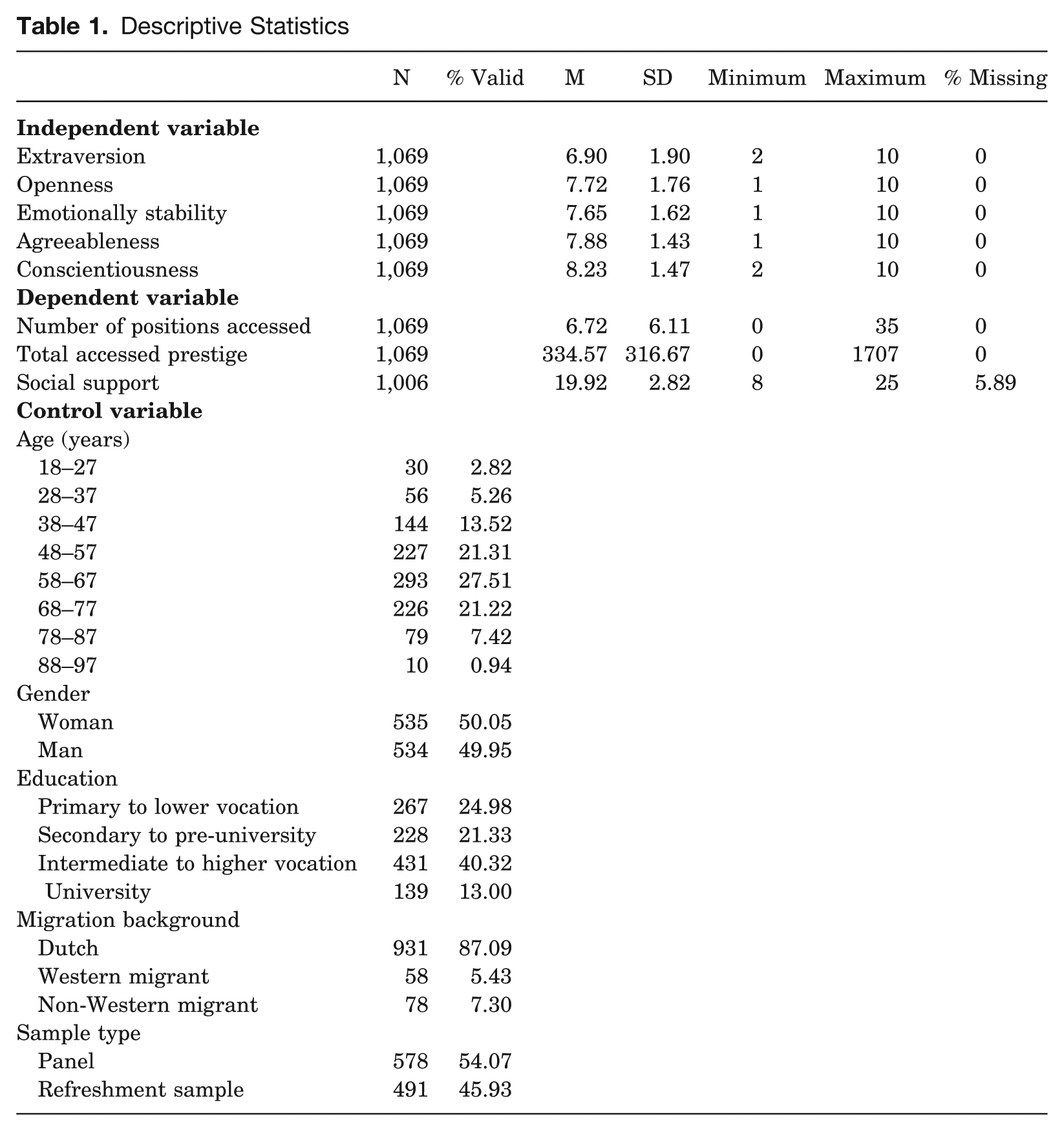
In the SSND, instrumental social capital is measured using the established position generator instrument, designed to operationalize social capital as access to socioeconomic resources via social ties located at different places in the social hierarchy (Lin and Dumin 1986; Van der Gaag et al. 2008). 2 Respondents were presented with a list of 30 occupations that are typical in The Netherlands and were asked whether any of their social ties occupied these jobs. If so, they were asked to indicate whether this tie was a family member, friend, or acquaintance. Based on these items, we coded whether respondents had access to these occupations via friends and acquaintances. 3 We then linked the accessed occupations to a socioeconomic measure of occupational status that is based on the International Socio-economic Index (ISEI) of occupational status (Ganzeboom 2010) 4 . ISEI scores measure occupational status, which summarizes the cultural resources and economic rewards that individuals receive depending on their occupations. The ISEI is a widely used measure of occupational status, and it was developed as a combined measure of education, occupation, and earnings based on a large-scale database of 198,500 respondents of the International Social Survey Programme 2002–2007. Higher scores refer to a higher occupational status, which is indicative of more cultural and economic resources. ISEI scores corresponding to the occupations included in the position generator can be found in the supplemental materials, in Table A1. 5
The (combined) measures of the position generator and the ISEI scores allow for the construction of different social capital indicators. Following Van der Gaag and colleagues (2008), we selected two indicators: the number of positions accessed, which measures social capital diversity, and the total accessed prestige, which measures social capital volume.
Number of positions accessed (diversity in instrumental resources)
The number of positions accessed is calculated as the sum of all positions that the respondent has access to via friends and acquaintances, and it ranges from 0 to 35. Since the position generator questions are chosen in such a way that they represent a wide range of occupations, a larger score on this measure can be interpreted as access to a larger diversity of social resources. 6
Total accessed prestige (volume of instrumental resources)
The total accessed prestige is calculated as the sum of the prestige scores of all occupations that respondents have access to via friends and acquaintances, and it ranges from 0 to 1,707. A larger score on this measure indicates access to more occupational status and thus access to more socioeconomic resources.
Social support (expressive resources)
To measure social support (i.e., expressive resources), we used the De Jong-Gierveld Loneliness Scale (De Jong-Gierveld and Van Tilburg 1999), which has been shown to be a valid and reliable measure of social support. Cronbach’s alphas ranged from .80 to .90 in a series of studies reviewed by De Jong-Gierveld and Van Tilburg (1999). The original scale consists of a total of 11 items that are divided into two subscales. The emotional subscale measures emotional support and intimacy, while the social subscale measures social support that stems from being embedded in a broader social network.
We focus on the social subscale (five items) because it taps into the kind of social support and expressive resources that are most relevant to our research question. These five items are measured on a five-point Likert-type scale (1 = fully disagree to 5 = fully agree), and they read as follows: “There is always someone I can talk to about my day-to-day problems.”“There are plenty of people I can rely on when I have problems.”“There are many people I can completely trust.”“There are enough people I feel close to.” and “I can call on my friends whenever I need them.” In our sample, the Cronbach’s alpha of these items was .77. We combined them into a measure of social support by summing across all five items.
Independent Variables
We used the very brief measure of the Big Five as developed by Gosling and colleagues (2003). This instrument consists of five items (10-point Likert-type scales), with one item per personality dimension. While more detailed measures of the Big Five, such as the 44-item Big-Five Inventory, are superior in terms of psychometric properties, the single-item measure of the Big Five has been shown to be a valid and reliable personality instrument (Gosling et al. 2003). It correlates reasonably well with the 44-item Big-Five Inventory, showing correlations between r = .62 and r = .68. It also shows satisfactory test-retest reliability (r = .68) when ratings are obtained approximately two weeks apart. The predictive validity is very good, which is demonstrated by virtually identical patterns of correlations with relevant external variables (e.g., political orientation, social value orientation, and depression) compared to longer measures such as the 44-item Big-Five Inventory. Column-vector correlations were very high, ranging from .819 to .997 (Gosling et al. 2003).
The items of the brief measure of the Big Five show the two extreme ends of the respective personality dimensions. On each end of the scale, adjectives are displayed that are typical of a very high score and a very low score on that personality dimension. Respondents indicate their score on the scale from high to low. A copy of the five-item personality inventory can be found in the supplemental materials (see Table A2).
Control Variables
We included a set of control variables, namely, gender (1 = female), educational level (primary education to lower vocational education, general secondary education to pre-university education, intermediate vocational education to higher vocational training, and university degree), and migration background (native born, Western immigrant, and non-Western immigrant). We included age categories (measured in eight categories of 10-year width) to account for possible nonlinear associations between age and social capital. Previous research shows that social capital changes during the life course (McDonald and Elder 2006), and the relation between age and social capital might initially be positive but less so at very high ages. Finally, we controlled for sample type (panel = 0, refreshment sample = 1). Descriptive statistics of all dependent, independent, and control variables can be found in Table 1.
Descriptive Statistics
Analytical Strategy
We fitted a series of multiple linear regression models (ordinary least squares method) with the three social capital indicators (number of positions accessed, total accessed prestige, and social support) as dependent variables. To show the predictions of personality above and beyond the effect of social background, we first modeled the effect of the control variables. We then added the personality traits. This led to a total of six regression models (two per social capital indicator). We subsequently conducted a series of robustness checks accounting for quadratic predictions of the Big Five personality dimensions and interaction effects between personality and social background variables.
Results
Number of Positions Accessed
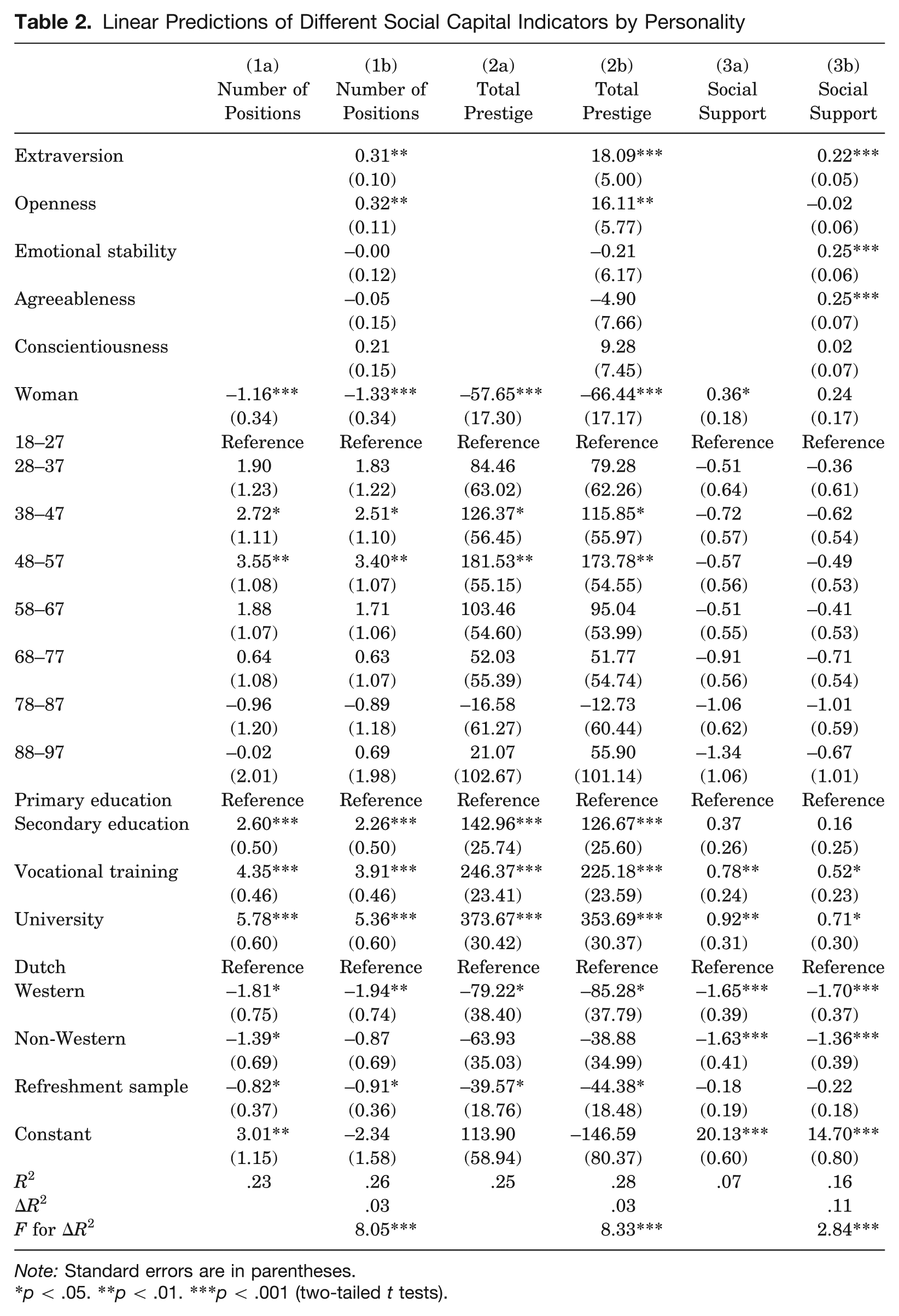
Model 1a shows the relation between the control variables and the number of positions accessed. As expected, age, gender, education, and migration background are all significantly related to the number of positions accessed (see Table 2). This model explains 23 percent of the variance in the number of positions accessed. When adding the Big Five personality dimensions (model 1b), the variance explained rises to 26 percent. Extraversion (B = .31, SE = .10, p = .002) and openness to experience (B = .32, SE = .11, p = .005) show a statistically significant and positive association with the number of positions accessed. Even though the regression coefficient of conscientiousness is sizeable and points in the positive direction, it fails to reach conventional levels of significance (B = .21, SE = .10, p = .15). Emotional stability and agreeableness are not significantly related to the number of positions accessed.
Linear Predictions of Different Social Capital Indicators by Personality
Note: Standard errors are in parentheses.
p < .05. **p < .01. ***p < .001 (two-tailed t tests).
The regression coefficients are best interpreted as follows: with every 1-point increase in extraversion, the predicted number of positions accessed is .31 higher. Considering that extraversion is measured on a 10-point scale, the difference in social capital between a person with the lowest possible extraversion score (= 1) and a person with the highest possible extraversion score (= 10) is about 3 points on the social capital scale, which ranges from 0 to 35. In other words, someone who is extremely extraverted has access to, on average, three more occupations than someone who is extremely introverted. The interpretation of the regression coefficients of other Big Five personality dimensions is analogous.
Total Accessed Prestige
The results for total accessed prestige mirror the pattern of results for number of positions accessed. Model 2a, which includes only the control variables, explains about 23 percent of the variance in total accessed prestige. Including the Big Five personality dimensions (model 2b) increases the variance explained to 26 percent. Again, the predictions of extraversion (B = 18.09, SE = 5.00, p < .001) and openness to experience (B = 16.11, SE = 5.77, p = .005) are positive and statistically significant. Emotional stability, agreeableness, and conscientiousness are not significantly related to the total accessed prestige. In sum, the results thus far lend support to the hypotheses that instrumental social capital is positively associated with extraversion (hypothesis 1a) and openness to experience (hypothesis 2a). We did not find support for the hypotheses that instrumental social capital is positively related to emotional stability (hypothesis 3a), agreeableness (hypothesis 4a), or conscientiousness (hypothesis 5a).
In the supplementary materials, we show the results of models 1b and 2b, separated by ties to friends versus acquaintances (see Table A3 on pages 4–5). The results largely mirror the main findings with the exception that conscientiousness is positively related to instrumental social capital that is accessed via acquaintances but not to instrumental social capital accessed via friends.
Social Support
Model 3a shows the results of a linear regression where the control variables predict social support. This model explains about 6 percent of the variance in social support. When adding the Big Five personality dimensions as predictors, the variance explained rises to 16 percent. Again, the coefficient of extraversion is statistically significant and positive (B = .22, SE = .05, p < .001). Different from the previous models, emotional stability (B = .25, SE = .06, p < .001) and agreeableness (B = .25, SE = .07, p = .001) are positively associated with social support, while openness to experience and conscientiousness are not. These results lend support to the hypotheses that expressive social capital is positively associated with extraversion (hypothesis 1b), emotional stability (hypothesis 3b), and agreeableness (hypothesis 4b). We did not find support for a positive link between expressive social capital and openness to experience (hypothesis 2b) or conscientiousness (hypothesis 5b).
Robustness Checks
Quadratic relationships
We reestimated all models adding squared terms of the Big Five. The only significant result was the squared term of conscientiousness predicting total accessed prestige, B = 5.71, SE = 3.17, p = .07). This association was U shaped, such that social capital was highest at the two extreme ends of conscientiousness and flattened out in the midrange (see Figure 1).
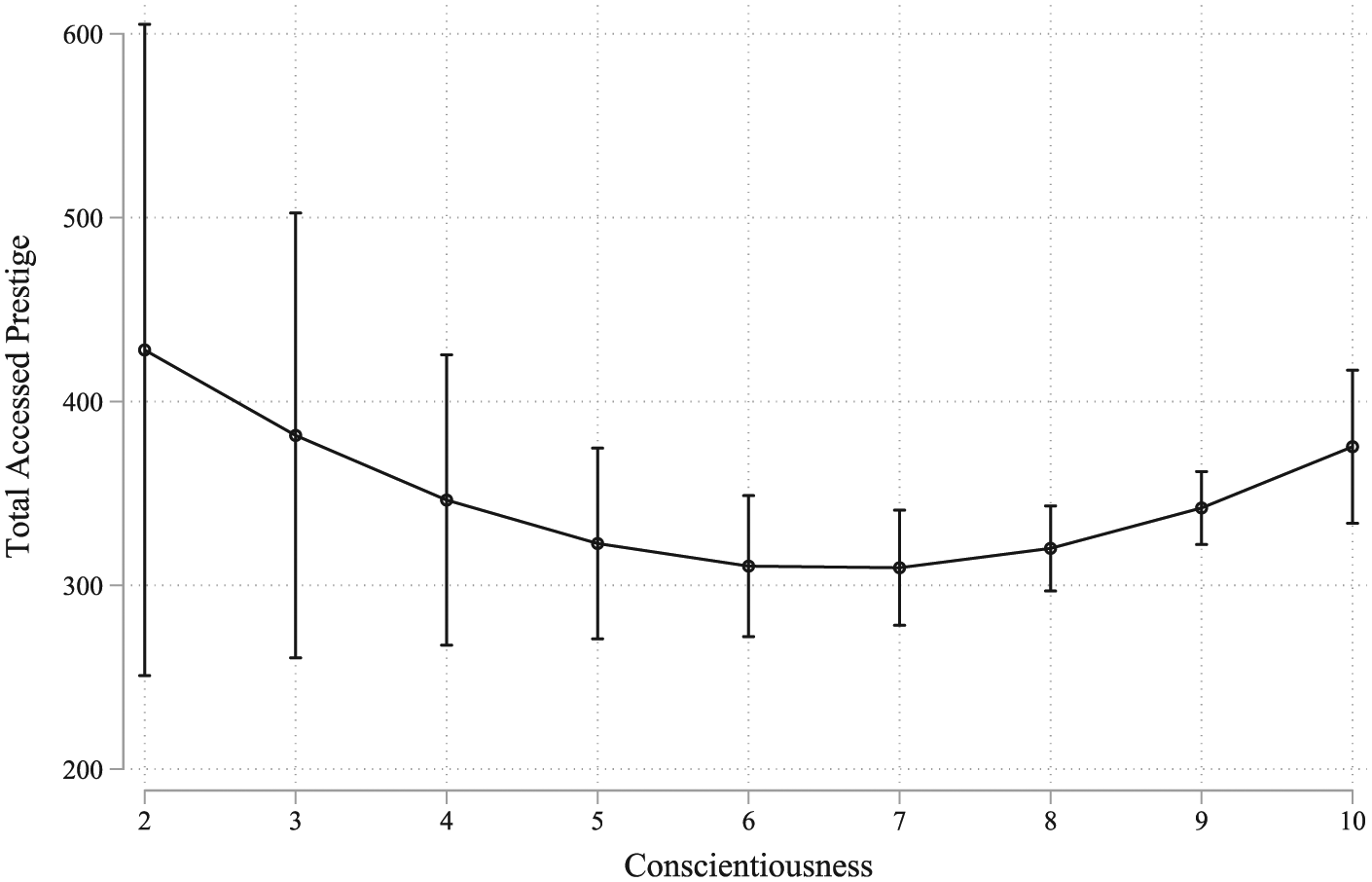
Quadratic Relationships between Conscientiousness and Total Accessed Prestige (Volume of Instrumental Resources)
A closer inspection of these quadratic associations reveals that the quadratic effect was driven by a few outliers at the lower end of the distribution. Adding the quadratic term to model 2b led to a negligible increase in the R2 by .002. A methodological explanation for the spurious quadratic relationship is related to the very brief Big Five questionnaire. Respondents were asked to place themselves in relation to the extremes: “dependable, organized, hard-working, responsible, self-disciplined, thorough” at the high end of conscientiousness and “careless, impulsive” at the low end of conscientiousness. Few respondents selected the low end of the scale, potentially due to the unfavorable phrasing, which made the predictions unreliable at lower levels of the conscientiousness distribution. The vast majority of respondents (i.e., 95 percent of the sample) placed themselves between the neutral midcategory and the favorable high end of conscientiousness, where the predictions were clearly positive.
Given these results, we conclude that the association between personality and social capital, at least in our data, is linear rather than quadratic. We therefore side with our initial hypotheses and interpret—with caution—the linear relations between conscientiousness and instrumental social capital. We do discuss potential substantial explanations for the observed quadratic association in the Discussion section.
Interaction effects
To test for potential conditional associations, we added interaction terms for the interactions between personality and our control variables. The associations were robust, with a few exceptions, which we highlight here. With regard to age, we found that the total accessed prestige of those aged 58 to 67 (B = 74.67, SE = 37.42, p = .046), and those aged 68 to 77 (B = 78.64, SE = 37.78, p = .04) significantly benefited from more conscientiousness.
With regard to gender, we found a positive association between conscientiousness and social support for men (B = .28, SE = .10, p = .001) and a negative association for women (B = −.48, SE = .14, p = .001). This means that hypothesis 5b is confirmed for men but not for women, and we discuss possible explanations in our Discussion section.
With regard to education, we found that those with primary education did not benefit from extraversion for building up either instrumental or expressive social capital. Those with a general secondary to pre-university education had less social capital when being more agreeable (B = −.45, SE = .21, p = .03).
With regard to migration background, Western migrants had negative associations between extraversion and number of positions accessed (B = −0.76, SE = 0.38, p = .045) as well as social support (B =–0.67, SE = 0.18, p < .001). Both Western and non-Western migrants had positive associations between openness and expressive social capital (B = 0.47, SE = 0.20, p = .02, and B = 1.00, SE = 0.39 p = .012, respectively).
When evaluating these findings, it is important to note that we tested a large number of interaction effects, namely, a total of 255. At an alpha-level of 5 percent, we would expect about 13 interaction effects to emerge as significant due to chance. Small cell sizes particularly increase the risk of Type I errors, and this might apply to our group of Western migrants (n = 58) and non-Western migrants (n = 78). We conducted the interaction analyses primarily to check the robustness of our main findings. Despite occasional variations in coefficient magnitudes, we generally find that our main findings are robust, and we discuss diverging findings in our Discussion section.
Discussion
The aim of this study was to explore the extent to which personality and social capital are related. We argued that the Big Five relate to three pathways that enable individuals to build up social capital: opportunities for contact, ego attractiveness, and trust and reciprocity. Opportunities for contact refers to the fact that one’s ability to form ties to useful others is constrained by the pool of potentially useful others that one gets to meets in a given social context (e.g., McPherson and Smith-Lovin 1987). Ego attractiveness refers to the idea that the more support ego can offer to others, the more attractive ego will be to others and the better ego’s ability to create social capital (Burt 2001; Lin et al. 2001). Reciprocity and trust pathway refers to the fact that social capital depends on alters’ willingness to share their resources (Coleman 1990). Those who are better able to build up social ties characterized by trust and reciprocity will have alters that are more likely to share their resources.
For each of the Big Five personality dimensions we specified the theoretical links to these mechanisms, and we empirically tested the relationships between the Big Five and two types of social capital, namely, instrumental and expressive social capital. We found support for personality’s being related to social capital, above and beyond the effects of well-known determinants of social capital, such as gender, age, education, and migration background. Our findings also show that the relationship between personality and social capital depends on the personality dimension and the type of social capital. Extraversion was the only personality dimension that was related to both instrumental and expressive social capital. Openness and conscientiousness predicted instrumental but not expressive social capital, while emotional stability and agreeableness predicted expressive but not instrumental social capital.
Considering extraversion, our results are in line with the argument that more extraverted individuals select themselves into social contexts where they meet a large number of people, which benefits their instrumental social capital according to the contact opportunities mechanism. In line with the argument that extraverts are more likely to nurture existing social ties, which is an important prerequisite for the trust and reciprocity mechanism, we found that extraversion benefits expressive social capital.
We argued that individuals high in openness select themselves into social contexts that are characterized by novelty and diversity. According to the contact opportunities mechanism, the opportunity pool from which they select their ties is more likely to contain individuals who control diverse resources. This is beneficial because more of the same resources produces only marginal benefits. Our findings for instrumental social capital are in line with this prediction.
For expressive social capital, we predicted a negative link to openness to experience because the formation and maintenance of close-knit and socially supportive ties benefits from repeated engagement in similar social settings (Feld 1981). According to the trust and reciprocity mechanism, this should lead to more expressive social capital because repeated engagement nurtures existing ties, breeds trust, and encourages alters to invest in ego. Our results did not support this hypothesis, suggesting that openness neither harms nor benefits expressive social capital.
Considering the benefits of high conscientiousness, we hypothesized that conscientiousness would be positively related to social capital because more conscientious individuals are more reliable and therefore better equipped to breed trust and reciprocity. Our findings show that the relationship between conscientiousness and instrumental social capital depends on several factors. While we did not find a main effect, we did find evidence for high conscientiousness’ being beneficial for individuals aged 58 to 77. We also found that conscientiousness was positively related to instrumental social capital accessed via acquaintances (but not friends) that occupy a diversity of positions that are on average highly prestigious. With regard to access to prestigious jobs, we found some evidence that very low conscientiousness also could be beneficial. This is possibly because low conscientiousness allows for spontaneity and adaptability, which can make egos more attractive, as opposed to the rigidity and dogmatism sometimes associated with high conscientiousness (Mondak and Halperin 2008). In our study, however, the negative prediction of conscientiousness showed rather low fit, and its estimate was based on only a fraction of the sample. We therefore favor the methodological explanation that the unfavorable phrasing of the negative end of conscientiousness may have led to few cases at lower levels of conscientiousness, resulting in too little evidence for a robust negative association at lower levels of conscientiousness. Future research using multi-item questionnaires and reverse phrasing will have to clarify whether instrumental social capital indeed benefits from low conscientiousness.
Regarding conscientiousness and expressive social capital, we found that men did benefit from higher conscientiousness, while women were at a disadvantage with increasing conscientiousness. The fact that conscientiousness is consistently beneficial for men, and more so than for women, might reflect the fact that men are generally trusted less than women (Buchan, Croson, and Solnick 2008), which makes conscientiousness a more valuable trait for men. The fact that very unconscientious men have lower instrumental and expressive social capital than very unconscientious women supports this interpretation, just like the fact that very conscientious men and women do not differ in their access to social capital. In other words, lower levels of conscientiousness hurt men more so than women, but men can make up for this by being more conscientious.
A remaining question is why less conscientious women report having more expressive social capital. A possible explanation is gender role expectations. The gender role of women emphasizes nurturance and caregiving, which makes it easier for women to give and receive social support (Reevy and Maslach 2001). Indeed, a meta-analysis shows that women are more likely to report and receive the support they need, which is reflected in lower levels of loneliness compared to men’s levels (Borys and Perlman 1985). Likewise, women in our study reported higher levels of social support than did men. Since women’s gender role expectation is to be dependable and disciplined (i.e., high conscientiousness), a highly conscientious woman signals that she does not need additional social support. In contrast, being careless and impulsive (i.e., low conscientiousness) deviates from this norm. Such a woman signals that she needs additional support, which she is likely to receive, as previous research has shown.
Our finding that conscientiousness is positively associated with instrumental social networks of weak ties (i.e., acquaintances) links to research in organizational settings. One line of research demonstrates that highly conscientious individuals are more successful in their professional lives (e.g., Barrick and Mount 1991). Another line of research shows that social capital as measured by the position generator is positively associated with job attainment (Flap and Boxman 2000; Lin 1999b). This type of instrumental social capital was shown to buffer against ethnic inequality in the receipt of job leads (McDonald, Lin, and Ao 2009) and to help entrepreneurs increase their firms’ employment rates (Schutjens and Volker 2010). Our results potentially can tie together findings from these two lines of research. This is because our results are in line with the explanation that conscientiousness is beneficial for individuals’ professional achievement, at least in part, because highly conscientious people create networks of acquaintances who provide access to valuable instrumental resources.
While in some cases it is evident that access to a range of occupations is beneficial, for other cases it is less evident. Entrepreneurs who aim to establish a new business have to deal with diverse stakeholders who span a wide range in the occupational hierarchy. It is obvious why having a network that covers a variety of positions is a valuable asset. Other cases are more indirect because they relate to the full range of help needed when seeking to advance one’s career (Lin 2001). Job applicants benefit not only from information about job opportunities but also from help with formatting CVs, updating personal websites, and preparing for job interviews. If the job requires moving, a new house needs to be found, and working toward a promotion can mean that a babysitter is needed. Considering all these tasks, knowing individuals in a variety of occupations can be useful.
Furthermore, the purpose of the position generator is not to measure access to occupations per se, but it is to measure access to structural positions in a hierarchy that determines who controls economic, cultural, and political resources (Lin 2001). Professional success can be a matter of demonstrating that one belongs to the right group within a stratified system, which is particularly true for elite groups (Bourdieu 1980; Collins 1971). Erickson (2001) provides direct evidence that employers hire applicants not only through networks but also for networks. This means that employers select applicants who have access to more social capital (measured by the position generator), especially for upper-level positions.
We found a differential pattern of associations for agreeableness and emotional stability. While agreeableness and emotional stability were not associated with instrumental social capital, they were positively associated with expressive social capital.
This supports our argument that agreeable individuals show an increased concern for the well-being of others and a stronger commitment to the continuation of social relationships. This leaves agreeable individuals better equipped to build trust and reciprocity. We argued that both agreeableness and emotional stability help individuals create social capital because these traits are associated with increased emotional and social resources that egos are able to invest in others. According to the ego attractiveness mechanism, this makes them more attractive targets for other people’s investments and helps them build up social capital.
Our finding that agreeableness and emotional stability do not predict instrumental social capital warrants explanation. While we expected more agreeable and emotionally stable individuals to be more attractive egos because they can offer more resources, it may be the case that expressive resources are not directly exchangeable for instrumental resources. Indeed, Bowling and colleagues (2005) show that social support at work is reciprocated with social support rather than work-related, instrumental support. Our results suggest that this is the case not only in the professional world. Being more emotionally supportive could make social ties more emotionally supportive in return; however, being more emotionally supportive does not lead to social ties with more socioeconomic resources.
This study has several limitations that point at opportunities for future research. First, we rely on cross-sectional data, which do not allow testing for causality. We theorized that personality traits enable the creation of social capital, implicitly treating personality traits as stable and endogenous. This is in line with the general consensus that personality is relatively stable (Corr and Matthews 2009) while social networks change within months (Kossinets 2006). If the development of personality precedes changes in social capital, this would fulfill an important criterion for causality, namely, the temporal precedence of cause and effect. However, we acknowledge that there is also evidence that the stability of personality depends on age (Specht, Egloff, and Schmukle 2011), such that personality is more stable at midadulthood than at older ages (i.e., 70 years or older) or younger ages (i.e., younger than 30 years). Given that the majority of our respondents were of midadulthood, it seems plausible that the temporal instability of personality has played a minor role. While our arguments and discussion tentatively favor the effect of personality on social capital, we are unable to test rigorously for causality. Future research might be able to address the question of causality more thoroughly, for example, by using longitudinal data.
A second limitation is that we were unable to measure exchanges of resources and that we rely on self-reports. This raises the question of whether social resources reported by individuals actually would be provided by alters. First, self-reports of exchange and support networks were shown to be particularly accurate as opposed to other self-reported personal network delineations (Van der Poel 1993). Second, there are a few advantages of focusing on direct ties and access to social capital rather than mobilization. Access refers to the pool of resources that potentially can be used, and mobilization refers to the actual use (Lin 1999a). Mobilization of social capital depends on the specific goal that individuals wish to achieve (e.g., finding a new job). Mobilization measures might underestimate social capital for a variety of reasons: individuals might prefer attaining goals without involving their social ties, they might not be in need of support, or they might be able to rely on institutions (Van der Gaag 2005). The advantage of focusing on access is that access does not depend on preferences, need, or institutional solutions. Moreover, the assurance of resource availability has positive effects above and beyond mobilization. The knowledge that a friend is able to lend out a large sum of money is an asset in and of itself, even if one never actually borrows money (Lancee 2012). Finally, individuals discount the many ways that their social ties help in attaining goals. When asked who helped individuals find their jobs, respondents tend to report social ties who passed on explicit job references, but they discount relevant support that was extended throughout the job searching process, such as proofreading a cover letter or sharing advice about job interviews (Lin 2001).
A third limitation is that despite extensive research showing that indirect ties matter, we are unable to empirically address this, because we use ego network data. The omission of indirect ties will likely have affected our measure of instrumental social capital more so than expressive social capital. This is because social support is valued more when received from strong, direct ties characterized by trust and reciprocity rather than from friends of friends. Instrumental resources, however, are valuable when provided by indirect ties. Weak ties have an increased potential to provide unique resources because they can form bridges to otherwise disconnected networks (Granovetter 1973). One way of addressing the issue of indirect ties with data coming from the position generator is to consider the different relationship types (i.e., family, friends, and acquaintances) that give access to instrumental social capital. Family ties usually form a tightly knit web of social relationships with many redundant resources. Friends are more likely to be connected to individuals outside of ego’s network, and acquaintances are even more so. Thus, when interested in the effect of indirect ties, one strategy is to consider ego’s access to acquaintances. In our supplementary analyses, we indeed found that personality characteristics had stronger associations with instrumental social capital that was accessed via acquaintances compared to friends. Instrumental social capital accessed via family ties was mostly unrelated to personality.
The fourth limitation is that we are unable to distinguish between ego’s perceptions and alters’ willingness to provide support. It is possible that some personality traits lead individuals to report higher levels of perceived social support, not because they are really different but because they are perceived to be different. In contrast, there is a great body of research on social support showing that perceptions matter. A meta-analysis shows that perceived and received social support are positively correlated and that perceived social support is a better predictor of health than received social support (Haber et al. 2007). Even though objectively available support might be a necessary condition, what matters for variations in health is the interpretations of the objectively available support. This is not entirely surprising given that an important mediator is loneliness (Hawkley and Cacioppo 2010), which has an inherently subjective definition: loneliness occurs when ego’s relationships are less satisfying than ego desires (Peplau and Perlman 1982). A meta-analysis found that interventions correcting maladaptive social cognition (i.e., subjective perceptions) were more successful at reducing loneliness compared to interventions that aimed at increasing opportunities for social contact or enhancing social support (Masi et al. 2011). Given the above, the findings of this study remain relevant even if personality relates to perceptions of social support that actually might not be forthcoming. Nevertheless, we believe that investigating the link between ego’s perceptions of support and alters’ willingness to provide is an interesting avenue for future research.
Conclusion
Our study draws unique theoretical and empirical links between personality and social capital. Our findings extend on previous literature that focused on structural explanations by demonstrating that personality is associated with both instrumental and expressive social capital and should therefore be considered a serious explanation for why social capital differs across individuals.
Like previous research, our study shows that people’s position in the social structure is a powerful explanation for differences in social capital. The main contribution of this study is the finding that differences in personality explain why some people have more social capital, independent of their social background. We show that personality matters, on top of the benefits or drawbacks of gender, age, education, and migration background. Irrespective of one’s social background, open and conscientious individuals are more likely to have instrumental social capital, emotionally stable and agreeable individuals are more likely to have expressive social capital, and extraverted individuals are more likely to have both types of social capital.
Supplemental Material
Supplementary_Materials_August_21st – Supplemental material for Personality and Social Capital
Supplemental material, Supplementary_Materials_August_21st for Personality and Social Capital by Marina Tulin, Bram Lancee and Beate Volker in Social Psychology Quarterly
Footnotes
1
Respondents could not be traced back for several reasons: moving houses without communicating their new addresses, emigration, becoming seriously ill, getting imprisoned, or passing away. To minimize attrition rate, enumerators went to respondents’ houses and asked the neighbors about the respondents’ whereabouts.
2
Previous work by Van der Gaag, Snijders, and Flap (2008) demonstrates that the position generator does not merely measure network size and diversity but taps into concrete financial, political, and cultural resources as measured by name generator items, name interpreter items, and the resource generator.
3
Including occupations accessed via family ties did not change the pattern of results; however, regression coefficients were somewhat smaller when including family. This is because occupations accessed via family ties were not empirically related to the Big Five, which is in line with the theories discussed in this article.
4
Occupational status measured by the International Socio-economic Index (ISEI) is theoretically distinct from occupational prestige measured by the Standard International Occupational Prestige Scores (Treiman 1977). Nevertheless, we refer to the ISEI scores as prestige scores for the sake of linguistic consistency with previous social capital research ( ).
).
6
compared the position generator to other measures of individual social capital, such as name generator and name interpreter items as well as the resource generator. They found only modest correlations between network size and Number of Positions Accessed (r = .25) or Total Accessed Prestige (r = .28) but found medium to large correlations with direct measures of prestige and political/financial resources accessible via social ties (r ranged from .34 to .50).
Bios
References
Supplementary Material
Please find the following supplemental material available below.
For Open Access articles published under a Creative Commons License, all supplemental material carries the same license as the article it is associated with.
For non-Open Access articles published, all supplemental material carries a non-exclusive license, and permission requests for re-use of supplemental material or any part of supplemental material shall be sent directly to the copyright owner as specified in the copyright notice associated with the article.
