




Abstract
According to the United Nations Office on Drugs and Crime, 55% of women and girls killed in 2022 died at the hands of intimate partners or family members, contexts indicative of femicide. The proportion of the remaining 45% of women and girls killed which involved sex or gender-related elements remains largely unknown. This is due to the lack of high-quality, gender-sensitive data collection tools and the few systematic efforts to more consistently and accurately document femicide. Information about femicide in marginalized and racialized communities is further affected because many of these deaths remain invisible in official data for women and girls who live – and die – at the intersections of race, poverty, ability, sexuality, and other social identities. Drawing from a recently released international statistical framework for measuring gender-related killings of women and girls, this article examines the presence of sex/gender-related motives and indicators in a Canadian sample, drawing data from publicly available information. Findings about the feasibility of documenting sex/gender-related motives and indicators generally and for specific groups of women and girls are discussed.
Introduction
Globally, there has been an increased use of femicide or feminicide 1 to call attention to how and why women and girls are killed which is distinct from how men and boys are killed (Dawson and Mobayed Vega, 2023). Focusing on sex- or gender-related elements of femicide, the term has been enshrined in legal and penal codes or in legislation in some countries, primarily in the Global South, and specifically Latin America. In contrast, in the Global North, including such countries as Australia, Canada, the United Kingdom, and the United States, for example, feminist activists and researchers have made strides in bringing the term into the public domain, but so far have drawn little engagement from governments at any level. Media in these countries have also been largely resistant to using the term which precludes improving professional and public education and awareness about femicide since the media are a key mechanism for primary prevention (Fairbairn et al., 2023).
Accompanying what is an increasingly global, human rights movement to use femicide to refer to the killings of women and girls because of their sex or gender (Dawson and Mobayed Vega, 2023a, 2023b) are discussions and debates about how femicide should be defined, how it is distinct from other homicides as well as whether and how differences can be measured (Dawson and Carrigan, 2021; Mujica and Tuesta, 2014; Walby et al., 2017; Walklate et al., 2020; Weil et al., 2018). Answers to these questions are crucial for at least the following three reasons: (1) To effectively produce and understand femicide statistics and patterns within and across countries, (2) to develop more effective preventions including appropriate punishments, and (3) to raise awareness and increase education, including more enhanced training of those responding to sex/gender-related violence against women and girls. Our ability to do so is necessary for helping to meet UN SDG Target 5, and particularly 5.2 – Eliminate violence against women and girls: Eliminate all forms of violence against all women and girls in the public and private spheres including trafficking and sexual and other types of exploitation.
Even if consensus could be reached on definitional parameters for femicide, however, there are few empirical studies that have examined its prevalence because of a dearth of reliable, prevention-focused data which captures these sex- or gender-based elements. One study, focusing on almost 5000 homicides over several decades in one Canadian province, assessed the utility of what they refer to as sex/gender-related motives and indicators (hereafter SGRMIs) to differentiate homicide perpetrator–victim gender combinations (Dawson and Carrigan, 2021). Their goal was not to classify each case as homicide or femicide but to determine patterns in the presence of SGRMIs. Their results demonstrated that SGRMIs were more common in male–perpetrator/female–victim homicides – killings that most closely align with the definition of femicide – suggesting SGRMIs are useful for distinguishing femicide as a distinct type of homicide. However, availability of information to consistently capture the presence of SGRMIs was weak with high proportions of missing data as shown by some examples below identified by the study authors.
For instance, despite research showing that recent separation is a risk factor for intimate partner femicide, information for this variable was missing in 66% of those cases – a similar proportion to the other gender combinations for which it is less likely to be a risk factor. Furthermore, sexual assault was missing in more male-on-female killings (28%) compared to the other combinations despite the increased likelihood of its presence in male-on-female killings. Finally, overall, the proportion of missing information was somewhat lower for incident indicators compared to victim, perpetrator, and pre-incident indicators. The authors argued that this provides some tentative support for the fact that the investigatory focus remains on the incidents themselves rather than the broader relationship context and surrounding circumstances, which is especially problematic for intimate partner femicide, but arguably for all femicides.
One reason for these data gaps stems from the fact that the characteristics of femicide and those involved are typically not the focus of official data collection efforts, particularly when perpetrators die by suicide following the femicide, or when the case remains unsolved. This is especially the case in countries where femicide is not part of their legal frameworks. Furthermore, data collection instruments often prioritize variables related to male-on-male homicide which was the early focus of much research and informed current data collection instruments. As such, more detailed information to determine the presence of SGRMIs is often absent, especially for some types of femicide and some groups of women and girls. As a result, data which could enhance prevention of femicide, and other forms of sex- or gender-related male violence against women and girls, are not being routinely collected by governments, a situation that is putting the lives of women and girls at risk. Therefore, states need to emphasize prevention as the priority for data collection rather than administrative needs of governments (Dawson and Carrigan, 2021). In doing so, a standardized definition can be used to collect data across communities, regions, and countries while also allowing for some flexibility to reflect regional concerns.
The need for accurate data focused on femicide has been highlighted by the United Nations Special Rapporteur on violence against women, its causes, and consequences since 2015 who calls on Member states for the establishment of femicide watches or observatories on violence against women which should collect data on gender related killing of women and femicide and analyse, with the assistance of interdisciplinary review panels, all femicide cases including court decisions in order to identify gaps in the intervention system, criminal justice and criminal procedures system, as well as risk factors to prevent and protect women and girls from those killings. (Academic Council on the United Nations System (ACUNS), 2017: 1)
These data gaps also continue to be highlighted by activists, researchers, and governments (for recent examples, see Collectif Féminicides Par Compagnons ou Ex et al., 2023; Illesinghe et al., 2023; Zecha et al., 2023). The recently released United Nations statistical framework for measuring gender-related killings of women and girls (femicide/feminicide) has the potential to move us in this direction, at least with respect to more consistent global data. This study draws from a national database in Canada to examine the feasibility of the statistical framework for measuring sex/gender-related killings of women and girls by determining the prevalence of the factors identified.
Conceptualizing femicide and feminicide
The term femicide was first introduced into the public domain in 1976 by the late Diana E.H. Russell, a feminist pioneer and social activist who was an expert on sexual violence and abuse of women and girls, when she testified at the first International Tribunal on Crimes Against Women in Belgium. The term was later defined in collections Russell co-edited with colleagues (Radford and Russell, 1992; Russell and Harmes, 2001) as ‘the misogynist killing of women by men’ (Radford, 1992: 3), ‘the most extreme form of sexist terrorism, motivated by hatred, contempt, pleasure, or a sense of ownership of women’ (Caputi and Russell, 1992: 15) and as ‘the killing of females by males because they are female’ (Russell, 2002, 2012: 3, 14 respectively). The definitional parameters of femicide continue to be debated almost 50 years later with variations emerging such as feminicidio (‘feminicide’ in English) to capture state complicity by way of inaction or impunity for perpetrators (Fregoso and Bejarano, 2010; Lagarde de los Ríos, 2010). However, agreement has reached some consensus on circumstances and contexts indicative of femicide because they highlight the ‘how’ and ‘why’ femicide is a distinct type of homicide as demonstrated by research (Dawson and Mobayed Vega, 2023) as well as three recent publications, discussed next.
Three documents have contributed significantly to these discussions, drawing on decades of feminist research and activism, primarily in the social sciences and law, which underscores how femicide as well as non-lethal forms of male violence against women and girls are not isolated incidents. Rather, these acts represent cultural patterns in attitudes and behaviours which are driven by individual and systemic misogyny and emphasize men as superior and women as inferior. As such, any explanation for male violence against women and girls must include a gender perspective that also allows for intersections of overlapping oppressions and discriminations (e.g. race, sexuality, age, and ability; Crenshaw, 1991; Hill Collins and Bilge, 2016) which arise from, and are maintained by, these attitudes and behaviours.
Building on volumes of feminist activism and research, the first publication is The Latin American Model Protocol for the Investigation of Gender-Related Killings of Women (Femicide/Feminicide; hereafter ‘the protocol’; Sarmiento et al., 2014), which documents how femicide might be identified by reviewing the contexts surrounding femicide and its subtypes (e.g. intimate partner femicide, familial femicide). While the protocol specifically targets legal investigations, it serves as a starting point for researchers who wish to better conceptualize and measure femicide within and across countries.
The second publication is the Inter-American Model Law on the Prevention, Punishment and Eradication of the Gender-Related Killing of Women and Girls (Femicide/Feminicide; Organization of American States, 2018). Drawing on existing country-specific legislation, the model law also identifies contexts and circumstances in which femicide occurs, which serves as a foundation upon which such killings can be considered by other jurisdictions who wish to recognize femicide as a distinct type of homicide. These two publications also address why countries should consider femicide as a distinct crime and the various ways that it can be done.
Finally, and most recently, drawing from the voluminous body of research as well as expert consultations, the United Nations Office on Drugs and Crime and United Nations Equity for Gender Equality the Empowerment of Women (UNODC and UNEGEEW, 2022), developed a statistical framework for measuring gender-related killings of women and girls (femicide/feminicide). The framework aligns with the International Classification of Crime for Statistical Purposes (ICCS), which is a classification of criminal offences based on internationally agreed-upon concepts, definitions, and principles to enhance global consistency and comparability (Bisogno et al., 2015). 2
The statistical framework identifies characteristics or contexts that capture the modus operandi or circumstances indicative of femicide (more detail provided in the methods section). It also identifies key data that countries could be collecting to capture relevant and appropriate information on victims, perpetrators, and state responses to femicide and feminicide. The framework is meant to begin to address the reality that, despite being ‘the most extreme and brutal manifestation of violence against women’ affecting all regions and countries worldwide . . . unlike for other forms of violence against women, there is not yet a global or regional standardized statistical approach to define and produce relevant metrics on such killings of women and girls. (UNODC and UNEGEEW, 2022: 3)
The current study
Data sources
This study draws from national data collected by the Canadian Femicide Observatory for Justice and Accountability (CFOJA) established in 2017 to bring visible and national attention to the phenomenon of femicide in Canada and globally (Dawson, 2018; Dawson et al., 2023). Data are collected from public sources, including media (i.e. incident, investigation, and trial coverage) and court documents (e.g. publicly reported sentencing remarks, appeal decisions, evidentiary hearings, etc.), from the date of the killing through to its resolution in the courts if the perpetrator did not die by suicide. These data sources align with international work which identified strategies that can be applied within and across different countries to improve the availability, collection, and monitoring of femicide data (Vives-Cases et al., 2016). Priority clusters of actions included a range of strategies and, according to experts’ assessment, ‘institutionalizing national databases’ was found to be most desired, however, ‘media coverage’ was rated most feasible (Vives-Cases et al., 2016: 34).
The CFOJA also uses court data and when media and court data conflict, which is seldom, court documents are considered more legitimate sources. However, given increasing reliance on media sources, researchers have compared the quality of information documented in media coverage to information contained in official sources. From this research, there is general agreement that newspapers identify just as much or more information about the circumstances surrounding a homicide (or femicide) than what is included in official data sources (Huff-Corzine et al., 2014; Parkin and Gruenewald, 2017; Shon and Lee, 2016). In addition, there were similarities between the two data sources in terms of the information and circumstances listed, highlighting a high level of agreement, and increasing reliability through data triangulation.
Below, we examine the total sample of women and girls killed in 2018 in Canada, the first year of data collection by the CFOJA and the year for which the most complete information is available, given we wanted court outcomes and related documents to be available. In 2018, 169 killings of women and girls were documented. For 13 of these victims (8%), no accused was identified in public documents. For the remaining 156 victims, the accused was male for 137 victims (88%) and female for 19 victims (12%).
Variables
The 10 variables identified in the UN statistical framework, which we refer to as SGRMIs, are as follows: (1) Women/girls killed by intimate partners; (2) women/girls killed by family members; (3) previous record of harassment/violence; (4) illegal deprivation of her liberty; (5) the use of force and/or mutilation; (6) body disposed of in a public space; (7) sexual violence was committed before, and/or after the killing; (8) victim was working in the sex industry; (9) hate crime motivated by bias against women/girls; and (10) victim of forms of illegal exploitation (see Table 1).
United Nations statistical framework.
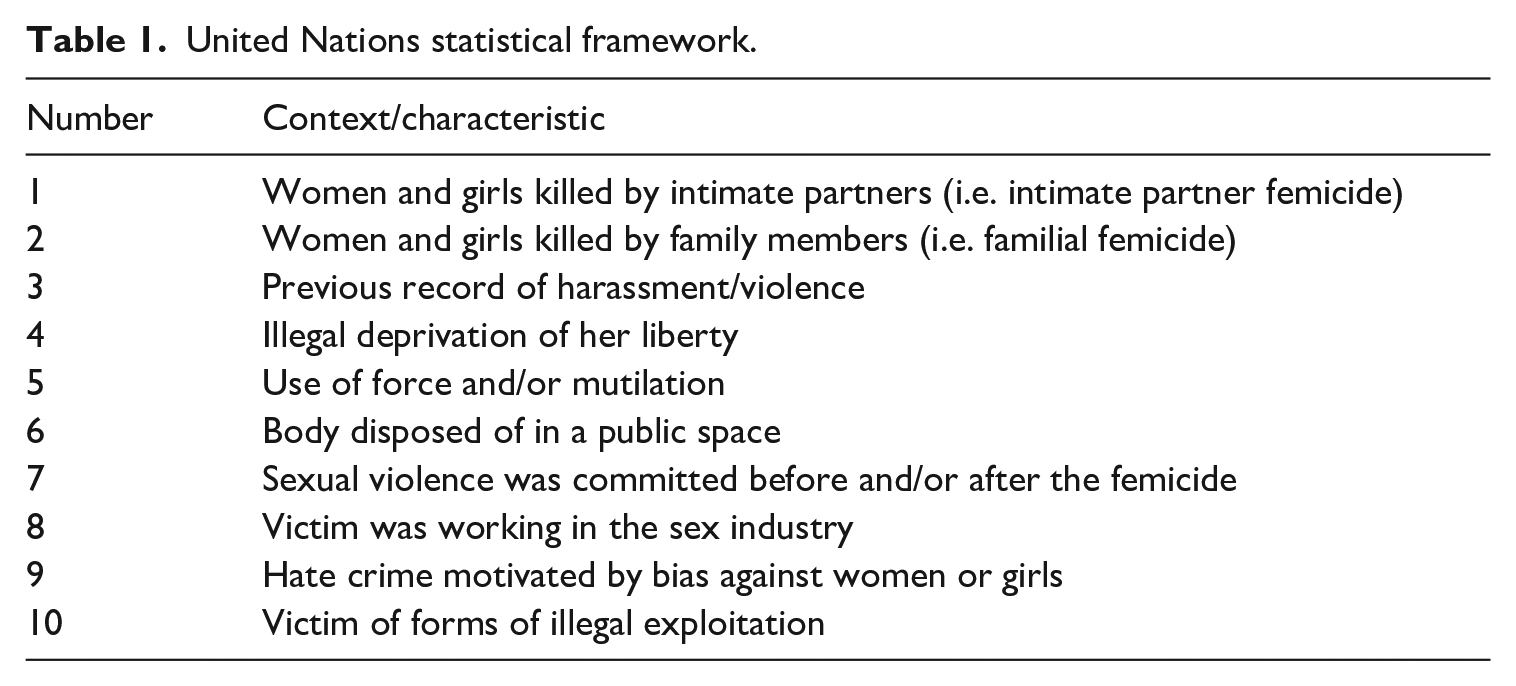
Supporting the inclusion of the first two contexts, the authors of the statistical framework argue that there is ‘ample evidence that the majority of gender-related killings of women and girls are perpetrated by current or former intimate partners or other family members’ (UNODC and UNEGEEW, 2022: 9). They further argue that these types of killings are often linked to the need to assert male control or punish what is considered to be unacceptable female behaviour . . . are embedded in societal and cultural norms . . . may take place within relationships where there is an unequal power relation between the victim and the perpetrator . . . [and] the perpetrator occupies a position of authority or care over the female victim. (UNODC and UNEGEEW, 2022: 9)
The remaining eight SGRMIs capture femicides that occur in contexts which do not necessarily involve intimate or familial relationships but have other elements indicative of femicide (see Table 1). One or more of these eight characteristics can be found in killings across all types of victim–perpetrator relationships, however, including intimate partner and family members. The statistical framework draws attention to how broader societal and cultural norms can lead to femicide because they are often linked to, and representative of, discrimination and hatred of women and girls.
For each variable below, we provide the UNODC description followed by the frequency each was present in this study. As coding was straightforward for most variables, one author coded and, when uncertainty arose over the presence of a SGRMI, the three authors discussed whether to include it. For example, in a case where the victim was ‘forced into the perpetrator’s car against her will’, it was clear that ‘illegal deprivation of her liberty’ was present in this case. However, for several variables, it was less straightforward, and specifically the variable capturing ‘hate crime motivated by bias against women’. As a result, two illustrative case examples are included for this variable below. A conservative approach was adopted; that is, we only coded the presence of a SGRMI if there was clear evidence. Given this, and the fact that only public data sources were examined, our results are considered minimum estimates of the presence of SGRMIs. We acknowledge the information reviewed is based on narratives provided by third parties (i.e. not the victims); however, this is standard in most homicide research (Brookman et al., 2017; Smith and Zahn, 1999).
While the variables examined are not exhaustive of all factors which can, and frequently do, distinguish female and male killings, they are recognized most consistently at the global level. We examine their presence in the total sample of women and girls killed in 2018, including female perpetrators, followed by the sample of male accused only. This allows for a preliminary consideration of the relative role played by SGRMIs in the killing of women and girls by both female and male perpetrators. After focusing on each SGRMI separately, we look at their combined presence – what we refer to as a ‘global measure’ of SGRMIs. While the protocol states that ‘understanding whether a killing is gender-related does not depend on the existence of more or fewer indicators’ (Sarmiento et al., 2014: 689), as will become evident in the illustrative examples, multiple SGRMIs are often present in each case. We argue that capturing the full, combined scope of their presence is important to achieving a more nuanced understanding of femicide.
Results
SGRMI #1: Women and girls killed by intimate partners
This context is most often referred to as intimate partner femicide or intimate femicide. The ICCS includes multiple victim–offender relationships in this category as listed: (1) current spouse or intimate partner (cohabitating or non-cohabitating partner or boyfriend/girlfriend); (2) current spouse or cohabitating partner; (3) current non-cohabitating partner (boyfriend/girlfriend/dating partner but not married); (4) former spouse or intimate partner (cohabitating or non-cohabitating partner or boyfriend/girlfriend); (5) former spouse or cohabitating partner; and (6) former non-cohabitating partner (boyfriend/girlfriend/dating partner but not married).
In our study, the relationship between the victims and their accused could not be determined for 18% of the victims because the case remains unsolved or, if solved, their relationship was not specified. Focusing on victims for whom their relationship to the accused was known (N = 139), 49% were killed by a suspected intimate partner (see Table 2). Of these, only one victim was killed by a female partner, demonstrating that this type of femicide is almost exclusively perpetrated by male, not female, partners of the victims.
The number and distribution of the presence of SGRMI 1 and SGRMI 2 in the killings of women and girls in Canada, 2018 (N = 139).
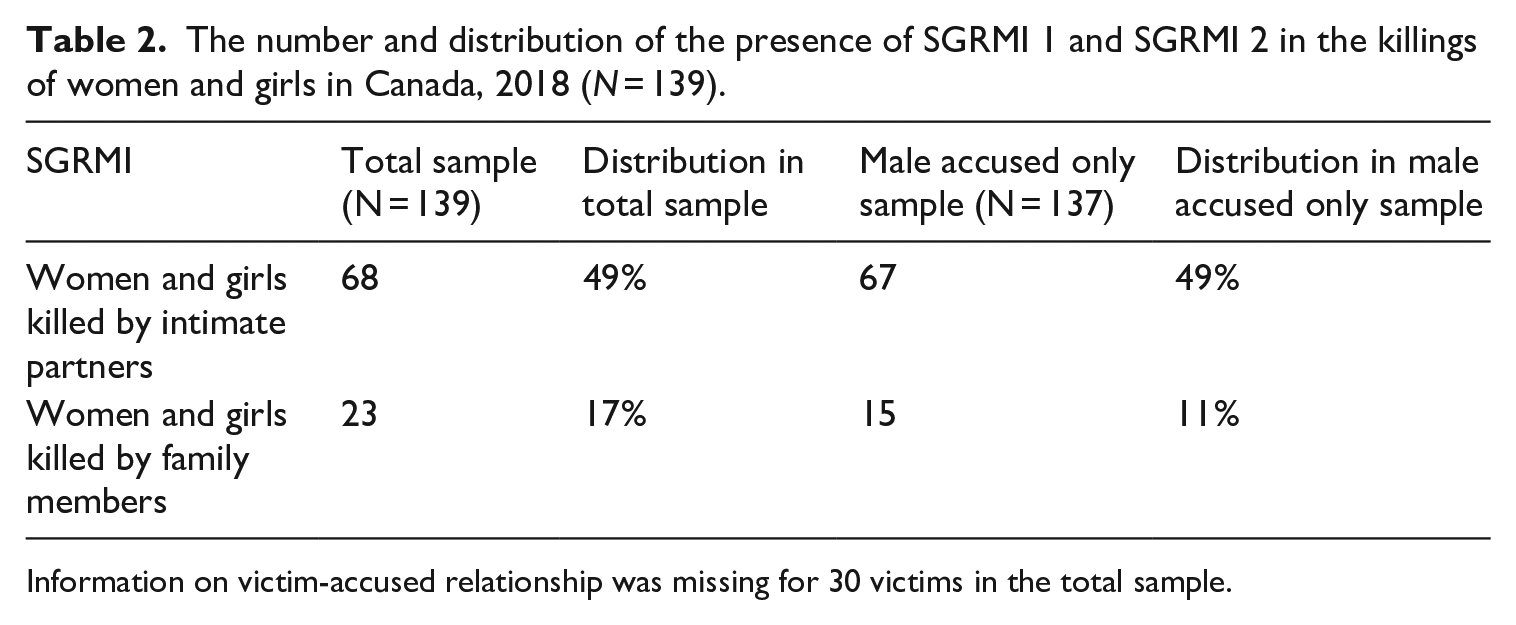
Information on victim-accused relationship was missing for 30 victims in the total sample.
SGRMI #2: Women and girls killed by family members
This femicide context is most often referred to as ‘familial femicide’. The ICCS considers the following victim-offender relationships within this category: (1) blood relative, including parents, children, siblings, other blood relatives, cohabitating blood relatives, and non-cohabitating blood relatives, and (2) other household members or relatives by marriage or adoption such as parents-in-law, children-in-law, stepsons/stepdaughters, adopted children, other relatives by marriage.
Including only victims for whom their relationships with the accused were identified, 17% of the victims were killed by a suspected family member (not including intimate partners; see Table 2). Focusing on male accused, 11% of the victims were killed in the familial context. The larger proportion of female accused in this context was expected given that, when women kill, research over time and across cultures shows that victims are most often family (Eckhardt and Pridemore, 2009; Jensen, 2001; Mann, 1996).
SGRMI #3: Previous record of harassment/violence
Previous history of harassment/violence captures those victims for whom there was a record of physical, sexual, and/or psychological violence and/or harassment perpetrated by their killer prior to the femicide. According to the UN framework, this variable would apply to victims who had previously reported physical, sexual or psychological violence by the alleged perpetrator of the homicide to competent authorities, or when authorities have obtained such evidence through other means, other than directly from the victim, including protection orders and restraining orders solicited by the victim or granted to the victim by relevant authorities. (UNODC and UNEGEEW, 2022: 13)
Expanding on this definition, the protocol states that physical violence is any act that harms or injures the body, even though it may not produce marks or traces on the body. This type of violence includes, among others, strikes against any part of the body whether it leaves a mark or not, pushing, internal and external injuries, hair-pulling, etc. (Sarmiento et al., 2014: 48)
Sexual violence ‘in its broadest sense . . . any act of sexual nature that is non-consensual’ (Sarmiento et al., 2014: 48). Finally, psychological violence includes any conduct or intentional omission that causes emotional harm or a lowering of the self-esteem of a woman, through threats, humiliation, harassment, demands of obedience or submission, verbal coercion, insults, isolation, or any other limitation to her personal liberty. Psychological violence includes guilt, surveillance, isolation, control, manipulation, demands of obedience or submission, the imposition of a servant role, among others, which cause harm or undermine self-determination. (Sarmiento et al., 2014: 48)
In the full sample, focusing on 156 victims whose accused was identified, 21% had a history of prior violence perpetrated against them by the killers. Focusing on male accused only, 23% had a history of such violence (see Table 3).
The number and distribution of the presence of SGRMI 3 through 10 in the killings of women and girls in Canada, 2018 (N = 169).
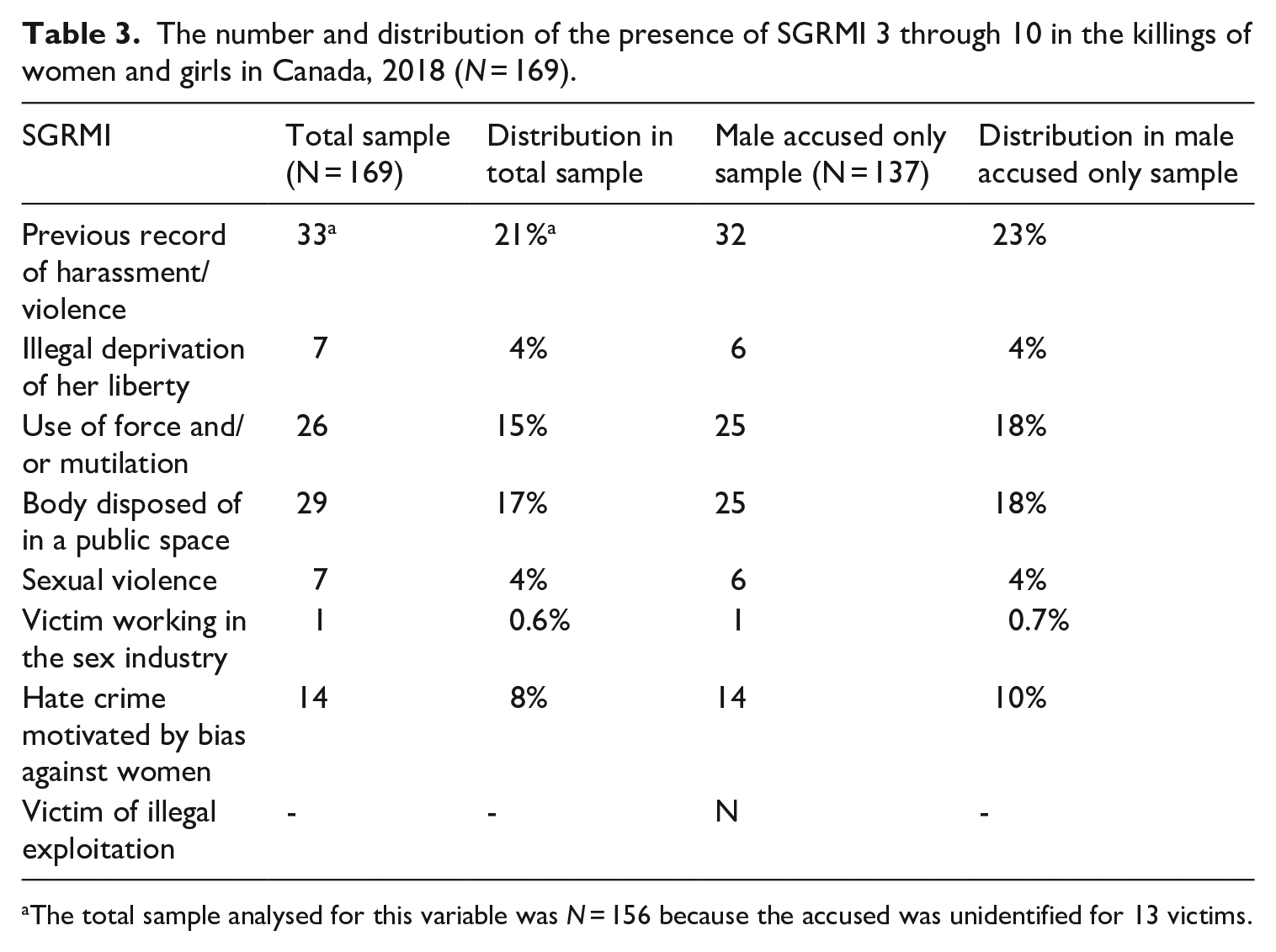
The total sample analysed for this variable was N = 156 because the accused was unidentified for 13 victims.
SGRMI #4: Illegal deprivation of her liberty
According to the statistical framework, this variable is applicable when there is evidence that the victim was unlawfully detained, against her will, or unlawfully taken away, concealed, or detained from their legal guardian, prior to the killing. This means that the victim was kidnapped, illegally restrained, hijacked, or unlawfully deprived of her liberty through any means. (UNODC and UNEGEEW, 2022: 13)
In 2018, seven victims in the total sample and six in the male accused only sample involved a victim who had been illegally deprived of her liberty.
SGRMI #5: Use of force and/or mutilation
Referred to as ‘killing accompanied by mutilation of the body’ in the UN framework, SGRMI #5 applies to situations which present body mutilation or, in general, when there are signs of derogative violence on the body that go beyond the amount needed to put an end to the life of the victim. This translates into the use of one or several instruments to inflict physical aggression, for example, blunt-force trauma caused by hands or objects followed by stabbing; the use of blunt force and strangulation; the use of a knife and a gun. One of the following criteria need to be identified after an autopsy, in order to determine whether the killing was accompanied by body mutilation: the body presents limb mutilation/dismemberment; the body presents signs of organ removal; the body presents evidence of degrading treatment; the body presents signs of torture; the body presents other signs of excessive mistreatment. (UNODC and UNEGEEW, 2022: 13)
The CFOJA does not have direct access to autopsy reports but draws on media and court documents reporting the results of autopsies. Therefore, this variable may be undercounted because it is based on third-party information. We determined the presence of this SGRMI by references to findings of excessive violence, mutilation, and/or the use of multiple methods. 3 In the 2018 total sample, 26 of the victims were subject to some form of ‘overkill’ or mutilation, and 25 of these were victims of male accused.
SGRMI #6: Body disposed of in a public space
This SGRMI captures, instances where the uncovered, exposed, and/or partially clothed or fully clothed body of a female victim was transported from the crime scene and intentionally exposed in an open area, which may include but is not limited to the following: streets, market places, residential areas, public transportation, public institutions such as schools or other institutions, commercial premises, institutional care settings, or other open areas. (UNODC and UNEGEEW, 2022: 14)
In 2018, 29 victims (17%) in the total sample and 25 victims (18%) in the male accused only sample involved victims being disposed of publicly after the killing.
SGRMI #7: Sexual violence was committed before and/or after the killing
This indicator is present in situations when a forensic examination of the victim’s body indicates that the victim was subjected to sexual violence before, during or after the killing. In addition to physical evidence of sexual assault on the victim’s body, this may also include the presence of biological material (DNA) foreign to the victim. (UNODC and UNEGEEW, 2022: 14)
The protocol also includes examples such as great violence on genital areas and areas with sexual meaning for the perpetrator, signs of direct sexual conduct (demonstrate commission of sexual aggression, direct proof, as well as those required through DNA/analysis), and signs related to sexual fantasies (situations of control, submission, torture, and humiliation) and the position in which the body is left following the femicide. (Sarmiento et al., 2014: 81)
In 2018, seven victims (4%) in the total sample and six victims (4%) in the male accused sample involved some form of sexual violence.
SGRMI #8: Victim was working in the sex industry
This variable refers to situations when a woman who worked in the sex industry is a victim of intentional homicide. This variable is applicable in all situations in which a female homicide victim is known by criminal justice authorities or other authorities to have previously been involved in the sex trade, regardless of whether it is criminalized under that jurisdiction. (UNODC and UNEGEEW, 2022: 14–15)
In the 2018 sample, one victim was reportedly working in the sex industry although this may not always be known or reported.
SGRMI #9: Hate crime motivated by bias against women and girls
The UN framework refers to these types of femicides as those committed by perpetrators who were motivated by hatred, which means that the perpetrator intentionally targets a woman because of a bias against this perceived group of people, or misogyny. Such crimes may or may not be committed out of direct animosity towards the victim, but hate crime displays hostility towards the group or community to which the victim belongs. The message conveyed by the offender, whether intentionally or not, sends a signal not only to the individual victim but also to other persons who feel that they are at risk of being labelled and treated like the victim. Signs of a hate crime can be recognizable by the specific modus operandi or context of the homicide. (UNODC and UNEGEEW, 2022: 13)
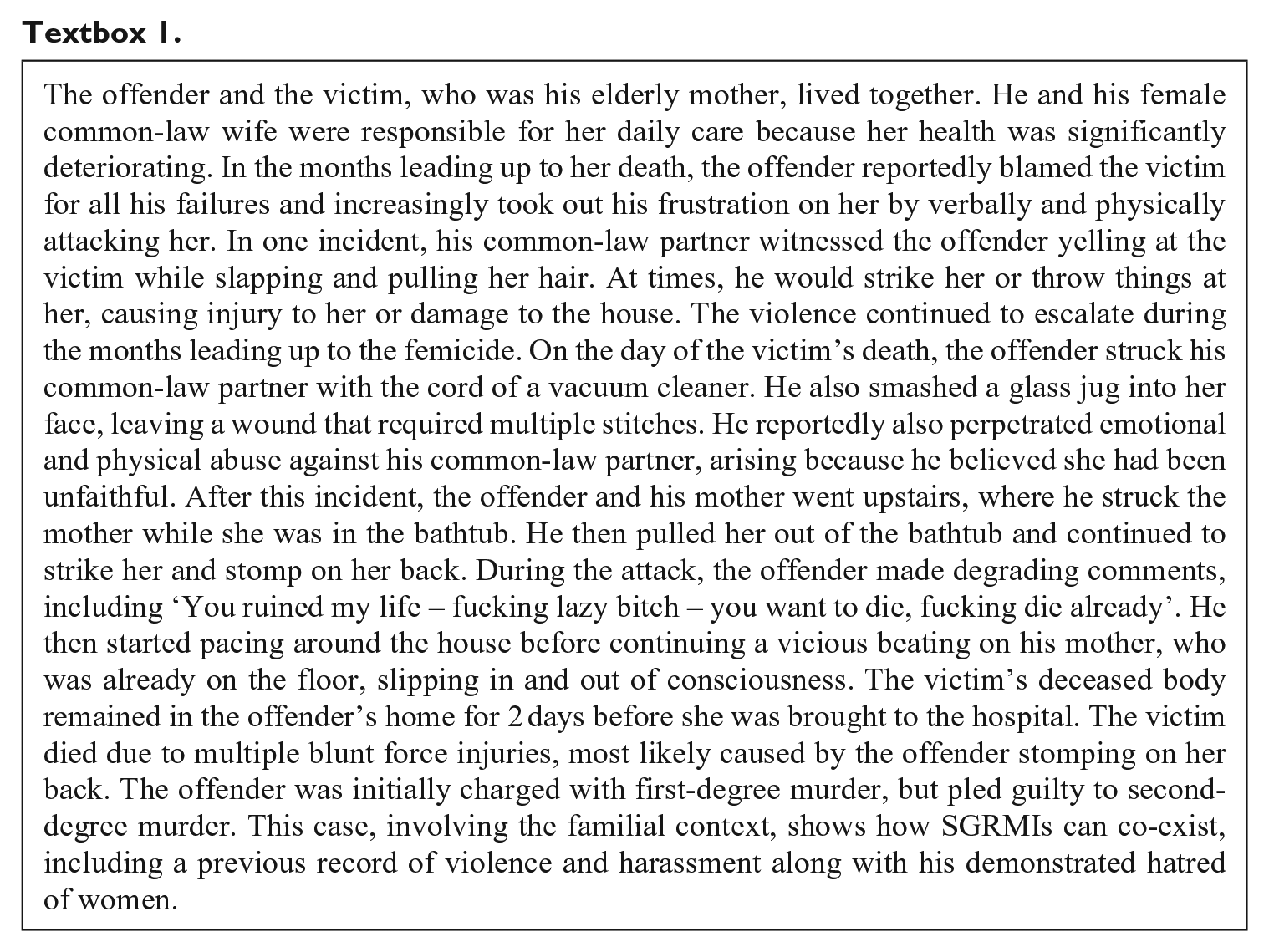
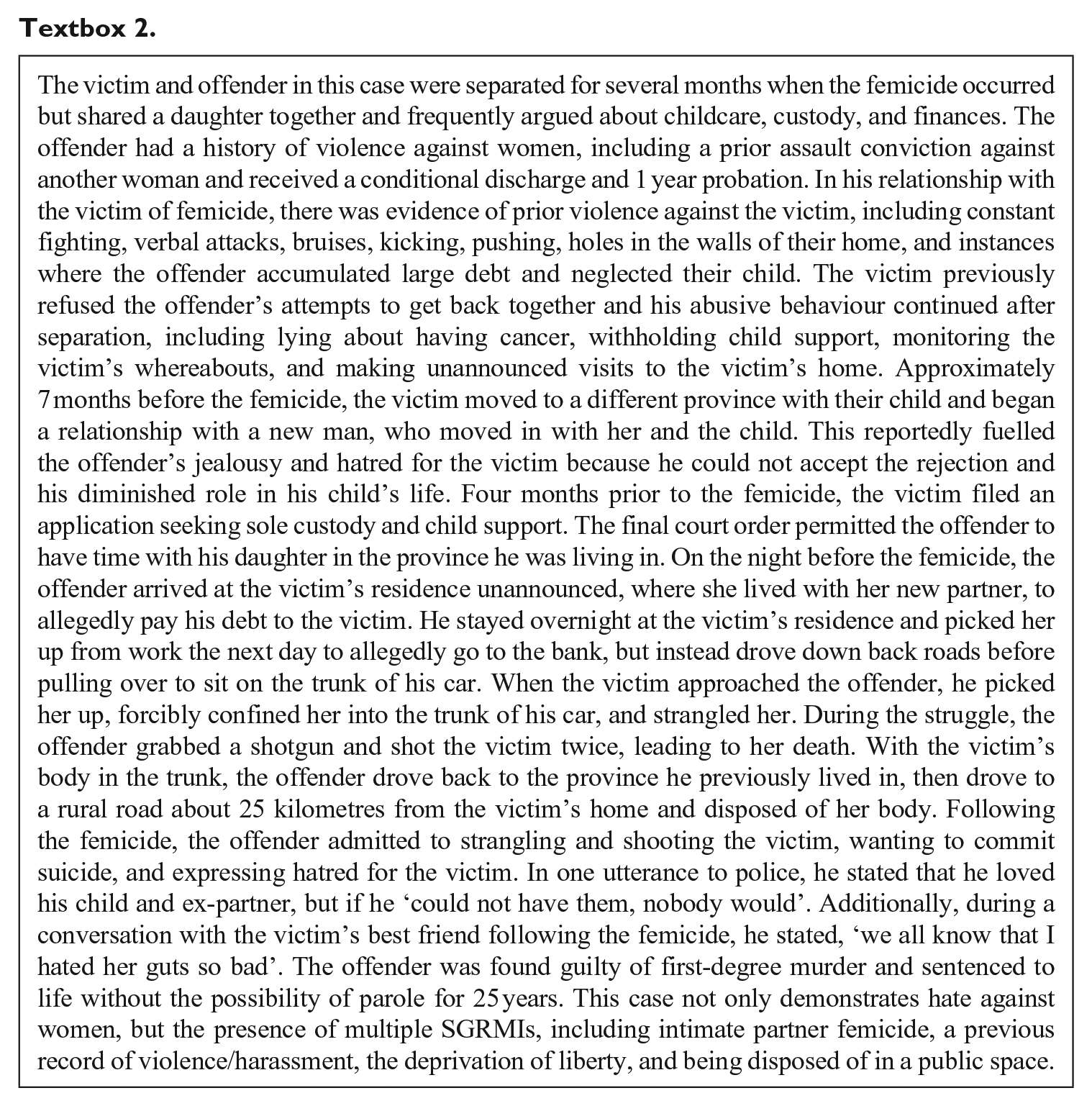
In the 2018 sample, the killing of 14 victims involved some evidence that the killing was motivated by bias or hate, all involving male accused. It has been documented that one mass killing leading to the deaths of nine women and two men was motivated by hatred of women or misogyny by a perpetrator who drew inspiration from the incel 4 online subculture of men united by sexual frustration and hatred of women. However, often overlooked, hate motivated by bias against women and girls is often present in lesser known cases as shown in Textboxes 1 and 2 (see also Dawson, 2022).
SGRMI #10: Victim of forms of illegal exploitation
The variable ‘victim of forms of illegal exploitation’ applies in situations when “there is evidence that the victim was subjected to trafficking in persons or to other forms of exploitation prior to the killing such as slavery, forced labour, or sexual exploitation. This contextual evidence can be derived from the recording of such conducts as separate offences” (UNODC and UNEGEEW, 2022: 13). In 2018, we were not able to identify any victims for whom this situation applied, which is not surprising given the focus is on 1 year only and limited data sources.
A global measure of SGRMIs
Our goal in the above section is to clearly delineate what is meant by SGRMIs for femicide to increase professional and public awareness and education by focusing on each separately. However, we argue that it is important to understand the full scope of SGRMIs in the total sample to underscore their prevalence in the killings of women and girls and, thus, the prevalence of femicide. Once there is some consensus on what SGRMIs are most appropriate to identify femicide, this would also help to monitor changes over time as (hopefully) more nuanced prevention initiatives are developed and implemented, leading to a reduction in their prevalence in the killings of women and girls.
To address this question, we examined the combined frequency of the 10 SGRMIs across all 2018 cases for the full sample and then for the male accused only sample. For the full sample (N = 169), at least one SGRMI was present in the killing of slightly more than three-quarters of the victims (N = 128; 76%) as shown in Chart 1. Recall that the full sample includes those victims whose killers had not yet been identified or whose cases remain unsolved because the circumstances of their killings (e.g. excessive violence, sexual violence) may still have evidence of SGRMIs indicative of femicide. Focusing on the sample of male accused only (N = 137), 115 victims (or 84%) involved at least one SGRMI (see Chart 2).
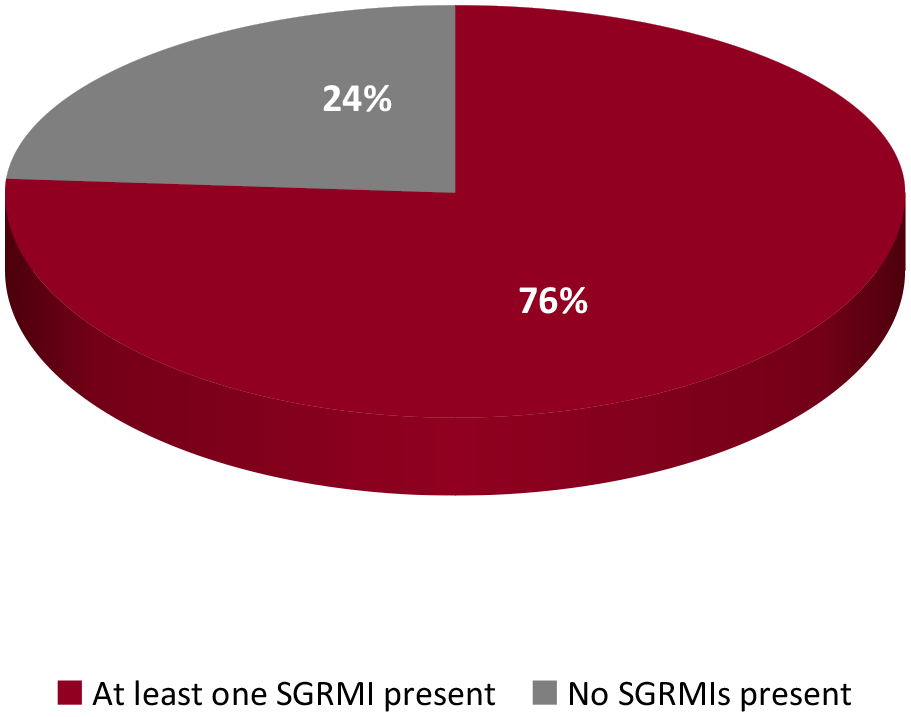
Percentage distribution of the presence of SGRMIs in the killings of women and girls in Canada, 2018 (N = 169).
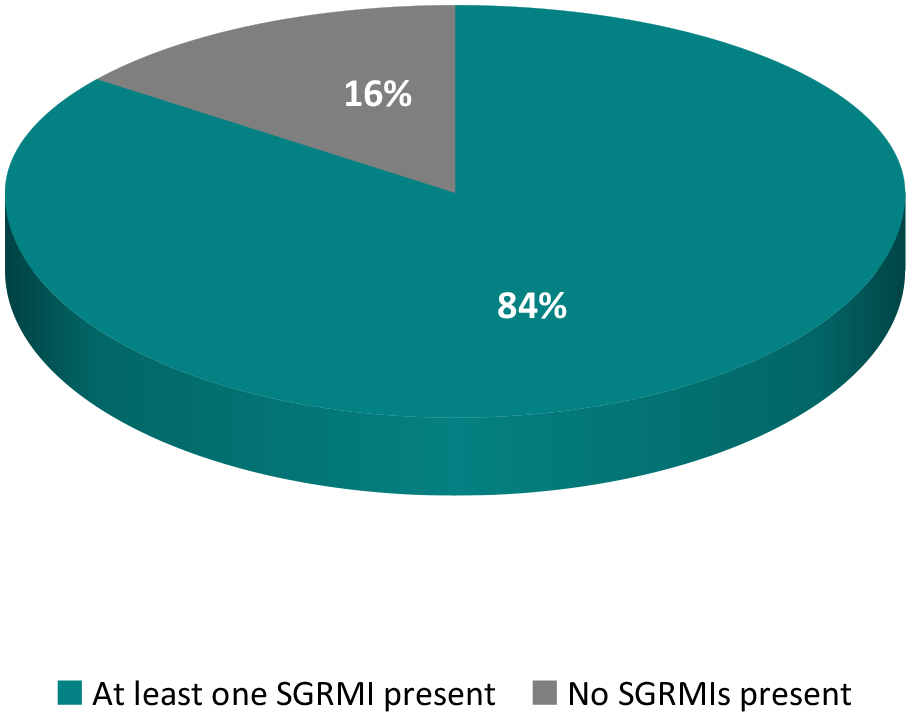
Percentage distribution of the presence of SGRMIs in the killings of women and girls involving male accused in Canada, 2018 (N = 137).
It can be argued that intimate partner femicide and familial femicide are not automatically sex/gender-related killings. While that may be the case, decades of research worldwide have documented the characteristics of these cases, supporting their inclusion in the UN statistical framework. However, to address the potential critique that the inclusion of these two SGRMIs inflates the global measure of SGRMIs, we examined the presence of SGRMIs without the first two relationship contexts. Focusing on the remaining eight SGRMIs, at least one SGRMI remained present in the killings of 79 of the 115 victims (58% of the sample).
Discussion and conclusion
To our knowledge, this study is the first application of the statistical framework on gender-related killings of women and girls (femicide/feminicide). Using a sample from one country and publicly accessible data sources, the results demonstrate support for the statistical framework. Specifically, we found evidence of at least one SGRMI for a low of 76% of the victims killed in the full sample, including female accused, to a high of 84% in the sample of male accused only. Given we focused on 1 year and public data sources only, we argue that this shows strong support for the utility of the statistical framework. With more detailed data sources, including official police and coroner reports, the prevalence of SGRMIs would arguably be much higher. Challenges remain, however, which preclude progress in violence prevention which should be one of the key goals of data collection and, arguably, the primary goal of any statistical framework. We discuss two of these challenges in more detail below.
Data availability
The first challenge is the lack of basic individual-level data indicative of femicide. The 10 variables in the statistical framework only scratch the surface of possible SGRMIs for femicide, focusing as the framework authors noted on those that have achieved the most consensus in research and through expert consultations. Regardless, most countries, both high- or middle-/low-income countries, are still not able to access and/or collect such data, including Canada where this research took place. To illustrate, in 2023, Statistics Canada released its first publication focusing on Gender-related homicide of women and girls in Canada, including 4 of the 10 indicators in the UN framework: ‘was an intimate partner or family member; perpetrated sexual violence on the victim as part of the homicide; or killed a woman or girl who was identified as a sex worker’ (Sutton, 2023: 4). They reported that, due to data gaps, they were unable to include any of the other variables (e.g. prior violence, mutilation, or public disposal of the victim’s body).
One could argue this was due to their administrative data relying on police reports and other data sources may lead to better data availability. However, focusing on Ontario, Canada, Dawson and Carrigan (2021), discussed earlier, drew from coroner, police, and crown attorney files as well as media and court documents and, even with this rigorous triangulation of data sources, their results showed many important contextual factors related to femicide were not regularly or routinely collected. For other variables, there were significantly high proportions of missing data. Missing data are a problem that has been grappled with by homicide researchers over time and across countries, despite homicide being one of the better documented forms of violence (Riedel and Regoeczi, 2004). The situation for femicide is likely exacerbated because contemporary data collection instruments were historically designed to capture more frequent male-on-male homicides (Dawson and Carrigan, 2021). Large-scale efforts to redesign instruments are required, but the political will to do so has so far been lacking in Canada and globally. Such efforts would have to move beyond the emphasis on individual-level factors which would also have benefits for violence prevention and data broadly, particularly for those women and girls at highest risk.
Emphasis on individual obscures role of community and society
The second challenge when collecting data indicative of femicide is the almost total invisibility of community- and societal-level indicators (e.g. lack of access to services or sexist attitudes/gender norms). It is recognized that there is no single contributor to violence and that variables, whether at similar or different levels, will interact to increase or decrease one’s risk or exposure to violence (i.e. the social ecological model; Heise, 1998). These individual, relationship, community, and/or societal-level factors may separately, and in combination, also differentially protect against, or exacerbate, risk of femicide for some groups of women and girls (i.e. intersectionality; Crenshaw, 1991; Hill Collins and Bilge, 2016). For example, women and girls who are Indigenous or belong to racialized minorities, live in rural/remote regions, are poor and/or living with disabilities are often at greater risk of male violence, including femicide, than other women and girls. However, it is not the individual identities of women and girls, or even just their relationships with men, which may make them vulnerable to violence. Rather, it is the community and/or societal responses to their identities, or help-seeking efforts if they occur, which contribute to their marginalization, vulnerability, and increased risk of violence. Individual identities and relational factors do play a role, but not typically on their own because individuals cannot be separated from the communities and/or societies in which they live, including the social structural processes and interactions that operate and occur as a result. Yet, community- and societal-level factors – sexism, racism, classism, ableism, homophobia, transphobia – continue to be invisible in official and, arguably most, data collection efforts.
The emphasis on individual- or relational-level factors has been present in violence research over time and globally. This has occurred, in part, because individual-level factors are easier to measure and related data easier to collect in comparison to community- or societal-level factors. In contrast, how does one measure sexism, racism, and classism in community-level interactions with available data? How can researchers measure ableism, homophobia, and transphobia in societal-level processes? Until we address these significant gaps, more nuanced prevention initiatives will be elusive for most women and girls experiencing male violence and especially those at highest risk. The obstacles to doing so are vast and complex, requiring communication, cooperation, and collaboration across individuals, sectors, and governments, but mechanisms are available to do so as we discuss next.
Injury, including violence, is recognized as a significant public health problem globally and remains a core focus of efforts by the World Health Organization. The accompanying public health framework recognizes that prevention requires an understanding of the nature and circumstances under which injury and violence occurs using the perspectives and expertise of individuals from across a variety of sectors and disciplines. Historical and contemporary mechanisms for achieving this understanding have been medical or legal death investigations which, in many countries, are established institutional structures which seek to determine the cause and circumstances of death in particular contexts, including violence. The information generated from these investigations has largely provided the capacity for population-level injury surveillance. In some jurisdictions, these investigations also generate recommendations which can make a more direct contribution to injury prevention. Over time, these investigations have evolved to address child deaths and, more recently, domestic violence-related deaths. The latter, commonly referred to as domestic violence death review committees, which now exist in some form in at least six high-income countries (Dawson, 2017, 2021).
In a recently released background paper (UNODC, 2023), the potential for these mechanisms, along with the rise of femicide observatories/watches, was examined as one way to improve data documenting femicide and, in turn, to develop more appropriate intervention and preventions initiatives. The background paper concluded that such reviews also had the potential to shift from the narrow focus on individual victims and perpetrators and their relationships as well as criminal justice responses to the broader role of all agencies and communities, including state obligations and societal-level norms, by emphasizing multi-sector coordination and whole-of-state prevention responses. This recommendation aligns with the perspective of the United Nations Special Rapporteur on Violence Against Women demonstrated in the quote at the beginning of this article, which identified the potential of interdisciplinary review panels to assist existing or future femicide watches or observatories in their collection and analyses of data on femicides (ACUNS, 2017: 1). If accurate data are a defence against femicide, the potential for such mechanisms to provide avenues for better prevention of femicide is crucial.
Discussions about how femicide should be defined and measured will no doubt continue. The shared goal is to move beyond the situation in which sex or gender is largely invisible in data collection instruments, which has been achieved to some degree. According to Walby et al. (2017), there are two remaining approaches to increasing the visibility of sex or gender in data and, subsequently, in state laws and policies. One approach is to focus on women, with the goal of ending the violations of women’s human rights and sex/gender-based violence against women. The other remaining approach is referred to as gender mainstreaming which makes ‘gender specificities visible by disaggregating gender and revising categories to allow gender dimensions to be fully included’. The five key dimensions identified by Walby et al. (2017) are sex of the victim, sex of the perpetrator, whether they shared an intimate partner or family relationship, whether there was a sexual element, and a gender motivation.
More recently, Walby (2023) argued that the sex of the victim is sufficient for a global indicator, and the approach most productive of change is that of gender disaggregation of data on all forms of violence: Measuring outcomes for women only or narrowing the definition to gender-motivated killings of women, in the particularist approach, reduces the capacity to build alliances that facilitate movement towards a hegemonic position that includes ending violence and gender inequality. By contrast, gender disaggregation, including the simplest and widest definition of femicide as the killing of women, provides greater capacity for mainstreaming intersecting inequalities, coalition building, moving from the margin to the centre and to creating a new hegemony that includes these concerns within a reworked understanding of universalism. (p. 23)
In our introduction, we identified at least three reasons why one might want to define, measure, and document femicide, each of which may necessitate different definitional parameters and indicators. For the first goal, we agree with Walby (2023) that sex of the victim may be enough to effectively produce and understand female homicide statistics within and across countries. We argue that the remaining two goals can only be achieved by better documentation of femicide specifically – not female homicide – which requires more nuanced data and measures. Specifically, more enhanced and detailed data are required if we are to determine more effective femicide preventions and more appropriate punishments to increase accountability and reduce impunity. A better understanding of what we mean by femicide defined as a woman or girl being killed because they are a woman or girl is also necessary if we are to raise awareness and increase public education, including the development of enhanced training for those responding to sex/gender-related violence against women and girls.
More importantly, our ability to do so is necessary for helping to meet UN SDG Target 5, and particularly 5.2 – Eliminate violence against women and girls: Eliminate all forms of violence against all women and girls in the public and private spheres, including trafficking and sexual and other types of exploitation. In doing so, states and governments must begin to “emphasize prevention as the priority for data collection rather than administrative needs” (Dawson and Carrigan, 2021: 683). Accurate data are crucial for monitoring trends and patterns. Better, more nuanced data are required to highlight emerging research, policy, and practice priorities, to enhance the prevention of violence, and to improve the lives of women and girls specifically. This can only be achieved with strong and sustainable collaborations across researchers, communities, and government, which, ultimately, requires political will.
Footnotes
Declaration of conflicting interests
The authors declared no potential conflicts of interest with respect to the research, authorship, and/or publication of this article.
Funding
The authors received no financial support for the research, authorship, and/or publication of this article.
