




Abstract
While studies of femicide perpetrators have focused on background factors, such as criminal history and mental health conditions, little attention has been paid to their individual experiences. Perpetrators emotions and sense-making have often been overlooked and even dismissed. With a micro-sociological approach to violence, we identify the narrated emotions involved in the perpetration of intimate femicide. The data gathered are based on 33 open-ended interviews with convicted male perpetrators from Argentina, Bolivia, Brazil, Chile, Honduras, Mexico, and Venezuela. We identify four main emotions reflecting participants’ experiences of femicide: Fear, expressed through stories of women as threats to self, family, and community; helplessness, expressed through stories of men being trapped, judged, and persecuted; and pain, connected to stories of jealousy and belittlement. These lead to anger, expressed through stories of bodily reactions and losing control. The findings indicate that intimate femicide perpetrators resort to lethal violence to regulate self-worth and remediate actions they feel were disruptive. Our research demonstrates the importance of embodied and narrated emotions to understand femicides. We argue that viewing femicide as a product of a shared pervasive emotional economy highlights the role of emotions in maintaining a gendered social order.
Introduction
Femicide – the intentional killing of a woman or girl based on her gender (UNODC, 2022) – is a social and cultural problem on a global scale. Ever since the term was formally coined in 1976 (Russell, 1976), there have been debates about the roots of the phenomenon, its intersectional nature, and the ways in which it should be conceptualised (Campbell and Runyan, 1998; Corradi et al., 2016; Dawson and Mobayed Vega, 2023; Walby et al., 2017). Recent scholarly work often focuses on the measurement of femicide and its methodological challenges (Dawson and Carrigan, 2021; Giesbrecht et al., 2023; Walby et al., 2017), risk factors and danger assessment (Campbell et al., 2007), legal frameworks and law enforcement (Pasinato and de Ávila, 2022), and activism and data production (D’Ignazio et al., 2022). Understandably, most of the literature has focused on victims and survivors. The exploration of these topics has unquestionably contributed to understanding the crime and its complexities. Yet, research on perpetrators has remained relatively scarce (Evans et al., 2023).
More recently, there has been an emerging interest in the life histories, narratives, and sense-making of individuals who commit intimate femicide (Di Marco and Evans, 2020; Dobash and Dobash, 2015; Fahs et al., 2023; Mathews et al., 2011, 2015; Regis-Moura et al., 2022). Research has revealed that comprehending the worldviews of the perpetrators is key to preventing it, as such views may reveal the norms involved in aggression (Jewkes et al., 2015; Presser, 2013). Although this type of research has helped shed light on the embodied meanings and underlying motives (Ceretti and Natali, 2020; Katz, 2002), the analysis of emotions involved in femicide remains largely unexplored.
Employing sociology of emotions perspective to understand femicide perpetrators’ experiences may help reveal the social processes underlying the violence. Interpretative phenomenological analysis can, for instance, be used to study actors’ own terms and logic. The approach has been shown to be particularly useful to study complex, ambiguous, and emotionally laden phenomena (Smith and Osborn, 2008). The study of emotions should include an understanding of how emotions enter public life and shape how people feel, and how mainstream narratives are incorporated and embodied. A framework of affective economies has been helpful to help identify the way in which emotions circulate in societies ‘and contribute to the construction and maintenance of the social order, particularly concerning gender, race, and sexuality’ (Ahmed, 2017: 10).
Stemming from a sociological understanding of emotions (Katz, 2002; Kleres, 2011), the objective of this study is to identify the main narrated emotions of men who commit intimate femicide and subsequently to link these embodied, gender narratives with affective economies (Ahmed, 2017). We subscribe to a restrictive definition of femicides, as intimate-partner homicide (Dawson and Carrigan, 2021). Studying in depth the narrated emotions of perpetrators reveal some of underlying societal forces that shape these misogynistic homicides and make them a structural phenomenon – feminicide (Dawson and Carrigan, 2021; Kouta et al., 2018; Segato, 2018). We collate data from different Latin American countries, which we use to provide an analysis of the most common emotions involved in femicide. The study assists in understanding the stable rate of gender-related killings in Latin America as well as similar patterns in other regions.
Bridging emotions and narratives
Sociology has a long, yet marginal tradition in the study of emotions. The inaugural works of Cooley (2010 [1902]) prompted the expansion of the field. Yet, it was only after the ‘emotional turn’ in the late 1970s that this topic gained traction (Cerulo and Scribano, 2022; Kleres, 2011). Since then, sociology of emotions has developed into its own field of study (Turner and Stets, 2006). As noted by Kusenbach and Loseke (2013), the study of emotions is still relatively little developed in sociology. While sociologists acknowledge the social nature of emotions, individual subjectivity has been the predominant empirical focus in this field (Turner and Stets, 2006). Investigating how social actors experience, handle and display their emotions has still led to various sociological insights, especially regarding the connection between social contexts and subjective experience. This connection stresses that emotions, like any other experience, are learned social behaviour (Hochschild, 1979), shaped by language, and culturally derived (Geertz, 1973). Emphasising the bodily component of meaning and cultural narratives Rosaldo (1994) describes emotions accordingly as ‘embodied thoughts’.
Despite decades of research, there are many unresolved epistemological issues in the theorisation of emotions (Cerulo and Scribano, 2022). Ongoing discussions include the link between emotions and actions (Bericat, 2015), the nature of emotions and feelings (Turner and Stets, 2006), the connection between subconscious processes and collective phenomena (Habermas, 2018), and the relation between emotions and discursive scenarios (Kleres, 2011). The latter is particularly important for this article since it addresses how prevailing narratives enable or dissuade experiences and social practices, such as racism (Ahmed, 2017), social change and masculinity (Logoz et al., 2023), and attitudes towards women (Jewkes et al., 2015).
Many of these unresolved issues can be better understood and theorised if emotions are understood as social practices. The practice approach implies two main premises. First, a rejection of an individualistic or naturalistic idea of emotions (i.e. they are neither isolated nor natural experiences). Second, a conceptualisation of emotions as shaped and instigated by a political economy. In other words, they do not reside in subjects or situations but are as (Ahmed, 2017: 11) emphasise ‘produced in circulation’. Therefore, emotions can be understood as structured by social scenarios, which informs individuals’ action tendencies towards others (Habermas, 2018).
As Ahmed (2017) argues, defining emotions as social practices distinguishes them from the two mainstream approaches on emotions: the ‘inside out’ perspective, assuming an inner instinctive response to an external stimulus and the ‘outside in’ perspective, emphasising emotions as ‘something we have’. Both approaches fail to capture ‘that emotions create the very effect of the surfaces and boundaries that allow us to distinguish an inside and an outside in the first place’ (Ahmed, 2017: 10). Emotions, within Ahmed’s (2017) perspective, are therefore not defined as something to be ‘possessed’, but rather a practice through which boundaries such as ‘you and I’, ‘safety-dangerousness’, ‘love-anger’ are made. Arguably then, researching narrated emotions provide a way to connect practice and discourse by showing how social experiences and practices are inscribed in language (Kleres, 2011).
Language has been shown to shape individuals’ interpretations of their own experiences and emotions. A range of concepts, such as interpretive codes (Cerulo, 1998), symbolic codes (Alexander, 1992), and cultural coherence systems (Linde, 1993), have been used to describe how language shape sense-making processes. Language also shapes emotions through emotional cultures (Gordon, 1990), and feeling, framing, and expression rules (Hochschild, 1979). As Kusenbach and Loseke (2013) put it, ‘narrative molds are blueprints for cognitive and emotional evaluations of self and others’ (p. 33). What Schutz (1967) referred to as ‘schemes of interpretation’ and Miller and Holstein (1993) as ‘interpretive structures’ work as cognitive and emotional resources for understanding experiences.
In this study, we underline the argument developed by sociologists and anthropologists who have suggested that emotions should not be reduced to mere mental experiences, but be seen as social practices (Ahmed, 2017; Katz, 2002; Rosaldo, 1994; White, 1993). As emphasised by contemporary scholars of emotions and narrative (Cerulo and Scribano, 2022; Habermas, 2018; Kusenbach and Loseke, 2013; Turner and Stets, 2006), going beyond the minutiae of experience and linking emotions instead to narratives that sustain them might contribute to a broader understanding of many social phenomena. Researching narrated emotions can thus widen the analytic lens in the study of femicide.
Emotions and intimate partner violence
In the study of violence, exploring emotions has helped bolster their theorisation as well as provide nuance to structuralist approaches (Collins, 2008; Weil, 2017). Nonetheless, emotions have been less explored empirically, specifically when it comes to femicides (Evans et al., 2023; see also Boira et al., 2013). The analysis of emotions related to intimate partner violence has been predominantly used to understand victims/survivors. For instance, it has been used to study resilience in survivors (Crann and Barata, 2016) and the lived experiences of battered women (Lee and Lee, 2022). More recently, an interest in studying male victims has emerged as a new field of research (Sinacore et al., 2017).
Studies focused on the perpetrators have been mainly restricted to non-lethal violence, such as violence in young partners (Berggren et al., 2021), stalking (Flowers et al., 2020), sexual offences (Weldon, 2016), rape (Segato, 2003), and other situations (Apiribu et al., 2020). Researchers, such as Watt (2011), have connected violence to childhood adverse experiences and psychosocial scholars argue that experiences of abuse may cause trauma, thus creating conflicting emotions that in turn may lead to violence against women (Gadd, 2000). A great deal of literature linking intimate partner violence and emotions has focused on desistance (Gottzén, 2019; Sheehan et al., 2012; Walker et al., 2017). Batterer intervention programmes, for instance, constitute a key community force that may initiate experiential changes and subjective shifts (Hellman et al., 2010; Sheehan et al., 2012; Silvergleid and Mankowski, 2006). Nonetheless, most studies focused on treatment groups emphasise the inability to control emotions, otherwise known as ‘emotional dysregulation’, instead of the broader range of feelings and their role in offences and harm.
For many decades, critical masculinity scholars have argued that understanding intimate partner violence implies identifying the main features of normative masculinity (Berggren et al., 2021). The hallmark of hegemonic masculinity was aggression, hyper-sexualisation, lack of emotional acknowledgement, and rejection of any idea related to femininity (Connell and Messerschmidt, 2005). Kimmel (2019) has recently made a case for this perspective by exploring how men’s experiences (most notably, aggrieved entitlement) illustrate several forms of violence, including femicide. From a psychosocial perspective, Gadd and Jefferson (2007) have stressed the limits of focusing on batterers’ stories without considering the role of the unconscious, emotional, and narrative contradictions. This can also be seen as a critique of Messerschmidt’s structured action theory by questioning to what degree individuals are moved by instrumental actions alone (Berggren et al., 2021).
Overall, the above literature suggests that hegemonic narratives about gender encourage similar experiences the symptoms of which are denial of emotions, a violent channelling of the feelings of frustration and pain, and the contradictory feeling of vulnerability. Yet, these emotions are not completely standardised. As argued by Presser (2005), male aggressors are not ‘mere conduits of patriarchal norms’ (p. 70): they comprehend, interpret, and feel social values and belief systems. This makes it important to explore their own understanding, or narratives, of the acts they have committed and link these to their current and past emotions and the patriarchal norms they have accepted.
In the case of lethal violence, even less studies have been carried out to understand the connection between emotions and killings. Interactionist studies have developed a series of concepts to account for the specific nature of these acts, including ‘situated transactions’ (Luckenbill, 1972; Polk, 1995) and rituals (Athens, 1997). These terms help categorise homicides as a phenomenon that is the result of interactions that follow scripted stages in situations where control is disputed. As a result, violence can be seen as an individual resource used to control interactions and self-presentation. Underlying these interactions are the master emotions of pride, shame (Cooley, 2010 [1902]), and humiliation (Gabaldón, 2020; Katz, 1988), and the aggression is most often used to negotiate honour.
This research, however, cannot be directly transferred to intimate femicides, as they do not consider the specific nature of violence in sexual and romantic relationships. Importantly, and as emphasised by feminist literature, the interactions that end up in male–male and male–female homicides are structurally different (Dawson and Mobayed Vega, 2023). Hence, identifying the specificities of particular forms of violence, and exploring and highlighting their societal and cultural context, is necessary to understand any kind of violence (Tutenges and Sandberg, 2024).
Regarding pride and self-worth, research on femicide perpetrators have yielded similar results as research on homicide more generally, but the relevance of power and control seems to be even more important. Di Marco and Evans (2020) have pointed out that male-chauvinistic narratives instigate feeling angry and ‘out of control’. Goussinsky and Yassour-Borochowitz (2012) have argued that femicides usually imply a sense of deep despair, which would trigger perpetrators to disregard consequences. In this regard, Fahs et al. (2023) showed that intimate femicide implies an action to express and remediate emotional pain, and Mathews et al. (2015) stressed that the homicides are connected to an immense emotional turmoil triggered by the idea of losing a partner. The same authors have also argued that the feeling of vulnerability and fear compelled them to polarise their partner as either good or bad.
A recent systematic review of existing research (Evans et al., 2023) has found support that fear, vulnerability, and despair are key emotions involved in femicide perpetration. Yet, as Graham et al. (2022) summarised, most literature understands these as ‘negative emotions’ under the umbrella of general strain theory, without accounting for the socio-cultural support in which these emotions are embedded and fostered. With this in mind, the aim of this article is first to explore intimate femicide perpetrators narrated emotions, and then to discuss how these can be linked to larger affective economies.
Methods
This article is based on data primarily derived from Crime in Latin America (CRIMLA) Project, a large-scale project applying a narrative criminology (Presser and Sandberg, 2015) framework to understand life-course trajectories and life histories of offenders in Latin America. 1 Participants (n = 33) in this study were cisgender men convicted of intimate femicide or feminicide, under local legislations. While implying conceptual differences, both of these legal terms indicate the intentional killing of a female partner or ex-partner, based on their gender. Our understanding and definition of intimate femicide/feminicide follow the use of the term by Dawson and Carrigan (2021) and UNODC (2022). This sample definition inevitably excluded other variations of the crime, such as non-intimate femicides and transfemicides. Interviewees were nationals from Argentina (15), Bolivia (2), Brazil (2), Chile (6), Mexico (3), Honduras (3), and Venezuela (2). Argentina is overrepresented since the first author was based there and combined data from a previous research project (PRI R20-24 Narratives of lives and deaths, Buenos Aires University) with the CRIMLA research project.
Before conviction, 27% of offenders had finished primary school, 55% had finished secondary school and 18% had university diplomas. When they committed their crime, 15% were between 18 years old and 25 years old, 18% between 26 years and 35 years, 36% between 36 years and 45 years, 21% were between 46 years and 55 years, and 9% was 56 years or above. The educational characteristics and age groups thus largely coincide with the distribution of femicide perpetrators in Latin America (UNODC, 2022). The status of the relationship with the victim varied with current partner being 75% and ex-partner 25%. The average time offenders had served in prison was 6 years.
Data collection took place during 2021–2023 in various cities: Metropolitan Buenos Aires (Argentina), La Paz (Bolivia), Recife and San Pablo (Brazil), Santiago de Chile (Chile), Tegucigalpa (Honduras), Mexico City (Mexico), and Caracas (Venezuela). Interviews were done in these cities’ respective penitentiary systems, primarily in medium and maximum-security level prisons. The interviews were conducted in Spanish and Portuguese. The first author conducted all the interviews that took place in Argentina along with one in Santiago de Chile, while the rest of the interviews, except for Venezuela, were conducted by local researchers of the CRIMLA project. Interviews from Venezuela stem from a similar project (Meanings and situational properties of youth interpersonal violence) led by Prof. Luis Gerardo Gabaldón, from the Andrés Bello Catholic University.
In most penitentiaries, there were no specific ‘rehabilitation’ or treatment programmes. Individual psychological sessions were available for those who were interested in them, but group therapy was not available in these prisons. Participants were informed that the study was focused on their perspectives and how they explained and understood significant events in their lives. The initial contact with participants varied in each location. Overall, they were either contacted by prison staff and informed about the ongoing project, or directly approached by a researcher in the facilities.
We conducted open-ended interviews, consisting of three sessions (approx. 90 minutes each) per participant. On average, sessions took place every other week. A narrative approach was followed (Rosenthal, 2018) and interviews started with participants being asked to tell their life story. Interpretative Phenomenological Analysis (IPA) (Smith and Osborn, 2008) was used as the method for data analysis given the inductive nature of this project. IPA focuses on the accounts of lived experiences in people’s own terms rather than on prescribed, pre-existing ones. Acknowledging the perspective of the individuals was key.
Interviews were recorded digitally and transcribed. The subsequent analysis was split in two parts. First, transcripts were coded with a previously defined extensive codebook in NVivo. The initial codebook was created based on the research questions of the broader project and the existing relevant literature. Second, an inductive coding process was followed to allow emergent data to be identified (e.g. emotions, interactions). Due to the design of the study and the sample size, the analysis is focused on the commonalities in the narrated stories. Therefore, we do not emphasise differences based on the countries, or establish a link between the emergent analysis and the context-specific social, political, and institutional realities.
Prior to implementation, the study was reviewed by the Ethical Committee of the respective countries. 2 We followed the ethical guidelines of Helsinki Ethical Principles. Prior to the interview, oral and written informed consent were provided to the participants. We discussed the nature of the interview and the overall purpose of the project. All names of people, locations, and institutions were de-identified in the transcripts. All potentially recognisable details from the cases (due to media attention) were excluded from the article. To ensure anonymity, the participant’s nationalities are not mentioned. Recordings were stored securely in an online platform provided by University of Oslo. The names of the participants were replaced by pseudonyms.
Four main narrated emotions of femicide
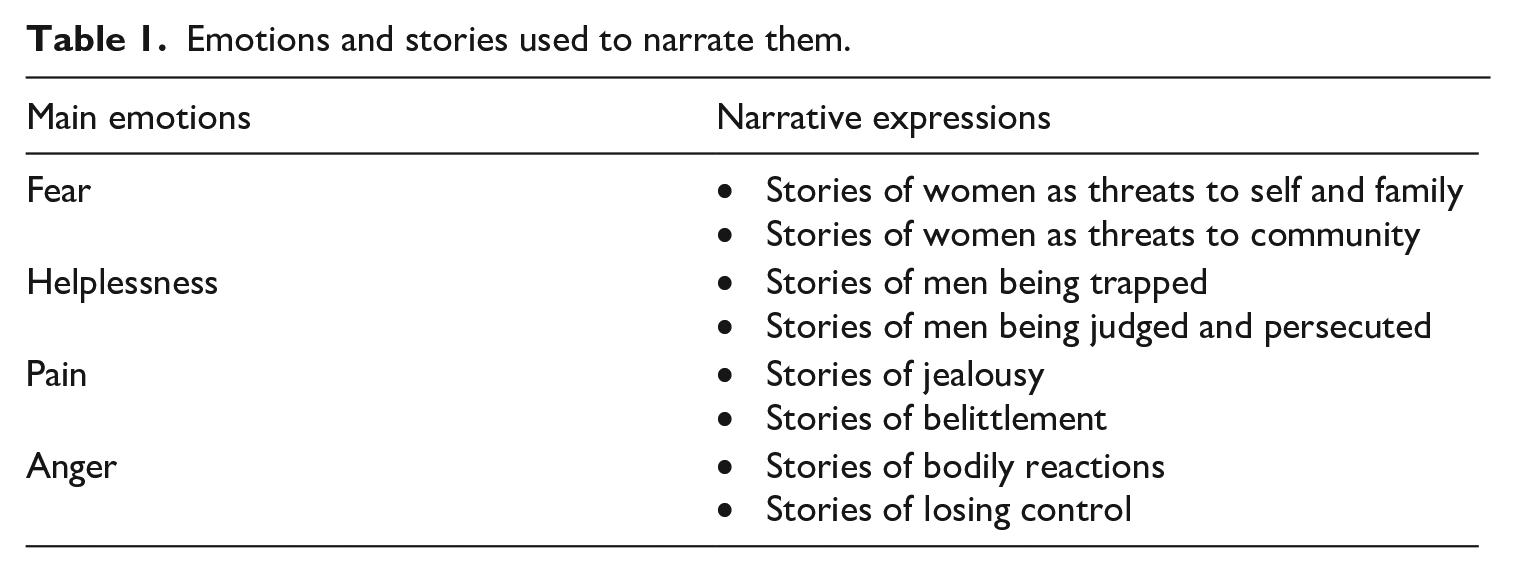
We distinguish between four main emotions involved in femicides and illustrated them with two narrative expressions each (Table 1). Some of the categories, which inevitably overlap, are based on patterns from empirical observations used to represent defining features of the phenomenon and should be seen as ideal types.
Emotions and stories used to narrate them.
Fear: Women as a threat
A salient narrated emotion across all the interviews was fear. Perpetrators referred to experiencing distress and emotional turmoil during the time of the intimate femicide, and women, whether their partners/ex-partners or women in general, evoked feeling a ‘potential hazard’ in their lives. One narrative expression of the feeling of fear was threat. In various ways, women were described as people who would potentially produce pain, uncertainty, vulnerability or, most often, humiliation. Threats were mentioned as feeling in different ways: when participants believed they were cheated on, as a response to a perceived damage to their family or social surrounding, and when they felt in jeopardy.
Femicide perpetrators experienced a sense of uneasiness and vulnerability and described it as a primal feeling that simultaneously justified and explained their actions. The feeling of being constrained by the victim was another common thread among the participants, who said they felt ‘manipulated’, ‘played at’, ‘jerked around’ and ‘questioned’, making them feel as if they were under attack.
Antonio (40 years) described her former lover as a ‘bad woman’. He killed her after 17 years of being together, which he described as ‘sheer torture’: She brought out the worst in me. I am not like that, not a violent person (laughs). It’s preposterous to say that I’m violent. But at that moment, I saw her as an enemy, as someone who was hurting me. Like her strikes were relentless, her piercing stare . . . (looks down). I just got sucked into that mayhem.
Violence was described as the outcome of feeling ‘taunted and challenged’. For most participants, violence culminated in a particular moment – an argument or fight about separation, cheating, or children – that led to the lethal aggression. Some participants mentioned women as threats to their families as well. In these cases, the feelings driving the femicide included broader aspects, such as disintegration of the family, children being exposed to danger, and paradoxically, vicarious violence. For instance, Celso (48 years) talked about his wife’s apparent affair having an impact on her children: She was a bad woman, but I loved her. She was selfish, and would not think of me, or others, just followed her desires. That was damaging me. She knew it. [. . .] There are things that people should not do, to ruin the relationship, no, no. People should not talk about them, because they harm a lot. She hurt me, damaged me a lot, but I moved on. [. . .]. She was hurting her kids and us as a family.
Pedro (42 years) referred similarly to the woman he was having an extramarital relationship with as having a negative influence on his family. The feeling of danger was central in his description of her: She was a bad woman. Manipulative and mischievous. And I felt that I wouldn’t be safe if she was near me and my family. She was a threat, waiting for the right moment to cause damage. Like a prey bird perched on a tree, waiting to destroy a family.
While most femicide perpetrators talked about experiencing some form of personal threat or a hazard for their relatives, some of their emotions involved broader feelings such as how certain women were a danger to society. Asdrubal (51 years) said, a ‘woman, a person, reflects on their society, their group. By being promiscuous or morally evil, someone can affect the entire community’. Some men also talked about feeling threatened by social changes related to gender and relationships. Dario (28 years) specifically addressed this issue by recalling the day of the killing: The (radio) program in the morning was a sign that that day was going to be catastrophic. That woman talking about divorce as if it were the solution to everything. It pissed me off and made me feel there was little to do, that no matter what I did, she was pursuing her goals.
Others, less commonly, felt threatened by a more general feminist social movement: ‘She had become one of those politicised women’, ‘I couldn’t help but think of the feminazi discourse’, and ‘She was brainwashed’ were comments referring to how women could be a danger to society. Francisco (37 years) said, I could feel how she had changed, how she was no longer paying attention to me, to us. [. . .]. I believe that men like me are taking the fall for all these changes, all these ideas being pushed. And I had little wiggle room to do anything [. . .]. Of course, I flipped that day.
Fear was widespread feeling and narrated emotion among the men in this study. A main pattern in femicide perpetrators’ emotions was an overwhelming sensation of threat and jeopardy that they described as caused by the women they had killed. Stories of self, family and community being in danger show how narration can be a way to access and understand emotions. Importantly, such a rhetoric of threat (Schulman, 2016: 24) based on ‘the claim of abuse’ can be used as justification for cruelty, masqueraded as punishment.
Helplessness: Men as victims
Another important narrated emotion was helplessness. Juan (48 years) said, ‘She could just leave me, just like that, and I had no say, no chance to act in any way. Like a dummy doll. As if she could use me however she desired’. The men commonly described their relationship as being ‘at the mercy’ of women. In some cases, they felt this way at the moment of the murder, but also in the relationship in general. Overall, they talked about feeling helpless in three ways: being trapped, evaluated, and persecuted.
Gustavo (27 years) expressed feeling ‘trapped’ by certain emotions towards the victim, making it difficult to act in any other way than he did: I was weeping before it happened (stabbing her). I was weeping, because I felt helpless, like my hands were tied behind my back. [. . .]. Feeling like I had no control over her, over us, or over myself. [. . .]. Trapped by both.
The perpetrators experienced being victims, which implies a simultaneous lack of agency in relation to partners and, as well, to their own feelings and actions. Feeling powerless was a widespread way participants described the conflict, both towards their partners and their own emotions.
Feeling judged and belittled were other common experiences among the participants. These were closely linked to helplessness. A recurrent underlying belief was that their actions, or lack of them, had an impact on how they were perceived by others. This related to how they lived their relationships and the conflicts within it. Celso (48 years) talked about ‘being stained’ by his partner’s alleged infidelity: Her children had a terrible example with her. Because she was not being a good woman, betraying me. I always provided for her. That was not a good example for them. And they would think that I was doing something wrong, faulty. [. . .]. Her actions stained me, and I was seen as the problem (in the relationship).
Celso’s account illustrates a sense of powerlessness and feeling judged that was common among the participants. ‘How will I be seen?’ was the recurrent question linked with these experiences. Similarly, David (36 years) associated feeling evaluated with being humiliated and victimised: I felt betrayed of course. But it was something else, like humiliation, like, what were people going to think of me? Was I now the ‘violent husband’ who has a restraining order, the crazy guy that everyone avoids or talks about.
Feeling trapped and that their own actions and self were being subjected to the scrutiny of others was not ‘only’ a feeling, but part of a bodily experience of helplessness. Participants described physical manifestations of these emotions (i.e. churning stomach, uncontrollable movements). These experiences produced uneasiness and boosted their aggression. The embodied emotion (Rosaldo, 1994) of helplessness verbalised through stories of being trapped, judged, and persecuted was linked to how they experienced the power dynamic in the relationship as breaching social norms.
Pain: A pivotal experience
The most important implicit emotion associated with feelings of helplessness and victimisation was pain. Sometimes, this was also expressed more directly as an emotion in and of itself. Feeling emotionally hurt was in Lucas’ (35 years) description ‘a pivotal experience in our relationship. I did everything I have done because I felt hurt, emotionally damaged’. Similarly, other men talked about pain as a triggering emotion. These narrated feelings of pain often came to the fore in stories of jealousy and belittlement.
Most femicide perpetrators presented pain as a response to some kind of rule-breaking by their partners. Changing ‘normal’ roles in the household and shifts in habitual relationship dynamics (such as schedules or visits) were mentioned, but infidelity was most frequently referenced in stories of pain. Celso (48 years) talked about how learning about his wife’s close relationship with a male neighbour inflicted pain on him: He was a painter, and she would go to his house, his house, every afternoon and spend an hour talking. Or God knows what. And that was painful, painful, because she knew she was playing with fire. If someone loves you, they don’t put you through that.
Other femicide perpetrators described feeling hurt by women’s actions. Miguel Ángel (42 years) said he was heart-broken after finding out his ex-girlfriend wanted to stop having contact with him, while Francisco (28 years) referred to his partner’s consuming interest in her job and Asdrubal (51 years) addressed his sexual frustration in their relationship. All these expressions of pain were narrated as relevant aspects of the relationship and key components of the femicide. The pain they felt was always connected to women’s autonomy.
For some, the experience of pain was continuous throughout the relationship. They said that the emotion was persistent until after the femicide. René (35 years) even said that the pain remained unaltered after his partner’s death: She suggested we should get married, to settle down, but the problem was that she cheated on me, then that started. I started to realise that God was giving me the answer, that I had lost her by then. So, I cried, because I loved her, she was my woman, even though love hurts. [. . .]. That pain never stopped, even after she died.
Descriptions of grievance was an important part of how the pain of infidelity was experienced and narrated, as encapsulated in Pedro’s interview (42 years): I was jealous and in pain, because I had been suffering all those days [. . .] So I was feeling that pain, and when I found her, she didn’t even have respect for me. Instead of talking nicely to me, she harshly said: ‘Yah, we separated already, he is not my boyfriend anymore, now I’m with another man’. [. . .]. She was doing things in a wrong, disrespectful way. And I felt this pain.
Explicit references to pain also often appeared in stories of belittlement. Juan (48 years) narrated a strong emotion of suffering when talking about his wife: She really knew how to hurt me. After so many years, she knew how to work me, what made me go crazy, and that was so . . . I don’t know. It turned me into a wimpy guy. I was actually afraid of her, because she knew how to hurt me.
Hugo (49 years) similarly talked about belittlement caused by his girlfriend and described what he felt when she confronted him about breaking up: She knew how to make me feel like a limp rag, which buttons to press, how to manipulate me. Of course, now I am ‘the big bad monster’ (states mockingly), but I can’t stress enough how little she made me feel that day. ‘I am leaving you’, she said. She talked all over me. I had never felt that radical sense of loneliness before.
Despite these strong emotions of threat, helplessness, and pain, the femicide perpetrators usually accepted responsibility for the murder. Paul (29 years) said, ‘I would react badly, it was my doing as well when feeling like that’ and Eduardo (41 years), ‘I don’t know what came to me, but I turned my sorrow into rage against her’. The pain inflicted on them still justified or, at least, provided some legitimacy to their actions. René (35 years) provides an illustrative example of this split emotional state: The only one who has the right to take someone’s life is God. No one has the right to take. [. . .]. But I was in agony. I reached rock bottom. I was . . . my soul was shredded. I would wake up tormented.
The femicide perpetrators described pain as a natural reaction against an illegitimate or immoral action, such as infidelity or being belittled and humiliated in other ways. The expressions of pain varied, but the men’s descriptions of them were often vivid, detailed, and hostile. While the narrated emotions of pain described how they felt, these stories also focused on what they claimed had caused the pain. This served to explain the pain they felt and, in some cases, also to justify the femicide they had committed.
Anger: Sparking the femicide
Emotions of fear, helplessness, and pain lead to anger, which was the emotional state most clearly linked to the femicide. In various ways, femicide perpetrators talked about feeling angry when committing the murder. They described it as being ‘pissed off’, ‘offended’, ‘exasperated’ or ‘out of control’. Two closely connected narrative expressions of anger were particularly common: stories of bodily reactions and stories of losing control. Asdrubal (51 years) said, I felt a rush. I felt all my blood coming to my face, to my cheeks. Burning. Like the anger was accumulating in my fists. And I had no way to, well, to do anything else. Like a battery about to explode.
Similar expressions of bodily reactions were often used by the femicide perpetrators to talk about the accumulation of anger. Eduardo (41 years), for instance, said, ‘My heart was pumping with rage, that’s how I felt it’ and David (37 years), ‘when she did that, I would instantly have a headache and felt pissed off’. Matías (35 years) felt torn between mounting embodied anger, physical manifestation of his rage and lack of communication with others: I just felt every muscle of my body tense, like the most rageful experience I had ever had in my life. For real. And I couldn’t tell my brothers this. It was just a strange experience, because I would normally cool down by doing something else, talking. Not at that point. It was too much.
Anger was usually narrated as the consequence of a long-lasting situation where they were ‘containing themselves’, but where the ‘bottled up anger’ and ‘repression’ finally led them to losing control. Femicide perpetrators described feeling ‘out of control’, ‘crazy’, ‘demented’, and ‘blinded by anger’ and conveyed a feeling of a disconnection between their ‘self’ and their bodies. Pedro (42 years) talked about having no control during the fight: I kept bashing the table. I was hitting the walls, I got the hammer and swirled it around, so forcefully. No control at all. I was out of my mind, like never before. I could feel possessed. The hammer hit her in one of the spins and she knocked her head against the banister.
Feeling ‘possessed’ is a variant of a wide range of terms used to refer to a similar ‘out of control’ experience – a well-known way to rationalise intimate partner violence (Hearn, 1998). It indicates the significant loss of power perpetrators feel they have of their own bodies.
Miguel Ángel (42 years) illustrated this emotional dynamic by stating he felt a disconnection between his anger and actions. ‘After I found out (that his girlfriend was leaving him), I went mad. I lost it. And I was not me, like myself. It was truly not me’. Juan Antonio (49 years) said, ‘I can’t be held responsible for going insane, because I was momentarily another person. But not me’. This experience of being in a ‘fugue state’ and blinded with anger was widespread in the interviews.
Nonetheless, two men referred to feeling in control and aware at that moment of the femicide, while still being angry. Ricardo (27 years) described himself as ‘determined by that point, to confront her, to damage her’. Celso (48 years) similarly described the act as being ‘provided by justice’ to ‘solve’ her infidelity. It started when his stepson told him, ‘Dad, you can’t be near the house, because my mom doesn’t love you anymore and she wants to leave you’. And well, I started thinking, because I am a man of my word. And I will come back. And I did. Because justice is giving me another chance.
While Celso and Ricardo described a form of ‘controlled anger’, their stories still bridged between feeling aggrieved and the physical manifestation of that emotional state. In each case, their accounts conveyed a shared theme of fear and indignation, highlighting a perception of injustice.
It was common among the participants to experience bodily reactions to the anger produced by their feelings of fear, helplessness, and pain. At the time of the intimate femicide, most men felt a strong loss of control over their bodies, or that was at least how they interpreted these emotions in retrospect. While there is certainly an element of rationalisation and justification in such retrospective accounts (Di Marco and Evans, 2020; Hearn, 1998; Regis-Moura et al., 2022), the narratives nonetheless describe the intensity of the emotions of anger that participants experienced.
The affective economy of femicide
Narrated emotions provide a unique entry point to understand the connection between intimate femicide and dominant stories about romantic relationships and gender relations, both in Latin America and elsewhere. As discussed by Ahmed (2017), inquiring about emotions allows not only an understanding of subjective experiences, but also an understanding of the political and social dimension of a social phenomenon, since emotions are partly learned and governed by what Hochschild (1979) describes as ‘feeling rules’. In the context of this study, how femicide perpetrators understand and express their emotions – for instance, the importance of punishing what they perceived as transgressions and turning damage into what they considered justice – reveal the underlying motives of these murders.
Most participants stressed harbouring grievance, whether this was related to feeling fear, helplessness, or pain. These emotions were fuelled by the alleged breaking of underlying social norms regarding fidelity, womanhood, manhood, or family norms. Concepts such as ‘restorative action’ (Kimmel, 2019) and ‘pedagogy of cruelty’ (Segato, 2018) highlight the punitive nature of intimate partner violence. Similarly, Tomsen and Gadd (2019) refer to ‘pedagogy’ to describe everyday male violence. All these terms reside in the idea that actors feel justified to react aggressively to a violation of commonly accepted norms. It can also help explain why participants’ narrations were laden with hostility and resentment (Goussinsky and Yassour-Borochowitz, 2012). Feeling fear, helplessness, and pain is partly learned behaviour in a gendered society. Such ‘embodied thoughts’ (Rosaldo, 1994) or ‘narrative moulds’ (Kusenbach and Loseke, 2013) may thus demonstrate the process through which dominant societal meanings are put into action through the body.
Violence is often experienced by perpetrators as a righteous action and an attempt to turn damage into justice by ‘the people who used to be on top’ (Cassino and Besen-Cassino, 2021: 10). Our analysis points to a similar emotional way to face this social dynamic and a common pattern to interpret and rationalise it. While we emphasise individual femicide perpetrators narrated feelings, we believe that these emotions inevitably reproduce a network of gendered relationships in which ‘deviant’ actions are structurally punished (Connell and Messerschmidt, 2005; Segato, 2018). As Segato (2003) argues, femicide can be understood as a social and collective action of ‘expressive violence’ that is a means of communication between the perpetrator and his peers. This approach contributes to identifying how these gendered affective economy work. Furthermore, punishing perceived transgressions and turning damage into justice can be linked to what Presser (2013) describes as a power paradox where harm doers feel helpless and powerless and, at the same time, entitled to use violence when their power is perceived as being in jeopardy.
The similar patterns in how emotions are narrated in different countries in Latin America highlight how a common affective economy works (Ahmed, 2017). Affective economies are the prevailing way in which emotions enter societies and create a social order including gender, intimate relationships, and sexuality. Such common emotional landscapes have long been the interest of socio-anthropological scholars (Cerulo and Scribano, 2022). Arguably, the narrated emotions of the intimate femicide perpetrators in our study illustrate how patriarchy as a social structure is mechanised subjectively, and also how embodied emotions maintain dominant social relationships. The fact that the narrative expressions in this study are so widespread indicates that they reflect hegemonic stories of gender, society, and intimate relationships – that again foster these emotions (Flowers et al., 2020). Thus, when emotions are felt and narrated, these are necessarily linked to a cultural stock of knowledge which is available for actors to use, reconfigure, and strategise with.
The narrated emotions identified in this study seem to cross national borders, which suggest an underlying resemblance in ways of experiencing relationships, love, and frustration in diverse cultural settings. The variety between Latin American countries when it comes to femicide are undeniable and includes differences in social structures and institutionalised forms of misogyny as well as differences in feminist mobilisations and grassroots organisations. While this variety is important, there are still similar cultural traits and a shared social underpinning, for instance, in regard to language, colonial history, and an ingrained gender cultures that might be conceptualised as patriarchy or machismo culture (Walby, 1990). Our decision to focus on the cross-cultural commonalities allowed describing a broader scenario that – while having local histories and variations – still reflects a persistent and more general gendered social structure. Other studies on femicide perpetrators in other regions share important similarities with our study (e.g. Dobash and Dobash, 2015; Goussinsky and Yassour-Borochowitz, 2012; Mathews et al., 2015). Hence, identifying crosscutting narrated emotions encourages the critical identification of aspects that connect national cultures into a shared affective economy.
Understanding emotions as embedded in an affective economy has several implications. It highlights that emotions should not be reduced to individual or private experiences. As argued by White (1993), the peril of privatising emotions is to dislocate them from the political context in which they are produced. Existing affective economies orient social actions and foster the production or reproduction of social relationships (Habermas, 2018). Emotions are incorporated into individual lives through narratives and foster social actions that are both based on, and reproduce, the existing gender order (Ahmed, 2017; Rosaldo, 1994).
While this study focuses on emotions described in stories of intimate femicide perpetrators, we believe that the affective economy we describe exceeds this specific sample, as well as men who have committed other forms of intimate partner violence. Hegemonic narratives are, after all, stories that circulate in the societies. The meanings about romance and relationships evoked in these stories are the product of long-lasting cultural and political expressions, ranging from traditional folk stories and mass media to educational policies and legislation (Binik, 2020; Illouz, 1997; Lagos Lira and Toledo, 2014). In Argentina, intimate femicides were historically referred to as ‘crimes of passion’, incorporated as such in national jurisprudence and effectively used as a legitimate explanation of these homicides (Ruggiero, 2001). Similarly, the romanticisation of gender-based violence in mainstream media, in soap operas and so on, can be seen as a way to maintain sexist ideological dominance in a society (Cuklanz, 2014). While the narratives and the emotional repertoire provide in media and popular culture are not mechanically enacted, they shape the way people think, talk, and hence, feel. As Valencia (2019) argues, this ‘live-streamed regime’ ensures the political governance of emotions through anecdotes, jokes, films, and books, among a vast range of cultural products.
Conclusion
We have identified fear, helplessness, pain, and anger as the four main emotions involved in femicide. These are expressed through a variety of narrative expressions and stories. Such embodied and narrated emotions are important to understand intimate femicides. Lethal violence was often used to regulate self-worth and remediate actions perpetrators felt were morally wrong. We argue that understanding intimate femicide as a product of a shared pervasive emotional economy points to the rule of embodied and narrated feelings in maintaining a gendered social order. Ultimately, understanding these incorporated experiences points at the cultural products that help to reproduce these feeling rules.
At present, intimate partner violence is increasingly under surveillance and lawmakers in Latin America and elsewhere are passing legislation as part of the criminalisation of femicide. Under these circumstances, we argue that it is crucial to recognise the cultural stories that foster violence and the emotions that connect these discourses with harmful practices. The gendered social and cultural order assist producing the emotions of fear, helplessness, pain, and anger associated with intimate femicide. This research thus demonstrates how important it is to understand the narrated emotions of perpetrators, but also how the scope of the problem goes far beyond these individuals, and includes a gendered system of meaning that feeds and upholds the emotional economy driving femicides.
Footnotes
Declaration of conflicting interests
The authors declared no potential conflicts of interest with respect to the research, authorship, and/or publication of this article.
