




Abstract
In this paper, I unravel the socio-materiality of the Mexican State’s data infrastructures measuring feminicide. Based on 14 semi-structured in-depth interviews with experts and dozens of content analyses of secondary sources, I argue that feminicide data are better understood as iteratively multiple rather than singularly factual. That is, the seeming singularity of a woman’s dead body shifts into many as her case is classified differently along the choreographed interactions between people, tools, protocols and techniques enacting feminicide as data. I propose the concept of ‘permeability device’ to showcase how power unevenly accrues through the different methods and mediums by which information is documented and transferred across data infrastructures. By opening feminicide data in their everyday multiplicity, I demonstrate how the unequal distribution of power becomes evident in the lack of gender perspective in crime investigations aggravated by public patriarchy, the challenges of processing information incited by the scarcity of resources resulting in data debris and the affective resonance experienced by public servants exposed to gruesome content. In the discussion, I point to precarity as a condition that cuts through the State’s infrastructures enacting feminicide as data.
Introduction
On International Women’s Day of 2022, a spectacular zeppelin cruised the skies of Mexico City (Image 1), carrying two simple yet powerful messages addressing violence against women and girls (VAWG). On one side was stated ‘10 Feminicidios Diarios’ (10 Feminicides Per Day) and on the other, ‘Ninguna en el Olvido’ (None in Oblivion). Images and videos documenting the zeppelin’s journey were posted on X (formerly known as Twitter) under the hashtag #FeministasTomanElCielodeMéxico (Feminists Take to Mexico’s Sky). Other associated hashtags included #ConDolorEnELCielo (With Pain in the Sky), #NiUnaMás (Not One Woman More) and #MéxicoFeminicida (Feminicidal Mexico). How did this ‘feminicide fact’ arise and how is it being mobilised?
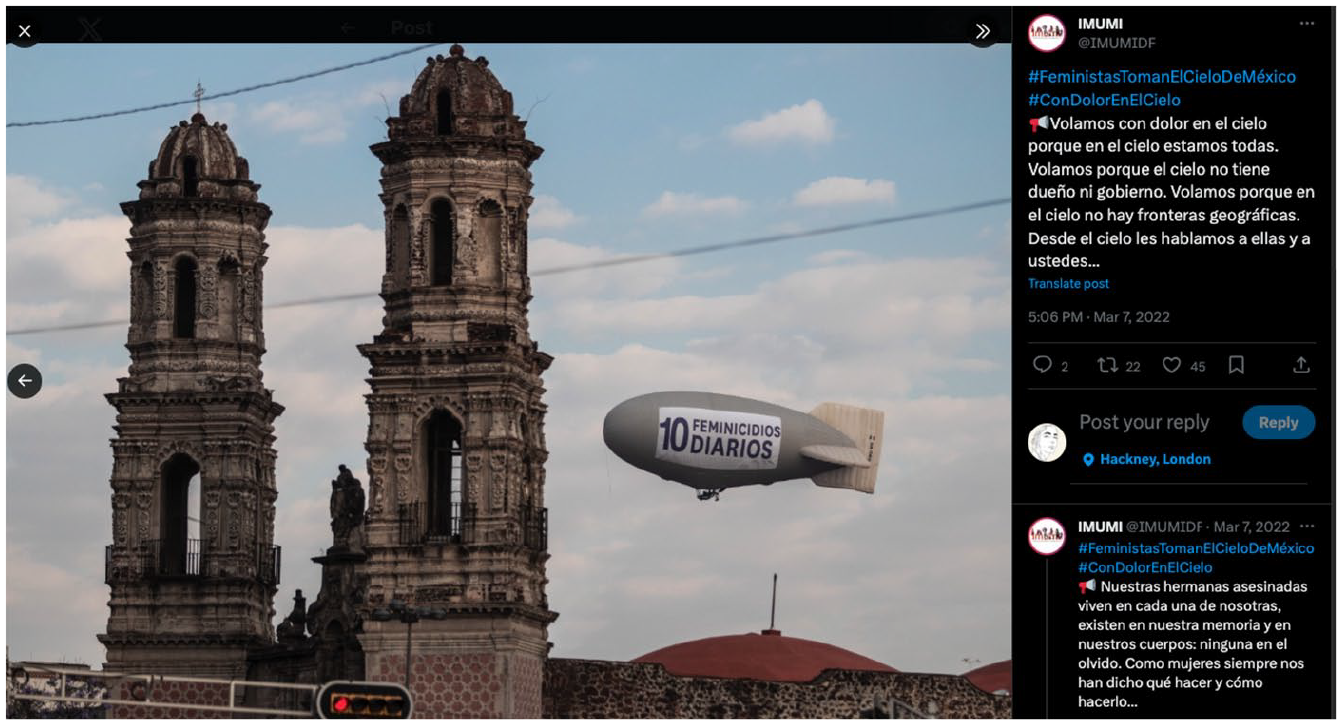
Screenshot of the campaign #FeministasTomanElCielodeMéxico taken with permission from the @IMUMIDf account on X (formerly known as Twitter).
Feminicide 1 (or femicide) is broadly defined as the gender-related killing of women and girls. The crucial difference in comparison with the term intentional female homicide is the role of gender as the underlying motivation for the crime. 2 The term ‘femicide’ was introduced by Diana Russell at the International Tribunal of Crimes Against Women in 1976 to bring attention to male violence against women. ‘Feminicide’ was repurposed by Marcela Lagarde in Mexico in the late 1990s. Instead of adopting the English term ‘femicide’ (in Spanish ‘femicidio’), feminicide aimed to highlight the State’s role in omitting, neglecting and even colluding in the violent crimes against women and girls occurring at the border between Mexico and the United States.
The epistemologies of feminicide responded to feminists’ theorisations emerging from Black, BIPOC and Latinx communities (often referred to as the ‘Global South’) 3 which placed VAWG as a fundamental organising and structuring principle of sociality rather than an addition to systems of oppression (Hill Collins, 2022). The redefinition of feminicide underscores the ‘discursive and material contributions and perspectives as transborder feminist thinkers from the global South (the Americas)’ (Fregoso and Bejarano, 2010: 4). Despite the linguistic differences in the terms, two commonalities stand out: the presence of gender-related elements in the crime and the prevalence of patriarchy and violence as organising principles.
In the last four decades, efforts to name, categorise and count feminicide have sky-rocketed in Mexico and beyond (Castro and Riquer, 2020, 2022; Dawson and Mobayed Vega, 2023; D’Ignazio, 2024; Fregoso and Bejarano, 2010; Mobayed Vega et al., 2023; Monárrez Fragoso, 2019; Radford and Russell, 1992; Walklate et al., 2020). The assertion ‘10 feminicides occur every day in Mexico’ has spread widely, from news articles and banners to protests across the sky. Statistics remain an essential aspect of recording feminicide ‘officially’ and as dannah boyd (2021) rightly states, ‘when statistics are understood as facts, the public expects exact knowledge. Precision’.
So, how ‘precisely’ does a woman’s dead body become a feminicide data point? To date, two primary official data infrastructures approximate the extent of feminicide in Mexico: (1) administrative data from open files on alleged feminicides from the State Attorney’s Offices, published by the Secretariado Ejecutivo del Sistema Nacional de Seguridad Pública (SESNSP; Executive Secretary of the National Public Security System) and (2) mortality data on intentional homicide disaggregated by sex produced by the Department of Health and processed by the Instituto Nacional de Estadística, Geografía e Informática (INEGI; National Institute of Statistics and Geography).
However, notwithstanding the undertaking by the Mexican Government to improve statistical data on feminicide, they remain incomplete, inaccurate or inexplicable. The reasons echo the relentless intricacies of structural violence and patriarchy at every level of the State’s institutional organisation. Despite such conjectures, the fractured process of how a single body becomes connected, separated and multiplied as she is captured as numerical data across the State’s data infrastructures remains understudied.
Sociologically, feminicide data provide a rich exploration of power asymmetries, given that both the violent event and its enumeration are subsumed in inequalities. Thus, feminist critiques of knowledge production and Science and Technology Studies (STS) scholarship concerned with the ontological politics of data are the frameworks on which this paper draws. Power is at the core of such explorations. Centring and situating intersecting forms of oppression in their every day is crucial to understanding how it is allocated and the consequent truths, facts and evidence it elicits.
In this paper, I unravel the socio-materiality of the Mexican State’s data infrastructures measuring feminicide to demonstrate how power operates in the crevices of daily life in tacit and covert ways. Based on 14 semi-structured in-depth interviews with experts 4 on this matter and content analysis of dozens of secondary sources, I argue that feminicide data are better understood as iteratively multiple rather than singularly factual. That is, the seeming singularity of a woman’s dead body shifts into many as her case is classified differently along the choreographed interactions between people, tools, protocols and techniques enacting feminicide as data. For security and anonymity purposes, I have changed the names of all the participants interviewed. Although I do not directly quote all of them, the testimonies I have chosen to depict showcase the overall postures, contentions, frustrations and concerns around documenting, measuring and quantifying feminicide.
All the interviewees had experience with feminicide data in Mexico coming from either state institutions (10), international organisations (3) or NGOs (1). Our conversations followed an ethnomethodological approach, widely developed by the American sociologist Harold Garfinkel (1967) whereby everyday activities become ‘account-able’ to those enacting them (p. vii). By reporting participants’ current or past actions, a revelation of what could otherwise be disregarded or categorised as common sense unfolds. Under this perspective, the researcher’s role shifts to trace ‘the contexts the actors themselves mobilise to make sense of their own actions’ (Asdal and Moser, 2012: 294), instead of looking at contexts as independent, explanatory tools. Contexts are made and remade through organising practices.
This paper also draws on material from dozens of reports, websites, guidelines, protocols, frameworks, databases, video conferences and presentations about feminicide data in Mexico produced mainly by the Mexican government, but also by NGOs, international institutions, academia and investigative journalism. The assembled data were coded and processed using the qualitative data analysis software atlas.ti.
I propose the concept of ‘permeability device’ to showcase how power unevenly accrues through the different methods and mediums by which information is documented and transferred across data infrastructures. Empirically, I illustrate the idea of permeability device using three examples involved in the crime investigation file and thus shaping the State’s data: the agents of the Public Prosecutor’s Office (PPO; known in Mexico as ‘los/as MPs’); the Informe Policial Homologado (IPH; Standardised Police Report) and the Atlas de Feminicidios de la Ciudad de México (Feminicide Atlas of Mexico City). By opening feminicide data in their everyday multiplicity, I underscore how power, entangled in the enactment of data, becomes evident in the lack of gender perspective in crime investigations aggravated by the corrosiveness of public patriarchy, the challenges of processing information incited by the scarcity of material resources resulting in data debris and the affective resonance experienced by public servants exposed to gruesome content.
In the discussion, I point to precarity as a condition that cuts throughout the State’s infrastructures enacting feminicide as data. Redistribution of all sorts (material, technical, emotional, financial) is essential to measure feminicide effectively. Yet, while recognition of the severity of the gender-related killing of women and girls is rarely ever questioned, redistribution remains unfathomed and thus an area deserving of attention. Finally, this contribution seeks to expand the growing feminist perspectives to sociology, STS and critical data studies scholarship interested in quantifying social life.
Counting Feminicide: Resisting Patriarchy
Feminist Sociologies of Knowledge
I began to realise what I already knew: that patriarchal reasoning goes all the way down, to the letter, to the bone.
—Sarah Ahmed (2017: 4), Living a Feminist Life
Feminists have always been concerned with the unequal conditions hawked by patriarchy and thus inherent to every aspect of social life. In her early work on this topic, Sylvia Walby (1991) noted ‘patriarchy needs to be conceptualised at different levels of abstraction’ (p. 20). Although situated in Britain in the 1990s, the six organising structures outlined by Walby (1991) remain current: the patriarchal mode of production; patriarchal relations in paid work; patriarchal relations in the State; male violence; patriarchal relations in sexuality and patriarchal relations in cultural institutions (p. 20). The pervasiveness of feminicide in Mexico stems from and taps into all these categories.
Patriarchy was foundational to the modern State’s infrastructures since its colonial inception – a scope this paper cannot cover in depth. Concerning feminicide, however, it is worth noting the substantial work of Rita Laura Segato (2016), who argues women’s bodies were the first colony of the patriarchal-colonial-modernity order (p. 19). Segato asserts feminicide is a ‘crime of power’ with a double function, the maintenance of power and its constant reproduction. Segato (2003) also points to the corrosively symbolic features of patriarchy as foundational to the binary architecture of gender violence. In a similar vein, Raewyn Connell (2015) stressed gender-based violence (GBV) is not consequential (gender + violence = GBV) but rather co-constitutive (p. 15). Put differently: gender is violence.
Referring back to Walby’s classification of patriarchy, I want to delve into its imbrications with the State and its impact on collecting data with a gender perspective; what Walby distinguishes as a kind of public patriarchy. In their analysis of sex/gender-related motives and indicators to identify feminicide locally and globally, Dawson and Carrigan (2021) build on Walby’s contribution to demonstrate how the design of data collection instruments has been chiefly shaped to gauge male-to-male homicide, failing to capture the specific risks faced by women and girls. The authors conclude by noting the political will necessary to improve feminicide data cannot be brought about by the State if patriarchy continues to inform ‘the hierarchy of needs related to data collection and analysis’ (Dawson and Carrigan, 2021: 17).
Continuing with the idea of patriarchy as a system of social relations, an underexplored (yet intrinsically imbricated) aspect of its domain endures as the norm: knowledge production. Numbers, like national statistics about feminicide, mobilise as solid facts and compelling evidence rooted in ‘objectivity’. Nevertheless, as standpoint scholars such as Donna Haraway, Sandra Harding, Hilary Rose and Patricia Hill Collins remind us, ‘objectivity’ – a feature assigned to scientific knowledge with the emergence of the European modern state – is often used as a tool to perpetuate structural privilege (mainly in the shape of male, white, cis, Western).
Caroline Criado Pérez captures the embeddedness of patriarchy and numbers through a series of empirical case studies that feature the gross gender biases perpetuated by male dominance. Throughout the entire data-making cycle, men continue to be ‘the fundamental human default’ (Criado Pérez, 2019: 1). Haraway refers to these biases as ‘the god trick’, which sees ‘everything from nowhere’. In other words, the idea that knowledge can be detached from any position or perspective. Yet vision, Haraway (1988) insists, ‘is always a question of the power to see – and perhaps of the violence implicit in our visualising practices’ (p. 585). Applied to feminicide data, for example: who is enumerating these bodies; with which tools and from where are they able to count?
The scholarship of Catharine D’Ignazio, specific to feminicide data, advances these epistemologies using the principles of data feminism carved together with Lauren Klein, stressing the value of intersectional feminism to examine unequal power distribution (see D’Ignazio and Klein, 2020). Put in simple terms, because data is power, ‘it must be challenged and changed’ (D’Ignazio and Klein, 2020: 14). Concurrently, the joint project of Silvana Fumega (ILDA) and Helena Suárez Val (Feminicidio Uruguay) Data against Feminicide emerged in 2019. Based on their ongoing collaboration, in her book Counting Feminicide, D’Ignazio presents dozens of data activism efforts from around the globe seeking to account for missing data, which she considers a twin of official data. Indeed, D’Ignazio (2024) contends that there is missing data in official data about feminicide ‘precisely because grassroots feminist, Indigenous, Black, queer, and women’s groups and social movements make demands that such data be produced’.
The Political Ontologies of Data
Not only is feminicide data imbricated within patriarchal ways of knowing, but also with the political ontologies of data. Since the late 1980s, sociology and STS have campaigned that facts are not independent entities representing ‘reality’ but are co-produced in socio-material practices and contingent upon political circumstances. The Latin root of data is ‘to give’, and, in this way, the State produces statistics that are then given to the public as data which are then treated as facts (boyd, 2021).
The work of Sally Engle Merry is foundational in unveiling the power of turning measurements of VAWG and GBV into numbers such as statistics and indicators across heterogeneous contexts. In The Seductions of Quantification, Engle Merry (2016) thoroughly critiques the consequences of translating complex social phenomena into simplified, stripped-of-context, comparable metrics. Quantification seduces, she argues, by establishing value-free numbers used as static facts, robust evidence and all-encompassing truths.
Although not concerned with violence – yet relevant to this paper – is Annemarie Mol’s (2002) work on ontological politics which empirically demonstrates how realities multiply when we investigate practices. In The Body Multiple, Mol underscores the significance of attending to how realities are made through the choreographies of people, tools, protocols and techniques that make up practices. By following these, we can identify the different (although seemingly similar) objects such practices enact. Enactment becomes a valuable concept to trace the multiplication of reality whereby there is no real material world to be represented. Instead, everything comes into being through multiple contradictory practices (Mol, 2002: 5).
Two crucial insights can be drawn from the literature reviewed in this section: (1) To comprehend the enactment of official feminicide data, it is imperative to recognise the patriarchal system that influences both the crime itself and the ensuing data. That is, feminicide exists and is condoned within a patriarchal order whereby two laws of patriarchy are abided: the norm of control or possession over the female body and the norm of male superiority (Segato, 2006: 4). These principles run throughout the entire State’s infrastructures, including those responsible for generating data. (2) Data are not ‘out there’ waiting to be discovered, but instead co-produced in socio-material and techno-political practices. In this way, and building on Mol, attending to how facts, truth and evidence about feminicide are enacted has a significant effect: realities multiply. Thus, establishing the context is closely involved with the ‘situated determination of what the object is’ (Woolgar and Lezaun, 2013: 327). Enactment allows us to attend to the ongoing practice of crafting (Law, 2004: 57). As a result, ‘what we think as a single body may appear to be more than one’ (Mol, 2002: vii). If attending to multiplicity is an act, so are the politics about and around them. To do so, we need to open and explore the conditions of possibility that enable the enactment of feminicide as data to challenge their seeming objectivity.
Enacting Feminicide as Data
To find the stories in the data, we must widen our lens to take not only the numbers but also the processes that generated those numbers. —Dan Bouk (2022), Democracy’s Data
Incorporating feminicide as data are not only about how that data come into being, but how numbers ‘are exercised, rather like a muscle, in everyday life’ (Ahmed, 2019: 3). ‘How is it possible that the Government cannot produce feminicide data when the killing of a woman is a fact!’, vehemently voiced Alex, a statistician with more than 20 years of expertise in measuring VAWG and GBV in Mexico. As opposed to other statistical categories, official data about feminicide began with and resulted from social mobilisation. 5 Feminists and activists on the ground were pioneers (and continue to be) in raising concerns about the gender-related killing of women and girls, turning their counting into a matter of care (de la Bellacasa, 2011), a fight against negligence. Demands to improve feminicide data have slowly trickled into the State’s data infrastructures, which has had a direct impact on legislation. Hence, the relevance of Alex’s question: if feminicide has already been established as a matter of fact, why can’t the State generate data about it?
To find stories in the data, we ought to look at the processes that generated those numbers, suggests Dan Bouk. Confronting how the State data infrastructures enact social facts about feminicide matters precisely because it is within these processes where we can detect power accruement or resistance in more detail. To this end, Judith Butler et al. (2000) note how ‘[power] is not stable or static, but is remade at various junctures within everyday life; it constitutes our tenuous sense of common sense and is ensconced as the prevailing epistemes of a culture’ (p. 14). Indeed, the uneven distribution of power does not occur suddenly but evolves over time.
Data Infrastructures
Data infrastructures are relational, organised systems comprised of concrete and abstract entities – such as hardware, wires, tools, pipes and software, human and computer protocols, guidelines, categories, standards and memory – that enable and sustain the performance of specific actions related to the process, management and distribution of data (Bowker et al., 2009: 97).
Data infrastructures depend upon conventions and agreements in a community of practice (Leigh Star and Ruhleder, 1996: 113). Rather than asking what data infrastructures are, Susan Leigh Star and Karen Ruhleder (1996) invite us to consider when they become such. This shifts our preoccupation to the elements ‘sinking into the background’ (p. 112). Indeed, infrastructures tend to go unnoticed – what Leigh Star and Ruhleder call their ‘embedded’ and ‘invisible’ dimensions – and, essentially, only become visible upon breakdown. There are two notable observations from data infrastructures: the intangible elements shaping them (such as ideologies, norms and values) and the collapse or failure of technologies in processing data. It is within those inconvenient outcomes and interactions that we can shed light on the uneven power dynamics enacting feminicide as data.
Permeability Devices
Permeability devices are the various methods and mediums through which information travels across data infrastructures. This conceptual tool allows the scrutiny and opens the multiplicity of data practices as they perform and capture specific instances in the unilinear chain of processing data. It finds tight roots in Susan Leigh Star and James Griesemer’s (1989) ‘boundary objects’, an analytic concept designed to examine communication and interchange within cooperative work. Boundary objects are sufficiently robust to retain a uniform identity across sites while being flexible enough to adapt to the specific local needs and limitations of different parties using them. Even though their meaning varies according to the context of use, their structural similarities allow for recognition between these, enabling them to function as translation vehicles (Star and Griesemer, 1989). For example, surveys, protocols, guidelines and indicators can be considered powerful boundary objects when discussing techniques used to measure, commensurate, translate and standardise violence in different settings, as illustrated by Sally Engle Merry (2016).
Scholars have questioned the terminology of boundary objects (Fiore-Silfvast and Neff, 2013; Walby, 2023), and I argue that the term might fall short of understanding the rapidly changing data environments intensified by digital technologies. This is particularly relevant when analysing the profound impact of citizen data practices against feminicide. Instead of ‘boundary’, which might evoke rigid limits and tight edges, I propose ‘permeability’, which refers to an action, the capability of things to go through.
Although Leigh Star (2010) contends that ‘object’ does not only refer to material entities (p. 603), I agree with Walby’s (2023) critique of the ontological depth the term object incites. Alternatively, ‘device’ renders better specificity to the perhaps perfunctory connotation of objects. A device suggests a plan, a method or an aim. A device is not a passive object but rather a participant in shaping our social worlds (Callon, 2006). Power dynamics fundamentally shape them. Devices do not exist in a vacuum; they are entangled with personal interpretations that are nevertheless inserted in a political context (the personal is political – and vice versa).
Like boundary objects, permeability devices let things seep through, sometimes allowing for an intended exchange without necessarily reaching for a homogeneous consensus. Here, I would like to turn to two verbs related to permeability: seeping and filtering. Although they are synonyms, what differentiates seeping from filtering is the intention. To filtrate is an action that requires something (i.e. a strainer) for it to occur, whereas to seep suggests oozing, a slow – at times unpredicted – interchange through tiny openings. Here is where combining the terms comes in handy, as it encourages us to shed light on the methods and mediums and the intentions that allow things to either seep or filter.
INEGI and SESNSP: A Tale of Two Discordant Data Infrastructures
Measuring the extent of feminicide in Mexico and the infrastructures involved comes with its genealogies, histories and battlefields (Mobayed Vega et al., 2023). Mexico has a Federal system adjudicating autonomy to its 32 states, and crimes can fall under Federal (fuero federal) or State jurisdiction (fuero común). Feminicide fits into the latter, meaning that each state defines and prosecutes the crime under its own authority. Although feminicide was designated as a crime in the Federal Criminal Code in 2012, it was not incorporated into State Criminal Codes until 2020 (H. Congreso Estado de Chihuahua, 2020). Such instability hindered longitudinal and geographical comparison of data patterns (see Data Cívica, 2019; Mobayed Vega and Gargiulo, 2024).
Unravelling the process by which a body becomes a number is anything but simple. With reference to the flying zeppelin and its message ‘10 Feminicides Per Day’, how did this statistic arise? The result (≈3,500 female homicides/365 = ≈10) is based on the two primary official data infrastructures gauging the extent of feminicide in Mexico, the SESNSP and the INEGI. Both INEGI and SESNSP data result from orchestrated choreographies performed by the State’s infrastructures measuring mortality rates (INEGI) and counting crime investigation files (SESNSP). Multiple permeability devices, including institutions, protocols and guidelines across the legislative, executive and judicial branches of Government, take part in categorising, classifying, standardising, commensurating and comparing such data.
Yet feminicide statistics, derived from the mortality data published by INEGI and the aggregate investigation file information made available by the SESNSP, tend to mismatch. INEGI (2023) registered 4,002 intentional female homicides in 2021. Divided by 365 days a year, the results are 10.964 women killed per day. We arrive at relatively similar results from open files on female homicide and feminicide. For the same year, a total of 3,731 victims were registered by SESNSP (2023), an equivalent of 10.22 women murdered per day. The two data infrastructures’ inconsistency is unsurprising: each responds to different inputs and outputs that vary in terminology, methodology, sources and access (see Mobayed Vega and Gargiulo, 2024).
Neither database generates firsthand data but compiles and aggregates information from third-party providers. For example, INEGI collects mortality data from various sources, and rather than offering a feminicide tally, they count the intentional homicides disaggregated by sex. To get closer to the extent of the gender-related killing of women and girls using INEGI’s information, it is necessary to open their Estadísticas de Defunciones Registradas (Registered Death Statistics) and search for specific variables (such as victim/perpetrator relationship) to get a sense of how many of these could be gender-motivated (see Mobayed Vega and Gargiulo, 2024).
In comparison, the SESNSP uses feminicide in their tally, making it the only source to provide a specific count of this subset of intentional killing of women. Their results derive from the count of investigation files classified as alleged feminicides supplied by the PPO and Attorney General’s Offices across Mexico’s 32 states (Data Cívica and Intersecta, 2022; Impunidad Cero, 2022; Mobayed Vega and Gargiulo, 2024). Therefore, the same body might be counted as a feminicide by SESNSP but as intentional homicide by INEGI.
Putting into place feminicide data practices is particularly useful to convey how entities that might seem singular are multiple. That is, the seeming singularity of a woman’s dead body shifts into many in the process of categorising whether gender was the motivation behind her intentional killing. For example, while, in some contexts, her death could be counted as feminicide, in others, she might be enumerated as an intentional female homicide. Unfortunately, in some cases, her homicide may be cited as a suicide. In this sense, considering realities as multiple allows us to evaluate the doubts and uncertainties inherent to practices of valuing and quantifying social life and social order, which, as Mol (2002) puts it, ‘lays bare the permanent possibility of alternative configurations’ (p. 164).
In addition, the truth is neither one of them gauges feminicide as we define it sociologically (Mobayed Vega and Gargiulo, 2024). In other words, they do not explicitly measure the motivation underlying the killing of a woman ‘because she is a woman’. Nevertheless, they provide approximations (see Mobayed Vega and Gargiulo, 2024). For instance, if the body shows signs of sexual abuse, the case should unquestionably be opened as an alleged feminicide in the investigation file. Theoretically, such an event would fit Julia Monárrez Fragoso’s (2023) term of ‘systemic sexual feminicide’, as it refers to the extreme physical and sexual transgression of the body, rooted in patriarchal structures, which can only occur within ‘structural, systemic complexity, going beyond the relationship between victim-killer’ (p. 323).
However, Iván del Llano Granados, lawyer and researcher at the Instituto Nacional de Ciencias Penales INACIPE (National Institute of Criminal Science), gives a contrasting point of view that I will describe using his analysis of a feminicide crime. That is, an offence consists of three elements that need to be appropriately accredited for the Public Prosecutor to issue a conviction: objective (verifiable through sensory perception); normative (pertinent to the legal or cultural spheres) and subjective (related to the active subject). In this regard, del Llano argues that proving ‘gender’ as an intention remains under-defined in the Criminal Code, given its underlying subjectivity, which is prone to multiple interpretations.
To overcome such subjectivity, the crime definition incorporates several objective (that is, verifiable) characteristics that the killing ought to have to be classified as feminicide, such as whether the body shows any signs of torture or whether the victim suffered sexual abuse prior to her killing. This, however, does not explicitly prove whether the victim’s gender was what motivated the crime. Based on this interpretation, the most appropriate evidence (and perhaps the only certain one) to prove whether the victim’s gender was what motivated the crime, would be the perpetrator’s confession. Regarding the sexual assault example whereby the crime is classified as an alleged feminicide, del Llano poses,
I am still to be convinced the motivation is specific to gender. What if the intent was to force copulation, which then resulted in the victim’s death at the hands of the perpetrator? Initially, the case should be labelled as homicide, until proven the contrary, underscoring the responsibility of the Public Prosecutor in proving these instances (see #CátedraPenal con Iván del Llano | Analísis del tipo penal de feminicidio, 2021).
Del Llano’s interpretation contrasts feminists’ understandings of feminicide. For instance, Segato argues that sexual crimes against women are not led by the need to satisfy a libidinal drive to fulfil sexual satisfaction (as del Llano suggests), but to maintain and reinstate patriarchal power. Rather than instrumental, sexual violence against women is expressive and therefore consolidated before the public gaze, a message of belonging triggered by a fraternal masculine mandate (Segato, 2016).
Although rightly grounded in legal and criminal theoretical principles, del Llano’s critique of the criminal definition of feminicide fails to consider the unequal distribution of gender-based power. In addition, it dismisses the corrosiveness of patriarchy across state institutions – a detrimental factor in the investigation of feminicide and exposed by my interviewees.
The fragility imbued in typifying and quantifying feminicide has also been widely contested by data activists and citizen initiatives recounting feminicide on the ground in Mexico and beyond (Collectif Féminicides Par Compagnons ou Ex et al., 2023; D’Ignazio, 2024; Mobayed Vega, 2022; Suárez Val, 2022). For example, Taylor (a data research coordinator for a human rights NGO) contested the zeppelin’s message ‘10 Feminicides Per Day’ with exasperation. Taylor noted how data use is laden with responsibilities.
Not all the intentional killing of women quantified by INEGI are feminicides. In my opinion, it is irresponsible to say 10 feminicides occur every day, because we are neither certain nor does this let us differentiate the current extent of gun violence in Mexico.
Indeed, if we stick to ‘the facts’, the SESNSP (2023) examination of investigation files for alleged feminicide crime totals 963 women killed in 2021. Divided by 365 days, this results in 2.6 feminicides committed every day. Despite the disparity, one woman killed is already too many. As pointed out by several human rights, feminist and civil society organisations, the level of crime under-reporting and impunity in the due diligence of the case proceedings in Mexico is abysmal, which suggests neither 10 nor 2.6 truly reflect the total count of feminicide (Impunidad Cero, 2022; México Evalúa, 2020).
In the next section of the paper, I illustrate how permeability devices shape the State’s data infrastructures with regard to processing feminicide data. I also showcase how power manifests in how information turns into data with long-lasting consequences. These include the lack of gender perspective in crime investigations aggravated by the corrosiveness of public patriarchy; the challenges of processing information incited by the scarcity of material resources resulting in data debris and the affective resonance experienced by public servants exposed to gruesome content.
Feminicide Data and Permeability Devices
The problem with feminicide data begins with how we register the information.
—Luca, an expert in government transparency, accountability, and institutional response to VAWG and GBV in Mexico
‘Nothing is as certain as death and taxes’, wrote Ian Hacking (1982) in his influential work on the avalanche of large numbers produced by the emerging European modern state (p. 280). Yet certainty fails when it comes to classifying the killing of a woman as feminicide. The problem begins with how we register information. How, then, are statistics about feminicide in Mexico aggregated and compiled? I have previously described the two main data infrastructures capturing the extent of the gender-related killing of women and girls. In the case of SESNSP, the most significant permeability device is the crime investigation file, while for INEGI, it is the Estadísticas de Defunciones Registradas (Registered Death Statistics). Because the SESNSP explicitly uses the term feminicide in their tally, I focus on the types of choreographies and permeability devices feeding into the SESNSP’s data infrastructure, fundamentally built on the count of investigation files opened as alleged feminicide.
A diversity of sources feed into the investigation file from the moment a woman’s dead body is found, including not only forensic and criminological assessments but also families’ testimonies and other contextual particularities relevant to determining whether the motivation behind the crime was gender-related. Classifications produce and are produced by material forces that cannot be understood separately from norms and values entangled in enacting meaning (Bowker and Star, 1999). Accordingly, materiality is highly relevant among the many features of permeability devices. Material resources such as hardware, tools, pens, papers, computers, wires and the Internet enable, but also constrain, the production of meanings. Situating the materiality of investigation files is highly relevant. They are primarily analogue, mainly consisting of printed documents, USBs and photos. While some of this information is digitally systematised, not everything is, with consequences I delve into later in the paper.
Another feature enabling permeability devices to share information is their porosity; that is their potential to fill in, exchange and absorb multiple elements. The investigation file’s porosity allows different information inputs to filter in and out. Throughout the process, other permeability devices take part, feeding and being fed by the data infrastructures in which they take part. I want to focus on three: the agents of the PPOs; the IPH and the Feminicide Atlas of Mexico City. I aim to showcase how power dynamics are enacted in everyday practices, often shaped by a normative patriarchal order inherent to the State’s institutions. What results from the analysis is that feminicide data go through multiple iterations, rather than being singularly factual.
Agents of the PPO: Ignoring Gender
How information-turns-to-data is central to assessing the accruement of power and the feminicide data they elicit (or not). Consequently, the figure of the Public Prosecutor (fiscal) and the agents of the PPO are fundamental in crime investigations. The PPO agents conduct daily activities, while the Prosecutor heads decision-making and oversees the team. They coordinate the investigation, determine criminal actions, initiate relevant proceedings to prove or disapprove the hypothesis, categorise the type of crime and assign the perpetrator’s level of responsibility. The primary permeability device through which agents carry out their work is the investigation file, comprised of the cases’ preliminary enquiries and evidence. Officially, crime incidence can only be measured (and thus tallied by the SESNSP) insofar as an investigation filed is opened.
Permeability devices encounter friction, given they are constantly manoeuvring the ‘unexpected conjunctures’ and ‘encounters across difference’ wrought by the exchange, transfer and documentation of information across heterogeneous sights (Tsing, 2005). Such frictions emerge in the first instances of categorising a case as a feminicide. Despite long-term Federal efforts to standardise State protocols to investigate crimes with a gender perspective, a consensus has not been reached, which means that each PPO follows different classification routes. As a result, in 13 states, the discovery of a woman’s intentional homicide is first categorised as feminicide. In contrast, the investigation file in other states is registered first as deliberate homicide, following a feminicide protocol to rule out whether the motivation behind the crime was gender-related (UNODC and CdE, 2020). Consequently, the same case would be labelled differently depending on the state where it occurred.
Variances are further aggravated depending on the PPO agent in charge of the case, as many of my interviewees voiced. In keeping with the earlier discussion around the accruement of power, it is worth noting agents are entirely responsible for how the case is investigated and categorised. This matters because the norms and values of the agent, including their sensibility towards gender, will have a direct impact on whether the case becomes a feminicide datapoint.
‘[Addressing] feminicidal violence is simply reduced to opening investigation files following a feminicide protocol’, Rene noted with annoyance. With vast knowledge in the field of prevention against VAWG for the Ministry of Health in Querétaro, Rene stressed the challenges of ceding power to one single individual (who is often male and who might or might not be familiar with a gender perspective) who decides on the relevance of a potential feminicide case. With an assertive undertone, Rene added,
People in our field assume everyone understands what gender is. The reality is different. It operates like a club. There are insiders, and there are outsiders. We are insiders because we are clear about what the gender-related motivation behind the killing of a woman means. But try explaining feminicide to a PPO agent who has never engaged in these conversations.
Like many other interviewees with broad experience in Government institutions, Rene stressed the embeddedness of patriarchy within these as an utmost detrimental factor in the investigation of feminicide, echoing Walby’s terminology of public patriarchy.
Ariel also had everyday firsthand experience with public patriarchy. With more than 40 years as a criminologist, 25 of which she served as a criminal judge in one of the most violent states in Northern Mexico during the early 2000s, Ariel had seen it all. She was often targeted for being the only woman in an all-male territory. She was laughed at; contradicted. ‘Patriarchal culture was everywhere. Nobody wanted to listen to me because I was the first female General Attorney’, she recalled during our interview. Ariel was generous with her time and memories. At times, I could trace undertones of anger, despair and sadness. But I also noticed a sense of pride in her achievements, her resoluteness to ‘change the narrative’, to ‘put a name to these killings’.
‘You can tell from the crime scene whether the case is a feminicide or not’, she continued. However, she pointed to a severe problem in Mexico City: the dependence of forensic experts, detectives and police on the PPO agents. ‘Sometimes agents do not have enough training to carry out proper criminological investigations [with a gender perspective]’, Ariel remarked. In Rene and Ariel’s observations, the knowledge (or not) regarding gender-based violence played an integral role in the crime investigation.
Not knowing is often equated with ignorance, ‘the main enemy against the successful investigation of feminicide’, as Ariel stressed. Similarly, the mother of one of the feminicide victims covered in the harrowing journalistic research of Lydiette Carrión’s (2014), La Fosa de Agua, insisted there were good policemen and good PPO agents, yet ‘many times, due to negligence, carelessness, or even not knowing how to do the process, things go very wrong’. A lack of professional training and knowledge to investigate homicides with a gender perspective at all levels of government and decision-making (from beat cops to judges, Prosecutors and legislators) was notable in my interviewees’ daily experiences enacting feminicide as data. ‘It is not only about having gender studies, but you also need the political will to clarify these cases, to generate new structures. Things changed mainly because of external pressures, NGOs, international organisations’, Ariel argued. This testimony resonates with Dawson and Carrigan’s analysis of data biases in feminicide data: how can we improve these structures when patriarchy continues to inform every aspect of its collection?
Thus, permeability devices can be guided by ignorance as a norm rather than an exception. Understanding what and how we know also needs us to look at what we do not know (and why). Feminist epistemologies have toyed with this idea (see Tuana and Sullivan, 2006). In Tuana’s (2006) words (elaborating on Haraway): ‘ignorance, like knowledge, is situated’ (p. 3). Lack of knowledge is not necessarily removed from deliberate intention. Catherine D’Ignazio (2024) also expands on this idea concerning the absence and omission of data as ‘an active and ongoing production of ignorance and maintenance of ignorance, requiring loads of labour to simply not know and not understand and not see a systemic phenomenon and not count it’.
Standardised Police Report (IPH) and Data Debris: Obsolete Technologies, Lost Evidence
Standards are essential to classification systems. To standardise includes negotiation, a practice often performed by experts. Negotiating suggests organising, evaluating, conducting, recognising, regulating, including and leaving out. Standardising data enables harmonious consistency, meaningful comparability and robust integrity. To think sociologically about standards encourages us to attend to their normative dimensions, including their powerful and subtle ways of organising social life (Timmermans and Epstein, 2010: 70). Heterogeneous communities tend to idealise the performance of standards that, when applied, rarely ensue. Here, the relevance of utilising the permeability devices in standardising information lies.
Police records play a vital role in documenting crimes and preserving the evidence, making them a permeability device worthy of attention. Answering how a woman’s dead body becomes a statistical data point in Mexico begins with the first official respondent to the crime scene, who often arrives after an emergency call is made. Data obtained during the phone call is also relevant as it feeds into the case investigation. As a result, investigation files on alleged feminicide are inaugurated with what could be considered another crucial permeability device enacting feminicide as data, the IPH. First respondents, usually known as beat cops or police officers (policía preventivo/a), complete the IPH. Their job is to preserve and protect the crime scene until the arrival of forensic experts.
The IPH is considered the primary instrument where public security officers record, one by one, the steps of their intervention, including any relevant information and evidence such as time, dates, objects collected and interviews with victims and detainees, among others (SESNSP, 2020). With the IPH, police officers of the public security and law enforcement agencies of the three levels of government (Federal, State and Municipal) record the actions carried out at the crime site. In that regard Kim, a former technical advisor to the PPO in Mexico City, argued with impatience, ‘imagine, you have multiple institutions generating information about a single event, and sometimes that information contradicts itself’. This quote indicates feminicide data ripples diversely across the plethora of institutions, multiplying the information generated ‘about a single event’.
The IPH operates as an essential permeability device because it enables information to travel along the investigation, where moments, institutions, times and places are captured. Rigid grids compose a structured arrangement of five sections and eight annexes (Image 2). This design renders its standardisation achievable, as the format is fixed and static (Image 2). However, information can potentially seep through with free-style writing.
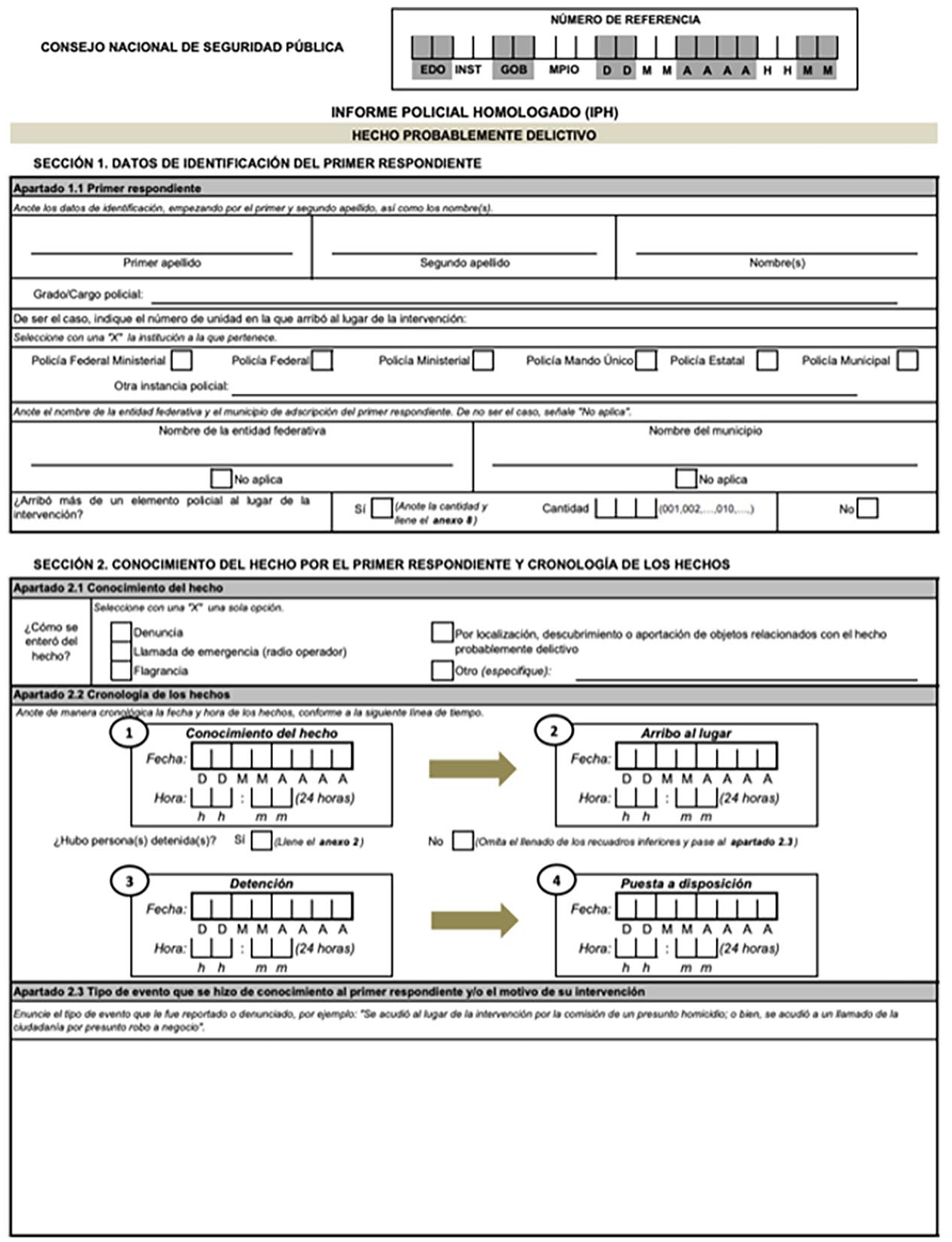
First page of the ‘Informe Policial Homologado’ (Standardised Police Report; IPH).
Inevitably, permeability devices such as the IPH, incur what I call data debris. For example, section 3 of the IPH is a full page (with the option of adding annexes) dedicated to narrating the crime. This exercise is subjective to the person recording the incident. Data debris results from information that is unorganised, unarticulated and messy. They accumulate over time because of incomplete documentation, errors, duplications and fallouts. Concerning feminicide, the conversations with my interviewees yielded data debris to be a by-product of unfit resource allocation and obsolete technologies taking shape as failed systems and lost evidence – resulting in the imprecision or inaccuracy of feminicide data.
Obsolete Technologies
I have already established that the IPH is a powerful example of a permeability device because it enables different actors to work together on the same case despite distance and heterogeneity. The first version of the IPH was launched in 2010, and a new version was developed in 2019. The format remains analogue for all crimes, despite efforts to digitise. When the PPO agent captures the information in a digital system; 6 they populate the investigation file with all the information related to the crime, including police reports, witness testimonies and forensic results. However, much of this information travels in USBs as unformatted Word files and bespoke spreadsheets, which are challenging to locate, link or access.
To improve crime data, Mexico City’s Government launched the Sistema de Interoperabilidad de Actuaciones Procedimentales (SIAP; Interoperability System for Procedural Actions) in 2015. SIAP links the work of police, experts and PPO agents to facilitate their investigative capacity. Although this ‘digital solution’ aimed to mitigate the notorious bureaucracy hampering the efficiency of the justice system, SIAP was inefficient and unproductive.
In 2020, Quinto Elemento Lab published a thorough report on SIAP’s failures. Steve Fisher (2020), the lead journalist in this research, noted,
some parts of the criminal investigation are recorded in Microsoft Word files or printed on paper, but are not captured on the digital platform, according to internal documents from the prosecutor’s office and the testimony of 15 agents interviewed for this report.
According to Fisher’s interviewees, given the technological failures and lack of trust in SIAP, relevant information about crime cases travels in the agents’ USB devices. Moreover, based on access to information requests, by 2020, 80% of the computers in the PPOs had used outdated software from 2009 (Fisher, 2020).
Lex, who previously worked in Mexico City’s General PPO, echoed these hurdles. Lex gave me a tangible example based on personal experience, showcasing the time-consuming journeys agents and detectives must endure to chase and exchange information. SIAP was supposed to improve how information travels, but instead, agents use USBs and commute up to three hours to collect pertinent reports. Between 2015 and 2018, Mexico City’s PPO agents filed over 11,000 complaints concerning the system’s failure, an average of seven times daily (Fisher, 2020).
The medium through which information travels is vital to ensure that statistical data is valid, timely, reliable and thorough. Tracing feminicide data as it becomes enacted in practice allows us to trace the fragility of how information moves and thus realise that it is iteratively multiple rather than singularly factual. What happens if the USB is lost? What happens when information about a feminicide perpetrator is contained in two different Word files? When and how will these data points meet?
Lost Evidence
The body of a murdered woman speaks. Her position, marks, clothes, and the fact that she is wearing clothes say things. The prosecutor explains it as if it were a kind of coded language.
—Almudena Barragán and Georgina Zerega, ‘En búsqueda de los feminicidas en México’, El País, October 2022
Indeed, dead bodies speak, yet their encoded language fades with time. Hence, the first moments when a body is found are crucial to preserve her story. Unfortunately, given the variations in documenting feminicide, it is the case that many feminicide cases are incorrectly classified as suicides. Thus, the cause of death is crucial as it determines how a body will be documented and how much time she will get to ‘talk’. Leverage from families, communities, activists, NGOs and some decentralised governmental agencies often pressures governments to re-investigate the case as feminicide. Yet on that note, Rene explained how by the time the file is re-opened much of the relevant physical evidence is either lost or has perished, ‘so, even though the case is now labelled as alleged feminicide, the chance of solving it is limited as there is a complete lack of evidence’. According to Kim, a body takes between 5 and 6 hours to reach the corresponding forensic unit and ‘in that journey, substantial evidence that would point to a feminicide is lost’. Impunidad Cero’s (2022) recent report on intentional homicide and feminicide impunity arrived at the same conclusion: ‘failure to investigate violent murders of women as femicides lead to irregularities in the investigation such as lack of due diligence, loss of evidence, leakage of information, among others’ (p. 46).
Luca, who worked on a multi-institutional research project about the conditions of the PPOs nationwide, emphasised the detrimental impact of insufficient resources on the PPO agents’ ability to perform their duties successfully. ‘How can they implement a gender perspective when they don’t have the necessary material, such as nail scraping kits, to preserve the evidence?’ Luca asked me. Although forensic experts are crucial to preserving the evidence, the pernicious lack of resources directly impacts allocating their services. Impunidad Cero (2022) showed that, by 2021, state PPOs had 6.6 forensic or medical forensic services per 100,000 inhabitants nationwide (p. 36). Mexico has a rate of 28 homicides per 100,000 inhabitants (UNODC, 2023: 8). 7 Added to material scarcity is this disparity in demand and services, resulting in a loss of evidence with direct impact on how feminicide is counted. How can bodies speak when nobody can hear them?
Feminicide Atlas of Mexico City: Affective Resonance
The Feminicide Atlas of Mexico City is a unique project combining citizen data activism methodologies – an interactive digital map – with state-compiled information designed within a State’s PPO. According to its website, the Feminicide Atlas
aims to proactively make transparent the information that is systematised daily in the Fiscalía Especializada para la Investigación del Delito de Feminicidio (FEIDF; Specialised Prosecutor’s Office for the Investigation of the Crime of Feminicide); through statistical analysis and its cartographic representation (https://atlasfeminicidios.fgjcdmx.gob.mx/).
The FEIDF was established by decree on 17 September 2019 and is the outcome of feminist and human rights activism, supporting ethics of care and solidarity at the forefront of a state institution. The feminicide cases of Mariana Lima Buendía and Lesvy Berlín Osorio were foundational to the FEIDF, becoming ‘seeds of justice for other women’, as recalled by the feminist lawyer Sayuri Herrera Román in an interview with El País (Barragán and Zerega, 2022). Herrera Román holds a long tradition of human rights activism, and her prominence surged after successfully prosecuting the case of Lesvy Berlín Osorio. Herrera Román is well-regarded, respected and celebrated, and her appointment as prosecutor of an agency specialising in feminicide in the country’s capital came as no surprise.
Sam is the brain and heart behind the Feminicide Atlas, and her workdays stretch indefinitely. Since July 2020, amid a global pandemic, she has spent between 10 and 12 hours daily reviewing female homicide investigation files at the (back then) newly established FEIDF in Mexico City. ‘When I started, feminicide data was not systematised as such, so I had to build the database from scratch’, she explained. The first time Sam read an investigation file, she rushed to the restroom, unable to contain her stomach churning with disbelief. Overwhelmed with the details she had just read; Sam’s body spoke before her voice could. ‘What you see in the press is just a small part of what you can access in an investigation file. And it is excruciatingly painful to see the despise [sic] against us’. Sam painfully added how this was a daily reminder of how much this country hates women and girls. Segato refers to this gruesome extent of VAWG as the pedagogy of cruelty, men’s indoctrination of the female body as a site of subjugation and public display. Evidently, Sam was deeply affected. ‘Suddenly, my daily life was all about strangled and dismembered women. And, because my work has become my life, [it feels like] everything around me is about violence. I believe I am different from when I started [this job]. In a way, a part of me has died’, Sam Shared.
However, despite Sam’s despairing, gruelling, gruesome days, she remained hopeful about the change ahead. ‘I believe in social movements and social transformation from within State institutions’, she added. Here is another aspect of power underexplored thus far: the institutional changes, including those in the State’s data infrastructures, wrought by engaged and committed public servants.
‘When have you seen a prosecutor hugging a woman who is crying inconsolably because she has lost her daughter?’ recalled Sam when talking about Herrera Román. Sam speaks highly of Herrera, using adjectives like genuine, caring and grateful. ‘I believe we are transforming the institution’, Sam argues. And indeed, they are. In a report for Gatopardo, journalists Wendy Selene Pérez and Paula Mónaco delve into the lives of female prosecutors, PPO agents and forensic experts in Mexico. With a poignant title, ‘Mirar nuestra muerte: Ser mujer perito en México’ (Seeing our death: Being a female expert in Mexico), 8 Pérez and Mónaco provide an in-depth snapshot of the early days of the FEIDF.
Originally known as ‘the corridor prosecutor’s office’ (or as the ‘horrendous aisle’ by Sam), the FEIDF began in a hallway, with files scattered on the floor next to the rubbish bins as there was no place to store them safely. Sam described the lack of resources as the main hindrance faced by their team:
Funds allocated to anything related to gender or with women is a tremendous obstacle. When the FEIDF started operating, we had to work with our personal computers. I did not have a desk either. We were literally in a corridor, Sam reflects on the same precarity addressed in Gatopardo’s report. Along those lines, it is worth noting Sam earns 11,000 Mexican pesos per month (the equivalent of £500).
The Feminicide Atlas, comprised of a sleek and simple interface, also fits into my definition of permeability devices as it is a medium through which the State filters statistical information to the public. In the ‘Map’ section, we see the heart shape of Mexico City populated with assorted colour pins corresponding to the year the investigation file was opened (from 2019 to 2023) (Image 3). Each pin is an investigation file which expands to four statistical variables: the date when the file was opened; the type of space where the body was found; whether there was a relationship between the victim and perpetrator and the age group of the victim. Visualising official data this way reminds me of the feminicide maps produced by activists such as María Salguero, Ivonne Ramírez and Sonia Madrigal (see Madrigal et al., 2019; Mobayed Vega, 2022). In these digital interfaces, the same case multiplies as it expands beyond the factual.
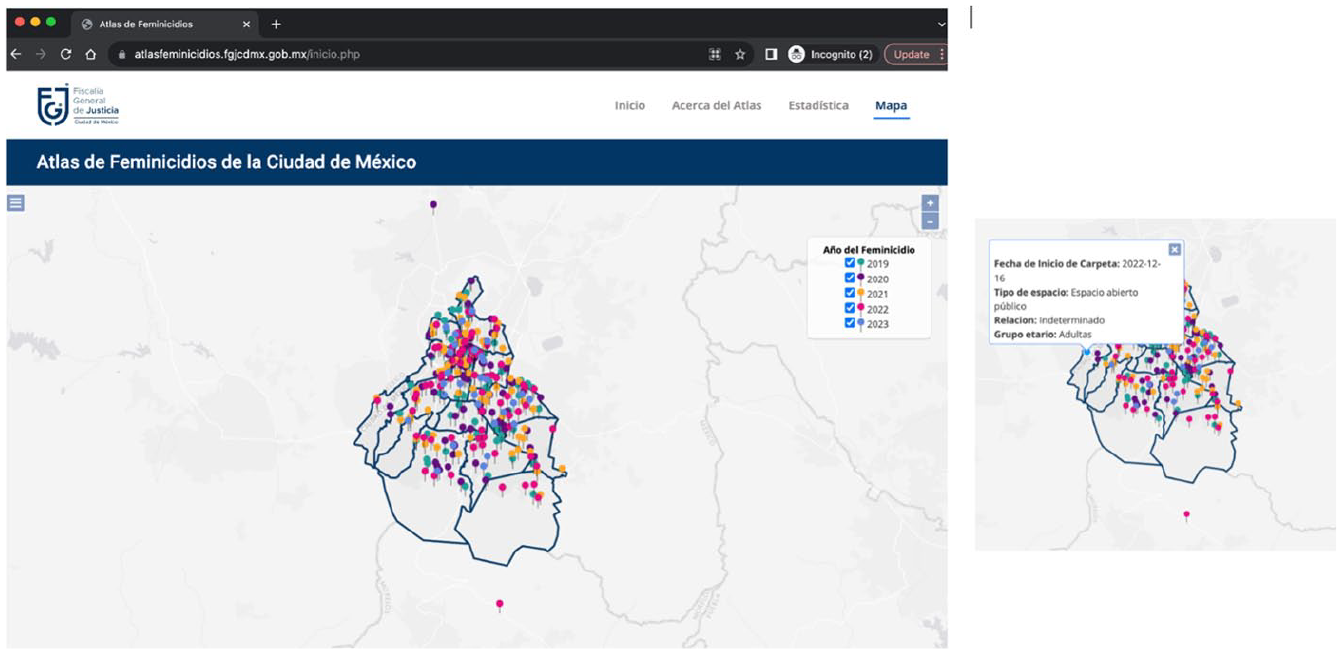
Screenshot of the ‘Atlas de Feminicidios de la Ciudad de Mexico’ (Feminicide Atlas of Mexico City) interface.
Sam scavenges through gruesome content to correct mistakes and better systematise the feminicide data displayed in the Altas. She incorporates the details across different Excel databases, specific to Indigenous women, transfeminicide, hotels where women have been violently killed and so on. A single body is categorised depending on her intersectional vulnerabilities as her body multiplies across databases. While exploring the development of the Atlas, Sam recounted to me a process she called ‘polishing data’. For example, in many investigation files, the georeferenced coordinates where the body was found were misleading, as they pointed to the hospital where the victim died. Sam noted how mapping the hospital was futile as it did not provide any meaningful contextual particularities, ‘so I had to dig deep in the investigation file to find out where the victim was assaulted. Often, I read that she was violently injured at home, but lost her life in the hospital’, she explained. Sam’s dedication to researching the facts still resonates with me today.
I deeply cherish and respect Sam’s interview. She gave me an insight into a fundamental aspect of enacting feminicide as data, which points to the affective echoes lingering on public servants systematising this kind of data. Sam encapsulated it well: ‘I cannot afford the psychological care I wish I had’. While the emotional toll of working with feminicide data has been widely explored concerning citizen-led practices (see Collectif Féminicides Par Compagnons ou Ex et al., 2023; D’Ignazio, 2024; Mobayed Vega, 2022; Suárez Val et al., 2022), the impact this has on government employees in State institutions remains overlooked.
Similarly, Luca recalled an incident during an interview with a General Attorney wherein he abruptly interrupted the conversation to take her outside his office. ‘Who arrived at this job married?’ he asked in a room with dozens of agents. Almost everyone raised their hands. ‘Who of you are still married?’ he asked again. Only a few hands remained in the air. ‘You see, these folks work from dawn to dusk’, the General Attorney remarked. Luca remembers the event clearly as it emphasised what she had repeatedly been listening to: burnout. Luca noted how the mental health of public servants working at crime institutions is shattered: ‘the things they see are atrocious’, she remarked.
Despite the recurring criticism the Mexican State often receives around impunity and resource precarity in solving crimes, during my research I have also encountered truly committed individuals who, like Sam and perhaps many of the agents who lowered their hands work relentlessly, moved by a genuine commitment to challenging the distribution of power and to transform from within the institutions from which they operate. Sam’s story showcases the affective resonance her work has had on her life but also her dedication and care.
Discussion
What is our democracy, if this is its data?
Dan Bouk (2022), Democracy’s Data
Numerical data shape decisions about resource allocation, prevention mechanisms and policy implementation to address VAWG and GBV. Statistical data are as technical and material as they are social and political, and it is essential to question the qualitative work of quantitative measurements (Pine and Liboiron, 2015). Classification systems are shaped by interpretation and judgement, deciding what to measure (Engle Merry, 2016: 21). Indeed, statistical data mirrors our democracy. The relevance of opening practices enacting data lies in its potential to shed light on the norms and values leading to the interpretation and judgement instilled in systems of oppression.
Overall, by attending to different permeability devices enacting feminicide as data, precarity is shown tout through the State’s data infrastructures. I understand precarity as the ‘condition of vulnerability relative to contingency and the inability to predict . . . located in the microspaces of everyday life’ (Ettlinger, 2007: 319, 320). Allocation of power is fundamental to sustaining precarious ways of life, as exposed by Judith Butler, whereby they outline precariousness as an ontological condition of exposure and interdependency. The uncertainties subsumed in the vulnerable conditions enacting feminicide as data manifest as lack and excess. On the one hand, ignorance about gender and scarcity of material resources are worsened by public patriarchy and tenuous political will, and on the other, data debris and affective resonance are aggravated by the exposure and multiple iterations of data about violence.
These results yield that redistribution of all sorts (material, technical, emotional, financial) is essential to effectively measure feminicide. While recognition of the severity of the gender-related killing of women and girls is rarely ever questioned, redistribution remains unfathomed and thus an area deserving of attention. As Nancy Fraser argues, recognition without redistribution is insufficient to achieve justice (Fraser and Honneth, 2003: 9).
It is worth noting, however, that the limitations outlined in this paper extend to the documentation of other crimes in Mexico. The difference is the gender dimension inherent to feminicide that adds complexities not only to how the crime is measured but also to the normative and structural conditions rooted in patriarchal systems of knowing. This makes feminicide data a worthy inquiry for feminists and critical data scholars alike.
Tracing how bodies become data is anything but simple or linear. The extent of feminicide in Mexico remains incomplete, inaccurate or inexplicable. Exploring how the State infrastructures enact feminicide as data in everyday practices, I showcase that feminicide data are better understood as iteratively multiple rather than singularly factual. By opening feminicide data in this way – that is, by getting close to the facts – I illustrate how power accrues in the crevices of daily life in tacit and covert ways in the choreographed interactions between people, tools, protocols and techniques. As Latour (2004: 231) advocates, the intention was never to get away from facts, but close to them. Tracing data in practice allows us to situate the specific moments in which they are created without foreclosing, resolving or normatively determining or labelling them.
Finally, this contribution seeks to expand the growing feminist perspectives to sociology, STS and critical data studies scholarship interested in quantifying social life.
Footnotes
Acknowledgements
The author thanks the two reviewers for their invaluable feedback and thoughtful suggestions for improvement. She also extends her heartfelt gratitude to Kathie Cullen for her caring and comprehensive editing.
Funding
The author disclosed receipt of the following financial support for the research, authorship, and/or publication of this article: The author received funding from the CONACYT Cambridge Trust Scholarship for this article’s research, authorship and publication.
