




Abstract
This article contributes to the periodization of ‘scientization’ by scrutinizing how international organizations (IOs) have evolved into such scientific authorities as many of them are today. The authors examine the Organisation for Economic Co-operation and Development (OECD), and its Economic Surveys during the period 1965–2015. The study sheds light on how scientific authority manifests in IOs’ reporting and policy recommendations directed at national governments. First, the analysis scrutinizes how science figures rhetorically in reports. Secondly, it focuses on policy recommendations and their connection to the scientific content of these reports. The results show that although the reports were portrayed as ‘scientific’ already in the 1960s, in the 2000s the reporting clearly shifted from the language of economics towards more popularized consulting language. The authors argue that these changes are due to the OECD’s reactions to transformations in the wider institutional environment and occasioned by its endeavours to appear as a significant actor in knowledge-based policymaking.
Introduction
Social scientists have paid increasing attention to the roles of international organizations (IOs) in the production of behavioural scripts for national states (Boli and Thomas, 1999; Boyle et al., 2002; Djelic and Sahlin-Andersson, 2006; Kentikelenis and Seabrooke, 2017). World society scholars in particular have perceived IOs as carriers and promulgators of world cultural principles and rationalized models of organizing society (Bromley and Meyer, 2015; Meyer, 2000; Meyer et al., 1997). IOs typically anchor the norms they advocate to such world cultural principles, and habitually seek to codify these norms as distinct models or scripts which can then be effectively propagated among domestic policy actors (Syväterä and Qadir, 2015). A script (e.g. a policy model recommended by an IO to national governments) produced by an IO includes ‘its own definition of a reform issue: a diagnosis of problems followed by a set of prescriptions’ (Halliday et al., 2010: 84). Yet, not all scripts produced by IOs are eventually implemented by even a handful of states, and only the most successful scripts end up ‘diffusing’ throughout the world (Simmons et al., 2008; Weyland, 2005). There is ample evidence of policy scripts which, despite forceful efforts on the part of IOs, have not diffused (Alasuutari et al., 2018a; Kentikelenis and Seabrooke, 2017).
In order to produce scripts with real prospects of becoming enacted in domestic contexts, IOs must succeed in persuading national policy actors of the value of the reforms they advocate (Halliday et al., 2010: 79–80). An important part of persuasion is to convince the target audience – national governments, officials in relevant ministries and specific domestic interest groups – of the IO’s legitimacy in advocating a given reform. To appear as an esteemed actor whose advice is to be taken seriously, an IO needs to craft its arguments so as to have an impact. As emphasized by Strang and Meyer (1993: 498), scripts and models have little impact when their effects are implausibly theorized.
What, then, makes an IO appear as an actor whose advice should be taken seriously by national policymakers? Sometimes their influence may be a result of coercive measures, but much more often their authority is based on the production and dissemination of knowledge. The world society approach points to a wider cultural legitimation. In contemporary world society, scientific authority plays a decisive role, in a way corresponding to the role once played by religion (Drori et al., 2003). Scientists produce rationalized and universalistic knowledge and, based on it, scripted models for organizing society. Such script-writing is organized particularly effectively in IOs, many of which maintain entire departments dedicated to scientific research (Kentikelenis and Seabrooke, 2017; Zapp, 2017, 2018). Instead of being considered actual agents, world society theory describes IOs as ‘disinterested rationalized others’, meaning that they serve as consultants, advising actors on how to behave (Meyer et al., 1997: 165). Their advice is presented as being not self-interested: they claim to contribute to the greater good by rationalizing human progress. The models they produce and seek to disseminate are typically legitimized by scientific knowledge, for instance in theories and measures of national economic development or ways of measuring societal equality (Meyer, 2000).
To explain why IOs have apparently engaged increasingly in scientific activity, world society theory offers two main arguments. The first emphasizes a cohort effect. As nation-states have enacted the principle of universal right to education (Meyer et al., 1992), the institution of higher education has spread to every corner of the world. The massification of higher education first burgeoned in industrialized economies in the 1960s, and more recently in virtually all other parts of the world (Schofer and Meyer, 2005). As an ever-bigger share of working age populations has some form of tertiary education, IOs employing these schooled individuals become research-minded (Zapp, 2018: 20). Staff members with academic backgrounds have internalized both the dominant organizational model (DiMaggio and Powell, 1983), and the rationale of explaining the world and its uncertainties with the help of research. The literature often mentions the rationalization of international non-governmental organizations (INGOs) as a telling example of this kind of cohort effect (e.g. Bromley, 2010; Chabbott, 2013; Inoue and Drori, 2006; for a review, see Zapp, 2018). The second argument ascribes the scientization of IOs to the expansion of rational world culture throughout the world and all societal sectors (Bromley and Meyer, 2015; Drori et al., 2003; Meyer et al., 1997). As a shared cultural frame extending far beyond national societies, world culture constitutes actors inhabiting world society, with the result that they rely on similar values and principles, often finding the same arguments and discourses appealing. One of these globally shared premises is a firm belief in science and rationality, which is why actors substantiate their claims by referring to empirical evidence and the authority of science. Along with general educational expansion, scientific progress is believed to expedite individual and social development and to provide policymaking with objective evidence and expertise. As science enjoys great legitimacy in contemporary world culture (Drori and Meyer, 2006: 31), IOs aspiring to facilitate decision-making increasingly invest in scientific knowledge production (Zapp, 2017, 2018).
While world society theory has argued vehemently that the global expansion of scientific culture is what explains dramatic organizational changes in all sectors of society, it has paid much less attention to the development of IOs as scientific authorities. The tradition has emphasized scientization of IOs as a part of a more widespread intensifying trend of scientization permeating the world society (Bromley and Meyer, 2015; Drori et al., 2003). Scientization has mainly referred to the crucial role of IOs in implementing and disseminating rationalized cultural models. Recent research shows that IOs are not only involved in science indirectly as promoters and professional science associations (e.g. Schofer, 2004) but increasingly also directly through their actual scientific output (Ravallion and Wagstaff, 2012; Zapp, 2017). Zapp’s (2018) recent bibliometric analysis of the scientific output of 1325 IOs (covering INGOs, IGOs and international research institutes) demonstrates a pervasive trend of scientific expansion especially since the early 2000s. More specifically, Zapp finds that in recent decades several IOs focusing on all kinds of societal sectors have become significant producers of scientific research, which he interprets to be an indication of the intensification of evidence-based policymaking in global governance. The quantitative volume of the scientific output of several IOs surpasses even that of top academic institutions, suggesting that IOs ‘reflect, and, indeed, spearhead, wider trends of the rationalization of social order and evidence-based global governance’ (Zapp, 2018: 3, 21).
In this article, we extend the research streams discussed above in two directions. Firstly, we contribute to a better understanding of how policy advising IOs have evolved into the scientific actors that many of them are today. While earlier research has measured the scientific activity of IOs in terms of the number of scientific publications or by the size of their research departments, we will shed light on how the supposed scientization manifests in IOs’ reporting and recommendations directed at national governments. Secondly, we argue that there is a need to periodize the grand narrative of ‘scientization’. World society theory has portrayed the post-Second World War era as a period of linearly progressing intensification of rationalistic world culture. The results of our analysis suggest, however, that studies producing more detailed accounts in concrete contexts are needed to elaborate this overall trend.
As a case in point, we study one IGO, the Organisation for Economic Co-operation and Development (OECD), and its country reporting during the period 1965–2015. The OECD was established in 1961 with a clear political mission: to defend and promote market economy and liberal democracy. However, ever since its founding the organization has presented itself as a ‘knowledge-based’ expert organization not connected to the policies of specific nation-states (Trondal et al., 2010). Indeed, it has become known for its high-quality country reports and international comparisons, many of which command attention from politicians, media and interest groups (Schäfer, 2006; Sellar and Lingard, 2014). Like many other IOs, the OECD has also engaged in scientific publishing. The output data from the bibliographic database Scopus (Figure 1) shows an increase in OECD-authored publications ever since the 1960s. 1 The increase is especially marked in the new millennium.
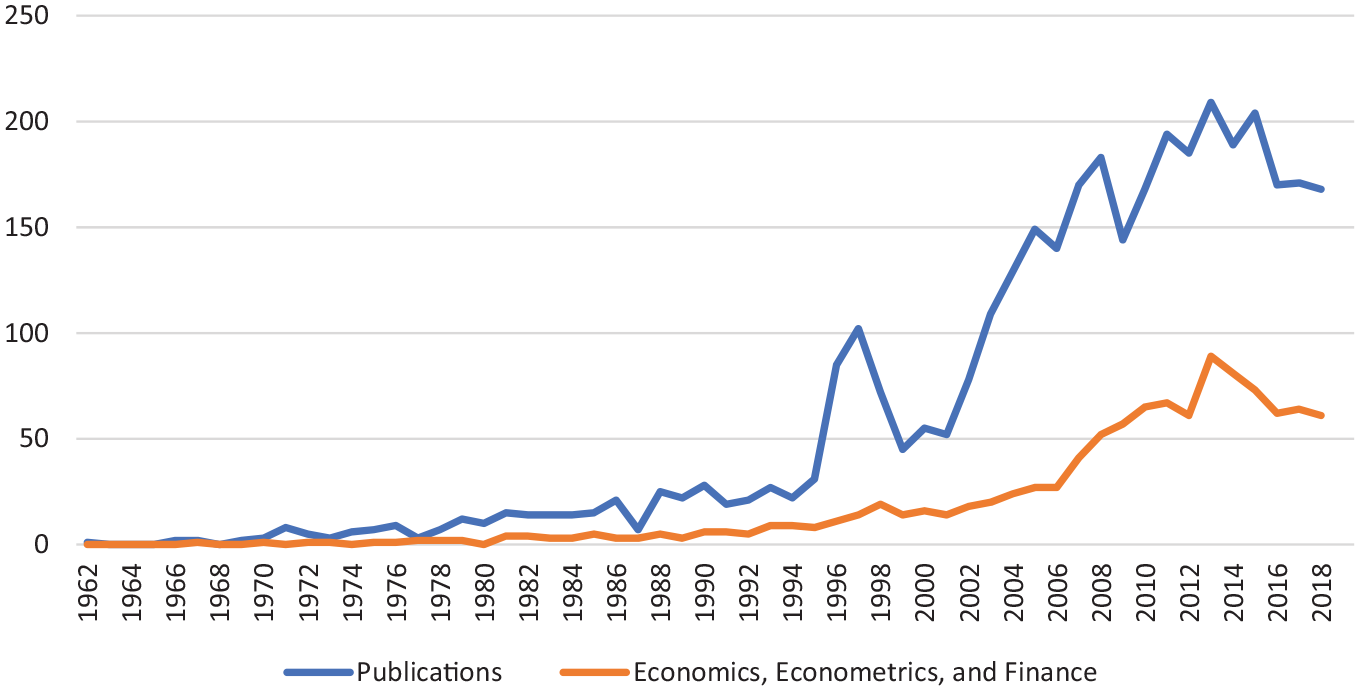
Scientific output of the OECD, 1962–2018.
The bulk of scholarly work on the OECD (Armingeon and Beyeler, 2004; Bradley and Stephens, 2007; Mahon, 2009; Mahon and McBride, 2008; Ydesen, 2019) is very much centred around the issues of effectiveness (whether and in what ways the guidance it provides has effects) and ideology (to what extent the OECD’s recommendations draw on a ‘neo-liberal’ political programme). It is surprising that while these issues have been widely debated, very little research has been published on the actual policy advice produced by the OECD (for a discussion, see Bergh et al., 2017). With our analysis we wish to fill this gap, paying special attention to the role of science in the justification of policy advice. Our data – the OECD Economic Surveys from five countries and six decades – allow us to examine this with a longitudinal view from the 1960s to the 2010s.
The epistemic governance perspective on IOs’ authority building
The research on national political argumentation shows that actors attempting to convince the public of desirable policy solutions frequently invoke policy models and recommendations issued by IOs (Alasuutari and Rasimus, 2009; Alasuutari et al., 2016). A recent study on debates on national draft laws suggests that, while invoking IOs as expert bodies has increased in parliamentary rhetoric over the past two decades (Rautalin et al., 2018), the increase in references to concrete policy models and recommendations advocated by IOs has been even more marked, suggesting that models packaged through ‘theorization’ (Alasuutari et al., 2018b: 359) and marketed by IOs are deemed legitimate motivations for national policy reforms. However, IOs offering advice on policy do not only produce rationalized models and policy recommendations, but in these endeavours they also attempt to portray themselves as credible authorities. As Halliday et al. (2010: 79) have argued, IOs ‘use texts tactically to advance claims to legitimacy’. Hence, if we want to understand how IOs engaged in tendering policy advice can aspire to being authoritative, it is important to study how IOs seek to construct themselves as authoritative figures capable of appealing to actors engaged in national policymaking. We are interested specifically in how IOs construct themselves as scientific authorities when seeking to legitimize themselves as credible policy advice providers.
IOs’ increased research output and their investments in establishing entire research departments have been associated with their endeavours to appear as rational purposive actors (Bromley, 2010; Zapp, 2017, 2020). Although such activities may well contribute to IOs’ authority, they do not sufficiently explain why nation-states end up introducing reforms that imitate global policy models and ideals. Earlier research conducted within epistemic governance scholarship has shown that the local adoption of global policy models is typically preceded by a negotiation in which various actors wishing to influence national policymaking debate the status of national systems and of desired policy decisions (e.g. Alasuutari, 2016; Syväterä and Alasuutari, 2013). In their attempts to exert influence, policy actors construct and appeal to facts, principles or entities that they assume others deem unavoidable determinants of the situation, or they cite sources assumed to lend credibility to the claims and proposals made. In other words, actors wishing to influence domestic policies lean on others’ authority by making reference to them (Alasuutari, 2018).
Borrowing the prestige of IOs is useful in affecting others’ views because they represent a large body of members and a set of collectively agreed ideals and principles. Actors seeking to influence domestic policies take part in the IOs’ activities and refer to their policy prescriptions since they believe that the authority of these bodies will further their policy interests (Alasuutari et al., 2016). Yet not all IOs enjoy similar authority in domestic contexts, which is why we must dig deeper into the preconditions of IOs’ alleged authority.
The epistemic governance framework points out that the authority of any entity is relational in the sense that is based on recognition on the part of others. According to the framework, authority can be built on four distinct grounds (Alasuutari, 2018; Alasuutari et al., 2016). Ontological authority refers to the prestige of the entity as a source of reliable information, typically based on scientific expertise. Moral authorities are referred to as sources dispensing guidance on what is right or acceptable. Capacity-based authority entails deference based on perceived competence or ability to accomplish actions. Finally, charismatic authority is based on revered characteristics portrayed as unique to a certain individual or organization. Empirical analysis on politicians’ practices of referring to IOs shows that they have very different profiles in this respect (Alasuutari, 2016: 121–122). For example, the OECD, relying on its vast research production, is typically referred to as an expert organization and hence as an ontological authority. Thus, it has acquired an authoritative position, from which it can credibly highlight trends, identify common problems and map out a range of appropriate solutions (Mahon and McBride, 2008; Woodward, 2009: 67). Whatever an organization’s specialization may be, it takes time and resources to establish authority that is widely acknowledged by others. Yet what ultimately counts is not the money or time expended on building an entity, but whether others do indeed regard it as an authority: whether its pronouncements or actions are taken into account in others’ deliberations on their choices.
IOs’ information dissemination is crucial from the perspective of their authority building, because through it they attempt to uphold and strengthen their prestigious status. The authority of the OECD and its formal reporting are a case in point. The potential effects of the OECD on national policies are not due to simple diffusion of rationalized ideas and models from the Organization to its member-states (cf. Jakobi, 2012; Zapp and Dahmen, 2016). Rather, the authority of the Organization manifests in and is constructed through policymakers’ (and other interested actors’) actions in domestic debates, in which they utilize information and policy recommendations produced by the OECD in their endeavours to convince other parties of the status of national systems and of desired policy measures (Alasuutari and Rasimus, 2009; Rautalin, 2018; Takayama, 2008). IOs are well aware of the conditions under which their authority appears as a useful resource for both national governments and interest groups aspiring to influence domestic political decision-making (Vähä-Savo et al., 2019), which is why they actively invest in elements that can be used as assets in national policymaking. In that sense, IOs should not be perceived as ‘disinterested’ others but as ‘self-interested’ actors who deliberately seek to accumulate their authority or ‘epistemic capital’ (Alasuutari, 2018) by means of which to exert influence.
Data and methods
To render comprehensible how the OECD has attempted to construct its knowledge-based credibility and hence to amass authority in global governance, we investigate the OECD’s formal country reporting. Our analysis focuses on the OECD Economic Surveys (from now on Surveys), series of country reports considered to be among the OECD’s flagships and the most cited OECD outputs in the field of economy (e.g. Bergh et al., 2017; Schäfer, 2006). The Surveys represent the culmination of the oldest OECD method – the peer review – with which the Organization has sought to ensure that its members follow the code of conduct for sound economic policies. According to the OECD’s own definition, ‘[P]eer review can be described as the systematic examination and assessment of the performance of a State by other States . . . , with the ultimate goal of helping the reviewed State improve its policy making, adopt best practices, and comply with established standards and principles’ (Pagani, 2002: 4). The organization of the reports is the responsibility of the OECD, but the content is produced in collaboration with its members, including the country under scrutiny (for review, see Schäfer, 2006). With a few exceptions, the OECD publishes Surveys on each member-state biannually.
We gathered a sample of the Surveys including reports from all six decades and from five different member countries: Canada, Iceland, Japan, Luxembourg and the United Kingdom. All these countries belonged to the 21 OECD member countries in 1965; since then the membership has grown to cover 37 countries. In the interests of work economy, we focused on Surveys concerning five countries. The countries in our sample were chosen as their national economies differ greatly in size, and because geographically, too, they reflect the overall variation between the OECD member-states. Starting from 1965, we included reports at 10-year intervals in such a way that the most recent are from 2015. 2 In total, our sample includes 30 reports amounting to 2868 pages in all.
Our analysis includes quantitative text coding and qualitative close reading. The first phase of the analysis was to examine how science figures at the level of individual reports. This involved analysing the overall mode of presentation of the reports such as language, literature citations and lists of references. We coded language according to whether the reports utilized economic rhetoric or other argumentation. We coded the sources cited in the reports into five subgroups: (1) scholarly literature; (2) national surveys and statistics; (3) reports of IOs other than the OECD; (4) the OECD’s publications; and (5) other references. As we were interested in how the OECD itself seeks to present its authority, we also paid attention to the Organization’s mission statements included in the reports. In order to demonstrate the overall temporal change in the language used in the Surveys, corpus linguistic keyword analysis (Evison, 2010; Seale and Tonkiss, 2012) was conducted (see Appendix A). 3
The second phase focused on policy recommendations within the reports. We examined how their share developed, how they are formulated and motivated and especially how they are related to the scientific content (e.g. evidence, references, theories) of the reports. We were interested in whether recommendations were motivated by scientific evidence and economic values or by some other value or norm deemed to be authoritative. We moreover examined whether the recommendations were explicit or implicit. Not all guidance was explicitly labelled ‘recommendations’ and at times it might be possible to differentiate one recommendation into several recommendations due to the varying complexity of their formulation.
Our aim is not to make statements on whether the OECD reports use scientific knowledge in a ‘proper’ way. We take a different path: our aim is to examine in what ways the OECD resorts to the authority of science in its attempts to establish its expert role and thus authority in national policymaking. The formal reports published by the OECD are excellent data for our purposes: as Halliday et al. (2010: 85) state, such texts ‘essentially reveal the bets of an IO about what rhetorical form will be most persuasive to critical audiences’.
Science in OECD Economic Surveys: From collecting information towards policy consultation
As regards the overall appearance of the reports, they developed from the early relatively short and concise accounts of a member country’s current economic situation and its future prospects into highly stylized and substantially longer reports discussing various themes, such as environmental sustainability, public transportation, educational matters and various quality of life issues under the broad umbrella of economics. 4 While the discussion in early Surveys relied heavily on data acquired from the national entities, such as governments, boards of trade, national banks, statistics bureaus and institutes, in later years this emphasis diminished as the more recent reports more widely refer to academic publications as well as to data collected by the OECD and many other IOs. On a superficial level it could very well be argued that during the 50-year timespan, these reports became more ‘scientific’.
However, as we discuss next in more detail, we argue that the early reports were as scientific, and in some ways even more so, than the more recent ones. We argue that certain distinct ways of ‘putting science out there’ in the Surveys are linked to the OECD’s endeavours to appear as a significant actor from the perspective of knowledge-based policymaking. These changes are connected to the changing role of the Organization during the five decades studied. According to our analysis, three periods can be identified on the basis of three distinctive ways in which the OECD has sought to establish its authority. In each of the periods the OECD has assumed a different role, gradually moving from that of a ‘compiler of information’ (1965–1985), through the period characterized by the search for a new expert identity (1995), to the role of a ‘policy consultant’ (2005–2015).
Compiler of information
During the first period, the emphasis of the Surveys was on carefully conducted analyses of national economies and the language used in them followed the rhetoric of economics. In the early reports, national sources were referred to almost exclusively, but the importance of the OECD’s own data grew substantially during the following decades, reaching the level at which it would remain during the following periods in the 1985 reports. As to why the share of references to national sources remained relatively large throughout the period analysed, is likely due to the way in which information for the actual analysis part of the Survey is sourced. 5 The overall development of references to various sources used in the report data is illustrated in Figure 2.
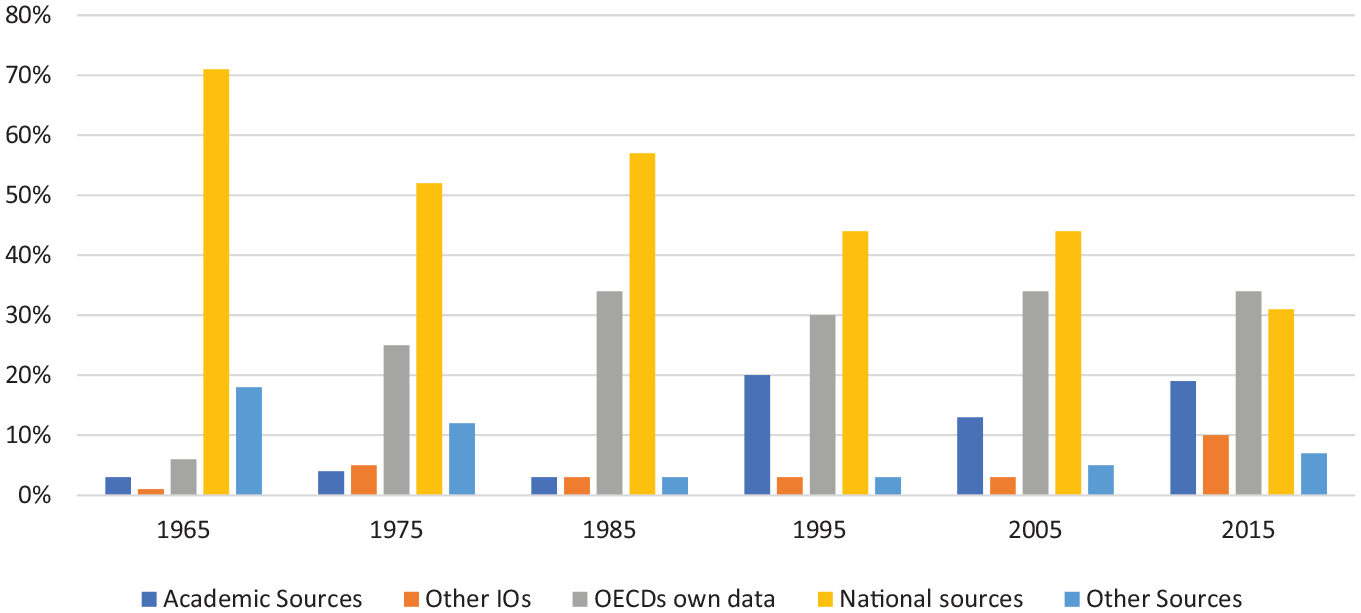
Sources cited in the OECD Economic Surveys, 1965–2015.
Although the emphasis of the early Surveys was on providing a concise overview of a national economy with help of the policy relevant information compiled, this does not mean that no solutions to existing problems were proposed. In the early reports some policy solutions were already put forward. These were not visually highlighted but appeared in the body copy (mainly as part of the concluding chapter). They were not clear guidelines on how to improve a certain economy, but rather tentative and general observations of actions deemed appropriate or desirable, such as improving the balance of payments and strengthening counter-inflationary policies. Explicit recommendations stating that some specific policy or action should or must be adopted do indeed occur, but rarely. Justifications used for motivating recommendations were mainly values shared in economics. Occasionally, recommendations were further justified by invoking international comparison (references were made to developments in other countries or the OECD area in general) or the Secretariat’s forecasts. However, the source of this comparative information or evidence was not made explicit in the context of making recommendations. The text extract below is a typical example: Recent developments in Japan raise important problems both from the analytical and from the policy point of view. The present recession seems more protracted and more difficult to overcome than previous ones. Is this the effect of a chance combination of circumstances, or more deep-seated factors? Why have monetary policies, so successful in the past in controlling business fluctuations and the balance of payments, failed this time to bring about a recovery? (OECD, 1965: 5)
In this excerpt, the OECD addresses Japan’s prolonged recession. Instead of giving detailed guidelines on how to come out of it, the Survey text invites the government officials and experts to ponder the measures used in coping with the recession and how they differ from those used (apparently with success) in the past.
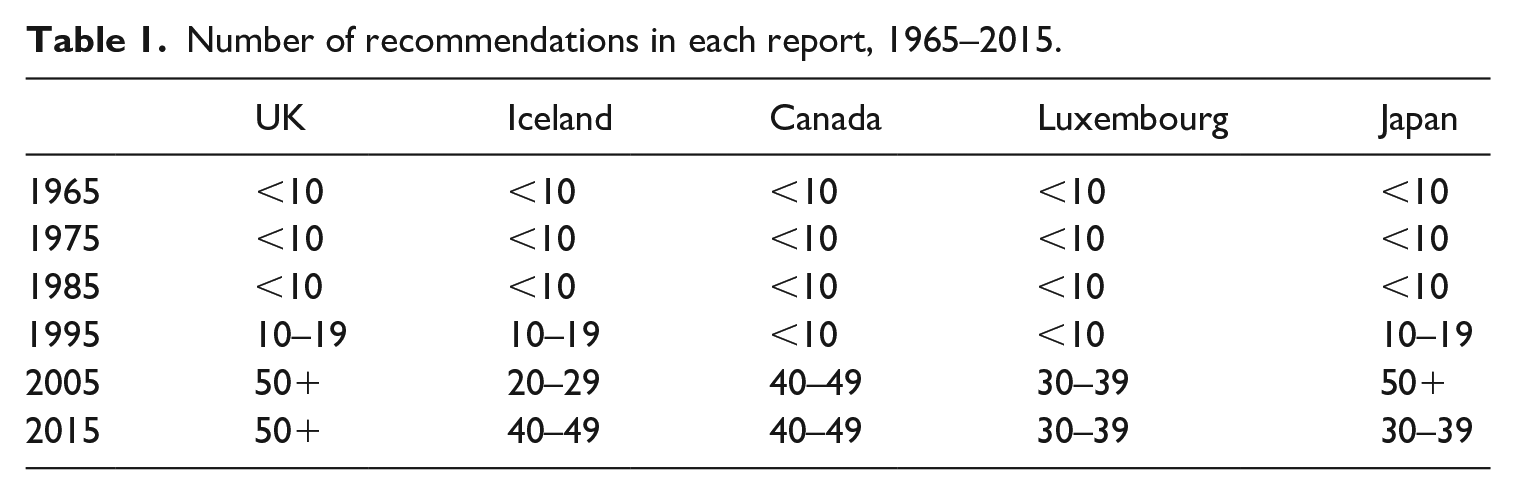
All in all, during 1965–1985 recommendation talk was barely perceptible, suggesting that in the early years the OECD wanted to present itself as a reliable compiler of policy-relevant information but was careful not to give too explicit political guidance. The number of recommendations put forward in the reports analysed is presented in Table 1.
Number of recommendations in each report, 1965–2015.
Interestingly, in the early reports, the possible defects related to the OECD’s own calculations were also discussed. For example, in the 1975 Economic Survey of Japan caution in interpreting one of the findings was advocated due to the results of the statistical analysis on which the finding was based. Similarly, in the statistical annex of the 1975 Economic Survey of Canada, when a simulation used to assess ‘the cyclical impact on the Canadian balance of trade’ was discussed, several caveats were mentioned. Being openly critical towards its own methods of enquiry alludes again to the fact that it was initially of utmost importance for the OECD to be seen an organization which gathers information and examines it in ways that can be trusted in knowledge-based policymaking. The language used in the Surveys followed strictly the rhetoric of economics suggesting that the early reporting was mainly intended for government officials with training in economics.
In the mission statements of the 1960s and 1980s the emphasis was on the role of the OECD as a multi-centred organization, its mission being to draw together and develop the economies of its member countries and to promote economic growth, increase general well-being and help the developing countries in their economic endeavours. These descriptions of the Organization’s mission relied explicitly on its founding Convention (OECD, 1960) and the tasks set for it therein. The mission statements did not place separate emphasis on the role of the Organization as an expert but rather as a forum for cooperation between governments and as a development forum. It is also noteworthy that the mission statements for 1965 note separately that the OECD was continuing the work of its predecessor founded in 1948, namely the OEEC. Mentions of the OECD as continuing the work of the OEEC ceased to appear in the mission statements after 1970.
In search of a new kind of expertise
Towards the 1990s the Surveys became lengthier. The number of literature citations also grew. As illustrated by Figure 2, while a few references to scientific sources were already made during the first period, the number of these grew substantially in the 1995 reports.
6
Extensive citation of academic research (especially studies appearing in international journals of economics) in these Surveys indicates a clear change in their nature. These references to academic sources were used, for example, to discuss gaps and debates in research, to support the OECD’s own views and to utilize calculations made in the academic papers as well as to discuss the reliability of these calculations. The strong emphasis on taking account of academics’ debates and the critical evaluation of the reliability of different information underlines the OECD’s scientific approach to the themes discussed, as exemplified by the following example: In Iceland’s case . . . in contrast with experience in other OECD countries, both goods and services imports have represented a declining share of GDP over time (Diagram 12). According to the equation, Iceland’s four percentage point decline in import penetration from 1983 to 1990 was associated with a predicted increase in the price level of over 12 per cent, leaving observed prices below the level predicted by the equation. This implies that relatively high prices in Iceland might be attributed primarily to relatively weak competitive pressures emanating from abroad. The evidence is conflicting as to whether Iceland’s degree of openness is appropriate for its situation. Some have argued that it is unusually low among OECD countries, given its small size (Krugman, 1991), although once transportation costs are taken into account, import penetration does not appear to have been unusually low, at least prior to 1985 (Barbone, 1988). (OECD, 1995: 49–50)
Although the Survey reports became longer and contained more detailed analysis of the status of the target country’s economy, the role of policy recommendations still remained minor (Table 1). The number of recommendations put forward grew slightly and some of the proposals made were more precise than in earlier years. The motivations used for recommendations made became more varied. Besides general economic values or goals, recommendations were also motivated by the OECD’s own research and recommendations (especially earlier findings made in earlier Surveys and those made in the OECD Job Study were referred to), policies of other countries (especially those within the OECD area) and international agreements (e.g. WTO, GATT agreements). The sources of information used to legitimize policy proposals made were not disclosed.
While recommendation talk became qualitatively somewhat diverse, there was nothing to suggest that the emphasis of the Surveys was on providing policy guidance for member countries. Rather, it appears that the aim of the reporting was still to provide a holistic research-based overview of a given national economy to support national decision-making. However, at this point the scope of the themes discussed became somewhat wider as different national policies came to be increasingly scrutinized under the broad umbrella of economics. For example, education became a major theme in the United Kingdom Survey, while still almost totally lacking in the other Surveys. As in earlier years, the language of the reporting follows the rhetoric of economics, suggesting that the target audience consisted of economists or government officials trained in economics and other experts, rather than, for example, civil society or the public at large. The mission statements appearing in the reports did not include references to the OECD’s professed expert or consultative role but repeated the organizational aims as stated in the Convention.
Policy consultant
With the new millennium, reporting evinces a clear shift towards more popularized consulting language. The style and the layout of the reports changed. Reports became much more stylized than before and now they started with an executive summary in which the main points of the analysis and the recommendations based on those points were presented very concisely and clearly. The actual in-depth analysis, the ‘thematic chapters’, were placed at the back of the reports. This suggests that, in contrast to earlier reports, the actual analysis was no longer at the centre of reports but that the policy recommendations aimed at a given member country were already introduced in the executive summary and after that repeated throughout the reports often with graphic visualizations. The essence of the recommendations had also changed from being somewhat implicit to being decidedly explicit, often arguing with frequent exhortation as to what must or should be done. In the extract below, the OECD urges the Canadian government to respond to the challenges related to population ageing: Looking ahead, the key challenges for all levels of government will be to lift productivity growth and to maintain sustainable fiscal and social policies to deal with the pressures arising from population ageing. Some broad re-orientations of policy should underpin the strategy. (OECD, 2006: 8)
What these distinct measures of lifting the productivity growth and rationalizing fiscal and social policies should actually include is left undiscussed in the context of issuing the recommendation.
Finally, the number of recommendations proliferated from the earlier periods as many of the more recent reports included over 50 different recommendations altogether (Table 1). Some of these recommendations were also very far-reaching in their scope. For example, in the 2015 Economic Survey of Iceland, an entirely new budget law aimed at achieving a sustainable and balanced budget, called the ‘Organic Budget Law’, is promoted. This law not only included fiscal rules, changes in the budget transparency and accountability, as well as the formulation, approval and execution of the budgets, it also demanded a creation of an independent body called a ‘fiscal council’, to oversee these processes. The increase in the number of recommendations, their new placing in the reports, and the change in individual recommendations’ breadth suggests that giving policy advice had indeed become one of the priorities of the reporting.
As far as the language is concerned it was no longer reminiscent of the jargon of economists but utilized the rhetoric of popularized oratory: suggesting that the target audience was no longer merely decision-makers and experts with a detailed familiarity with the field but the public at large. Themes raised in the agenda diversified considerably. Our keyword analysis (see Appendix A) shows how, for example, childcare, education, retirement, immigration, healthcare and environmental matters started to be discussed extensively in the Surveys, as more traditional economic discourse declined.
While the references to academic sources remained more or less on the same level as in the reports of the second period, now they were more evenly divided between the Surveys. In addition, the role of these references in the Surveys also changed. The discussion about the gaps in academic knowledge and debates among researchers (which were visible in the reports from 1990s), all but disappeared, thus decreasing the ‘critical’ nature of these reports. The academic literature mostly served as background information to justify the views adopted in a very straightforward manner or as a tool to enhance the credibility of the reporting, often appearing only in the bibliographies of the reports. In addition, the links between academic knowledge and the vast number of recommendations made in the Surveys were often marginal at best. For example, in the 2015 Economic Survey of United Kingdom, adopting a ‘user-paid toll system’ was recommended in order to achieve a ‘more rational use of road infrastructure’, but no proof apart from the Survey was provided that road tolls would be the best way to achieve this goal or that achieving such a goal was even necessary. Another example of this is the recommended ‘Organic Budget Law’ discussed above. While the need to curtail public debt was justified partly by referring to scientific findings, the rest of the chapter arguing for the law was devoid of any academic scientific references.
Instead of basing the recommendations firmly on research and on scientific evidence, the effectiveness of the persuasive talk was built at times on references to global society in general and to the values disseminated by the global community such as social equality and national well-being. The persuasive talk cultivated clearly more trendy buzzwords than before, such as ‘lifelong learning’ or ‘absorptive capacity’, albeit without making any connection between the origins of these terms and research in the field. All in all, it appears that during this last period, academic references in reports were often used to add credibility to the reporting, i.e. to convey the impression that high-quality scientific enquiry precedes the policy proposals made, rather than to actually discuss the issues brought up in the reports in light of scientific knowledge.
Such an evidence-based consultative role was also apparent in the texts of the mission statements of the reports for 2015. In contrast to earlier mission statements in which the OECD’s tasks were strictly defined by reference to the Convention, now the tasks of the Organization were defined in terms of its altered profile. As earlier, the Organization was described as a multi-centred institution for co-operation and development, but the role of the OECD as an expert and a consultant of governments was raised alongside. This role was announced through expressions such as: ‘The OECD is also at the forefront of efforts to understand and to help governments respond to new developments and concerns, such as corporate governance, the information economy and the challenges of an ageing population.’ Further prominence was given to the capacity of the OECD in knowledge production by references to the Organization’s statistics and studies in numerous policy sectors. This novel description of the tasks of the Organization, from which reference to the Convention had been removed, would suggest that the change of profile from an institution compiling information towards that of becoming a policy consultant was part of the Organization’s well thought out new strategy.
Conclusions
This study set out to examine the changing ways in which the OECD has attempted to establish its scientific authority throughout its existence. To investigate this, we analysed a sample of OECD Economic Surveys during 1965–2015. Our analysis showed that in its early years the Organization already sought to profile itself as an expert organization independent of national politics. It emphasized its role as compiler and then as a producer of information but was careful not to give too explicit policy guidance. The dramatic change occurred in the reporting between 1995 and 2005 when providing policy recommendations became the main purpose of reporting. These recommendations were accompanied by references to scientific sources albeit typically substantiated with little analysis about their concrete effects. Moreover, the focus was no longer strictly on economics; other themes arguably of importance for achieving long-term economic growth were extensively discussed.
How do these findings relate to the alleged scientization of IOs? The OECD was decidedly scientific in its early decades. However, it has gradually assumed consultative practices. This would suggest that there has been a change in the way the OECD ‘put science out there’. Whereas the academic style of writing previously dominated the language of the country reports, this is no longer the case. Instead, such work is now published in peer-reviewed journals of economics. While scientific publications authored by the OECD personnel increased dramatically from 2000 onwards, in its own country reports the Organization has invested ever more in ‘popularized’ consultative talk.
The reasons for such a change in performing authority may lie in transformations in the institutional environment in which the OECD operates. Thus, the changes can be perceived to result from ‘institutional isomorphism’ (DiMaggio and Powell, 1983: 150): processes wherein organizations adjust their goals and functions to the wider organizational culture. In order to appear as legitimate actors, organizations keep a keen eye on other organizations and adopt goals and models perceived to be appropriate and effective. In this light, it can be suggested that the OECD has increasingly sought to profile itself as a policy consultant, because consultative practices have gained a legitimate position in the field of international policy advice. Providing policy recommendations via consultative talk has become to appear a more efficient way to exert influence in national policymaking than publishing only scholarly reports.
As our analysis has shown, scientization clearly is not the only source of authority for the OECD. Its goals and practices have also been shaped by conformity to consultancy culture, which has gained prominence since the 1980s and flourished globally, particularly in the last 30 years (Prince, 2012; Saint-Martin, 1998). In addition to changing the language and style of the reports, the adoption of consultative practices is apparent in the ways in which the OECD has increasingly invested in straightforwardly issued policy recommendations, broadening its operational field, networking with other policy advising organizations, and in the use of the mass media and public opinion in order to get the message through to the policymakers.
Explaining the changes in the OECD’s formal reporting solely from the perspective of institutional isomorphism (DiMaggio and Powell, 1983) would be insufficient, however, as such an approach would not recognize interests beyond the organizational field. It is important to recognize that, in order to appear authoritative and attract the resources vital to its functioning, any organization must remain credible and useful in the eyes of those who provide these resources. This means that the changes in the OECD’s formal reporting are not only responses to the developments taking place in the field structured around international policy advice, but also to the member-states which finance the activities of the organization. The OECD does not produce its reporting and policy advice independently of member countries’ political interests.
There is a plethora of evidence of how member-state interests were fundamental to the OECD’s transformation from the Keynesian economic perspective to supply-side economics. The long-standing Keynesian hegemony of the organization was increasingly challenged during the 1970s, leading to mixed propagation of economic policies during that decade. However, it was the interests of the member-states, especially the United States and the United Kingdom, which caused the OECD to abandon Keynesianism altogether (Woodward, 2009: 27–29).
The OECD’s legitimacy crisis following the end of the Cold War serves as another example of the pressures affecting its conduct. While the collapse of the Soviet Union strengthened the credibility of the principles of free trade, market liberalism and democracy, it also raised questions about the usefulness of the Organization in this new situation. With its traditional enemy gone, questions were raised about the suitability of the Organization for the governance of the post-Cold War world as its membership excluded the rising non-Western economies and covered only one fifth of the world’s population (Woodward, 2009: 32–33). In addition, many IOs had adopted similar methods of international governance based on collecting and comparatively analysing high-quality data (Trondal et al., 2010: 68). The OECD responded to these legitimacy and identity crises in many ways, including extending its membership, increasing co-operation with non-member countries, enhancing its communication with civil society and broadening the scope of its agenda (Trondal et al., 2010: 66–71; Woodward, 2009: 32–42). Thus, the pressures affecting the conduct of the OECD stem both from inter-organizational competition, as well as from the member countries’ demands according to which the OECD must find its own role in order to remain politically indispensable. These pressures are entwined with mimetic and normative processes leading to the isomorphic change (DiMaggio and Powell, 1983: 152), e.g. adaptation to global trends of scientization and consultancy culture. The adaptation to such cultural models can be expected to increase the organization’s credibility in the eyes of national policymakers and the wider public.
It can be argued that in their quest for a prestigious position in global governance, IOs increasingly invest in concrete policy recommendations as a form of policy consultancy. Our study does not allow us to make claims about whether the shift from information producer to provider of recommendations has affected the OECD’s actual influence over the outcomes of national policymaking. However, in light of earlier studies (e.g. Alasuutari and Rasimus, 2009; Alasuutari et al., 2016; Pettersson et al., 2017; Steiner-Khamsi et al., 2020) it is well known that such recommendations are viable resources in national political rhetoric; they may legitimate ideas already existing in the minds of the domestic decision-makers, yet when packaged by an organization perceived as an authority, they lend more authority to efforts to convince others of what is deemed a desirable or acceptable way of organizing domestic policies. As knowledge-based policy recommendations are deemed viable assets in policymaking, it may be that nation-states and their governments actively seek to bring these recommendations onto IGOs’ agendas. At the same time organizations engage in extensive scientific publishing, seeking to strengthen their scientific authority and enhance their status in the increasingly crowded field of policy advising. These and other scientific publications can be used as assets to add credibility to policy proposals put forward in the organizations’ more consultative reporting.
Finally, we argue that there is a need to periodize the grand narrative of ‘scientization’. World society theory has portrayed the post-Second World War era as a period of linearly progressing intensification of rationalistic world culture. The results of our analysis suggest, however, that alongside the ‘scientization’ of IOs there is another trend: the dramatic increase in the policy recommendations provided. Our analysis illustrated that although such recommendations are legitimized by scientific authority, they often are not at all clearly linked – at least at the level of the report text – to the evidence. Considering IOs’ increased scientific publishing activity, it remains to be ascertained whether this is a precondition for the success of an IO, or whether the authority of an IO is attributable to its capability of formulating policy recommendations that can be used as leverage to advance policy reforms in national contexts. It can be assumed that the organization’s authority resides in its capability to do both – to publish high-quality research and formulate decisive policy recommendations. It can also be hypothesized that becoming an influential policy consultant is easier for organizations which are already acknowledged as reputable producers of scientific knowledge.
Footnotes
Appendix A
Tables A1 and A2 show the results of a keyword analysis illustrating the major changes in the language used between the 1965 and the 1995 as well as between the 1995 and the 2005 Economic Surveys. In both analyses, the body copy of the 1995 Economic Surveys of the five countries is used as a ‘benchmark’ corpus to which the ‘target’ corpora, the content of the 1965 (Table A1) and the 2005 (Table A2) Economic Surveys, are compared. ‘The positive keywords’ are words that appear in the target corpora significantly more frequently than in the benchmark corpus, while ‘negative keywords’ are words that appear in the benchmark corpus with significantly higher relative frequency than in the target corpora. The top 25 words (excluding non-lexical words, such as particles, pronouns and conjunctions) based on their keyness value, are displayed. Keyness value refers to the statistical representation of the degree of difference between the target and benchmark corpora regarding the occurrences of the word. In these analyses log-likelihood was used. In addition, the raw frequency of the appearance of the word is presented.
Acknowledgements
We thank the IS editors, two anonymous reviewers, and the members of the Tampere Research Group for Cultural and Political Sociology for insightful comments and suggestions on earlier versions of the manuscript.
Funding
The authors received financial support from the Academy of Finland (decision numbers 276076 and 307755).
