



Abstract
Why do so many attempts to distribute authority fail—even in organizations deeply committed to decentralization of authority? In this article, I argue that the answer lies in the cognitive, motivational, and emotional residues of learned helplessness shaped by prolonged exposure to hierarchical conditioning. From this perspective, I conceptualize the adoption of distributed authority as a process of unlearning the learned helplessness. Drawing on ethnographic action research into the adoption of Holacracy as a specific form of a self-managing organization, my study demonstrates how learned helplessness inhibits individuals from acknowledging, internalizing, and enacting the authority embedded in distributed authority frameworks—and how this cycle can be broken through deliberate practices. I identify three human-centered boundary conditions—clarity of role boundaries and responsibilities, purpose-driven proactive behavior, and complex social interaction—that interrupt habitual patterns of deference and managerial intervention. These conditions enable the overarching process of unlearning the learned helplessness, allowing self-organization to emerge. Theoretically, the study reveals why distributed authority so often collapses in practice and outlines the human-centered boundary conditions required for its long-term viability. Practically, it highlights the need to address the psychological effects of learned helplessness—not just redesign formal structures—to implement and sustain distributed authority.
Keywords
Introduction
The question of whether new forms of organizing (Puranam et al., 2014) that rely on distributed authority and collaborative coordination offer viable solutions to contemporary organizational demands has gained increasing relevance (e.g. Hamel and Zanini, 2025; Foss and Klein, 2022; Reitzig, 2022), particularly following Lee and Edmondson’s (2017) influential review. Within this broader conversation, self-managing organizations denote frameworks that radically decentralize authority in a formal and systematic way (Lee and Edmondson, 2017), whereas the phenomenon of self-organization captures how this decentralization is enacted in practice. Holacracy (Robertson, 2015), the specific form of self-managing organization examined in this study, has emerged as a prominent example of a constitution-based approach to distributed authority, with relevance for human flourishing (Valkiainen and Jaakson, 2025) and organizational anti-fragility (Valkiainen and Jaakson, forthcoming). Echoing Foss and Klein’s (2023) emphasis on the contingency of less-hierarchical organizing, this study examines the human-centered boundary conditions that shape the viability of self-managing organizations. The human-centered boundary conditions, as used throughout this study, refer to the cognitive, motivational, and socio-emotional prerequisites that enable distributed authority to be acknowledged, internalized, and enacted.
The shift toward distributed authority involves transferring decision-making authority from managers to employees while simultaneously allowing coordination to arise through direct, lateral interactions among organizational members (e.g. Martela, 2019). Together, these changes form the foundation for self-organization, where collaboration, coordination, and alignment emerge through ongoing role-to-role interactions (Fjeldstad et al., 2012), rather than being mediated by formal managerial authority.
A growing body of recent scholarly research has examined self-managing organizations (e.g. Bourlier-Bargues et al., 2025; Jensen and Mikkelsen, 2024; Kantola and Kinnunen, 2024; Koistinen and Vuori, 2024; Kummelstedt, 2023; Lee, 2024), neo-participative management (e.g. Daudigeos et al., 2021; Picard and Islam, 2020; Vallas, 2006; Van Baarle et al., 2021), and post-bureaucratic forms of organizing (e.g. Josserand et al., 2006; McSweeney, 2006; Sturdy et al., 2016), documenting recurring barriers in their adoption. Studies highlight how employees often struggle to enact autonomous decision-making (Bernstein et al., 2016; Sturdy et al., 2016), particularly in the absence of a “shared mental model of ownership” that supports collective responsibility and agency (Druskat and Pescosolido, 2002), leading actors to fall back on “hierarchical modes of sensemaking” when navigating ambiguity (Bremer et al., 2025). When formal hierarchical authority is deliberately weakened or displaced, organizations may experience hierarchical “zombie structures” (Anicich et al., 2024), worker resistance in the form of “proletarian traditionalism” and “populist defiance” (Vallas, 2006), managerial escalation processes that culminate in the subversion and reversal of self-managing experiments (Bourlier-Bargues et al., 2025), or opt for “democratic deviations” (Lee and Young-Hyman, in press), where employees continue to defer to former authority figures. Emotionally, employees may experience autonomy as overwhelming (Picard and Islam, 2020), producing emotional labor and strain (Hoffmann, 2015), or even anxiety and fear during transitions to distributed authority (Kantola and Kinnunen, 2024). Together, these findings suggest that the transition to distributed authority is psychologically fraught.
Yet, despite the insights offered by this literature, explanations for these failures remain fragmented: some point to cognitive barriers, others to passive deference or resistance, and still others highlight emotional strain. What remains missing is a coherent theoretical account of the underlying psychological mechanisms driving these failures. Moreover, this empirical record sits uneasily alongside motivational theories that posit autonomy as a universal psychological need toward which individuals naturally gravitate. According to self-determination theory, humans have an inherent tendency to seek volition and self-endorsed action (Ryan and Deci, 2017). If autonomy is indeed such a fundamental need, why do individuals in organizations with formally distributed authority so often resist—or fail to embrace—the authority granted to them? This study suggests that less-hierarchical forms of organizing often underestimate the psychological factors that shape how individuals experience and adapt to radical autonomy. Without an autonomy-supportive psychological context to foster the internalization of authority (Deci et al., 2017), distributed authority frameworks risk faltering not because of structural design but because of the human adaptiveness on which they depend. These barriers arise from internalized hierarchical orientations and default organizing preferences shaped by traditional hierarchical environments (Gruenfeld and Tiedens, 2010), as well as from the demanding motivational processes of internalization required in autonomy-intensive settings (Gagné and Deci, 2005). At its core, this study shows that the transition to a self-managing organization hinges on a profound psychological shift from hierarchical dependence to self-directed agency: the gradual internalization of authority—what this study terms an unlearning of learned helplessness, a concept rooted in classic work by Maier and Seligman (1976, 2016)—impeded by years of hierarchical conditioning.
This study constructs its core research phenomenon (Alvesson and Sandberg, 2024) as the micro-level emergence—or breakdown—of self-organization, rooted in how individuals internalize and enact distributed authority. To investigate this, the study adopts an inductive action research approach (Cassell and Johnson, 2006) and employs ethnographic methods (Jaumier, 2020), drawing on Holacracy adoption as the case study (Gioia, 2021) to identify human-centered boundary conditions that enable distributed authority to take root. The resulting empirically grounded inductive-dynamic model follows Corley and Gioia’s (2011: 12) definition of a theoretical model as “a statement of concepts and their interrelationships that shows how and/or why a phenomenon occurs.” Accordingly, the central research question driving this study is: How do individuals come to internalize—or fail to internalize—authority during transitions to self-managing organizations, when formal redistribution of authority does not guarantee its enactment? By foregrounding both internalization and its failure in such settings, this question directly addresses the tension between motivational theories that posit autonomy as a universal psychological need and the persistent empirical pattern of faltering self-organization. This study examines the human-centered conditions under which the internalization of distributed authority is facilitated or hindered, highlighting the cognitive, motivational, and emotional dynamics that enable individuals to act with self-authorized agency within self-managing organizations.
To address this question, I conducted a 12-month action-based ethnographic field study in a manufacturing company operating in a post-Soviet cultural context, transitioning from a traditional hierarchical structure to Holacracy. This unique case provided a real-world laboratory for examining the dynamics of adopting Holacracy and offered insights into the challenges and opportunities of such a significant organizational shift.
Building on this longitudinal field engagement, this study contributes to debates on the viability of self-managing organizations by reframing why attempts to distribute authority so often falter in practice. First, it theorizes the adoption of distributed authority as a process of unlearning the learned helplessness, showing how enduring failures to internalize and enact authority reflect cognitive, motivational, and emotional conditioning shaped by hierarchical organizing. Second, the study introduces learned helplessness as an integrative psychological mechanism explaining why cultural, cognitive, and emotional barriers to distributed authority tend to co-occur and persist, shifting theorizing from documenting fragmented barriers toward explaining the underlying psychological dynamics that sustain them. Third, it advances a processual account of authority internalization, conceptualizing self-management as a fragile and reversible trajectory in which authority must be repeatedly acknowledged, endorsed, and enacted to become subjectively operative. Fourth, it reconceptualizes boundary conditions of distributed authority as human-centered enabling conditions—clarity of role boundaries and responsibilities, purpose-driven proactive behavior, and complex social interaction—that sustain self-organization by counteracting the residual effects of hierarchical conditioning. Fifth, it conceptualizes failure, relapse, and the durability of distributed authority as emergent dynamics of authority internalization, rather than as episodic breakdowns or reversals of decentralization.
The promise of and barriers to self-managing organizations
In response to the alienating and demotivating effects of managerial authority (e.g. Freeland and Zuckerman Sivan, 2018), distributed authority has been proposed as a way to unlock human potential (e.g. Hamel and Zanini, 2025). By distributing decision-making authority to employees and fostering horizontal coordination and collaboration (Fjeldstad et al., 2012; Kellogg et al., 2006), this approach provides the structural conditions through which such human and creative potential may be expressed, while also enhancing the organization’s ability to adapt to turbulent environments (Valkiainen and Jaakson, forthcoming).
Despite the appeal of less-hierarchical organizing, authority hierarchies remain the dominant organizing structure (Anderson and Brown, 2010; Gruenfeld and Tiedens, 2010). Efforts to radically distribute authority often falter, with organizations lapsing—formally or informally—to traditional hierarchical models (Diefenbach and Sillince, 2011). In response, recent research has sought to move beyond binary views of hierarchy by conceptualizing adaptive movement between formal hierarchy and informal flatness—described as hierarchical adaptability (Abi-Esber et al., 2025). While this perspective advances our understanding of behavioral coordination across hierarchical forms, it largely assumes that individuals can readily adapt to and enact such flexibility, leaving open the question of what barriers may constrain their ability to make use of hierarchical adaptability. Accordingly, the discussion below is structured around three recurring types of barriers identified in the literature: cultural, cognitive, and emotional.
Cultural and institutional barriers
Efforts to decentralize authority confront the deep institutionalization of hierarchy. Hierarchically structured authority relations permeate core social institutions, rendering top-down organizing forms largely taken for granted (Rothschild-Whitt, 1979). Over generations, hierarchies have become so normalized that they fade into the background and are rarely questioned—even when alternatives are available (Anderson and Brown, 2010). Particularly in high power-distance contexts, participatory decision-making is often seen as destabilizing and inefficient (Sagie and Aycan, 2003), and distributed authority is refracted through prevailing cultural expectations that frame hierarchy as the “natural” order.
Even when formal hierarchies are dismantled, informal authority patterns often endure. “Zombie structures” (Anicich et al., 2024) and “asymmetries of responsibility” (Koistinen and Vuori, 2024) persist as approval-seeking and top-down communication continue long after managerial roles are removed. Organizations also engage in “democratic deviations,” temporarily re-centralizing decision-making during uncertainty (Lee and Young-Hyman, in press). Shifting from bureaucratic to post-bureaucratic organizing, employees may fall back on hierarchical behaviors as a result of “identity stickiness” (Josserand et al., 2006), while organizations often reintroduce or intensify bureaucratic controls to restore order and manage uncertainty when ambiguity undermines confidence (McSweeney, 2006).
Such tendencies mirror worker responses to participatory reforms, where “proletarian traditionalism” reflects attachment to established hierarchies and “populist defiance” signals skepticism toward managerially framed empowerment initiatives (Vallas, 2006). These enduring dispositions reveal how cultural and institutionalized attachments to hierarchy can outlast structural reforms, making sustained decentralization especially difficult.
Psychological and cognitive barriers
Cultural barriers are reflected in the psychological conditioning and cognitive mindsets shaped under hierarchical frameworks. When organizations transition to distributed authority, employees may initially struggle to take initiative or make independent decisions due to conditioning that fosters reliance on hierarchical approval (Sturdy et al., 2016). This may stem from an insufficiently institutionalized “shared mental model of ownership” (Druskat and Pescosolido, 2002), reflecting a residual hierarchical mindset in which employees remain psychologically tethered to past structures, limiting their ability or willingness to fully embrace autonomy. From this perspective, hierarchical mindset operates as a deeply ingrained “sensemaking device” (Bremer et al., 2025), prompting employees to revert to hierarchical practices when the removal of managerial authority leaves a sensemaking gap. This sensemaking gap is particularly acute for former managers, who are positioned as change agents while being required to dismantle their own authority, a paradox that generates cognitive dissonance and identity threat and can escalate into coordinated resistance that ultimately subverts self-managing experiments (Bourlier-Bargues et al., 2025).
Even in formally decentralized systems, the discursive power of former managerial authority may continue to shape norms and beliefs in ways that unintentionally reinforce hierarchy (Kummelstedt, 2023). For example, selective managerial interventions (Foss, 2003) by leaders retaining override authority erode the credibility of distributed decision-making. Likewise, when leaders verbally promote empowerment but in practice revert to controlling behaviors—reflecting “within-actor tensions” (Van Baarle et al., 2021)—it is difficult for individuals to internalize a sense of agency. Over time, these dynamics recondition employees to view autonomy as provisional, contingent on approval, and ultimately eroded.
Emotional barriers
Beyond cultural and cognitive hurdles, distributed authority imposes emotional demands that can jeopardize its long-term viability. Transitioning to self-managing organizations often generates emotional strain (Hoffmann, 2015), particularly for individuals coming from hierarchical environments. Some report autonomy-related fear and anxiety (Kantola and Kinnunen, 2024) at three levels: “doing” (task-related worries about competence and workload), “being” (concerns about isolation and unclear roles), and “becoming” (anxieties over long-term career prospects and the pace of change). Such fears can trigger defensive behaviors that undermine the intended empowerment.
Distributed authority can also be experienced as a sense of obligation or subtle coercion. For instance, ostensibly “liberating” leadership—intended to empower—can instead generate implicit expectations for constant engagement and positivity (Picard and Islam, 2020). In some cases, “concertive control” (Barker, 1993)—peer-enforced norms and discipline—can become more stringent than managerial oversight, creating coercive environments where deviation from collective expectations is harshly sanctioned. More subtly, participatory initiatives can be absorbed into existing managerial patterns through “elusive domination” (Daudigeos et al., 2021), fostering engagement while simultaneously constraining autonomy.
All this is compounded by the continual need to reinforce distributed authority (Lee, 2024) in order to resolve the tensions inherent in coordinating within such frameworks. Without ongoing reinforcement, teams risk drifting into unresolved conflicts and dysfunction (Langfred, 2007). Unresolved role conflicts and disidentification between teams, in turn, can paralyze decision-making and hinder cross-team collaboration (Jensen and Mikkelsen, 2024).
Across these cultural, cognitive, and emotional explanations, the literature offers varied interpretations for why distributing authority falters. Yet, despite the varied angles from which self-managing organizations have been studied, these accounts converge on a common issue: the difficulty of internalizing authority. Whether through ingrained deference to hierarchy, reliance on managers for sensemaking, reluctance to act without approval, or anxiety about autonomy, the underlying barrier is a persistent dependence on external authority and a hesitation to exercise self-directed agency.
This deep-seated reliance suggests that distributing authority requires more than redesigning structures; it also demands support for individuals in developing the capacity for autonomous action. The persistence of these barriers highlights a research gap: we lack an understanding of the psychological mechanisms that facilitate or hinder the shift from hierarchical dependence to self-directed agency. To address this gap, the present study examines authority internalization through the lived experiences of individuals navigating a Holacracy adoption and introduces learned helplessness as a theoretical lens to interpret these dynamics.
Introducing the phenomenon of learned helplessness
I argue that this difficulty in internalizing authority can be conceptualized as a unified psychological phenomenon. I propose that it can be understood through the construct of learned helplessness (Seligman and Maier, 1967; Maier and Seligman, 1976, 2016)—originally developed in psychology to explain how repeated exposure to uncontrollable circumstances fosters enduring expectations of powerlessness and leads to a loss of proactivity. More than fifty years of research on learned helplessness shows that, under conditions of uncontrollability, passivity emerges as the default response (Maier and Seligman, 2016). It stems from action-outcome non-contingency, whereby unsuccessful control attempts gradually erode one’s sense of agency (Maier and Seligman, 1976, 2016) and foster a generalized perception of uncontrollability. This phenomenon manifests along three dimensions: cognitive (misinterpretation of available control), motivational (reduced initiative even when control is possible), and emotional (anxiety or disengagement).
The original theory has been extended (Carlson and Kacmar, 1994; Martinko and Gardner, 1982) by applying learned helplessness to workplace behavior, suggesting that formal structures—through rigid rules, centralization, and bureaucracy—can condition employees into a state of helplessness, where they feel powerless and passive even when change becomes possible. After prolonged exposure to strict managerial control, individuals adapt to environments characterized by close supervision and noncontingent evaluation, gradually prioritizing compliance over self-directed initiative (Ashforth, 1990). Over time, such non-contingency fosters what Deci and Flaste (1995) call an outward focus, where individuals seek external validation and direction, leaving little space for autonomy and intrinsic motivation. Learned helplessness thus provides a direct lens for understanding barriers to distributed authority, offering a parsimonious explanation for the cognitive, motivational, and emotional dynamics that undermine the adoption of distributed authority.
Methods
Research setting and context
The empirical setting is a long-established, family-owned manufacturing company in the Baltic region, characterized by mid-level organizational complexity. The company produces specialized equipment for industrial applications and coordinates the full value chain, including design, production, and implementation. Historically, the organization’s structure bore an industrial imprint of centralized oversight and tightly coordinated workflows.
Although the company no longer explicitly promoted top-down leadership, long-standing habits of authority, control, and limited delegation persisted. These patterns were shaped both by its industrial roots and by the influence of family ownership, which reinforced deference to authority and strengthened hierarchical reflexes among employees. A recent shift in governance—marked by appointing a non-family CEO and adding external directors to the supervisory board—signaled a move toward more professionalized leadership and opened space for experimenting with distributed authority.
This context offers a particularly suitable setting for examining the psychological dynamics of transitioning from hierarchical habits to distributed authority. The interplay between legacy leadership culture and the move toward distributed authority created a natural laboratory for examining how employees came to internalize authority in an environment shaped by procedural discipline and strong managerial traditions.
Research design
This study adopts an inductive-participatory action research design (Cassell and Johnson, 2006) and was conducted as a case study (Gioia, 2021) researching Holacracy adoption. The case functioned as a longitudinal field site, where I was simultaneously researcher and practitioner, and where action research structured the inquiry as an iterative cycle of intervention, observation, and reflection. This prolonged immersion allowed me to trace how self-organization unfolded over time, and to capture the lived struggles and adaptations of employees during the transition.
To complement this interventionist design with a systematic process of theory building, I employed a grounded theory approach using the Gioia methodology (Gioia et al., 2013). Action research and grounded theory share iterative and emergent logics, and combining them strengthens both (Dick, 2007). Action research provided the framework for intervention and reflection, while grounded theory methods enabled me to distill the resulting experiences into contextualized theoretical insights. This integration allowed the study to move beyond practice-oriented outcomes and generate a theoretical account of the human-centered boundary conditions under which self-organization emerges.
Within this design, I drew on multiple qualitative methods—ethnographic interviews, participant observation, and autoethnography—to capture different dimensions of participants’ lived experience. Ethnographic interviews and participant observation provided contextually grounded data on how employees enacted and experienced distributed authority. Autoethnography (Bochner and Ellis, 2016) added a reflexive dimension, enabling me to surface tacit, affective, and embodied insights often inaccessible through observation or interviews alone. Together, these complementary methods generated rich, multi-perspective data suited to answering the research question and producing contextualized, theory-building insights (Charmaz, 2024; Gioia et al., 2013). Through real-time engagement, reflection, and ongoing theorizing, this approach cultivates what Corley and Gioia (2011) call theoretical scope—producing transferable, context-rich insights that advance understanding of self-managing organizations for both theory and practice.
The intervention
The organization had recently undergone a leadership transition and sought to shift from a reactive, CEO-centric culture toward one that was more purpose-driven, proactive, and characterized by participatory management. The new executive team described the company as in a constant “state of emergency” and viewed Holacracy as a framework that could foster responsiveness, empower employees, and reduce overreliance on managerial direction.
Holacracy is a constitution‑based framework for self‑managing organizations, structured around role‑based organizing, distributed authority, and formal governance processes (Robertson, 2015). It distributes authority through a documented constitution that reallocates decision rights from former managers to role holders—defined units of work with a stated purpose and a set of accountabilities. Roles are grouped into “circles”—self-governing teams hierarchically nested within a broader organizational structure—culminating in the General Company Circle. Role holders are empowered to take any action in service of their roles without prior approval and are accountable for addressing work requests from any member of the organization that align with their accountabilities. Governance meetings allow circle members to collectively manage and modify role structures; any member can propose changes, which are adopted by consent. All meeting records and role updates are maintained on a dedicated online platform ensuring full organizational transparency.
Adoption was voluntary: after introductory seminars, five units—approximately one third of the organization—joined the first wave alongside the executive team. I initially worked with the top management team and subsequently supported the maintenance and storage, sales, project management, project design, and quality assurance teams.
The 12-month intervention introduced teams to core Holacracy practices, including role clarification, tension processing, and the use of holacratic tactical and governance meeting formats. Practical work focused on breaking down jobs into role-based units, linking these roles to each circle’s purpose, and coaching role holders as they began enacting distributed authority. A dedicated software platform supported transparency and real-time governance. Throughout the transition, I provided ongoing one-on-one and team-level coaching to help participants navigate challenges and build confidence in practicing Holacracy.
Data collection
Data collection spanned 12 months, beginning with the adoption of Holacracy in late 2021. I conducted 77 site visits, totaling 110 hours of interaction, including 79 tactical and governance meetings across multiple circles. As an embedded consultant-researcher, I supported the transition while observing both formal and informal interactions. This dual role allowed me to engage with participants’ daily routines and document nuanced dynamics, providing a comprehensive understanding of the Holacracy adoption process.
Data collection included 21 in-depth semi-structured interviews, each lasting over an hour, conducted using purposeful sampling (Patton, 2014). The ethnographic interviews balanced structure and flexibility to explore participants’ evolving roles, autonomy, and adjustments to distributed authority while allowing for emergent themes. In addition, I used autoethnographic methods (Bochner and Ellis, 2016) to document observations and reflections immediately after each site visit. During the 30-minute drive home from the field study site, I recorded over 20 hours of reflective audio notes, capturing fresh insights into the Holacracy adoption process and its challenges.
Data analysis
I used grounded theory (Charmaz, 2024) and the Gioia methodology (Gioia et al., 2013) to analyze the data, emphasizing the human-centered boundary conditions necessary for self-organization to emerge. This inductive—at times abductive—process unfolded in four phases: (1) coding raw data to identify first-order concepts, (2) developing second-order themes informed by theoretical insights, (3) organizing the second-order themes into more abstract “aggregate dimensions,” and (4) presenting the findings through a narrative framework.
I began the analysis early in the research process, engaging in simultaneous data collection and data analysis. Following the Gioia methodology (Gioia et al., 2013), I began by creating initial first-order codes from the raw data. This involved reading interview transcripts thoroughly, followed by transcripts from my autoethnographic accounts. I iteratively compared emerging codes within and across data sources, allowing theoretical insights to evolve throughout the study. As the number of first-order codes expanded, I employed a process similar to axial coding (Gioia, 2021; Strauss and Corbin, 1998) to identify similarities and differences across themes and gradually consolidate them into more manageable codes. These codes captured participants’ varied experiences during the transition into Holacracy, with a specific focus on identifying both the enablers and constraints encountered while introducing holacratic practices. My initial impression was that people appeared unusually passive and silent, as if holding back. Holacracy meetings felt forced, and interactions seemed unnaturally constrained. Similarly, during fieldwork, I observed a lack of engagement while people experienced distributed authority. These observations left me surprised, asking: What is happening here? Why are people unreceptive? The aim was to develop key thematic codes related to the conditions that either supported or hindered the adoption of Holacracy. The raw data were iteratively analyzed until common first-order codes began to emerge, capturing diverse experiences related to the Holacracy adoption process.
In the second phase, the transition from first-order codes to second-order themes followed the logic of Gioia et al. (2013), in which participant-centric codes are progressively distilled into researcher-centric conceptual categories. This focused coding phase (Charmaz, 2024) reflects what Van Maanen et al. (2007) describe as an abductive research process characterized by iterative movement between empirical material and theory, rather than a linear progression from data to constructs. This phase yielded three second-order themes—serving as the three human-centered boundary conditions—that structured participants’ experiences.
Together with the three second-order themes, I constructed two interrelated sub-dimensions through iterative categorization to articulate the deeper, latent structure of the second-order analysis. These sub-dimensions are labeled: moving away from passive deference (PD) and letting go of the strongness reflex (SR). What initially appeared as surface-level behavioral cues (e.g. remnants of strong leadership culture, hesitation to speak up, or emotional withdrawal) were coded as first-order categories and progressively abstracted into these two sub-dimensions. Many first-order codes contributed to one or both sub-dimensions (marked PD, SR, or B in Figure 1), reflecting the intertwined nature of ongoing transformations during the adoption of distributed authority.
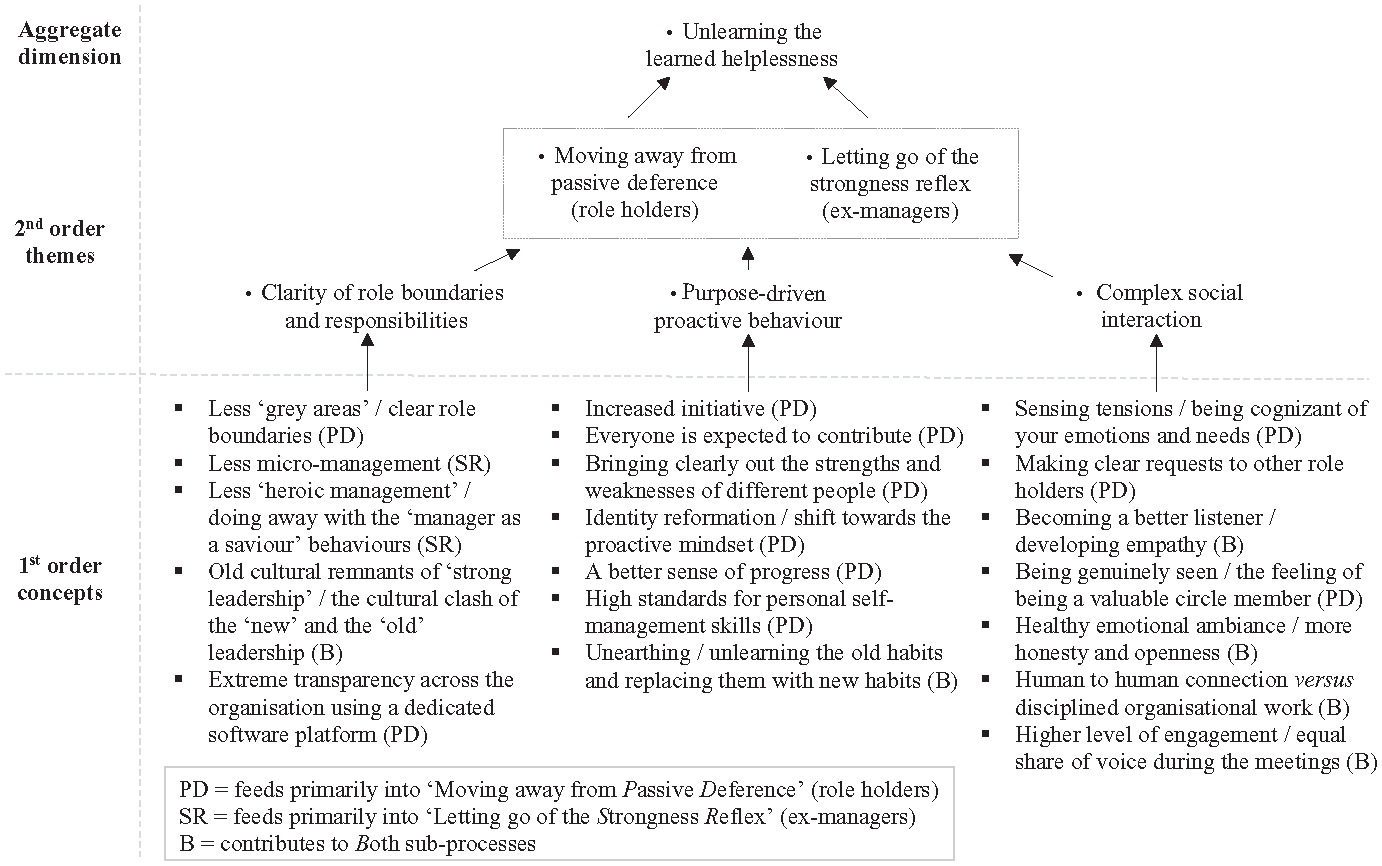
Data structure.
For role holders, the sub-dimension “moving away from passive deference” drew from a range of first-order codes (PD), including “identity reformation,” “shift toward the proactive mindset,” “unearthing/ unlearning old habits,” and “high standards for personal self-management skills.” These codes captured an inner transformation process in which individuals had to recognize, accept, and eventually enact the authority embedded in their roles, shedding behaviors conditioned by hierarchical structures.
In parallel, the sub-dimension “letting go of the strongness reflex” surfaced among former managers. First-order codes marked SR—such as “old cultural remnants of strong leadership,” “the cultural clash of the ‘new’ and the ‘old’ leadership,” and “less heroic management”—revealed a persistent reflex to intervene, direct, or “save” the team. These patterns highlighted the challenge of releasing ingrained managerial instincts.
Together, these two sub-dimensions—moving away from passive deference and letting go of the strongness reflex—coalesced into the overarching aggregate dimension of unlearning the learned helplessness. This aggregate dimension provided a powerful analytical lens for understanding whether and how employees internalized and enacted distributed authority.
And finally, I integrated insights from this analysis to develop a conceptual framework (see Figure 2) that outlines the key boundary conditions necessary for the effective enactment of distributed authority. The data structure (see Figure 1) provides a link between first-order codes, second-order themes, and aggregate dimension, enabling readers to trace the inductive-abductive path from raw data to conceptual framework (Gioia et al., 2013).
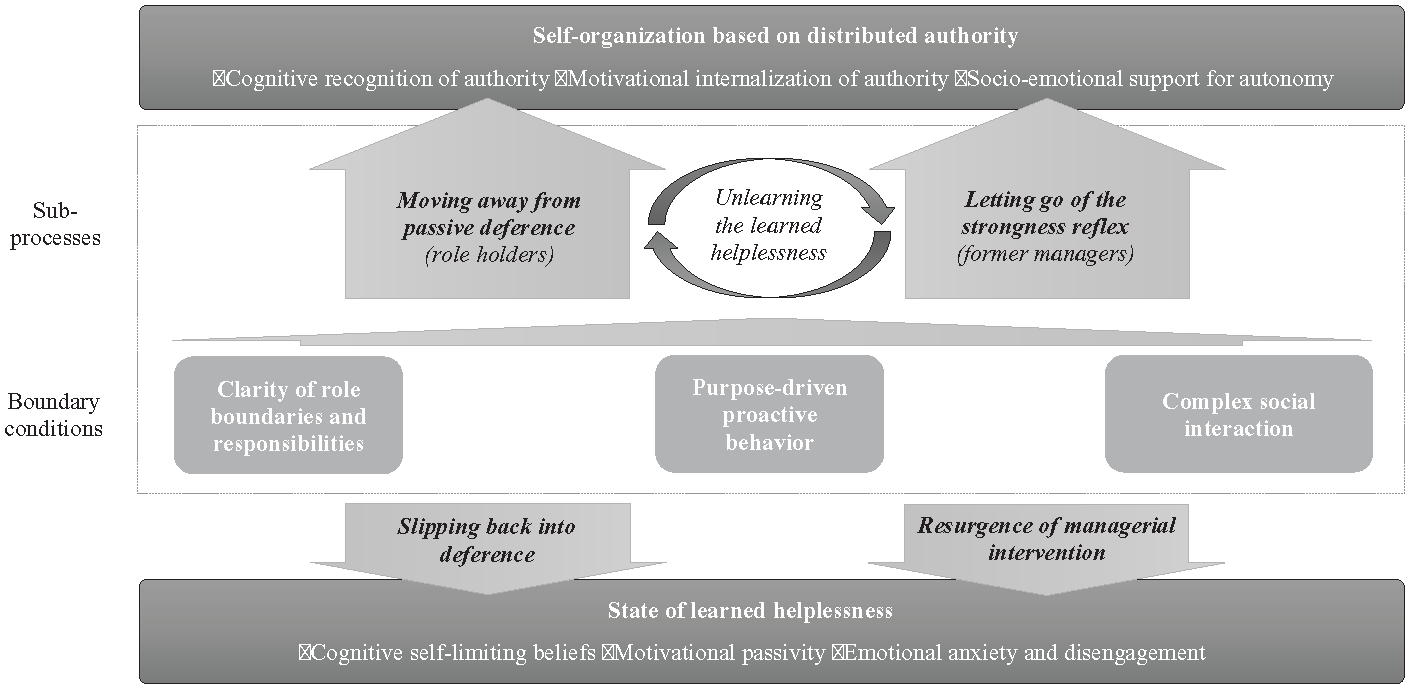
A dynamic model of human-centered boundary conditions and associated sub-processes that support the emergence of self-organization.
In addition, I used vignettes to enrich the analytic process and bring emerging themes to life. Woven into the Findings, these short, real-world narratives anchor the conceptual interpretation in concrete field experience (Jarzabkowski et al., 2014). They provide vivid, context-rich illustrations that make the boundary conditions more immediately graspable.
Researcher positionality and reflexivity
My initial assumption was that Holacracy’s structured approach to distributed authority would naturally empower individuals. Sustained engagement in the field challenged this view. My background in psychology and psychotherapy sensitized me to subtle signs of withdrawal, avoidance, and conditioned passivity—a kind of intuitive attunement that, as Kump (2021) notes, typically remains unarticulated in empirical accounts—ultimately leading me to identify learned helplessness as a core phenomenon in the adoption process. Combined with my practitioner pre-understanding, this perspective functioned as an “interpretation enhancer” and “horizon expander” (Alvesson and Sandberg, 2022), enabling deeper engagement with the empirical material and opening novel avenues for theorizing.
My liminal position as both practitioner and researcher (Kreiner and Joshi, 2021) required deliberate boundary work to navigate tensions between involvement and analytical distance. I engaged in relational reflexivity (Hibbert et al., 2014), testing early interpretations with colleagues and participants, and used structured tactics—such as post-session audio journaling, temporal separation of coaching and analysis, and signaling when I spoke as a coach versus as a researcher—to minimize role confusion and mitigate over-identification.
This dual role also introduces methodological limitations. As a single-author practitioner–researcher, my interpretations are situated and shaped by my experiential background. While reflexive journaling, stakeholder feedback, and temporal distancing helped temper these risks, the findings should be read as generative theorizing rather than detached objectivity.
In the following sections, I draw upon exemplary power-quotes, autoethnographic reflections, and vignettes to illustrate the results of the data analysis. Observations of emotional reactions, moments of surprise, and interpretive shifts during fieldwork are treated as data, offering additional insights into the human experience of Holacracy adoption. Direct participant accounts and researcher interpretations are distinguished where appropriate to maintain transparency while honoring the methodological foundations of autoethnography.
Findings
Analysis of the collected data yielded several key insights, grouped into three overarching second-order themes (see Figure 1) that enable two interlinked sub-processes—moving away from passive deference and letting go of the strongness reflex—culminating in the aggregate phenomenon of unlearning the learned helplessness.
Clarity of role boundaries and responsibilities (cognitive dimension)
The adoption of Holacracy required a fundamental restructuring of work and authority. Decision-making authority shifted from managers to role holders, now tasked with “energizing” their roles within clear authority boundaries. This shift was enabled by a formalized governance process requiring continuous updating and clarification of roles.
The initial resistance to clarifying role boundaries was evident early on. Many viewed it as an unnecessary bureaucratic burden, asking, “Why do we need this? We already know what we do.” In my early autoethnographic reflections, I noted a deep-rooted hesitancy toward practices that made work more transparent—what I initially interpreted as a fear of being controlled or disciplined. From my perspective as a Holacracy practitioner, the intent behind transparency was to create clarity and reduce ambiguity. Yet, I came to see that such transparency could also be experienced as unsettling exposure, particularly in environments where trust in the new framework had not yet been established. Initially, some participants perceived Holacracy’s governance process as overly complex and highly formalized, which appeared to contribute to hesitation or delay in engaging with role clarification efforts. A role holder from a sales circle that was initially hesitant about Holacracy remarked: “The first reaction is confusion. Holacracy is not something you can easily explain; it has to be experienced. But until we started practicing, the ambiguity created resistance.” Role holders’ hesitation to acknowledge their authority and perceive governance as empowering illustrates the cognitive dimension of learned helplessness—the difficulty of recognizing or trusting that control has shifted internally.
Drawing on my prior experience as a practitioner working with Holacracy, I recognized the act of clarifying role boundaries as serving a dual purpose: establishing clear authority and reducing coordination issues. This perspective informed my attention to how participants engaged with role definition during the fieldwork. In practice, several participants appeared to gain greater clarity about what decisions fell within their authority and where the boundaries of their accountability lay. The ongoing clarification of roles gradually raised awareness of the need for transparency and prompted reflection on the vagueness that had previously characterized participants’ jobs. Under the old system, managers could adjust job boundaries as they saw fit, stretching or redefining them based on the situation or context. The shift toward clearly defined, role-based authority marked early steps in role holders’ movement away from passive deference and required former managers to relinquish long-standing discretion in shaping others’ work, prompting them to recalibrate how they related to circle members whose work they previously supervised. A cross-circle role holder who contributed to internal Holacracy training efforts remarked: “Our business and processes are complex. [. . .] There is a lot of ‘grey area’ at the moment. When the roles are described more precisely, that ‘grey area’ starts to peel away and we can deal with things more effectively.”
To facilitate this process, “Holaspirit,” the software platform used to manage roles, became a central tool. Role holders regularly consulted it to better understand not only their own responsibilities but also those of others in their circle. Meetings frequently involved pulling up role descriptions to clarify boundaries or revise them when gray areas or overlaps persisted. Over time, the platform became a frequently used reference point for role-related information, gradually taking the place of traditional job descriptions that were often static and less integrated into daily workflows. This transparency enabled everyone to know who was responsible for what, fostering accountability and reducing dependency on hierarchical authority structures. A member of the HR circle involved in organizational development described the impact succinctly: “The clarity around roles brought focus. People stopped jumping into issues that were not theirs and started owning their areas.”
A particularly illustrative moment of this dynamic occurred during a governance meeting in early 2022, when the organization faced new challenges related to COVID-19 protocols (see Vignette 1 in the Vignette box).
Clarifying a role.
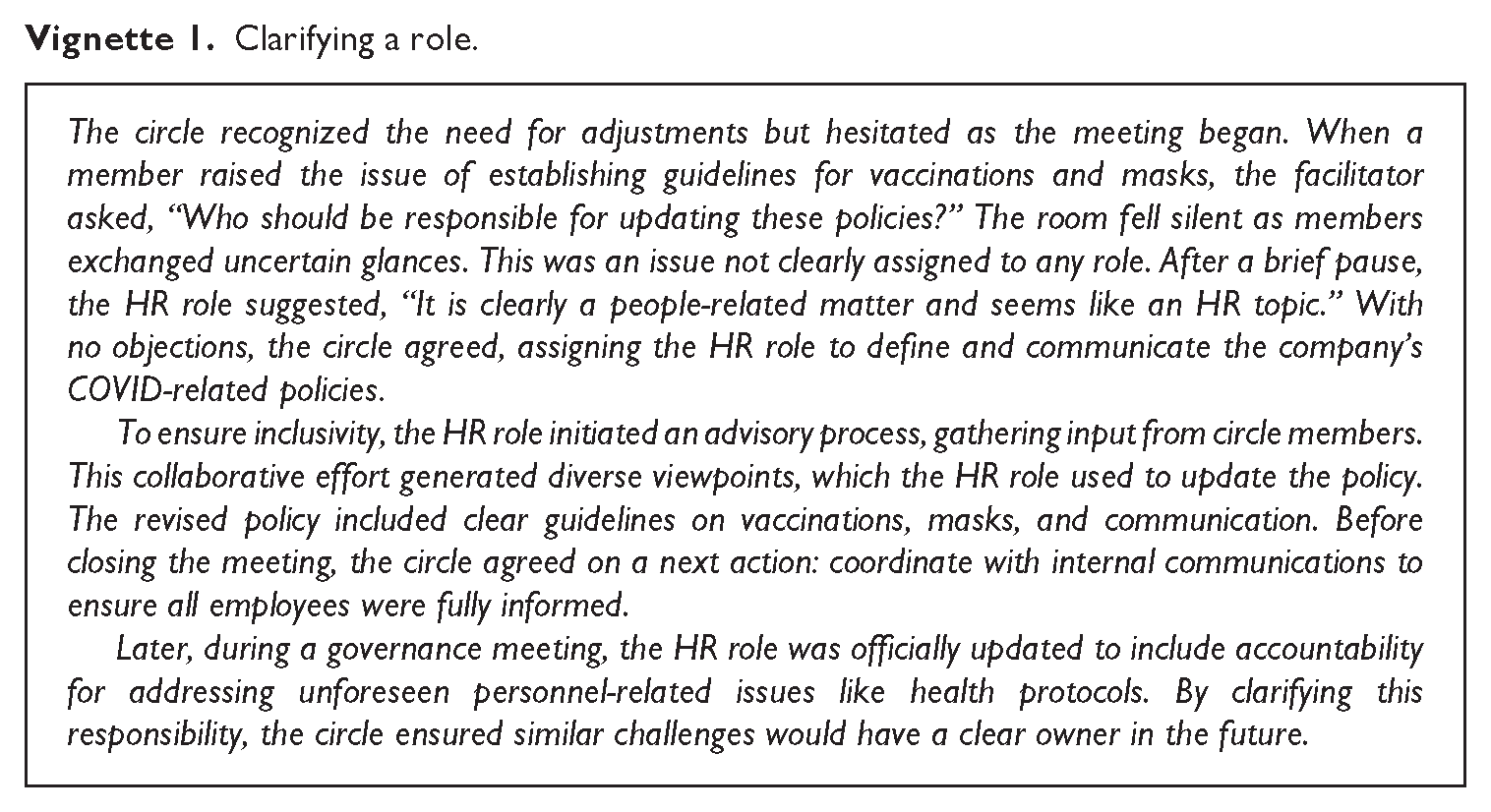
The first vignette highlights how Holacracy’s governance framework addressed gray areas by clarifying boundaries and redefining responsibilities. Yet, the process of reaching this clarity was not without challenges. For many role holders, achieving precision required sustained effort, active engagement, and a willingness to adapt to an unfamiliar level of formalization.
Over time, as role boundaries were constantly refined, circles experienced a shift in focus and ownership, as noted by a participant holding multiple roles, including a facilitator role in the general company circle: “Holacracy helps to really set the role boundaries and gives the opportunity to very clearly agree on the responsibilities. It should give everyone a very clear, simple base to handle their duties. It reduces being dependent on your [previous] manager.”
Over time, the formalized governance process—while often described by participants as complex and initially overwhelming—appeared to contribute to a more structured and transparent working environment. Several role holders reported that reducing gray areas and overlaps in responsibilities helped them act with greater decisiveness within their domains. These moments reflected a shift from role confusion to clearer ownership and distributed accountability. However, this shift was not uniform, and not all participants experienced it as empowering; for some, the process remained cognitively demanding and emotionally taxing.
Purpose-driven proactive behavior (motivational dimension)
Even with clearly defined role boundaries, many role holders found it challenging to step into their authority and act decisively within the scope of their roles. This shift required role holders to adopt a leadership mindset within their domains, often an unfamiliar and uncomfortable change. As a role holder from a project management circle still in the early stages of Holacracy adoption critically noted, “People do not take the ownership immediately. Even when you tell them, ‘This is your role and this is your decision,’ they look around the room for others to validate it.”
The transition was marked by hesitation, anxiety, and uncertainty, as role holders grappled with the unfamiliar responsibility of asserting authority, even when it was explicitly granted. A member of the project design circle reflected the struggle of transitioning from dependence to autonomy, “At first, it is overwhelming. You are suddenly told, ‘This is your domain, you are responsible,’ but what if you get it wrong?” Overcoming ingrained habits of dependency on validation made it difficult for role holders to fully embrace their responsibilities.
The challenge was not merely procedural but deeply psychological. This recurring hesitation to act, even in the presence of full authority, is not simply habit or resistance; it reflects the motivational effect of learned helplessness, where prior experiences of external control condition individuals to project agency outward. This hesitation often became apparent in meetings, where role holders deferred to former managers or circle members with higher informal status, despite having clearly defined authority. As a role holder actively involved in training and facilitation across circles reflected on the group dynamics in meetings, “There is this moment of hesitation in meetings where people just wait—wait for someone to speak up, wait for someone to take the lead. But that is not how it works anymore.” A newly appointed facilitator in the sales circle shared how ingrained habits resurfaced: “Even when my role is clear, I still do not feel comfortable being pushed to decide on my own.”
Some participants reported experiencing an increased sense of autonomy as they became more familiar with Holacracy, despite encountering initial difficulties. One role holder from the project design circle described the empowerment that came with leading their role: “For me, the biggest shift was understanding that my role is mine to lead. No one else is going to step in and that is both terrifying and empowering.” Personal responsibility, initially challenging, gradually became a source of strength as many role holders learned to use their authority effectively. A member of the younger leadership generation, now serving as a circle lead and respected internally as an opinion leader, noted: “The discussion about the exact wording [of a role]—and developing a real understanding of the role’s aims—is very valuable. [. . .] I think ‘the purpose of the role’ is also [a heuristic] tool that helps people [make decisions].”
Placing a person in a role with full authority to make decisions in pursuit of a specific purpose required not only a deep sense of responsibility but also significant demands on his or her self-leadership. Role clarity and distributed authority, albeit slowly, increased initiative and proactivity, as noted by one of the circle leads: A good example [of increased initiative] is a meeting that took place last week which I did not attend. I only received the report, and I could see that it had been a meaningful meeting. There were important topics and concrete outputs—I would not have imagined something like that being possible half a year ago.
These episodes illustrate how assuming responsibility for role purpose gradually replaced habitual deference with self-authorized action, while also reducing former managers’ perceived need to step in and “carry” the decision process. Former managers no longer bore the full weight of responsibility, as the stress was now shared across all role holders within the circle. Each member had the capacity to drive progress, creating a more balanced and collaborative environment. At the same time, former managers confronted the opposite challenge: learning to hold back instead of stepping in. It was evident how difficult it was to resist ingrained intervention reflexes, even when doing so would have undermined others’ autonomy (see Vignette 2 in the Vignette box above).
Embodying and energizing a role.
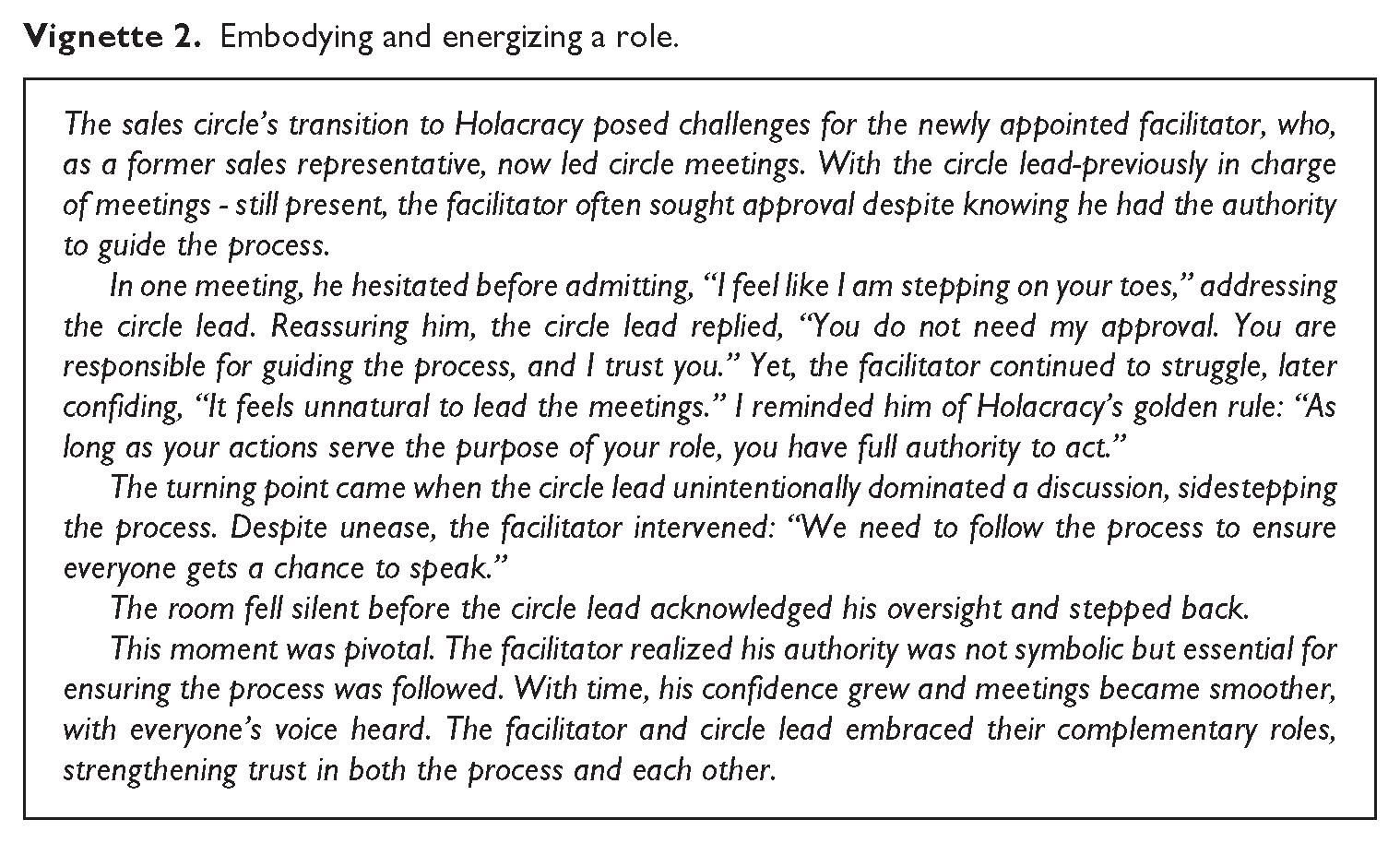
The second vignette highlights how, even with clearly defined role authority, some circle members remained hesitant to act without continuous encouragement from the circle lead. For Holacracy to succeed in this instance, the circle lead needed to actively reinforce the boundaries of their own authority and encourage the newly appointed facilitator to confidently step into his new role.
Complex social interaction (emotional dimension)
Beyond the challenges of clarifying and acting upon role boundaries, many participants struggled to engage with Holacracy’s concept of “processing tensions into meaningful change” (Robertson, 2015: 14). Before Holacracy, participants relied on superiors to make decisions and resolve conflicts. Now, they alone became fully responsible for sensing and processing tensions related to coordination and collaboration. However, emotions, dismissed as unprofessional, were rarely discussed, leaving participants with a limited vocabulary for articulating tensions.
This lack of practice left role holders struggling to express themselves effectively. “Holacracy asks us to pay attention to what we feel and sense. But for me, that feels entirely out of place. I am not used to discussing my personal stuff with colleagues like that,” shared an interviewee from the project design circle with a strong engineering background. At the time, I struggled to frame “sensing tensions” as a legitimate skill in the eyes of participants. In my autoethnographic reflections, I noted how easily emotional awareness was dismissed as unprofessional, which made the legitimacy of these practices difficult to establish. I noticed that this disconnect made it hard for role holders to link internal states with their role performance. One interviewee, formerly part of the top management team and now a member of the general company circle, reflected on the past, “People would just ‘power through.’ If something felt off, they would not openly talk about it.” For many, the idea of sensing and expressing tensions felt distant, even irrelevant, to the workplace.
This shift required heightened self-awareness and responsibility for felt tensions. Identifying and addressing tensions was challenging and required practice, as the following autoethnographic note illustrates an early moment of sensemaking during my time embedded with the organization: We are immersed in our routine activities and often trivialize the tensions we experience. This tendency stems from a learned belief that most of these issues are beyond our control. [. . .] We seldom take the time to deliberately pay attention to them or discuss them openly; instead, we tend to silently carry them with us.
This reflection emerged from observing how frequently participants downplayed minor tensions or interpersonal disconnects in meetings. While Holacracy emphasizes responding to tensions, it became evident that cultivating the felt sense of these tensions—and giving oneself permission to express them—was a developmental process in itself. The corresponding emotional reactions—anxiety and uncertainty—constitute the affective expression of learned helplessness, where ingrained expectations of external control create dissonance when individuals are asked to self-govern.
Participants’ struggles and gradual improvements in articulating tensions resonated with Holacracy’s conceptual framing of individuals as “sensors” of organizational reality (Robertson, 2015: 4). But this remained aspirational for many in the early stages. Developing the ability to notice tensions, articulate needs, and make requests appeared crucial for navigating their roles effectively. This was reinforced in another autoethnographic note where I reflected on the interpersonal demands of making requests: “In Holacracy, a crucial skill is the ability to clearly articulate what your role needs from others—whether it is action, collaboration, attention, or setting new expectations. [. . .] The real challenge is becoming comfortable with making deliberate and clear requests.”
At the time, this insight was informed by witnessing moments where requests were avoided, delayed, or mishandled—often because of emotional discomfort, fear of rejection, or uncertainty about authority. While informed by my practitioner knowledge, this reflection emerged in dialogue with what I observed participants grappling with in practice—particularly the challenge of translating role authority into confident, respectful requests.
Role holders had to develop the ability to clearly articulate their needs based on the tensions they experienced—a significant challenge for those unaccustomed to voicing personal or emotional concerns in a professional setting. This transition was supported by the highly participatory meeting formats employed in Holacracy. As reflected in comments from experienced members of the general company circle: The clear division of roles and the CEO stepping aside from leading the meetings have supported openness. I think that there is less of his [CEO’s] voice during the meeting. You could say that previously, most of the topics were initiated by him. Today, there are more others’ voices.
Another general company circle member described how Holacracy encourages active engagement from all and provides a safe space for everyone to share, ensuring that those who may have previously been left out of discussions now have the opportunity to be heard: “Holacracy brings it [your stance] out very clearly since it does not really leave the option to stay out of the discussion. It gently demands participation—speaking out, in a way.”
This also necessitated that participants develop active listening skills. A former manager reflected on how stepping back from leading meetings allowed him to become a better listener, appreciating others’ perspectives and competence: “Now, when I do not have to carry the meeting, I can just listen to what other people are talking about, and I feel more in tune with their opinions and can appreciate their competence.” This shift towards active listening and acknowledging others’ perspectives is a good example of how the socio-emotional aspect of role leadership—being more present and attuned to others—helps to address tensions in ways that foster collaboration and growth. For former managers, this often meant replacing habitual directing with listening and co-sensing, marking a significant relational reorientation (see Vignette 3 in the Vignette box).
Tension-processing.
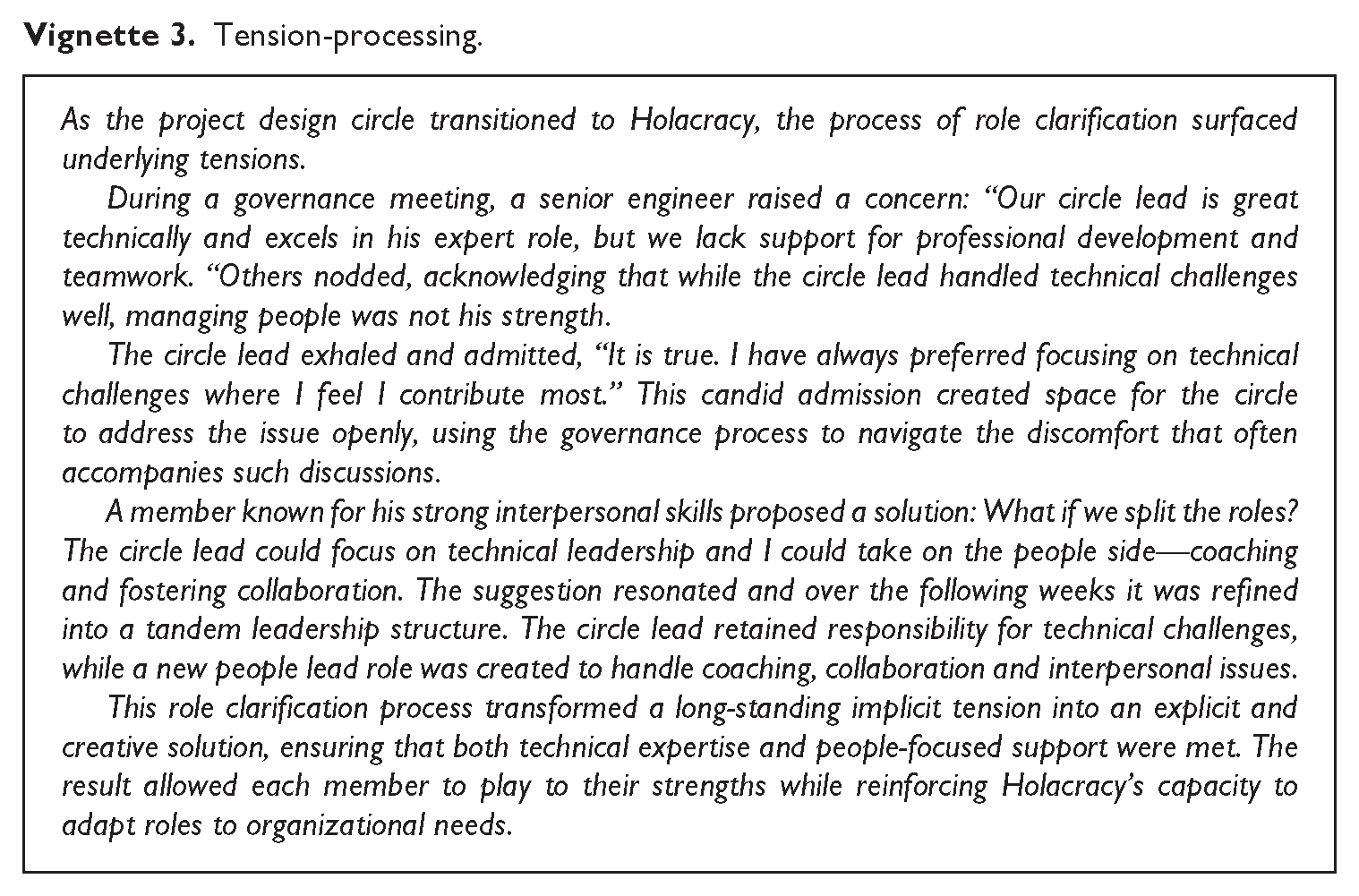
The third vignette illustrates how Holacracy enables circles to turn tensions into experimental solutions. By delicately addressing the tension between the circle lead’s technical strengths and the lack of people management skills, the circle was able to propose a new, tandem leadership structure that was a relief to everyone involved. Over time, such interactions not only supported role holders in sustaining action without hierarchical reassurance but also enabled former managers to remain present without reverting to directive authority—thereby reinforcing both sub-processes of unlearning the learned helplessness.
Unlearning the learned helplessness: Moving beyond deference and the strongness reflex
As highlighted by the previous themes, a key dynamic during the transition was a phenomenon I refer to as “unlearning the learned helplessness.” Distributed authority necessitated a reframing of roles and relationships with former managers and colleagues. It became clear that many of the habits formed under traditional authority hierarchy no longer served participants in Holacracy, as reflected in an autoethnographic note: I can see people intellectually grasp the idea that managers who make all the final decisions are a thing of the past. [. . .] In practice, it is common to see them revert to old habits, seeking guidance from their previous manager with questions like—‘What should we do about this?’—instead of taking the shot themselves or identifying the role that is responsible for the decision.
Working within role boundaries often left role holders hesitant and uncertain about how to exercise their authority, particularly in the presence of former managers. This hesitation stemmed from a perception that their authority was still subordinate to that of former managers, despite Holacracy’s explicit design to elevate all role holders to the same level of authority within their defined scope.
The cultural context that participants had experienced prior was rooted in authority hierarchy, where respect for higher ranks was ingrained, often discouraging role holders from exercising their authority or questioning decisions of higher-ups. Many were accustomed to relying on authority figures to define priorities, solve problems, and validate decisions. This dependency left them hesitant to take initiative or trust their own judgments, as they were used to deferring to managers for guidance and approval. As one leadership-level interviewee, conscious of both past influences and future possibilities, reflected: “I think people’s experiences and beliefs about how management should be done—and what has worked in the past [can become an obstacle to the Holacracy adoption]. If you have worked in different kinds of companies shaped by Soviet-era culture, your understanding of leadership and successful management systems is very different.”
This underscores how past experiences in hierarchical organizations, particularly in culturally specific contexts, shaped role holders’ deeply held beliefs about leadership. These beliefs created a significant obstacle to embracing Holacracy, as role holders found it difficult to reconcile Holacracy’s expectations of self-management with their prior understanding of what effective leadership looked like. A senior leader reflecting on the internal tension between past authority and present expectations under Holacracy shared: We have people in our circle who think that it is a sign of a weak leader [if they do not have the last say]. This also creates an inner dilemma [for me] and the question of whether I do or do not speak up at the meeting. People who are used to more traditional management expect clear, strong leadership, which for them means that the manager talks and decides by themselves. Maybe they even ask for others’ opinions, but then they make the final decision. And if the leader does not lead ‘strongly,’ people [in this particular frame of mind] think the leader does not have control over the company.
These habits of deferring to former managers and expecting strong leader intervention are surface manifestations of a latent psychological state consistent with the learned helplessness. While participants did not describe themselves as helpless, their behaviors reflected a generalized expectation that meaningful control resides outside of themselves. The perception that they had little control over their environment led to disengagement and a reluctance to take initiative. In Holacracy, unlearning required confronting the mindset that someone else would fix problems. It was not merely about changing actions—it required a deeper shift in how they saw themselves, their roles, and others.
Former managers, used to authority from rank, struggled with losing control over decisions. Distributed authority forced former managers to redefine their professional identity. Their previously well-defined roles, grounded in managerial status, were no longer relevant in the new framework. As noted in my autoethnographic reflections: Managers frequently anchor their self-perception in their authority: ‘If I no longer have the managerial status to make decisions, what purpose do I serve then?’ Their self-esteem is often tied to the notion, ‘My worth is contingent upon my decision-making power.’ In the context of Holacracy, this assumption is radically challenged. They must forge a new sense of professional identity and create a fresh narrative about why they are still a valuable and significant part of the organization without the formal power of a manager.
There were instances where former managers felt compelled to step in as heroic leaders, particularly in moments of silence, hesitation, or uncertainty. Accustomed to resolving bottlenecks and driving progress, they often felt a sense of responsibility to take charge and help the circle overcome obstacles, even when the situation fell outside their role’s authority. Overstepping boundaries undermined distributed role-based authority. Former managers’ tendency to step in as heroic leaders illustrates the active side of the same dependency: a learned strongness reflex that complements passive helplessness in sustaining hierarchical patterns. It not only disrupted the system but also discouraged role holders from fully engaging with their responsibilities, reinforcing old habits of dependency and diminishing the shift toward distributed authority (see Vignette 4 in the Vignette box).
Unlearning the learned helplessness.
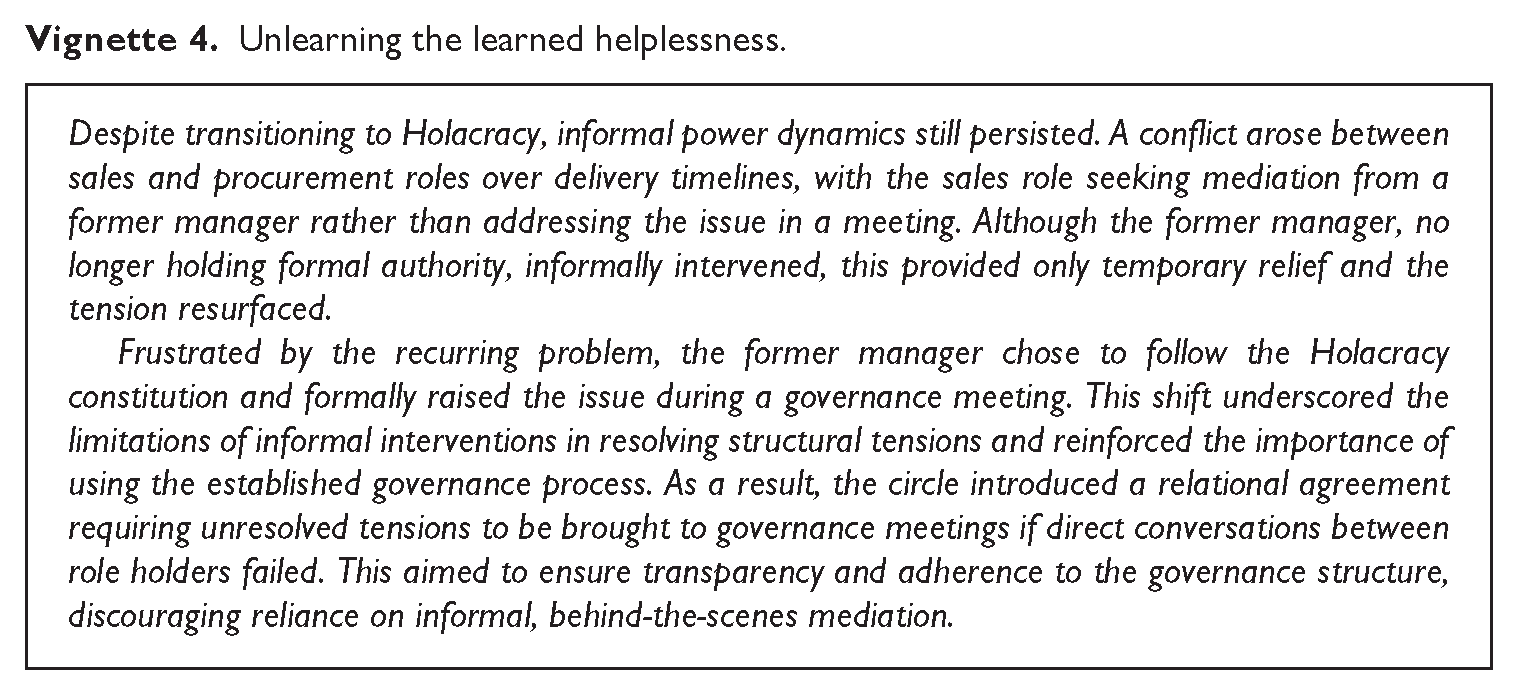
The fourth vignette underscores the ongoing struggle to dismantle hierarchical reflexes and build trust in Holacracy’s processes. While many role holders made progress, the journey of unlearning was neither linear nor uniform. Some role holders flourished within the new framework, while others continued to revert to old habits, seeking validation from their former managers. Similarly, former managers grappled with finding their place in an organization where authority derived from roles rather than rank. Ultimately, unlearning the learned helplessness required a collective effort to build new habits, trust the governance structure, and challenge deeply ingrained behaviors.
How boundary conditions counteract learned helplessness: An integrative view
Learned helplessness has been understood as a multidimensional construct, encompassing cognitive, motivational, and emotional effects (Maier and Seligman, 1976, 2016). The boundary conditions that emerged from the data show how each effect can be counteracted. Clarity of role boundaries and responsibilities mitigates cognitive distortions by making authority visible and actionable, purpose-driven proactive behavior counters motivational passivity by internalizing the authority and channeling energy toward role purpose, and complex social interaction alleviates emotional strain by embedding relatedness and collective sensemaking into organizational life. These counteractions overlap, mutually reinforce, and influence all three dimensions of learned helplessness.
A first manifestation of learned helplessness is cognitive distortion: individuals fail to recognize opportunities for control, even when present (Maier and Seligman, 1976, 2016). In this study, role holders understood that Holacracy’s constitution granted them authority, yet they frequently behaved as though managerial approval was still required. Role holders deferred decisions, avoided surfacing tensions, and sidelined governance meetings. These responses reflected a failure to acknowledge and interpret authority, consistent with prior research showing that employees in self-managing organizations often struggle to reframe authority (e.g. Bremer et al., 2025; Druskat and Pescosolido, 2002).
The clarity of role boundaries and responsibilities directly addresses this cognitive effect by making authority visible, interpretable, and actionable. When managerial authority recedes, individuals may struggle to recognize discretion that is no longer externally conferred. In such contexts, role clarity does not merely replace managerial guidance but functions as an autonomy-supportive condition that renders authority psychologically recognizable as a locus of personal discretion. Explicit role definitions and reduced role ambiguity substitute for the lost managerial anchor and are among the strongest predictors of psychological empowerment (Spreitzer, 1996).
The recognition of the boundaries of authority, however, is not sufficient on its own. In this study, role boundaries reduced ambiguity and acted as autonomy-supportive cues, but their role was primarily cognitive: they enabled awareness of control. While not yet ensuring internalization, they formed a precondition for later endorsement and enactment of authority.
A second major effect of learned helplessness is motivational withdrawal. When individuals experience prolonged uncontrollability, they default to passivity and inaction, even when opportunities for control arise (Maier and Seligman, 1976, 2016). This dynamic was evident in the study, where role holders, despite having explicit authority to act and decide, hesitated to take initiative. Role holders deferred to former managers for validation, postponed decisions until peers endorsed them, or avoided addressing tensions altogether. These patterns reflected not resistance to change but a residual imprint of earlier uncontrollable conditions (Maier and Seligman, 2016), in which initiative was conditioned to stem from managerial direction rather than self-directed agency. This aligns with prior research showing that, during the transition to distributed authority, employees often struggle to take initiative as they are conditioned to rely on hierarchical approval (e.g. Sturdy et al., 2016).
The boundary condition of purpose-driven proactive behavior counteracts this motivational deficit by supporting the internalization of authority. Once individuals recognize the authority vested in their roles, the next step is to psychologically endorse it as their own. This internalization shifts attribution from external managers to the self, transforming passivity into initiative. In this study, genuine moments of self-organization occurred when role holders moved beyond acknowledgment of their authority and began to act proactively from their role purpose rather than waiting for managerial validation. This mechanism aligns closely with self-determination theory, which emphasizes that autonomy emerges when individuals experience choice and self-endorsement of their actions (Ryan and Deci, 2017). Similarly, empowerment research underscores the experience of choice as a central factor enabling action (Thomas and Velthouse, 1990).
Learned helplessness also produces emotional consequences. Prolonged uncontrollability fosters anxiety and disengagement (Maier and Seligman, 1976, 2016). These dynamics surfaced strongly in the study. Role holders reported unease when asked to make decisions alone, expressing fears of “getting it wrong.” Several participants became silent and disengaged in meetings, while former managers described feeling “lost” without the authority to decide for others. These responses underscore—consistent with prior research—that distributing authority is not only a cognitive and motivational process but also an emotional one, accompanied by anxiety and fear (e.g. Hoffmann, 2015; Kantola and Kinnunen, 2024).
The boundary condition of complex social interaction counteracts these emotional effects by embedding authority enactment in collective processes. Structured forums such as tactical and governance meetings allowed role holders to articulate tensions, receive feedback, and experience validation from peers. These repeated interactions created relational support, buffering against anxiety. In self-determination theory terms (Ryan and Deci, 2017), they fulfilled the need for relatedness, ensuring that autonomy was felt as a shared practice that fostered a participative climate (Spreitzer, 1996).
In sum, complex social interaction serves as an emotional stabilizer: alongside acknowledgment (countering the cognitive effect) and the internalization of authority (countering the motivational effect), it enables individuals to withstand the emotional turbulence of autonomy. By embedding authority enactment in a supportive social fabric, it mitigates fear, sustains engagement, and makes distributed authority psychologically viable.
Taken together, the boundary conditions identified in this study can serve as counterforces to the tripartite effects of learned helplessness. The following section introduces the dynamic model (Figure 2), which explains how the cycle of learned helplessness is reproduced through deference and managerial intervention, and how the boundary conditions, when enacted consistently, can gradually dismantle this cycle and sustain self-organization.
A model of the human-centered boundary conditions for self-managing organizations
Figure 2 synthesizes how the three boundary conditions along with the two sub-processes interact with the effects of learned helplessness. Whereas the previous section described how each condition can serve as a counterforce to the three deficits, the model illustrates the dynamic framework in which these mechanisms unfold. It highlights both the vicious cycle that sustains hierarchical dependency and the counterforces that gradually dismantle it.
At the center of this cycle lies the phenomenon of dominance complementarity (Tiedens and Fragale, 2003; Tiedens et al., 2007). Employees conditioned by managerial authority tend to defer, instinctively seeking validation or approval before acting (e.g. Anderson et al., 2012). Former managers, in turn, experience a strongness reflex—a compulsion to step in, guide, or decide—even when their authority is no longer formally recognized (e.g. Foss, 2003). These two behaviors reinforce one another: deference invites intervention and intervention strengthens deference. Left unchecked, this loop reproduces hierarchical dynamics and reifies learned helplessness.
The boundary conditions and the two sub-processes identified in this study function as systemic counterforces to the cycle, fostering the unlearning of the learned helplessness through distinct yet interconnected pathways. Clarity of role boundaries and responsibilities interrupts habitual deference by making authority interpretable, visible, and actionable (e.g. Spreitzer, 1996). In hierarchical settings, managers establish clarity through their authority; once this reference point is removed, employees may not yet fully embrace it. Explicit role definitions substitute for the lost managerial anchor, allowing role holders to cognitively comprehend where their authority begins and ends.
Clarity of role boundaries and responsibilities supports both sub-processes of unlearning the learned helplessness by making authority cognitively visible and legitimate. Deference often reflects conformity to perceived expectations about one’s appropriate rank rather than a lack of competence (Anderson et al., 2012); by making decision authority explicit and role-bound, this boundary condition disrupts these expectations, enabling role holders to move away from passive deference while reducing ambiguity about when former managers’ intervention is legitimate and thereby supporting the letting go of the strongness reflex.
Once authority is acknowledged, it must also be internalized. The shift to purpose-driven, proactive behavior requires individuals to psychologically endorse authority as their own and act upon it (Ryan and Deci, 2017). The internalization of authority progresses from introjected regulation (acting out of “shoulds” and self-pressure), toward identified regulation (personally valuing the authority embedded in one’s role), and ultimately to integrated regulation (aligning that authority with one’s sense of self)—a developmental shift in which the perceived locus of causality moves from external expectations to internal endorsement (Gagné and Deci, 2005). In this sense, internalization transforms awareness into action, providing the motivational backbone for distributed authority. Because individuals often defer when they doubt their value or fear violating implicit status expectations (Anderson et al., 2012), enacting role purpose enables role holders to move away from passive deference, while their proactive engagement simultaneously reduces former managers’ perceived need to intervene and supports the letting go of the strongness reflex.
Finally, the enactment of authority must be emotionally sustained, with complex social interaction playing a central role. When autonomy follows a prolonged cycle of learned helplessness, it can elicit emotional strain and even fear (e.g. Hoffmann, 2015; Kantola and Kinnunen, 2024). Structured forums for collective sensemaking—tactical and governance meetings in this case—provided the relational scaffolding that made autonomy bearable and ensured that authority was exercised in a context of relatedness and mutual support.
Complex social interaction provides the conditions under which the sub-processes of moving away from deference and letting go of the strongness reflex can be sustained by reducing anxiety about legitimacy and others’ judgments, which often underpin deference (Anderson et al., 2012). Shared sensemaking makes it emotionally safer for role holders to act without approval and for former managers to remain non-interventionist, thereby stabilizing movement away from deference and supporting the letting go of the strongness reflex.
Seen together, the three boundary conditions weaken the feedback loop of deference and strongness by addressing learned helplessness at cognitive, motivational, and emotional levels. Acknowledgment without internalization leaves individuals hesitant to act; internalization without emotional support risks stress and withdrawal. Only when authority is made visible, internalized, and emotionally sustained in combination do role holders make autonomous decisions and coordinate laterally without managerial mediation.
This dynamic resonates with empowerment research showing that clarity, choice, and supportive climates strengthen individuals’ sense of agency (Spreitzer, 1996; Thomas and Velthouse, 1990); and with self-determination theory, which emphasizes the nurturing of autonomy, competence, and relatedness as foundations of sustained intrinsic motivation (Ryan and Deci, 2017). In this sense, the model underscores that successful self-organization depends not only on structural design but also on the continuous maintenance of human-centered boundary conditions. The findings of this study, together with decades of research on learned helplessness, reinforce that removing uncontrollability is insufficient (Maier and Seligman, 2016). Agency does not automatically emerge when hierarchical constraints are lifted; rather, it must be repeatedly enacted for individuals to develop a sustained expectation of control. Distributed authority can be sustained only when the psychological legacies of hierarchy are actively unlearned and replaced with practices that cultivate acknowledgment of authority, its internalization, and the emotional regulation required to enact it.
Contributions to theorizing distributed authority and self-managing organizations
This study contributes to debates on the viability of self-managing organizations by reframing the adoption of distributed authority as a psychological transition rather than a problem of cultural resistance, cognitive limitation, or emotional strain taken in isolation, even when formal structures are redesigned. Prior research has documented multiple barriers to decentralizing authority, including the persistence of hierarchical norms and informal authority relations (e.g. Anicich et al., 2024; Josserand et al., 2006; Vallas, 2006), difficulties in developing shared mental models of ownership and authority (e.g. Bremer et al., 2025; Druskat and Pescosolido, 2002), and the emotional burdens associated with autonomy, such as anxiety and withdrawal (e.g. Hoffmann, 2015; Kantola and Kinnunen, 2024). While these accounts offer important insights, they remain dispersed across explanatory domains and provide limited leverage for explaining the deeper psychological processes that generate these barriers as interconnected expressions of a common underlying phenomenon. Building on this literature, the present study shows that the viability of distributed authority hinges on how individuals internalize and enact the authority embedded in self-managing organizations. Drawing on learned helplessness theory (Maier and Seligman, 1976, 2016), I argue that prolonged exposure to hierarchical organizing produces enduring cognitive, motivational, and emotional residues that shape how individuals experience autonomy once external authority is removed. From this perspective, hesitation, deference, and managerial intervention in self-managing organizations reflect not resistance or incapacity, but a conditioned orientation toward external authority—helping explain why individuals often reproduce hierarchical patterns even in formally flatter structures (Gruenfeld and Tiedens, 2010). This reframing clarifies that adopting distributed authority entails a fundamental psychological shift in how authority is experienced and enacted, rather than a purely structural or normative change.
Building on this reframing, the present study explains why cultural, cognitive, and emotional barriers to distributed authority tend to co-occur and persist. A second theoretical contribution lies in introducing learned helplessness as an integrative psychological mechanism that brings coherence to previously fragmented explanations. Existing research has treated these multiple barriers as analytically distinct, describing what impedes decentralization without fully explaining why these impediments endure even after authority is formally redistributed. By employing learned helplessness theory (Maier and Seligman, 1976, 2016), this study provides a unifying lens that connects these observations through an underlying mechanism. Learned helplessness explains how repeated experiences of non-contingency cultivate expectations of external control, which manifest cognitively as difficulties recognizing authority, motivationally as reduced initiative despite formal autonomy, and emotionally as anxiety or withdrawal. This mechanism clarifies why cultural, cognitive, and emotional barriers are not distinct obstacles but interrelated expressions of the same conditioning. In doing so, the study shifts theorizing on distributed authority from cataloguing barriers toward explaining the psychological dynamics that sustain them.
A third theoretical contribution lies in developing a processual account of how distributed authority becomes internalized—or fails to become internalized—over time. Prior research has approached authority as formally granted or informally reconfigured through social interaction (e.g. Diefenbach and Sillince, 2011), paying limited attention to the psychological processes through which individuals come to experience themselves as legitimate agents of authority. Building on learned helplessness theory and the inductive model developed in this study, I conceptualize authority internalization as a fragile and non-linear process that unfolds through repeated cycles of acknowledgment, endorsement, and enactment. Individuals may recognize that authority has been redistributed yet still hesitate to act, defer to former managers, or seek validation, indicating that acknowledgment alone is insufficient for sustained self-directed agency. Internalization requires individuals to endorse authority as their own and to enact it repeatedly in practice, gradually recalibrating expectations shaped by hierarchical conditioning. Crucially, this process is reversible: setbacks, ambiguous authority cues, or renewed managerial intervention can reactivate learned helplessness and pull individuals back toward passivity and deference, often through relational dynamics in which deference invites dominance and dominance reinforces deference (Tiedens and Fragale, 2003; Tiedens et al., 2007). By foregrounding authority internalization as a temporal and precarious process rather than a punctuated transition, the study explains why early signs of self-organization often coexist with relapse into hierarchical patterns and why organizations may oscillate between hierarchical and decentralized modes of organizing even after formal authority has been redistributed (e.g. Lee, 2024).
A fourth theoretical contribution lies in reconceptualizing the boundary conditions of distributed authority as human-centered psychological capacities rather than as structural or contextual constraints. Prior research has tended to treat the viability of self-managing organizations as contingent on features of organizational design and task environments, such as task interdependence, coordination complexity, scalability, and the degree of output standardization (e.g. Martela, 2019). While such accounts offer insight into where self-managing arrangements may be structurally feasible, they position boundary conditions largely external to actors. By contrast, this study theorizes boundary conditions as conditions of psychological viability—the cognitive, motivational, and emotional capacities required for individuals to acknowledge, internalize, and enact authority in the absence of hierarchical control. The boundary conditions identified—clarity of role boundaries and responsibilities, purpose-driven proactive behavior, and complex social interaction—do not merely reduce coordination demands; they actively counteract the residual effects of learned helplessness by supporting responsibility-taking and emotional regulation under autonomy. In this sense, boundary conditions operate not as static moderators but as ongoing enabling conditions that must be cultivated if distributed authority is to remain viable over time.
A final theoretical contribution of this study lies in re-theorizing failure, relapse, and sustainability of distributed authority in self-managing organizations as predictable outcomes of ongoing authority internalization dynamics, rather than as deviations or breakdowns that signal abandonment of decentralization. Prior research shows that even when formal hierarchies are dismantled, organizations often revert to informal authority patterns through approval seeking (Vallas, 2006), selective managerial intervention (Foss, 2003), or temporary re-centralization of decision making under uncertainty (Lee and Young-Hyman, in press). Such dynamics suggest that setbacks in distributed authority are less about rejecting decentralization than about how individuals respond when autonomy becomes difficult to enact in practice. Extending these insights, the present study shows that relapse is fueled by the psychological residues of hierarchical conditioning. Sensemaking gaps can prompt reversion to familiar authority structures (Bremer et al., 2025), while residual hierarchical mindsets continue to shape how individuals interpret responsibility and agency (Druskat and Pescosolido, 2002). Managerial interventions—often intended as support—may further recondition employees to experience autonomy as provisional and approval-dependent (Foss, 2003). At times, managerial uneasiness may escalate into organized resistance and the restoration of hierarchy (Bourlier-Bargues et al., 2025). These tendencies are amplified by the emotional demands of autonomy, including anxiety, uncertainty, and the relational pull toward deference when responsibility feels overwhelming (Kantola and Kinnunen, 2024). From this perspective, oscillation between hierarchical and decentralized modes of organizing is not anomalous but an expected feature of distributed authority systems, given the enduring psychological pull of hierarchical ordering (Gruenfeld and Tiedens, 2010).
Extending these theoretical insights to practice, the findings suggest that autonomy must be internalized to become operational. By reframing the adoption of distributed authority as a psychological transformation rather than merely a structural shift, this study adds a psychological layer to accounts of self-managing organizations centered on the reliability–adaptability trade-off (Bernstein et al., 2016), showing that adaptability depends on individuals’ capacity to internalize authority. While formal structures—such as clearly defined roles, transparent governance processes, and decision-making protocols—are necessary, they are insufficient for the longer-term psychological transition required for distributed authority to become viable. Many employees—especially those socialized in hierarchical environments—approach distributed authority with a legacy of control dependence (Deci and Flaste, 1995; Martinko and Gardner, 1982). Rebuilding intrinsic motivation and a sense of personal efficacy requires repeated experiences of agency (Ryan and Deci, 2017), in which individuals are encouraged to acknowledge their role boundaries, make decisions within those roles, and receive feedback about the meaning, value, and impact of their actions (Spreitzer, 1996; Thomas and Velthouse, 1990).
Limitations and future directions
Several contextual features constrain the generalizability of these findings. First, the study was conducted in a single organization in the Baltic region, where a legacy of centralized leadership and high-power distance may have intensified learned helplessness. These conditions likely shaped employees’ initial responses to distributed authority. Cross-cultural research suggests that power distance and uncertainty avoidance affect how individuals interpret authority (Urbach et al., 2021), implying that in lower power-distance contexts, the psychological burden of unlearning hierarchical dependence may be less pronounced. Future research could examine how initial conditions—such as hierarchical rigidity, managerial practices, and autonomy support—shape individuals’ capacity to embrace authority.
Second, the study captures only the early phase of Holacracy adoption. Although shifts in authority internalization were evident, their long-term durability remains unclear. Prior work shows that hierarchical and distributed authority often oscillate during early adoption (e.g. Lee, 2024), raising questions about whether the unlearning of learned helplessness can be sustained over time. Longer time-horizon studies could explore how individuals maintain—or lose—internalized authority as adoption unfolds.
Third, working simultaneously as researcher and coach placed me in a liminal researcher–practitioner position (Kreiner and Joshi, 2021), providing deep access but requiring ongoing reflexivity (Hibbert et al., 2014). This dual role enriched insight into everyday dynamics but also introduced tensions in balancing facilitation with analytical distance. The model developed in this study would therefore benefit from examination through alternative methods, comparative cases, and research designs grounded in greater analytical distance.
Footnotes
Acknowledgements
I am deeply grateful to the members of the case organization studied here, who generously opened their world of work to me, welcomed the research in a context of considerable uncertainty, and engaged with me in the shared exploration and enactment of distributed authority in their everyday organizational life. I am particularly grateful to my handling editor, Professor Dennis Schoeneborn, for recognizing the potential scholarly contribution of the core idea at a stage when the manuscript was still highly formative, for his guidance throughout the review process, and for shepherding it toward what it ultimately became. I would also like to thank the three reviewers and the many discussants whose thoughtful and constructive feedback shaped the manuscript as it evolved across its various stages of development. Last but not least, I thank my PhD supervisor, Associate Professor Krista Jaakson, for her sustained support and stewardship throughout my scholarly journey, and for creating the conditions that allowed this research to unfold.
Funding
The author disclosed receipt of the following financial support for the research, authorship, and/or publication of this article: Estonian Research Agency PRG1513.
AI usage declaration
The author acknowledges that he has followed Human Relations’ AI policy. No AI was used for preparing the manuscript.
