



Abstract
Nation states often end up adopting practices that are incongruent with their formal commitments to international efforts, such as mitigation of climate change. Although the necessity of a transfer towards carbon-neutral societies is widely understood, such decoupling is a challenge to transition. This study analyses the political discourse in the Finnish media from 2017 to 2018 around the European Union's Land Use, Land Use Change and Forestry (LULUCF) Regulation. The discourse embodies a contradiction, as the Finnish government sought to justify its aim to log a record amount of forest while officially pledging to climate change mitigation. The forest industry and the government launched a major lobbying campaign to influence the regulation calculations to be adopted by the European Union. Several representatives of the scientific community rose to oppose the government's plan of action by distributing scientific knowledge on the negative climate effects caused by extensive forestry; a vigorous public debate around the correct ways to use this natural resource ensued. Our analysis identifies three prevailing narratives, each portraying and resolving the contradiction in a distinct way. We argue that narratives work as tools of epistemic governance and demonstrate how policy actors selectively weave scientific knowledge into such narratives.
Keywords
Introduction
Nation states often commit to international agreements whose purpose is to advance globally important aims and moral ideals but end up choosing policymaking paths that do not bring them any closer to fulfilling such commitments or shift those goals to a more distant future. Such widespread ‘decoupling’ (Meyer et al., 1997) between formal commitments and actual practices is a characteristic of national policymaking throughout the world. It is most dramatically visible in fields where the legitimation gained from formal conformity to international treaties is notable, but national governments have control and responsibility for the actual implementation (Fallon et al., 2018; Hafner-Burton and Tsutsui, 2005; Henderson, 2021; Hironaka, 2014; Schofer and Hironaka, 2005). Studies on decoupling have most often focused on repressive and authoritarian states, whose ceremonial conformity to international norms offers increased legitimacy.
Climate policy provides a noteworthy example of how even democratic countries end up adopting practices that are incongruent with their formal commitments, such as international efforts to mitigate climate change. Although the necessity of a large-scale global transfer towards carbon-neutral societies is widely understood, decoupling can be a central challenge to such a change, even in the context of democratic, non-repressive states (Harring et al., 2019). In a democratic polity, decision-makers are expected to provide public justification for any deviation from international commitments, with the media both a central site for such justification and an arena for opponents to challenge government policies. Our first contribution is arguing that media discourse has an important function in rationalising the decoupling of actual practice from international commitments, detailing how that process unfolded in one case.
Our second contribution is to add to the understanding of the role of scientific authority in the public discourse over climate change. While science is routinely used to justify political arguments in all policy sectors (Qadir and Syväterä, 2021; Syväterä, 2020), climate policy is a particularly science-permeated domain. From its earliest days, this policy sector has evolved in parallel with the rise of climate science and, at least since the establishment of the Intergovernmental Panel for Climate Change (IPCC) in 1988, climate science has routinely been politicised, with its policy advice triggering political battles in countries around the world (Miller, 2004). Alongside formal sites of parliamentary politics, the media functions as an important arena for such struggles (Hajer, 2009). Most individuals’ knowledge of climate change – and the scientific research and political struggles invoked by it – is filtered by news media (Carmichael and Brulle, 2017). While there is ample research on scientific policy advice and its politicisation (Bijker et al., 2009; Bocking, 2004; Jasanoff, 1990; Pielke, 2007), including in the climate policy context (Hoppe et al., 2013; Kukkonen and Ylä-Anttila, 2020; McCright and Dunlap, 2011; Schmid-Petri, 2017), less is known about how scientific authority figures in the news media in cases where the scientists take the initiative to point out inconsistencies between climate commitments and policy.
The empirical case we analyse is the Finnish news media discourse from 2017 to 2018 around the EU's Land Use, Land Use Change and Forestry (LULUCF) regulation. The discourse embodies a contradiction, as the Finnish government sought to justify its aim to log a record amount of forest while officially pledging to climate change mitigation. The forest industry and government launched a major lobbying campaign to influence the regulation calculations to be adopted by the European Union. Several members of the scientific community rose to oppose the government's plan of action by disseminating scientific knowledge on the negative climate effects caused by extensive forestry, and a vibrant public debate around the issue followed. Our analytical perspective draws on the theory of epistemic governance (Alasuutari and Qadir, 2019), which provides a framework for scrutinising how the debate participants depicted the issue, which actors were assumed to be important, and what underlying norms and values were used to justify actions. We complement the analytical toolbox of epistemic governance with narrative analysis and argue that narratives work as both tools and objects of epistemic work.
Finland and LULUCF
Finland is Europe's most heavily forested country, with more than 75% of its land area covered in largely commercially exploited forests; while the state owns about a quarter of the total forested area (Ministry of Agriculture and Forestry, 2021), one in five Finns is a forest owner (Natural Resources Institute Finland, 2013). Forestry and forest industries, including the bioeconomy, made up 4.5% of the national economy in 2019 and employed 62,000 people in 2018 (Lier et al., 2019). Forest policy is under national control, and the EU does not have a common forest policy. Yet the EU Forest Strategy and several other EU policies influence Finnish forest policy, as do international and global climate, environmental and energy regulations.
In May 2018, the EU adopted legislation committing each member state to ensure that greenhouse gas emissions attributed to the LULUCF sector were compensated by at least an equivalent removal of CO2 from the atmosphere through actions taken in the land-use sector (European Commission, 2018). The LULUCF Regulation is a part of the EU effort to implement the 2015 Paris Agreement, which encourages signatories to enhance carbon sinks, reservoirs that store greenhouse gases or other processes that effectively remove greenhouse gases from the atmosphere. The regulation is based on the knowledge produced by climate science, according to which emissions caused by human activities have greatly exceeded the capacity of forests, oceans and land to store them.
During the last three decades, Finland has often been cited as a leader in environmental protection (Koskimaa et al., 2021). Recent governments have committed to advancing the transition to a carbon-neutral society, with forests playing an important part as carbon sinks (Ministry of Economic Affairs and Employment of Finland, 2016). The National Forest Strategy 2025, as updated by Sipilä's government (2015–2019), had as its first objective ensuring the competitiveness of forest-based livelihoods, an aspiration in which heavy emphasis was placed on the prospects of increasing bioenergy production to implement the country's climate and energy strategy (Ministry of Agriculture and Forestry and National Forest Council, 2019). However, the LULUCF Regulation made it clear that using forests for bioenergy and thus a low-carbon substitute for fossil fuels is far from straightforward (Soimakallio et al., 2016).
Before the vote on the regulation, the Finnish government launched a major lobbying campaign at the EU level aiming to influence the reference years used to calculate the effects of forests as carbon sinks (Toivanen, 2021). The case is noteworthy because the Finnish position stood in stark contrast not only to its climate change mitigation commitments and the rationale for the EU regulation but also to the views of several scientific groups, who pointed out a contradiction between the government's plans to significantly increase the use of wood for bioenergy while simultaneously claiming to pursue carbon neutrality. For example, the European Academies Science Advisory Council, commissioned by the Finnish Academy of Science and Letters, published an extensive policy report on the sustainable use of forests, finding that ‘while younger, faster-growing forests may have a higher rate of carbon uptake from the atmosphere, it is the older, longer-rotation forests and protected old-growth forests that exhibit the highest carbon stocks’ (EASAC, 2017: 1). Around the same time, another international group of scientists published an open letter to the EU to express concerns over the lack of scientific basis for the LULUCF Regulation in general. An important aspect of this criticism regarding the Finnish government's plans was to underscore that ‘bioenergy is not carbon-neutral and can have seriously negative climate impacts’ (De Wever et al., 2017). Similarly, a group of Finnish researchers signed a letter stressing that the government's plans to increase logging ran counter to the aims of safeguarding biodiversity, which was already endangered by the existing use of forests (Berglund et al., 2017). In addition, the Finnish Climate Change Panel (2020) – an independent advisory council providing scientific advice to policy-makers – ordered two studies related to the LULUCF: one on the meaning of ‘carbon neutrality’ because the different sides appeared to attach divergent meanings to the term, and another which aimed to make sense of the forest reference calculations in the LULUCF Regulation. Despite the scientists’ efforts, the lobbying machinery of which the Finnish government was a visible part was successful, and Finland eventually obtained extra flexibility regarding emissions under the category of managed forests, effectively undermining the regulation's original ambitions (Nicolás, 2019). 1
Theoretical framework and research questions
Examining national political discourse is vital for understanding the processes by which international environmental agreements become translated into practices (Fisher, 2004; Harrison and Sundstrom, 2010). In contemporary mediatised societies, politics is characterised by a struggle over who can make authoritative claims in those stages of political processes that matter most for outcomes (Hajer, 2009). While every individual, group and organisation is allowed to make claims in the public sphere of democratic societies, the authoritativeness of a given claim depends on several factors, including the institutional position of the claim-maker, the dramaturgical success of the political performance through which the claim is articulated and the extent to which the claim is connected to or detached from hegemonic views of reality.
That last point has been usefully scrutinised by the epistemic governance framework, which holds that epistemic governance concerns efforts of actors to alter other actors’ perceptions of reality (Alasuutari and Qadir, 2019). Actors striving for social change draw from and seek to shape widely shared understandings of the situation, the relevant actors and the kinds of means and objectives deemed appropriate. Several earlier epistemic governance studies have examined media discourse (Alasuutari et al., 2016; Ojala, 2017; Rautalin, 2018). The epistemic governance approach can be distinguished from other media studies approaches, such as framing theory (Chong and Druckman, 2007) and political claims analysis (Koopmans and Statham, 1999), because it treats media discourse as an arena for intentional efforts to influence others’ conduct and perceptions through knowledge and its validation. It is not so much focused on journalists’ or media outlets’ agency as on seeing how various societal actors succeed in using the public sphere to change the way a given issue or situation is perceived. When actors seeking social change frame issues or make political claims, they are engaged in ‘epistemic work’ (Alasuutari and Qadir, 2019: 21), meaning that they draw from widely held conceptions of reality, norms, and actor identities while seeking to convince others about the desirable direction to follow and the necessary measures to take.
We argue that narratives play a crucial legitimating role in epistemic governance, especially when it occurs through media discourse. Political claims presented in media discourse are articulated through narrative meaning-making, in which events are made comprehensible by emplotment: the creation of connections through which sequential events and actors’ roles are interwoven (Polletta, 1998). As our case illustrates, the integration of the narrative approach into the epistemic governance framework advances our understanding of how authoritative accounts of reality are produced together with a sense of belonging to a shared community.
Toivanen (2021) examined the Finnish forestry sector's reactions to the EU's original proposal and found that, besides launching an EU-wide lobbying campaign, the sector also aggressively engaged in public debate. Our article advances this discovery by making sense of how two seemingly contradictory aims – Finland's role as a leader in the EU's transition to carbon neutrality and increasing logging to record volumes – were negotiated within the public discourse. We investigate this contradiction by answering two research questions: What narratives most significantly organise the Finnish news media discourse around the LULUCF Regulation?
How does each narrative portray and negotiate the problem of contradictory aims?
We approach these questions by interpreting the narrative meaning-making as epistemic work undertaken to resolve the contradiction. The epistemic work that actors carry out in political discourse typically involves more than a mere reference to assumed facts, norms and values. The rhetorical weight of any such assertion is typically amplified by citing various kinds of authority (Alasuutari et al., 2016). In the epistemic governance framework, authority is always relational because it depends on and consists of recognition by other actors (Alasuutari, 2018). One frequent authority is science: experts, scientists and specific studies are regularly cited in political debates (Qadir and Syväterä, 2021; Syväterä, 2020).
As the LULUCF Regulation is largely based on scientific calculations and modelling, the tumult in the policy landscape reveals how actors selectively wove scientific knowledge into policy narratives in the news media discourse, with potentially significant and long-lasting ramifications. Several studies have analysed the interface between science and climate policymaking, demonstrating that the relation between the supply of scientific evidence and its use in policymaking is far from linear. In addition to showing how science is woven into narratives, our case sheds new light on another, less intensively studied aspect of scientific authority's role in political processes: it has become increasingly common for ‘the scientific community’ to undertake advocacy (Pielke, 2007), which departs from their traditional position of disinterested advisors. Carmichael et al. (2012) discussed ‘critical communities’ and ‘critical intellectuals’ communicating publicly, thus creating social movements aiming to come up with new values that would win political battles. The open letters discussed in the present study mobilised the authority of science to question the dominant framings that emphasised economic rationality and national sovereignty over natural resources. Here, the epistemic governance approach becomes especially useful by helping to reveal how the shared values are deployed in the media discourse that included the open letters and the actors’ attempts to use those values to win over the public. Such open letters, often signed by hundreds or even thousands of researchers, have recently become common. For example, Graminius (2020) documents that from 2018 to 2019, climate change was addressed by at least nine prominent open letters in Europe, each published by major news outlets in addition to social media and institutional webpages. However, little is known about the impact of such open letters.
Data and methodology
We examine the discourse around LULUCF Regulation in the Finnish media from 2017 to 2018. The data consist of 204 articles published online by five major news outlets in Finland and 28 press releases from the Finnish government. The press releases are included because they are sources for the media and play a central role in providing public justification for governmental actions and strategies. The data set's inclusion criteria were that an article published in 2017 or 2018 mentioned ‘LULUCF’. We selected this timeframe because the EU vote on the LULUCF Regulation took place at the end of 2018, a clear milestone for the debate around the issue in Brussels and its echoes in Finland. All items (news reports, editorials, feature articles, columns, opinion pieces and comments) which fulfilled these two criteria were included. The news media outlets were chosen based on large readership statistics and nationwide distribution: The Finnish Broadcasting Company (YLE), Helsingin Sanomat (HS), Iltalehti (IL), Ilta-Sanomat (IS) and Maaseudun Tulevaisuus (MT). YLE is Finland's national public broadcasting company. HS is the largest subscription newspaper in Finland, while IL and IS are tabloids that rank among Finland's three most widely read newspapers. MT (Rural Future) takes fourth place in readership and, though a general newspaper, tends to focus on agriculture, forestry and rural life. In general, media–party parallelism is low in Finland (van Kempen, 2007), with varying stress across outlets. None of the five news media outlets has a political affiliation, though HS is often associated with liberal/centre-left views and MT with conservative/centre-right leanings. MT is owned by The Central Union of Agricultural Producers and Forest Owners, which is an interest organisation that actively lobbies around both domestic and EU policymaking. The vast majority (149) of items appeared (unsurprisingly, because forestry is among its focus areas) in MT. HS published 25, YLE 16, IS 9 and IL 7 items.
Our methodological approach to epistemic governance draws from interpretive policy analysis, which emphasises the role of discursive and narrative meaning-making in the processes wherein public debates over policy plans unfold. Analysing narratives within a larger discourse is particularly useful for making sense of culturally laden controversies (Roe, 1994). A notable earlier study on epistemic governance in the news media context is Ojala’s (2017) examination of epistemic work conducted by the financial elite and the journalists through which that elite was constructed. Our approach also pays attention to the epistemic work conducted by actors – including politicians, researchers, forest owners and environmental activists – who appear in news stories not only as sources of information but also as interpreters of information, setters of policy agendas, claim-makers and critics. Thus, we understand the analysed texts as produced by both actors and journalists (Ojala, 2017), who select sources of information, organise the texts and frame the stories according to their perspectives. However, they do so in a certain cultural and political context that limits the set of meaningful frames, ideas and narratives.
The first author coded the data in order to identify the claim-makers, objects of epistemic work and references to science or scientific knowledge. Then, both authors inductively identified three prevailing narratives by paying attention to frequently recurring storylines that strove to make sense of the LULUCF Regulation and the government's lobbying campaign. This was done by first identifying claims and arguments which derive credibility from their sequential structure and provide possible plots for action narratives, thus helping audience attain control over complex reality (Fischer, 2003; Stone, 1989; Syväterä and Alasuutari 2013). An analysed item (an article or a press release) often covered arguments from several claim-makers and made use of more than one narrative. We examined more closely how scientific authority figured in the narratives and how each narrative distinctively portrays and resolves the contradiction.
Three narratives
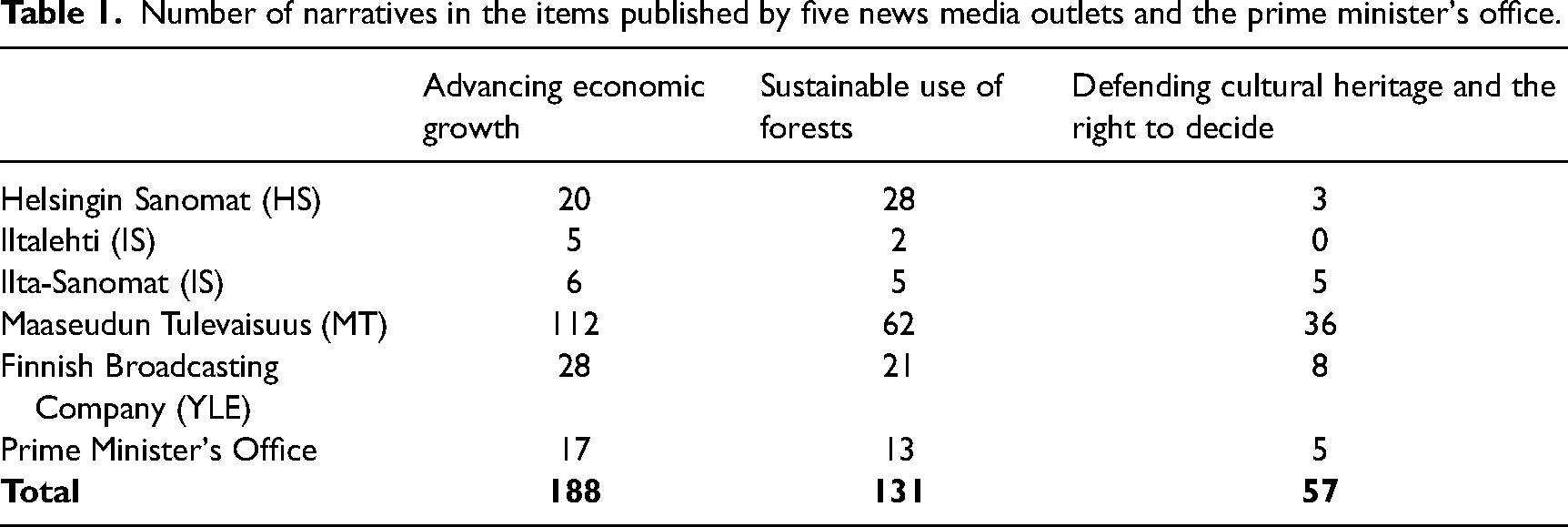
Table 1 presents the three narratives that were identified; the nodal point around which the entire debate is organised is the glaring contradiction between two aims – a rapid decrease of CO2 emissions and a massive increase in logging – which the government insisted on achieving. In the following subsections, we illustrate how each narrative portrays and resolves the contradiction.
Number of narratives in the items published by five news media outlets and the prime minister's office.
Narrative 1: Advancing economic growth
The narrative of advancing economic growth was the most common and appears consistently in articles published by all news outlets. It portrays the world as highly market oriented and driven by economic incentives. Principles such as sustainable development are used to justify the government's plans to increase logging. The forest is viewed as a commodity and less valued as part of nature.
Within this narrative, the main object of epistemic work is to convince the audience of the appropriateness of the government's actions by emphasising the benefits that Finland and its economy would enjoy if the logging increase were permitted. The most important claim-makers are the Finnish government, especially Prime Minister Juha Sipilä, Finnish Members of the European Parliament, local politicians, forestry union representatives and researchers affiliated with the Natural Resources Institute Finland, who appear united in favour of logging, with the few exceptions of researchers and representatives of non-governmental organisations who rely on the authority of science to voice criticism of increased logging.
HS, for example, reported that Finnish politicians organised one of its largest-ever lobbying campaigns to sway the EU to decide in accord with the forest industry's needs (Hartikainen, 2017). The campaign is presented as a matter of urgent importance because current logging calculations would make forests a carbon source instead of a sink, but it also reserves a few sentences for critics of the lobbying campaign, who encourage far-sightedness in the name of climate mitigation. The narrative presents lobbying as something necessary to achieve justice for Finnish silviculture, with the strict carbon calculations viewed as unfair. In the government press releases, the lobbying (called ‘promotion of interests’) is explained pragmatically, giving an impression of intense activity in a matter of vital importance to Finland, including Sipilä's written pleas to other heads of state.
The authority of science in this narrative is uncertain but omnipresent. Although all actors in the narrative allude to scientific sources, they tend to cite the science that best fits their own agendas. This is visible in the ways some research organisations are valued over others. The calculations made by the Natural Resources Institute play an important role because they formed the basis of Finland's participation in the LULUCF Regulation negotiations. Occasionally, though, the Institute's scientific authority is contested. Its calculations are alleged to be overly optimistic and driven by the political need to gather support for increasing logging, as opposed to climate change mitigation being the main objective. In order to counteract such claims, a government official who participated in the negotiations guaranteed that the government did not seek to control the findings and condemned the allegations of politicised science (Luukka, 2018).
The contradiction, when addressed, is resolved by emphasising that forests as a renewable natural resource play an important part in replacing fossil fuels and that forestry allows forests to become even more profitable while serving as carbon sinks. Given that the economic consequences of logging and the regulation were integral to the argument, surprisingly few economists appear in the analysed articles. For the Finnish government, advancing its bioeconomy plans appeared to be the highest priority, and it did not welcome those plans being put in jeopardy. Even when the national and international scientific community wrote open letters in HS appealing to the government to moderate its logging plans for the sake of climate change, those plans remained unchanged. As the ambiguity inherent in the government's contradictory aims simply fades away, the narrative relies on the ‘logic of confidence and good faith’ (Meyer and Rowan, 1977: 357) in prioritising the economic valuation of forests, which legitimates the government's campaign and enables the fundamental contradiction to be overlooked. Some statements adopt an almost aggressive tone towards non-economic science, such as this remark from the Metsä Group CEO: ‘There is enough timber. It is useless to research that. What should be researched is how much its worth is’ (Jylhänlehto, 2018).
Narrative 2: Sustainable forest use
In the second narrative, moderate exploitation of forests as natural resources is accepted as a solution to the regulation negotiations and a norm of Finnish society. Silviculture, growing and cultivating trees, is conceived of as important for several other affordances of forests, such as scenery for recreation, tourism and berry-picking. As in the first narrative, the forests are a commodity to be used, although a larger number of affordances beyond the merely economic are recognised and valued. The main actors in this narrative are representatives of nature conservation unions, the Finnish government, EU politicians, forestry union representatives and the scientific community, which includes groups and individual scholars who have signed open letters to Finnish and EU politicians urging them to treat the calculations behind the LULUCF decision with caution. The aspiration to take part in the fight against climate change is present in all actors’ arguments, even though there is remarkable variation regarding the forms of mitigation favoured.
Finnish silviculture expertise is often portrayed as better than the EU norm; thus, decisions over forest matters should be made in Finland. Jyrki Katainen, a Finn and then the European Commission Vice-President, expressed concern several times in the media: ‘Some of my colleagues call forests parks. I feel like many understand forestry as if it were raking. Forests and forestry are as strange to many as cultivating tuna in Malta is to Eastern Finnish people’ (Reku, 2017). The Finns’ expertise was harnessed to increase logging and oppose environmental activists who sought to limit it, which highlights that the epistemic work used values and norms that were assumed to be widely shared. Finnish expertise and moderation are presented as playing an important role in solving the problem regarding carbon sinks.
The authority of science is generally prevalent within this narrative. Actors on both sides of the debate explicitly base their statements on scientific knowledge, often citing relevant reports and figures. Although extensive scientific information about the highly complicated LULUCF Regulation exists, the most likely bone of contention (the reference years used to calculate carbon sinks) remained unclear to the wider audience. The scientific community's appeals were especially laden with information much more difficult to understand than, for instance, references to the economic and recreational uses of forests.
The news items underlined the uncertainty over the scientific basis of the calculations. HS published an article with interviews from IPCC experts, the prime minister, other politicians involved in the case, forestry union representatives and environmental groups. Yet that article suggests that the greatest scientific authority belongs to an anonymous EU official ‘well acquainted with the matter’ who buttressed the Finnish government's view: ‘The LULUCF legislation is an ambiguous entity, but the government's view seems to be correct’ (Teittinen et al., 2017).
The open letters from the scientific community are most visible in this narrative, as they encourage ‘sustainable’ use of the forest and encourage finding options. Although their concerns are understood, they are contested and deemed as solely related to forestry's social factors, with doubt about the reliability of the calculations behind the results expressed. The following lines are situated right under a quote by a silvicultural sciences professor, with the aim of questioning the Finnish scientists behind the letters, putting the journalistic choices in sharp focus: ‘When discussing sustainable use of the forests it should be remembered that it is not wise to saw your own branch. Education on forests and bioeconomy is needed also domestically, in addition to Brussels’ (MT, 2017).
Some commentators, however, also demand humility regarding the forest economy, as in a forest engineer's opinion piece which draws attention to the fact that Finnish forests are part of the global ecosystem, not an isolated entity. The quote describes the mutual understanding that forests are a commodity to be used and part of an ecological system that should not be pushed past its limits: ‘The most important one is the last: there is only one planet, and at the moment we are living over its carrying capacity – that is why the forest economy, too, needs to be sustainable, also in ecological terms’ (Keränen, 2017).
Narrative 3: Defending cultural heritage and the right to decide
This narrative takes the discourse deep into the imaginary of the Finnish soil. The contradiction is cast as a story of Finland protecting its prosperity based on ‘green gold’ and not ceding power to outsiders such as the EU. In this narrative, Finland manages its affairs so well that decision-making over land and forests has profound impacts on individuals and the future of the welfare state. The actors evoke the image of Finns as lumberjacks, pilgrims shaping virgin land, while arguing that forest use must remain with Finns in the future.
Politicians in favour of increased logging extensively harness the cultural heritage related to forests, as in Prime Minister Sipilä's speech at the centennial of The Central Union of Agricultural Producers and Forest Owners (Prime Minister’s Office, 2017): [T]he tale of the land and the forest are inseparable parts of Finland's tale. Väinö Linna
2
opened Finland's tale with biblical tones: ‘In the beginning there were the swamp, the hoe – and Jussi’. Linna's words condense how powerful perseverance and dedication are needed to practice agriculture here in Europe's northernmost country. Throughout the history of independent Finland, rural folks have always needed to adapt. Uncertainty is always present in a farmer's life, and agriculture has been often practiced in difficult circumstances. Faith in the future has, nevertheless, carried us through even the hardest of times.
As the LULUCF Regulation connects Finnish forests to global climate mitigation practices, debates over protecting the small country can become emotionally intense. The powerful lobbying of the EU by the government and forestry industry is conceived as the fundamentally right thing to do, with support frequently aroused by patriotic metaphors. The dividing line between those who have the best for Finland in mind and those who do not is clearly expressed. In this third narrative, the contradiction is completely relocated: instead of being between the aims of climate mitigation practices and increased logging, it pits those acting on behalf of Finland against those opposed to its best interests.
The main agenda for the government, according to some articles, is to secure the future of bioenergy, with the situation metaphorically depicted in martial terms. A Member of the European Parliament states that ‘we need the spirit of the Winter War’ (Hartikainen, 2017). References to that spirit have often been used in Finland to rally national consensus in the face of a powerful opponent, as the Soviet Union was in the 1939 Winter War, and highlight the need to identify ‘us’ as a single national entity with clear, common interests (Kettunen, 2018: 61). Thus, the debate over LULUCF is narrated as part of a much wider battle in which Finland must protect its right to determine the use of its forests and not surrender to the EU.
On some occasions, those opposing the government's agenda to log record amounts of forest are even depicted as ‘traitors’. Members of the European Parliament were interviewed about their voting, and it was made clear that some of their votes were no surprise because they had previously voted against Finland's ‘national good’. An editorial on the looming decision over the fate of Finnish silviculture describes the situation as follows: ‘The Finnish guardians of interest are facing a challenging, yet extremely important task for all Finns. The konkelo threatening Finnish well-being must be able to discharge. There are no other options’ (MT, 2017a).
Here, the word ‘lobbying’ is replaced with the phrase ‘guardians of the interest’, a reference to all stakeholders who supported the government's plans. ‘Konkelo’, the Finnish silvicultural word, refers to a fallen tree leaning on another one, creating a natural guillotine for the unprepared logger, as there is no predicting where, when and how it is going to fall.
The authority of science is least prevalent in this narrative and can be detected mostly in the biographical information provided about claim-makers or the use of impressive-sounding titles. The overall difference from the other narratives is that this one draws so bluntly on nationalist metaphors and images of Finnish culture and history, creating a clear division of ‘us’ versus ‘them’.
Discussion and conclusions
This paper has examined how news media discourse unfolded during the Finnish government's lobbying campaign concerning the EU's LULUCF Regulation. The claims presented are all legitimated by drawing on a set of narratives that organise the entire debate, providing culturally meaningful rationales for the arguments. Although individual actors’ arguments differ substantially from one another, they invariably rely on at least one of the three narratives, which did epistemic work not only by employing certain understandings of reality but also by enforcing particular views, cultural norms and values, such as Finns’ special connection to forests. However, the narratives do not simply impose certain ways of understanding reality; rather, they must be conceived as tools that actors can use creatively in epistemic governance when they seek to affect others’ conduct and understandings. We argue that the narratives are also objects of epistemic governance: the actors involved in political debates share tacit understandings of culturally meaningful ways of making sense and thus may also seek to rewrite the narratives to better advance their aims.
We have looked more closely into how the contradiction between the government's aim to authorise record logging levels while fulfilling climate change mitigation policies is portrayed and negotiated within distinct narratives. The most prevalent and arguably most effective, the narrative of advancing economic growth, values economic growth above all. In this narrative, it appears as if there was no contradiction whatsoever between the government's climate change mitigation commitments and increased logging. The second narrative, sustainable forest use, also emphasises the contribution of forests to Finland's national wealth but also cherished other values (e.g. biodiversity) and affordances (e.g. various recreational uses of the forest). The contradiction is resolved by confidence in a moderation of the heated debate and in ‘reasonable’, responsible Finnish forestry. The third narrative, defending cultural heritage and the national right to decide, emphasises ‘Finnishness’ and connects it to the ‘proper’, traditional use of the forests, which is seen as the best for Finland's future. The contradiction is resolved by reframing it as resulting from EU decision-making. The problem regarding carbon sinks is deemed an EU creation that would not exist if decision-making had been kept at the national level and not ceded to the EU. The main adversary is not so much climate change but those Finnish politicians, activists, and researchers who are depicted as acting against the country's best interests. The cultural and emotional images of Finland's forests play important roles in this narrative, efficiently sparking debate beyond the fact that the regulation itself only concerns state-owned forests, with most forests excluded because they are privately owned.
Arguments completely against using forests or for leaving them untouched are not prominent. This implies a strongly shared value of forests as a commodity rather than an entity of their own (cf. Fourcade, 2011). This finding is not surprising in light of earlier studies concerning environmental discourse and forest and climate policy in Finland (Harrinkari et al., 2017; Kröger and Raitio, 2017). Neither were their arguments explicitly denying climate change or even the role of forests in mitigating it. This finding supports the conclusion by Vesa et al. (2020), who argued that although the pro-economy lobbyists do not directly oppose climate mitigation in media, they can be viewed as forming a ‘quiet opposition’ that influences decision-making while keeping out of the public eye. Our results indicate, however, that in the case of the LULUCF, the pro-economy actors were in fact strongly present in the news media.
An interesting feature of this case is the active role taken by the scientific community, which was mobilised to publicly present concerns over the government's desire to increase logging. While politicisation of science and scientific policy advice has been abundantly studied, our study paid attention to an aspect that has received less attention (Pielke 2007): how scientists themselves seek to politicise the scientific grounding of government policy. The several open letters signed by the groups of researchers did not receive major coverage; within the narratives, their importance was restricted to bringing out the contradiction without leading to much further debate. The results call for further study of scientists’ open letters, which could be interpreted, for example, as an avenue to illuminate politicians’ practices wherein scientific knowledge is selectively used to advance political agendas, or even as signs of a novel ‘social contract between science and civil society’ (Graminius 2022: 20). As the most prevalent narrative simply disregards the arguments raised by the open letters, they remain mostly on the margins of the coverage. Although our results suggest that the open letters had a limited effect on the government's lobbying campaign at the EU level, these letters contributed, however, to the lively public discourse, and the narrative of advancing economic growth never acquired a fully hegemonic position.
This analysis of the news coverage has demonstrated that the economic, cultural and political meanings attached to forests are deeply embedded in Finnish society. By participating in the debate, actors not only sought to define how much forest ought to be logged but also contested the social and cultural dimensions of forests. The social dimension articulated in the debate is linked to the fact that forestry provides local jobs, yet the cost of reduced carbon sinks is a global concern. The government and forest industry coalition successfully deployed nationalist imagery most visible in the narrative of cultural heritage and the right of Finns to decide their future, making the partial dismissal of the scientists’ open letters understandable. Cultural imagery on the connection of forests and Finnishness were building blocks in narratives, effectively enabling to shift the focus from forests as carbon sinks to ‘our’ forests, the traditional and ostensibly sustainable use of which was depicted as under threat by powers exogenous to sovereign national rule.
Earlier studies of climate reporting have suggested that coverage tends to be too fragmented to hold political leaders accountable for their climate governance (Karlsson-Vinkhuyzen et al., 2017). In this case, however, the government was one of the most active participants in the debate, and its arguments were largely identical to those of forest industry representatives. Earlier studies have also pointed out that in the news coverage of international climate politics, the views of national actors tend to receive more attention than those of international organisations (Kleinen-von Königslöw et al., 2019). In our case, it is striking that, beyond the scientific community's open letters and one anonymous EU official, international actors were not among the claim-makers in the analysed media texts.
The LULUCF Regulation ‘is a rather complicated text’ indeed, in the words of the prime minister of Finland (MT, 2017b). Overall, in climate-related reporting, a wide range of background knowledge is expected of the readers and actors involved, such as specific vocabulary from the fields of silviculture and climate sciences, if they are to understand the topic. While science can draw attention to the negative effects of, for instance, increased logging, news media reports often fall short in explaining these complicated phenomena, especially as they are part of broader societal struggles. The analysed media discourse vividly demonstrates how decoupling policy objectives and practices can be rationalised by narrative meaning-making, in which scientific authority is selectively woven into news stories with imaginaries of the national past and future.
Footnotes
Acknowledgements
We thank the three anonymous reviewers for their detailed and constructive feedback. We are grateful to the members of the Tampere Research Group for Cultural and Political Sociology for insightful comments and suggestions on earlier versions of the manuscript.
Funding
The authors disclosed receipt of the following financial support for the research, authorship, and/or publication of this article: This work was supported by the Academy of Finland (grant number 341716).
