



Abstract
Firms are increasingly adopting predictive artificial intelligence (AI) to address economic, social and environmental sustainability challenges. However, there remains limited understanding of how predictive AI contributes to the development of AI capabilities that underpin sensing, seizing and reconfiguring dynamic capabilities for business sustainability. Drawing on a multi-case study, this research identifies six AI capabilities: pattern recognition and emotional intelligence (linked to sensing), agile decision-making and interdisciplinary integration (linked to seizing), and resource orchestration and transformation mastery (linked to reconfiguring). These AI capabilities augment the potential of firms’ dynamic capabilities by enhancing their ability to sense opportunities, seize them strategically and reconfigure resources in response to sustainability imperatives. This study further reveals two distinct yet interrelated approaches through which this augmented potential is realised: a humanistic, stakeholder-focused approach and an instrumental, firm-focused approach. These approaches shape how AI capabilities are embedded in dynamic capability processes and lead to different sustainability outcomes. The humanistic approach prioritises social and environmental objectives, with economic benefits as secondary, whereas the instrumental approach foregrounds economic performance, with social and environmental sustainability as secondary. By clarifying how AI capabilities and organisational approaches interact to influence dynamic capability realisation, this study advances theoretical understanding of AI-enabled strategic change and its role in achieving business sustainability. The findings contribute to academic discourse and inform managerial and policy decisions.
Keywords
Introduction
Predictive artificial intelligence (AI) is the application of machine learning algorithms and statistical models to forecast future outcomes based on historical and real-time data (Haftor et al., 2024). It equips firms with new capabilities to respond to intensifying sustainability pressures (Haefner et al., 2023; Marabelli and Davison, 2025; Mariani et al., 2023; Saura et al., 2021). By detecting patterns, enhancing operational efficiency and optimising resource allocation, predictive AI can support triple-bottom-line business sustainability (Bracarense et al., 2022; Dyllick and Muff, 2016). Its application is particularly salient in B2B industries, where firms must navigate complex interdependencies with suppliers, partners and regulators under escalating sustainability expectations (Asatiani et al., 2021; Dubey et al., 2021; Wei and Pardo, 2022). For example, waste management firms employ predictive AI to coordinate with local communities and recycling facilities, refining collection schedules to eliminate redundant routes in the face of fluctuating demand and regulatory uncertainty. This optimisation advances environmental sustainability through lower fuel use and supports social sustainability by mitigating noise pollution and traffic disturbances in residential areas. Similarly, transportation firms leverage predictive AI to streamline route planning, reducing delays and costs while easing congestion and cutting carbon emissions, thereby helping firms adapt to rapidly changing market conditions. These examples illustrate the potential of predictive AI to build new capabilities for addressing sustainability challenges across economic, social and environmental dimensions (Bag et al., 2021; Benzidia et al., 2021; Tsolakis et al., 2023). They also highlight the relevance of a dynamic capabilities perspective (Teece, 2007), which emphasises how organisations sense opportunities, seize them strategically and reconfigure resources to respond effectively to turbulent sustainability contexts.
However, most studies to date conceptualise predictive AI as operational capabilities, that is, day-to-day routines that improve efficiency and automate existing tasks, with a primary focus on organisational performance outcomes (Chowdhury et al., 2023; Haefner et al., 2023; Pieper and Gleasure, 2025; Stoffels et al., 2025; Zhang et al., 2022). This perspective has advanced understanding of AI’s immediate benefits, but it overlooks how distinct AI capabilities operate as microfoundations that augment firms’ dynamic capabilities for sustainability-oriented transformation (Abou-Foul et al., 2023; Hanelt et al., 2025; Sjödin et al., 2023). Equally underexplored are the mechanisms through which firms leverage these capabilities to pursue different sustainability outcomes. As the earlier examples indicate, some B2B firms employ AI in ways that prioritise social and environmental objectives, while others deploy it primarily to reinforce economic performance. Yet the literature has not adequately theorised the managerial approaches that shape these divergent uses, nor the trade-offs that accompany them (Bag et al., 2021; Rahman et al., 2023; Steininger et al., 2022; Zhang et al., 2022).
Building on these limitations, this study addresses two research questions: (1) What AI capabilities do firms develop that act as microfoundations for sensing, seizing and reconfiguring dynamic capabilities? (2) How do firms realise these AI-augmented dynamic capabilities to achieve economic, social and environmental sustainability outcomes? To answer these questions, the study adopts the dynamic capabilities perspective (Teece, 2007; Teece et al., 1997), a well-established lens for explaining how firms adapt and transform in response to evolving sustainability challenges. This perspective supports a more granular analysis of how predictive AI generates operational capabilities that underpin higher-order dynamic capabilities, and how managerial approaches influence their integration into sensing, seizing and reconfiguring processes. In doing so, it provides a theoretical basis for understanding how predictive AI adoption shapes pathways towards business sustainability.
This research makes key contributions to the literature by identifying six AI capabilities – pattern recognition, emotional intelligence, agile decision-making, interdisciplinary integration, resource orchestration and transformation mastery – categorising them under the pillars of sensing, seizing and reconfiguring. These findings advance understanding of AI’s strategic potential in enabling firms to address complex business sustainability challenges across economic, social and environmental dimensions (Abou-Foul et al., 2023; Sjödin et al., 2023). In addition, this study reveals two distinct yet complementary approaches through which firms leverage these capabilities: the humanistic, stakeholder-focused approach and the instrumental, firm-focused approach. The humanistic approach emphasises stakeholder collaboration to prioritise social and environmental sustainability, with economic sustainability as a secondary outcome, while the instrumental approach focuses on optimising internal processes to achieve economic sustainability, often resulting in secondary social and environmental benefits. The findings demonstrate that firms frequently blend these approaches, generating both synergies and conflicts that have been underexplored in prior information systems research, which has tended to emphasise instrumental outcomes disproportionately (Sarker et al., 2019). Collectively, these contributions clarify how operational AI capabilities augment the potential for dynamic capabilities, and show how their realisation is shaped by humanistic and instrumental approaches, thereby enriching theoretical understanding of AI-enabled strategic change and its implications for achieving business sustainability.
Theoretical background
In this section, we critically review the literature on predictive AI and business sustainability, with a particular focus on identifying key research gaps. Following this, we discuss how the dynamic capabilities perspective serves as an overarching theoretical lens to investigate the complex interplay addressed in this study.
Literature review on predictive AI and business sustainability
AI has reshaped how firms operate, compete and innovate across industries (Currie et al., 2024; Hanelt et al., 2025; Pieper and Gleasure, 2025). Grounded in supervised machine learning and statistical models, including decision trees, regression algorithms and neural networks, predictive AI analyses historical and real-time data to forecast future outcomes (Haftor et al., 2024; Wagner et al., 2022). It supports firms in addressing complex sustainability challenges by enhancing operational efficiency and enabling data-driven decision-making, although it also raises concerns related to algorithmic bias, model opacity, data privacy and workplace surveillance (Mettler, 2024; Mikalef et al., 2022; Nishant et al., 2024; Rana et al., 2022).
Predictive AI is particularly relevant in B2B contexts, where organisations must manage intricate interdependencies and respond to rising ESG expectations across extended supply chains (Ding et al., 2024; Rahman et al., 2023). It supports core strategic functions such as analytical forecasting, operational planning, risk mitigation and resource optimisation. These applications are central to sustainability-related decision-making in B2B settings (Haefner et al., 2023; Mariani et al., 2023; Saura et al., 2021). Several review studies also underscore its role in improving efficiency, fostering innovation and strengthening competitiveness, all of which are critical elements of economic sustainability (Ahmad et al., 2021; Haefner et al., 2021, 2023).
Recent research has extended the scope of predictive AI applications beyond economic benefits to include social and environmental dimensions, adopting the triple-bottom-line perspective to examine how predictive AI contributes to business sustainability (Melville, 2010; Rahman et al., 2023). Within this perspective, business sustainability comprises three interrelated dimensions: economic, social and environmental (Dyllick and Muff, 2016). Economic sustainability involves managing financial risks and opportunities while ensuring profitability and long-term shareholder value. Social sustainability focuses on improving the well-being of employees, customers, communities and other stakeholders. Environmental sustainability emphasises reducing ecological impacts through sustainable operations, resource conservation and practices that enhance planetary health (Dyllick and Muff, 2016; Kotlarsky et al., 2023).
This broader view seeks to address the negative externalities associated with traditional business practices, including climate change, environmental degradation, resource overuse and social inequality (Marabelli and Davison, 2025; Mettler, 2024; Papagiannidis et al., 2025). For instance, predictive AI enables farmers to adapt in real time to variations in crop growth and weather conditions, promoting sustainable food production (Zhang et al., 2021). Similarly, predictive AI reduces maintenance waste and supports circular economy practices (Bag et al., 2021). Integrating predictive AI into sustainability strategies is therefore vital for shifting corporate priorities beyond profit generation towards broader societal and environmental concerns (Rahman et al., 2023; Raman and McClelland, 2019).
Despite these promising developments, significant gaps remain in the literature. First, research on predictive AI has primarily focused on operational capabilities such as process automation and demand forecasting (Mikalef et al., 2022; Mikalef et al., 2023; Sjödin et al., 2021). Much less attention has been devoted to dynamic capabilities, which are essential for addressing the complex and rapidly changing nature of sustainability (Abou-Foul et al., 2023). Dynamic capabilities enable firms to sense, seize and reconfigure resources in order to achieve business sustainability (Karimi-Alaghehband and Rivard, 2019; Sjödin et al., 2023). The prevailing emphasis on operational outcomes leaves a gap in understanding how predictive AI can augment dynamic capabilities to support economic, social and environmental objectives.
Second, there is limited insight into the mechanisms through which firms leverage predictive AI capabilities to achieve sustainability. While prior studies highlight positive outcomes, they often lack detailed explanations of the processes that enable firms to harness these capabilities effectively (Bag et al., 2021; Rahman et al., 2023; Steininger et al., 2022; Zhang et al., 2022). Furthermore, existing work tends to examine sustainability in a fragmented manner, focusing on either the economic, social or environmental dimension in isolation (Asatiani et al., 2021; Benzidia et al., 2021; Galaz et al., 2021; Vassilakopoulou et al., 2023). This narrow focus limits our understanding of how firms manage trade-offs across the three dimensions simultaneously. An integrated perspective that captures the mechanisms through which predictive AI capabilities shape dynamic capabilities and, in turn, business sustainability is therefore needed.
To address these gaps, this study adopts the dynamic capabilities perspective to analyse how firms adapt and transform in response to evolving sustainability demands. The relevance and applicability of this perspective are discussed below.
Dynamic capabilities perspective as an overarching theoretical lens
The dynamic capabilities perspective provides a foundation for understanding how firms adapt, innovate and transform in response to rapidly changing environments, particularly in the context of business sustainability (Sjödin et al., 2023; Teece et al., 1997). It centres on three interrelated processes: sensing, seizing and reconfiguring (Teece, 2007). Sensing involves identifying shifts in the external environment and assimilating new knowledge to inform strategic decisions; seizing entails integrating resources and formulating strategies to capture opportunities; and reconfiguring refers to creatively redeploying existing resources, sourcing new ones to address gaps and combining assets in optimal ways (Abou-Foul et al., 2023).
A useful distinction within this perspective is between lower-order operational capabilities and higher-order dynamic capabilities. Operational capabilities enable efficiency and consistency in established routines and day-to-day activities (Winter, 2003). While essential for stability, they are insufficient when conditions demand adaptation and strategic renewal. By contrast, dynamic capabilities reflect a firm’s ability to purposefully modify, integrate and reconfigure resources to sustain competitive advantage in evolving environments (Helfat and Winter, 2011). Their effectiveness depends on microfoundations such as technological resources and organisational routines that support sensing, seizing and reconfiguring (Teece, 2007).
Building on prior literature, this study positions AI capabilities as microfoundations of dynamic capabilities (Mikalef et al., 2021). Although operational in nature, AI capabilities can augment a firm’s potential to enact dynamic capabilities when embedded within managerial and organisational processes (Abou-Foul et al., 2023). For example, predictive AI may enhance sensing by scanning complex data for ESG-related patterns, support seizing through improved decision-making, and facilitate reconfiguring by guiding resource realignment. Thus, while AI capabilities do not themselves constitute dynamic capabilities, they strengthen a firm’s potential to sense, seize and reconfigure in pursuit of business sustainability. This augmented potential, however, is not automatically realised. Its translation into dynamic capabilities depends on how firms embed predictive AI into managerial processes (Mikalef et al., 2021). Without deliberate integration, AI capabilities may remain isolated, underutilised or misaligned with broader sustainability goals. Different organisational approaches shape the extent to which AI-augmented dynamic capabilities contribute to economic, social and environmental outcomes.
Accordingly, this study draws on the dynamic capabilities perspective as its overarching theoretical lens to examine which AI capabilities are enabled by predictive AI, how these capabilities function as microfoundations of sensing, seizing and reconfiguring, and how organisational approaches shape their contribution to business sustainability across the triple bottom line.
Research methodology
A multi-case study approach was employed to investigate how firms leverage AI capabilities to achieve economic, social and environmental sustainability outcomes. This methodology is well suited to the in-depth examination of complex and evolving phenomena, particularly when the boundaries between the phenomena and their real-life contexts are not clearly defined (Yin, 2014). This approach aligns with the objectives of the research. The following sections provide an overview of the empirical setting, research design, data collection and data analysis procedures applied in the study.
Empirical setting and research design
The empirical context of this study focuses on B2B industries in China that utilise predictive AI to address business sustainability objectives. B2B industries provide a compelling context for studying predictive AI as they often involve long and complex value chains that require advanced tools for coordination, forecasting and optimisation in the global economy (Dubey et al., 2021; Rahman et al., 2023). Furthermore, China is one of the global leaders in AI development, with substantial investments across various sectors and rapid adoption in B2B industries, making it an exemplary context for exploring how predictive AI reshapes organisational capabilities and supports sustainability (Hong et al., 2023; Wei and Pardo, 2022). This empirical setting provides deeper insights into how predictive AI operates in a technologically advanced and rapidly evolving market.
To mitigate potential researcher bias and ensure broad representation of B2B industries, we collaborated with seven experts from a consulting firm specialising in predictive AI solutions for B2B organisations. These experts played a central role in case selection, drawing on their industry knowledge to identify companies that had adopted predictive AI for sustainability initiatives across a range of sectors. Through this process, 12 industries were identified where predictive AI has made a notable impact on business sustainability: agriculture, construction, e-commerce, education, energy, financial services, healthcare, manufacturing, retail, telecommunications, transportation and waste management.
Industry inclusion and exclusion were guided by three criteria: (1) evidence of predictive AI adoption in sustainability-related initiatives, (2) diversity across B2B contexts in terms of value chains and digital maturity and (3) potential to generate different insights into how AI capabilities augment dynamic capabilities for business sustainability. For example, agriculture was included because predictive AI supports precision farming that reduces fertiliser and water use, thereby improving environmental outcomes while enhancing food security and community well-being, which demonstrates strong social sustainability relevance. By contrast, hospitality was excluded, even though AI is used for demand forecasting and customer analytics, as these applications are largely operational and focused on service efficiency rather than sustainability outcomes. This demonstrates how the criteria ensured the inclusion of industries with strong sustainability relevance and the exclusion of those where predictive AI adoption remains peripheral to the research objectives.
To control for external variation beyond the central phenomenon, B2B companies and interviewees were selected using four theoretical criteria. First, all companies operate within the Chinese market, one of the world’s leading B2B economies, and apply predictive AI across sectors, allowing us to capture its implications in a technologically advanced and rapidly evolving context (Yoo et al., 2010). Second, the companies have extensively utilised predictive AI solutions in their business operations, ensuring a deep understanding of AI. Third, they have recently applied predictive AI in sustainability projects or demonstrated a strong commitment to integrating it into long-term ESG strategies. Finally, interviewees held at least 3 years of management experience in their firms and were directly responsible for projects using predictive AI to address social and environmental sustainability within the past 3 years. These rigorous selection criteria ensure that our study encompasses a representative sample in B2B industries and involves knowledgeable practitioners who can provide deep insights into predictive AI for sustainability, thereby enhancing the validity and reliability of our findings.
The seven experts initially identified 43 B2B companies, including two of their own clients, based on evidence of predictive AI being used to address or partially address social and environmental sustainability in recent projects. To minimise potential bias and strengthen the robustness of the sample, we also partnered with a reputable market research firm, which applied the same criteria to expand the pool. This process increased the total to 74 B2B organisations and provided a broader set of representative interviewees for data collection. Of these, 32 companies agreed to participate, yielding a response rate of approximately 43%.
Data collection
The empirical evidence for this study includes both primary and secondary sources, collected from May 2022 to June 2023. This period is particularly valuable as AI becomes increasingly prevalent, prompting organisations to integrate predictive AI into their business strategies to enhance sustainability in a competitive market and demanding regulatory environment. Prior to initiating primary data collection, a case report summary was assembled using secondary sources such as industry reports, company annual reports and ESG reports. In total, the secondary data collection included eight industry reports and 23 company reports.
Summary of informants.
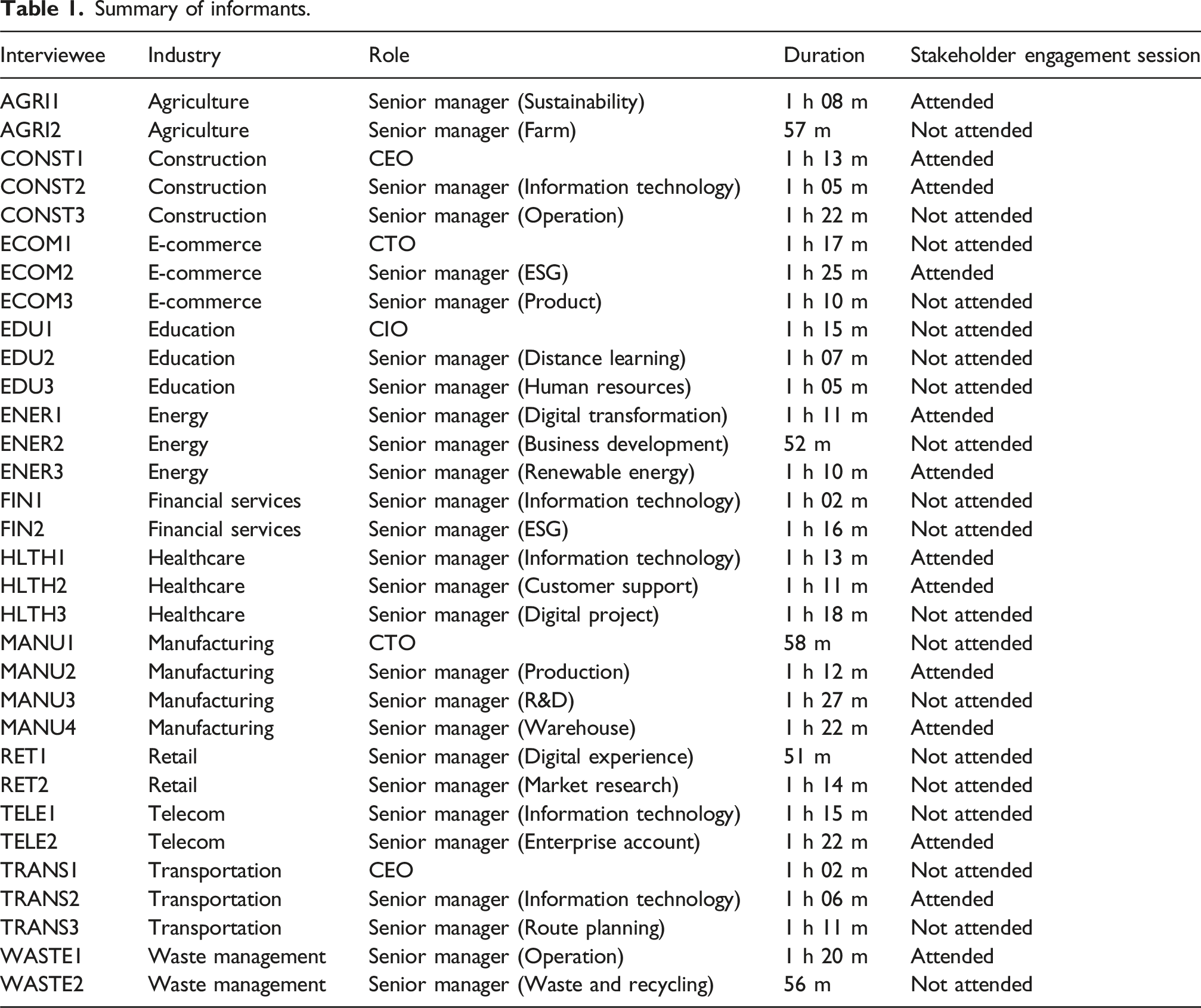
The interview guide was devised by the research team and underwent a pilot phase with industry experts to ensure it facilitated effective discussions (see Online Appendix 1). All interviews were recorded and transcribed to ensure accuracy and rigour in the analysis. To capture elements not recorded, extensive notes were taken during and after the interviews. This reflective practice helped mitigate any potential influence of personal biases on the findings (Reay, 2014).
Data analysis
The data analysis comprised five stages, adapted from the methodology proposed by Gioia et al. (2013), and integrated measures to ensure validity and reliability. The first stage focused on analysing secondary data, synthesising insights into brief case summaries to understand how predictive AI applications address business sustainability issues. The secondary data were helpful in complementing and contextualising the primary data collected through interviews. They also served to validate findings, with specific examples from company ESG reports illustrating how B2B firms leverage humanistic and instrumental approaches to achieve economic, social and environmental sustainability.
In the second stage, a detailed analysis of interview transcripts was conducted using NVivo software. The coding process followed the Gioia methodology, beginning with open coding to generate first-order concepts from the data (Gioia et al., 2013). To ensure reliability and reduce interpretive bias, two independent coders were involved in the coding process. Both coders initially applied the open coding separately. Their results were then compared, and discrepancies were resolved through structured consensus discussions, refining the codebook iteratively (Nowell et al., 2017). Intercoder reliability was assessed by calculating the percentage of agreement across coded segments, which reached 86%, indicating a high level of consistency. Figure 1 presents the data structure, illustrating a transparent coding process grounded in empirical evidence. Data structure.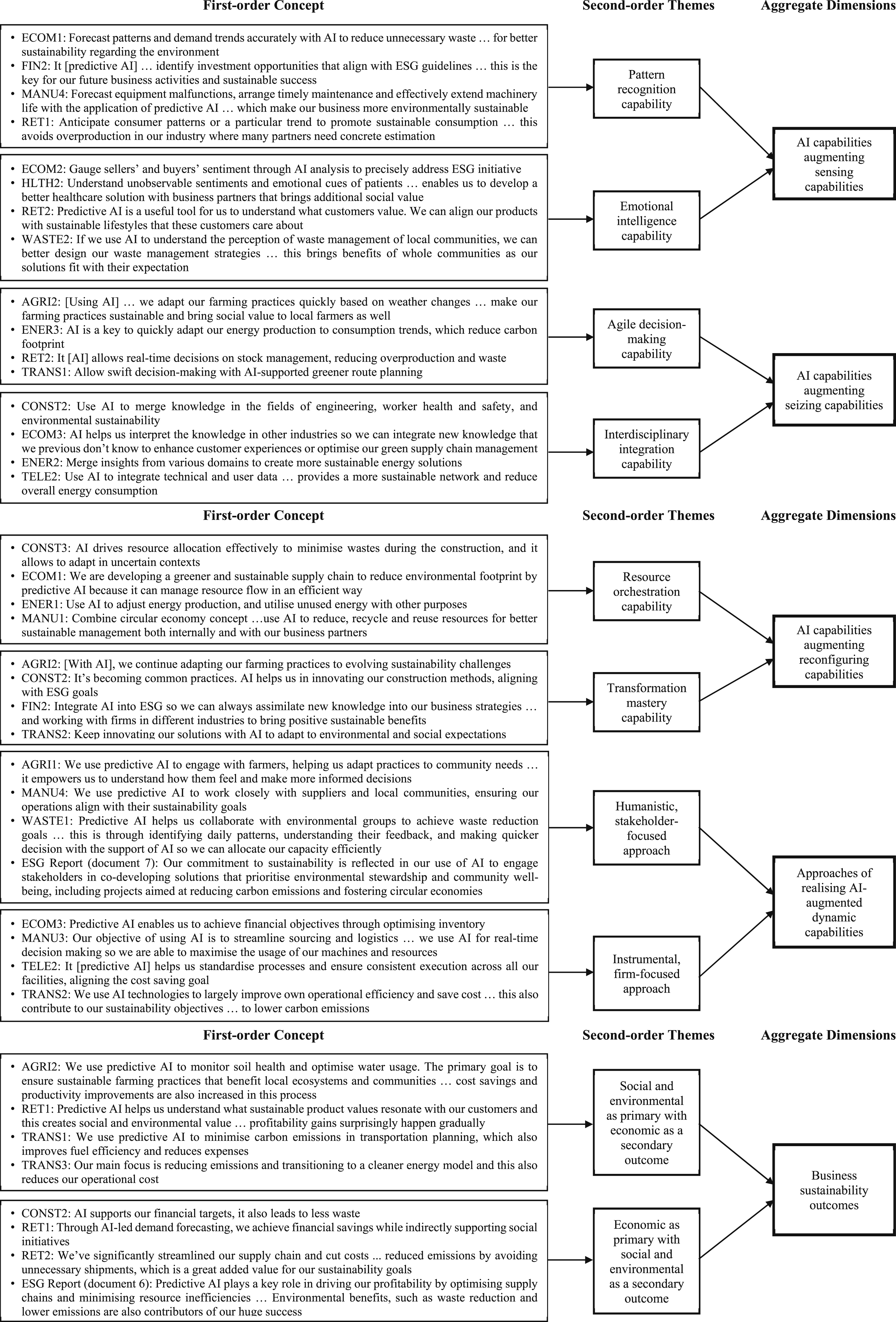
The third stage applied a replication logic to confirm whether the findings from the interviewees supported or contradicted each other (Silverman, 2013). The identified general concepts underwent iterative analysis and interpretation until shared second-order themes emerged and were fully explored (Suddaby, 2006). These insights were cross-referenced with existing literature, enabling the identification of similar constructs. This process ensured that the analysis was not limited to individual perspectives, but reflected a comprehensive understanding of patterns across cases. To ensure saturation, the researchers continued analysing data until no new concepts or themes emerged.
In the fourth stage, theoretical themes were sorted, reinterpreted and indexed into well-defined theoretical categories (Silverman, 2013). These categories were further abstracted into aggregate dimensions, which captured the distinctive ways in which AI capabilities augment sensing, seizing and reconfiguring dynamic capabilities. Through this process, a theoretical framework was developed, illustrating how firms leverage different combinations of AI capabilities through two distinct approaches to pursue business sustainability.
In the final stage, all 32 interview participants were invited to a four-hour stakeholder engagement session to further validate and refine the findings. Thirteen participants attended, representing diverse industries and organisational roles. Although this session was not part of the original research design, it was conducted after several rounds of coding analysis to strengthen interpretive rigour, particularly regarding the identification of the two distinct approaches through which firms enact AI capabilities. This reflexive exercise enabled participants to evaluate critically whether these approaches were evident in practice and consistent with their experiences. Their feedback confirmed the analytical distinctions between the two approaches, clarified the specific ways AI capabilities were being deployed and affirmed that the two approaches often co-exist within B2B contexts. This validation enhanced the credibility of the framework and ensured that the interpretations reflected the realities of AI use in complex B2B environments. Figure 2 shows the data analysis process. Data analysis process.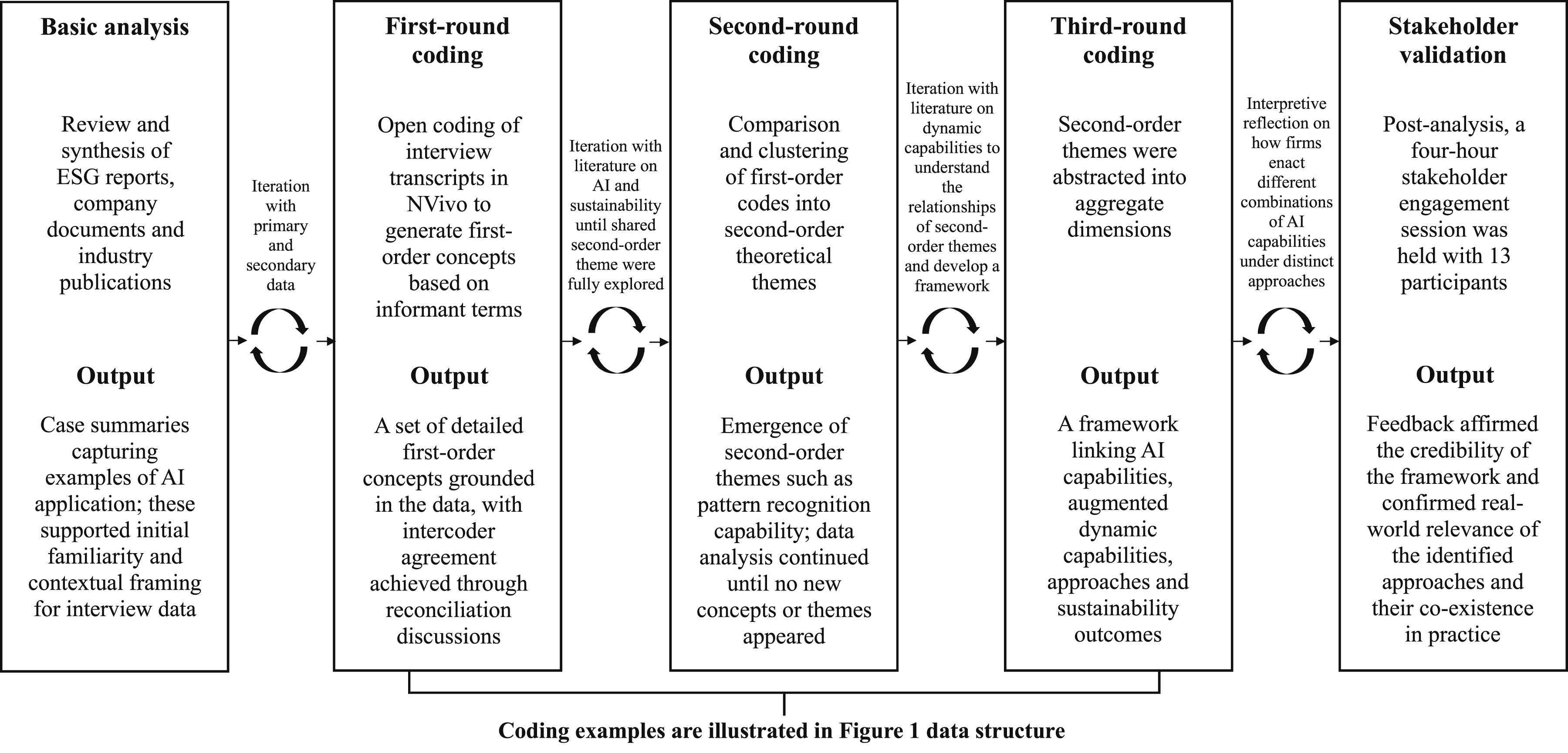
Findings
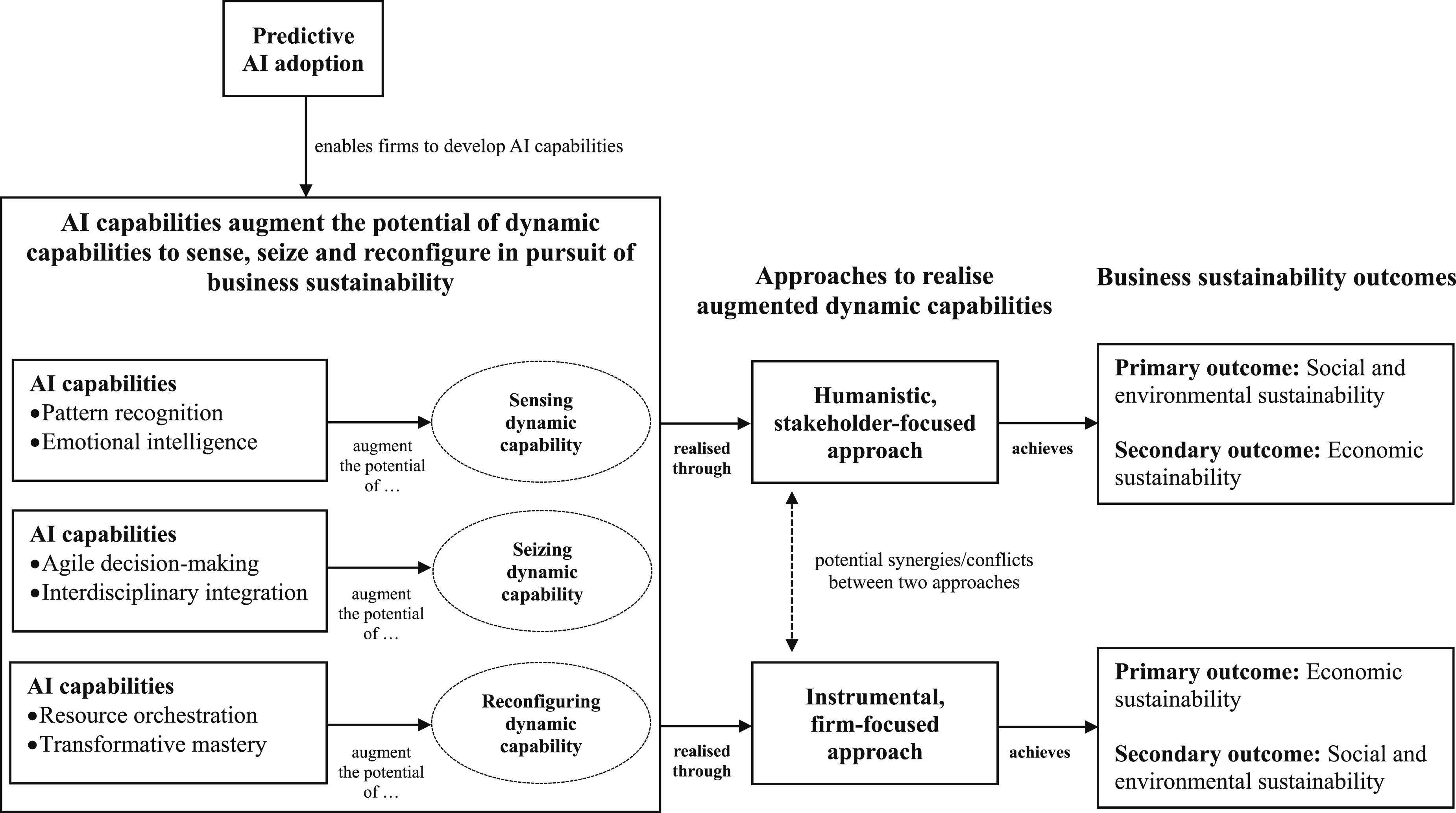
The findings identify six AI capabilities that augment the potential of firms’ dynamic capabilities by enhancing their ability to sense opportunities, seize them strategically and reconfigure resources in response to business sustainability. These capabilities are not mutually exclusive, but instead complement each other. Figure 3 provides a visual representation of these AI capabilities. Firms integrating predictive AI into their operations frequently utilise these capabilities to address sustainability issues through two distinct approaches: (1) a humanistic, stakeholder-focused approach and (2) an instrumental, firm-focused approach. Figure 4 presents a grounded framework that elucidates how these approaches shape the enactment of AI-augmented dynamic capabilities and lead to distinct business sustainability outcomes. To ground the findings in the perspectives of interviewees, this research is supported by a systematic data structure (Figure 1) and selected interview quotations that explain the identified concepts. AI capabilities augmenting the potential for sensing, seizing and reconfiguring dynamic capabilities. A grounded framework of leveraging AI-augmented dynamic capabilities for business sustainability.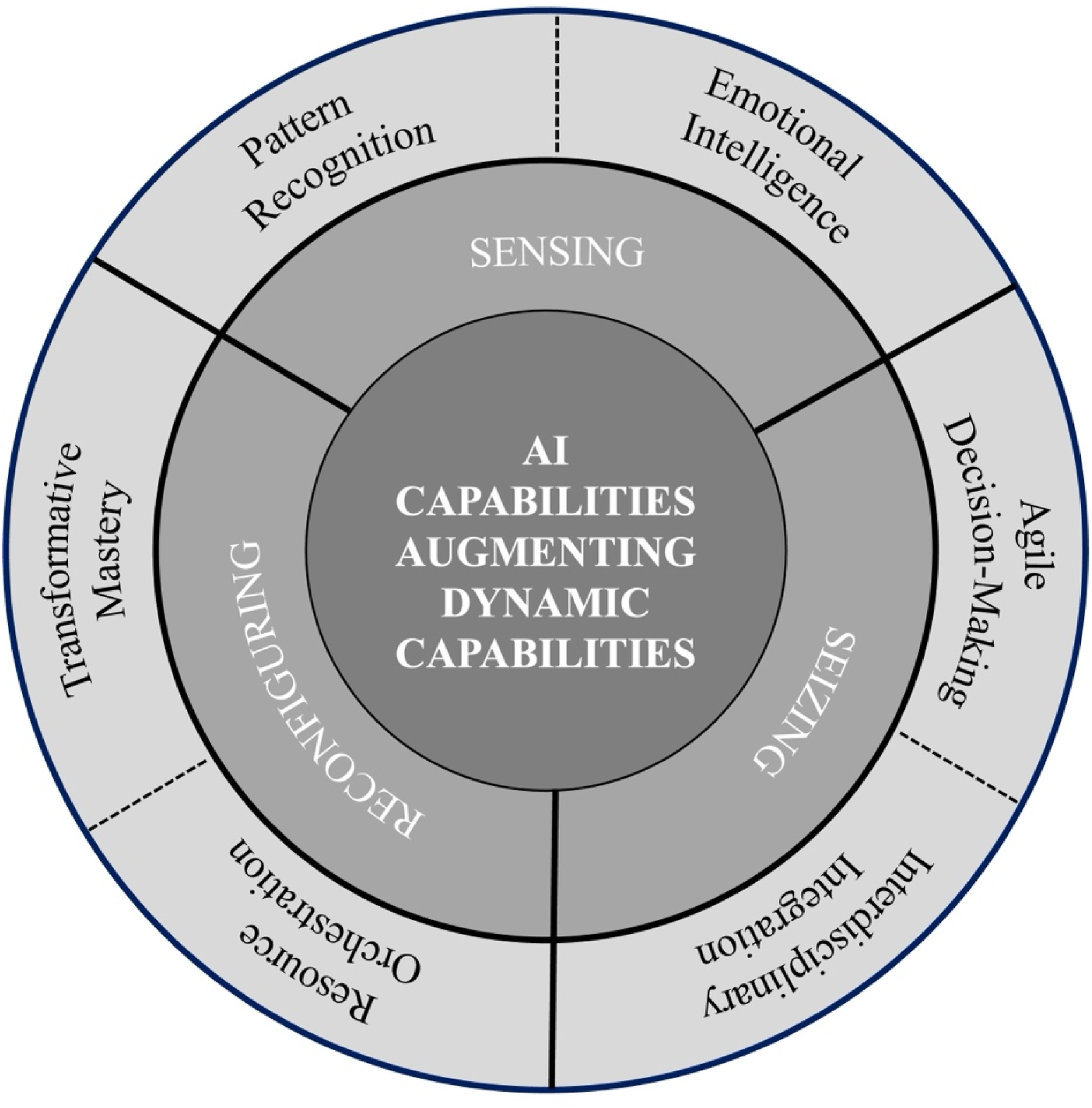
AI capabilities augmenting the potential for sensing, seizing and reconfiguring dynamic capabilities
Pattern recognition capability (augmenting sensing dynamic capability) empowers an organisation to identify and interpret patterns within complex datasets by employing predictive AI. This capability primarily targets the detection of trends, opportunities and risks. It equips organisations with the ability to anticipate market changes and identify potential breaches in the regulatory landscape, both of which are vital for spotting sustainable opportunities and maintaining regulatory compliance. As a CEO in the construction industry noted: ‘We anticipate potential delays or identify patterns in workplace safety incidents through recognising unusual patterns with AI…this allows us to take preventive action and create a safe work environment’ (CONST1).
This illustrates how predictive AI advances sensing in the construction industry by turning operational project and safety data into early warnings. Instead of waiting for incidents to occur, managers can foresee risks such as delays or safety breaches and intervene promptly. In this way, predictive AI reduces uncertainty in high-risk construction environments and supports compliance with safety regulations.
Similarly, predictive AI extends sensing across organisational boundaries by enabling firms to anticipate public health risks through large-scale datasets. It supports timely preventive actions, reducing both the social and economic burden of public health crises. As an Information Technology Manager in the healthcare industry explained: ‘It [predictive AI] enables the whole industry to predict disease trends and outbreaks … this is particularly useful to prevent future diseases … this reduces public health risks, lessens the societal burden of epidemics, and generates broader social value for society’ (HLTH1).
Emotional intelligence capability (augmenting sensing dynamic capability) pertains to the perception and interpretation of stakeholders’ emotions and sentiments. This capability empowers organisations to comprehend and empathise with stakeholder concerns, thereby fostering effective communication and engagement. By utilising AI to enhance emotional intelligence, organisations can nurture more meaningful relationships with their stakeholders and proactively align sustainability initiatives with stakeholder values. As a Route Planning Manager in the transportation industry mentioned: ‘We have so many information every day, and lots of them are regarding travellers’ feedback regarding their trip. Applying AI to analyse their perception and reaction to the new route or new services is truly helpful to enhance their travel experience and satisfaction. That said, AI application can help us uncover the emotional insights that we previously might ignore or take for granted, which eventually bring more social value to these daily travellers’ (TRANS3).
This demonstrates how predictive AI enhances sensing by enabling organisations to detect and interpret subtle emotional signals in large volumes of feedback. In transportation, AI-supported sensing is not limited to technical or operational data, but extends to the emotional dimensions of stakeholder experience. By capturing these insights, organisations can anticipate concerns more effectively and align sustainability initiatives with stakeholder expectations.
Agile decision-making capability (augmenting seizing dynamic capability) equips organisations with the ability to make swift and adaptive decisions in real time. Unlike pattern recognition, this capability centres on the decision-making process itself, enabling organisations to seize opportunities and respond to challenges with agility. Fundamental to this capability is the aptitude to react to evolving circumstances, capitalise on emerging opportunities and mitigate potential risks. By incorporating predictive AI into decision-making, organisations can enhance both the speed and precision of their responses, ensuring they are well equipped to adapt.
As an Information Technology Manager in the telecom industry explained, predictive AI augments seizing by enabling immediate operational adjustments in response to rapidly changing demand. This dynamically reallocating network capacity optimises energy use, which not only improves efficiency but also reduces environmental impact. More critically, AI allows managers to move beyond reactive decision-making towards proactive seizing of opportunities, such as optimising supply-side resources for both economic and sustainability outcomes. ‘According to the changing demand, we can quickly adjust network capacity to enhance energy efficiency with the application of AI. This makes our operation more efficient and maximise the utilisation of supply sides. It is the way how AI can help make agile decisions and create benefits for our environment’ (TELE1).
Interdisciplinary integration capability (augmenting seizing dynamic capability) involves the use of predictive AI to integrate knowledge across disciplines, fostering sustainable collaboration and innovation. It focuses on breaking down silos and encouraging cross-disciplinary dialogue, which leads to comprehensive insights and solutions for complex sustainability challenges. By facilitating the generation of insights that reflect the interdependencies of sustainability issues, this capability supports more effective problem-solving. As a Digital Project Manager in the healthcare industry explained: ‘We use AI to integrate clinical and patient data across disciplines to develop a more comprehensive, sustainable and advanced healthcare framework. This is quite difficult without AI given that the diverse and specialised knowledge across different departments’ (HLTH3).
This shows how predictive AI augments seizing by enabling organisations to bring together fragmented expertise that would otherwise remain siloed. In healthcare, integrating clinical and patient data across departments allows more informed decisions that balance efficiency with sustainability. AI does not simply process more information; it supports cross-disciplinary collaboration, making it possible to seize opportunities for innovative solutions that address challenges such as long-term patient well-being and sustainable healthcare delivery.
Resource orchestration capability (augmenting reconfiguring dynamic capability) centres on the strategic allocation and utilisation of resources in a sustainable manner. Unlike agile decision-making, this capability focuses on dynamic resource reconfiguration aligned with sustainability objectives. It empowers organisations to adapt their resources and competencies in response to evolving challenges. Through integrating and adjusting diverse resource bases with predictive AI, organisations are better equipped to develop innovative solutions that uphold sustainability while considering broader contexts. As a Farm Manager in the agriculture industry emphasised: ‘We adjust our resource plans based on predictive AI insights. When we see inefficiencies in water use or energy consumption, we reallocate accordingly. It’s not just about saving costs but about meeting our sustainability targets more systematically’ (AGRI2).
This explains how predictive AI augments reconfiguring by revealing inefficiencies in resource use and enabling organisations to reallocate accordingly. In agriculture, it allows managers to shift water and energy resources in real time, ensuring operations are not only cost-efficient but also aligned with sustainability objectives. The application of predictive AI goes beyond efficiency gains; it provides a systematic approach to reconfiguring resources to achieve long-term sustainability.
Transformation mastery capability (augmenting reconfiguring dynamic capability) encompasses an organisation’s ability to continuously learn, adapt and innovate in an increasingly complex environment. It focuses on assimilating new knowledge, processes and competencies. Organisations can leverage this capability to innovate and evolve in order to maintain a competitive edge. This is about mastering transformation in line with strategic objectives and environmental dynamism. As highlighted by a CTO in the manufacturing industry, this capability plays a vital role in driving agility, promoting innovation and facilitating long-term success: ‘Our team leverages predictive AI to become a firm that embrace innovation and new possibilities. We continue renewing our competences and become more competitive and sustainable in the market by linking AI with our technological infrastructure … In this way, it [predictive AI] plays a critical role in fostering organisational agility, enabling innovation and securing long-term value through working with different partners for environmentally, economically and socially sustainable transformation’ (MANU1).
Predictive AI augments reconfiguring by enabling organisations to renew their competencies and sustain innovation. It links technological infrastructure with broader partnership ecosystems, allowing manufacturing firms to reconfigure resources and processes in ways that embed sustainability into long-term strategy.
Humanistic stakeholder-focused and instrumental firm-focused approaches to realising AI-augmented dynamic capabilities for business sustainability
The findings reveal two distinct approaches through which B2B firms realise AI-augmented dynamic capabilities in pursuit of business sustainability: the humanistic, stakeholder-focused approach and the instrumental, firm-focused approach. Although both approaches aim to mobilise AI capabilities to support sustainability outcomes, they diverge in their priorities and in the specific AI capabilities they employ. These approaches may co-exist within a single organisation or be adopted independently, often resulting in different economic, social and environmental outcomes.
Humanistic, stakeholder-focused approach involves the deliberate use of predictive AI to engage with a broad array of stakeholders, such as suppliers, customers, regulators, local communities and the natural environment, to co-develop solutions that address shared sustainability goals. This approach draws on all six identified AI capabilities in different ways, thereby fully augmenting sensing, seizing and reconfiguring. Firms adopting this pathway embed predictive AI into collaborative practices such as stakeholder-informed product design, socially responsible logistics coordination and inclusive sustainability planning.
In B2B settings, where firms manage extended supply chains and respond to increasing ESG expectations, this approach enables them to align operational decisions with collective stakeholder values. With the humanistic approach, firms use predictive AI to identify emerging sustainability opportunities and risks across interconnected operations and markets, while also interpreting partner sentiments and public expectations to guide communication and foster engagement with sustainability initiatives. Drawing on insights from diverse domains, the humanistic approach supports predictive AI use for cross-functional coordination and collaborative solution development. These insights feed into real-time decision-making, redistribute resources and manage uncertainties jointly with their partners. Over time, firms reconfigure internal processes and routines to reflect shared sustainability values, embedding continuous learning into their operations. As highlighted by a Digital Transformation Manager in the energy industry: ‘Predictive AI allows us to work closely with local communities and grid operators to balance energy supply and demand more sustainably. For example, the AI tells us when solar or wind power will generate extra energy, so we can work with the community to redirect that power locally. This supports the community’s sustainability goals by reducing reliance on fossil fuels’ (ENER1).
Similarly, a Digital Project Manager in the healthcare industry noted: ‘Using predictive AI lets us collaborate with hospitals, patient advocacy groups and suppliers of medical equipment to make healthcare more accessible … AI predicts health needs based on local data, so we can focus resources on underserved areas first. It’s about being fair and building trust with the community, and honestly, it even helps us avoid wasting resources like medical equipment’ (HLTH3).
Under the humanistic, stakeholder-focused approach, social and environmental sustainability are prioritised, with economic sustainability emerging as a secondary outcome. This pathway reflects a proactive commitment to shared goals, whereby firms integrate predictive AI not simply to optimise performance but to align with stakeholder values. Rather than viewing sustainability as an external constraint or reputational lever, firms adopting this approach use predictive AI to embed sustainability into operational routines, strategic planning and stakeholder engagement. This extends the role of AI from a technical tool to an enabler of participatory sustainability. As an Operation Manager from the waste management industry explained in detail: ‘Predictive AI helps us coordinate with local committees, recycling facilities and community groups to ensure waste is managed sustainably … We use AI technology to optimise collection routes, which reduces fuel consumption and emissions, but it doesn’t stop there. AI identifies patterns in recycling behaviours across different neighbourhoods. This allows us to engage with communities that might need more support and sustainable promotion. By working closely with these groups, we’ve seen an increase in recycling rates and a reduction in landfill waste. These insights then help us collaborate with recycling facilities to streamline operations, ensuring the sorted materials are processed efficiently … While the primary goal is to create environmental and social benefits, we also see cost savings through better efficiency and optimised resource allocation. It’s definitely a super win-win, but the focus remains on sustainability first’ (WASTE1).
Instrumental, firm-focused approach reflects a commercially driven orientation, where predictive AI is primarily used to enhance internal efficiency, reduce operational costs and maximise profitability. In contrast to the humanistic approach, which emphasises stakeholder engagement and shared outcomes, the instrumental pathway is inward-looking, prioritising firm-level optimisation over collaborative initiatives. In this approach, firms tend to rely on a narrower subset of AI capabilities – pattern recognition, agile decision-making and resource orchestration. These are directed mainly towards optimising operational tasks and improving financial performance, rather than addressing social or environmental goals as primary objectives.
This approach is prevalent when B2B firms face competitive pressures to meet contractual obligations, reduce inefficiencies and maintain service continuity across tightly coupled supply chains. Predictive AI is deployed to detect recurring deviations from performance benchmarks, inform rapid tactical responses and orchestrate resources to optimise flows, minimise delays and maintain profitability. For example, firms use predictive AI to forecast inventory needs, adjust order volumes and reallocate assets across production lines, all in pursuit of margin protection and cost optimisation. These activities are largely internally focused and guided by financial metrics, although they may produce secondary benefits such as waste reduction or lower energy consumption. As a Market Research Manager in the retail industry described: ‘Using predictive AI helps us forecast customer demand with incredible accuracy. This allows us to adjust our inventory levels in real time, reducing overstock and the waste associated with unsold goods … We aim to save as much cost as possible so the primary driver is cost savings. Of course, there’s an environmental benefit to this … As we discussed before, [predictive AI] it also optimises our energy usage in stores and warehouses. This creates real value of cutting utility expenses and also reducing our carbon footprint’ (RET2).
Under the instrumental, firm-focused approach, firms leverage AI capabilities primarily to achieve economic sustainability, with profitability, efficiency and cost reduction as the core objectives. While social and environmental benefits may emerge, they are typically regarded as incidental rather than intentional. For example, reductions in energy usage or waste often result from efficiency improvements, not because they were explicitly pursued for sustainability purposes. This contrasts with the humanistic approach, where such outcomes are central. As a CTO in the e-commerce industry pointed out: ‘It [predictive AI] helps us optimise our supply chain by accurately forecasting demand and aligning inventory levels accordingly. This reduces the possibility of overstocking and lowers warehousing costs, which is crucial for our profit margins. At the same time, it indirectly reduces waste, as fewer products go unsold and end up discarded. AI-driven logistics solutions allow us to optimise delivery routes, cutting down on fuel consumption and shipping costs … We allocate resources in a way that prioritises regions with underserved communities, ensuring fairer access to our services. In summary, predictive AI drives greater efficiency and profitability and it also aligns with sustainability outcomes that we aim to contribute to society and the environment’ (ECOM1).
It is important to emphasise that, while the humanistic and instrumental approaches differ in intent and in the specific AI capabilities they employ, they are not mutually exclusive in practice. Our findings indicate that organisations do not rigidly adhere to a single pathway but occasionally blend both to address evolving challenges. As illustrated in Figure 4, these approaches influence how AI capabilities are deployed, thereby shaping how firms enact sensing, seizing and reconfiguring, which in turn lead to different outcomes. Rather than treating the approaches as separate routes, firms may alternate between them or operate them in parallel to realise synergies. During our stakeholder engagement session, many participants highlighted that their firms unconsciously integrate these approaches, using them complementarily to balance economic, social and environmental objectives. This creates the potential for synergy, where the economic gains from instrumental uses of AI reinforce the legitimacy and resources needed to support more stakeholder-oriented initiatives. As one participant, a Production Manager in the manufacturing industry remarked, ‘We aim to improve operational efficiency and cut costs through predictive AI, which aligns with our financial objectives. But simultaneously, we notice how these enhancements indirectly benefit the environment, like reducing energy consumption and waste. When it comes to engaging with community stakeholders, we take a different approach, using AI to co-create solutions and realise shared sustainability goals. Honestly, we don’t consciously separate these strategies, they emerge naturally, shaped by the context and the issues we’re addressing. But having a clearer understanding of these two approaches can help us develop a more synergistic way to leverage AI for different sustainability purposes’ (MANU2).
At the same time, participants noted tensions, including short-term efficiency targets that crowd out stakeholder engagement and coordination frictions around data and decision rights, which can blunt these benefits if left unmanaged. These issues typically surfaced when key performance indicators within the company and across stakeholders were set without alignment. As another participant, an Information Technology Manager in the construction industry remarked, ‘Sometimes the pressure to deliver projects faster and at lower cost pushes us to use AI mainly for efficiency. But then worker safety or engagement with local communities can feel secondary, and it is hard to balance both priorities. We end up trading off speed against participation, so we need clearer decision rights and time for consultation to keep both aims aligned’ (CONST2).
Discussion and conclusion
This study reveals six AI capabilities and illustrates how firms leverage these capabilities to realise dynamic capabilities for business sustainability through two distinct approaches: the humanistic, stakeholder-focused approach and the instrumental, firm-focused approach. These approaches shape the deployment of specific AI capabilities and influence firms’ enactment of sensing, seizing and reconfiguring dynamic capabilities, ultimately leading to different sustainability outcomes, as illustrated in Figure 4.
Theoretical contributions
This study advances information systems literature by theorising how distinct AI capabilities function as microfoundations that augment dynamic capabilities and thereby shape business sustainability outcomes (Abou-Foul et al., 2023; Raman and McClelland, 2019). Prior research has primarily examined AI through an operational lens, focusing on automation, prediction and optimisation (Chowdhury et al., 2023; Hanelt et al., 2025; Mikalef and Gupta, 2021; Stoffels et al., 2025). However, this narrow framing has provided limited understanding of how AI capabilities contribute to firms’ ability to sense, seize and reconfigure in response to economic, social and environmental pressures (Karimi-Alaghehband and Rivard, 2019; Li et al., 2024; Mikalef et al., 2022; Rahman et al., 2023). By anchoring the analysis within the dynamic capabilities perspective (Teece, 2007), this study reconceptualises AI not as a collection of generic tools but as strategically embedded resources that reshape organisational capabilities. This move extends the literature beyond operational framings to clarify AI’s strategic role in expanding the scope and potential of dynamic capabilities (Mikalef et al., 2021; Sjödin et al., 2023). Accordingly, it establishes a stronger theoretical foundation for future research to examine AI as microfoundations of dynamic capabilities across diverse business sustainability contexts.
Building on this theoretical clarification, the findings identify two distinct managerial approaches through which firms leverage AI for sustainability. This contributes to the literature, which often lacks detailed theorisation of how AI capabilities are deployed in practice (Pieper and Gleasure, 2025; Rahman et al., 2023; Steininger et al., 2022; Zhang et al., 2022). The analysis shows that the potential of AI-augmented dynamic capabilities is realised either through a humanistic, stakeholder-focused approach or an instrumental, firm-focused approach. These approaches shape the use of specific AI capabilities and lead to different sustainability pathways. The humanistic approach mobilises the full range of AI capabilities to co-create solutions with diverse stakeholders (Mumford, 2000, 2006), prioritising social and environmental outcomes, while economic gains often arise as secondary effects. In contrast, the instrumental approach uses a narrower subset of capabilities, namely, pattern recognition, agile decision-making and resource orchestration, to optimise efficiency, reduce operational costs and maximise profitability. Here, sustainability is treated as a by-product of economic performance rather than as a strategic objective in its own right (Münch et al., 2022; Sawyer et al., 2003). Identifying these two approaches not only addresses a gap in the information systems literature that has tended to emphasise instrumental logics while neglecting humanistic orientations (Sarker et al., 2019), but also underscores the importance of studying them together. Research that isolates one approach risks overlooking the interplay between instrumental and humanistic orientations, and therefore fails to capture the full picture of how AI supports business sustainability.
This study further reveals that the humanistic and instrumental approaches are not mutually exclusive. Firms often draw on both when addressing complex sustainability challenges, particularly in B2B contexts where diverse stakeholders hold competing priorities (Rahman et al., 2023). Such hybrid logics generate synergies because economic gains from instrumental uses of AI can be reinvested in stakeholder-focused initiatives, while legitimacy gained from engagement can strengthen adaptability and long-term transformation. At the same time, tensions emerge when these logics collide. Efficiency pressures and short-term profitability goals can crowd out consultation and inclusivity, while extensive stakeholder engagement may delay decision-making and reduce agility. Recognising both synergies and conflicts advances understanding of organisational plurality in the mobilisation of AI capabilities (Teece, 2007, 2010). By showing how firms integrate, and sometimes struggle to reconcile the two approaches, this study opens promising avenues for research to examine how AI capabilities are configured to navigate competing sustainability objectives through distinct yet interrelated strategic orientations.
A final contribution is to show that research on sustainability should adopt an integrated perspective that considers economic, social and environmental dimensions simultaneously, rather than examining them in isolation (Benzidia et al., 2021; Galaz et al., 2021; Marabelli and Davison, 2025; Vassilakopoulou et al., 2023). Firms rarely pursue these dimensions separately; rather, the use of technology in sustainability initiatives typically entails trade-offs across them, where progress on one dimension may come at the expense of another. The findings demonstrate that managerial approaches play a decisive role in determining which combinations of outcomes are prioritised. This underscores the need to theorise business sustainability holistically and highlights how different managerial logics shape outcomes across its dimensions. Research on sustainability would benefit from embracing this integrative view to examine how technologies influence economic, social and environmental outcomes, thereby avoiding the fragmented perspectives that have characterised much of the existing literature.
Managerial implications
This study offers guidance for managers aiming to integrate predictive AI into their sustainability strategies. The six AI capabilities provide a practical basis for embedding AI into sensing, seizing and reconfiguring processes. Managers can use predictive AI not only to detect shifts in ESG expectations and regulatory requirements, but also to respond dynamically by reallocating resources and adapting operational routines. In B2B contexts, where firms must coordinate across extended supply chains and address diverse stakeholder expectations, these capabilities enable more adaptive responses to sustainability challenges.
The findings further reveal two distinct approaches to realising AI-augmented sensing, seizing and reconfiguring. The humanistic, stakeholder-focused approach mobilises the full set of AI capabilities to co-develop sustainability initiatives with external stakeholders, fostering long-term environmental and social value. For example, healthcare providers may use predictive AI to identify underserved communities and allocate resources in ways that reflect insights gained through collaboration with local stakeholders. In contrast, the instrumental, firm-focused approach prioritises operational efficiency and profitability by leveraging a narrower subset of capabilities – pattern recognition, agile decision-making and resource orchestration. For example, a retail firm may use predictive AI to streamline inventory planning and reduce energy use, with sustainability outcomes arising as secondary benefits rather than primary objectives.
Managers should recognise that these approaches are not mutually exclusive. While they differ in strategic intent and capability deployment, firms can combine them to meet diverse sustainability demands. For instance, efficiency gains achieved through instrumental applications of AI can be reinvested into stakeholder-oriented programmes. Similarly, the legitimacy built through stakeholder engagement can increase an organisation’s flexibility and public credibility, making it easier to implement AI innovations in partnership-intensive or regulated environments. This hybrid enactment enables firms to balance competing pressures and develop more resilient, context-sensitive sustainability strategies.
For policymakers, the findings underscore the importance of designing governance frameworks that promote the responsible and inclusive use of AI across both humanistic and instrumental orientations (Papagiannidis et al., 2025). While ESG agendas frequently emphasise stakeholder inclusivity, firms often implement these goals through commercially driven strategies. Policy frameworks should therefore support the integration of both logics. This is particularly important for B2B firms at earlier stages of AI adoption, where governments could offer tax incentives for emissions reduction alongside funding support for collaborative supply chain initiatives.
At the same time, managers and policymakers must remain vigilant about the unintended consequences of AI adoption. Ethical concerns such as surveillance, consent and data misuse (Menard and Bott, 2025; Mettler, 2024), particularly in applications involving stakeholder sentiment analysis, require the establishment of clear governance protocols. Managers should implement transparent consent mechanisms, align AI practices with organisational values and anticipate potential stakeholder concerns. Addressing digital skill gaps is also essential. Firms should invest in workforce training and digital literacy initiatives to ensure inclusive participation in AI-enabled processes. These proactive measures can help mitigate risks while enhancing internal preparedness and strengthening stakeholder trust.
Limitations and directions for future research
Although this study advances understanding of how AI capabilities augment dynamic capabilities and shape business sustainability outcomes, several limitations warrant attention and suggest avenues for future research. First, the evidence is drawn exclusively from B2B firms in China. This context provides valuable insights into AI deployment within complex supply chains and under evolving ESG pressures, yet it constrains the generalisability of the findings beyond this setting. Future research could extend the analysis by comparing B2B and B2C sectors, and by examining how differences in regulatory regimes and market structures shape both the configuration of AI capabilities and the adoption of humanistic versus instrumental approaches. Second, this study incorporates expert input during the case selection process to mitigate researcher bias; however, subjectivity cannot be entirely eliminated and may introduce other biases. Future research could consider randomised case selection to enhance reliability. Third, the stakeholder workshop provided only a single snapshot of stakeholder perspectives, limiting the depth at which synergies and conflicts between the two approaches could be examined. Future studies could investigate these trade-offs more explicitly through longitudinal case studies that track how hybrid logics form and evolve as sustainability initiatives progress. Finally, this study primarily examines the enabling role of AI capabilities in advancing business sustainability. However, insights from the stakeholder engagement session also surfaced concerns about unintended consequences, including surveillance, consent violations, algorithmic bias, the digital divide and uneven resource consumption, which resonate with recent literature on the dark side of AI (Marabelli and Davison, 2025; Menard and Bott, 2025; Mettler, 2024; Nishant et al., 2024; Papagiannidis et al., 2025). While these issues lie beyond the core scope of the present analysis, they warrant further investigation to provide a more comprehensive understanding of how to govern AI applications responsibly.
Conclusion
This study advances the information systems literature by identifying six AI capabilities that augment dynamic capabilities and by delineating two distinct organisational approaches: humanistic and instrumental. It offers a nuanced explanation of how firms enact AI-augmented sensing, seizing and reconfiguring dynamic capabilities, and how these pathways lead to varied business sustainability outcomes. The study also highlights that these approaches are not mutually exclusive, but are often blended in practice, particularly in complex B2B contexts. By offering actionable implications for both managers and policymakers, this research promotes more strategic and responsible integration of AI in practice. It also sets the stage for future inquiry into how different organisational approaches shape the benefits and trade-offs of AI use.
Supplemental Material
Supplemental Material - AI-augmented dynamic capabilities for business sustainability: Enactment through humanistic and instrumental approaches
Supplemental Material for AI-augmented dynamic capabilities for business sustainability: Enactment through humanistic and instrumental approaches by Ping-Jen Kao in Journal of Information Technology
Footnotes
Acknowledgements
I am sincerely grateful to Secciya Li for her invaluable assistance with data collection and her insightful contributions to the data analysis. I also thank colleagues at the University of Sussex for their helpful suggestions and support. Particular appreciation is extended to the journal editor, Professor Wendy Currie, and the two anonymous reviewers, whose constructive feedback significantly enhanced the quality and development of this paper.

Funding
The authors received no financial support for the research, authorship, and/or publication of this article.
Declaration of conflicting interests
The authors declared no potential conflicts of interest with respect to the research, authorship, and/or publication of this article.
Supplemental Material
Supplemental material for this article is available online.
Author biography
References
Supplementary Material
Please find the following supplemental material available below.
For Open Access articles published under a Creative Commons License, all supplemental material carries the same license as the article it is associated with.
For non-Open Access articles published, all supplemental material carries a non-exclusive license, and permission requests for re-use of supplemental material or any part of supplemental material shall be sent directly to the copyright owner as specified in the copyright notice associated with the article.
