




Abstract
This article explores the challenges faced by companies in profiting from artificial intelligence (AI). The case of Swedish multinational networking and telecommunications company Ericsson highlights that while AI holds great promise, realizing returns on investment in AI is difficult. This article identifies two main strategies: bottom-line improvements, which focus on internal efficiency gains, and top-line growth, which involves creating new businesses enabled by AI. The latter strategy is particularly challenging given the need for co-specialized complementary assets that amplify challenges related to data, capabilities, and value. This study of Ericsson’s experience emphasizes the importance of having clear strategic objectives and a deep understanding of complementarities in efforts to implement AI successfully.
Keywords
The number of sophisticated applications of artificial intelligence (AI) is large, but profiting from AI is challenging. It is especially difficult to profit from AI when value capture is based on top-line growth from new business development rather than on bottom-line improvements from efficiency gains. The underlying explanation can be traced to the nature of relevant complementarities.
The promise of AI is grand. There has been a surge in reports discussing how to use AI to reinvent businesses, create new value propositions, and enhance competitive advantage. 1 The power of AI has been showcased to a broad audience through the introduction of generative AIs, with user-friendly interfaces such as ChatGPT. The public debate has largely focused on how AI can benefit and potentially challenge society, and also on AI’s risks and the implications for the future of work if it replaces whole categories of workers. 2 Many firms, however, have focused specifically on how to turn the promise of different types of AI into actual business success. But in many cases, returns on AI investments have been slow to materialize, 3 highlighting a key challenge for innovators: how to profit from investments in AI-related innovation. This article explores the unique challenges that established companies encounter when trying to implement and profit from AI.
The questions of how to, and who will, profit from innovation have generated substantial interest among both management scholars and managers for several decades. As early as the 1980s, David J. Teece introduced the profiting from innovation (PFI) framework, convincingly showing how appropriability regimes, complementary assets, and timing are key to determining how profits from innovation are distributed among innovators, imitators, and complementors, and how those factors influence the viability of different business models for the innovator, including integration and contracting. 4
Profiting from AI is especially challenging because of the complexity of the technology, its broad span of use cases, and its close interdependencies with data. 5 This article provides observations from the leading telecommunications firm Ericsson on the difficulties and challenging decisions in seeking to profit from AI. Our conclusions echo one of the main messages in the classical PFI framework—that complementary assets play a key role in explaining how profits from innovation are distributed. However, new sorts of technological complementarities 6 in the digital and AI-driven economy impede value capture for innovators, even for large incumbent firms with strong positions in intellectual property (IP), production and distribution capabilities, and other complementary assets.
About the Research
This is an in-depth study of Ericsson, a firm that holds a leading patent portfolio in the mobile telecommunications industry. 7 The study is based on observations from working within Ericsson as researchers, hundreds of internal documents, and 34 interviews with key informants from different functions, including the strategy director, service portfolio director, head of capability development, head of commercial management, and data scientists. One author is an Ericsson employee who is actively involved in the day-to-day business development, with rich access to the case, and two authors are external researchers.
Profiting from Innovation
One of the most profound questions for business leaders is how to profit from innovation and what mechanisms and factors come into play. Teece’s seminal work on PFI focused on conditions that impact the choice of business models for innovators, and when innovators are well positioned to profit from innovation relative to imitators and owners of complementary assets. Teece identified how factors such as appropriability regimes, timing, standards, and complementary assets critically impact the chances for innovators to capture value from their innovation investments, and the viability of different business models in doing so—including vertically integrated product sales or disintegrated technology sales and licensing. One of Teece’s main contributions was that when the appropriability regime is weak, the control of complementary assets is likely to determine who will win and who will lose. 8
The original PFI framework primarily focused on discrete innovations with narrow applications—that is, innovations that are relatively independent from other innovations. Over time, increasing attention turned toward complex systems technologies, where complementarities between innovations are critical, and where such complementarities must be managed. 9 For example, consider the telecommunications industry, where thousands of interdependent innovations developed by various organizations in an ecosystem must be coordinated. In such settings, IP strategies, licensing, and standardization processes are central for both integrated and disintegrated business models. Moreover, the competition for profits not only involves innovators, imitators, and holders of complementary assets, but also competing ecosystems such as alternative standards. 10
Another type of technology that requires a broader, more nuanced understanding of the challenges to profit from innovation is enabling technologies. Enabling technologies are characterized by the multiple and broad application areas in which they are relevant, being adaptable and upgradable to fit different settings. While enabling technologies have the potential to generate significant value across multiple domains, innovators also confront challenges in capturing a fair share of that value. In enabling technologies, innovators face trade-offs between design costs and applicability on the one hand, and between value and applicability on the other. In short, a technology can be designed with broader applicability, but that design is likely to incur additional costs for the innovator. Similarly, while a broader applicability creates value across multiple domains, it may generate less value in individual domains because it is less fine-tuned to the specific conditions. These considerations have been added to the original PFI framework by Gambardella, Heaton, Novelli, and Teece in an elegant revision of the original PFI framework, broadening its applicability to include enabling technologies. 11
Profiting from AI is especially challenging, as it is complex and enables a wide array of use cases. 12 However, while some AI technologies are enabling technologies that are upgradable, adaptable, and useful in different settings, others are narrower and designed for specific domains. 13 In line with predictions in the revised PFI framework, 14 innovators such as Ericsson may, due to value-capture considerations, opt to narrow the horizontal and vertical scope related to their AI investments, despite the enabling potential of the technology. 15
The Promise of AI
AI is critical for the success of many firms. For example, digital companies such as Alphabet, Amazon, Alibaba, Baidu, and Spotify use AI for product suggestions, targeted advertising, pricing, and demand forecasting. 16 Executives in established nondigital industries are also beginning to recognize that AI can help create business value by embedding AI in products and services, and in their upstream activities. 17 Large incumbents across industries have invested in AI, both through their own R&D and through acquisitions of AI firms, and the investments have grown quickly in the past decade. Firms spent $276 billion on global corporate investments in 2021 alone. 18
Several cases show how AI has been used to improve firms’ offerings and operations. For example, the automotive company BMW uses AI in its products and in its internal business processes to reduce errors and ensure efficient operations. 19 The energy company Chevron uses AI applications to diagnose performance and to predict machinery maintenance. 20 The industrial conglomerate Siemens uses AI to improve trains’ availability and reduce maintenance costs. 21
As the promise of AI has become increasingly evident, 22 the number of scholarly and consultancy frameworks on how to use AI in business has exploded. 23 However, few experts explain the real challenges business leaders face in trying to profit from AI. 24 As of 2025, there is an increasing number of failed investments in AI. 25 Profits will not always follow from investments—our research on Ericsson shows investments in AI technologies must be accompanied by a deep understanding and management of complementarities.
Ericsson’s AI Journey
Managed Services is one of Ericsson’s four business units. It designs, optimizes, and manages networks, IT, and data centers for mobile operators around the world. This business unit provides Managed Services in more than 100 countries to approximately one billion subscribers, employs about 28,000 people, and monitors about 700,000 sites. In part due to customer-specific contracting, the business unit suffered from low scalability and poor efficiency in the 2010s. In 2017, Ericsson appointed a new CEO, Börje Ekholm, who initiated work to improve the profitability of Managed Services. This effort was also pushed by some large shareholders, in particular a private equity firm backed by Carl Icahn. Ericsson soon discovered that cost-cutting efforts and the scrapping of bad customer accounts were not enough, and it decided to make use of AI to automate operations.
Ericsson recognized that AI technologies, in combination with advanced analytics, could automate problem-solving and processes within network and IT operations and could bolster network design and optimization. The outcomes were expected to enhance network performance and reduce total cost of ownership (TCO), for example, by using AI to replace and augment humans in managing telecommunications networks: The networks become more stable and have higher performance. AI can also minimize interference between antennas. All of this makes the networks faster and consumes less energy. The utilization of the infrastructure improves.
26
(Head of Global AI Accelerator)
Ericsson redesigned the entire Managed Services business unit in three steps (see Figure 1). The first step was to streamline manual operations by reengineering and simplifying 26 different processes and creating tool platforms with data-driven architectures. The second was to add a cognitive layer of AI and machine learning to achieve proactivity. This enabled operations to involve digitalized and automated processes, as well as to create automation analytics platforms. The third step was to create data-driven operations. At this stage, Ericsson processed more than 175 terabytes daily to track and improve its customers’ experience and created an AI platform. Although the three steps had no exact timeframes, they had clear milestones—each was planned to reach proactive data-driven and autonomous operations of telecommunication networks.
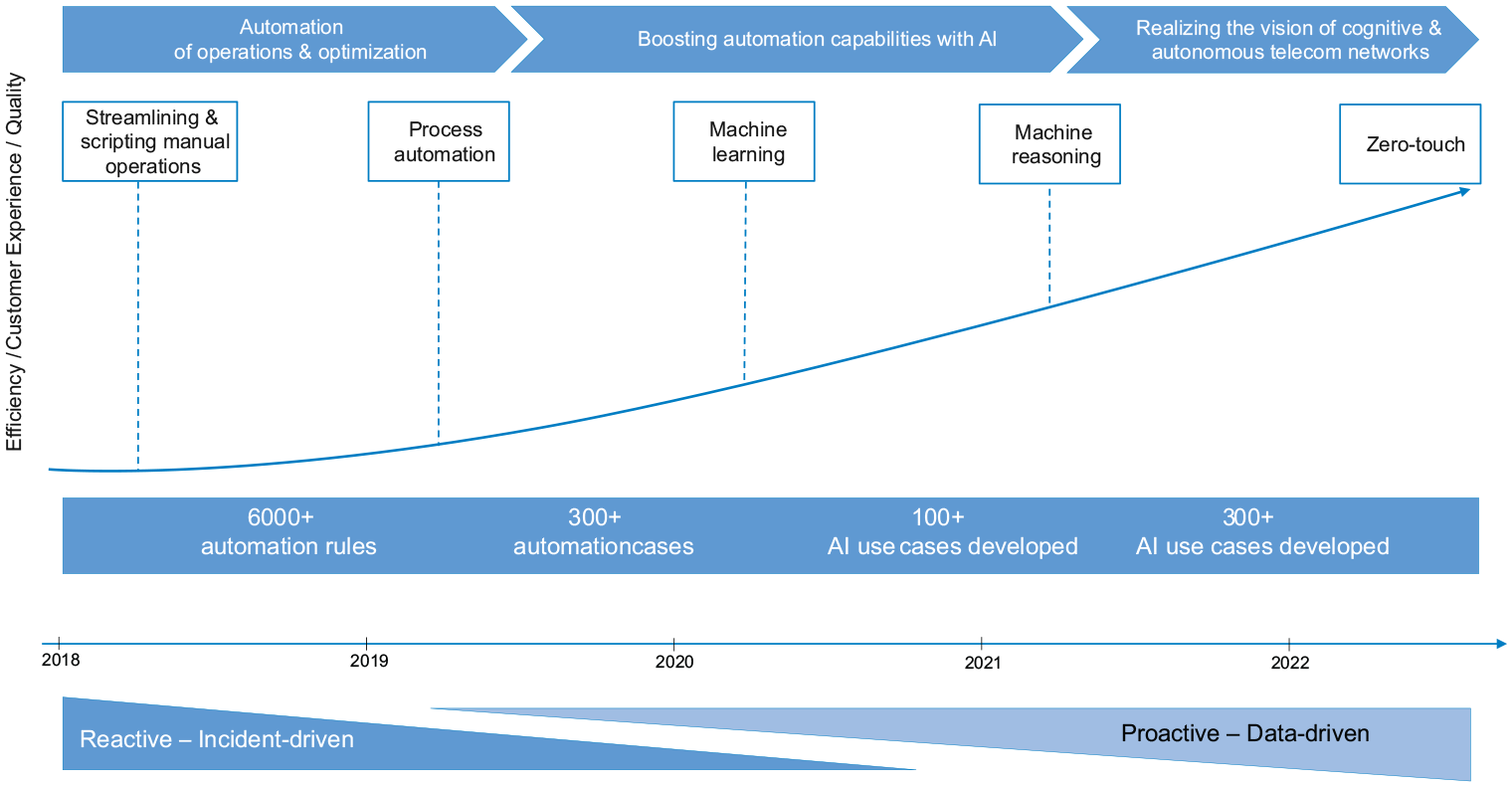
Ericsson’s AI transformation.
Over three years, Ericsson invested $130 million to build what it called the Ericsson Operations Engine, involving over 1,000 multiskilled experts with both telecommunications and data science expertise, and 100 AI researchers. The results as of 2025 were 6,000 automation rules, with 85% reuse, and the automation of 10,000 tasks. AI is now the cornerstone of Ericsson’s strategy and vision for Managed Services, with the goal of managing the best networks and service experience in the most cost-effective way.
Ericsson’s Operations Engine uses a variety of AI technologies to support Managed Services. The use and adoption of AI technologies are continuously updated as technologies evolve. For example, automated data processing systems are pivotal, utilizing machine learning algorithms to systematically detect and classify network issues. The engine incorporates predictive analytics to anticipate network failures before they occur, enabling preemptive actions that enhance network reliability and end-user experience. In addition, the engine uses deep learning techniques for complex pattern recognition across extensive datasets, which is crucial for identifying anomalies that may not be apparent through traditional methods. Furthermore, the engine employs reinforcement learning strategies whereby AI models improve through trial and error, adapting the strategies based on the feedback from network performance outcomes. This feature, especially important for dynamic network conditions, allows the engine to continuously improve its decision-making processes. Key inputs to the Ericsson Operations Engine include extensive datasets of network performance indicators from the managed networks. Notably, the generative AI models that have recently become popular with consumers have not been the most central types of AI for Ericsson. Nevertheless, the firm has experimented with different kinds of AI, including generative AI, to find the best solutions to the problems at hand: We use all the powerful AI tools that we deem solve the problem faster. We are not particular in that way, in that we must do everything ourselves. However, it is always the case that we orchestrate together a small number, or sometimes a large number, of pieces to achieve something that truly solves a business problem.
27
(Global Head of AI, Quantum and Blockchain)
From Bottom-Line Improvements to Top-Line Growth
As with many mature firms venturing into AI, Ericsson’s business strategy was initially unclear in differentiating what it could do with AI from what it should do. Equally unclear was how to capture value from those investments. The lack of strategy resulted in a broad scope, given that Ericsson had developed AI with broad applicability. After initially trying to increase internal efficiency with AI, it quickly turned toward using AI to help customers become more efficient and increase their revenue generation, with hundreds of AI use cases for its customers through AI applications that required additional development (and costs) for specific settings: 28
We first had to solve our own improvement areas, and then once the value was proven, we are helping our customers. (Strategy Director)
Ericsson tries to profit from AI in four ways: by reducing its own cost of operations, by making its customers more efficient, by improving customers’ experience, and by generating more revenues for its customers (see Table 1). Ericsson divides its offers into two types of customer categories when trying to create and capture value, depending on whether or not Ericsson manages the relevant networks.
Four Areas Where AI Is Used.
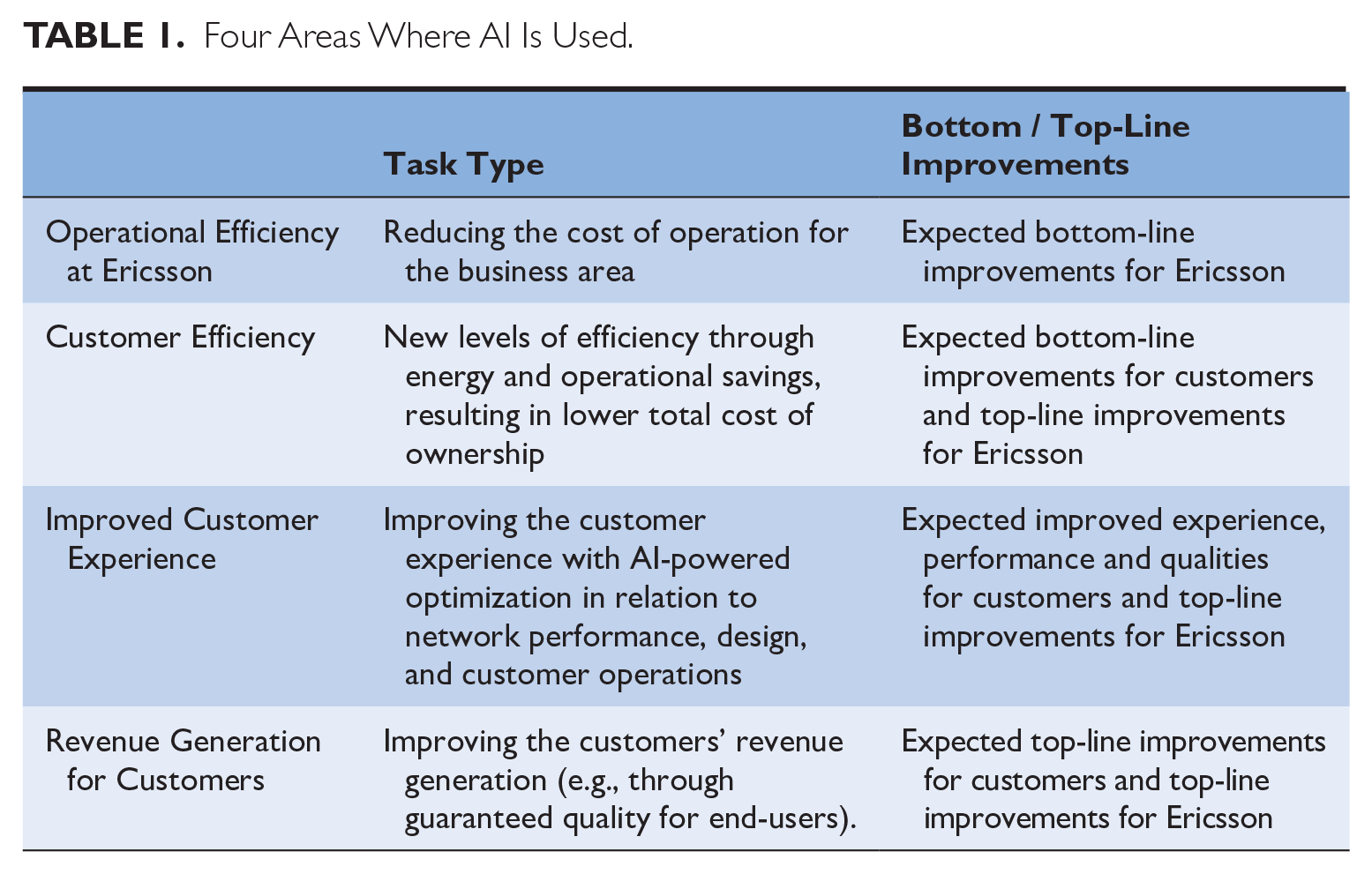
First, for customers whose networks Ericsson operates, it provides service-centric offerings by selling different types of AI packages—AI base packages and AI value packages. With base packages, AI is used to improve the customers’ operational efficiency in their networks, including network service operations and optimization, cloud and IT service operations, and cloud-native application development (see Figure 2). The customer benefit is that a complex multivendor network can be managed at relatively low costs. Customers who use Ericsson’s base packages usually achieve 95% automation of the front office (first line of support), a big reduction in network unavailability (some up to 50%), and a big reduction in customer complaints (some over 50%). New and complex telecommunications networks such as 5G and 6G can, if not planned properly, more than double the operating costs for mobile network operators compared with traditional mobile networks such as 3G and 4G. This underscores the potential advantages of utilizing AI. Ericsson charges a performance-based contract when managing its customers’ networks using its AI base packages, in order to balance between the value captured by the mobile network operators on the one hand and by Ericsson on the other. The AI base packages also help Ericsson increase profits through more efficient internal operations.
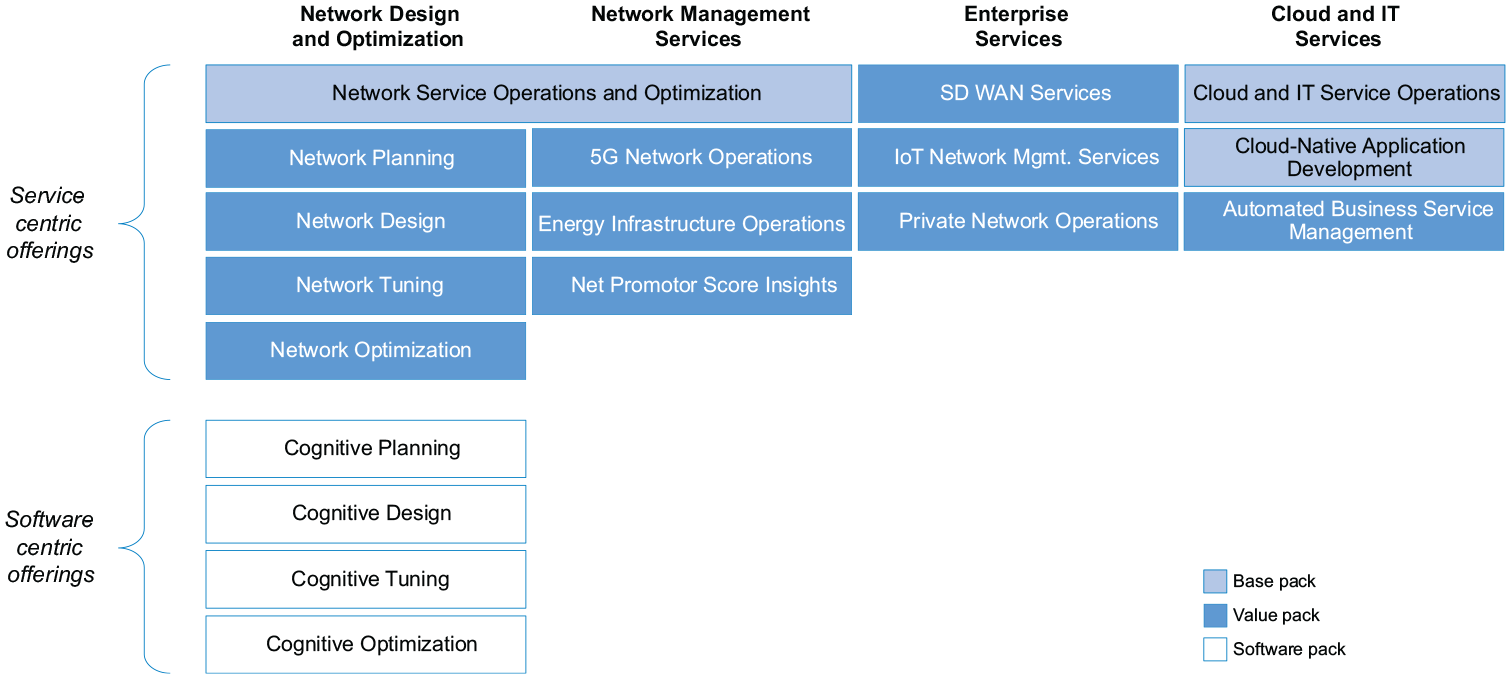
The base, value and software packages.
The AI value packages employ AI to predict network performance and incidents as well as enable proactive network management—for example, before the end-user experience becomes poor. The value packages also improve energy efficiency and plan, design, and fine-tune networks. For instance, the mobile network operator Indosat Ooredoo uses Ericsson’s value pack Energy Infrastructure Operations in a highly loaded 4G residential cluster with more than 3,000 mobile sites. AI takes into consideration the full site of the operator, which contains active and passive equipment such as radio network parts, diesel generators, batteries, and temperature meters from many different manufacturers; this has led to significantly improved network performance and reduced power consumption. T-Mobile uses the value pack cloud and IT service operations, which have led to a 95% reduction in order fallout when, for example, customers are buying a new phone or changing subscription plans. Those types of orders depend on 140 multivendor IT systems on the back end. Ericsson has taken over that environment and applies its AI algorithms to manage the order-to-activation process. When Ericsson operates customer networks, customers are charged for AI value packages with a value-based pricing scheme.
Second, Ericsson provides AI-based offerings to customers for whom the networks are not managed. Those offerings are based on the vast experience of running other customers’ networks and are sold as software licenses or as AI-as-a-Service (AIaaS) packages to customers running their own networks. The offerings include cognitive planning, cognitive design, cognitive tuning, and cognitive optimization. As a result, Ericsson can penetrate a new market niche in which customers are not outsourcing their network operations but still need support in managing their own complex networks. In 2022, Ericsson had 48 commercial customers worldwide using its AI software offerings.
One is Swisscom, a telecommunications provider that uses Ericsson’s Cognitive Optimization offering, which reduces the power consumption of the network. Typically, when an operator reduces power to the network, it will lose coverage. However, AI solves this problem by actively iterating between reducing power and tilting antennas up and down to compensate for the power reduction. This approach helped Swisscom lower its energy consumption at the same time it improved customer experience. AI has resulted in a 20% transceiver power reduction, resulting in 3.4% energy savings per base station, 5.5% downlink user throughput gain, and 30% uplink user throughput gain.
Another mobile network operator, XL Axiata, uses Ericsson’s AI Cognitive Tuning to speed up network optimization and site approval. Historically, operators who rolled out new networks had to do significant manual work on measuring interference and network performance. With AI, crowdsourced data and device data are used to perform virtual drive tests quickly and accurately, in a completely remote fashion. The speed of rollout is accelerated by achieving 60% faster site acceptance and 20% higher project capacity. It also improves customer experience through better network performance and quality.
Where Are the Profits?
While Ericsson identified and developed several applications of AI, it turned out to be difficult to profit from these applications. One manager explained, I certainly think that you need to be very clear on what you are trying to achieve with AI, even in the experimentation phase. In the early days, Ericsson was a little bit too focused on the belief that AI was a transformational capability. And then heading off, down more of a technology-driven track to build AI models without having a clear view of how the value was going to be captured. And then realizing once we went down that track, that value was a little bit more elusive than what we thought. We ended up spending a lot of time building AI models, which did not bring what we thought was going to be the value. (Head of Capability Development)
Why is it difficult to capture value from AI? Despite significant investments and efforts, Ericsson’s generation of top-line growth by the use of AI solutions was hampered by several problems, including difficulties in articulating the value of its AI solutions, scaling the solutions in a cost-efficient way, and pricing them. Much of the challenge is associated with co-specialized complementary assets. Key to profiting from AI in this setting is access to and investments in customer-controlled complementary assets.
First, it was difficult for Ericsson to articulate the value of its AI value packages and persuade customers to pay for them. The value is specific to the customer context, for example depending on the size of the network and network complexity, and it is impossible to specify without considering complementarities with customer assets. As a resolution, Ericsson started to quantify the outcome for customers, “proving” the value by calculating the TCO before and after an implementation of an AI value package. The TCO calculator was used to quantify the savings in operational expenditures (OPEX) and capital expenditures (CAPEX), as well as increases in revenues that each value package brought. This worked well when it came to value packages devoted to, for example, lowered power consumption and increased battery life. Here, Ericsson started charging based on the energy savings of its customers. However, value packages that resulted in OPEX savings for the customer—but that required more and better-trained staff for implementation—were difficult to sell. Moreover, value packages intended to improve the quality of the network or increase revenue for the customer were even more challenging to commercialize, as this value was difficult to evaluate and articulate.
Second, Ericsson experienced difficulties in selling AI solutions to customers for whom Ericsson was not operating their networks. AI solutions are often associated with customization and specialized investments, leading to co-specialization between supplier and customer. It was therefore challenging to sell stand-alone AIaaS offerings: Each customer is very different with their strategies and how they really work and how they operate their network. So I think for every use case, 60 percent is something we can consider as usable, but then, 40 percent is something which we really need to customize as per a customer’s need, because there are a lot of things, every customer has different bands, every customer has different command structure to do operations. . . I think when we are in full control of the processes, it is much easier: You have the data and the processes, you can bring in AI much more easily than if you were to do it with a new customer. With their tools and processes, it becomes much more difficult because you need to spend time on understanding the data, processes, and organization. (Service Portfolio Director)
Since almost every implementation of AI required some level of co-specialization between Ericsson’s and its customers’ assets, it was difficult to scale AIaaS offerings efficiently, which led to limited value capture. To better industrialize and scale software-centric offerings, Ericsson had to reformulate and change its approach to sell stand-alone AI solutions by reducing the level of co-specialization and moving away from costly on-site integration.
To mitigate this challenge, Ericsson combined its AI-based insights and recommendations with a closed automation loop that had standardized interfaces (see Figure 3). Instead of customizing the integration on-site at the customer, Ericsson developed standardized interfaces and commands, enabling remote information retrieval and processing, reducing the need for customization. In short, Ericsson made an effort to generalize the technology by designing clearer interfaces to broaden applicability across customers: 29
There is a higher tier of value capture when we combine AI technology with closed-loop automation. Here, we not only generate insight or prediction based on the algorithm, but we also, in an automated fashion, make changes in the customer’s network. That brings quite sizable performance gains. We’re sort of getting to the point beyond operational savings—AI technology obviously can drive network performance. (Head of Commercial Management)
Profiting from AI became easier when used to optimize internal processes where relevant complementarities are within the boundaries of the firm—giving rise to the firm’s own bottom-line improvements—and where it is used to improve customers’ bottom lines by reducing easily measurable costs at client sites, such as energy use. 30 Those benefits helped turn around the negative trend for Ericsson’s business unit. For example, the gross margin improved by 7.6 percentage points from 2018 to 2021. In total, Ericsson estimated that it delivered $500 million in enabled value from AI from the start of its AI effort until 2023. 31 However, it has been significantly more challenging to capture value from providing stand-alone and value-enhancing—not only cost-reducing—AI solutions to Ericsson’s customers.
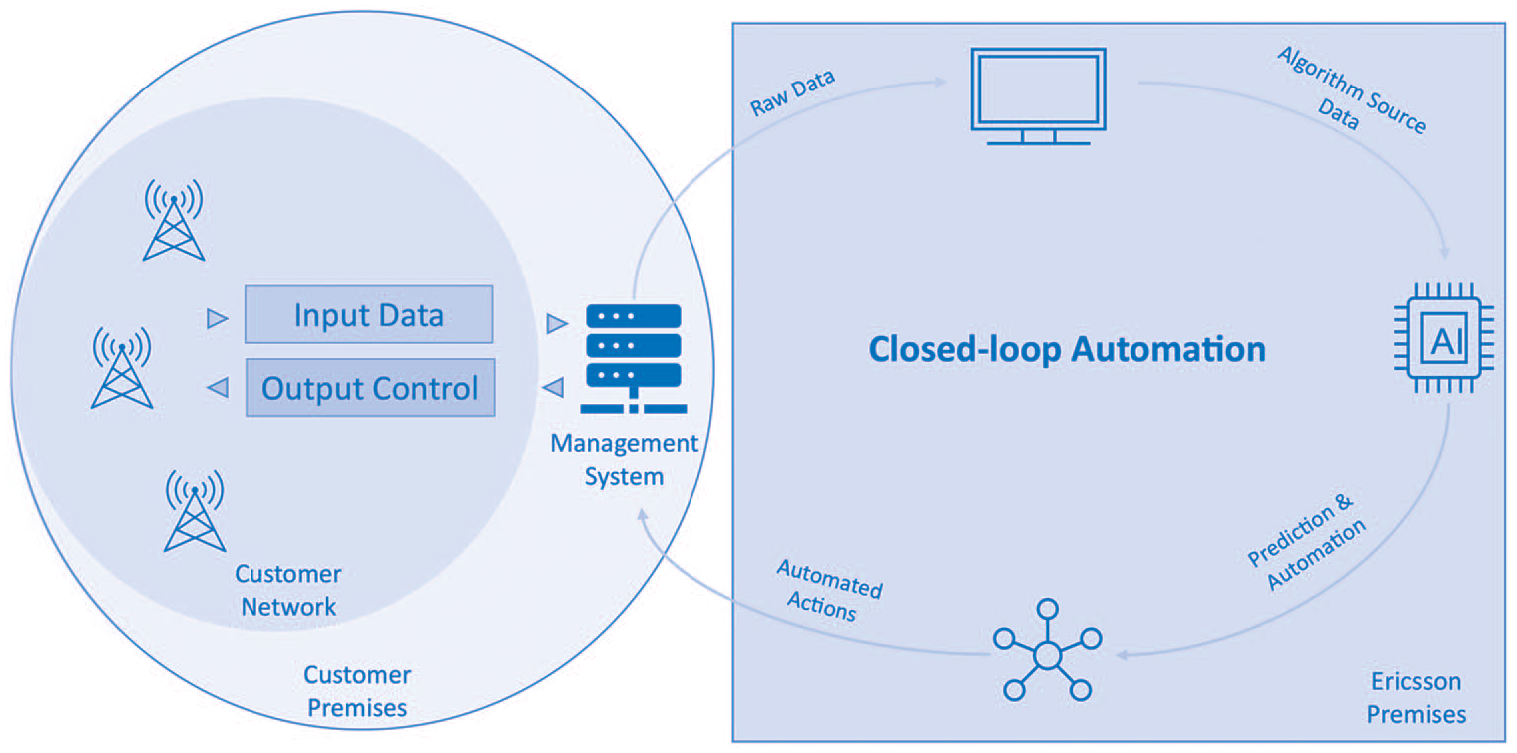
Closed automation loop.
Implications for Profiting from AI
There are two main strategies for established firms to create and capture value from AI, based on the case of Ericsson’s AI transformation: first, a strategy to grow the bottom line, with a focus on using AI to improve internal efficiency, and, second, a strategy to grow the top line, with focus on new businesses enabled by AI. Just as the original PFI framework predicts, 32 complementary assets are necessary to profit from investments in AI, and just as the revised framework on profiting from enabling technologies predicts, 33 such complementarities relate to trade-offs between design costs and applicability, and between value and applicability. However, complementarities play out differently in strategies aimed at top-line growth compared with those aimed at bottom-line improvements. In particular, top-line growth strategies rely on co-specialized complementary assets distributed across firm boundaries, amplifying three important AI appropriation challenges: a data challenge, a capability challenge, and a value challenge (see Figure 4).
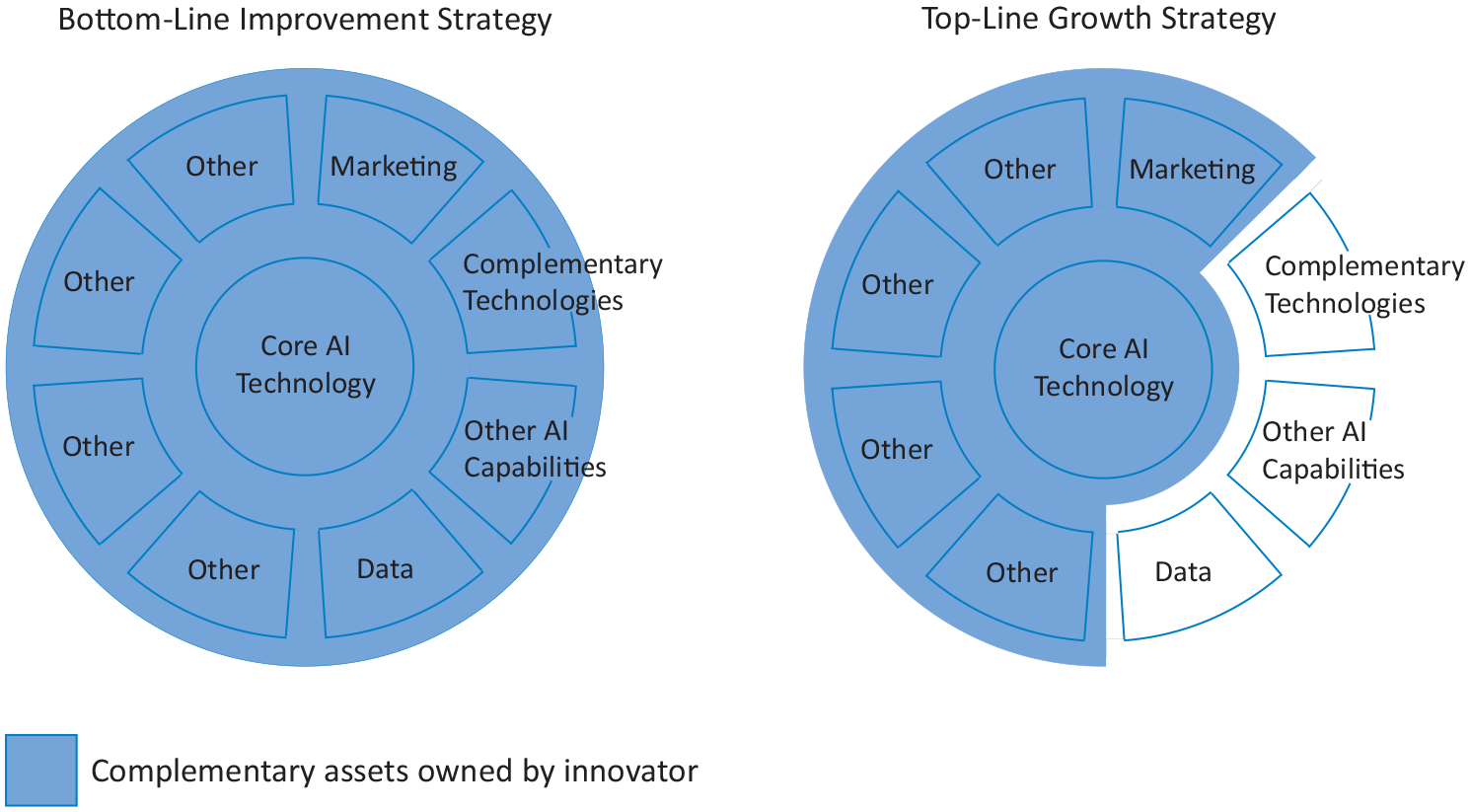
Control of complementary assets in different strategies.
Data Challenge
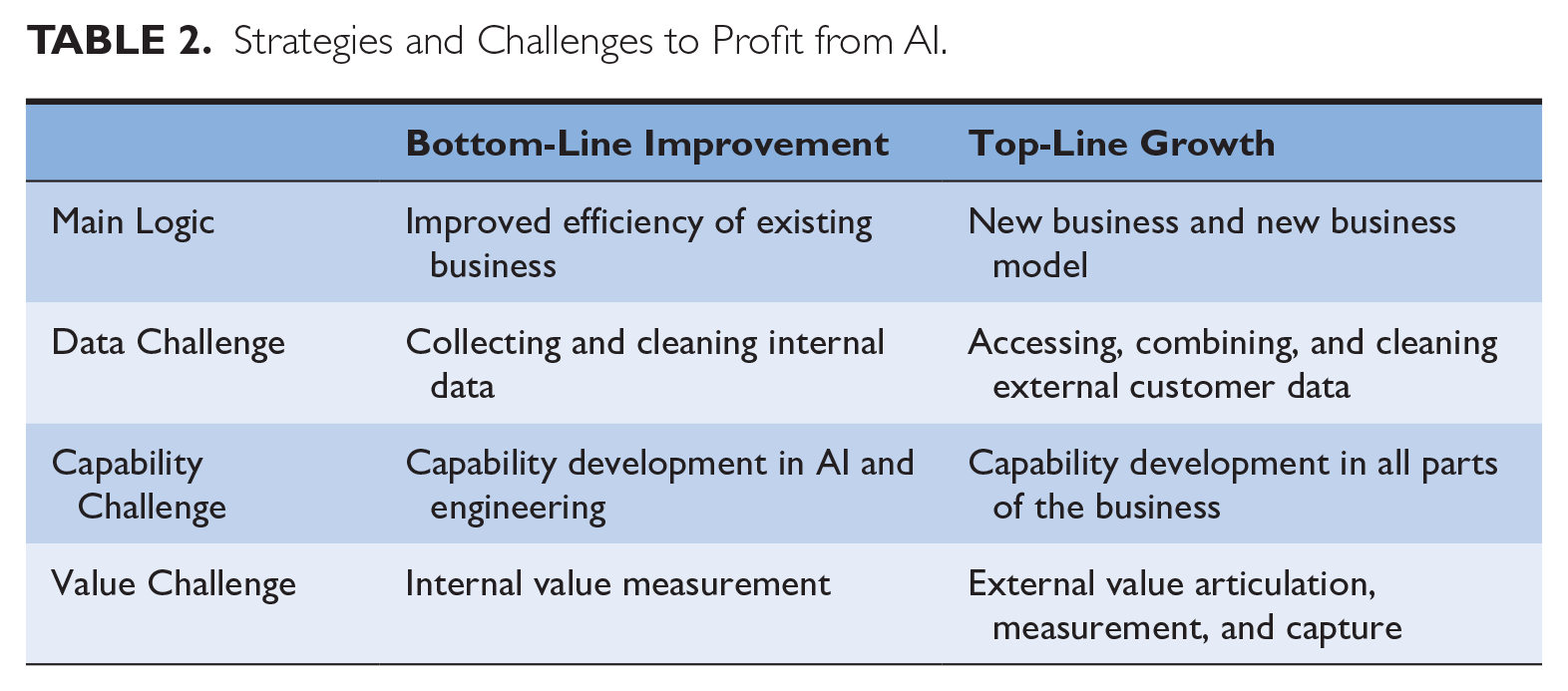
AI and data have strong complementarities. 34 Great AI technologies cannot be developed without great data, and data access is more challenging for building new businesses aiming at top-line growth than for improving the efficiency of existing operations (see Table 2). For example, when developing internal AI for efficiency and bottom-line improvement, Ericsson could rely on its vast access to data on internal operations. When developing new AI-driven businesses, however, customers’ data were an essential complementary asset outside Ericsson’s immediate control. Customers are generally reluctant to share data for AI that could be used in competitors’ operations.
Strategies and Challenges to Profit from AI.
Customer data are typically the customer’s asset, and it often takes much effort to get access to data and to deal with the anonymization of data. 35 To access and use external data, firms must also comply with data integrity and regulations, and so the physical location of AI algorithms is usually a concern for customers. In some cases, AI algorithms must be physically located on the customer’s premises, which creates difficulties in utilizing data to improve and scale generalized AI offerings. Ericsson’s approach to this problem was to offer AIaaS placement in three different physical locations: a global location for customers who have no data restrictions, an in-country location for customers who have national regulations that require data to remain in that country, and an on-site location for customers who require all data to remain on their premises. By using the same data stack across all types of sites, replication was smooth and cost-effective, and Ericsson could still control management of the algorithms, with only the sensitive input data remaining at its location. In effect, Ericsson succeeded in persuading many customers to share data by showing them the value of sharing it. Larger datasets can enhance the effectiveness of data algorithms, benefiting everyone involved. For Ericsson’s customers, often the primary concern was losing control over their data, which also involved regulatory constraints. Ericsson addressed this issue with federated data solutions, ensuring that customer data remained under the customer’s control. However, value-capture problems remained due to additional challenges.
Capability Challenge
Profiting from AI is not only about data. Ericsson estimated that 60% of its efforts in AI were related to reconfiguring processes and building new capabilities. For example, Ericsson communicated that 90% of employees in the business unit needed training to be upskilled and reskilled. It took five years to assess and certify 63% of the employees. And since the AI technologies and tools continue to evolve and to be developed, upskilling of the workforce is ongoing.
Competence development is especially challenging when aiming for top-line growth, as upskilling and reskilling are needed across a larger share of the firm’s functions. In addition, competence development often needs to be matched with capability development on the customer side. A bottom-line growth strategy does not necessarily require any major change to the existing business model. Ericsson could continue to sell customized solutions with individual pricing based on performance-based value capture. This stands in sharp contrast to the capabilities needed for the strategy to grow the top line by building new businesses, where AI competence is required across the board from engineering to sales and customer support. Strategy formulation, business model design, and dynamic capabilities are tightly connected, and this interdependency made it significantly more difficult for Ericsson to profit from top-line growth than from bottom-line improvements. 36
Value Challenge
It is easy to fall into the trap of developing cool, alluring AI while forgetting how it solves customer problems. To be successful, the customers’ pain points must be identified and evaluated. However, even for AI that is creating customer value, it might sometimes be difficult to profit, as Ericsson’s case shows. Given the complementarities among AI, data, and complementary technologies, AI is impossible to value on its own. In other words, the value of AI is truly context-specific and the value challenge multiplies when the customer controls the context.
Ericsson uses TCO calculators to articulate and capture the value of AI for its customers—for example, in terms of energy reductions. Nevertheless, measuring and communicating the value of an AI service to customers is a significant challenge. Firms need to tread carefully when choosing among different AI opportunities. Put simply, the value-capture logic should be a central consideration when prioritizing among AI applications. 37
An increasing number of firms now focus on revenue increases rather than on making operational processes more efficient, 38 and they are likely to find that it is hard to get the result they aim for with AI without a proper strategy formulation, business model design, and strong dynamic capabilities. Therefore, the transformation into an AI-driven organization requires a clear purpose: why is AI important, and why might it allow the firm to create and capture more value? To be successful, a firm must sort out why it should become an AI-driven organization and where it should allocate its resources. Is the goal to cultivate a better customer experience, to create a better employee experience, to make better business decisions, to lower customers’ costs, to increase the customers’ revenues, or something else? In Richard Rumelt’s words, “what is the crux?” 39 Lacking a clear purpose is costly and often leads to failure.
Conclusion
It is clear that AI can be used to enable both top-line growth and bottom-line improvements. While all types of AI transformations are challenging, transformations aiming for top-line growth are especially difficult because of distributed complementary assets, which amplify data, capability, and value challenges. An important differentiator between AI strategies for bottom-line improvements and top-line growth is indeed the nature and locus of complementarities. Our research shows that top-line growth often requires external data access and integration with complementary customer technologies—thus a level of co-specialization between the innovator’s AI and the customers’ assets—leading to significant value-capture challenges for the innovator. This sheds new light on the PFI framework in the specific context of AI in established companies, with implications for both management theory and practice. Future research could further explore and test the distinctive value capture challenges in different strategies to better understand the unique complementarities at play. Meanwhile, the message to management practice is clear: to grow the top line with AI, firms must analyze complementarities carefully and invest wisely in competence, technology, data, and dynamic capabilities. In some cases, firms may be better off prioritizing the use of AI for their own efficiency gains.
Footnotes

Notes
Author Biographies
Mats O. Pettersson is Principal Researcher at Ericsson Research, Ericsson and Affiliated Researcher at the Stockholm School of Economics, Department of Entrepreneurship, Innovation and Technology (email:
Joakim Björkdahl is Professor of Strategic Management and Innovation at the Department of Technology Management and Economics at Chalmers University of Technology, Sweden (email:
Marcus Holgersson is Professor of Industrial Management and Economics at the Department of Technology Management and Economics at Chalmers University of Technology, Sweden (email: