




Abstract
We show that proximity is significant during cloud computing’s adoption. This is counter to the prevailing assumptions of cloud adoption as being more impersonal and distant, with less interaction between provider and purchaser than on-premise technologies. We do this through an interpretive study of cloud computing adopters across Europe. We develop a conceptual framework of cloud proximity which draws attention to its locational, relational and temporal proximal dimensions. Our proximal analysis leads us to identify three aspects of cloud adoption where proximity plays a key role: mercantile aspect (e.g., cloud sales support), counsel aspect (e.g., access to internal and external expertise) and organi-technical aspect (e.g., the understanding of cloud technology and services alongside their organizational adoption context). By challenging assumptions of distant and remote adoption, we contribute to the cloud computing adoption research and raise questions for IT adoption in general.
Keywords
Introduction
The ‘cloud’ metaphor implies something that is remote and ethereal. This metaphor has influenced the perception of cloud computing (henceforth cloud) in the business community, and in research; cloud is assumed as a ‘remote’ service which requires minimum interaction with the vendor and other relevant stakeholders. However, our engagement with the business community as part of our broader research agenda on cloud adoption (Polyviou et al., 2023) showed that location of data and services and close partnerships with vendors remain important, thus leading us to question this perception of remoteness and motivating us to study cloud proximity in depth. We understand such proximity as ‘being close to something on a certain dimension’ (Knoben and Oerlemans 2006). To be proximal is to be co-present and thus always ‘located within time and space’ (Urry 2002, p.159).
The cloud literature indicates that the factors and the processes through which cloud adoption decisions are made are qualitatively different from earlier technologies (Schneider and Sunyaev, 2016; Venters and Whitley, 2012) with considerable literature outlining differences (e.g., Asatiani, 2015; Oliveira et al., 2014). This literature, however, does not explicitly address how the proximity (or remoteness) of ‘cloud’ influences businesses’ adoption of this technology. Is cloud really so distant and remote for those deciding? If cloud has proximal characteristics and dimensions, how do these influence cloud adoption?
We answer these questions by contributing a proximal understanding of cloud and its adoption, developing a theoretically informed and empirically grounded conceptual framework of cloud proximity that encapsulates locational, relational and temporal dimensions. Our empirical work confirms the relevance of proximity in cloud adoption, challenging earlier literature on the impersonality and location-independence of cloud services and on neglecting the role of temporality in cloud adoption. Furthermore, our research analysis leads us to identify three key aspects of cloud adoption where proximity matters: the mercantile aspect, to illustrate the role of proximity in cloud’s presentation and its sales support, the counsel aspect, to depict how access and use of internal and external expertise matter, and the organi-technical aspect that focuses on a proximal understanding of cloud technology and services alongside their specific organizational adoption context. This enhanced conceptual framework also sensitizes businesses engaged in cloud adoption (as vendors, consultants or adopters) to the importance of proximity and contextual conditions. It additionally provides a new theoretical lens for examining other contemporary information technologies and services adoption where proximal assumptions may be evident (e.g. IoT, Blockchain, AI).
The paper is structured as follows: We first examine the concept of proximity and its locational, relational and temporal dimensions and show how these can be used to examine cloud adoption. Then we explain our methodological approach and we present our findings, showing the relevance and importance of cloud proximity dimensions. We discuss the theoretical and practical implications of our findings; we present the mercantile, counsel and organi-technical aspects that emerged as important in each proximal dimension of cloud and build an enhanced theoretical conception of proximity in cloud adoption. We also present avenues for further research. We then summarize the contribution of the paper to our understanding of cloud adoption.
Proximity in cloud computing
Proximity concerns closeness – a ‘co-present interaction’ (Boden and Molotch 1994) – ‘The fact or condition of being near or close in abstract relations, as kinship (esp. in proximity of blood), time, nature, etc.; closeness. Also, the fact, condition, or position of being near or close by in space; nearness’ (OED 2007). Proximity remains a ‘scarcely explored area’ within management science (Lis, 2020) and existing research mostly addresses proximity between people such as dispersed colleagues or teams (O’Leary et al., 2014; Shi et al., 2016; Zamani and Pouloudi 2021) and inter-organizational collaboration (Knoben and Oerlemans 2006; Klimas 2020). In considering technology, such research often examines its subjective influence such as the perception of proximity among such people (e.g., O’Leary et al., 2014). Wilson et al. (2008), for example, suggest that a perception of being proximal can be achieved through ‘frequent, deep and interactive’ (p.986) communication and enhanced cognitive connections – mediated by technology.
While not explicitly examined, IS literature indicates the relevance of proximity within the adoption of technology. Oshri et al. (2018) show how ‘familiarity’ is important for successful outsourcing contracts, Mola and Carugati (2017) discuss ‘localism’ in sourcing decisions, while Gertler (1995) highlights the importance of ‘closeness’ among collaborators in developing and adopting technology. Such research remains focussed on human proximity or organizational proximity (e.g., Oerlemans et al., 2001; Oerlemans and Meeus, 2005; Oliveira et al., 2014). In order to examine cloud adoption though, we assert the need to also consider the proximity to a technology (Shane, 2000) – physically (network latency) and virtually (the experience of connecting to a service).
To study cloud proximity in this paper, we draw upon Urry (2002) who suggests that to be proximally close to someone or something concerns a location, a relationship but also a period of time. Consider meeting as an example of proximity. A meeting has
Proximity literature often refers to geographical proximity defined as the ‘linear distance between people’ (Monge et al., 1985, p.1130) or ‘geographic closeness’ (O’Leary et al., 2014, p.1219). Research highlights the ambiguity and paradox in such measures (Lis, 2020) which can be subjective for individuals (e.g., co-located staff can feel ‘distant’ from each other) (Wilson 2008) where perception of distance is cultural (Mola and Carugati, 2017). Given that geographical distance is less relevant to cloud than other dimensions related to location (such as network latency and bandwidth, power sources, laws, travel possibilities, meeting venues etc), so we subsume such geography into the broader analysis of ‘locationality’.
Proximity can be cognitive, social and institutional (Boschma, 2005a, 2005b) so that knowledge (both tacit and explicit) is shared, kinship and trust created, and norms and relations emerge from proximal relations. Proximity can also be perceived in the sense of a ‘cognitive and affective sense of relational closeness’ (O’Leary et al., 2014, p.1219). That is, teams or organisations may perceive themselves as close despite huge distances and lack of face-to-face interactions (Wilson et al., 2008; O’Leary et al., 2014). Indeed, O’Leary et al. (2014) demonstrate that it is perceived proximity and not physical proximity which impacts relationships. We synthesise such proximities into our term ‘relationality’ for cloud adoption reflecting that multiple forms of relations may emerge between different actors (e.g. adopters, consultants, vendors, internal staff and systems).
The literature also notes the similar importance of various past structures (institutions, technological lock-in, norms of behaviour, ties of past personal experience) on proximity (Boschma, 2005a, 2005b; Lis, 2020), whereas others highlight temporal features such as overlapping working hours and timezones (O’Leary and Cummings 2007). Cloud adoption, with its emphasis on radical change, on transformation, and on the new, alongside a focus on speed and access, thus calls for a focus on temporality. Indeed, pre-existing knowledge and experiences shape the perceptions of actors (Laneh and Lubatkin, 1998) towards technology. For example, in researching technological proximity, Shane (2000) revealed that entrepreneurs discover new technologies’ possibilities based on their prior knowledge (see also Venkatarman, 1997). In the context of cloud, for a firm to be able to recognise the value and reflect on the benefits of cloud technology, specialized knowledge is required of past systems, and future planned uses. In elaborating such an examination of temporality within proximity, we are informed by Emirbayer and Mische (1998, p.964) who argue that agency is ‘always oriented towards the past, the future and the present at any given moment’ with past and future relational to the present. We therefore synthesise our term ‘temporality’ for cloud adoption reflecting that it is influenced by the remembered past (friendships, lock-in, legacy systems and other path dependencies) and orientated towards the projected future (through plans, anticipated changes, imagined solutions and uses).
We now turn to the cloud literature to examine proximity through these entwined dimensions of locationality, relationality and temporality.
Proximity in the cloud computing literature
One of the most cited 1 definitions of cloud describes it as ‘ubiquitous, convenient, on-demand network access to a shared pool of configurable computing resources (e.g. networks, servers, storage, applications, and services) that can be rapidly provisioned and released with minimal management effort or service provider interaction’ (Mell and Grance, 2011 p.2). This definition highlights that cloud differs substantially from earlier forms of IT provision. With our research agenda in mind, we re-read this definition of cloud and note the following. First, network access and ubiquity signal that cloud resources may be provided from different geographical locations. Second, the ‘minimal management effort or provider interaction’ suggests changes in the relationship of the organization with the technology vendors and its employees, who traditionally have been heavily engaged in interactions and negotiations throughout the adoption process. Third, the ‘convenient’, ‘on-demand’, ‘rapidly provisioned and released’ characteristics suggest a temporal dimension, as technological resources can be easily and quickly adopted, altered or adjusted on-demand, inviting a comparison with past experiences and justifying the choice of cloud based on imagined benefits. Thus, this definition is in line with the cloud metaphor as a technology that is remote. The definition also shows the relevance of the locational, relational and temporal dimensions to portray this remoteness as a distinctive characteristic of cloud.
We employed these three dimensions to revisit the literature on cloud and explore whether the perception of cloud as remote is consistent across the literature. We found that this new reading of the literature reveals inconsistencies in the perception of these three proximal dimensions of cloud and thus begs a deeper investigation and analysis of cloud proximity. On the one hand, existing research shows that cloud indeed enables organizations to go beyond the locational, relational and temporal boundaries experienced with previous technological decisions. On the other hand, researchers argue that organizations adopting cloud remain bound to location, relation and temporal restrictions, and implicitly question whether cloud is a radically different provisioning paradigm. Here, we review how these alternative perspectives relate to each of the three dimensions.
First, locationality is recognized as a prevailing concern for cloud (Brynjolfsson et al., 2010). Cloud is an evolving technical innovation (Venters and Whitley, 2012) that has enabled the outsourcing of data-centres (Buyya, 2009) and virtualized computing resources. This change in technology provision enables organizations to access technology vendors across the world, overcoming in this way the restrictions imposed by their geographical location and their need to manage datacentres at their own location. As a new form of digital infrastructure supply, cloud services are likely to be adopted in unusual ways as ‘they span beyond the boundaries of a single corporation. Traditional rules and mechanisms of alignment, centralization, and cost control need to be augmented with new governance principles’ (Yoo et al., 2010, p. 732). Cloud offers ‘location independence’ (Iyer and Henderson 2010; Polyviou and Pouloudi 2015), so that the location of the provider is, it is suggested, no longer important. As noted by Oliveira et al. (2014), even local legal and regulatory frameworks do not necessarily impact cloud adoption decisions, letting organizations seek technological solutions beyond their local or regional geographical restrictions. Other research, however, notes that jurisdictional geography, particularly the lack of clarity of where data are stored (Denny 2010), and specific legal jurisdictions, may impact privacy and trust decisions (Pearson and Benameur 2010) and have security implications (Morgan and Conboy, 2013; Polyviou and Pouloudi, 2015) and are thus important considerations. Recent debate on cloud data sovereignty (relating to governments’ authority over data stored in local or foreign data-centres) also highlights geopolitical pressures for certain data locationality (Amoore, 2018; Braud et al., 2021). Furthermore, the impact of latency (Venters and Whitley 2012), that is, the time a message takes to be delivered being limited to the speed of light through a fibre optic cable (e.g., Yoo, 2011), becomes globally consequential. The rise of Fog and Edge computing (Dastjerdi, 2016), and the rise of profiting on arbitraging latency (Patterson 2012) highlight the challenge of latency in cloud services. Indeed, trading markets (such as IEX) introduce delay (known as ‘speed bumps’) to limit the trading opportunity of arbitrage against geographical differences in cloud based financial services (Friedman, 2017).
Second, cloud reconfigures the organization’s relations with its stakeholders, not least because it changes its boundaries with employees, customers and other organizations (Willcocks et al., 2014). In cloud, relationships between vendor and customer are often considered ethereal (in line with the cloud metaphor), mediated entirely by technology (the network) and ephemeral or transactional. Cloud restructures the relationship of the organization with technology vendors because the traditional way technology services are purchased is significantly altered (Bardhan et al., 2010). While ‘traditional’ requests for proposals (RFP), tenders and contracts were a feature of software adoption, cloud services are promoted as off-the-shelf services to be purchased online in the form of a subscription pay-as-you-go pricing model (Marston 2011) often using only credit-card payments. Face to face meetings (whether virtual or physical) are usually assumed unlikely with cloud providers. As a result, direct relationships between vendors and customers may be eliminated and RFP approaches no longer used. Thus, provider trustworthiness in the context of cloud is interpreted in terms of provider reputation (Koehler et al., 2010) and the presence of certain website elements on the provider’s website (e.g., search box and social recommendation agent, Karimi and Walter 2015). Nonetheless, vendors’ potential to provide customer support remains critical when considering cloud adoption (Alshamaila et al., 2013), as well as vendor competences (Saedi and Iahad, 2013). Partner and competitive pressure also influence cloud adoption (Hsu et al., 2014; Khajeh-Hosseini, 2012; Low et al., 2011; Alshamaila et al., 2013). Additionally, the literature highlights changes in the relationships with internal stakeholders. It shows that different stakeholders of the organization, such as top management executives and the CIO, are actively involved in cloud adoption (Alshamaila et al., 2013; Low and Chen, 2011; Morgan and Conboy, 2013; Oliveira et al., 2014; Whitley et al., 2013; Polyviou et al., 2014). Business owners are also involved in such decision making: the ‘owner intention towards cloud’ was found as relevant to cloud adoption (Saedi and Iahad, 2013) as well as CIO innovativeness (Lian et al., 2014).
Finally, the cloud paradigm differs from earlier technologies because it alters the perception of technological impact over time (temporal dimension). It is assumed to be quicker to adopt with simpler contracting and purchasing arrangements. Furthermore, users can test candidate services before adopting (Surya et al., 2014) quickly and without a large investment. Organizations can also move their technology expenditures from capital expenditure (CapEx) to operational expenditure (OpΕx) (Van der Molen, 2009; Vouk, 2008) enabling more flexibility in temporally adjusting their expenditure. Cloud services thus offer strategic flexibility (Benlian et al., 2009) since organizations can extend or eliminate services on-demand. Nonetheless, cloud adoption may not be independent from past decisions. Venters and Whitley (2012) argue cloud adopters analyse cloud in terms of its ‘equivalence’ to a company’s existing historic on-premises IT provision. In this sense, temporal relevance goes beyond the notion of on-demand services that are used independently of any earlier computing provision. Rather than an entirely new paradigm, a notable number of studies consider cloud’s relative advantage, when compared to previous technology (e.g., comparisons with the mainframe or PC eras (Heath, 2012)), as one factor impacting cloud adoption decisions (Asatiani, 2015; Oliveira et al., 2014). In addition to taking a stance with reference to the past, cloud also enables organizations to remain flexible in the future. One of the stated advantages of cloud is its ability to scale on demand (Armbrust et al., 2010; Owens 2009), with scalability as a key adoption factor. Yet in all such cases, decision makers must relate their decision to an expectation (an imagined projection of the future) of dynamic demand and uncertainty (Espadas et al., 2013), compared with a remembered past of existing services and demands. Indeed, evaluating the cost of cloud involves comparing whether future demand is dynamic (favouring OpEx) or stable (favouring CapEx) based on a past demand. Cloud’s imagined future in the organization is also translated into foreseen cost benefits (Alshamaila et al., 2013; Khajeh-Hosseini, 2012; Lian et al., 2014; Morgan and Conboy, 2013) and foreseen risks associated with potential vendor lock-in (Sarkar and Young, 2011; Seethamraju, 2013; Trigueros-Preciado et al., 2013). Finally, cloud platforms and infrastructures (PaaS and IaaS) are generative and open to recombination (Yoo et al., 2010), thus enabling adopting companies to innovate upon them in ways that will evolve and change over time. Venters et al. (2014), however, show that such generativity exists within a temporal dynamic of change in which past technology and remembering are entwined with future technology and human intentions.
This review of the literature highlights the research interest in understanding cloud provision as a different paradigm for IT provisioning but reveals that there are mixed arguments as to whether cloud is indeed ‘remote’. This inconsistency begs for research into cloud proximity and particularly in its role in cloud adoption decision making. The locational, relational and temporal dimensions of proximity can provide a relevant preliminary conceptual framework for guiding such research as explained in the next subsection.
A theoretical perspective of proximity in cloud adoption
Proximity dimensions relevant to cloud adoption.
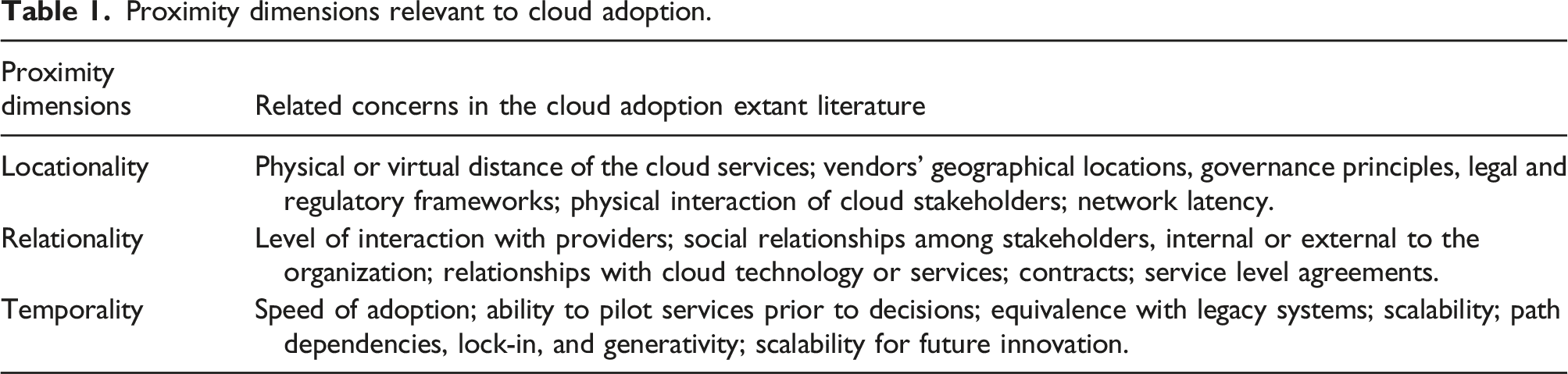
Our theoretical perspective thus allows for an alternative and complementary analysis of the cloud adoption decision-making and allows us to hone our research question to: How do the locational, relational and temporal dimensions of proximity influence cloud adoption decision making? The next section outlines our research approach for addressing this question.
Research approach
This research forms part of a larger exploratory and interpretive study of cloud adoption. We did not enter the field with specific theories in mind beyond our intent to study cloud adoption in organizations. We first focused on the cloud adoption decision-making process (Polyviou et al., 2023). During this study our data led us to raise the question of whether cloud is as remote and impersonal as it is often defined (cf. Strong et al., 2014). We employed our empirical material as ‘critical dialogue partner – not a judge or a mirror – that problematizes a significant form of understanding, thus encouraging problematization and theoretical insights’ (Alvesson and Kärreman, 2007, p.1266). Problematization here is an ‘endeavour to know how and to what extent it might be possible to think differently, instead of what is already known’ (Foucault 1985, p.5 cited in (Alvesson et al., 2011)). It is this problematization which led us to see proximity as a key issue within our initial interviews (in contrast to the assumptions inherent in the extant cloud narrative). Accordingly, our empirical research was organized in two phases.
Phase one entailed a qualitative exploratory field study based on 30 hour-long semi-structured interviews (across 29 heterogeneous European organizations) 2 with CIOs or equivalent that had recently led adoption decisions (see Table A1 in Appendix A for details). We invited interviewees to reflect on their experiences (Poole et al., 2000). We adopted an interpretive research approach (Van de Ven and Poole, 2005) based on multiple sites which as ‘retrospective studies, offer the opportunity to identify patterns indicative of dynamic processes’ (Leonard-Barton, 1990, p.248). The interview agenda included open questions, prompting respondents to talk about their initial and emerging perceptions of cloud, the cloud adoption decision process they followed and the reasons for their decision, the internal and external stakeholders engaged and the sources of information and resources they used. In addition, we attended industry events on cloud to observe trends, marketing activity and networking behaviour among vendors and clients.
Following data collection, we analysed the transcripts iteratively, allowing the voice of the respondents to inform us on cloud perceptions and cloud adoption processes. All authors were involved in the interpretation, and it is through this analysis of cloud perceptions and the respondents’ narratives on how the decision for (or against) cloud adoption unfolded that we discovered that cloud was not necessarily perceived as remote. In line with an inductive research process, we revisited the cloud literature focussing our revised review on aspects of proximity – unveiling the limited and conflicting perceptions of cloud proximity presented in the previous section. 3 We then revisited our interview transcripts, now explicitly coding references in our data to proximity, whether locational, relational or temporal. This revealed an interesting disparity between these dimensions of proximity as evident or implied in cloud literature and the interviews. Indeed, we revealed that, based on our evidence, cloud was more proximal than remote, insubstantial or ‘cloud-like’. Our data were particularly instrumental in defining and refining our understanding of the temporal dimension of proximity. We then reviewed and compared the relevant extracts and inductively and iteratively (Walsham, 2006) built a refined understanding of locational, relational and temporal cloud proximity.
To strengthen this understanding and ensure the timeliness of our findings, in phase two, we undertook a follow-up study with senior executives, where we qualitatively surveyed an 17 cloud adoption decision makers and interviewed an additional 8 (see Table A1) for around 45 minutes each, including one of the major global cloud vendors and a cloud ERP software vendor, while we also continued attending relevant industry events. Table A2 in Appendix A presents an overview of the data collection and analysis phases and the respective key findings.
Our interview agenda in this second phase focussed explicitly on proximal aspects of cloud adoption, inviting respondents to report their experiences concerning the interaction of cloud adopters with cloud vendors, the role of physical and virtual events on cloud, the location of datacentres, sales-support offices or consultants and the effect of past IT adoption decisions on cloud adoption themes that emerged from the analysis of the first phase of interviews, once we had re-read them from a proximity theoretical angle. The interviews also included open questions on cloud perception and the cloud adoption process. As this research phase followed the Covid-19 pandemic, we also invited respondents to comment on the role of virtual versus in-person events. We analysed the responses based on the key proximal dimensions, as in the first phase, comparing the results revealed from data with existing theory (Urquhart and Fernandez, 2006), and confirmed that proximity has continued to be an important facet of cloud perception, influencing cloud perception along the three dimensions. We were also able to confirm and further refine relevant concepts and concerns within each dimension, incrementally refining our conceptual framework on cloud proximity.
Our dialogue with the empirical corpus was ongoing within the multiple rounds of writing of this paper as we sought to understand further our evidence base’s vision of cloud adoption ‘blurring, clarifying, magnifying and diminishing the things we see through it’ (Alvesson and Kärreman, 2007, p. 1267). Our later stage analysis thus seeks richer insights on what was happening in cloud adoption within a phenomenon-focussed problematization of proximity within cloud adoption (Gkeredakis and Constantinides, 2019; Monteiro et al., 2022). Through this analysis, we identified mercantile, counsel and organi-technical aspects of proximity, as we explain in the next section where we present our findings and the resulting framework in detail.
Analysis
We analyse how proximity matters in cloud adoption decision making, organised through the three proximal dimensions of cloud presented earlier in this paper, and discuss how these interrelate. We quote from specific interviewees [i#], qualitative surveys [s#] or cloud provider interviews [CSP#] (cf. Table A1) and use bold to highlight emerging key themes/concepts.
Locational analysis of proximity
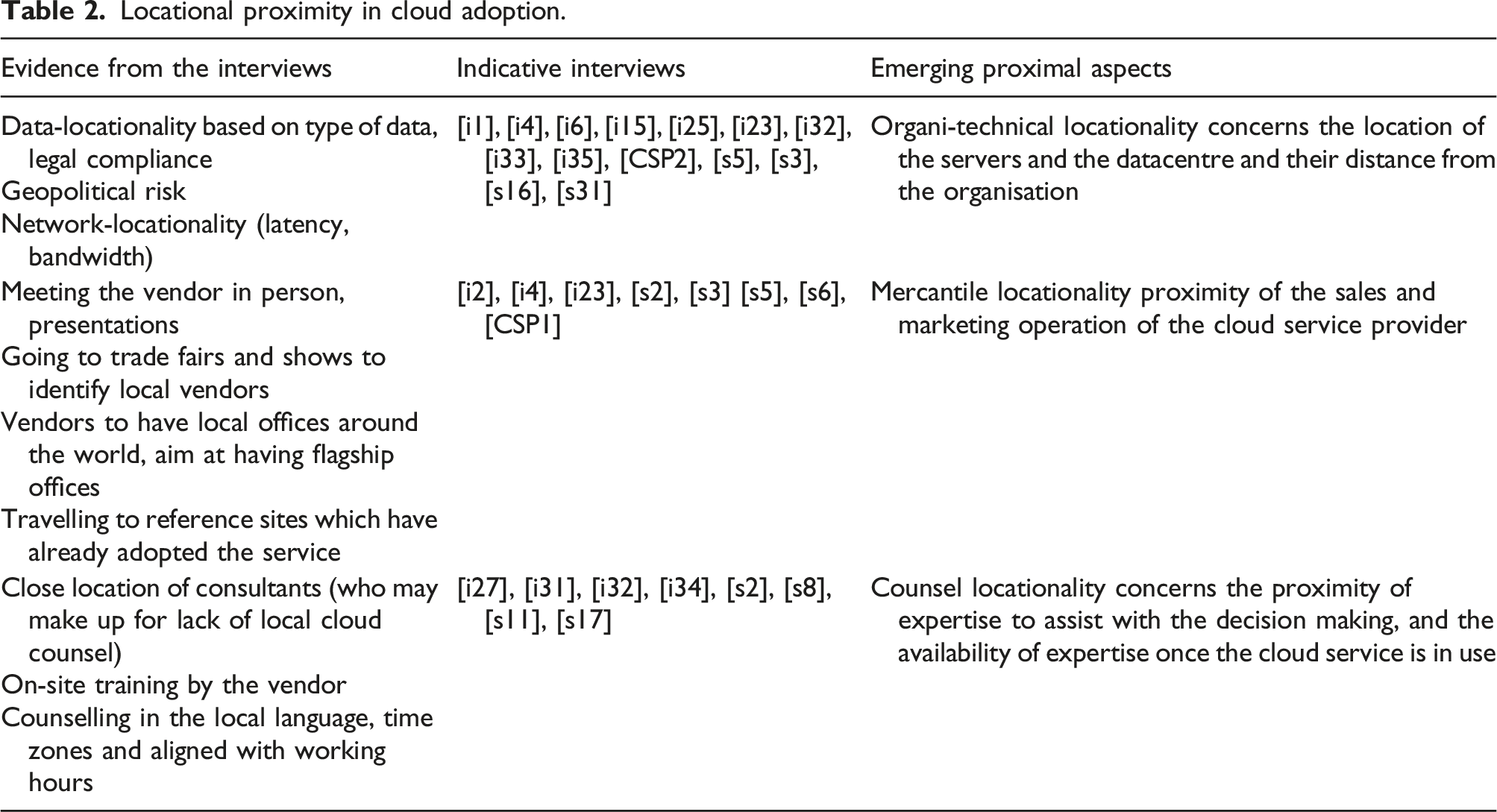
Our interviews show that location matters to cloud adopters in various ways. Several interviewees focussed on technical issues, related primarily to data and network locationality. Certainly, such technical issues were entwined with organisational issues and relevant contextual conditions. To stress this contingency, we refer to these concerns as ‘organi-technical’.
The location of the adopters’ organisational data within the physical cloud, and the cloud-providing organisation’s relationship to that data were foremost among this type of concerns. This was contingent on the type of data being put into the cloud service (with customer data and intellectual property as most likely to cause concern over location) and particularly acute for the military and heavily regulated industries, and those with patient data [i4,i6] where the national regulation (or lack thereof) prevented storing data outside of the country. In general, where national or local regulations were perceived to impose restrictions or requirements, interviewees were adamant that local datacentres should be used – though this included selecting datacentres whose controlling organisation was covered by the same political laws or requirements. For example, data protection requirements (such as GDPR and UK-GDPR) led to a desire for physically localised cloud technology and legal organisations ‘inside the EU’ [s9]; ‘it needs to be stored somewhere in the EU data centre […] all have to be in Europe. That’s by legal, audit laws, accounting laws’ [i35].
Interestingly, the global cloud vendor [CSP1] saw things differently regarding the legal and regulatory issues for the physical location of their datacentres: ‘[Datacentres] show a long-term commitment to a country. It’s more psychological than anything else…it shows that you’re going to make a multimillion-dollar investment in countries. It’s important because it’s seen as a sign of acknowledging the world’s changed and privacy and compliance … even though there’s other ways of solving [those legal challenges without in-country datacentres]... it seems important’. This quote emphasises how technical and organisational proximity issues entwine in their provision of services.
Globalised businesses’ decisions were complex as they needed datacentres in multiple physical locations but covered by specific laws and the relationships between them [CSP2] ‘due to multi-regional issues’ [s4]. ‘It’s more about regionality, we’re primarily in Northern Europe cloud regions’ [i33]. Regions were also chosen for disaster-recovery reasons – ‘cross regionality means we can failover to a secondary cloud [region]’ [i33]. Two people raised the issue of geopolitical risk for data, stating that today ‘you wouldn’t use [a particular country’s cloud services]… they were a credible player five years ago…and then obviously [a change in political circumstances]… we [now] blacklist [that country]’ [s31]. [CSP2] also noted that geopolitical realities inhibited cloud adoption in certain places due to tensions between countries on technology exports and imports.
Locationality influenced adoption decisions due to the network latency and bandwidth of the network connecting use with cloud services. This was acute for global firms that must ‘…consider [the] speed of access’ [s16]. This was associated with access to and from users’ 4 physical locations, so reflected the organisation’s global structure and staff mobility. [CSP2] noted that political and network instability led to the impossibility of cloud access in certain geographical regions (e.g., in Afghanistan and Iraq) restricting cloud adoption – something global cloud services providers need to consider. Ultimately, as [i15] stressed, cloud should provide ‘the capability to operate anytime and from anyplace’. In this respect, latency and bandwidth concerns were also organi-technical.
The proximal locality of the sales and marketing operation of the cloud service provider – what we term mercantile locationality – significantly affected adoption decisions. Interviewees were often interested in meeting the vendors in person to assess the vendor’s reachability and responsiveness, and to gain assistance in understanding the product in the context of their organization’s needs. Several avenues were used to this end. For example, interviewees used trade fairs and shows to identify candidate local vendors. Following the Covid-19 pandemic, many such events were organized online and although they were preferred by some respondents, they did not replace physical events. Instead, people became ‘more selective [of] physical attendance’ [s2], even though one respondent noted that ‘after the pandemic I am trying to prioritise physical events’ [s3]. Almost all those surveyed in the second phase of our research planned to interact both physically and virtually going forward. Notably, however, it was clear that physical interaction had substantially returned, and, significantly for our research, all interaction involved local vendor staff – usually within country. This is consistent with the evidence from the first phase of our research where adopters visited trade shows to meet with ‘local sales staff’ [i25], focussed on cloud services sales operation in their own countries or visited the cloud vendors offices to identify candidate services.
From the vendor’s perspective, appreciation of this customer need is reflected in the major investment they make to physically attend or sponsor others’ tradeshows, 5 organize conferences and shows, 6 provide websites aligned with local geographical requirements or focussed on particular sectors, organise site visits to discuss products in context, or have local offices around the world 7 – such as the iconic ‘Salesforce tower’ and Google, Microsoft and Amazon’s flagship offices across the globe. The cloud service provider also noted the value in meeting with potential adopters: ‘It’s being able to read body language... Are they bored? Are they interested? Or do they have a question, but they’re not asking it because hey, leaders know everything’. [CSP1]. Indeed, even during the Covid-19 pandemic, vendors continued to seek locational proximity with customers by holding ‘local’ events, albeit virtually. For example, Salesforce Live UK and Ireland, held in July 2021, 8 included local speakers and ‘virtual rooms’ to ‘connect live with customers’. Many other vendors and consultancies held similar locally focussed virtual summits during this period 9 that included local speakers, languages, industry challenges and locally targeted sales staff. As [CPS1] stated ‘would we not have a sales team in a country? I can’t see that’. Reference sites also provided an important location where adopters met others who had purchased a cloud service. For example, [i4] travelled to consult users of the services being considered: ‘Outside Greece. I visited a hospital in Barcelona (St Pauli) and … from the USA’ [i4].
We use the term counsel to refer to concerns about the proximity of expertise to assist with the decision making, and the proximity of expertise once the cloud service is in use. As [s17] explained of his team: ‘Our plan is to get a consultancy to help, someone who has the skills to develop our own skills, and lead them by hand... get the mentoring, planning, external skills’. A similar demand for skills was reflected upon by the CSP: ‘For a customer, sometimes it’s a sign of commitment too, it’s having the skills on hand, sitting down and having that conversation’. [CSP1]. Across the empirical corpus, it appeared important that, where they were used, they were located locally – ‘in our area’ [s2]. [s8] even argued: ‘[its] more [important than the datacentres’ location for] the consultants, [to]understand the way we work’. Similarly, [s11] wanted ‘implementation partners’ to be local but didn’t care where SaaS providers were located. While for [s15] the location of the datacentre was less important, they were clear that ‘sales support/consultants [location] was very important’. Equally, respondents showed a demand for on-site technical training. For example, [i27] were keen to have training with the cloud company’s software developers at their own offices.
Vendors were also favoured if support was in the local language and were located geographically close-by. This also related to time-zones: ‘what we want is tech support … which for us [has to be 24hrs a day because]... there’s always going to be one [of our offices] in every time zone’ [i31]. This point was reiterated by another interviewee: ‘You want to be sure that you’re not dealing with a company that only operates nine-six in the UK when [many of your users are located outside the UK]’ [i32]. Beyond just time zones, demand for counsel also related to being available beyond usual working hours: ‘We’re only looking at vendors from Cyprus. […] We need to know we can pick up the phone at any given time and find them, because our hypermarkets work 14 hours a day’ [i34].
Locational proximity in cloud adoption.
Relational analysis of proximity
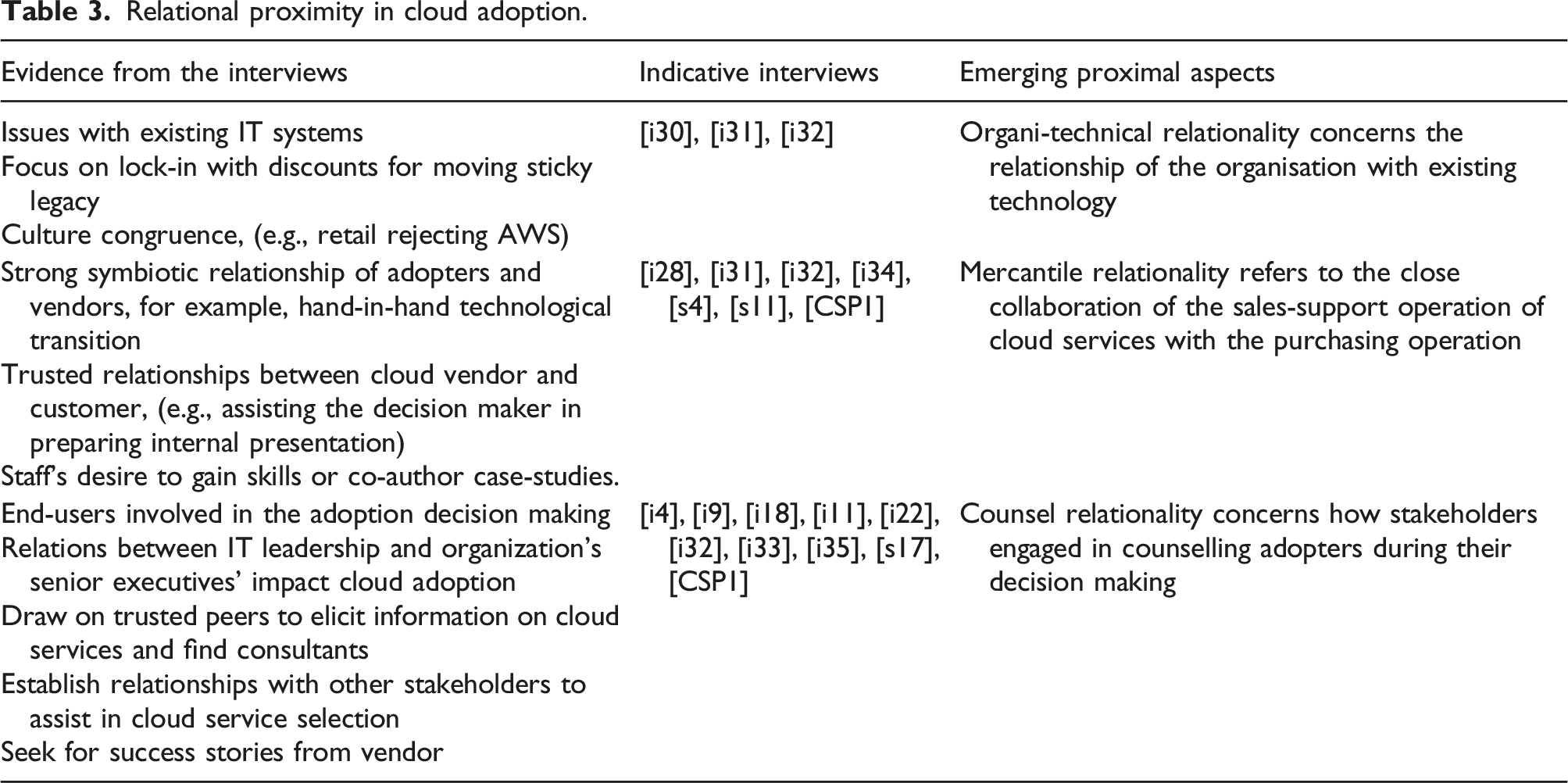
The interviews showed that adoption decisions related to the intended use of cloud but were also strongly dependent on the technological landscape that pre-existed within their organisation as well as the organisational culture and landscape more broadly defined. In this respect, the organi-technical aspect is also relevant in relational proximity. For example, in [i30], the adoption decision was influenced by complaints from staff and failures in the existing IT systems which was a ‘complex, fragmented and expensive architecture… It stinks, everybody hates it, and we’re paying for it’ allowing more radical adoption decisions to be made. This history allowed a digital transformation of the whole organization in relation to ‘a digital road map which [would] allow the [organization] to harness the benefits of cloud technologies’ [i30].
Pre-existing (legacy) systems were attractive to Infrastructure-as-a-service (IaaS) providers who would discount prices for moving them into the cloud (so-called ‘lift and shift’ projects): ‘if you can show it is a lift and shift they’ll give you loads of money off’ [i31]. Furthermore, specific legacy applications that would lock-in cloud customers were directly supported: ‘AWS have got their own Murex onboarding teams to help companies migrate the whole thing to AWS because they know they will get loads of money off you… because Murex is a really sticky product’ [i31].
Such relationality with a company’s pre-existing technology and organisational landscape also influenced the cloud service providers' products which have become targeted at sectors and verticals. Close collaboration of the sales-support operations of cloud services with the purchasing operation of the adopting company and their cloud adopter ensued (mercantile relationality). Relational proximity was evident in the selection of vendors, whereby cultural congruence was sought: ‘It wasn’t long before we decided that they are our preferred candidate really. We saw the way they deal with us, the way they work and that [they] built a personal relationship with us and they quickly became the sole option. […] So, we want people that are approachable as persons, people that we can work with for an idea’ [i16].
While some cloud vendor products might not be tailored for specific sectors, providers sales operations often were: ‘hyperscalers [cloud vendors] have got smart… Initially they were like a utility provider. But they have now spun up dedicated sales teams and capabilities relevant to different sectors and verticals’ [i32]. Notably, however, for one interviewee in the retail sector AWS could not be used ‘as a retailer it would seem very strange to pay Amazon, a competitor, for AWS’ [i34].
Occasionally a strong symbiotic relationship of adopters and vendors developed. For example, [i34] reported a hand-in-hand technological transition of the vendor’s and the client’s services to the cloud: ‘[we] faced a difficult decision. Do I leave the vendor behind? Who has supported me and we’re happy with for so many years… Do I help the vendor upskill? Do I push the vendor to upskill?’. Organisational size influenced the type and level of collaboration: ‘It depends on the scale, size and complexity of the organisation… [in] larger [organisations] you get a procurement function involved [with the CIO]... to do the vendor management…negotiating contracts, doing due diligence’ [i32]. We noted that the increasing pressure to adopt cloud services during the pandemic maintained or enhanced high levels of interaction with vendors.
It follows that trusted relationships with vendors clearly influence adoption decisions. [i28] contacted an existing vendor for an opinion: ‘Our main vendor is ... we discussed this thoroughly with them and they encouraged us to get it’. Vendors strived to prove they can be reachable and to establish collaborative relationships – and to provide information and success stories. [i16] reported how a vendor assisted them with an internal decision meeting: ‘they did help me to set the presentation up, they did send me material. What I presented was based on what they presented to me’. Some interviewees held tight existing relationships with vendors and would not risk changing them: ‘It’s a bit like dealing with a crack dealer, I suppose. But a very, very mature and sort of personable one’ [i31].
For some large organisations the vendor relationship is close enough to be a partnership: ‘it’s also a great way of keeping skills sharp within house… Partner with vendors, we create common solutions. Everyone’s happy, brilliant...’ [i33]. This was also reflected upon by the cloud vendor [CSP1]: ‘some technology companies protect their engineering teams from customers. We’ve gone the opposite [way] 90% of what we build comes from interactions with the customer: 10% comes from knowing the customer well enough that we can invent on their behalf and that requires that our engineers have direct contact with customers’.
Another relational issue was more junior staff’s desire to gain skills in particular cloud offerings and build their future careers around those vendor specific cloud skills (rather than necessarily within their own company) – something cloud providers encouraged: ‘At a developer level, you tend to get more of that: “I want to be [cloud] certified”, or “I want to be the best in the [cloud service]. At our conferences you see people wearing [jackets showing their personal level of certification]” [CSP1]. A similar strategy extended to very senior staff: ‘there are a lot of C-suite executives… who want to be in the press for having done something really impressive... showing how they’ve managed to scale up because of the cloud’ and so working closely with the vendors to co-author case studies [CSP1].
Relational aspects internal to the organisation were also significant. Future end users were usually involved – indeed for [i4] ‘it was recommended by doctors to the IT people’. In other cases, end users provided insights and assisted the IT team to ‘gather the requirements internally’ [i35]. At the senior level, relations between IT leadership and the company board impacted decisions to adopt: ‘they want to examine and to check my decision-making process really […] to ask good insightful questions and potentially expose flaws of my thinking’ [i22].
Relational proximity in cloud adoption.
Temporal analysis of proximity
Our temporal analysis regards past experiences with cloud’s technology predecessors and earlier experiences with technology experts as well as projections on how business needs can be served by the new service both from a technical and from a support perspective.
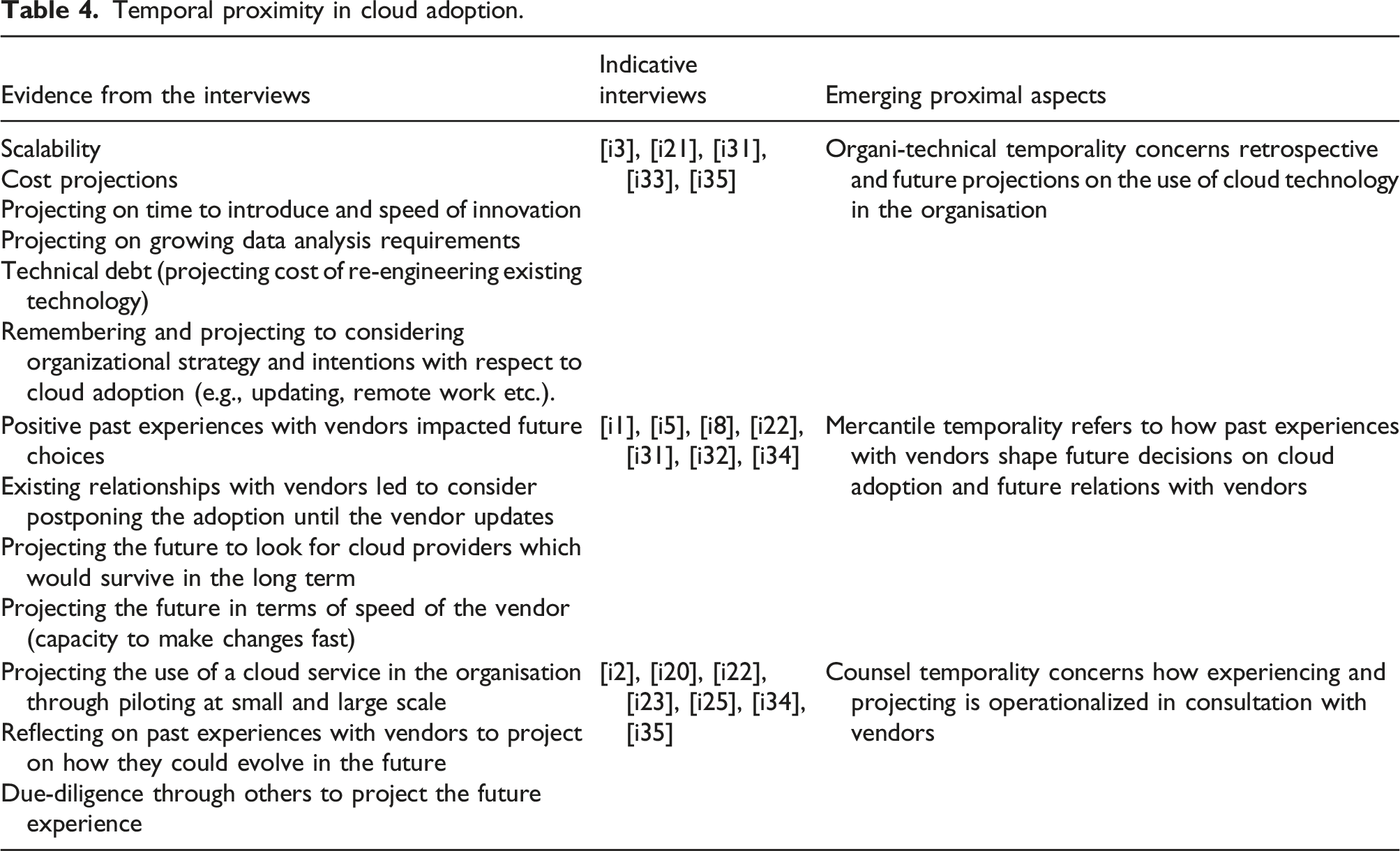
Technical aspects of cloud such as scalability, cost and time to introduce services were entwined with how the organisation’s adopter projected how their cloud usage would unfold into the future (showing how temporality also carries organi-technical aspects). Rather than adopting a static technology, interviewees were concerned about scalability and evolution of the cloud service in comparison to existing static technology (such as on-premises servers): ‘scalability matters, because we buy, sell companies, hire people, reduce staff members etc. We don’t want to be tied to an infrastructure for something that isn’t entirely changeable’. They also acknowledged the difficulties in realistic cost projections: ‘What we’re not considering is trajectory… it’s this much now but Microsoft just announced a 9% uplift in costs [that] wasn’t anticipated’ [i33].
Additionally, many sought to increase the speed of innovation, through ‘the minimal time required to introduce the [new] service in the organization’ [i21]. Many anticipated growing data analysis requirements: What if our ‘[data requirements] rise exponentially… hockey-stick… It’s a balance between [a slow] move to the cloud, [or] accelerating the move to the cloud, and then work on modernisation, orchestration’ [i33].
A number of those interviewed mentioned the technical debt they carry in their organisations when adopting cloud services. Technical debt relates to the cost of re-engineering their existing technology estate, since past choices of technology inhibit and shape the current cloud adoption process. For example, one company had an old IBM DB2 database running on-premises but wanted to adopt Microsoft’s Azure cloud product: ‘We need to move DB2 to the cloud. There is no enterprise instance of DB2 in the cloud at this point… [Azure promise] January 2023...[i.e.,] in the future… but it doesn’t exist… we don’t want to go multi-cloud … but I don’t want to be a guinea pig for the Microsoft guys to work out how to do [it]’[i33]. Conversely, negative experiences with systems were also considered when imagining and desiring future functionality. In [i35], users were invited to provide feedback on ‘What’s wrong with our existing system?’
Interviewees undertook considerable remembering and projecting to consider cloud and its impact within the context of their own organization’s strategy and intentions (e.g., [i30]’s ‘digital road map’ which connected the ‘hated’ existing IT with the future harnessing of cloud). Respondents reflected on how cloud has evolved over time, for example, ‘The commercial model has obviously changed massively, the way in which you can bring services online and the range and breadth of services that [hyperscalers] offer…’ [i31]. We perceived interviewees to be projecting forward and imagining a future in which services would change and need updating in line with the organization’s overall strategy. For example: ‘We plan, at least for the next five years, to open ten new sales points every year. [Cloud] provides us with the flexibility to do so quickly and without any major costs’ [i1]. We saw a similar projection of how cloud might allow employees to have ‘the ability to control the entire organization from a single device’, [i3] – something they clearly imagined important and possible in the future.
Past experiences with vendors also shaped future decisions on cloud adoption, providing evidence of mercantile temporal proximity. As [i5] underlined, ‘there was a previous experience by the CIO, who came from another company, so he knew the solution and hence we knew how the deployment will evolve’. Similarly, [i5]’s past experience created a strong sense of long-lasting collaboration which even directed future choices: ‘When you are rejecting a product or a collaborator, you have to justify why. So, the existing vendor gave us another suggestion’. In other cases, the relationships with a vendor led interviewees to consider postponing adoption until the vendor was ready. As [i1] highlighted: ‘[the vendor] are planning to move their products to the cloud at some point. So, they were trying to convince us, not to do the transition to the cloud, not to make this change… they tried to change our decision and to influence us negatively’.
Projecting forward influenced the choice of cloud provider as interviewees sought providers they expected to survive long-term: ‘who is going to be there in the future… there’s been lots of consolidation of vendors. We try our best to stay on top of that’ [i32]. The speed of change and innovation of the vendor were also a crucial temporal aspect within the cloud decision as some decision makers needed to make changes fast: ‘find good vendors who do good jobs that can accelerate the process of getting things done, because a CIO/CTO, they’re there to deliver change’ [i32]. Similarly, vendors’ ability to mature over time has also been noted: ‘things have changed markedly... And they matured considerably, even [a vendor] has matured a lot. About eight, nine years ago, [that vendor] didn’t want to talk to me except through a third-party which was crazy [given the size of my business]’[i31].
Over time in working with a customer ‘interaction changes…in some ways it becomes more intense … it’s about building those relationships for the long term’ [i36]. In this journey, you start with ‘how do you get the customer into the cloud, obviously, but that’s not modernisation, that’s just you’re in the cloud… [To do innovation] intentional contact is important. It’s that old thing about why do you meet in the office? Well, it’s getting around a whiteboard and brainstorming’ [i35].
Piloting cloud services provides an eloquent illustration of how experiencing and projecting is operationalized, in consultation with vendors (counsel aspect). Pilots allow customers to experience cloud services at a small scale while projecting their imagined future use across their organization. For example, [i2]: ‘we set up one [pilot] of our services and we did a test migration to their data centre’. Similarly, [i23] piloted multiple services at the same time: ‘[we] identified four to five [services] to install and test for a minimum of one month, by three people. All options were tested in parallel, and they were discussing and commenting on their experience frequently’. Thus, piloting facilitated diffusion of the remembering and projecting among the organization’s internal stakeholders. Alongside piloting, adopters sometimes conducted due diligence: ‘We’re also doing due diligence, meaning I’m contacting the references, the existing clients of these two vendors […] companies in similar industries to gather feedback’ [i35] examining feedback to imagine their own future risks and opportunities.
Cloud also enabled piloting across a global company. For instance, [i20] revealed that, for their candidate cloud-based CRM service, ‘we ran a pilot in the Nordics and, since the pilot was successful, we ran a second pilot before adopting for countries that are more traditional, for example, Romania. We allowed three to four months and saw how it goes’. Piloting was relevant to the temporal dimension as it allowed an understanding of evolving technological and organizational change and the relationality between these and the benefits of cloud. It connected the past with the projected future.
Temporal proximity in cloud adoption.
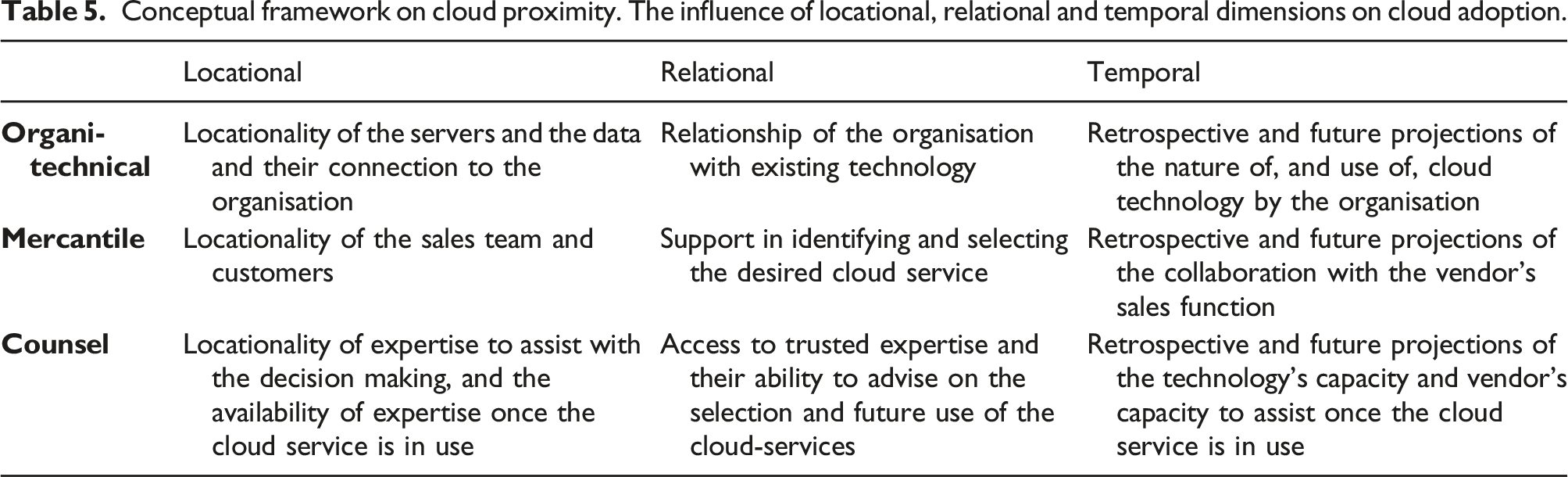
Conceptual framework on cloud proximity. The influence of locational, relational and temporal dimensions on cloud adoption.
Discussion
We show how our mercantile, counsel and organi-technical aspects of cloud adoption proximity lead to our conceptual framework and come into play within cloud adoption, so enhancing our understanding of cloud proximity. We then explore the theoretical and practical implications of this study.
A conceptual framework on cloud proximity
Our analysis revisits and challenges the conception of cloud as ‘remote’. We did this by employing proximity as a theoretical lens and showing how locational, relational and temporal dimensions of proximity are key dimensions of cloud adoption decision making. Thus, in making adoption decisions, cloud is not as remote, impersonal or distant as is often assumed.
These three dimensions were analysed separately but constitute complementary analytical lenses to consider the proximity of cloud and are often interrelated. For example, vendors often draw on location (e.g., participate in trade shows, visit customers etc.) specifically to develop relationships with their customers (e.g., trust, personal contact etc.), and so respond to clients’ expectations (temporal imagining and projecting). Beyond the locational, relational and temporal dimensions of proximity, our analysis reveals that each proximity dimension in the context of cloud adoption encapsulates organi-technical, mercantile and counsel aspects. Table 5 brings together our analysis of the proximal dimensions of cloud and their impact on cloud adoption and summarizes how organi-technical, mercantile and counsel aspects come into play within each dimension. The table synthesizes our insights from the proximity literature and our empirical findings in a conceptual framework for appreciating and studying cloud proximity. Our results support the argument that cloud is not ethereal, but rather that organisations hold concerns about cloud technology, similar to cloud’s predecessors; they are reflecting on the sales and support from the vendor, they seek internal and external expertise to assist in making such technology decisions; and they consider the technology’s capacity with respect to the context of the organisation’s use.
Proximity and cloud adoption: extending our understanding
Earlier in this paper, we built on the cloud definition by Mell and Grance (2011) to highlight assumptions about the ‘remoteness’ of cloud and identifying inconsistencies among research findings related to such remoteness. This led to a fresh reading of the cloud literature that questioned whether cloud is as remote and ethereal as the cloud metaphor suggests. We noted that, while several researchers draw on cloud’s remoteness to argue that cloud enables organizations to overcome the locational, relational and time boundaries experienced with previous technologies, others argue that organizations adopting cloud remain bound to location, relation and time restrictions, and question the significance of cloud’s remoteness.
Cloud research, as Wang et al. (2016) argue, is dominated by foundation-building conceptual studies. Our research contributes a distinctive qualitative and interpretive understanding of cloud adoption revealing that organisations and adopters seek to be proximal to the cloud in three different ways that have emerged from our analysis and which we have termed: Organi-technical, Mercantile and Counsel. Whereas Mercantile Proximity and Counsel Proximity emphasise the social proximity between human actors, Organi-technical Proximity emphasises the proximity of technology, and its contingency to the adopting organisation, during adoption and at the extended scale of cloud.
Organi-technical proximity
Organi-technical proximity is a gauge of the closeness of the adopted cloud service itself. From a purely technical standpoint the physical proximity of cloud datacentres matters for many in their adoption decisions. This was not necessarily a dominant concern and was contingent upon the intended use of the adopted services. Reasons for this included the need for locationality that matched latency and bandwidth needs (noted also by Friedman, 2017) between the datacentre and the users’ devices, or other cloud services via APIs. Latency issues are contingent on geographical realities of cloud providers’ organisational networks since, for example, the UK and USA are connected by low-latency and high bandwidth connections despite significant geographic distance, whereas countries in Africa may be physically local but face significant delay and low-bandwidth if fibre connections between the countries and datacentres are absent. Those interviewed with complex global IT needs were mindful of these challenges – and opportunities – and could benefit from the Hyperscalers (AWS, Azure, Google’s) global networks and datacentres to reduce bottlenecks and distribute workload.
The physical locationality, however, was very important since where the cloud adopting company’s data would be held mattered (previously noted by Denny, 2010), but we also noted this accounted for geopolitical risks (‘blacklisted’ countries) and disaster-recovery planning – things absent from much of the literature but reflected in industries concern for cloud data sovereignty as the legal and geopolitical landscapes evolve (Karlstad, 2022; Amoore, 2018), particularly in response to the U.S. Clarifying Lawful Overseas Use of Data (CLOUD) Act and GDPR. Security (Zhang et al., 2020) was also mentioned though this did not appear a dominant concern.
Our analysis showed that cloud adoption appeared strongly influenced by path dependency through technological lock-in as previously noted in the literature (Brynjolfsson et al., 2010; Armbrust et al., 2010; Asatiani, 2015; Polyviou, 2016; Trigueros-Preciado et al., 2013) (e.g., DB2) but also due to technical debt (e.g., configurations and customisations) from past technology choices. We further show that cloud companies recognise this lock-in and offered discounts for moving legacy ‘lift and shift’ and ‘sticky’ systems into the cloud where the locked-in technology remains (e.g., Murex) albeit hosted on cloud-based infrastructure. Further, some legacy systems proved so sticky that the adopter chose instead to push their existing vendor to move to the cloud and ‘upskill’ rather than change supplier.
Importantly, cloud adoption was undertaken in relation to future technological demands (‘a digital road map’, ‘scalability matters’, risks of ‘hockey-stick’ increased demand) and future costs (e.g., Microsoft’s 9% cost uplift). As with other assets, cloud adoption required a projection of costs, benefits and discount-rates, but with cloud this was also associated with the move from technology as a capital expenditure (CapEx) to being an operating expenditure (Opex) (Naldi and Mastroeni, 2016; Schneider and Sunyaev, 2016). This favours business with dynamic demand for resources over those with static consistent demand. Indeed, we observed that adopters are willing to accept relatively higher fees in order to benefit from scalability when they believed their company’s needs would change dramatically. However, we also observed a company adopting an on-premise solution for $10m (CapEx) because they believed they faced very static demand making this cost effective. Further research examining the way adopters’ future projection of demand influences cloud adoption decisions would be welcome.
It is notable that environmental sustainability was not raised within our analysis, given this is already impacting the physical location of cloud services (Kaushal et al., 2019). As datacentres rely on electricity and cooling, so their location impacts their carbon intensity, 10 with, for example, AWS’s Swedish datacentre proving an extremely low emitter whereas AWS’s South African one is a relatively large emitter. Innovations such as locating datacentres underwater 11 , or where heat can be recycled 12 can reduce emissions but further constrain location. As cloud adopters will be increasingly forced to consider carbon emissions, the geographical location of datacentres will likely become ever more important, particularly if datacentres consume 8% of world electricity by 2030 as anticipated (Andrae and Edler, 2015). That our interviews failed to discuss this shows more work, and research, is needed on the proximity of cloud datacentres.
Mercantile proximity
Mercantile proximity is a gauge of the closeness of the sales function of vendors to the cloud adopter. Early arguments about the move to the cloud were influenced by the idea of a ‘utility’ model of computing in which cloud services were assumed fungible – for example, comparing computing to the power infrastructure (Carr, 2003, 2005, 2008) with its similarly simplistic purchasing agreements based on ‘Pay as you Go’ contracts. Healey (2010), however, noted early on that cloud contract is a ‘hybrid of outsourcing, software and leasing, […and] major contractual agreements’. Furthermore, cloud services come with complex operational costs which Ali et al. (2021) show to be significant factors in cloud adoption but often hidden from simplistic cost calculations. In line with such arguments for complex purchasing and use, our findings show the significance of having proximal mercantile support in constructing and evaluating those contractual commitments. This is in stark contrast to the prevailing assumption that cloud provision is primarily product-based (Schneider and Sunyaev, 2016) and based on fixed agreements (e.g., SLAs or fixed contracts), rather than social practices and proximal relations.
While likely contingent upon the complexity of the service being adopted, our study showed that, for many, the trusted relationship with a supplier was important, and for vendors the ability to ‘read body language’ aided sales. Adopters wanted to meet with sales staff and interact with sales staff who understood the complex regulatory frameworks of their regions (cf. Pearson and Benameur, 2010). While vendors may invest in providing detailed information about features of their products online (Karimi and Walter 2015), our research suggests that it is the personal relations and cultural match between clients and vendors that are critical for building reputation and trust relevant for cloud adoption. Such results show similarity with IT outsourcing decision making (Michell and Fitzgerald, 1997) in which familiarity is seen as significant (Oshri et al., 2018) and suggests the need for further research examining the sales, marketing and support relationships cultivated by cloud vendors.
If the cloud vendors are, as one interviewee suggested, like ‘crack dealers’ it probably pays to be proximal to them. Furthermore, relationships last – with choices of cloud services moving with a CIO to their new company and with vendors helping with evaluations of competitors, and with a desire not to ‘multi-cloud’. Yet these trusted relationships were also seen as instrumental in driving the innovation and accelerating the processes of change – leading vendors to intensify their sales support offerings and interaction in order to drive benefits within the customers (and so profit from ongoing fees). Bridging and aligning ‘the business’ and ‘the technology’, are a persistent top concern for companies (Kappelman et al., 2021) and our findings indicate that cloud adopters are conscious of bringing these together.
Our study extends the view that cloud blurs the organization’s boundaries with external entities (Willcocks et al., 2014) and that cloud entails a step-change into how organizations and vendors collaborate (Vithayathil, 2017), as we show that organizations persist in demanding close relations with the vendor; postponing an adoption to wait for a vendor to catch up; seeking vendors assistance in accelerating in their business processes, and gaining help in modernisation and innovation. Vendors were keen to build such close relationships and commitments, perhaps because technical switching-costs are low for cloud (Ellahi et al., 2011), particularly for SaaS (Xiao et al., 2020).
Wang et al. (2016) highlight the emphasis on service level agreements within cloud research and the lack of research on relational governance. Our findings address this by indicating that adopters may place emphasis on tacit knowledge (Johannessen et al., 2001; Sveiby, 1997) of vendors, built through social relations, rather than relying solely on SLAs – and we call for further research in this regard. Interestingly, relationships were also often personal with the individual adopter such that an adopter’s own career could become aligned with cloud vendors (e.g., through certifications or press-releases and case-studies of impressive leadership) – something seldom discussed in the literature. Indeed, existing research on cloud certifications (Lansing et al., 2018) (e.g., ISO-27,001) may be enlightened through research connecting them to personal identity. Furthermore culture, trust and morality have been related to proximity in human relationships (Gössling 2004). Drawing upon these concepts to examine personal identity within technology adoption would be beneficial. For example, an old IT-industry adage was that ‘nobody was ever fired for buying IBM’ 13 – implying that IBM reduced the personal risk to the adopter. Certainly, interviewees aligned optional decisions with their own careers asking ‘whether I have done a good job coming to a good decision’ [i22].
Our research hinted that many adopters prefer purchasing from local vendor sales operations rather than international options (even during Covid) when they perceive that the proximity to their location could smooth collaboration and problem-solving. This was supported by cloud companies building complex sales operations within countries (even if their data-centres were elsewhere). Adoption was in relation to the adopter’s businesses – with cloud suppliers developing sector-specific and vertical-specific offerings and with retailers spurning AWS due to Amazon’s competition in retail. Research on factors associated with location, service and business type would be welcome.
Top management support is known to be needed for cloud adoption (Asatiani, 2015). However, we extend this knowledge by showing how merchants assisted these relationships through providing presentations, meetings and shows for adopters to present to top managers. We further saw that top-management’s involvement varies considerably and can involve dedicated procurement functions.
Certainly our research provides understanding to earlier work exploring the future role of the IT function (Vithayathil, 2017) by suggesting an IT function’s value is in driving innovation via close proximal relations with the merchant and informed, socially connected, purchasing processes. Like other forms of technology adoption, it is unlikely that cloud adoption is wholly techno-economically rational (Mignerat and Rivard, 2009) and proximal relations seem part of building necessary trust, knowledge and understanding.
Counsel proximity
Counsel proximity is a gauge of the closeness of those to whom a cloud adopter might turn for counsel when using the cloud service. Counsel proximity has crossover and interrelationship with mercantile proximity. This is because cloud services are often integrated and piloted before and after adoption, and because mercantile proximal relations set the scene for counsel proximity. A striking element of our analysis was the weight placed on close counsel during and after cloud adoption – with users, senior managers, peers, vendors and consultants.
Cloud services are not isolated technologies, but a suite of complex services 14 increasingly integrated within complex organisational digital infrastructures (Tilson et al., 2010). These often employ complex boundary resources (such as APIs) which connect an ecosystem of services (Melville and Kohli, 2021). In this way, today’s adopted cloud service is unlikely to be isolated and is more likely to form part of an emerging incomplete and complex ecosystem and infrastructure (Constantinides et al., 2018) with resultant complex work practices which requires learning and integrating into organisational routines (Feldman, 2000). It is thus important, as Ali et al. (2021) show, that adopted cloud services are compatible and integrated into existing systems and technology. Melin et al. (2020) further argue that adopted cloud services must be institutionalised – compatible with the routines and practices of the organisation. Our study adds weight to such arguments by demonstrating how adopters sought close relationships with stakeholders during and after the adoption process. They sought ‘partnering’ with vendors and consultants and ‘building relationships for the long term’ – though also not wanting to be a vendor ‘guinea-pig’. This further contrasts with assumptions that cloud provision is product-based (Schneider and Sunyaev, 2016) through fixed agreements. Whereas early cloud literature emphasised such self-service and arm’s length, some recent studies have highlighted the value to adopters of receiving education, training and guidance from their suppliers (something Ali et al. (2021) noted) – and that this will make them likely to use the service 35% more (Retana et al., 2018). It was thus unsurprising that interviewed adopters wanted vendors with ‘local languages’ and the same ‘time zones’ who could consult, mentor and train them but also work with them on innovating and ‘accelerate the process of getting things done’. Above all, we show cloud adopters to be subjective humans seeking relationships and closeness to build their knowledge and make their decisions – evidenced by the use of terms like ‘feel’, ‘opinion’, ‘encourage’, ‘convince’ in interviews.
It was also evident that adopters themselves were proximal to social collectives with other adopters to gain counsel on cloud offerings (e.g., ‘peers’, ‘external partners’, ‘Worshipful Company of IT’). Adoption and use thus extended beyond the enterprise to involve communities of practices of outside stakeholders – something worthy of further research.
Although cloud is argued to minimize upfront investment risk, our findings show that interviewees invested considerably through pre-sales time, piloting and testing the services and through gaining a proof of concept such that cloud adoption was more rolling and incremental as complex testing (‘test migration’, for ‘due diligence’ etc.) moved into production. This starkly contrasts with the implied ‘pay as you go’ character of cloud; rather, it emphasises considerable care, prior to formal adoption, in checking that a service could be integrated into the work practices and digital infrastructures of a firm and lead to long-term use. Existing research suggests that a benefit of cloud is that it provides organizations with the flexibility to readjust their usage of on-demand and pilot candidate services (Benlian et al., 2009; Surya et al., 2014). Within our research, we saw evidence of piloting being used as a way to learn about, and integrate services into use, prior to the adoption decision making and to grow services organically across the organisation. Adoption was thus emergent. This characteristic provides flexibility in terms of cost, as organizations can also adjust their technology expenditure across time (Van der Molen, 2009; Vouk, 2008) and even partially adopt a service, thus enabling organizations to minimize risks associated with technology decisions and to grow use incrementally.
Decision makers used these broad counsel proximities to identify characteristics of cloud and assess their fit with the organizational strategy and their projected future organization – a future-oriented view against which the adoption decision is made (Venters et al., 2014). Projecting and imagining about technology as well as strategy was also important because cloud services often have rapid innovation cycles themselves so that their features evolve over time. Such future projecting might consider the technology (e.g., the claim that a vendor’s solutions will be cloud-based in the near future), and/or the organization (e.g., the belief that employees will use remote access, and the intention to make such access available). Thus, decision makers are seeking assistance to identify equivalence (Venters and Whitley, 2012) with their currently experienced (or remembered) technology but also compare this with the projected value of the new paradigm. They further attempt to project the future of the organization once the candidate cloud service is adopted drawing on their proximity to relevant social collectives (e.g., CIO innovativeness (Lian et al., 2014)).
Theoretical contribution
While the above discussion elucidates and deepens understanding of cloud, our main contribution is in demonstrating the importance of a proximal perspective towards cloud adoption and providing a theoretical frame by which to examine such proximity. Our research shows that proximity, a ‘co-present interaction’ (Boden and Molotch 1994), is a significant factor within cloud adoption in contrast to the assumed ephemeral and distance of cloud (for example through assumptions of locational independence (Iyer and Henderson, 2010) or ‘utility’-like purchase (Carr, 2008)). Cloud adopters value proximity and close interaction.
Proximity is associated with its benefits in the absorption of knowledge (Boschma, 2005a), by assisting in identifying, interpreting and exploiting knowledge (Cohen and Levinthal, 1990). Its significance within cloud adoption suggests those adopting cloud value knowledge (including tacit knowledge) of cloud capabilities and benefit from learning and building communities of practice (Wenger, 1998) around cloud in support of their adoption. Technology adoption is not wholly economically rational (Mignerat and Rivard, 2009) and cloud adoption can be influenced by social factors. Yet, our research on proximity suggests the important value cloud adopters place on gaining knowledge both prior to cloud adoption (mercantile) and post cloud adoption (counsel). We speculate that this may be because cloud technology is usually generative (Lyytinen et al., 2017; Henfridsson and Bygstad, 2013) whereby its value (though innovation) is entwined with its configuration and use alongside complementary tools. Value is thus highly dependent upon the harnessing of such generative possibilities through such configuration and integration work – work which requires detailed knowledge and support.
Our research on the temporality dimension of proximity also highlighted this emphasis on growth and innovation within cloud adoption and so suggests reorientating our view of adoption away from being a staccato isolated practice towards being a more dynamic temporally entwined process. While further research on such cloud adoption processes would be welcomed, our research here indicates that cloud adoption is part of an unfolding process influenced by remembered past relationships, lock-in and institutionalised practices and projected towards future innovation. Re-orientating cloud adoption research to examine it as a continuous socio-technical transformation flow (Baygi et al., 2021) within a dynamic and relational orientation towards organisational and technological infrastructure (Faraj and Leonardi, 2022) would thus be welcomed. Indeed, the rise of multi-cloud, edge computing, IoT and polymorphous technology such as blockchain suggests the need for an increasing focus on locational, relational and temporal aspects of proximity within wider technology adoption research.
This paper is, to our knowledge, the first piece of research to address the relevance of proximity to technology adoption. As we take an interpretive stance, this approach is open for the wider research community to test its generalizability for cloud and technology adoption more broadly. With the rise of 5G, Blockchain, Internet of Things, Artificial Intelligence and Robotics, technology is becoming an important part of corporate strategy and organizations will have to make frequent and strategically important technology adoption decisions. Despite the often-assumed impersonality and temporal/spatial distance of new technologies (e.g., AI, Blockchain), or belief of proximity as technical feature (e.g., Robotics, IoT), further research should examine the proximity of such technology and its adoption and explore whether this influences their success. For example, does proximity of AI counsel and its organi-technical adoption influence the propensity for bias? Could a focus on relational proximity reduce the chances of organisations adopting biased AI systems? We hope that our proximal analysis of cloud adoption will generate research interest to explore this theoretical lens further in understanding such interesting questions for future technology adoption.
Practical implications
For vendors, our proximal dimensions suggest localized sales and support functions are beneficial within their marketing and sales efforts (even if they harness virtual meetings) and that the location of data is significant. Both sides should focus on closer vendor-IT department relationships and sales support and consider a broader ecosystem of consultancies and sales agents that may act as intermediaries bringing geographically ‘remote’ cloud providers and services closer. Vendors’ presence at local events enhances their potential to establish a relationship with a future customer. Local vendors can benefit from promoting their presence and locational relevance to future customers, whereas international vendors may consider opening local branches or forming alliances with companies (e.g., consultancies) in locations with a large potential client base. Further, our findings on temporal proximity highlight the need for vendors to assist adopters in evaluating their product in relation to their existing technology and their projected future intentions (and the cloud technologies future innovation).
Conclusion
Through a qualitative study, this paper reveals the importance of proximity, and its locational, relational and temporal dimensions in cloud adoption. The paper shows how, within each dimension, organi-technical, mercantile and counsel aspects shape the cloud adoption decision. The paper joins the debate on the distinctiveness of cloud and shows that, during cloud adoption, organizations do not treat cloud as impersonal and location-independent by default. Consequentially, trust, mutual flexibility, value co-creation and risk-sharing between the organization and the vendor remain important areas for future research as the cloud ecosystem evolves (cf. Willcocks et al., 2014; Willcocks et al., 2014) and as further distributed technologies (e.g., IoT, blockchain etc.) are connected to an organization’s technological resources. Our findings therefore carry significant implications for future technology adoption.
Footnotes
Declaration of conflicting interests
The author(s) declared no potential conflicts of interest with respect to the research, authorship, and/or publication of this article.
Funding
The author(s) disclosed receipt of the following financial support for the research, authorship, and/or publication of this article: This research was partially supported by the UK’s Engineering and Physical Sciences Research Council (Grant EP/R006865/1).

Notes
Appendix
This appendix presents further details on the profile of our respondents in the two phases of the research (Table A1) and an overview of our research approach and its iterations (Table A2). Profile of respondents. An overview of the research process followed.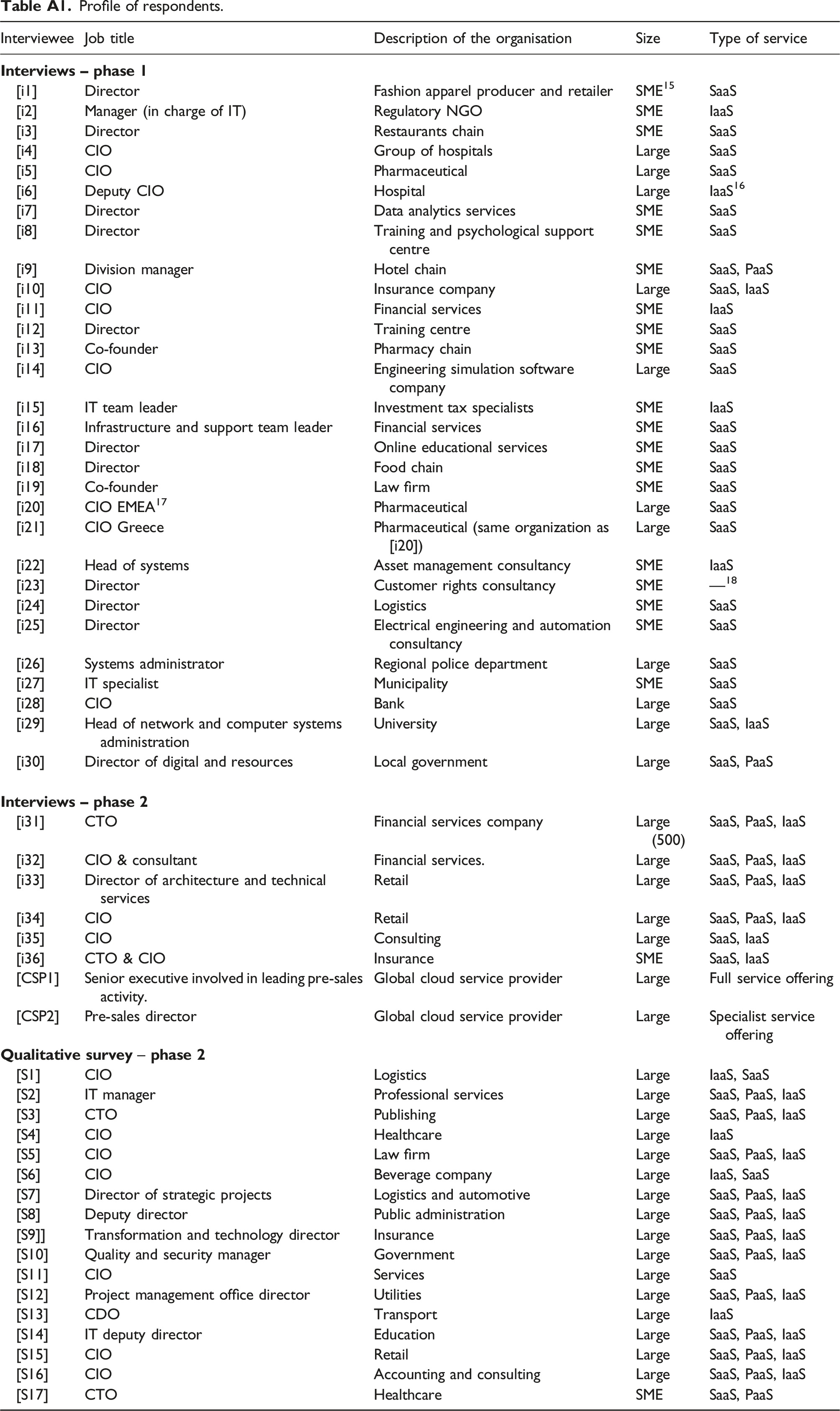
Interviewee
Job title
Description of the organisation
Size
Type of service
[i1]
Director
Fashion apparel producer and retailer
SME
15
SaaS
[i2]
Manager (in charge of IT)
Regulatory NGO
SME
IaaS
[i3]
Director
Restaurants chain
SME
SaaS
[i4]
CIO
Group of hospitals
Large
SaaS
[i5]
CIO
Pharmaceutical
Large
SaaS
[i6]
Deputy CIO
Hospital
Large
IaaS
16
[i7]
Director
Data analytics services
SME
SaaS
[i8]
Director
Training and psychological support centre
SME
SaaS
[i9]
Division manager
Hotel chain
SME
SaaS, PaaS
[i10]
CIO
Insurance company
Large
SaaS, IaaS
[i11]
CIO
Financial services
SME
IaaS
[i12]
Director
Training centre
SME
SaaS
[i13]
Co-founder
Pharmacy chain
SME
SaaS
[i14]
CIO
Engineering simulation software company
Large
SaaS
[i15]
IT team leader
Investment tax specialists
SME
IaaS
[i16]
Infrastructure and support team leader
Financial services
SME
SaaS
[i17]
Director
Online educational services
SME
SaaS
[i18]
Director
Food chain
SME
SaaS
[i19]
Co-founder
Law firm
SME
SaaS
[i20]
CIO EMEA
17
Pharmaceutical
Large
SaaS
[i21]
CIO Greece
Pharmaceutical (same organization as [i20])
Large
SaaS
[i22]
Head of systems
Asset management consultancy
SME
IaaS
[i23]
Director
Customer rights consultancy
SME
—
18
[i24]
Director
Logistics
SME
SaaS
[i25]
Director
Electrical engineering and automation consultancy
SME
SaaS
[i26]
Systems administrator
Regional police department
Large
SaaS
[i27]
IT specialist
Municipality
SME
SaaS
[i28]
CIO
Bank
Large
SaaS
[i29]
Head of network and computer systems administration
University
Large
SaaS, IaaS
[i30]
Director of digital and resources
Local government
Large
SaaS, PaaS
[i31]
CTO
Financial services company
Large (500)
SaaS, PaaS, IaaS
[i32]
CIO & consultant
Financial services.
Large
SaaS, PaaS, IaaS
[i33]
Director of architecture and technical services
Retail
Large
SaaS, PaaS, IaaS
[i34]
CIO
Retail
Large
SaaS, PaaS, IaaS
[i35]
CIO
Consulting
Large
SaaS, IaaS
[i36]
CTO & CIO
Insurance
SME
SaaS, IaaS
[CSP1]
Senior executive involved in leading pre-sales activity.
Global cloud service provider
Large
Full service offering
[CSP2]
Pre-sales director
Global cloud service provider
Large
Specialist service offering
[S1]
CIO
Logistics
Large
IaaS, SaaS
[S2]
IT manager
Professional services
Large
SaaS, PaaS, IaaS
[S3]
CTO
Publishing
Large
SaaS, PaaS, IaaS
[S4]
CIO
Healthcare
Large
IaaS
[S5]
CIO
Law firm
Large
SaaS, PaaS, IaaS
[S6]
CIO
Beverage company
Large
IaaS, SaaS
[S7]
Director of strategic projects
Logistics and automotive
Large
SaaS, PaaS, IaaS
[S8]
Deputy director
Public administration
Large
SaaS, PaaS, IaaS
[S9]]
Transformation and technology director
Insurance
Large
SaaS, PaaS, IaaS
[S10]
Quality and security manager
Government
Large
SaaS, PaaS, IaaS
[S11]
CIO
Services
Large
SaaS
[S12]
Project management office director
Utilities
Large
SaaS, PaaS, IaaS
[S13]
CDO
Transport
Large
IaaS
[S14]
IT deputy director
Education
Large
SaaS, PaaS, IaaS
[S15]
CIO
Retail
Large
SaaS, PaaS, IaaS
[S16]
CIO
Accounting and consulting
Large
SaaS, PaaS, IaaS
[S17]
CTO
Healthcare
SME
SaaS, PaaS
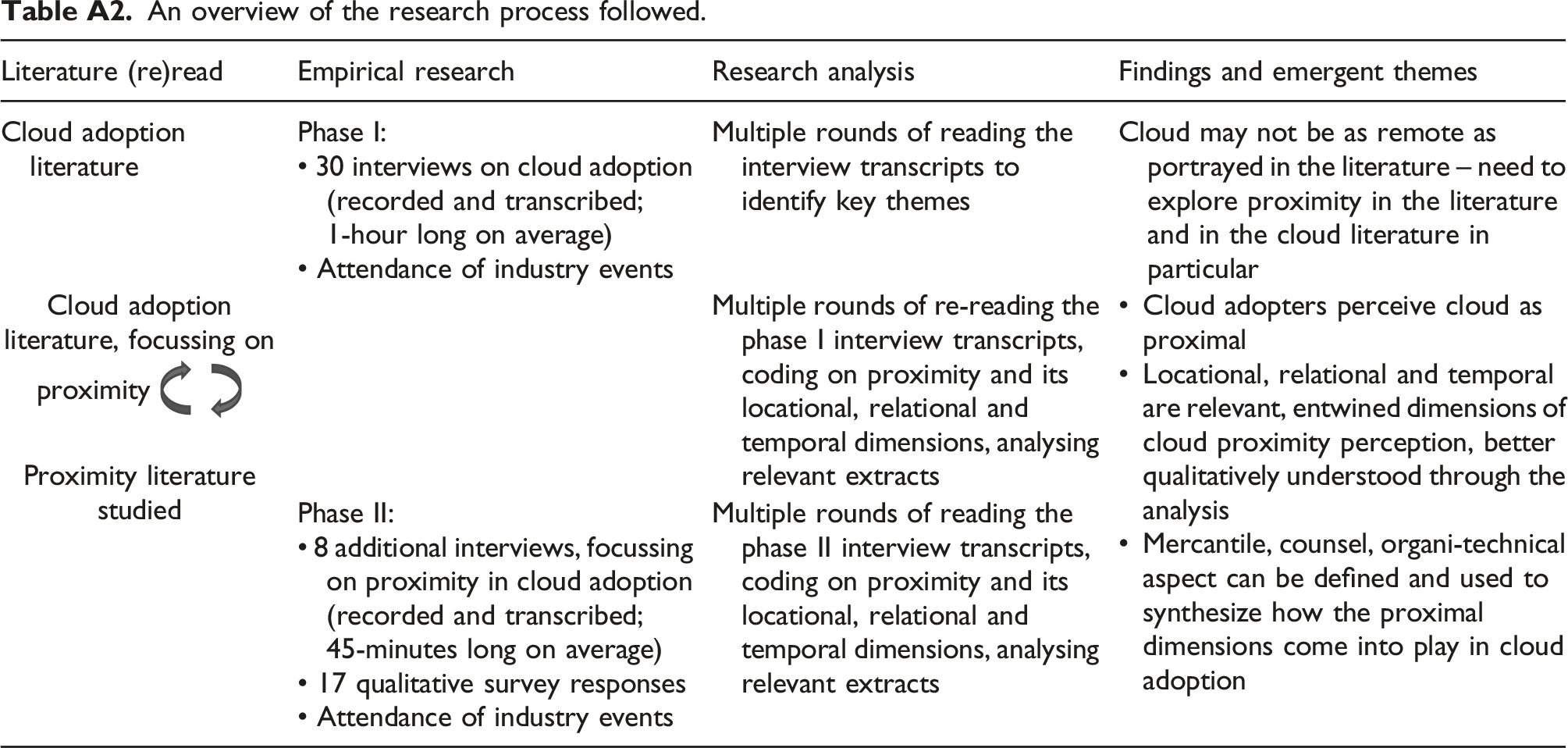
Literature (re)read
Empirical research
Research analysis
Findings and emergent themes
Cloud adoption literature
Phase I:
Multiple rounds of reading the interview transcripts to identify key themes
Cloud may not be as remote as portrayed in the literature – need to explore proximity in the literature and in the cloud literature in particular
Cloud adoption literature, focussing on proximity Proximity literature studied
Multiple rounds of re-reading the phase I interview transcripts, coding on proximity and its locational, relational and temporal dimensions, analysing relevant extracts
• Cloud adopters perceive cloud as proximal
Phase II:
Multiple rounds of reading the phase II interview transcripts, coding on proximity and its locational, relational and temporal dimensions, analysing relevant extracts