



Abstract
For almost two decades, the debate on net neutrality influences the governance of the Internet infrastructure operated by Internet service providers (ISPs) and has spurred an enormous body of academic literature. However, new business models such as zero-rating, rapid technological progress, changing consumer behavior and political transformations constantly challenge our understanding of net neutrality. Despite the breadth and depth of knowledge on this topic, a conceptualization and synthesis of almost two decades of interdisciplinary literature is missing. This paper provides a comprehensive state of knowledge review based on a framework of net neutrality that captures the chronology of the debate as well as individual, organizational, and societal level concepts, which allows us to disentangle the nature, effects, and implications of different business practices of ISPs in order to extract new insights. Finally, we develop a research agenda on net neutrality in telecommunications and on neutrality in the wider Internet ecosystem addressing the challenges with respect to digital platforms and data gatekeepers.
Keywords
Introduction
For almost two decades, the debate on net neutrality influences the governance of the Internet infrastructure operated by Internet service providers (ISPs) and has spurred an enormous body of academic literature. The term “net neutrality” intends to capture how ISPs should be allowed to control, manage, and price the telecommunications infrastructure that provides access to the Internet. Since the Internet serves as the key information infrastructure of society, it’s governance and the discussion whether net neutrality is “a solution in search of a problem” (Brenner, 2012) is of key importance. Despite the mature state of the debate, new business models, technological progress, changing consumer behavior and political transformations constantly challenge our understanding of net neutrality. Accordingly, this paper reviews and assesses the state of knowledge of net neutrality research and develops a research agenda that also covers the wider Internet ecosystem since there is also discriminatory behavior not directly tied to the provision of Internet access through telecommunications networks. With the rise of digital platforms permeating nearly all areas of our digital life and society establishing the success of content and service providers (CSPs) such as Alibaba, Alphabet, Amazon, Apple, Baidu, Meta, Microsoft, and Tencent, new types of powerful players evolved in the Internet ecosystem. As a consequence, there are battles on “Big Tech” regulation in the European Union (EU) and the United States of America (U.S.). Therefore, an information systems (IS) perspective on net neutrality and on the concept of neutrality in the wider Internet ecosystem is gaining increasing relevance.
Due to the fact that the literature on net neutrality is interdisciplinary and evolves since almost two decades, we deem it highly relevant for future research to synthesize the state of knowledge across different disciplines. Therefore, we provide an organizing review to 1) provide scholars with a concise overview of the net neutrality debate with an in-depth focus on new issues that emerged in recent years, 2) analyze how current discussions about new challenges to net neutrality can be informed by insights that have been derived in earlier contributions to the net neutrality literature, and 3) identify areas where insights are scarce and encourage the generalization of the neutrality concept for the wider Internet ecosystem addressing digital platforms and data gatekeepers.
Accordingly, our research question is “what are the key concepts and main insights of net neutrality research in telecommunications and what are further avenues of research in the context of neutrality in the wider Internet ecosystem?”. We contribute to a better understanding of net neutrality in at least three ways: First, we advance scholarly understanding of concepts that emerged in recent years based on a framework of net neutrality that captures the chronology of the debate. Second, we differentiate between individual, organizational, and societal levels, which allows us to disentangle the nature, effects and implications of different business practices of ISPs in order to extract new insights on key concepts of the net neutrality debate. Third, we develop a research agenda for emerging net neutrality themes and suggest avenues for future research towards a generalization of the concept of neutrality for the wider Internet ecosystem.
The remainder of this article is structured as follows. In the next section, we explain the review method. Then, we structure the selected literature in a chronological manner and we develop a framework of (net) neutrality. Subsequently, we discuss the implications of recent ISP business models. In the penultimate section, we provide a synthesis of the overall net neutrality debate. Finally, we develop a research agenda suggesting future research towards a concept of neutrality for the wider Internet ecosystem.
Review method
By focusing on the state of knowledge on net neutrality, we provide an organizing review (Leidner, 2018) that is based on an iterative literature search (Boell and Cecez-Kecmanovic, 2015) and a concept-centric literature synthesis (Webster and Watson, 2002). The literature review was conducted in several steps: First, we started by defining our research question. Second, we developed a search plan for an iterative keyword search to identify the relevant literature. Third, we developed guidelines for collecting the literature including inclusion and exclusion criteria. Fourth, we developed the concepts inductively from the literature. Finally, we synthesized the literature and developed a research agenda.
Search and selection
In order to arrive at a set of articles that covers the key concepts of net neutrality, we began the review with a broad search strategy including the information retrieval systems (databases) Web of Science, Social Sciences Research Network (SSRN), EBSCO, AIS eLibrary, INFORMS, Elsevier (Science Direct), Springer (Link), Wiley, Taylor & Francis, ACM (Digital Library), and IEEE (Xplore) to cover the most important publications. For the search process, we consulted several domain experts in order to identify and discuss relevant terms for the iterative keyword search. As a result, we searched for the terms “Net* Neutrality”, “Telecommunications”, “Internet Access”, “Priorit*”, “Terminat*”, “Discriminat*”, “Congestion”, “Managed Service”, “Network Management”, “Quality of Service (QoS)”, “Quality of Experience (QoE)”, “Zero-Rat*”, “Sponsor* Data”, “Toll-Free Data”, “Data Cap”, “5G”, “Network Slic*”, “Internet Service Provider (ISP)”, and “Digital Platform” in the title, abstract, and keywords of articles for an initial and preliminary assessment of their relevance to the focus of our study. The search procedure resulted in 653 potential candidates. Figure 1 illustrates our search and selection processes. Search and selection processes. Source: Authors, adapted from Günther et al. (2017).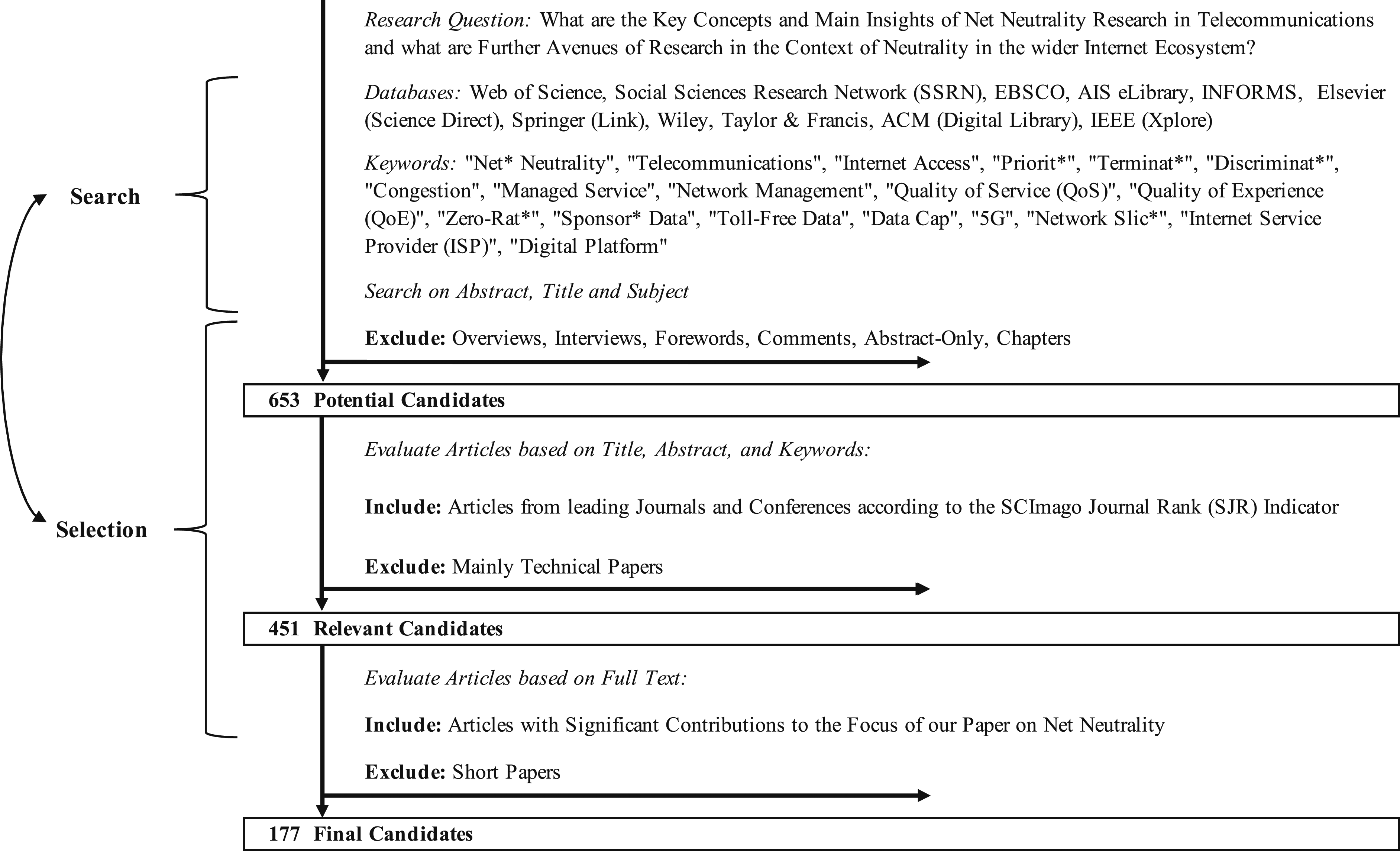
The main selection process involved two rounds. In the first round, we judged articles based on the inclusion criterion whether they are from leading journals and conferences according to the SCImago Journal Rank (SJR) indicator, 1 that is, articles had to be published in English and be peer-reviewed. In this step, we excluded mainly technical papers. As a result, we derived 451 relevant candidates. In the second round, we inspected the full texts of the articles and we judged them based on the inclusion criterion whether they provide significant contributions to the focus of our paper on net neutrality. Furthermore, we identified 21 additional articles (i.e., mainly grey literature) with backward search reviewing the references of the articles and with forward search using Web of Science to find articles that have since cited articles that we identified as relevant. Backward and forward searches were conducted within the scope of the 451 relevant candidates. In this step, we excluded all short papers with less than five pages since they did not provide significant contributions to the focus of our study. As a result, we identified 177 articles that qualified as final candidates.
While the first article on net neutrality was published by Tim Wu (2003), our set of articles covers the whole net neutrality debate until the end of the year 2019. Over the course of the debate, regulatory activities represented fundamental changes of discussion, which we use as transition points in order to divide the net neutrality debate into three phases: Past, present, and future.
Analysis and synthesis
The literature analysis focuses on highlighting the key concepts and main insights of net neutrality research in a chronological order and differentiating between individual, organizational and societal levels. Both authors developed the concepts inductively from the literature and then discussed them by making use of a process of abstracting and generalizing from specific observations by means of constant comparison, coding and memo procedures (Strauss, 1987). Moreover, both authors discussed all of the concepts and consulted a third scholar as judge to resolve any discrepancies. The discussions continued until agreement with respect to all articles and concepts was reached. In cases where the added value of an article was doubtful, we discussed the extent to which the respective article addresses 1) key concepts of the net neutrality debate; 2) the implications for or applications to the wider Internet ecosystem; and 3) new insights compared to previous articles. Breadth and depth of our understanding of the net neutrality literature and the relevance criteria, that is, the extent to which a certain concept is intelligible, substantiated, and significant, led us to the identification of the key concepts.
Analytically, we differentiated the selected literature in terms of key concepts and level of analysis. At the supra level of analysis referring to principles and rules, there is no consistent concept of net neutrality since each research discipline has its own focus and locus. For instance, while engineering and information systems scholars emphasize network design principles and network management practices of the ISP (Easley et al., 2018), economists focus on the direction and size of data traffic and payment flows and the market power of the ISP (Greenstein et al., 2016). In general, the net neutrality principle states that all data traffic in the last-mile ISP network should be treated equally, irrespective of their origin, destination, type, and content (Wu, 2003). Ultimately, we considered a multitude of concepts (a concept map is available from the authors upon request) that informed our framework of the past, present, and future of (net) neutrality.
A framework of (net) neutrality
The core of the debate revolves around the organizational level. Consequently, the following framework of net neutrality has a focus on the concepts of the organization level as they are the main drivers of the concepts at the individual and societal levels. The framework maps the net neutrality debate based on a timeline showing the distinct deviations from the net neutrality principle discussed within each phase. The framework helps to organize the existing literature with respect to different business practices of the ISP and provides guidance to researchers on the dependencies between different deviations from a neutral network approach. Furthermore, findings in the context of a specific practice often depend on assumptions, which are not necessarily valid, or have been omitted, by researchers focusing on other aspects of net neutrality. Figure 2 represents our framework of the core net neutrality debate, that is, telecommunications, which incorporates and builds upon the net neutrality framework developed in Krämer et al. (2013). Moreover, our framework extends to the current debate on neutrality in the wider Internet ecosystem, covering key concepts and topics for future research. Framework of (net) neutrality in telecommunications and the wider Internet ecosystem.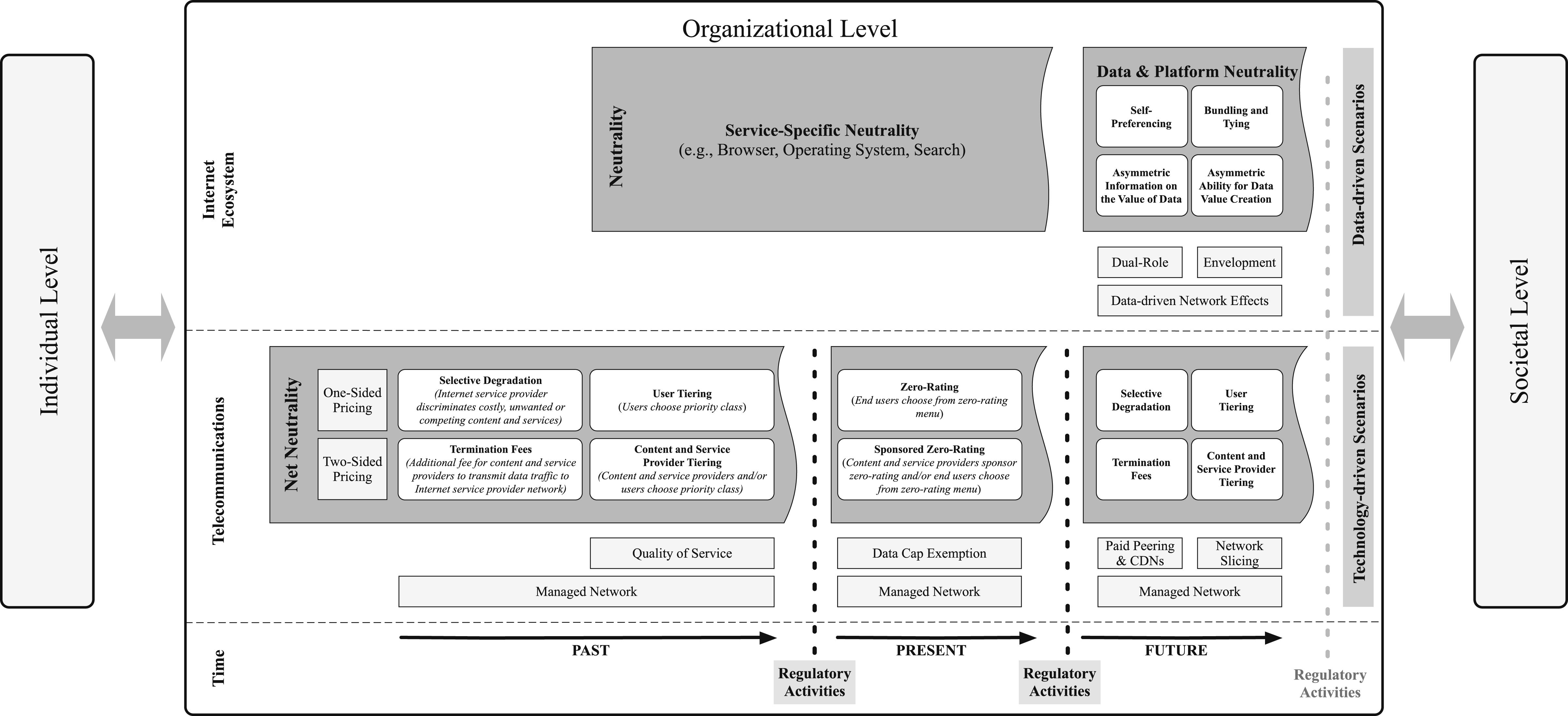
ISPs can charge end users for Internet access based on their fixed and mobile plans, thus representing a one-sided pricing regime. In order to further differentiate their services, ISPs can also establish a two-sided pricing regime, thus charging CSPs in addition to end users (Krämer et al., 2013). Therefore, ISPs can act as digital platform providers intermediating between end users on one side and CSPs on the other (Rochet and Tirole, 2003; Rochet and Tirole, 2006; Armstrong, 2006; Constantinides et al., 2018; De Reuver et al., 2018; De Corniere and Taylor, 2019). Accordingly, the pricing regime is an important dimension of our framework in order to disentangle different practices of the ISP. Another important dimension is the network regime (Krämer et al., 2013). ISPs may 1) provide a managed network and decide on whether to terminate the data traffic through its network or not, 2) offer service tiers based on quality of service (QoS) technologies, and 3) exempt data traffic from counting against a (monthly) data cap of users.
By analogy, digital platform providers and data gatekeepers in the Internet ecosystem may charge end users and/or business users. Moreover, they may 1) have a dual role as a platform provider and also be part of a user group of its platform (e.g., Amazon in its role as marketplace provider and seller of products over the platform at the same time) while applying self-preferencing or tying and bundling practices, 2) make use of data-driven network effects in order to provide customized services to the users while benefitting from asymmetric information on the value of data and/or their disproportional ability for data value creation, and 3) engage in platform envelopment in order to further expand to a digital ecosystem provider. Overall, they represent new issues with respect to data neutrality and platform neutrality in the wider Internet ecosystem. We discuss these issues in detail in the section “Future: A research agenda.”
Past: The idea of neutrality in access networks
The idea of neutrality in the context of the Internet infrastructure can be traced back to the open access movement led by Lawrence Lessig (2001). He argued in favor of neutrality in broadband access networks and the potentially harmful impact that control by large telecommunications providers may have on access to information and innovation. However, the term network neutrality has been first introduced by Tim Wu (2003) and has since then evolved into an ongoing international debate among scholars from different disciplines, ISPs, CSPs, end user rights organizations, policymakers, and regulators.
At the beginning of the debate, subscription fees paid by end users were the main source of revenue for last-mile ISPs. Net neutrality gained momentum when the U.S. Federal Communications Commission (FCC), a national regulatory authority, reclassified the Internet as an “information service” (i.e., Title I) in 2005, essentially relaxing the strict non-discrimination rules usually imposed on a “common carrier” (i.e., Title II). Following that reclassification, the telecommunications provider AT&T started working towards a business model aiming to generate additional revenues from CSPs. Edward Whitacre, former CEO of AT&T, famously said in 2005: “Now what they [CSPs] would like to do is use my pipes free, but I ain't going to let them do that because we have spent this capital and we have to have a return on it.” (Bloomberg, 2005). ISPs pursuing such plans justified these efforts by the continuously increasing data volume transmitted through their networks (Swanson and Gilder, 2008) and argued that they have to continuously invest in network infrastructure to cope with increasing Internet traffic, while CSPs benefit from these investments without contributing to the recovery of costs. From an ISP perspective, CSPs were free-riding on the network infrastructure. Moreover, revenues on the end user side were dominated by flat-rate tariffs and did not allow for sufficient network infrastructure return on investment.
However, scholars and practitioners alike were still discussing which aspects and scenarios of a deviation from the “neutral” status quo were relevant and how to quantify potential negative and positive effects of transitioning to a new network regime. Thus, in the early stage of the net neutrality debate, a precise definition of the concept was still lacking. According to Hahn and Wallsten (2006: 1), “net neutrality has no widely accepted precise definition, but usually means that broadband service providers charge consumers only once for Internet access, don’t favor one content provider over another, and don’t charge content providers for sending information over broadband lines to end users.”
Selective degradation
In a so-called “managed network,” ISPs can identify different types of data traffic in their networks and apply differential treatment of data traffic. In general, this can be achieved by taking into account header information, payload, traffic behavior and routing information (Garrett et al., 2018). The ability of ISPs to block or throttle undesirable content and services in a managed network raised many concerns by scholars from the law domain (Sidak, 2006; Van Schewick, 2010; Zittrain, 2008). Specific cases fueled their arguments, for instance, the Canadian ISP Telus blocking the web presence of “Voices for change,” an organization supporting their workers’ labor union during a strike (Nunziato, 2009); Madison River Communications blocking access to Vonage, a competing voice over IP service (Atkinson and Weiser, 2006); Comcast throttling the traffic of peer-to-peer (P2P) applications in their networks, however, an initial cease and desist order by the Federal Communications Commission against Comcast was later repealed by the U.S. Court of Appeals because the Federal Communications Commission has overstretched its authority (Mueller and Asghari, 2012); and BellSouth blocking access to social media websites such as MySpace and Youtube because of concerns about rising traffic transmission costs (Nunziato, 2009).
Termination fees
ISPs operating a managed network may also charge CSPs a termination fee for connecting to their end users. This simple form of two-sided pricing does not offer any added value for CSPs compared to a neutral network regime (Krämer et al., 2013). Furthermore, CSPs already pay their own ISP for Internet access and transmission of their data traffic to last-mile ISPs (Economides, 2005). Therefore, additional termination fees charged by last-mile ISPs would introduce a form of double charging. Since innovation at the edge by CSPs is one of the main concerns of net neutrality proponents, termination fees may introduce additional barriers to entry for new CSPs (Guo et al., 2012; Reggiani and Valletti, 2016). Accordingly, ISPs should not be in a position to pick winners and losers in the Internet value chain by leveraging their gatekeeper position in telecommunications to distort competition in the Internet ecosystem (Lee and Wu, 2009). CSPs usually have universal access to all end users if they connect to the Internet backbone, but local “quasi-monopolistic” market structures such as in the U.S. provide ISPs with a strong bargaining position over CSPs. Therefore, termination fees may result in a fragmentation of the Internet since some CSPs may not find (or seek) a termination agreement with every ISP (Kourandi et al., 2015), that is, some CSPs that are accessible for customers of ISP A are not accessible for customers of ISP B. In contrast, ISPs argued that innovation at the core of the network is driven by additional revenues from two-sided pricing, increasing their incentives and financial capabilities to invest in new network technologies and capacity expansions.
Quality of service tiering
ISPs may leverage QoS technologies to create fast lanes, thus charging for preferential treatment of data traffic. Typical QoS parameters that affect data transmissions are jitter, delay, packet loss, uptime, and throughput (Meddeb, 2010). In the case of QoS tiering scholars find beneficial effects, because congestion in the network is allocated more efficiently (Guo et al., 2017; Krämer and Wiewiorra, 2012b). Furthermore, ISPs may enhance end user choice with a differentiation of their services, if there is competition in the provision of Internet access (Jamison and Hauge, 2008; Katz, 2017). Additionally, entry of new providers, expansion, and upgrades of existing networks generate strong incentives for ISPs to retain end users by providing services and pricing models that are to the benefit of end users (Becker et al., 2010).
However, the introduction of QoS tiering may also create undesirable effects. First, even under ISP competition, more efficient CSPs may be better-off with paid prioritization, thus even strengthening the position of dominant players (Guo et al., 2017). Second, ISPs that monetize QoS tiering may have an incentive to keep network capacity scarce in order to increase demand for profitable priority access (Schuett, 2010; Krämer et al., 2013). More specifically, the term “dirt road fallacy” has been coined to describe the incentive of ISPs to reduce the quality of the best-effort service tier to spur demand for costly prioritization (Sidak and Teece, 2010). As a possible remedy, proponents of net neutrality suggested the introduction of minimum quality standards to warrant a sufficient quality of the best-effort service tier (Brennan, 2011).
As a result, net neutrality has been defined by a “zero-price rule” and a “non-discrimination rule” (Schuett, 2010). The zero-price rule prohibits fees being charged by ISPs to CSPs, and the non-discrimination rule implies that there should be no preferential treatment of certain data traffic over others.
Regulatory activities
Ultimately, the discussion about two-sided pricing in the form of termination fees and QoS tiering remained hypothetical, since at the end of the “past” phase many countries adopted some form of net neutrality regulation before ISPs de-facto implemented these business models. The U.S. Federal Communications Commission approved the Open Internet Order in December 2010, consisting of a set of “net neutrality principles” stating that 1) end users have the right for transparency about network management practices; 2) there should be no blocking of lawful data traffic, content, services and devices; 3) end users and CSPs should act on a level playing field. As a consequence, ISPs have to refrain from unreasonable discrimination and exclusive “pay for priority” business models but are allowed to offer service tiers (e.g., based on bandwidth); and 4) ISPs can apply reasonable network management. In the U.S., the initial Open Internet Order was challenged in court and in 2015 the Federal Communications Commission had to reclassify the Internet as a “common carrier” in order to restore net neutrality based on the Communications Act of 1934 and Section 706 of the Telecommunications Act of 1996. Consequently, the Open Internet Order had to be revised, however, the basic guidelines from 2010 prevailed: 1) no blocking, 2) no throttling, and 3) no paid prioritization. In Europe, the Netherlands became the first country to enact a net neutrality law in 2012 and a net neutrality framework for the European Union came into effect in 2016 (i.e., EU Regulation 2015/2120), but the regulation has been criticized for its exemptions that undermine the effectiveness of sanctioning net neutrality violations (Marsden, 2017).
There are several empirical studies that address the extent to which ISPs employ traffic differentiation before net neutrality regulation was implemented. However, they rely only on selected test applications, use simulated traffic or exclude mobile networks (Dischinger et al., 2010; Kanuparthy and Dovrolis, 2010). A recent large-scale study addresses the compliance of ISPs with net neutrality regulation. Li et al. (2019) use crowdsourced measurements across 2735 ISPs in 183 countries and regions. Ultimately, they collect a sufficient number of samples from 144 ISPs to detect traffic differentiation and find that a share of 20% employs some form of content-based differentiation. Thus, they conclude that content-based traffic differentiation policies are not common among ISPs.
Present: The change of ISP business models
Since alternative revenue streams of ISPs may be constrained by net neutrality rules and traditional telecommunications services are subject to severe competitive pressure from Internet-based services (Peitz and Valletti, 2015), ISPs adapted their strategy to increase revenues from data plans. As a result, pricing in telecommunications networks has changed from voice and messaging centric tariffs towards data centric tariffs, and from linear tariffs towards tariffs with data allowances (in particular in mobile networks), also known as “data caps” (Ascarza et al., 2012; Chen and Ke-Wei, 2016; Lambrecht et al., 2007; Masuda and Whang, 2006). Empirical and theoretical studies find that data caps set by a profit-maximizing ISP effectively restrict the data consumption of end users (Malone et al., 2017; Nevo et al., 2016; Dai and Jordan, 2015). Economides and Hermalin (2015) find that a profit-maximizing monopolistic ISP sets data caps even lower than the welfare-optimal level. However, Dai and Jordan (2015) argue that data caps also allow the monopolistic ISP to distribute network costs more fairly among users but overall reduce consumer welfare.
Results are more ambiguous with respect to the effect of data caps on network use and congestion. Usage-based pricing is generally considered to be a suitable tool to manage network congestion, if prices correctly reflect the negative externalities a user imposes on the network (MacKie-Mason and Varian, 1995; Bauer and Wildman, 2012; Odlyzko et al., 2012; De Fontenay et al., 1990). Hence, some studies conclude that data caps are not an appropriate measure to manage network congestion since the aggregate data consumption of end users does not correspond to important determinants of network congestion, for example, demand at peak-times (Odlyzko et al., 2012; Hussain et al., 2012). Other studies find that data caps can reduce network congestion in the short-term (Malone et al., 2017; Wang et al., 2016). However, Jordan (2017a) argues that such a congestion-alleviation effect of data caps will be internalized by ISPs in their long-term capacity investment decisions, implying that the overall effect of data caps on network capacity and investment is ambiguous.
Data caps may also influence competition between CSPs (Kehl and Lucey, 2015; FCC, 2013) because they impose an additional budget constraint on the consumption decision of end users. Therefore, an ISP offering tariffs with data caps intensifies competition between CSPs, or even induces competition between CSPs, which are not in a competitive relationship otherwise (Economides and Hermalin, 2015; Schnurr and Wiewiorra, 2018; Jullien and Sand-Zantman, 2018). In contrast, studies on the effect of ISP competition on plain data caps are rare. Wang et al. (2016) find that intense ISP competition has a positive effect on the size of data caps, which indicates that ISPs offer higher data allowances to gain market shares. Overall, data caps are not per-se anticompetitive, however, they can be used as an anticompetitive instrument. For instance, it has been argued that ISPs offering traditional television services can implement data caps that hamper the consumption of over-the-top (OTT) services (Minne, 2013).
Data cap exemption: (Sponsored) zero-rating
In contrast to the “past” phase of the net neutrality debate, which was driven by hypothetical scenarios, in the “present” phase ISPs are now experimenting with different strategies and configurations of zero-rating. Therefore, these practices are under regulatory scrutiny in several countries for potentially harming competition and the net neutrality principle (FCC, 2017; EC, 2017; BEREC, 2018) and some regulators have recently taken action. However, as Greenstein et al. (2016: 132) argue in their survey of the net neutrality literature, “whether these practices represent efficiency gains, or whether they unfairly tip the competitive landscape, raise the cost of rival services, and provide a cause for regulatory intervention“ still remain unresolved issues.
Our analysis of the selected literature revealed that there is no consensus regarding a precise definition of zero-rating in the context of Internet access services (Eisenach, 2015; Yoo, 2017; Frieden, 2017; Jullien and Sand-Zantman, 2018; Kimball, 2015). The most compelling definitions of both types of zero-rating are provided by Easley et al. (2018: 257) defining them as “non-neutral data caps,” where zero-rating (i.e., a one-sided pricing practice) means that “neither side pays extra to ISP” or the “consumer side pays extra to ISP,” and sponsored zero-rating (i.e., a two-sided pricing practice) means the “content provider side pays extra to ISP” for being exempted from data caps.
Most of the confusion in the literature is based on the fact that 1) both types of zero-rating result in a zero (marginal) rate for data traffic from an end user perspective, however, zero-rating with two-sided pricing (i.e., sponsored zero-rating) involves a fee being paid by CSPs; 2) current definitions do not differentiate between the treatment of data traffic before the data cap has been reached and the treatment of data traffic after an end user reached the data allowance. Consequently, we use the terms “data accounting” referring to the rating of data traffic before the data cap has been reached, and “data cap enforcement” referring to the availability of zero-rated content and services after the data cap has been exceeded. We thus suggest to re-interpret the term “non-neutral data caps” by Easley et al. (2018) such that zero-rating corresponds to “non-neutral data accounting” practices, whereas the term “non-neutral data caps” implies a “non-neutral enforcement” of the cap, favoring zero-rating traffic after the cap has been exceeded or end users do not have to buy a data plan at all to consume zero-rated content and services. Therefore, we define zero-rating arrangements as follows:
Implementations of zero-rating
Unilateral and bilateral zero-rating
An empirical study found that T-Mobile’s “Binge On” traffic identification relies solely on host information, content type, and server name indication to classify zero-rating traffic and that this approach is rather unreliable (Kakhki et al., 2016). ISPs face a trade-off between identifying zero-rating traffic correctly in order to avoid complaints by end users consuming zero-rated CSPs whose data traffic has been counted against their data cap (i.e., Type II error), and avoiding revenue losses if data traffic of non-(sponsored) zero-rating CSPs is not counted against the data cap (i.e., Type I error). To avoid identification errors, ISPs initiate partnerships with CSPs, which require (sponsored) zero-rating CSPs to fulfil technical requirements and adhere to informational protocols in order to attribute data traffic reliably (Curwin, 2015). In the zero-rating case, CSPs partner with ISPs, but in contrast to the sponsored zero-rating case, CSPs are not being charged. Nevertheless, fulfilling such requirements may be costly for CSPs, too. Thus, zero-rating can be a two-sided mechanism in nature without involving two-sided pricing. Hence, zero-rating can be implemented either unilaterally, where the ISP solely relies on its data traffic identification and classification technologies, or bilaterally, where the ISP collaborates with CSPs to exchange technical information and to provide the infrastructure necessary to zero-rate reliably. In contrast, sponsored zero-rating agreements are bilateral by definition, since both parties contractually agree upon a fee for sponsoring data to end users.
Bandwidth throttling
End users exceeding their data cap either face severely reduced downloading and uploading speeds or no service at all. In contrast, data traffic is usually not restricted before the cap has been reached, in particular for sponsored zero-rating (Garrett et al., 2018). Nevertheless, ISPs often rely on traffic policing in order to restrict the consumption of their end users even before the cap has been reached. This practice, commonly referred to as “throttling”, negatively impacts the quality of experience (QoE) of end users when they consume content and services that would demand higher bandwidth to be delivered in the highest quality available (Flach et al., 2016). For bilateral zero-rating, ISPs require from CSPs a technical infrastructure delivering content and services under throttling at adaptive quality levels, for example, via adaptive bitrate streaming. However, throttling is not a necessary means to establish zero-rating. Jordan (2017b) distinguishes between 1) Zero-rating without throttling; 2) Zero-rating with throttling of zero-rated CSPs only; and 3) Zero-rating with throttling of all CSPs within the same class of services. The third option implies that also non-zero-rated CSPs offering the same type of content and services are being throttled for all zero-rating end users of an ISP, as long as they do not opt-out, for example, T-Mobile “Binge On”. However, an opt-out is never possible for CSPs that participate in zero-rating programs.
Downsized versions of content and services
A special type of zero-rating can be found in developing countries’ emerging markets where smartphone penetration and demand for mobile data services are still low (Galpaya, 2017; Ramos, 2014; Chen et al., 2017). Here, zero-rating end users only have access to a downsized version of content and services, for example, Facebook “Free Basics” (GV, 2017; Facebook, 2018). A downsized version excludes data-intensive elements such as pictures, audio, and video (Sen et al., 2017). In contrast to throttling, where content and services are downscaled dynamically ex-post due to bandwidth restrictions, downsized versions are an ex-ante reduced form of content and services.
Regulatory activities
Zero-rating is the first widespread differentiated service offered by ISPs under a net neutrality regime that involves direct agreements between ISPs and CSPs. However, net neutrality regulation differs between countries and therefore significantly impacts the characteristics of zero-rating programs. Regulators are still evaluating zero-rating from a net neutrality perspective. For instance, the Telecom Regulatory Authority of India banned all types of zero-rating in 2016, while zero-rating practices were still allowed under certain requirements in the EU, for example, non-discriminatory and free of charge access to all content and services in the same category, and no discrimination between content and services within the same category. In 2021, the Court of Justice of the European Union (CJEU) ruled that zero-rating practices in general violate the EU Regulation 2015/2120 on net neutrality and are thus prohibited from mid-2023. In contrast, the U.S. Federal Communications Commission (FCC) adopted the Order “In the Matter of Restoring Internet Freedom” in 2018, which effectively reversed the 2015 Open Internet Order. Therefore, ISPs in the U.S. are free to implement QoS tiering, (sponsored) zero-rating and other discriminatory practices.
Synthesis of zero-rating regulation
Zero-rating is often discussed in the context of net neutrality (Greenstein et al., 2016; Easley et al., 2018). To describe these practices, Easley et al. (2018: 256) coined the term “non-neutral data caps.” In fact, several aspects of zero-rating practices in the “present” phase relate to concerns raised in the “past” phase of the net neutrality debate: First, they are inherently discriminatory data accounting practices. Moreover, they can be designed in a discriminatory or even exclusionary manner, thus raising further net neutrality concerns about hampering competition in the Internet ecosystem (Guo et al., 2017; Bourreau et al., 2015), reducing innovation at the edge (Guo et al., 2012; Reggiani and Valletti, 2016), and limiting end user choice (Van Schewick, 2015b). Second, they may negatively impact data cap sizes to spur demand for zero-rating and sponsored zero-rating programs (Van Schewick, 2015b; Jullien and Sand-Zantman, 2018). Third, zero-rating can involve throttling of data traffic, which allows ISPs to price discriminate between different quality levels of content and services (Kakhki et al., 2016; Krämer and Peitz, 2018). Figure 3 shows a comparison of main net neutrality concerns with corresponding zero-rating issues and suggests regulatory measures to address them, which also reflects the structure of this section. Identification of discriminatory implementations and regulatory measures.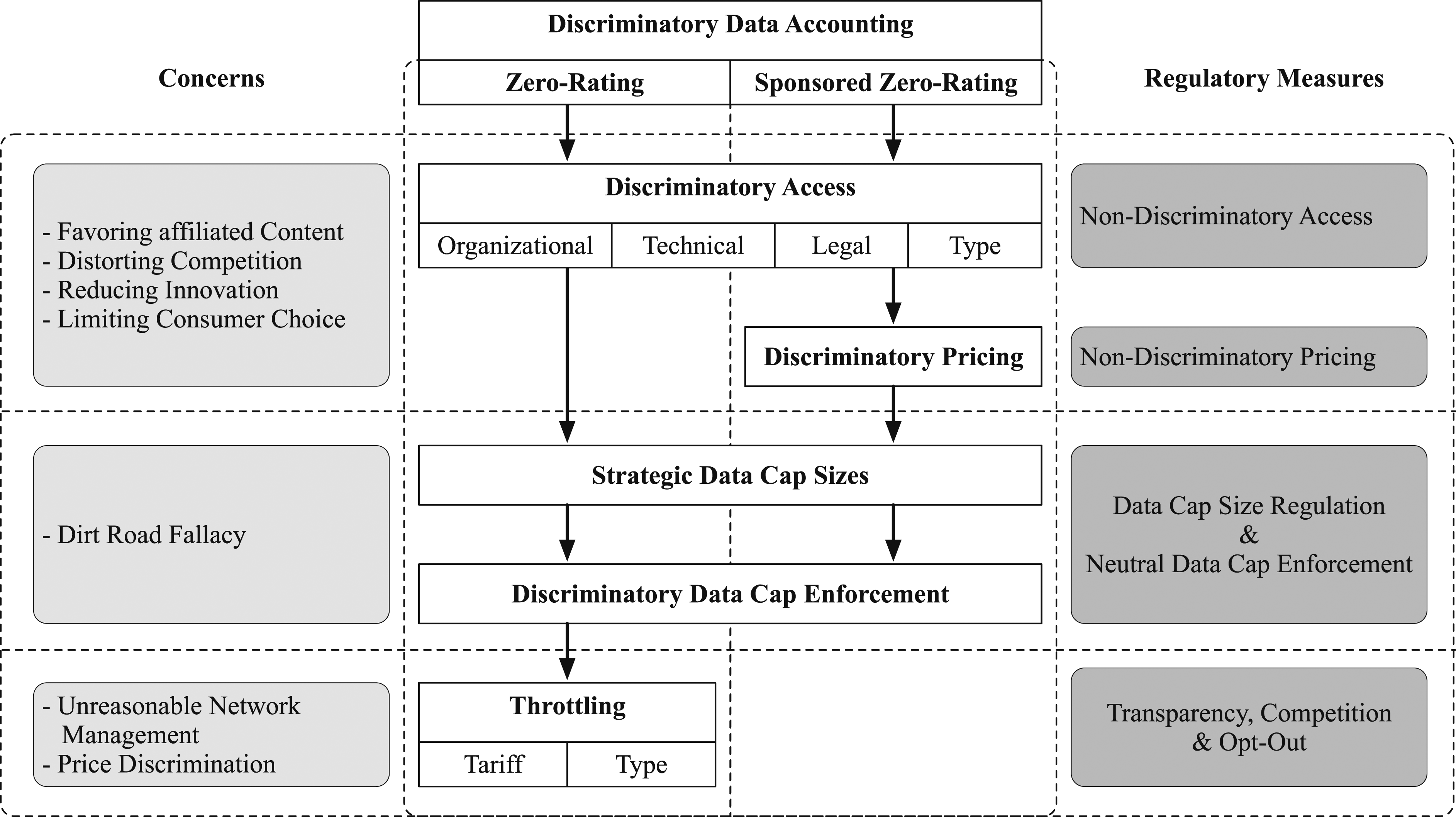
Discriminatory access and discriminatory pricing
Sponsored zero-rating arrangements violate the zero-price rule because ISPs charge CSPs for transmitting data traffic to end users, but universal interconnection is not affected by sponsored zero-rating agreements since non-sponsoring CSPs can still be accessed via regular data allowances. Nevertheless, sponsored zero-rating can distort the level-playing-field between CSPs by means of discriminatory data accounting (Jullien and Sand-Zantman, 2018; Gautier and Somogyi, 2018; Jeitschko et al., 2021). Net neutrality researchers agree that price discrimination, which is considered to be inappropriate on the end user side (e.g., first degree price discrimination), should not be allowed on the CSP side of the market (Krämer et al., 2013). Therefore, non-discriminatory pricing of sponsored zero-rating is an appropriate obligation (e.g., U.S.), if sponsored zero-rating is not prohibited ex-ante by net neutrality rules (e.g., EU). In the context of zero-rating, regulators should be concerned if access to zero-rating programs is discriminatory. ISPs can discriminate via 1) organizational requirements that only larger CSPs can fulfil, for example, demanding dedicated service staff; 2) restrictive technical requirements, for example, excluding specific protocols; 3) exclusion of illegal or undesirable content and services; 4) selection of the types of content and services that are eligible to participate in zero-rating programs (Van Schewick, 2015b; Van Schewick, 2016). Therefore, the entry barriers to zero-rating programs can be relatively high for CSPs. Nevertheless, some sort of discriminatory access is a necessary means because otherwise zero-rating would ultimately turn any mobile data plan with zero-rating into a full flat-rate. Moreover, ISPs may favor their vertically integrated CSPs by exclusive zero-rating or reduced fees when it comes to sponsored zero-rating (Jeitschko et al., 2021; Gautier and Somogyi, 2018). Despite the fact that regulators have found evidence for such concerns to hold true (FCC, 2017; EC, 2017), they are not unique to zero-rating practices, and competition law has been argued to be well-suited to address such concerns (Hollis, 2018). Nevertheless, imposing non-discriminatory access obligations also implies that regulators would restrict the ability of ISPs to prefer vertically integrated and affiliated CSPs.
From now on we summarize our overall interpretation on different matters in light of our assessment of the literature as “Insight”.
Strategic data cap sizes and discriminatory data cap enforcement
When comparing paid prioritization with zero-rating, Gautier and Somogyi (2018) find that if the value of content is high and congestion is relatively severe, the ISP opts for prioritization, otherwise the ISP favors zero-rating. However, they also find that zero-rating harms end users if congestion is relatively low. Similarly, ISPs might have an incentive to keep data caps artificially low in order to generate additional revenues from (sponsored) zero-rating, in particular if ISPs maintain full bandwidth for zero-rated content and services after the data allowance has been exceeded. However, if ISPs offer zero-rating, optimal data caps are smaller than without data cap exemptions, either due to lower residual demand for regular data traffic (Schnurr and Wiewiorra, 2018) or due to the ISP internalizing negative congestion externalities (Jullien and Sand-Zantman, 2018). Thus, smaller data caps under (sponsored) zero-rating are not necessarily an indication of artificial scarcity. A similar argument has been put forward with respect to zero-rating offers in emerging markets, where zero-rated services are accessible even if end users do not have a mobile data plan at all (Galpaya, 2017). By tying these arrangements to data allowances for regular data traffic, regulators can limit the ability of ISPs to establish (sponsored) zero-rating programs as substitutes for regular Internet access and some countries already prohibited such zero-rating practices, for example, Chile, Egypt, and India (Frieden, 2017).
Throttling
If throttling under zero-rating is primarily applied to counterbalance the negative effect of additional demand for zero-rated CSPs on network congestion, it may be considered as a form of reasonable network management. In contrast, if throttling is primarily applied to facilitate, for instance, price discrimination, it may violate net neutrality rules. Furthermore, Krämer and Peitz (2018) suggest that throttling also has a beneficial effect by reducing the need for costly network capacity expansions to cover peak load demand. However, non-transparent throttling practices can also confuse end users and zero-rating with throttling of all CSPs of the same type may not always be desirable from an end user perspective.
State of knowledge of net neutrality
Individual level
Transparency
Network management is a highly intransparent ISP practice for end users. Even if ISPs provide easy to understand terms and conditions, it is very difficult for end users to actually verify if service degradations are related to network management practices. To that end, end users can rely on publicly available information or a variety of different testing tools (Li et al., 2019). Publicly available information enables end users to make informed decisions about their Internet access product without incurring additional costs, but information has to be accessible and comprehensive to support the decision-making of end users (Faulhaber, 2010). Results from a laboratory experiment on net neutrality and transparency suggest that even a fraction of informed end users has a positive effect on welfare (Sluijs et al., 2011). Thus, if accurate information is available to some experts, information sharing helps all end users to make better decisions.
Choice
Transparency only supports end users if they have a choice between different ISPs, tariff models, and access technologies. Thus, choice is a fundamental building block of end user protection, but hard to address with stand-alone measures (Becker et al., 2010; Katz, 2017). Therefore, regulators can increase choice of end users directly by reducing switching costs (e.g., by mandating short contract terms and notice periods) and by preventing bundling strategies and undesirable default options. Nevertheless, end user choice is intertwined with the level of ISP competition. ISPs compete on prices, tariff structures, access technologies, network quality, and coverage. Competition is therefore often viewed as a prerequisite for end user choice and as beneficial for end users due to its welfare-enhancing effects (Pasquale, 2010; Faulhaber, 2011; Becker et al., 2010; Sluijs et al., 2011). In contrast, legacy telecommunications monopolies were associated with technological monocultures, slow network deployment, high prices and low choice (Davis et al., 1996). Therefore, choice is a result of competition rather than a regulatory objective.
Organizational level
Competition between ISPs
ISP competition tones down the incentive for discriminatory behavior, as end users have alternatives to purchase Internet access. Conversely, QoS tiering and (sponsored) zero-rating also allow ISPs to differentiate their products from each other along an additional dimension, thus potentially alleviating competitive pressure. Therefore, despite competitive pressure from rivals, ISPs may still have the incentive to implement QoS tiering on the CSP side of the market (Guo et al., 2017). Nevertheless, CSP tiering can also intensify competition for end users, which is not always beneficial to ISPs. If each ISP has a unilateral incentive to switch to a discriminatory network regime, a prisoner’s dilemma between ISPs can arise (Bourreau et al., 2015). These results indicate that ISP competition does not imply that regulators do not need to worry about the introduction of QoS tiering on the CSP side of the market. In contrast, the attractiveness of QoS tiering on the end user side under ISP competition appears limited. Despite the fact that ISPs wish to offer multiple service tiers to increase the benefits for users and charge higher prices, offering multiple service tiers further increases the level of competition between ISPs. Therefore, offering multiple quality tiers to end users, as would be profitable in a monopoly, is not necessarily the outcome under ISP competition (Gibbens et al., 2000).
Under zero-rating, ISPs can tailor their products to attract certain types of end users or market segments, for example, targeting younger audiences by zero-rating popular CSPs (Yoo, 2017). Hoernig and Monteiro (2020) analyze an ISP duopoly setting with zero-rating where ISPs compete on the basis of retail tariffs and find that the larger an ISP’s network, the more likely it will offer zero-rating under competition, given that CSPs are rather complementary. This result corresponds to Brake (2016), arguing that mobile ISPs use zero-rating offers in an attempt to gain market shares and to differentiate themselves from competitors. The competitive landscape is also complemented by service-based mobile virtual network operators (MVNOs) relying on wholesale products of infrastructure-based mobile network operators (MNOs), that is mobile virtual network operators have contractual arrangements with mobile network operators for the co-use of their network infrastructure. Krämer and Peitz (2018) argue that zero-rating may be used by mobile network operators to reduce the competitive pressure from mobile virtual network operators as they can offer zero-rating programs while the latter cannot.
Price discrimination
Vertical differentiation or quality segmentation (i.e., versioning) is a form of second-degree price discrimination (Shapiro and Varian, 1999; Varian, 1997) and an effective tool to extract consumer surplus when there is sufficient heterogeneity among end users (Moorthy, 1984; Mussa and Rosen, 1978). Tiered plans that offer different levels of QoS are a case of segmentation by congestion-sensitivity, comparable to plans that offer different levels of bandwidth (Economides, 2008). Bandyopadhyay and Cheng (2006) find that QoS pricing on the end user side can increase ISP revenues, since it allows the ISP to extract more consumer surplus. In contrast, Fishburn and Odlyzko (2000) find that a two-tier network yields lower revenues, but a network with uniform quality imposes additional costs on the network provider. However, “these costs may well be worth paying to attain the simplicity of a single network that treats all packets equally and has a simple charging mechanism” (Fishburn and Odlyzko, 2000: 128).
Zero-rating options can be viewed as a special case of second-degree price discrimination as well (Chellappa and Mehra, 2018; Bhargava and Choudhary, 2008). Under zero-rating, ISPs can “engage in efficient price discrimination through the bundling of two goods (mobile wireless service and content), thereby creating the ability for marginal consumers to pay a reduced price by choosing a differentiated product in the form of a ‘basic’ form of online access” (Eisenach, 2015: 6). Other scholars argue that zero-rating may induce end users to switch to more comprehensive and expensive tariffs, offering access to a larger variety of zero-rated CSPs, that is, the ISP engages in an upselling strategy (Frieden, 2017; Krämer and Peitz, 2018). Assuming the zero-rating option comes at no extra cost, Rogerson (2016) argues that zero-rating may benefit end users under intense ISP competition because continued price competition diminishes additional profits from zero-rating in the long run, that is it reduces the ability for price discrimination.
Network management
While there is consensus in the net neutrality literature that reasonable network management practices should be allowed (Guo et al., 2013; Peitz and Schuett, 2016), the results with respect to QoS tiering are more diverse. Scholars find that paid prioritization can distribute network congestion more effectively, alleviating congestion for very congestion-sensitive services and end users and aggravating congestion for less congestion-sensitive CSPs (Krämer and Wiewiorra, 2012b; Bourreau et al., 2015). Others find also negative effects of QoS tiering if congestion-sensitive CSPs react to higher priority by increasing traffic volumes (Peitz and Schuett, 2016) or if QoS tiering induces the entry of new bandwidth-intensive content (Choi et al., 2018). ISPs that gain revenues from QoS tiering may have the incentive to artificially reduce the best-effort service quality in order to boost revenues from selling priority (Sidak and Teece, 2010). However, by prioritizing some traffic, the residual best-effort traffic is necessarily slowed down, if network capacity is not expanded. The so-called “dirt road fallacy” describes the additional incentive of ISPs to go beyond the endogenous congestion aggravation effect in the best-effort class to further boost the relative attractiveness of priority service tiers (Choi and Kim, 2010; Krämer and Wiewiorra, 2012b). Nowadays, QoS tiering is considered to be a violation of net neutrality in the EU and ISPs started to offer tariffs with data caps and exemptions, that is, zero-rating. However, monthly data allowances do not correspond to demand at peak-times. Empirical studies of Internet backbone traffic find that the relationship between aggregated monthly demand and peak-time demand of heavy-users is relatively weak (Gyarmati et al., 2012) and that non-heavy users are contributing the most to peak-time traffic (Felten, 2011). Both results are in contrast to the claims made by ISPs about the effect of heavy-user’s demand on network congestion (Li and Liao, 2014).
Zero-rating and sponsored zero-rating already represent a form of network management of ISPs (Easley et al., 2018). ISPs often rely on “throttling” in order to counterbalance the negative effect of increased demand for zero-rated content and services on network congestion and to manage the traffic of data-intensive CSPs (Krämer and Peitz, 2018; Gerpott, 2018). Furthermore, ISPs may profit from zero-rating by smoothing the overall demand pattern in their networks, thus eliminating high fluctuations in overall network use (Krämer and Peitz, 2018; Frieden, 2017; Gautier and Somogyi, 2018). Offering zero-rating with throttling may therefore increase the average use of network resources but decrease the need to provide additional costly capacity for peak-times. By imposing bandwidth throttling on all CSPs in the same service class, the ISP can further increase the positive effect of demand smoothing on its network. Nevertheless, zero-rating with throttling also involves a trade-off for CSPs: In case of no zero-rating, end users are restricted by data caps but experience full-service quality. In case of zero-rating, end users face no demand restrictions but experience a reduced service quality, for example, video streaming. Hoernig and Monteiro (2020) explicitly consider the zero-rating and capacity investment decision of the ISP in a quantitative analysis. They find that an efficient allocation of network capacity can be realized by means of zero-rating, because it allows an ISP (in the monopoly case) to shift consumption to CSPs that increase network effects (i.e., value of the ISP platform) and thus gain an advantage if the costs of capacity expansions are low. In addition, this increases welfare per end user and thus social welfare. Furthermore, stronger network effects due to zero-rating also increase capacity investments of the ISP if CSPs are complementary and decrease capacity investment in case the CSPs are substitutes.
Self-preferencing
Vertical integration and foreclosure of competing CSPs by means of deviating from net neutrality is frequently debated in the selected literature (BEREC, 2012; Greenstein et al., 2016; Van Schewick, 2015a). ISPs may have the incentive and the ability to block or even to exclude competing CSPs. Exclusion is more likely if 1) content and services are less differentiated, 2) there is a monopolistic ISP, and 3) ISP competition prevents the leverage of network effects (Hagiu and Lee, 2011; Broos and Gautier, 2017). Nevertheless, exclusionary behavior can be addressed by competition law thus rendering net neutrality regulation redundant for this issue (Dewenter and Roesch, 2016; Hollis, 2018). An ISP can create advantages for vertically integrated CSPs under all non-neutral network regimes without relying on strict exclusionary measures such as blocking and throttling. Under a managed network regime with termination fees, the ISP can refrain from or reduce these fees for its integrated or affiliated content and services. Under a QoS tiering regime, the ISP may provide higher quality tiers only for vertically integrated service units or offer the benefits of higher QoS for free or at a lower price (Guo et al., 2010).
Since more and more ISPs offer their own on-demand streaming services, data caps can also negatively impact demand for vertically integrated CSPs. By exclusively zero-rating its own content and services or affiliated CSPs, the ISP gains an advantage over CSPs competing with the ISP in the Internet ecosystem (Jeitschko et al., 2021; Gautier and Somogyi, 2018). Even if an ISP offers sponsored zero-rating to competing CSPs, it can still maintain a competitive advantage by zero-rating its own content and services for free or charging its own content and service unit a lower sponsoring fee. According to Van Schewick (2015b), all cases of preferential treatment of integrated or affiliated CSPs create an uneven playing field between ISP-affiliated CSPs and unaffiliated CSPs with similar offers (Van Schewick, 2015b).
Distorting the level playing field
CSPs can differentiate themselves from competitors with respect to quality, variety, and business model, irrespective of any network management practices employed by ISPs. While termination fees just impose additional costs on CSPs, QoS tiering and (sponsored) zero-rating arrangements add a new dimension to CSP competition and provide a new way to differentiate themselves from rivals or to expand demand for their content in general (Economides and Hermalin, 2012; Economides and Tag, 2012; Krämer and Wiewiorra, 2012b; Guo et al., 2017; Cho et al., 2016; Gautier and Somogyi, 2018; Qiu et al., 2017).
With respect to termination fees, the main findings suggest that welfare can be reduced if (some) CSPs cannot afford to pay these fees and therefore have no access to end users (Economides and Hermalin, 2012; Economides and Tag, 2012). This is due to the fact that end users internalize the impact of their consumption on congestion. Therefore, excluding some CSPs cannot create a positive congestion alleviation effect (Economides and Hermalin, 2012). However, without considering congestion effects, termination fees have also been found to increase welfare compared to net neutrality even in a monopoly situation (Economides and Tag, 2012).
QoS tiering differs from termination fees and zero-rating by opening up a new dimension: While zero-rating provides unlimited consumption of CSPs at the same transmission quality as before (i.e., absent throttling), QoS tiering provides higher priority of data traffic from and to (paying) CSPs. Therefore, CSP tiering benefits ISPs at the expense of CSPs (Cheng and Bandyopadhyay, 2011; Economides and Hermalin, 2012). Since ISPs can focus on extracting surplus from the CSP side absent net neutrality, they have to rely on extracting surplus solely from the end user side under a net neutrality regime. However, some CSPs may also be better off with paid prioritization, either because they are more efficient than their competitors or they provide services with a higher congestion-sensitivity thus gaining from congestion alleviation (Krämer and Wiewiorra, 2012b; Guo et al., 2017; Nault and Zimmermann, 2019). Nevertheless, QoS tiering distributes congestion according to the willingness-to-pay, thus less congestion-sensitive CSPs with a low willingness-to-pay are more likely to suffer from congestion aggravation under QoS tiering (Krämer and Wiewiorra, 2012b; Nault and Zimmermann, 2019). Furthermore, even if CSPs prefer QoS tiering unilaterally, they may end up in a prisoners’ dilemma situation with lower payoffs if both opt for priority (Choi and Kim, 2010). As QoS tiering on the CSP side of the market is prohibited by regulation in many countries, (sponsored) zero-rating oftentimes is the remaining driver of differentiation between CSPs.
Since CSPs are not charged for participating in zero-rating programs, lower barriers to entry for zero-rating programs are assumed to correspond to smaller distortions of CSP competition (Gerpott, 2018; Stallman and Adams, 2016). In contrast, sponsored zero-rating allows an ISP to establish itself as a platform provider (Armstrong, 2006; Caillaud and Jullien, 2003; Rochet and Tirole, 2003; Rochet and Tirole, 2006; Rysman, 2009) acting as an intermediary in a two-sided market (Cho et al., 2016; Qiu et al., 2017; Jullien and Sand-Zantman, 2018; Gautier and Somogyi, 2018; Jeitschko et al., 2021). Eisenach (2015) argues that an ISP increases the value of its platform with an optimal mix of customers and a positive selection of CSPs, since this enables an efficient internalization of network externalities and increases the attractiveness of sponsoring to advertising-based CSPs by means of reaching a larger audience. A monopolistic ISP can use sponsored zero-rating as a tool to discriminate between high-value and low-value CSPs with an advertising-based revenue model (Jullien and Sand-Zantman, 2018). Whereas high-value CSPs have an incentive to opt for sponsored zero-rating to spur demand and to generate higher advertising revenues, low-value CSPs have no incentive for sponsored zero-rating. Here, sponsored zero-rating induces efficient consumption of high-value CSPs and ultimately increases social welfare if the share of high-value CSPs is large. However, while sponsoring mitigates the underconsumption of high-value content, it also worsens the underconsumption of low-value content at the same time. Therefore, if the share of low-value CSPs is large, zero-rating is more efficient than sponsored zero-rating from a societal perspective. If content differentiation is low and all CSPs are allowed to sponsor data, a prisoner’s dilemma may arise (Cho et al., 2016; Qiu et al., 2017). Thus, the ISP is inducing all CSPs to pay the sponsoring fee in order to avoid losing end users to the rival. Consumer welfare is maximized if there is either low content differentiation with the dominating CSP sponsoring data or a high level of content differentiation without sponsored zero-rating, which also maximizes social welfare. However, the less differentiated CSPs in a duopoly are, the more likely they will opt for sponsoring in order to reduce competitive pressure (Qiu et al., 2017). Since the ISP makes the final pricing decision by means of properly setting the variable costs of data traffic, this allows the ISP to extract the entire consumer surplus and CSP profit. Thus, increased competition between CSPs participating in sponsored zero-rating programs does not benefit end users.
Societal level
Innovation at the core and the edge
With termination fees, innovation at the core of the network is likely to be higher because an ISP offers a higher network quality compared to a scenario where termination fees are forbidden (Hermalin and Katz, 2007). Njoroge et al. (2013) argue that termination fees allow the ISP to extract more surplus from CSPs, which in turn increases its investment level. However, due to increased network quality, the profits of CSPs might increase as well.
Given a QoS tiering or a non-neutral data accounting regime, concerns with respect to innovation at the edge are more diverse. Depending on variations with respect to content heterogeneity, congestion-sensitivity of content, market structure, and end user preferences, there are ambiguous results in the literature with regards to the relationship of a QoS regime and innovation at the edge. Some find net neutrality to ensure a higher availability and sustainability of content and services (Wu, 2003; Van Schewick, 2007) and that abandoning net neutrality would drive less effective content and services out of the market (Wu, 2003; Van Schewick, 2007; Choi and Kim, 2010; Guo et al., 2012; Guo et al., 2017). Others find that a QoS tiering regime will lead to increased content and service variety in the long-run (Yoo, 2005; Krämer and Wiewiorra, 2012b; Bourreau et al., 2015; Choi et al., 2018; Nault and Zimmermann, 2019). Improved network quality and prioritized data transmissions in these studies are found to provide a breeding ground for congestion-sensitive services that could not be established in a one-size-fits-all best-effort Internet. Therefore, net neutrality establishes a level playing field between all CSPs, but introduces discrimination of congestion-sensitive content and services with high QoS requirements (Easley et al., 2018).
ISPs have been found to either underinvest or overinvest in infrastructure in the absence of net neutrality (Choi and Kim, 2010; Cheng and Bandyopadhyay, 2011). Other studies find that the investment level compared to net neutrality is overall ambiguous, but “(…) that net neutrality could boost the incentive for ISP capacity expansion because it […] adversely affects the ability to extract rent from content providers” (Choi and Kim, 2010: 459). In contrast, some find that infrastructure investments will be higher under QoS tiering, since the ISP benefits from these investments by higher fees from CSPs (Krämer and Wiewiorra, 2012b), while others find that the ISP has no additional investment incentive in a two-tier Internet (Nault and Zimmermann, 2019). Overall, the results with respect to ISPs innovation incentives at the core under QoS tiering are ambiguous.
In the case of zero-rating, throttling of bandwidth-intensive services of a particular category such as video streaming is generally considered to be detrimental for innovation at the edge in the case of selective (asymmetric degrees of) throttling between CSPs that are (not) affiliated or (not) vertically integrated with the ISP (Krämer and Peitz, 2018). In contrast, zero-rating benefits innovation at the core since it is a price discrimination device enabling higher profits for the ISP and thus increases the incentives for capacity investments (Inceoglu and Liu, 2019).
Affordable Internet access
Guo et al. (2012) and Guo et al. (2017) find that ISPs have an incentive to provide Internet access for free or for a lower access price to end users under QoS tiering than under a net neutrality regime. In particular, if end users do not value access to the Internet, they can get subsidized from the payments collected from CSPs, which in turn helps the ISP to serve more end users and thus to increase Internet penetration. Bandyopadhyay and Cheng (2006) find that based on widespread network overcapacity, ISPs are likely to offer “lite” versions at lower prices, which enables end users to experience the benefits of Internet access and increases the number of upgrades to higher speeds over time.
Zero-rating in emerging markets is often driven by large CSPs that partner with mobile ISPs to offer (downsized versions of) their services to end users, for example, Facebook “Free Basics” and Google “Free Zone.” However, if end users leave these specific services, the resulting data traffic is again counted against their data cap. Therefore, it has been argued that “banning zero-rated services through regulation in order to preserve the open Internet as we know it may limit Internet use for price sensitive users and for those who cannot afford data services otherwise” (Chen et al., 2017: 589). In contrast to established markets, where data caps are a necessary means to create demand for zero-rating, this ISP practice aims at educating end users about the value of (mobile) content and services, which in turn may foster demand for costly additional data volume in general (i.e., ISP incentive) and demand for zero-rated CSPs in particular (Galpaya, 2017). According to Chen et al. (2017), an increasing use of zero-rated CSPs in Kenya and South Africa is associated with a majority of end users preferring full versions on a paid mobile data plan over downsized versions on a zero-rating plan. However, the incentives of ISPs and CSPs may not always be aligned (Romanosky and Chetty, 2018). ISPs seek to zero-rate CSPs that have the potential to increase demand for paid mobile data plans. Rather popular CSPs are therefore more likely to benefit from zero-rating, whereas the ISP might offer less popular CSPs to sponsor zero-rating to end users (Cho et al., 2016). Offering product bundles, for instance, mobile Internet access combined with zero-rated services, creates the opportunity for marginal end users to opt for a basic form of Internet access (Eisenach, 2015). Regulators can limit the ability of ISPs to establish (sponsored) zero-rating programs as substitutes for regular Internet access by tying zero-rated services to data allowances for regular data traffic.
Free speech on the Internet
Net neutrality rules that ensure unrestricted access to all types of CSPs through the public Internet have been argued to ensure freedom of opinion and expression on the Internet (Cherry, 2011; Novak and Hajibayova, 2019). In fact, end users have been found to associate a general notion of fairness with the concept of net neutrality and value equality (Shin and Lee, 2017; Krämer and Wiewiorra, 2015). Krämer and Wiewiorra (2015) find that those end users that prefer net neutrality over QoS tiering are driven by equality, while end users in favor of QoS tiering are guided by the equity principle. Overall, their results suggest that, despite the fact that the majority of end users prefers net neutrality, end users do not value communications networks like a public resource, but rather like a common good.
According to Ard (2016), the opportunities for free expression and end users’ ability to prepare for engagement in the public sphere through education and self-empowerment is an important aspect of (downsized versions of) zero-rating. However, zero-rating programs of the ISP may prioritize commercial CSPs such as Netflix over CSPs that are more open to end user’s personal expression such as Youtube. Goodman (2016) argues that while a neutral treatment of ISPs indeed benefits end users, zero-rating helps under-served end users, in particular as it supports end user participation in digital discourse. Therefore, zero-rating can promote end user speech interests in having access to CSPs that distribute their opinions. However, a survey by Geopoll on the adoption and use of Facebook Zero found that the service biases the perception of end users in emerging markets (Mirani, 2015). For instance, 61% of Indonesian, 65% of Nigerian and 58% of Indian end users participating in the survey agreed with the statement that “Facebook is the Internet”. These numbers are in stark contrast to the results from the U.S., where only 5% of the surveyed U.S. end users share the view of Facebook being the “entire Internet” (Mirani, 2015). In 2018, the Brazilian election campaign of candidate Bolsonaro leveraged WhatsApp, a zero-rated messenger service, to spread conservative messages and misinformation. Therefore, it has been argued that “zero-rating policies that fuel the popularity of one specific platform (WhatsApp) and curbs users from accessing a full functioning Internet obviously are a practical impediment for a voter that could be educated to adequately research and check the news stories they receive” (Evangelista and Bruno, 2019: 18).
Future: A research agenda
The debate in telecommunications
Net neutrality revisited
In June 2018, the U.S. net neutrality regulation was officially repealed by the Federal Communications Commission rendering a revision of the arguments from the early stages of the net neutrality debate relevant again. ISPs in the U.S. are free to implement QoS tiering, (sponsored) zero-rating and other discriminatory practices. Therefore, we suggest scholars to carefully observe evolving business models of ISPs (in the U.S.) in the future. Since the U.S. provides a setting that resembles the characteristics of a (natural) experiment, we encourage researchers to conduct comparisons between the U.S. and other countries (e.g., the EU) as regards the effect of net neutrality regulation on industry profits, consumer welfare and network investments.
(Sponsored) Zero-rating
Since regulators worldwide pursue different approaches to zero-rating practices, we encourage research addressing the following issues of (sponsored) zero-rating: First, analytical models used to analyze (sponsored) zero-rating are overwhelmingly focusing on monopolistic ISPs. Studying duopolistic or oligopolistic market structures in the context of (sponsored) zero-rating may reveal further insights with respect to ISP product differentiation and price discrimination under competition. Second, it has been frequently argued that zero-rating might alter the consumption behavior of end users. However, only a few studies consider endogenous consumer demand and analyze tariffs with data caps explicitly in the form of three-part tariffs. Therefore, we encourage empirical research that captures the impact of (sponsored) zero-rating on usage patterns in more detail. Third, end users prefer flat-rate tariffs over metered tariffs because a flat-rate separates the joy of consumption from the price payed for the service (Prelec and Loewenstein, 1998; Krämer and Wiewiorra, 2012a; Lambrecht and Skiera, 2006). Since zero-rated content and services are exempted from a data cap, they induce no additional psychological disutility. This effect may even increase the preference for tariffs with zero-rating and therefore lead end users to overpay for such tariffs similar to full flat-rate tariffs. Therefore, we encourage researchers to address the question if zero-rating can also cause a tariff bias. Finally, since data cap sizes are not a suitable benchmark to draw conclusions with regards to consumer welfare effects, empirical research identifying appropriate measures to evaluate the impact on end users may reveal further insights.
Paid peering and content delivery networks
Network management practices implemented by the ISP are only one way to increase the quality of experience (QoE) of end users (Fiedler et al., 2010; Kilkki, 2008). CSPs can also address QoS issues by bypassing the public Internet. The most prominent techniques are content delivery networks (CDNs) (Baake and Sudaric, 2019) and paid peering agreements (Chiang and Jhang-Li, 2014).
Content delivery networks such as Akamai, Level3, and Limelight provide strategically distributed cache servers at multiple locations using a scalable architecture consisting of backend servers for an efficient distribution of content and frontend servers residing close to or within the last-mile ISP network for the interaction with end users (Hau et al., 2011; Chiang and Jhang-Li, 2014). Content delivery networks avoid congestion by means of routing the data traffic through optimized paths via an overlay network to the last-mile ISP network (Clark et al., 2006). Therefore, it may be argued that content delivery networks violate strict net neutrality (Krämer et al., 2013), in particular when they are vertically integrated or affiliated with an ISP or CSP.
Internet interconnection is a predominantly unregulated field of the information infrastructure. ISPs are neither obliged to interconnect with every CSP, nor are the terms and conditions of peering settlements regulated or have to be made public. Settlement-free peering relationships are commonly accepted by both parties if the traffic ratio of inbound and outbound traffic is (approximately) symmetric (Wang et al., 2021). Otherwise, CSPs may enter bilateral peering arrangements with last-mile ISPs that assume direct payments (Coucheney et al., 2014; Kim, 2019; Little and Wright, 2000; Choi et al., 2015). Such paid peering agreements represent a direct form of network interconnection and enable faster delivery of content and services by rendering the transmission via intermediaries such as backbone providers obsolete (Wang et al., 2021). Thus, paid peering may be used to establish de-facto termination fees, especially if traffic ratios become more and more asymmetric due to the consumption of data-intensive content and services (Courcoubetis et al., 2016; Ma, 2017). However, since negotiations are private, little is known about the terms and conditions. Even if peering disputes are settled to the satisfaction of both parties today, ISPs may “(…) increase the peering price and want to further differentiate its services for higher charges (…)” (Ma, 2017: 363) in the future. Furthermore, ISPs may strategically use the utilization of routes into their network and the resulting congestion to force CSPs to the negotiation Table. In 2014, Netflix accused Comcast and Verizon of strategic underprovisioning of interconnection capacity in order to degrade the quality of experience of their subscriber base and scholars find that “periods of degraded QoS match periods of negotiation between the largest ISPs and Netflix” (Goetz, 2016: 17). Large European telecommunications providers are arguing again in favor of termination fees and call for a “fair contribution” of CSPs in the EU. Therefore, we suggest future research to address the issue of ISPs as gatekeepers in Internet interconnection markets and the potential of paid peering to implement two-sided pricing in Internet access markets.
Network slicing
5G networks are a service-oriented infrastructure that provides more spectral efficiency and increases network bandwidth beyond the level of 4G networks. More specifically, due to the diverse requirements of different service categories, the network can be divided into slices on a per-service or a per-service-category basis (Foukas et al., 2017; Zhang, 2019). Network slicing in conjunction with “software defined networking” (SDN) and “network function virtualization” (NFV) allows a mobile ISP to slice a single physical network into multiple isolated virtual networks (Barakabitze et al., 2020).
These inherent features of 5G technology have several important net neutrality implications: First, despite the fact that an ISP can create independent slices tailored to the need of specific services and applications, the overall network capacity is still limited. Therefore, increasing the bandwidth and quality of one slice tends to affect the bandwidth and quality of other slices negatively (Sciancalepore et al., 2017). According to Afolabi et al. (2018: 2449), developing algorithms for “(…) flexible optimal slice resource allocation is very challenging, particularly when considering a set of functional requirements that should be known beforehand in order to be fulfilled”. Basic insights from QoS tiering should thus apply to network slicing as well. Second, network slicing allows infrastructure-based mobile ISPs to offer separate network slices to service-based mobile virtual network operators (Samdanis et al., 2016; Caballero et al., 2019). Mobile ISPs have to provide direct access to their networks, which implies that network quality and coverage are virtually identical for both types of providers. This may change with the introduction of network slicing in 5G networks, since the mobile ISP is able to degrade transmission quality or tailor it to the willingness-to-pay of the mobile virtual network operator. Third, managed services such as voice over IP are exempted from net neutrality regulation in the EU. However, network slicing is a technological foundation to implement almost any service as a managed service in a dedicated network slice (Smirnova et al., 2019). Therefore, it remains an open question if network slicing will be used by ISPs to provide services and applications that are also considered to be a legitimate managed service (i.e., not addressed by net neutrality regulation), or whether ISPs use this technology as a tool to introduce QoS tiering through the back door.
The debate on the Internet ecosystem
Since the beginning of the net neutrality debate, several authors have extended and transferred the concept of neutrality from telecommunications to the Internet ecosystem (Easley et al., 2018). For instance, there are “search neutrality” (Odlyzko, 2009), “wireless net neutrality” (Hahn et al., 2007; Wu, 2007) or “operating system / device neutrality” (Easley et al., 2018; Krämer et al., 2013), and “browser neutrality” (Easley et al., 2018) approaches. They all make an important observation: Gatekeeper positions in other parts of the Internet ecosystem may potentially yield similar negative results as have been identified in telecommunications.
Service-specific neutrality
In the context of “search neutrality,” Odlyzko (2009) is concerned about the gatekeeper position of search engine providers. More specifically, they may have an incentive to distort search results in favor of advertisement revenues, tailoring their algorithms to maximize revenues, which may not be in line with the needs of end users. This issue is not limited to dedicated search engines but holds for search functionalities in general. In the context of app stores, operators implemented similar functionalities to promote applications in more prominent sections of an app store or on top of the search results. Such discrimination in the Internet ecosystem is analogous to QoS-based discrimination in telecommunications. However, in contrast to telecommunications, regulating a search engine and implementing measures against discriminatory behavior may also reveal business secrets of a search engine provider and creates adverse incentives to optimize content and services for search algorithms. Search neutrality is a domain-specific term coined at the early stage of the net neutrality debate, but the idea of neutrality in search is generalizable to other digital platforms and services and therefore represents the first transition of the concept of neutrality to the Internet ecosystem.
At the early stages of public mobile communications, network operators tried to exert power over mobile device manufacturers by tying subsidies for and sales of smartphones to restrictions, such as limited voice over IP and Bluetooth connectivity (Hahn et al., 2007; Wu, 2007). With the rise of smartphones, mobile communications devices have evolved towards capable computers with powerful operating systems and control shifted towards popular device manufacturers. Now these players leverage their gatekeeper position as developers of mobile operating systems and services. For instance, Apple as a provider of iOS and several digital services (e.g., messaging, music and video streaming, mobile payments) decides which applications can be distributed via its app store and which are allowed to use certain hardware functionalities (e.g., near-field communication). The risks and potential detrimental effects for competing CSPs are now discussed under the term “operating system neutrality” (Easley et al., 2018).
Web browsers are still the universal gateway to digital content and services. Therefore, popular providers of web browsers such as Google’s Chrome and Apple’s Safari shape the features and restrictions of this access technology, and thus can be regarded as gatekeepers, too. Furthermore, web browsers and their functionalities can be enriched by installing plug-ins and add-ons. The term “browser neutrality” was first coined by Easley et al. (2018) and captures all forms of discrimination based on browser features and technologies. For instance, ad-blocking is a functionality that is available as third-party plug-in solution or natively integrated in web browsers. Ad-blockers modify a webpage and exclude ads that are embedded in the content (e.g., banners, pop-ups) and thus influence the revenue stream of ad-financed CSPs. Therefore, ad-blockers establish themselves as gatekeepers between end users and CSPs by offering a whitelisting of advertisements in return for a revenue share of regained ad-revenues (Shiller et al., 2018). Thus, gatekeepers can emerge in different domains and a unified approach to neutrality in the Internet ecosystem is warranted.
The neutrality concept in the Internet ecosystem: Data neutrality and platform neutrality
In contrast to telecommunications, where technology-driven scenarios generate market power of ISPs for Internet access services, we argue that in the wider Internet ecosystem, data-driven scenarios lead to monopolistic market structures. The concept of neutrality in the Internet ecosystem has evolved substantially in recent years. Several articles emerged that focus on generalizing the neutrality concept to find a more widely applicable formula of neutrality as a non-discrimination principle, for example, “platform neutrality” (Krämer and Schnurr, 2018) and “data neutrality” (Easley et al., 2018). The first term refers to the fact that many gatekeeper positions in digital markets are multi-sided platforms that enable upstream and downstream services to business users, which rely on access to and features of these digital platforms to offer their services to end users (i.e., retail market) or other business users (i.e., wholesale market). The second term refers to the fact that the digital economy is transformed by (big) data analytics towards a data economy where business success is driven by access to and leverage of a large quantity, a high quality, variety and velocity of data (Wiener et al., 2020; Spiekermann et al., 2015).
In fact, many successful digital platform providers are also dominant players in data-driven markets, where the amount of machine-generated data about users lowers the cost of improving and tailoring their services. The underlying relationship between the amount of user/usage data and the increase in quality, which in turn attracts even more users to a certain platform, has been described as “data-driven network effects” (Prüfer and Schottmüller, 2021). Therefore, we argue that “data-driven network effects” can be regarded as a potential organizational level concept in the future debate on platform neutrality and data neutrality in the wider Internet ecosystem. Furthermore, digital platform providers may leverage their “dual-role” as provider of the ecosystem and player within the ecosystem, thus benefitting disproportionately from asymmetric information on the value of data and self-preferencing practices, for example, Amazon offers its Marketplace as platform owner while also competing with merchants as (re-) seller at the same time (Zhu and Liu, 2018). Moreover, digital platforms may engage in “envelopment,” thus increasing their functionalities through multi-platform bundling and tying by making use of different complementarities in order to foreclose access to end users (Eisenmann et al., 2011). In addition, large digital platforms disproportionately benefit from their asymmetric ability for data value creation and appropriation. In fact, scholars, regulators, and policymakers worldwide work on the appropriate regulation of digital platforms and data gatekeepers (Furman et al., 2019; Crémer et al., 2019; Morton et al., 2019; Feld, 2019; ACCC, 2019; Cicilline and Nadler, 2020).
A research agenda.
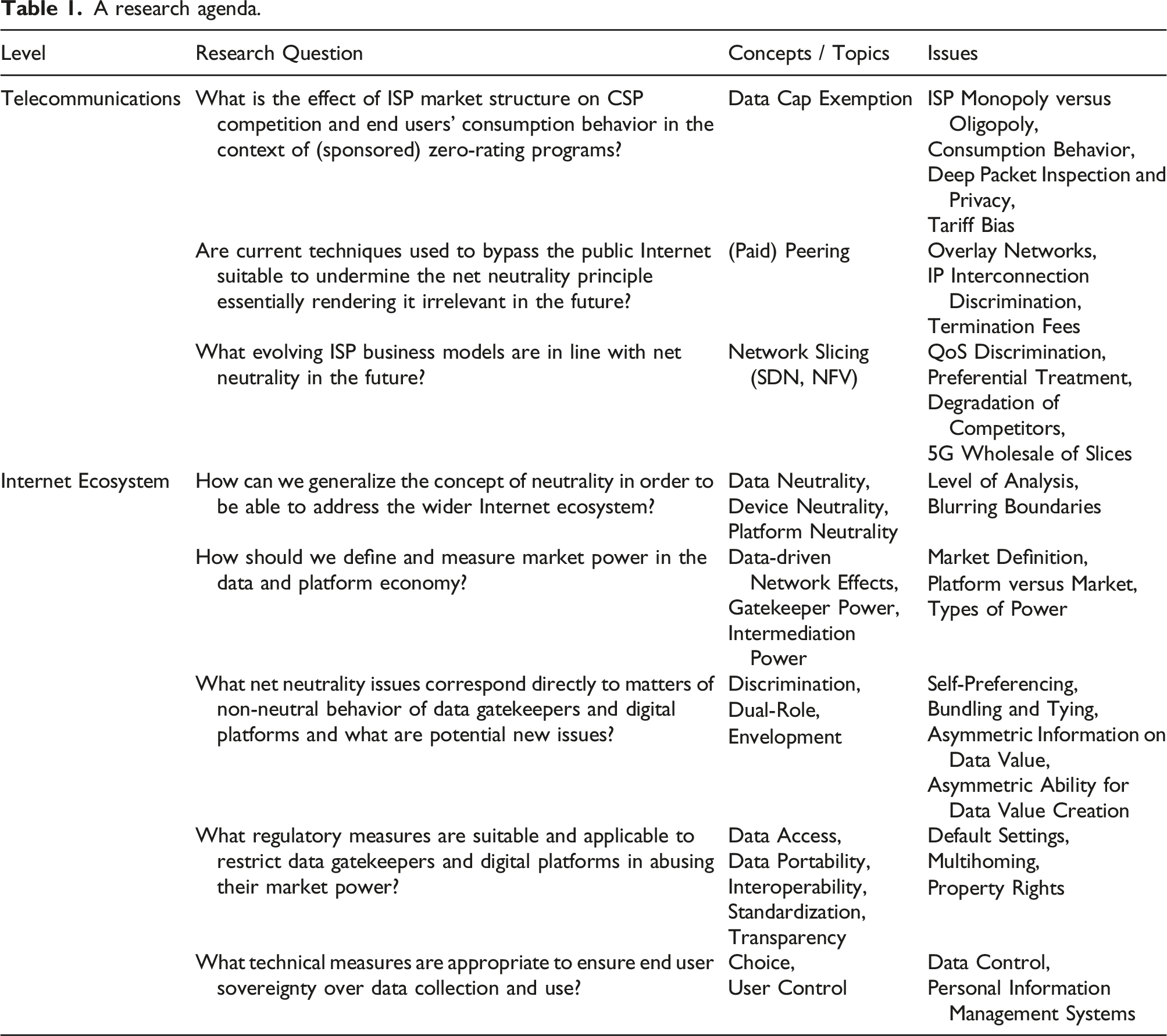
How can we generalize the concept of neutrality in order to be able to address the wider Internet ecosystem?
The concept of neutrality comprises of a set of principles that ensure non-discriminatory access to a bottleneck and equal treatment of all providers in adjacent markets. In order to generalize the issue of neutrality from telecommunications to the wider Internet ecosystem, there is a need to 1) define the essential characteristics of a digital platform in control of a bottleneck, and 2) define criteria that have to be fulfilled in order to qualify for neutrality regulation. For instance, discriminatory behavior of digital platforms may require the implementation of application programming interfaces (API) neutrality, ad-blocking neutrality, search neutrality, app store neutrality, browser neutrality, device neutrality, or even platform or data neutrality in general. Since value creation and capture is increasingly moving from telecommunications to the Internet ecosystem, market power of digital platforms and gatekeepers is a key issue rendering further activities of policymakers and regulators necessary. Due to the rising essentiality of several digital platforms for end users and complementary (third-party) service providers, the Internet ecosystem, which is characterized by data-driven markets, may require a similar neutrality framework as has been established in telecommunications. For instance, Amazon has been accused to leverage data about successful products sold by merchants on its marketplace in order to offer such products under the umbrella of its own “Amazon Basics” product line, that is, self-preferencing (Mattioli, 2020). However, the characteristics that may generate the economic power of a certain digital platform might be substantially different from those of ISPs and even more complex from a technical perspective. In the digital economy, information technologies, algorithm design, and big data analytics capabilities determine economic dynamics and market structures. Thus, we encourage scholars to generalize the neutrality concept and to develop a generalized approach to neutrality in the Internet ecosystem.
How should we define and measure market power in the data and platform economy?
Market power is a rather abstract economic concept and legal term, referring to a firm that has a relatively wide scope of conduct allowing for a behavior that is relatively free of competitive constraints (Motta, 2004). Traditionally, market power assessment consists of defining the relevant market (e.g., by means of demand substitutability and supply substitutability) and determining the market share or the ability to raise prices above marginal costs. However, the platform and data economy renders this traditional approach ineffective because 1) users oftentimes pay non-pecuniary prices in terms of revealing (personal) data or spending their attention to advertisements, 2) marginal costs of service provision are close to or equal to zero and substantial fixed costs exist, which is comparable to ISPs’ cost structure, however, scalability of digital platforms is many times higher while coverage is determined by the underlying telecommunications networks, 3) domain-specific Internet services differ broadly in their technical characteristics, and 4) digital platforms offer multiple services and significant competitive dynamics lead to blurring market boundaries. Moreover, having a large market share, for instance, as a result of network effects, not necessarily reflects market power, for example, because multi-homing users reduce the scope of action of a digital platform. In addition, digital platforms are multi-sided markets, which implies that efficient prices will be asymmetric (Rochet and Tirole, 2006; Armstrong and Wright, 2007), thus the most important user group (e.g., end users) enjoys the platform service free of charge while the other user groups (e.g., advertisers, publishers) have to subsidize the others. To this end, new metrics and indicators for market power of digital platforms and data gatekeepers are needed. Since data-driven services and digital platforms are rather complex entities, we strongly encourage scholars to engage in research on new approaches to effectively deal with these challenges.
What net neutrality issues correspond directly to matters of non-neutral behavior of data gatekeepers and digital platforms and what are potential new issues?
The discussion about neutrality in the Internet ecosystem gained momentum due to the fact that digital platforms have become an essential part of our information infrastructure. With the rise of dominant firms in the Internet economy, practitioners and scholars build upon the insight that certain issues arising in the wider Internet ecosystem are conceptually similar to issues already discussed in the context of net neutrality in telecommunications. Despite these similarities, a systematic analysis of the relationship between issues in telecommunications and the Internet ecosystem is missing. For this interdisciplinary challenge, we deem the information systems discipline well prepared to contribute to future research on platform and data neutrality. More specifically, we suggest IS scholars to draw upon the insights gained from telecommunications and to provide a systematic comparison of the issues in the wider Internet ecosystem. Future research may also identify new issues that arise specifically in the context of data-driven markets. To this end, we encourage scholars to analyze, characterize, and classify the relevant (technical) bottlenecks of digital platforms.
What regulatory measures are suitable and applicable to restrict data gatekeepers and digital platforms in abusing their market power?
Regulatory interventions in telecommunications take into account the technical details of different network regimes to address the source of market power and discriminatory behavior of ISPs appropriately. Likewise, technical details of digital platforms and data gatekeepers have to be taken into consideration in the Internet ecosystem. For instance, digital platforms control algorithms, the scope of their data collection and use, application programming interfaces, revenue shares and the terms and conditions, which also shape competition and innovation on their platforms and ecosystems. While data in general is an essential input in the digital economy, the term “data” is oftentimes used in a very unspecific manner, mostly intended to capture the notion of information. However, data requires context and semantics in order to become information of economic value (Lawrence, 1999). In addition, a high context-dependency requires regulatory measures to go beyond plain access to data and simple non-discrimination rules. The information systems discipline has a long track-record with respect to the design, optimization and behavioral analysis of digital services and platforms (De Reuver et al., 2018; Ondrus et al., 2015; Wessel et al., 2017; Sutherland and Jarrahi, 2018; Alaimo et al., 2020). Therefore, IS scholars are well-equipped to contribute to a better understanding of the potential bottlenecks in the information infrastructure of data service providers and of how to regulate and control their (potential) market power.
What technical measures are appropriate to ensure end user sovereignty over data collection and use?
Data and its information value are highly context-specific and therefore difficult to assess for end users (Spiekermann and Korunovska, 2017). Choice and transparency are key to end user sovereignty. However, transparency can only support end users in their data sharing decision-making, whereas data control would allow end users also to manage and to limit the consequences of past data disclosures. Control over disclosed data and thus the revealed information is determined and restricted by the tools provided to end users. In the Internet ecosystem, we deem end user sovereignty a highly relevant and important issue. For instance, trust and reputation are essential building blocks of the rising peer-to-peer sharing economy (Ter Huurne et al., 2017). However, it remains an open question if end users should be able to migrate their reputation from one platform to another. For instance, how should a conversion of reputation from one domain to another be designed (e.g., ride sharing to rental accommodations)? How should a standardized data management dashboard be designed to enable end users to make informed decisions about their data disclosures? By generalizing the neutrality concept, it is important to realize that end users face the burden of decision-making under incomplete information without decision support or any (technical) control of the exchange processes at all. Information systems scholars with expertise in user interface design as well as privacy and security are well-equipped to contribute to the issue of end user sovereignty in the data economy (Noam, 2011; Zimmermann et al., 2014; Yigitbasioglu and Velcu, 2012; Whitley, 2009). Thus, we suggest addressing how end user sovereignty can be implemented and managed in a cross-sectoral and interrelated data economy.
Conclusion
The entire net neutrality debate has developed over the course of almost two decades and is yet to be assessed from an interdisciplinary perspective. This state of knowledge review systematically analyzed the key concepts revolving around net neutrality from an individual, organizational and societal perspective. We synthesized the selected literature by proposing a framework essentially structuring the net neutrality debate based on 1) key concepts involved and 2) different phases identified. We used a concept-centric approach to discuss the intended and unintended consequences of net neutrality and their implications for ISPs, CSPs, end users, regulators, and society. We highlighted similarities and differences of the most important differentiated services of the ISP, that is, QoS tiering and (sponsored) zero-rating, with regards to net neutrality. While ISPs refrained from the introduction of QoS tiering, we argue that disentangling the data accounting practice from the data cap enforcement practice helps to efficiently address issues with (sponsored) zero-rating.
Moreover, we developed a research agenda to shape the evolution of a generalized neutrality concept for the Internet ecosystem. While the first two decades of the net neutrality debate were shaped by scholars from the law and economics domains, we argued that the key issues shifted from telecommunications to the wider Internet ecosystem involving a higher degree of complexity driven by information technology. While our organizing review aims to help scholars to locate their research in a broader net neutrality context, our research agenda highlights promising avenues for research towards the development of a “generalized neutrality concept” for the wider Internet ecosystem.
Limitations
We carefully crafted our search and selection processes, but it required to a large extent manual effort. In the process, we examined numerous articles and conducted extensive forward and backward searches. We also excluded articles based on several criteria. Therefore, we cannot rule out that we missed relevant articles dealing with other issues of net neutrality. Moreover, our review focused on articles published in leading journals and conferences. Despite the fact that many books on this topic are based on insights from journal articles, we cannot rule out that there are additional contributions in books on net neutrality we did not consider.
Footnotes
Declaration of conflicting interests
The authors declare no potential conflicts of interest with respect to the research, authorship and/or publication of this article.
Funding
The authors confirm that this research received no specific grant from any funding agency in the public, commercial, or not-for-profit sectors.
