




Abstract
Although sociomaterial theorizing has provided important insights into how digital technologies enable or constrain behavior in organizational contexts, there is a need to advance theory to better account for how digital technologies shape heterogeneous work practices in which distributed organizational actors use diverse technology portfolios to collaboratively produce and consume information. Against that backdrop, we draw on the distinction between digital mediation and digital representation to investigate tensions in how actors transfer information across organizational and technological boundaries, how they translate information into meaning, and how they eventually transform information into action in digitalized work. We illustrate and develop this framing through detailed analyses of digitally enabled, condition-based maintenance of equipment in a mining context. Drawing on these analyses and extant literature, we advance theory on tensions in how digital technologies are implicated in producing and consuming information in today’s increasingly heterogeneous work practices.
Keywords
Introduction
As organizations engage in digital transformation, they seek to improve efficiencies, interactions, and services by producing and consuming up-to-date and detailed information about their operations (Ramaprasad and Rai, 1996; Schildt, 2022; Vial, 2019). These ongoing efforts require organizations to create new capabilities, mindsets, and work arrangements to exploit the opportunities afforded by digital technology. When manual work arrangements are replaced or supported by real-time information, smart algorithms, and increased automation, management and organizations are transformed dramatically (Schildt, 2022). These transformations resemble the historical changes in organizational paradigms and management models associated with technological revolutions (Bodrozić and Adler, 2018). Contemporary digital transformation is accompanied by a new organizational paradigm of networks where work arrangements and people are closely connected across internal and external organizational boundaries via diverse portfolios of digital technologies to collaboratively produce and consume vast amounts of requisite information (Jarvenpaa and Ives, 1994; Mathiassen and Sørensen, 2008; Barao et al., 2017). To understand how such heterogenous work arrangements can be supported and managed, we must carefully consider how digital technologies are used and information is produced and consumed in contemporary organizational practices.
Traditionally, Information Systems (IS) research has traditionally adopted either a material (Benbasat and Zmud, 2003) or a social perspective (Orlikowski, 2000) to explore the role of technology and information in organizational practices. The ontological lens of sociomateriality was advanced to overcome this gap by viewing the material and the social as inseparable and co-emerging in organizational practices (Orlikowski, 2007; Orlikowski and Scott, 2013). By exploring how work arrangements are constituted through sociomaterial entanglements (Orlikowski and Scott, 2008; Carlile et al., 2013; Sarker et al., 2019), sociomateriality promises to help IS researchers overcome traditional weaknesses in theorizing the role of digital technology (Orlikowski and Iacono, 2001) and the particular materiality of technology and information in digitalized work (Leonardi and Barley, 2008; Zammuto et al., 2007). However, while Orlikowski and Scott (2008) emphasize the multiple meanings and arrays of how such materiality entangles in everyday work practices, sociomateriality research has mainly focused on co-located organizational contexts and relatively coherent technologies. Although a few studies have explored issues of sociomateriality in heterogeneous work arrangements (Contractor, Monge and Leonardi, 2011; Introna and Hayes, 2011; Pelizza, 2021), none have included in-depth analyses of how multiple meanings are constituted across organizational and technological boundaries. Moreover, most sociomaterial studies provide little insight into the role played by technology and information (Doolin and McLeod, 2012; Wagner, Moll and Newell, 2011; Pelizza, 2021). This is unfortunate because digital technology increasingly mediates organizational life (Jonsson, Mathiassen and Holmström, 2018; Waardenburg, Huysman and Sergeeva, 2021) and radically changes the conditions under which organizations produce, use, and share information (Alaimo and Kallinikos, 2021).
Because digital technologies and information are central in organizing (Alaimo and Kallinikos, 2022; Berente, Seidel and Safadi, 2019; Constantiou and Kallinikos, 2015), detailed and accurate information is increasingly important in contemporary work arrangements. As a result, digitalized work has recently been defined as work whose execution, articulation, and appraisal rely deeply on data (Alaimo and Kallinikos, 2022) to generate valuable information and knowledge, which in turn requires changes in the competences, tasks, and functions of existing occupations and professions. Against this backdrop, we investigate a distributed digitalized work arrangement in the mining industry supported by diverse configurations of technology and information, asking: How do organizational actors enact diverse portfolios of digital technology to produce and consume information across distributed work practices? We address this question by using the distinction between digital mediations and digital representations (Jonsson, Mathiassen and Holmström, 2018) to understand how diverse portfolios of digital technology serve the dual purposes of (i) sharing and enacting work arrangements and (ii) monitoring and producing work spaces. Further, to understand the tensions that arise when using multiple technologies across distributed work practices, we draw on Carlile (2004) to investigate how actors transfer information across organizational and technological boundaries, translate information into meaning, and eventually transform information into action. As a contribution to sociomaterial theorizing within IS, we illustrate and develop this framing based on empirical insights from condition-based maintenance of equipment at an iron ore mine in which distributed actors combine several digital technologies to prevent imminent equipment failure.
Theoretical background
The sociomaterial perspective contributes to a long tradition of socio-technical research within the IS discipline (Sarker et al., 2019) in which the social and technical are viewed as discrete, interacting elements that can be independently mapped over time. Instead, sociomateriality research emphasizes human and non-human agency as an analytical distinction that produces indeterminate outcomes and consequences in everyday practices and in particular settings (Orlikowski, 2010; Carlile et al., 2013; Monteiro and Parmiggiani, 2019). “Sociomateriality research asserts that the distinction between human and non-human agency is purely analytical and produces indeterminate outcomes and consequences in everyday practices and particular settings” (Orlikowski, 2010; Carlile et al., 2013; Monteiro and Parmiggiani, 2019). This implies a constitutive entanglement between people and technology (Jones, 2013) whereby material artifacts have no meaningful existence (i.e. they do not “matter”) beyond their appropriation in specific social contexts (Scott and Orlikowski, 2014). The sociomaterial perspective highlights performativity as a way to understand the constitutive entanglement between people and technology. Performativity originates in theories of linguistic action where words not only signify things—thereby serving a representational function (Mokros and Deetz, 1996)—but also enact them (Searle, 2010). In her sociomaterial account, Barad (2003) contrasts performativity with representationalism, whereas representationalism separates “real” events and things from the passive signifiers that refer to them, a performative ontology maintains that reality is produced by the material and discursive arrangements through which we seek to represent it. Performative approaches therefore emphasize the “world-making” aspects of sociomaterial entanglements, which means that sociomateriality offers a way to overcome established opposition between social and material determinism by treating technology and organization as aspects of the same underlying phenomenon (Leonardi, 2012). Interest in sociomateriality has increased due to its use in IS studies that have examined the role of digital technologies in work practices (Faraj and Pachidi, 2021; Monteiro, 2022). However, our review of the literature in this area revealed some deficiencies that set the background for this study.
The first such deficiency is that despite the specificity of digital technology, extant sociomateriality research tends to be presented in quite general terms. For example, Doolin and McLeod (2012) study the production and use of a digital repository prototype in a development environment composed of the user organization, an external software development and implementation consultant, and a software vendor. They rely on sociomaterial concepts such as assemblage, performativity, and sociomaterial agency to unpack the prototype as a boundary object and highlight the digital materiality of how it enables external consultants and vendors to work independently of the user organization. Similarly, Wagner, Moll and Newell (2011) study an Enterprise Resource Planning implementation for grant accounting in an Ivy League university. They focus on the social aspects of renegotiating the system’s configuration through a bolt-on that was intended to restore support for commitment-based accounting practices that faculty had used before the ERP’s conversion to time-phased accounting. Neither Doolin and McLeod (2012) nor Wagner et al. (2011) directly address the materiality of the involved technology, which is consistent with the argument of Leonardi and Barley (2010) that despite its virtues the generic performative approach precludes IS researchers from theorizing about how similar technologies occasion outcomes across different organizational settings. Moreover, Contractor et al. (2011) note that the performative approach gives researchers no useful guidance on empirically depicting specific sociomaterial entanglements between human and material agency.
Some studies do offer detailed accounts of observed materiality. For example, Scott and Orlikowski (2012) analyze the performativity of TripAdvisor media channels to understand how accountability is enacted online using social media and how offline practices are revised in relation to this new form of accountability. We also identified two other studies that provide detailed sociomaterial accounts of technology and information in digitalized work. Dourish and Mazmanian (2013) explore the material constructs that shape how people engage with, experience, and make sense of information. By doing this, they identified five distinct aspects of materiality: the material culture of digital goods, transformative materiality of digital networks, material conditions of digital technology production, consequential materiality of information metaphors, and materiality of information representations. They further argue that the relationships between representations, digital goods, and social processes are underexplored in sociomaterial studies, and suggest that their concepts provide a novel lens for investigating the roles of technology in producing digital forms and how these forms shape the environment.
Another deficiency of the current sociomateriality literature relates to the work arrangements that have been investigated: most studies have been conducted in relatively homogeneous contexts with a focus on single technologies used by co-located actors (Dourish and Mazmanian, 2013; Scott and Orlikowski, 2012). While some studies include multiple technologies (Contractor, Monge and Leonardi, 2011) and others consider distributed work across organizations (Introna, Hayes and Al-Hejin, 2019; Pelizza, 2021), we found no study of work arrangements where actors use multiple technologies to conduct work across organizational boundaries. Consequently, there is a need to further advance our understanding of digital technology in sociomaterial inquiry (Leonardi and Barley, 2010; Mutch, 2013), and especially to characterize the ways technology is used in heterogeneous work arrangements where distributed actors employ diverse technology portfolios to produce and consume information across organizational and technological boundaries. Without such knowledge, it is difficult to give digital technologies a more central position in the management literature (Orlikowski and Scott, 2008) and understand the diverse ways in which they change organizations (Leonardi, 2008).
In general, when previous studies on digitalized work have focused on materiality, they have generally been concerned primarily with the technology being used and its functions, design, interface, and affordances. To emphasize the unique characteristics of digital technologies, however, we suggest that technology artifacts can and should be conceptually distinguished from information artifacts, which are understood as discrete, identifiable objects that can be manipulated, stored, and transmitted using digital technology (Faulkner and Runde, 2013). Since representations based on information artifacts are fundamental for understanding the use of digital technology (Burton-Jones and Grange, 2012), efforts should be made to understand how information is collected, processed, and structured, and how the associated information artifacts are created and shared using various technology artifacts. Accordingly, information artifacts constitute separate, but intrinsically related materiality in digitalized work that go beyond the operational and technical affordances of the involved technology artifacts (Tallon, Ramirez and Short, 2013). However, information is frequently incomplete or cooked, and may not faithfully represent external phenomena. It is therefore necessary to carefully determine how actors produce and consume information across organizational and technological boundaries, create meaning from information, and eventually transform information into action (Alaimo and Kallinikos, 2022; Alaimo and Kallinikos, 2021).
Theoretical framing
To frame our empirical inquiry and theorization, we draw on Jonsson et al.’s (2018) sociomaterial perspective on how digital mediations and digital representations are recursively intertwined in digitalized work, and adapt Carlile’s (2004) perspective on knowledge-intensive work to focus on how actors transfer, translate and transform information into action across organizational and technological boundaries.
We find particular inspiration in Leonardi’s (2011) adoption of the sociomateriality approach in his study on how flexible routines and flexible technologies entangle in digitalized work. Based on Latour’s (2005) notion of figurations as observable traces of how human and material agency come together in the constitution of work practices, Leonardi argues that although routines and technologies are indistinguishable sociomaterial phenomena “the ways in which those agencies are weaved together produce empirically distinct figurations” (Leonardi, 2011: 151). Leonardi demonstrates, in this way, that it is feasible to move beyond general notions of sociomaterial entanglement to understand how human and material agency produce distinct figurations. Similarly, to further theorize about how the particular characteristics of digital technologies are implicated in the production of work, we assume figurations can be conceptualized as empirically distinct phenomena that are enacted through sociomaterial entanglements. Based on this framing, we zoom in on the entanglement between digital mediation figurations and digital representation figurations to help understand how technology and information artifacts change heterogeneous work practices (Jonsson, Mathiassen and Holmström, 2018). Digital mediations refer to the use of technology to share and enact a work arrangement (Persson et al., 2009; Andersen, 1990) and is rooted in the CSCW perspective (Schmidt and Simone, 1996) and the semiotic perspective on digital technology (Mingers and Willcocks, 2004). In contrast, digital representations focus on the use of technology to monitor and produce a work space, thereby drawing attention to how human and material agency afford opportunities to leverage information (Mingers and Willcocks, 2004). Jonsson et al. (2018) show how contemporary digitalized work relies on distributed arrangements and diverse technology portfolios through entanglement of digital mediations and representations.
Theoretical framing of digitalized work.
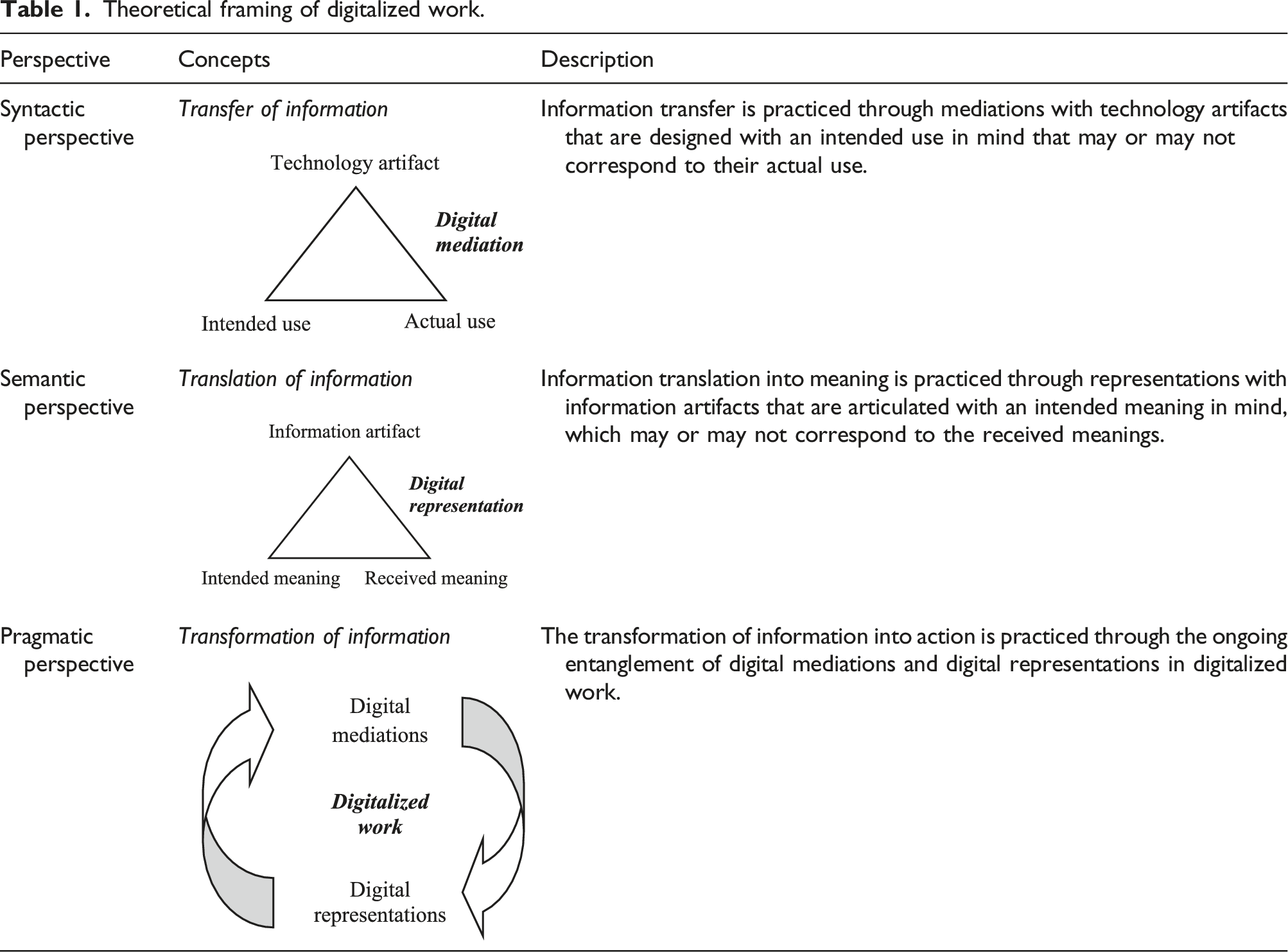
The syntactic perspective focuses on information transfer and how actors use technology artifacts to share information. Although technology artifacts are designed with an intended use in mind, their actual use is determined by the actors and may differ from the designer’s intent. This tension between the intended and actual use of technology artifacts has been explored in a number of IS studies. Gasser (1986) identified workarounds as a user strategy for coping with situations where elements of a technology artifact’s actual use were not part of its design. McGann and Lyytinen (2005) distinguished between planned and improvised uses of technology and suggested that improvised uses can be supported either by flexible solutions (configured technology improvisation) or by adjusting the artifact in ways it was not designed for (technology workarounds). Similarly, Orlikowski (1996) introduced the concept of “situated changes” where transformations of a technology emerge during practical use. Following Jonsson et al. (2018), we assert that information transfer is practiced through digital mediations whose intended use (as defined by their designer) may or may not correspond to their actual use.
The semantic perspective focuses on the translation of information artifacts as the involved actors seek to create shared meaning by communicating via information artifacts. Using semiotic terms, information artifacts are signs consisting of an ordered sequence of symbols with an intended meaning that are presented in the form of gestures, sound, text, or other means of visualization (Mingers and Willcocks, 2014; Mingers and Willcocks, 2017; Andersen, 1990). Hence, information translation in organizations is preceded by a process in which information artifacts are created with intended meanings (Desouza and Hensgen, 2002) relating to entities and processes. These artifacts can have various forms (e.g. qualitative or quantitative, aural or visual, and structured or unstructured) and may be created by various means (e.g. formal measurement, observation, discussion, and computation) (Ramaprasad and Rai, 1996). However, as they are communicated, a translation occurs in which actors interpret each artifact to establish a received meaning that may or may not correspond to the intended meaning (Ramaprasad and Rai, 1996; Desouza and Hensgen, 2002). Therefore, as argued by Jonsson et al. (2018), information translation is practiced through digital representations and may create tensions between the intended and received meanings of the involved signs.
The pragmatic perspective focuses on how actors transform information into action as an intrinsic part of digitalized work. Hence, the pragmatic perspective synthesizes the syntactic and semantic perspectives into an understanding of how material artifacts and human agency are entangled in the ongoing constitution of digitalized work. Ramaprasad and Rai (1996) suggested that this translation is enacted through two complementary activities that are critical to organizational performance: actors produce information by expressing experiences and observations embedded into their organizational practices, and consume information by using it to formulate plans, make decisions, and enact changes. Ramaprasad and Rai argued that the continuous emerging relationship between information production (from practice to information) and consumption (from information to practice) is important for organizational performance, and that effective practices feature positively reinforcing cycles between production and consumption.
To summarize, our theoretical framing (Table 1) extends the sociomaterial understanding of how organizations appropriate digital technologies to provide a detailed account of the involved technology and information artifacts. Digital technologies are fundamentally different from technologies in general because of their capacity to represent and mediate information (Jonsson, Mathiassen and Holmström, 2018). In the context of distributed work, digital technologies are not merely tools to create and process information; their use is more appropriately described in terms of media through which actors create and share meanings about their organizational contexts (Mingers and Willcocks, 2017; Mingers and Willcocks, 2014). Using this conceptualization, we seek to explain how diverse portfolios of digital technologies are implicated in the constitution of distributed work practices through entanglement of mediations, focusing on the use of technology artifacts to create and process information based on a token view of information (McKinney Jr and Yoos, 2010), and representations, focused on the use of information artifacts to create and share meanings based on a representation view of information (McKinney Jr and Yoos, 2010).
Research method
This work builds on and extends the theorizing of a qualitative field study by Jonsson et al. (2018) on condition-based maintenance work done in northern Europe by the mining company Luossavaara-Kiirunavaara AB (LKAB) and the service company Monitoring Control Center (MCC). Following basic case study principles (Cavaye, 1996; Yin, 2003), we investigated working practices during condition-based maintenance and their implications for the involved actors and organizations to obtain a deep understanding.
Interview respondents and interview dates.
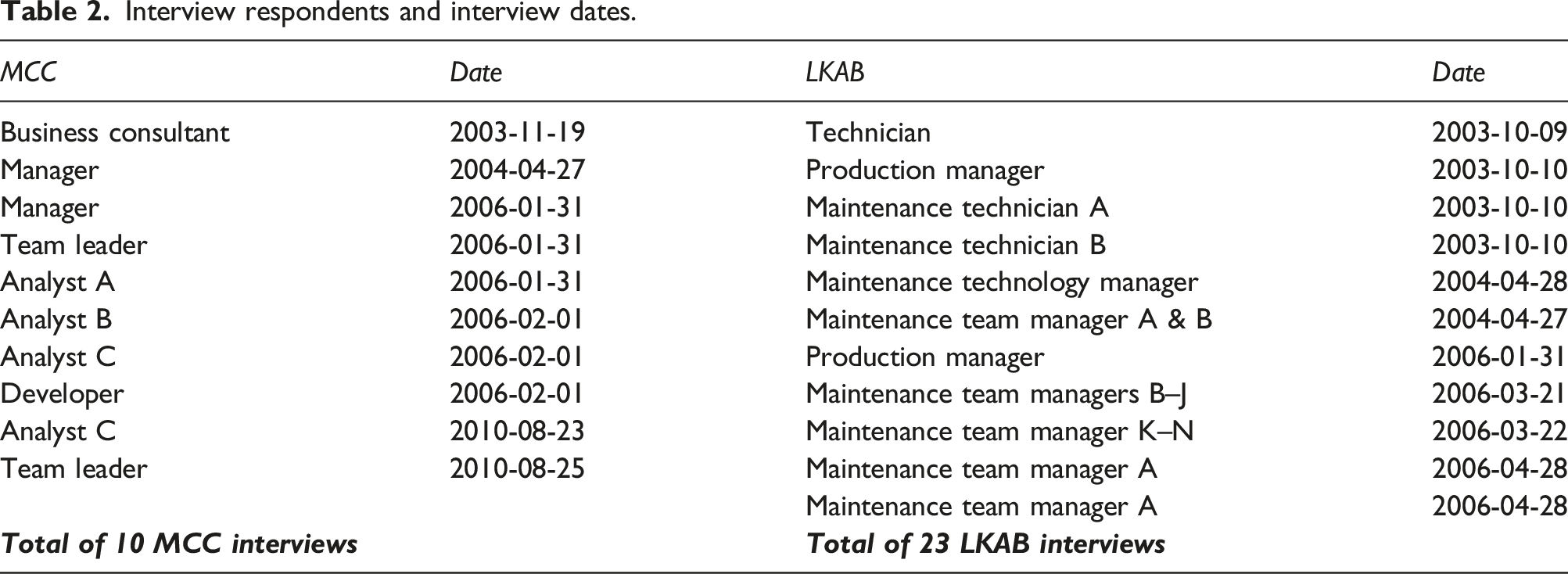
The interviews were semi-structured and open-ended to reveal work practices and how the respondents used different digital technologies. We asked respondents to describe a typical working day, the technology artifacts they used, the actors they interacted with, and the information artifacts they created and used. Respondents were also asked to describe the features and usage of each technology artifact, breakdowns in their usage, and ideas for improving their features. We then asked similar questions for each information artifact. Each interview lasted for one to two hours. All interviews bar three were conducted face-to-face at the respondents’ workplace, which gave us contextual understanding and insights into each company’s work practices, and allowed respondents to demonstrate the digital technologies they used. Although key informants helped us identify relevant interviewees, participation was strictly voluntary. The first author conducted the interviews together with a fellow researcher. Data collection concluded when we achieved saturation, that is, when additional interviews revealed no new insights. We complemented three data collection engagements (2003–2006) and purposeful sampling by conducting two follow-up interviews with a manager and an analyst in 2008 and 2010. In these interviews, we sought to supplement our data and learn how the condition-based maintenance work had been consolidated. We then tracked the development of the condition-based maintenance at a distance through webpages and articles. The maintenance arrangement presented and analyzed here remained operational at the time of writing.
To analyze the data, we followed recommended procedures for qualitative research (Eisenhardt, 1989; Miles and Huberman, 1994) using related literature to guide the process through three coding steps. In the first step, the first author reread all data material, immersing herself in the data and looking for central themes. During this work, she took notes and highlighted key phrases that were representative for the respondents. This round of coding was open-ended (Strauss and Corbin, 1990) and helped her recall the details of the case, which was important, as several years had passed since the data was collected. In the second coding step, the first author looked for empirical examples of digital representation and digital mediation figurations, the tensions involved in each, and their entanglement in work practices. In this step, we identified the different technology and information artifacts, emphasizing tensions between intended and actual use, and between intended and received meaning, respectively. This served as a basis for discussion between all three authors to refine our understanding of the representation and mediation figurations and to establish a common understanding of the case. In the third step, we applied digital representation and mediation figurations and their entanglement to the case. Because we gathered a large amount of information about digital technology usage, we chose three technology artifacts and two information artifacts for detailed analysis. For each of these, we coded intended versus actual use and intended versus received meaning, respectively. Further, to analyze the entanglement of representation and mediation figurations we focused on one key information artifact and followed its transfer and translation using different technology artifacts. Although our analyses progressed primarily from empirical to conceptual, the two approaches constantly interacted, with empirical material leading to specific conceptual advances and conceptual reflections triggering further analysis of the empirical data.
Empirical context
MCC was established in 2003 as a competence center for maintaining and monitoring machinery and equipment in mining, minerals processing, and cement industries around the world. MCC’s condition-based maintenance service involves collecting and analyzing information, communicating diagnostic results, and assisting customers in making decisions based on those results. LKAB was established in 1890 and is one of the world’s leading producers of upgraded iron ore products for the steel industry, as well as a growing supplier of industrial mineral products to other sectors. In 2002, LKAB initiated a project aimed at increasing its productivity without making major investments. As part of this project, LKAB decided to use remote diagnostics technology to make its maintenance more condition-based. MCC became the main supplier of these services. The goal was to move from corrective maintenance after a breakdown to anticipating breakdowns. As LKAB’s production manager explained: “You can take calculated risks [with preventive maintenance]. Before, machinery just broke down. Today, it’s much easier to work because we can take conscious risks: in some situations, we are prepared to run the machinery despite indications of issues; in other situations, we are not—so we stop to repair. Previously, when a machine broke down, production stopped and we had to repair it immediately without being prepared.”
To improve maintenance, LKAB invested in condition-based maintenance in which remote diagnostic technology is used to monitor equipment. Remote diagnostics relies on a set of heterogeneous technologies: sensors that collect information, networks that transmit that information into a centralized repository, and analytical and operational rule systems. These rule systems store, retrieve, analyze, and visualize information, and then make recommendations, generate alarms, or initiate responses accordingly. Different types of sensors are installed in equipment to collect information on the vibrations, temperature, pressure, and speed of relevant machine components. By monitoring and simulating this information, a machine’s condition can be assessed and potential breakdowns anticipated.
Condition-based maintenance is co-created through interactions between maintenance personnel in the LKAB plants and analysts at MCC’s remote service center. The analysts receive information through the technologies and can gather additional information from maintenance team managers at the plants. The analysts are then responsible for collaborating with and providing recommendations to these maintenance team managers. This organization of condition-based maintenance has centralized LKAB’s previously local maintenance work. Remote service centers can monitor and diagnose numerous distributed industrial machines and their associated components across multiple organizations. For MCC and LKAB, using digital technologies for condition-based maintenance has generated new insights and new maintenance practices and rules. Moreover, it has increased the intensity of information in maintenance work because the remote analysts can analyze multiple information artifacts at little additional cost. The analysts can also focus on proactively diagnosing problems by learning from past cases and preventing failures through rule-based decision-making or statistical sampling and data mining. By separating local information from its origin, these services produce new ways of organizing maintenance tasks that separate analysts from the equipment they monitor.
Results
In this section, we first present our analysis of the digital mediation figurations and the digital representation figurations. This is followed by our analysis of their entanglement in daily work practices.
Digital mediation figurations
Technology Artifacts used in Condition-based Maintenance.
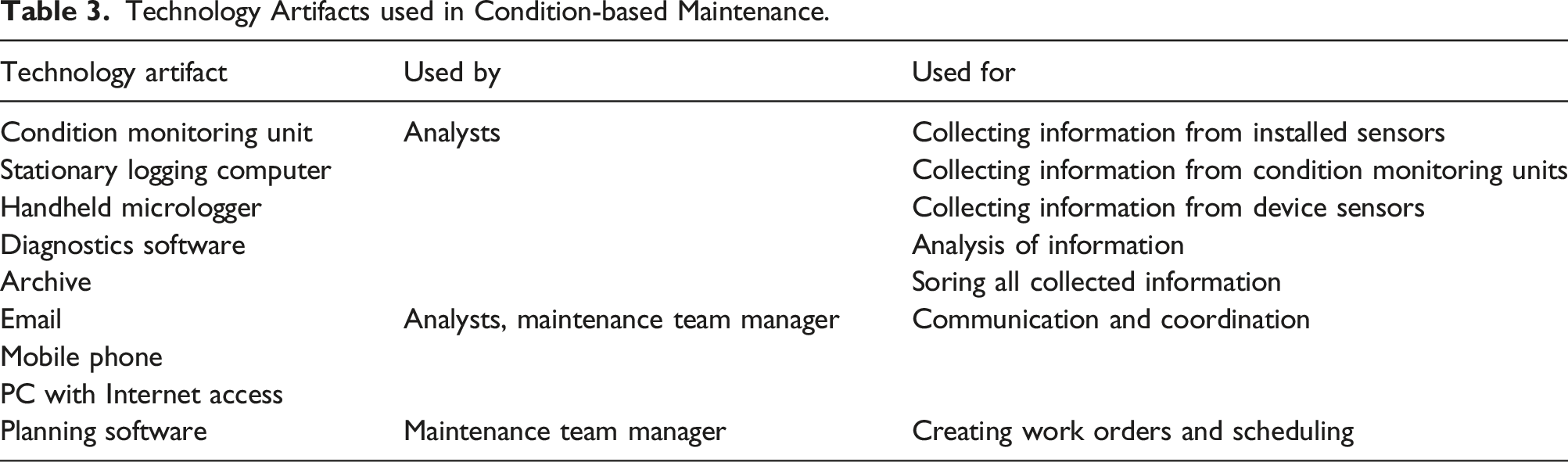
Information transfer via condition monitoring unit
To enable online monitoring, sensors are installed to monitor equipment vibrations. These sensors are connected to a CMU, which in turn is connected to a logging computer. The logging computer transfers the collected information to a central archive for storage.
Intended use
The CMU is designed to enable round-the-clock information collection. It can be networked and can accept information from a variety of sensors permanently installed in plant equipment in any industrial or process environment. The CMU collects and evaluates vibration and other equipment-related information from the sensors on a scheduled basis. Each CMU has between 4 and 32 digital channels that handle up to 8 sensors each. The largest CMUs can thus handle 256 measurement points. The host computer can handle over 60 CMUs, with an overall capacity of 16,000 measurement points. The CMU has a rugged design that enables its use in harsh, remote, unsafe, or difficult-to-reach locations. All electronic components are placed in a metal cabinet to protect them from dust and dirt.
Actual use
MCC uses the CMU for online monitoring of plant equipment. However, there are various tensions between the CMU’s actual and intended uses. MCC monitors mining equipment, some of which is located underground. Because their data networking capabilities are limited underground, CMUs sometimes break down. Analyst A at MCC said: “When the customer installs fiber optics for their control system underground, we try to reserve space for monitoring as well, but the capacity is limited.” In fact, when LKAB reconfigured equipment underground, additional networking capacity was installed and reserved for the CMU. This allowed monitoring to be conducted online instead of off-line with the micrologger. Another type of breakdown occurs when the network between the CMU and the host computer is not working, causing the CMU to run out of memory and information to be lost. Finally, CMU breakdowns have occurred after power outages, which require the CMU to be reset manually. This is rather time consuming, as the CMUs are located all over the plant.
Information transfer via micrologger
Equipment that is not monitored online is monitored off-line with a portable handheld micrologger that has a sensor to collect information from connected equipment.
Intended use
The micrologger can be used to collect, store, and transmit vibration information. It can handle both route-based and non-route-based information collection processes. For route-based information collection, routes are designed using diagnostics software installed on a separate computer and then transferred to the micrologger via a connecting cable. The micrologger’s ability to handle non-route-based collection facilitates in-the-field additions and changes to downloaded routes. Monitoring is performed by applying the micrologger’s sensor to the monitored machine’s bearing house. The sensor is magnetic to ensure a firm fit during logging. After a predefined time that depends on the equipment being monitored, the sensor is removed from the bearing house and attached to the next machine to be monitored. Once the route is completed, the micrologger is connected to the computer and the collected information is transferred to the diagnostic software for later analysis. The micrologger has a rugged design, allowing it to function in harsh and dirty industrial environments. It has a 240 × 160 pixels display with cursor keys and a numeric keypad for navigation and input.
Actual use
MCC uses microloggers as intended for handheld measurements in industrial environments. The devices are mainly used underground where the networking capacity required for online measurements is unavailable. The analysts take a micrologger with them underground to the equipment level, and then attach the magnetic sensor to the target machine to collect measurements. Several tensions between the micrologger’s intended and actual uses emerge during this process. First, the low lighting levels underground coupled with the micrologger’s very dark display make it difficult for analysts to read the display’s text. As Analyst C at MCC explained, “When you stand down in the mine you see nothing [on the display]. You need a flashlight to light up the micrologger.” A second tension results from the micrologger’s four- to five-hour battery life. Because the underground routes are time consuming, analysts must sometimes interrupt the process and return to the office to recharge the battery before going back underground to complete the route. A third type of tension relates to the micrologger’s functionality: it often freezes when transferring collected information to the computer. As Analyst B at MCC put it: “I can be out and collect information for four to five hours. When I get back to the office [and begin the information transfer to the laptop], everything freezes. Then I have to reset the micrologger, so it takes a long time to transfer the information. Sometimes the information is even lost and I need to go back underground and do the measurements all over again. It isn’t that much fun to have to go out and do four to five hours of measurements all over again.” To address this tension, the analysts often bring their laptops when they collect equipment measurements and connect the micrologger to the laptop to immediately ensure successful information transfer.
Information transfer via diagnostics software
The analysts use diagnostics software, which takes vibration information as input, to access the collected vibration data and analyze the equipment’s condition. The online information is transferred from the sensors to the CMU and also via the host computer to an archive, where it is stored in a database. The diagnostics software is connected to the archive and does not use any information from the local computer.
Intended use
The diagnostics software is intended to be used for analysis of vibration information collected online or off-line with microloggers. The diagnostics software contains functions to add information on machine characteristics (e.g. model and component types) to facilitate analysis. In analysis mode, the software visualizes the collected information and helps the analyst identify and examine different trend curves, and view multiple plots together. The software multitasks: the CMU continually collects and processes information, and the diagnostics software notifies analysts of real-time operational problems even while they are using the system for analysis. Additional diagnostic functions let analysts view measurement information seconds after it is acquired. The program contains event logging, reporting functions, and database management tools that enable close tracking of equipment problems, indicating whether maintenance is required and recreating events that led up to current conditions. When new equipment is to be monitored, equipment-specific information is loaded into the software. A virtual representation of the equipment and components is created using all available information, including bearing type, engine type, and information about individual bearings.
Actual use
MCC uses the diagnostics software as intended to analyze vibration information collected online or off-line. The diagnostics software is the main technology that the analysts use on a daily basis. However, tensions arise when the software does not function as intended or lacks needed functions. First, there are tensions related to connecting to the archive, which contains the measurements that analysts need to do their job. Analyst A explained: “There have been a lot of problems with the server communication. Then we cannot work as we don’t get access to the server.” Another tension relates to re-analyzing historical information. If the analyst discovers an increasing trend curve in a vibration spectrum, the software lets them isolate that trend and track it over time. It does this by specifying the vibration’s range of frequencies and then displaying only vibrations within that range. Historical comparisons would be beneficial for determining how rapidly such trends are increasing, but the diagnostics software lacks functionality for re-analyzing historical information at certain frequencies. Despite the tensions in the actual use of the diagnostics software, the analysts all greatly appreciate how it facilitates equipment condition analysis.
Tensions in transfer of information
In this analysis of three digital mediation figurations, we focused on tensions between the intended and actual use of the technology artifacts. It was found that important design intentions were realized in their actual use and that users were satisfied with the technology as a result. For example, the analysts acknowledged the value of functions related to the micrologger’s off-line monitoring features and the visualization and analysis features of the diagnostics software. Moreover, they realized the affordances of these features in situations where connectivity in the mine was absent or unreliable and when they had to make sense of and summarize complex data from LKAB’s machinery, respectively.
However, we also found that when the intended use of a technology artifact was inappropriate and not realized in practice, it created tensions and users became dissatisfied and sought alternative solutions. For example, the display of data in the micrologger sometimes did not function as intended due to poor lighting, so users brought flashlights with them underground. Additionally, to address the risk of the micrologger’s battery running out of charge on long underground routes, extra microloggers were brought along, and users brought laptops to save data during routes to mitigate the risk of unstable data transmission leading to loss of data. Users thus demonstrated considerable creativity in compensating for badly implemented, limited, or lacking functionality in the technology by identifying and realizing alternative solutions outside the intended use of available technologies and by combining technologies to create new solutions. However, this was not possible in all cases, for example during losses of connectivity. The technology provided battery power and extra memory to handle shorter power outages or connectivity problems, but this was not always enough and data were lost. It is therefore important to identify such context-specific critical tensions and consider technology redesigns that might make additional functions available.
Digital representation figurations
Information artifacts in condition-based maintenance.
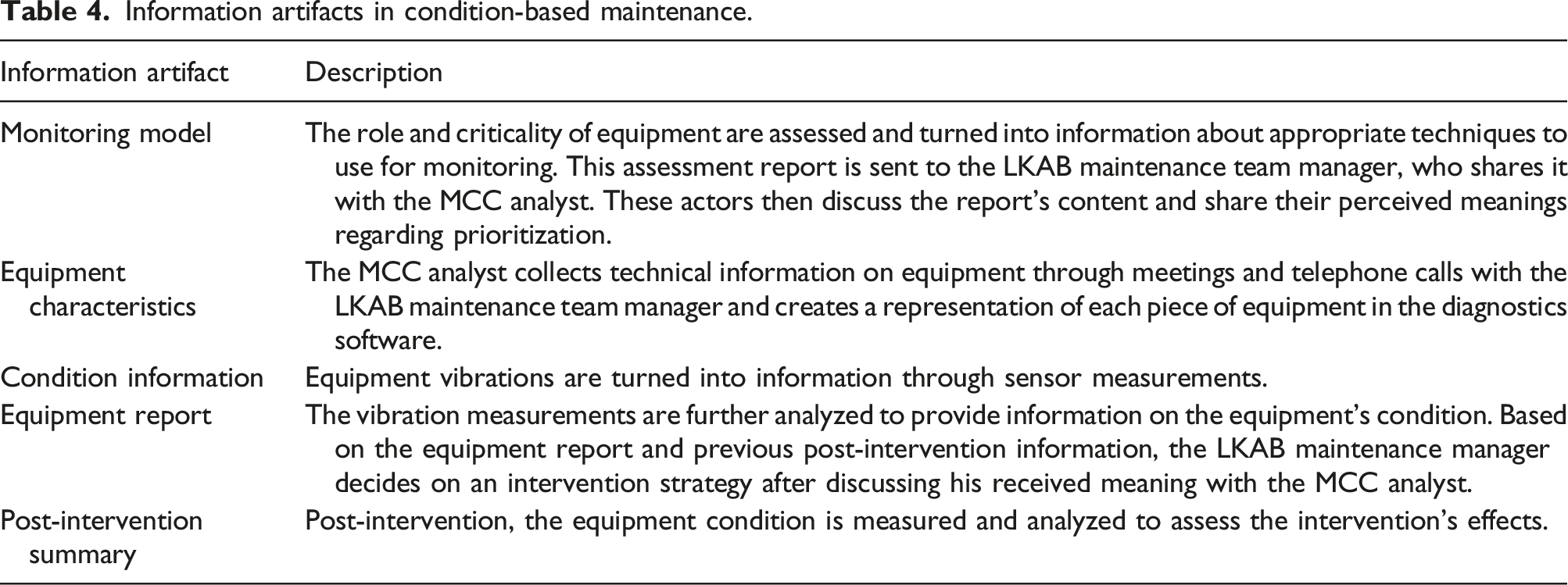
Translation of equipment characteristics
This artifact contains information on the monitored equipment that serves as an input to the diagnostics software and is used by analysts to collect and analyze condition information.
Intended meaning
The equipment characteristics are intended to provide an accurate basis for collecting and analyzing information from each piece of equipment. Analyst A at MCC described it as follows: “We build a virtual representation of a machine that is identical to its physical counterpart. For example, we build a transporter with all of its components, such as the electrical engine and gearbox, and we also add measurement points to the virtual machine. Then we add all available technical information on the electrical motor and the gearbox. The supplier has information about the bearing type, the kind of motor, and its bearings.” To create these information artifacts, the analyst combines each piece of technical information relating to the equipment with the preinstalled information in the software, such as information on typical bearings and the number of teeth on the bearings of a gearbox. However, it can be difficult to obtain accurate information about LKAB’s equipment; as Analyst C at MCC put it, “Sometimes, when I need certain information, I go to the customer and we search for a machine drawing, but we can’t find it. Then I call the machine supplier, but they don’t want to share the drawing with me. Then I contact the customer and ask them to push the supplier to provide the drawing. It would be much easier if the machine information was delivered with the purchase, but that’s not the case today.”
Received meaning
The characteristics of each piece of equipment allow analysts to understand and assess the equipment when related measurement information is displayed in the diagnostics software. As MCC analyst C explained, the representation displayed on the screen helps him visualize the equipment in his mind: “I can see on a spectrum if something is odd. I think it is beneficial to have experience of working with mechanical equipment. When I look at a spectrum from a gear box on the screen I actually see the gear box in front of me.” When a component is replaced in a piece of equipment, the new technical specification for that component must be loaded into the software; if it is not, the meaning an analyst receives will not correspond to the intended meaning, i.e., the actual status of the equipment. However, the customer does not always update the technical documentation, and loading new information into the software can be time consuming. Consequently, there are sometimes tensions between the intended and received meaning of equipment characteristics. This is problematic because analysts use these records to define equipment measurement points and establish routes for off-line information collection.
Translation of equipment reporting
Intended meaning
Equipment reports are written once a month and summarize the condition of the monitored equipment. The intention is to give LKAB complete documentation of the diagnostics. A developer at MCC explained: “The customer may have a piece of equipment in a bad condition. Then an analyst from here … points to all the problems [in the report]. The customer may think that that the analyst is too careful and just complains about everything. You need to have a shared vision of how to maintain the machines and at what level you should [report problems].” The written report is intended to create a shared understanding of the status of the equipment and to provide historical documentation of identified problems.
Received meaning
The reports are interpreted by LKAB representatives. Although the intention is to report conditions in a factual way, MCC analysts must be sensitive to how reports may be interpreted. It is therefore important to establish shared meaning through both face-to-face visits and ongoing discussions over the phone. Analyst C at MCC explained: “The first report I wrote was extensive. When I sent it, I thought I would get some response, but no. Now I’ve simplified it so you don’t need to be an engineer to understand it. When I send it, my contact calls and asks follow-up questions. That’s a signal that he actually read the report. When I write it more briefly, they absorb it better.” The monthly report is therefore followed up with a meeting in which the MCC analyst and LKAB representative discuss the report. Unfortunately, tensions between intended and received meanings persist. MCC analyst A notes that the customer does not always receive the intended meaning: “We decide a time and meet to discuss the report. Many times, it [the report’s content] is obvious for us but [the customer] doesn’t understand what we mean.” The report can also serve as an expert statement, and LKAB’s maintenance team managers sometimes use reports to pressure their maintenance employees: “Sometimes we try to make sure that the MCC analyst includes things that haven’t been conducted in the report. If it is in the report, then it is easier for us to put pressure on the maintenance employees to fix the problem. The words from an external expert are weightier than from an internal guy.”
Tensions in translation of information
In this analysis of two information artifacts, we focused on the tensions between the intended and received meanings of the corresponding digital representation figurations. The analysis reveals that the information records deal with two types of digital representations of physical objects: descriptive equipment characteristics and analytical equipment reports. If the digital representation in an equipment report corresponds to the physical object (a machine), the receiver can readily capture the equipment’s current characteristics. However, tensions arise because these information artifacts are not automatically updated to continuously reflect their physical counterpart and therefore provide only partial (and sometimes incorrect) insights into equipment characteristics. Analysts therefore face uncertainties when defining equipment measurement points and establishing routes for off-line information collection. The information in the analytical equipment reports is based on evaluations and judgements of equipment status and therefore requires more interpretation and contextual knowledge to both create and understand than the equipment characteristics. These reports allow analysts and customers to develop a shared understanding of the status of specific equipment and to use that shared understanding to make decisions about maintenance interventions. However, analysts recognize that customers did not always receive the intended meaning from the reports, so they complement the reports with discussions during site visits and over the phone to ensure that knowledge is shared accurately and that appropriate maintenance decisions are made. Both of these analyses show that information records were created by multiple actors using different technologies and gave rise to tensions between intended and received meanings, requiring the actors to embrace uncertainties and apply complementary approaches that allow these uncertainties to be reduced.
Transformation of information into practice
To illustrate in situ uses of different technology and information artifacts, we examine the transformation of condition information into condition-based maintenance work. To this end, we follow the production and consumption of condition information from the micrologger to the archive, the diagnostics software, and finally email or phones. In this way, we show how the considered digital representation entangled with different digital mediations during the practice of condition-based maintenance work.
To manually transfer machine condition information into the micrologger, analysts load the logger with a route generated using the diagnostics software and then go down into the mine where the equipment is located. Upon reaching the machine, they attach a magnetic sensor to it, enabling the transfer of vibration information. The micrologger’s small display allows the analysts to view a diagrammatic display of the vibration information to confirm that information is being transferred. Interruptions in transfer are visualized as interruptions in the curve on the display. The micrologger thus transfers condition information to analysts in real time, indicating whether information is being captured as expected.
The archive contains all of the historical condition information for the machines. It is physically located in a server room at LKAB, and remote MCC analysts use it daily to translate condition information. It is an structured query language database in which each observation is recorded in the form of a machine identifier, a timestamp, and a vibration value. This information structure can be used to store all of the gathered condition data for the LKAB equipment. The archive helps analysts make sense of machine conditions by performing various kinds of queries that make specific equipment conditions available for analysis. They mainly use it when uploading information collected manually using microloggers and when subsequently analyzing information with the diagnostics software.
The diagnostics software is used to facilitate the analysis of condition information. MCC analysts use it on a daily basis to analyze equipment status and predict upcoming failures. To this end, it allows analysts to visualize condition information in the form of an overall vibration spectrum and can also generate detailed charts showing specified frequencies. By analyzing specific ranges of vibrational frequencies, analysts can generate information on different types of damage and where they have occurred. When used for vibration monitoring, the diagnostics software offers detailed information on whether damage has occurred on the bullets or the outer or inner bearing, and whether it is due to mechanical looseness, an imbalance, or a lubrication issue. Analyst C at MCC explained: “There are filtered monitoring modes, called ‘envelope measurements,’ where we can see the bearing damage very early. But if we can see the damage in the speed monitoring [the overall spectrum] then we know from experience that the damage is more severe.” Vibration information is analyzed at different frequencies. For example, in speed monitoring mode, vibration values are measured over a wide spectrum covering many frequencies. Different vibrational frequencies result from vibrations of different parts of the bearing. Therefore, to facilitate monitoring of specific parts, the software can focus on specific frequency ranges within the collected condition information. Analyst B at MCC described the procedure as follows: “A specific rotation speed may be at the frequency of 24 hertz. We can then build a trend at that frequency, and the software removes everything else. For example, you adjust the frequency to cover a range from 23.89 to 24.02 and just analyze that frequency.” The analysis using the diagnostics software is performed on multiple condition information values simultaneously to detect upcoming equipment problems and predict when they will occur. The diagnostics software also lets analysts filter condition information in different ways, for example by focusing on specific frequency ranges. As such, it enables the generation of condition information in ways that go beyond the capabilities offered by the micrologger or the archive.
Condition information is finally transferred via email and mobile phones when analysts update LKAB maintenance personnel on the condition of specific machines. During these dialogs, analysts translate condition information into equipment status data to provide a basis for maintenance decision-making. As Analyst A at MCC noted, “if the trend curve is drastically increasing, I immediately pick up the phone and tell the customer that they should be alert, something is about to happen.” Mobile phones are thus used as direct communication channels with LKAB maintenance personnel. MCC analysts often make phone calls while working with the diagnostics software to communicate and discuss the results displayed on the computer screen with LKAB maintenance personnel. Condition information may also be presented via email using a traffic light code (red, yellow, or green) to communicate a machine’s current status. Finally, analysts compile monthly reports on the status of all monitored equipment that are emailed to the LKAB maintenance managers. In all cases, when condition information is transferred via phone or email, it is presented in the form of trends in equipment status to support maintenance decision-making rather than as numbers. Thus, over the entire process, a given piece of information will be represented and mediated in multiple different ways taking advantage of the features of specific technologies used at each stage. The actors also use these different technologies in parallel: for example, an analyst may work with the archive through the diagnostics software while communicating over the phone with LKAB maintenance personnel and examining the analysis results in the diagnostics software.
This analysis showed how condition information on mining equipment is represented and mediated by different technologies to produce condition-based maintenance practices. Although the involved technology and information artifacts are empirically distinguishable, as discussed in the preceding sections, this analysis shows how they are entangled in use to produce specific effects on the work practices they support at LKAB and MCC: the diagnostic software would be useless without the condition information, the diagnostics software would be useless without the logic provided by a monitoring model, and the planning software would be useless without the maintenance decisions enabled by the equipment report.
Discussion
In this paper, we advance sociomaterial theory by showing how diverse portfolios of digital technologies are used to produce and consume information in today’s increasingly distributed work practices. In doing so, we bring nuance to how the particular characteristics of digital technologies shape work practices compared to technologies in general. Specifically, we draw on the distinction between digital mediation and digital representation (Jonsson, Mathiassen and Holmström, 2018) to investigate how actors transfer information across organizational and technological boundaries, translate information into meaning, and eventually transform information into action in digitalized work (Carlile, 2004). We illustrate and develop this framing through detailed analyses of digitally enabled, condition-based maintenance of mining equipment. In accordance with McKinney Jr and Yoos (2010), this conceptualization distinguishes between how organizational actors create and process information tokens using digital mediations and how information representations allow them to co-create meaning about work practices, products and services using digital mediations. Hence, as summarized in Figure 1, our theorization and empirical analyses extend current sociomaterial research by offering new ways of thinking about digitalized work. Entanglement of Representation and Mediation in Digitalized Work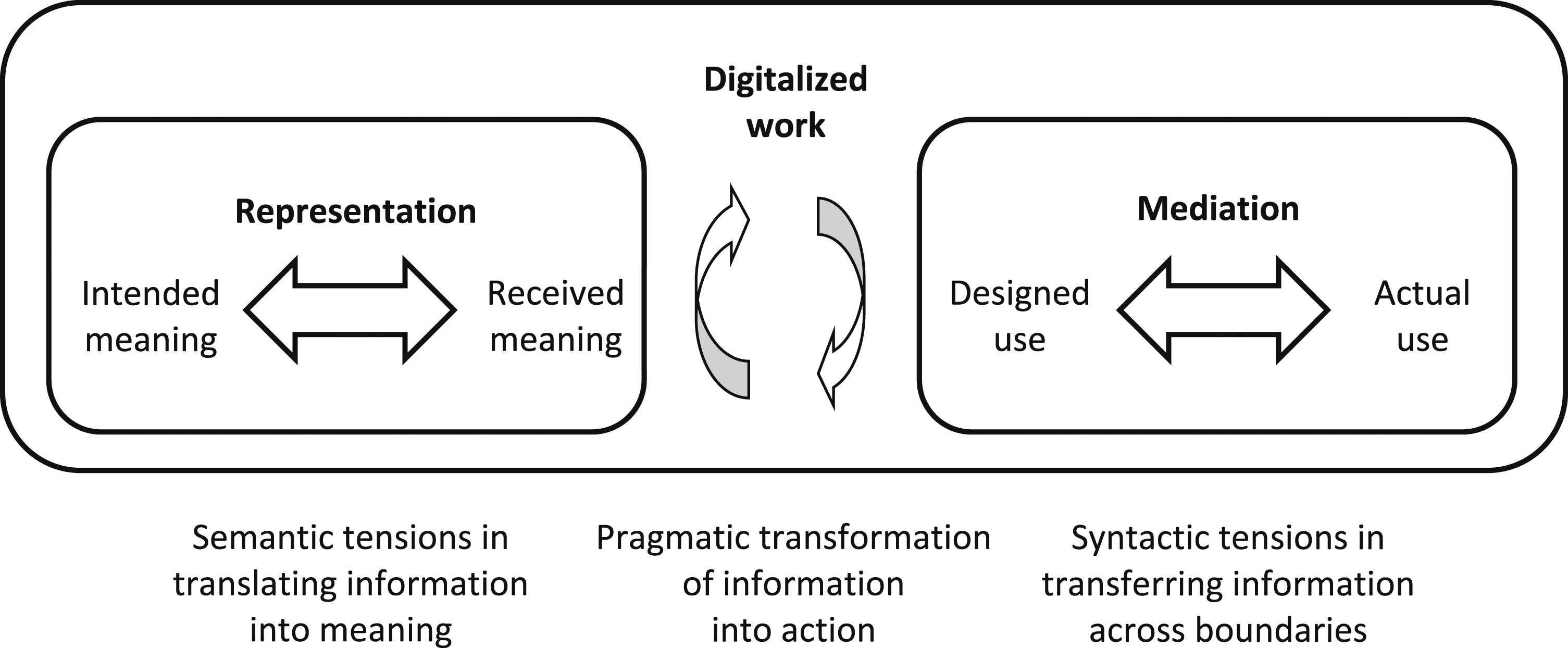
With respect to digital mediation in digitalized work, our theorizing emphasizes how organizational actors experience syntactic tensions as they use technology artifacts to transfer information across organizational boundaries (Carlile, 2004) because their actual use of these technologies may or may not correspond to that intended by the technology designers (Koopman and Hoffman, 2003). These syntactic tensions are illustrated by the way maintenance staff at LKAB and analysts at MCC transferred information about mining machinery using condition monitoring units, microloggers, and diagnostics software. With respect to digital representation, our theorizing emphasizes how organizational actors experience semantic tensions as they translate information into meaning (Carlile, 2004) using information artifacts that were created with an intended meaning that may or may not correspond to the meaning the actors receive (Andersen, 1990; Mingers and Willcocks, 2004). These semantic tensions are illustrated by the way analysts at MCC used diagnostic software to translate information in the form of equipment characteristics and equipment recordings in order to assess the condition of mining machinery.
Previous sociomaterial studies have focused predominantly on co-located organizational contexts (Suchman, 2007; Svahn, Henfridsson and Yoo, 2009) and relatively coherent technologies (Contractor, Monge and Leonardi, 2011; Doolin and McLeod, 2012; Introna and Hayes, 2011; Scott and Orlikowski, 2012). In contrast, this work focuses on heterogeneous work practices and shows that they involve multiple technology and information artifacts that are used by organizational actors as they continuously seek to establish and maintain shared meaning across organizational boundaries. Accordingly, our theorization reflects the in situ entanglement of multiple mediation and representation figurations as organizational actors continuously and pragmatically translate information into action (Ramaprasad and Rai, 1996). These complex entanglements are illustrated in our analyses of how condition information as digital representation figuration entangled with different technology artifacts as digital mediation figurations in condition-based maintenance work. These entanglements reveal how the maintenance staff and analysts pragmatically translated information into maintenance decisions through the production and consumption of condition information using the micrologger, archive, diagnostics software, and email or phones.
Theoretical implications
As a contribution to theory, our research offers a framework (Table 1) to explore, understand, and engage in the sociomaterial discourse on digitalized work practices. Specifically, it demonstrates the complex and varied use of digital technologies in distributed work practices where organizational actors rely on multiple technologies to produce and consume information. To that end, it juxtaposes a tool perspective that highlights how digital technology supports organizational actors in creating and processing information with a medium perspective that highlights how digital technology helps organizational actors create and share meaning across organizational boundaries. While IS scholars are paying increasing attention to materiality issues in general (Zammuto et al., 2007; Leonardi and Barley, 2008; Orlikowski and Scott, 2008), to date no study has leveraged the distinction between digital mediation and digital representation to improve our understanding of the unique ways in which digital technology shapes heterogeneous work practices through information transfer, translation, and transformation. Overall, our theorization suggests that use of digital technologies in such work practices is shaped through ongoing negotiation of tensions between the intended and actual uses of the involved technology artifacts and between the intended and received meanings of the involved information artifacts (Mingers and Willcocks, 2014; Mingers and Willcocks, 2017; McKinney Jr and Yoos, 2010; Koopman and Hoffman, 2003).
This theorization is particularly important given the increasing use of data analytics, machine learning and other digital technologies to turn access to pervasive digital data traces into information and organizational action. Recent studies have underlined a number of challenges associated with such data liquidity (Parmiggiani, Østerlie and Almklov, 2022; Monteiro and Parmiggiani, 2019) relating to processes such as identifying, editing, formatting, and sharing data (Janssen, Charalabidis and Zuiderwijk, 2012) and understanding the relationship between data, information and action (Alaimo and Kallinikos, 2022). These studies have emphasized the potential difficulties organizations face in transforming data into meaningful and actionable information, with specific capacity requirements for data acquisition, assimilation, transformation and exploitation (Huber, Wainwright and Rentocchini, 2020). Conversely, our theorization and empirical findings explain why action is not easily derived based on information, and how collaborative use of multiple digital technologies can help actors transfer, translate, and transform information across distributed work practices to increase business value.
Practical implications
Our theorization of how information is produced and consumed in digitalized heterogeneous work arrangements offers insights into how digital technology could be used in organizations to help mobilize, integrate, and apply multiple competences and capabilities. Although prior studies have suggested that the social and the material are deeply entangled in digitalized work (Introna and Hayes, 2011; Scott and Orlikowski, 2012; Wagner, Moll and Newell, 2011), our analysis shows in detail how the unique characteristics of digital technology are implicated in shaping heterogeneous work practices. Additionally, it highlights the need for practitioners to consider the in situ entanglement of digital mediations and digital representations as complementary and co-producing work configurations. The mediation perspective challenges us to consider different technology artifacts and ways to leverage complementary technologies with different intended and actual use patterns. Similarly, from a representation perspective, the primary challenge is to help diverse, distributed actors use information artifacts to converge towards shared meanings of the contexts in which they work. Finally, the in situ entanglement of these distinct types of work configurations reminds us that management is not merely about optimizing technology usage or information production and consumption; it is also about managing technologies with the information they mediate in mind and managing information with the mediating technologies in mind. In a given work practice, managers should therefore seek to understand the tensions between intended and actual usage of the involved technology artifacts as well as those between the intended and perceived meaning of the information artifacts that the technologies mediate. By distinguishing between these perspectives and bringing them together in specific work practices as summarized in Figure 1, managers can better understand and address the complexities involved in contemporary use of digital technologies.
Limitations
Despite our contributions to the sociomaterial discourse within the IS discipline, our theorization and empirical findings have some limitations. First, the case study validates the conceptualization of transfer, translation and transformation of information via digital mediations and digital representations in a very specific—and in some ways, unusual—context. While this empirical illustration helped us refine key concepts, we adhered to the principles of analytical generalization (Yin, 2003; Lee and Baskerville, 2003) to strengthen the general validity of our conclusions. Our theorizing could however be further advanced by applying the concepts presented here in other heterogeneous work contexts. Second, because our theorization combines concepts and insights from different disciplinary domains, it reflects specific choices that simplify some issues and elaborate others without giving a full account of the original perspectives. Researchers are therefore encouraged to complement our presentation with elaborations from the original sources we build on.
Footnotes
Declaration of conflicting interests
The author(s) declared no potential conflicts of interest with respect to the research, authorship, and/or publication of this article.
Funding
The author(s) received no financial support for the research, authorship, and/or publication of this article.
Author biographies
 .
.