




Abstract
This article furthers a sociomaterial framework to examine inter-organizational boundaries in government IT projects. It engages in a dialogue with the practice theory-based approach to boundary spanning and utilizes analytical tools and epistemologies drawn from the social studies of technology. It aims to contribute to a situated, material understanding of inter-organizational boundaries. We argue that boundaries in outsourcing relationships can be de facto enacted through definitions of what counts as relevant knowledge. Information systems have a key role in eliciting such definitions, thus establishing knowledge asymmetries and regimes of inclusion and exclusion. The article responds to the call to value the role of artefacts in IT research. Furthermore, it eventually shows that understanding knowledge asymmetries triggered at the micro-level of information systems can help to examine macro-scale transformations between the public and the private sectors. To illustrate the framework, two ethnographic case studies of governmental IT projects are discussed. The first case concerns a permit and licence submission service in Italy. The second case analyses a 20-year-long database integration carried on at the Dutch land registry. In the first case, information systems made relevant a form of knowledge developed by contractors; in the second case, the integration process valued knowledge developed in-house. Three sets of implications are drawn for the theory and practice of inter-organizational IT projects. To conclude, the article focuses on inter-organizational boundaries involving the public and the private sectors and foresees a novel interdisciplinary research direction at the confluence of information systems and political studies.
Keywords
Introduction
When in June 2013 Edward Snowden revealed the existence of a massive surveillance programme run by the US National Security Agency, few observers noticed an organizational detail. Snowden’s disclosures about the Prism programme were made possible by his liminal job position. Not a civil servant himself, he worked as system analyst at Booz Allen Hamilton – a US government contractor. In this capacity, Snowden had access to highly classified information not even accessible to US Congress members.
Similar paradoxes are increasingly common with inter-organizational projects outsourced by governments. They reveal that when information technology (IT) articulates the boundary between government and business, such a boundary is de facto much more mobile than law, constitutional charts and lay knowledge suggest. When considering the implementation of information systems (ISs) in governmental settings, identifying the actual boundaries of the state might not be trivial. Any clear-cut definition would require examining the boundaries between two organizations: the state and its contractor.
In this article, we show that with the introduction of IT outsourcing (ITO) in the public sector, examining inter-organizational boundaries at the macro-scale of government requires understanding knowledge asymmetries triggered at the micro-level of IS development. Drawing on literature on practice-based organizational boundaries (Levina and Vaast, 2013) and the social studies of technology (Callon, 1986), the article proposes a sociomaterial framework to account for IS-based inter-organizational boundary shifting. The framework reclaims the key role of ISs in eliciting situated definitions of what counts as relevant knowledge and suggests that boundaries can be the outcome, not the cause, of such definitions. Inter-organizational transformation is thus not only triggered by high-level decisions, but can be due to minor, mundane technological arrangements that are embedded in ISs.
The debate on practice-based boundary spanning has assumed organizational boundaries as impediments to collaboration and innovation (Fox and Cooper, 2013; Hardy et al., 2005; Levina and Vaast, 2005). Boundaries distinguish actors based on their status and practices (Levina and Vaast, 2008), and follow established power dynamics (Levina and Orlikowski, 2009). Yet, not all boundaries have the same relevance; rather, relevance is situated (Kotlarsky et al., 2014). This article contributes to this situated understanding of inter-organizational boundaries by investigating how they are de facto enacted through access to relevant knowledge. With ‘relevant’ we mean knowledge that is not salient a priori, but comes to be valued as such in given situations. We argue that, by establishing what counts as relevant knowledge, ISs have a key role in enacting boundaries as regimes of inclusion and exclusion.
To empirically illustrate this argument, the article compares two ethnographic analyses of case studies in Italy and the Netherlands: one in which the implementation of ISs made relevant a form of knowledge that was developed by contractors; another in which knowledge developed in-house was valued. In analysing both cases, we used a situated 1 paradigm (Gherardi, 2008; Jansson et al., 2007; Tsoukas, 2002) that borrows the concept of ‘interessement devices’ from the social studies of technology (Callon, 1986).
To elaborate the overall sociomaterial framework, we illustrate ways in which a social studies of technology perspective can contribute to understanding the enactment of boundaries in inter-organizational IT projects. First, we recover social studies of technology’s analytical tools. Notably, the notion of ‘interessement device’ is helpful to account for how artefacts 2 are constitutive of boundaries. Second, we adopt a performative epistemology (Latour, 2005) that refuses a priori definitions and dynamically tracks how established classifications are blurred in practice. This is true of the two cases analysed, which involve actors that are at the same time public (as they share a civil service working culture) and private (as they sell their products on the market and experience some form of competition).
The article is organized as follows. In the next two sections, we discuss organizational boundaries of IT projects and knowledge asymmetries. We then briefly introduce the distinctiveness of public and private boundaries. Next, we describe the methodology used to conduct the study and describe the two research sites. We recover and update the analytical concept of ‘interessement device’ to account for the sociomaterial nature of inclusion/exclusion dynamics. The findings illustrate how such dynamics can be produced at the micro-scale of design and implementation of IS. First, an Italian online business platform is analysed. Then, a rather different case is exemplified against the Dutch land registry’s integration. The discussion describes our sociomaterial framework on the basis of these findings, and exemplifies the implications of our framework for practice theory and the practice of IS development. In the conclusion, we hypothesize the possibility of an interdisciplinary dialogue between IS and political studies. If questioning organizational boundaries at the macro-scale requires understanding knowledge asymmetries at the micro-level of IS, then IS studies on inter-organizational boundaries have much to contribute to studies on state disassembling.
The relevance of inter-organizational boundaries
The discussion about inter-organizational collaboration and boundaries goes back to early studies on ITO. In 1992, Loh and Venkatraman could state that up to then ‘research efforts ha[d] focused on the use of IT to influence the boundaries of a firm with its suppliers, buyers and other intermediaries’ (Loh and Venkatraman, 1992: 8). Even earlier, transaction cost economics advocated a strong correlation between outsourcing decisions and shifting boundaries. This early scholarly work conceived ITO as instrumental for firms to strategically redraw their organizational boundaries (McLellan et al., 1995; Mosakowski, 1991; Pisano, 1990). Boundaries reconfiguration, therefore, was deterministically seen as the desired outcome of purposeful outsourcing strategies.
More recently, literature has rather come to see organizational boundaries as impediments to IT knowledge sharing, collaboration and innovation (Fox and Cooper, 2013; Hislop, 2003; Sturdy et al., 2009). It has been argued that boundaries distinguish actors based on their status and practices (Levina and Vaast, 2008). Scholarship has thus normatively engaged with methods and conditions to span boundaries (Fox and Cooper, 2013; Hardy et al., 2005; Levina, 2005; Levina and Vaast, 2013; Pawlowski and Robey, 2004). Research has also focused on understanding and harnessing power relationships that impede collaboration in and across organizations (Carlile, 2004; Levina and Orlikowski, 2009; Levina and Vaast, 2005; Orlikowski, 2002; Pozzebon and Pinsonneault, 2012).
It has been shown that boundaries are of different kinds: organizational, cultural, functional (Espinosa et al., 2003; Lam, 1997; Levina, 2005). One major concern is the degree to which these multiple kinds of boundaries should span simultaneously in order to boost collaboration (Espinosa et al., 2003). Despite such attempts, some argue that the relevance of diverse types of boundaries is not absolute, but depends on situated practices of collaboration (Walsham, 2002).
Understanding under which conditions some boundaries become relevant – or on the contrary, they stop mattering – has been a topic of reflection for the practice approach to boundary spanning (Levina and Vaast, 2005, 2008; Orlikowski, 2000). These approaches adopt structuration theory (Giddens, 1984) and a Bourdieusian perspective (Bourdieu, 1977) to account for power dynamics in intra- and inter-organizational IT projects. Power relations are associated with both pre-existing positions (e.g. hierarchical role, gender, tenure) and ‘the unique status distinctions produced by agents within the particular field (e.g. the distinction between experts and novices)’ (Levina and Orlikowski, 2009: 674). An actor’s position in a given IT-project thus depends on the unique combination of established and contextual relations. Position, in turn, determines actors’ access to material and immaterial resources, and therefore their potentialities for action.
Despite this causal linearity, in practice theory, the chain of action proceeds rather ambiguously. If it is true that structuration and Bourdieusian theories see structural properties (i.e. positions) as determining differential access to resources, it is also true that, according to Giddens, structural properties can always be transformed through actors’ everyday practices and micro-social interactions. As Levina and Vaast (2008) have put it ‘practices, boundaries, and fields are mutually constructing; none is given theoretical dominance’ (pp. 309). While co-construction is a tenet shared with neighbouring disciplines like the social studies of science and technology, practice theory eventually seems to give priority to practices and interests emerging in situated IT projects. Boundaries emerge from differences in practices and interests that are differently valued across diverse fields (Levina and Vaast, 2006). New fields and associated boundaries may be triggered by situated IT development efforts (Levina, 2005; Levina and Vaast, 2005).
Causal relations in situated inter-organizational IT projects are explained in terms of relevance. Material and immaterial resources are recognized as relevant or irrelevant through everyday practices of actors. Structural properties of project actors become more or less relevant in producing status differences depending on the composition of the team and the context of work (Levina, 2005). ‘Interests and practices [. . .] can impact whether participating parties’ knowledge is ‘transformed’ to become an integrated part of a synergistic solution (Carlile, 2004) or whether it is merely combined or even completely ignored’ (Levina and Vaast, 2008: 309). This understanding thus raises a key question about how resources, structural properties, knowledge and eventually boundaries become relevant.
The sociomateriality of knowledge asymmetries
Following Bourdieu, the practice approach to boundary spanning distinguishes four types of resources: economic, intellectual, social, symbolic. Intellectual resources include professional knowledge and expertise. The key role of knowledge in negotiating inter-organizational boundaries is stressed by much literature on ITO. For example, among the 17 motivations for outsourcing identified by a systematic review of ITO literature, four are explicitly linked to the client’s need to access the contractor’s expertise (Lacity et al., 2009, 2010). In offshore outsourcing, the ability to manage knowledge sharing across distant actors is paramount (Kotlarsky et al., 2007; Oshri et al., 2007). The methods and solutions to facilitate the transfer of knowledge between on-site and offshore teams have thus received particular attention (Oshri et al., 2008, 2015). In addition, it has been argued that the entanglement of knowledge practices and power relations provides an important angle to investigate the relationship between clients and contractors (Coelho et al., 2016; Pozzebon and Pinsonneault, 2012).
Given the close correlation between knowledge transfer and inter-organizational boundaries – and considering the question concluding the previous section – it appears evident that understanding how some knowledge resources come to be valued as relevant, while others do not, becomes crucial in order to understand power dynamics in inter-organizational IT projects. According to practice theory, this is an eminently discursive process. Discursive practices renegotiate power dynamics in inter-organizational IT projects, and thus make some intellectual resources relevant in a given situation (Levina and Orlikowski, 2009). We wish to provide a contribution to this endeavour by verifying whether artefacts, as well, play a role in defining what counts as relevant knowledge across organizations collaborating on IT projects.
Some studies have claimed a role for artefacts as boundary objects (Star and Griesemer, 1989) serving as mediators across diverse actors (Levina and Vaast, 2005). It has been shown that boundary objects such as data repositories, ideal types and protocols tie together actors with different goals in an organizational setting (Briers and Chua, 2001). Similarly, it has been argued that internal practices of knowledge sharing are conditioned by structural conditions, as well as by shared IT systems that serve as boundary objects linking organizational units (Pawlowski and Robey, 2004). Yet these analyses focus on artefacts as (a) boundary objects featuring in daily use (b) across internal boundaries.
First, by focusing primarily on social relations mediated by boundary objects seen as mere intermediaries, technological affordances vanish from view. Most studies tend to minimize the role of the technology itself (Orlikowski, 2007; Orlikowski and Iacono, 2001). Second, with few exceptions (e.g. Barrett and Oborn, 2010; Levina and Vaast, 2013), such studies do not address inter-organizational boundaries enacted in IT projects. Analysing the active role of ISs in enacting inter-organizational boundaries during IT project development remains an under-investigated topic of research. Despite proposals to move towards a sociomaterial perspective in organization studies (Orlikowski, 2007), empirical attempts at valuing the role of artefacts are still scattered. As a matter of fact, Pozzebon and Pinsonneault (2012) have suggested that future research should explore the role of sociomaterial artefacts in reinforcing or transforming client/contractor relationships in IT projects.
To fill this gap, social studies of science and technology can provide helpful analytical tools and epistemological perspectives. Following the principle of generalized symmetry (Bloor, 1976), social studies introduced two other principles: agnosticism and free association. The principle of free association states that researchers must abandon all a priori distinctions between natural and social phenomena. What is ‘natural’ and what is ‘social’ is the result of negotiations among actors, rather than an objective classification. The implications of this sociomaterial principle have been summarized by the social studies’ strands of actor-network theory (Latour, 2005) and feminist theory (Barad, 2007) as the symmetry of humans and non-humans. By setting agency and intentionality apart, actor-network theory has suggested that artefacts too can have agency. Saying that an artefact has agency and acts as a full-blown actor does not mean that it has intentionality. The classical example is the kettle: while it has agency in boiling water, it does not need to act intentionally.
A further way to describe the symmetry of humans and artefacts is expressed by saying that ‘technology is society made durable’ (Latour, 1990). With this, it is meant that artefacts are interfaces, the temporary materialization of social relationships that can either take durable form or be enacted in practices. In this understanding, practices and artefacts are not ontologically opposed, but designer’s choices (Latour, 1992). We thus suggest that research on inter-organizational boundaries in IT projects should not limit itself to studying social relations as expressed in practices, but should also consider cases in which those practices are ‘made durable’ in artefacts.
One way of studying social relations as crystallized in artefacts has been introduced through the concept of ‘interessement device’ (Callon, 1986). The concept of ‘interessement device’ proves helpful to account for the sociomaterial nature of power dynamics. ‘Interessement’ refers to the set of actions by which the proponents of a sociotechnical innovation try to define roles, functions and intended behaviour of other actors that they see crucial for the successful completion of the project (Akrich et al., 2002; Callon, 1986). For example, a software architect defines the roles, skills and expected behaviours of different types of intended users. He tries to ‘inter-esse’ them. Actual users can comply with and accept those roles, skills and suggested behaviours, or not. The architect does not conduct this defining exercise in a vacuum, but through design papers, schemas, scenarios and eventually code. These artefacts operate as ‘interessement devices’ that push users to adopt the intended roles and behaviours. As Callon (1986) has put it, ‘to interest other actors is to build devices which can be placed between them and all other entities who want to define their identities otherwise’ (pp. 133). In Figure 1, the artefact (i.e. the arrow) interests A and B and cuts the links between B and the group of other entities C, D, E. That is, the interessement device establishes a regime of inclusion (i.e. A) and exclusion (i.e. C, D, E).
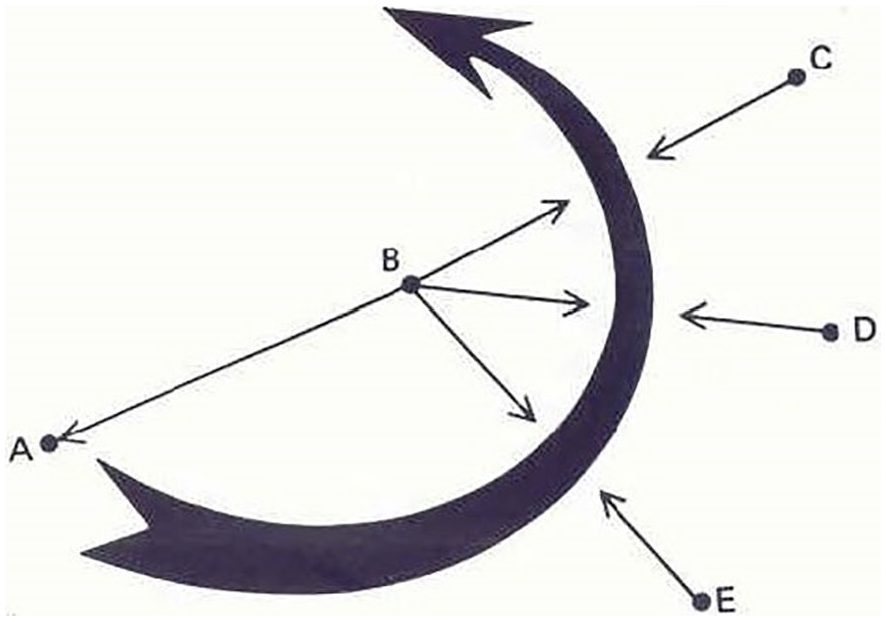
Interessement device.
Combining the concept of interessement devices together with practice theory’s attention to relevance allows accounting for knowledge-based power dynamics in inter-organizational IT projects. We define ‘knowledge asymmetries’ as the inter-organizational condition of inclusion or exclusion in which actors find themselves as a consequence of how their knowledge is valued (i.e. relevant/irrelevant). The bearers of relevant knowledge are included, and the bearers of irrelevant knowledge are excluded. Under this definition, Snowden would be de facto included, thanks to the relevancy of his knowledge skills for the organization. This definition requires realizing the importance of understanding how some knowledge comes to be valued as relevant, while other knowledge does not. In what follows we suggest that ISs can be conceived of as interessement devices making some kinds of knowledge more or less relevant in specific situations.
The distinctiveness of government boundaries
Before proceeding to describe the research methods and to analyse the two case studies, we need to recall some specificities of government ITO, that in the conclusion will allow extending the scope of this research to imagining novel interdisciplinary overlaps. When it comes to government ITO, boundaries are not simply inter-organizational, but inter-sectorial. They articulate the distinction between the public and the private. Such a distinction is foundational of the modern state’s division of tasks between collective and particular interests, and thus does not retain the same meaning as inter-firm boundaries. In liberal democracies, this distinction is built with the clay of constitutional charts and accepted definitions of ‘public interest’ and ‘entrepreneurial freedom’.
Therefore, when it comes to governmental ITO, inter-organizational boundaries are also inter-sectorial. On one hand, this distinction has called for ITO policies to take into account government specificities (e.g. Coelho et al., 2016). Cordella and Willcocks (2010) have argued for a public sector ITO model that ‘does not neglect the role of bureaucratic organization in enforcing fundamental democratic values, such as impartiality and equality for citizens before the state’ (Cordella and Willcocks, 2010: 86. See also Cordella and Willcocks, 2012).
On the other hand, the massive adoption of ITO in government may elicit a fundamental reconsideration of the core functions of the state (Dunleavy et al., 2006; Margetts, 2003), and of its internal (Pelizza, 2016a) and external boundaries. As the Snowden case has revealed, when IT projects prompt boundary spanning between contractors and the state as a client, long-term consequences in the modern order of governance might be expected. For example, if the civil service cannot access data needed in its daily routines, and must instead rely on contractors, this might eventually affect democratic accountability (Prins et al., 2012).
A sociomaterial framework that aims to account for inter-organizational boundary shifts in IT projects should therefore not only be able to foresee the implications of such shifts for the debate on inter-organizational boundary spanning within the IS community. It should also be able to ask what the macro-implications of a sociomaterial, micro and situated understanding of boundaries are, when such boundaries are not only inter-organizational, but inter-sectorial. In the conclusion, we will attempt to answer this question by hypothesizing a research area at the confluence of IS and political studies.
Method: information systems as interessement devices
Drawing on social studies of technology, in our research we adopted a performative epistemology, ethnographic methods for data collection and the concept of interessement device for data analysis. A performative (Latour, 2005), ‘Wittgensteinian’ (Pelizza, 2010) epistemology refuses a priori definitions and instead dynamically tracks how established classifications are blurred in practice. This is true of the two cases analysed, Sigma and the Dutch land registry, which involve actors that are at the same time public and private. Instead of giving an a priori definition of whether these actors are public or private, in the analysis we tracked how boundaries were crossed. Similarly, instead of adopting in advance a straightforward definition of relevant knowledge, we analysed which forms of knowledge came to be valued as relevant in the two cases.
As to data collection, we identified and compared two longitudinal case studies that offered the possibility to observe IS design-implementation-design cycles over relatively long timeframes. The first case concerns the design and implementation of an online submission service aimed at enabling businesses to apply for permits and licences to local, regional and national authorities in Italy. The submission service ran on a ‘vertical’ application, Permits and Licences (P&L), which in turn ran on a ‘horizontal’ middleware, People. The People middleware had been developed nationwide in the mid-1990s. Its development was jointly financed by national and regional government agencies. Both middleware and vertical applications were offered as free, open source and re-usable software (FOSS). Agencies and other authorities (e.g. provinces, chambers of commerce, schools, etc.) could require customizations, especially concerning vertical applications.
For this case, the author conducted an autoethnography in a dual practitioner–researcher role (Jones et al., 2016) while working at an in-house engineering company (Sigma). 3 Sigma was administratively, financially and technically accountable to a regional government in Northern Italy. Depending on the project, Sigma’s functions could range from full in-house IS design and development, to outsourcing of software design and/or implementation. In the case of P&L, Sigma was expected to take over design and implementation from the original contractor. Data collection relied on ethnographic participant observation of actors’ daily practices conducted 5 days per week from 2010 to 2013. This included access to technical documents issued by the regional government, software designers and implementing contractors; to an uncountable number of e-mails; to individual annotations taken during observations at meetings with contractors and regional government’s civil servants.
The second case concerns system integration at the Dutch land registry (Kadaster). Originally a government agency, the Dutch Kadaster is a financially independent public body since the 1990s, operating under the political responsibility of the Minister of Infrastructure and the Environment. Since system integration unfolded over a period of 20 years, the researcher was not able to conduct ethnographic participant observation of design-implementation cycles. Rather, data collection was designed based on the experience developed in the first case. Fifteen semi-structured interviews were designed based on the results of case 1 and conducted with five key technical, legal and administrative profiles at Kadaster, both at officer and executive levels. Data collection was conducted at different moments from September 2013 to August 2015. Interviews focused on the diverse available technical solutions, their proponents and trial-and-error processes that took place over such a long timeframe. Furthermore, we analysed over 30 documents, including laws and decrees, design concepts and schemas, web pages and system screenshots. Annotated versions of the same documents were particularly useful in tracking modifications over time. Table 1 summarizes the methods followed in the two cases.
Comparison of methods used in the two case studies.
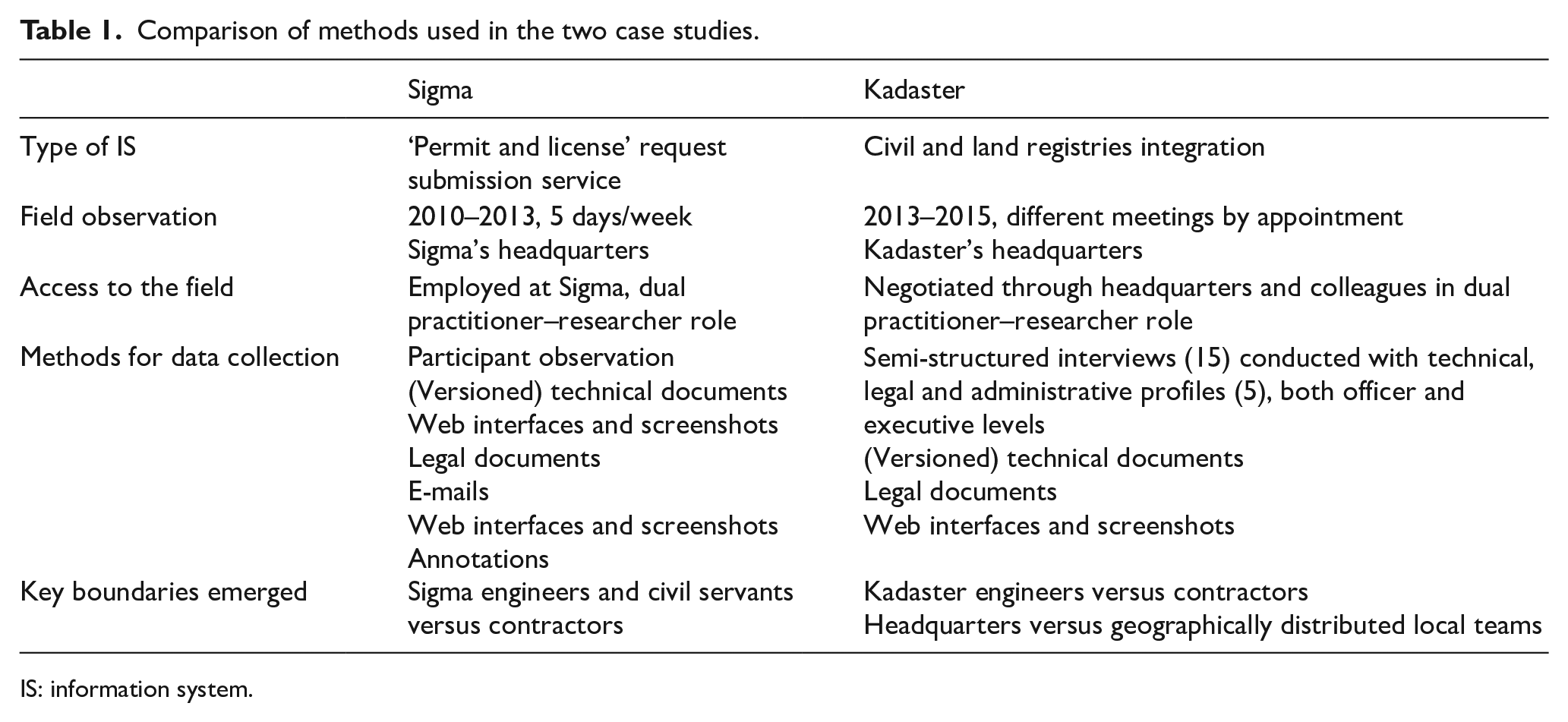
IS: information system.
Concerning data analysis, we conducted content analysis informed by the concept of ‘interessement device’ (Callon, 1986). We first went through qualitative data and wrote single case descriptions regarding agency exerted by both humans and artefacts. In doing so, we followed Latour’s (2005) criterion about ‘good texts’ as successful lab experiments. 4 This meant writing iterative descriptions that stabilized only when all observed actors and artefacts were accounted for. Next, we compared the finally refined descriptions for the two cases. The comparison between the two cases allowed us to raise and challenge interpretations about artefacts acting as interessement devices. With some interpretations, pieces of software did not establish regimes of inclusion and exclusion; with other interpretations, it was not clear who was included and who was excluded. We only reported consistent interpretations.
Eventually, we realized that the original conceptualization of interessement device needed an update. The original formulation was introduced to account for innovation happening in a well-defined time period and with individual devices. However, our analyses – and especially the second – showed that the concept can cumulate its heuristic potential across diachronic developments and multiple devices.
Sigma: ‘Permit and License’ request submission service
P&L runs on the People middleware and provides a dynamic online submission service for firms to apply for permits and licences to government agencies. The system is meant to replace paperwork submission with a web platform that offers dynamically assembled forms. As the outcome of long-term nationwide investments in the People middleware and related applications, P&L was distributed as FOSS to government agencies and local authorities nationwide. On top of the standard version of the software, agencies used to require specific customizations. In most cases, customization was outsourced to contractors, who not only developed adds-on according to specifications, but were also in charge of their implementation, including integration with existing systems, maintenance and re-use across diverse regions.
In 2010, the in-house engineering company Sigma took over the implementation of P&L on behalf of a regional government in Northern Italy. Up to that moment, both customization design and implementation had been outsourced to a contractor. With the new arrangement, the contractor-retained design and implementation was delegated to Sigma, which was also running the regional datacentre. As Sigma had access to application and database servers, implementation included operational system integration and functional profiling.
Despite Sigma’s technical expertise and the FOSS distribution, this apparently straightforward design/implementation division of labour became problematic. Initially, Sigma engineers attempted to acquire full knowledge of P&L functionalities, and even to actively foster knowledge sharing by training regional civil servants in routine system configurations. However, the knowledge necessary to run the system had not been adequately shared, neither through collaborative practices nor through supporting documentation. This elicited knowledge asymmetries between the contractor and Sigma’s engineers.
As a way of illustration, Figure 2 shows one of the P&L database tables. The labels on the left menu are, in part, customizations previously developed by the contractor. They appear rather arbitrary and generic. For example, the third arrow from above indicates the label ‘documents’, which – in the absence of an exhaustive list of all documents contained – remains too vague to be self-explanatory. Nor was supporting documentation more explicit. A more sophisticated example is given by the labels ‘conditions’, ‘laws’ and ‘conditions laws’ (indicated respectively by arrows one, two and four in Figure 2). The table ‘conditions laws’ is logically expected to merge the two previous tables, but the nature of this merging was not adequately explained in the supporting documentation.
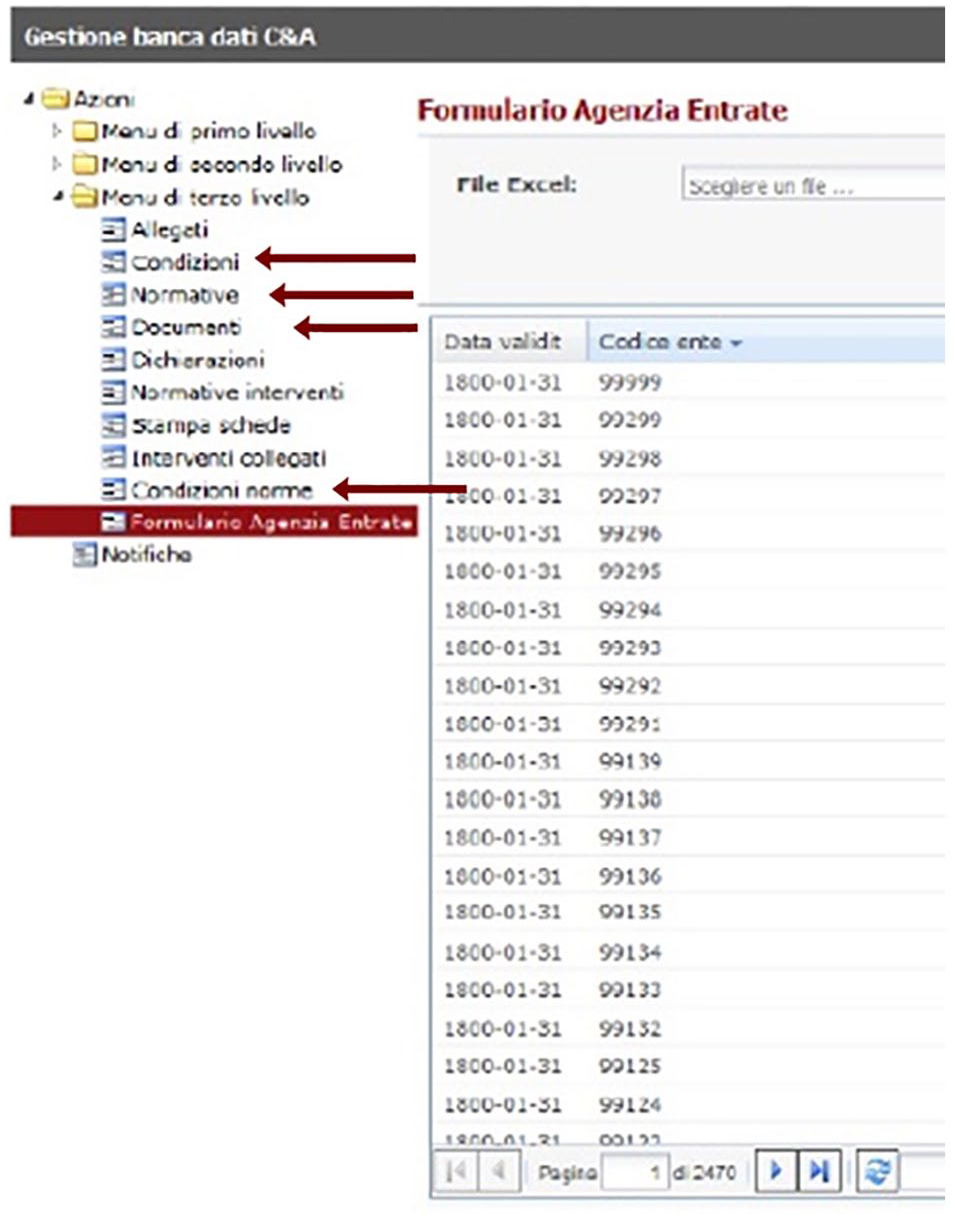
P&L database table.
Knowledge asymmetries were reinforced by the fact that the contractor had ongoing agreements with other regional governments, and thus knew most local customizations. Sigma’s technical staff, however, did not have knowledge of locally commissioned developments, besides those in its own region. Customizations asked by local chambers of commerce are a case in point. The contractor re-used customized solutions already developed for other clients, with the consequence that Sigma had to contract out not only their design, but also implementation.
As a result of these obstacles in knowledge transfer, Sigma engineers could not fully take over implementation tasks from the contractor. Nor could they adequately train civil servants in routine system configuration, given the risk of accidentally intervening on tables whose function was unknown. All in all, knowledge asymmetries were established despite the use of FOSS. Crucially, asymmetries were not due to ‘technical’ knowledge per se: it was not technical expertise that Sigma engineers lacked, but micro-knowledge of specific design choices, produced in the context of a specific IS.
Notably, the database tables worked as interessement devices (Figure 3). Being generically labelled, they ‘linked’ information management functions to the incumbent contractor, and ‘detached’ them from Sigma engineers, as well as from civil servants at the regional office. Actual knowledge of such labels distinguished those who took part in the project since its design stage (i.e. contractor’s staff) from those who had only lately been tasked with implementation (i.e. Sigma’s staff and civil servants). As a consequence, database tables excluded civil servants and Sigma engineers.
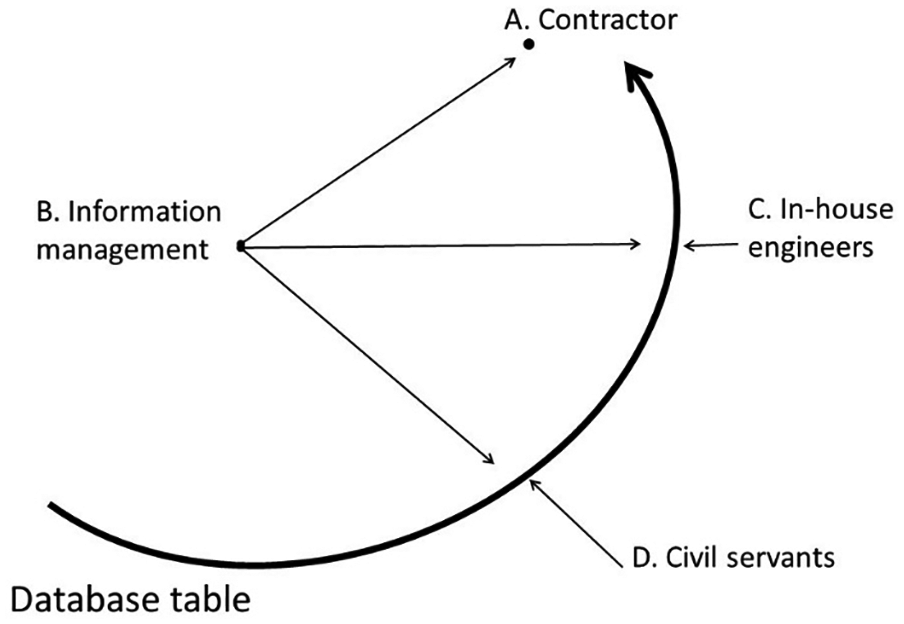
Database table as an interessement device.
Kadaster: civil and land registries integration
The second case deals with an early system integration programme at the Dutch land registry (Kadaster). This programme was initiated in the early 1990s and aimed to match personal data stored in the land registry’s person database (the Kadastrale Personen Registratie – KPR) with the same type of data stored in the municipal civil register (Gementelijke Basis Administratie Personen – GBA). The KPR contained names, birthplace and other data of owners of properties recorded in the Dutch land registry. The GBA was the main national source of personal data, a Dutch-wide register kept updated by all municipalities.
Since April 2007, GBA has been classified by law as the ‘authentic’ register for personal data, meaning that the use of GBA data is mandatory for any government agency. This law has been the point of arrival of a much longer process started in the early 1990s. The KPR–GBA integration was the pioneer of this process. Twenty years after its inception, a national system of authentic registers, backed by law, has been established, a new organizational unit at the land registry has been created, and a new set of procedures generating reliable data has been devised. While accounting for the whole process is not compatible with this article’s required length, here we briefly reconstruct the story that brought into being a form of knowledge that was exclusive of external contractors and inclusive of (some) Kadaster operators.
First interessement device: COBOL
In the KPR–GBA integration, three interessement devices were developed over a period of 20 years. The first artefact, COBOL, was chosen as the main programming language at an early design stage. Besides other technical considerations, this ‘early entrenchment’ (Star and Lampland, 2009) was key to ensure Kadaster’s financial independence, as COBOL was known by Kadaster’s IT staff. As a technical executive recalled during interview, the choice of the programming language was dictated by the type of knowledge already present in-house, as this allowed saving on external contracts.
This choice was thus meant to avoid involvement of contracted software developers. Using the model of interessement, COBOL ‘inter-essed’ Kadaster’s IT department and dis-interessed potential contractors at the early stages of the project. The match between COBOL’s socio-technical characteristics and Kadaster’s economic constraints defined which actors were included (i.e. Kadaster’s IT department), and which ones were excluded (i.e. contractors). In other words, the programming language acted as a ‘technical device [which] distributes the forces which will support or resist it’ (Akrich et al., 2002: 205).
Indeed, the choice of COBOL affected the long-term likelihood of outsourcing, while it reinforced the involvement of Kadaster’s IT department in the programme. It is worth noting that with this choice, Kadaster did not produce a new form of ad hoc asymmetric knowledge. Rather, it valued expertise of a generic programming language. In contrast to the P&L case previously described, at this early stage, knowledge was not an element of exclusion per se. In a situation of symmetric knowledge, consultant exclusion was rather dictated by economic and organizational concerns. This early ‘fenced space’ did not, however, impede that other asymmetries were introduced at a later stage through further interessement devices.
Second interessement device: the broker
The initial exclusion of potential contractors was only the first of a series of detachments. Another interessement device was introduced to solve a design conundrum. The KPR–GBA integration required a centralized database architecture that could sort information flows to/from GBA (Figure 4). However, this requirement was incompatible with KPR’s originally decentralized database architecture, actually composed of 15 distinct components (Administratie Kadaster Registratie – AKR). Each component database corresponded to a different territorial area and was managed by a distinct local Kadaster production team.
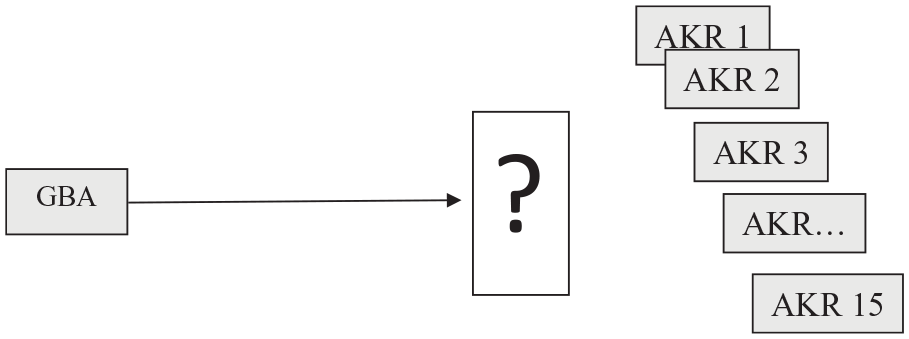
Information flows between GBA and one of the fifteen AKR.GBA: Gementelijke Basis Administratie Personen; AKR: Administratie Kadaster Registratie.
The solution came in the form of a ‘broker’, a software component that matched individuals’ IDs in the diverse AKR databases with a unique Kadaster Person Number. With the introduction of the broker and the Kadaster Person Number, the database architecture on the Kadaster side reached a degree of centralization that allowed information flows to/from GBA to be forwarded to the correct AKR database (Figure 5).
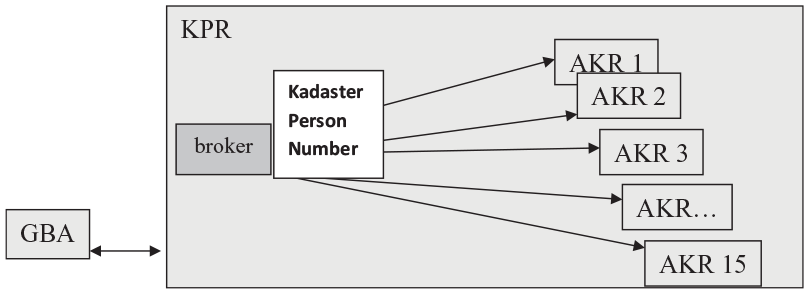
Kadaster Person Number resolving AKR KPR: Kadastrale Personen Registratie; GBA: Gementelijke Basis Administratie Personen; AKR: Administratie Kadaster Registratie identification.
This technical solution nevertheless had organizational implications for local production teams. Up to that moment, only local production teams could visualize and modify personal data on AKRs. With the introduction of the broker, civil servants at Kadaster headquarters could access and modify personal data, as well, thus eroding local operators’ monopoly. All in all, the broker operated as an interessement device: it weakened the exclusive connection of local operators with data management, while it introduced a new connection with Kadaster’s headquarters.
Third interessement device: recipient indications
The third interessement device established a permanent connection between the KPR and GBA systems. In order to match data from the notarial deed recorded in KPR with data stored in GBA, a recipient indications mechanism established a permanent link between the two databases. For any new person entered in KPR, a recipient indication was recorded at the correspondent GBA entry, so that every spontaneous data mutation in GBA was automatically pushed to KPR.
The system of recipient indications made it impossible for local production team operators to modify data in KPR once a recipient indication was entered in GBA. One technical executive depicted this mechanism as a ‘switch’: an automatic switch is triggered in KPR, which results in the fact that no user [i.e. production team operator] can change anything anymore about that person in any AKR database. From this moment on, GBA is in control of the data of that person. (technical executive)
This ‘switch’ introduced a remarkable novelty in the distribution of functions. Up to that moment, production team operators were the ones tasked with changing a person’s records according to the data reported in the notarial deed. With the system of recipient indications, however, that function was delegated to GBA. When production team operators noticed a mismatch between data in the deed and in GBA, they could not do anything but send a notification to GBA and the notary (Figure 6). This exclusion did not hold for civil servants at Kadaster headquarters. They maintained the possibility to directly modify data when they did not match.
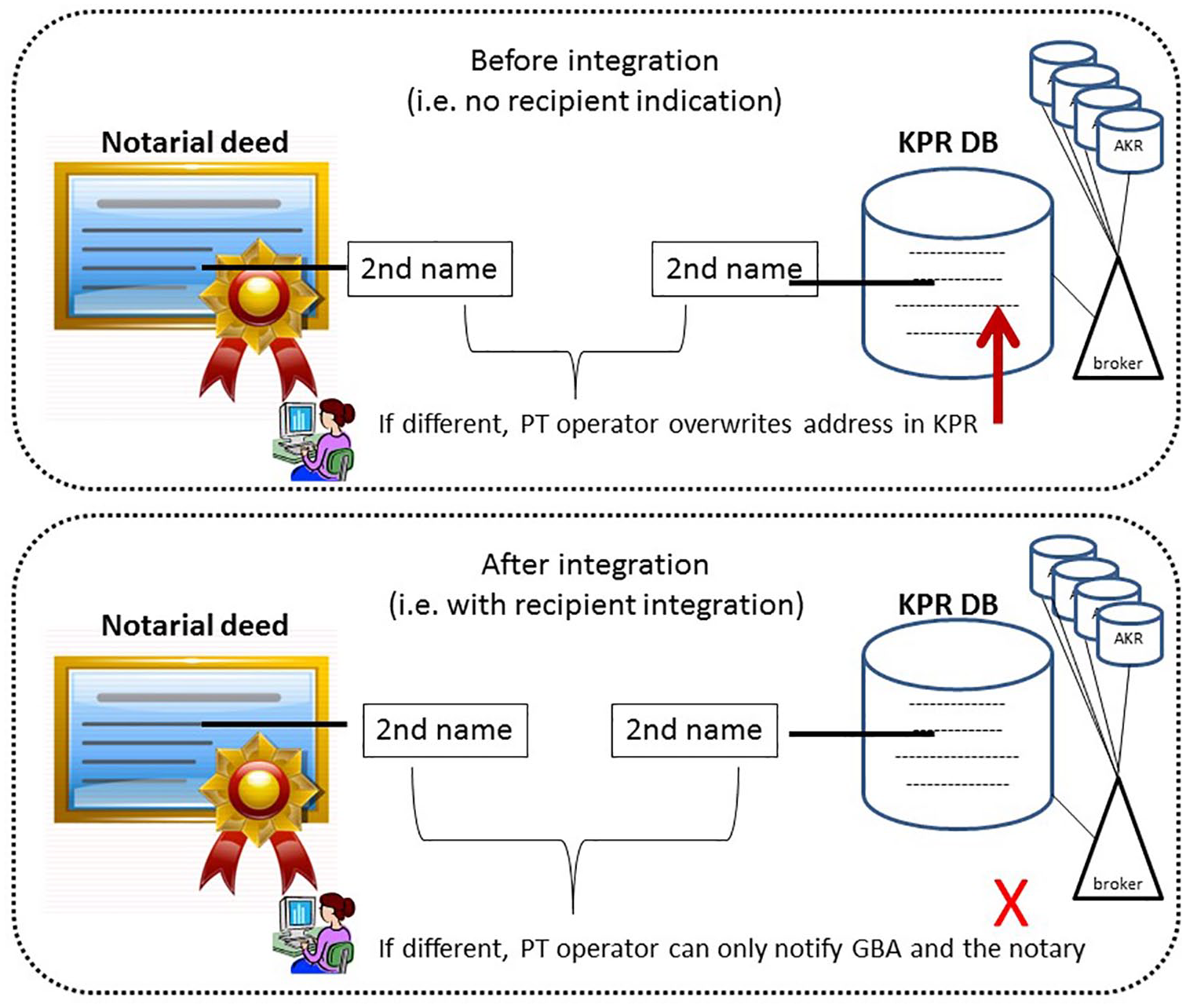
Personal data modification before and after the KPR–GBA integration.
The mechanism of recipient indications is the archetype of the interessement device. It re-allocates information management tasks from production team operators to an automated mechanism at GBA. Recipient indications excluded production team operators, while they established a link with GBA. Only Kadaster headquarters staff could modify this link.
Figure 7 sums up the series of detachments cumulating over time thanks to the three interessement devices. COBOL excluded potential contractors, and favoured the inclusion of Kadaster’s IT department. The broker weakened the monopoly of local production teams (PT) on personal data, and gave access to employees at Kadaster’s headquarters. The system of recipient indication eventually ratified this detachment from local operators by introducing a permanent link with GBA, which only operators at the central Kadaster office could modify.
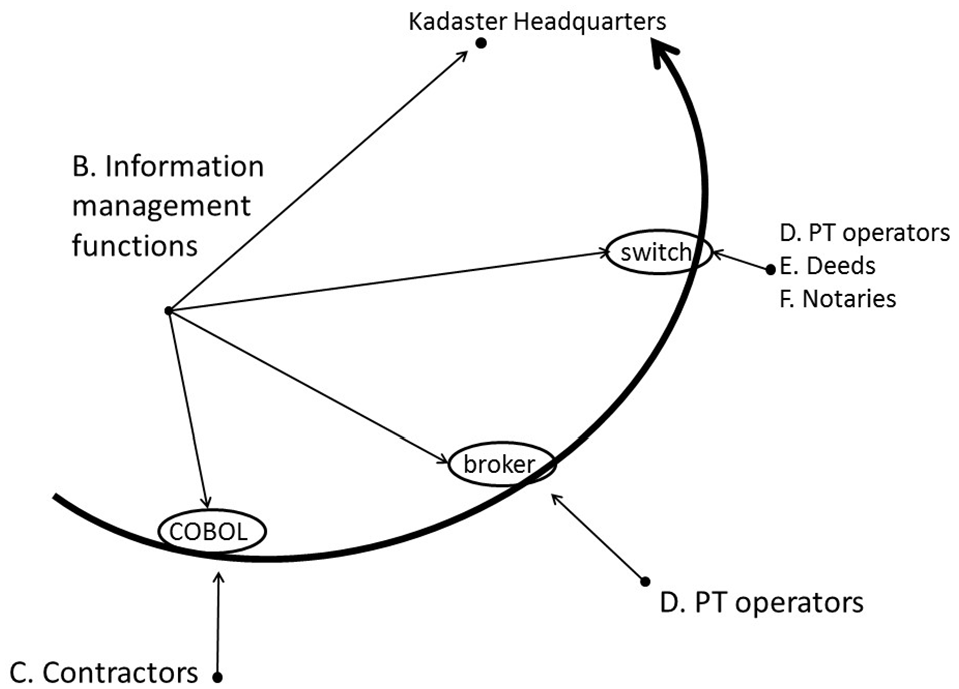
COBOL, broker and system of recipient indications as interessement devices.
All in all, the KPR–GBA integration introduced new knowledge and a novel organization at Kadaster. The choice of using a diffused programming language as COBOL allowed avoiding outsourcing. Then, in this preliminarily fenced space, other asymmetries emerged among Kadaster’s offices. The central headquarters eventually took over information management from local production teams. A new unit was established at Kadaster’s headquarters (Pelizza, 2016b), and the number of production teams was reduced to five. If not ‘caused’, this re-organization was at least facilitated by software artefacts like the broker and the recipient indication switch, which established some kinds of knowledge as relevant (e.g. expertise of the GBA system), while downplayed the relevance of other forms of knowledge (i.e. data processing of notarial deeds).
Discussion: the sociomateriality of knowledge asymmetries shaping organizational boundaries
The comparison of the Sigma and Kadaster analyses suggests a framework to explain a possible set of relationships between IS artefacts, knowledge asymmetries and inter-organizational boundaries (Figure 8). As sociomaterial interessement devices, ISs set required skills and behaviours and thus define what counts as ‘relevant knowledge’ in a specific situation. Relevant knowledge establishes knowledge asymmetries: the bearers of knowledge that is valued as relevant turn out to be experts, while the bearers of irrelevant knowledge become non-experts. Eventually, such regimes of inclusion and exclusion de facto shape inter-organizational boundaries. Boundaries are thus the consequences of knowledge asymmetries, rather than the reason for impeding cause of knowledge sharing. Let us unpack these steps in dialogue with the practice theory-based approach to boundary spanning.
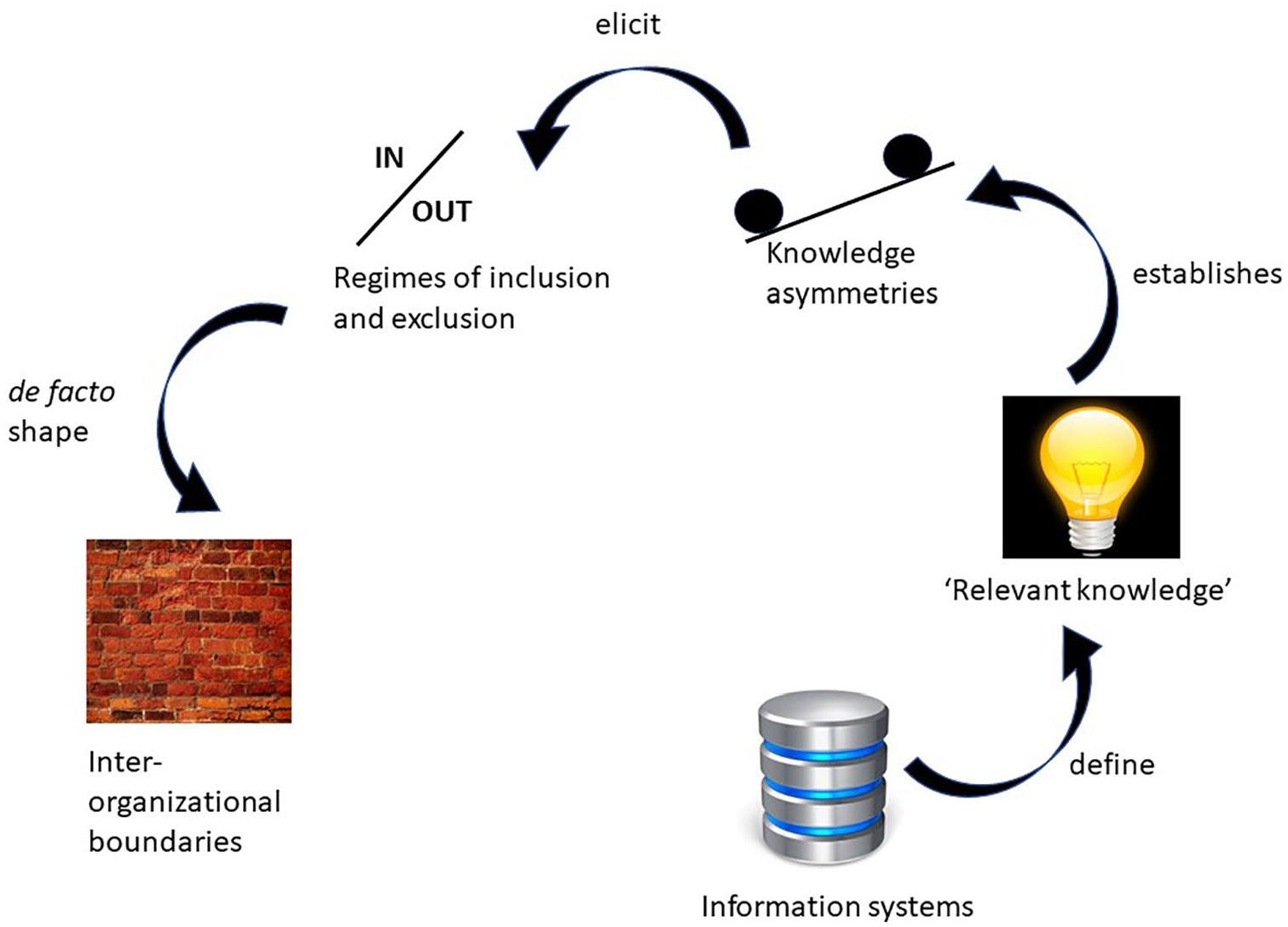
Sociomaterial framework: relationships between ISs, knowledge asymmetries and inter-organizational boundaries.
The chain of action implied by our sociomaterial framework resonates with practice theory-based approaches to boundary spanning in three ways. First, both acknowledge that boundaries emerge as the result of situated IT development efforts. Second, in both approaches, boundaries and knowledge are not relevant per se or given pre-existing positions, but become relevant in specific situations. Third, our framework shares with practice theory an interest in understanding the power dynamics of inter-organizational IT projects. For both approaches, inclusion and exclusion are not given once and for all; rather, they are re-enacted by definitions of what counts as ‘relevant knowledge’.
The two approaches, however, differ in the material form taken by those definitions. For practice theory, power dynamics are negotiated in discursive practices. Our framework instead shows that also artefacts can play a role in defining what counts as relevant knowledge across organizations. As sociomaterial interessement devices, ISs value some kinds of knowledge, while they disregard others. In the cases analysed, what came to be considered ‘relevant knowledge’ was the outcome of technical affordances and limitations. Design decisions might have been taken upstream, but eventually it was database tables, programming languages, brokers and switches that valued some forms of knowledge and disregarded others. It was the introduction of database tables according to a set of naming rules that made knowledge of those rules necessary to implement the P&L platform. It was the automation of name matches with the GBA that made knowledge of notarial deeds irrelevant. Not mere ‘boundary objects’ or ‘tools’ supporting knowledge sharing, Sigma’s tables and Kadaster’s system of recipient indications acted as full-blown actors in establishing regimes of inclusion and exclusion.
While Levina and Orlikowski (2009) point out that ‘discursive practices may shift power positions within organizations, while also renegotiating power relations across the organizations participating in the joint project’ (pp. 673), in our cases it was practices made durable in ISs that shifted boundaries. This conclusion allows complementing literature on inter-organizational boundaries and power dynamics with an attention to sociomateriality and the agency of artefacts. We suggest investigation should not deny cases in which practices are ‘made durable’ in artefacts.
This conclusion is not only relevant for theory: it has also implications for practice. To practitioners developing IT projects across organizations, our framework suggests the need to identify at the early design stage which decisions are to be performed as discursive practices, and which decisions are to be embedded into artefacts. In Sigma’s case, the inclusion of contractors in the implementation phase was de facto decided by means of database tables; another option might have been specifying their inclusion in the formal contract. In the case of Kadaster, exclusion of local teams might have taken place through industrial negotiations. As Latour (1992) has recalled, deciding whether regimes of inclusion or exclusion are extra- or intra-somatic is a matter of design.
Second, our framework contributes to existing literature on inter-organizational IT projects with a non-normative approach. While literature tends to normatively assume boundary spanning as a necessary condition for innovation and competitive advantages (Carlile, 2002, 2004; Hardy et al., 2005; Levina and Vaast, 2005), following the principle of generalized symmetry (Bloor, 1976), a scientific framework should equally account for cases in which collaboration does not take place. As Pollock and Williams have put it, ‘it has become commonplace within Technology Studies to talk of the ‘mutual shaping’ of technology and society. There is, however, a danger that this metaphor could, even unintentionally, convey an impression that this was a smooth and harmonious process’ (Pollock and Williams, 2008: 78).
The two cases discussed show that knowledge can also be produced for the purpose of distinguishing actors, not only blurring them (Allen et al., 2002; Levina, 2005; Metiu, 2006). Indeed, they show that ISs have a role in eliciting knowledge asymmetries and regimes of inclusion and exclusion by establishing what counts as relevant knowledge. Relevant knowledge defines whose expertise is valued most. In the first case, Sigma’s engineers turned out to be non-experts, given their ignorance of database labelling conventions, and thus were de facto excluded from the IT project. In the second case, Kadaster IT department’s knowledge of COBOL was considered relevant and the IT department was able to steer the subsequent project development. Local production teams instead experienced a drastic asymmetry, as their expertise was not deemed relevant anymore. All in all, collaboration and inclusion are only one of the possible outcomes of situated IT projects, the opposite outcome being knowledge asymmetries and exclusion. Our framework allows accounting for knowledge convergences and porous boundaries, as well as for knowledge asymmetries and solidified boundaries.
Finally, a third contribution of our framework to ITO and organizational boundaries concerns decisional processes. Differently from transaction cost economics’ narratives of strategic high-level ITO decisions enacting boundaries (McLellan et al., 1995; Mosakowski, 1991; Pisano, 1990), our cases show that the design of inter-organizational boundaries can be the situated outcome of ISs development. Boundary shifts happen in the situated design and implementation of software minutiae at least as much as they are determined by top-down policy decisions. 5 In the conclusion, we will further develop this point.
For the time being, it is important to note that the comparison of the two cases shows that ISs can be designed and implemented both ways: to exclude civil servants and value contractors’ knowledge, or vice versa to exclude contractors and empower civil servants. It is key stressing that in none of the two cases actors were excluded because they lacked technical skills, but because they lacked relevant knowledge. In the cases analysed, ‘relevant knowledge’ did not coincide with ‘technical knowledge’. Rather, ‘relevant knowledge’ was defined by artefacts. As a consequence, actors who were deemed experts were so not because of their generic technical expertise, but because they retained a form of knowledge that in a given situation was valued as relevant. Yet other kinds of knowledge could have been relevant in slightly different situations. In case of code bugs, for example, knowledge of C++ might have become relevant. Metaphorically, we can claim that knowledge asymmetries are not written in stone, only in code.
This insight not only empirically counters popular arguments about civil service’s endemic lack of technological skills (e.g. Goldsmith and Eggers, 2004; Peled, 2001; UK Cabinet Office, 2012), but also substantiates the findings of those studies acknowledging that the client/contractor relationship contains no pre-determined structure (Fincham, 1999). To public sector decision-makers, this insight suggests that outsourcing decisions should not be motivated by knowledge asymmetries (i.e. civil service detaining little technical knowledge, and therefore in need of corporate expertise). Indeed, knowledge asymmetries are not given a priori, but sociomaterially shaped by the forms of knowledge that are valued as relevant in situated IT project.
Conclusion: macro-changes inscribed in micro-processes
Contemporary people interact with standardized forms, technologies, and conventions built into infrastructure. [. . .] The contemporary view [. . .] includes the growing place of all sort of standards, formal and informal, in our everyday lives. This growth is apparent at the most minute level and at the most macro-level. (Star and Lampland, 2009: 3, author’s emphasis)
We would like to conclude by expanding the scope of this research to figure out novel research directions at the confluence of IS investigation and political studies. As shown by the initial vignette, when boundaries are not only inter-organizational, but inter-sectorial, inclusion/exclusion dynamics can entail consequences for the outer edge of the state. To figure such consequences out, we wonder to what extent the regimes of inclusion and exclusion in the two cases analysed overlap with formal governmental boundaries.
Figures 3 and 7 visualize the regimes of inclusion and exclusion entailed by each of the two discussed case studies. At Sigma, contractor staff had full access to the systems and were fully included, while Sigma engineers were excluded. Similarly, civil servants turned out to be outsiders, despite being government insiders. At Kadaster, the IT department was fully included, but production teams were revoked access to the system.
These results show that the regimes of inclusion and exclusion enacted by ISs developed in IT projects might not overlap with institutional boundaries between government and private contractors. While this may not be unexpected, the fact that – when it comes to government ITO – the outer edges of the state can be shaped by technological affordances and limitations should not risk going unnoticed. De facto shifts in state boundaries are enacted by database tables, programming languages and ‘switches’ – rather than through laws, decrees and constitutional charts.
On one hand, the obduracy of infrastructures suggests that de facto boundary shifts may correspond to long-term transformations in the order of governance. If civil servants at Sigma cannot design and implement P&L, future ITO choices may strengthen the contractor’s monopoly. In the case of Kadaster, major transformations concerned the discontinuation of local production teams. On the other hand, de facto boundary shifts are enacted by highly situated and unaccountable micro-processes inscribed in ISs. As such, they question one of the pillars of statehood, namely the assumption that state authority is upkept by texts issued by parliaments and governments (Latour, 2010).
Taking a closer look, macro-boundary shifts entailed by micro-technical components constitute a case of what Saskia Sassen (2006) defines as ‘capabilities for denationalization’. In response to simplifications assuming that the raise of a new global order comes at the expense of the former national one, Sassen identified some enabling elements – ‘capabilities’ – that assure continuity between national and global systems. Capabilities mediate between the new and the old orders by changing valence, ‘jumping tracks’ and ‘getting relodged’ into novel assemblages (Sassen, 2006: 7–9). As such, capabilities developed in the former national order can contribute to new global organizing logics. 6
Sassen’s notion of capabilities is interesting in that it bridges micro- and macro-levels of analysis. According to her use of the concept, global dynamics happen inside the state, at the micro-level, and not despite it. Similarly, our analyses have shown that shifts of government boundaries at the macro-scale can de facto be encoded and enacted at the micro-level of government ISs. Crucially, such shifts are acknowledged in laws and constitutional charts. We thus suggest that such macro/micro arrangements constitute an occurrence of what Sassen (2006) calls ‘capabilities for denationalization’. The capability of ISs to shift state boundaries, without being legally acknowledged, is indeed lodged inside the informational core of the state. Yet such capability could change valence and mediate the transition to a new order in which core data functions are not deemed functions proper to the nation state anymore.
In summary, understanding knowledge asymmetries triggered at the micro-level of IS development allows examining inter-organizational boundaries at the macro-scale of government. In this light, we suggest that IS studies have a potential to engage with empirical analyses that can turn out crucial for political studies about globalization and state disassembling.
Footnotes
Declaration of conflicting interests
The author(s) declared no potential conflicts of interest with respect to the research, authorship, and/or publication of this article.
Funding
The author(s) received no financial support for the research, authorship, and/or publication of this article.
