




Abstract
Researchers often hold a romantic view of theory, which they feel should be a complete, flawless, deep, and exhaustive explanation of a phenomenon. They also often hold a romantic view of theory building, which they envision either as emerging from trancelike writing or as the product of a straightforward deductive process. The perspective I offer is more realistic and pragmatic. I espouse the view that the outcomes of a researcher’s theorizing efforts are often incomplete explanations of a phenomenon, which, given a chance, may develop into rich theories. I propose a highly iterative spiral model that portrays theory building as a craft, which calls for care and ingenuity, and requires patience and perseverance. I also propose design principles that can contribute to the quality of the outcome of theorizing.
Keywords
Introduction
The premise of this article is that many of us researchers hold a romantic view of theory and of theory building, a view that hinders our ability to effectively develop theory. The objective of this article is to present a more realistic view of theory and of its construction process. Accordingly, I propose a pragmatic model of the theory-building process. I developed the model inductively, by analyzing my experience as a theory builder and the experience I vicariously gained from supporting—as a senior editor—several authors in their theory development efforts and by guiding PhD students as they prepare a theory piece as part of the theory-building course I have been teaching for a decade. The model is enriched with methods, techniques, and heuristics that I have gleaned over the years and which I have found particularly useful or inspiring.
The romantic view of a theory portrays it as a complete, detailed, flawless, deep, and exhaustive explanation of a phenomenon, an object that Weick (1995) refers to as “Theory That Sweeps Away All Others” (p. 386). Such a conceptualization is intimidating, and most of us are likely to see reaching the level of explanatory power and generality it implies as unattainable. As an alternative to this romantic view, I suggest that it would be more productive if researchers and review teams alike agreed that products of the theorizing process seldom emerge as full-blown theories, which means that most of what passes for theory in organizational studies consists of approximations [. . . and represents] interim struggles in which people intentionally inch toward stronger theories. (Weick, 1995: 385)
This is indeed what we are developing: approximations. This notion resonates in the information systems (IS) field, for instance, in Hassan’s (2014) notion of products of theorizing “that only approximate theories but are critical to their development” (p. 1). This view is shared by theorists in several fields of the domain of management. For instance, Bandura (2005) comments that “[t]heorists would have to be omniscient to provide an ultimate account of human behavior at the outset. They necessarily begin with an incomplete theory [. . .] Successive theoretical refinements bring one closer to understanding the phenomena of interest” (p. 28). My view is that if, as authors, we come to terms with the idea that we are developing approximations and if, as reviewers and editors, we come to terms with the idea of publishing what may be approximations of theory, then we will learn to develop more refined approximations and become more proficient at theory building.
In addition, researchers sometimes hold one of two alternate romantic views of theory building. The first is that of theory building as an art. Under this view, the theorist has sparks of inspiration, and the theory emerges during trancelike periods of inspired writing. Once the theory is in writing, this object of art should not be “touched up.” The alternate romantic view is that of theory building as a science, whereby there exists a series of activities—such as reviewing the literature to circumscribe the phenomenon of interest, analyzing the constructs and relationships from extant literature to identify gaps, and developing new theoretical propositions—that if dutifully followed will result in good theory. Unfortunately, neither of these two views is realistic, since few of us have sparks of inspiration that are powerful enough to result in a full-blown theory, and most of us need more than a well-defined series of steps to follow to produce compelling theories.
This article proposes that theory building resembles a craft more than an art or a science. This does not imply that the theorist should not be creative and imaginative as the artist is, or does not need to be rigorous and methodical as a scientist is expected to be. Yet, in addition to possessing these qualities, the theorist as an artisan must also demonstrate care and ingenuity and work with patience and perseverance, being engaged in the work in and for itself (Sennet, 2008).
Boundary conditions
Before presenting my model, it is essential that I state its boundary conditions, specified by the conceptual and contextual assumptions under which the model was developed. The first conceptual assumption is that, although I consider the outcome of the theory-building process an approximation, not an all-encompassing theory, the theorist nevertheless develops an explanation—or an explanation and prediction—of a phenomenon. This explanation will state the “relations among concepts within a boundary set of assumptions and constraints” (Bacharach, 1979: 496); the explanation can be expressed as relational statements organized in a discursive essay or as a set of formal propositions (Bourgeois, 1979). Second, the process presented is my explanation of how theory emerges from a set of activities. It is neither prescriptive nor predictive: it does not intend to tell theorists what they should do to develop a theory, nor does it pretend that faithfully following the proposed process will result in a good approximation of theory.
Two contextual assumptions circumscribe the relevance of the proposed model. First, the process presented here is better suited to developing theory under a deductive approach, one that commences “at the intersection of the theorist and the existing knowledge typically contained in the literature” (Shepherd and Sutcliffe, 2011: 361). My experience, however, suggests that the overall process and several of its activities are also relevant to inductive theory building, often based on qualitative data the theorist collects. The second contextual assumption pertains to the domain of theorizing to which the model applies. As many IS academics, I have anchored much of my research in the literature of the broad field of management, such as organization theory (Mignerat and Rivard, 2009), business strategy (Karimi-Alaghehband and Rivard, 2019), and behavioral decision making (Moeini and Rivard, 2019). This gave me the opportunity to read, albeit in part only, the literature from those research areas. In doing so, I realized that the challenges IS theorists faced were similar to those of researchers from those domains. Therefore, while my immediate audience is that of IS researchers, I would like to think that my comments are also pertinent to theory building within the broader field of management.
A spiral model of the theory-building process
The model depicted in Figure 1 is highly iterative. This spiral model 1 should be read as follows. The process comprises two main components: activities and their outcomes, which I call the “ions 2 of theory construction” (Rivard, 2014). The term “ion” refers to small elemental particles that can be assembled into a compound—in the present case an approximation of theory—that has specific, unique, properties. It is not the presence of the elemental particles that gives value to the compound, it is how the theorist assembles them.
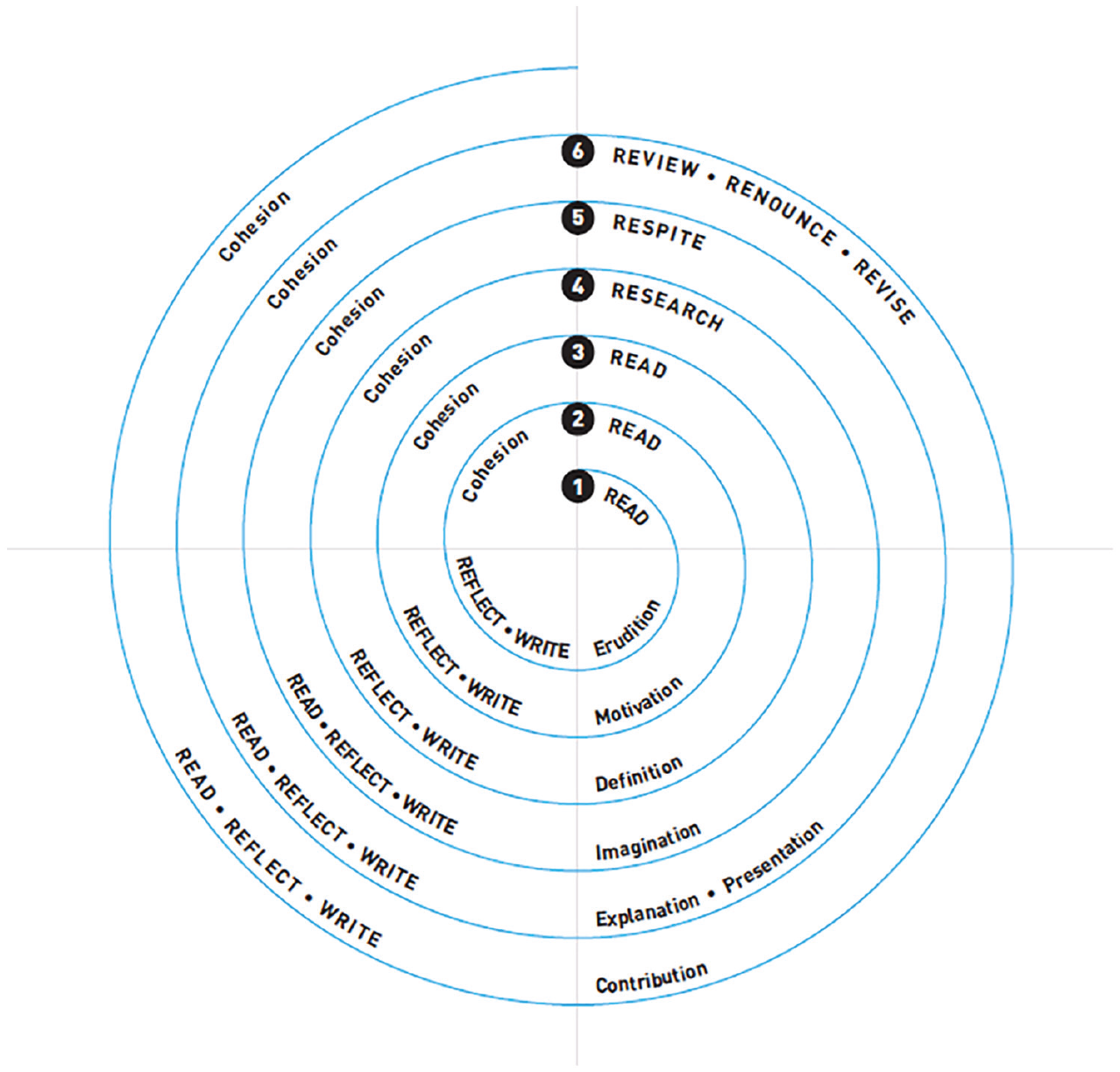
A spiral model of theory building.
Three activities—read, reflect, and write—are part of every iteration, and are likely to take place almost concurrently. Such activities may take different forms depending on the iteration in which they are effectuated. For instance, at the beginning of theory building, the theorist may only reflect, becoming introspective and contemplating her or his motivations in undertaking theory development. Reflect and read will also occur jointly, such as when the theorist consults the literature to understand it, map it, and make sense of it. Here, reading pertains to both scanning abstracts to select relevant sources and engaging with a source in greater depth, while reflecting takes the form of organizing, analyzing, and synthesizing. In the next iteration, the read and reflect activities will be motivated by a desire to identify trends or gaps in the literature or to challenge assumptions underlying a research domain. Later in the process, the reflect activity can occur conjointly with research, for instance, when the theorist conducts thought experiments to enrich his or her theorization. In this case, reading would follow researching and reflecting, with the theorist going back to the literature to determine the extent to which the results of thought experiments are new and interesting. Reading often implies reading one’s own work and reflecting pertains to assessing the written piece. Writing can take the form of jotting down ideas, documenting findings or hunches, sketching a model, and evidently putting into words the actual theory piece. No matter what form it takes, writing is essential throughout the theory-building process to capture the explanation as it develops.
The model illustrated in Figure 1 emphasizes that theorists are well advised to ensure that one specific ion—cohesion—is an ongoing outcome of their theory development process. Cohesion refers to unity within an ensemble and agreement among the parts of a whole. Checking for cohesion is essential throughout the process of theory building. Early on, cohesion must be established first between the phenomenon of interest and the literature that is reviewed, then between the gaps that the theorist observes and those he or she wishes to fill, then between the assumptions of the theory and the explanations it provides, and so on. Reflecting is a particularly important activity with respect to producing and ensuring cohesion, and this is one of the reasons why the reflect activity is present in each iteration.
Iteration 1—Activities: read, reflect, and write. Ion: erudition
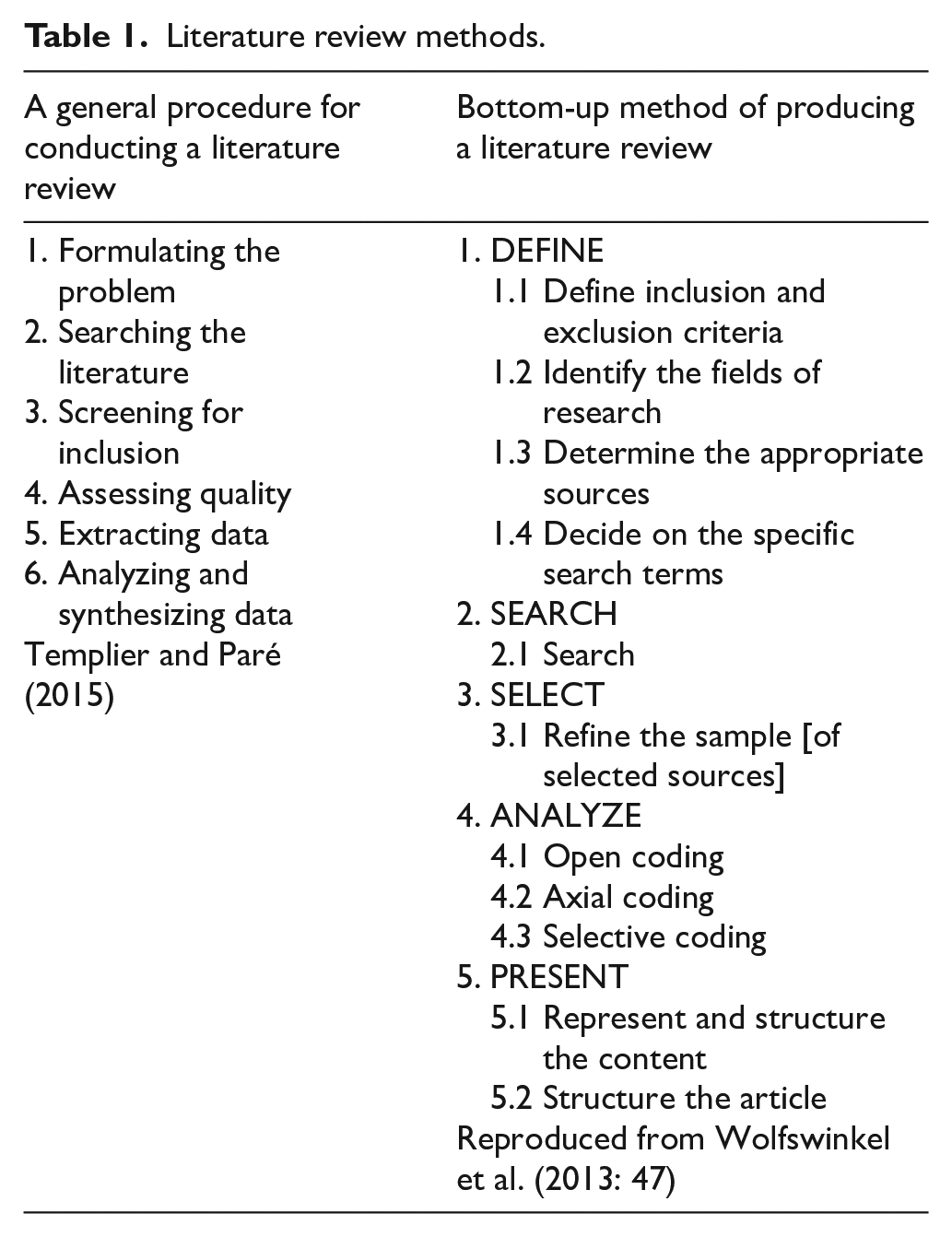
The first iteration situates the beginning of the deductive theory-building process at the intersection of the theorist and the existing knowledge represented by extant literature (Shepherd and Sutcliffe, 2011). This implies that one of its core activities is reading. The intensity of the review, in terms of its breadth and depth, will depend on the theorist’s knowledge of the literature. A theorist with intimate knowledge of the extant research on a phenomenon will approach and read this literature differently from one with less extensive knowledge. In terms of methods, many excellent sources propose methods for reviewing the literature. As illustrated in Table 1, there exist different approaches to reviewing the literature. The choice of a method, whether a traditional top-down or a bottom-up, grounded-theory inspired method, belongs to the theorist.
Literature review methods.
The main outcome sought during the first iteration is erudition. Defined as “great academic knowledge,” 3 erudition refers to the breadth and depth of one’s understanding of a particular topic, “acquired by study, research, etc.” 4 Constructing a theory requires this kind of deep and broad knowledge. This implies an internalization of the literature’s content in order to juggle concepts and organize them in a coherent whole that will provide a sound explanation of a phenomenon. To reach erudition, one must go through the steps proposed by literature review methodologists: search several sources and identify the relevant works; classify those works according to various schemes, such as levels of analysis, antecedent variables, and foundational theories; build descriptive tables that summarize this accumulated information; map the territory; and identify gaps. But these activities do not immediately yield erudition; they are the raw materials that serve as inputs to the ongoing reflect and write activities, which are essential if erudition is to develop as one reads the literature.
Iteration 2—Activities: read, reflect, and write. Ion: motivation
Although literature review methodologists often present their methods as a series of phases and stages, they emphasize the iterative nature of a literature review (e.g. Templier and Paré, 2015; Wolfswinkel et al., 2013). This is reflected in the first four iterations of the model presented here, as they take place when theorists engage with the literature, which is the raw material of deductive theory building. I propose that the main aim in the second iteration is to develop the motivation for the theory-building endeavor. In this context, read, reflect, and write will have a purpose quite different from that in the first iteration, although they will continue to support the development of the theorist’s erudition. Here, the reading becomes more analytic and more critical. The objective is no longer to extract the essence of what is known on a phenomenon of interest, to make sense of what others have written, and to map the territory of extant research. Instead, the objective is to identify gaps in extant explanations or to relax the assumptions that undergird extant research, with the aim of expanding extant knowledge on the phenomenon of interest.
Being interested in a phenomenon is often enough as a motivation for many theorists to undertake theory development. Most readers, however, expect more convincing arguments if they are to devote time to reading a manuscript. One motivation often used is that of identifying gaps in extant research. This is shown in Sandberg and Alvesson’s (2011) analysis of 52 articles published in premier organization studies journals, wherein gap-spotting was found to be the prevalent way to construct research questions. Sandberg and Alvesson further identified three modes of gap-spotting: (1) confusion spotting, which refers to the identification of competing explanations of a phenomenon or of contradictory evidence from extant research; (2) neglect spotting, which pertains to the search for areas within a field where no research—or no good research as put by Sandberg and Alvesson—has been conducted; and (3) application spotting, which corresponds to searching a field for areas where a given theory or perspective has not been mobilized. Gap-spotting is a legitimate and often fruitful approach to motivate a theory development effort. Yet care must be exercised in doing so: it is not only because a topic is understudied that it deserves further research or theorizing. It is possible that no-one ever studied it because it is not interesting! Theorists need to demonstrate that the gap they have spotted is important in terms of theoretical explanation, and that filling it will truly contribute to advancing knowledge.
Another motivation for engaging in theory building is the desire to conceptually clarify a construct. This approach can lead to important contributions. One notable example is that of Ajzen and Fishbein, who undertook the clarification of the attitude construct and ended up developing the Theory of Planned Behavior (TPB; Ajzen and Fishbein, 1977; Jaccard and Jacoby, 2010). In IS research, some strong theoretical contributions have been made by authors spurred by this motivation. For instance, observing confusion over the use of the terms “participation” and “involvement” in IS research, Barki and Hartwick (1989) argued for separation of the two constructs, with participation being a set of behaviors and involvement a psychological state. From this clarification, they developed a theoretical model explaining the relationships between involvement, participation, and system success (Hartwick and Barki, 1994).
A third and ostensibly powerful approach to motivate the development of new theory is problematization. Ranging from modifying the boundaries of a theory by relaxing assumptions (Whetten, 2002) to challenging the assumptions underlying existing theories (Alvesson and Sandberg, 2011), and even denying some assumptions (Davis, 1971), problematization is said to be a “central ingredient in the development of more interesting and influential theories” (Alvesson and Sandberg, 2011: 247). For instance, Simon (1972) proposed the theory of bounded rationality by modifying the assumptions of the classical theory of the firm, such as assuming that decision makers have only incomplete information about their choice of alternatives, and altering the nature of decision makers’ goals, from maximizing to satisficing. In IS, Moeini and Rivard (2019) adopted a problematization approach to analyze the IS project risk management literature, which comprises two dominant bodies of knowledge—the normative and the experiential—that diverge on some of their key assumptions. Aiming to advancing knowledge by bridging the two bodies of literature, the authors conducted a dialectical literature review that first synthesized both the normative and the experiential literature on IS project risk management. Performing dialectical interrogation, they then articulated the key assumption-level tensions between the two bodies of literature. Developing on the most salient assumption-level tension—pertaining to the relative performance of intuition and deliberate analysis for project risk assessment—that emerged during this interrogation, they developed a theoretical model aimed at resolving this tension.
Being an “endeavour to know how and to what extent it might be possible to think differently, instead of what is already known” (Foucault, in Alvesson and Sandberg, 2011), problematization does not primarily question how well some constructs or relationships between constructs represent a particular subject matter [. . .] Instead, it questions the necessary presuppositions researchers make about a subject matter in order to develop the specific theory about it. (p. 253)
Iteration 3—Activities: read, reflect, and write. Ion: definition
The theorist remains engaged with the literature during this iteration, but the purpose of this engagement switches from understanding and assessing extant knowledge to using it to set the foundations of the theory under development. The read, reflect, and write activities will focus on delineating the phenomenon that the theorist wishes to explain or explain and predict, stating the conceptual and contextual assumptions that set the boundaries of the theory under development, and developing clear conceptualizations of the constructs that will serve as the building blocks of the theory. Some of these defining elements will emerge from reading the literature anew and reflecting upon it to adopt extant definitions or develop new ones.
Therefore, definition is the key outcome of this iteration. Definitional clarity is indispensable for the authors to convey the meaning of their theory. Although construct definition first comes to mind when one refers to definitional clarity, it is not the only element that requires the theorist’s attention. The phenomenon of interest, the type of theory that is proposed, the boundary of the theory, and its underlying assumptions must also be clearly defined.
Definition of the phenomenon under study
Although the phenomenon under study may be obvious to the authors themselves, this is not always the case for the readers who, if they are confused, will either miss the explanation provided by the theory or misinterpret it. Consider the following example: the introduction to a manuscript announced that the authors’ aim was to propose a model of IS implementation. When reading this, an image formed in my mind that the paper would pertain to the implementation—including initiation, adoption, adaptation, acceptance, routinization, and infusion, as per Kwon and Zmud (1987)—of any type of software, whether a custom-developed system or configurable software such as an ERP. Yet, several pages into the manuscript, I realized that the paper dealt with configurable software only and was solely interested in its configuration, not in the whole implementation process; the phenomenon under study was no longer the same. And it changed again later, in the model itself, which pertained essentially to user–analyst interactions during configuration.
Definition of the type of theory being developed
Theorists also ought to define the type of theory they propose. Although there is general agreement about what a theory is (e.g. “a statement of relations among concepts within a boundary set of assumptions and constraints”; Bacharach, 1989: 496), it may have different purposes, as suggested by Gregor (2006). It is important to tell the reader whether one wants to explain a phenomenon or explain and predict some outcome. Also, because the phenomena we study may vary in terms of whether they are static or dynamic, authors should state whether they are proposing a variance or process type of theory (Poole et al., 2000) or a system or hybrid type (Burton-Jones et al., 2015; Ortiz de Guinea and Webster, 2017).
Definition of the theory boundaries
It is also essential that theorists specify the boundary of their theory, which is shaped by the theory’s underlying assumptions (Bacharach, 1989). Two types of assumptions are key to the specification of the boundary of a theory (Whetten, 2002). The first type, conceptual assumptions, “can be thought of as ‘second order explanations’—the implicit whys underlying an explicit answer to a specific why question [and] are often articulated using the language of foundational theories” (Whetten, 2002: 58). For instance, when theorists adopt transaction cost theory as a foundational theory, they espouse two key conceptual assumptions: bounded rationality and a “self-interest-seeking assumption that makes allowance for guile” (Williamson, 1989: 139). Similarly, adopting the TPB as a foundational theory implies the assumption “that any single sample of behavior reflects not only the influence of a relevant general disposition, but also the influence of various other factors unique to the particular occasion, situation, and action being observed” (Ajzen, 1991: 181). It is important that the manuscript makes such conceptual assumptions clear so that the reader can follow the authors’ theoretical explanation. It is also essential that a theory developed by mobilizing a foundational theory remains faithful to this foundational theory’s conceptual assumptions.
The second type of assumption that helps specify the boundary of a theory is the set of contextual assumptions that set the conditions that delineate the proposed explanation (Whetten, 2002). According to Whetten, failing to specify the contextual boundaries reduces the “power” of explanations. On this issue, Whetten cites Sutton and Staw (1995), who posit, “One indication that a strong theory has been proposed is that it is possible to discern conditions in which the major proposition or hypothesis is most and least likely to hold” (p. 376). Contextual assumptions pertain to when, where, and for whom the theory is assumed to hold (Whetten, 2002). For instance, Vial and Rivard (2016) propose a theory of the effects of institutional distance between parties in outsourced IS development projects. In addition to the conceptual assumptions of neo-institutional theory, the authors state the contextual assumptions that limit their explanation: (1) IS development projects that involve only two parties, a client and a vendor; (2) projects where a software artifact is built, configured, or maintained; and (3) the project requires regular exchanges between client and supplier.
Definition of the theory constructs
Constructs are the essential components of a theory and as such ought to be clearly defined (Weber, 2012). Failing to provide clear conceptual construct definitions can be particularly problematic because readers will themselves ascribe meanings to constructs, with the risk of ending up with as many meanings as there are readers. A good construct definition is said to be “a concise, clear verbal expression of a unique concept” (Wacker, 2004: 631). In contrast, a “bad” construct definition is “any verbal explanation that does not lead to a unique concept” (Wacker, 2004: 631). According to Suddaby (2010: 347), a construct definition should accomplish three main tasks. First, it ought to capture the essential properties and characteristics of the concept under consideration. Second, it should avoid tautology or circularity. Tautology refers to construct elements appearing in the definition, such as defining user resistance to IT implementation as “users who resist the implementation of a new IT.” Circularity is present when the antecedents or outcome variables are part of the definition, such as defining IT strategic capability as “the capacity to use IT in a manner that leads to sustained competitive advantage.” Third, a good construct definition should be parsimonious and capture succinctly the fundamental attributes of a concept, that is, attributes that are “necessary and sufficient for something to be an exemplar of the construct” (MacKenzie et al., 2011: 299). In practice, this means that conceptual definitions should include as few words as possible to “avoid violating the parsimony virtue of ‘good’ theory” (Wacker, 2004: 638).
The read, reflect, and write activities play a critical role in the elaboration of clear conceptual construct definitions. As suggested by MacKenzie et al. (2011), the initial activity in that context could very well be write. Indeed, the authors cite Clark and Watson’s (1995) perspective wherein [a] critical first step is to develop a precise and detailed conception of the target construct and its theoretical context. We have found that writing out a brief, formal description of the construct is very useful in crystallizing one’s conceptual model. (MacKenzie et al., 2011: 298)
Read then takes precedence, as MacKenzie et al. (2011) emphasize the role of reviewing extant literature to examine how the construct of interest has been defined in prior research before developing a new conceptualization. The role of the reflect activity becomes critical in the next steps: specifying the nature of the construct, which involves delineating the conceptual domain of the construct—that is, the type of property it refers to such as thought, perception, or action; identifying the entity to which it applies—that is, person, project, or organization; and clarifying the intention of the construct by describing its conceptual theme—that is, defining the set of attributes that are “necessary and sufficient for something to be an exemplar of the construct” (MacKenzie et al., 2011: 300) and determining its dimensionality and its stability over time. The write activity then returns to the forefront, as the resulting formal conceptual definition is advanced.
Iteration 4—Activities: research, read, reflect, write. Ion: imagination
Espousing Weick’s (1989) idea that theory construction is a highly creative endeavor, the model portrays imagination as the ion to emerge from the next iteration. Although we all wish to find sudden inspiration, a eureka moment, as great minds such as Archimedes and Newton allegedly experienced (Falk, 2005), the creative process that most of us experience in our theory development efforts is somewhat more arduous. This is often noted by reviewers and editors who deplore that a manuscript’s theoretical propositions are neither insightful nor meaningful and that they seem rather obvious, which makes their proposed theory simplistic. Furthermore, reviewers often deplore that not only the propositions but also the arguments supporting them seem to be too simplistic or underdeveloped and could have been justified more strongly. In many cases, the arguments supporting the propositions are based on what seem to be a simple translation or rephrasing of arguments drawn mainly from [the foundational theory or extant literature].
In a nutshell, reviewers appear to deplore a lack of imagination on the part of the theorist.
The spiral model of theory building described here proposes research as an activity that can stimulate the theorist’s imagination and help develop more interesting and original theories. In the model, the term “research” refers to the effectuation of mental activities, such as role-playing, analogizing, imaging, and conducting the thought experiments proposed in the theory-building literature. The following paragraphs present three types of such mental activities.
Generative theorizing practices
With the objective of informing the theorizing process and enriching the conversation on theorizing in the IS domain, Hassan et al. (2019) conceptualize theorizing by applying the Foucauldian notion of discursive formation. This leads them to propose four generative discursive practices that theorists can adopt to generate ideas and organize them to “make sense of the phenomenon” (p. 10) they wish to explain. As such, the four discursive practices are likely to be particularly effective in fostering a theorist’s imagination; the practices are analogizing, metaphorizing, mythologizing, and modeling.
To the theorist, a major benefit of analogizing is to facilitate the development of an explanation for a new phenomenon or concept by analyzing the similarities between this new phenomenon and a well-known phenomenon, as one way to gain an understanding of the new phenomenon (Kuechler and Vaishnavi, 2012). Defining analogizing as “using a simplified or scaled-down reference to something familiar to explain or illustrate something more complex or less familiar” (p. 10), Hassan et al. provide several examples of how analogizing has helped theory development. These include project escalation (Keil and Robey, 1999), wherein an implicit analogy is made with a military scenario, or Goffman’s (1959) presentation-of-self theory, which uses the analogy of theatrical performance in one’s interactions with others.
Metaphorizing is like analogizing, as it calls for referring to known phenomena to develop one’s explanation of a new phenomenon. The two practices differ in that metaphorizing goes further than using the similarities between two phenomena; it also uses the behavior of the known phenomenon to explain that of the new. The mere suggestion of the metaphor suffices to evoke “a network of analogies” (Hassan et al., 2019: 11). One example is the metaphor of political systems that underlies Weill and Ross’s (2005) typology of IT governance. Indeed, the mere mention of an archetype being a business monarchy, an IT monarchy or a feudal system has direct implications on the key characteristics of each archetype, such as the distribution of power within an organization, of the types of relationships among IT stakeholders, and even the types of conflicts that may emerge among stakeholders. It is important to note, however, that the metaphor does not constitute the theory (Bacharach, 1989). Theorists are encouraged to use metaphors as a tool for generating novel explanations for their object of study (Bacharach, 1989; Boxenbaum and Rouleau, 2011).
Mythologizing refers to the use of “myths, mythologies, and hidden assumptions to provide or interrogate a means of explanation, as well as to study symbols of value, coherence, unity, social structure, conflict and contradictions” (Hassan et al., 2019: 11). The authors provide several examples of IS researchers who identified myths either in extant practice or research, and developed explanations to “debunk” such myths, which include the myth of real-time systems that Dearden (1966) used to “expose several fallacies regarding the assumed capabilities of computers to support management functions” (p. 11).
The fourth generative practice proposed by Hassan et al. is modeling. They refer to a model as the “precise and economical statement of a set of relationships that are sufficient to produce the phenomenon in question” or the “actual biological, mechanical, or social system that embodies the relationships in an especially transparent way” (Schelling, 1978: 87, as cited by Hassan et al., 2019: 12). The authors suggest that models are “useful for building theories because they reveal the consequences of making certain assumptions and including or excluding certain elements in an economical way” (p. 12). Although a model is often used to represent the result of theorizing, the modeling process itself can serve as a valuable way to fire up one’s imagination.
Modeling as theorizing
While Hassan et al. view modeling as a generative practice, Whetten (2002) portrays it as actually theorizing and proposes a method to this end. The four-step method is based on Whetten’s (1989) set of questions, the answers to which constitute theoretical contributions. The first step involves answering the question of “What” and identifying the key constructs that will constitute the theory. Although the main constructs will have been identified in a previous iteration, addressing the question anew while modeling may very well lead to the identification of new constructs. In the second step, the theorist will answer the question of “How” the constructs are related. The nature of the relationship will indeed vary depending on whether the theory under construction is a variance or a process theory. The third step involves determining “Why” the constructs are related. During this step, the conceptual assumptions the theorist has defined earlier are brought to the fore where, according to Whetten, they will play an important role in the development of the explanation. The fourth step is that of answering the questions of “When-where-who” and will help refine the contextual boundary of the theory being developed. In addition to the cognitive activities of answering key questions, the method implies physical activities. Indeed, Whetten suggests writing the names of the constructs on Post-It® notes (PINs) and starting with the focal construct’s PIN at the center of the model, add other constructs, at times treating them as direct antecedents, mediators, or moderators and at other times treating them as consequences. My experience is that physically rearranging PINs on a board or a desk is itself an exercise that fosters one’s imagination.
Applying heuristics
In their book on theory construction, Jaccard and Jacoby (2010) suggest heuristic techniques. Although they argue that “there is no simple strategy for generating good ideas or good explanations [and that] it is a creative process that is difficult to articulate, describe and teach” (p. 40), the heuristics they describe—from conducting thought experiments to shifting the unit of analysis—can help generate ideas about the phenomenon one seeks to explain. I do not intend to review all 26 of the heuristics they propose. Instead, I will introduce two of them as illustrations and invite authors to consult Jaccard and Jacoby’s work and apply some of those heuristics when developing their theories.
Example 1—Alternate between abstractions and specific instances of the phenomenon under study
Here, Jaccard and Jacoby suggest that “[t]heory is developed by thinking about concrete instantiations of concepts and then abstracting upward to more general constructs that allow us to make theoretical propositions” (p. 56). This heuristic is readily applicable and useful, notwithstanding the theorist’s preferred mode of thinking. For example, some minds work better at the level of concrete instantiations. Remaining at this level, however, may lead to propositions that seem obvious or to models that will be deemed simplistic. When trying to explain why software project managers adopt risk management practices, for instance, one may identify the following antecedents from a literature review: project size, technological newness, lack of user support, project manager’s training, and practices advocated by the project manager’s professional association. Propositions developed directly from these antecedents would resemble the following: project size (or project manager’s training) will have an effect on software project managers’ choice of project risk management practices. If the theorist moves to a more abstract level, project size, technological newness, and lack of user support may become risk sources, while the project manager’s training and practices as advocated by the project manager’s professional association may become institutional norms. The theorist might then derive a more interesting proposition: software project managers’ choice of project management practices will be influenced by project risk sources and by institutional norms. It is when one purposefully makes the effort to think in terms of more abstract constructs that more interesting theoretical explanations seem to emerge.
In contrast, some people think at very abstract levels. According to Jaccard and Jacoby, remaining at abstract levels may “obscure important distinctions that should be made” (p. 56), distinctions that can be identified when one moves from abstractions to specific instances of the phenomenon under study. This would be the case of a theorist who theorizes that institutional pressures (Scott, 2008) explain software project managers’ enactment of project risk management practices. Although this is an interesting proposition, it is too general. Moving to the concrete level might help the theorist draw a more finely grained portrait of institutional pressures, which might include practices advocated by project management professional associations, practices that are enforced by quasi-laws (such as the project risk management practices enforced by the Basel agreements), and practices that have developed within an organization and are now part of the organization’s culture. Moving back to an abstract level would result in the proposition that the institutional pressures emerging from the three main institutional pillars—normative, regulative, and cultural-cognitive (Scott, 2008)—may influence project managers’ enactment of risk management practices, hence providing a richer and more convincing explanation.
Example 2—Focus on processes or focus on variables
Most theoretical models developed in the IS domain are either variance or process models. As a way to foster the imagination of variance theorists, Jaccard and Jacoby suggest that they think about their phenomena of interest in terms of processes rather than variables. They suggest a strategy for invoking process perspectives by changing nouns into verbs. This would be the case, for instance, if someone started thinking about IT adoption in terms of adopting IT. Instead of theorizing on user, technology, or environment attributes that can lead to a certain degree of adoption, the theorist might reflect upon the stages in adopting a technology. Conversely, Jaccard and Jacoby suggest that for those who are accustomed to thinking in terms of processes, thinking in terms of variables might be more fruitful. They refer to Abbot and Alexander (2004), who proposed the heuristic of “[. . .] ‘stopping the clock’. The idea is to ‘freeze’ the process at a given point in time and then describe the system in detail at the frozen moment” (p. 55).
Iteration 5—Activities: respite, read, reflect, and write. Ions: explanation and presentation
The previous iteration, Iteration 4, was aimed at generating ideas about the relationships among the constructs of the theory being developed. Along with the other three iterations, Iteration 4 portrays theorists as constantly and purposefully working toward delineating, characterizing, describing, and understanding their phenomenon of interest. This ongoing mental activity is indeed fruitful, but from time to time, it leads to a state of mental exhaustion, where the theorist feels that something is missing, preventing the emergence of a rich explanation, most often of why the constructs of the proposed theory are related. I contend that respite—defined as an interval of rest or relief 5 —is the activity of choice here. Not only should it relieve the theorist from some of the mental exhaustion experienced, but it can also be most fruitful for generating two essential ions: explanation and presentation.
Here, the term “explanation” refers to causal relationships (Sutton and Staw, 1995); its use is based on the assumption that the main goal of theorizing is to answer the question of why (Bacharach, 1989). Indeed, “[e]xplanation, according to contemporary epistemology, requires unravelling causal processes that bring about theorized phenomena” (Avgerou, 2013: 400). Several different views of causality exist, among which theorists may choose to develop their explanation.
A particularly informative discussion of the nature of causal relationships is offered by Poole et al. (2000) and Van de Ven and Poole (2005). Contrasting and comparing variance and process explanations in terms of their assumptions about causality, the authors introduce Aristotle’s four types of causes: material, formal, efficient, and final. These four types of causes indicate as follows: that from which something was made (material cause); the pattern by which it is made (formal cause); that from which comes the immediate origin of movement or rest (efficient cause); and the end for which it is made (final cause). (Van de Ven and Poole, 2005: 1396)
Variance theory explanations are based on efficient causality and put forth the conditions, or antecedents, that are necessary and sufficient for the outcome to occur (Poole et al., 2000). Process theory explanations are also based on efficient causality—as “[e]ach causal event imparts a particular direction and pushes the developing subject toward a certain outcome” (Poole et al., 2000: 41). Process explanations, however, are based on necessary—but not sufficient—causality. Indeed, in contrast to variance explanations, in process theories, [b]ecause causal influences come to bear “eventwise”—through one or more events—rather than continuously, it is rare for a cause to be sufficient in narrative explanation. Only the entire set of forces that influence the developmental span, in the particular order and combinations in which they occur, are necessary and sufficient to explain a narrative. (Poole et al., 2000: 42)
Process explanations may also involve final causality and formal causality. Final causality is at play when an end or a goal guides the unfolding of a phenomenon. Formal causality refers to “a pattern that informs change; the pattern must be applied to the developing entity somehow, either through plan or through some other governing mechanism” (Poole et al., 2000: 42).
Focusing on causal reasoning in IS research, Markus and Rowe (2018) propose a three-dimensional framework of causal structure. The first dimension, causal ontology, pertains to the theorist’s “beliefs about the reality of causality” (p. 1258). The authors suggest that theorists will hold one of the following three beliefs: causality as a metaphor for a logical or metaphysical association, causality as a real mechanism, and causality as a “misnomer, because it incorrectly implies unidirectional, deterministic, external forces” (p. 1260). The second dimension, causal trajectory, refers to what is changed in causation. According to Markus and Rowe, there are three main trajectories of this type: across the boundaries of a stratified entity, within an undifferentiated entity, and “through the accretion (growth and complexification) over time of a heterogeneous entity” (p. 1260). The third dimension, causal autonomy, concerns the role played by human agents and/or by IT in a given change episode. Three arrangements of roles are proposed, as causality goes from people to technology, from technology to people, and back and forth between people and technology. Positioning oneself and the theory under development within this framework can be most useful as a way to help the theorist develop a congruent and rich explanation.
An explanation that is clear in an author’s mind does not automatically become so in the reader’s mind. The presentation of the theory includes the structure of the manuscript, the syntax, the vocabulary, and sometimes a graphical representation, which are powerful tools that authors can use to convey their novel explanation. These elements must be assembled very carefully and fully exploited in order for demanding readers to be able to embrace the author’s theoretical explanation.
For instance, referring to the structure of a paper, I once commented to the authors of a manuscript that it was only when I had read half of their paper’s third section that I realized that the section was indeed where they had presented their theoretical development. Why did this happen? First, the authors had not announced that the third section presented their theoretical development. Second, while the previous section had introduced their foundational theory, the third section continued to introduce new concepts from that theory. Third, the boundary of the theory and its underlying assumptions were never defined. Fourth, the key elements of the process theory, which comprised events, triggers, and sub-processes, had not been introduced. Although the authors probably took my comments as petty details, as we all know, the devil is in the details!
In terms of presentation, what else might help better convey the results of one’s theorizing efforts? Regarding another manuscript, an associate editor’s report mentioned that reviewers felt that the paper’s elements were disconnected because the authors did not provide an integrated visual depiction of their model. Although a figure does not constitute a theoretical explanation (Sutton and Staw, 1995), and is not always necessary for conveying an explanation, it often helps clarify it. Furthermore, as suggested above, the very activity of modeling—as in drawing a picture of one’s model—can be an intrinsic part of the theorizing process (Hassan et al., 2019; Whetten, 2002).
Propositions play an important role in the formulation of a theory, as they state the relationships among the theory’s constructs (Bacharach, 1989). Here, Bacharach portrays a theory as a system of constructs—bounded by the theorist’s assumptions—that are related to each other by propositions. Because a key goal of theory is to provide an explanation, “[t]o the extent the propositions imply causality either implicitly or explicitly, the predictive and explanatory power of [the] theory is enhanced further” (Weber, 2012: 21). This implies that, when wording their propositions, authors should try to go beyond statements of correlation between constructs, and weave in explanation.
Should the formulation of a theory always be presented as propositions? Maybe not. This is illustrated by comments that I received on a theory-building manuscript I had written with a co-author. In preparing our manuscript, we had spent hours formulating and crafting propositions that would crystallize our theoretical explanation. The reviewers, however, found that the power of explanation of this set of propositions was limited. Our associate editor commented that it might have been premature to “lock into this form of theory before examining other more comprehensive forms.” She suggested that [a] better approach might be to consider this theoretical contribution not as a set of propositions but a set of insights and criteria that would set the stage for the development of a more comprehensive theory in the future. Over the long term, taking this approach may lead to a more significant contribution to theory development in this area.
Following this recommendation implied for us to completely rewrite the presentation of our explanation. The resulting manuscript, however, was well received by our review team, and the manuscript was eventually accepted!
In my experience and in that of others, the difficult and profound questions around explanation and the demanding issues that need to be addressed in order to arrive at a presentation that will draw and maintain readers’ attention are better resolved when the mind of the theorist is not in a state of unrest. Therefore, respite is a key activity in the theory-building process: In his struggles with extremely complicated mathematics that led to the general theory of relativity of 1915, Einstein often turned for inspiration to the simple beauty of Mozart’s music [. . .] “Whenever he felt that he had come to the end of the road or into a difficult situation in his work, he would take refuge in music,” recalled his older son, Hans Albert. “That would usually resolve all his difficulties.” (Miller, 2006)
Einstein turning to the music of Mozart when he met a stumbling block in his theory building was a form of combinatory play, which describes the conscious and unconscious cognitive playful manipulation of two or more ideas, feelings, sensory experiences, images, sounds, words, or objects. In combinatory play, players experiment with hypotheses, they play with possible outcomes, and they adjust to unexpected results and even “failures.” These players compare, contrast, synthesize, and break apart disparate elements or constructs in the service of reenvisioning a larger whole. (Stevens, 2014: 99)
Although imagination is also nourished during combinatory play, it is my experience that periods of respite are particularly effective in yielding explanation and presentation.
Simply put, combinatory play pertains to situations where the theorist is not focused on theory building but rather lets her mind wander while being occupied by activities that are completely unrelated, such as running or washing the dishes (Stevens, 2014). During an interview on the process of planning the production of the opera Carmen, a stage director mentioned that decoupage and taking long walks were activities that he would perform when he had thorny issues to solve in staging the opera (Duchesne, 2019). While the research activity keeps the mind consciously focused on the phenomenon to be explained, during respite “the conscious mind remains busy with other tasks but the unconscious mind keeps working on the problem, combining or playing with ideas in ways rational thought might inhibit” (Stevens, 2014: 102). According to Stevens, this is when the “illumination” of the explanation can emerge. Although the outcome of combinatory play is not always an illumination in the sense of a “eureka” moment, it can nevertheless lead theorists to a more interesting explanation and a well-organized, clear, and interesting presentation.
Iteration 6—Activities: review, renounce, revise, read, reflect, and write. Ion: contribution
The review and revise activities require theorists to take some distance from their work and read it as if it was the work of another. Most of the time—except when the theorist is a perfectionist—when one thinks that a paper is finished, it is not. When reviewing our own work, we often identify issues that we just hope reviewers will not see. Most of the time they do see those issues. Therefore, the theorist would be well advised to complete a few iterations of self-imposed review and revision before considering the work complete. Although being one’s own reviewer is challenging, it comes more naturally after a period of respite. Although we are often anxious to submit a manuscript as soon as it is complete, leaving it aside for a while allows us to be more detached from it when time comes to read it one more time. Obtaining friendly reviews and workshopping one’s manuscript are also profitable. Often, the mere exercise of preparing a presentation makes us identify flaws, weaknesses, and areas for improvement!
Another essential activity, one that is most difficult to accomplish, is to renounce. The term renounce refers here to giving up some part of the manuscript we are writing or of the theory we are developing. Renouncing may imply to let go of one of the foundational theories we were using to develop our own theoretical explanation (e.g. because with hindsight we have one too many foundational theories), let go of a long literature review section that we painstakingly put together (e.g. when we realize that this literature review might have been too broad for the phenomenon we are studying), and let go of a set of propositions that we carefully crafted (e.g. when we realize that the large number of propositions we came up with challenges the parsimony of our theory). Often times, we have worked so hard to develop each element of our theory piece that renouncing to any of them is unthinkable. Yet, it often happens that after reviewing our own work—and more often when our work has been reviewed by peers—one of those elements suddenly appears superfluous and may even threaten the contribution we purport to make. Because of all the efforts we have already invested in producing this work, we often resist renouncing. Yet, renouncing it may very well be the activity that is the trademark of true artisans, as they are engaged in the work in and for itself that they are willing to let go of part of it (Sennet, 2008).
In addition to checking for the presence of the ions of theory construction produced during the previous iterations, review, renounce, and revise activities should be focused on clarifying the contribution of the proposed theory. Having spent months, sometimes years, developing a theory—even an approximation—often comes with the conviction that a theoretical contribution is being made. Often the authors consider this so self-evident that they do not deem it necessary to spell out the contribution they are making. Nevertheless, one should not expect readers to see this contribution in the manuscript. Most often they do not, unless the authors explicitly state: how their theory is novel and different from extant explanations of the phenomenon of interest; what it can explain that other theoretical explanations have missed or ignored; how their theoretical explanation adds to extant knowledge about a phenomenon, to their field—and to other fields—of study; and how its use can change practice in the field of IS.
When authors have carefully reflected on their motivation and provided strong and convincing arguments for undertaking theory development, one way of presenting the proposed theory’s contributions is to return to these motivating arguments and discuss how each gap was addressed, how each unclear construct was clarified, or how relaxing each assumption has helped move the field forward.
Did we say cohesion?
Cohesion is an outcome of each of the six iterations of the theory-building process I describe, and for a good reason. A theory is an artificial world that the theorist has created. This artificial world comprises constructs, assumptions, a boundary, and relationships among the constructs. When formulating a theory, authors ought to ensure that all these elements form a cohesive whole. Unfortunately, this does not always occur.
Sometimes, the model proposed in a manuscript does not correspond to the phenomenon initially announced as the phenomenon of interest (see my earlier example about system implementation vs software configuration). It also happens that the theoretical explanation does not remain within the boundaries initially set. This was the case of a manuscript for which I was senior editor. The author had announced that the proposed theory would explain an individual-level phenomenon. However, the theoretical development proposed market-level explanations of the phenomenon of interest, thus moving outside the boundary originally set. The issue was not that the market-level explanation was irrelevant or problematic. Rather, it was the lack of cohesion between the stated boundary and the boundary-in-use. Since theory building is highly iterative, it may happen that the contextual assumptions specifying the boundary of the explanation will change, as in the example above. If this occurs, theorists ought to either revise their explanation or their contextual assumptions so that they fit the provided explanation. Authors should also ensure that their theoretical explanation is in line with the conceptual assumptions that help specify the boundary of their theory. For instance, if one develops a theory that fully espouses transaction cost theory, one must remain faithful to its underlying assumption of self-interest seeking with guile.
The vocabulary also needs to belong to the theory and only to the theory. I once attended a presentation on theory building given by Ajay K. Kohli, former editor of the Journal of Marketing. During his presentation, Kohli referred to “the synonym as the enemy of the theorist.” My reading of many theory development manuscripts—even my own!—strongly supports this statement. What did Kohli mean? At the core of the artificial world that we build—our theory—stand our constructs, which we name and define. It often happens that authors, probably because they want to reduce repetitions, use a synonym to refer to a construct. For instance, one of my co-authors and I proposed a process theory of a phenomenon related to software development. Two important concepts in our theory were the goals and the means of a software development project. Reading the manuscript for the nth time, I realized that, because of the multiple iterations we went through developing our theory, we ended up using “objectives,” “outcomes,” and “ends” as synonyms for our concept of “goal”—all within a single page! As noted by a reviewer of a manuscript on IT adaptation by users, which had synonyms for “IT adaptation” including “IS change,” “user modifications,” and “alterations to system,” this “slippage in terms” can be quite confusing for the reader and undermines the manuscript. To make sure that cohesion exists, nothing can replace an author’s thoroughness in reading, and re-reading the manuscript, almost as one would walk through an algorithm or program code, to make sure it is without defects.
Concluding remarks
In this article, I propose a pragmatic model of theory building, one that emphasizes the approximate nature of the theories we develop and the iterative nature of the theory-building process. The spiral model portrays theory building as an iterative process and suggests that each of six iterations produces an ion, each representing an element that is essential to good theory but whose presence is not enough to ensure that the theory under development has value. It is how the theorist assembles the ions that will provide value to the theory. As models do, this iterative representation simplifies reality. Indeed, if the emergence of a given ion is a more salient outcome of a given iteration, in reality, all ions may emerge as an outcome of any iteration. It is for the theorist to be attentive to the emergence of each ion, to capture it, and reflect upon how it will be combined with the other ions into a theoretical approximation that will advance knowledge.
Footnotes
Acknowledgements
Several people contributed to the development of this article. Nik Rushdi Hassan and Suprateek Sarker were instrumental in my undertaking this work when they invited me to speak about the process of theory building. During the numerous iterations of model building, I presented my ideas to several audiences who provided constructive comments. I am particularly grateful to colleagues from Aix-Marseille Université, Nanyang Technological University, Queen’s University, the University of Auckland, and to the PhD students who took my Theory Building seminar at HEC Montréal. I am also grateful to Leslie Willcocks for his advice and support.
Declaration of conflicting interests
The author(s) declared no potential conflicts of interest with respect to the research, authorship, and/or publication of this article.
Funding
The authors disclosed receipt of the following financial support for the research, authorship, and/or publication of this article: This work was supported by the HEC Montreal Chair in Strategic Management of Information Systems.
