




Abstract
This study attempts to explain a systematic phenomenon that has been described in interlanguage grammars crosslinguistically: Null-Prep, which consists of omitting the obligatory preposition in certain movement constructions. We propose that Null-Prep is not related to lack of knowledge of wh-movement, as previously assumed, but to structural complexity; indeed, we consider Null-Prep a movement-derived structure. With evidence from prepositional relative clauses, wh-interrogatives, and sluicing constructions in first language (L1) and second language (L2) Spanish (English and Arabic L1s), we predict the potential appearance of the Null-Prep with a two-way complexity hierarchy that takes into account the syntactic position displaced, as well as its derivational complexity, in such a way that we calculate Null-Prep to occur more often in Relative Clauses, followed by Sluicing, and finally by Questions. This scalar phenomenon uniformly applies to all participants, native and L2 learners, emphasizing its universal nature.
I Introduction
The study of A-bar movement has been of crucial importance in the advancement of formal approaches to second language acquisition (SLA) research, for its investigation has afforded researchers the opportunity to hypothesize about and elaborate on the (in)accessibility to Universal Grammar by second language learners (L2ers). Typically, observation of constraints on movement (i.e. islands) has been taken as proof of mastering movement in second language (L2) grammars after puberty (Martohardjono, 1993; White and Juffs, 1998), and the lack of sensitivity to subjacency violations has been interpreted as some sort of impairment or defective L2 grammar (see, amongst others, Bley-Vroman et al., 1988; Hawkins and Chan, 1997; Johnson and Newport, 1991; Li, 1998; Schachter, 1990). However, more recently, several authors have cast doubt on the appropriateness of extraction from islands to assess accessibility to UG (Belikova and White; 2009; Espírito Santo, 2022; Perpiñán, 2020). In short, the debate has focused on the availability of movement (overt or covert) in the interlanguage grammar, particularly if the first language (L1) is a wh-in-situ language, and whether this availability comes directly from UG. Similarly, the focus of the discussion when investigating the development of A-bar movement in L1 grammars has also been whether children can resort to movement from the first stages of language acquisition, or whether it appears later (Atkinson et al., 2018; Guasti, 2002; Labelle, 1990, 1996; Pérez-Leroux, 1993, 1995). Whereas the general assumption is that by age 5–6 years, children’s syntactic knowledge of filler-gap dependencies is adult-like (De Villiers and Roeper, 1995; Roeper and De Villiers, 2011), little is known about the morphological characteristics of the structures formed when attempting to produce movement in developing grammars, basically because most studies only investigated the acquisition of (and the asymmetries between) subject and object relative clauses and/or questions (Friedmann and Costa, 2010; Guasti, 1996; to name a few), that is, relative clauses that are not typically morphologically marked, except for languages with case.
One relevant exception is the study of displacement of prepositional phrases (oblique positions), the object of our investigation. In these cases, most L2 studies have examined the acquisition of Pied-Piping (PiP) vs. the typologically marked Preposition Stranding (PS), so common in English. Most of these studies aimed at investigating which of these two strategies was acquired first when learning English. The cross-sectional evidence has repeatedly shown that, unless PiP is directly transferred from the L1 of the L2 learners, PS is acquired earlier in both L1 child acquisition (French, 1984; McDaniel and McKee, 1996; McDaniel et al., 1998) and L2 English (Bardovi-Harlig, 1987). PiP is the strategy in which the preposition moves along with the wh-word, such as in ‘In which house did you live?’; whereas in PS only the wh-word moves, and the preposition remains in its original position, as in ‘Which house did you live in?’ The attention to this debate (PiP vs. PS) has left other structural options out of the analysis and, oftentimes, unexpected results were not even reported in the results section (for instance, in Adjémian and Liceras, 1984; Bove and Limerick, 2020; Liceras, 1981, 1986; Mazurkewich, 1984), which stands in the way of accounting for L2 learners’ different morphosyntactic solutions. In the present study, we focus on one of those unexpected structural options: the one in which the obligatory preposition is omitted. This strategy, although usually substandard or ungrammatical, is not only systematically present in developing grammars, but it can also be found in stable grammars. The ‘No-Prep’ (Bardovi-Harlig, 1987), ‘Null-Prep’ (Klein, 1993b), ‘P-Chopping’ or ‘PP-deletion’ (Tarallo and Myhill, 1983) strategy consists of dropping the obligatory preposition when the Prepositional Phrase (PP) is displaced, as in relativization or question formation. A further option of not producing the obligatory preposition is the avoidance of the construction altogether (Guasti and Cardinaletti, 2003), which is frequent in child grammar. Another possibility is the appearance of intrusive resumptive pronouns, resorting to an A-bar binding strategy. However, resumptive pronouns do not seem to be prevalent in L2 grammars, not even in learners whose L1 productively employs them such as Arabic or Chinese (see Espírito Santo, 2022; Perpiñán, 2015). Thus, if full characterization of the properties of A-bar movement in developing grammars is pursued, then acquisition studies also need to account for these ‘other’ strategies that appear in the process of generating movement structures.
This study focuses on the generally understudied and underexplained phenomenon of omitting (or producing null) prepositions in wh-constructions in L2 interlanguage grammars. Ultimately, it aims at revealing the cause of the Null-Prep phenomenon and, with that purpose in mind, we explore to what extent the syntactic environment dis/favors its appearance. Furthermore, we are interested in determining whether the origin of the Null-Prep phenomenon concerns the L2 mental representation created in the interlanguage grammar, or whether it is the result of economical parsing mechanisms, if these two linguistic components can be dissociated at all. In particular, the research questions of this study are whether the Null-Prep phenomenon is the result of incomplete knowledge of wh-movement in the interlanguage grammar, and whether it appears differentially depending on the syntactic environment.
One of the originalities of this study is the examination of the Null-Prep phenomenon in three movement structures, so we can provide a more comprehensive view of this morphosyntactic strategy and how it relates to other more general structural considerations such as wh-movement or resource limitations. The next section briefly describes the three oblique structures under investigation (relative clauses, wh-questions, and sluicing constructions) in the three languages that we are taking into consideration in this study: Spanish, English, and Moroccan Arabic. Later, a brief summary of previous studies that have investigated this phenomenon will be presented, mostly from the SLA field, followed by a theory-based proposal regarding syntactic complexity, drawn from language typology data as well as atypical development and language disorders data. Section III lays out the research questions and hypotheses that guide this study; Section IV presents the two experiments that form the body of this investigation together with their results, and Section V discusses these results taking into account previous interpretations of the Null-Prep phenomenon and proposes a new explanation.
II The linguistic phenomenon
1 Wh-movement in oblique positions
According to Keenan and Comrie (1977), relativization strategies can be ranked by easiness of accessibility, forming an implicational hierarchy called Noun Phrase Accessibility Hierarchy (NPAH). This well-known hierarchy ranks relative clauses according to two main considerations: crosslinguistic or typological evidence and frequency of the relative pronoun function. The NPAH predicts that subject (SU) relative clauses are the less difficult and more frequent, followed by the direct object (DO) ones, and so on. The proposed order is represented in (1). The implicational nature of the NPAH expects that if a language allows lower elements in the hierarchy such as oblique or genitive relativizations, this language necessarily would also allow relativizations in higher positions. And although this hierarchy was not proposed with empirical psycholinguistic data to back it up, the underlying understanding is that the further down in the hierarchy, the harder / more costly it is to relativize.
(1) Noun Phrase Accessibility Hierarchy Subject (SU) > Direct Object (DO) > Indirect Object (IO) > Oblique (OBL) > Genitive (Gen) > Object of Comparison (OComp) (Adapted from Keenan and Comrie, 1977: 66)
This hierarchy was frequently employed in SLA studies to test the availability of universal scales in the development of a second language (for a review, see R. Elis, 2008: 563–67). For our case at hand, this hierarchy is relevant as it already predicts that oblique positions are hard to relativize and somewhat rare in the languages of the world. For the sake of comparability, we have chosen three languages that allow relativization in this position: Spanish (a), Moroccan Arabic (b), and English (c). In Spanish, our target language, as well as in Moroccan Arabic and English, oblique relative clauses are [+case] positions (Comrie and Keenan, 1979), as these require a preposition (2). Note that in these three languages, case assignment occurs before A-bar movement, so case is assigned in its original position and needs to be identical to the case expressed in the displaced constituent. That is, A-bar movement does not change case marking requirements. If the constituent required a preposition in its original position, it does so also in its displaced position, unlike what usually occurs in A-movement.
(2) a. El hombre * (con) {el que / quien} fui . . . the man with {the that / whom} I-went b. r-rajl * (mʕa) men mʃi-t . . .(from Nouhi, 1996: 11) def-man with whom went-I c. The man * (with) whom I went . . .
The case marker in the form of a preposition is also necessary for wh-questions (3):
(3) a. ¿* (Con) quién discutiste? with who argued-you b. * (mʕa)- men txaʕsm-ti? (from Ennaji, 1985: 83) with who quarreled-you? c. * (With) whom did you argue? / Who did you argue with?
In the case of sluicing constructions, and assuming that they imply deletion of a wh-question, as explained in detail below following Merchant (2001), the preposition may be deleted if it is part of a P-Stranding (PS) structure, as could be the case in English, the only one of these three languages that allows PS. This would explain its optionality in English (4c), but not in Spanish (4a) or Arabic (4b).
(4) a. Sé que María habló * (con) alguien, pero no sé ? (con) quién. I-know that María she-talk with somebody but b. Driss tkəllem mʕa ʃi wahəd, walakin ma ʕraft ʃ * (mʕa) mən. Driss talked with someone but not know (from Merchant, 2001: 99) c. I know that Mary talked to somebody but I do not know (to) who(m).
Whereas there is little doubt about the movement derivation of wh-interrogatives as these involve the overt displacement of the wh-word in the three languages and usually subject–verb inversion, this issue is controversial with sluicing constructions. According to Ross (1967) or Merchant (2001), proponents of a full structure in sluicing, the syntax of sluicing is the same as in wh-questions, so the wh-phrase moves to SpecCP, but the remnant TP is unpronounced or deleted at PF. It is then logical to assume, as an anonymous reviewer points out, that if the wh-phrase contained a stranded preposition, then it can be deleted with everything else in the sluicing construction: Mary talked to somebody, but I do not know who [Mary talked to]. Consequently, these cases would not constitute proper instances of Null-Prep as understood in this study; we will come back to this issue in Section V.
Non-movement proposals such as Chung et al. (1995) instead consider the wh-element to be base-generated in SpecCP and assume an impoverished structure of sluices; other proposals such as Culicover and Jackendoff (2005) or Ginzburg and Sag (2000) simply propose that there is no structural material generated (or deleted) and that the interpretation comes from semantic or pragmatic mechanisms. One argument in favor of the non-movement approach in sluicing is that sluicing does not violate island configurations. However, according to Merchant (2001), islands can be interpreted as a PF phenomenon. A key element for Merchant’s (2001) movement analysis is precisely the need for identical morphological case (the preposition) in the interrogative element remaining in the sluicing clause, which is particularly relevant for our study. Merchant argues that only if wh-movement has taken place in the sluice clause, so that the clause was fully present in the syntax at some point and later deleted, one can explain the case-matching condition. Thus, if the present study finds comparable data in relative clauses, wh-interrogatives, and sluicing, this could constitute further evidence of a movement explanation for sluices. Indeed, recent experimental approaches to sluicing (Mateu and Hyams, 2021) support a movement account, as acquisitional results go hand in hand with data from other A-bar movement structures, such as the subject–object asymmetry. In this sense, our results would not only speak about the nature of L2 interlanguage grammars and their ability to use wh-movement, but they could also be relevant for the syntactic analysis of sluices.
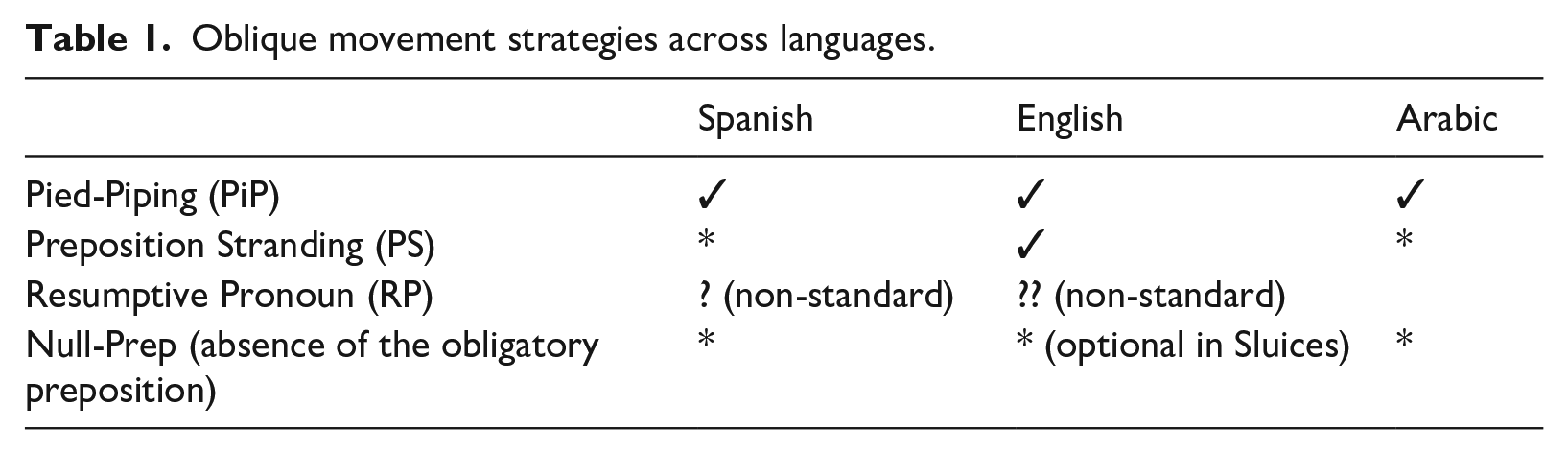
A further issue that we need to take into account when investigating oblique wh-movement in these languages is the variety of morphosyntactic strategies in which movement may take place. As previously exemplified, Spanish only allows for Pied-Piped prepositions (5c), that is, the preposition needs to move along the wh-element to a fronted position, regardless of register. Pied-Piping is also available in Arabic (5b) and English (5a), making the construction quite formal, particularly in English. In English, the most common strategy is Preposition Stranding (6a), which leaves the preposition dangling at the end of the phrase. PS is ungrammatical in Arabic (6b) and Spanish (6c). Lastly, Arabic usually employs a resumptive pronoun when relativizing (7b), which in English (7a) and Spanish (7c) is generally considered ungrammatical or substandard.
(5) Pied-Piping: a. The book b. L-katab c
c. El libro (6) Preposition Stranding: a. The book which / that you talked b. * L-katab aši / llii h c. * El libro el cuali / (el) quei hablaste (7) Resumptive Pronoun a. The book * which /?? that
you talked b. L-katab * aši / llii h c. El libro * el cual / ? que hablaste
Generally speaking, these strategies hold across the three structures we are dealing with: relative clauses, interrogatives, and sluicing. A summary of all these properties is displayed in Table 1.
Oblique movement strategies across languages.
2 Oblique movement in L2 studies: The Null-Prep phenomenon
Despite the relevance of the studies on wh-movement in adult L2 acquisition in the field of SLA, there are very few studies that have investigated the acquisition of wh-movement from a comprehensive perspective, taking into account several movement constructions simultaneously to reach broader generalizations. Most of these few studies mainly focused on the well-known subject/object asymmetry observed in both interrogative and relative clauses (Friedmann et al., 2009). In this literature review, though, we want to focus on the Null-Prep phenomenon in movement constructions, our ultimate object of investigation. As mentioned before, the Null-Prep phenomenon in L2 was observed when investigating the acquisition of PiP vs. PS. For instance, Bardovi-Harlig (1987), in a study of L2 English (95 participants from different L1 backgrounds and different proficiency levels, half of them Arabic speakers) investigated dative wh-questions and prepositional and phrasal verbs in relative clauses. The cross-sectional results showed that before mastering PiP or PS, the L2 learners go through a stage in which they do not produce the preposition, what Bardovi-Harlig calls the ‘no-prep strategy’. These findings led her to propose the following developmental acquisition order: (1) No-Prep > (2) PS > PiP. Very relevant for our study, she also found certain asymmetries between questions and relative clauses, as in L1 acquisition, with questions developing earlier than relative clauses, and PiP developed first in questions and later in relative clauses. In fact, they are in an implicational relationship: if a speaker is able to use PiP in relative clauses, she also knows how to make use of PiP in questions, but not the reverse. Bardovi-Harlig argued that the results were due to the availability of the input, and in particular to ‘salience’. She considers that PS in English is more frequent than PiP and also more salient to the learners. However, Bardovi-Harlig did not provide an explanation for the ‘No-Prep’ strategy, largely attested in her beginner levels (around 80% of their productions).
The appearance of Null-Prep, when explained, has usually been related to the optionality of strategies in oblique relativization or question formation, that is, a middle ground between PiP and PS. Of vital importance in this regard is the study of Klein (1993b, 1995), which investigated the acquisition of Pied-Piping and Preposition Stranding in questions and relative clauses in L2 English. She did not find a correlation with the phonological salience of the preposition or the type of preposition with its omission, and qualified ‘Null-Prep’ as a feature of a rogue grammar, outside UG, since an empty category cannot govern a trace. Later, Klein (2001) conceived Null-Prep as a mid-journey between PiP and PS, which makes the phenomenon intrinsically linked to the acquisition of English or any language that accepts both of these relativization strategies. However, studies on L2 French (Jourdain, 1996) and L2 Spanish (Perpiñán, 2008, 2010) also attested this form.
For instance, Jourdain (1996) further attested the Null-Prep phenomenon in L2 French with questions and relative clauses, proving that it is a genuine interlanguage phenomenon not reducible to the target or the native language, although it highly correlates with the proficiency level of the learners. Still, the frequency of appearance of Null-Prep is significantly lower in L2 French (similar to L2 Spanish; Perpiñán, 2010), between 5% and 38%, depending on the proficiency level, compared to the frequencies found in L2 English (30%–78%). Jourdain also observed asymmetries among prepositions, as less phonetically salient prepositions such as à and de were omitted more often than avec. This tendency was not found in English (Klein, 1993b). Finally, Jourdain gave two possible explanations for the Null-Prep: as a misset of parameters caused by lack of access to certain components of UG, or as a problem-solving issue caused by processing or cognitive overload.
Instead, Dekydtspotter et al. (1998) reanalysed the cases of Null-Prep in relative clauses as A-bar binding instead of movement, and proposed that apparent categorial mismatches in A-bar chains may result in preposition incorporation (Baker, 1988). That is, they assume a bound null PP-pronominal variable that gets its interpretation thanks to a D(iscourse)-linked wh-phrase (only available to subcategorized arguments). Under this view, Null-Prep is highly sensitive to discourse context. Ultimately, these authors assume an overall online computational complexity cost of move (8a), which learners (and also native speakers in oral production) would avoid by deriving the structure through a less costly operation, i.e. merge (8b).
(8) a. [CP Opi [IP. . . . . . [PP ti ] . . . . . .]] b. [CP Opi [IP. . . . . . [PP proi ] . . . . . .]]
Also very relevant from Dekydtspotter et al.’s (1998) analysis is that they rejected the idea of a wild or rogue grammar and fully characterized the Null-Prep phenomenon within the UG possibilities. The phenomenon is indeed attested in colloquial French with certain prepositions and in other languages such as Yoruba, Portuguese, or Cape Verdean Creole, among others (Alexandre, 2012).
Klein and Casco (1999) and Klein (2001) further reformulated their proposal and hypothesized, against Dekydtspotter et al. (1998), that learners indeed resorted to movement, but through a null-operator, which is licensed by a null preposition. The Null-Prep, then, is understood as the result of incomplete acquisition of wh-movement: operator movement as an option before fully acquiring wh-movement. It remains as an empirical question, though, whether a filler-gap dependency is psycholinguistically resolved differently depending on whether we assume the structure is derived by movement of an empty operator or by binding.
In order to answer this question, Perpiñán (2015) investigated whether the most recurrent non-standard options of oblique relative clauses found in interlanguage grammars actually appear as a result of their less costly processing. Perpiñán compared the online processing of relative clauses formed through PiP, PS, Resumption, and Null-Prep with a real-time self-paced grammaticality judgment task. She tested English and Arabic speakers learning Spanish, and her findings showed that reaction times in the verb region (when the head of the relative clause is integrated, and theta roles assigned) were only different at the PiP condition. Both experimental groups, as well as the control group, processed the verb faster when the relative clause was formed through PiP, compared to the other structures, which had significantly slower reaction times and no differences among them. These results led her to conclude that the presence of the pied-piped preposition had an anticipatory effect that facilitated the integration of the extracted element. That is, the parser was able to look ahead and plan for potential subcategorizers when the relevant clue, i.e. the preposition, was processed. Despite these processing results, Perpiñán (2015) did not find any significant difference across structures in the L2 learners’ actual judgments. In other words, the L2ers did not distinguish among relative strategies, i.e. they did not generally judge PiP as grammatical and the rest of relative clauses (Null-Prep, Resumption, PS) as ungrammatical; actually, they produced instances of these ungrammatical structures. Notwithstanding, these L2 learners were able to process the PiP strategy faster. Whereas PiP is indeed the grammatical and salient structure and, as such, it is supposed to be processed faster than its ungrammatical counterparts, these results could also be interpreted as evidence that non-movement constructions such as Resumption (binding) are not necessarily easier or less costly (time-wise) to derive, as typically assumed. In other words, processing efficiency as measured in reading times cannot be the sole explanation for the appearance and acceptance of these ungrammatical or non-standard options in developmental grammars. This interim conclusion brings us to the continuing debate on the relationship between linguistic representation and computational mechanisms, which will be considered further in the discussion section.
Finally, in a recent study on L2 European Portuguese by intermediate and advanced Chinese-speaking learners, Espírito Santo (2022) found that both native and non-native speakers alternated between PiP and Null-Prep in the oral production of oblique relative clauses (RCs) with relativized arguments. With adjuncts, on the other hand, only intermediate learners produced Null-Prep, whereas native speakers mostly employed PiP or the locative strategy with onde (‘where’). Similar results were found in a self-paced grammaticality judgment task (GJT), in which native speakers rejected Null-Prep with adjuncts but not with arguments, and all participants (native and non-native) had similar acceptance rates of Null-Prep with arguments. These results generally indicate that Null-Prep is an argumental phenomenon and that even though Null-Prep is available in the native input, some instances of the non-native Null-Prep may have a different nature, i.e. developmental. A further relevant result in this study is that Chinese learners did not produce resumption, despite its obligatoriness in Chinese oblique RCs. In other words, Espírito Santo (2022) did not find direct transfer from the L1 in this respect, not even in the intermediate learners.
It is worth mentioning that there are several studies on the Null-Prep phenomenon in monolingual grammars such as in Portuguese (Kato, 1993, 2010; Kato and Nunes, 2007; Tarallo, 1983), Cape Verdean Creole (Alexandre, 2012), and Spanish (Cerrón-Palomino, 2010, 2014). These authors refer to this phenomenon as prepositional phrase chopping or P(P)-chopping. The phenomenon is quite extended in European and Brazilian Portuguese, and the theoretical explanations have been several, from being the result of pro-drop in Brazilian Portuguese, which means that it originates from resumption (Tarallo, 1983), to movement of prepositionless DPs to a ‘default’ case position (Kato, 2010). From a variationist point of view, Cerrón-Palomino (2010, 2014) examined resumption and PP-chopping in Spanish relative clauses and concluded that whereas the resumptive pronoun appearance is dependent on the syntactic position relativized, PP-chopping is an independent phenomenon, not in complementary distribution with resumption (as it appears to be in Brazilian Portuguese; Tarallo, 1983).
Given these unsettled questions in previous studies, our present study aims at exploring a somewhat different route to investigate the source of Null-Prep as a pervasive interlanguage phenomenon. Inspired by several studies on treating syntactic deficits in selective language impairments (Levy and Friedmann, 2009; Thompson and Shapiro, 2005, 2007; Thompson et al., 2003), here we want to delve into the asymmetries typically found across different movement constructions and the potential relationship of the appearance of Null-Prep with the syntactic complexity of the structure.
3 Asymmetries between movement structures: Syntactic complexity
Thompson et al., (2003) formulated the complexity account of treatment efficacy (CATE), stated as follows:
(9) CATE: Training complex structures results in generalization to less complex structures when untreated structures encompass processes relevant to (i.e. are in a subset relation to) treated ones. (Thompson et al., 2003: 601)
In other words, a clinical intervention on a complex structure has beneficial effects on unattended syntactically related simpler structures. That is, in language pathology, clinically treating the most difficult structures such as relative clauses not only improves the treated structures, but it also has positive consequences on untreated syntactically simpler sentences such as clefts and wh-questions. This has been proven with individuals with agrammatic aphasia (Thompson et al., 2003), a group of which received training production of object-extracted who-questions (simpler structures), and another group received training in object-relative clausal embedding (more complex structures). For the first group, no generalization of improvement was attested in other structures, whereas for those who received object-relative training, the improvement was found across structures, indicating that generalization is enhanced when the direction of treatment is from more complex to less complex constructions. Relatedly, in a classroom intervention L2 study in which they provided instruction on only one type of relative clause to each group (one group received instruction on subject RCs, another group received instruction on object RCs, and the third one on preposition RCs), Eckman, Bell, and Nelson (1988) found in a post-test that maximal generalization of learning took place when instruction focused on the most typologically marked structure (preposition RCs) but not the reverse. These speech pathology and acquisition studies not only provide evidence for the implicational hierarchy of movement structures according to their internal derivation, but they also provide evidence in favor of the efficacy of the derivational theory of complexity beyond theoretical linguistics (Marantz, 2005).
Crucially, the CATE proposal is based on syntactic complexity, and to measure it several variables are taken into account such as the number of embeddings and/or verbs in the sentence, the order of the constituents (canonical vs. non-canonical), and the length of the filler-gap dependencies. A comparable derivation complexity metric is put forward by Jakubowicz and Strik (2008) and Jakubowicz (2011), based on economy considerations for the development of questions in children. Their Diversity Complexity Metric (DCM) is formalized as follows:
(10) a. Merging α n times gives rise to less complex derivation than merging α (n+1) times b. Internal merge of α gives rise to less complex derivation than internal merge of α + β
Complexity considerations have proved to be significant in the development of language in children (Bentea and Durrleman, 2014; Prévost et al., 2010, 2014), atypical grammars (Thompson et al., 2003; Thompson and Shapiro, 2005, 2007), heritage languages (Hopp et al., 2019), and L2 grammars (Slavkov, 2015; Turrero-Garcia, 2017).
In this section, we focus on the different derivational history of questions, sluicing, and relative clauses, in particular in terms of syntactic complexity. In theoretical terms, merge and move (Chomsky, 1995; Marantz, 1995) explain sentence formation. Merge is an operation by which two categories are combined to form another category, whereas move is an operation by which a word or phrase is displaced from one position to another. Under principles of economy, a structure that requires more merging and/or movement operations would be more complex than one that requires fewer operations. The standard analysis for wh-movement in languages that display fronting such as Spanish is that the wh constituent moves to a higher position, in particular to the SpecCP position (11b), followed by T-to-C (head) movement. As for PiP structures, we assume that the preposition merges with the wh-word (11a), an extra previous step that direct object interrogatives, for instance, do not require. Questions can present different levels of complexity, as they can involve long vs. short movement, simple vs. multiple wh, direct vs. indirect questions, or extractions from islands, with different levels of complexity, and this has direct effects on their acquisition (Hopp et al., 2019; Turrero-Garcia, 2017). However, in this study, we only focus on wh-question movement within a clause.
(11) a. Los compañeros de oficina piensan PP[P
en DPquién]. Merge the mates of office think on whom b. ¿[CP[PP En quién]i los compañeros de oficina piensan ________i? (A′-) Move on whom the mates of office think c. ¿[CP [En quién] [C piensanj [los compañeros de oficina [T ______j? (T-C) Move on whom think the mates of office ‘Who are the office mates thinking about?’
With respect to sluicing, following Ross (1967) and Merchant (2001), the wh-phrase that appears sluiced at the end of the structure is a full interrogative CP that is later deleted, as depicted in (12). Only this late deletion rule can explain the case-matching effect in oblique structures such as preposition stranding or pied-piping as seen in (4). Thus, the sluicing constructions that we consider in this study involve movement within a clause plus deletion, an extra operation as compared to wh-movement in questions.
(12) a. Anne invited someone, but I don’t know who. (from Merchant, 2001: 40) b. . . .
c. Anne invited someone, but I don’t know [CP who [C’ [C0 [+Q] [IP ]]]]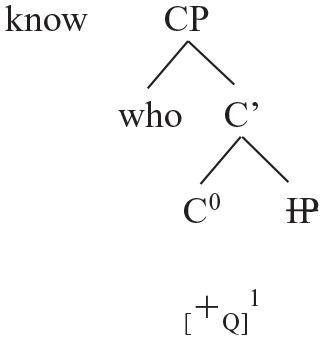
Finally, assuming the head movement analysis of relative clauses (Bianchi, 1999; Kayne, 1994), relative clauses with relative pronouns feature more movement operations than wh-questions and sluicing. They involve a phrase-internal movement in SpecCP, which is absent in wh-questions and sluicing. The derivation of relative clauses looks as follows (Kayne, 1994: 89–90):
(13) a. [DP the [CP [DP picture [which picture]] [C0 [IP Bill saw [DP which picture]]]]] b. [DP the [CP [PP hammer [with which hammer ]] [C0 [IP he broke it [PP with which hammer]]]]]
Italics signal the traces of the moved elements to allow the reconstruction of the derivational history. The relative pronoun is a wh-determiner which pied-pipes the nominal complement and, if present, the preposition (two potential merge operations). Not only is there pied-piping; the complement of the wh-determiner also raises to the specifier of the determiner and the preposition, respectively. No such extra-movement is found in wh-questions and sluicing. Thus, following the complexity of the derivation, we propose a complexity hierarchy of the movement derivations used in this study, in which relative clauses are the most difficult ones, followed by sluicing, and finally by questions. This hierarchy could be complemented with other movement constructions such as clefts, islands, etc., as new empirical evidence comes to light.
(14) Complexity Hierarchy: Relative Clauses > Sluicing > Questions
III Research questions and hypotheses
The focus of this study is the relationship between the Null-Prep phenomenon and wh-movement. Given previous studies on the Null-Prep phenomenon, and its explanations as a wild grammar (Klein, 1995), non-movement (binding) derivation (Dekydtspotter et al., 1998), or a dithering acquisition between PiP and PS (Klein, 2001), our first general research question regards the relationship between the appearance of Null-Prep and knowledge of wh-movement in interlanguage grammars. In particular:
Research question 1: Is Null-Prep a direct outcome of incomplete knowledge of wh-movement?
If the Null-Prep phenomenon is indeed the consequence of a deficient or absent knowledge of wh-movement in the interlanguage grammar, we would expect comprehensive difficulties in all three structures, as we would expect A-bar movement to be impaired across the board. If this were the case, we anticipate that Null-Prep would alternate with avoidance strategies and/or with resumption, that is, with non-movement strategies. If, on the other hand, we find instances of PiP alternating with Null-Prep, we could then hypothesize that the difficulty does not necessarily lie on the movement derivation per se, but on the morphosyntactic complexity of PiP and/or the merging of the preposition. Additionally, if we find asymmetrical results across the three structures that we are investigating, we would explore the complexity of derivation. This leads us to our second research question:
Research question 2: Is Null-Prep a byproduct of the complexity of the derivation?
Our prediction is that more complex structures would favor the appearance of Null-Prep in the grammar. Specifically, we predict that if a learner produces Null-Prep in questions, they will also produce it in more complex structures such as sluicing and relative clauses, as we envision the hierarchy we proposed in (14) with an implicational nature, following the assumptions of the Noun Phrase Accessibility Hierarchy (Keenan and Comrie, 1977) and the CATE (Thompson and Shapiro, 2005, 2007).
Finally, as a way to disentangle possible L1 or transfer effects from complexity issues given the differences among the three movement structures in the three languages that we are considering, we wonder whether the Null-Prep phenomenon would appear differentially depending on the morphosyntactic realization of prepositional wh-movement in each language:
Research question 3: Do we see different frequency/acceptance of Null-Prep depending on the specific properties of the L1 of the learners?
If we find differences in the behavior of the two L2 learners’ groups, even though direct transfer cannot explain Null-Prep as it is not grammatical in the L1 of the learners, the results may be explained in terms of crosslinguistic effects. In particular, we could expect instances of preposition stranding in the interlanguage grammar of English-speaking learners and resumption in the interlanguage of Arabic-speaking learners. Ultimately, we are interested in examining whether Null-Prep is a language-specific or a universal phenomenon in developing grammars.
IV The study
To examine the Null-Prep phenomenon and its relationship to movement and syntactic complexity, we designed two experiments: a production experiment with two tasks, one targeting relative clauses and the other one focused on wh-questions. The second experiment was a processing task that included the three structures investigated (questions, relative clauses, and sluicing) in Spanish as the target language.
1 Participants
An initial pool of 116 Spanish learners (L1 English or L1 Arabic) and 20 native Spanish speakers participated in this study. The Arabic speakers (n = 35) were all native speakers of the oral Moroccan Arabic variety dariya (دارجة) educated in Standard Arabic and French. These speakers were students of intermediate or advanced Spanish courses either at the Instituto Cervantes or at the language academy ‘Dar Loughat’ in Tetouan, Morocco. Most of them were college graduates (mean age = 25.6 years), and all of them reported not being fully fluent in French. The English-speaking learners (n = 81) were monolingually raised college students enrolled at two US universities at the time of testing (mean age = 21.9 years). The control group consisted of native speakers of Spanish (n = 20), from different Central and South American dialectal varieties as well as Peninsular Spanish. Their mean age at the time of testing was 32.25 years. They were all college graduates, except for two of them. All participants completed a consent form to participate in the study and a language background questionnaire with general demographic information such as age, place of birth, residence, etc., as well as languages spoken at home during childhood. Participants that spoke a different language at home other than Moroccan Arabic, English, and Spanish, respectively, were not considered in this study.
2 Tasks
a Pre-experiment
Materials: Proficiency/ screening test
All participants took a proficiency test of 40 questions, 19 from the Michigan vocabulary test, and 21 from a slightly modified version of a grammar section of the superior level (C2) of the standardized Diploma de español como lengua extranjera (DELE), created by the Instituto Cervantes. We slightly manipulated the multiple-choice grammar task so that it included six screening items that tested subcategorization knowledge of the target prepositional verbs. We chose two items per preposition (2 × 3), and we made sure these prepositions only introduced arguments and not adjuncts in these structures: hablar de (‘to talk about’), depender de (‘to depend on’), pensar en (‘to think about’), confiar en (‘to rely on’), soñar con (‘to dream about’), contar con (‘to count on’) (see Appendix A in supplemental material, Table A1.1). These verbs also required an obligatory preposition to introduce an argument in the native languages of the participants (English and Moroccan Arabic). The multiple-choice task included three options: the target preposition, an incorrect preposition, or Ø. 2
Procedure
The pre-screening task was administered in a classroom setting, in a paper and pencil format. Participants that satisfactorily completed the pre-experiment task were invited to participate in the remaining experiments on a different day. All participants read an information letter and signed a consent form but only those that completed the entirety of the study were paid for their participation. Experiments 1 and 2 were completed in a quiet room, individually, with the first author, in two different sessions of approximately 45 minutes each. In the first session, participants completed the online-self paced reading tasks (and other tasks not reported here), and in the second session participants completed the oral tasks (among other oral tasks not reported here).
Pre-experiment results
Only participants that chose a preposition, correct or incorrect, that is, those who did not choose a transitive construction (Ø) for any single prepositional verb, were invited to participate in the remainder of the study. This implied that 62% of the initial pool of participants was discarded, as only 22 English-speaking learners of L2 Spanish and 22 Arabic learners of Spanish (out of 112) passed the screening text. Later, two more participants were removed from the analysis because of their extremely slow reading times in the processing tasks (Experiment 2). From now on, all reported data in this study correspond to these 42 L2 learners (21 English L1 and 21 Arabic L1), and 20 native speakers.
Responses to the screening task showed that the English learners were the participants who had the most difficulty choosing the required preposition for each verb. In fact, in this pre-experiment we can see a clear L1 transfer effect, especially in verbs such as depender and soñar in which almost half of the English speakers learning Spanish opted for the literal translation of the English prepositions on or of/about. 3 Table 2 summarizes the preposition selection with the target verbs in the participants that did not choose any transitive construction (those were already discarded).
Percentage of accuracy and (number of participants) in preposition selection.
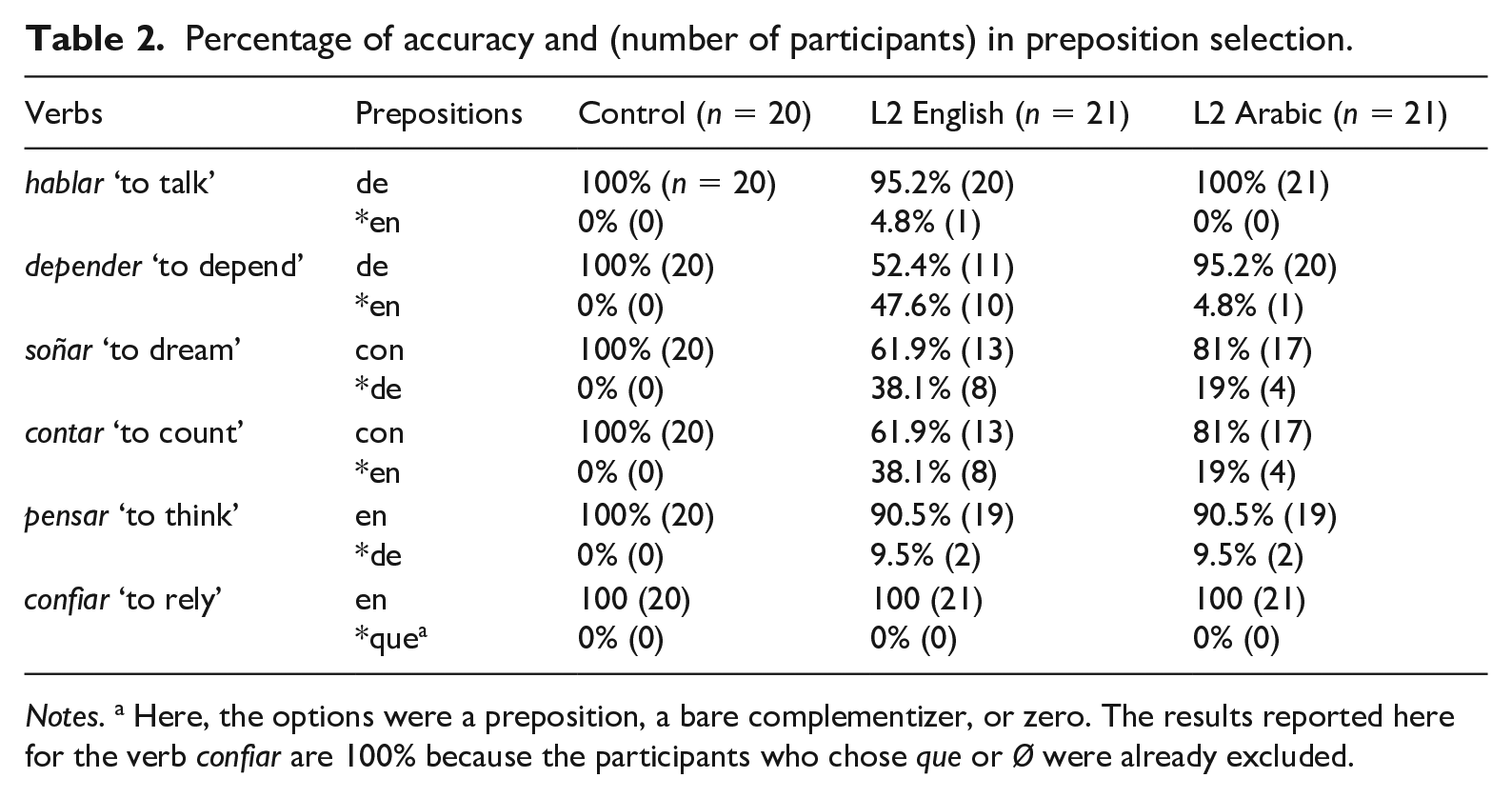
Notes. a Here, the options were a preposition, a bare complementizer, or zero. The results reported here for the verb confiar are 100% because the participants who chose que or Ø were already excluded.
The participants’ proficiency scores (maximum score 40) were submitted to a one-way ANOVA and, as expected, the results of the ANOVA indicated a significant effect by group F(2,59) = 28.74, p < .001. A post-hoc Tukey HSD test revealed that the only different group was the control group (p < .001), whose mean score was 39.6 (SD .681), with a 99% rate of accuracy. The Arabic (mean score = 25.67, SD = 8.79, 64% accuracy) and English learners of Spanish (mean score = 26.05, SD = 7.32, 65% accuracy) did not differ significantly (p = .98). These results classify the experimental participants of this study as intermediate learners of Spanish.
b Experiment 1: Production
Task 1: Oral production of relative clauses
Participants were presented with an image on a computer screen along with some information describing it. The information was written on the screen and read out loud by the researcher. Participants were instructed to complete the sentences according to the information previously introduced. The second slide targeted the extracted element and a written question that the participants needed to answer; this was also read out loud by the researcher. The beginning of each response was provided so that we made sure that the head of the relative clause was the expected one. All responses were recorded with a digital recorder through a headphone microphone set. Later, the recordings were transcribed and coded according to the structure produced.
There was a total of 12 experimental scenarios: six eliciting oblique relative clauses, one for each target verb, and six eliciting direct object relative clauses with transitive verbs that acted as fillers. One model scenario for each syntactic structure and a practice situation were provided before the experiment started. Example in Figure 1 targets the verb pensar en, and the expected response was: Esta es la secretaria en la que piensan los compañeros de oficina (‘This is the assistant about whom her office mates think constantly’).

Situation targeting an oblique relative clause.
Task 2: Oral production of wh-questions
Participants were presented with the same pictures as in Task 2 and the same background information. This time the target oblique argument was presented as the answer to a question that participants were instructed to formulate using the previous information. This task elicited wh-questions extracting oblique objects (one for each target verb), as well as direct objects, and subjects (6 × 3 = a total of 18 scenarios). Participants were recorded producing the sentences which were later transcribed and coded. The example in Figure 2 targets the verb pensar en, and the expected response was: En quién piensan los compañeros de trabajo constantemente? (‘On whom do the office mates think constantly?’)

Situation targeting an oblique wh-question.
c Experiment 1: Results
Task 1: Production of relative clauses
Participants’ responses were coded according to the syntactic structure. In the case of PiP, a structure was coded as such as long as it included a preposition before the relative pronoun, even when the preposition was not the correct one. Other morphological considerations – such as the specific form of the relative pronoun (human–non-human), the presence of the article, which is usually optional, or the gender/number agreement of the article/pronoun with the antecedent – were coded but will not be taken into account here. Thus, some of the target PiP production might be morphologically deficient, i.e. formed with the wrong preposition, or wrong agreement, but syntactically accurate. These considerations also apply to the coding of questions and sluicing. Due to space limitations, and our specific focus on the Null-Prep phenomenon, we will only report in detail the results from the contexts that targeted oblique relative clauses, leaving aside the direct object context, in which participants were more accurate, as the statistical model showed. For more information on other syntactic positions, see Perpiñán (2013). Table 3 presents the percentages of production and counts by group.
Frequency and constructions produced in oral prepositional relative clauses, percentages, and (raw numbers).
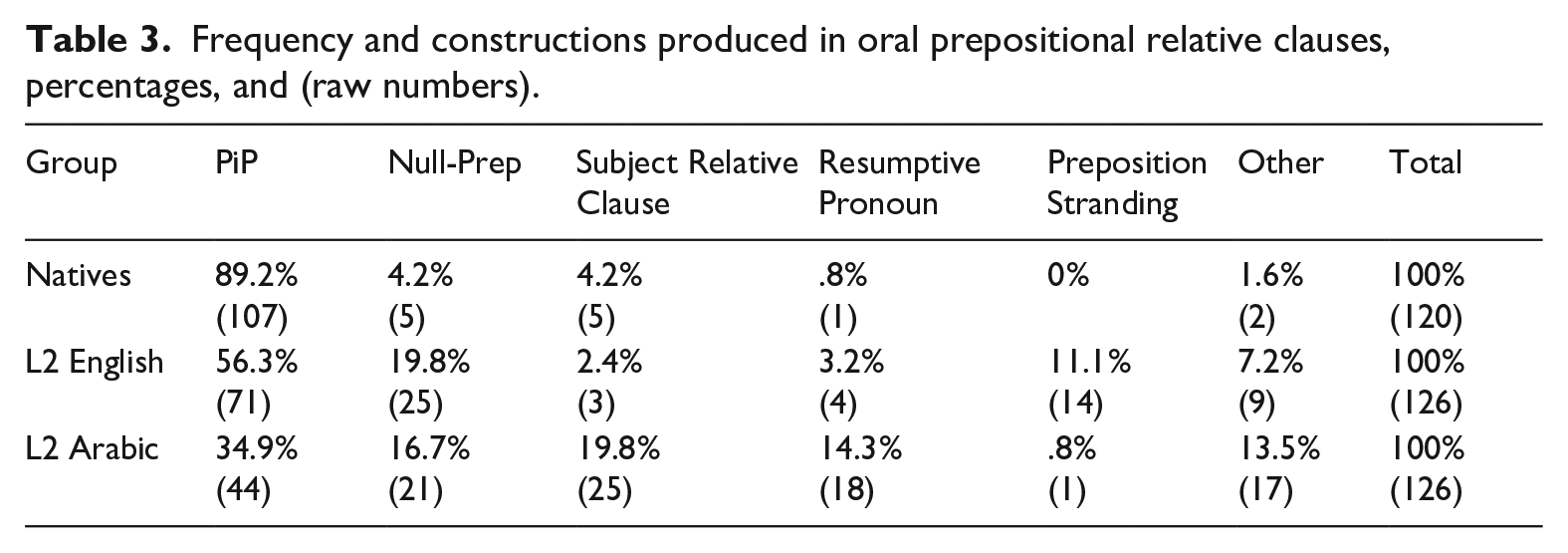
To different extents, PiP, the expected response, was the most produced strategy by all groups. The L2 learners also produced a significant amount of the structure that mirrors their L1: in the case of Arabic speakers, they produced over 14% of relative clauses with a resumptive pronoun (15a), in this case with a gender agreement error. As for the English speakers, they produced 11% of Preposition Stranding (15b). Remarkably, both groups produced more Null-Prep than L1 transfer structures: almost 20% of the relative clauses were produced without the obligatory preposition in the case of the English learners, and 16.7% in the Arabic group (15c). Thus, the Null-Prep structure is prevalent over L1 transfer structures. Null-Prep also appeared anecdotally in the native speakers (4.2%). Additionally, Arabic speakers resorted to a more ‘accessible’ structure, a subject relative clause, changing the meaning of the relative clause in almost 20% of their productions.
(15) a. Esta chica es la secretaria que los compañeros de oficina piensan en él. This girl is the secretary that the mates of office think.3pl of him L1Arabic #38 b. La chica que los compañeros de oficina están pensando en constantemente. The girl that the mates of office are thinking of constantly L1 English #20 c. Esta es la secretaria que los compañeros de oficina piensan constantemente. This is the secretary that the mates of office think.3pl constantly L1 Arabic #50
Task 2: Production of interrogative sentences
For length limitations, we only report the sentences elicited in the oblique context, in which PiP was expected and, indeed, overwhelmingly produced, as results in Table 4 show. Interestingly, only the English-speaking learners had comparable rates of Null-Prep in relative clauses and wh-questions (16a); they also produced some subject questions instead (16b), changing the intended meaning. The Arabic speakers hardly produced Null-Prep in questions, but they produced direct object questions, that is, they changed the oblique verb for a transitive verb (16c).
Frequency and constructions produced in oral prepositional questions, percentages, and (raw numbers).
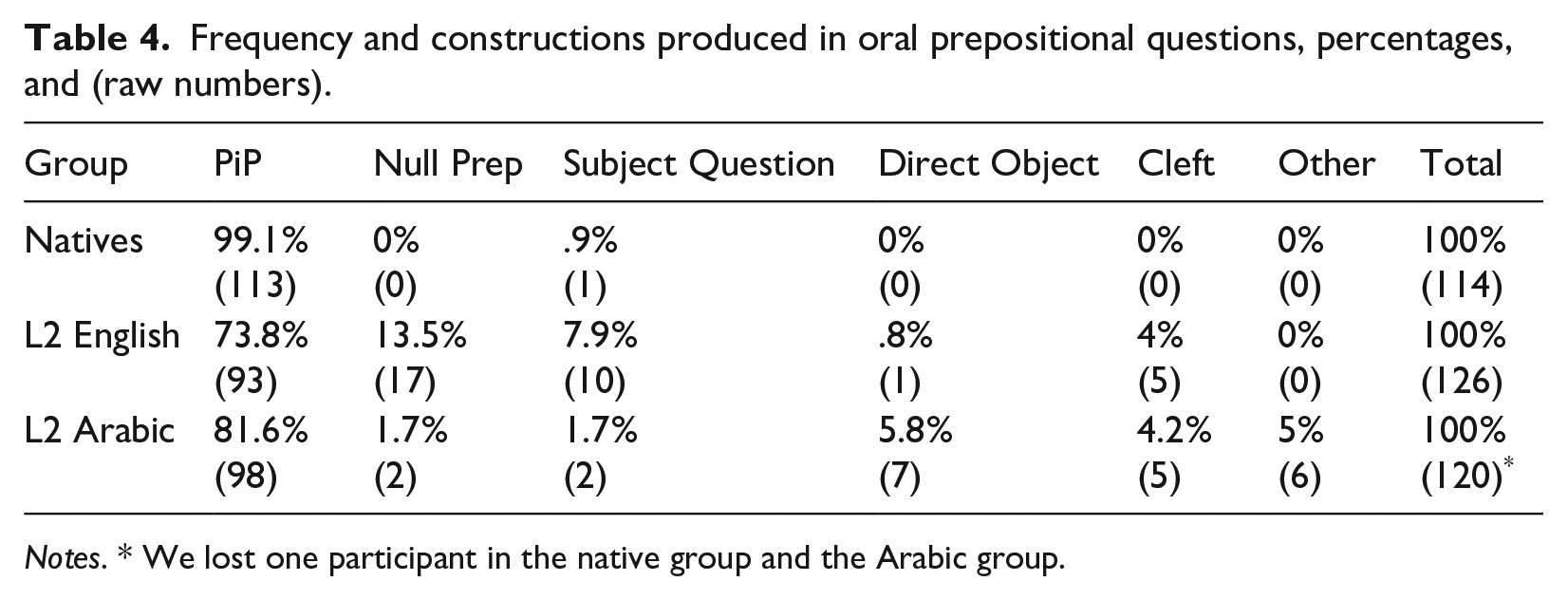
Notes. * We lost one participant in the native group and the Arabic group.
(16) a. ¿Quién piensan los compañeros? Who think.3pl the mates ‘Who do the colleagues think?’ L1 English #11 b. ¿Quién piensa en los compañeros de trabajo constantemente? Who think.3s of the mates of work constantly ‘Who thinks of her office mates constantly? L1 English #6 c. ¿Qué piensan los compañeros de trabajo de la mujer? What think.3pl the mates of work of the woman? ‘What do the woman’s office mates think? L1 Arabic #46
We further coded for verb movement in the oblique wh-questions, with rates of 100% of subject–verb inversion in the native speakers; 94% of subject–verb inversion in the English-speaking group, 3% of in-situ questions, and 3% questions with a null subject, so we cannot tell whether the verb has moved. In the Arabic-speaking group, 88.3% produced the questions with subject–verb inversion, 5% of wh-in-situ, and 4% of wh-fronting with no subject–verb inversion. With these overall fronting and subject–verb inversion results, we can safely conclude that the participants generally employ wh-movement and T-to-C movement when forming oblique interrogative sentences in their Spanish interlanguage.
As for the statistical analysis, we ran two models: one predicting overall accuracy comparing the two tasks and two syntactic positions, and one predicting Null-Prep in the oblique position across tasks. The two generalized linear mixed effects models had a binomial distribution with the package lme4 (Bates et al., 2015). In the first model, the outcome variable was whether the response provided was the target one (1) or not (0). The predictors in this model were the Syntactic Structure targeted in each task (Question vs. Relative Clause), Syntactic Function (Direct Object vs. Prepositional 4 ) and Group, a factor with three levels (Native speakers, L1 English, L1 Arabic learners). We also included four interactions:
the interaction between Syntactic Structure and Syntactic Function;
the interaction between Syntactic Structure and Group;
the interaction between Syntactic Function and Group; and
a three-way interaction between Syntactic Structure, Syntactic Function and Group.
We introduced Proficiency as a covariate, which was a numerical variable that had been scaled and centered. There were two random intercepts: one for Item and one for Subject. Finally, there was a random slope by participant for Syntactic Structure and Syntactic Function. We will only report significant differences. The relevant output of the model, with the pairwise comparisons, is in Appendix A in supplemental material.
As for the within-participants differences, native speakers produced questions in prepositional contexts more accurately (p = .0008) as compared to the other contexts and syntactic functions. The L2 learners were more accurate in DO contexts than in prepositional contexts in relative clauses (Arabic, p = .0004; English, p = .0455); see Table A1.1 from Appendix A in supplemental material. The differences between Questions and Relative Clauses had several significant results, all of them in the same direction, and only for prepositional contexts: Questions were more accurately produced than relative clauses by native speakers (p = .0057), Arabic speakers (p = < .0001), and English speakers (p = .0094). The overall differences between groups were only significant between native speakers and L2 Arabic speakers and only for prepositional relative clauses (p = .0045). See Table A1.2 from Appendix A in supplemental material.
In order to predict the appearance of the Null-Prep, the motivation of this study, we dropped from the first model the DO contexts, where the Null-Prep is not expected, as well as the control group, as they did not produce this structure. Recall that this structure is not a majoritarian solution in the production of the L2 learners, but it is systematic in interlanguage grammars. The results of modeling the use of Null-Prep were not significantly different between the two L2 groups (p = .527). Proficiency did impact the results, with more proficient speakers being less likely to use Null-Prep (p = .0454). Lastly, Null-Prep was used significantly more often in relative clauses as compared to questions (p = .0013). The full output of the model is reported in Appendix A in supplemental material, Table A2.
d Experiment 2: Processing comprehension
Self-paced grammaticality judgment task
Participants read a total of 84 items (6 target conditions × 6 items each = 36, + 48 fillers 5 ) in a self-paced manner with a non-cumulative window technique. All the experimental conditions manipulated the syntactic structure (three levels: relative clause, wh-question, sluicing) and the appearance of the preposition (obligatorily pied-piped vs. null) with the six target prepositional verbs (hablar de, depender de, pensar en, confiar en, soñar con, contar con). The sentences were pseudo-randomized so that no sentence from the same condition would appear consecutively. All participants read the same items in different orders. The sentences were presented on a computer monitor, mostly word by word (DPs were presented in one region), in a self-paced non-cumulative display. Each sentence fit in one line and ended in an adverb ending in -mente (‘-ly’), followed by a period. Crucially, these ‘mente’ adverbs never form prepositional collocations, so the preposition could not be interpreted as part of the adverb. All arguments referred to human beings, to avoid biases with animacy (Betancort et al., 2009) (for the complete list of target stimuli, see Appendix B in supplemental material). As soon as participants finished reading the last word of the sentence signaled by a period, they were prompted in a new window with the question Esta frase, ¿está bien? (‘Is this sentence ok?’). Participants were instructed to answer according to their intuitions by pressing either the ‘Yes’ key or the ‘No’ key on the keyboard. They were told to respond as quickly as possible without compromising their understanding of the sentence. Sentences in the task were counterbalanced for expected ‘Yes’ or ‘No’ answers. The experimental conditions with the verb confiar en appear below in the relative clause structure condition (17), interrogative condition (18), and sluicing (19), in grammatical pied-piped version (a) and ungrammatical Null-Prep (b).
(17) Relative Clause Structure a. La peluquera peinó al actor The hairdresser combed to-the actor on the who the director relied in secret undoubtedly. ‘The hairdresser combed the actor on whom the director secretly and undoubtedly relied.’ b. * La secretaria observó al novio The secretary observed to-the boyfriend that the friend relied in serious secretly. ‘The administrative assistant observed the boyfriend who his friend relied secretly and undoubtedly.’ (18) Wh-question a. ¿ On whom relied the father? The father relied on his relatives faithfully. ‘On whom did the father rely? The father relied loyally on his relatives. b. * ¿ Who relied the mother? The mother relied on her sisters faithfully. ‘Who did the mother rely? The mother relied loyally on her sisters. (19) Sluicing a. Sé que la señora confiaba en alguien, pero no sé en quién exactamente Know.1s that the lady relied on somebody, but no know.1s on whom exactly ‘I know that the lady relied on somebody, but I do not know on whom.’ b. * Sé que la señora confiaba en alguien, pero no sé quién exactamente Know.1s that the lady relied on somebody, but no know.1s who exactly ‘I know that the lady relied on somebody, but I do not know who.’
Experiment 2: Results
To have an overall view of the results, we calculated the mean grammaticality rates by participant and syntactic condition, where 1 meant ‘it is OK’ and 0 meant ‘it is not OK’. Figure 3 represents these mean ratings, in which we can see that all participants preferred the PiP (grammatical) version over the Null-Prep (ungrammatical) version of these structures, being the Pied-piped relative clauses, the grammatical sentences with the lowest acceptability ratings. From this graph, we can also sense that there is an effect by structure, which will be later confirmed with the statistical analysis.
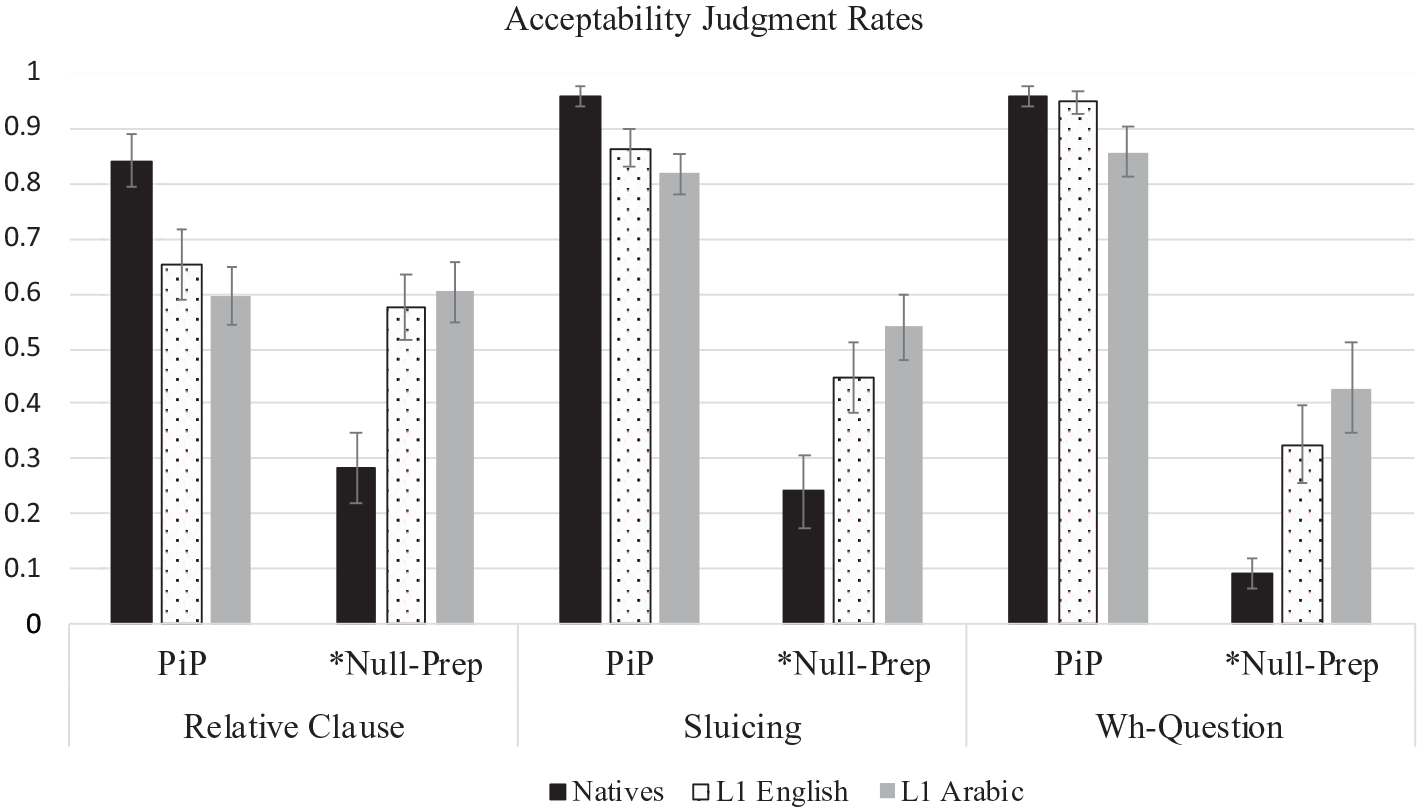
Mean acceptance rates for the self-paced grammaticality judgment task (GJT).
We ran a generalized linear mixed effects model with a binomial distribution with the package lme4 (Bates et al., 2015). In this model, the outcome variable was whether the sentence was rated as acceptable (1) or not (0). The fixed effects were Group, a factor with three levels (native speakers, L1 English, L1 Arabic learners), Syntactic Structure (Question, Sluicing, Relative Clause), Grammaticality (PiP, Null-Prep), and the interaction between Syntactic Structure * Grammaticality, and Proficiency, which was a numerical variable that had been scaled and centered and was introduced to the model as a covariate to control for any differences in proficiency. There were two random intercepts, one for Item and one for Subject. There was a correlated random slope for Structure by Subject. This was the most complex random effects structure that the model could support given convergence issues. We ran a model without the interaction between syntactic structure and grammaticality, but the model had a significantly worse fit as demonstrated by the log likelihood test. The full output of this model, both for the random effects and the fixed effects, is presented in Appendix A in supplemental material, Table A2. Since the group and the structure factors had three levels each, to obtain all pairwise comparisons we ran pairwise comparisons using the package emmeans; the full output appears in Appendix A in supplemental material, Table A2. Results are given on the log odds ratio (not the response) scale. P values are adjusted with the Tukey method for comparing a family of three estimates. We summarize the most important results in the text.
In terms of sentence type, all types were significantly different from each other with respect to the correct responses. Questions were correctly responded to the most, followed by sluicing, with relative clauses receiving the least correct responses (Questions > Sluicing > Relative Clauses; all comparisons p < .001). We found more correct acceptances of grammatical constructions than correct rejections of ungrammatical sentences. The scalar results and this main effect are displayed in Figure 4. Importantly, the hierarchy was not significantly different between participant groups, as evidenced by the lack of a significant interaction between Structure and Group. The hierarchy was the same in grammatical and ungrammatical sentences, although the differences were not as significant for relative clauses, a difference that can also be observed in Figure 4.
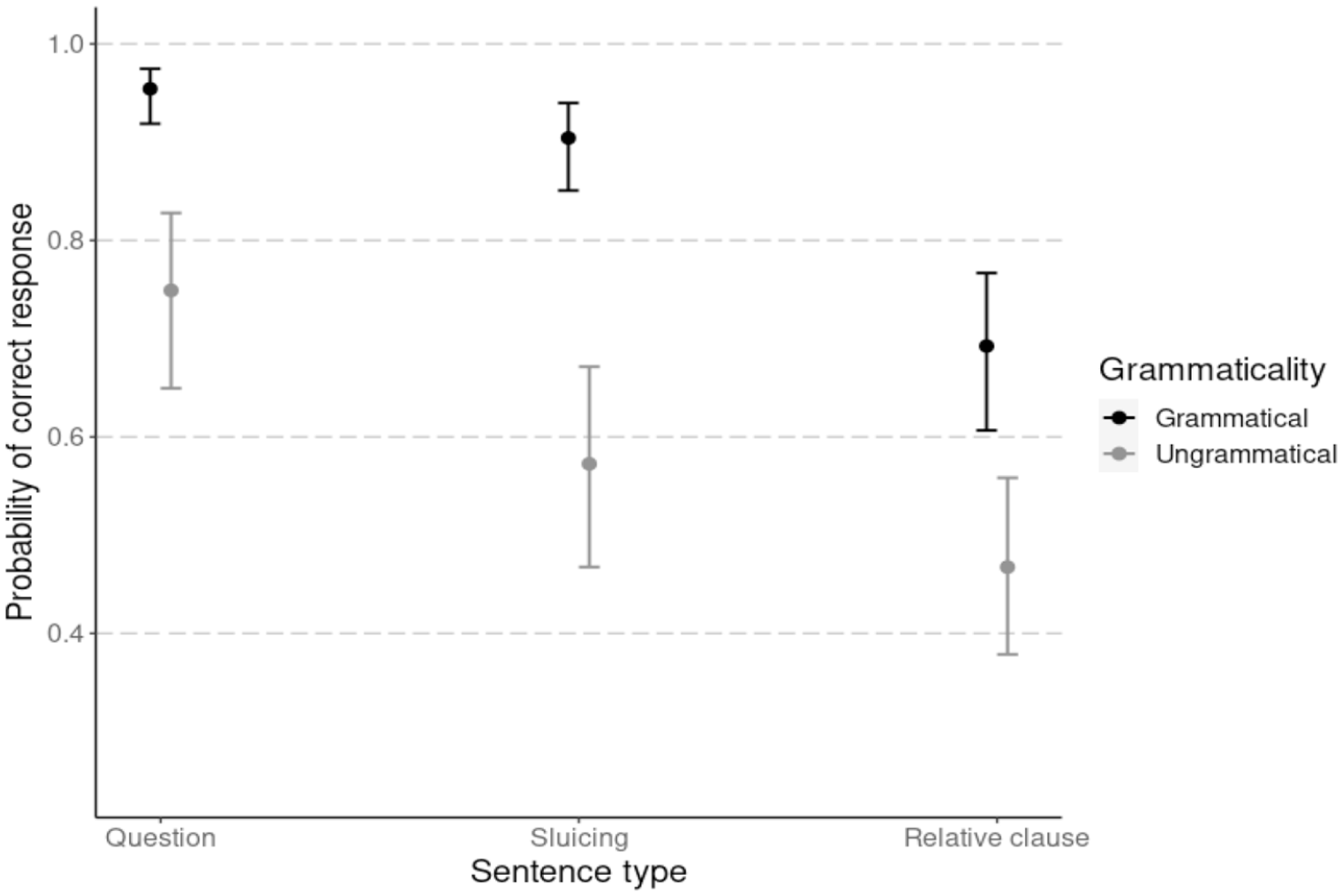
Probability of acceptance of PiP (grammatical) and rejection of Null-Prep (ungrammatical).
As per between-participants analysis, there was an overall significant effect of Group, with natives being significantly more accurate than L2 speakers, and L2 speakers not being significantly different from one another. Proficiency was significant, as participants with higher proficiency scores had more correct responses.
V Discussion
Summarizing the results of the four tasks included in this study (pre-experiment, two tasks in experiment 1, and one in experiment 2), we can extract several conclusions. First of all, the pre-experiment task, the one that served as a screening task, clearly showed that L2 learners had a very weak knowledge of preposition categorization, particularly of functional prepositions which contribute very little to the overall meaning of the sentence. Selecting only those participants that provided a preposition when needed in declarative sentences did not guarantee to us that their knowledge of preposition categorization was strong enough to be stable across structures. Still, the production task of relative clauses (Task 1) showed that PiP was the most accepted option in relative clauses; likewise, the task that elicited production of questions (Task 2) has shown that all L2 learners overwhelmingly employ wh-movement and T-to-C (or V-to-T) movement when forming questions. We interpret these two pieces of evidence as use of A-bar movement to construct both questions and relative clauses. Indeed, Null-Prep does not systematically alternate with a binding strategy, not even in the data of the Arabic learners, whose L1 presents grammatical resumptive pronouns. Furthermore, we do not find the same Null-Prep results across interrogatives and relative clauses, which would be expected if it were the direct result of an impaired A-bar movement. Thus, in response to research question 1, we conclude that nothing indicates that the Null-Prep phenomenon is due to the lack of wh-movement in the grammar of these L2 learners. On the contrary, and as we elaborate later on, we propose that the Null-Prep is also a movement derivation, not a binding one.
Nonetheless, we found differential results between syntactic structures in both tasks, production and comprehension, in the form of a hierarchy, and these asymmetries hold across participants. Our statistical models predicted that Null-Prep will appear and indeed appears more often in relative clauses than in questions, and it is also accepted more in relative clauses, followed by sluicing constructions and accepted the least in questions. The GJT results not only showed the differential acceptance of Null-Prep across constructions, but also the differential acceptance of Pied-Piping across constructions, a fact hard to explain just by L1 effects since all languages have PiP in these structures. Remarkably, both strategies, PiP and Null-Prep, followed the same gradient scale, matching the complexity hierarchy we proposed in (14). As already mentioned, this hierarchy is not exclusive to predicting the appearance of Null-Prep, but also that of PiP: the more PiP is accepted, the less Null-Prep is accepted, and vice versa. It is as if these two strategies were at the ends of a see-saw, constituting the extremes of the same element. This complementarity in deriving movement structures suggests that the true competitor of PiP, at least in the Spanish interlanguage, is Null-Prep and no other strategies such as Resumption (Klein, 1995) or Preposition Stranding (Bove and Limerick, 2020). We take these facts as compelling evidence towards a vision in which Null-Prep is a natural (inter)language property, as already argued in Dekydtspotter et al. (1998), given that it exists in native grammars too, notably in Yoruba and in colloquial French with à and de. We further argue that Null-Prep alternates with PiP in the development of oblique movement constructions and, thus, there is no fundamental reason to assume it is a non-movement strategy or an instance of a wild grammar, an option outside of UG, as put forward in Klein (1993a, 1993b). It is true that after a typological survey on languages that allow omission of the obligatory preposition, Klein (1993b, 1995) did not find languages that allowed the preposition to drop in relative clauses and in interrogative sentences, as she had found in her L2 data. This made her conclude that Null-Prep is not an available option in UG because no natural language presents it in questions. But crucially, with implicational hierarchies in mind such as the NPAH (Keenan and Comrie, 1977) and the CATE (Thompson and Shapiro, 2005; Thompson et al., 2003), adopted in this study, this should not be a problem. The fact that Null-Prep appears in more complex positions (i.e. relative clauses) in the hierarchy does not imply that it will also appear in less complex positions (i.e. questions); on the contrary, we expect that if it appears in questions, we would expect also Null-Prep in relative clauses, and that is what our statistical data confirm. In other words, Null-Prep presence (i.e. acceptance, production) is predicted by an overall account of the complexity of the movement structure and the syntactic position moved that applies to all participants, L2 learners and native speakers alike. These arguments would lead us to respond affirmatively to research question 2, which asked whether Null-Prep is a byproduct of the complexity of the derivation.
Thus, crossing the two hierarchies entertained here, the NPAH and the CATE, we would like to propose a quite elementary two-way hierarchy of predicted difficulty, which would calculate the presence of Null-Prep and, in turn, also of PiP. This two-dimensional hierarchy indicates that the more complex in ‘syntactic position’ and ‘movement structure’, the more Null-Prep is predicted. Inversely, the less complex in ‘syntactic position’ and ‘movement structure’, the fewer instances of Null-Prep, and more PiP is predicted. To different extents, this scale summarizes the complexity of the derivation in terms of distance, number of operations, embeddedness, and probably also referentiality (D-linking), as the material deleted (the preposition) needs to be somehow recovered in the discourse. We adopt Kato’s (2010) analysis for Brazilian Portuguese in which she proposes that the preposition is optional in the numeration when the displaced element is discourse-linked and the preposition is licensed by the verb. The licensing of an optional preposition is a lexical characteristic (Kato and Nunes, 2007), which is possible only when the preposition is subcategorized by the verb and assigns inherent case. This way, the displaced element moves as a prepositionless DP with its case unvalued until it lands into a default case position (i.e. A-bar position). In our complexity terms, all Null-Prep constructions would suppose a ‘saving’ of one merge operation (P + DP) and, consequently, less derivationally complex than their PiP counterpart. Likewise, Kato (2010) extends her arguments to questions and cleft constructions beyond relative clauses.
Finally, and responding to research question 3, our results indicated that Null-Prep is fairly independent of the L1 syntactic properties. Thus, we respond negatively to research question 3 since Null-Prep does not depend on the properties of the L1 learners. We did find some effects of L1 transfer in the form of PS in the English-speaking learners, and more Resumption in the Arabic learners. Still, their Null-Prep rates are rather similar. Hence, we believe Null-Prep is a natural phenomenon in languages that display (obligatory) PiP, although more persistent in developing grammars than in stable grammars. We consider it a universal phenomenon available through UG thanks to the recoverability of the deletion of the preposition. We do not believe it is linked to any particular language per se, but to a compound of factors, mainly the complexity of the derivation, which applies to all types of speakers, native and non-native alike, and it is also favored by the weak knowledge of the subcategorization frames of the target language in the case of L2 learners. Recall that we had to disregard 62% of our initial pool because the participants did not know that the target verbs required a preposition, even though all the L1 equivalents of these verbs also required an oblique object. This might be tangential to the core of our investigation, but we believe it has an impact in the overall results. It is just logical to suppose that if your oblique subcategorization knowledge is weak, case marking – in the form of a preposition – might be easily diluted in the derivation. As is usually attested in L2 ultimate attainment, knowledge of functional prepositions is a locus of persistent problems in SLA, and might present residual optionality many times, even in very advanced L2 speakers. Additionally, we observed a proficiency effect in both experiments, in such a way that less proficient learners produced and accepted more Null-Prep and, as proficiency increased, Null-Prep decreased, and PiP increased. This was true for both groups of L2 learners, emphasizing the negligible L1 transfer effect in the appearance of Null-Prep.
VI Conclusions
This study has shown that the appearance of the Null-Prep phenomenon in movement structures in L2 grammars is a systematic (inter)language property connected to the difficulty of the movement derivation. Whereas this phenomenon is indeed present in natural languages, it is also evident that it is more extended in interlanguage grammars, and by no means does it constitute an example of a wild grammar, as previously argued (Klein, 1993a, 1993b). The complexity of pied-piping, together with the weak L2 knowledge of functional prepositions and their relatively easy semantic recoverability makes perfect ground for missing the obligatory preposition along the way in the (complex) movement derivation. Following the tenants from the NPAH and the CATE, we modeled a hierarchical distribution of Null-Prep across movement structures in such a way that we predict more Null-Prep in more complex syntactic structures such as relative clauses, followed by sluicing, and finally by questions: Questions < Sluicing < Relative Clauses. This hierarchy can be further completed with other wh-movement structures as new experimental evidence comes to light. The appearance of Null-Prep is inversely associated with the development of pied-piping, and negatively correlates with proficiency: the higher the proficiency, the less Null-Prep and more PiP we will find. Finally, we claim that the Null-Prep strategy does not necessarily imply a binding structure; on the contrary, it is found in genuine movement derivations.
Supplemental Material
sj-docx-1-slr-10.1177_02676583221132198 – Supplemental material for Null-Prep as a systematic interlanguage phenomenon: Evidence from relative clauses, interrogatives, and sluicing constructions
Supplemental material, sj-docx-1-slr-10.1177_02676583221132198 for Null-Prep as a systematic interlanguage phenomenon: Evidence from relative clauses, interrogatives, and sluicing constructions by Sílvia Perpiñán and Anna Cardinaletti in Second Language Research
Footnotes
Declaration of Conflicting Interests
The author(s) declared no potential conflicts of interest with respect to the research, authorship, and/or publication of this article.
Funding
The author(s) received no financial support for the research, authorship, and/or publication of this article.

Notes
Supplemental material
Supplemental material for this article is available online.
References
Supplementary Material
Please find the following supplemental material available below.
For Open Access articles published under a Creative Commons License, all supplemental material carries the same license as the article it is associated with.
For non-Open Access articles published, all supplemental material carries a non-exclusive license, and permission requests for re-use of supplemental material or any part of supplemental material shall be sent directly to the copyright owner as specified in the copyright notice associated with the article.
