




Abstract
This article reports on an experimental study on the acquisition of prepositional relative clauses in second language European Portuguese by Chinese native speakers. It focuses on the role of resumption, mandatory in prepositional relative clauses in Chinese (the native language of the learners) and non-conventional in European Portuguese (the target language). Results of an oral production task and two online acceptability judgment tasks indicated that resumption does not transfer from the native language, and that Chinese learners of European Portuguese employ movement structures to produce and process relative clauses. Additionally, results showed that resumptive pronouns do not rescue or ameliorate ungrammatical extractions from islands, contrary to what is traditionally assumed in grammatical theory. This finding was kept constant across participants, native and non-native. Overall, we conclude that second language speakers are able to select and reassemble movement features in their non-native language and use similar processing mechanisms as native speakers to analyse island configurations.
I Introduction
1 Filler-gap dependencies and resumptive pronouns in second language (L2) acquisition
Filler-gap dependencies are constructions that are interpreted as a unit but appear separated in the sentence. The filler – the debate, in example (1) – only receives a full semantic interpretation when the hearer reaches the gap position instead of its actual position.
(1) This is the debatei that the politician mentioned _i yesterday.
Depending on the language and/or the context, the gap position can be filled by a resumptive pronoun (RP), such as it in (2) that gets its interpretation from the filler
1
:
(2) This is the debatei that the politician mentioned iti yesterday.
Whereas there are several other structures that involve filler-gap dependencies, in this study we are interested in the filler-resumptive construction in relative clauses (RCs) and its equivalent movement construction: the filler-gap construction, in the Portuguese of Mandarin Chinese speakers. To investigate the acquisition of these structures in second language (L2) European Portuguese (EP), we focus on prepositional RCs, which in EP can involve both, a filler-gap or a filler-resumptive strategy (with or without movement, respectively). In particular, we will take resumption as a proxy for (non)acquisition of wh-movement in an L2. Given that RPs may display both sensitivity to movement (as pure/empty variables) or not (as pronominal variables) (see Cinque, 1990), these can be good indicators of acquisition of movement in an L2. The debate on the acquisition of linguistic properties not instantiated in the first language (L1) has been very fruitful in the last 40 years, particularly with respect to the availability of movement constructions in L2 interlanguage grammars (ILG; see, amongst others, Benati, 2018; Hawkins, 2005; Hawkins and Chan, 1997; Hawkins and Hattori, 2006; Juffs and Rodriguez, 2015; Li, 1998; Martohardjono, 1993; White and Juffs, 1998). However, our knowledge about the nature of RPs in L2 grammars is still scarce. Our general purpose in this study is to bring light to this debate by investigating the acquisition of oblique RCs in L2 EP by Chinese native speakers.
Researchers distinguish languages that display grammatical RPs from those that resort to RPs in ‘last resort’ situations, to rescue constructions that would result in an ungrammaticality without the pronoun, often in island configurations. Sells (1984) called the former ‘true/grammatical’ resumptives, and the latter ‘intrusive’ resumptives. 2 In the present article, we adopt the terminology ‘grammatical’ vs. ‘intrusive’. Grammatical resumption is often ‘construction-dependent’ (Chaves and Putnam, 2020: 104), meaning that one language may license RPs in some constructions but not in others (this is the case of Hebrew, for instance). Besides, in some languages, RPs are present in all types of constructions, not involving movement (these are also called ‘free variation’ languages, ‘Type I’, in McCloskey’s 2006 typology). In contrast, other languages display grammatical RPs in specific constructions, with movement. These are ‘restricted variation’ languages or ‘Type II’ in McCloskey’s (2006) typology. It is not completely clear whether Chinese, the L1 of our speakers, belongs to Type I or Type II category. In non-islands syntactic configurations, resumptives and gaps can alternate freely, except in prepositional RCs, where the former are mandatory (e.g. Pan, 2016b: 287–90). This suggests that Chinese would fit in Type I languages of McCloskey’s (2006) typology. However, Pan himself identifies many additional syntactic and semantic constraints on using RPs in Chinese (Pan, 2016a: 3, footnote 2), suggesting that it can fit Type II (for a more detailed description of the constraints identified by Pan, see the respective section). Additionally, some languages can show both grammatical and intrusive RPs simultaneously, which invalidates this macro-variation classification (Pan, 2016b). It should not be ignored that, when they are realized as pronouns, RPs ‘are pronouns (at least in their apparent form)’ (McCloskey, 2006: 96). As so, there is still no answer for the issue of co-occurrence: considering that grammatical and intrusive resumptives have identical forms, why would two different languages use the same form for different operations? (Polinsky et al., 2013); and why would the same language resort to more than one type of resumptive? (Aoun et al., 2001; Erteschik-Shir, 1992). This short introduction already gives us an idea of how unresolved the classification of languages according to the presence of RPs is and how little we know yet about their availability and their (non-)movement derivation; needless to say, our knowledge of this construction in ILGs is very limited.
Despite this current debate, we assume that grammatical and non-grammatical RPs are different phenomena in this article. We look at two languages that are typologically different in this respect: EP and Mandarin Chinese. In particular, this study looks at the acquisition of EP prepositional RCs by native Mandarin Chinese speakers. The general research question that guides our study is the following: What does resumption tell us about the acquisition of wh-movement?
In the next sections, we will describe the behavior of resumptives in both languages under investigation, in island and non-island configurations, contextualizing our experimental study, presented in Section V. First, we present the relevant syntactic facts for EP and (Mandarin) Chinese with respect to oblique RCs and RPs. This will allow us to depict the specific learnability tasks that Chinese-speaking learners face when acquiring EP. Then, we describe our experimental design, present the results, and finally, we discuss the implications and contribution of this study for our knowledge on the acquisition of wh-movement.
2 The linguistic phenomenon: Relative clauses and resumptive pronouns
European Portuguese (EP) displays overt wh-movement in prepositional RCs formed with the pied-piping (PiP) strategy, which involves moving along the mandatory preposition with the relative pronoun (3a). We assume movement is also present in the non-conventional null-preposition strategy, which entails operator movement and omitting the mandatory preposition (3b). Besides these widespread syntactic strategies, oral EP may display prepositional RCs with an RP, as in (3c), which is generally analysed as a binding chain without movement (Alexandre, 2000). When the preposition holds a locative value, abstract or concrete, the relativizer onde ‘where’ is also available; we analyse this construction as a subtype of PiP, involving movement, and we will refer to it as the locative strategy (3d).
(3) a. Foi um debatei [[OBL be-PST.3SG DET.INDF.M.SG debate to Rel be.worth-PST.3SG watch. b. Foi um debatei [[OBL be-PST.3SG DET.INDF.M.SG debate Rel be.worth-PST.3SG watch c. Foi um debatei [[OBL que] valeu a pena assistir a be-PST.3SG DET.INDF.M.SG debate Rel be.worth-PST.3SG watch to 3SG ‘It was a debate that was worth watching.’ d. Foi um debatei [[OBL be-PST.3SG DET.INDF.M.SG debate Rel DET.M.SG Prime Minister participate-PST.3SG ‘It was a debate where the Prime Minister participated.’
Resumptive RCs in EP (see, amongst others, Alexandre, 2000; Arim et al., 2004; Duarte, 2013; Peres and Móia, 1995) are usually introduced by the invariable que and present a lexically and phonetically realized element in the gap position. However, resumptive RCs can also be introduced by relative pronouns that have a morphophonological or abstract realization of their ϕ-features, even displaying PiP, as in (4).
(4) São comportamentos [CP para Be-PRS.3PL behaviors to DET.M.PL Rel-M.PL 1PL not CL-Dat find-PST.3PL answer Literally: ‘These are behaviors to which we could not find an answer to them.’ (Alexandre, 2000: 73, footnote 56)
The RP agrees in ϕ-features and Case with the head of the RC; see (3c) and (4). Resumptive elements can be stressed (strong) and unstressed (clitic) pronouns, demonstratives, adverbs, or even the whole antecedent.
a Resumptive pronouns outside islands
In EP, if resumption occurs, it can occur in all syntactic positions. Alexandre (2000) attested examples of resumptive production from spontaneous non-controlled contexts, even in structures that are not particularly complex and could survive without the pronoun. In the present article, we are particularly interested in resumption in prepositional RCs, that we reproduce below (Alexandre, 2000: 63).
(5) Bem, há certas, não é, há Well exist-PRS-3SG certain not be-PRS.3SG exist-PRS.3SG customers good Rel DET.F.SG people already está habituada a trabalhar [OBL
be-PRS.3SG used to work with 3PL.F ‘Well, there are certain good customers, isn’t it, that we are already used to work with them.’
A corpora-based study developed by Aßmann and Rinke (2017) 3 on EP claims that resumption occurs more frequently in simple RCs – see (6) – not identifying any island context in the resumptive RCs analysed in their corpora (48 resumptive RCs out of 1,913 RCs analysed, 2.5%), possibly because syntactic islands are not usual in spontaneous speech. Whereas certainly possible, resumption is still an infrequent phenomenon in EP: Veloso (2007) found only 2% of resumptive RCs in the corpus studied; Arim et al. (2004) found only 1% and Santos (2014) also found residual instances of resumption.
(6) Fui a um senhor que chamam- Go-PST.1SG to a gentleman Rel call-PRS.3PL-DAT.3SG DET.M.SG Arlindo ‘I went there to a gentleman whom they call Arlindo.’ (ASCRP, Outeiro) (Aßmann and Rinke, 2017: 30)
b Resumptive pronouns inside islands
The possibility of forming a resumptive RC with an element extracted from a syntactic island, rescuing the sentence from ungrammaticality, is also attested in EP, as illustrated by the contrasts between the gap and the resumptive strategy in sentences (7a) and (7b). The resumptive strategy is analysed by Alexandre (2000) as a form to avoid long and successively cyclic wh-movement.
(7) a. * A pessoai DET.F.SG person with whom 2SG leave-PST.2SG without speak-INF.2SG get sick-PST.3SG b. A pessoai que tu partiste [ sem falares DET.F.SG person that 2SG leave-PST.2SG without speak-Inf.Infl.2SG with 3SG.F get sick-PST.3SG ‘The person with whom you left without speaking with her got sick’. (Adapted from Alexandre, 2000: 77–78).
The amelioration of resumptive RCs formed with elements extracted from a syntactic island, when compared with their gap counterparts, argues for considering that resumptive chains do not involve moved constituents, but establish co-referential binding relations, as claimed by Alexandre (2000). In Alexandre’s (2000) vein, we will assume that resumptive RCs have a null base-generated operator in SpecCP that A′-binds the RP, as argued for Irish in McCloskey (1990), and also in Faria and Duarte (1989) for Portuguese. Specifically, the RC (formally a CP) merges with the antecedent NP yielding the structure [NP CP NP] as in (8b) for sentence (8a).
(8) a. A story that I was not very happy with it. (Literal translation from Alexandre, 2000: 150) b. [DP a [GenP [Genº storyk Genº] [NbP [NPi tk] [Nbº [NP [CP Opk [Cº that] [AgrP I was not very happy with itk]] [NP ti]]]]]] (Adapted from Alexandre, 2000: 151)
The NP story moves to Spec,GenP forming a constituent with Dº and thus being an adequate antecedent for the RP it. The RC is saturated when the R-binding rule applies, after Spell-Out, assigning the same index to the head of the RC (story) and the null Operator (Op), which sits at SpecCP and shares its index with the RP, at the tail of the chain formed by binding.
c The paradox of intrusive RPs: Production vs. low rates of acceptance
From the previous paragraphs, we can conclude that resumptives in EP are similar to resumptives in English: they appear in unbounded dependencies, not necessarily complex, and they seem to improve syntactic islands, rescuing these sentences from ungrammaticality. Nevertheless, the literature on ‘intrusive’ resumptives is far from consensual. Syntactic literature claims that these RPs improve island violations in English (e.g. Chomsky, 1986; Kroch, 1981; Ross, 1967). Under this view, a syntactic island with an RP seems to be better than its gap counterpart – see (9a) and (9b) – as it is claimed for Portuguese by Alexandre (2000), among others.
(9) a. * Which mani did Jane say that [the parent who scolded __i] forgave the babysitter’s mistake? b. Which mani did Jane say that [the parent who scolded himi] forgave the babysitter’s mistake? (Example from Ackerman et al., 2018)
However, experimental data resorting to different methods, such as grammaticality judgments (Heestand et al., 2011; Perpiñán, 2010, 2020; Polinsky et al., 2013) and magnitude estimation tasks (Alexopoulou and Keller, 2007; Omaki and Schulz, 2011) cast doubt on the ability of RPs to rescue island configurations. Indeed, Zukowski and Larsen (2004, in Beltrama and Xiang, 2016) and Ferreira and Swets (2005) concluded that the participants find resumptive dependencies considerably worse than the grammatical controls. Other studies tested the ability of RPs to rescue island configurations, comparing them with their gap counterparts, finding no relevant improvement on the grammaticality of extractions from islands with resumptives (Alexopoulou and Keller, 2002, 2007; Heestand et al., 2011; McDaniel and Cowart, 1999; Polinsky et al., 2013). Alexopoulou and Keller (2007) concluded that RPs never improve island violations (weak or strong) in questions and that embedding reduces the levels of acceptability, even in non-island structures. As for McDaniel and Cowart (1999), the results showed no preference for RPs over gaps in island contexts but a preference for RPs in violations of conditions on representation. Likewise, Polinsky et al. (2013) considered visual and auditory input and concluded that auditory presentation did not improve the rating of RPs.
Although experimental data collected by different researchers and using other methods show that speakers do not accept RPs, even in regions of processing difficulty, the puzzling fact is that speakers produce them. This paradox is described in the literature (Kroch, 1981; Prince, 1990) and is confirmed experimentally (Ferreira and Swets, 2005; Swets and Ferreira, 2003). Prince (1990) attested examples of resumptive production from spontaneous non-controlled contexts, similar to the ones identified in EP by Alexandre (2000), even in structures that are not particularly complex and that could well survive without the pronoun; see (10).
(10) You assigned me to a paper which I don’t know anything about
The production of intrusive RPs was also identified under controlled circumstances in English (Ferreira and Swets, 2005; Swets and Ferreira, 2003), with and without time pressure. The researchers aimed at verifying if the absence of time pressure would give more time to the participants to plan the utterance avoiding the RP. Nevertheless, the participants mainly produced islands with resumptives, regardless of the time pressure. Similarly, based on the outcomes of an off-line task, Ackerman et al. (2018) concluded that English native speakers prefer RPs in island contexts.
Beltrama and Xiang (2016) propose that the paradox of RPs results in the type of the task used. They have looked at the rescuing effect of RPs in Italian and English, comparing the results of an acceptability judgment task and a comprehension task. RPs did show an amelioration effect when the participants were asked about the comprehension of the sentences, but not when the question was about the grammaticality. The authors concluded that the rescuing effect of RPs is not at the level of grammaticality/acceptability, but at the level of sentence comprehension. Taking an approach centered on comprehension, Chacón (2019) – following Engdahl (1983), Phillips (2006) and Chaves and Dery (2014) – attempts to resolve the intrusive resumption paradox by proposing a mechanistic account of resumption. Under this view, speakers prefer to resolve a filler-gap dependency with a gap. This representation needs to be committed in the working memory over time. If the working memory becomes strained out (as it happens while processing complex syntactic constructions, e.g. island configurations), then the expectation of the gap is lost. In that case, an RP may help the speaker recover the intended interpretation through a regular coreference relation.
However, different analyses have been proposed for the type of relationship RPs involve. Considering the results obtained in their experimental task, Polinsky et al. (2013) claim that resumption never solves a problem in the derivation and that RPs are only grammatical if they occur in a construction that does not involve movement. Under this view, RPs in English are not considered a strategy to establish an A’-dependency. Instead, they are seen as a mechanism establishing a co-referential relationship that obeys discourse–pragmatics and not syntax. In the authors’ words, RPs in English are a ‘(co)reference tracking device’, similar to a cross-sentential anaphora: ‘a way for speakers to maintain coreference and add more information without breaking the production chain’ 4 (Polinsky et al. 2013: 357). Beltrama and Xiang (2016: 17) also claim that RPs are anaphorically linked to their antecedents and that they aid parsing ‘in very particular and yet principled ways’. RPs facilitate the comprehension of the sentence, by ensuring that the sentence is locally well formed. Besides, in complex structures, RPs provide clues to the identification of the tail of a non-local dependency. The fact that RPs provide morphologically explicit clues (such as number, gender, etc.) contributes to guide the retrieval of the appropriate antecedent, despite the intervening islands boundaries (Clemens et al., 2013, cited from Beltrama and Xiang, 2016).
Like Polinsky et al. (2013), McDaniel and Cowart (1999) propose that RPs do not repair movement violations, but they suggest that intrusive RPs are spelled out traces, i.e. morphological manifestations of traces that remain in the derivation when the derivation with the trace is not possible due to syntactic constraints. According to their account, ‘RPs are predicted to save only violations of conditions on representation; they should not affect the status of violations of conditions on the derivation (i.e. on movement itself)’ (McDaniel and Cowart, 1999: B17–B18).
As Chaves and Putnam (2020: 107) summarized, the conflicting outcomes obtained with RPs in English may result from the application of experiments with ‘different methodologies and items’, but also reflect ‘different types of resumptive use’. Following these researchers, English may license some types of RPs even outside island configurations, ‘for some grammatical functions and in certain constructions’, while ‘others are more likely due to processing difficulty and are not fully sanctioned by the grammar.’
Given these different explanations for the appearance of intrusive RPs, one could well assume that L2 learners that present difficulties with wh-movement would resort to this construction in their ILG, as it would ease the processing and production of the filler-gap dependency. Particularly so, if the L1 grammar presents obligatory RPs in certain syntactic positions, as it is the case in Mandarin, Cantonese, and other Chinese varieties. This assumption motivated the present study.
II Mandarin Chinese
In the current section, we focus our attention on the description and analysis of RCs in Mandarin Chinese (also referred to as ‘Chinese’). The properties of prepositional RCs appear to be sufficiently similar in Mandarin Chinese and other varieties, including Cantonese (Hawkins and Chan, 1997; Lardiere, 2008; Matthews and Yip, 1994; Yip and Matthews, 2017). 5 Hence, we predict no differences in the acquisition process modulated by the Chinese variety of the learner. Furthermore, all participants in our study spoke Mandarin Chinese as a native language or as the majority language acquired very early in life.
Chinese RCs are head-final, so the RC precedes the head in linear order, contrasting with head-initial RCs in Portuguese:
(11) [ Xiaoming xihuan de ] [DEM-Cl na-ge ren ] jiao Zhenni. Xiaoming like Rel DEM-Cl person named Zhenni ‘The person that Xiaoming likes is named Jenny.’ (Xu, 2009: 26)
All syntactic positions can be relativized in Chinese. Besides, Chinese RCs display grammatical RPs (contrary to Portuguese), and gaps and RPs are said to alternate freely, except in the contexts where RPs are mandatory (such as the prepositional). However, the occurrence of RPs is constrained by different factors, as noted by Pan (2016a, 2016b). For example, an RP is practically unacceptable in the subject position for an action verb, but such sentences improve for experiencer subjects. An RP can never replace an inanimate object in the postverbal object position.
In RCs, RPs are mandatory whenever the object of an overt preposition is relativized. Chinese behaves exactly like Welsh (Rouveret, 1994) or Hausa (Tuller, 1986) in this respect: neither of these languages permits PiP nor preposition stranding and, as a consequence, oblique relativization is always done through resumption. Thus, an RP is mandatory in the object position of the preposition in Chinese prepositional RCs; see (12)–(14) (from Pan, 2016b: 287–88). The resumptive element may be an RP – ta (12) or qi (13) – or an adverb, such as nar (14). Qi has the same form regardless of the properties of its antecedent, and it is only associated with a formal register (Pan, personal communication), being frequently used in classical Chinese.
(12) Wo dui 1SG to 3PL very not.bad Rel DEM-Cl friends ‘The friends to whom I am very kind’ (Pan, 2016b, adapted) (13) Ta zhe-ci meiyou chenggong, 3SG this.time Neg succeed 3GEN reason very complicated ‘He has not succeeded this time, and the reason (for which he has not succeeded) is complicated.’ (Pan, 2016b: 201) (14) [ Ta-men zài 3PL at there spend-Exp honeymoon Rel castle ‘the castle where they had their honeymoon’ (Pan, 2016b: 288)
To sum up, Chinese is a language that displays fully grammatical RPs in prepositional RCs. However, the literature on resumptive RCs in Chinese does not reach a consensus regarding the existence of wh-movement in these constructions. It has been assumed that Chinese displays an asymmetry regarding the sensitivity to movement: wh-in situ arguments are not sensitive to island constraints, but wh-in situ adjuncts are (see, amongst others, Aoun and Li, 2003; Cheng, 2009; Huang, 1982a, 1982b; Tsai, 1994, 1999). The existence of operator movement has been identified in the relativization of adjuncts that show sensitivity to subjacency violations, as illustrated in (15) (e.g. Aoun and Li, 2003; Ning, 1993):
(15) * zhe jiu shi [[[[ ruguo ta ti shengqi] ni hui bu gaoxing] de ] yuanyini] this exactly be if 3SG angry 2SG will not happy Rel reason ‘This is the reason (x) that you will not be happy if he gets angry (because of) x.’ (Aoun and Li, 2003: 177)
More recently, Pan (2016b) argued that the existence of operator movement applies to all RCs, regardless of these involving a gap or an RP. Pan shows evidence from crossover effects and scope reconstruction, arguing for operator movement in Chinese RCs (for a more detailed analysis, see Pan, 2016a, 2016b). The most compelling argument presented by Pan is that extractions from islands are always ungrammatical; see (16a) and (16b).
(16) a. * Zhe shi [ wo jiandao-guo [ tanlun-guo _/ta de ] na-ge nütongxue de zuojiaj this be 1SG meet-Exp talk-Exp _/3SG Rel that-Cl female-student Rel writer ‘This is the writerj whom I met the student who talked about tj/(himj)]] (Pan, 2016b: 35–36) b. * Zhe shi [ wo jiandao-le [ maixia-le this be 1SG meet-Perf buy-Perf 3SG-Gen house Rel that-Cl female.student Rel writer (‘This is the writerj that I met the female student who bought hisj house’) (Pan, 2016b: 38)
Nevertheless, these judgments on extractions from islands are not consensual. Aoun and Li (2003) claim that RPs can rescue islands in Chinese when an NP is relativized. In other words, resumptive chains do not involve movement in the relativization of subjects or direct object arguments:
(17) Wo xiang kan [ na-ge [ ni [ yinwei tai bu hui lai ] hen shengqi de ] [ xuesheng]i] 1PL want see DEM-Cl 2SG because 3SG not will come very angry Rel student ‘I want to see the student that you invited the person over that brought him over.’ (Adapted from Aoun and Li, 2003: 170)
However, the same authors admit that movement is involved in the relativization of adjuncts, irrespectively of the presence of an RP. In Pan’s vein, Lu et al. (2020) claim that both argument and adjunct wh-in-situ are sensitive to complex NP islands. Others (e.g. Wen, 2020) consider that RCs with a gap involve movement. In contrast, RCs with RPs do not show movement, no matter the status of the relativized object (argument or adjunct). In sum, it is clear that the analysis of Chinese RCs is a puzzling subject. Still, it seems consensual that operator movement exists, either in all RCs (Pan, 2016b), in gap RCs (Wen, 2020), or only in adjunct RCs (Aoun and Li, 2003).
III The L2 acquisition of wh-movement and relative clauses by Chinese speakers
In the last 30 years, a considerable number of studies regarding the L2 acquisition of wh-movement by speakers whose L1 does not display overt movement has seen light, with a variety of results. Some of them (e.g. Li, 1998; Martohardjono, 1993; White and Juffs, 1998) concluded that L2 speakers can indeed go beyond the properties of their L1 and acquire wh-movement, while others claimed the opposite (e.g. Hawkins, 2005; Hawkins and Chan, 1997; Hawkins and Hattori, 2006). To our knowledge, the research on the acquisition of wh-movement in L2 EP is scarce. Nevertheless, the L2 acquisition of RCs in other languages by Chinese learners was tackled in studies that compare L2 speakers from different native languages (see, amongst others, Flynn, 1989; Gass, 1979; Hawkins and Chan, 1997; Schachter, 1973) but is also approached in works that look exclusively at Chinese native speakers (see, amongst others, Lardiere, 2008; Li, 1992; Xiaorong, 2007; Yip and Matthews, 1991). Most of these studies looked at the acquisition of RCs under the light of the Noun Phrase Accessibility Hierarchy (NPAH; Keenan and Comrie, 1977), focusing on the difficulty of relativization according to their syntactic position. Chinese speakers’ avoidance of RCs, specifically in the more embedded positions, is also underlined (see Schachter, 1973; Yip and Matthews, 1991).
Despite the large bibliography on this issue, here we will review in depth the two most relevant studies for our investigation only; these studies defend opposite theoretical positions: Hawkins and Chan (1997), and Lardiere (2008). Hawkins and Chan (1997) looked at the acquisition of English RCs by Chinese and French native speakers. As Portuguese, English displays movement of an overt wh-pronoun in RCs and has intrusive RPs. They tested L1 speakers of Cantonese at three proficiency levels in English and compared them with native speakers, using a Grammaticality Judgment Task. The participants showed better performance in recognizing grammatical RCs and rejecting ungrammatical RPs as their exposure to the L2 increased. Nonetheless, more advanced learners performed worse than beginners at identifying and correcting subjacency violations. The same Chinese beginners failed to reject ungrammatical resumptives in simple RCs (i.e. without extraction from syntactic islands), and judged grammatical RCs at chance level. Overall, these results were interpreted as transfer of L1 properties and inability to go beyond the L1 input in certain linguistic properties. Instead, advanced learners accurately rejected overt RPs (in 90% of the cases) and judged grammatical RCs largely as OK (79% acceptance rate). However, according to Hawkins and Chan, this does not imply that they have acquired wh-movement. They interpreted the results as an example of misleading performance, overcoming linguistic competence (Hawkins, 2005; Hawkins and Chan, 1997).
From a different point of view, Lardiere (2008) assumed that adjunct RCs in Chinese display wh-movement. So, despite all the aspects that distinguish RCs in Chinese from RCs in English, she assumes that there are some similarities between them that the learners could identify in the process of L2 acquisition. As Lardiere puts it: ‘Oversimplifying, it would appear that for a native Chinese speaker acquiring English, the properties of adjunct relatives in Chinese must be extended to all relatives in English’ (Lardiere, 2008: 20). Her data showed about 120 RCs from the production of Patty, the Chinese subject of Lardiere’s case study, including subject, object, and oblique RCs. According to Lardiere, Patty acquired operator movement since she correctly used preposition stranding in English in a context where resumption would be expected in Chinese. Following the Feature Reassembly Hypothesis (FRH; see Lardiere, 2008, and subsequent work), in the early stages of acquisition, L2 speakers look for correspondences between the L1 and the L2, identifying and mapping the similarities between the functional meanings of the lexical items from the target L2 and their L1. Once initial mapping is established and there are no more correspondences available, the FRH predicts that the L2 speakers may acquire new features not available in the L1, abandon distinctive features relevant in the L1 but not necessary in the L2, and assemble features existing in the L1 into new lexical items or into new bundles in the L2. The acquisition of movement by Patty constitutes an example of the ability to assemble the operator movement features available in other relative structures in the L1 into the acquisition of RCs in the L2.
The studies of Hawkins and Chan (1997) and Lardiere (2008) show that advanced Chinese speakers can correctly judge and produce RCs in English, but these outcomes lead the authors to opposite conclusions. Hawkins and Chan (1997) state that there are specific functional properties that L2 learners cannot acquire, specifically wh-movement. On the contrary, Lardiere (2008) claims that Chinese native speakers can successfully reassemble the features of their native language to acquire operator movement in the L2. In their test, Hawkins and Chan (1997) have included RPs in simple RCs but not in islands (they have only tested ungrammatical extractions without RPs). Indeed, RPs in syntactic islands have not been the focus of much research on L2 acquisition, but see Perpiñán (2020). We believe that RPs in syntactic islands can bring new data about the nature of interlanguage grammars and, as such, they should be included in the experimental design. Besides, the native language of our participants presents resumption in its standard variety; thus, if we want to make any claim about transfer effects in L2, these contexts need to be taken into consideration.
IV Learnability task
The scenario that we are looking at involves learners whose native language (Mandarin Chinese) displays prepositional RCs with grammatical and mandatory resumptives. Operator movement is also present in the relativization in the L1. The L2 (EP) shows movement in different relativization strategies 6 and has non-conventional resumptive RCs that do not involve movement. Table 1 summarizes these assumptions.
Comparison of resumption and pied-piping in European Portuguese (EP) and Mandarin Chinese relative clauses (RCs).
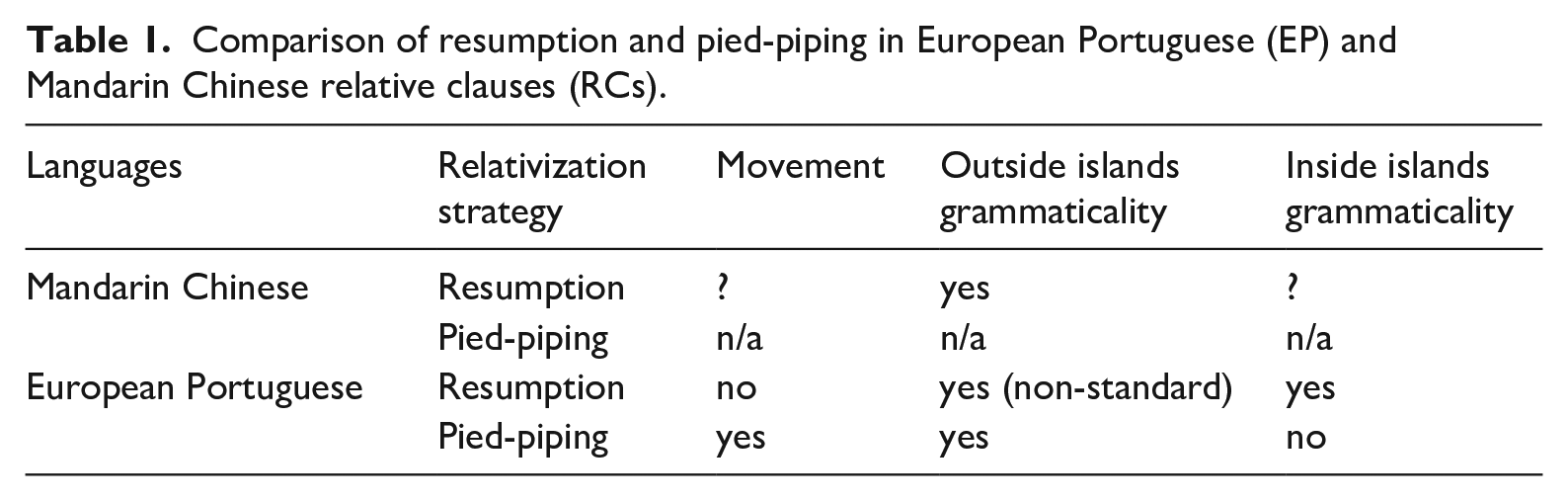
Thus, if Pan (2016a, 2016b) is on the right track and Chinese indeed displays obligatory movement in prepositional RCs, assuming the Full Transfer/Full Access hypothesis, we predict that Chinese learners of EP would transfer the ability of constructing oblique RCs through movement. However, they need to acquire the PiP strategy, as it is not available in their language, and reject RPs. At the same time, we expect a significant amount of transfer of RPs, which are obligatory in Chinese oblique relativization, but non-standard in EP. In the present study, we investigate acceptability judgments on RCs produced with resumption, comparing them with pied-piped RCs. Additionally, to assess availability of movement in these L2 learners, we examine these same syntactic structures (PiP and resumptive) inside island configurations, violating (or not) subjacency constraints.
Considering the properties of resumption in EP and Chinese described above, and with the general inquiry of how Chinese-speaking learners of EP acquire oblique RCs, we formulated the following specific research questions:
Research question 1: Do Chinese-speaking learners of EP try to initially map the properties of prepositional RCs from their L1 onto the target language? Specifically, do they produce and accept resumptive RCs in EP?
Research question 2: Are Chinese-speaking learners of EP able to select the wh-movement feature from other L1 relative structures (i.e. gap or adjunct RCs), reassemble it onto prepositional RCs in the L2, and eventually produce PiP?
Research question 3: Are Chinese-speaking learners of EP sensitive to island configuration violations, showing acquisition of wh-movement? Relatedly, do Chinese participants rate higher syntactic islands comprising an RP?
Given these research questions, we hypothesize that:
Hypothesis 1: Assuming the Feature Reassembly Hypothesis (FRH, Lardiere, 2008), which builds on the Full Transfer/Full Access Hypothesis (Schwartz and Sprouse, 1996), we expect occurrences of resumptive RCs, particularly at the lowest levels of proficiency.
Hypothesis 2: If Chinese L2 learners of EP can reassemble the features of wh-movement, we expect them to produce and accept PiP in prepositional RCs in EP.
Hypothesis 3: Assuming that RPs rescue island configurations in EP, we expect Chinese learners of L2 EP to give higher acceptability rates to resumptive RCs than to PiP relative configurations within island configurations.
V The study
To shed some light on the nature of the acquisition of wh-movement in this intricate puzzle of resumption and (non)movement possibilities, we have developed three experimental tasks: an oral production task (Task 1), a self-paced acceptability-judgment task testing RCs formed with different relativization strategies (Task 2), and an acceptability judgment task testing RCs formed out of extractions from islands (Task 3), administered in this order.
1 Participants
The three tasks were performed by a group of Chinese learners of EP (n = 72). Additionally, a group of native speakers of EP (n = 30) acted as the study control group. Thus, a total of 102 participants (N = 102) completed the experiment.
The Chinese participants (61 female) were or had been students of Portuguese as a Foreign Language (mean age = 19.32 years, SD = 3.79), and they were distributed into two groups: intermediate learners (B1–B2 levels of the Common European Framework of Reference for Languages) and advanced learners (C1–C2 levels according to CEFR) according to the proficiency test they took to be placed in the language course they were taking at the time of testing. Thirty-nine participants were Mandarin Chinese native speakers, 18 spoke Cantonese as L1, 11 participants reported having Mandarin and Cantonese as their native languages, and 4 participants referred to other Chinese dialects as their native language. Regardless of the native dialect of Chinese indicated, all participants were exposed to Mandarin Chinese very early in life through school. Given that the structural properties of prepositional RCs are similar in Mandarin Chinese and Cantonese (see Section II), the Cantonese native speakers were included in the study. The native EP speakers from the control group (28 females and two males) were mainly college students at the School of Arts and Humanities of Lisbon University, (mean age = 24.71 years, SD = 18.15). The few cases that were not college students were graduate adults.
All participants performed a pre-test on an online platform (Learnclick) to ensure that they knew the argument grid of the prepositional verbs tested. The pre-test consisted of a cloze test including the eight experimental prepositional verbs and 14 fillers. The participants could choose one of four options to fill in the blanks of the cloze test. In the case of the experimental verbs, an option with null preposition was always provided. Participants who were unaware that the experimental verbs required a preposition were not invited to proceed with the study. One hundred and eighteen Chinese speakers performed the pre-test, but only 74 met the requirements to proceed (63% of the initial pool). Two of these 74 were further discarded from the analysis as they did not complete the three tasks of the experimental design.
All participants filled in a language background questionnaire, inspired by Carrol and Conklin (2017) and Slabakova (2015), including several questions about the frequency with which the participants speak, write, listen, and read contents in Portuguese.
2 Selection of experimental items
The experimental combinations of verb + preposition (V+Prep) included the prepositions de ‘from, of’ and em ‘in’; only experimental verbs compatible with de and em were chosen. These verbs were selected according to their high frequency in EP and the manuals and syllabus of Portuguese as a Foreign Language. The experimental combinations of V+Prep were also controlled for their selection properties: both, prepositional arguments and adjuncts were tested to identify a potential asymmetry in the acquisition of relativization of PP constituents depending on their argumental or adjunctal nature.
The prepositions do not bear the same semantic/functional value in all the combinations tested. In the argument combinations gostar de ‘like’, precisar de ‘need’ and pensar em ‘think’, the preposition has a strict functional value, deprived of semantic meaning. With participar em ‘participate in’, which also selects an argument, em has a functional or a locative stative meaning. In the combinations where the PP plays the role of an adjunct, the preposition has the locative meaning of origin (gritar de ‘scream from’ and telefonar de ‘call from’) or a locative stative value (trabalhar em ‘work in’ and estudar em ‘study in’).
Considering the different roles played by the preposition selected by each verb, different standard and non-standard relativization strategies are available in EP. Pied-piping and resumption are available in all contexts, but the use of the relativizer onde is only possible when the preposition bears a semantic locative meaning, abstract or concrete.
VI Tasks
1 Oral production task
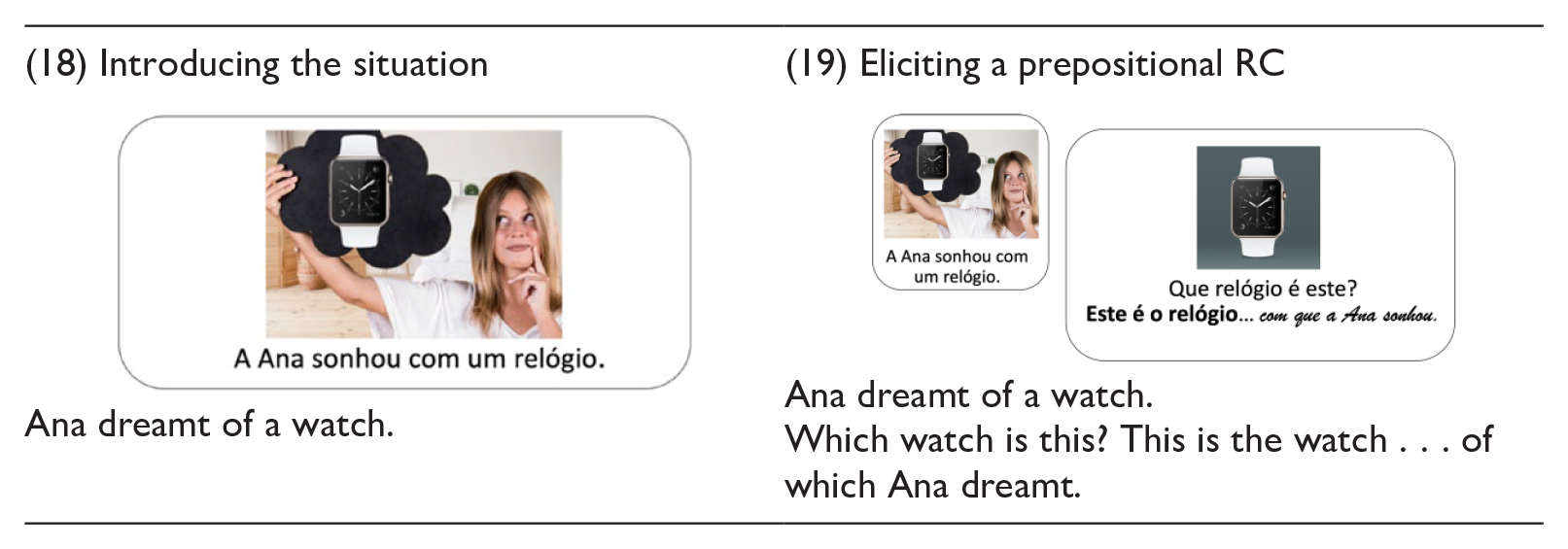
The purpose of this task was to understand whether the participants preferred to produce RCs with movement (PiP) or without it (resumption). Participants were presented with a scenario (two pairs of pictures) on a computer screen and some information describing each image. Following the procedure from Perpiñán (2013), the information was written on the screen and read out loud by the researcher. The following slide consisted of a selection of the previous image with a question that participants needed to answer. The beginning of each answer was provided to ensure that the extracted constituent for each sentence was the targeted one. Presenting the information orally and in writing ensured that the Chinese participants did not have problems recalling the necessary information to construct the RC. To tap a more implicit response, the participants were instructed to complete the sentence orally as fast as possible with the information provided.
The experimental items included eight target items that required prepositional RCs (four arguments and four adjuncts) and eight items targeting direct object RCs (with animate and non-animate heads). For the present study, we are only looking at prepositional target items. There were an additional set of 18 fillers (36 scenarios) with unrelated structures for a total of 34 items, 68 scenarios (16 RCs items, 18 non-RCs items). Scenarios were randomized into two list orders (same items in each list but with a different order). Half of the participants completed the task in order A and the other half in order B to avoid biased results. An example of an experimental scenario targeting prepositional RCs is shown below.
2 Self-paced reading acceptability judgment tasks
The purpose of the Self-Paced Reading Acceptability Judgment Tasks (SPR-AJT) was to tap into the implicit ILG and avoid performance issues that production data may carry. In particular, we were interested in revealing movement knowledge in L2 learners. We have contrasted items with PiP, entailing wh-movement, with items with RPs that do not entail movement in EP.
The SPR-AJT tasks were implemented with a time limit: the segments appeared like a row of dashes, and participants pressed the space button on the keyboard to reveal each next word of the sentence. However, after 300 ms, if the participants had not moved to the next word, the word would disappear automatically, being replaced by the following segment. This solution allows the participants to create their own reading path (permitting different paces for natives and non-natives) but still includes time pressure, which is considered necessary to tap into the implicit knowledge of these structures. Both SPR-AJT were run on PsychoPy v3.2.3.
Participants read each sentence on a non-cumulative, word-by-word display, on a computer screen. After the last word disappeared, a screen with a sliding bar showed up, and the participants were asked to rate the sentence previously read. In the left edge of the sliding bar, there was a 0 with the indication ‘very bad’ below and, in the extreme opposite, appeared the number 1, with the indication ‘very good’. Participants were aware that this line was continuous and that they could rate the sentence by using the trackpad in the computer at any point of the scale. Participants read the instructions and practiced with four trials before the experiment started. Instructions were provided in Portuguese and Chinese for non-native participants.
Each SPR-AJT had 100 sentences, pseudorandomized in 10 blocks so that no sentence from the same condition nor the same verb would appear consecutively. Participants could take a break between each block if needed. The same procedure was followed in both tasks.
a Self-paced reading acceptability judgment task (relativization strategies)
Like in the oral production task, the experimental items included prepositional and direct object RCs. In the present article, we are only focusing on prepositional RCs. These were tested in each relativization strategy (PiP, null-preposition, and resumption). Four items tested argument PPs (4 verbs × 3 strategies), and four tested adjunct PPs (4 verbs × 3 strategies). Thus, there were 12 experimental prepositional RCs with arguments and 12 with adjuncts (total = 24). We tested the same combinations V+Prep as in the oral production task. Additionally, the task included 60 fillers: 20 grammatical, and 40 ungrammatical. The sum of experimental items (16 direct object RCs + 24 prepositional RCs) and fillers (60) equaled 100 sentences. In this task, we are interested in the differences between pied-piped RCs (20) and resumptive RCs (21), in argumental (a) and adjunct positions (b), which are exemplified below.
(20) a. O filme DET.M.SG movie in Rel DET.F.SG think-PST.3.SG be-PRS.3.SG interesting ‘The movie of which the student thought is interesting.’ b. A janela DET.F.SG window from Rel DET.M.SG grandfather scream-PST.3.SG be-PRS.3.SG very high ‘The window from where the grandfather screamed is very high.’ (21) a. O computador que a menina precisa DET.M.SG computer Rel DET.F.SG girl need-PRS.3.SG from-it be-PRS.3.SG expensive Literally: ‘The computer that the girl needs it is expensive.’ b. O café que a rapariga trabalha DET.M.SG coffee-shop Rel DET.F.SG girl work-PRS.3.SG in-it has-PRS.3.SG many customers Literally: ‘The coffee-shop that the girl works in it has a lot of costumers.’
b Self-paced reading acceptability judgment task (island configurations)
In this last task, participants had to judge RCs formed out of extractions from syntactic islands. We have only included adjunct islands (temporal, conditional, causal, and concessive clauses) as these are consensually classified as strong islands. We have left out weak islands to avoid biased results (see Belikova and White, 2009). Furthermore, given that RPs are assumed to rescue island violations, we expect a stronger amelioration effect with strong islands; as Polinsky et al. (2013: 350) put it: ‘if resumption helped remedy island violations, one might imagine that strong islands would be the first place to look for stimuli with RPs to be rated higher than stimuli with gaps.’
As in the previous tasks, we included here direct object and prepositional RCs, but direct object RCs are not analysed: 4 conditions concerned direct object RCs (total of 16 items, 4 × 4 verbs), and 6 tackled prepositional RCs (total of 24 items). The 24 prepositional RCs were split between arguments and adjuncts, in the three relativization strategies (PiP, null-preposition, and resumption) for each case: (4 arguments × 3 relativization strategies) + (4 adjuncts × 3 relativization strategies). Additionally, 60 fillers were included (20 RCs in non-island syntactic configurations and 40 adverbial clauses). The task included a total of 100 sentences. As before, we are interested in the contrasts between PiP and resumption strategies in argumental and non-argumental positions. A pied-piped RC and a resumptive RC formed through extraction from an island are illustrated in (22) and (23), respectively; arguments in (a) and adjuncts in (b).
(22) a. * Este é o concertoi em que o rapaz vai DEM.M.SG be-PRS.3.SG DET.M.SG concert in which DET.M.SG boy go-PRS.3.SG comprar bilhetes no concertoi se a cantora participar no concertoi. buy tickets if DET.F.SG singer participate ‘*This is the concert in which the boy is going to buy tickets if the singer participates.’ b. * Este é o escritórioi de onde a senhora enviou DEM.M.SG be-PRS.3.SG DET.M.SG office from Rel DET.F.SG lady send-PST.3.SG um e-mail do escritórioi depois de telefonar do escritórioi. DET.INDF.M.SG e-mail after call ‘*This is the office from where the lady sent an e-mail after calling.’ (23) a. ? Este é o concertoi que o rapaz vai comprar bilhetes DEM.M.SG be-PRS.3.SG DET.M.SG concert Rel DET.M.SG boy go-PRS.3.SG buy tickets se a cantora participar nelei. if DET.F.SG singer participate at-it ‘This is the concert that the boy is going to buy tickets if the singer participates at it.’ b. ? Este é o escritórioi que a senhora enviou um e-mail DEM.M.SG be-PRS.3.SG DET.M.SG office Rel DET.F.SG lady send-PST.3.SG DET.INDF.M.SG e-mail depois de telefonar de lái. after call from there ‘This is the office that the lady sent an e-mail after calling from there.’
3 Procedure
The experiment consisted of two presential meetings of around 45–55 minutes each performed at least 24 hours apart. In the first part of the first meeting, participants completed the oral production task (see Section VI.1) and the SPR-AJT in non-island configurations (see Section VI.2.a). On the second day, participants performed the second SPR-AJT targeting extractions from islands (see Section VI.2.b). All presential meetings took place in a quiet room. These steps were followed uniformly with 47 participants until the occurrence of the Covid-19 pandemic. Due to the restrictions to presential meetings, the experiment had to be adapted, and the self-paced reading tasks were completed on PsychoPy accessed remotely. The procedure was identical, but Zoom meetings replaced the presential meetings. As for the online tasks, participants had remote access to the first author’s computer; this affected 54 Chinese-speaking participants and one Portuguese speaker. We made sure the remote access did not significantly alter the acceptability results, but we cannot guarantee that the reaction times were not affected; for this reason, we are not considering them here.
4 Results
a Oral production task
The oral production task rendered a total of 3,468 sentences (1,632 experimental items and 1,836 for the filler contexts). Each participant produced 34 sentences, 16 experimental items (8 prepositional and 8 direct object RCs), and 18 fillers. Sentences were coded according to the relativization strategy uttered by the participants in direct object RCs (gap or other) and prepositional RCs (PiP, null-preposition, resumption, locative, or others).
Direct object RCs did not present difficulty for any group, with equivalent percentages of target structures across groups (92% for native EP; 93% for advanced Chinese participants, and 90% for intermediate Chinese participants). Although direct object RCs are out of the scope of the present article, these serve as a baseline confirming that Chinese speakers could produce RCs.
Looking at prepositional RCs, particularly at PiP and resumption, the first remarkable aspect is the absence of resumption in the oral production of Chinese participants and native speakers in any context. There were only two utterances involving resumption (one of a native speaker and one of a Chinese participant); these did not include a pronoun but a full DP (or a synonym). 7 Given that these were single occurrences, they were grouped under the category ‘others’.
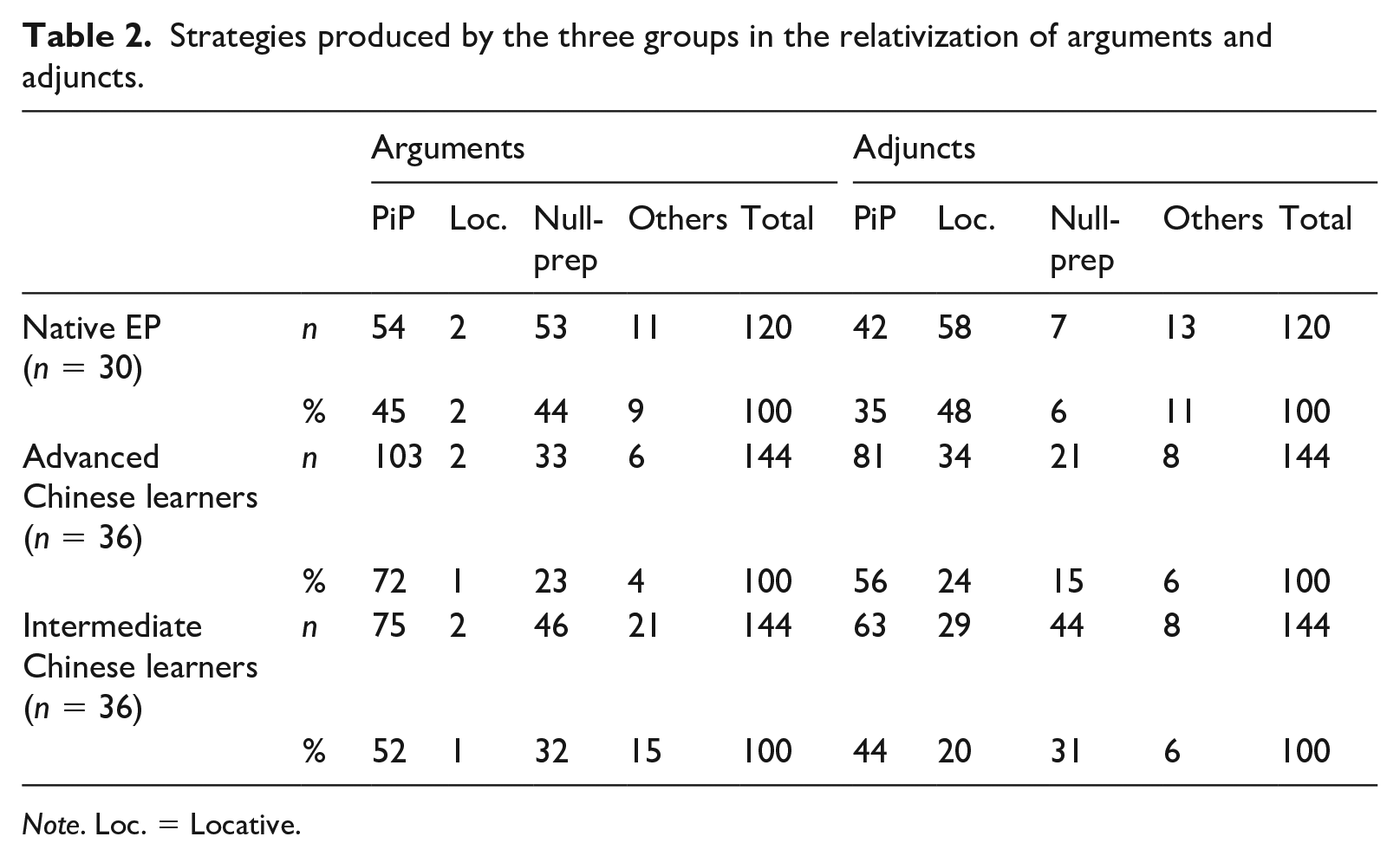
Pied-piping was the strategy more frequently adopted by advanced L2 speakers for verbs selecting an argument (72%), contrasting with the native speakers (45%). Although PiP is considered the standard strategy to relativize PPs in EP, natives adopted other strategies with arguments, particularly the null-preposition strategy (44%). Intermediate learners showed a less stabilized grammar, alternating PiP (52%), null-preposition (32%), and other solutions (15%) to avoid the RC (such as the use of possessive pronouns, replacement with an adjective or a descriptive expression, deletion of the relativizer, and cleft constructions). The differences among groups regarding the use of PiP to relativize arguments are not statistically significant (χ2(2) = 8.858, p < .012).
Concerning relativization with adjuncts, the group with the highest rates of PiP (56%) was the advanced Chinese learners, which had in addition an important proportion of utterances with the locative strategy (24%). Native speakers alternated between PiP (35%) and the locative strategy (48%), preferring the latter. Intermediate Chinese participants were more evenly divided between the three strategies: PiP (44%), locative (20%), and null-preposition (31%). Non-native participants uttered other grammatical and ungrammatical alternatives to the RC, such as the possessive, cleft, passive, and reduplication of the relativizer, grouped in the category ‘others’. The differences among the groups regarding the use of PiP to relativize adjuncts are not statistically significant (χ2(2) = 6.648, p < .036). The overall results for the oral production of prepositional RCs are presented in Table 2.
Strategies produced by the three groups in the relativization of arguments and adjuncts.
Note. Loc. = Locative.
b Acceptability judgment tasks
In both AJTs, the data were analysed using a mixed-effect logistic regression fit using the lme4 package in R (Bates et al., 2015; R Core Team, 2021). As the nature of the percentage rating data could not be analysed as continuous data, 8 it was binarized to be either 0 or 1, with the cutoff being based on the distribution of the data for each experimental task for each model. The models included random intercepts for participant and item, as well as random slopes for both Argument/Adjunct contrast and Strategy (PiP or resumption), by participant. 9 A model containing these two predictors and language background was fit. As it was pertinent to our research questions whether or not the effects of each predictor would vary based on the levels of other predictors, all potential interactions were tested. The contribution of these interactions was tested by comparing nested models with the likelihood ratio test. The final models reported here (see Appendixes 4, 5 and 6) all provided significantly improved fits over reduced models. In keeping with recommended statistical practices, all experimental conditions were kept in all models regardless of their contribution to model fit.
c AJT: Relativization strategies
Figures 1 and 2 display the mean acceptability rates (before binarization) given to RCs formed with PiP and resumption by the three groups of speakers, where 0 meant ‘very bad’ and 1 meant ‘very good’; recall that participants could choose any intermediate point in the scale. (For the descriptive statistics, see Appendix 1.) These results clearly indicated that all participants gave higher acceptability rates to RCs formed through PiP, and that their judgments varied widely when judging oblique RCs that contained an RP.
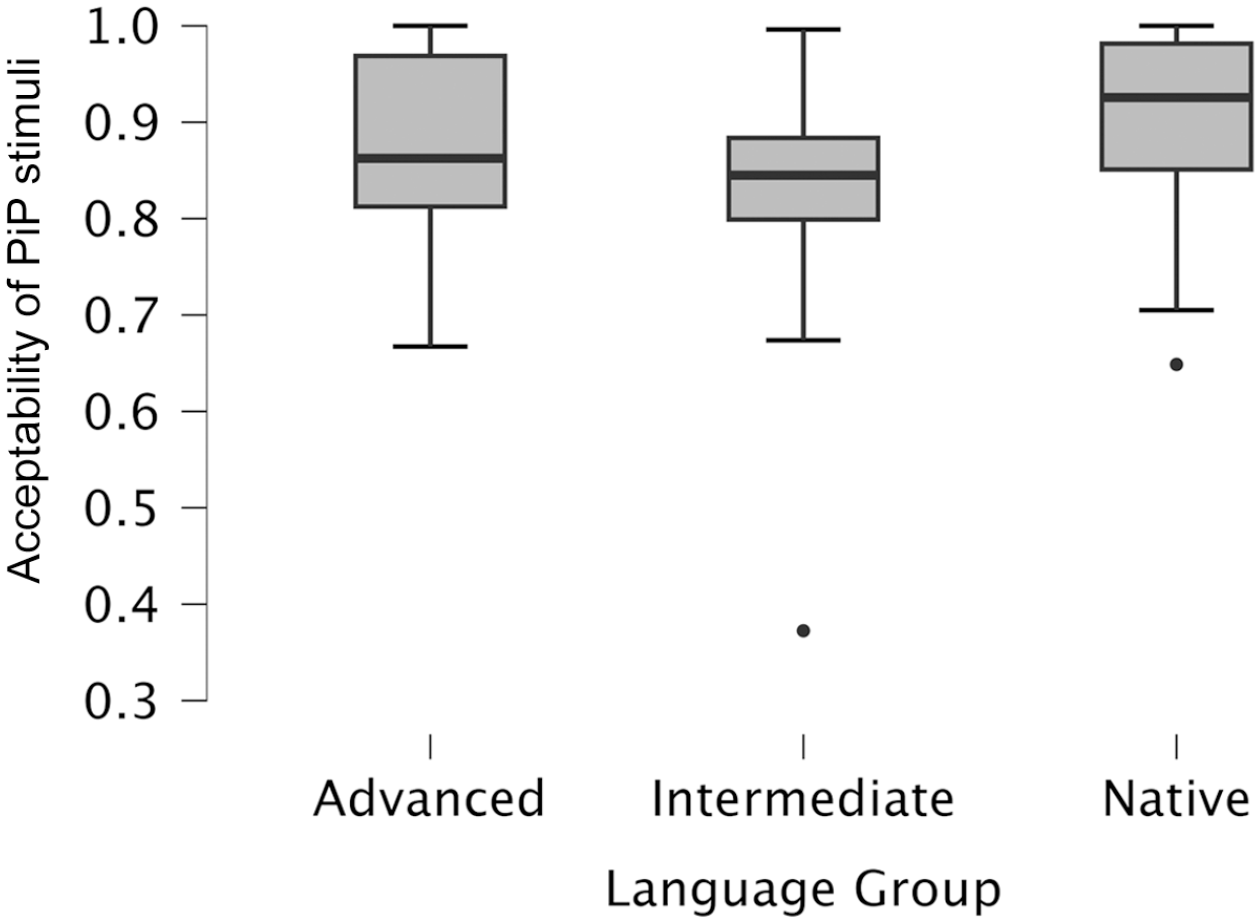
Mean acceptability judgment task (AJT) ratings for oblique relative clauses (RCs) formed with pied-piping.
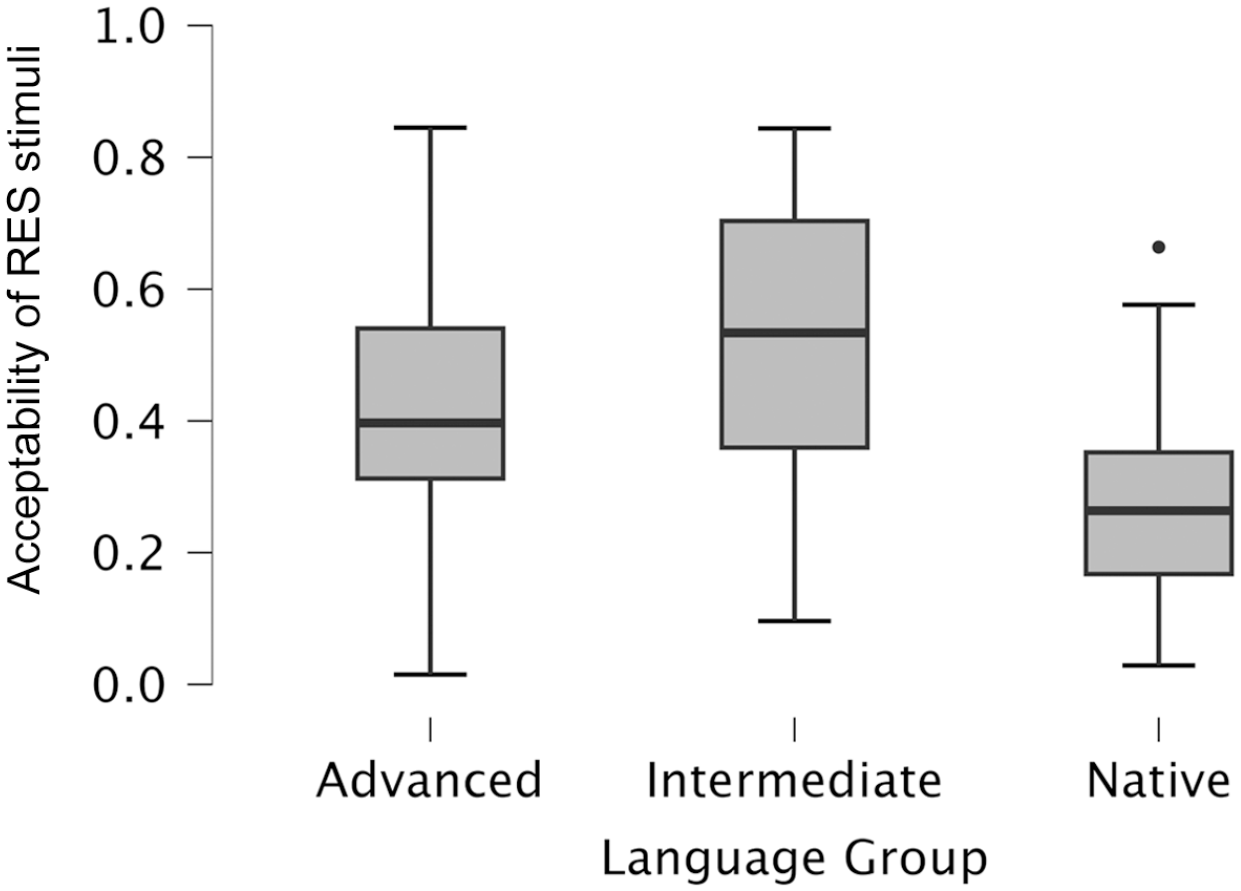
Mean acceptability judgment task (AJT) ratings for oblique relative clauses (RCs) formed with resumption.
After running the statistical model, in the AJT targeting the relativization strategies, the interaction between groups and relativization strategies shows us that the difference between PiP and resumption is not the same across groups. It is the largest for native speakers, while it is smaller for advanced L2 speakers and smaller still for intermediate L2 speakers (see Figure 3). The comparisons with the Tukey adjustment showed that, for PiP, native speakers were not significantly different from advanced Chinese participants (p = 0.1297). Still, native speakers were significantly different from intermediate L2 speakers (p = 0.0033). Advanced and intermediate L2 participants did not differ significantly when the strategy was PiP (p = 0.2758). Regarding resumption, native speakers were significantly different from advanced (p = 0.0002) and intermediate L2 speakers (p < .0001), but the two learner groups were not significantly different (p = 0.1548) from each other.
Looking at the interaction between the relativization strategies (PiP and resumption) and the status of the relativized PP (argument or adjunct), we can see that the difference between adjuncts and arguments is significant for PiP sentences (p = 0.0158), but not for resumption sentences (p = 0.4662). Figure 3 and Figure 4 allow us to visualize the estimated probability of acceptability for each syntactic strategy.
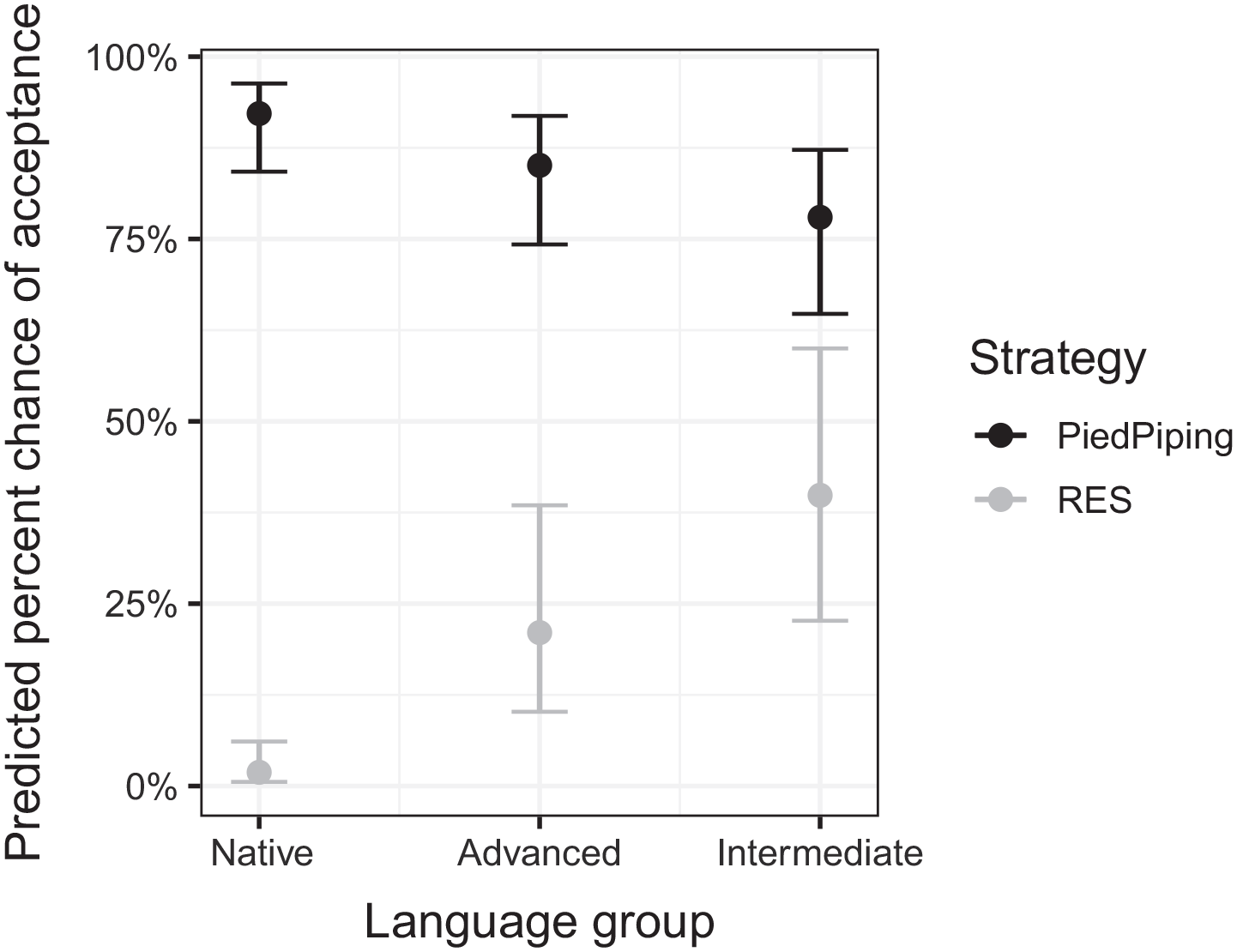
Estimated chance of acceptance of strategy by group.
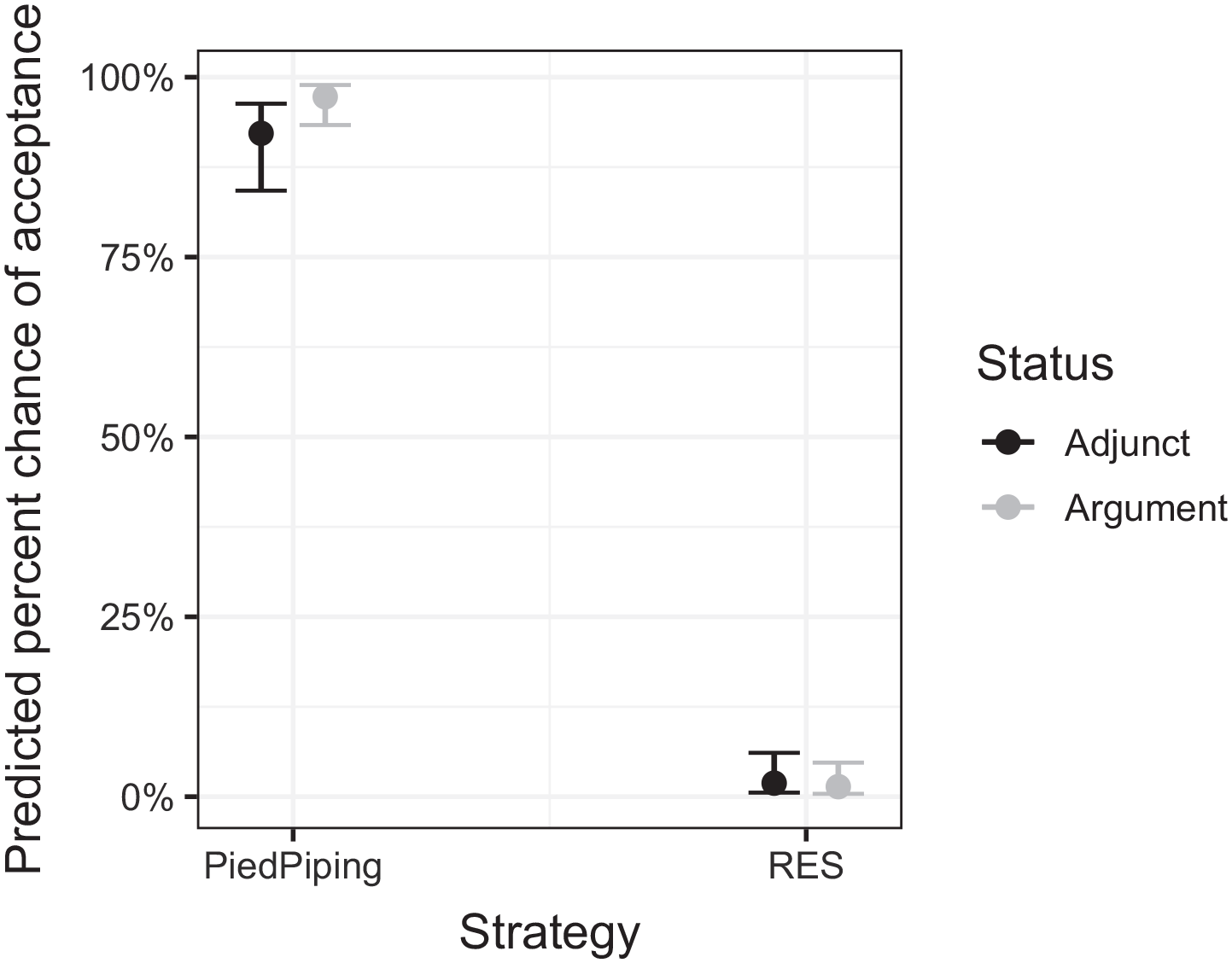
Estimated chance of acceptance of strategy by status.
d AJT with extractions from islands
The mean ratings (from 0 to 1) given by the participants to RCs formed with extractions from islands, illustrated in Figures 5 and 6, show that there is a great deal of variability in the judgments in both structures, PiP and resumption. (For the descriptive statistics, see Appendix 2.)
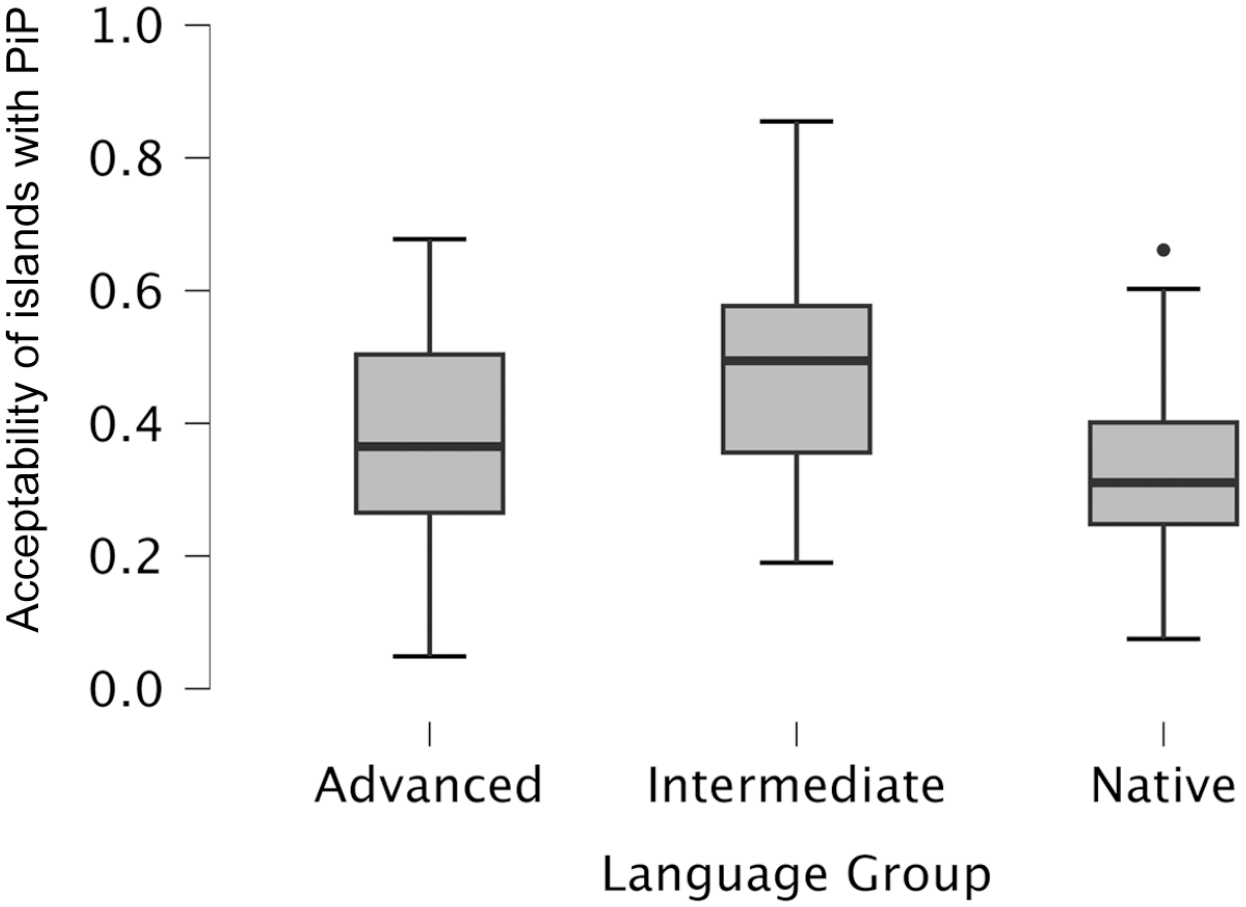
Mean acceptability judgment task (AJT) ratings for pied-piping relative clauses (RCs) formed with extractions from islands (before binarization).
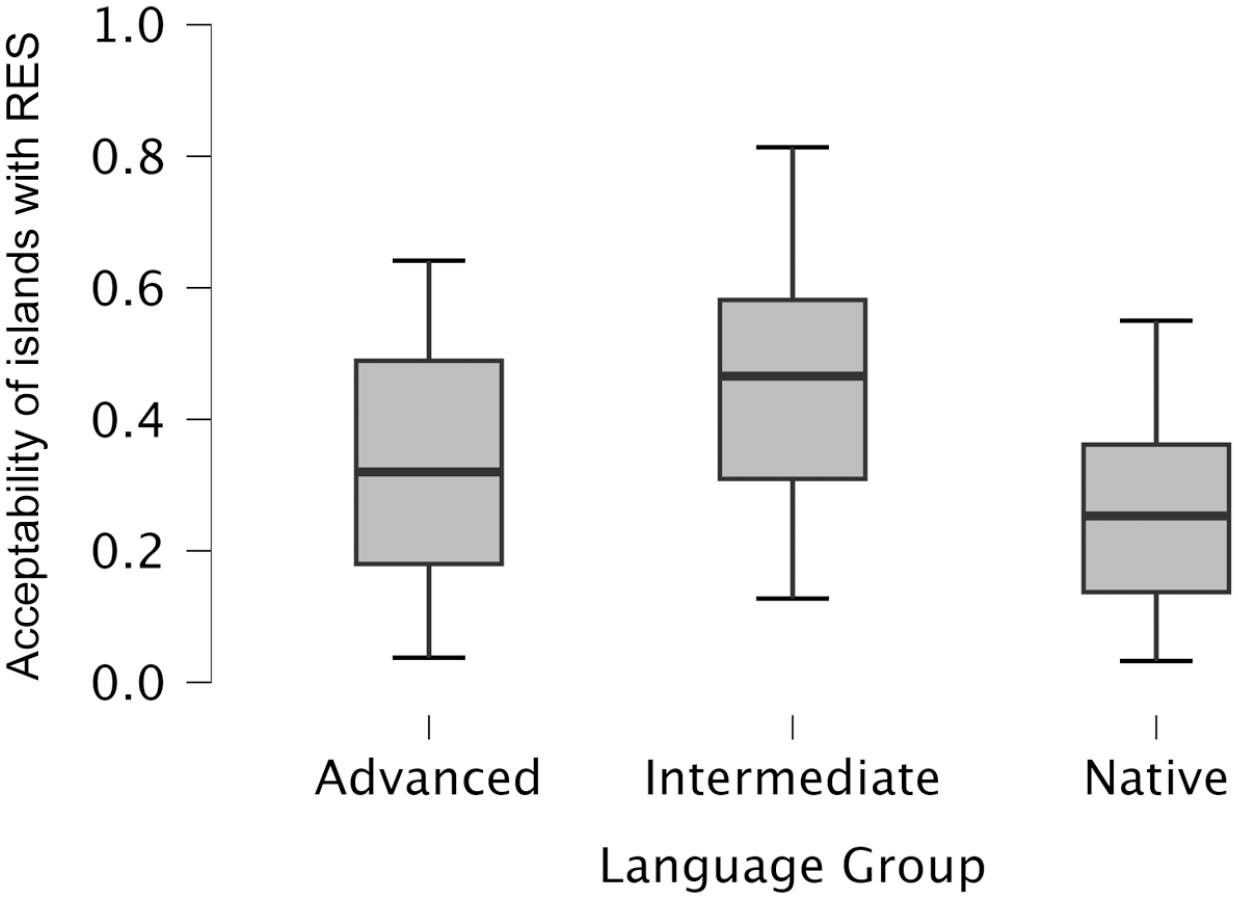
Mean acceptability judgment task (AJT) ratings for Resumptive relative clauses (RCs) formed with extractions from islands (before binarization).
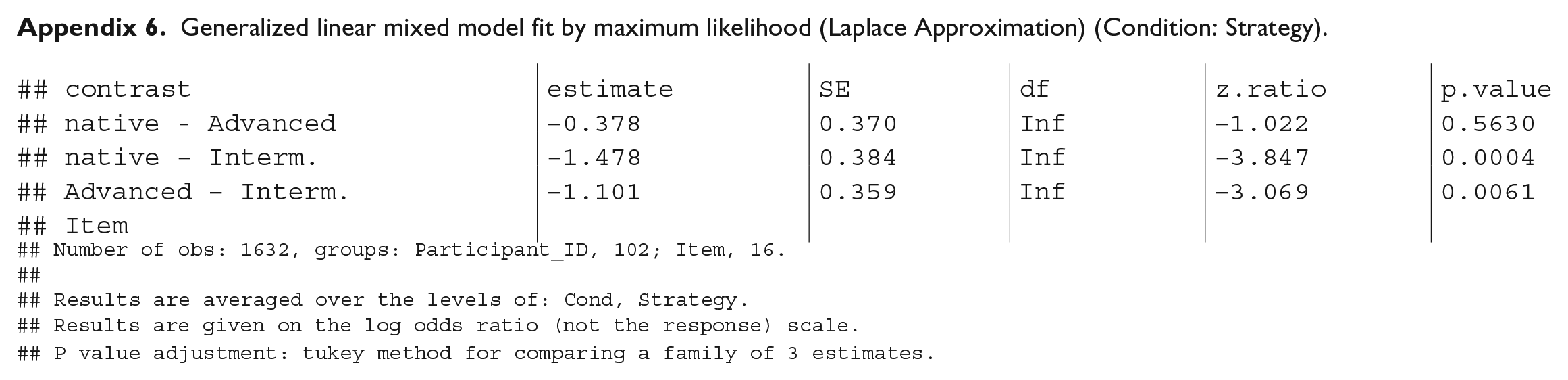
After running the statistical model, the first outcome is that extractions of arguments were accepted significantly less than extractions of adjuncts (p < 0.0001) (see Appendix 3). The second finding is that intermediate Chinese speakers accepted more sentences across all types than native EP and advanced Chinese speakers. Native and advanced speakers were not significantly different from each other (p = 0.5630), but both native speakers (p = 0.0004) and advanced speakers (p = 0.0061) were significantly different from intermediate speakers. Finally, islands with resumption were accepted less than islands with PiP (p = 0.024255) across all groups regardless of the status of the relativized PP (adjunct or argument).
VII Discussion
In this study, we wanted to investigate the developmental path to the acquisition of wh-movement and its related properties by focusing on resumption in prepositional RCs, a structure that requires an RP in Chinese, the L1 of our participants, but that displays obligatory PiP in EP, the target language. Our working hypothesis was that L2 learners would initially map the properties of grammatical resumptives of their L1 onto the L2, transferring this strategy to form prepositional RCs in EP. Later, we hypothesized, they would be able to select the movement features available in other relative structures in their L1, such as operator movement and sensitivity to extractions from islands, onto new configurations in the L2, such as the acquisition of PiP. A supplementary aim of this study was to investigate the ability of RPs to rescue island configurations in EP.
Our initial hypothesis was only partially confirmed, as Chinese speakers did not transfer the entirely of their L1 to form oblique RCs in EP since they did not resort to a non-movement account resolved with RPs, as it is done in their native language. We originally predicted some degree of direct mapping from the L1 into the L2. Following the FRH, it would be easier to map the features that set standard relativization in Chinese (not triggering movement) into resumption in EP (without movement) than to reassemble existing features in the L1 onto different configurations on the L2 that involve movement. Recall that Chinese oblique RCs display obligatory resumption; consequently, we expected some degree of negative transfer more visible in intermediate than in advanced participants. However, contrary to what was predicted, L2 participants practically did not use resumption in their utterances, with no evidence of full transfer in that sense. Nevertheless, we believe this fact does not compromise the validity of the FRH as we did not include beginner learners in our study. A full transfer account has been typically proposed for initial stages of acquisition (Schwartz and Sprouse, 1996, 2021); hence, the lack of transfer of resumption could be interpreted in at least two ways. It could be the case that our participants had already passed that full transfer initial stage, so we just did not observe it in our results. These results, though, could also be an indication of the selectivity of transfer, and exemplify a selective model of transfer instead of a wholesale one. We will need further evidence in order to disentangle this theoretical debate. In any case, the absence of resumption in the current study is at odds with what was found in the intermediate L2 Spanish of Arabic speakers, in oral (Perpiñán, 2015) and written (Perpiñán, 2020) production. Arabic is a language that accepts (or requires) resumption in all relativization positions except for subjects; similarly, Chinese displays optional grammatical RPs in subject and direct object positions, mandatory in oblique cases. It is true that native speakers did not produce resumptive RCs in our experiment either, but that was also the case in Perpiñán’s studies. Indeed, the situation of EP and Spanish is quite similar in terms of resumption: it is ungrammatical in the standard varieties but it can be attested in spontaneous data. 10 A plausible explanation for the lack of any sort of transfer in our intermediate participants could be that they are past the full transfer initial period, so they have already realized that RPs are not a grammatical option in EP and that they need to use a different strategy. The rejection of resumptives and the slight proficiency effect found in the AJT point towards this direction. Certainly, in order to confirm this explanation, we would need to test beginner learners, but this raises a methodological problem, since prepositional RCs are too complex to be acquired or learned at initial stages of language acquisition.
One fact that seems clear is that our participants have properly restructured their ILGs and adopted PiP as the appropriate strategy. Actually, the frequency of production of the PiP strategy is higher in the learner groups than in the native group, clearly showing that this is their preferred strategy for oblique contexts. In parallel, advanced learners have undistinguishable judgments from those given by the native speakers with respect to acceptance of PiP, and only the intermediate learners have significantly different lower acceptance rates of PiP from the control group. Indeed, non-native speakers, particularly advanced learners, mirror native’s production not only in their performance of the target structure, PiP, which they even produce more frequently, but also in the production of other non-standard strategies such as Null-Prep and the locative relativization, not taught explicitly in the classroom, but quite frequent in the native production. Remarkably, advanced learners, and to a lesser extent also intermediate learners, keep the same asymmetries and tendencies found in native speakers with respect to arguments and adjuncts, producing more PiP and more Null-Prep with arguments than with adjuncts. These identical tendencies indicate that the L2 learners, particularly the advanced speakers, have internalized the target grammar and do not apply the same rule for all sorts of predicates. Intermediate speakers, as expected, present a less stabilized grammar, evidencing a proficiency effect. All in all, we interpret these results as robust pieces of evidence of the appropriate restructuring of the ILG and the acquisition of wh-movement. The use of wh-movement not only obeys the relevant syntactic rules, as seen in the findings on sensitivity to extraction from islands, but it is also susceptible to the forms movement may take place, i.e. PiP, Null-Prep, locative relativization, resumption; this is not a trivial finding. This finding corroborates Lardiere (2008), who shows that Patty acquired wh-movement adopting the different forms present in the input (including preposition stranding, in the case of English). Chinese-speaking learners of EP have been able to restructure their ILG and form oblique RCs through movement, confirming our second hypothesis. This conclusion is reinforced with the results from the second self-paced reading task, in which advanced Chinese learners are indistinguishable in their judgments from native speakers, and only intermediate learners show less sensitivity to island violations, showing a proficiency effect.
As for island configurations, the most noteworthy result is that extractions from syntactic islands with RPs were rated worse than extractions from syntactic islands with the PiP strategy and a gap, and this effect was kept constant across all groups. Thus, the RP not only does not rescue or improve island violations, but it renders them less acceptable than extractions from islands with PiP, which yield illicit wh-movement. This result contradicts the traditional literature that advocates for the rescuing effect of RPs (e.g. Kroch, 1981; Ross, 1967). However, more recent experimental studies, including off-line and online comprehension of island constructions with RPs and gaps, presented similar outcomes in other languages (see, amongst others, Alexopoulou and Keller, 2007; Heestand et al., 2011; Perpiñán, 2020; Polinsky et al., 2013). The present study reinforces these conclusions for EP as well, given that extractions from islands were considered worse with an RP by all groups. This study goes in line with the findings of Perpiñán (2020), as the lack of rescue properties of RPs in island configurations were also found for native and non-native grammars. Perpiñán (2020: 10) suggested that the complexity of the extracted element with the PiP strategy ‘makes it more salient and/or more referential, and as such it remains highly activated in memory (Hofmeister and Sag, 2010; Just and Carpenter, 1992; Kluender, 1998), making its integration in the discourse (d-linking) easier.’ Our results may also be a consequence of the type of task applied since the participants were asked to rate the acceptability of the sentences and not its comprehension, which may impact the overall assessment (Beltrama and Xiang, 2016). Likewise, the grammatical function tested may have also played on the acceptability of RPs (Chaves and Putnam, 2020).
In any case, the results from task 2 corroborate that RPs are not solving the problems in the derivation and suggest that RPs may relate with discourse–pragmatics and comprehension, as noted by Beltrama and Xiang (2016), and not exclusively with syntax (Polinsky et al., 2013).
Similarly, Culicover et al. (2022) recently proposed the Extended Radical Unacceptability Hypothesis (ERUH) to explain the results with island configurations: ‘All judgments of reduced acceptability in cases of otherwise well-formed (i.e. locally well-formed) extractions are due to non-syntactic factors, not syntactic constraints’ (Culicover et al. 2022: 24). In other words, extra-grammatical factors may explain the nature of syntactic islands, without the need of considering universal constraints. According to the authors, these factors include processing complexity, discourse acceptability, pragmatic plausibility, and contextual factors. We believe this strong hypothesis could be extended to the case of island configurations with RPs.
Notably, the lack of amelioration of extractions from islands with RPs is attested in native and non-native speakers alike, indicating that Chinese learners not only have been able to acquire wh-movement and its related morphological properties, as seen in the production task, but they are sensitive to the same restrictions that govern island configurations, be it syntactic and/or extra-syntactic, despite the fact that their native language allows RPs in some island contexts (although not consensually, as exposed above). We take these results as clear indicators that non-native speakers are able to fully access UG and restructure their grammars accordingly, even in cases of poverty of stimulus such as the one presented in this study. Chinese learners have totally overcome the properties of their L1 oblique relativization strategies and have mastered or are in the process of mastering the morphosyntactic properties of EP prepositional RCs, a quite complex structure that already presents in the L1 more variation than what is usually taught in class. This is a remarkable enterprise particularly taking into account the low frequency of the structure in the input.
VIII Conclusions
This study investigated the acquisition of prepositional RC in L2 EP by Chinese native speakers. Its main goal was to determine whether Chinese learners could acquire wh-movement, its morphosyntactic expression and its limits in EP. Overall, our results indicated that Chinese L2 learners are fully able to acquire wh-movement and its associated properties in the L2, and go beyond the L1 properties, even under conditions of poverty of stimulus. The results of our experimental design further indicated a reduced power of transfer effect in the acquisition of prepositional RCs by Chinese native speakers (at least at intermediate and advanced stages of acquisition) since these learners neither produced nor accepted resumptive pronouns in the L2, which are grammatical and mandatory in their L1. In particular, the L2 learners consistently produced and accepted relative clauses with pied-piping, clearly involving movement. Furthermore, the L2 learners showed sensitivity to subjacency constraints, rightly identifying island violations.
These outcomes indicated that EP non-native speakers can access UG and reassemble the functional features that determine wh-movement, restructuring their interlanguage grammar concerning this mechanism in the target language. These findings constitute robust evidence towards full access approaches to second language acquisition, such as the Feature Reassembly Hypothesis (Lardiere, 2005, 2008, 2009), showing that non-native speakers can recruit uninterpretable functional features from UG to restructure their interlanguage grammar in adulthood. On the other hand, these results are at odds with L2 acquisition hypotheses that consider that acquisition after the critical period is constrained to certain features, such as the Representational Deficit Hypothesis (Hawkins, 2005; Hawkins and Chan, 1997; Hawkins and Hattori, 2006).
Additionally, this study also showed that RPs do not generally rescue island configurations. These results corroborated other studies underscoring the relation between resumptive pronouns, discourse/pragmatics and comprehension (Polinsky, 2013) and underline the need to look at other components of the grammar (besides syntax) when analysing syntactic islands and their effects. The lack of rescuing power of RPs may be explained by the type of task (Beltrama and Xiang, 2016), but also by the grammatical function of the RPs tested (Chaves and Putnam, 2020). Such outcomes reinforce the need of developing further research controlling for the grammatical function of the RPs tested as a variable (Chaves and Putnam, 2020), and also considering other tasks focused on comprehension, i.e. on the ability to understand the sentence (instead of focusing on its acceptability) (Beltrama and Xiang, 2016).
Footnotes
Appendix
Generalized linear mixed model fit by maximum likelihood (Laplace Approximation) (Condition: Strategy).
| ## contrast | estimate | SE | df | z.ratio | p.value |
|---|---|---|---|---|---|
| ## native - Advanced | −0.378 | 0.370 | Inf | −1.022 | 0.5630 |
| ## native – Interm. | −1.478 | 0.384 | Inf | −3.847 | 0.0004 |
| ## Advanced – Interm. | −1.101 | 0.359 | Inf | −3.069 | 0.0061 |
| ## Item |
## Number of obs: 1632, groups: Participant_ID, 102; Item, 16.
##
## Results are averaged over the levels of: Cond, Strategy.
## Results are given on the log odds ratio (not the response) scale.
## P value adjustment: tukey method for comparing a family of 3 estimates.
Declaration of Conflicting Interests
The author(s) declared no potential conflicts of interest with respect to the research, authorship, and/or publication of this article.
Funding
The author(s) disclosed receipt of the following financial support for the research, authorship, and/or publication of this article: Ana Espírito Santo acknowledges the Ph.D. Scholarship given by the Portuguese Foundation for Science and Technology (FCT), reference number SFRH/BD/146971/2019. Nélia Alexandre acknowledges the support given by the Portuguese Foundation for Science and Technology (FCT) reference number UIDB/00214/2020.
