



Abstract
Study abroad homestays are generally assumed to provide visitors with opportunities to learn language ‘in the wild’ by participating in the host family’s everyday life. Ultimately such participation is accomplished via individual episodes of interaction as the visitor is socialized into the family’s mundane routines and rituals. Building on research into second language interaction in the lifeworlds of learners beyond the classroom, this study considers (1) how interactants in one homestay context draw on a range of ecologically available resources to co-accomplish participation and membership, and (2) how such participation affords the guest with an expanding repertoire of resources, including linguistic elements and new participatory practices. The study uses multimodal conversation analysis (CA) to discuss two extended extracts from naturally occurring interaction collected between a novice L2 English speaker and his homestay family. The analysis suggests that language learning is more complex than the mere provision of linguistic input: new lexical items and practices emerge within the interactants’ respective lifeworlds in relation to locally situated contingencies, and can be occasioned and explained via recourse to a range of material and embodied affordances beyond just language. Input, therefore, is sequentially and ecologically located in the broader business of an ongoing collective sociality and primarily serves the two key interactional imperatives of progressivity and intersubjectivity.
Keywords
I Introduction
Living with a host family is one of the quintessential study-abroad experiences, and homestays are generally assumed to provide visitors with opportunities to learn language ‘in the wild’ by participating in the family’s everyday life. Canonically within the literature on second language acquisition (SLA), such changes in linguistic competence involve input in some form (e.g. Krashen, 1985; Gass and Selinker, 1983). Study abroad research grounded in language socialization and sociocultural theory has used input as a central research topic within investigations into the development of linguistic and pragmatic competence via homestay dinner table talk. These researchers have investigated, for example, the homestay guests’ vocabulary knowledge (Kinginger and Carnine, 2019), knowledge of phonology and metaphor (Lee and Kinginger, 2016) and cultural practices (Lee et al., 2017), as well as their ability to use pragmatic actions such as compliments (Lee, 2017). Conversely, homestays that do not provide sufficient interactional opportunities do not usually foster linguistic competence (see, among others, Kinginger, 2015; Kinginger and Wu, 2018). Whether or not a homestay is successful is ultimately contingent on the extent to which the guest is able to engage in interaction, and therefore expand their repertoire of tools for participating.
While the focus of most SLA studies of input is firmly on language, from an ethnomethodological perspective, language learning can also be conceptualized as changes in the way a learner participates in interaction and how that leads to expanding membership within the target-language culture. At a micro-level participation is accomplished via individual episodes of interaction as the visitor is gradually socialized into the family’s mundane routines and rituals. Each episode is situated in a rich ecological context which features a complex array of interactional, embodied and material affordances that may be co-opted into the business of learning (or teaching) a new word, phrase or expression. Competently using an expression or accomplishing a given social action is a mark of membership within the community of people who speak the language in which it was formulated. As such, input is not just about providing opportunities to hear and learn words: by extension it also concerns becoming a member who can competently participate in recognizable social activities in the target language. In this article we explore these notions further by analysing two episodes of naturally occurring talk taken from a short-term homestay visit.
The majority of study abroad studies have drawn on semi-structured interviews, questionnaires, field observations, student journals and diaries as their main methods for establishing empirical evidence (for a scoping review, see Tullock and Ortega, 2017). Over the last decade, however, researchers have increasingly moved towards more interactional approaches and have included recordings of naturally occurring homestay interactions. Wilkinson (2002), Shively (2013), Kinginger et al. (2016) and Diao (2016) all collected regular audio recordings, and Lee et al. (2017) added visual material such as photographs into the methodological mix. Several of these studies use elements of conversation-analytic (CA) methodology for the transcription and analysis of these recordings (Wilkinson, 2002; Shively, 2013; Kinginger et al., 2016). However, since their focus was on verbal input, there has not been any need for video recordings.
Expanding the focus of interest to the details of ongoing episodes of interaction allows us to understand language as embedded in the embodied actions of the participants and based on the specific socio-material environment of the interaction. It opens up opportunities for observations about talk not only occasioned by other talk, but also by embodied activities and features of the environment that participants take up during their interaction. Input, then, no longer needs to be measured in linguistic categories, but instead has to do with activities that might improve the participant’s interactional competence (Hall et al., 2011; Pekarek-Doehler et al., 2017).
Recent CA studies have documented the development of interactional competence over time in study abroad contexts (e.g. Burch, 2019; Dings, 2014; Ishida, 2017; McMeekin, 2016; Taguchi, 2014), including some that focus particularly on the homestay dinner table (Greer, 2018, 2019a, 2019b) and related contexts such as college dormitories (Mori and Matsunaga, 2017) and au pairs living with a host family (Pekarek Doehler and Berger, 2018, 2019). Such studies view learning as temporally and socially situated in sequences of co-constructed interaction, accounting for the participants’ orientations via the micro-details of the talk.
In order to reconceptualize input in terms of participation and membership, our study therefore adopts a multimodal CA approach (Nevile, 2015; Sidnell and Stivers, 2013). CA research is informed by phenomenology (Merleau-Ponty, 1962) and ethnomethodology (Garfinkel, 1967), and CA studies of second language interactions do not invoke systemic concepts such as input. As we see it, the CA approach to language acquisition differs from cognitive approaches in at least four main respects:
Where participants are co-present, language is just one of many tools they have available to them. In interaction, language is anchored to its local ecology of environment, participants and purposes.
Interaction is jointly organized in action sequences where a prior turn at talk becomes consequential for what comes next and therefore how the activity is perceived by the participants (and, by extension, analysts). As a result, the most immediately relevant aspects of language acquisition are outside the head.
Input in the local language is not just words wafting over the guest: it comes out of an active process of co-participation in interaction through which the course of interaction is mutually shaped. Therefore, exposure cannot be isolated from the people involved in it.
Linguistic input is part of a broader complexity and its form will depend on a range of phenomena in the environment which are not always predictable.
With this co-participatory perspective on input in mind, in this article we account for the situated role of participation and membership in two extended sequences of interaction recorded in a homestay context. In doing so, we explore the following grounded research questions:
How do interactants in a homestay context draw on a range of ecologically available resources to co-accomplish participation and membership?
How do participation and membership afford new resources to the homestay guests with respect to (a) linguistic elements that may get introduced and made sense of, and (b) new or different participatory practices?
In Section II we sketch out the theoretical background, methodology and our research interest in understanding second language learning. In Section III we present the background to the data and then in Section IV analyse two extracts from video recordings collected by a Japanese guest during his homestay in the United States. Finally, in Section V, we discuss how video analysis of interaction can add to the study of input and reflect on how input can be viewed as changes in participation and membership.
II Theoretical background and methodology
The ways language learners participate in their lifeworlds (Garfinkel, 2007) and the role of that participation in second language acquisition have been the focus of CA research for several decades (Firth and Wagner, 1997; Kurhila, 2006; Markee, 1994; Mori, 2003; see contributions to Gardner and Wagner, 2004; Hall et al., 2011; Nguyen and Kasper, 2009; Kasper and Wagner, 2011; Hellermann et al., 2019). Much of this research has been related to workplace and lifeworld encounters where newcomers are concurrently being socialized into their environment in a new country and into using a second language. Early studies of second language learners’ participation mainly concentrated on the ways in which they participate in their new environment, how they cooperate with locals when meaning making and understanding is at stake, and how linguistic elements are made relevant and potentially acquired.
Participation is at the heart of language acquisition. Goodwin and Goodwin (2004) define participation as ‘actions demonstrating forms of involvement performed by parties within evolving structures of talk’ (p. 222). Participation is not bound to talk: it is jointly accomplished by (multiple) co-present parties through a wide range of embodied resources and displays. Participants can co-construct the roles of speaker and hearer, as Goodwin (2004) has shown in his studies of Chil, an aphasic speaker. Chil told stories by proxy, i.e. by initiating a tellable and leaving the telling proper to his wife, who shared his memories of the tellable event. Goodwin and Goodwin (2004: 223) therefore concluded that ‘[a] comprehensive study of participation requires an analytic framework that includes not only the speaker and her talk, but also the forms of embodiment and social organization through which multiple parties build the actions implicated in a strip of talk in concert with each other.’ In short, interaction involves far more than just language.
Participants therefore need to draw on a joint reservoir of embodied and linguistic resources to make sense to each other. To describe what this means, ethnomethodology introduces the concept of ‘membership’. Members are socialized into the orderliness of a specific social world and their behavior is accountable to other participants as the way ‘we are doing things here.’ Becoming socialized, or learning the ropes in a specific participation framework, means becoming a member. Homestay students begin as guests and invited strangers, but by learning the practices, rituals and timing of what the family does together, they may become a kind of member of the family.
However, just ‘being around’ a family home is not the same as active participation. The visitor must be invited into the rituals, as Greer (2018) has shown. If there is little social co-operation and inclusion by the hosts, newcomers cannot participate and will not become competent members, nor be treated as such. As Kinginger (2015: 55) notes: ‘the success of the homestay as a learning environment seems to depend . . . on whether or not students are received as persons of consequence, deserving of the family’s attention and socializing efforts.’ To understand why homestays sometimes fail with respect to language learning, the quality of the interactions needs to be understood through careful micro-analysis.
Participants deploy interactional practices (i.e. packages of recognizable purposeful actions) not accidentally but accountably, meaning they can provide grounds for their just-prior action if needed. Practices are not deterministic and participants need to make sense of them by doing understanding work. Heritage (1984a) illustrates this with the practice of mutual greeting. Although greetings are addressed to acquaintances, we might witness person A greeting somebody who ‘we know is not an acquaintance’ (p. 126). On seeing this we can decide whether A ‘broke the rule or we can infer that, via the use of the rule, he was seeking to treat the other as an acquaintance’ (p. 126). To infer a creative use of a practice, we need to see person A as a member, as somebody who knows that greetings entail acquaintance but ‘breaks’ it for some purpose. If a non-member (such as a homestay visitor) were to do the same thing, this might be perceived as the learner breaking the rule through ignorance.
Social practices can be recognized by ‘members’ for what they are, while the need for an account indicates that the social order has been challenged and needs to be confirmed or repaired. As argued by Heritage, a social practice is a resource. Greeting somebody who is vaguely familiar can be understood as an offer to make this person familiar and can lead to mutual greetings in the future. When a first greeting is not responded to it may be made accountable through local contingencies (e.g. ‘he was busy with his phone and did not see me waving to him’). As Haslanger notes, ‘practices . . . are certain kinds of normatively unified regularities’ (Haslanger, 2018: 8).
This understanding of practical social action has consequences for the methodology of studies following this radically emic phenomenological approach. CA studies will always aim to reconstruct the perspective of the participants in order to reveal the ways in which they make sense of their world. As a consequence, data are collected in consequential encounters in the participants’ lifeworld and will typically consist of audio- and video-recordings that can be repeatedly inspected.
1 Learning in and through participation
Goffman (1981) distinguishes between different speaker and listener positions. Listeners can be ratified participants, overhearers and bystanders or un-acknowledged eavesdroppers. Research has mainly investigated second language learners in their role as ratified active participants who are able and expected to participate actively. However, second language learners can be overhearers and non-speaking participants for a period and then gradually adopt the status of active ratified participants. Greer (2018) shows how a Japanese student at a homestay participates in the guest-family’s daily ritual of saying grace and after some time is invited to lead the prayer himself. Based on what the visitor observed through participation in the ritual, he is able to produce a version of it that over time comes closer to the version spoken by the families. Lave and Wenger (1991) describe this process as situated learning: the social process of increasing participation. We prefer to describe the process as expanding membership. A sociological conceptualization of learning as membership allows us to come analytically closer to categories and knowledge emerging in and from the interaction to which the Lave and Wenger model does not adequately attend.
In a number of papers, Eskildsen (2011, 2012, 2018) has shown that exposure to a second language in participatory environments stimulates language acquisition. By combining Usage Based Linguistics with CA’s sequential understanding of action and talk, Eskildsen is able to demonstrate how linguistic structures emerge from participation. These acquisition processes – which can run over very long periods of time before they settle (e.g. Nguyen, 2019) – may be supported by embodied behavior, such as specific gesture-talk packages (Eskildsen and Wagner, 2013, 2015, 2018).
2 Participatory practices for learning
Meaning and understanding are co-constructed by the participants through accountable social practices. CA has repeatedly documented the robust interactional organization of talk and the enormous flexibility of repair practices (clarifications, reformulations and the like) that in very localized ways take care of interactional hitches in the talk (for an overview, see Kitzinger, 2013). Second language interactions are particularly sensitive to trouble and the study of repair practices has been prominent in researching second language interactions (for an overview, see Kasper, 2006).
Brouwer (2003) has argued that repair practices isolate troublesome elements of talk and thereby make them available for verbal operations that eventually foster learning. Since then, a significant number of publications have argued for the relevance of word search practices in meaningful second language interactions (as the most recent, see Eskildsen, 2019; Greer, 2019a; Pekarek Doehler and Berger, 2019). Trouble within talk can be addressed in a number of ways. Speakers can orient to problems in some yet-to-be produced segment of a turn-in-progress and address that repairable via word searches, circumlocution and the like (forward-oriented repair, Schegloff, 1979), or they can use a temporary replacement for the word and repair it afterwards, or get help in doing so (backward-oriented repair). Word searches are therefore trouble solutions in the ongoing talk, but speakers have other possibilities as well. They can try to pre-empt problems before they occur or they can de-brief the situation after the trouble has been resolved (Svennevig, 2010).
Participation and repair practices contribute in significant ways to second language learning and both of these notions are central to our analysis of homestay data.
III Background to the data
The data are video recordings of English interaction collected in a homestay context. The two conversations we will analyse in detail come from a dataset recorded in Seattle, USA in the summer of 2012. The homestay guest, ‘Shin’, was a first-year student from a Japanese university who was taking part in a 3-week study abroad program while living with a local host family which consisted of Mom, Dad and Gran, as well as ‘Jennifer’, their 20-year-old daughter who was not living in the home. Shin was asked to video-record instances of natural interaction between himself and the host family and written consent was obtained from all parties. The researchers were not present at the time of recording.
The Shin data are part of a larger homestay data corpus in which the learners are participants in the daily activities of their host family. While most CA studies explicate a specific interactional practice by compiling a collection of relevant fragments from various conversations, Schegloff (1987) extols the value of applying our knowledge of a range of practices to an extended instance of talk in what is known as a single case analysis. Following ethnomethodological practice, we have chosen two episodes that show how participation creates opportunities for accessing practices and language elements that are embedded in the physical and embodied intricacies of the local situation.
The data have been transcribed according to the conventions developed by Jefferson (2004), and embodied aspects of the talk have been indicated below the talk following a simplified version of Mondada’s (2018) transcription approach. For further details, see the Appendix 1.
IV Analysis
1 Membership through ecologically occasioned and co-accomplished participation
Physical, interactional and co-embodied facets of the participants’ respective lifeworlds are often drawn on to facilitate language learning. In order to document such ecologically occasioned participation, this section will focus on part of an extended conversation between Dad and Shin that involves several instances of language negotiation and displays of understanding. The recording takes place in Dad’s den after the evening meal and the participants are seated facing each other approximately 2m apart (Figure 1).
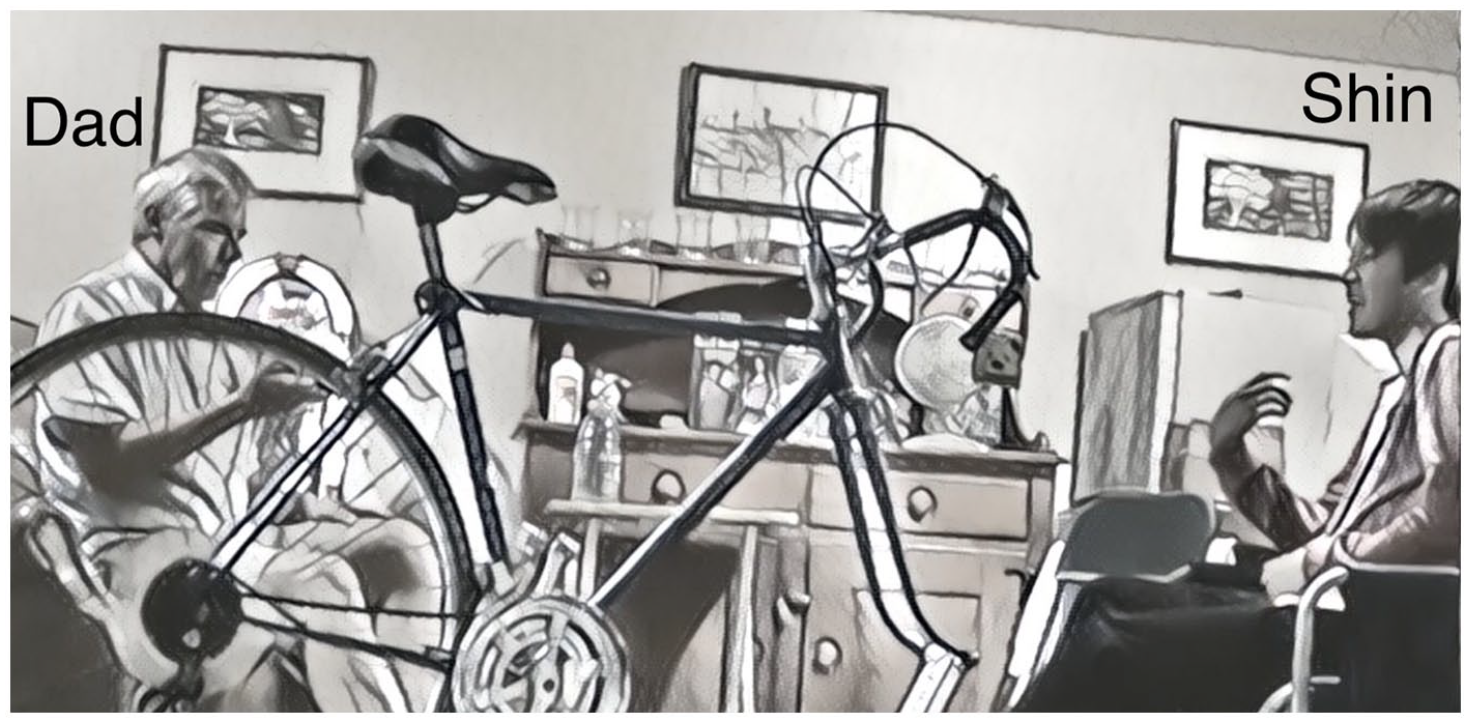
The seating arrangement.
Throughout the analysis, we will explore how the participants orient to (potential) trouble within the talk, and how they deal with it through both the apparatus of interactional repair and by using ecologically available objects and multimodal resources such as gaze and gesture. We will also consider how these resources enable the interactants to display their participation and therefore make relevant their co-membership, particularly with respect to Shin’s shifting understanding of language usage.
Dad and Shin are both baseball fans and former players. Immediately prior to the sequence, they have been talking about their experiences and Dad has said he was hurt by the ball many times, even in softball games.
Extract 1.1: Shin notices visual elements of the ball
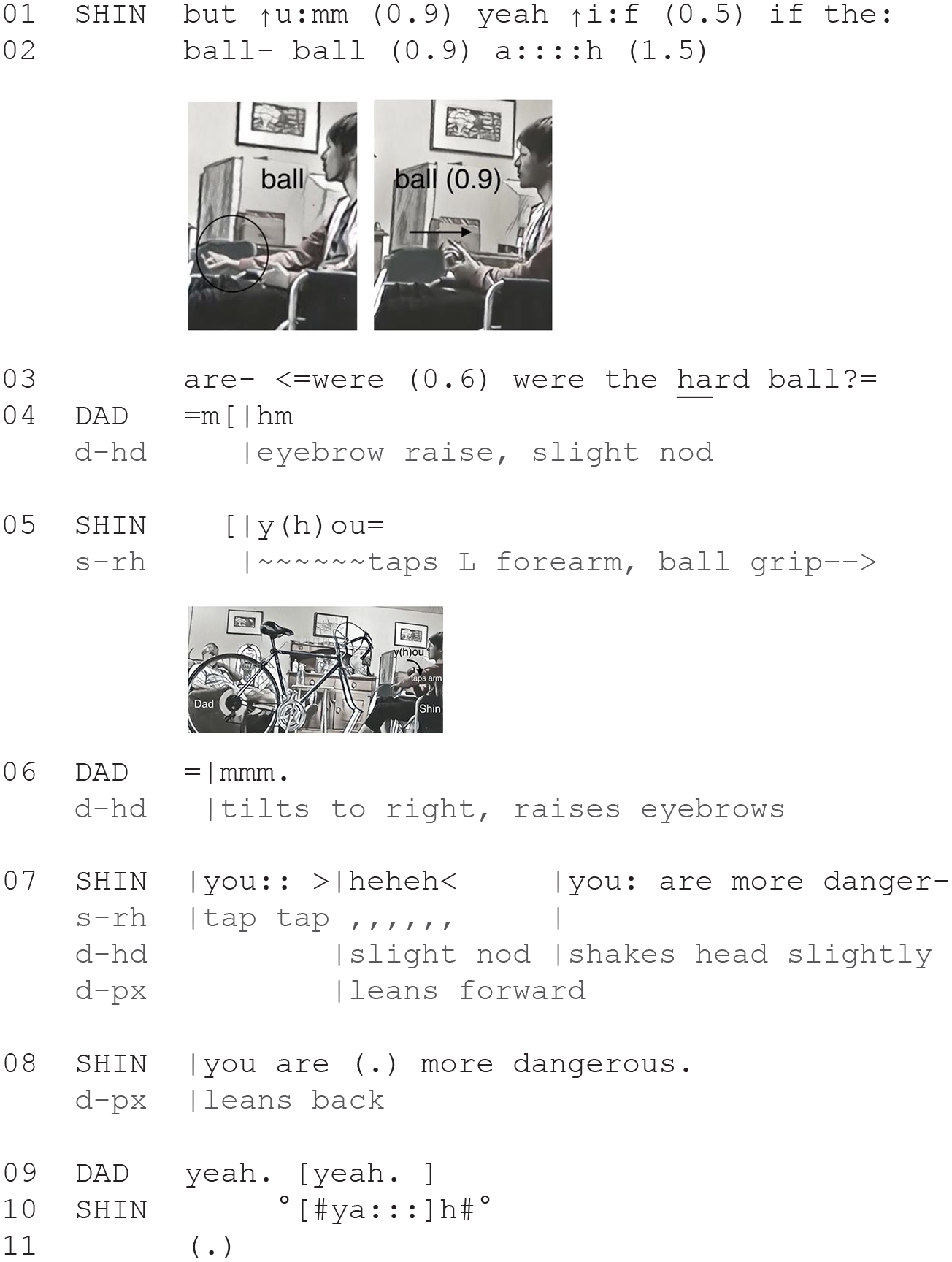
At this point Dad and Shin have already topicalized softball, but it appears that Shin has not had much direct experience with the sport. In lines 1–8 he formulates a conditional turn that essentially says, ‘Yeah, if the ball were hard, you’d be in more danger.’ Although Dad does not treat it as problematic, Shin’s turn is clearly not as succinct as that: the intra-turn pauses and restarts in lines 1–3 and 7–8 demonstrate his hesitation but also his orientation to self-repair, such as syntactically sensitive tense changes (line 3) and changes in parts of speech (line 8). Crucially, Shin also refines his message through his embodied conduct. In line 5 he taps his left arm with his right hand in a manner that suggests his arm is being hit by a ball. This comes at a point where he has just completed the conditional element of his turn-in-progress (‘if the ball were a hard ball . . .’), and the gesture therefore illustrates elements of the as-yet unformulated consequence. Although at line 5 and the start of line 7 Shin has only said ‘you’, Dad is able to project that the turn ending will involve the ball hitting him on the arm. Shin then produces the somewhat ambiguous formulation ‘you are dangerous’ (line 8), which Dad does not treat as incomprehensible (as evidenced by his uptake in line 9). Although Shin is clearly having some trouble constructing this turn, Dad claims understanding and lets it pass without initiating repair.
Dad delivers two other uptake tokens in this segment. In line 4 his ‘mhm’ is delivered with a nod and an eye raise that signals that he has understood the message so far and is perhaps able to recognize the direction in which it is heading. In contrast, the ‘mmm’ in line 6 is delivered with falling intonation and a slight tilt of the head implying that Dad has also begun to assess the content of Shin’s turn further and is disaffiliating with the direction in which it is heading. In the next segment we see that Dad does go on to disagree, suggesting that a softball is not really that soft.
Extract 1.2: Dad disagrees and Shin’s display of lack of epistemic access prompts Dad to get a ball
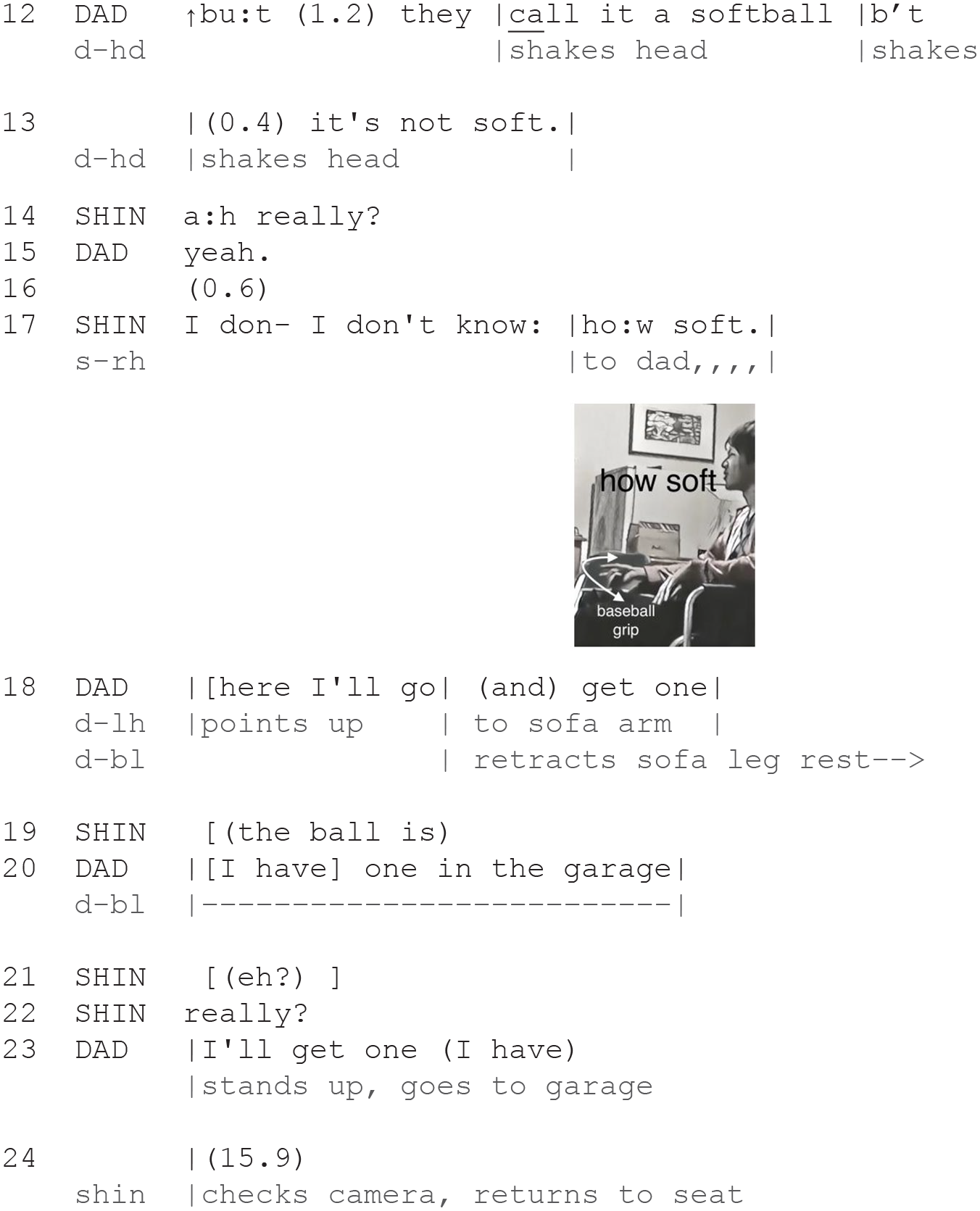
Retrospectively then, we can see that Dad’s ‘yeah’ in line 9 was part of a ‘yes, but’ partial disagreement (Pomerantz, 1984) that works to dispute Shin’s assessment of the ball as hard. Shin treats this as newsworthy in line 14, which makes an implicit claim to lack of haptic experience with a softball. He later follows this with a more explicit claim of insufficient knowledge (line 17) that works as a bid for further explanation (Beach and Metzger, 1997). When he produces the phrase ‘how soft’ his hands form a kind of pinching gesture that illustrates the embodied action for testing the hardness of a ball.
This leaves Dad with something of an interactional quandary: what is the most efficient way to explain the softness of a softball? Multisensorial features of objects, such as haptic perception, are difficult to explain (Mondada, 2019). Dad solves this problem by going into the adjacent garage and coming back with an actual softball. Although this momentarily delays the progressivity of the interaction, it ultimately solves the intersubjective impasse by allowing Shin to touch the ball, and therefore judge its hardness for himself. This delay therefore warrants some sort of explanation from Dad, which he accomplishes with an offer (lines 18 and 23) and an account (line 19). Dad then returns approximately 16 seconds later with a leather softball in his hand.
Extract 1.3: Shin notices visual elements of the ball
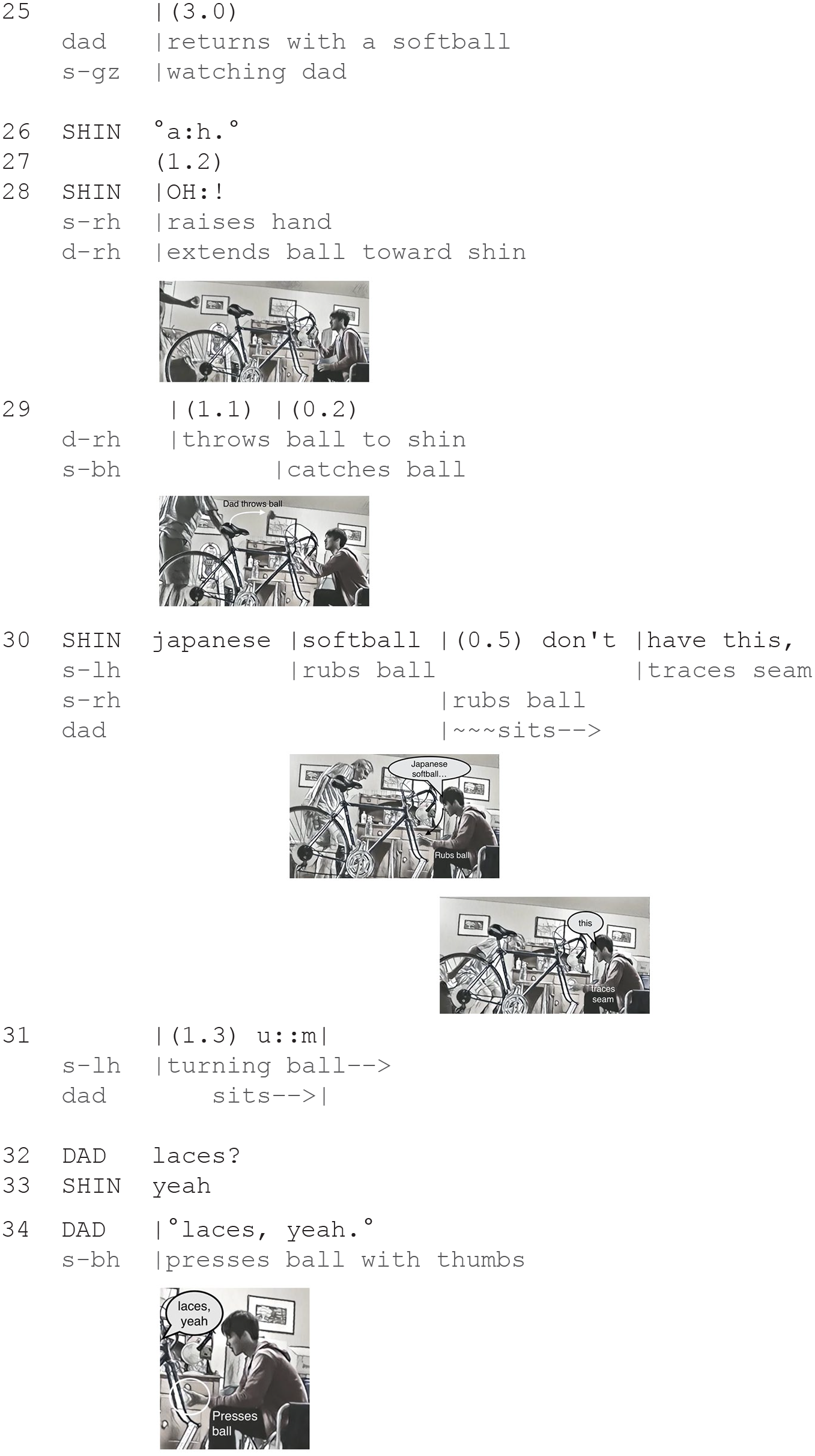
Shin’s initial reaction appears to be a response to the visible appearance of the ball: his ‘ah!’ in line 26 is formulated as a (Japanese) change-of-state token (Heritage, 1984b) and he then follows this with an English equivalent in line 28. The first, therefore, seems more visceral and self-addressed, whereas the second is a bigger, more public reaction delivered as Dad is positioned closer and preparing to throw Shin the ball. Indeed, Shin’s subsequent noticing (line 30) is one that is based not on haptic but visibly available elements of the ball–he compares the American softball to a Japanese one, noting that Japanese softballs do not have laces.
However, this turn itself becomes an opportunity for language learning, or at least recalling. Note that in line 30 Shin does not say ‘Japanese balls don’t have laces’, but rather ‘Japanese balls don’t have this’, producing it with continuing intonation as he rubs the ball’s stitching. Along with the pause and hesitation marker in line 31, this suggests that he is experiencing some difficulty in accessing the word he is looking for (forward-oriented repair), and his use of the distal demonstrative pronoun as he touches the ball is akin to an embodied word search practice identified by Hayashi (2003). It also provides a possible chance for Dad to participate in the word search: Shin could have, for example, simply completed line 30 with the deictic ‘this’ and falling intonation, but by talking through it he treats this as an opportunity for language learning.
For his part, Dad has visual access to the part of the ball that Shin is touching (the stitching) and is able to correctly infer the missing object that completes Shin’s environmentally coupled gesture (Goodwin, 2007), completing the turn in line 32 with a try-marked candidate (Sacks and Schegloff, 1979) that Shin immediately accepts in next turn (line 33). Although he has initiated repair, this brief acknowledgement (‘yeah’) suggests that Shin was already familiar with the word, since he doesn’t treat it as new, such as by repeating it or trying it out. In fact, the word lace does already exist in Japanese, although not in this particular context. 1 Shin has recognized a broader use of a known word. In this case it does not prompt any further discussion from Dad, possibly because Shin is also beginning to touch the ball more carefully by pressing his fingers into it (line 34).
A little later Dad goes on to explain the difference in size between a softball and a baseball, which leads to another opportunity for learning, this time regarding the word ‘circumference’. Interestingly, this explanation begins with a gesture from Dad (since Shin is holding the ball), but later involves Dad taking the ball back from Shin in order to give a fuller or better explanation.
Extract 1.4: An opportunity for language learning embedded in another explanation
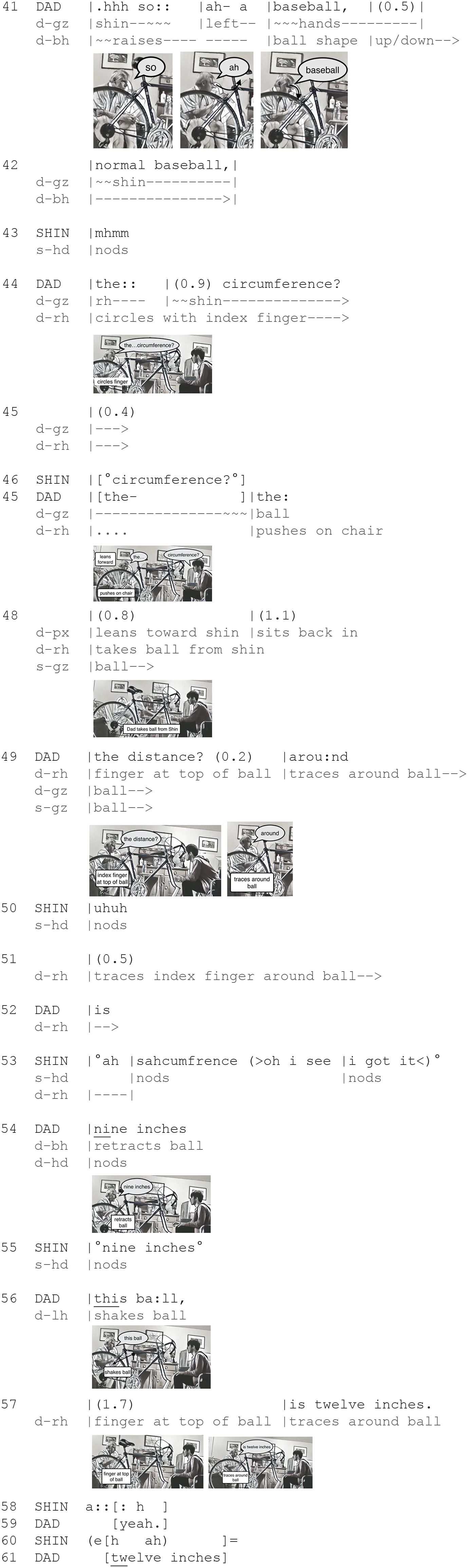
Extract 1.4 therefore initiates an explanation of the size of a softball by comparing it to something Shin is more familiar with, a baseball. In line 41, Dad begins the explanation while glancing at the ball in Shin’s hands, perhaps the first hint that Dad might be orienting to it as an environmentally available resource for accomplishing the explanation. However, without immediate access to it, he continues by cupping his hands together in a gesture that seems to illustrate both the size and shape of a baseball as he formulates the words ‘baseball, normal baseball’ (lines 41 and 42), and Shin receipts this as understood in line 43. Dad then produces a turn segment that includes the lexical item circumference, which he flags as potentially problematic by delivering it in an upwardly intoned, try-marked fashion indicative of pre-emptive repair (Svennevig, 2010). While doing so, Dad also uses his index finger to trace around the circle he has just delineated with his hands and which therefore is currently understood by both participants to represent a baseball. This tracing is therefore representative of the word circumference and constitutes an additional embodied display that supports Dad’s flagging of the word. The brief gap of silence in line 45 and Shin’s hesitant repetition in line 46 both display to Dad that Shin is experiencing interactional trouble, and he immediately launches into an embedded explanation (line 45, ‘the, the-’). Dad then momentarily puts the talk on hold until he can optimize the environmental conditions for accomplishing a more efficient explanation: he leans forward and takes the softball back from Shin (line 48) before tracing his finger around the circumference of the ball as he restarts his turn-in-progress (line 49, ‘the distance around . . .’). Like Shin’s earlier noticing of the laces, then, this turn also takes the form of an environmentally coupled gesture where the grammatically incomplete turn is only understandable by referring to Dad’s indexical incorporation of an element from the physical environment.
Shin’s uptake token in line 50 is a claim of understanding, but not a display (Sacks, 1992), which may account for Dad’s continued embodied explanation in line 51 before he continues with ‘is’ in line 52. It is at this point that Shin produces a more on-record claim of understanding by nodding while repeating the target item in line 53 and saying ‘I’ve got it’. Although Dad does not acknowledge this turn through any spoken language, he stops circling the ball with his finger at this point, perhaps indicating that he now views Shin’s claim of understanding as sufficient.
Dad completes his turn in line 54. A gloss of this turn as ‘the circumference is nine inches’, would start all the way back in line 44, but such a simplification would forfeit all the co-constructed intricacies of how the participants mutually arrived at this point. Dad’s comparative explanation, however, is not yet complete and he is faced with another interactional challenge. At line 54 he has a softball, which he has interactionally reimagined as a baseball, in order to explain the word circumference to Shin. Without missing a beat, he then reworks it back into its actual form (a softball) by shaking it slightly while saying ‘this ball’ (line 56) and then proceeding to place this into a turn that mirrors the one he has just completed (line 57, ‘is twelve inches’). This and his embodied action (tracing his finger around the ball) therefore accomplish a comparison, expertly transforming one ball into two for the purpose of this explanation. In lines 57–61, Shin and Dad work to close down the sequence through a series of receipt tokens and repetitions that treat Dad’s explanation as successful.
To return to our central concern of how homestay interactants co-accomplish participation and membership, our detailed micro-analysis of this extended sequence of talk has revealed that the participants make use of a range of ecologically available resources. The immediate physical environment of Dad’s den may be the setting for this conversation, but its ecology is broader than just that. The den possesses a range of material objects, including a bicycle and a juke box, but the participants do not treat those as relevant to the thread of conversation we examined and so as analysts there is nothing further we have to say about them. They are, however, there and available to be drawn on at any point via the organization of interaction. In fact, as we have seen, Dad does just this; he changes the physical setting by going to get a ball because it is occasioned through the talk and, in turn, it becomes consequential for the ongoing interaction and even leads Shin to orient to new lexical items, like ‘lace’ and ‘circumference’. The presence of the ball changes the ecology of the interaction, as does each of the other fleeting deployments of audio-verbal and visuo-spatial affordances, including gestures, gaze, grammar, prosody, haptics, proximity and so on. The interactional ecology is made up of a far more complex web of resources than the physical environment alone, and the ability to competently navigate them constitutes expanding membership in the community of people who use that language.
2 Displaying participation and membership in a family ritual
In this section we consider how participation and intersubjectivity afford resources to homestay guests with respect to new or different participatory practices. We analyse how the visitor’s emerging comprehension is brought to bear on not just linguistic elements, but the way an utterance is to be understood within a given socio-temporal context and its connection to the family/cultural practices of birthday rituals (Rancew-Sikora and Remisiewicz, 2020). In particular we examine how Shin initially treats the host’s situated use of the phrase ‘make a wish’ as problematic and the consequences that has for the unfurling interaction. We also document how Shin is able to adapt his participation to accommodate the phrase and therefore broaden his membership into the community of English users.
The family has surprised Shin with a birthday cake on the final night of his 3-week homestay. They are gathered around the table as shown in Figure 2 and are singing Happy Birthday to Shin. There is a birthday cake with lit candles on it in front of him on the table.
Extract 2.1: Post-song actions
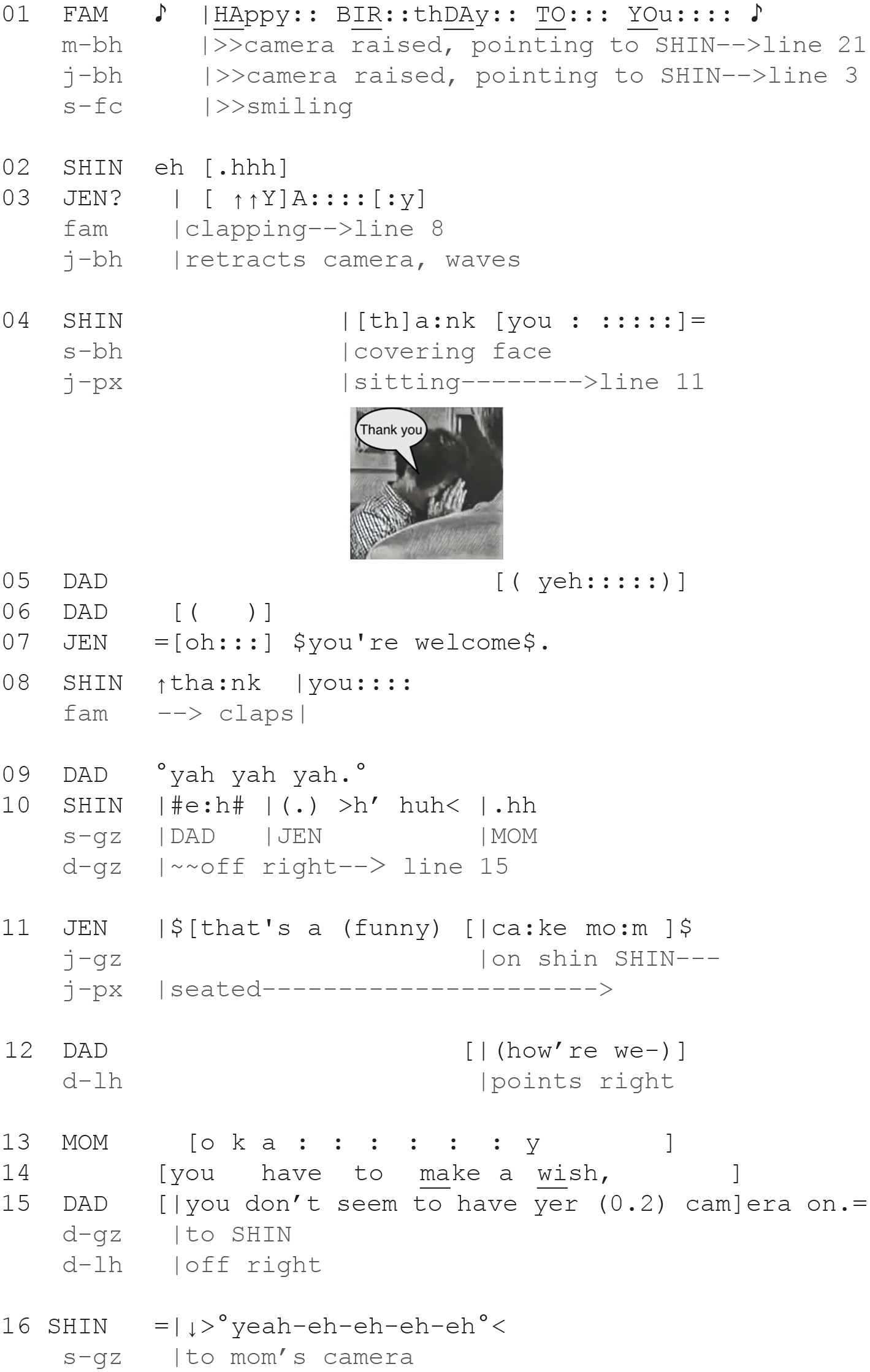
In line 1 the family are just finishing the customary ‘Happy Birthday’ song, a sequential slot at which a fully competent member of the host culture could be reasonably expected to make a silent wish, blow out the candles, and express their thanks to those in attendance at the party. Shin gives the expression of appreciation (lines 4 and 8), but does not enact an embodied display of wishing or move to blow out the candles. Jen and Dad provide sequentially due responses to Shin’s thanks (lines 7 and 9) and Shin then appears to be at a loss for words as he gazes around the family. Dad and Jen’s actions in the ongoing talk do not seem to orient to anything problematic in the talk at this point: Jen makes an assessment of the cake (line 11) and Dad initiates a side-sequence account that does not result in any further topical talk (lines 15 and 16). However, Mom’s transition-oriented ‘okay’ in line 13 does treat Shin’s inaction as noticeable, and she goes on to specify the problem with a directive in line 14, ‘you have to make a wish’.
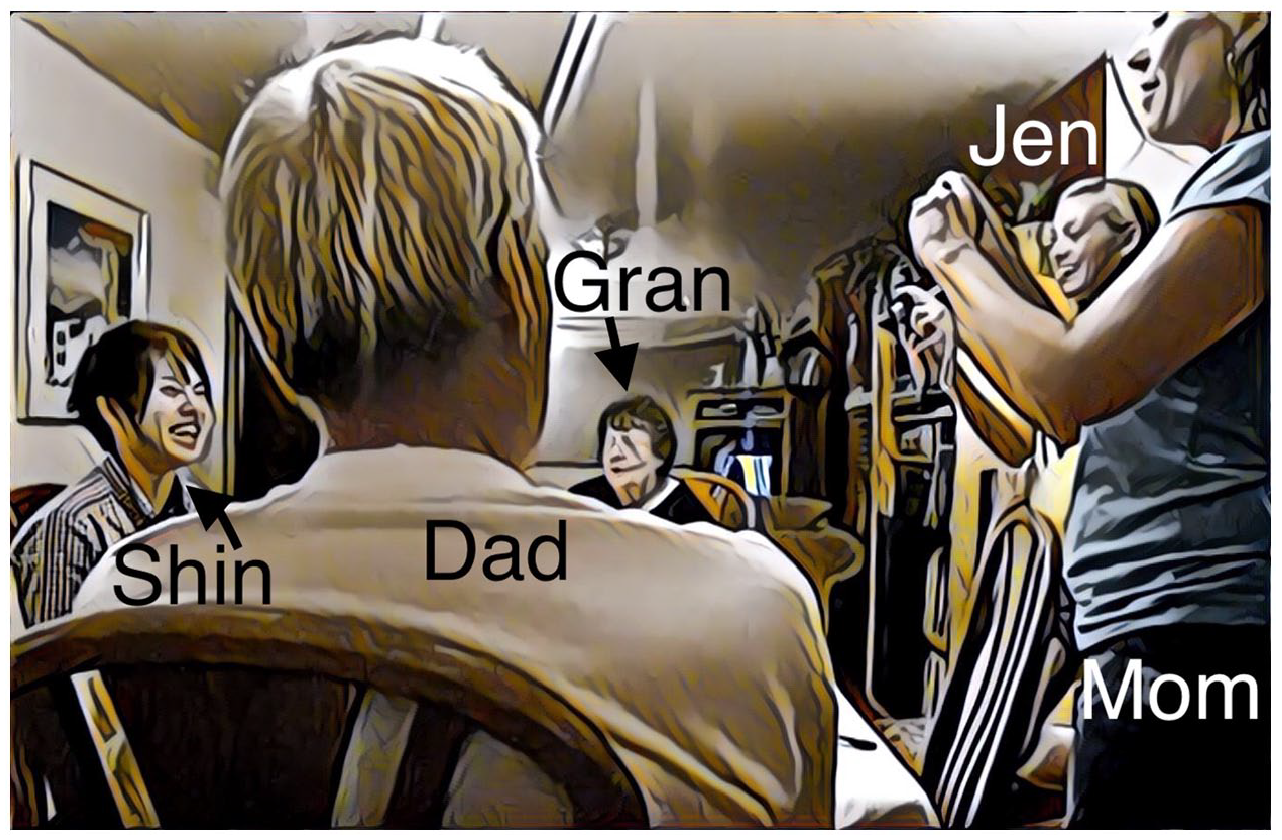
Participant constellation in the Extracts 2.1 to 2.3.
At this point, it may be helpful to examine some significant differences between the birthday cake script in Japanese and American cultures. Lighting candles on a cake is a common practice at birthday parties in Japan, and the birthday song is even routinely sung in English; however, people do not make a silent wish before blowing out the candles. It is therefore understandable that Shin does not immediately treat Mom’s directive to ‘make a wish’ (line 14) as situationally implicative of ‘blow out the candles’, although it seems this is how she intends it (as becomes evident in the pursuant talk). Since it was produced in overlap with two other distinct courses of action, it could also be that Shin has not heard it or is unsure who to respond to, so Mom goes on to produce ‘make a wish’ again in the clear (line 17).
Extract 2.2: ‘Make a wish’
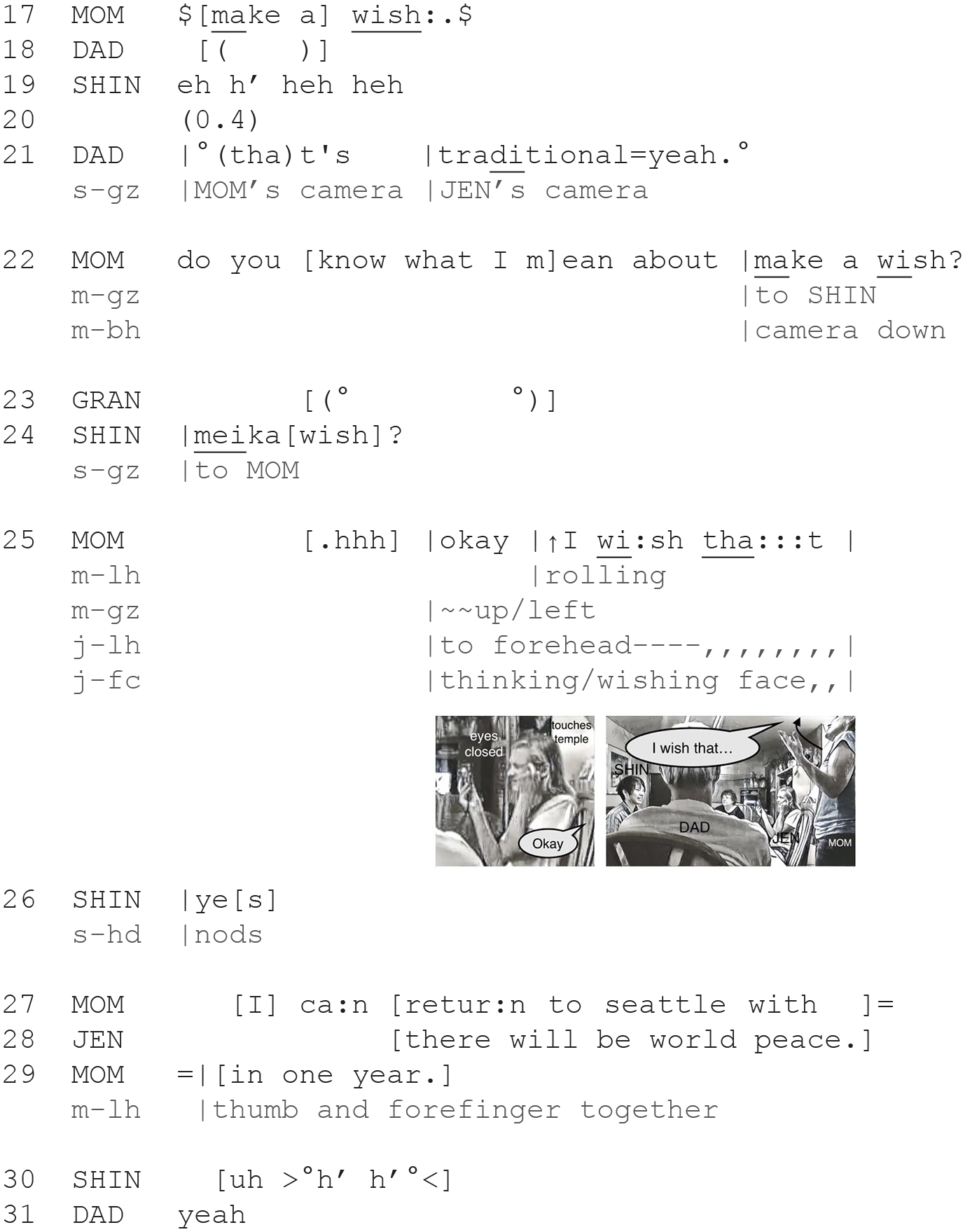
In this segment, Mom re-issues her directive for Shin to ‘make a wish’ (line 17), but Shin’s response, a non-committal laugh (line 19) and no immediate move to blow out the candles, does not demonstrate his understanding of the instruction. This leads Mom to initiate a knowledge check (line 22, ‘Do you know what I mean about make a wish?’) (Nanbu, 2020), and implicit in that formulation is Mom’s stance that Shin does not in fact understand. In other words, Mom has noticed some sort of interactional trouble and is projecting a possible repair sequence. This becomes even more apparent in the next turn as Shin repeats ‘make a wish’ in a single upwardly intoned chunk (line 24), suggesting that he does not in fact recognize the phrase, at least in this context (the repair initiation proper).
In line 25, Mom again uses ‘okay’ to transition the activity, this time to one that involves hypothetical enactments to illustrate making a wish. At the same time, this ‘okay’ also receipts the prior sequence, making public Mom’s understanding that Shin is experiencing trouble with the phrase. She begins with ‘I wish that . . .’, which highlights the focal expression by placing it at the start of the turn and extending the vowel sound on ‘that’ to project an unfinished end to the turn and therefore depict thinking. The phrase is simultaneously illustrated through embodied means, with Mom waving her hand and looking up in the air in a display of thinking and Jennifer enacting thought (or silently thinking of a wish) by scratching her forehead and furrowing her brow (line 25). At this interactionally incomplete juncture, Shin produces a firm uptake token (line 26, ‘yes’), a claim that he may in fact be familiar with the word wishing, but one which therefore suggests that he is unaware of the connection between a wish and a birthday cake, i.e. unfamiliarity with this cultural practice. Mom and Jen go on to complete Mom’s turn-in-progress with two phrases that illustrate the notion of a wish, Mom’s hearably formulated in Shin’s voice (lines 27 and 29 ‘I can return to Seattle within one year’), and therefore personalized, and Jennifer’s as an almost stereotypical wish (line 26). The family therefore works to make the target phrase accessible to Shin, but the overlapped delivery seems to cause additional challenges, and in line 30 he receipts it only with a further subdued laughter token reminiscent of that he produced prior to the explanation (line 19). This leads Mom to go on to specify Shin’s next course of action, blowing out the candles, which is ultimately successful (Extract 2.3).
Extract 2.3: Blowing out the candles
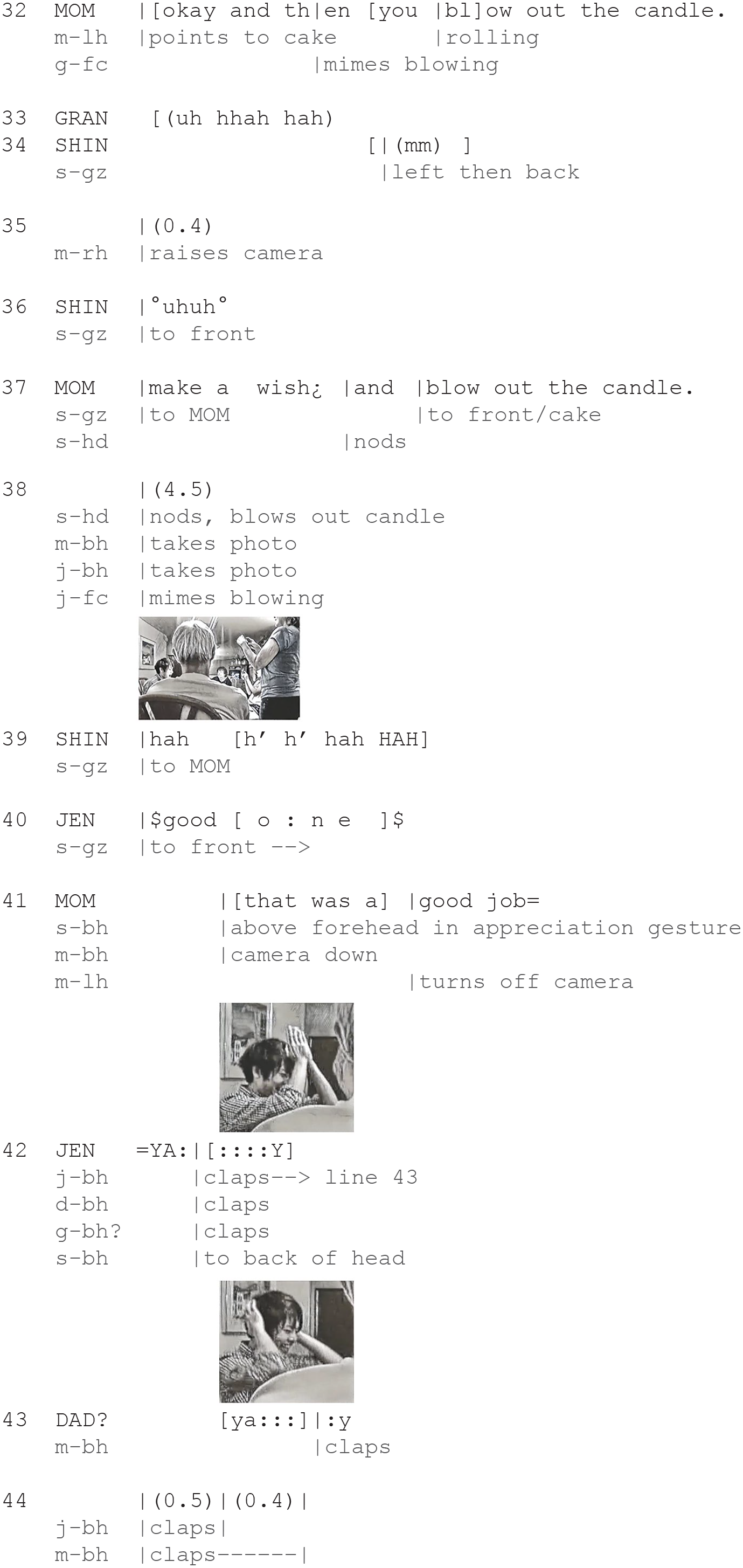
In line 32, Mom makes it clear that her early instruction to ‘make a wish’ should be followed by a second action, ‘blow out the candles’, as Gran provides embodied support by miming ‘blowing’. For someone more familiar with the target culture, ‘make a wish’ would be sufficient instruction to lead them to also blow out the candle. However it is still unclear to the family whether or not Shin has understood the significance of ‘make a wish’ in this context; after a brief gap of silence in line 35 he produces only a barely audible receipt token. This leads Mom to reproduce the two target actions/phrases in the clear, embedding each in a separate intonational contour (line 37). Her nod at the transition between the two phrases elicits a reciprocal nod from Shin, and by raising her camera she also signals to Shin that there is something ‘photo-worthy’ about to happen.
It is only after all this instruction from the family that Shin eventually responds to the request by blowing out the candles (line 38). However, significantly, he does so without performing any demonstrable ‘wish’, i.e. completing the first part of Mom’s instruction. Although birthday wishes are traditionally kept secret in English-speaking cultures (and therefore rarely spoken aloud), the recipient in a birthday cake ritual will often make a show of wishing, such as by closing her eyes (as Jen did in her enactment in line 25) or pausing before blowing out the candles. These sorts of action are absent as Shin blows out the candles in line 38, suggesting that in the end he may not have understood Mom’s ‘make a wish’. In Japanese culture, making a wish is more akin to praying, the sort of thing one would do at a shrine rather than at a birthday party. However, there are similar embodied means for displaying to others that one is ‘doing wishing’ and Shin does not enact anything like those here. After the candles have been extinguished, the family reacts to the ritual as properly completed via laughter, positive assessments and applause (lines 39–44), and by no longer delaying the progressivity of the action, they make public their approval of Shin’s understanding of the ‘make a wish’ practice.
The main point to notice from this analysis is that the target form ‘make a wish’ is not merely a phrase to be acquired: it is first and foremost a social practice embedded within a cultural ritual, and the family habituates Shin into the community of its users via a complex co-accomplished web of situated actions. It seems clear to us that Shin in fact already understood the linguistic form ‘make a wish’ prior to this episode (as evidenced by his uptake in line 30), but was unable to apply it immediately to this particular interactional event. In part, this was because Mom was also using it to have him perform another more observable action (blowing out the candles). The family is also adjusting their understanding of what Shin knows in a sequentially contingent, step-by-step fashion. Mom’s ‘Do you know what I mean by make a wish?’ in line 22, for example, is reactive to Shin’s failure to do so at several key junctures in the talk up to that point, and when he does not immediately demonstrate that he understands its relevance, Mom’s explanation is occasioned. ‘Input’, therefore, is sequentially and ecologically located in the broader business of an ongoing collective sociality and primarily serves to maintain the two key interactional imperatives of progressivity and intersubjectivity. We will explore this notion further in our discussion below.
V Concluding discussion
In this article we have analysed two episodes of interaction, collected by a Japanese student during his homestay in the USA. In this section we will discuss the value that video-based studies add to the study of input and to the research on homestays as language learning environments. We will then reflect on some of the consequences our study has for theorizing the notion of input.
Video-based studies enable us to ask research questions like the ones we have in this article, and therefore shed light on the highly consequential minutiae that influence how input is co-accomplished. Just as a sports commentator can pause, rewind and replay video footage to highlight how a particular pass changed the game play, so too can careful empirically grounded observations of video-recorded mundane talk allow conversation analysis researchers to get at moments when participants orient to language learning as well as how those moments play out. Our analysis of these recordings has demonstrated how participation and membership afford new resources to the homestay guests with respect to (1) linguistic elements that may get introduced and made sense of, and (2) new or different participatory practices. We have also explored how interactants in this context draw on a range of ecologically available resources to co-accomplish participation and membership.
The two family interactions engage Shin in a variety of ways. The first involves two baseball fans who bond over the details of their sport, like the circumferences and laces of American and Japanese softballs. Their talk is about the world they share, and that world overlaps only partly. To understand each other better, Dad and Shin recruit tangible objects and inspect them via vision and touch.
Elements like talk, gestures and physical objects were used to clarify understandings and form knowledge. When Shin asks Dad about the softness of an American softball (Ex 1 line 17), he uses a baseball grip which becomes a pinching action as he draws it toward his other hand, suggesting the hardness of the imagined ball. Bringing in a real leather softball to be studied allows Shin to trace the stitching on the ball, a feature that was not the focus of his imagined version. Shin’s environmentally coupled gesture occasions a verbally produced indexical reference (‘this’) together with part of an object in the environment and therefore fuses, as Goodwin (2007) argues, different semiotic systems. In lines 34–37 Shin inspects the real softball by pressing it and hitting it into his palm. The inspection is brought to a close in line 38 with the assessment that Shin does ‘not know this ball’. To do a multisensorial inspection of the object, Shin needs access to the real thing (Mortensen and Wagner, 2019). Other actions, such as showing the circumference, can be done by gesture alone without access to the object.
Material objects are not just what they seem to be. They can symbolize themselves or even other objects. When Dad explains the size of the softball, he makes a ball-shaped gesture (a circle), which he traces with his index finger in line 42. In line 54, Dad reimagines the softball as a baseball and then shakes it to turn it back into a softball as he conducts his comparison of the two. The interplay between talk, hand gestures and physical objects shifts swiftly and without any problems for the participants. Physical environments for explaining, understanding and learning are unique environments where understanding can be built and learning can occur.
Taken together, these practices provide evidence to suggest that Shin and Dad use language, but also a wide variety of embodied and environmentally accessible material objects, to make themselves understood and share their realities. Researchers, therefore, must take into account both language-based practices and how they are coupled and compose the interactional ecology of any given conversation.
In Extracts 2.1 – 2.3, Shin is placed at the center of the scene when his host family presents him with a birthday cake. Mom, acting as the overseer of the ritual, inducts him into the process (making a wish, blowing out the candles), and with support from the whole family, Shin eventually succeeds with the candles while the wishing part – or better the recognizably ‘doing wishing’ by face, gaze and embodied posture – is abandoned.
Unlike the baseball extract (1.1 to 1.4), this is not so much about understanding a phrase, but understanding its relevance to the current situation. Mom and the family enforce the proper physical action required for the ritualized family practice: when Mom says ‘make a wish’, she is in fact directing Shin to blow out the candles. Shin has to do the right thing in the right order, and the ability to do so constitutes evidence of membership. Not doing so is therefore grounds for teaching and for enculturating the guest into the family (and by extension the community of people who celebrate a birthday in this way). Shin’s lack of understanding is demonstrated through his actions, not blowing out the candles, and the family take this as evidence of his inability to participate fully in the birthday ritual.
Homestays hold the opportunity for close social contact and for talk that builds on the life experience and knowledge of the participants. Participation in social interaction will eventually bring the interaction into areas of interest for both participants and provide talk that is bound to the personal knowledge and interest of the participants. In this sense, second language learning in the lifeworld builds on and forms the biography of the participants involved (Wagner, 2015).
Both extracts demonstrate something that is rarely discussed in second language learning research. The video recording documents a large range of gaze directions, proximity adjustments, gestures and the intricately timed incorporation of specific elements of the physical environment that become crucial in building Shin’s understanding. Video recordings give access to the ways in which participants use multisensorial features in their interaction to make sense of what is happening.
The extracts show that language use is localized and embedded in the lifeworld: it recruits objects and other human beings and is interspersed with the expression of emotions, stance and sensorial experience. The participation in a common lifeworld affords potential learning of what could be glossed as ‘cultural knowledge’. But it does more: The homestay shapes relations to other people. The guest’s experiences with the family can have long term consequences – as Mom hints in Extract 2.2, line 27 and 29. The students may return, they may remember their family fondly and vice versa, or they may hate the way these people live and act.
Restricting our attention solely to the verbal input the students are exposed to reduces, over-simplifies and ignores important details that can be observed via a video-based study of homestay interactions. What we have been able to describe in these two episodes goes well beyond just linguistic and pragmatic competence. Language, embodied action, material objects and more are interwoven into social interaction as resources the participants employ in their joint production of sociality. In order to acknowledge and embrace the interactional complexity that students face in their homestays, our approach broadens the notion of input by recognizing it not only in terms of language, but also via a range of occasioned social, material and embodied interactional resources. It is often assumed that the homestay environment will provide opportunities for learning ‘in the wild’, but in order to investigate how they are co-accomplished and sequentially occasioned we must account for learning from the displayed perspectives of the participants themselves.
Footnotes
Appendix 1
Transcription conventions.
The embodied elements are positioned in a series of tiers relative to the talk and rendered in gray. The onset of the embodied action is located relative to the talk tier via a horizontal bar (|). Participants carrying out embodied action are identified by their initial in lower case, along with one of the following codes for the action:
Framegrabs are positioned within the transcript relative to the moment at which they were taken.
Declaration of conflicting interests
The author(s) declared no potential conflicts of interest with respect to the research, authorship, and/or publication of this article.
Funding
The author(s) disclosed receipt of the following financial support for the research, authorship, and/or publication of this article: This study was funded in part by JSPS Grant 24520619.