




Abstract
Aims:
This study provides a multimodal conversation analytic account of directive sequences used in the presence of a child aged 1;8-2;4 growing up in an English-dominant environment and acquiring Polish as a heritage language.
Design:
The video recorded data are drawn from naturally occurring interactions, in which the child is present when one caregiver produces a directive turn (request, proposal, or suggestion) and another one carries it out in an embodied fashion.
Analysis:
The analysis focuses on the sequential unfolding of the triadic interactions, the two adults’ and child’s verbal turns, gaze direction, manual actions, and handling of objects.
Findings:
Although the child is not always verbally active in the directive sequences, she observes them and sometimes takes part, either through bodily actions or verbal utterances. The multimodal analysis also shows that even if the child’s verbal activity might indicate understanding a prior turn and responding to it, the child may not actually be orienting to the conversation. Observing adults carrying out heritage language directive sequences is only possible when the child is interacting with two speakers of her heritage language, or a speaker of that language and a person who has some passive knowledge of it. Seeing adults’ mutual social actions offers the child a social environment, in which she can get a rich linguistic model and also observe the benefits of using the heritage language in everyday interactional situations.
Originality:
This is the first study to offer a multimodal conversation analysis of directive sequences in which one adult produces the directive and another adult responds to it in the presence of a child acquiring a heritage language.
Keywords
Introduction
Our study investigates a child raised by following the one-parent-one-language (OPOL) strategy. Sadie resides in the United Kingdom and her Polish is passed on to her at home as part of her heritage from her Polish-speaking mother. As Sadie’s father does not speak or understand Polish, her parents interact in English. Sadie also hears English from the wider community, including her nursery and friends. The data presented in this article consist of naturally occurring interactions video-recorded when Sadie was aged between 1;8-2;4 and discussed in more detail elsewhere in the research literature with reference to Sadie’s lexical acquisition (Gaskins, 2020), her early use of nominal inflection (Gaskins, 2018), and her bilingual speech (e.g., Gaskins et al., 2019). This paper takes a novel perspective to the data: we set out to examine the interactions Sadie encounters in her home environment. In order to better understand the nature of such interactions, we use multimodal conversation analysis that gives us a detailed picture of what happens within them. As the scope of the paper is limited, we will focus only on directive sequences in situations where there are two Polish speaking caregivers present. More specifically, we look at sequences in which one adult utters a directive and the other carries it out. Since her mother did not speak Polish to her father or other adults, Sadie only encountered this action type when either her Polish grandmother or a babysitter was present. At the end of the paper, we discuss how the possibility to observe adults’ multimodal everyday activities may affect heritage language acquisition.
Directives
Directives are utterances which promote the performance of a desirable or necessary action in the way that impacts the co-participant’s behaviour (Couper-Kuhlen & Etelämäki, 2015). They are mostly uttered verbally but can also involve gesture and bodily movement (Drew & Couper-Kuhlen, 2014; Goodwin & Cekaite, 2018). They tend to manage practical actions and get reactions which are publicly observable in the recipient’s embodied conduct by all parties involved (Zinken & Depperman, 2017). Directives and responses to them form adjacency pairs which function as the core of directive sequences (Schegloff, 2007). In this paper, we treat the embodied actions as an equally important part of the sequences as the verbal utterances.
Prior multimodal conversation analytic studies of parental directives have concentrated mainly on monolingual families and on directives addressed at, and responded to by, children. A significant contribution to this topic has been made by Goodwin and Cekaite (2013, 2018). They view the family as a social form, in which children are socialized into giving and receiving directives as a part of everyday tasks (Goodwin & Cekaite 2018, pp. 40–41). Goodwin and Cekaite (2014) show that family directive sequences can take very different trajectories depending on the timing, embodiment, and linguistic formulation of the parental directive (see also Aronsson & Cekaite, 2011). Much less attention has been paid to the multimodal organization of directives in multilingual families (see, however, Frick & Palola, 2022) or to directive sequences that children observe while growing up.
For children who start to produce directives themselves, as is the case with Sadie, the only way to observe them in action is to have two other interlocutors present in the context of the interaction. In monolingual contexts, interactions with only one parent on a daily basis are supplemented by interactions with peers, teachers, and the rest of the linguistic environment. In many bilingual contexts, such supplementary interactions are not possible and demonstrating the function of heritage language directives is down to the child’s parents–either two speakers of a heritage language, or at least one person who speaks it and another who understands it and can act upon it. As far as we know, ours is the first study to offer a multimodal conversation analysis of directive sequences in which one adult produces the directive and another adult responds to it in the presence of a child acquiring a heritage language.
In the range of directives studied in this paper, we include (1) proposals, (2) requests, and (3) suggestions (see, for example, Couper-Kuhlen, 2014). However, in our analyses, we tend to refer to them under the general term of directives because in some cases it is difficult to determine the precise nature of the directive. For example, when the child is asked to eat, it is difficult to determine if the child will benefit by satisfying their hunger (suggestion), of whether the mother will benefit by seeing an empty plate (request). Zero-person constructions (e.g., Trzeba umyć okno ‘This window needs cleaning’) are also possible in directives (Zinken & Ogiermann, 2011), but they are open to recipient’s interpretation and may also be understood as acts of informing or asserting (Couper-Kuhlen & Etelämäki, 2015). In Polish, apart from imperatives (e.g., Daj mi to ‘Give me this’), common forms of directives include off record hints (e.g., Ja nie mam śliniaka ‘I don’t have a bib’) (Ogiermann, 2015a), want-statements (Ja też bym chciała ‘I would like [it] too’), simple performatives (e.g., Ja poproszę jak najwięcej grzybów ‘I will ask for as many mushrooms as possible’), simple interrogatives (Podasz mi duży talerz? ‘Will you give me a big plate?’), and interrogatives with modal verbs (Możesz mi nalać? ‘Can you pour some for me?’) (Ogiermann, 2015b).
In adult–child interactions, directives are often supported with the use of gestures, such as stretching out one’s hand when beckoning the child to come, bodily orientation and haptic (tactile) behaviour (Cekaite, 2015; Goodwin & Cekaite, 2013). In adult–adult interactions, directives can be supported with, for instance, gestures, facial expressions, body movements, and manoeuvring objects (e.g., Kärkkäinen & Keisanen, 2012; Keevallik, 2018; Kendrick & Drew, 2016; Rossi, 2014; Sorjonen & Raevaara, 2014). We examine only hand gestures, as these are the only part of the adults visible in the video, with the camera otherwise pointed at the child.
Data and method
The video recordings used in this study are part of a larger project which captures Sadie’s everyday interactions between the ages of 1;8-2;4. She was recorded in dyadic interactions with her mother, and in triadic interactions with her mother and either her maternal grandmother or her babysitter. Overall, there were three interactions with Sadie’s mother and her maternal grandmother, and seven with her mother and the Polish-speaking babysitter, all captured during meals and the subsequent sessions where the child played with toys, looked at books and cards with pictures of animals, and used playdough to create different objects. As the child was always the main focus of the camera, the analysis of adult bodily enactment had to be restricted to hand movements visible in the recordings and to exclude head and body movement and facial expressions. Overall, 458 directives were found in dyadic contexts and 536 in triadic contexts. In this paper, we only examine triadic interactions between the child and her caregivers in order to highlight their observable contributions to the presentation of directives in these contexts.
First, video-recordings of interactions between Sadie, her mother and either her grandmother or the babysitter were scrutinized for the use of constructions highlighted in the existing literature on Polish directives (Ogiermann, 2015a, 2015b; Zinken & Ogiermann, 2011). The adults’ turns were subsequently examined on video to determine whether any borderline cases would qualify as directives. The data were analysed according to what is known as ‘next-turn proof procedure’ in conversation analysis. When one person utters a turn, recipients monitor it, assign an action to it, and formulate a next appropriate action – that is, their own responsive turn. From this, we as analysts can deduce that if the recipient acts in a way that is typical for responses to directives, the prior turn should be analysed accordingly, that is as a directive (cf. Levinson, 2012; and Enfield & Sidnell, 2017 for a critique of Levinson’s approach). This process confirmed that indeed the same grammatical form could sometimes be classified as a directive and at other times as some other action. For example, trzeba ‘[it] needs’ was clearly a directive when the mother said To trzeba przewrócić ‘This needs to be knocked down’, inviting the child to join in with the activity. However, it was not a directive when the mother said Trzeba spiąć grzywkę ‘The fringe needs to be tied back’, as she seemed to be merely accounting for the action she performed alongside.
We identified 35 tokens of an adult issuing a directive at another adult, who subsequently addressed it in front of the child. Among them, there were 17 tokens of verbs in imperative forms such as (po)daj ‘pass’, zjedz ‘eat’, zabierz ‘take away’, (po)patrz ‘look’ and zobacz ‘look’, which included the use of a prompt and the other adult’s reaction to the directive. In the case of the verbs (po)patrz ‘look’ and zobacz ‘look’, the other adult’s reaction to the prompt consisted in her verbal response. For example, Sadie’s mother showed her grandmother a piece of paper with Sadie’s writing on it, which was followed by the grandmother’s assessment: Pięknie ‘wonderful’. All imperatives but one were found in the three recordings made with Sadie’s mother and her grandmother. In the same category were two negative imperatives: one of Niech się pani nie schyla ‘do not bend’ which was issued by the babysitter to refer to an action the mother was doing, and which was followed up by the mother straightening up in her seat, and one of Nie zamykajcie ‘do not close’ which referred to an action two people were doing, and which was followed up by one of them ceasing to perform the action.
There were also 17 turns which involved non-imperative forms. They included eight affirmative sentences which were followed by the desired next action by the recipient. For example, the mother stated Zaraz babcia da kartkę ‘Soon grandma will pass you the paper’, and Babcia zaraz naprawi ‘Grandma will fix [it] soon’, which were followed by the grandmother fulfilling the directive. Also, when the grandmother stated A mama będzie dawała jajko ‘And mummy will be giving you egg’, the mother acted upon the directive in front of the child. There were also six simple interrogatives such as Przyjdziesz do nas? ‘Will you come to us?’ and Wytrzesz jej nos? ‘Will you wipe her nose?’, both acted upon by the grandmother. One off record hint stated a problem: Ona chyba chce foremkę ‘She might want a mold’ and was followed by a solution–the directive being met through an embodied conduct. There was also one zero-person construction which expressed a need: Ale je trzeba posmarować ‘But she needs to have [this] spread [with jam]’ and was followed by the need being met in situ. Finally, there was one utterance with a modal verb Możesz przejść pod tym jak chcesz ‘You can walk under it if you like’. All non-imperative forms except one were recorded in the contexts where Sadie interacted with her mother and her grandmother.
There were also five instances of a directive addressed to the child, or no one in particular, and acted upon by another adult. Among them, there were two in which the nominated agent was in the second person singular (Sadie, a kto wytrze buźkę? ‘Sadie, and who’s going to wipe the face?) or inferred from the context (Miałaś buźkę wytrzeć! ‘You were supposed to wipe your face!). Both of them were issued by the babysitter and acted upon by the child’s mother. There were also three directives in which the nominated agent was in the first-person plural: I odrysujemy twoją ‘And we shall draw around yours’, To może tę gwiazdkę też spakujemy w takim razie ‘So maybe we shall pack that star too in this case’ and A może najpierw wytrzemy łapki? ‘So maybe first we shall wipe [your] hands?’. The first-person plural is commonly used in child-focused directives (DuBois, 2012), and although the implied agent (see Couper-Kuhlen & Etelämäki, 2015) of such directives is often the child, the first-person plural form leaves enough ambiguity for the agency of the proposed action to be negotiated or distributed among the participants.
We then focused on the multimodal conversation analysis (see, for example, Mondada, 2019) of adult directive turns that the other adult carried out. Multimodal conversation analysis allows a detailed account of the moment-by-moment unfolding of social interactions. It helps us to understand how the participants use verbal and embodied resources to carry out social actions and how they observe and react to others’ actions. For this paper, we chose five extracts that show the child’s orientation to the adults’ actions and one deviant case. The analysis of the extracts shown here was kept relatively robust in order to meet the word limit and to keep the paper well focused. The video-based analysis was supported by multimodal transcripts that were created according to the Mondada conventions for multimodal transcriptions (Mondada, 2016). The transcription symbols are listed in the end of the paper (Appendix 1). Some of the extracts were also viewed and discussed with other researchers in conversation analytic data sessions (for the benefits of this approach, see Peräkylä, 1997; Stevanovic & Weiste, 2017).
Analysis
Directive sequences unfolding
This section presents multimodal analysis of six extracts in which a directive is issued by one adult and acted upon by the other in the presence of the child. Extract 1 is from a mealtime recording. In it, Sadie’s grandmother first offers food to the child who declines the offer (this is not shown in the transcript) and then to the mother (line 01).
Extract 1: zjedz ‘(you) eat!’
then mummy (you) eat it
mummy will eat it
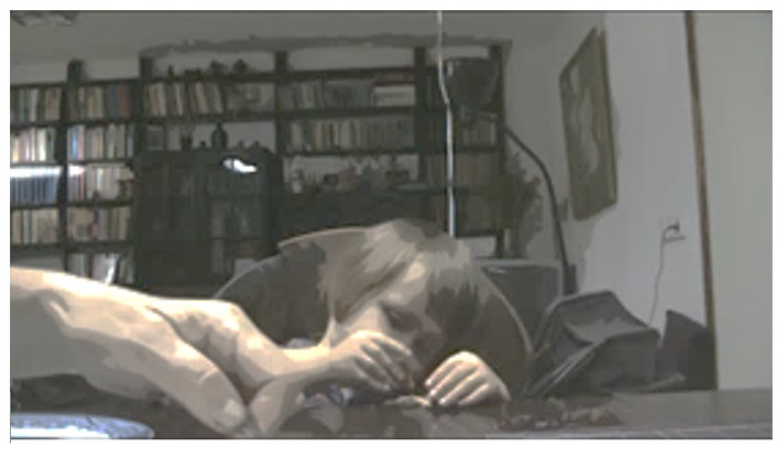
Extract 1, lines 01–02.
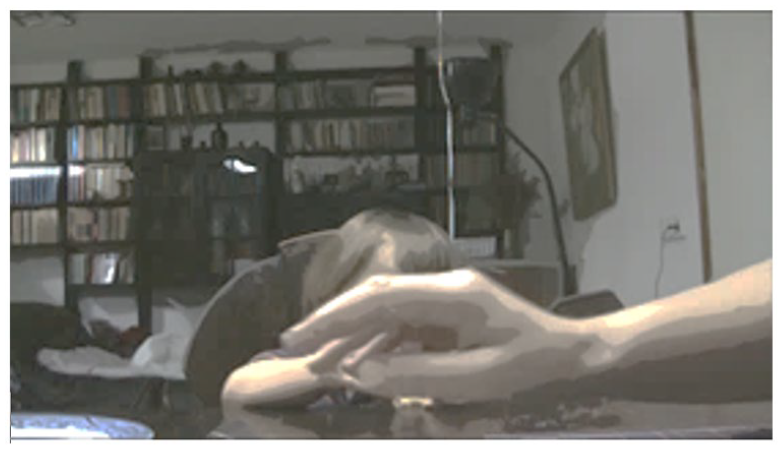
Extract 1, line 03.
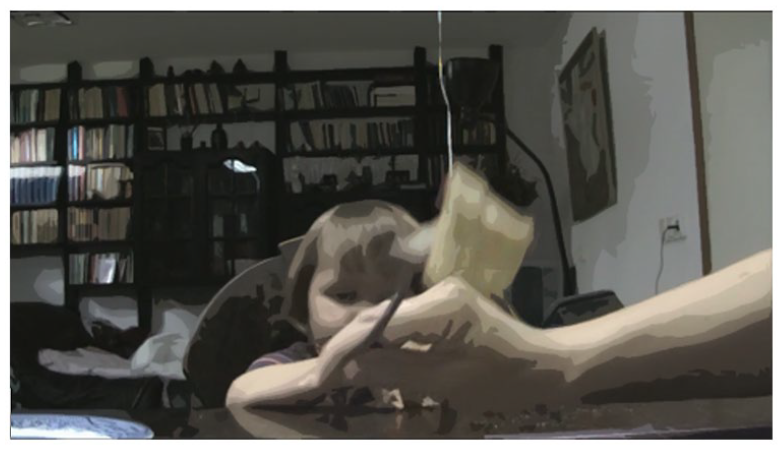
Extract 1, line 03.
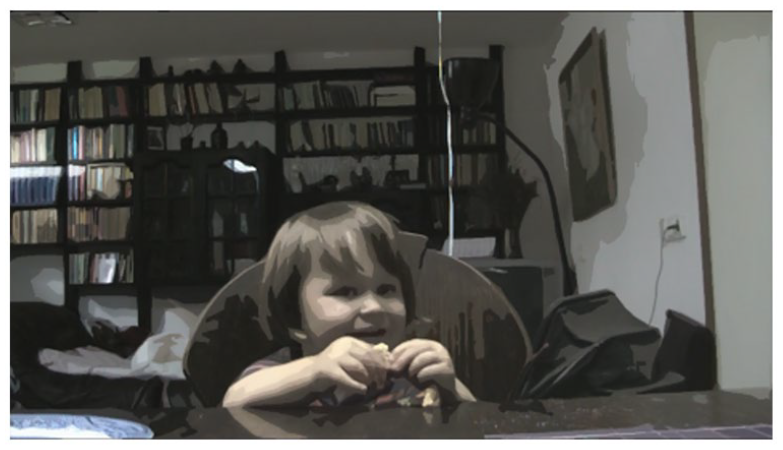
Extract 1, line 05.
We see in Extract 1 that the grandmother uses an imperative form to ask the mother to eat, placing the fork with food on the table between them (line 01). The mother picks up the fork and eats the food (lines 03-04). Sadie is first looking at food that is in front of her on the table (Figure 1, lines 01-02), but turns her gaze forward when her mother grabs the fork (Figure 2, line 03). Sadie follows her mother’s hand with her gaze when she lifts the fork (lines 03-04). Sadie smiles (line 05) and laughs (line 06). The mother is not visible on camera, but it is possible that Sadie’s smiling and laughter are a reaction to the mother putting the food in her mouth. Sadie then smilingly produces a turn, in line 08, stating that her mother is eating. By doing the unexpected, the mother and grandmother have thus elicited an affective reaction from the child. Sadie’s reactions show that she orients towards the activity which was named in the grandmother’s Polish directive Mama zjedz, in the imperative mood. The word zje ‘she will eat’ in line 08 is Sadie’s recycling of her mother’s turn, which suggests her orientation to the word. She finishes her turn with the English verb eating, which serves the function of reiteration (see, for example, Gumperz, 1982, pp. 78–79) or translation (see, for example, Kolehmainen & Skaffari, 2016) of the Polish verb.
Extract 2 is another similar extract from a mealtime recording. In it, the mother produces a directive and the grandmother acts upon it.
Extract 2: podasz ‘(will you) pass’
mum will you pass me the knife too please
yes yes.
here you are
thank you
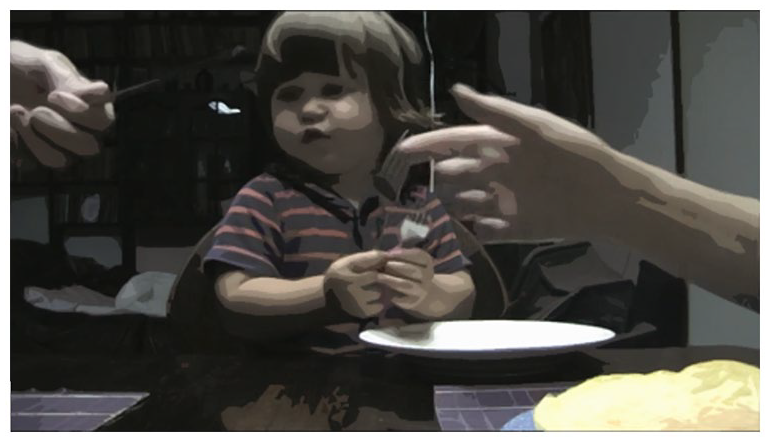
Extract 2, line 05.
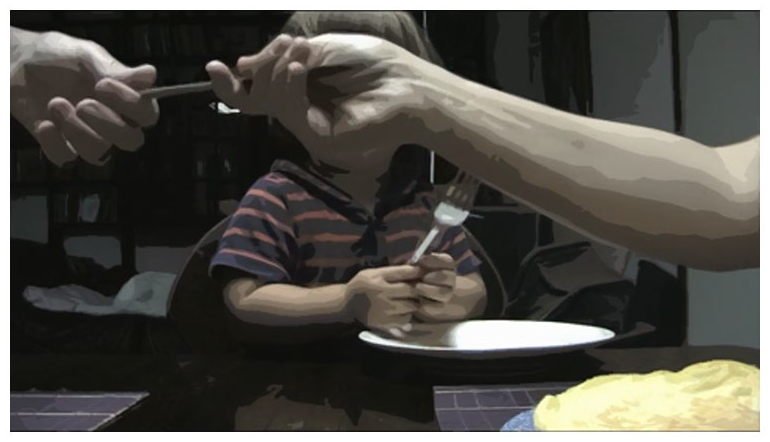
Extract 2, line 07.
In extract 2, line 01, the mother uses a simple interrogative to ask the grandmother to pass a knife. The grandmother complies to the request with a multimodal format (see Rauniomaa & Keisanen, 2012) that consists of a verbal acceptance (line 03) and an embodied fulfilment (line 07) of the request. Such formats have been found to be used when there is a delay–even a short one as in Extract 5, line 04–to the request being met (Rauniomaa & Keisanen, 2012). In the video we see how Sadie looks elsewhere in the beginning of the extract (lines 01-04) but fixes her gaze on the knife when her grandmother starts handing it over (line 05) and follows its movement with her gaze (lines 06-08). This suggests that her attention is drawn to the fulfilment of the directive.
In the following Extract 3 the grandmother utters a directive and the mother acts upon it.
Extract 3: trzeba posmarować ‘needs to have [this] spread (with jam)’
but she needs to have [this] spread [with jam] because it
like this without anything
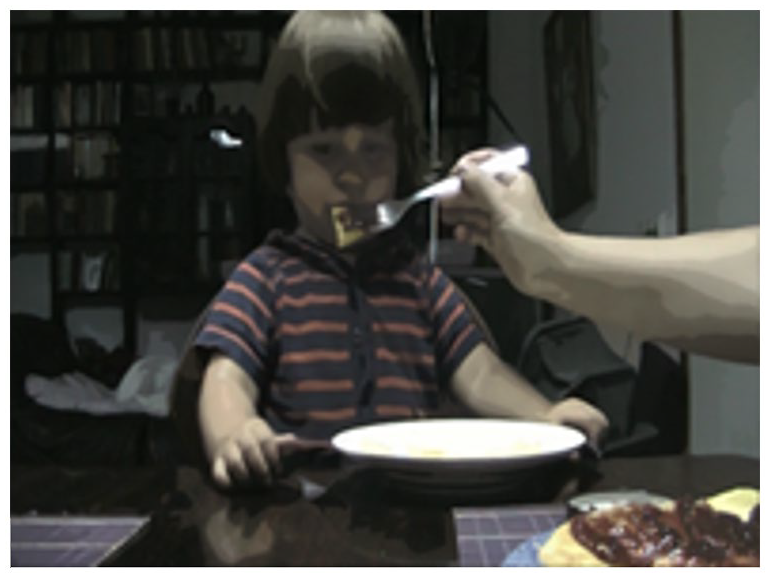
Extract 3, lines 03–04.
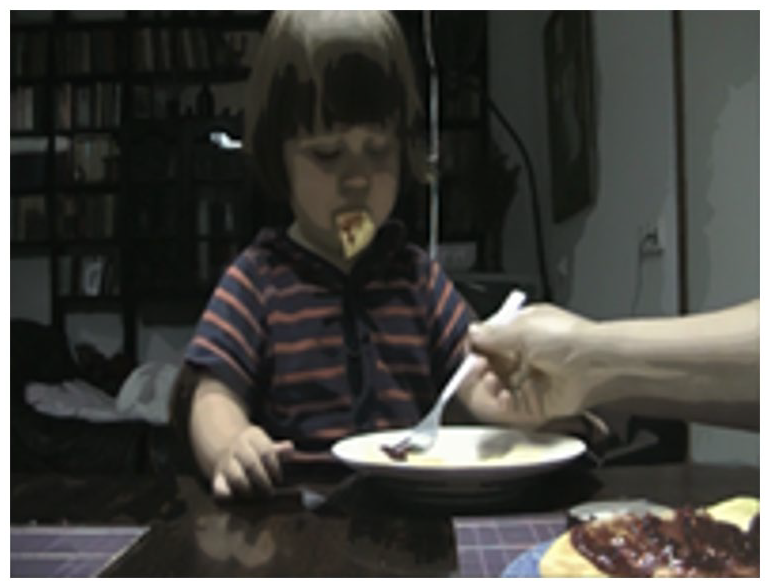
Extract 3, lines 05–06.
In Extract 3, Sadie is again sitting at the table together with her mother and grandmother. Sadie’s mother spreads jam on her own pancakes. Grandmother cannot be seen on the video. The grandmother uses a zero-person construction in line 01, saying that the pancakes should have some jam spread on them, and the mother seems to orient to this as a directive to spread jam on Sadie’s pancakes. She reaches for some jam and starts spreading it on Sadie’s pancakes before the grandmother continues her utterance in line 03 because like this without anything, ending the utterance on a rising intonation which might indicate ‘unfinishedness’ of her thought. It is possible that she prefers to leave her turn unfinished rather than giving a negative evaluation of the plain pancakes. In the beginning of the extract, Sadie’s gaze moves from the right, where her grandmother is sitting, down to her own plate, then the mother’s plate (lines 01-02). Sadie then fixes her gaze on her mother’s fork, with which the mother spreads jam on Sadie’s pancakes – first the piece in her mouth (lines 03-04, Figure 7), then the one on her plate (lines 05-06, Figure 8), taking more jam in between.
In Extract 4 we see a directive that is related to an on-going action. Extract 4 begins with Sadie sitting behind the table with her mother and babysitter. All three are wiping the table.
Extract 4: miałaś wytrzeć ‘you were supposed to wipe’
you were supposed to wipe [your] face, come on
mummy will wipe it
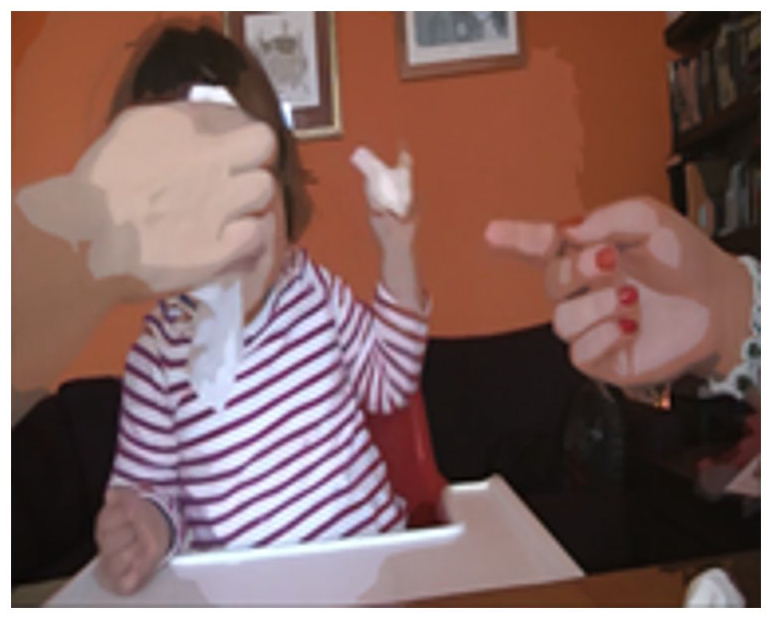
Extract 4, line 03.
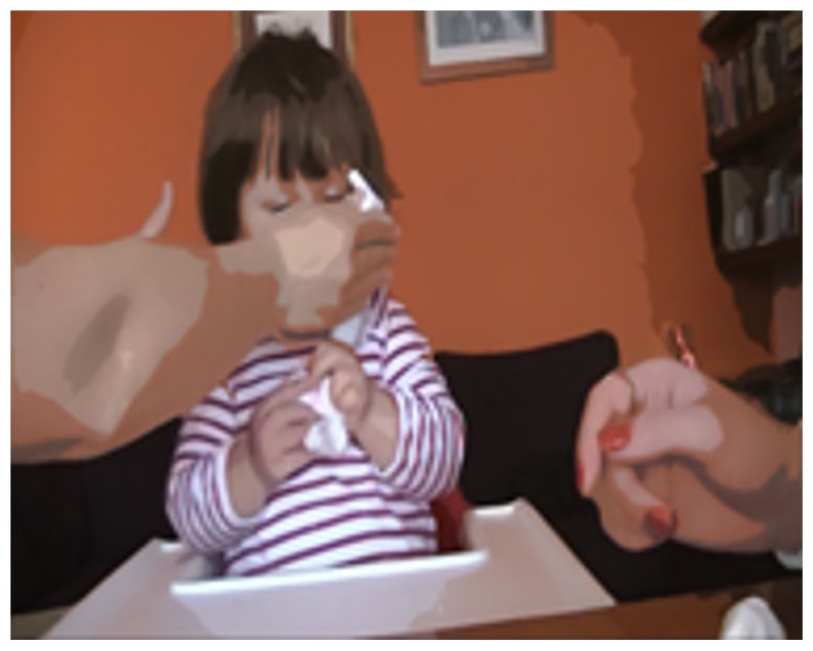
Extract 4, line 03.
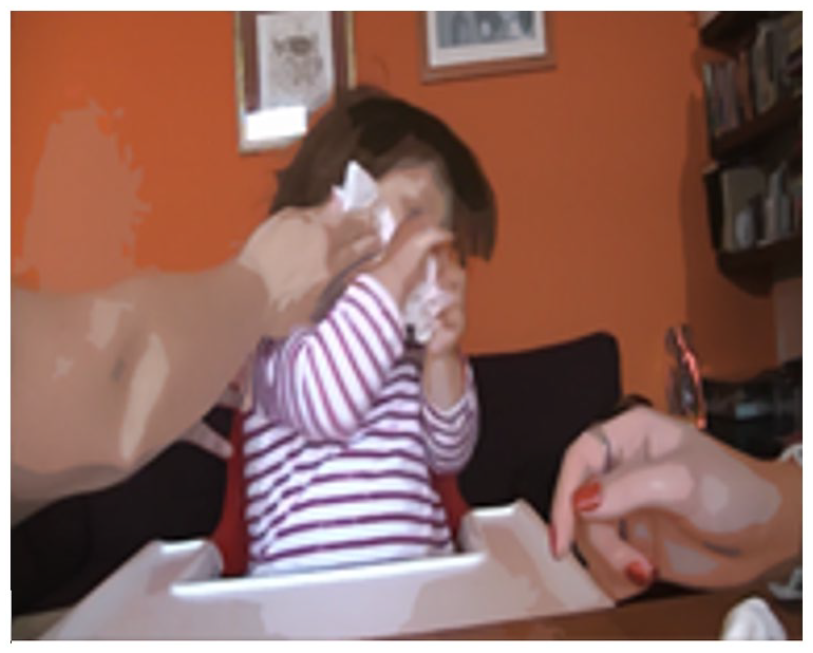
Extract 4, line 04.
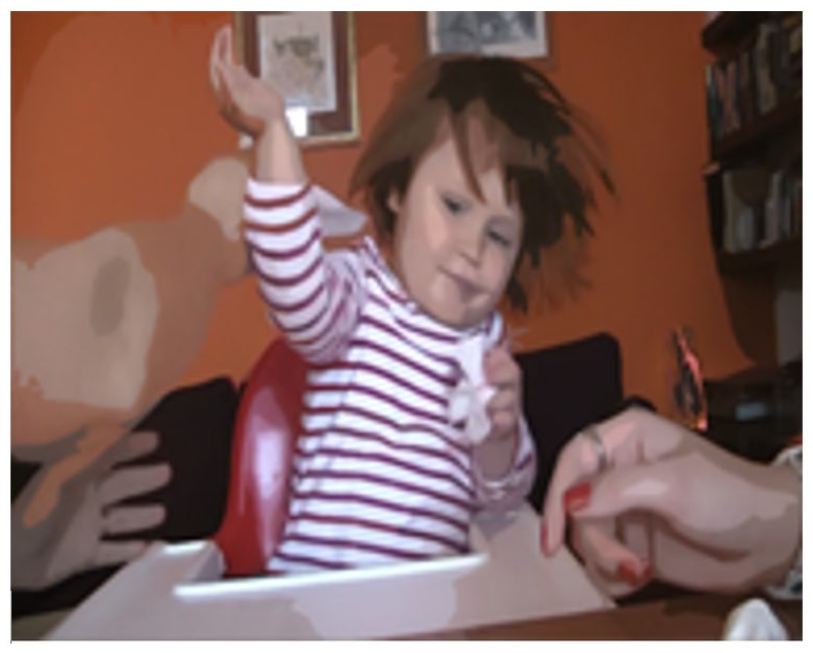
Extract 4, line 04.
In Extract 4, line 02, the babysitter indicates the need to wipe Sadie’s face by saying that Sadie was supposed to wipe her face. The babysitter’s utterance is an affirmative clause with a modal verb that ends in the particle no ‘come on’ uttered with rising intonation. A clause like this could be interpreted either as a statement of facts, a question or directive. Although Sadie is the nominated agent of the turn, she does not respond to it. The babysitter raises her hand and points at Sadie’s face, immediately after which the mother starts wiping Sadie’s face (line 03, Figures 9 and 10), uttering that she will do it (line 04). This shows that the mother orients to the babysitter’s turn as a directive. Sadie pulls back when her mother’s hand approaches her face and pushes away her mother’s hand (line 04, Figure 12), which shows awareness of and resistance to the action (wiping) that the adults talked about.
Extract 5 is from a situation, in which Sadie, her mother and babysitter are tracing hands on a piece of paper. In the example, there is an imperative and a proposal. The main focus here is on the imperative but overall, the example shows how, in a triad, a directive turn can lead into collaboration of all three participants.
Extract 5: połóż ‘put down’ and odrysujemy ‘we will draw around’
And maybe now you put [it] down
yours and we will draw [around] yours yes?
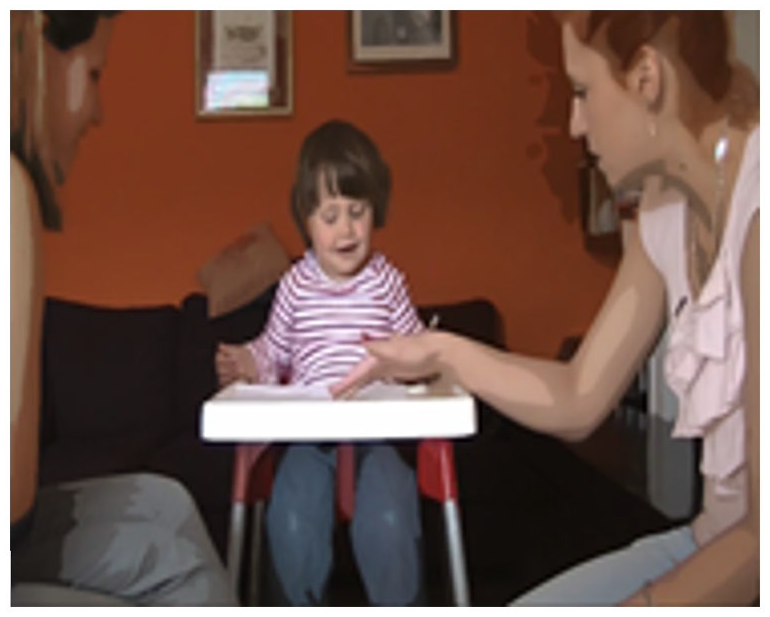
Extract 5, line 01.
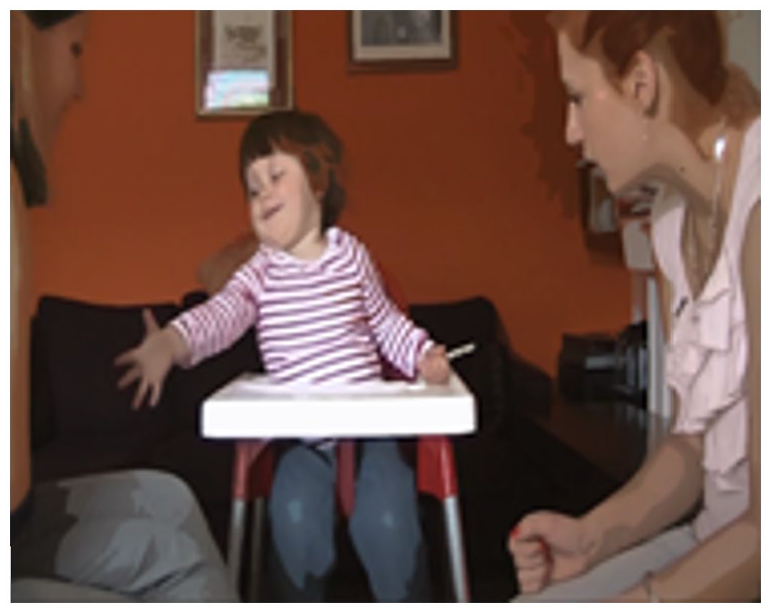
Extract 5, line 02.
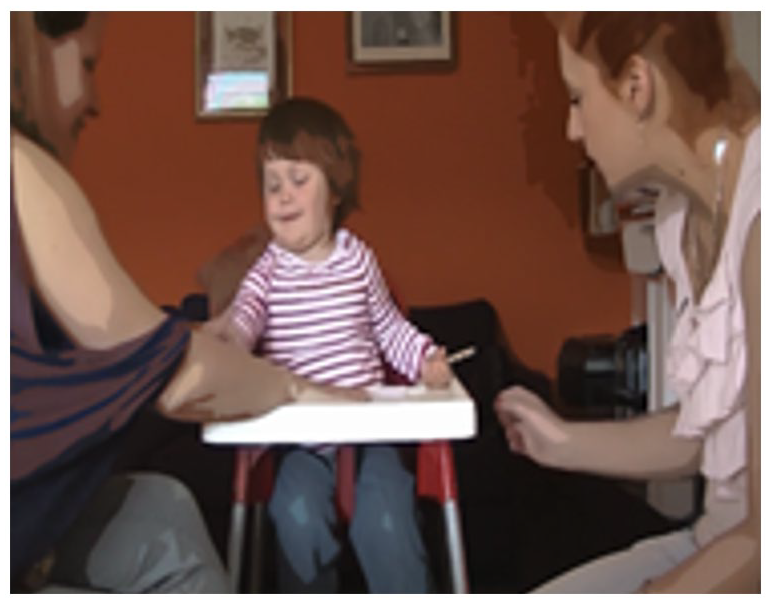
Extract 5, line 03.
Extract 5 starts with the babysitter’s directive for Sadie to put her hand down on the paper so she could trace it (lines 01-02). Her turn combines an imperative in the second-person singular ty połόż ‘you put [it] down’ and a proposal in the first-person plural odrysujemy ‘we’ll draw [around]’. When uttering the imperative turn, the babysitter looks at Sadie and taps the paper lightly (line 01, Figure 13). Sadie, however, turns to look at her mother’s hands and reaches out with her hand towards them (line 02, Figure 14). The mother orients to this as a directive to place her hand on the paper, and does so (line 03, Figure 15). Thus, in this extract, Sadie gives an appropriate reaction to the babysitter’s request and is also an active participant in carrying out the requested action: she ‘delegates’ the request to her mother by non-verbally requesting that the mother put her hand on the paper instead of Sadie herself. The babysitter’s proposal then leads to a full collaboration of the three participants.
Our final example, Extract 6, acts as a deviant case showing how Sadie does not always necessarily orient to what the adults are doing. The extract also shows that what may seem as a well-aligned conversation on the verbal level (see Stivers, 2008) may actually reveal different orientations by the speakers when analysed multimodally. In Extract 6, Sadie is again sitting at the table with her mother and grandmother. They are finishing up playing with playdough: Sadie is holding a lid of a playdough cup and gazing at the cups–probably in search of the right colour cup to put the lid on. The adults are placing bits of playdough in the cups according to colour. The directives in this extract (lines 01 and 06) are uttered in the 1st person plural form.
Extract 6:
then maybe we shall pack this as well
then maybe that star also
we shall pack in this case
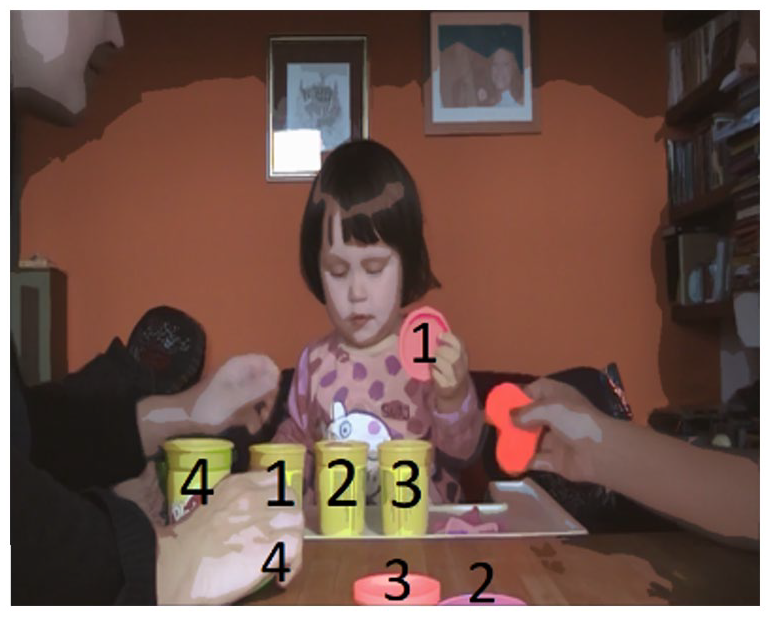
Extract 6, line 01.
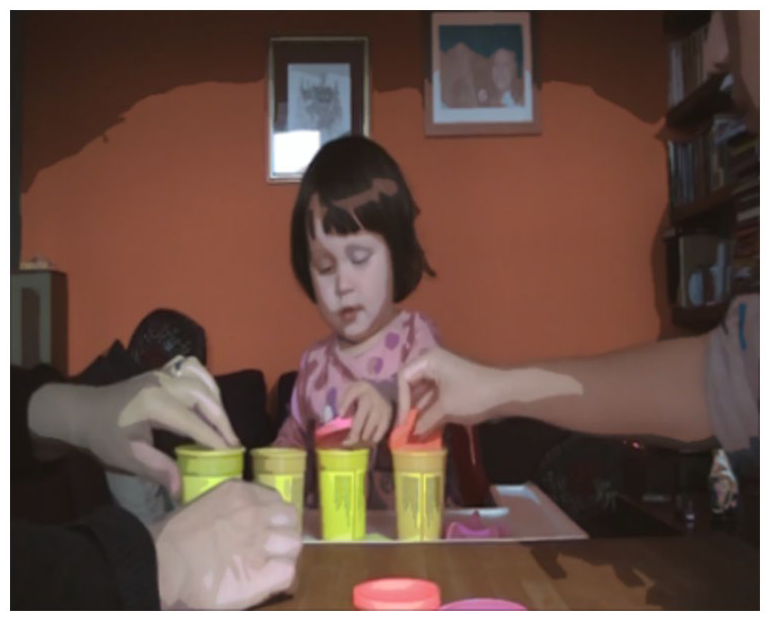
Extract 6, line 04.
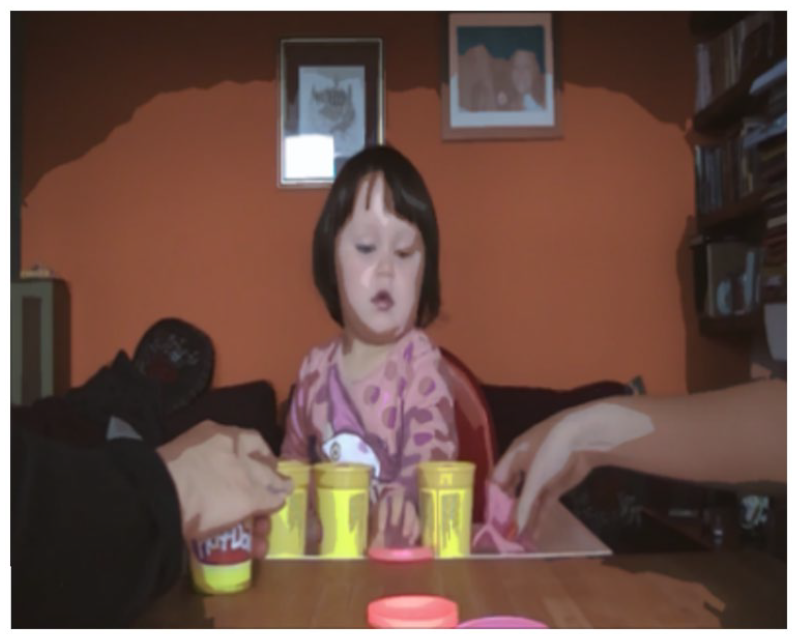
Extract 6, lines 08-09.
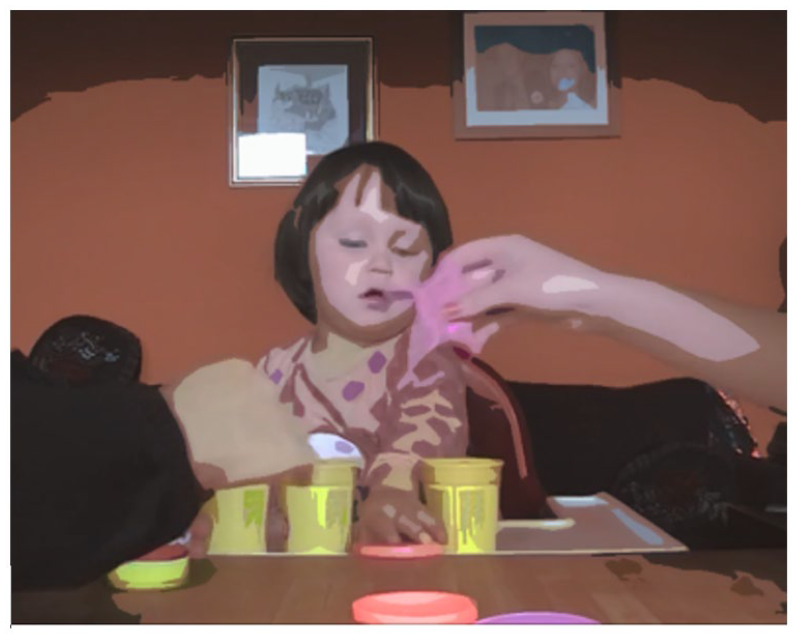
Extract 6, lines 08–09.
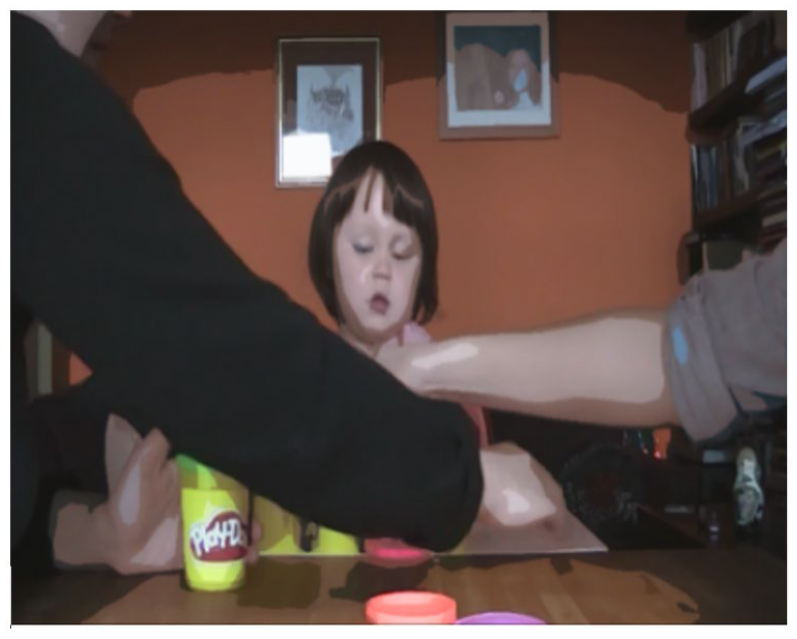
Extract 6, line 10.
Extract 6 starts in a setting where the mother is picking up small pieces of playdough and putting them into cases while the babysitter proposes that a heart-shaped figure be packed as well (line 01, Figure 16). She is already touching the figure before she utters the directive and immediately carries out the proposed action herself.
Mother continues her prior activity of putting pieces of playdough in cases. In lines 06 and 08 she proposes that they should pack the star-shaped playdough as well. In her directive, the mother uses the same construction to może X spakujemy ‘then maybe X we shall pack’ that the babysitter had used earlier, but this time it is not the speaker but the recipient (babysitter) who immediately starts carrying out the proposed action (lines 08-10, Figures 18 to 20). The extract shows how 1st person plural proposals can be used to spread responsibility of the proposed action among different participants: after such a proposal, anyone can carry out the proposed action (Couper-Kuhlen & Etelämäki, 2015). In this case, the star the mother talked about was made by the babysitter and is also closer to her on the table. This may explain why the mother does not self-select as the one to carry out the proposed action.
This example shows how people who are working on a shared project can have slightly different orientations withing the larger activity frame. Sadie’s actions are worth noticing. She is verbally active in line 03 when she produces a yes that could easily be interpreted as a second-pair-part to the babysitter’s proposal and thus as evidence of her understanding the babysitter’s Polish utterance. However, the analysis of her gaze direction and continued manual activity show that she is orienting to placing the lid on a different cup than the one the babysitter is talking about. This means that Sadie is not, in fact, responding to the babysitter’s turn. She continuously gazes at the cups (lines 01-06) and lids (lines 04-09) she is working with, until the very end of the extract when she gazes at the babysitter’s hand in line 10. Her manual activity of placing the lids on cups is also uninterrupted. In fact, a look at the data beyond this extract shows that Sadie recurrently uses yes as an exclamative when achieving a goal (for instance when given a playdough lid just a few seconds prior to this extract). The example is a good reminder that video data is needed to fully understand the nature of interaction and language use and to avoid misinterpretations.
Summary
To sum up, the data shows different multimodal ways for adults to form directives and respond to them. The analysis also shows that while not being verbally involved in many of the directive exchanges illustrated in this study, Sadie is nevertheless an active participant in the directive sequences unfolding in front of her eyes. In many cases, Sadie’s gaze is not directed at the speaker when the directive is uttered, and it is only after the adults start fulfilling the directive that Sadie’s attention is visibly drawn to the adults performing the action. For instance, in Extract 1, Sadie smiles when she sees her mother eating the food that was intended for her. This is also one of the few examples in which Sadie makes a verbal contribution to the directive sequence. It is more common that Sadie’s gaze follows the carrying out of the fulfilment of the directive, such as the knife which her grandmother passes over the table in Extract 2 and the mother spreading jam on her pancakes in Extract 3. In Extract 4, Sadie actively participates by resisting having her face wiped, and in Extract 5 she participates by formulating an embodied directive issued at her mother, which results in full embodied collaboration of the three participants. In other words, even when Sadie does not verbally participate in the interaction, her bodily actions show an orientation towards what is happening. Extract 6 is deviant in this sense: in it, Sadie gives a seemingly well-fitted verbal response to the babysitter’s directive but is, in fact, orienting to something else and uttering a turn that just happens to fit the verbal interactional slot.
Lowi (2013) has shown that young children do not necessarily respond linguistically, but they can demonstrate understanding through their actions and reactions. Access and orientation to language use are prerequisites for learning (Tomasello, 2003), and our study is a reminder that micro analysis of both verbal and bodily actions in everyday situations is needed to fully understand the contexts in which children are socialized into language use. The set of interactions chosen for analysis illustrates the added benefit of having two interlocutors present in the context of using directives: with one adult present in each given context, the opportunity for the child to observe the directives in action would have been missed. In the next section, we discuss possible implications this might have for bilingual language acquisition and suggest that future research is needed on the topic.
Possible implications for heritage language acquisition
Increasing numbers of children now have an opportunity to achieve bilingualism: in the UK alone, the numbers of children with a second language at home have increased gradually from 12.5% in 2006 to 21.2% in 2018 (DfE, 2018). And yet, in spite of the rise in language contact, child bilingual acquisition is not a given. Approximately 25% of children who hear two languages in their environment end up speaking only one of them–the language of the community (De Houwer, 2020). Bilingual children who do pick up their heritage language often use only single words and short phrases from that language in the utterances composed in the language of their community (see, for example, Bernardini & Schlyter, 2004). This in turn can create an undesirable emotional distance between the children and their parents (Tseng & Fuligni, 2000) and may be a cause of the parents’ upset, shame, depression, and anger (De Houwer, 2017). Such multitude of unwanted socio-emotional and behavioural outcomes calls for an investigation of factors which impact adversely the acquisition of the heritage language, and which could be eliminated to facilitate it.
Heritage language development is grounded in the learner’s participation in social practice and in the multiple activities that constitute the social and communicative worlds s/he inhabits. (He, 2014, p. 605). In bilingual contexts, children often hear much more of one language than the other (e.g., Bedore et al., 2012; Hoff et al., 2012; Pearson et al., 1997). As the two languages are in a constant competition for the input space, their proportions in the input change depending on a myriad of factors, such as the child going to preschool (Pfaff, 2011), or visiting grandparents for a prolonged period of time (Gaskins et al., 2019; David & Li, 2008). An important aspect which defines input in the heritage language is its use at home (Gathercole & Thomas, 2009). The family constellation and the number of heritage language speakers in a given household is likely to increase language variety (Paradis, 2011; Quay & Montanari, 2016). The input situations of bilingual children are extremely varied, with some hearing their heritage language a lot, while others only a little. At one end of the spectrum children may hear their heritage language from two adults at home, while at the other the heritage language is delivered by only one parent (De Houwer, 2007). Our paper explores one difference a second adult’s presence can make.
In this study, we have illustrated an aspect of the multimodal formation of directives which is only feasible when two speakers interact with a child and the directives issued by one are acted upon by the other. We found the child orienting to and even actively participating in many of the directive sequences the adults were engaged in. The analysis shows that even in contexts where the child’s linguistic resources may be limited, she may still act in a way that aligns with the adults using the heritage language. Compared to situations in which directives are targeted at the child, the ones discussed here put less pressure on the child to respond and give her the freedom to participate, observe or not be engaged at all.
The results of our study are captured through a small set of recordings with only partly visible interactants. Therefore, they are intended exclusively as a source of hypotheses for future research on heritage language family directives. Future research should address the question through the analysis of well-documented interactions using multimodal conversation analysis that can capture the actions and reactions of family members in different everyday settings.
Footnotes
Appendix 1
Acknowledgements
We would like to thank the participants of the University of Oulu data sessions for their valuable comments on the data. We also thank Elina Vittaniemi for providing multimodal transcripts for this article.
Declaration of conflicting interests
The author(s) declared no potential conflicts of interest with respect to the research, authorship, and/or publication of this article.
Funding
The author(s) disclosed receipt of the following financial support for the research, authorship, and/or publication of this article: The study was partly conducted as a part of the Academy of Finland project in Linguistic and Bodily Involvement in Multicultural interactions.
