



Abstract
This article investigates spoken productions of complex questions with long-distance wh-movement in the L2 English of speakers whose first language is (Canadian) French or Bulgarian. Long-distance wh-movement is of interest as it can be argued that it poses difficulty in acquisition due to its syntactic complexity and related high processing load. Adopting the derivational complexity hypothesis, which has so far been applied to long-distance (LD) wh-movement in L1 acquisition and child second language acquisition, I argue that adult L2 learners also show evidence that questions with LD wh-movement are often replaced by alternative utterances with lower derivational complexity. I propose that such utterances, which are sometimes of equivalent length and with similar meaning to the targeted LD wh-structures, are avoidance strategies used by the learners as an intermediate acquisition resource. That is, such strategies are used as an escape-hatch from the derivational complexity of LD wh-movement. Overall, the results of this research indicate that the link between the number and complexity of derivational steps in a given structure is a fruitful area with strong potential in the second language acquisition field.
Keywords
I Introduction
Complex (biclausal) questions involving long-distance (LD) wh-movement, 1 as in (1), have received attention in the first language (L1) acquisition literature over the past 25 years, and more recently in second language (L2) acquisition.
(1) What
i
do you think ti Mary is eating ti?
Such questions involve long-distance movement of the wh-phrase, which has been analysed as successive cyclicity in the Government and Binding model (Chomsky, 1981 and subsequent work) and as phases in the Minimalist Program (Chomsky, 2001; 2005 and subsequent work). Regardless of the specifics of the theoretical implementation, in languages where wh-movement applies, it is commonly assumed that the wh-phrase of a complex wh-question goes through several intermediate steps in the derivation before raising to the left periphery of the matrix clause. From an acquisition point of view, two interesting issues that arise are how language learners handle the complexity of moving a wh-element in intermediate steps and whether they resort to alternative, potentially less complex constructions, before they have fully acquired LD wh-movement.
Both L1 and L2 acquisition studies have shown that long-distance wh-movement is subject to some variation. One type of alternative to the complex wh-question in (1) that has been reported is medial wh-. Medial wh-constructions were first attested in child L1 English by Thornton (1990; see also McDaniel et al., 1995) and included wh-copying, as in (2), and wh-scope marking, as in (3). 2
(2) * (3) *
Similar constructions were subsequently attested in the L1 acquisition of other languages, including Dutch (Jakubowicz and Strik, 2008; van Kampen, 1997), French (Jakubowicz and Strik, 2008; Oiry and Demirdache, 2006), Spanish (Gutierrez, 2004a), and Basque (Gutierrez, 2004b). 3 Furthermore, studies have shown that such constructions may also exist in the L2 English of speakers whose L1s include Japanese (Schulz, 2006; Wakabayashi and Okawara, 2003; Yamane, 2003), German (Schulz, 2006), and bilingual Spanish/Basque (Gutierrez, 2005).
While medial wh-constructions are ungrammatical in English, both wh-copying and wh-scope marking are licensed options in other languages, such as German and Romani (McDaniel, 1986, 1989), Frisian (Hiemstra, 1986), Passamaquoddy (Bruening, 2006), Afrikaans (Du Plessis, 1977), etc. 4 The existence of such non-target constructions in the L1 and L2 acquisition of English is of interest not only because it offers support for the idea that wh-phrases move in successive steps in the syntactic derivation, but also because it provides a renewed context for discussion of language development processes overall.
With the above background in mind, the purpose of this article is to augment the incipient L2 literature on complex wh-questions by pursuing three general goals. First, while retaining focus on English L2, it aims to add two new, typologically distinct L1 backgrounds: L1 French and L1 Bulgarian. Second, while keeping in mind medial wh-constructions and the specific acquisition issues they raise, it extends the discussion to a broader range of phenomena. This allows for a more comprehensive view of questions with LD wh-movement in L2 English, including the full spectrum of alternative constructions that L2 learners may resort to. Third, it provides further discussion on the issue of the role of grammatical competence versus processing in L2 acquisition. In particular, while the two are sometimes viewed as a dichotomy in the relevant literature on complex wh-questions, I adopt an approach in which both play a role in accounting for the phenomena observed.
Apart from these general goals, the specific purpose of this article is to apply the derivational complexity hypothesis, henceforth DCH (Jakubowicz, 2004, 2005, 2011; Jakubowicz and Strik, 2008; Strik and Pérez-Leroux, 2011) to L2 data. While this hypothesis has so far been used mostly in L1 acquisition, I show that it has strong potential in adult L2 acquisition (for a study testing this hypothesis in child L2, see also Prévost et al., 2010). The DCH is appealing because of its ability to make predictions about a wide range of constructions that may be attested in the context of LD wh-movement and because it draws on insights from both grammatical theory and processing. At the same time, the DCH faces some challenges and needs continuous theoretical and methodological refinement.
In what follows immediately, I describe the DCH and review its predictions with regards to complex wh-questions. Then I report on a study designed to elicit spoken LD wh-questions from L2 English learners whose first language is (Canadian) French or Bulgarian. I discuss the results in terms of the DCH and show that many L2 learners resort to a variety of derivationally less complex alternatives to LD wh-movement which I call avoidance strategies. 5 Finally, I outline some challenges and future research directions.
II The derivational complexity hypothesis
1 Background
The idea that the number of derivational operations can be correlated with behavioral variables such as reaction times, etc. on different psycholinguistic tasks has existed since the inception of generative grammar (after Chomsky, 1957). While this research program, known since the 1960s as the derivational theory of complexity, was generally unsuccessful (for discussion see, amongst others, Berwick and Weinberg, 1984; Marantz, 2005; Phillips, 1996), some of its insights have resurfaced, especially with regards to language acquisition and language processing. As Jakubowicz and Strik (2008) point out, economy considerations in the sense of Chomsky (1995 and subsequent work) have led to different formulations of derivational complexity and its effects on language development. This has been the case particularly with regards to movement, which is considered costly not only from the point of view of grammatical theory but also of acquisition. 6 For example, it has been suggested that children first acquire constructions with fewer movements and prefer looser information packaging; in other words, they prefer PF spell-out that is closer to the corresponding structure at LF. On the other hand, adults prefer denser information packaging where the PF and LF representations may differ significantly (van Kampen, 1997; van Kampen and Evers, 1995; see also Jakubowicz, 2011). Another relevant claim has been that if a given language allows for different options, children will acquire the more economical ones before acquiring the less economical ones (Hulk and Zuckerman, 2000; Zuckerman, 2001).
Jakubowicz (2004; 2005) and Jakubowicz and Strik (2008) propose that language acquisition is affected by developmental constraints, such as working memory capacity, and is sensitive to the computational complexity of the derivation. The claim is that less complex derivations are ‘input convergent’, that is, correctly spelled out or pronounced, before more complex ones (Jakubowicz and Strik, 2008: 106). In other words, all other things being equal, derivations that are less complex appear earlier in language development. The authors propose that derivational complexity can be measured by the metric illustrated in (4).
(4) Derivational Complexity Metric (DCM) A. Merging αi n times gives rise to a less complex derivation than merging αi (n + 1) times. B. Internal Merge of α gives rise to a less complex derivation than Internal Merge of α + β. (Jakubowicz and Strik, 2008: 106)
The above formulation states that the language learner is sensitive to the number of times a wh-element will be moved during the derivation and thus utterances with fewer applications of wh-movement will be preferred initially (clause A of the DCM). Furthermore, the learner is also predicted to initially prefer derivations with movement of one element over derivations with movement of more than one element (clause B of the DCM). It should be pointed out that the DCH is not a mere description of interlanguage where processing constraints influence linguistic performance. 7 Rather, it is a developmental view of language acquisition, where grammar and processing are two separate but interdependent systems. While the hypothesis was initially created by Jakubowicz (2004, 2005) in the context of child L1 (French) acquisition, the claim is that it applies to other conditions of acquisition such as specific language impairment (SLI) and L2; the idea that grammatical development proceeds from derivationally simpler structures to more complex ones is grounded in the assumption that processing resources, such as working memory, increase incrementally in similar ways as acquisition progresses in L1, SLI, or L2 contexts (Jakubowicz, 2011; Prévost et al., 2010). 8 Thus, during the advanced stages of acquisition, or when acquisition is complete, both grammatical and processing resources would be at a higher capacity than in the earlier stages, and speakers will be able to make use of derivationally more complex structures. Note, however, that Jakubowicz (2011) suggests that the DCH should also in principle affect adult native language processing; this does not mean that adult native speakers would also prefer derivationally less complex structures. Rather, it is in line with research findings in the psycholinguistic literature where LD wh-dependencies are often associated with higher processing difficulty (see endnote 6).
To summarize, the appeal of the DCH is twofold: first, it draws on insights from both syntactic theory and processing, as opposed to viewing the two as mutually exclusive; and, second, it is able to juxtapose complex wh-questions with a wide range of alternative productions and discuss them in terms of relative acquisition difficulty. Specific examples of some potential alternatives that are less complex than questions with LD wh-movement are provided below.
2 Predictions
One immediate consequence of the derivational complexity metric is that questions with long-distance wh-movement, as in (5), should be viewed as more complex than simple wh-questions, where only short wh-movement applies, as in (6).
(5) What do you think Mary is eating? (6) What is Mary eating?
This prediction may seem trivial because it involves a juxtaposition of a biclausal and a monoclausal question where the former is simply longer than the latter. However, it is also possible to juxtapose sentences that are matched for relative length (i.e. number of words), as illustrated in (7) and (8).
(7) What do you think Mary is eating? (8) Do you know what Mary is eating?
The complex wh-question in (7) involves a wh-phrase that originated in object position in the embedded clause and subsequently moved long-distance to the left periphery of the matrix clause. On the other hand, in the embedded question construction in (8) the wh-object has moved only locally, to the left periphery of the embedded clause. Since the former construction involves LD wh-movement and the latter only short wh-movement, the DCM predicts that the former has higher derivational complexity than the latter. Note that both examples contain do insertion / T-to-C movement and, as such, the LD movement in (7) represents an additional step in the derivation. 9
It is also possible to compare wh-questions with yes/no questions in terms of derivational complexity. As shown in (9)–(10) and (11)–(12), this can be done with both monoclausal and biclausal pairs of questions, matched for relative length. According to the DCM, in both pairs the former structure is considered more complex as it involves wh-movement. That is, all other things being equal, wh-questions are predicted to be more difficult to acquire than yes/no questions.
(9) What is Mary eating? (10) Is Mary eating pizza? (11) What do you think Mary is eating? (12) Do you think Mary is eating pizza?
Another potential alternative construction to wh-movement is wh-in-situ. Although wh-in-situ structures are not a licensed option in English, 10 assuming that acquisition is influenced by derivational complexity constraints, they should be considered as a possible alternative to both short and long wh-movement, respectively, as in (13)–(14), and (15)–(16).
(13) What is Mary eating? (14) * Mary is eating what? (15) What do you think Mary is eating? (16) * You think Mary is eating what?
Wh-in-situ questions are less complex than either short or long wh-movement, as per the DCM. As such, L2 learners may resort to them as a derivationally simpler alternative, regardless of whether such constructions are licensed in the L1 (however, for further discussion see Sections III and IV).
Medial wh-constructions are another potential alternative to target LD wh-movement. As already mentioned, such constructions are ungrammatical in English; yet, they are licensed in various other languages. The predictions of the DCM are somewhat ambiguous with regards to medial wh-, due to its controversial status in syntactic theory. To begin with wh-scope marking, as in (17), it can be analysed as short movement of the wh-phrase where in the embedded clause and an insertion of a separate, vacuous scope marker in the form of a default wh-form what in the matrix clause (see, amongst others, McDaniel, 1989; Müller, 1997; Sabel, 2000). Even though in this type of analysis wh-scope marking involves only local wh-movement, it is assumed that there is a chain between the partially moved wh-word and the scope-marker; this analysis falls under what is generally known as a direct dependency approach to wh-scope marking, which assumes a type of LD relationship. 11 Thus, wh-scope marking questions, as in (17), would be similar to wh-fronted LD questions but should be considered derivationally less complex because the wh-word itself has not moved to the left periphery, as in the LD question in (18).
(17) * What do you think where Mary is eating? (18) Where do you think Mary is eating?
Wh-scope marking constructions have also been analysed as movement of the wh-phrase to intermediate position, followed by wh-feature separation and movement of the wh-feature to the left periphery of the matrix clause (Cheng, 2000; Hiemstra, 1986). Under this analysis, which also falls within the direct dependency approach, LD wh-movement does take place in the derivation, albeit only the wh-feature raises all the way to sentence-initial position. 12 The current formulation of the DCM does not elaborate on the treatment of feature movement. I will assume that if wh-scope marking is to be analysed as LD wh-feature movement, such constructions cannot be considered derivationally less complex but, because of the overt manifestation of a wh-word in an intermediate position, they may be easier to produce due to processing factors. Since under the derivational complexity hypothesis working memory capacity plays an important role in the initial stages of language development, it is reasonable to assume that a filled gap, or an overtly pronounced wh-word in sentence-medial position reduces the processing burden and ultimately makes this construction easier than standard LD wh-movement. More specifically, the assumption is that in the processing of a LD dependency the wh-word needs to be kept active in working memory until the appropriate gap with which it is associated is reached. Since the wh-word is linked to more than one gap in a sentence with a LD dependency, having the gap in intermediate position filled helps keep the wh-filler active and ultimately alleviates the processing burden (for similar reasoning with regards to L2 acquisition, see Schulz, 2006, 2011; with regards to child L1 French and SLI, see Jakubowicz, 2011; for an overview of some relevant processing literature, see also Phillips et al., 2005). Finally, under a third theoretical analysis of wh-scope marking, sentences as in (17) roughly represent two independent questions in their own right; 13 that is, wh-scope marking is viewed as two independent local movements, which is generally known as an indirect dependency (see, amongst others, Bruening, 2006; Dayal, 2000; Horvath, 2000). If we assume this theoretical view, wh-scope marking is a derivationally simpler alternative to LD wh-movement.
The wh-copying construction, illustrated in English in (19), has a less controversial status in the theoretical literature. Consistent with most analyses of languages where wh-copying is licensed, I assume that it is an instantiation of a LD wh-chain with an overtly pronounced intermediate wh-copy (e.g. Bruening, 2006; Fanselow and Mahajan, 2000; Felser, 2004).
(19) * Where do you think where Mary is eating?
The DCM does not differentiate between LD wh-movement in wh-copying, as in (19), and standard LD wh-movement, as in (18). However, I will argue that an overtly pronounced wh-element in an intermediate position of the sentence helps learners to keep that element active in the working memory, as mentioned above; thus, the overt intermediate copy alleviates the processing burden of the repeated application of wh-movement in the derivation (see Jakubowicz, 2011; for a similar argument, see Jakubowicz and Strik, 2008).
To summarize, the DCM predicts the following general complexity hierarchy: LD wh-movement > Medial wh-constructions (including wh-copying and wh-scope marking) > Constructions with short wh-movement > Constructions with no wh-movement. It is important to point out that the alternatives to English LD wh-questions discussed above do not represent an exhaustive list. These were generated based on the DCM in addition to what had been reported in previous L1 and L2 acquisition studies. However, since previous studies usually do not report on the full spectrum of utterances attested, it was expected that L2 learners may resort to other alternatives as well.
III The study
1 Research questions, hypotheses, and L1s
Consistent with the three general goals identified earlier in this article and with the idea that derivational complexity may affect acquisition, the following research questions and hypotheses were formulated.
Research question 1: Do English questions with LD wh-movement pose difficulty in the initial stages of L2 acquisition and are they susceptible to derivational complexity effects?
Research question 2: In a production context where questions with LD wh-movement are required, do L2 learners of English whose first language is (Canadian) French or Bulgarian resort to alternative productions with lower degree of derivational complexity?
Research question 3: Do L2 learners produce constructions which are not part of the L1 grammar or the L2 input, but are attested in other, typologically distinct languages?
With regards to research question 1, the DCH predicts that complex wh-questions would pose difficulty in the acquisition of L2 English, due to the successive cyclical application of wh-movement in such structures and the associated high degree of derivational complexity. Turning to research question 2, the DCH was conceived in the context of L1 acquisition and makes no explicit predictions about L2 learners and the potential effects of different L1 backgrounds. However, since complexity is measured by the number of movements, the DCH is expected to apply across the board; that is, similar derivational complexity effects are expected in L2 English from learners with different L1 backgrounds, and both groups of participants in this study were predicted to resort to alternative constructions of lower derivational complexity. It is important to point out that the two groups of L2 participants (French speakers and Bulgarian speakers) were specifically chosen to represent typologically distinct L1 backgrounds so as to allow comparison of derivational complexity effects based on different L1s (for more details on L1 transfer, see below). Finally, with regards to research question 3, different types of medial wh-constructions were expected, based on the data available from previous L2 research. However, such constructions generally occur at low rates, and only in limited subsets of participants, and thus, their presence in the current study was also predicted to be limited.
Before proceeding with more details on the participants and the methodology of the study, I will briefly outline the relevant properties of the learners’ L1s with regards to complex wh-questions. French has a rich system of question formation, which is sometimes described as mixed because it incorporates both wh-movement and wh-in-situ, as in (20) and (21), respectively.
(20) Qui penses-tu qui lit des histoires? who think you that reads stories ‘Who do you think is reading stories?’ (21) Tu penses que qui lit des histoires? you think that who reads stories ‘Who do you think is reading stories?’ (Jakubowicz and Strik, 2008)
It should be noted that wh-in-situ in embedded clauses, as in (21), may be judged as ungrammatical by many adult native speakers of French, and that there is considerable controversy in the literature on this issue. 14 Some researchers claim that wh-in-situ is ungrammatical in embedded clauses (Bošković, 1998; Cheng and Rooryck, 2000), while others believe that the restrictions may be related to the distinction between colloquial and formal registers, and that wh-in-situ in embedded questions is routinely attested in both spontaneous productions and under experimental conditions (see, amongst others, Aldi, 2006; Oiry, 2011; Pollock, 1998; Starke, 2001). 15
In addition, complex wh-questions can also be formed by using the so called wh- + ESK construction, as in (22), and cleft structures, as in (23).
(22) Qui est-ce que tu penses qui lit des histoires? who is it that you think that reads stories ‘Who do you think is reading stories?’ (23) Tu dis que c’est où que Marie va? you say that it is where that Marie goes? ‘Where is it that you say Mary is going?’ (Jakubowicz and Strik, 2008)
Without engaging in any detailed discussion of the different types of wh-questions in French and their analyses, it is important to note that French speakers learning English as a second language have to realize that the target L2 system is much more limited. English uses only the LD wh-movement mechanism and constructions equivalent to French wh- + ESK, as in (22), or French wh-clefts, as in (23), are illicit or very limited. It is difficult to postulate specific hypotheses with regards to the amount of L1 transfer or the types of relevant constructions that may be transferred into L2 English from French. On the one hand, it can be speculated that the learners can simply transfer the LD wh-movement mechanism into the L2, and not transfer the additional mechanisms available in the L1. This idea receives some support from proposals that alternative question formation strategies such as wh-in-situ, for example, occur only in restricted contexts in French (see Bošković, 1998; Cheng and Rooryck, 2000; Mathieu, 2004). However, as already mentioned, such proposals are subject to debate (see Aldi, 2006; Reinhart, 1998). Apart from theoretical controversies, the status of wh-in-situ is also debated in L1 acquisition. Some studies show that wh-in-situ questions in French child language appear before their wh-movement counterparts (e.g. Hamann, 2000, 2006; Plunkett, 1999), while others show the opposite (Crisma, 1992; Hulk, 1996). The results also differ to some extent based on whether they come from spontaneous or elicited production data (for an overview, see Strik, 2012).
Returning to the issue of transfer, it could also be argued that French speakers will have difficulty limiting their system to the LD wh-movement option in L2 English because the in situ mechanism available in their L1 is derivationally less complex, as per the DCM (but see discussion and conclusion sections for a different proposal). In this respect, a comparison with the Bulgarian participants may prove revealing, as their L1 does not license wh-in-situ.
Turning to Bulgarian, its system of complex wh-question formation is similar to English. That is, Bulgarian uses exclusively LD wh-movement, as illustrated in (24). 16 Thus, it seems likely that L2 learners of English whose first language is Bulgarian will be able to draw on their native grammar and transfer the LD wh-movement mechanism into the target L2.
(24) Koj misliš (če) Ivan e tselunal? who think.2sg (that) Ivan has kissed ‘Who do you think (that) Ivan has kissed?’
Despite having the same basic wh-movement mechanism, Bulgarian differs from English in that it licenses multiple wh-fronting. That is, in the case of several wh-phrases, English raises only one to the left periphery and leaves the rest in situ, as in (25). Bulgarian, on the other hand, allows for a wide array of wh-elements to move to sentence-initial position, as in (26).
(25) Who do you think John kissed where (and when)? (26) Koj, kâde, (koga) misliš (če) Ivan e tselunal? who where (when) think.2sg (that) Ivan has kissed ‘Who do you think (that) Ivan has kissed where (and when)?’
Questions with multiple wh- are beyond the scope of this article (for details on multiple wh-fronting, amongst others, see Rudin, 1998) and were not targeted in the data collection. Nonetheless, it is important to keep in mind that Bulgarian speakers are presumably very comfortable with LD wh-movement, as their language allows the raising of not only one but several wh-phrases across clausal boundaries in a given sentence.
To summarize, with regards to complex wh-question formation, both French and Bulgarian overlap with English in some respects and differ in others. This makes for potentially interesting transfer effects, in addition to the derivational complexity considerations discussed earlier.
2 Participants and methodology
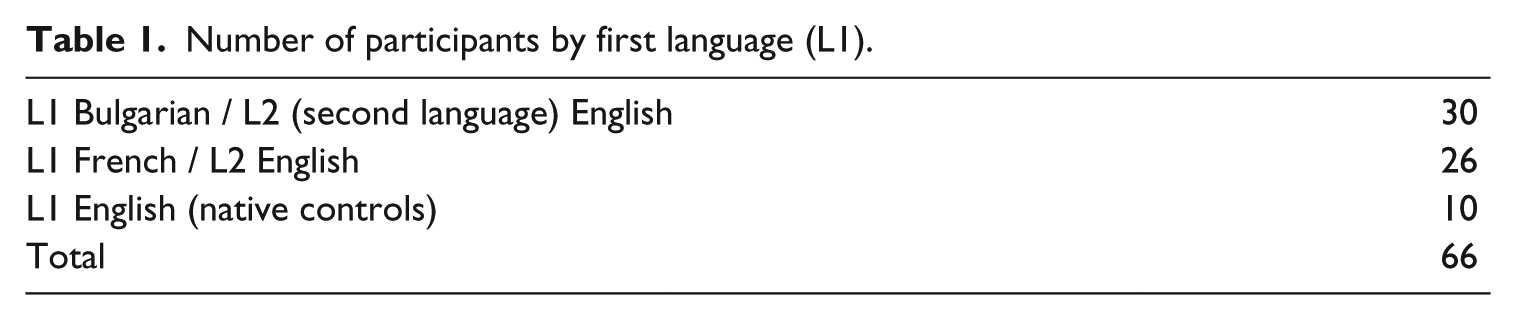
The total number of participants in this study was 66, of which 26 were French speakers, 30 were Bulgarian speakers, and 10 were English native controls, as shown in Table 1.
Number of participants by first language (L1).
The French-speaking participants were adults enrolled in a summer immersion ESL program in Ottawa, Canada, and were between 15 and 18 years old (mdn = 18), while the Bulgarian-speaking participants were adults enrolled in an EFL program at the Department of Language Learning of Sofia University in Bulgaria and were between 18 and 40 years old (mdn = 22). Both groups were placed at the lower-intermediate level by written proficiency tests administered in their respective programs. Independent proficiency measures were not administered due to logistical constraints. It should also be pointed out that the French speakers, being residents of Canada, acquired English in a more naturalistic setting and had higher exposure to English on a daily basis. Thus, their overall proficiency, and especially their level of spoken English was considered to be higher than that of the Bulgarian group. The Bulgarian participants, on the other hand, were learning English mostly in structured classroom environment and had less exposure to English in their everyday life. Overall, even though the two groups were not matched for proficiency by the same measures, they were both placed at the lower-intermediate level and as such were expected to resort to some alternatives to LD wh-movement characterized by lower derivational complexity. The inclusion of individual participant results in Section III.3 below also helps account for proficiency differences between the two groups. 17
All learners were given a language background questionnaire designed to collect relevant demographic information, including questions about multiple L1s, parents’ L1s, languages spoken at home, level of exposure to English, etc. Participants who reported more than one first language were excluded. The experimental task of the study involved elicited production in the form of a guessing game. Such tasks have become standard in the L1 and L2 acquisition literature on LD wh-movement since Thornton (1990). The current experiment used a magnetic board with a hand-drawn picture of a house, and a set of magnets involving different characters, food, drinks and reading materials, as illustrated in Figures 1 and 2, respectively.
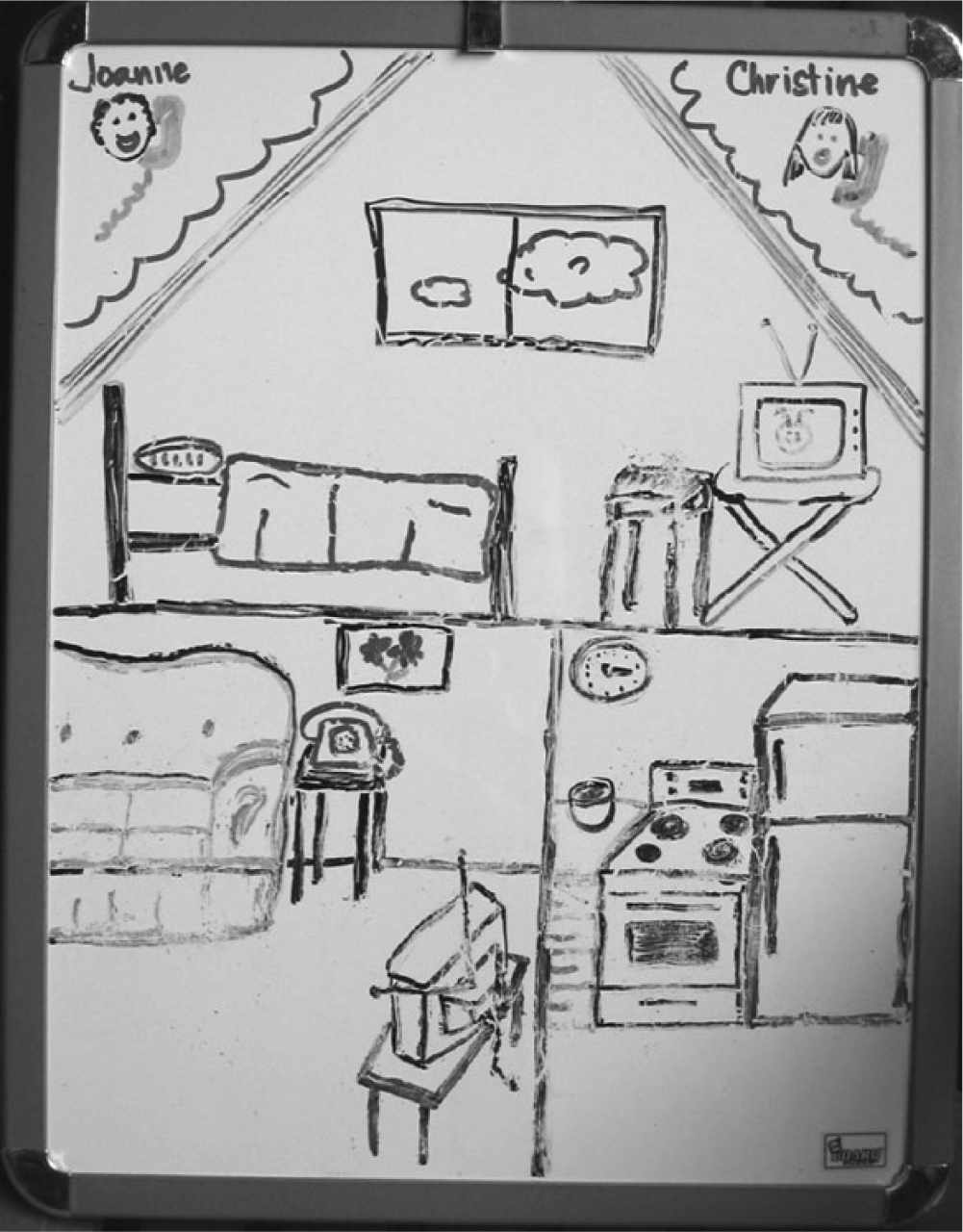
Elicited production task: magnetic board.

Elicited production task: magnets.
The participants met one-on-one with the researcher and were instructed to place the magnetic board on a stand in front of them, in a way that the researcher could not see it. The game involved different situations in which the characters were placed in different rooms and engaged in different activities (e.g. eat, drink, sleep, watch TV, talk on the phone, kiss someone, etc.). A sample item from the elicitation protocol and a participant’s response are given in (27).
(27) Elicitation protocol (excerpt) Researcher: Okay, now I’m going to be asking you to place the different people and the different objects somewhere. For example, can you place John in one of the rooms. But don’t tell me where you put him. Okay? … Now you want me to guess where you put him. So, you have to ask me a question. Okay? … Participant: Where do you think John is?
As this example illustrates, the elicitation protocol created a strong bias towards LD wh-movement not only because of the situation, but also because the lead-in (in bold type) incorporated a complex wh-question. Schulz (2006; see also Schulz, 2011) provides a critique of the various types of lead-ins used in previous oral production studies eliciting LD wh-questions, and in her own experimental protocol uses what she calls a ‘neutral’ lead-in that does not contain the verb ‘think’. The rationale was that ‘what do you think’ might represent an unanalysed chunk or a formulaic response developed in a repetitive task (an anonymous reviewer also mentions this possibility). However, Schulz found that the ‘neutral’ lead-in was less likely to produce the desired bias towards a LD wh-question and potentially increased the rate of occurrence of monoclausal responses. Furthermore, she found that the native control group used almost exclusively the verb think, and thus she concluded that ‘think’ is the most natural lexical item in these constructions.
Apart from the main lead-in, the protocol in the current study included follow-up prompts that further biased the participants towards complex wh-questions. For example, in response to a simple question produced by a participant, the researcher would provide hints as to the type of question expected under the specific elicitation circumstances as follows: Participant: ‘Where is John?’ Researcher: ‘Well, I don’t know for sure, so you have to make me guess. You have to ask me where I THINK he is.’ As indicated by the capital letters, the verb ‘think’ was pronounced with special intonation, so as create a bias toward the desired response. A maximum of three follow-up prompts were used per participant (for additional discussion, see Slavkov, 2009).
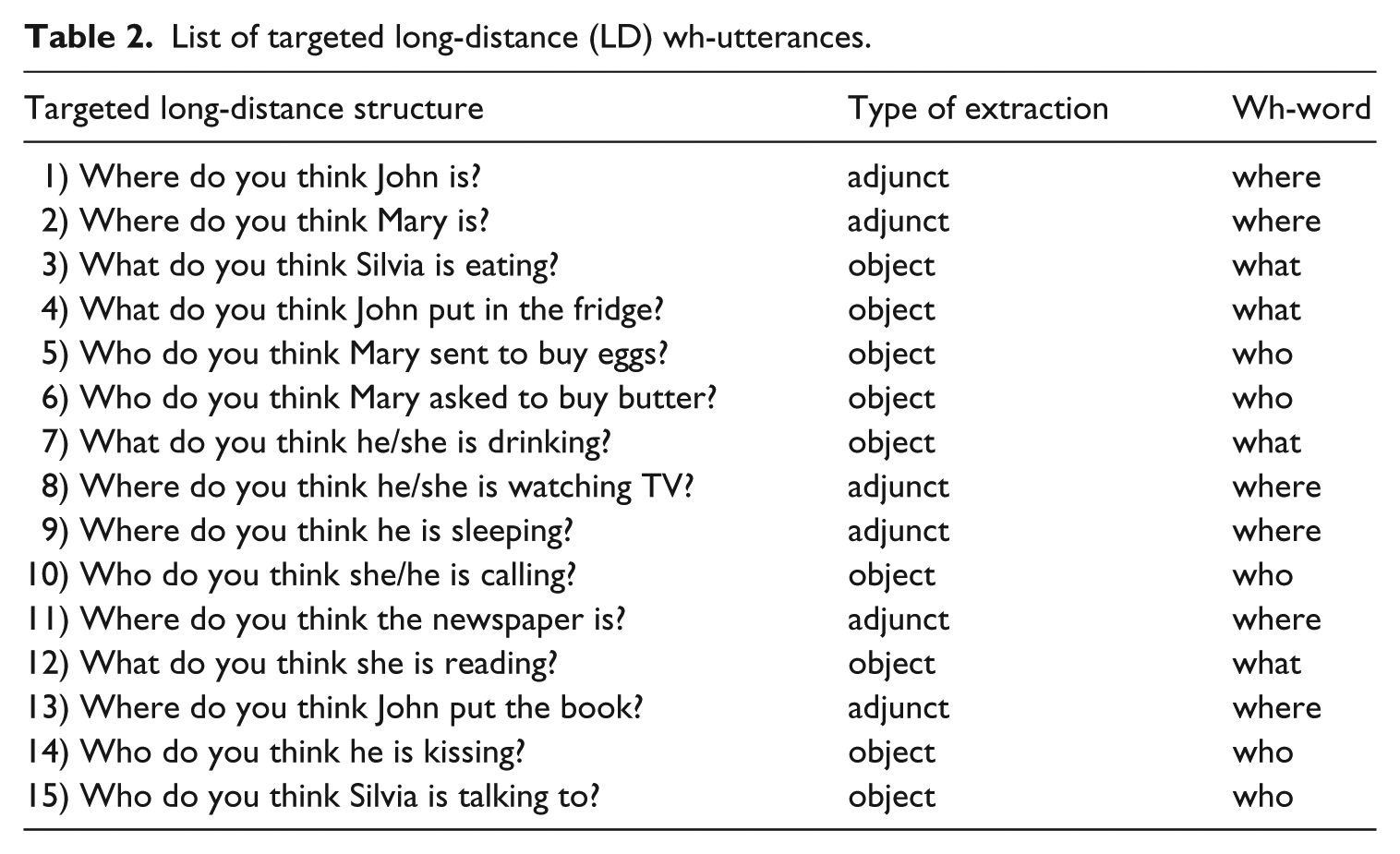
The task involved 15 different situations (i.e. 15 complex wh-utterances were targeted). The targeted structures included object (what, who) and adjunct (where) wh-extractions. 18 The interactions with all three groups of participants were recorded digitally and all elicited questions were transcribed. False starts, hesitations and pauses were transcribed impressionistically but are not indicated in the examples below for the sake of simplicity. Spontaneous self-corrections during production where an utterance was started but not completed and then self-corrected (i.e. a new utterance completed) were noted in the transcripts and during coding only the self-corrected versions were taken into account. In cases where the participant completed a whole utterance and then self-corrected, both completed utterances were coded. Fragments, incomprehensible utterances, utterances where more than three elicitation prompts had to be given, and tokens where the participants had to resort to their native language to ask for clarification or guidance in producing the utterance were excluded. As a result of these procedures, the average number of tokens included per participant was 12 for the French group and 14 for the Bulgarian group. A list of the 15 targeted wh-utterances is provided in Table 2.
List of targeted long-distance (LD) wh-utterances.
3 Results
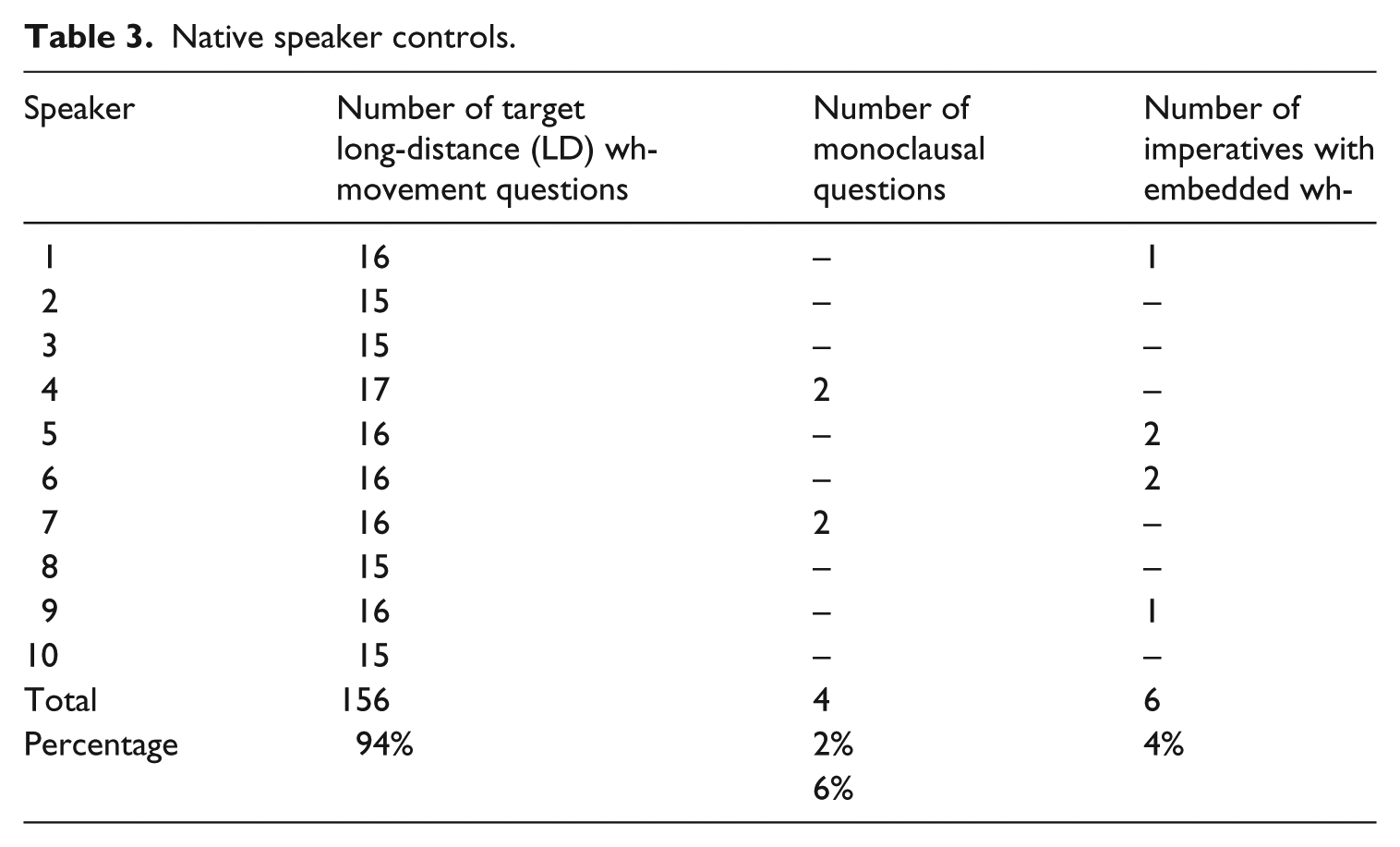
The main purpose of the English native control group was to ensure that the elicited production task did create a context in which LD wh-questions were the most appropriate utterance. The native speakers produced such questions consistently and with minimum variation (a total of 167 questions were elicited). Several participants occasionally produced a simple wh-question (e.g. Where is John?) or an imperative with an embedded wh-clause (e.g. Guess where John is), instead of a complex wh-question (e.g. Where do you think John is?). Following such utterances, these participants either spontaneously self-corrected and produced a complex wh-question, or did so after a follow-up prompt, as per the elicitation protocol. Overall, this variation was limited to a few participants and to not more than two deviant utterances per participant. Since such utterances amounted to 6% of the total productions, and the remaining 94% were target LD wh-questions, as indicated in Table 3, the native speakers provided a steady baseline for comparison with the L2 learners and confirmed that the task did create a context that requires complex wh-questions.
Native speaker controls.
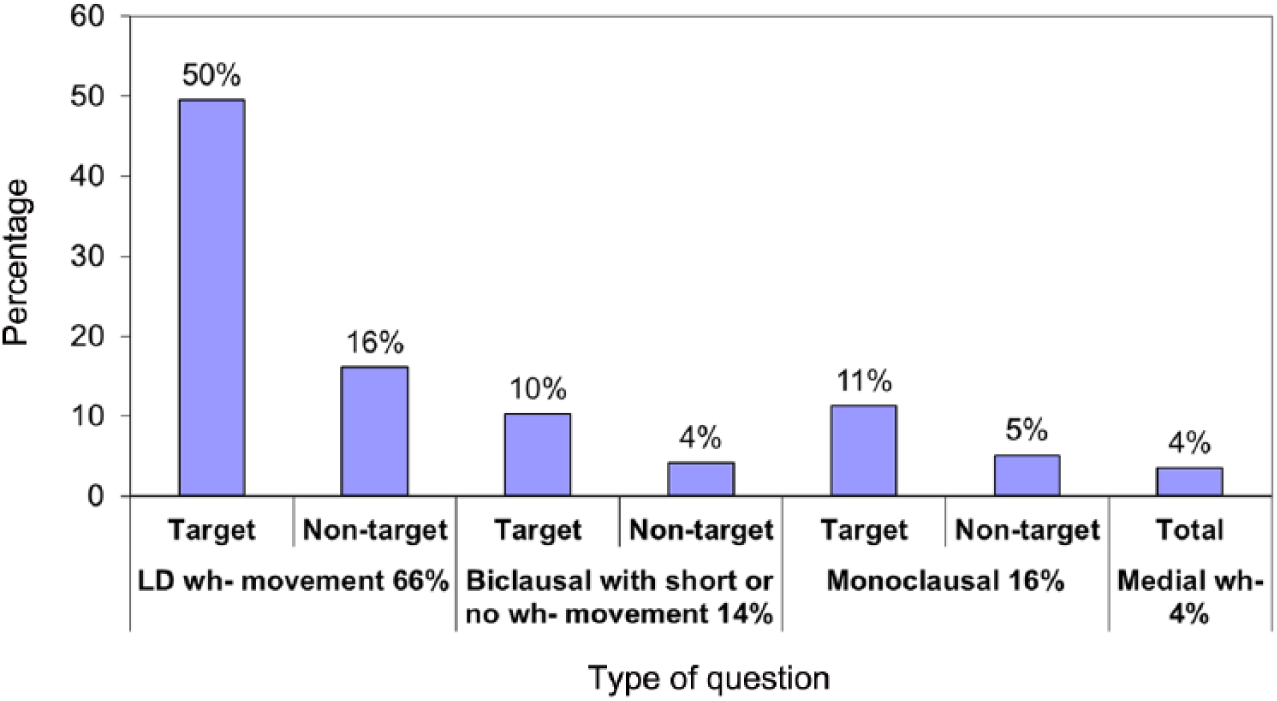
The group of 26 English L2 learners whose L1 was French produced a total of 311 questions, of which 260 (84%) were biclausal and 51 (16%) were monoclausal. As expected, the L2 learners showed a much higher degree of variation in the types of questions produced. The total productions categorized by type are shown in Figure 3.
Total productions by type: French speakers
As indicated in Figure 3, four major categories of productions were identified: LD wh-movement (i.e. complex wh-questions); biclausal structures with only local wh-movement or no wh-movement altogether; monoclausal (i.e. simple) questions; and medial wh-constructions. Within each of these categories, the productions were further subdivided into target and non-target, except for the medial wh-category (see discussion below). Morphological, lexical, aspectual, etc., errors were not considered relevant, as the focus of this research is on a syntactic phenomenon; thus, sentences with incorrect plurals, tense, word choice, etc. were still classified as target. On the other hand, sentences with syntactic errors pertaining to auxiliary inversion, presence of do-support, word order or complementation were designated as non-target.
The category containing LD wh-movement (both target and non-target) accounts for 66% of the total productions of this group. The remaining 34% represent constructions of lower derivational complexity where wh-movement is shortened, eliminated, or ‘bridged’ by an overt intermediate wh-element. Recall that the situations set up in the elicitation task, the lead-in and the follow-up prompts were all designed to create a strong bias for LD wh-movement. The native speaker control group performed as expected and consistently produced complex wh-questions. The fact that the L2 learners in this group also produced complex wh-questions most of the time suggests that they were aware on some level of the type of question most appropriate in the context of the elicited production task; at the same time, the fact that they also resorted to a number of alternative, derivationally simpler utterances, is a strong indication that LD wh-movement poses difficulty and is thus often avoided at this level of acquisition.
Examples of productions from each of the four categories and their subcategories are provided below, beginning with target complex wh-questions, as in (28).
(28) Target LD wh-movement (50% of all productions) a. What do you think she’s reading? (participant FR 24) b. What do you think he drinks? (participant FR 10) c. Where do you think the newspaper are? (participant FR 1)
The non-target LD wh-movement structures included missing do-support in the matrix clause, as in (29a), incorrect subject auxiliary inversion (T-to-C movement) in the embedded clause, as in (29b), and missing auxiliary be in the embedded clause, as in (29c), (also see Table 2, item 10).
(29) Non-target LD wh-movement (16% of all productions) a. Where you think the book is? (participant FR 3) b. Where do you think is John? (participant FR 18) c. Who do you think Mary call? (participant FR 8)
Despite the fact that these productions are non-target, they still show a high degree of derivational complexity as LD wh-movement has taken place. Thus, such examples cannot be considered avoidance strategies. 19
Turning to the different LD wh-movement avoidance strategies, target biclausal utterances involving only local or no wh-movement are shown in (30).
(30) Target biclausal with short or no wh-movement (10% of all productions) a. Do you know who buy eggs?
20
(participant FR 2) b. Do you think John’s watching TV in the bedroom? (participant FR 19) c. What do you think about the place I put the newspaper? (participant FR 2)
According to the DCM, the first two examples are considered derivationally less complex alternatives to LD wh-movement as follows: (30a) is a complex yes/no question with an embedded wh-clause, and as such, it involves only short wh-movement in the second clause; (30b), is a complex yes/no question with no wh-movement altogether. The example in (30c), however, poses a challenge to the current formulation of the DCM. On the one hand, it appears to be a case of avoidance because instead of producing the targeted LD wh-utterance Where do you think the newspaper is? (see Table 2), the learner uses the circumlocution What do you think
The next category of avoidance strategies includes non-target biclausal structures with short or no wh-movement, as in (31).
(31) Non-target biclausal with short or no wh-movement (4% of all productions) a. What do you think is Joanne or Christine Silvia call? (participant FR 18) b. You think it’s who go to the search butter? (participant FR 3) c. You watch TV and you drink what? (participant FR 13)
In addition to having only local wh-movement or no wh-movement altogether, these productions show structural errors, such as incorrect object–subject word order, as in (31a), a wh-cleft construction, as in (31b), and wh-in-situ, as in (31c). The latter two may be developmental errors or cases of transfer from the learners’ L1, as wh-clefts and wh-in-situ are both question formation strategies used in French. As for the former, the word order error could also be due to developmental reasons, transfer from a cleft question in French, or an attempt at a focalized structure, which could potentially be grammatical in English (e.g. Is it Joanne or Christine that Silvia is calling?). All these structures are nonetheless classified as avoidance strategies because they shorten or eliminate LD wh-movement.
The next category of alternatives to LD wh-movement illustrated in Figure 3 involves monoclausal questions. Examples of target and non-target productions from this category are listed in (32) and (33), respectively. As illustrated, the non-target category involved errors with placement of the auxiliary be.
(32) Target monoclausal (11 % of all productions) a. What food does she eat? (participant FR 3) b. According to you, who is outdoor the house? (participant FR 5) (33) Non-target monoclausal (5% of all productions) Who John is kissing? (participant FR 17)
Monoclausal wh-questions are a derivationally less complex alternative to the LD wh-movement structures required in the elicitation task and as such represent avoidance strategies. The example in (32b) is particularly interesting because phrases such as according to you or in your opinion obviate the need to use the matrix clause what/who do you think as in complex wh-questions. That is, such phrases help avoid LD wh-movement and at the same time amount to a near-equivalent utterance to the target Who do you think is outside the house? As such, this example demonstrates high creativity in LD wh-movement avoidance.
The last category illustrated in Figure 3 includes medial wh-utterances. Examples of such productions are listed in (34). These consist of wh-copying, as in (34a), and wh-scope marking, as in (34b), (34c) and (34d).
(34) Medial wh- (4% of all productions) a. Who do you think who sent the butter? (participant FR 10) b. What do you think where he watch TV? (participant FR 2) c. What do you think where is Mary? (participant FR 18) d. What do you think who is the person that John kiss?
21
(participant FR 18) e. [Ø] Do you think where is Mary? (participant FR 19)
It is important to point out that the productions in (34c) and (34d) contain subject–auxiliary inversion in the second clause. 22 Thus, it could be that the learners were postulating two separate local wh-movements, as in sequential questions, which are licensed in English (What do you think? … Where is Mary?). This would correspond roughly to the indirect dependency analysis mentioned in section II.2. Alternatively, these utterances could still be analysed as LD wh-movement, assuming that the L2 learners who produced them sometimes over-invert in the embedded clause. This would correspond roughly to the direct dependency analysis mentioned in section II.2. Since the current study did not include an independent measure of the L2 participants’ knowledge of inversion in English (cf. Schulz, 2006, 2011), and since there is an ongoing debate with regards to direct and indirect dependency approaches in the theoretical literature, it is impossible to decide which of the two representations should be assumed (however, for more on this issue, see Slavkov, 2009). If we were to assume that these utterances are examples of sequential questions, they would clearly represent derivationally less complex alternatives to target LD wh-movement in English. On the other hand, if they were an instantiation of a direct dependency, they may not necessarily be derivationally less complex but may alleviate the processing load in comparison with standard LD wh-movement with deletion of all intermediate wh-copies. Thus, as mentioned above, such utterances, regardless of their precise status, can be considered avoidance strategies.
Finally, consider the example in (34e), which has a wh-word appearing in medial position, but no wh-word in the matrix clause. This roughly corresponds to the scope marking medial wh-structure, except the scope marker in the matrix clause is assumed to be unpronounced (marked as [Ø] above). Once again, such examples could be analysed as either a direct or an indirect dependency, as mentioned in Section II.2. Regardless of the specific analysis, such questions are ungrammatical in L2 English but exist in other, typologically distinct, languages such as Bahasa Indonesia, Quechua and Kitharaka (see Saddy, 1991; Cole and Hermon, 1994; and Muriungi, 2004; respectively). Furthermore, similar structures have also been reported in child L1 French (Jakubowicz and Strik, 2008; Oiry and Demirdache, 2006) and in adult L2 English (Wakabayashi and Okawara, 2003). 23 Just as wh-scope marking with an overt wh-word appearing in the matrix clause, silent scope marking is considered to alleviate the processing load. 24
Overall, the French-speaking group showed a sufficiently high number of productions containing LD wh-movement (66%), showing that these learners could make use of it in L2 English. At the same time, unlike the native speaker control group, the French-speaking participants also produced a wide variety of alternative productions with lower derivational complexity (34%). This indicates that LD wh-movement did pose difficulty and the learners frequently resorted to avoidance.
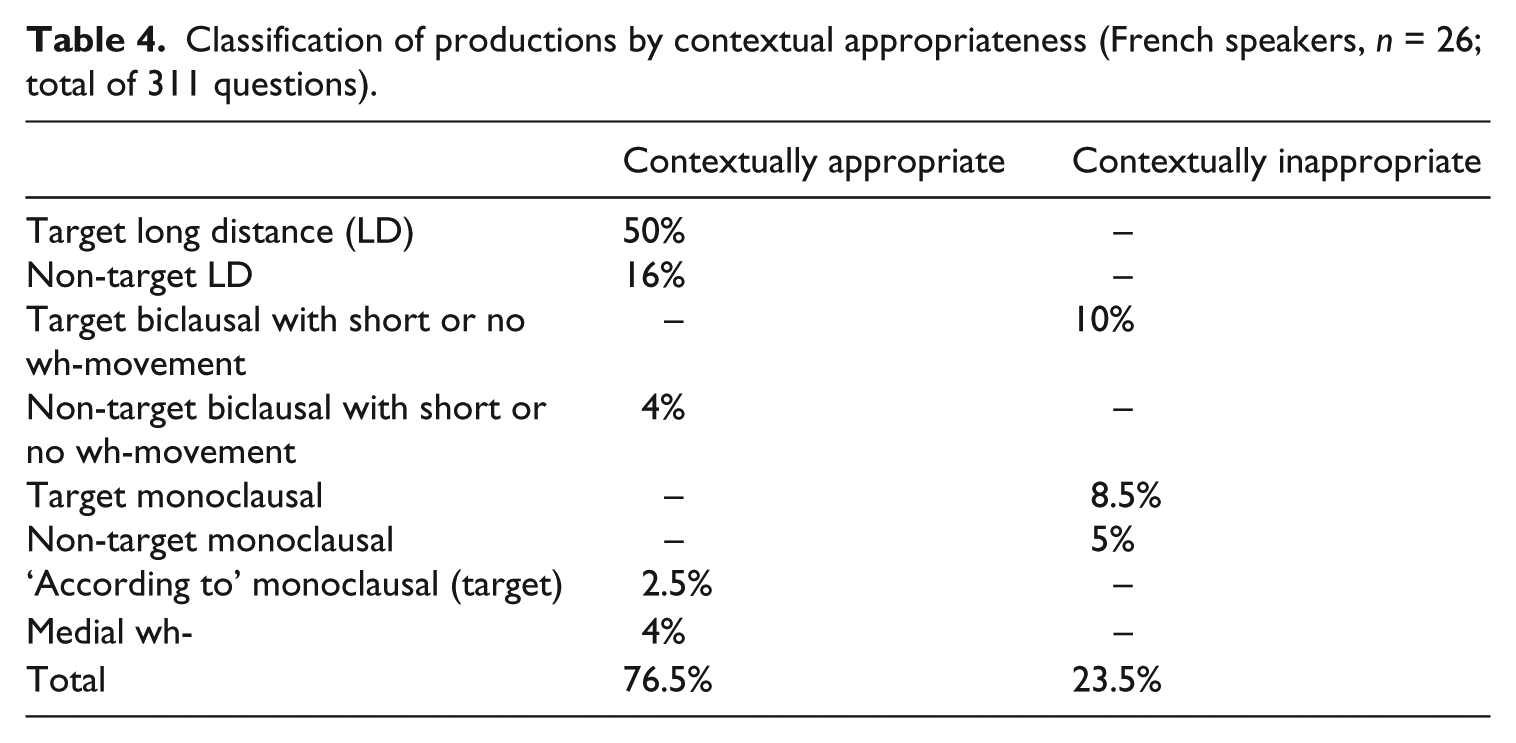
It should be noted that the above classification of avoidance strategies is based on the formal criteria arising from the DCM. However, the questions produced by the L2 learners can also be classified in terms of contextual appropriateness. For example, the questions listed in the LD category (both target and non-target), the non-target biclausal productions with short or no wh-movement, and the medial wh-productions can all be classified as contextually appropriate under the specific elicitation circumstances of the experiment. On the other hand, the target biclausal productions with short or no wh-movement and the monoclausal (both target and non-target) questions were generally contextually inappropriate. One exception is the monoclausal questions preceded by according to you, as in (32b), which are roughly equivalent to the LD fronted wh-questions in terms contextual appropriateness. A classification based on these criteria is given in Table 4. Further discussion of contextual appropriateness and its relationship with grammatical accuracy is beyond the scope of this article (for more details on this issue, however, see Slavkov, 2009).
Classification of productions by contextual appropriateness (French speakers, n = 26; total of 311 questions).
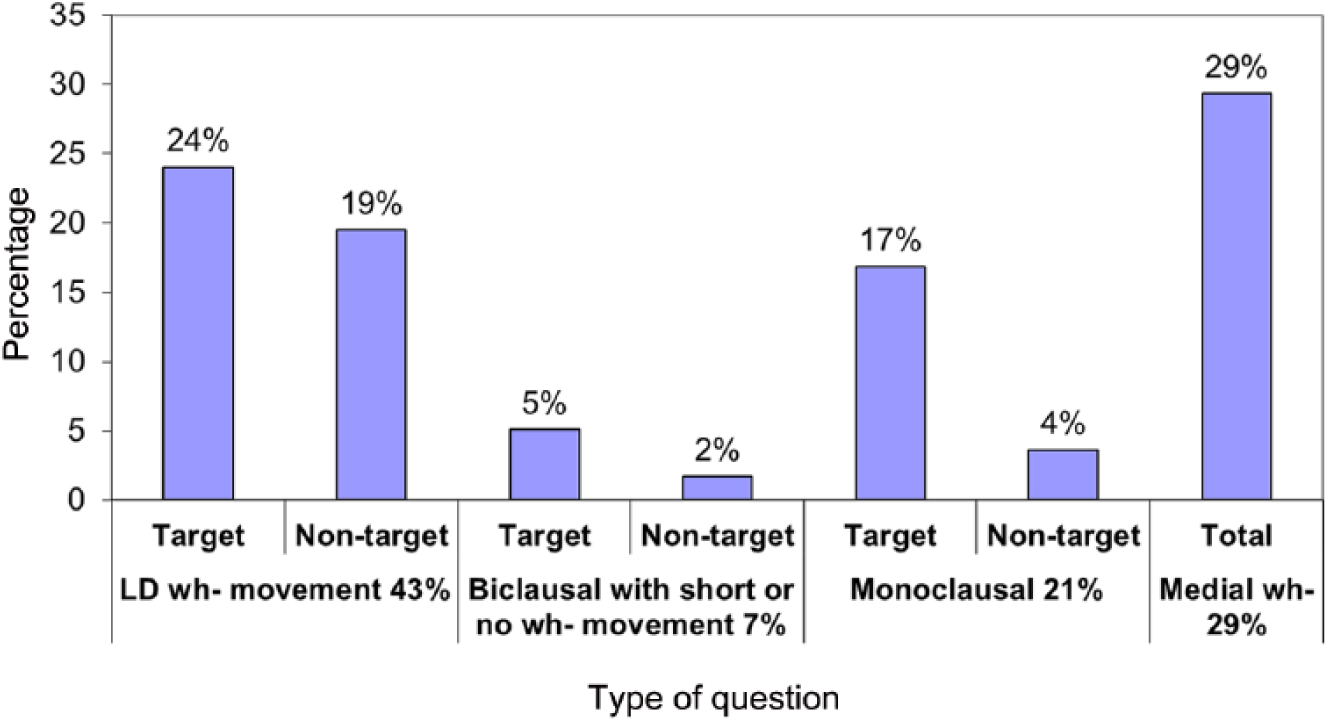
Turning to the second group of L2 participants, the Bulgarian speakers of L2 English showed a similar pattern to the French speakers. They produced 416 questions in total, of which 331 (79%) were biclausal and 85 (21%) were monoclausal. As Figure 4 indicates, the utterances were also grouped by number of clauses, length of wh-movement and presence of medial wh-.
Total productions by type: Bulgarian speakers.
As mentioned earlier, the Bulgarian group had a different acquisition setting and it was assumed that these participants were at a lower level than the French group with regards to their conversational facility. In terms of types of utterances, however, the Bulgarian group patterned closely with the French speakers. Examples of the four major categories and their subcategories are listed in (35)–(41) below.
(35) Target LD wh-movement (24% of all productions) Where do you think John is? (participant BG 7) (36) Non-target LD wh-movement (19% of all productions) a. Where you think John is? (participant BG 2) b. Where do you think is she watching TV? (participant BG 5) c. What do you think Silvia eating?
25
(participant BG 9) (37) Target biclausal with short or no wh-movement (5% of all productions) a. Do you know where John is now? (participant BG 4) b. Do you think John is at the kitchen? (participant BG 11) c. What do you think does John like Silvia? (participant BG 1) d. What do you think if John put a glass of water in the fridge? (participant BG 12) (38) Non-target biclausal with short or no wh-movement (2% of all productions) a. Do you know where is the newspaper? (participant BG 3) b. What do you think John is kissing which? (participant BG 18) (39) Target monoclausal (17 % of all productions) a. Where is he? (participant BG 24) b. Who did you go to the shop?
26
(participant BG 21) c. Does Silvia like pizza? (participant BG 7) (40) Non-target monoclausal (4 % of all productions) a. Who John is kissing? (participant BG 22) b. What Silvia read? (participant BG 16) (41) Medial wh- (29% of all productions) a. What do you think what he’s doing now? (participant BG 1) b. Where do you think where John is watching TV? (participant BG 18) c. What do you think who did Mary sent to buy some eggs? (participant BG 4) d. What do you think where is John now? (participant BG 12) e. What do you think who John kissing? (participant BG 22) f. [Ø] Do you think who Mary sent to buy eggs? (participant BG 16)
As these examples illustrate, the types of complex wh-productions and LD wh-movement avoidance strategies attested in the Bulgarian group are similar to the ones produced by the French-speaking participants listed earlier in (28)–(34). A few differences are worth noting: the Bulgarian participants did not show evidence of wh-cleft constructions, which could be attributed to L1 transfer in the French-speaking group, as mentioned earlier; on the other hand, the French participants did not use monoclausal yes/no questions as an avoidance strategy, while the Bulgarians did. In terms of medial wh-constructions, the rate was much higher in the Bulgarian group (29%) than in the French-speaking group (4%). In this respect, it should be noted that the Bulgarian participants produced a high number of structures with subject–auxiliary inversion in the second clause, as in (41c) and (41d). As mentioned earlier, such constructions could potentially be sequential wh-questions (i.e. two independent clauses with local wh-movement, roughly equivalent to the indirect dependency analysis). In addition, the Bulgarian participants also produced constructions with missing embedded auxiliary, as in (41e), which could also be analysed as sequential questions, assuming that the participants omitted the auxiliary in the second question. However, because the current study did not involve an independent measure of subject–auxiliary inversion (for some further discussion, see Schulz 2006, 2011 and Slavkov, 2008, 2009) it is not possible to validate the analysis of medial wh-constructions as sequential questions. It should also be noted that in recent theoretical proposals on Russian, what has previously been analysed as wh-scope marking has been suggested to represent a parenthetical construction, where the second wh-clause in the question triggers a Pottsian conventional implicature (Potts, 2002, 2005) and does not contribute to the main assertion but rather ‘conveys additional not-at-issue meaning’ (Korotkova, 2012). Should such analysis prove to apply to Bulgarian as well, then potential medial wh-constructions in the L2 English of Bulgarian speakers could reflect a strong transfer effect. I leave this issue open to further research. 27
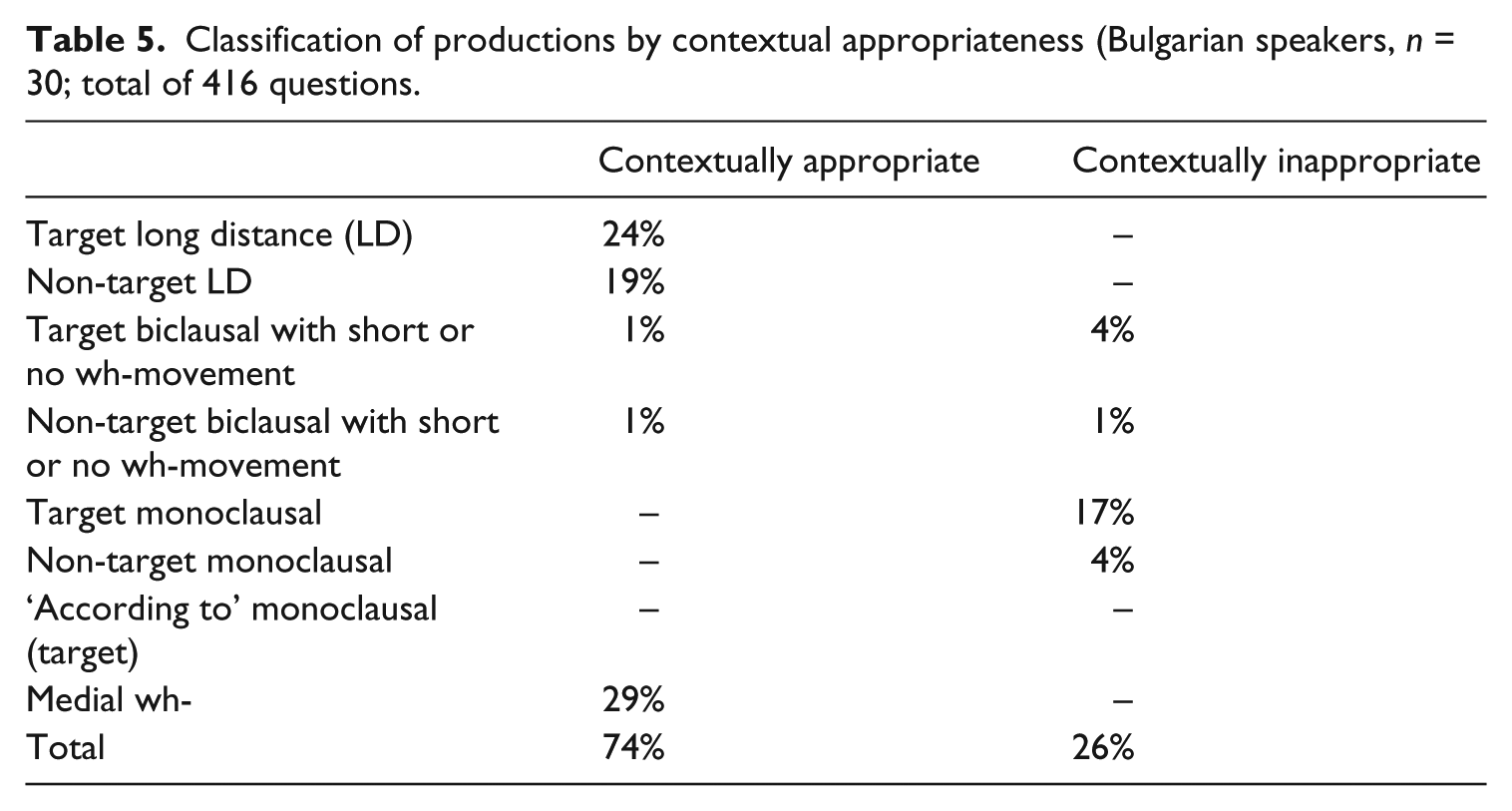
In terms of contextual appropriateness, the classification is similar to the one provided for the French speakers. As indicated in Table 5, the questions listed in the LD category (both target and non-target) and the medial wh-productions can be classified as contextually appropriate. On the other hand, the monoclausal questions produced (both target and non-target) were contextually inappropriate. Note that monoclausal questions preceded by according to you… were not attested in this group. Another minor difference can be observed in the short or no wh-movement biclausal category, where both contextually appropriate and inappropriate utterances were attested.
Classification of productions by contextual appropriateness (Bulgarian speakers, n = 30; total of 416 questions.
Overall, the picture that emerges from the results of the two groups of learners is one in which both populations can use the target LD wh-movement mechanism with some success, but both also resort to a wide variety of avoidance strategies. The types of avoidance strategies across the two populations are remarkably similar. The rates of the various productions, on the other hand, differ in that the French speakers show a higher rate of LD wh-movement and of biclausal structures in general. Conversely, the Bulgarian participants show a higher rate in the use of avoidance strategies, particularly monoclausal structures and medial wh-/sequential questions.
An important question that also needs to be addressed is how the different types of LD wh-movement productions and avoidance strategies are distributed among the individual participants. In other words, are there participants who use predominately or exclusively LD wh-movement, while others make use of predominately or exclusively alternative structures? These results are shown in Figure 5 for the participants of the French-speaking group.
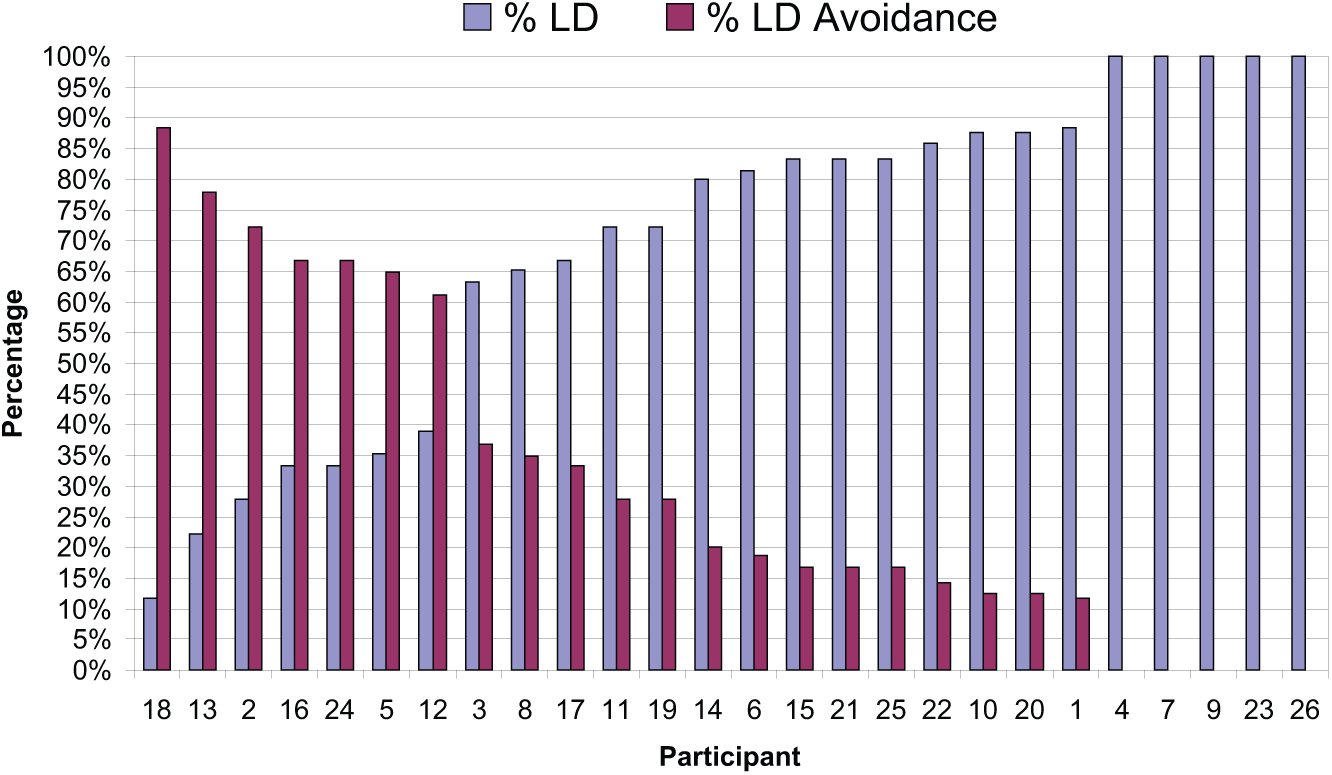
Individual distribution of LD wh- movement versus avoidance structures. French speakers of L2 English, n=26.
On the one end of the spectrum are participants 18, 13 and 2, who consistently use avoidance structures (between 70% and 90% of the time). On the other end of the spectrum are participants 4, 7, 9, 23 and 26 who use exclusively LD wh- movement. A similar distribution is observed with the Bulgarian participants, as figure 6 indicates.
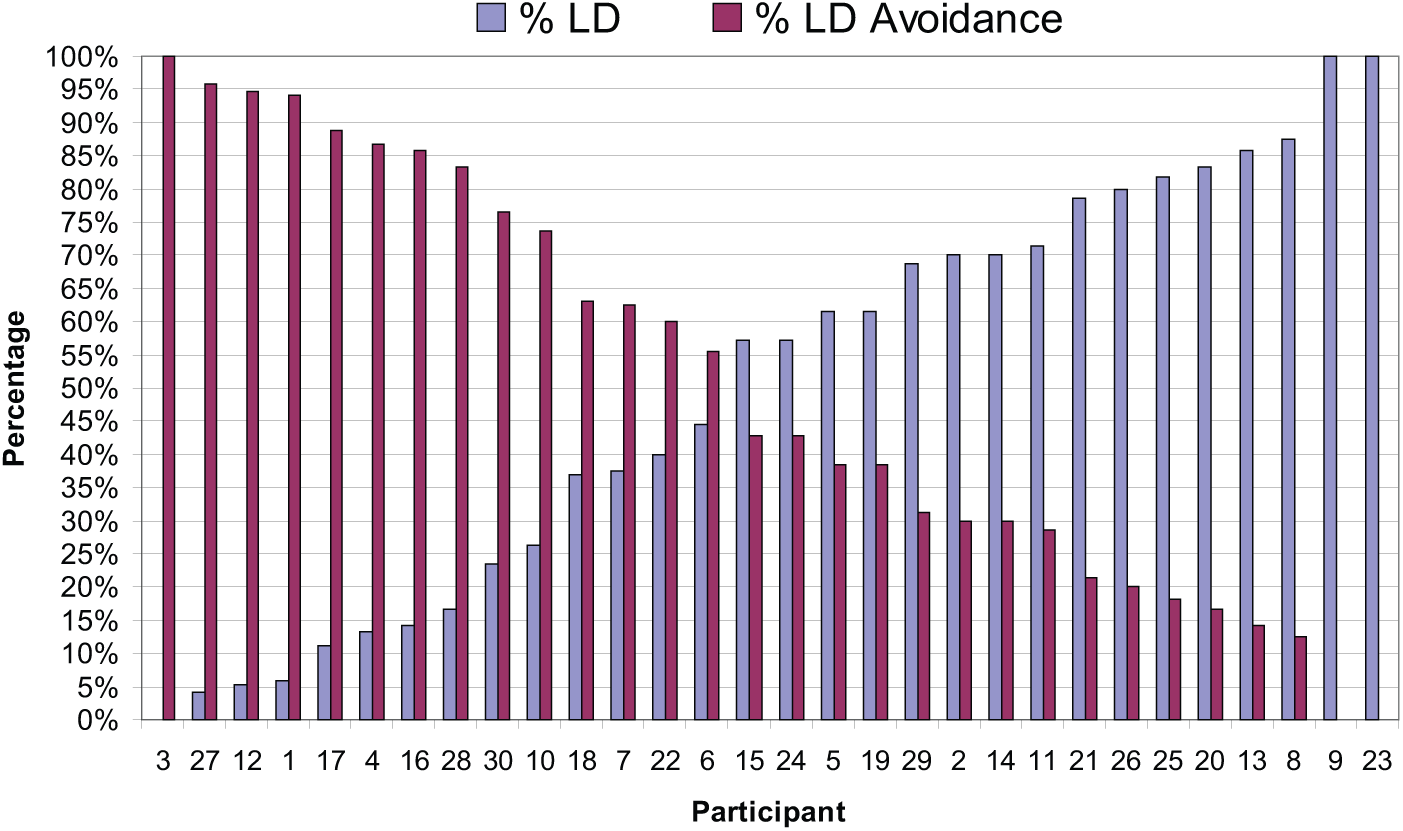
Individual distribution of LD wh- movement versus avoidance structures. Bulgarian speakers of L2 English, n=30.
Participants 3, 27, 12, 1, 17, 4, 16, 28, 30 and 10 use predominately avoidance strategies (between 70% and 90% of the time), while participants 9 and 23 use exclusively LD wh- movement. Comparing the two groups, there are more participants leaning towards avoidance strategies in the Bulgarian group and more participants using LD wh- movement comfortably in the French speaking group. This finding is consistent with the group results presented earlier, and with the assumption that the Bulgarian group is somewhat less advanced.
4 Discussion
Overall, the results of this study generate support for the application of the derivational complexity hypothesis in L2 acquisition. With regards to research question 1 and research question 2, the data showed that producing complex wh-questions poses difficulty in L2 English and thus the two learner populations resorted to a wide variety of alternative structures, which had a lower degree of derivational complexity and were called avoidance strategies. These included biclausal structures with only local or no wh-movement, monoclausal structures with local or no wh-movement, and medial wh-structures.
Many of the avoidance strategies were constructions that are licensed options in English, including embedded wh-questions, yes/no questions, and monoclausal wh-questions; however, they were not appropriate in the particular elicitation context, which had a strong bias for complex wh-questions. While variability is a well-known phenomenon in L2 acquisition and L2 learners are often reported to show higher degree of variability than native speakers, the fact that the L2 participants in the study drew from a wider pool of grammatically licensed structures than the native speakers may seem somewhat paradoxical. That is, speakers who have native command of English may be expected to resort to a richer variety of grammatical constructions in their productions. However, this paradox is only apparent due to the premises of the derivational complexity hypothesis. That is, LD wh-movement is not expected to pose difficulty to adult native speakers because they have a fully developed grammar and sufficient processing resources at their disposal; thus, they can produce LD wh-structures consistently and with less effort than language learners. The L2 learners, on the other hand, produced a variety of alternative structures because LD wh-movement poses a substantial burden on their developing L2 grammar and processing capacity. The DCH assumes that at later stages of acquisition both the grammatical competence and the availability of processing resources of the learners will increase. Thus, advanced learners are expected to use fewer, if any, avoidance strategies. While I leave this prediction to be tested in future research, the fact that several speakers from both the French-speaking and the Bulgarian groups in this study showed 100% use of LD wh-movement is a positive indication in this respect.
In terms of the issue of L1 transfer, it was mentioned earlier that French and Bulgarian use the LD wh-movement mechanism in complex question formation. Thus, one can speculate that positive transfer, that is, transfer accounting for target-like L2 behavior, played some role in the production of LD wh-movement constructions in the study. Recall that such constructions amounted to 66% for the French speakers and 43% for the Bulgarian speakers. On the other hand, negative transfer, that is, transfer of structures that are not licensed in the L2, seemed to play more limited role in both groups (however, see endnote 19). Structures with multiple wh-fronting were not attested in the L2 English of the Bulgarian speakers, despite their availability in the L1. 28 Wh-cleft structures and wh-in-situ, which are licensed in French in addition to LD wh-movement, were attested in the productions of the French speakers but their rates were very low (less than 4%). In fact, wh-in-situ was also attested in the Bulgarian group (less than 2%), despite the unavailability of such constructions in the L1 of these participants. Thus, it can be argued that wh-in-situ appears not only because of L1 transfer but also because it is a derivationally less complex option (but see further discussion of this issue in the next section). Overall, the data suggest that LD wh-movement avoidance strategies may be less likely to result from L1 transfer than from derivational complexity effects.
With regards to research question 3, the question about constructions that cannot be accounted for in terms of either L1 transfer or L2 input, different types of medial wh-structures were attested in both L2 populations. The rates of such structures were quite limited in the French-speaking group (4%). The Bulgarian participates had a higher rate of such productions (29%); however, as mentioned earlier, the status of such structures is not clear at this point, and it is possible that they could be analysed as sequential wh-questions (i.e. What do you think? … Where is John?).
If we assume that at least some of the attested medial wh-structures are to be analysed under a direct dependency approach, this would pose an interesting acquisition question. That is, why do certain L2 learners resort to constructions not supported by the L1 or the L2 grammar, but available in other languages, of which they report no knowledge? The DCH assumes that such constructions may alleviate working memory load as they provide an overt intermediate ‘bridge’ or a filled gap in the structure of a complex sentence. At the same time, it can also be argued that the underlying abstract grammatical competence of the L2 learners leads them to hypothesize that such constructions are in principle possible in the target language, despite the lack of any relevant L2 input or L1 influence. Within the framework of the DCH, such constructions are expected to appear at low rates because they are just one possible option of LD wh-movement avoidance. In fact, some of the other options, such as embedded wh-questions, yes/no questions, sequential questions, etc., must be viewed as more viable and more likely avoidance strategies, as they are licensed in both the L1s and the L2 of the two groups of participants and as such, there is relevant input for such constructions.
As mentioned in the beginning of this article, the derivational complexity hypothesis allows for the relevant L2 phenomena to be captured in a single account integrating the role of both the learners’ grammatical competence and their processing profile. In some views this may seem to be a confounding position. In terms of complex wh-questions, and more specifically focusing on the scope marking construction, Schulz (2006) presents grammatical competence and processing as a dichotomy. In investigating wh-scope marking in L2 English, she proposes that such constructions must be grounded either in the learner’s grammar or be due to a processing effect. Other accounts of medial wh-constructions, and of complex wh-questions in general, are often based on an in-depth syntactic analysis of the L1 and L2 grammars and sometimes assume access to Universal Grammar in L2 acquisition, without necessarily making reference to processing (Gutierrez, 2005; see also, amongst others, Wakabayashi and Okawara, 2003; Radford and Yokota, 2006).
The approach adopted in this article assumes a strong relationship between grammatical processing and competence in L2 acquisition. On the one hand, the L2 development of complex wh-questions must be influenced by abstract grammatical principles operating in the L1 and the L2 and possibly extending beyond them. Such abstract principles must guide L2 learners in developing structures that correspond to the target grammar as well as structures that may deviate from the target grammar but are consistent with the options of the languages of the world; the latter being only a temporary deviation that presumably self-corrects with enough target input (see Schulz, 2006, among others, for discussion of the role of indirect negative evidence with regards to complex wh-questions). On the other hand, L2 development cannot be guided by grammatical principles only. It interacts with the learner’s processing resources, which are more limited in the initial stages of acquisition and increase as acquisition progresses. Thus, LD wh-movement avoidance strategies result from pressures placed on the L2 learner by both their developing L2 grammatical competence and the gradual increase in their L2 processing resources. Note that such a close-knit relationship between grammar and processing has been assumed by previous literature, not necessarily concerned with acquisition. For example, Phillips (1996) and Lewis and Phillips (in press) make an argument that the dichotomy between processing and grammar can be dispensed with. Essentially, they claim that the parser is the same as the grammar and vice versa, and mention that derivational complexity views are compatible with their proposals. Thus, although the DCH assumes two separate but closely interrelated systems for grammar and processing, it is possible that its predictions would also apply under a unitary system view. Further elaboration on this issue is left for future work.
IV Conclusion
Viewing LD wh-movement – and possibly other phenomena – from the perspective of derivational complexity sets up a new research program with the potential of bringing fresh theoretical and empirical insights into the L2 field. The DCH faces many challenges in terms of theoretical development and empirical testing. For example, the current formulation of the hypothesis offers a general metric by which different structures can be classified in terms of relative complexity. However, this metric does not offer specific predictions about exactly which types of productions should be expected at any given stage of acquisition. For example, wh-in-situ is considered less complex than many of the other avoidance strategies attested in this article (e.g. structures with short wh-movement); this raises the question as to why the learners produced a very limited number of wh-in-situ utterances. Whether the learners were past a possible wh-in-situ stage in their L2 development, or whether such a stage may not really exist, are just a few of the specific questions that remain unanswered. It should be noted that recently proponents of the DCH have suggested that wh-in-situ may actually have higher processing costs, assuming that the wh-word is not in the position where it is interpreted in LF, that is, initial position in the left periphery of the clause (Jakubowicz, 2011; Strik, 2012). 29 Currently such ideas remain speculative and further work is needed to test their validity. Additionally, as mentioned earlier, the theoretical analyses of wh-in-situ and its status in child L1 French remain controversial; thus, aligning empirical data with theoretical accounts continues to be a challenge. Finally, while the DCH is currently limited to considerations of movement operations, it is possible that other derivational processes such as feature checking, agreement, etc., may also have impact on the complexity of the derivation as it relates to acquisition.
Overall, fine-tuning the predictions of the DCH and widening the scope of the hypothesis is a demanding new task to be undertaken in the future. Working in this direction, however, seems worthwhile as it has the potential of increasing our understanding of how both native and non-native language development works.
Footnotes
Acknowledgements
Many thanks are due to five anonymous reviewers who have offered thorough and thoughtful comments. I am also very grateful to Nina Kazanina and Juana Liceras for their advice and support leading up to this publication. Various aspects of this work have previously been presented and benefited from comments at the following conferences: Canadian Linguistic Association (CLA), Generative Approaches to Language Acquisition North America (GALANA) and European Second Language Association (EUROSLA)
Declaration of Conflicting Interest
The author declares that there is no conflict of interest.
Funding
This article is supported by an open access publication grant from the University of Ottawa’s Author Fund.