



Abstract
Russia's full-scale invasion of Ukraine in 2022 compelled the European Union (EU) to take the unprecedented step of providing co-ordinated military aid to Ukraine. This article explores the intriguing, yet under-researched question of how this major policy transformation was discursively legitimised in the EU's official communication. Theoretically drawing on Van Leeuwen’s framework of legitimation and methodologically combining qualitative content analysis with critical discourse analysis, it examines posts published on X (Twitter) between 2022 and 2024 by eight EU institutions and representatives. The findings reveal a complex pattern of discursive coherence achieved through a division of labour across the actors. While all actors relied on legitimation strategies of moral evaluation, authorisation, and rationalisation, they did so through distinct yet complementary registers, ranging from institutional consensus and strategic resolve to moral duty, emotional urgency, and the Union's normative vocation.
Introduction
The Russian invasion of Ukraine in February 2022 sent shockwaves across Europe, exposing the fragility of the continent's security architecture and confronting the European Union (EU), for the first time since the Second World War, with a full-scale war on its doorstep. The EU reacted with unprecedented speed, from providing humanitarian and financial support to granting Ukraine candidate country status (Bosse, 2024). Yet, the most transformative step lay elsewhere. The decision to provide co-ordinated military assistance constituted what observers have described as a watershed moment (Johansson-Nogués and Leso, 2025: 133). By supplying lethal aid through its institutional mechanisms, the EU crossed a deeply entrenched normative threshold, abandoning its longstanding taboo against military means in the pursuit of peace and setting a precedent with far-reaching implications for its foreign and security policy (Juncos and Pratt, 2025: 653–654). This act of rupture not only redrew the boundaries of EU external action but also signalled an aspiration to act as a more geopolitically autonomous and assertive power, less reliant on external guarantors of security and increasingly willing to exercise agency in the global arena (Helwig, 2023; Johansson-Nogués and Leso, 2025).
Equally remarkable was the unity underpinning the decision. Since the inception of the Common Foreign and Security Policy, questions have been raised about the EU's capacity to ‘speak with one voice’ on matters of international significance (Genini, 2025: 2). The cohesive reaction to Russia's aggression in 2022, however, marked a stark departure from the previous episodes of fragmentation and prompted renewed debates on the EU's actorness in security and defence (Börzel, 2023: 16).
Yet, despite widespread recognition of this historic rupture, remarkably little is known about how the EU discursively justified its unprecedented turn to military assistance and how it reconciled the break with past taboos with its self-proclaimed normative identity. What legitimising logics sustained this transformation, and did the much-celebrated unity in action also manifest as unity in discourse? To address these questions, the article investigates how the EU constructed legitimacy around its provision of military aid to Ukraine. Specifically, it asks: How did EU institutions and representatives legitimise the provision of military assistance to Ukraine in their communication on X? In doing so, the study draws on Van Leeuwen's (2007) framework of legitimation, methodologically combines qualitative content analysis with critical discourse analysis (CDA), and empirically works with a corpus of institutional posts published on X between February 2022 and September 2024.
Such inquiry is particularly essential, as legitimation is the very mechanism through which political actors secure consent and stabilise contested choices (Lenz and Söderbaum, 2023; Rojo and van Dijk, 1997: 528; Dijk, Teun, 1998: 255–256). In moments of rupture, the need to justify decisions becomes notably acute (Wodak, 2022: 1). Moreover, in an environment saturated with foreign interference, how the EU communicates its rationale for military support directly affects its capacity to resist hostile narratives designed to delegitimise its action, fracture unity, and erode democratic resilience (e.g. Tyushka, 2022). Examining these legitimation strategies is therefore indispensable for understanding both the consolidation of the EU's emerging geopolitical role and the discursive resources it mobilises to defend itself against external contestation.
The article proceeds as follows. It first outlines the broader context of the EU military assistance to Ukraine, before situating the study within the existing scholarship and highlighting its contribution. It then presents the theoretical framework, introduces the data and methodological approach, and proceeds to the empirical analysis. The conclusion reflects on the broader implications of the findings for the EU's evolving geopolitical identity and the study of legitimation in political communication.
Context: EU military assistance to Ukraine
Since the outset of Russia's full-scale invasion, the European Union has taken unprecedented steps in security and defence. On 28 February 2022, only 4 days into the war, the European Council authorised military support to Ukraine through the European Peace Facility (EPF), marking the first time lethal weapons were provided under the EU mechanism (Steenberghe, 2023: 232). By February 2025, 6.1 billion euros had been disbursed, with the ceiling expanded by a further 5 billion through the creation of the Ukraine Assistance Fund in March 2024 (Council of the EU, 2024). In May 2024, member states authorised the use of proceeds from frozen Russian assets, with most of the first tranche allocated to military aid (Congressional Research Service, 2025). Alongside financing, the EU launched the Military Assistance Mission for Ukraine (EUMAM UA) in November 2022, its first training mission on EU soil, which by early 2025 had trained more than 70,000 Ukrainian soldiers (European Commission, 2025). Together, these measures marked a decisive shift in the Union's external action.
Politically and symbolically, this turn was profound. Long seen as a civilian power built for peace and self-conceived as a ‘normative power’ (Moser, 2024: 26), the EU had previously limited itself to economic support and state-building and civilian security reforms in Ukraine (Mills, 2025; Rabinovych and Pintsch, 2024). The decision to channel lethal weapons through the EPF thus represented a decisive rupture with what Johansson-Nogués and Leso (2025: 133) term the Union's ‘everything-but-arms’ policy. This shift signalled not only an aspiration to act more autonomously and geopolitically (Fabbrini, 2024) but also exposed internal rifts, with Hungary and Slovakia obstructing further EPF funding, while public support for military aid has shown signs of decline (Vries and Hoffmann, 2022, 2024). EU military assistance to Ukraine thus stands as both a transformative policy step and a fragile exercise in maintaining unity, amplified by the constant risk of foreign interference, which seeks to exploit divisions and cast doubt on the legitimacy of EU support (Osadchuk, 2023).
Literature review
The article makes a key empirical and theoretical contribution across four strands of scholarship: (1) the legitimation and framing of the EU's external action; (2) EU institutional discourse on the Ukraine war; (3) the EU's capacity to project coherence in foreign policy communication and, finally, (4) the broader literature on legitimation in political discourse. The legitimation and framing of EU external action have attracted sustained scholarly attention, with many studies highlighting the centrality of the EU's normative identity. The EU has consistently positioned itself as a normative power promoting peace and democracy outside (and within) its borders (Manners and Diez, 2007), while simultaneously framing its engagement with other regions in terms of security and stability management (Niţoiu, 2013). Indeed, the core values of democracy, peace and human rights appear to be the EU's dominant legitimating resources (Orrico Sandrin and Hoffmann, 2018; Tomic and Tonra, 2018). Yet the use of these resources varies across political contexts. The case of Ukraine illustrates this well. Legitimation of the EU's engagement with Ukraine following the Orange Revolution relied on rationality and strategic arguments (Wagenmakers, 2023), whereas the EU's response to Crimea in 2014 was notably shaped by values and emotions (Smith, 2021). Despite the historic significance of the war in Ukraine, existing research on EU institutional discourse remains scarce and limited to individual actors. Thematically, it focuses mostly on general themes of unity, solidarity and values. The EU's leading representatives were found to have co-ordinated their value-based messaging when addressing the war (Niessen, 2023), with emotions playing a substantial role in constructing a shared ‘community of values’ and justifying collective action (Gürkan, 2024a, 2024b). Yet, how the EU discursively crossed the normative threshold into providing lethal weapons – arguably the most contested part of its response – has not been examined, and ours is the first study to address this directly.
Whether the EU has coherently projected this policy step to the public is itself a contested question. The EU's public diplomacy is decentralised and diffused to many actors (Bay Rasmussen, 2009), which carries inherent risks. Earlier work indeed highlighted fragmentation as a feature of EU external communication (Michalski, 2005), with the tensions persisting in the realm of digital diplomacy too (Krzyżanowski, 2021; Zaiotti, 2024). This issue seemingly did not diminish in 2022, as Pérez-Curiel, Garrote-Fuentes and Rivas-de-Roca (2023) found that the EU's representatives’ communication in the early stages of the war in Ukraine lacked a unified strategy, with each actor using a distinct approach to social media messaging.
By adapting Van Leeuwen's (2007) framework to address both the content and coherence of the EU's legitimation of military aid, the article also makes a theoretical contribution to the scholarship on legitimation in political discourse. Despite not being conceived as such, it has proven to be versatile to use across a wide range of political contexts, with its application being extended to appeals to emotions (Reyes, 2011), mythopoetic legitimation (Bennett, 2022), and defensive strategies of blame avoidance (Hansson and Page, 2023). Taken together, this article examines how the EU's institutional actors legitimised an unprecedented policy shift through discursive means, thereby advancing our understanding of the Union's communicative construction of geopolitical agency.
Theoretical framework
The study is broadly grounded in discursive institutionalism, which conceives institutions as both structured by and constitutive of discourse (Schmidt, 2008, 2010), providing a suitable lens to understand how communicative practices, including those of legitimation, contribute to the EU's ongoing redefinition as a geopolitical actor. The key concept guiding the analysis is legitimation, understood here in its discursive sense. Discursive legitimation draws on social constructionist perspectives, which view language not as a neutral description of reality but as a force that actively shapes it (Barker and Galasiński, 2001). In this understanding, actors legitimise their stances, decisions, or actions by offering reasons for them, thereby seeking approval and endorsement (Bennett, 2022; Dynel, 2025; Van Leeuwen, 2008). In politics, such processes are essential: political actors (both individual and collective ones) must justify their choices to secure normative acceptance and mobilise public support (Reyes, 2011; Rojo and van Dijk, 1997).
The article employs, and slightly adapts, Van Leeuwen's (2007) influential framework of legitimation strategies, which distinguishes four main categories of legitimation: authorisation, moral evaluation, rationalisation, and mythopoesis. Two modifications to Van Leeuwen's framework were introduced to capture the nuances of the dataset. First, a collective authority sub-category was added to reflect the frequent invocation of the EU as a collective actor, a dimension absent from Van Leeuwen's original framework. Second, the definition of moral abstraction was adjusted. Since all posts in the dataset explicitly referenced military aid, abstraction was reconceptualised as an appeal to broader value concepts (such as solidarity) rather than as the avoidance of naming the action itself.
An overview of the categories and their sub-categories can be found in Table 1. Their operationalisation, together with the example from the corpus, is provided in the Codebook (Table 2).
Overview of the legitimation (sub-)categories.

Codebook.

Note. EU: European Union.
Data and method
The dataset comprises posts published on the social media platform X between 24 February 2022, the start of Russia's full-scale invasion of Ukraine, and 30 September 2024, when data collection for this analysis was concluded. This timeframe captures a sufficiently long period to trace the evolution of the EU's communicative strategies during the war. Posts were collected from nine official X accounts representing eight different EU actors with a central role in EU foreign and security communication: the European Commission, the European External Action Service, the European Parliament, the Council of the EU, and four leading representatives – Ursula von der Leyen, Roberta Metsola, Charles Michel (both his own official account @CharlesMichel and the account of the President of the European Council @eucopresident) and Josep Borrell. An overview of the dataset across the analysed accounts, along with the roles of the actors in the EU foreign and security policy, is provided in Table 3.
Overview of the dataset.

Note. CFSP: Common Foreign and Security Policy; EU: European Union.
X was chosen because it constitutes the EU's primary arena of strategic communication, where institutional actors routinely articulate and legitimise policy decisions to a mass audience in real time (Özdemir et al., 2025) and has been recognised as a key platform to engage with citizens and media followers (Reveilhac and Trembovelskyi, 2025). In total, 4323 posts were initially collected using the platform's advanced search function with the keyword ‘Ukraine’. The dataset was then refined by filtering for posts that contained explicit references to military assistance, such as ‘military aid’, ‘military support’, ‘weapons’, ‘ammunition’ or ‘defence’. Posts not directly addressing EU military assistance to Ukraine or lacking legitimising elements (defined here as discursive statements justification, evaluation or reasoning in support of the EU's military assistance) were excluded. The final corpus consists of 236 posts, each of which contains discursive efforts to explicitly legitimise EU military support to Ukraine.
Methodologically, the analysis combines qualitative content analysis with elements of CDA. Qualitative content analysis involves assigning categories to text qualitatively and then examining their frequency quantitatively (Mayring, 2014: 366). The article adopts an abductive strategy, moving between deductive and inductive logics (Graneheim et al., 2017). The deductive element derives from Van Leeuwen's (2007) framework of legitimation, which provided the initial categories and sub-categories guiding the coding process. At the outset, a detailed codebook was created (Table 2), operationalising these categories in relation to the context of the EU communication on the war in Ukraine. The inductive element was introduced as patterns in the data suggested refinements to the framework, resulting in the modification of operational definitions and addition of one further sub-category.
The data were coded manually in ATLAS.ti, with each X post serving as the unit of analysis. Coding followed the principle of one occurrence per sub-category, although posts could contain multiple (sub-)categories simultaneously. After the final coding round, frequencies of categories and sub-categories were calculated to allow for systematic comparison across institutions and representatives.
To complement this systematic categorisation and capture more nuanced discursive dynamics, the study employed CDA as a second layer of analysis. CDA views discourse as a form of social practice through which authority and legitimacy are both constructed and reproduced (Fairclough, 1995; Wodak, 2015). Attention was paid to linguistic devices such as pronouns, modality, evaluative adjectives, and metaphors, which were examined in their broader political and social context. By combining content analysis with CDA, the study moves beyond identifying the presence of legitimation strategies to uncovering the discursive mechanisms through which the EU sought to justify its policy shift.
Results
Detailed results of the content analysis are presented in Table 4. The table does not include the following sub-categories: role model authority, expert authority, authority of tradition, moral evaluation – analogy, theoretical rationalisation – explanation, theoretical rationalisation – definition and mythopoesis – cautionary tale, which were part of the coding scheme but absent in the dataset. In what follows, we unpack the findings in greater depth.
Results: overview of legitimation strategies across the corpus.
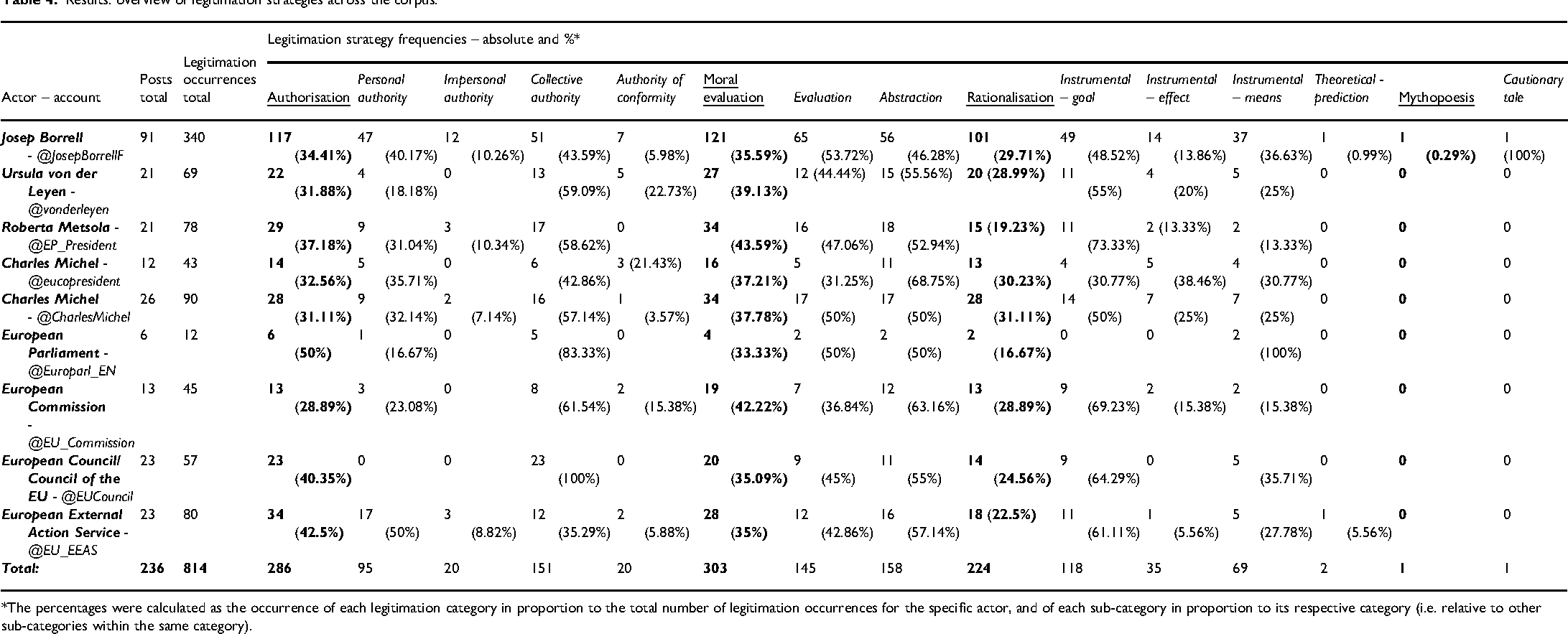
*The percentages were calculated as the occurrence of each legitimation category in proportion to the total number of legitimation occurrences for the specific actor, and of each sub-category in proportion to its respective category (i.e. relative to other sub-categories within the same category).
As Figure 1 illustrates, EU actors legitimised military aid to Ukraine primarily through moral evaluation, which accounted for 37% of all occurrences. Authorisation followed with 35%, while rationalisation made up 28%. Mythopoesis was virtually absent, appearing only once – a scarcity likely linked to the structural constraints of X, whose character limit ‘disallows the communication of detailed and sophisticated messages’ and instead favours concise formulations (Ott, 2017: 60–61).

Occurrences of legitimation strategies – sum of all actors.
At the actor level, the distribution of legitimation strategies was relatively balanced across accounts (Figure 2). Even the European Parliament, which relied most heavily on authorisation (50% of its legitimation occurrences), still employed rationalisation in roughly one-sixth of its posts. Overall, however, all actors consistently drew on the three main legitimation strategies, indicating a broadly coherent discursive repertoire across EU channels.

The frequency of main legitimation strategies by actor (as % of all legitimation occurrences of the actor).
The following analysis examines the three principal legitimation strategies – authorisation, moral evaluation, rationalisation – in depth, tracing their distribution across actors and their discursive realisations. Given the marginal presence of mythopoesis, this category is excluded. We use concrete textual examples from the dataset to provide illustrations of the identified discursive features, yet refrain from listing every single instance, so as to avoid overburdening the analysis with repetitive references.
Moral evaluation
Within the most prevalent strategy – moral evaluation – two sub-categories, evaluation and abstraction, appeared in roughly equal measure (Figure 3). Yet, certain variations emerged: Charles Michel (@EUCOPresident) and the European Commission displayed a strong preference for invoking overarching moral concepts, while Josep Borrell alone favoured explicit evaluative language.

Moral evaluation – frequency of sub-categories by actor (as % of all moral evaluation category occurrences of the actor).
A central feature of the moral evaluation sub-category was the appeal to urgency. Across all accounts, military aid was described with necessity-oriented adjectives such as ‘vital’, ‘urgent’ or ‘necessary’, thereby constructing a sense of time pressure and immediate obligation, as in ‘The EU defence industry is key to getting #Ukraine urgent military supplies’ (@CharlesMichel, 11.3.2024 1 ). Urgency was further discursively intensified through Borrell's deployment of emphatic and modalised formulations, as in ‘we must do more, and we must do it faster’ (7.2.2024) or ‘it is a matter of life and death’ (27.2.2022), which implied that inaction would entail catastrophic consequences. In other instances, the aid was described as being provided at ‘a critical moment’ and at ‘a crucial stage of the war’, further eliciting a feeling of a necessity to act.
Another salient aspect was the highly positive appraisal of Ukraine, its citizens, and their actions. Ukrainians were consistently attributed with virtuous qualities such as ‘brave’, ‘heroic’ and ‘courageous’, as in ‘We must speed up our military assistance to the brave Ukrainian people’ (@CharlesMichel, 19.3.2024) or ‘Ukraine's brave soldiers are safeguarding their land, their people, and their democratic values’ (European Commission, 8.9.2023). Often, this evaluative discourse employed affiliative terms such as ‘friends’ and ‘partners’ to express proximity and alignment with Ukraine.
In contrast, references to Russia were uniformly negative. A recurrent theme was aggression, with Russia depicted ‘an aggressor’ and ‘a danger’, and its actions described through strongly negative evaluative adjectives such as ‘aggressive’, ‘brutal’, ‘ruthless’, ‘barbaric’ and ‘atrocious’. These emotionally charged expressions served to articulate a moral judgement over Russia's actions and simultaneously their rejection, thereby ‘assigning it [Russia] a further inferior status in the international community’ (Gürkan, 2024b: 313).
Notably, positive depictions of Ukraine and negative portrayals of Russia often appeared in tandem, reinforcing a binary ‘us’ versus ‘them’ construction, as in ‘Ukraine is heroically resisting the brutal Russian invader’ (von der Leyen, 3.5.2023). Such juxtaposition positioned the EU discursively within Ukraine's moral in-group, whose actions are represented as rational and just (Reyes, 2011: 788).
The abstraction sub-category was expressed primarily through references to solidarity with Ukraine. Across accounts, military aid was consistently legitimised as a moral duty, articulated not only through normative nouns such as ‘solidarity’ and ‘support’, but also through the recurring ‘Stand with Ukraine’ slogan, which functioned as a unifying discursive marker across all actors. This phrase appeared either within the text – ‘The EU stands with Ukraine. Today and tomorrow’ (European Parliament, 5.7.2023) – or, more frequently, as a hashtag, as in ‘€12 billion in military support #StandWithUkraine’ (EUCO, 24.2.2023).
Another common form of abstraction framed military aid as a commitment undertaken by the EU. With the exception of the EUCO and the EP, all actors expressed this stance via nouns such as ‘promise’ and ‘commitment’, as in ‘We are taking a key step towards delivering on our promises to provide #Ukraine with more artillery ammunition’ (Borrell, 20.3.2023). This form of abstraction was particularly salient in Borrell's discourse, where long-term dedication was stressed through future-oriented modals ‘will’ or ‘must’ (as in ‘The EU has stood by Ukraine since day one & we will continue to do so’ [Borrell, 24.2.2024]) and reinforced by intensely evaluative adjectives such as ‘unwavering’, ‘firm’ or ‘unshakeable’ (as in ‘Our shared commitment remains unshakeable’ [Borrell, 2.10.2023]). Another hallmark of this messaging was the pervasive pledge to support Ukraine ‘for as long as it takes’ (as in ‘We have stood by Ukraine since day one. We will keep it up for as long as it takes’. [@CharlesMichel, 19.5.2023]), which discursively cast military support as EU's non-negotiable effort that will persist until the war ends.
Finally, with the exception of the EUCO and the EP, all actors occasionally situated military aid within a broader framework of European values such as democracy, peace and freedom. Roberta Metsola particularly stood out for consistently grounding her justifications in such principles. The specific values invoked also varied: Ursula von der Leyen stressed ‘freedom’ (‘The EU reaffirm their commitment to Ukraine's freedom, security and sovereignty’ [11.7.2024]); the EEAS highlighted ‘peace’ (‘You have to win the war and to win the peace’ [8.2.2024]); whereas Josep Borrell and Charles Michel resorted to the more general ‘our values’ (‘Ukraine's victory will be the victory of our common values’ [Borrell, 2.2.2023]). Through this lens, the provision of military aid was also discursively constructed as a form of self-defence, with Ukraine being implicitly recognised as a ‘proxy defender’ of the EU's core values (Johansson-Nogués and Leso, 2025: 135). These discursive choices also foster a sense of shared identity between the EU and Ukraine, and, therefore, a sense of moral responsibility towards supporting the country (cf. Heck, 2025: 63).
Authorisation
The second most frequent category, authorisation, relied heavily on appeals to collective authority across all actors (Figure 4). Such appeals serve to present decisions as broadly endorsed and thus endowed with greater legitimacy (Hansson and Page, 2023: 368). This was followed by invoking personal authority, authority of conformity and impersonal authority. By contrast, expert, role model and tradition authority justifications were completely absent in the discourse.

Authorisation – frequency of sub-categories by actor (as % of all authorisation category occurrences of the actor).
Collective authority was predominantly articulated through appeals to the will of the member states or the EU as a whole. These justifications served to aggregate the EU into one cohesive actor, presenting military aid as the outcome of consensus. Lexically, this strategy drew on collective labels such as ‘member states’ and ‘the EU’, as well as inclusive pronouns such as ‘we’ and ‘our’ (‘We are stepping up our support for Ukraine’ [von der Leyen, 27.2.2022]). Collective authority was further reinforced through references to the positions of specific EU bodies, most frequently the EU institutions and, in some instances, their formations (e.g. the FAC) or their members (e.g. foreign affairs ministers). These were typically coupled with verbs of deliberation (‘agree on’, ‘decide’, ‘call for’) or nouns denoting institutional outcomes (‘political agreement’, ‘decision’). Notably, the EP and the EUCO relied heavily on this strategy, reporting almost exclusively on deliberations and formal decisions adopted by EU ministers and MEPs.
Personal authority functioned as a secondary yet significant legitimation tool, manifesting in three distinct patterns. First, only Josep Borrell, Charles Michel and Roberta Metsola referred to Ukrainian representatives, employing interactional verbs such as ‘discussed’ or ‘spoke to’, and nouns such as ‘call’ or ‘meeting’, thereby framing military aid as the outcome of consultation rather than a unilateral EU initiative. As Reyes (2011: 786) notes, such framing strengthens legitimacy by signalling that decisions were carefully evaluated rather than taken hastily. Second, with the exception of the EUCO, institutional accounts frequently appealed to the authority of their own leaders – whether directly (‘The most important way of acting is providing air defence batteries & ammunition’, said HR/VP @JosepBorrellF [EEAS, 22.4.2024]) or indirectly (‘HRVP @JosepBorrellF proposed a three-way approach, which includes purchasing ammunition jointly’ [EEAS, 15.3.2023]). Finally, personal authority was only sporadically enacted through explicit self-reference, a practice largely confined to Borrell's communicative repertoire. Here, the pronoun ‘I’ was recurrently coupled with performative verbs such as ‘present [a proposal]’, ‘propose’, or ‘support’ (‘I have proposed a €5bn/year Ukraine Assistance Fund’ [Borrell, 30.8.2023]), thereby directly asserting his individual agency in the decision-making process.
Authority of conformity emerged when EU actions were discursively aligned with broader international efforts. It was enacted through emphasis on collaboration, particularly with NATO, G7, or partner states such as the Unites States. Most accounts, except for those of Metsola, the EP, and the EUCO, highlighted this co-ordination, employing lexical markers of co-ordination, such as ‘together’, ‘united’ and ‘co-ordinated’ to depict military aid as part of a wider international response. The strategy also surfaced in appeals to the ‘will of the people’ (cf. Hansson and Page, 2023). In some instances, the European Commission explicitly invoked opinion polls to legitimise the military aid: ‘Two-thirds of Europeans (67%) approve that the EU finances the purchase and supply of military equipment to Ukraine’ (15.6.2022).
Impersonal authority was the least common and operated through (implicitly) invoking principles of international law. Here, the discourse framed support chiefly as upholding Ukraine's right to self-defence, as in ‘We are supporting Ukraine's right to defend itself’ (Borrell, 18.7.2023). The actors, however, did not refer to any specific document or regulation from which this principle derives and instead employed general formulations. Occasionally, they also subtly appealed to humanitarian law, as in ‘Strong resolution following war-crimes in Ukraine: delivery of weapons to be stepped up’ (Metsola, 7.4.2022). The discourse here operated mainly through appeals to accountability, as in ‘We support accountability for this and other Russian war crimes’ (Borrell, 9.8.2024), framing the provision of military aid as a necessary action in response to Russian war crimes perpetrated against Ukraine.
Rationalisation
As Figure 5 shows, within the rationalisation category, instrumental rationalisation overwhelmingly prevailed, while theoretical appeals to ‘the facts of life’ (Van Leeuwen and Wodak, 1999: 105) appeared only twice in the corpus. Most actors justified military aid by stressing its goals, with means and effects treated as secondary. Two exceptions stood out: the European Parliament focused entirely on means, while Charles Michel (EUCO President account) foregrounded effects, giving goals and means roughly equal weight.

Rationalisation – frequency of sub-categories by actor (as % of all rationalisation category occurrences of the actor).
The most frequent sub-strategy was the goal-oriented rationalisation. Goals were articulated either through explicit purpose clauses (‘to’, ‘for’, ‘in order to’) (Van Leeuwen, 2007: 102), or through more ambiguous formulations that nevertheless conveyed the purposive logic of military aid and were thus coded under this sub-category.
The most salient goals were supporting Ukraine's defence against Russia and securing its victory. With the exception of Roberta Metsola, who relied exclusively on value-based messaging, all actors repeatedly used ‘defence’ or ‘to defend’, as in Borrell's ‘We have provided EUR12 billion of military support to Ukraine. To defend itself’ (14.2.2023). At times, this purpose was communicated indirectly by juxtaposing Russian aggression with a promise of support or call to action (as in ‘Horrifying to see Russia strike one of the main stations used by civilians evacuating the region where Russia is stepping up its attack. Action is needed: more weapons to #Ukraine are underway’ [@eucopresident, 8.4.2022]). Alongside defence, actors stressed Ukraine's ‘victory’, expressed through triumphalist verbs such as ‘win’ or ‘prevail’, as in ‘Ukraine needs first to win the war. We have to increase our military support to Ukraine’ (Borrell, 17.2.2023). In fewer instances, this was framed as Russia's defeat (‘We must make sure that Putin will be defeated […] We must support Ukraine's resistance as much as possible’ [@eucopresident, 23.3.2022]). Von der Leyen, the EC and Borrell also depicted the support as intended to counter Russia in a broader sense, without necessarily focusing on its defence function (‘We continue to maintain pressure on Russia’ [von der Leyen, 24.11.2023]).
A further set of goals, though less frequent, concerned strengthening European security and safeguarding values. Here, actors implied that by supporting Ukraine militarily, the EU also aimed to render Europe as a whole more secure, as in ‘We could use windfall profits of frozen Russian assets to purchase military equipment for Ukraine. There is no better symbol or use for that money than to make Ukraine & all of Europe a safer place to live’ (von der Leyen, 20.3.2024). References to values appeared chiefly in Metsola's discourse, where they were invoked explicitly (‘to defend peace and democracy’) or more generally (‘for our shared values’).
Means-oriented rationalisation operated chiefly through references to concrete policy measures and their practical utility. The EPF featured most prominently as the central instrument for co-ordinating military support, invoked by all actors. These legitimations were highly context-specific, tied to measures under discussion or implementation at the moment of posting. Actors often named them explicitly, as in ‘We will sustain our transfers to the Ukrainian armed forces with the support of the European Peace Facility’ (EEAS, 16.11.2022), while in other cases they employed more generic labels such as ‘proposals’, ‘decisions’ or ‘agreements’, specifying their practical function (e.g. ‘Proud of the swift agreement between @Europarl_EN and @EUCouncil to boost the production of ammunition with €500 million’ [Metsola, 7.7.2023]). A notable finding is that references to means invariably co-occurred with authorisation: actors emphasised institutional procedures not only to indicate who had adopted a measure but also what it concretely entailed.
Effect-oriented rationalisation appeared exclusively in the form of positive claims, predominantly future-oriented, given the ongoing war. The most frequent effect was Ukraine's anticipated victory, articulated through the modal certainty of ‘will’ (as in ‘Ukraine will prevail’ [European Commission, 23.8.2024]), expressing certainty regarding the positive effect of military support. Military aid was also framed as essential for European security, an essential prerequisite for peace, exemplified by ‘We must make sure that Putin will be defeated – it's a question of security for the future of Europe’ (@eucopresident, 23.3.2022). Past effects were rare and voiced mainly by Charles Michel, who retrospectively linked EU support to demonstrations of European capability, as in ‘European power was on display within hours of the military aggression against Ukraine’ (@eucopresident, 28.2.2022) or ‘Our Defence Union was born in the hours after Russian tanks rolled over the Ukrainian border’ (@CharlesMichel, 30.11.2023). Here, military aid was discursively constructed not only as assistance to Ukraine but also as a strategic advance in the EU's own defence capacity.
Discussion and conclusion
This article has shown that the EU's official institutional discourse about military assistance to Ukraine was marked by a high degree of consistency. Across institutions and representatives, three strategies dominated: moral evaluation, authorisation and rationalisation. Taken together, this reliance on similar repertoires points to a clear attempt to ‘speak with one voice’ and rhetorically project the EU as a co-ordinated actor with a uniform stance on the war. In this respect, the discourse counters earlier concerns about incoherence in EU foreign policy communication (e.g. Krzyżanowski, 2021; Zaiotti, 2024) and aligns with broader assessments of its unified and well-co-ordinated response to the Russian aggression (e.g. Bosse, 2022; Johansson-Nogués and Leso, 2025).
Yet, this discursive coherence did not result from uniformity. Our analysis shows instead a division of rhetorical labour. The key EU institutions (European Commission, EP, EUCO) chiefly underlined unity and collective decision-making. EEAS and Josep Borrell focused on stressing urgency and longevity of the measures, with Borrell, as the most active actor, frequently highlighting his own role in shaping policy responses. Charles Michel (both accounts) also adopted a strategically oriented messaging but placed a stronger emphasis on the EUCO's authority and the collective stance of European leaders. Metsola's discourse contrasted with this by drawing more heavily on values, foregrounding the EU's normative role. Von der Leyen frequently combined these approaches, linking practical arguments for military support with appeals to European values. Rather than undermining coherence, these nuances proved complementary, reinforcing different dimensions of the same overarching narrative of solidarity and committed action. This layered discursive construction illustrates how coherence in EU external communication can be achieved through complementarity rather than identical messaging. Notably, such coherence is significant not only internally but also externally, as it strengthens the EU's resilience against foreign interference, which thrives on exploiting inconsistencies in institutional communication (Stivachtis, 2023).
Another striking finding is the degree of moralisation. Military assistance was consistently framed as a moral duty, expressed through urgency, solidarity, and appeals to shared values. Ukraine was depicted as brave and virtuous, Russia as brutal and aggressive, producing clear in-group/out-group binaries that positioned the EU alongside Ukraine in a joint ethical community. Such reliance on moral evaluation confirms the EU's image as a normative power (Niţoiu, 2013; Gürkan, 2024a).
Equally significant is the finding that the EU's discourse was highly self-referential. Legitimation drew overwhelmingly on the EU's own institutional authority, whether collective or personal, with only marginal reliance on external actors. Even when invoked, these references served to underline co-ordination with the EU rather than dependence on it. This rhetorical pattern suggests that the EU was not merely acting together but was discursively constructing itself as a sovereign and strong actor in security and defence (cf. Biegoń, 2016). In this sense, the discursive evidence complements political analyses of the EU's shift from a strictly civilian actor towards strengthening its hard power (Raik et al., 2024), showing how this transformation was narrated and justified in official institutional communication.
Finally, our findings carry implications beyond the Ukraine case. By developing and deploying a discursive repertoire that legitimises military measures, the EU has, in effect, created a toolkit for justifying war-related actions. If the taboo against military means has been broken in both language and practice, similar strategies may be mobilised in future crises, potentially consolidating the EU's emerging geopolitical role. What began as an exceptional response to Russia's war may thus mark the beginning of a broader discursive shift – one in which the EU's authority, values and identity are increasingly anchored in its capacity to act militarily.
Our study is not without limitations, and these delimitations should be kept in mind when interpreting the findings. First, the analysis focuses exclusively on X, which, while highly relevant as a site of EU strategic communication, captures only one segment of the Union's broader communicative ecosystem. The discursive patterns identified here therefore cannot be assumed to exhaust how the EU legitimises military assistance across other venues. Second, the platform-specific affordances of X – above all brevity, immediacy and a preference for compressed and slogan-like formulations – likely shape the form and visibility of particular legitimation strategies, while constraining others, such as more elaborate narrative or mythopoetic constructions. Third, the study is confined to official institutional and elite accounts and therefore does not address how these legitimising messages are received, contested or recontextualised by broader publics, journalists or counter-discursive actors. Finally, while the combination of qualitative content analysis and CDA allows us to identify recurrent patterns and their discursive functioning, it is less suited to tracing the visual, interactive and longitudinal dynamics through which legitimacy may also be produced and transformed in digital communication.
At the same time, these limitations open up several promising avenues for further research. Future studies could broaden the empirical scope beyond X by comparing legitimation across other platforms, institutional speeches, press releases, parliamentary debates or audiovisual outputs, thereby yielding a more comprehensive account of EU discourse. They could also examine the multimodal dimensions of legitimation, including images, videos, layout and platform-specific semiotic cues, in order to assess how legitimacy is constructed not only through text but through the interplay of verbal and visual elements. A further step could be to investigate reception and contestation, for instance by analysing audience responses, media uptake, or the appropriation of EU narratives by hostile or supportive actors. Finally, future work could explore how distinct legitimation strategies cluster over time into more durable discursive formations.
Supplemental Material
sj-docx-1-ejc-10.1177_02673231261444597 - Supplemental material for Legitimising the unprecedented: An in-depth analysis of the EU institutional discourse on the military aid to Ukraine
Supplemental material, sj-docx-1-ejc-10.1177_02673231261444597 for Legitimising the unprecedented: An in-depth analysis of the EU institutional discourse on the military aid to Ukraine by Simona Škríbová and Monika Brusenbauch Meislová in European Journal of Communication
Footnotes
Funding
The authors disclosed receipt of the following financial support for the research, authorship, and/or publication of this article: This work was supported by the European Regional Development Fund project ‘Foreign Interference in the Context of Geopolitical and Technological Change’ (grant number CZ.02.01.01/00/23_025/0008692).
Declaration of conflicting interests
The authors declared no potential conflicts of interest with respect to the research, authorship, and/or publication of this article.

Supplemental material
Supplemental material for this article is available online.
Notes
References
Supplementary Material
Please find the following supplemental material available below.
For Open Access articles published under a Creative Commons License, all supplemental material carries the same license as the article it is associated with.
For non-Open Access articles published, all supplemental material carries a non-exclusive license, and permission requests for re-use of supplemental material or any part of supplemental material shall be sent directly to the copyright owner as specified in the copyright notice associated with the article.
