




Abstract
This study analyzes the factors influencing public support for economic sanctions in the Bucharest Nine (B9) states in the context of the war in Ukraine (2022) and the measures taken by the European Union (EU) against Russia. Operating data from the Flash Eurobarometer 506 (2022) survey, this work assesses the influence of public awareness, trust in the sender alliance, emotional resonance, solidarity with the aggressed state, and targeted sanctions on public opinion across these nine EU member states. Multiple regression analyses demonstrate that a multifaceted approach, incorporating various dimensions, yields a more comprehensive understanding of public support for economic sanctions. The findings of this study emphasize that the most significant factors driving public support include sanctions imposed on Russian oligarchs, closer military cooperation within the EU, and military equipment provided to Ukraine. It can be concluded that the findings of this study reveal that the citizens of B9 countries have a pragmatic rather than an emotional approach when referring to both the conflict in Ukraine and the imposition of sanctions against Russia.
Plain Language Summary
This study analysed the factors influencing public support for economic sanctions in the Bucharest Nine (B9) countries in the context of the war in Ukraine and the measures taken by the European Union (EU) against Russia. It tested five hypotheses related to public awareness, trust in the issuing state, emotional resonance, solidarity with the aggressed state, and preference for targeted sanctions. Linear regression models were applied to analyse the data and concluded that all five tested hypotheses were validated. The study’s results highlight the significance of factors such as public awareness, trust in the issuing state, emotional resonance, solidarity with the aggressed state, and preference for targeted sanctions in shaping public support for economic sanctions. Implications of this study include providing cherished evidence to policymakers, international relations and foreign policy practitioners. Understanding the factors that determine public support for sanctions can help develop and implement effective communication and action strategies. It can be concluded that the findings of this study reveal that the citizens of B9 countries have a pragmatic rather than an emotional approach when referring to both the conflict in Ukraine and the imposition of sanctions against Russia.
Introduction
Economic sanctions (ES) are one of the most frequently used tools in international relations to achieve foreign policy objectives. They are seen as a more peaceful and less destructive way to pressure countries to change their behavior. These economic sanctions are part of the hard power tools (Wilson, 2008, p. 114) that a state or a coalition of states uses against another state to change its attitude in international relations (Allen, 2008). Sometimes sanctions are labeled as “war by other means” (Blackwill & Harris, 2016).
The Russian invasion of Ukraine (February 24, 2022) highlighted the issue of public support for the economic sanctions system as a tool for shaping a state’s behavior in the international system. Imposing economic sanctions as a form of coercive diplomacy has become a relatively common practice in recent decades. One can see a certain tendency on the part of the European Union (EU) to use sanctions as a form of countering specific potentially threatening actions by other states (Giumelli, 2017, p. 1063).
However, the effectiveness of ES in achieving the proposed objectives has become a subject of debate in the international policy literature. Two significant currents can be identified in this debate. Firstly, some scholars argue that ES can be a successful policy tool for states or coalitions of states (Heine-Ellison, 2001; Hultman & Peksen, 2017; van Bergeijk, 1989). On the other hand, other researchers believe that ES are ineffective and even counter-productive (Allen, 2008; Drezner, 2000; Pape, 1997).
Starting from the fact of the invasion of Ukraine by Russia, this study analyzes the public support within the states of the Bucharest Nine Format (B9) for the sanctions that the EU applied to Russia as a form of support for Ukraine. The research was not organized as an individual case study of the nine states but to identify the factors that determine public support for ES in the case of a group of states that, until 1990 to 1991, were part of the Warsaw Treaty Organization (WTO), and are currently member states of NATO and the EU.
Background
On February 24, 2022, the Russian Federation began invading the territory of Ukraine through an operation that Vladimir Putin called a “special military operation” (Mardones, 2023). Defined by part of the international community as aggression against international peace and security (Cavandoli & Wilson, 2022), this invasion was the critical determinant of the revival of some international alliances that were in a dormant or decaying state (Chachko & Linos, 2022, p. 124). In this sense, the EU and NATO faced redefining their international agenda by assuming roles they had never played.
The Russian invasion of Ukraine marks a turning point in recent European history. After more than eight decades, it is for the first time that a European power starts a war of occupation of another sovereign state on the continent. The invasion of Ukraine in 2022 represents the highest point of existing tensions between the two states, which have escalated since 2014 when the Russian Federation occupied and then annexed Crimea.
This war can be analyzed through a Marxist perspective, highlighting that imperialism was essential in triggering the conflict (Kotz, 2023). Such an argument could find evidence in the evolution of socio-economic relations in post-Soviet Russia, the tortuous relationship between Russia and Ukraine, and even the logic of geopolitical competition with the USA. Equally, some analysts consider this a proxy conflict in which the US attempted to undermine the hegemonic power profile that the Russian Federation had been striving to project over the past two decades (Beal, 2023).
Seen from the perspective of Europe, the war in Ukraine reveals the inability of the EU to be a security provider for both member states and Europeans (Della Sala, 2023). On the foreign policy level, the EU manifested itself as a normative actor and not an actor capable of carrying out coercive actions. For this reason, the EU’s response to the Russian invasion of 2022 showed the regulatory capacity that this organization exhibits but is associated with the lack of strengthening of its capabilities (Freudlsperger & Schimmelfennig, 2023). On the other hand, the closing of the borders with Russia and the opening of the borders with Ukraine shows that the war did not significantly affect the configuration of the internal border of the EU nor its border control capacity (Freudlsperger & Schimmelfennig, 2023). Moreover, the war led the EU to revive the enlargement process, similar to the reaction after the Balkan wars of the 1990s (Anghel & Džankić, 2023). However, the hesitations in this response and the avoidance of presenting a timetable for Ukraine’s possible accession did not indicate a preferred EU work agenda but rather a security-enhancing mechanism. Under the impetus of some significant actors (such as the United States, the United Kingdom, and France), most member states agreed to readjust the agenda and the actions of the two international organizations. NATO decided to activate its defensive plans on the eastern flank of the organization (Kunertova & Masuhr, 2022, p. 2), thus coming in response to older requests from the states of the B9 format. At the same time, NATO adopted a policy of logistical support and defensive military equipment to aid Ukraine’s effort to defend itself. As far as the EU is concerned, it has, for the first time, exceeded the previously self-imposed limits of acting only through ES and humanitarian support. In the context of the war in Ukraine, the EU supplemented the economic sanctions imposed on Russia with support from military equipment delivered to Ukraine (Steiner et al., 2023). It was the first time that the EU decided to provide military equipment for a state in conflict (De la Baume & Barigazzi, 2022).
Table 1 presents the five packages of measures taken by the EU within the regime of international sanctions imposed on Russia. It can be observed that the EU uses targeted sanctions. In this sense, there are four distinct target categories for these sanctions: (1) against government authorities; (2) against wealthy businessmen (oligarchs); (3) against specific sectors of the economy and (4) against state-sponsored media institutions. These measures complement the financial and military-logistical support that EU member states give Ukraine to resist Russian aggression.
The Sanctions Packages Imposed on Russia by the European Union (February–April 2022).

Note. 1 = authorities; 2 = oligarchs; 3 = specific sectors; 4 = mass media.
However, beyond geopolitics, public support for ES is an essential determinant of the success of these coercive measures. Examining public support for ES is critical because the level of support influences the effects of these sanctions unexpectedly. The population of the sanctioned state may react in a way that undermines its effectiveness. For example, sanctions can cause an increase in the feeling of nationalism, manifesting itself in support of the state’s leadership (Alexseev & Hale, 2020). This is a reaction known as the “rallying effect,” where the public rallies around their leaders in the face of an external threat.
On the other hand, in the sending states, the public might be affected by the consequences of sanctions or possible countersanctions from the sanctioned state. In the face of economic and financial difficulties, the population will express dissatisfaction with their leaders’ foreign policy. If the sanctions lead to the escalation of the conflict or have failed to change the behavior of the sanctioned state, then the public questions the effectiveness of such coercive measures in the foreign policy of their state.
In this context, this study aims to observe what factors determine, among EU citizens, public support for these ES against Russia. This analysis considered the states that make up the B9 format. The geographical proximity to the conflict zone and the historical experience with Russia are two fundamental reasons to analyze this group concerning supporting ES.
Bucharest Nine Format
B9 is a political-military initiative that includes the member states from the eastern flank of NATO: Bulgaria, the Czech Republic, Estonia, Hungary, Latvia, Lithuania, Poland, Romania, and Slovakia. These nine states were, before 1991, part of the Warsaw Treaty Organization (WTO) controlled by the Soviet Union. In the years following the dismemberment of the Soviet Union, these states applied to join NATO in search of a collective defense system that would offer them security guarantees.
Created in 2015, at the initiative of Poland and Romania, in response to the crisis in Ukraine caused by the annexation of Crimea by the Russian Federation (2014), the member states of this format generally supported the ES against Russia. They demanded increased cooperation with Western countries in response to Russian aggression (Tangör & Sari, 2021).
The literature is still early in analyzing the B9 subject. In general, several aspects are highlighted: (a) the cultivation of dialogue and cooperation between the B9 member states (Calmels, 2019; Jankowski & Stępniewski, 2021; Moskalewicz & Przybylski, 2018; Orzelska-Stączek, 2020); (b) strengthening regional defense capabilities (Pawłowski, 2020); (c) addressing divergent national interests and threat perceptions between member states (Gerasymchuk, 2019; Vaida, 2022); (d) encouraging strategic initiatives such as the establishment of “enhances Forward Presence” (eFP) and “tailored Forward Presence” (tFP; Pawłowski, 2020).
Some authors consider that B9 Format was essential even for encouraging solidarity in Central and Eastern Europe (Moskalewicz & Przybylski, 2018; Orzelska-Stączek, 2020). In the same sense, some scholars emphasize the importance of the B9 in the context of Polish and Ukrainian security concepts (Wojtaszak, 2022). The need to adapt approaches to traditional security concerns to the changing geopolitical dynamics on NATO’s eastern borders, as well as non-traditional threats, such as cyber-attacks, hybrid warfare, and disinformation campaigns (Stępniewski, 2022; Turchyn & Ivasechko, 2022).
However, the literature needed to deepen the analysis of how public support is manifested in the countries of the B9 Format toward the war in Ukraine and the ES imposed on Russia by the European Union.
The ES against Russia represent the first test for the B9 states to position themselves against the actor who, after the Second World War, created and imposed its collective defense system over Central and Eastern Europe for almost four decades.
The Flash Eurobarometer 506 survey (FEB-506) shows, in general, high public support among the citizens of the B9 states. However, specific differences between states can be identified on an individualized analysis of the survey results (see Table 2). This study aims to observe the predictors that determine these public attitudes toward sanctions so that decision-makers can effectively shape their communication.
Distribution of the Answers of Citizens From B9 States to the Question: “Please Tell Me If You Approve Them or Not. Economic Sanctions Against Russia” (European Commission, 2022).

For this reason, this study aims to observe how specific dimensions become explanatory models for the attitude of the citizens of the B9 states toward the five packages of sanctions imposed by the EU in the first weeks after the outbreak of the war in Ukraine.
The research question of this study is:
RQ: What factors influence the attitudes and perceptions of the B9 member states toward the war in Ukraine and the EU’s response to it?
Next, this study will present the main analysis dimensions of the ES in the literature. Based on these dimensions, this work will formulate the five research hypotheses highlighting the main predictors that can be analyzed in further research on the evolution of the B9.
International Sanctions and Their Effectiveness
International ES are the manifestation of geopolitics, as they are part of a set of seven instruments suitable for specific balance of power games: (1) trade power, (2) investment policy, (3) economic and financial sanctions, (4) cyber, (5) economic assistance, (6) financial and monetary policy, and (7) national policies governing energy and commodities (Blackwill & Harris, 2016).
There are three significant directions of argumentation regarding ES: (a) the effectiveness of these coercive instruments; (b) their ineffectiveness as a foreign policy approach; (c) potential negative effects on sender alliance.
Regarding the effectiveness of the sanctions, various studies have found that ES can positively affect public opinion in the receiver state, especially when they are perceived as a response to the state’s aggression (Frye, 2019; Grossman et al., 2018; Ngo et al., 2022). The impact of ES on public opinion may also depend on media openness and repression (Peksen, 2010), the domestic political costs of sanctions (Allen, 2008), and the reciprocity and structural determinants of the international sanctions network (Cranmer et al., 2014).
Regarding the second line of argument previously mentioned, literature has debated whether the ES effectively accomplishes foreign policy objectives. In this regard, several lines of argument can be observed. First, the literature emphasizes the importance of the receiver country’s domestic political context in determining ES’s effectiveness (McGillivray & Stam, 2004). For instance, because authoritarian governments have fewer channels for public criticism than democracies, they may be less vulnerable to economic sanctions. In these instances, public opinion can pressure the government to modify its behavior through sanctions. Second, recent studies indicate that sanctions rarely achieve their intended objectives, regardless of public opinion in the targeted nation (Hultman & Peksen, 2017; Pape, 1997; Peksen, 2019). These studies show that ES may be ineffective if the targeted state has access to alternative markets (van Bergeijk, 2021). This view suggests that sanctions frequently fail to exert sufficient pressure on governments to alter their behavior and may have unintended consequences, such as increased conflict intensity or decreased media openness (Hultman & Peksen, 2017; Peksen, 2010). In her response to Pape’s (1997) study, Elliott (1998) offers a more optimistic perspective on the results attained through ES. She argues, based on literature derived from empirical studies, that the ES effectiveness should not be evaluated in isolation but as a complementary instrument of pressure to military force (Elliott, 1998, p. 51).
Finally, beyond the ES ineffectiveness, some authors highlight their potential unintended negative effects on the sender states or alliance: the ideological support, the economic resilience, or social support (Alexseev & Hale, 2020; Bělín & Hanousek, 2021; Crozet & Hinz, 2016; Giumelli, 2017; Hedberg, 2018). Despite their intentions to impose political or behavioral changes in target states, ES can have unintended adverse effects on sending states or their alliances. One of these involuntary effects is increased ideological support for the targeted regimes (Alexseev & Hale, 2020). Instead of eroding public support for the target state’s leaders, sanctions can strengthen it, a political backfire phenomenon seen in the 2014 sanctions against Russia.
On the other hand, the literature has highlighted that implementing sanctions can negatively impact the sending states’ economic resilience. Sanctions may lead to counter-sanctions by the originally sanctioned state. However, this exchange of sanctions also results in significant economic losses for the states that initiated them. Studies on the food embargo imposed by Russia after 2014 in response to Western sanctions and the trade balance of Western states have precisely emphasized this negative impact (Crozet & Hinz, 2016; Hedberg, 2018).
Finally, some analyses have looked at how public support in sending states can be affected, especially if sanctions are ineffective or have negative economic repercussions. Consequences can range from public dissatisfaction with the deterioration of relations with target states to economic pressures the population feels following a decrease in trade (Bělín & Hanousek, 2021).
This study considers the following five dimensions to explain the public attitude toward ES in sender states: public awareness, trust in the sender state (alliance), emotional resonance, moral support for the aggressed state, and preference for targeted sanctions.
Public Awareness
In recent years, various studies have analyzed the relationship between public awareness and support for ES. Institutional factors and the role of citizens’ perceptions of threats from the sanctioned state have been discussed to understand the enforcement mechanism and success of economic sanctions (Hufbauer et al., 2007; Lektzian & Peterson, 2007). However, this research needs to specifically address the relationship between public awareness in sender states and support for ES.
This study considered that when the public is better informed and aware of actions deemed dangerous or unacceptable by Russia, they may be more inclined to support ES against that country.
H1: The level of public awareness determines the degree of public support for economic sanctions against Russia.
Trust in the Sender State (Alliance)
A particular dimension in the literature on ES analyzes the level of trust citizens give to the state or the alliance of states that impose sanctions. Hufbauer et al. (2007) present one of the most comprehensive studies on ES. The authors analyze over 200 cases of ES imposed between 1914 and 2000, evaluating their success according to the political objectives pursued. They found that ES were effective in about one-third of cases. The ES effectiveness is influenced by factors such as their scope and intensity, the extent to which the target of the sanctions is internationally isolated, and international support for the sanctions. These authors suggest that citizens’ confidence in the ES’s effectiveness can be influenced by the perception that these measures can impact the receiver country and bring about desired political changes.
However, Pape (1997) offers a different perspective on ES effectiveness. The author argues that ES are generally ineffective, having limited success in achieving political objectives. He considers that citizens’ confidence in the ES’s effectiveness is often unwarranted, as these measures can lead to human suffering in targeted countries without significantly impacting the desired political changes.
These two studies highlight different arguments regarding ES effectiveness, suggesting that citizens’ trust in the actors imposing these measures may be influenced by their perceptions of the sanctions’ success in achieving policy goals. These studies also indicate that publicly available information and how the media and political leaders present it can play an essential role in shaping citizens’ trust in the ES effectiveness and the actors imposing them.
This article intends to identify the extent of trust that the citizens of the B9 states have toward the EU concerning the regime of ES imposed on Russia after February 24, 2022. As a result, the research hypothesis is:
H2: B9 Citizens’ trust in the actions taken by the EU in the context of the war in Ukraine is a determining factor of public support for ES.
Emotional Resonance
Another significant factor affecting public support for international ES is emotional resonance. Beauregard (2022) used the case of transatlantic ES against Russia to examine the role of emotional resonance in shaping public opinion. The study found that emotional resonance was a critical factor in the decision-making process of transatlantic policymakers, and emotional appeals helped increase public support for ES.
Emotional resonance is the connection between two actors created through shared cultural, historical, or political ties. When a state perceives a threat from another state, the emotional resonance can lead to ES, even if they can also affect the state that imposes them. This theory complements rational choice theory which explains why states might use ES even if they do not provide immediate economic benefits. Beauregard (2022) emphasizes that “international emotional resonance is thus when actors from different states independently and synchronously feel similar emotions in reaction to the same situation because it reactivates emotional beliefs” (Beauregard, 2022, p. 4).
In the case of ES against Russia after the annexation of Crimea (2014), Beauregard (2022) analyzed 571 “public statements from heads of states and foreign ministries.” Instead, this study attempts to provide a new perspective of emotional resonance analysis using data collected immediately after the outbreak of the war through the FEB-506 among citizens of EU states. Considering only the B9 member states, this article aims to analyze how citizens of the nine former WTO states assess the reactions of various actors to the outbreak of the war in Ukraine.
The hypothesis of this study is that:
H3: Emotional resonance explains public support for the ES imposed on Russia in the case of the states in the B9 format.
Solidarity With the Aggressed State
Starting from the premise that humanitarian solidarity and support for the aggressed state can motivate the population to support ES, this study aims to analyze to what extent these factors define public support for ES in the context of the war in Ukraine. Although the existing literature has examined the effectiveness and impact of these measures on targeted states, few studies have focused on the factors that determine public support for sanctions and the role of solidarity in this process (Lektzian & Peterson, 2007; Wood, 2008). This article intends to contribute to the existing literature by exploring the link between solidarity with the aggressed state and public support for ES.
H4: Humanitarian solidarity and support for the aggressed state influence public support for ES against the aggressor state.
Targeted (Smart) Sanctions
Finally, the literature also distinguishes between comprehensive sanctions (non-discriminatory, affecting the entire country and its population) and targeted sanctions (“discriminating policy measures”). The latter is focused on specific individuals, entities, sectors, or regions in a country (Biersteker et al., 2016, p. 13).
Biersteker et al. (2016) examined the effectiveness of United Nations targeted sanctions and found that the success of these sanctions largely depends on their ability to distinguish between the government and the population of the sanctioned country. Targeted sanctions are designed to minimize the negative impact on the civilian population and focus on the entities and individuals responsible for the actions that led to the imposition of the sanctions. Their results suggest that citizens of countries that impose sanctions may be more inclined to support such measures if a clear distinction can be made between the government and the population.
Despite their apparent ineffectiveness, Drezner (2000) argues that sanctions are a popular foreign policy tool. The author suggests that when citizens perceive sanctions as directed against the government and not the population, they may be more willing to support using this foreign policy tool.
The hypothesis of this study is that:
H5: The population of B9 states prefers targeted sanctions to change Russia’s behavior.
These five dimensions have been built on the context of the war in Ukraine, measuring the public attitude of the citizens from the nine states which, before their NATO membership, were encapsulated, for more than three decades, in a Soviet-controlled defense system. The five hypotheses correspond to one of the following models of ES approach by the population: emotional and pragmatic. Thus, H1 and H3 correspond to the emotional approach since public awareness is based on a non-rational impulse (i.e., perception). In contrast, the emotional resonance within H3 is based on the population’s perception of how they reacted to various actors toward the invasion of Ukraine.
Research Design
Dataset
To explore the five hypotheses presented previously, this study considered the Flash Eurobarometer 506 (FEB-506) conducted by the European Commission. This survey is based on a methodology carefully tested and developed over the past decades. It has become a widely used data source in academic research precisely because of its accuracy.
FEB-506 was conducted, between April 13 and April 20, 2022, by Ipsos European Public Affairs on behalf of the European Commission. The FEB-506 aimed to assess the EU’s response to the war in Ukraine, focusing on the perceptions of EU citizens aged 15 and over in each of the 27 member states. A total of 26,066 interviews were conducted across the EU using Computer Assisted Web Interviewing (CAWI) via Ipsos online panels and their network of partners. Respondents were selected from online access panels, with pre-recruited groups of individuals who agreed to participate in the research. Sampling quotas were set by age, sex, and geographic region (NUTS1, NUTS2, or NUTS3, depending on the size of the country and the number of NUTS regions) to ensure a representative sample of each country’s population (European Commission, 2022).
This article restricted the analysis to the states of the B9 Format: Bulgaria, the Czech Republic, Estonia, Hungary, Latvia, Lithuania, Poland, Romania, and Slovakia. The total number of interviews was 9,130 (see Table 2).
This paper analyzes selected data from the GESIS archived FEB-506 dataset hosted by the Leibniz Institute for the Social Sciences. The questionnaire can be downloaded via the GESIS platform (European Commission, 2022).
Operationalization of the Variables
Since this study aims to identify the significant predictors of B9 public support for the ES, 27 items were selected from FEB-506 and distributed to the five dimensions discussed in the previous section. Supplemental Appendix 1 provides the deployment of these variables.
Dependent Variable
This paper defined the item Q4_1 from FEB-506 as the dependent variable. It satisfies all semantic, form, and content requirements for illustrating public support for the EU’s decision to impose five packages of sanctions on Russia.
Q4_1 For each of the following measures that have been announced by the EU to respond to the war in Ukraine, please tell me if you approve of them or not. Economic sanctions against Russia
Considering the five dimensions that this study investigates, the other 26 items selected from the FEB-506 were organized as follows:
Public awareness. From the set of FEB-506 questionnaire items, those assessing the level of concern about the war in Ukraine (Q3_11), the level of trust in the news about the war provided by national authorities (Q5_1), the European Union (Q5_2), non-governmental organizations (Q5_3), journalists (Q5_4), and social media (Q5_5) were selected. All these items depict the interest of the citizens in the Ukrainian situation and the potential impact that various news sources have on their attitude.
Trust in the sender state (alliance). Seven items were selected to illustrate the trust that the citizens of the B9 states have in the EU in the context of the war in Ukraine and the sanctions packages that this organization sent to Russia. These items test the public satisfaction with the way the EU reacted to the war (Q2_2), perception of EU unity (Q3_1), appreciation of the EU’s speed of response (Q3_2), appreciation of solidarity with Ukraine (Q3_3), acceptance of the need for closer military cooperation militaries within the EU (Q3_4), increased sense of belonging to the EU (Q3_5), trust in war news provided by European authorities (Q5_2). These items are focused on the EU’s actions regarding the war and measure the extent to which citizens trust the EU’s commitment, effectiveness, and communication in addressing the crisis in Ukraine.
Emotional resonance. Based on the concern about the war in Ukraine, the satisfaction expressed toward the reaction of various actors provides the picture of the emotional resonance of the citizens of the B9 states. Thus, the items selected for the analysis of this dimension are those that refer to the satisfaction with the reaction to the war by the national authorities (Q2_1), EU (Q2_2), NATO (Q2_3), UN (Q2_4), and USA (Q2_5).
Solidarity with the aggressed state. This dimension of solidarity toward Ukraine is revealed by the answers summed up by the following six items: the feeling of sympathy toward Ukraine (Q3_6), the acceptance of Ukraine as part of the European family (Q3_7), the acceptance of financial support for Ukraine (Q4_3), the offering of military equipment (Q4_4), humanitarian support (Q4_5), reception of refugees in the EU (Q4_7).
Targeted (smart) sanctions. The rational aspect of the attitude of the citizens of the B9 states toward the way sanctions against Russia should be applied is shown by the answers to the following four items in FEB-506: considering the leadership of Russia as responsible for the war (Q3_9), making a distinction between the leadership of Russia and the Russian people (Q3_10), supporting the sanctions imposed on Russian oligarchs (Q4_2), as well as the ban on Russian state-sponsored media broadcasting in the EU (Q4_6).
Analytical Approach
To answer the research question, this study follows two stages of analysis. In the first phase, B9 is approached as a unitary group to identify the predictors that significantly impact forging citizens’ public support toward ES. Considering the many shared historical, political, and geopolitical features, as well as the joint statements assumed by the leaders of these states in the B9 meetings, such an approach is justified to observe the level of distinction of this group from the general attitude of EU citizens toward ES. In the second stage, whether the predictors identified at level B9 are also found in the individual cases of each component state is checked.
Initially, following the pattern of synthesizing responses used in the Eurobarometer reports (see Table 3), the dependent variable was treated as a binary variable. Accordingly, it was approached through a Binary Logistic Regression (BLR; hereafter Model 1).
Binary Classification of Selected FEB-506 Items.
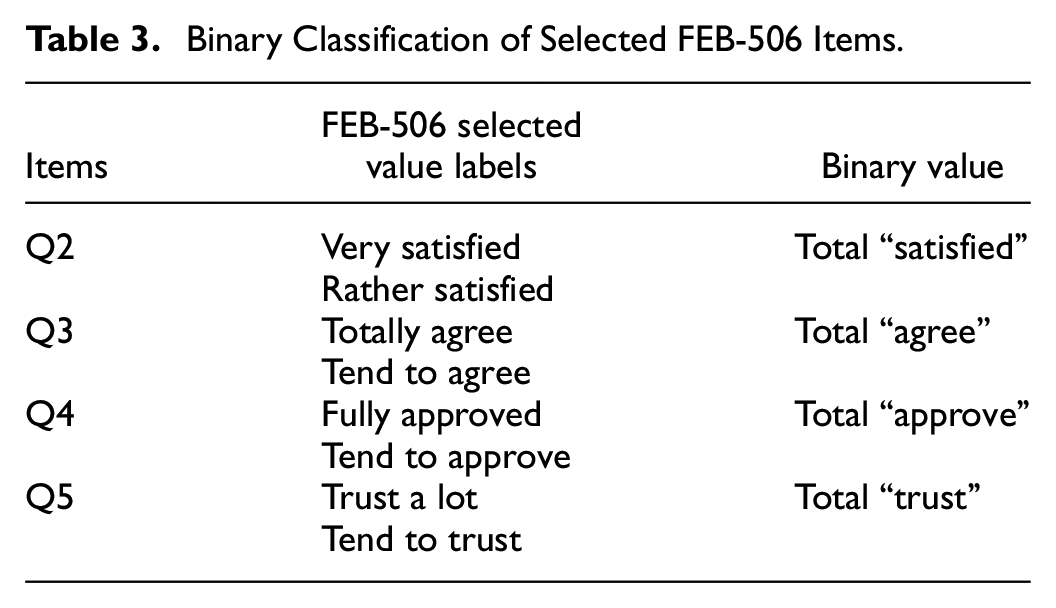
This study chose logistic regression on a binary variable as a preliminary model (Model 1) to obtain provisional results about the predictors of the dependent variable. Despite its general directions, the binary approach gives us a relatively simplistic view of how citizens relate to the various issues associated with their attitude toward ES.
For this reason, this study also opted for formulating an alternative regression model (hereafter Model 2), which is the Ordinal Logistic Regression (OLR). The OLR model provided a more nuanced understanding of the relationships between the variables. In this case, the dependent variable was treated as an ordinal variable. This model considers the inherent ordering in the response categories of the dependent variable, thus providing a more accurate representation of the data.
Relating Models 1 and 2 allowed us to test the research hypotheses robustly (Supplemental Appendix 2 contains the regression formulas.). It provided a comprehensive view of the factors influencing public support for ES against Russia. The results from these analyses are presented and discussed in the next section.
Regarding completing the second stage of the analysis to check the predictors for each state of B9, only Model 2 was used. This choice is based on the intention to identify the nuances of the levels of acceptance of economic sanctions in each of the nine analyzed countries. Therefore, it will be possible to see if the general predictors identified at the B9 level are also confirmed in the individualized analysis of the B9 Member States.
Finally, a correlation coefficient analysis was applied. The Pearson correlation coefficient is a statistical measure for evaluating the degree of association between two continuous variables. This coefficient is appropriate in political and social research to examine the relationships between variables and to identify possible correlations between them (Henshaw & Meinke, 2018). By calculating the Pearson correlation coefficient, variables that show significant correlations with each other can be identified, and this information can be considered in the interpretation of ordinal logistic regression results.
Results
Table 4 presents the two regression models’ results. The objective of this approach is to determine whether the study’s hypotheses can be substantiated through the examination of these models. Both models included all 26 independent variables that can indicate public support for ES grouped based on the previously stated research hypotheses.
Public Support for Economic Sanctions in B9 Format.

Note. Coefficients and standard errors in parentheses are provided for each variable. The significance levels are demarcated as: *p < .05. **p < .01. ***p < .001. Model fit and diagnostics are displayed at the bottom, including the adjusted R2, log-likelihood, Akaike Information Criterion (AIC), and Bayesian Information Criterion (BIC). The dataset originates from the European Commission (2022).
The first analysis shows that Model 1 fits better for the data when we choose the dichotomization of the citizens’ response options. However, Model 2 provides a detailed insight into the attitudinal nuances of the respondents. The results presented below were obtained after analyzing the data using Model 1 and Model 2.
The relationships between these variables and support for sanctions differ depending on the nature of the dependent variable (binary vs. ordinal) and the regression model used. However, it can be observed that a set of independent variables are statistically significant in both Models: (1) news about the war from NGOs; (2) news about the war from journalists; (3) closer military cooperation in the EU; (4) UN’s reaction to the war; (5) USA’s reaction to the war; (6) Ukraine as part of the EU family; (7) financial support for Ukraine; (8) military equipment; (9) humanitarian support; (10) responsibility of Russia’s leadership; (11) sanctions imposed on Russian oligarchs; (12) banning state-owned Russian media broadcasting in the EU. At the same time, several variables have no statistical significance in any of the models: (1) news about the war from national authorities; (2) EU reaction to the war; (3) perception of EU unity; (4) the EU’s speed of response; (5) EU reaction to the war; (6) NATO’s reaction to the war.
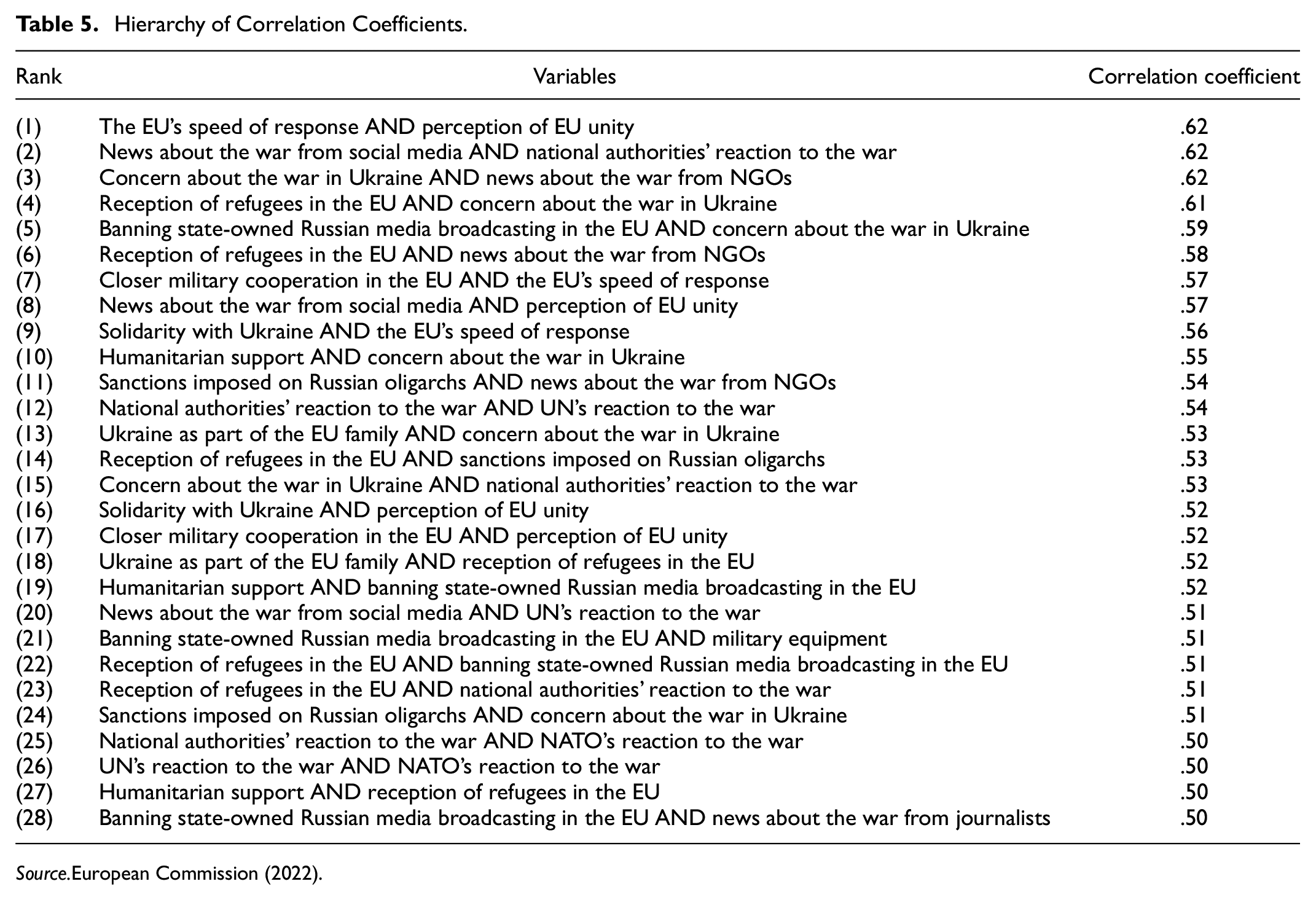
The bivariate correlation (Pearson) results (Supplemental Appendix 3) reveal some important aspects. Table 5 presents a hierarchy of correlation coefficients. The strong correlations (.60–.62) suggest that there is a significant relationship between (a) EU reaction speed and perception of EU unity; (b) war news from social media and national authorities’ reaction to the war and (c) concern about the war in Ukraine and war news from NGOs. This result highlights the crucial role of social media in communicating government actions and shaping public perceptions.
Hierarchy of Correlation Coefficients.
Source. European Commission (2022).
In summary, the hierarchy of correlations highlights several significant relationships between different aspects of the war in Ukraine and reactions at the international level. The results underline the importance of unity and cooperation within the EU, the active involvement of international actors such as the UN and NATO, and the crucial role of information sources such as the media and NGOs in shaping public perceptions and disseminating information about developments in the conflict. These correlations also reveal that the EU and its member states are addressing the war in Ukraine through political, military, and humanitarian measures, reflecting a multifaceted and coordinated approach to this complex and long-lasting crisis. In the second stage of the analysis, we checked to what extent the predictors defined for group B9 were also confirmed in the case of each member state. Supplemental Appendix 4 shows the coefficients obtained by each state. These results indicate a robust statistical significance for the variables in hypotheses H4 and H5.
Looking at each state individually, in the case of Bulgaria and Estonia, the predictors of H1 have statistically significant coefficients, whereas in the other states, these coefficients are insignificant.
Regarding the predictors of H2, it is found that they are devoid of statistical significance in almost all states, except for some states in which certain predictors are significant: Poland (2 out of 6), Bulgaria (1 in 6), Estonia (1 in 6), and Latvia (1 in 6).
Hypothesis H3 presents a reduced statistical power in the B9 group. In the case of the Czech Republic and Romania, no predictor is significant. In the case of the other states, only one or two significant predictors out of the five make up this research hypothesis.
The situation improves for H4 and H5, where most predictors have statistical significance. The exceptions are Hungary and Lithuania, which, in the case of H4, have only two significant predictors out of the six that make up this hypothesis.
In general, it is found that the predictors identified at level B9 are confirmed in the individual case of the states, with the exceptions of Bulgaria and Estonia (H1, H2), Poland and Latvia (H2), the Czech Republic and Romania (H3), Hungary and Lithuania (H4).
Furthermore, the results of Model 2 must also be accompanied by descriptive statistics of the percentages developed by FEB-506 for each variable (see Figures 1–5 in Supplement Appendix 5).
Figure 1 provides an overview of the percentages obtained by the most common answers given by citizens to each question by country. Thus, the darker colors indicate high approval, satisfaction, and agreement, respectively, trust that the citizens declared within each of the 27 questions. On the other hand, lighter colors reflect a low level of approval, satisfaction, and agreement, respectively, and trust declared on the same items.

Heatmap of the most common response percentage for each variable and country.
Additionally, Table 6 illustrates the differences in approach to the variables in the case of each country, based on the percentages provided by FEB-506. Only four themes can be noted on which the citizens of the B9 states agree with more than 75%. It is about: (a) concern about the war in Ukraine, (b) solidarity with Ukraine, (c) humanitarian support, and (d) reception of refugees in the EU. Otherwise, all other items show different attitudes and perceptions of the citizens of the B9 states regarding the war in Ukraine.
Attitudes and Perceptions of the Citizens of the Bucharest Nine States Toward the War in Ukraine.

Note. The markings in the shape of circles (•) illustrate the concentration of favorable responses for each subject and country. Thus, “••••” represents a percentage between 75% and 100%, whereas “•○○○” corresponds to a percentage under 25%.Source. European Commission (2022).
Figures 1 to 5 (Supplemental Appendix 5) show how the citizens’ options of the B9 states are distributed in percentage for the items that constitute the image of each of the five dimensions. Thus, in the case of Public Awareness (H1), one can observe a significant tendency not to trust the information about the war in Ukraine transmitted through social media channels. Conversely, trust in the news from the EU authorities is significantly higher at the B9 level, but Bulgaria has the highest percentage of distrust (55%) in this source of information. An analysis of the percentages presented by the items describing the Trust in Sender State/Alliance dimension (H2) shows strong solidarity with Ukraine (76%), and openness to closer military cooperation within the EU (72%) but moderate satisfaction with the way the EU reacted to the war (47%) and the speed of response (54%), and a similar degree of moderation is also observed regarding the perception of European unity (55%) and the sense of belonging closer to the EU (50%). However, citizens of some of the B9 states are more skeptical of EU military cooperation (Bulgaria 54%) but also have a weaker sense of belonging to the EU (Bulgaria 31%; Hungary 36%).
Regarding the Emotional Resonance (H3) dimension, at level B9, citizens show moderate satisfaction with the reaction of the national authorities (56%), NATO (49%), the USA (49%), the UN (38%), and the EU (47%). The fourth and fifth dimensions (H4 and H5) indicate a strengthening of public support for sanctions. From the perspective of the percentages revealed by FEB-506, the humanitarian dimension (93%), reception of refugees (95%), and sympathy for Ukraine (85%) are the strongest predictors of public support. Instead, the pragmatic aspect is revealed again when citizens are questioned about the approval of financial support (77%), military support (64%), or the opportunity to consider Ukraine part of the EU family (69%). The item on the imposition of economic sanctions against Russian oligarchs has a substantial and statistically significant coefficient in most of the B9 states; what differs is the percentage of approval (91% in the case of Poland and 58% in the case of Bulgaria). Likewise, regarding the item on providing support to Ukraine through the delivery of military equipment, it has a strong coefficient with high statistical significance in determining support for ES in most countries. However, the sense of influence differs among the B9 states: 87% of Estonians approve of this military support, while 48% of Hungarians disapprove.
Discussions
Within this study’s dichotomy, B9 state residents predominantly favor a pragmatic view on the ES policy toward Russia and aid to Ukraine. The emotional approach (represented by H1 and H3) has a weak power to influence the public support that the citizens of B9 states give to ES. Instead, this public support is built on pragmatic considerations, found in the items that make up H4 and H5. At the same time, the predictors within the H2 do not have the necessary statistical power to influence the support given to ES.
Considering the hypotheses of this research, the findings lead to several insights about the public support for ES.
First, for the sending state or alliance to gain the support of its population, it is necessary to give adequate importance to constant and accurate information. The first step in gaining public support is to crystallize public awareness of the danger. Then, a critical step is to convince citizens that ES is a necessary temporary sacrifice for indefinite well-being. The findings of this study indicate a negative relationship between support for ES and information through social media. This result can be interpreted in several ways. First, social media channels may convey information or opinions that minimize the seriousness of the war in Ukraine. Second, people informed mainly through social media may have a different perception of the war, as these platforms may facilitate the formation of “echo chambers” (Cinelli et al., 2021, p. 1) and the polarization of opinions. It is also worth noting that when national identity is activated, individuals seek news that confirms their prejudices, leading to affective polarization (Wojcieszak & Garrett, 2018). For example, this can be seen in the case of Bulgaria. 55% of Bulgarian citizens do not trust news from the EU about the war, which means that this information instead reinforces disapproval of the ES imposed on Russia. In this situation, an in-depth analysis of the level of Euroskepticism within Bulgarian society can better clarify this nuance. These findings validate hypothesis H1. For this reason, both national and EU decision-makers should pay more attention to how they communicate with the public decisions on the imposition of ES. At the same time, more attention should be paid to social networks in communication with the public to increase the impact of their message and effectively counter disinformation and the polarization of public opinion.
Second, trust in the sender state/alliance (H2) has relatively little impact on the formation of public support for ES. In general, the coefficients for B9 are relatively small and close to zero, suggesting that, at the group level, there is no strong correlation between trust in the EU and the listed perceptions. However, a significant positive correlation is observed between the desire for closer military cooperation in the EU and trust in the EU, as well as a significant negative correlation with the sense of belonging to the EU. This approach is rather one of the geopolitical and geostrategic opportunities that the citizens of the B9 states intuitively manifest. In this case, the history of these states with Russia plays an important role. How they managed to manage the various geopolitical tensions also impacts how they consider effective in approaching the current situation. For this reason, the strengthening of military cooperation within the EU and the manifestation of the sense of belonging to the EU are significant predictors in defining public support for ES.
On the other hand, the shared experience of the B9 states and Ukraine in the relationship with Russia determines a particular emotional resonance (H3) and, implicitly, a certain degree of expectation on the part of international actors who could provide security guarantees in Central and Eastern Europe. The responses of national authorities, the EU, NATO, and the US to the war do not significantly impact emotional resonance at the B9 level. However, the UN reaction shows a significant negative correlation, while the US reaction has a significant positive correlation. The B9 public is skeptical of reactions from national bodies, the EU, NATO, the UN, and the US to the war. In this case, how the official reaction of states and international organizations is formulated may have an essential role in further defining the support for the sanctions imposed on the aggressor state. The findings of this study show that in researching public support for ES, attention should also be paid to the degree of satisfaction of citizens toward a specific conflict situation. Against high expectations and prejudices regarding international politics, citizens judge differently the reactions of the organizations their states are a part of. Emotional resonance is an argument for understanding citizens’ level of trust in the sender alliance.
Fourth, one can observe a pragmatic approach of the citizens of the B9 states regarding the manifestation of solidarity toward the aggressed state. At the B9 level, there are significant positive correlations between sympathy, considering Ukraine as part of the EU family, financial support, military equipment, humanitarian support, and solidarity with Ukraine. It suggests a strong sympathy and willingness to support Ukraine among the population of the B9 countries. Again, corroboration of the coefficients provided by Model 2 and the percentages shown by FEB-506 helps to nuance the observations. The fact that, for example, the variable regarding the provision of military equipment to Ukraine obtained a strong coefficient and statistical significance in all B9 states does not necessarily mean that these states support the provision of this military support. Instead, it shows us that this theme concerns societies in the B9 states and impacts how public support for imposing ES is formulated. For example, there are states where citizens disapprove of this type of support offered to Ukraine (Bulgaria 63%, Hungary 48%, Slovakia 50%).
On the other hand, the item on humanitarian support has a relatively significant coefficient at the B9 level and a high percentage in all member states. The lowest coefficient is recorded by the item regarding the reception of war refugees, even if within FEB-506, it registers high percentages in all states. Overall, these findings show disinterest in humanitarian support and the issue of receiving refugees in the EU. However, these results must be understood in the context in which citizens perceive that international organizations are better equipped to effectively manage the issue of refugees and humanitarian problems (Thielemann & Schade, 2016). Instead, the findings of this study reveal the importance of the themes of financial support and support with military equipment as a form of solidarity toward the aggressed state.
Finally, on the same note as the pragmatic approach, this study’s findings highlighted the citizens’ ability of the B9 states to distinguish between the culpability of the Russian authorities and the Russian people. The individualized study of the B9 states will have to consider the people’s attitude toward the Russian leadership’s responsibility for the war in Ukraine and the targeted sanctioning of the Russian oligarchs. Also, the prohibition of state-owned Russian media broadcasting in the EU is a topic that has the necessary significance to explain the level of approval of ES against Russia.
In the case of a global analysis of the five dimensions, it can be found that certain variables become stronger predictors in explaining the attitude of the citizens of the B9 states toward sanctions.
Conclusions, Implications, and Limitations
This study analyzed the Flash Eurobarometer 506 conducted by the European Commission to identify which factors influence the attitudes and perceptions of the citizens from B9 states toward the war in Ukraine and the EU’s response to it. This paper ran two logistic regression models (binary and ordinal) to check to what extent the public attitude toward ES can be explained by the five dimensions initially defined: public awareness, trust in the sender state (alliance), emotional resonance, moral support for the aggressed state, and preference for targeted sanctions. This article provides some major findings that may contribute to the literature on international ES.
First, in order to be able to obtain solid public support among the population of the sending (alliance) states for the imposition of ES, the authorities must give additional interest to constant and accurate communication to counter disinformation. Official communication should be tailored to each nation’s informational landscape and biases to mitigate emotional divisiveness.
Second, the level of trust of the population in the sender (alliance) states is determined by the degree of satisfaction with the way and speed in which the conflict situation was reacted to, strengthening the sense of unity and belonging to the alliance in this context. The B9 states are more open to closer military cooperation within the EU, given the context of the conflict in Ukraine.
Third, in the context of sanctions imposed on Russia due to its invasion of Ukraine, emotional resonance is not a strong determinant of public support in the B9 states. However, this may instead be an effect of the contrast between the expectations citizens had from the international organizations of which their states are a part (UN, NATO, EU) and how they perceived the reactions of these actors in the period immediately following the outbreak of the war. For this reason, how national authorities and international organizations communicate can shape public attitudes toward sanctions imposed on an aggressor state.
Fourthly, solidarity with the aggressed state is manifested instead on a humanitarian level and by showing sympathy toward the cause of Ukraine. However, when trying to introduce geostrategic initiatives to support Ukraine, the citizens from B9 states no longer present the same unity of perspective. States remain divided regarding Ukraine’s membership in the EU family or the provision of military equipment. This pragmatism stems from individual state factors: how various communities perceive the danger, the history of bilateral relations with Russia or Ukraine, or how people intuitively define the costs of such initiatives. The same motivations underlie the preference for targeted sanctions and the distinction between Russia’s leadership and the Russian people, imposing sanctions on Russian oligarchs and banning state-owned Russian media broadcasting in the EU.
The novelty of this study consists of analyzing the opinion of the citizens of the B9 states regarding the sanctions packages imposed on Russia by the EU in the first weeks after the invasion of Ukraine. The need for such a research approach was determined by two primary factors: geographical proximity to the conflict zone and the shared experience of the nine states as former members of WTO and currently as members of NATO. What this paper brings new to the international sanctions literature is the consideration of public support for ES by the population of the sending state or alliance, but by investigating additional dimensions such as public awareness, trust in the sending state (alliance), emotional resonance, solidarity with the aggressed state, preference for targeted sanctions. All these dimensions achieved statistical significance, and two of them (i.e., solidarity with the aggressed state and preference for targeted sanctions) were reconfirmed by the integrated analysis.
This study’s limitations are related to the data size that Eurobarometer-type surveys carry. In the analysis, two logistic regression models were applied: binary and ordinal. Although these methods are powerful tools in socio-economic research, they have limitations. Furthermore, logistic regression suggests associations between variables but does not establish causal relationships with certainty. There is also the possibility of omitting crucial variables or introducing redundant variables, influencing the quality of the model. In addition, these regression models may only sometimes fully describe the complexity of social and economic phenomena. In this article, the logistic regression approach aimed to identify the predictors that determine the nature of public support for ES and not to explain the causes of the differences between the B9 states. However, future research will need to address the cross-sectional nature of the data and the specificity of the Ukrainian war context. The approach to the dimensions that define public support for ES will need to be verified in a longitudinal and comparative framework to examine how public support for ES evolves when the reciprocal effects of sanctions are felt at the economic and societal levels. A dimension that needs to be studied in the context of the war in Ukraine is the ethical dimension of ES, as observed in the analysis trend in the ES literature (Amstutz, 2013; Gordon, 2011).
Supplemental Material
sj-docx-1-sgo-10.1177_21582440241268319 – Supplemental material for Beyond Geopolitics: Unraveling Public Support for Economic Sanctions in the B9 States at the Beginning of the Ukrainian War (2022)
Supplemental material, sj-docx-1-sgo-10.1177_21582440241268319 for Beyond Geopolitics: Unraveling Public Support for Economic Sanctions in the B9 States at the Beginning of the Ukrainian War (2022) by Mihai Alexandrescu in SAGE Open
Supplemental Material
sj-xlsx-2-sgo-10.1177_21582440241268319 – Supplemental material for Beyond Geopolitics: Unraveling Public Support for Economic Sanctions in the B9 States at the Beginning of the Ukrainian War (2022)
Supplemental material, sj-xlsx-2-sgo-10.1177_21582440241268319 for Beyond Geopolitics: Unraveling Public Support for Economic Sanctions in the B9 States at the Beginning of the Ukrainian War (2022) by Mihai Alexandrescu in SAGE Open
Supplemental Material
sj-xlsx-3-sgo-10.1177_21582440241268319 – Supplemental material for Beyond Geopolitics: Unraveling Public Support for Economic Sanctions in the B9 States at the Beginning of the Ukrainian War (2022)
Supplemental material, sj-xlsx-3-sgo-10.1177_21582440241268319 for Beyond Geopolitics: Unraveling Public Support for Economic Sanctions in the B9 States at the Beginning of the Ukrainian War (2022) by Mihai Alexandrescu in SAGE Open
Footnotes
Acknowledgements
The author would like to thank the anonymous reviewers, as well as Paul Popa for their helpful comments on the earlier version of the manuscript.
Declaration of Conflicting Interests
The author declared no potential conflicts of interest with respect to the research, authorship, and/or publication of this article.
Funding
The author received no financial support for the research, authorship, and/or publication of this article.
Ethical Approval
Not applicable.

Data Availability Statement
Data sharing not applicable to this article as no datasets were generated or analyzed during the current study.
Supplemental Material
Supplemental material for this article is available online.
References
Supplementary Material
Please find the following supplemental material available below.
For Open Access articles published under a Creative Commons License, all supplemental material carries the same license as the article it is associated with.
For non-Open Access articles published, all supplemental material carries a non-exclusive license, and permission requests for re-use of supplemental material or any part of supplemental material shall be sent directly to the copyright owner as specified in the copyright notice associated with the article.
