




Abstract
Research on opinion leadership has gained new relevance in the digital age, where information is increasingly curated by networks, algorithms, and individual preferences rather than traditional journalism. While opinion leadership has been used to characterize individuals engaged in specific issues, mainly political communication, it is also crucial to apply this concept to scientific contexts due to the societal prominence of science. Although scientific information differs from opinion or news, its prominence supports this application and raises questions about how much science opinion leaders trust science or believe in conspiracies. This study addresses this by examining science opinion leadership using data from an online survey in Germany (n = 2435). We confirm the relationship between science opinion leadership, interest, perceived knowledge, and media use for receiving and disseminating information. Additionally, trust in science and disapproval of conspiracies and populist media were less pronounced and more varied than expected.
Introduction
The research on the concept of opinion leadership has been reignited by digitized, high-choice media environments (Jungnickel, 2018; Mangold and Bachl, 2018; Park, 2019; Powell, 2022; Strömbäck et al., 2023), as the information found in these environments is based more on social, algorithmic, and personal curating than on journalistic curating (Strömbäck et al., 2023). The advent of social media, along with the reduction of barriers to generating public content, has paved the way for new actors capable of capturing public attention (Harff and Schmuck, 2024). Thus, the relevance of individuals who spread their opinions among their networks has increased.
The concept of (political) opinion leadership has long been used to identify and characterize those persons who are particularly active and articulate about an issue (Lazarsfeld et al., 1968: 34–35). Opinion leaders are introduced as individuals who often talk to others about specific issues, share information, and attempt to influence others’ ways of thinking and behaving, thereby seeking to persuade them to adopt their viewpoints (Katz, 1957: 77; see also Jungnickel, 2018; Mangold and Bachl, 2018; Schäfer and Taddicken, 2015).
Traditionally, the concept of opinion leadership has been closely associated with political issues discussed in the news and public spheres. However, the nature of scientific information—grounded in evidence rather than opinion or news—raises questions about whether the concept on the dissemination of (accurate or inaccurate) information can be effectively applied to science-related communication. Unlike in political realms, where opinions often dominate, science prioritizes evidence, and information is predominantly communicated by experts. Furthermore, scientific advancements do not occur on a daily basis; instead, they rely on methods refined over many years. As a result, scientific findings and expertise are far less dynamic compared to the rapid changes observed in political news. This distinction raises doubts about the applicability of the concept of ‘science opinion leadership’. Despite this, we argue that opinion leadership remains relevant for science issues, as they are typically complex, multifaceted, and contested (Schäfer and Taddicken, 2015), and of significant relevance for individuals and society. Modern scientific debates increasingly blur the line between science and its political, moral, and legal impacts (Scheufele, 2014). The context of opinion leadership has fundamentally changed in digitized communication environment, particularly relevant to science-related information (Zhang and Lu, 2023). In the ‘social conversation’ about science (Bucchi and Trench, 2021), the distinction between public and non-public communication of science has become blurred. Circular processes of individual and societal appropriation and engagement with scientific evidence occur in digitized communication environments, leading to converging epistemic roles (Neuberger et al., 2023) and increasing public contributions to the societal discourse on science, notably on social media (Taddicken and Krämer, 2021). This underscores the importance of investigating the concept of scientific opinion leadership.
Therefore, the aim of this study is to explore this by applying traditional theoretical questions of opinion leadership to the field of science. We use an online representative survey with n = 2435 to test our assumptions about the established theoretical framework and associated questions to scrutinize the role of opinion leaders in the domain of science.
The established concept of opinion leadership
The foundation of opinion leadership lies in the idea that public communication occurs in different steps, assigning specific communicative roles to different actors, with some providing information or guidance, while others seek it. The original concept of the ‘two-step flow’ traces back to the panel study conducted by Lazarsfeld et al. (1944), which was revolutionary at the time. This study examined the evolution of individual voting decisions across seven survey waves during the 1940 presidential elections in the United States, comparing the influence of individual, interpersonal, and mass media factors. Lazarsfeld et al. (1944) identified a distinctive ‘two-step’ diffusion process: At the first step, information on the election campaign was primarily received by a minority of politically engaged and knowledgeable ‘opinion leaders’ (Lazarsfeld et al., 1944: 49), described as those ‘who are most concerned about the issue as well as most articulate about it’ (Lazarsfeld et al., 1944: 49). At the second step, political information was spread from these opinion leaders to less engaged individuals, referred to as ‘opinion followers’ (Lazarsfeld et al., 1944: 49). Opinion leaders are proposed as politically interested, engaged, well-informed, and trusted sources of information within their social network (Turcotte et al., 2015).
As research on opinion leadership has progressed, the concept was refined. It was suggested that opinion leaders have to share a similar social position with those they influenced (Hamilton, 1971). Lazarsfeld et al. (1968: 38) also discussed the increasing homogeneity within the social groups of the opinion leaders. Deutschmann and Danielson (1960) criticized that opinion leaders merely disseminate supplementary information; Troldahl and van Dam (1965) argued that opinion leaders can change roles depending on the situation and become opinion followers themselves. Opinion leaders were moreover found to have stronger personalities (Schenk and Rössler, 1997; Weimann, 1991), and maintain diverse contacts with frequent discussions within their social networks (Katz, 1957; Katz and Lazarsfeld, 1955).
Various methods were developed and implemented to enhance the operationalization and identification of opinion leaders. The self-assessment method, introduced in Lazarsfeld et al.’s (1944) original study, had been refined in numerous subsequent studies. These measures typically revolve around the concept that opinion leaders exhibit greater issue-related interest than their followers, possess more knowledge about the issue, and tend to rely more frequently on mass media for information (Childers, 1986; Myers and Robertson, 1972; Troldahl and van Dam, 1965).
Opinion leadership and social media use
Opinion leaders convey media information through interpersonal communication (Deutschmann and Danielson, 1960), guide their followers to use specific media content, and shape their perceptions (Weimann and Brosius, 1994). The online environment, especially social media, offers numerous avenues for engagement, ranging from information retrieval and consumption to active participation through actions such as liking and sharing content and content creation. Here, opinion leaders facilitated by platforms such as blogs, Instagram, and X can efficiently provide advice and orientation in this context (Mangold and Bachl, 2018; Park, 2019; Schäfer and Taddicken, 2015). They are found to engage in public discourse by sharing the information they have received from the media and also incorporating their own evaluations (Harff and Schmuck, 2024; Park, 2013; Turcotte et al., 2015; Vraga et al., 2015). Against this background, the online environment may gain increased importance of opinion leadership where people need to and are encouraged to select content according to their needs and preferences (Harff and Schmuck, 2024). This can empower opinion leaders to exert a growing influence in online settings (Podschuweit and Geise, 2024), particularly in social media (Schäfer and Taddicken, 2015; Weeks et al., 2015).
Not least because of the empowerment of users (i.e. laypeople) instead of scientific experts, the online environment is seen as a ‘disinformation order’ (Bennett and Livingston, 2018), suggesting a deep epistemic crisis caused by digital media technologies (Neuberger et al., 2023). The spread of mis- and disinformation is the biggest challenge to the epistemic integrity of democracy (Dahlgren, 2018; Lewandowsky et al., 2023). It is crucial to deepen our understanding of why some users believe themselves to be eligible to spread information on scientific issues, along with their interpretations and opinions, and why they are believed to be eligible.
The concept of opinion leadership in the domain of science
Research on opinion leadership has mainly been conducted in the field of political communication, as in the original study by Lazarsfeld et al. (1944). Opinion leadership is issue- or domain-specific (Gnambs, 2019; Gnambs and Batinic, 2011; Nisbet and Kotcher, 2009; Schäfer and Taddicken, 2015). In the domain of political communication, opinion leaders are individuals who express a keen interest in politics, engage in discussions about political matters, frequently share information about political issues with others, and endeavor to persuade them to adopt their own political perspectives (Jungnickel, 2018; Katz, 1957; Mangold and Bachl, 2018; Turcotte et al., 2015). Basically, opinion leadership is relevant in the domain of multifaceted, highly complex, and contested issues (Schäfer and Taddicken, 2015). Here, well-informed and willing information sources are required to shape individual opinions and guide decision-making processes. There is a significant demand for so-called science influencers (Galetti and Costa-Pereira, 2017; Looi and Ho, 2023). Moreover, science communication research favors science opinion leaders for their potential to bridge the gap between scientific information and inattentive audiences, engaging their social networks on key issues like climate change (Nisbet and Scheufele, 2009).
Nevertheless, science is arguably a distinct societal field in its own, where evidence prevails over opinion, and scientists are the primary communicators guiding information flow. However, scientific information has gained popularity, particularly in Western societies that have transitioned to knowledge-driven entities, underscoring the growing relevance of science and scientific information (Lewandowsky et al., 2023). Numerous scientific issues are directly relevant to individuals and society in general and can impact various aspects of daily life. However, science has become not only more individually and socially relevant but also more specialized, requiring ‘translation’ for comprehension by an interested public (Weingart and Guenther, 2016). Hence, science communication is seen as highly relevant (Peters, 2022). Science and a multitude of scientific subjects have become integral to the public agenda, causing the scientific system, which depends on evidence and efficient communication (Oppenheimer, 2006), to extend its scope to nonscientists. Considering these developments, it is reasonable to apply a theoretical framework to comprehend the dynamics of the public flow of information and its interpretation within this context.
However, limited academic attention has been paid to the concept of scientific opinion leadership (SOL). To fill this research gap, we begin by exploring the established correlates of opinion leadership identified in the research on opinion leadership in the domain of science. We also aim to extend knowledge on the relationship between SOL and variables particularly relevant in the context of digital media environments, including an examination of potential downsides of opinion leadership, such as its relationship to the use of populist media and conspiracy affinity.
Hypotheses
In this study, we focus on concepts that are particularly interesting for science and in digitized communication environments. Hence, besides science-related media use, interest, and knowledge, we further focus on social media engagement, conspiracy affinity, and trust in science.
Science opinion leadership and interest and knowledge
Opinion leaders are expected to show a higher interest in and knowledge of specific issues (Katz, 1957; Katz and Lazarsfeld, 1955; Kingdon, 1970; Lazarsfeld et al., 1944; Myers and Robertson, 1972; Schenk and Rössler, 1997; Troldahl and van Dam, 1965). Interestingly, it has not been fully confirmed that opinion leaders know more about an issue than others, although this is assumed to be a prerequisite for this role. Past empirical research shows that—despite their opinion-leading behavior—not all opinion leaders actually know more, but show higher levels of self-perceived knowledge (Strömbäck et al., 2023; Taddicken and Silva-Schmidt, 2019; Trepte and Scherer, 2010). Hence, we hypothesize:
Science opinion leadership and media use
Regarding political issues, opinion leaders are often frequent users of high-quality media, resulting in a higher level of (self-perceived) knowledge (Mangold and Bachl, 2018; Strömbäck et al., 2023). The renewed interest in the concept of opinion leadership (Strömbäck et al., 2023) is largely driven by the high level of self-selectivity in online information reception, as content is curated less by journalism but more by networks, algorithms, and individual preferences. This highlights the importance of distinguishing between traditional journalism (H3a) and social media (H3b).
Moreover, opinion leaders use media not only to inform themselves but also to interact with others (Schäfer and Taddicken, 2015). Hence, we also assume a positive correlation between SOL and the use of social media to share opinions, that is, social media engagement. As digitized communication environments allow users several forms of engagement, we differentiate between consuming, participating, and generating, following Taddicken and Krämer (2021), who state that consumption refers to individuals who watch, read, or view but do not participate. Participation encompasses both user-to-user and one-click user-to-content interactions, such as ranking, liking, and sharing. Generating, in contrast, includes the creation and publication of personal content, including writing comments, in which individuals articulate their thoughts, beliefs, and feelings in their own words (Taddicken and Krämer, 2021). As the consuming element is already captured by H3, we differentiate H4a on participation and H4b on generation:
Science opinion leadership and disinformation
Moreover, because of its relevance in modern communication environments, we investigate the correlation between SOL and the use of populist and right-wing media as information sources and with individual conspiracy affinity. Disinformation dissemination is a major societal challenge (Lewandowsky et al., 2023). This is particularly true in the context of scientific issues (van der Linden et al., 2017). Given that democratic processes depend on the involvement of an informed public, democracy is jeopardized when the population makes decisions grounded in distorted facts (Dubois et al., 2020).
As opinion leaders are perceived as honest and trustworthy by opinion followers, with whom they often engage in discussions about the issues (Turcotte et al., 2015), it is crucial to comprehend the role of opinion leaders in mediating digital threats (Dubois et al., 2020). They seem to have more authority than others in judging and disseminating information (Turcotte et al., 2015). Dubois et al. (2020) state that opinion leaders show behaviors such as fact-checking that set them apart from other social media users in terms of their responses to the political information they encounter and share. From this, it can be assumed that opinion leaders exhibit reduced receptivity to populist right-wing media or use them less frequently. Based on these findings, we hypothesize the following:
Science opinion leadership and trust in science
Although opinion leaders are often considered trustworthy information sources (Lazarsfeld et al., 1948; Turcotte et al., 2015), asking about the extent to which they trust their information sources is less common. Some cues suggest that opinion leadership is associated with higher trust in news media (Dubois et al., 2020). However, in the domain of science, it is more interesting to learn about trust in science, as this is basically the source of scientific information.
An extensive body of literature on trust in science (see Besley and Tiffany, 2023; Hendriks et al., 2015) examines, for instance, the dimensions of trust (Besley et al., 2021; Reif et al., 2024). Here, we specifically focus on epistemic trust in science, which pertains to reliance on scientific experts’ knowledge and the potential risk of not being informed correctly. Public trust in science signifies the public's belief that science provides trustworthy and relevant information (Bromme, 2020). To measure public trust in science, we use the framework by Reif et al. (2024), building on Hendriks et al. (2015). This includes expertise, integrity, benevolence, transparency, and dialogue orientation.
As previous research has demonstrated, those who are most positive and optimistic regarding science inform themselves actively about science, use different information sources, and share information about science with their social networks (Klinger et al., 2022). This leads to the assumption of a positive correlation:
Methods
We conducted an online survey using YouGov's online access panel with respondents aged over 18 years. To ensure representativeness of the sample for the German population, we implemented a quota plan based on gender, age, and federal state. For pragmatic reasons, the entire sample of n = 4824 was randomly split into two subsamples for some parts of the questionnaire. For this study, we used a subsample of n = 2435. Because of the random split, the sociodemographic structure of both groups corresponds to the total sample's distribution (see Table 1 for a comparison with the German Census data; Statistisches Bundesamt, 2021). The survey was conducted in spring 2022.
Sample description by sociodemographic information (frequencies, percentages).
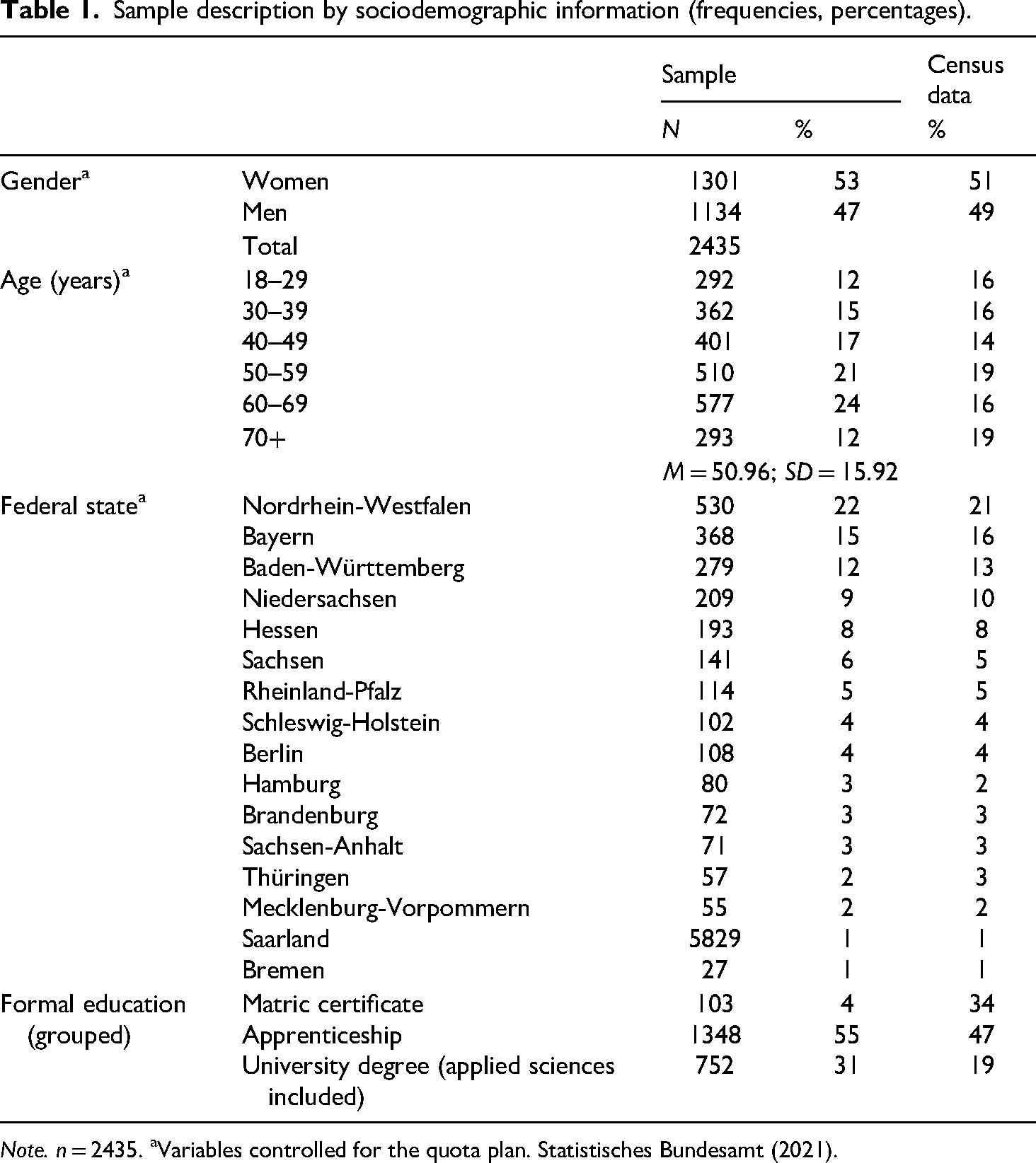
Note. n = 2435. aVariables controlled for the quota plan. Statistisches Bundesamt (2021).
Measures
Different measures were applied to analyze the hypotheses (overview in Table A1 in the Appendix).
Opinion leadership
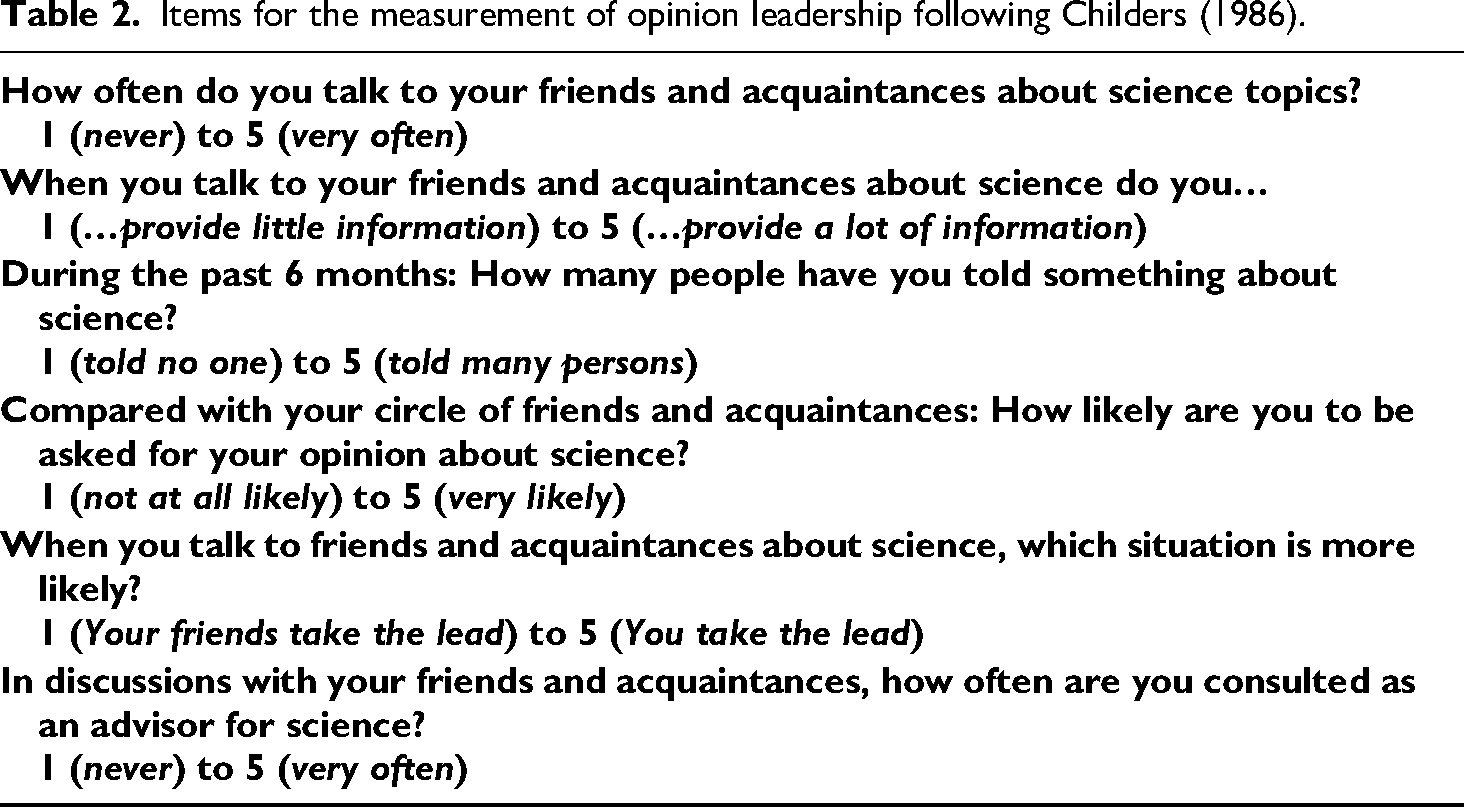
Various scales have been developed in the tradition of opinion leader research (for an overview, see Jungnickel, 2018), originally aimed at operationalizing opinion leaders by persuading others and seeking advice. Later, the measurement encompassed the respondent's self-perceived status as an opinion leader and their prior interactions with others (Rogers and Cartano, 1962). A more recent addition to this tradition is the Childers (1986) scale, which comprises six items focused on topic-related communication roles, including being approached for information and leading discussions. This scale has demonstrated internal consistency as a reliable measure of opinion leadership (Batinic et al., 2016; Geber, 2019; Gnambs and Batinic, 2011; Goldsmith and Desborde, 1991; Mangold and Bachl, 2018; Schäfer and Taddicken, 2015; Trepte and Scherer, 2010). It employs a 5-point rating scale to assess opinion leadership (‘no answer’ allowed), thereby conceptualizing it as a continuous rather than a dichotomous phenomenon, aligning with the current state of research (Gnambs, 2019; Strömbäck et al., 2023). All items are applied to the science domain (Table 2, see Appendix for German original). Internal consistency was high (α = .90), a mean index was calculated.
Items for the measurement of opinion leadership following Childers (1986).
Interest and knowledge
We measured interest and self-assessed knowledge regarding science in general and scientific methods on a scale from 1 (not interested at all know nothing) to 5 (very interested / know a great deal) and calculated mean indices (based on European Commission, 2013; αinterest = .87, αknowledge = .85). Thus, we used self-reports, which are particularly relevant for interpreting the results based on knowledge.
Media use
To measure traditional media use related to science, we asked about the consumption of public and private broadcasted television, radio, and newspapers (either in print or online), including tabloid press and science magazines. For social media, we asked for blogs or discussion forums, wikis, video platforms such as YouTube or TikTok, photo platforms such as Instagram, social networking sites such as Facebook, and microblogs such as Twitter (now X). A 5-point rating scale from 1 (never) to 5 (very often) was used. Internal consistencies were satisfactory to use mean indices (αtradmed = .76, αsocmed = .81).
Social media engagement
As mentioned above, we differentiated between participating in and generating engagement behavior on social media, according to Taddicken and Krämer (2021). Hence, we asked about the frequencies of how often respondents like and share (participating), as well as comment on and publish their own content (generating) related to science. Again, a 5-point rating scale from 1 (never) to 5 (very often) was used. Again, mean indices were calculated (αparticipating = .79, αgenerating = .81).
Use of populist right-wing media
To capture how often respondents used media other than traditional journalistic media, we avoided the term ‘populist right-wing media’ and instead used ‘critical media’ in the questionnaire. For clarification, we presented several examples of alternative information platforms, popular in Germany. A 5-point rating scale from 1 (never) to 5 (very often) was used.
Conspiracy affinity
We asked how much respondents believed in conspiracy theories by applying a scale by Imhoff and Decker (2013), consisting of five items, such as ‘I consider the various conspiracy narratives circulating on the Internet to be utter nonsense’ (reverse coded). A 5-point-rating scale from 1 (strongly disagree) to 5 (strongly agree) was applied and a mean index was calculated (α = .77).
Trust in science
The Public Trust in Science Scale [PuTS] by Reif et al. (2024) was used here, comprising 15 items to indirectly measure trust at the micro-level (scientists). It completes the sentence ‘Scientists can be trusted because they…’ across five dimensions: expertise (e.g. ‘…are experienced experts in their particular topic’), integrity (e.g. ‘…adhere to strict rules and standards in their work’), benevolence (e.g. ‘…work for the common good’), transparency (e.g. ‘…inform the public about relevant results of their research’), and dialogue orientation (e.g. ‘…sufficiently involve the public in their research’), each represented by three items (Table A2 in the Appendix). The items were presented in randomized order with five response options (1—strongly disagree to 5—strongly agree). Internal consistencies were satisfactory (αexpertise = .89, αintegrity = .85, αbenevolence = .85, αtransparency = .82, αdialogue = .86). Mean indices were calculated.
Sociodemographics
For sociodemographics, we gathered information on gender (male, female), age (open field), and education by asking for the highest school-leaving qualification according to the German system (1—no qualification, 2—still in education, 3—Hauptschulabschluss, 4—Realschulabschluss oder POS, 5—Abitur).
Results
The average SOL index was calculated as M = 2.70 (SD = .952), ranging from a minimum of 1 to a maximum of 5. The skewness value was −.021, suggesting a fairly symmetric distribution, while the kurtosis value was −.505, indicating a slightly flattened distribution with lighter tails.
To test the hypotheses, we calculated linear regression models for parallel analyses of the relationships among all related concepts. As shown in Table 3, all predictors together explain nearly half the variance of the SOL-dependent index variable, indicating a high effect size (adjusted R2 = .507).
Regression analysis with the dependent variable science opinion leadership.
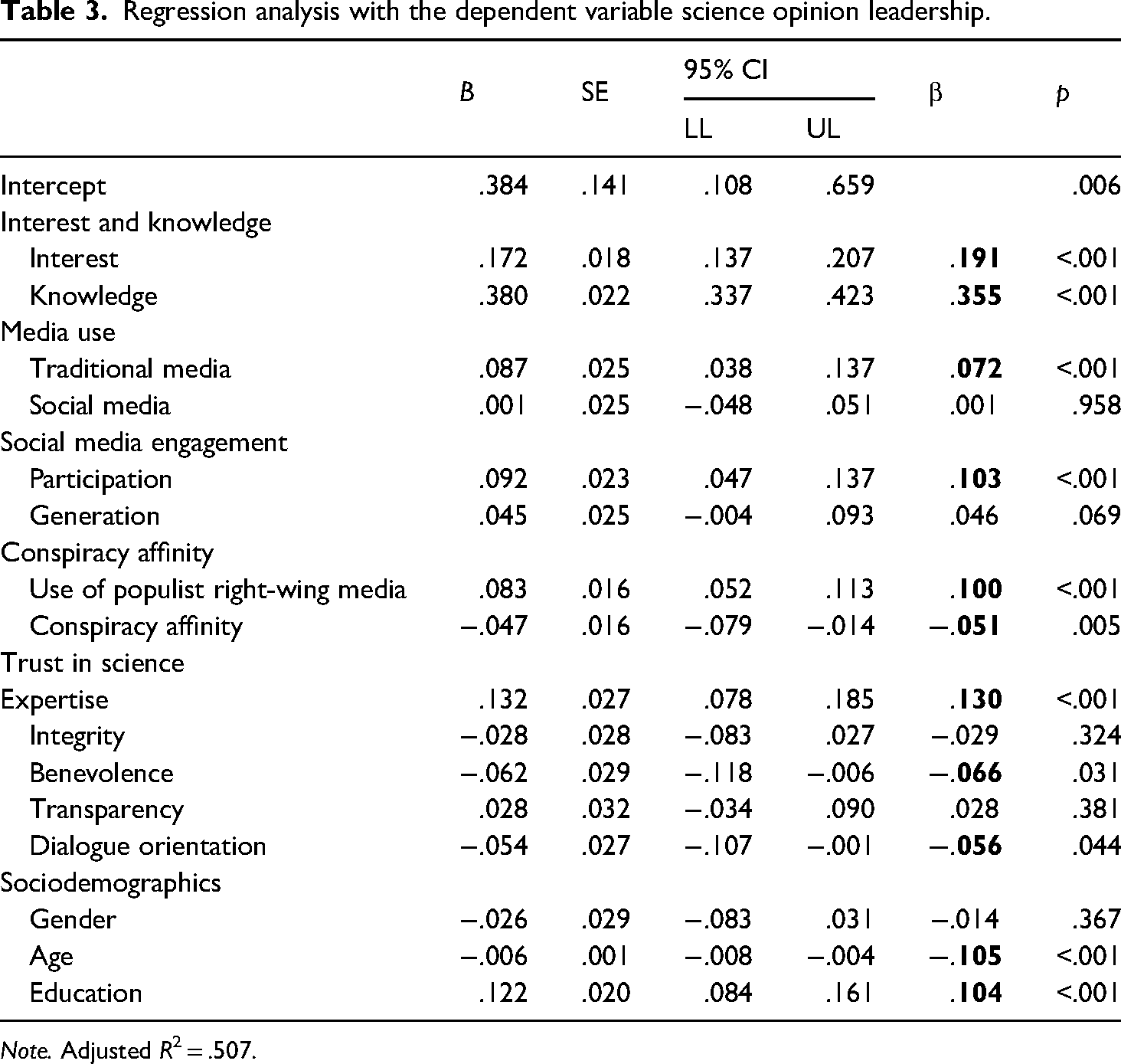
Note. Adjusted R2 = .507.
For descriptive purposes, we included sociodemographic variables in the analysis without prior hypotheses. The results revealed no significant predictions based on gender. Small and statistically significant β-values were observed for age and education, with a negative connection for age and a positive connection for education.
H1 and H2 on SOL and interest and knowledge
In line with past research, interest and self-perceived knowledge were found to be very significant predictors with the highest β-values of the analysis, indicating a medium to high positive relationship (H1 and H2 confirmed). Thus, these concepts were the most relevant for describing opinion leadership in the science domain. This confirmed the findings of prior research and hinted at the applicability of the concept to the science domain.
H3a and H3b on science opinion leadership and science-related media consumption
Based on research on opinion leadership in political contexts, we assumed that science-related media consumption would predict SOL positively. Indeed, the consumption of science-related traditional media was a significant predictor of SOL, albeit at a very small level (H3a confirmed). The consumption of science-related social media was not shown to be a significant predictor (H3b not confirmed).
H4a and H4b on science opinion leadership and science-related social media engagement
SOL was assumed to be positively predicted by social media engagement. Here, participating in science-related social media content, such as liking and sharing, was a significant predictor for SOL, with small β-value (H4a confirmed). By contrast, generating science-related content via commenting and publishing content was not a significant predictor of SOL (H4b not confirmed).
H5 and H6 on science opinion leadership and populism/conspiracies
We assumed that the consumption of populist media (H5) and conspiracy affinity (H6) were the only negative predictors in the analysis. This proved to be true, as conspiracy affinity was a significant predictor, but only with a very small negative β-value (H6 confirmed). This finding implied that scientific opinion leadership is typically associated with a reluctance to embrace conspiracy theories. However, the consumption of populist media also significantly predicted SOL, but with a positive β-value, indicating a small effect (H5 rejected).
H7 on science opinion leadership and trust in science
Different results were obtained for SOL and trust in science. We assumed a general positive correlation. Concerning the trust dimension of expertise, this assumption was supported, as indicated by a significant small β-value. No significant relationship was observed for the trust dimensions of integrity and transparency. For the dimensions of benevolence and dialogue orientation, significant negative β-values were found, but on a very small level. This implies that SOL is linked to trust in the expertise of scientists but is not connected to trust in their integrity and transparency. Additionally, SOL might be correlated with hesitancy to trust the benevolence of scientists and their orientation toward dialogue. Thus, H7 was partly confirmed, partly rejected.
Conclusion
In this research, our objective was to extend the concept of opinion leadership, traditionally rooted in political communication, to the realm of scientific communication. We posited that similar to political issues, scientific issues exhibit multifaceted complexity and contentiousness, requiring well-informed and benevolent sources of information to shape individual opinions and guide decision-making processes. We argued that science has become a major public concern, thereby justifying the application of a theoretical concept to understand the public flow of information and its interpretation. Consequently, we proposed that opinion leadership is relevant to science-related matters.
However, there is a noticeable gap in academic attention to the concept of SOL, despite its clearly stated relevance (Nisbet and Scheufele, 2009). It has long been argued that the ‘two-step flow of influence’ remains an overlooked resource for campaigns, for example on climate change (Nisbet and Kotcher, 2009) and that certain individuals with strong personalities and high social capital play a particularly important role for civic participation here (Scheufele and Shah, 2000). These individuals were found to be actively engaging with climate change online, influencing large numbers of people (Taddicken and Reif, 2016). To address this gap, we embarked on an exploration of established correlates of opinion leadership derived from existing research within the domain of science: issue-related interests and knowledge. Consistent with previous research findings, we confirmed that interest and self-perceived knowledge are the factors most strongly associated with opinion leadership (Myers and Robertson, 1972; Strömbäck et al., 2023; Troldahl and van Dam, 1965).
For media use, we applied concepts particularly relevant to digitized communication environments and science, encompassing issue-related consumption of traditional and social media and social media engagement (participation and content generation). Owing to the concern about epistemic crises in online environments (Dahlgren, 2018; Lewandowsky et al., 2023; Neuberger et al., 2023), we also asked about the consumption of populist media, conspiracy affinity, and trust in science.
Our findings confirm that SOL is positively connected to traditional media use and participation in science-related content on social media. This aligns with the established notion that opinion leaders are those most concerned about and articulate regarding a specific issue (Lazarsfeld et al., 1948), in this case, science. Although we were able to highlight the existence of SOL, we acknowledge that we had expected a closer relationship between media use and SOL. Although this was confirmed for traditional media at a very low level, no significant link was detected between SOL and the consumption of science-related social media. One explanation could be the extensive diversity of social media platforms. Our inquiry encompassed multiple platforms, which may not all be included in the individual's repertoire, potentially lowering consumption metrics. Additionally, our focus on relationships between friends and acquaintances may have been too narrow to encompass participants’ social media contacts. Future studies should extend this measurement. Furthermore, in environments characterized by abundant choices, individual interests likely play a more significant role.
Given the important role of scientific opinion leaders in disseminating both accurate and inaccurate information (Galetti and Costa-Pereira, 2017; Harff and Schmuck, 2024; Looi and Ho, 2023), it is noteworthy that our data show they participate more in online environments, though not necessarily by generating their own content. Additionally, the extent to which they rely on populist media or conspiracy theories and their level of trust in scientists is crucial. Regarding populist right-wing media and conspiracy concerns, we found a small positive connection between SOL and populist media consumption, although encouragingly, no inclination toward conspiracy beliefs. Moreover, SOL was positively connected to trust in scientists’ expertise, albeit not or not positively to other trust dimensions. Thus, we assumed that the use of populist media is caused more by interest and curiosity, and less by confirming one's own opinions. This might be caused by the attempt to anticipate the counterarguments and objections of potential opponents in social debates (Scheufele, 2014; Xenos et al., 2011). The finding is moreover in line with that of Strömbäck et al. (2023), who found a positive relationship between opinion leadership and knowledge of contested facts. However, this cannot be fully addressed by our data and warrants further investigation. Future research should delve deeper into the extent to which science opinion leaders are science supporters with high levels of trust in science.
An alternative interpretation of our findings could suggest that science opinion leaders possess an interest in and perceive themselves as knowledgeable about scientific matters but do not fully trust science. This interpretation aligns with that of Taddicken and Reif (2016), which identified a subgroup termed ‘participating experts’ characterized by high levels of interest and knowledge regarding climate change but demonstrating lower levels of support for science and problem awareness.
We did not investigate the extent to which science opinion leaders attempt to persuade others or influence their opinions and knowledge levels, as outlined by previous scholars (Geber, 2019; Harff and Schmuck, 2024; Jungnickel, 2018; Katz, 1957; Mangold and Bachl, 2018; Schäfer and Taddicken, 2015; Turcotte et al., 2015). Furthermore, our data do not allow us to delve into whether these leaders indeed affect others’ opinions and decision-making processes, especially within the dynamic context of social media. Future research should explore the extent to which their engagement affects others’ opinions and decision-making.
We captured self-perceived knowledge, which could raise concerns (Taddicken and Silva-Schmidt, 2019); future research should investigate whether scientific opinion leaders actually have more knowledge and influence compared to others. Our survey was conducted in Germany, potentially reflecting a specific cultural context; hence, future studies should consider diverse cultural settings, particularly in non-Western contexts. Despite employing a professional research institute to ensure representativeness in terms of gender, age, and location, our sample had a higher level of education than the general German population. Finally, the heterogeneity of the scientific field prompts further investigation, necessitating a finer differentiation of science into specific sub-domains and issues.
Despite these limitations, we were able to support the applicability of the concept of opinion leadership to the field of science, confirming established correlates found in opinion leadership research. With this, future research can more clearly distinguish between digital influencers and science opinion leaders, while also examining how each shapes public discourse on science topics. Additionally, it became evident that trust in science and disapproval of conspiracies and populist media were less pronounced and more varied than previously assumed. Consequently, this study serves as a valuable foundation for future research in science communication, as well as for practical applications. This includes integrating citizens into participatory formats and designing targeted campaigns to disseminate relevant scientific information.
Footnotes
Acknowledgments
We would like to thank our project partners for their valuable input and constructive feedback on this research.
Data availability
The data supporting the results of this study are available upon request to the corresponding author. The data set will be published after completion of the project.
Declaration of conflicting interests
The authors declared no potential conflicts of interest with respect to the research, authorship, and/or publication of this article.
Funding
The authors disclosed receipt of the following financial support for the research, authorship, and/or publication of this article: This research is part of the project ‘The trust relationship between science and digitized publics’ (TruSDi), funded by the Deutsche Forschungsgemeinschaft (DFG, German Research Foundation)—456602133. Grant applicants are Lars Guenther (GU 1674/3-1) and Monika Taddicken (TA 712/4-1). The project is coordinated by Anne Reif and supported by Peter Weingart in an advisory capacity. Further members of the research group are Justin T. Schröder, Evelyn Jonas and Janise Brück.
Ethical approval
Before data collection, we have consulted with Dr Vanessa Stange ( ), the contact person for the Ethics Committee at TU Braunschweig. She confirmed that, in our case, no ethical approval was required. We used an external online access panel where the researchers have no access to respondents’ personal information (e.g. name, contact details). We only collected sociodemographic variables and people's perceptions of science, hence, no sensitive data. The operator of the online access panel (YouGov) gave respondents a small incentive for responding to each survey wave.
Informed consent
Written consent was obtained by YouGov when respondents opted to join the online access panel. Participants had the autonomy to choose whether they wished to complete our survey and were free to end the survey at any time.
Appendix
Descriptive statistics and measures.
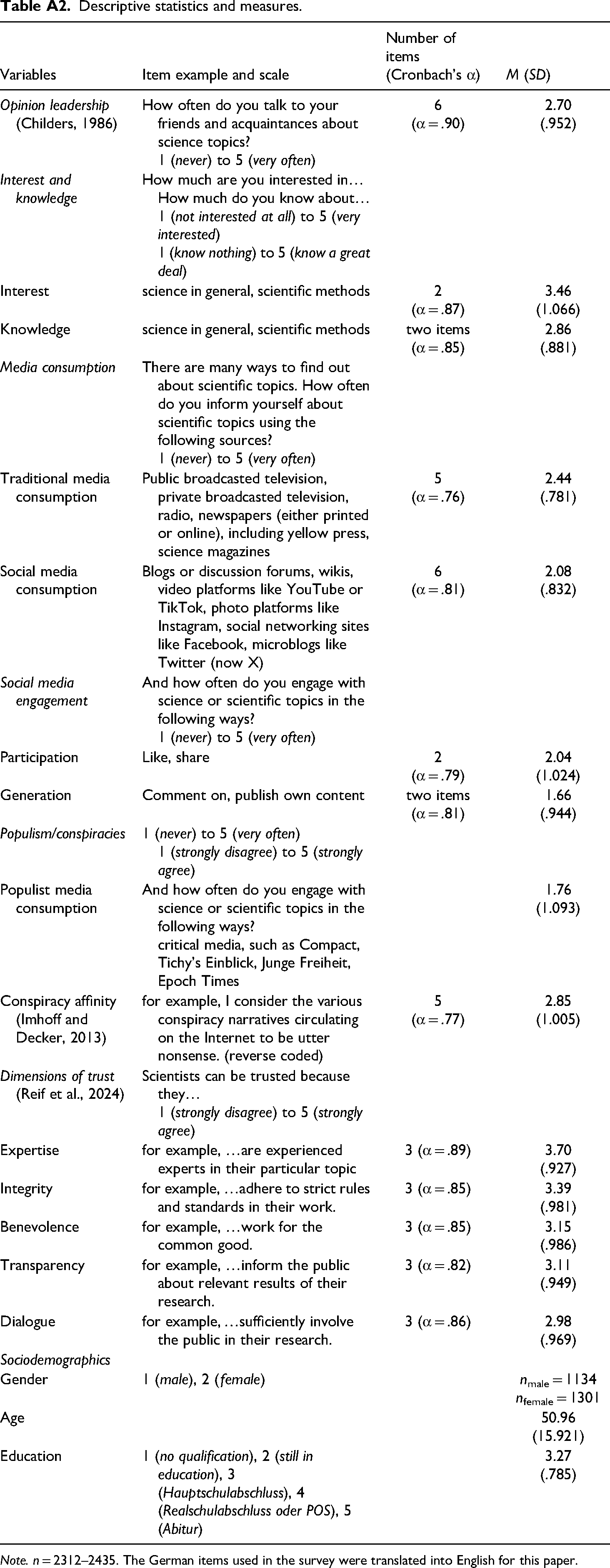
| Variables | Item example and scale | Number of items (Cronbach's α) | M (SD) |
|---|---|---|---|
| Opinion leadership (Childers, 1986) |
How often do you talk to your friends and acquaintances about science topics? 1 (never) to 5 (very often) |
6 (α = .90) |
2.70 (.952) |
| Interest and knowledge | How much are you interested in… How much do you know about… 1 (not interested at all) to 5 (very interested) 1 (know nothing) to 5 (know a great deal) |
||
| Interest | science in general, scientific methods | 2 |
3.46 |
| Knowledge | science in general, scientific methods | two items |
2.86 |
| Media consumption | There are many ways to find out about scientific topics. How often do you inform yourself about scientific topics using the following sources? |
||
| Traditional media consumption | Public broadcasted television, private broadcasted television, radio, newspapers (either printed or online), including yellow press, science magazines | 5 |
2.44 |
| Social media consumption | Blogs or discussion forums, wikis, video platforms like YouTube or TikTok, photo platforms like Instagram, social networking sites like Facebook, microblogs like Twitter (now X) | 6 |
2.08 |
| Social media engagement | And how often do you engage with science or scientific topics in the following ways? |
||
| Participation | Like, share | 2 |
2.04 |
| Generation | Comment on, publish own content | two items |
1.66 |
| Populism/conspiracies | 1 (never) to 5 (very often) |
||
| Populist media consumption | And how often do you engage with science or scientific topics in the following ways? |
1.76 |
|
| Conspiracy affinity |
for example, I consider the various conspiracy narratives circulating on the Internet to be utter nonsense. (reverse coded) | 5 |
2.85 |
| Dimensions of trust |
Scientists can be trusted because they… |
||
| Expertise | for example, …are experienced experts in their particular topic | 3 (α = .89) | 3.70 |
| Integrity | for example, …adhere to strict rules and standards in their work. | 3 (α = .85) | 3.39 |
| Benevolence | for example, …work for the common good. | 3 (α = .85) | 3.15 |
| Transparency | for example, …inform the public about relevant results of their research. | 3 (α = .82) | 3.11 |
| Dialogue | for example, …sufficiently involve the public in their research. | 3 (α = .86) | 2.98 |
| Sociodemographics | |||
| Gender | 1 (male), 2 (female) | nmale = 1134 |
|
| Age | 50.96 |
||
| Education | 1 (no qualification), 2 (still in education), 3 (Hauptschulabschluss), 4 (Realschulabschluss oder POS), 5 (Abitur) | 3.27 |
Note. n = 2312–2435. The German items used in the survey were translated into English for this paper.