



Abstract
The study investigates which democracy dimensions impact the share of (foreign) media followers of European governments’ Twitter social media accounts. To achieve this target, a network analysis and a data-linking strategy are relied upon to conduct three multilevel regression models. The first model reveals that while overall government media attention is positively associated with gross domestic product and internet penetration, it is negatively associated with higher levels of deliberative democracy. The second model, which focuses specifically on the share of foreign media followers, finds that individual-level factors are the primary predictors of foreign media attention. The third model explores the country context of media followers and indicates that government accounts benefit from followers in countries with higher democratic standards and greater media freedom, though there are negative associations with certain democratic dimensions such as liberal and participative democracy. Additionally, ministers and ministries consistently have a higher proportion of foreign media followers compared to heads of state. These findings are discussed in light of the literature on Twitter's role in media attention and gatekeeping theory.
Keywords
Introduction
It has been widely recognized that social media have emerged as a pivotal platform for governments to engage with citizens and gain knowledge on public opinion (Joseph et al., 2021), but also to connect with journalists and media in real-time (DePaula et al., 2018; Tandoc & Vos, 2016). Among these platforms, Twitter (now X) stands out as a dynamic space where political discourse unfolds, offering unprecedented opportunities for governments to establish dialogic engagement with their citizen and media followers (Kent & Taylor, 2021). However, the efficacy and impact of government Twitter accounts are also subject to the gatekeeping dynamics inherent in journalistic practices controlling the flow and visibility of information and determining which content reaches audiences and shapes public discourse. Government accounts, in contrast to those of legislators, may particularly attract media attention due to their formal representative function, broadcasting government policies and diplomatic stances, which have implications for international and domestic audiences alike. This study seeks to investigate the interplay between media gatekeeping and their attention to governmental Twitter (now X) accounts across Western European countries, shedding light on the underlying factors that shape media engagement with government accounts.
Gatekeeping theory (Fiske & O'Sullivan, 1994) provides a theoretical lens through which one can understand the role of journalists as information mediators. Within this framework, journalists serve as gatekeepers, exerting influence over which government messages are amplified, disseminated, and ultimately consumed by the public. McCombs and Shaw (1972) noted a direct connection between the media agenda and the level of importance audiences attribute to the issues covered in the media. Government bodies are important entities that can both influence media content and be the subjects of media discussions along with political and societal events impacting the future of democracies. Against this background, the media acts to make government actions accountable.
Gatekeeping logic may be even more pronounced on social media compared to traditional media because algorithms and user engagement metrics can amplify or suppress content rapidly, thus intensifying selective visibility and shaping public perception (Golan & Himelboim, 2016; Thorson & Wells, 2016). Our study therefore relies on network theory, which examines how relationships between actors shape behaviors and outcomes. In the context of our study, we apply network theory to analyze the structure of the (inter)national media follower networks surrounding government Twitter accounts, particularly how these transnational networks are influenced by democratic and media freedom contexts. The transnational angle provides insights into how governmental communication transcends national borders, potentially signaling geopolitical influence and democratization (Chadwick et al., 2015; Kim & Barnett, 1996; Wu, 2007). We thus build upon previous studies that have underlined the importance of accounting for the effects of contextual factors, such as democracy and economic indices, on the transnational news flows and coverage (Jones et al., 2013).
As mentioned by Guo and Vargo (2017), previous research has predominantly relied on manual annotation to study international media coverage. Our approach leverages follower network data to examine transnational engagement in a semi-automated and scalable manner. By focusing on follower networks, rather than manually coded content, we offer a new perspective on media attention potential across borders. This allows us to assess government accounts' influence on media followers within different democratic contexts and to explore how contextual factors such as media freedom and democracy indices shape these follower networks.
Central to our inquiry are two overarching research questions: (RQ1) How is the share of media followers of government Twitter accounts across Western European countries impacted by democracy dimensions at the country level? (RQ2) How do the same contextual factors explain the share of foreign media followers of government accounts across Western European countries and how does this reflect broader geopolitical dynamics? Our focus on follower networks (rather than tweet content or media output) offers a unique perspective on media attention (rather than direct coverage or reporting) and distinguishes between national and international media attention. As social media such as Twitter have become an essential source of information for more of the population (Shearer & Mitchell, 2021), understanding how information may move through these networks is essential. From a democratic integration perspective, citizens should ideally be exposed to foreign information, and not only nation-wide related news, notably by keeping updated about and thus being a part of a transnational community (Imhof, 2008; Koopmans et al., 2010). This article thus proposes a first step in this direction by understanding which context-level factors impact the share of followers of government Twitter accounts. This study can further complement survey research by clarifying how citizens are likely to be exposed to international media coverage (Jürgens et al., 2020; Widholm, 2018), especially as social media content is increasingly reported in the mainstream media.
To answer these questions, the study links contextual factors at both the government and media account levels. We, therefore, contribute to the literature by addressing two main research gaps: understanding the factors that shape the media follower networks of governmental accounts across borders under different democratic contexts by relying on; clarifying the potential of Twitter data to investigate international media attention patterns (as compared to more traditional media content annotation methods). More practically, the study employs a network analysis and a regression modeling approach, drawing from comprehensive datasets encompassing media coverage of government Twitter accounts in relation to democracy dimensions—including media freedom, electoral processes, civil liberties, and satisfaction with government—thereby providing a nuanced understanding of the political and institutional contexts in which media attention to government Twitter accounts operates. Additional contextual factors—such as gross domestic product (GDP), share of foreign population, as well as individual account-level factors (such as account type and tweeting activity)—are used as control variables. It is important to note that our data was collected before Elon Musk acquired Twitter. As research has shown, this acquisition and subsequent platform changes impacted information dissemination, with shifts in content visibility, audience interactions, and the spread of misinformation (e.g. Haman & Školník, 2023). Twitter was widely recognized as an essential platform for examining the connections between political actors, media accounts, and the public, providing valuable insights into public discourse and media gatekeeping dynamics (e.g. Graham et al., 2013; Reveilhac & Morselli, 2023a).
Theoretical background
Social media opportunities for international media coverage
Due to the information overload, social media revolutionizes international news dissemination, leveraging recommendation algorithms at minimal cost—specifically designed to provide users with pre-selected information and a personalized stream of content based on their preferences (Iyengar and Hahn, 2009). Journalists have embraced social media, favoring Twitter since the 2010s (Cision, 2012). McGregor (2019) notes its use for narratives and vox populi, echoed by PEW's finding that over 90% of US journalists utilize social media (PEW, 2022). While these platforms create unprecedented access, scholars such as Molyneux and McGregor (2022) argue that this reliance may alter journalistic values, risking accuracy for speed. This shift can lead journalists to prioritize immediacy over context, sometimes reducing verification standards to “stealing thunder” by prioritizing sensational over verified information (Lee, 2020). As a result, social media's role in international news is complex, offering both increased accessibility and challenges to journalistic standards of rigor.
Both national and regional news outlets often lack resources for extensive global coverage. Transnational news is primarily disseminated by international news agencies such as Keystone SDA, Reuters, or AFP, leveraging correspondents worldwide. Despite the central role of news agencies, social media, and the internet offer journalists broader coverage opportunities without necessarily being present on-site and removing the need for intermediaries such as those agencies ( Boumans et al., 2018; Cazzamatta, 2022). Social media, notably Twitter, facilitates rapid access to official communications, enabling journalists to react swiftly and disseminate information. This has led to a digital news ecosystem in which government, media, and influential actors converge, with social media now functioning as a key site for political discourse, especially in fields such as politics, economics, and science (McGregor, 2019; PEW, 2022; Rauchfleisch & Metag, 2016; Rauchfleisch et al., 2021; Shahi et al., 2021). 1
Political communication on social media increasingly influences traditional news (Molineux & McGregor, 2022), with Twitter content being reported in the traditional media. Furthermore, network analysis reveals transnational media usage across multiple countries (Thurman et al., 2020). World leaders' widespread adoption of social media can be attributed to socioeconomic factors, technological access, political institutions, and voter turnout (Barberá & Zeitzoff, 2018; Faber et al., 2020; Manoharan, 2013; Silva et al., 2019). Furthermore, the attention to government accounts has been explained by popularity metrics, such as search engine results (Müller, 2022) and presence in traditional news (Gerhards & Schäfer, 2010). We examine this transnational interest through social media follower networks, where influence flows beyond traditional news channels.
Gatekeeping practices on social media
Social media platforms and the Internet, in general, are impactful components of the intramedia agenda-setting process where media coverage can be used as a measure of public concern, further influencing agenda-setting by releasing the most resonating and actual news (Wanta & Alkazemi, 2017). Among the factors impacting international media attention, media freedom is pivotal for journalists to serve as effective gatekeepers. Countries with greater media freedom empower journalists to critically assess government messaging and independently decide whether to disseminate or withhold information, thus underscoring the importance of journalism as a public good (UNESCO, 2022). Additionally, political pluralism and government accountability shape the context of gatekeeping (Esser & Pfetsch, 2020). Journalists in politically pluralistic states with robust accountability mechanisms are more likely to scrutinize government actions, provide diverse perspectives, and hold officials accountable, influencing media attention to government social media accounts. Conversely, in countries with limited media freedom or political pluralism, journalists may face constraints, resulting in biased or uncritical government coverage, due to propaganda filters media endures in order to sustain itself and resist government pressure.
Gatekeeping theory, which originated from studies of information flow in traditional media, is highly relevant to understanding the selective nature of social media coverage (Shoemaker & Vos, 2009). In traditional contexts, gatekeeping emphasizes the role of editors, institutions, and other controls that determine newsworthiness. On social media, however, gatekeeping is even more pronounced as algorithmic and user-driven factors can rapidly amplify or suppress content, creating selective visibility that shapes public perception (Esser & Pfetsch, 2020). These dynamics of gatekeeping can reveal how democratic contexts affect journalists’ roles as information mediators across borders, with implications for both national and international media networks.
Network theory to explain international news flow and the effect of contextual factors
The gatekeeping theory can be linked to the research field of international news flow theory which was initiated 50 years ago (Galtung & Ruge, 1965; Östgaard, 1965) and proposed a substantial conceptual framework linking transnational news coverage to population, economic, and political factors. Our study builds on this framework by examining how these contextual factors shape government account follower networks on social media. For instance, media freedom and government accountability are integral to determining whether media attention includes diverse, international perspectives or remains domestically focused (Esser & Pfetsch, 2020).
The extent to which government accounts attract international media attention, and the impact of contextual factors, are particularly relevant questions from the perspective of foreign policy relationships, public opinion on foreign affairs, cross-national values, and cultural exchanges. Extending the work of Brüggemann and Kleinen-von Königslöw (2009) about the “vertical dimension of transnational integration,” it suggests that, by focusing on national governments' interactions on platforms such as Twitter, researchers can examine how these official entities contribute to a larger, integrated political space that spans multiple countries. We are particularly interested in the effects of democracy dimensions, such as the achievement of electoral and deliberative democracy, but also media freedom and public satisfaction with government.
In addition to democratic factors, previous studies have shown the importance of context variables such as GDP, percentage of foreign nationals, and internet penetration rate to explain cross-national media attention. Indeed, economic power, geographical proximity, and deviant behavior serve as key predictors of media attention (Tunstall, 1977). While the media landscape is no longer dominated solely by elite countries, structural factors not only determine a country's international attention but also its ability to shape global discourse (Guo & Vargo, 2020). Rauchfleisch et al. (2020) analyzed Swiss online news media's transnational reach on Twitter, discovering that quality media can attract audiences from neighboring countries (Germany, France, and Italy).
The present study
The connection between democracy factors and gatekeeping theory lies in their collective influence on the information flow and media dynamics within a democratic society, particularly in to study of the dynamics of media attention to government Twitter accounts. The analysis of these attention patterns echoes the insights from network theory which is useful to account for representations of (a)symmetric relations between objects (Newman, 2018). In the context of our study, these objects are government and media accounts, and their relationship. Twitter exists as a complex network of users (the nodes) and interactions (the hedges) between users (Liu et al., 2017). In our study, these interactions are symbolized by the share of (foreign) media followers of government accounts both domestically and internationally.
Based on the reviewed literature, the following hypotheses are tested:
Note that the hypotheses differentiate between the values related to the government's home country and those associated with the media followers’ home country, as well as between the total share of media followers and the share of external media followers. With respect to the democratic factors, we rely on the Varieties of Democracy (V-Dem) dataset to assess democracy dimensions. The V-Dem offers a comprehensive framework for assessing various dimensions of democracy and governance across countries. Furthermore, we will rely on the media freedom index (MFI) measured by Reporters Without Borders.
In addressing these hypotheses, we seek to clarify the relationship between contextual factors and media following structures on Twitter, particularly examining if higher democratic scores in both the government and follower home countries correlate with broader and more international media follower networks. Our approach differs from previous research, which often relies on manually coded media attention, by employing network theory to analyze follower structures and investigate whether these follower compositions indicate broader patterns of international interest. Additionally, typical factors—such as GDP, internet penetration, and the proportion of foreign nationals—are considered as controls to better assess the real impact of democracy indicators. The present study thus contributes to a novel perspective on how these elements might influence the likelihood of diverse media engagement with government Twitter accounts.
The study also considers individual-level factors. Indeed, gatekeeping theory applies variably to national leaders, ministers, and ministries, influenced by their roles, communication strategies, and media relationships (Mergel, 2013; Sutter, 2004). Leaders, due to their prominence, wield significant media influence, especially through social media platforms such as Twitter, bypassing traditional gatekeepers (Mergel, 2013; Sutter, 2004). The senior leadership of the country, overseeing specific policy areas, tailors their Twitter communication accordingly, with varying media attention based on policy relevance, novelty, or controversy. Partially to maintain the image of objectivity and to shield themselves from criticism of bias and the threat of libel, journalists need material that can be portrayed as predictably accurate. It is why government institutions receive high levels of attention from the media even on social media platforms. For example, the press secretary of the prime minister or president is considered a powerful news source (Herman & Chomsky, 1988; Mullen & Klaehn, 2010). Parallelly, government messaging may receive favorable attention if they engage actively with the media. Ministries use Twitter to disseminate policy information complemented with opinionated discourse surrounding it, which usually is subject to editorial control and coordination. Media attention depends on the relevance of their tweets to policy areas or public interest issues. Against this background, the study will also consider Twitter account types (e.g. head of state, government, minister, and ministry accounts) and activity levels (yearly publication frequency) as control variables.
Data and method
Database of government-media accounts
The more recent changes in platform policies and features have impacted information dissemination, with shifts in content visibility, and audience interactions. While these shifts raise questions about the platform's current suitability for public interest and accountability studies, its enduring relevance in media and politics supports our investigation of transnational media gatekeeping under evolving conditions.
To construct the database of government-media accounts (see Supplemental Material, Annex 1 for the list of government accounts), we first browsed all governmental actors and institutions from the Western European countries to search for their presence on Twitter during the year 2022. More specifically, we focus on accounts pertaining to heads of state, government pages, prime ministers, ministers, and ministries. Note that specific governmental agencies, such as the Attorney General's Office, are included under the ministries category. Furthermore, the accounts are official, not private ones. Cases where multiple accounts exist for different languages are also included, such as when foreign ministries maintain one account in the national language and another in English to facilitate international communication. This approach acknowledges that English-language accounts are likely to attract a broader, more international media following, due to their accessibility to the international audience, whereas national-language accounts may better reflect domestic media engagement and are specifically targeted to the country's audience. By including both, we can assess potential differences in follower composition and ensure our analysis considers the language-specific audiences that these accounts engage. Furthermore, Twitter is widely used in Western Europe, whereas Facebook is more popular in Eastern European countries (Zumofen et al., 2023), leaving Twitter the least popular platform—making a focus on the Western region more appropriate.
The comprehensive list of government-related entities was compiled manually using official government websites and directories, which frequently included links to the social media handles of government accounts. When official sources did not provide a Twitter handle, we conducted direct searches on Twitter to locate any existing official government accounts by querying the names of individuals and entities. The database of government accounts is constituted of a total of 582 government actors and institutions among which 474 (81%) possess valid and active Twitter accounts. Table 1 details the total number of government entities (both actors and institutions) that were manually reviewed. It shows the number of valid and active Twitter handles included in the analysis and indicates the proportion these handles represent relative to the overall number of government accounts on Twitter. Table 1 also includes the distribution of the democracy dimensions: V-Dem, MFI, and satisfaction with government (stf_gov). These dimensions will be presented in the “Democracy dimensions and additional contextual-/individual-level factors” section.
Description of the sample of government Twitter accounts.
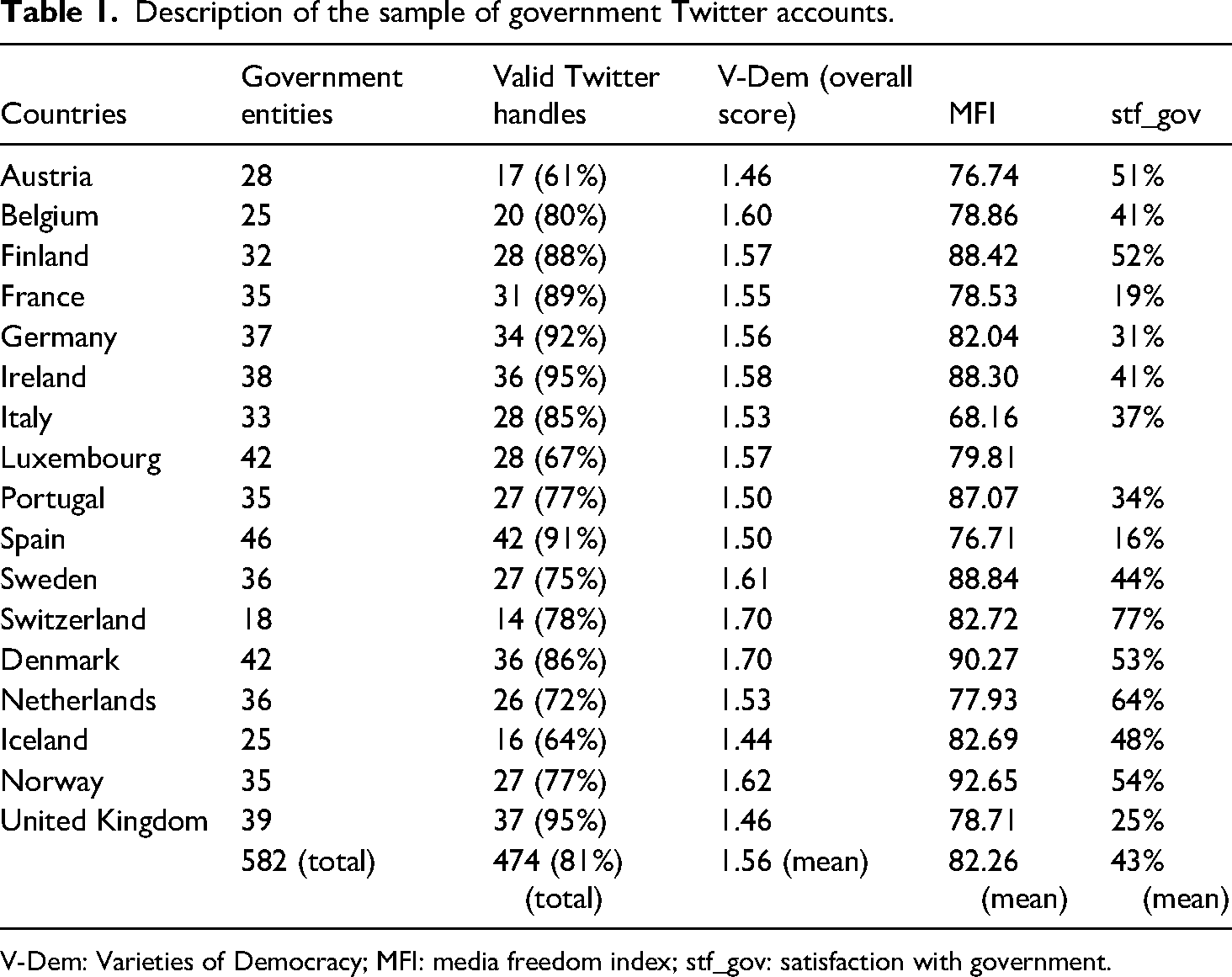
V-Dem: Varieties of Democracy; MFI: media freedom index; stf_gov: satisfaction with government.
We focused on several West European countries, including Austria, Belgium, Finland, France, Germany, Ireland, Italy, Luxembourg, Portugal, Spain, Sweden, Switzerland, Denmark, Netherlands, Iceland, Norway, and the United Kingdom. The included countries are widely recognized as part of the West European region, ensuring that our sample encompasses a diverse range of governmental structures and media environments within this geographical context. We included countries that vary in size and political systems to provide a comprehensive overview. The selection was influenced by the availability of reliable and accessible data on government Twitter accounts and contextual information (e.g. measure of democracy dimensions and media freedom). Therefore, we excluded certain countries from the list due to limitations such as insufficient data availability or challenges in accessing reliable sources for government social media handles. The included countries ensure a representative sample of Western European governments and their social media presence, allowing for robust comparisons and insights within the scope of our study. This regional concentration minimizes the influence of starkly divergent political or media environments, enabling a clearer analysis of how more nuanced variations in democracy levels and media freedom affect media follower networks. Additionally, Western Europe is particularly relevant for this research because it has a high degree of cross-border media interaction and established traditions of public accountability and transnational discourse, making it an ideal setting to study transnational media dynamics and the influence of government accounts on international media followers.
Then, we relied on the official Twitter API 2 to collect the follower network data. We collected the follower network of the actors with a valid Twitter handle using Twitter API, totaling 8,014,217 unique followers. As we are interested in identifying followers who are media accounts, we also need to collect followers’ profile descriptions, which can be done with the Twitter API, along with additional meta-information (e.g. data of account creation, number of tweets emitted, location-related information if available, etc.). As collecting the profile information from all followers might be impracticable as we are interested in influential accounts, a decision was made to collect the profile information only for the followers with at least five connections to any of the governmental actors, reducing the number of followers to 546,258. We used the specific threshold value of five connections to ensure the robustness and relevance of the data collected for followers who demonstrate a meaningful level of engagement, thus providing a more accurate representation of influential or engaged users within the network. We selected this value after reviewing similar studies on networks and engaged publics (Barberá et al., 2019; Reveilhac & Morselli, 2023b), which often use thresholds to balance data richness with manageability.
Semi-supervised detection of media followers
Semi-supervised identification of media-related accounts (including mainstream media, alternative media, journalists, citizen journalists, and news aggregators) from the network of Twitter followers was performed. To do so, a classifier is trained on a manually labeled training dataset of follower profiles to differentiate between media and non-media follower accounts.
To construct a valuable training sample, we first elaborated a list of media-related search queries to retrieve accounts matching these keywords (see Supplemental Material, Annex 2). The accounts containing a valid profile URL were manually checked and retained if they could be identified as media accounts based on the profile description (3353 accounts were included in the training sample). Then, we added a random sample of 3000 accounts that did not contain any of the search queries and, after manual verification, labeled them as non-media (2992 accounts were included in the training sample). The training sample includes 6345 accounts in total. Note that citizen journalists are also considered media accounts as they can play a significant role, especially in crisis communication contexts (Hocevar, 2024). Citizen journalists were included in our dataset if their profile descriptions explicitly identified them as journalists, reporters, or independent media contributors, or if they referenced journalism-related activities, such as crisis reporting or investigative work. Our criteria for inclusion as a media account did not rely solely on affiliation with a recognized media organization but also considered self-identification and activity in journalism-related roles.
The classification model is a custom-trained Bidirectional Encoder Representations from Transformers (BERT) classifier with the dichotomous variable being “media account” (coded as 1) versus “non-media account” (coded as 0). The model was trained on both the original language and English transcription of the profile descriptions. We translated every profile description into English using GoogleTranslate. The BERT model employed is the distilbert-base-multilingual-case, which is a distilled version of BERT optimized for multilingual tasks. The model's vocabulary size is 119,547, and it utilizes a maximum of 512 position embeddings. The loss function employed is cross-entropy loss, which is commonly used for classification tasks. For training, we used a batch size of 32, which strikes a balance between computational efficiency and model performance. The learning rate was set to 2 × 10⁻⁵, a common choice for fine-tuning BERT models, providing a controlled adjustment to the model weights during training. The classification accuracy of the model was above 96% accuracy on the testing set (the F1 score was 0.95, with a larger share of false negatives than false positives). An additional sample of 200 profiles, which led to an accuracy of 0.98 was also manually checked. An example of a false positive is associated with the expression “news junkies,” while an example of a false negative is associated with the expression “bringing together news/journalists from….” Although we did not compare our model against other baseline models, our approach was validated through this manual verification process.
We also assessed the country of the identified media accounts semi-automatically, based on network analysis and manual classification. More precisely, media accounts that followed at least 60% of government accounts from one country were assigned to the same country. The remaining accounts (almost 3000) were manually classified for their country. If the accounts were from non-European Union countries and if no country information could be found, we indicated “other.” This is the case in 7% of the media accounts. The threshold of 60% ensures that we included only those media followers who had a substantial and consistent interest in the social media presence of a government from a particular country, as opposed to those from foreign governments.
Democracy dimensions and additional contextual-/individual-level factors
Our main democracy dimensions of interest are the five macro-level indices that describe features of democracy at the highest (most abstract) level by V-Dem, the MFI, and public satisfaction with government:
The V-Dem 3 comprises the extent to which the next instances are achieved: (1) the ideal of electoral democracy; (2) the ideal of liberal democracy; (3) the ideal of participatory democracy; (4) the ideal of deliberative democracy; and (5) the ideal of egalitarian democracy.
We also include two additional factors: satisfaction with the government calculated as the sum of the value 6–10 from the original 10-point scale as measured by the European Social Survey 2022 4 and MFI as measured by Reporters Without Borders 5 for the year 2022.
Additional contextual factors that we control include the internet penetration rate measured by InternetWorldStats 6 for 2022, the reported GDP 2022 from the International Monetary Fund, 7 and the share of foreign nationals in 2022 reported by the Organization for Economic Co-operation and Development. 8
Concerning individual factors at the government account level, we specified the type of entity (head of state, government, minister, and ministry accounts) with “head of state” accounts as the reference category. Furthermore, we specified the yearly publication frequency of each government account.
Regression and network analyses
The share of media followers refers to the proportion of media followers relative to the total number of followers for each government account. This ratio is calculated by dividing the number of media followers by the total number of followers, and the resulting share was log-transformed to achieve a normal distribution for analysis. A similar logic applies to the share of foreign media followers, which is calculated by dividing the number of foreign media followers by the total number of media followers. We conducted three multilevel linear regressions explaining the share of media followers of government accounts:
The first model considers the overall share of media followers, linking the contextual factors to the countries of the government accounts. This model gives us insight into which factors specific to the government country (or internal factors) relate to a different share of overall media followers (both national and international media followers). The second model links the contextual factors to the countries of the government accounts. This model gives us insight into which factors specific to the government country (or internal factors) relate to a different share of foreign media followers. The third model links the contextual factors to the countries of the media follower accounts. This model provides insights into which factors specific to the media followers’ country (or external factors) relate to a different share of foreign media followers.
The second and third models limit the analyses to the share of external media followers, thus including media followers only from another country as the government accounts they are covering.
The multilevel structure of these regressions allows us to analyze the relationships at different levels: the first level relates to the specific government accounts and their characteristics, while the second level relates to the countries of the media followers, thereby distinguishing between internal and external influences on media follower shares.
Furthermore, we investigate international attention by constructing a network between government Twitter accounts and the identified media followers, specifying the country of origin of both types of accounts. The network structure is analyzed to differentiate between the national and international attention to government accounts by media followers.
Results
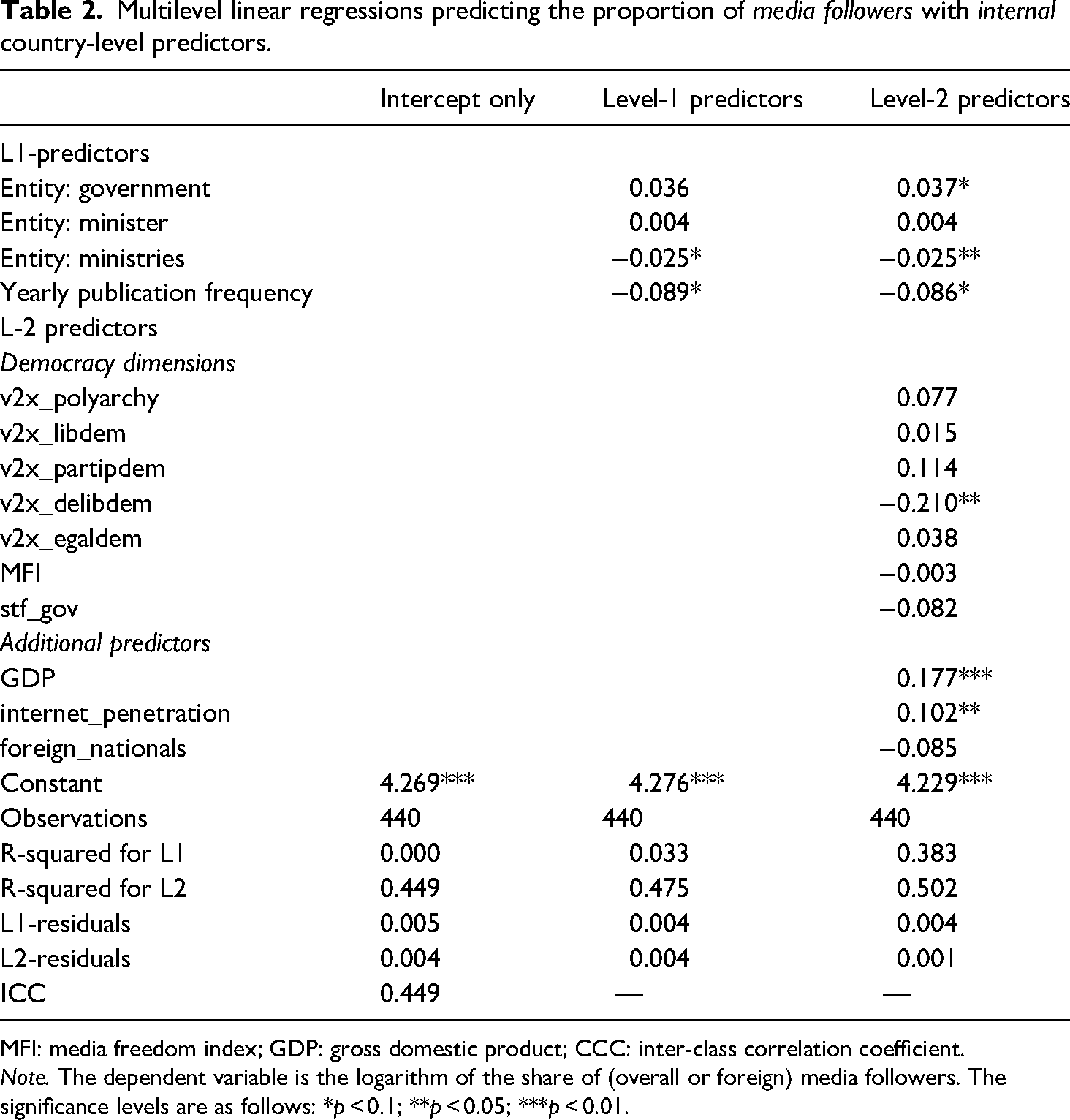
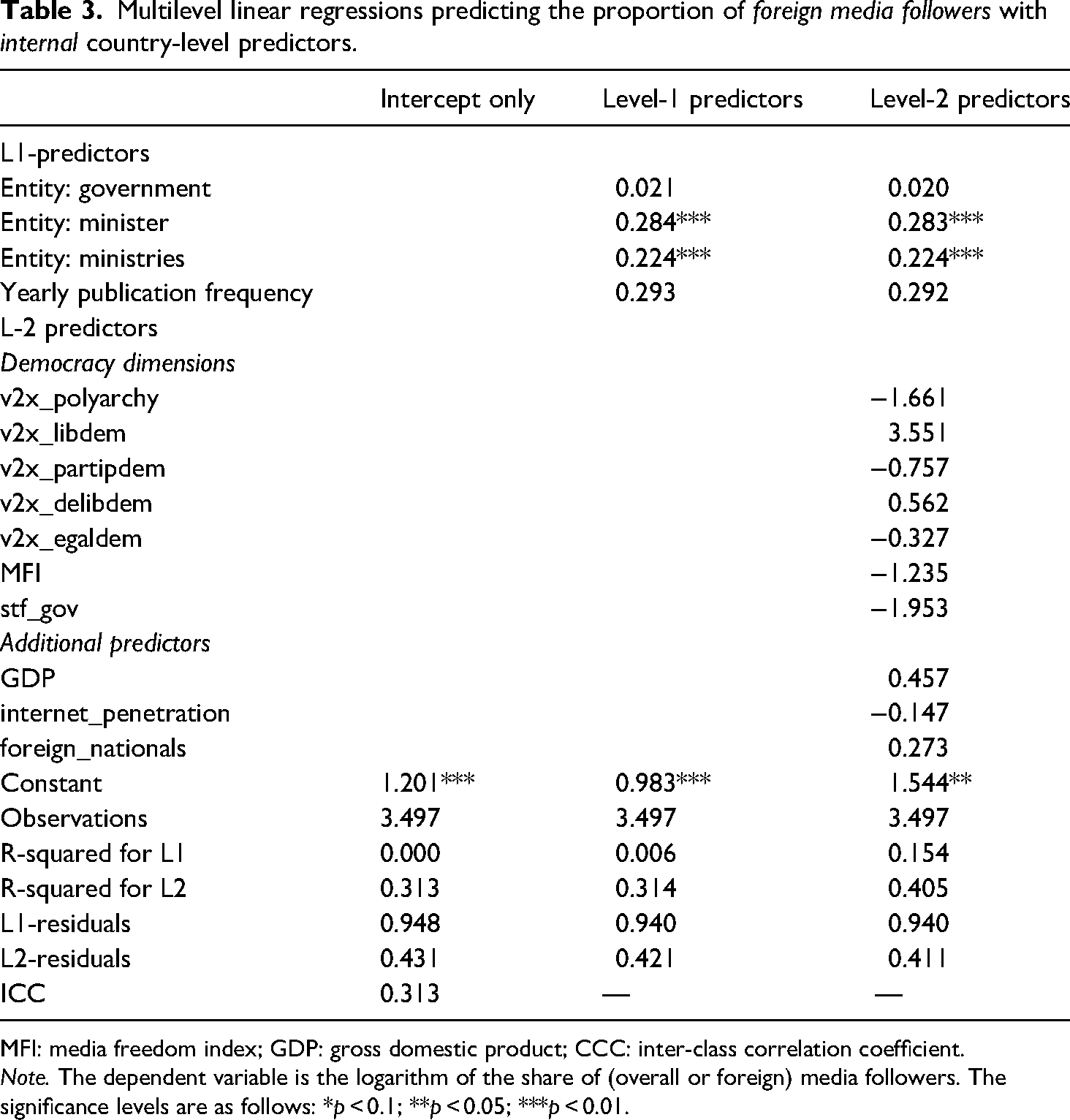
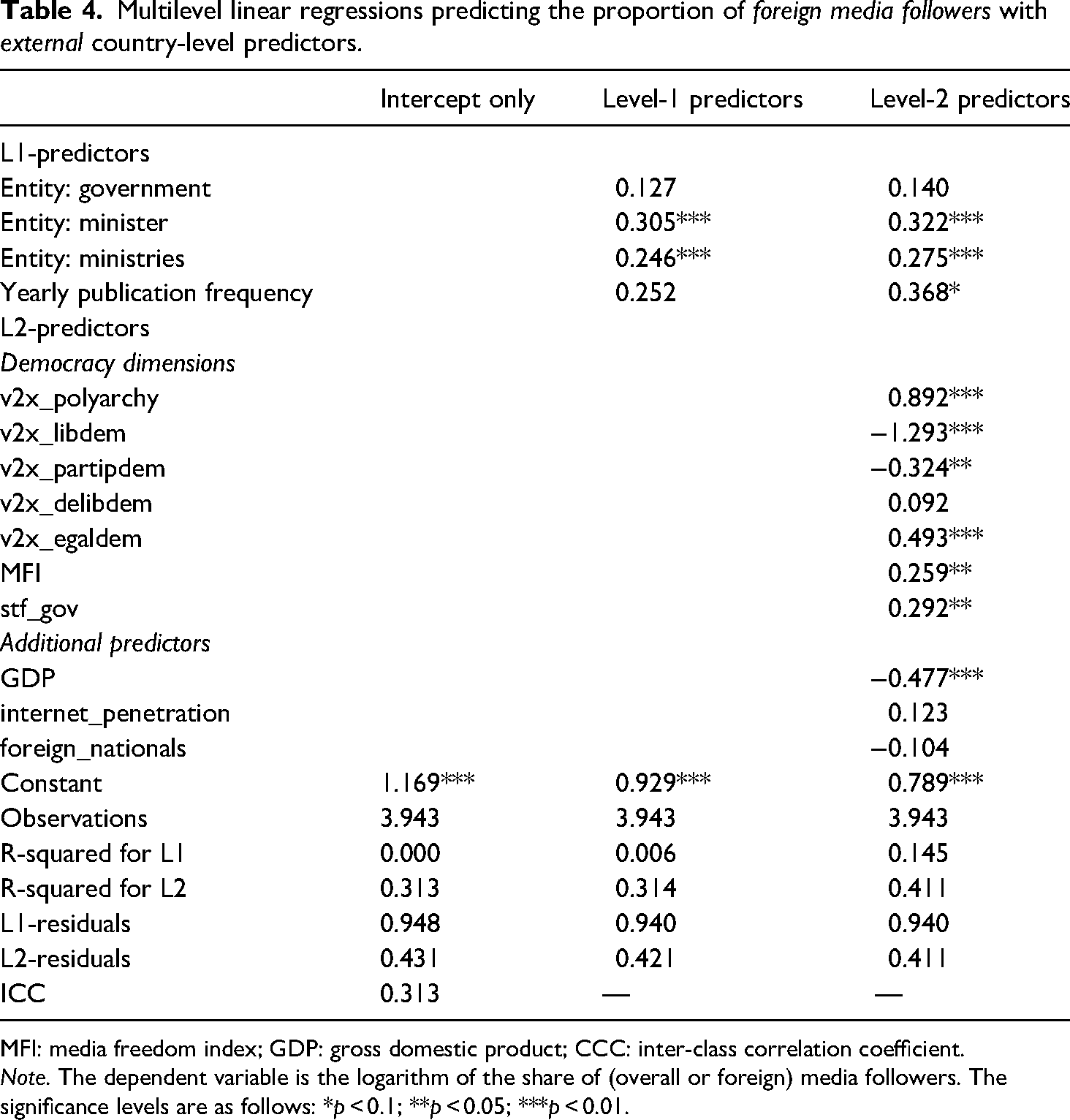
The results of the three multilevel regression models are given in Tables 2 to 4. The models explain the share of media followers of government accounts for different contextual factors linked to either the level of the government (Tables 2 and 3) or media (Table 4) accounts. Tables 3 and 4 are restricted only to the share of external media followers. The inter-class correlation coefficient (ICC) varies between 0 and 1 and tells us how much of the variance in (overall or foreign) media attention can be explained by the country-level predictors. It is calculated for each table and demonstrates the necessity to rely on multilevel modeling (0.50 for Table 2, 0.31 for Table 3, and 0.31 for Table 4). For more transparency, we also include the intercept only and level-1 predictors models (gray coefficients). Below, we interpret only the level-2 predictors models.
Multilevel linear regressions predicting the proportion of media followers with internal country-level predictors.
MFI: media freedom index; GDP: gross domestic product; CCC: inter-class correlation coefficient.
Note. The dependent variable is the logarithm of the share of (overall or foreign) media followers. The significance levels are as follows: *p < 0.1; **p < 0.05; ***p < 0.01.
Multilevel linear regressions predicting the proportion of foreign media followers with internal country-level predictors.
MFI: media freedom index; GDP: gross domestic product; CCC: inter-class correlation coefficient.
Note. The dependent variable is the logarithm of the share of (overall or foreign) media followers. The significance levels are as follows: *p < 0.1; **p < 0.05; ***p < 0.01.
Multilevel linear regressions predicting the proportion of foreign media followers with external country-level predictors.
MFI: media freedom index; GDP: gross domestic product; CCC: inter-class correlation coefficient.
Note. The dependent variable is the logarithm of the share of (overall or foreign) media followers. The significance levels are as follows: *p < 0.1; **p < 0.05; ***p < 0.01.
The results from Table 2 show that the more a country fulfills the ideal of deliberative democracy, the smaller share of media and journalist accounts are following government Twitter accounts (−0.210**). The remaining democracy indexes are not statistically significant. Furthermore, neither the MFI nor the public satisfaction with the government (stf_gov) plays a statistically significant role in explaining governments’ share of media and journalist followers. Looking at the additional contextual factors, there are positive effects of the internet penetration rate and GDP on governments’ media attention (0.177***). There is no significant effect on the share of foreign nationals. The results therefore do not support Hypothesis 1 according to which higher values on the democracy dimensions, will positively correlate with an increased share of media followers of government Twitter accounts. At the individual government account level, government accounts have a larger share of media followers than the heads of states (which is the reference category), while a higher publication frequency is associated with a lower share of media followers.
Table 3 includes only foreign media followers (i.e. from another country than the followed government accounts) and links the context-level predictors to the government accounts’ country level (as in Table 2). In this configuration, we observe that none of the country-level predictors is statistically significant, thus rejecting Hypothesis 2 suggesting that higher values on the democracy dimensions of the government country will positively correlate with an increased share of external media followers. In fact, only individual-level factors play a role in explaining the share of foreign media followers. For instance, ministers and their ministries have a larger share of media followers than the heads of states. However, publication frequency is not significantly associated with the share of foreign media followers.
Table 4 also includes only foreign media followers (as Table 3) but links the contextual factors to the account level of media followers. Media accounts from countries fulfilling the ideal of electoral democracy (v2x_polyarchy, 0.892***) tend to follow more foreign government accounts than media accounts from countries with lower values of electoral democracy (0.892***). A similar positive logic applies to media accounts from countries with higher values on the ideal of egalitarian democracy (v2x_egaldem, 0.493***), the MFI (0.259**), as well as with higher public satisfaction in the government (stf_gov, 0.292**). However, a negative relationship applies to countries fulfilling the ideals of liberal (−1.293***) and participatory democracy (−0.324 ***). Results thus partially support Hypothesis 3 according to which higher values on the democracy dimensions at the country level of media followers, will positively correlate with an increased share of external media followers of government Twitter accounts. This can be explained by the fact that media followers stemming from countries that have a high level of democracy achievement are more likely to cover external politics. Looking at the additional contextual factors, there is no effect of the internet penetration rate and the share of foreign nationals, but there is a negative effect of GDP (−0.477***). At the individual government account level, ministers and ministries have a larger share of media followers than the heads of states, and a higher publication frequency is significantly associated with a higher share of foreign media followers.
While providing important insights, the moderate R-squared and ICC values underscore the complexity of the factors influencing media follower shares and suggest that additional variables might be necessary to improve explanatory power. For instance, in Table 2, which explores internal country-level predictors for the overall share of media followers, the R-squared values show a modest increase from 0.033 with level-1 predictors to 0.383 with level-2 predictors, indicating that while the model explains some variance, a substantial portion remains unaccounted for. The ICC value of 0.449 reflects that nearly 45% of the variance is attributable to country-level factors, yet the model still leaves considerable unexplained variance. Furthermore, Table 3, which focuses on the proportion of foreign media followers with internal country-level predictors, shows even lower R-squared values, with a maximum of 0.154. This suggests that internal country-level factors have minimal impact on the share of foreign media followers, and the model's explanatory power is limited. The ICC value of 0.313 indicates that around 31% of the variance is due to differences between countries, but the model's overall performance is still limited. Table 4 shifts the focus to external country-level predictors for foreign media followers. The R-squared values in this table range up to 0.411. The ICC value of 0.313 suggests that external country-level factors explain a similar proportion of variance as in Table 3. However, the overall low R-squared values highlight that while external country-level predictors offer some explanatory power, the model still does not fully capture the variability in media follower shares.
In addition to the regression analyses, Figure 1 displays the network analysis of foreign media attention and government accounts. It illustrates the connections between government Twitter accounts and their media followers, with specific attention to the country of origin for both types of accounts. Each cell represents the share of government accounts (rows) and foreign media followers (columns). It highlights strong geographic and linguistic affinities. For instance, it demonstrates that the South European countries (i.e. Spain, Italy, and Portugal) and the North European countries (i.e. Iceland, Norway, Finland, Sweden, and Denmark) share the same media attention. There is also a linguistic affinity applying, for instance, with German-speaking countries (i.e. Germany, Austria, Switzerland, and Luxembourg) and English-speaking countries (i.e. Ireland and the UK). There are also signs of diplomatic connections, such as between France and Germany. Furthermore, the countries that are important players in the European Union (such as the UK, France, and Germany) receive comparatively a higher share of attention from non-Western European countries (see last columns). Overall, we observe that the share of foreign media followers is generally higher for countries such as Luxembourg, Belgium, Austria, and Switzerland. Rather than a strict division based on population size, this trend might reflect these countries' traditionally strong international orientations, due to factors such as geographic location, political roles within Europe, and most importantly—multilingual environments. In contrast, countries such as Portugal, Denmark, and Spain exhibit a lower share of external media followers, which may suggest a more domestically focused media landscape and a narrower language variety. This aligns with previous findings that news coverage in certain countries tends to be more nationally than transnationally oriented (Brüggemann & Kleinen-von Königslöw, 2013; Widholm, 2019).
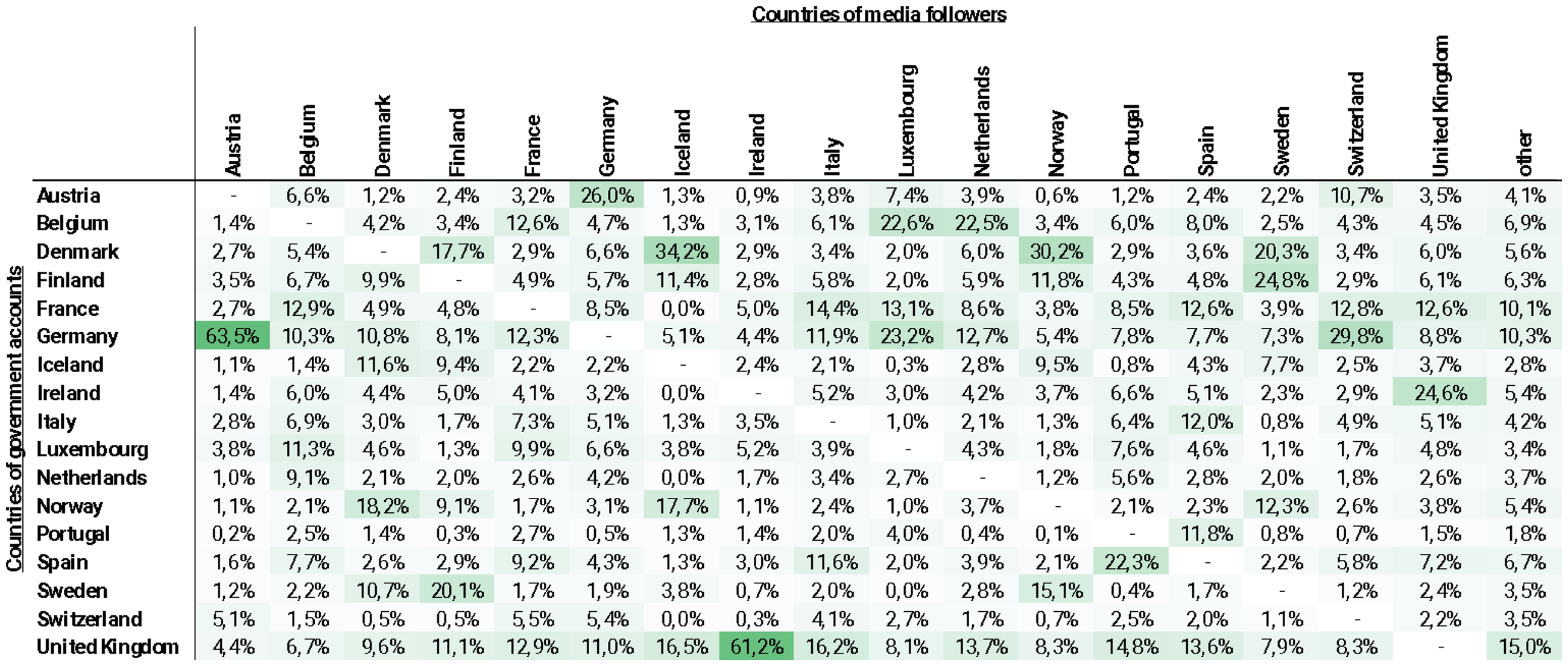
Network of government accounts (rows) and foreign media followers (columns).
Discussion of the main findings
The study examined three regression models to understand the factors affecting the share of media followers of government Twitter accounts. In the first model focusing on overall media followers, positive relations were found with the GDP and the internet penetration rate, and a negative relation with the fulfillment of deliberative democracy. Additionally, official government accounts have a larger share of media followers compared to the heads of state, but increased publication frequency correlates with a lower overall share of media followers. In the second model analyzing foreign media attention, we observe that none of the democratic country-level predictors are statistically significant. Only individual-level factors have an impact such as both ministers and ministries have a larger share of external media followers than heads of state, but publication frequency does not significantly affect the share of media followers. Lastly, the third model focusing on external media attention and linking the country-level factors to the level of the media accounts reveals that government accounts benefit from the attention of followers stemming from countries with higher levels of electoral and egalitarian democracy. Government accounts are also more followed by media accounts stemming from countries with higher MFI and higher levels of public satisfaction in the domestic government. However, negative relations are observed with higher values of liberal and participatory democracy. Similarly to the previous model, ministers and ministries gather more media followers than heads of state, and publication frequency positively impacts media followers.
These main findings of the study connect and reflect the literature in several ways. First, the study confirms the significance of Twitter in facilitating international media coverage, aligning with the literature that highlights social media's role in providing journalists with broad news dissemination without being physically on-site (Boumans et al., 2018; Cazzamatta, 2022). The findings also underscore Twitter's importance as an elite platform for discussing policy issues, resonating with previous research on its popularity among journalists and political figures (McGregor, 2019; PEW 2022). However, it is crucial to clarify that the study's findings reflect patterns of media attention rather than confirmed media coverage. While following a government account indicates potential interest, it does not necessarily result in actual reporting on that account's content. Media followers represent an initial, voluntary media connection that aligns with gatekeeping interests, but further research involving media content data would be needed to assess whether these follower relationships result in news coverage.
Second, the study results connect the gatekeeping theory by exploring how contextual factors such as media freedom, political pluralism, and government accountability influence gatekeeping decisions. This reflects the work of Barberá and Zeitzoff (2018), Silva et al. (2019), and Faber et al. (2020) who have highlighted the importance of media freedom and political institutions in shaping media dynamics. Moreover, by considering factors such as V-Dem dimensions, MFI, and public satisfaction with the government, the study aligns with the literature's emphasis on assessing various dimensions of democracy and governance in understanding media dynamics (Galtung & Ruge, 1965; Östgaard, 1965). Third, the study acknowledges the variability in gatekeeping tendencies across different government account types, such as state leaders, ministers, and ministries, confirming the established literature that highlights the influence of roles, communication strategies, and media relationships (Sutter, 2004; Mergel, 2013).
The implications of ministers having a larger social media following than heads of state can shed light on significant shifts in gatekeeping and international media coverage. When ministers have greater visibility online, they may exert more influence in shaping global perceptions and diplomatic narratives, potentially shifting the focus of international media coverage from traditional high-level state interactions to more direct engagements with global audiences. This could impact public diplomacy efforts by enhancing the ability of ministers to project their countries' messages more effectively and could alter how certain issues are prioritized and discussed in the media suggesting that international journalists prioritize accounts with targeted, policy-specific information. This aligns with gatekeeping theory, which posits that journalists favor sources that provide timely, relevant content for their audiences. Ministers, often responsible for specific domains such as foreign affairs or finance, likely address topics of transnational interest more directly than heads of state, whose messages are often broader or symbolic. This pattern underscores how specialized government roles on social media can shape transnational media attention, offering insights that are actionable and aligned with the needs of international journalists. It also aligns with findings in the public diplomacy literature, which highlight how local-level actors, such as mayors, increasingly influence international discourse and public diplomacy by engaging directly with international audiences and media on important topics (e.g. cities promoting sustainability or tourism) (e.g. Béal & Pinson, 2014).
The results from the follower network analysis demonstrate, however, that the variety of transnational media attention might be restricted to some geographic and linguistic patterns. Furthermore, the highest share of media followers remains largely domestic. This might be explained by the fact that content domestication still constitutes the main editorial focus of news (Rauchfleisch et al., 2021). In addition to that, the journalistic strategy might consider foreign newsworthiness if there is a connection between the country of origin of the news outlet and the events reported, or for the depiction of globe-wide issues such as climate change (Berglez, 2013). This is even more likely that people can gain rapid access to foreign news by consulting foreign media directly. The network analysis also confirms some of the findings from previous studies about international coverage. Most notably, even if Twitter offers opportunities for increased international coverage, important factors such as geographical and language affinities remain impactful (Guo & Vargo, 2020; Widholm, 2019).
Conclusion and outlook
The objective of this research was to enhance our comprehension of the interplay between government and media accounts on the Twitter platform. These two user categories are pivotal opinion leaders capable of influencing public sentiment formation. The study directed its focus toward the correlation between the percentage of media followers, diverse media, and political indicators. Additionally, it visually depicted the follower network, enabling a critical evaluation of the international connections prevalent in media coverage. Furthermore, the study pinpointed significant factors linked to an increased proportion of media followers for the government profiles.
However, this research has certain limitations. First, it focuses on Twitter due to its acknowledged significance as an information source and strategic communication tool for politicians and journalists. Nonetheless, the exploration of other social media platforms remains a prospective area. More important perhaps is the fact that we only focus on followers with at least five connections to governmental accounts. However, this makes sense in the light that the study focuses on elite/influential followers who can act as gatekeepers. Second, the study's temporal scope is specific, assessing follower counts at a singular instance. Yet, the share of followers can fluctuate in response to specific events (e.g. the COVID-19 pandemic), and the impact of both media and political indicators can evolve over time. Consequently, a future study might examine how contextual indicators influence changes in the size of media followers, as demonstrated by Haman (2020). Moreover, this study remained agnostic regarding the type of content posted by government accounts. Nevertheless, the nature of content could also motivate media and journalists to follow official profiles. Lastly, the study concentrated on a selection of European countries, necessitating the inclusion of non-European states to yield greater insights into even broader international media coverage. Exploring whether the proportion of shared media followers genuinely reflects the media coverage of foreign policy in national newspapers is an intriguing field. This would involve annotating (or semi-automatically categorizing) media content from each country's primary newspapers to measure the proportion of foreign news.
To conclude, this research has highlighted the main drivers behind government media followers across Twitter accounts. It also contributes to the literature concerning the interplay of agenda-setting dynamics between government and media entities. The findings can complement survey results concerning citizens' consumption of international news and the role that social media assumes in this context. This suggests that despite opportunities provided by Twitter for increased international coverage, journalists and media accounts mostly use Twitter to monitor national information (e.g. press releases from officials responsible for government communication) that can be more easily transformed into premade reliable information (Mansoor, 2021; Molyneux & McGregor, 2022). This research contributes to a more nuanced comprehension of the multifaceted interplay between government communication strategies, journalistic practices, and public engagement with political discourse intertwined in the digital realm. Additionally, it underscores the unique opportunities that Twitter provides journalists to cover and follow government accounts, thereby enriching democratic discourse and fostering greater transparency and accountability in governance.
Supplemental Material
sj-docx-1-ejc-10.1177_02673231251315911 - Supplemental material for Analyzing the share of media followers of government Twitter accounts across Western European countries
Supplemental material, sj-docx-1-ejc-10.1177_02673231251315911 for Analyzing the share of media followers of government Twitter accounts across Western European countries by Maud Reveilhac and Bohdan Trembovelskyi in European Journal of Communication
Footnotes
Data availability statement
The data was collected from Twitter (now X). In line with Twitter regulations, only the user and tweet identifiers can be provided by the authors upon request.
Declaration of conflicting interests
The authors declared no potential conflicts of interest with respect to the research, authorship, and/or publication of this article.
Funding
The authors received no financial support for the research, authorship, and/or publication of this article.

Supplemental material
Supplemental material for this article is available online.
Notes
References
Supplementary Material
Please find the following supplemental material available below.
For Open Access articles published under a Creative Commons License, all supplemental material carries the same license as the article it is associated with.
For non-Open Access articles published, all supplemental material carries a non-exclusive license, and permission requests for re-use of supplemental material or any part of supplemental material shall be sent directly to the copyright owner as specified in the copyright notice associated with the article.
