




Abstract
For a few years now, members of the government in Austria have been using Facebook to reach out to the public as well as to the mass media. Following normative guidelines and regulations, tax-funded government communication should be neutral, informative and autonomous of party politics. Using a multi-method approach, combining a structural analysis of formal criteria of Facebook accounts and an automated quantitative content analysis of Facebook postings, we investigated to what extent the official Facebook accounts of members of the last two Austrian governments were an exclusive tool for digital government communication. We found that not all representatives made use of Facebook. Moreover, tax-funded digital government communication on Facebook was not all neutral and autonomous of party politics. Based on our findings, we conclude that there is a lack of regulatory framework in Austria to govern tax-funded use of social media.
Introduction
In May 2017, Reinhold Mitterlehner, the then Austrian Vice-Chancellor (since 2014) and Austrian Federal Minister of Education, Research, and Economics (since 2013), resigned and left politics. When he left office, he retained his Facebook account, which was established in spring 2015 and used as the official Facebook account of the Austrian Vice-Chancellor and the Austrian Federal Minister of Education, Research, and Economics. This was despite the minister’s press and public relations teams producing most of the content, especially photographs and videos, making this a form of tax-funded government communication. Today, Reinhold Mitterlehner, as a ‘private person’, has a Facebook account with more than 23,000 followers. 1 This observation raises the question: to what extent the official Facebook accounts of the members of the Austrian government are an exclusive tool for digital government communication and, hence, should not be used for party politics and/or private matters. After all, government communication aims to be ‘neutral and informative’ (Busch-Janser and Köhler, 2006) as well as autonomous of party politics when communicating with citizens and promoting greater participation with the wider public.
The specific empirical setting for this study is Austria, as it is our primary country of research. Moreover, to our knowledge, empirical studies examining tax-funded digital government communication on Facebook do not exist for Austria. Facebook is the most often used social media platform among the Austrian population. In 2017, about 42% of the population had an active Facebook account (Statista, 2018). First, we will theoretically discuss the role of tax-funded government communication and present previous studies in the field. Second, the official Facebook accounts of members of the previous two Austrian governments are subject to an in-depth analysis. Applying a multi-method approach, we combine a structural analysis of the Facebook accounts and an automated quantitative content analysis of Facebook postings. The article ends with a discussion of the results and implications for government communication in practice and future research.
Government communication: Aims, tasks, and functions
Government communication has a mediating function and, following Gebauer (1998: 464), it is defined as tax-funded public relations and information policymaking of executive offices in order to explain and justify governmental decisions – within and outside of government, on the national as well as international level (see also Kocks and Raupp, 2014, 2015; Köhler and Schuster, 2006). Elected officials and, therefore, state entities are obliged to inform citizens about their actions (see among others, Gebauer, 1998; Kocks and Raupp, 2014, 2015) because policy decisions and political conduct demand public justification. Hill (1993) notes that government communication is about informing and helping citizens to participate in and to have an impact on government activities, decisions, and proposals. Hence, citizens must be allowed to access and approve and/or reject government decisions, actions and proposals to assess their impact on everyday life.
To inform citizens as well as to legitimize their doings, governments primarily address the mass media through press releases and go public in newspapers, radio interviews and on TV (Köhler and Schuster, 2006). The mass media serves as an intermediary (Jarren, 2008) between the government and the people, and thus, the mass media influences public opinion. However, since the mid-1980s, the media context of government communication is changing because of the ongoing and profound changes in individual communication as well as the platforms of mass communication, and through this, political public relations gained in momentum and complexity (Pfetsch, 1998). The importance of public relations for governments increased with the rise of digital media and digital communication tools. Since the early 1990s, digital media and digital communication tools have contributed to the constantly growing belief ‘that openness and transparency were desirable features of government’ (Marcella et al., 2005; see also DePaula et al., 2018). Moreover, successful communication is mandatory for building government-public relationships and for achieving and maintaining trust, credibility and compliance (Berner et al., 2011; Pieczka and Escobar, 2012). Especially with the rise of social media, governments have increased opportunities to inform and interact with the public to accommodate their needs and expectations (Borucki, 2016) as well as ‘educate citizens about governmental activities’ (Berner et al., 2011: 129).
The White House and the US Senate were the first to publish information about legislative matters and members of Congress under www.whitehouse.org and www.senate.org in the mid-1990s. In Europe, for instance, the German federal government has been represented on the web under www.bundesregierung.de since 1996 (Bieber, 2006). Today, government ‘[c]ommunication has, according to popular demand, not only to be fast, open and truthful but also highly responsive; governmental Public Relations are from this point of view expected to foster participation’ (Kocks and Raupp, 2015: 221). Social media such as Facebook provide a platform to directly inform citizens and to increase transparency, democratization and government-public participation (DePaula et al., 2018; Picazo-Vela et al., 2012).
In this context, government communication (in Western democracies) has to comply with legal regulations and is guided by normative principles (Gebauer, 1998). Government communication has to be ‘neutral and informative’ (Busch-Janser and Köhler, 2006) and autonomous of party politics. Government communication focuses on the dissemination of information and, unlike party politics, not on persuasion. 2 Political parties’ communication, however, utilizes a combination of informative and persuasive communication techniques to convince relevant stakeholder groups of their interest-led and goal-oriented messages (Rußmann, 2012). However, in practice, the separation between government communication and political parties’ communication (public relations) is hardly possible – the boundaries are fluid (Busch-Janser and Köhler, 2006). A prominent example is that of the private Twitter account of Donald J. Trump (@realDonaldTrump). Donald J. Trump highlights in his profile that he is using the account in his official position as 45th President of the United States of America and, 1 year after his inauguration, it had more than double as many followers as the official Twitter account of the President(s) of the United States of America (@POTUS).
Digital government communication
The question of fluid boundaries between government communication and party politics in the context of digital communication has not yet been addressed. The majority of studies on external digital government communication have examined the extent to which local and national government bodies are using different digital platforms for communicating with their stakeholders (citizens and the mass media) (Klinger et al., 2016). Avery et al. (2010) investigated the adoption of social media by public health departments in US communities but found only low adoption rates for social media tools. Graham and Avery (2013) reported similar results for US local governments, which underutilize social media. Standard communication tools were Facebook and Twitter, but only about a third of the local governments were posting on a daily basis. However, the use of interactive online platforms is slowly increasing, as shown by a more recent study by Klinger et al. (2016) on Swiss cities. More than 70% of Swiss cities used at least one interactive platform for their public communication.
Previous studies also show that specific standards within countries are often missing. In 2010, Liste and Sorensen (2015) analysed the content on the websites of all 430 Norwegian local governments and revealed great variations in the scope and depth of information available on local government websites. In 2011, Kocks and Raupp (2015) analysed the content of the websites of 18 governmental bodies in Germany. Almost all websites provided general information, such as on the organizational structure, history and current issues. However, the 18 governmental bodies were not willing to interact with the public. Graham and Avery (2013) show similar results for the United States, where local governments used their Facebook accounts mainly to provide information on upcoming events, thereby also neglecting information on policy issues. Even some years later, governments are still not using the dialogic potential of online communication for maintaining relations with the public and the mass media, as shown by Borucki (2016, 2018). Analysing the use of Facebook accounts in Germany, Austria, and the United Kingdom, during the 2014 European parliamentary election campaign – a time of intensive outreach to the public and the mass media – the author shows that governments hardly reacted to comments and questions. Government communication was focusing on posting videos and pictures. The dialogue was primarily taking place between the users.
Despite the fact that governments are still often reluctant to interact with citizens through social media and primarily focus on informing citizens, social media have the potential to reshape traditional boundaries between individuals, the public and the government in ways that dramatically alter how the public and their government exchange and develop solutions (Bertot et al., 2010). Based on a nationwide survey with more than 2000 American citizens, Hong (2013) notes that the use of social media increases trust in government-public relationships at the local and state levels.
The setting: Austria
Austria is a representative democracy. The country has a multi-party political system structure; its electoral system is based on the principle of proportional representation, and it has a consensus-based political culture. The National Council (Nationalrat) is composed of 183 members who are directly elected by universal suffrage for a 5-year term of office. Since the 2008 national election, the voting age for all elections has been lowered to 16 – the social-media-savvy cohort. Since the Second Republic (since 1945), coalition governments have always ruled Austria, with the exception of 1966–1983. Over the years, participation in elections decreased to an all-time low of 74.9% in the election held on 29 September 2013 (see Federal Ministry of the Interior, 2013). This unwillingness to vote is reflected in the lack of trust in politics: In the autumn of 2013, only 22% of Austrian voters trusted politics (OGM, 2013). In the 2013 elections, the governing parties lost votes: The Social Democratic Party of Austria (SPÖ) (26.8%) and the Austrian People’s Party (ÖVP) (24%) had the worst election results in their histories. Nonetheless, both parties retained an overall majority in the National Council, and the grand coalition was renewed (16 December 2013 to 18 December 2017). From December 2013 until May 2016, Chancellor Werner Faymann (SPÖ) led the coalition government (Government Faymann II). After his resignation, Chancellor Christian Kern (SPÖ) led the coalition government (Kern government, 17 May 2016 to 18 December 2017).
In May 2017, the Austrian People’s Party called for snap elections, which were held on 15 October 2017. The ÖVP won 31.5% of the votes, the SPÖ 26.9% and the Freedom Party of Austria (FPÖ) won 26% of the votes. The new coalition government of the conservative ÖVP and the right-wing populist FPÖ under the Chancellor Sebastian Kurz of the ÖVP was sworn in on 18 December 2017 and lasted only 525 days (Kurz government). Following the Ibiza affair (political scandal) on 17 May 2019, the Kurz government collapsed on 18 May 2019. On 27 May 2019, Sebastian Kurz and his government were ousted from power with a no-confidence vote in Parliament. New elections were held on 29 September 2019.
In 2017, Internet penetration in Austria was at 88.4% among those 14 years old and older (Statistik Austria, 2018). Of the various social media platforms, Facebook was (and still is) the most popular in Austria. About 42% of the population has an active Facebook account (Statista, 2018). Certainly, very few Facebook users are visiting Facebook pages used for political purposes. A mass survey conducted during and after the 2013 Austrian national election campaign found that less than 10% of the respondents who used (at least one) social media platform (40% of the 1504 respondents) were linked to a politician’s or a party’s social media page (Kritzinger et al., 2016). Of these people, only 20% had read opinions on a politician’s or a party’s social media page during or after the election, with approximately 5% posting an opinion online. However, the number of Austrians using the Internet and social media as their main source for political information (during national elections) has slowly risen, from 17% in 2013 to 21% in 2017 (Plasser and Sommer, 2018). Moreover, the basic understanding of the Austrian government is that citizens are to be taken seriously and to be involved in decision-making processes. For instance, in the Austrian government programme, from 2017, it is emphasized, ‘By expanding direct democracy, we will increase the opportunities for public participation in political processes’ (Austrian Government Program 2017–2022, 2017: 7, translation by the authors). Hence, government communication should make use of Facebook.
Research setting
Research questions
The aim of this study is to investigate: (a) the use of Facebook for external government communication by members of the Austrian government, the Chancellor, the Vice-Chancellor, the Federal Ministers, and the State Secretaries (www.bundeskanzleramt.gv.at/aufgaben-und-zusammensetzung-der-bundesregierung) and (b) the use of the accounts after the members of the government had left office. To focus on more than a single case, we included the previous two governments in our study, the Kern government and the Kurz government. This longitudinal approach allows us to identify similarities and differences between the governments. The Kern government consisted of the Chancellor, 13 ministers, and one state secretary. The Kurz government consisted of the Chancellor, 13 ministers, and two state secretaries.
Regarding the fact that the Austrian government aims at providing accurate and sufficient information to the public, the first research question to be considered concerns the online presence of the members of government: Did all members of the previous two Austrian governments have an official Facebook account to foster government-public relationships?
Considering normative principles and legal regulations, according to which government communication has to be neutral and autonomous of party politics, the second question that arises is whether members of the previous two Austrian governments used their official Facebook accounts for government communication only, or also for party politics or private purposes? To answer the second research question, we first examined formal criteria, such as the username and the account owner (see next section). This information tells us who is in control of the Facebook account that is managed by tax-funded government communication staff. Second, we analysed the content of the postings and the extent to which the information given is solely about (e.g. government activities, decisions, proposed solutions, planned projects). Again, as this content is displayed on the official Facebook account of a member of the government, and hence, managed by tax-funded government communication, it should not be used to promote party politics.
Data and method
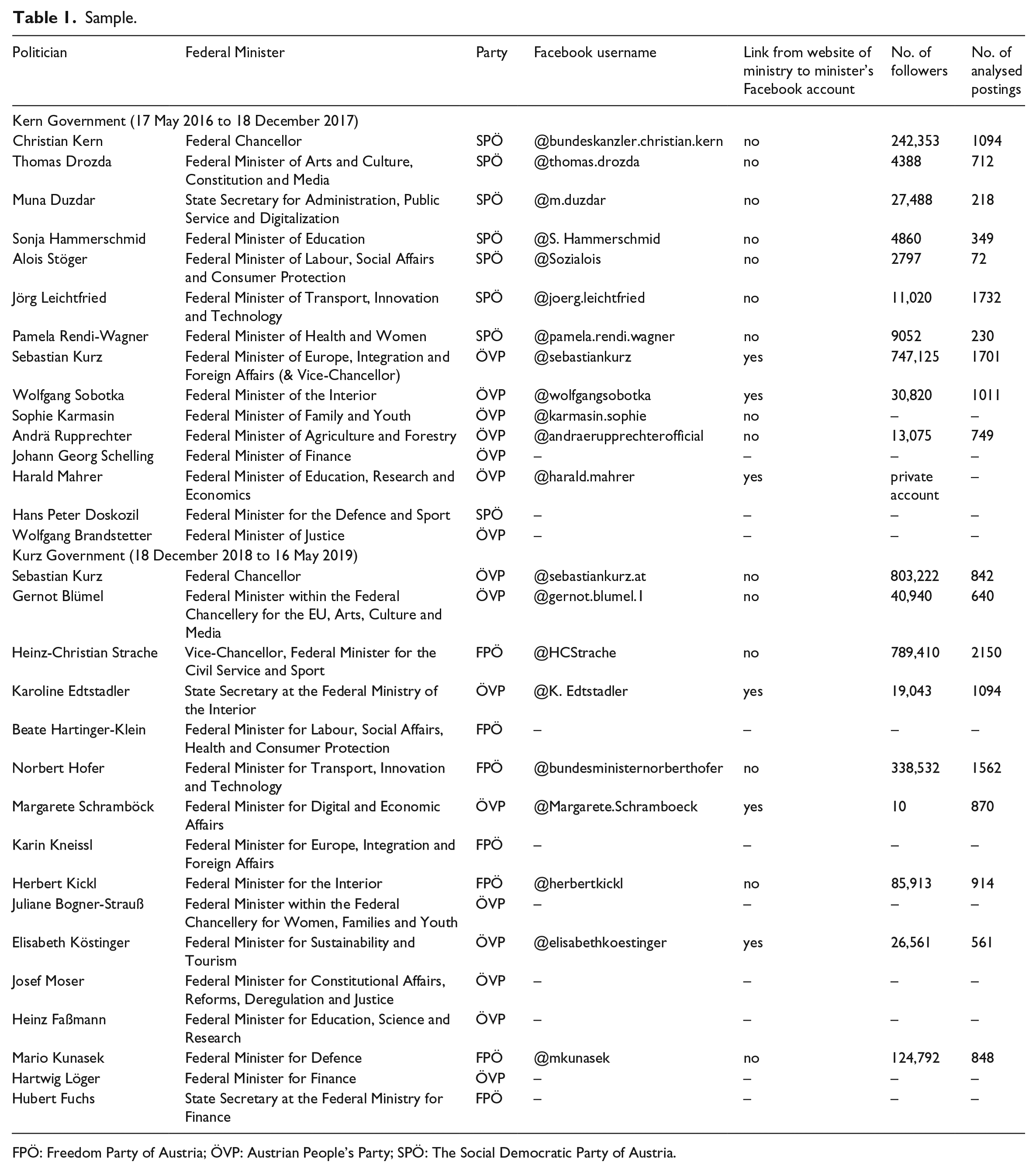
To find the Facebook accounts of members of government, we searched for a link to Facebook on the ministries’ websites. If these did not contain a direct link, we directly searched on Facebook. Using a multi-method approach, data collection was conducted in several steps. 3 For the first dataset, we conducted a structural analysis of all Facebook accounts within our dataset (see Table 1) by examining the following formal criteria, username, number of followers, about, account owner and profile picture. The data were collected in an Excel file. The first data collection was conducted on 15 September 2017 and thus during the 2017 national election campaign (Election Day 15 October 2017) – a time during which a higher interest of citizens in politics can be assumed. Also, the profile pictures were examined on 9 October 2017, a week before Election Day, as well as after the election on 19 October 2017. The collected data provide information on the Kern government. The second round of data collection on formal criteria was conducted on 18 April 2018 and hence, 4 months after the swearing-in of the Kurz government. This time data on the Kern government as well as on the Kurz government was collected. The third round of data collection on the formal criteria of Facebook accounts of the Kurz government was conducted on 18 July 2019.
Sample.
FPÖ: Freedom Party of Austria; ÖVP: Austrian People’s Party; SPÖ: The Social Democratic Party of Austria.
The second dataset consists of an automated content analysis of postings on the sampled Facebook accounts. For the automated retrieval of data from Facebook, we used the function getPage of the library Rfacebook (https://github.com/pablobarbera/Rfacebook) as well as Netvizz (Rieder, 2013). The fields ‘message’ and ‘story’ of the queried posts were automatically searched for the names of all ministers. For this, in most cases, the minister’s full name was used. Since the ‘story’ field was searched, posts that were originally posted on the politicians’ Facebook accounts but shared by other accounts of the sample were also tracked. Only the text of the posts was analysed; photos and videos were excluded. A limitation of this method is that only those posts that were public on the day of data collection are included. Deleted or hidden posts are not included in the data. For each representative in the sample, we collected data for the time she or he was a member of government (starting from the 2013 Austrian national election). The longest period of data collection was from 16 December 2013 to 16 May 2019 for the account of Sebastian Kurz as he had been in office since the 2013 Austrian national election. For his account, in total, 2543 postings were collected and analysed. Table 1 gives an overview of the Facebook accounts and the number of analysed postings.
Research findings
Members of governments’ presences on Facebook
Of the Kern government, which was ruling until December 2017, the Chancellor, 9 of the 13 ministers, as well as the state secretary had an official Facebook account (public person, verified account) (Table 1). The Federal Minister of Education, Research, and Economics, Harald Mahrer (ÖVP), only had a private account (@harald .mahrer, on invitation only) to which we did not have access and, therefore, the account is not part of this analysis. Two government members, Sebastian Kurz (Federal Minister of Europe, Integration, and Foreign Affairs and since May 2017 Vice-Chancellor) and Wolfgang Sobotka (Federal Minister of the Interior), linked directly from the websites of their ministries to their Facebook accounts. This practice emphasizes the official nature of the accounts.
Of the Kurz government, which was ruling until May 2019, only 9 of the 16 representatives had an official Facebook account (Table 1). Three government members, the State Secretary at the Federal Ministry of the Interior, the Federal Minister for Digital and Economic Affairs, and the Federal Minister for Sustainability and Tourism, linked directly from the website of their ministries to their Facebook accounts.
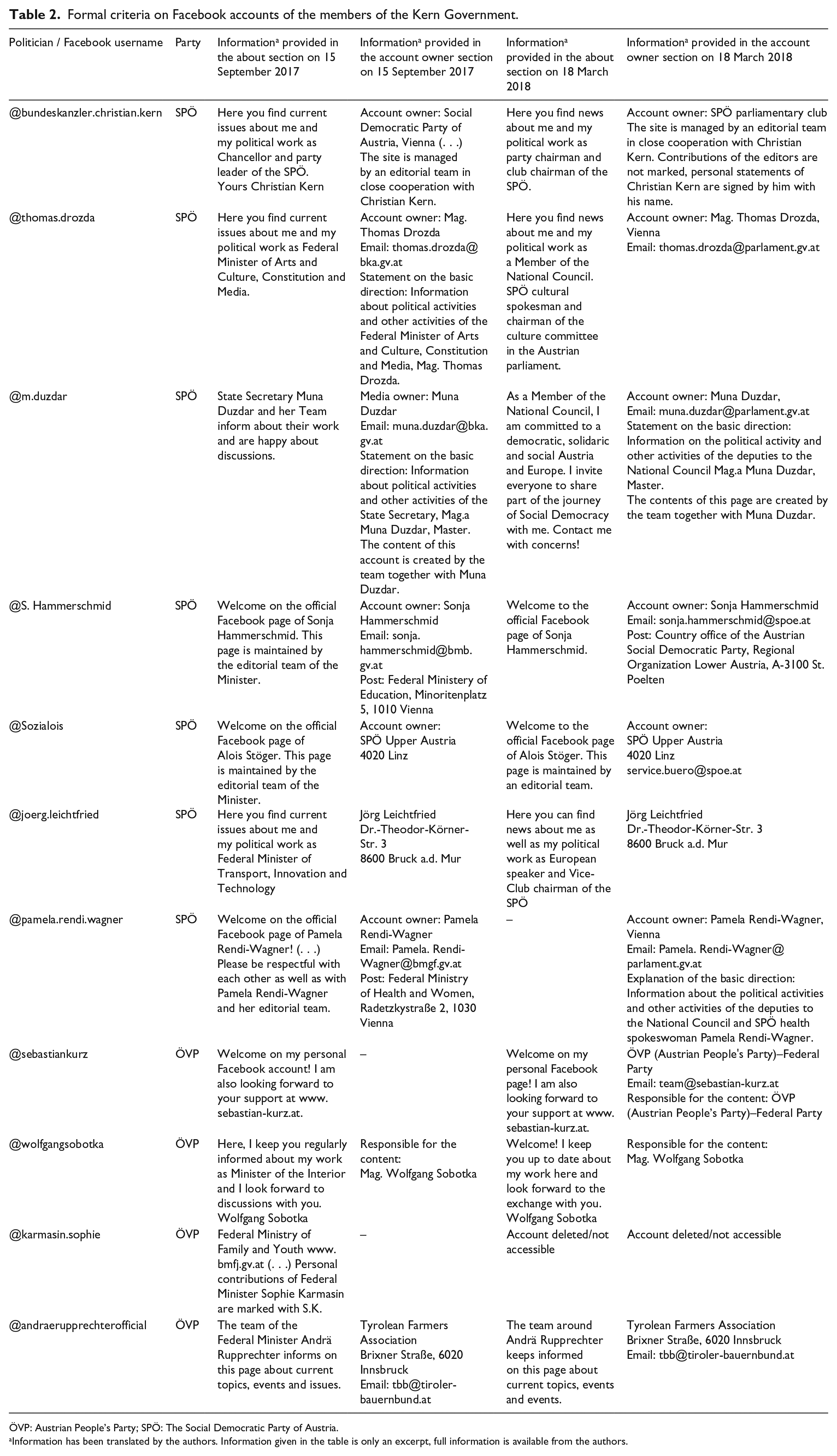
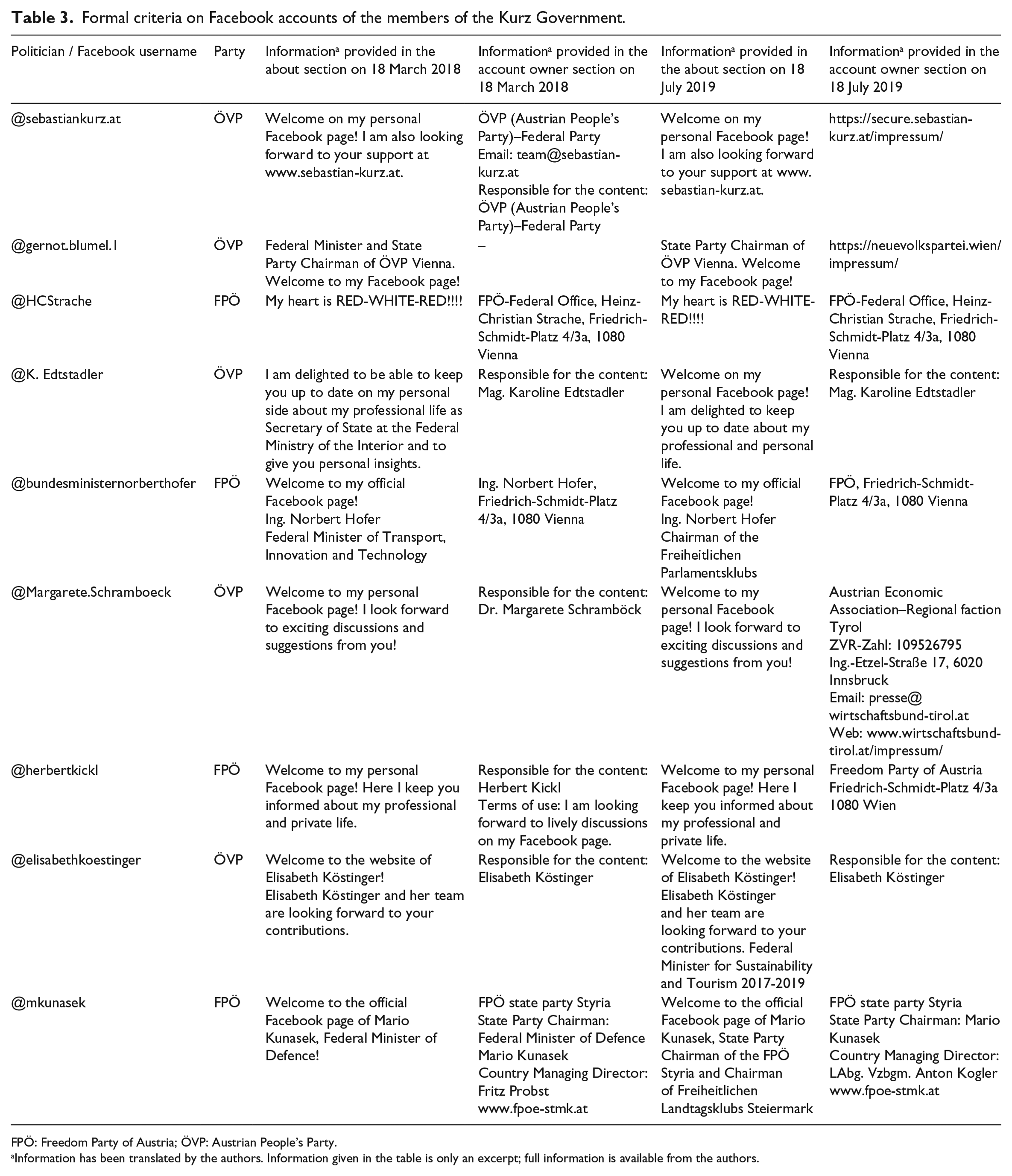
The data on the analysed formal criteria in column 3 in Table 2 for the Kern government and in column 3 in Table 3 for the Kurz government illustrate that the aim of the analysed Facebook accounts was to inform about the representatives and their work as well as to communicate directly with citizens. For instance, ‘Here, I keep you regularly informed about my work as Minister of the Interior, and I look forward to discussions with you. Wolfgang Sobotka’ (@wolfgangsobotka).
Formal criteria on Facebook accounts of the members of the Kern Government.
ÖVP: Austrian People’s Party; SPÖ: The Social Democratic Party of Austria.
Information has been translated by the authors. Information given in the table is only an excerpt, full information is available from the authors.
Formal criteria on Facebook accounts of the members of the Kurz Government.
FPÖ: Freedom Party of Austria; ÖVP: Austrian People’s Party.
Information has been translated by the authors. Information given in the table is only an excerpt; full information is available from the authors.
Hence, almost all of the members of the Kern government and about half of the members of the Kurz government followed normative principles of (digital) government communication by directly informing citizens. The information retrieved from the about and account owner section (see columns 3 and 4 in Table 2) shows that this was maintained, or at least supported, by their public relations teams and/or social media teams. On seven of the eleven Facebook accounts of the Kern government and on one of the nine accounts of the Kurz government, ‘the team’ or the ‘editorial team’ of the government member, which is referring to her or his press and public relations team and/or the social media team, was officially operating the Facebook account. For instance, ‘Welcome on the official Facebook account of Alois Stöger. This account is maintained by the editorial team of the Minister’ (@Sozialois) and ‘The team of the Federal Minister Andrä Rupprechter informs on this page about current topics, events, and issues’ (@andraerupprechterofficial) . Hence, representatives had support for posting new content and to increase their number of followers, but neither did they personally nor their parties cover the costs. The accounts were operated by tax-funded government communication.
However, in both governments, representatives used their personal name as the Facebook username. In the Kurz government, even the Federal Minister for Digital and Economic Affairs, Margarete Schramböck, and the State Secretary at the Federal Minister of the Interior, Karoline Edtstadler, who established new accounts in January 2018, were using their personal names as the username. Only three representatives made a clear connection to their position by adding it to their username. For instance, the former Chancellor Christian Kern had added chancellor (bundeskanzler) to his username (@bundeskanzler.christian.kern), and the Federal Minister of Labour, Social Affairs and Consumer Protection Alois Stöger referred with @Sozialois to his position as ‘social minister’ (Sozial = social). Moreover, the account owner information in column 4 in Table 2, as well as in Table 3, reveals that the ministry was not the owner of these individual accounts of Chancellors, ministers, and state secretaries. The owner of the accounts was either the representative herself/himself or the representative’s party. Hence, after leaving office, all members of the Kern government and of the Kurz government took the accounts with them and only changed the information in the about and account owner sections to their new positions (see columns 4 and 5 in Tables 2 and 3). For instance, the former Federal Minister of Arts and Culture, Constitution, and Media of the Kern government, Thomas Droszda, now informs in the about section that citizens find the following information on his account: ‘Here you find news about me and my political work as a Member of the National Council. SPÖ cultural spokesman and chairman of the culture committee in the Austrian parliament’ (@thomas .droszda, translation by the authors).
In their former positions as members of the government and with the support of public relations and/or social media teams, these representatives were able to gather many followers, and therefore, the majority of them have a larger followership than the average Austrian politician. Keller and Kleinen-von Königslöw (2018) note that a larger followership on Facebook might lead to more media coverage, attract as well as mobilize more supporters in the next election campaign, and that the politician receives more feedback on published messages, which can be evaluated and used for future communication. Another, rather disquieting consequence of current practices, is the fact that a member of the Kern government Sophie Karmasin as the owner of the Facebook account of the former Federal Minister of Family and Youth (@karmasin .sophie) was able to delete the official minister’s account. Thus, citizens, the mass media, as well as other government entities, no longer have access to it. To support openness and transparency of government communication, the accounts of former members of government need to be publicly available, or at least postings must be archived.
Content of Facebook postings of members of governments
Guided by legal regulations and normative principles, tax-funded digital government communication should be neutral, informative and autonomous of party politics. To examine whether ministers and state secretaries of the previous two Austrian governments used their official Facebook accounts for government communication only, or additionally for party politics or private purposes, as asked by the second research question, we investigated content-related aspects. First, we analysed the profile pictures on the accounts of members of the Kern government before and shortly after the 2017 Austrian national election. Second, using automated content analysis, we analysed how often each member of both governments referred to another member of government in the postings published during the period she or he was a member of the government.
The Kern government: Profile pictures during the 2017 Austrian election campaign
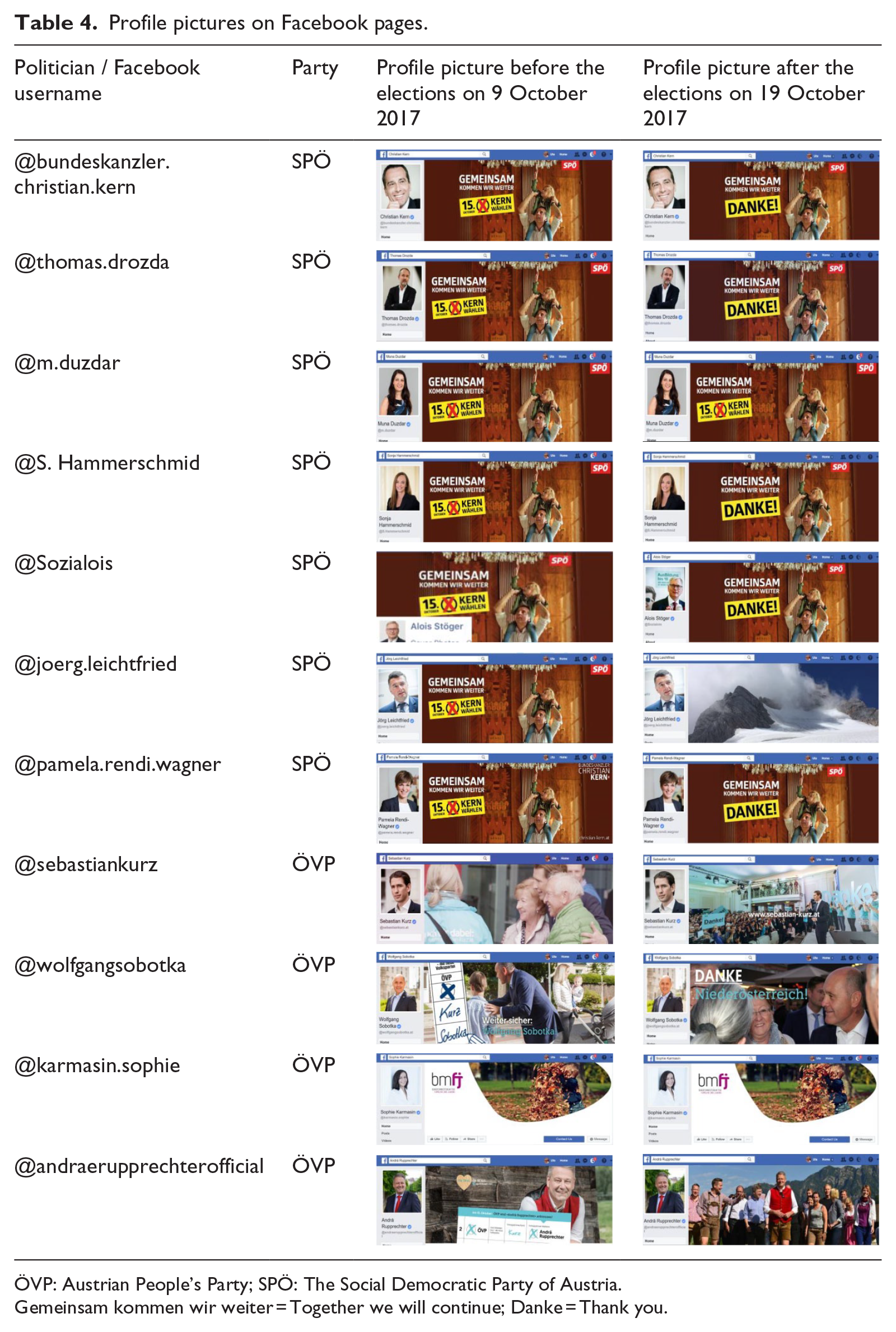
The data collected on the profile pictures reveal that all seven members of the Social Democrats, as well as three of the four members of the Austrian People’s Party, explicitly used their Facebook accounts to campaign for their party in the 2017 Austrian national election. In fact, Table 4 shows that the representatives of the Social Democrats all used the same profile picture, showing the then-Chancellor Christian Kern and calling users to vote for him (column 3, Table 4) and thanking voters for voting (column 4, Table 4). Only the conservative Federal Minister of Family and Youth Sophie Karmasin posted a profile picture that was referring to the ministry (bmfi, Bundesministerium für Familie = Federal Ministry for Family and Youth) and hence, it was autonomous of party politics.
Profile pictures on Facebook pages.
ÖVP: Austrian People’s Party; SPÖ: The Social Democratic Party of Austria.
Gemeinsam kommen wir weiter = Together we will continue; Danke = Thank you.
The Kern government and the Kurz government: Posting behaviour
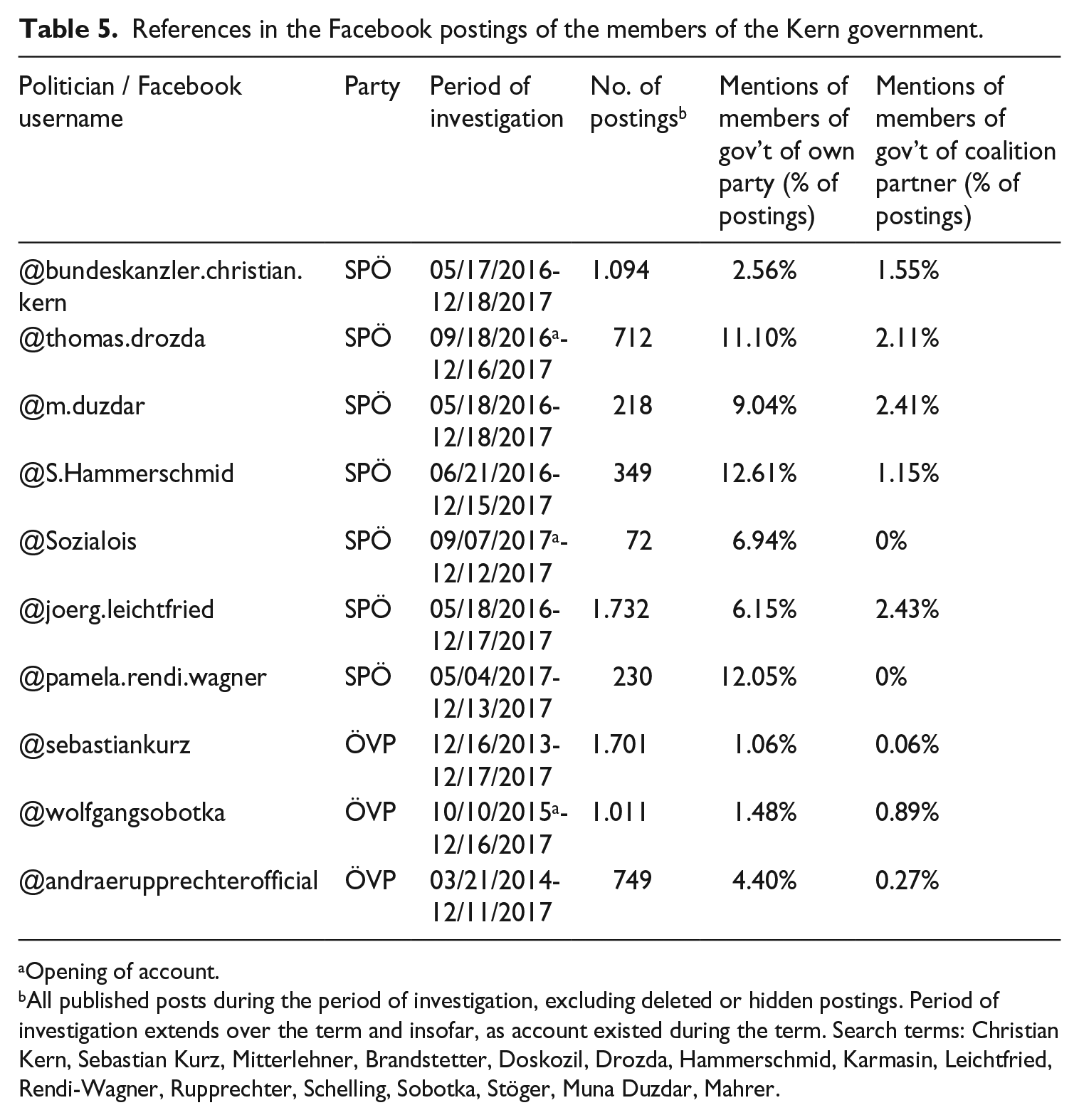
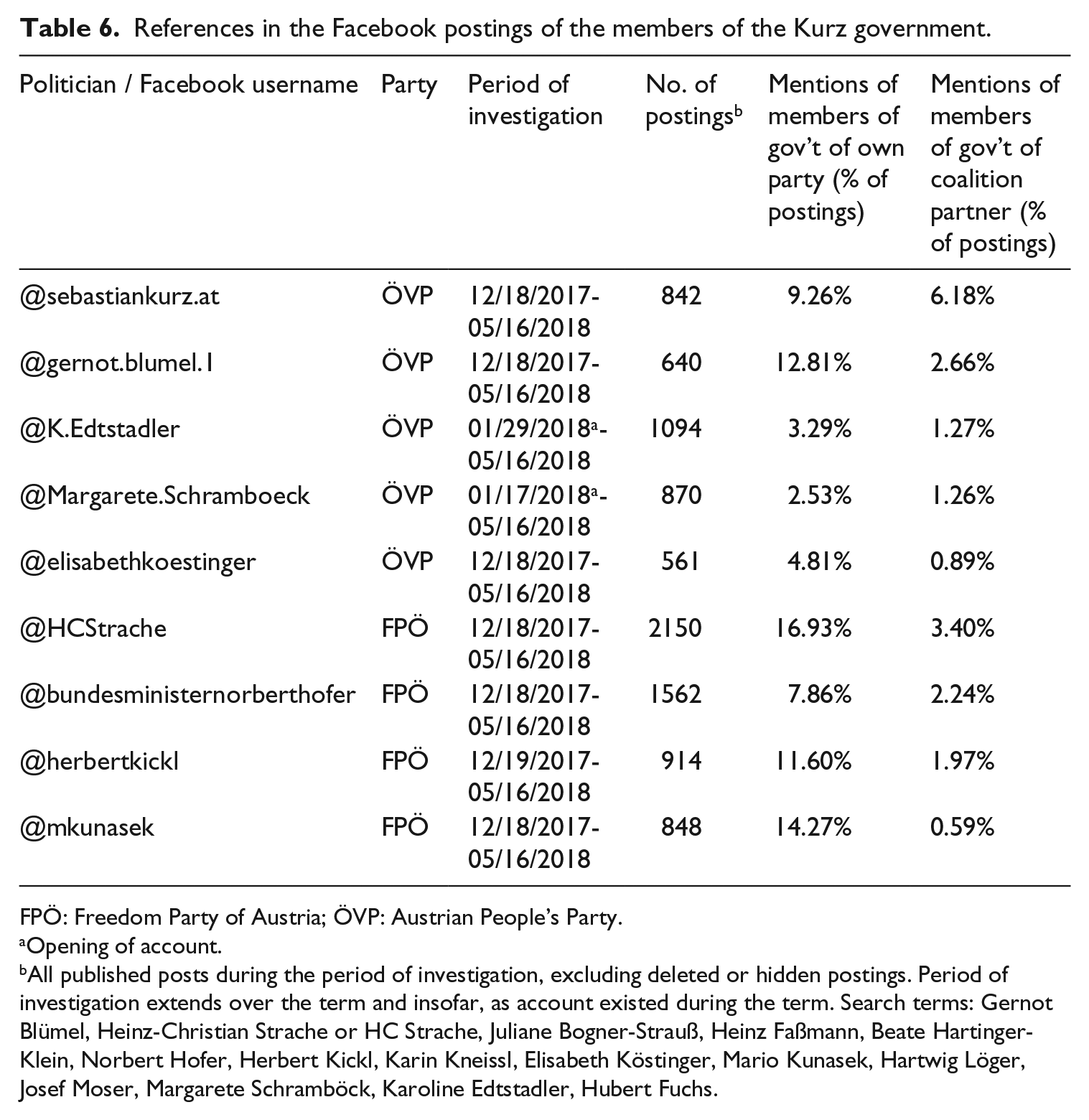
The automated content analysis of postings confirms that all members of the Kern government, as well as all members of the Kurz government, used their Facebook accounts to emphasize the work of their party within the government to a greater extent than to emphasize the work of the coalition partner (Tables 5 and 6).
References in the Facebook postings of the members of the Kern government.
Opening of account.
All published posts during the period of investigation, excluding deleted or hidden postings. Period of investigation extends over the term and insofar, as account existed during the term. Search terms: Christian Kern, Sebastian Kurz, Mitterlehner, Brandstetter, Doskozil, Drozda, Hammerschmid, Karmasin, Leichtfried, Rendi-Wagner, Rupprechter, Schelling, Sobotka, Stöger, Muna Duzdar, Mahrer.
References in the Facebook postings of the members of the Kurz government.
FPÖ: Freedom Party of Austria; ÖVP: Austrian People’s Party.
Opening of account.
All published posts during the period of investigation, excluding deleted or hidden postings. Period of investigation extends over the term and insofar, as account existed during the term. Search terms: Gernot Blümel, Heinz-Christian Strache or HC Strache, Juliane Bogner-Strauß, Heinz Faßmann, Beate Hartinger-Klein, Norbert Hofer, Herbert Kickl, Karin Kneissl, Elisabeth Köstinger, Mario Kunasek, Hartwig Löger, Josef Moser, Margarete Schramböck, Karoline Edtstadler, Hubert Fuchs.
The Kern government, especially members of the government belonging to the Social Democrats (SPÖ), mentioned their fellow party members more frequently in their postings. The data in Table 5 illustrate that three of the seven Social Democrats (@thomas .drozda, @S .Hammerschmid and @S .Hammerschmid) were mentioned in more than 11% of the analysed postings by fellow party members, whereas only in 2% or less of the postings they mentioned a conservative minister. The analysed postings of the three conservative ministers were more neutral.
In the Kurz government, members of the Freedom Party of Austria were more likely to promote fellow party members and their work. The Vice-Chancellor Heinz-Christian Strache (@HCStrache) mentioned someone from his party in 16.93% of his postings, but only 3.4% of his postings mentioned a member of the Austrian People’s Party. The Federal Minister of Defence Mario Kunasek (@mkunasek) mentioned someone from his party in 14.27% of his postings but referred to a member of the coalition partner in less than 1% of his postings. Similar results can be found for the Chancellery Minister (responsible for EU, Art, Culture, and Media), Gernot Blümel (@gernot .blumel.1), from the Austrian People’s Party; 12.81% of his postings referred to a member of his party and only 2.66% to members of the coalition partner FPÖ.
The comparison for both governments shows that the content of postings on the Facebook pages of members of the conservative ÖVP were more autonomous of party politics. With the exception of the former Chancellor Christian Kern of the Social Democratic Party. Albeit far from being neutral. Unfortunately, the collected data do not explain this result. Moreover, as to our knowledge, this is the first study of its kind; we do not have other studies to compare the data to, and hence, we are not able to make any assumptions on this finding. Figure 1 represents a comparison of Facebook postings.
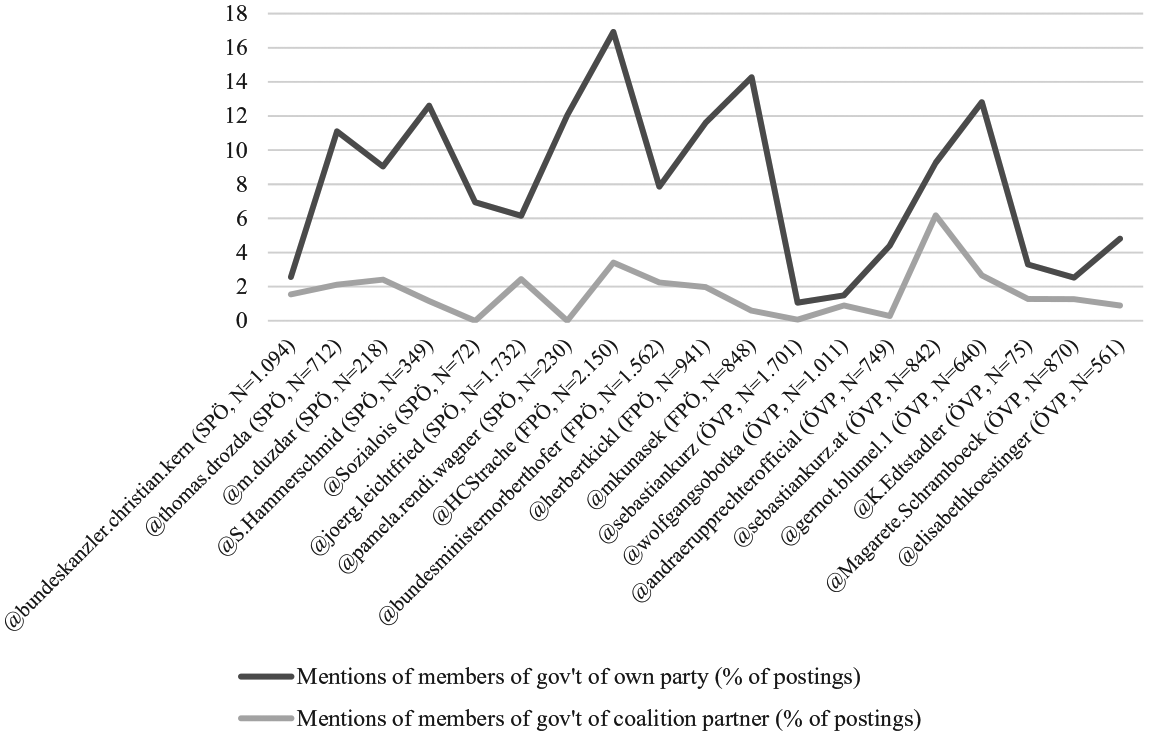
Comparison of Facebook postings.
Discussion and conclusions: Need for a regulatory framework
Starting from an observation in the Austrian political landscape, this study investigated tax-funded digital government communication in Austria on Facebook. Answering the first research question (did all members of the previous two Austrian governments have an official Facebook account to foster government-public relationships?), the study reveals that 11 of the 13 members of the Kern government had an official Facebook account, but this was true for only 9 of the 16 members of the Kurz government. Taking into account that the aim of government communication in Austria is to ‘increase the opportunities for public participation in political processes’ (Austrian Government Program 2017–2022, 2017: 7, translation by the authors) and to foster government-public relationships, it is rather surprising that not all representatives are present on Facebook and that their presence on Facebook is declining over time, especially as each member of the government had a public relations team and/or social media team to support the representative’s Facebook communication, even though not a single Facebook account is owned by the government entity (Chancellery, ministry) it is representing.
In addition, our findings on the second research question, which focused on the content of the analysed Facebook accounts (whether members of the Austrian governments used their official Facebook accounts for government communication only, or also for party politics or private purposes?) show that tax-funded digital government communication in Austria is not all neutral and autonomous of party politics. All members of governments used their official Facebook accounts to inform about, to support and promote their parties.
Based on our findings, we conclude that there is a need for standardization of rules and procedures governing the use of social media, as well as other online channels (Picazo-Vela et al., 2012). Legal frameworks on digital government communication are still missing: The social media accounts of ministries are treated as those of a public institution, but the social media accounts of ministers are treated as personal sites, and not a single Facebook account is owned by the government entity (Chancellery, ministry) it is representing (Personal Information by the Federal Chancellery, 17 July 2019). Moreover, the content of the Facebook accounts of ministries is archived in the Austrian state archive (Personal Information by the Federal Chancellery, 17 July 2019) and hence, once a new government assumes power and new ministries are established, the public still has access to all previously posted content. However, the increasing trend of personalization of government communication emphasizes the importance of the individual Facebook accounts of ministers. Borucki and Jun (2018) note that citizens perceive official social media accounts of individual government members more than the official ministry pages, which primarily serve for internal communication. Directly after the collapse of the Kurz government, the parties spent thousands of Euros on Facebook advertisements on the personal Facebook accounts of their politicians. For instance, on 28 May 2019, a day after Kurz and his government were ousted from power with a no-confidence vote in Parliament, his party spent 26,610 Euros on Facebook advertisements on his account alone (Der Standard, 2019). This practice highlights the importance of individual Facebook accounts.
One issue is that the Austrian law does not take into consideration social media or other online channels of government actors (Personal Information by Federal Chancellery, 17 July 2019). Current laws and regulations of tax-funded government communication need to be updated to include the use of digital communication channels – particularly on their use in external communications. For instance, to avoid that Facebook accounts are deleted, and hence, no longer accessible to the public and the mass media, to avoid that ministers take their accounts with a relatively high number of followers with them for private use, or are using these accounts to reach out to voters in the next election campaign (Keller and Kleinen-von Königslöw, 2018). Power-holders have to be publicly accountable. Access to and control of tax-funded digital government communication cannot be in the hands of a political party or a single politician. For instance, introducing generic pages for ministers can contribute to better fiscal stewardship.
With this assessment of empirical patterns in government communication, it is our desired outcome to contribute to a much-needed discussion that the Austrian government has so far failed to initiate. Our findings on two governments show that legally binding regulations are in need to ensure a fair use of Facebook as well as all other social media, because members of government are currently not acting according to normative principles of external stakeholder communication (public relations), such as optional self-control, self-regulation and self-reflection (Bentele and Grünberg, 2013). Apart from this practical implication, the findings of this study also emphasize the importance of the discussion of ethical aspects of government communication within the scientific community.
This study does have its limitations, one of which is that we did not include various social media platforms. Albeit, we assume that the findings on the most often used social media platform in Austria are probably displaying a certain status quo. A question is also how governments in other countries handle this matter. In many European countries, such as Germany, government communication is partly tax funded. Due to limited resources, another limitation is that we did not include follower comments and representatives’ replies to analyse interaction processes between the members of government and citizens. Although, when observing the accounts, representatives generally do not seem to comment much. Interviews with members of the government and/or their public relations and/or social media teams would help to learn more about their daily work, guidelines and intergovernmental collaborations. Future studies should focus on this topic because research can be helpful for the development and the adoption of rules, norms and policies of tax-funded digital government communication, which is hoped would ultimately change current practices, increase the level of citizen trust in government, and enhance government-public-relationships.
Footnotes
Acknowledgements
All authors, Uta Russmann, Markus Hametner and Eduard Posch, have agreed to the submission and the submitted article is not currently being considered for publication by any other print or electronic journal.
Authors’ Note
Eduard Posch is currently associated with Zukunftsinstitut GmbH, Germany.
Funding
The author(s) received no financial support for the research, authorship, and/or publication of this article.
