




Abstract
Journalists’ privileges and the perceived value of their contributions are being affected by the increasing belief that journalistic work is a product that can be produced by anyone. This perspective should prompt questions related to the conceptualization of journalistic expertise and the functions of educational institutions that assert they teach it. This research contributes to scientific knowledge by introducing an alternative scholarly approach toward defining journalistic expertise—a communication perspective. Prestige in the digital landscape is increasingly associated with the ability of communicators to package information conveying their expertise to various publics. We proposed a set of variables to assess expertise: journalism-related degree, previous professional journalism experience, affiliation, journalism awards, specialization, technical skills, journalism skills, and public service through a content analysis of public Facebook fan pages. The results revealed that journalists communicated their expertise by highlighting their affiliation, previous experience, and specialization(s).
Journalism scholars argue that journalism is a field that possesses unique concepts of theoretical interest (Shoemaker & Reese, 2014). A lack of definitional and boundary consensus concerning the concepts delineating the field of journalism may be resulting in journalism being classified as a marginalized component of communication studies (Donsbach, 2014). As a result, it would be expected that scholars and journalists take a proactive approach to intellectually assess or publically defend its practical and theoretical value (Atton, 2002; Deuze, 2005; Oreskes, 2000; Papacharissi, 2014). Yet research shows that journalists are unable to clearly articulate how their contributions differ from amateur content producers. Instead of an articulation of their value, employed journalists simply dismiss journalism produced by people not employed at a mainstream news organization (Atton, 2002; Örnebring, 2013). Challenges to the uniqueness of their expertise are occurring because past demarcations defining journalism as “an ongoing social process as filtered through the apparatus of the news industry” are no longer valid as freelance journalism and self-publishing tools become more prominent (Johnstone, Slawski, & Bowman, 1976, p. 6). The diversity of amateur and professional news media producers has prompted the statement that journalism is not one entity joined together by values and standards, but rather present-day society consists of multiple journalism(s) (Atton, 2002; Papacharissi, 2014). To confront these recent disruptions, we review existing scholarly interpretations associated with the present journalistic expertise paradigm. We then introduce a perspective to encourage alternative scholarly dialogue in research about what components represent the journalistic expertise construct.
The present approaches used to study journalistic expertise tend to be from a sociological, or a boundary justification or conflict, approach. The review of literature reveals insight about group justification behaviors from this particular perspective, but this approach does not illuminate how journalists obtain expert status or share items to use in quantitative research, which can assist in predictions of factors influencing variations in journalists’ expertise (Abbott, 1988; Eraut, 2005).
The expertise analytical lens assumes that journalists possess distinct obligations and proficiencies (Ugland & Henderson, 2007). Consequently, this study redirects journalistic expertise research by investigating the empirical possibility of interpreting it through a communication perspective. In this study, journalistic expertise is defined as the skills, knowledge, and/or abilities associated with journalism-related tasks or activities. The flood of self-proclaimed experts requires individual professional communicators to commutatively claim their place as experts in the digital media landscape. The self-marketing movement, also known as personal branding, suggests that individuals need to learn how to communicate individual expertise to secure employment and establish credibility (Wenger & Owens, 2013). As a result of recent common practices, scholars are now able to observe individuals displaying their journalistic expertise. We investigated whether and to what extent journalists communicated expertise through the following variables rooted in the literature review: journalism-related degree, previous professional journalism experience, affiliation, journalism awards, specialization, technical skills, journalism skills, and public service. We carried out a quantitative content analysis of journalists’ Facebook fan pages to study how they communicated expertise on a public platform. Content analysis may be an effective approach because previous interview research showed that journalists struggle verbalizing their areas of expertise (Örnebring, 2013). The consensual specification of expert knowledge enables professionals to argue that they play the special roles in society as found argued by boundary management scholars. Content analysis of communication messages at this point in time may be fruitful because communication messages provide insightful evidence about the mindset of the person who produced the message (Fico, Lacy, & Riffe, 2008). Scholars could then use these results to include in their interview and survey questionnaires to assist in the articulation and testing of journalistic expertise.
Journalistic expertise
We assume that an increase in a loss of control over practical knowledge areas is weakening the group’s ability to argue that journalists possess expertise. Reich (2012), inspired by the expertise work of Collins and Evans’ (2002) expertise model, argued that journalists do not possess journalistic expertise, but they instead possess interactional expertise because they need to know how to extract information from recognized human experts and present sources’ knowledge and opinions of complex issues. Additionally, the field of journalism is not considered a profession, or a group that possesses a unique body of knowledge, by many outside entities because there are no licensing requirements that mandate journalists to follow guidelines on how to select, construct, and disseminate information (Johnstone et al., 1976; Kovach & Rosenstiel, 2001). Expertise recognition, however, results in increased confidence and reliance (Thomas-Hunt & Phillips, 2004). Trust in journalists’ ability to convey accurate, unbiased information is declining, which is likely having an impact on journalists’ expertise claims (Wynne, 1996). In fact, a notable of portion of the US public feels that the news media have misled them and do not represent their best interests resulting in the public seeking alternative news sources. A decline in traditional news media consumption has led to companies investing their advertising money into other publishing companies resulting in fewer journalists finding work in the news business (Bureau of Labor Statistics, 2015; Mitchell & Holcomb, 2016). Journalism scholars, however, argue that journalism is a semi-profession (Beam, 1990), while the majority of mainstream working journalists argue it is indeed a profession in which their expert knowledge is necessary for connecting citizens to issues and organizing information in an accurate manner (Delano & Henningham, 1996; Deuze, 2005). A revisitation related to their uniqueness needs to take place because public relations and marketing practitioners are developing their own in-house newsrooms; the blending of broadcast and print applications in online environments has led them to encroach on each other’s turf within a single community, and technologies have opened up membership to citizen journalists, alternative journalists, participatory journalists, bloggers, and so on prompting followers of the field to have philosophical conversations about journalism’s functions and value (Carpenter, 2008; Deuze, 1999; Donsbach, 2014; Nikunen, 2014; Project for Excellence in Journalism, 2007; Zelizer, 2004).
The interpretation of expertise is challenging and varies depending on scholarly domain. Cognitive psychology researchers, for example, examine how experts engage subject areas to further develop their abilities (Eraut, 2005). Fields include sports, chess, education, medicine, for example (Bedard & Chi, 1992; Berliner, 2004; Maheswaran, Sternthal, & Gürhan, 1996; Patel, Glaser, & Arocha, 2000). They compare experts and novices to identify to what extent experts are more efficient in addressing problems or tasks than novices. Tasks are directly related to a specific area because an expert is “an individual with specialized knowledge of the domain” (Patel & Groen, 1991, p. 96). Basically, experts are argued to think differently in comparison to non-experts (Adelson, 1981; Farrington-Darby & Wilson, 2006). They possess a higher level of knowledge in which they are able to organize information to efficiently solve problems and accomplish tasks in complex environments (Bedard & Chi, 1992; Shafto & Coley, 2003).
In journalism research, however, the concept of journalistic expertise has been primarily investigated as a boundary management, or sociological, phenomenon. From this perspective, journalists do not possess unique knowledge, but rather the profession encompasses several rationalizations as to why their existence is necessary (McCombs, 1974). Thus, the research outcomes of this line emphasize narratives and justifications. Democratic normative rationalizations are used to combat professions from encroaching on their intellectual turf and enable them to construct boundaries around their areas of expertise (Carlson, 2016; Carlson & Lewis, 2015; Deuze, 2005; Kunelius & Ruunsunoksa, 2008; Lewis, 2012; Schudson & Anderson, 2008). For example, Deuze (2005) has argued that the profession of journalism is an ideology in which they advance narratives defending their ideals within society, while Kunelius and Ruunsunoksa (2008) stated that journalism is a culture held together by journalistic principles and values. Based on the present journalistic expertise paradigm, the profession is a loose entity that continually manages its boundaries in two ways: (1) dismissing the value of content produced by other individuals who publish news information and/or (2) defending their normative place within society.
The boundary perspective has contributed to knowledge by capturing how journalists justify their place through normative language; however, Friedson (2001) has stated that the boundary management, perspective is limited in its ability to predict and explain expertise. The group conflict-based perspective is valuable in illuminating how journalists enact jurisdictional control within and across professional systems, but it also begs an exploration of whether they indeed possess a specialized body of knowledge. We introduce an alternative perspective to journalistic expertise—the communication of journalistic expertise. If journalism is to be considered distinct, scholars need to articulate a body of knowledge (or expertise) because a profession’s intellectual labor should be unique and altruistic/ethical to gain public trust and profit.
Communication of journalistic expertise
An examination of journalists’ communication behaviors may reveal more concrete indicators regarding how journalists define themselves as experts. The expertise approach assumes that journalists represent a distinct professional group of people who are more efficient and competent at collecting and disseminating news than novices. Treem (2012) examined expertise from a communication perspective arguing that workers must adopt ways to communicate to other employees that they are experts in knowledge-intensive institutions. In a qualitative study of two public relations firms, he found that experts communicated to other workers that they were able to collect information more efficiently, had better recall, and were more detail-oriented than non-experts based on his observations.
We argue that communication science is an appropriate perspective in the advancement of journalistic expertise because people are increasingly choosing to communicate their expertise on the web. This study is focused on an individual-level analysis by concentrating on professionals rather than professional systems. Social media profiles are presently the primary way individuals brand themselves as experts (Labreque, Markos, & Milne, 2010). Thus, we assume the expertise of journalists empirically exists in some observable form as public self-presentation is “always overly behavioral” (Leary & Kowalski, 1990, p. 35). Holton and Molyneux (2017) found that journalists used social media pages “to craft themselves as ‘true journalism experts’” (p. 8), and Carpenter, Kanver, and Timmons (2016) found that the majority of textual information found on journalists’ Facebook pages was mostly professional rather than personal in nature, but approximately 30% of the sampled journalists shared information on both their work and personal lives with audiences. Journalists often disseminate information related to their identities on their individual channels (Hermes, Wihbey, Junco, & Aricak, 2014). People present positively framed identities to various search-engine publics in hopes of increasing their self-status (Efimova & Grudin, 2008; Labreque et al., 2010). Likewise, users subscribe to individual channels, such as Facebook pages, because they enjoy receiving information from a notable individual or organization (Bagozzi & Dholakia, 2006). In its essence, social media sites tend to reflect individuals highlighting perceived positive personal and professional attributes about themselves through the sharing of text, pictures, and other props (Carpenter, Kanver, & Timmons, 2016).
Journalistic expertise indicators
The goal of this study is to identify to what extent the literature review guides us in determining expertise at a behavioral level. Expertise is a multi-faceted concept. Baer (1987) argued, “Expertise and specialized knowledge are at the core of professions” (p. 532). Expertise is related to occupational control (Abbott, 1988); however, ambiguity exists concerning whether journalists can be considered experts because technologies have empowered more people to produce, write, and publish content as well (Atton, 2002; Carpenter, 2008). A dilution of expertise stems from the reality that journalists are expected to share work tasks and demonstrate flexibility using multiple technical skills to report on a broad range of topics (Nikunen, 2014). In the past, journalistic expertise was defined by employment at professional news organizations that represent a particular medium. Radio reporter, television producer, and newspaper editor were titles that communicated their expertise to other journalists and to the public. Today, journalists need to communicate their expertise because affiliation and title may no longer be a sufficient definition of expertise (Ugland & Henderson, 2007), especially with the growth in the number of freelance and citizen journalists (Carpenter, 2008; Carpenter et al., 2016).
The lack of clarity concerning journalistic expertise may be partially attributed to few scholars working to define expertise. Donsbach (2010, 2014) argued that all journalists should possess five general competencies as a knowledge profession: (1) possess knowledge in history, current affairs, and analytical thinking; (2) have expertise in subjects outside of journalism; (3) have scientific knowledge about communication processes; (4) master journalistic skills; and (5) conduct himself or herself based on a code of professional ethics. This typology helps organize scholarly efforts, but it also presents questions related to the conceptual and empirical specification of abilities needed in areas such as journalistic skills, communication processes, history, and analytical thinking. Still, as Donsbach (2010) points out, it is important to continue dialogue in scholarly journals to understand what makes journalism distinct from other occupations.
Generally, scholarly literature shows that journalists define their expertise as the ability to evaluate and contextualize information. For instance, Örnebring (2013) asked professional journalists to articulate how they differed from citizen or amateur journalists and found that the sampled journalists had difficulty articulating how citizen and professional journalists differed, but they felt strongly they were different. For the most part, they argued that professional journalists possessed the ability to identify news and verify information based on a code of ethics. Interestingly, the increasing pressure to publish on multiple platforms has left them with less perceived time to verify information (Nikunen, 2014). Anderson (2013) found similar findings showing that journalists believed that original reporting, first-hand observations, and news judgment distinguished them from news aggregators.
Communication indicators of journalistic expertise
The following section highlights the items that journalists may acknowledge on social media profiles to communicate their expertise to the public based on the review of literature. Data must be gathered to determine whether such indicators are a fruitful area of exploration. It is expected that journalists will describe their journalistic expertise using a certain cluster of characteristics on their Facebook fan pages. The following variables reflect attributes that have been used to directly or indirectly measure journalistic expertise.
Affiliation
The US courts have traditionally defined a journalist as someone who is a salaried employee affiliated with a particular type of news organization (Ugland & Henderson, 2007), and proposed definitions continue to promote such a definition excluding unemployed people who do not regularly publish for a news organization (Peters & Tandoc, 2013). Employment by an organization is one indicator that communicates the identity of journalists (Russo, 1998; Ryfe, 2009), but it may not be a sufficient measure as the number of people working as freelance journalists is rising. A survey of US journalists showed that 54% of their work was distributed outside of traditional news employment or freelance channels (Hermes et al., 2014). Hermes et al. argued that a reference to employment in the definition of journalists “delivers a fatal blow to the people engaging in new forms of journalism (p. 16).”
Previous professional journalism experience
Journalism experience is a major criterion used to determine whether an employer will hire a job candidate (Wenger & Owens, 2013). Expertise derives from the word experience. In fact, it means to have tried or have experienced (Eraut, 2005; Farrington-Darby & Wilson, 2006). Experience is also one of the most important characteristics used to determine the competence of police officers and physicians (Dando, Wilcock, & Milne, 2009; Roter et al., 1995). As one’s experience increases, one’s efficiency and skill increase. It is expected that previous employment at different journalism organizations will be an indicator used to communicate their journalistic expertise.
Journalism-related degree
Some journalists argue that a degree in journalism makes them qualified to work as a journalist (Ugland & Henderson, 2007). Admission to a profession is often controlled through educational credentials. Universities play the primary role in transferring information necessary for entry into a profession (Abbott, 1991). Training is hypothetically a necessity because expertise is supposed to be so complicated that an education is essential (Becker, 1970). And journalists should receive training in media ethics during their time in a journalism program, which is an important component for professional status.
Awards
The production of quality news can be used as an indicator of expertise. Awards such as the Pulitzer have been used to distinguish quality journalism from other types of journalism. An award demonstrates that the winners have produced content that reflects the best practices in journalism (Cozma, Hamilton, & Lawrence, 2012; Hansen, 1991).
Technical and non-technical skills
Professionals utilize their knowledge through practical techniques because professional tasks are considered to be an expert service. Journalists are expected to possess certain skills to work in the field (Nikunen, 2014). Skills are “the capacity to use knowledge to accomplish tasks” (Friedson, 2001, p. 33). Tasks are important because when control of tasks disappears, the distinctiveness of a group may disappear (Abbott, 1988). Journalism has been referred to as a set of practices, and a change in practices can influence their concept of self (Nikunen, 2014; Zelizer, 2004). Skills expertise can include researching topics, selecting news, writing text, and editing information (Carpenter, 2009; Coddington, 2014). Historically, the central component of their profession was to conduct original reporting. Oreskes (2000) argued, “Journalism is a way of watching the world, the events, the ideas, and the incidents that shape use” (p. 102). Journalists, however, are increasingly spending more time behind their desk rather than observing behaviors in the field (Garcia Aviles, Leon, & Sanders, 2004). Carpenter (2009) interpreted journalistic expertise of media professionals more broadly by categorizing it into two areas—adaptive and routine expertise. Routine journalistic expertise consisted of skills knowledge such as writing, shooting video, and editing, while adaptive knowledge included skills such as critical thinking and bilingual knowledge. She found the majority of employers wanted someone with both types of expertise. In fact, skills play a key role in hiring decisions. Lowrey and Becker (2001) found that mass communication employers look for specific skills to reduce uncertainty in the hiring process.
Public service
The enactment of expertise occurs through organized intellectual activities that are learned techniques, which carry a social responsibility for public betterment (Abbott, 1991, 2001; Becker, 1970; Friedson, 2001). Professions such as education or medical science consist of carrying out activities that are aimed to help individuals. These activities delineate them from the public. Journalists motivated by public service distribute information because they believe the information could benefit other people, which is suggested by the boundary justification literature (Abbott, 1988; Flexner, 1915). Concepts used to support that journalism is a profession include public service (Beam, 1990; Kovach & Rosenstiel, 2001). Journalists, as argued professionals, should seek to be of service to others because professional codes of ethics encourage such behaviors among journalists (Beam, 1990; Kovach & Rosenstiel, 2001).
Beat
News organizations have historically preferred journalists who can interact with sources from many different backgrounds. A beat, or specialization, often means that a journalist has earned the right to cover a topic over other journalists. Such status is often obtained through an acquisition of certain skills and knowledge (Breed, 1955; Farrington-Darby & Wilson, 2006). Specializations such as public affairs, government, city hall, technology, environment, and sports indicate that they will likely effectively report on that subject.
RQ1: To what extent do journalists communicate journalistic expertise on their public Facebook fan pages?
Method
The literature review supported that journalistic expertise can be viewed as a communicative act because social media profiles enable individual workers to publicly highlight their expertise from a communication perspective. Specifically, we assessed the degree that they highlighted these variables: journalism-related degree, previous professional journalism experience, affiliation, journalism awards, specialization, technical skills, journalism skills, and public service. We carried out a quantitative content analysis of journalists’ Facebook fan pages to examine how they communicated their journalistic expertise.
Sampling procedure
An important step in the explication process is to collect data to determine the validity of the concept. Facebook fan pages, public profiles set up by celebrities, businesses, and so on are selected as units of analysis in this study mainly because of the website’s popularity in the world (Alexa, 2016; Pew Research Center, 2014). In other words, any information shared on journalist’s fan page is likely to reach more users on Facebook than other public platforms: As of September 2016, there are 1.7 billion users on Facebook, compared to 500 million on Instagram, 313 million on Twitter, and 106 million on LinkedIn (Statista, 2016).
The characteristics of the platform were also influential in our choice of Facebook. Unlike Twitter, which only provides limited space (a 160-character bio line) for the user to share “about me” type of information, and LinkedIn, whose main focus is to connect potential employees to employers rather than the public, Facebook provides enough space for journalists to communicate any information relating to their expertise, and thanks to its popularity among people of all backgrounds, it enables them to share it with the public, which includes both audiences and future employers.
We selected fan pages of the journalists as opposed to personal pages because they are a more common way to learn about notable individuals and organizations as these spaces provide journalists with the structural freedom to share much more detailed professional as well as personal information. Fan pages are used to build one’s own professional brand, sustain interaction with their audience, and communicate personal values (Lin & Lu, 2011). In addition, Facebook search displays healthier results for journalist pages under Pages compared to People. When one creates a fan page, they can pick a category such as “journalist” or “news personality,” both of which allow their page to be listed among journalist pages in a search.
As Facebook requires membership to find Facebook fan pages, we created a separate Facebook account using a newly created email address with no contacts or location information to prevent biased search results. We restricted the analysis to pages that were operated in English and included full names of individual journalists. We assessed whether each page could be classified as that of a journalist based on information such as webpages and credentials provided on the page. In the end, the search yielded 468 journalists’ Facebook fan pages. Our sample included individuals who categorized themselves as a journalist, reporter, editor, producer, writer, photographer, videographer, graphic design, columnist, and so on.
Information provided on the About tab was coded for “journalistic expertise” and “journalist type” variables. The About tab of a public/fan page on Facebook consisted of three main sections: About, Basic Info, and Contact Info at the time of data collection, with subsections such as Biography, Awards, Personal Interests, Personal Information, Location, Affiliation, and Website. We coded each full sentence, bullet statement, and fragment that contained at least some reference to the variables defined in the next section.
Operational definitions
Journalistic expertise
We developed the variables based on examining the professional and journalistic expertise literature. We recorded the presence and absence of these variables: (1) journalism-related degree (journalism, mass communication, visual communication, communication, media, and film studies), (2) affiliation (organization name of current employment), (3) previous journalism-related experience (past journalism employment), (4) specialization (e.g. sports, crime/courts/law, domestic government and politics, environment, education, food, arts and entertainment, international, technology, military, health, business, economics, transportation, weather, fashion, motor vehicle industry, race/gender, agriculture), (5) journalism-related awards, (6) technological skills (e.g. programming, design, multimedia editing), (7) journalism non-technical skills (e.g. writing, verification, storytelling), and (8) public service (e.g. addressing social problems, reporting on diversity and cultures, engaging communities).
Intercoder reliability
Following pretests and expert feedback, one doctoral student and one faculty researcher coded 84 randomly selected pages from the sample, which corresponds to 18% of the total sample, for the purposes of intercoder reliability. We applied Riffe, Lacy, and Fico’s (2014) procedure to compute the test sample size for intercoder reliability. These authors recommend running multiple statistics to test the reliability of measures due to the intellectual challenges associated with the appropriateness of certain reliability statistics. Thus, we employed Krippendorf’s Alpha, Cohen’s Kappa, and Scott’s Pi for reliability analyses for the nominal-level variables. Reliability for the variables ranged from .80 to .89.
Results
Descriptive results show that a diversity of journalists was represented on Facebook. Female (54.5%) and males (45.5%) were both represented. The majority of journalists were from the United States (81.2%). Journalists outside the United States were distributed continentally: 29% in Europe, 26% in Asia, 19% in Africa, 17% in Oceania, and 9% in Americas. The majority were television journalists (41.4%), followed by newspaper (12.5%), online (7.6%), and magazine (3.2%) journalists. Freelancers made up a notable proportion of journalists (11.8%) as well. Most platform users categorized themselves as reporters (50.1%), on-air personalities (22.8%), writers (5.3%), or editors (4.9%).
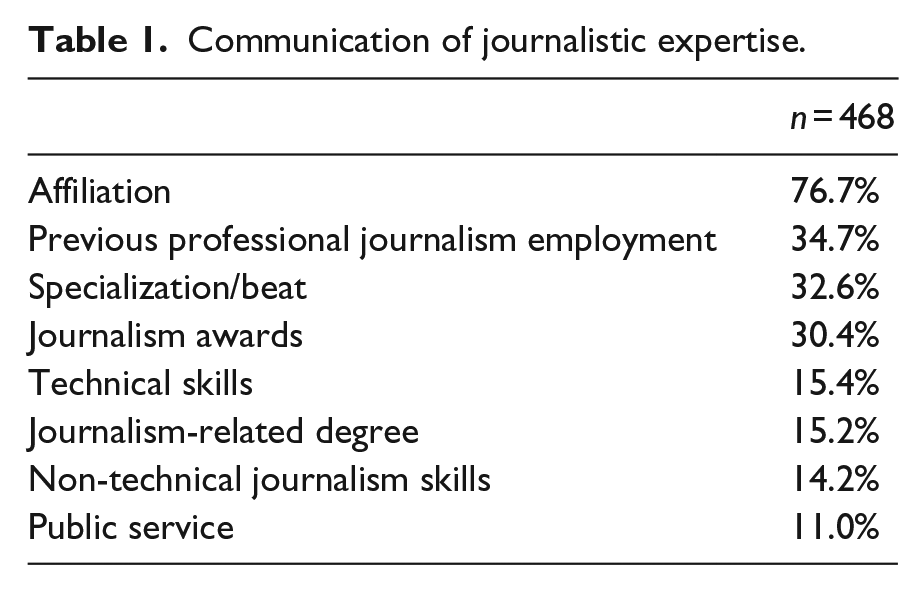
RQ1 asked to what extent journalists communicated their expertise on their Facebook profiles. The descriptive results show that journalists primarily self-publish the name of their organization (76.7%), list journalism organizations in which they were previously employed (34.7%), position themselves as specialized knowledge experts (32.6%), and cite previous journalism awards to communicate their journalism expertise (30.4%; see Table 1). The journalists on Facebook scored a mean of 2.3 (standard deviation (SD) = 1.5) out of eight on the journalistic expertise index.
Communication of journalistic expertise.
Discussion and conclusion
Journalists and scholars should be able to evaluate the expertise of other journalists if journalism wants to continue to maintain its semi-professional status. To aid in understanding the complexity of journalism expertise, we interpreted expertise as a communicative act rather than a sociological conflict perspective or a cognitive psychological trait. We mapped the communication of expertise theoretically and evaluated possible indicators empirically in the hopes of increasing awareness of how journalists strategically distinguish themselves, because previous research states journalists, when asked, struggle to express how they are professionally distinct from other content contributors such as citizen journalists (Anderson, 2013; Örnebring, 2013). This study revealed that journalists distinguished themselves from lay people through the sharing of their credentials and experience. Organizational affiliation, previous journalism employment, and journalism awards are the specific ways journalists erect boundaries and communicate that they are credible journalists.
As stated, it appears that expertise, as communicated by journalists, is being employed in the news industry. Previous research examining journalists’ Twitter bios found that they often included the name of their place of employment (Holton & Molyneux, 2017). Branding can involve the sharing of information to promote oneself or their home organization (Holton & Molyneux, 2017). Broadcast journalism students have been found to take pride in being associated with an organization. The securing of a broadcast journalism job enables them to become local or even a national celebrity (Carpenter, Grant, & Hoag, 2016). It is common for journalists to present themselves as an employee of an organization (Hanusch & Bruns, 2017). The organizationally aligned messaging means that journalists’ self-concept is intertwined with an organization (Holton & Molyneux, 2017).
The communication perspective revealed that journalists to a greater degree interpret expertise through their employment history and organizational affiliations rather than their knowledge on an individual level, which likely partially explains why journalists and scholars struggle articulating their expertise knowledge at an individual level because expertise in journalism is viewed as securing a job with established media institutions. The implications of this single study suggest and support interpreting expertise from the interactional perspective in which their expertise consists of their ability to interact with people of expert status (Collins & Evans, 2002; Reich, 2012). If competency in journalism is viewed as organizational affiliation, freelancers will continue to struggle to demonstrate their value within the field. This study, however, requires the validity of these measures to be tested on multiple samples across multiple platforms to determine whether these results hold across different social media platforms such as LinkedIn because it is also important to keep in mind that perceived audiences of Facebook may have influenced the sharing of particular expertise indicators. We also suggest that focused interview research on the construct of experience and organizational affiliation be carried out to learn more about how journalists define experience and why it is such an important indicator of expertise in comparison to other indicators.
This research also indicates that journalists recognize that a specialization is important to highlight on social media profiles as well. For example, the content analysis revealed a third of people who claim to be journalism professionals included information about their specialization, claiming that they are knowledgeable in a niche area such as sports, politics, and technology. Breed (1955) also stated that specialization is a symbol of status. This finding supports Donsbach (2010, 2014) when he argued that journalists should possess several competencies including expertise in an outside subject area.
Donsbach (2010, 2014) and other scholars also believed that journalists need to possess skills to be classified as experts. When asked about their expertise, journalist will often point to their writing skills (Örnebring, 2013). Interestingly, journalists did not share skills information to a great extent with their audiences even though skills competencies may be critical in securing them a job (Lowrey & Becker, 2001). Only about 15% of the profile owners highlighted their ability to write stories, edit video, code websites, and so on. Perhaps they assume that those skills are apparent attributes of journalists because Facebook fan pages are likely used to communicate and build relationships with publics rather than potential employers. Journalists may not perceive communicating such skills to the general Facebook public as noteworthy to establish their credibility.
Abstract knowledge allows professionals to maintain intellectual control over their work. The push for learning skills, however, limits journalists’ ability to maintain authority because many people can easily learn those same skills (Abbott, 1988). Skills such as writing and video shooting are key teaching areas targeted by journalism program leaders. Yet the increased access of publishing and editing technologies is likely leading to the decline in the monopoly of some knowledge areas once prized by journalists. Interestingly, science and technology scholars study the concept of expertise in an attempt to program knowledge areas into machines so that humans can interact and rely on them for their organizing and reasoning power. Machines will likely surpass humans in some areas of expertise (Dreyfus & Dreyfus, 1984). High-powered machines can store large amounts of memory and efficiently organize information, which means journalists must rearticulate what unique human qualities define their field including skills knowledge. While journalists may no longer hold a monopoly over certain technical and non-technical skills due to the low costs of technologies, they may still be able to employ these skills in a more complex way than the general public. Some journalism scholars do argue that good journalists are distinct from other content producers. For example, Lippman (1922) said that a good journalist understands how to find information. Other methodological approaches such as qualitative work begin to work in identifying and elaborating complex human skills such as storytelling, information verification, and visual communication.
Survey research revealed that public service journalism is a value at the heart of journalism and it is a part of journalism students’ liberal arts and theoretical journalism training (Beam, Weaver, & Brownlee, 2009). Ideally, public service, the lowest publicly endorsed indicator (11%), would have been one of the top indicators. The public service variable in this research represents the assessment regarding the extent to which individual journalists support the sociological narrative regarding their value in society. In fact, other research on journalists’ social media profiles has found that their narratives focus to a greater extent on themselves rather than journalism or humanity ideals (Carpenter et al., 2016). Perhaps journalism educational programs need courses that transmit knowledge related to the philosophy of journalism, rather than offering a general media and society course, to increase students’ understanding about the functions of journalism and their individual roles within the occupation including how their work can support the common good.
Future research is necessary to determine the scientific utility and content validity of these measures because we restricted this exploration to a convenience sample of journalists who chose to present themselves professionally on Facebook. Scholars could use this study to develop survey items and conduct comparative research with people from different countries because coder observations revealed that people from some countries outside the United States were more likely to state the importance of public service on their profiles. Other methodological approaches could provide increased insight into journalistic expertise. Future research could also examine how employers identify journalistic expertise during the hiring stage; for example, researchers could observe how employers evaluate applications and interview them. Scholars could also run an experiment varying the top indicators to determine whether variations in expertise stimuli influenced perceptions of credibility, news quality, and so on or experimental researchers could also examine what factors influence expertise recognition among readers.
A purpose of this research was to foster scholarly dialogue concerning the constructs unique to the journalism field. Theoreticians need to identify the characteristics relevant to journalism and determine whether their concepts reflect journalism studies because the choice of paradigms, concepts, concept labels, and construct dimensions have implications concerning the relevance of journalism scholarship and the advancement of it. Researchers, as problem-solvers, should approach theoretical challenges from different perspectives and engage in conversations addressing our current assumptions. For example, the sociological paradigm reveals that journalism is a grand ideological or normative narrative that galvanizes journalists to work as a collective for the greater good (Deuze, 2005; Lewis, 2012; Schudson & Anderson, 2008). The results, however, show that they do not often communicate that they serve the public or journalistic ideals. In contrast, the communication or behavioral perspective results highlight that individual journalists may simply interpret expertise as an association with a news organization. Much research has focused on measuring the output of journalists (e.g. news quality, media frames, source diversity) rather than articulating the concepts that bind journalists as a collective. We encourage more efforts by educational institutions and professional associations to identify a codified body of shared knowledge that individual journalists should possess including accepted standards of individual performance.