




Abstract
Although various studies have investigated the link between corruption and politicization, there is still a lack of comprehensive reflection in the literature on both this topic and the idea of politicization itself. Analyzing the politicization of an issue necessarily implies considering the public sphere and then the role of the media. Considering its penetration and its role as a news source for citizens, social media today is a particularly intriguing object of research. Our study shows that while social media may assist in raising awareness about and curbing corruption, it can also become dysfunctional in some circumstances. The multiplicity of the actors who intervene in corruption and the diversity of interests that characterizes their actions make online discussion complex and adaptable to different objectives. Discussions on corruption in Italy are highly polarized, favoring the political instrumentalization of the issue for different goals.
Introduction
In recent years, the corruption issue has piqued the interest of several researchers who have examined the subject from various perspectives and disciplinary approaches, ranging from the economic (Gründler and Potrafke, 2019), to the sociopolitical (Fazekas et al., 2022) to the mass media one (Mancini et al., 2017). Looking at the relationship between media and corruption, to which the European Journal of Communication has dedicated a special issue (1/2018), specifically, they have been analyzing the legacy media’s role to hinder corruption or in corruption perception, as well as the bad functions of journalism (Berti et al., 2020). One of the main theoretical frameworks used in the studies on media and corruption is politicization, described in various studies as a process that leads the condemnation of the phenomena to partisan judgements (Mancini et al., 2017; Sberna and Vannucci, 2013) and, as a result, precludes effective public control. Often, in fact, the concept of politicization is superimposed on that of “instrumentalization,” giving it an exclusively negative meaning. However, studies on politicization on other topics (immigration, European Union) highlight that politicization “is neither good nor bad per se. Too little can be as problematic as too much” (Hutter et al., 2016: 6). In the specific case of our study, the fact that political actors deal with corruption and anticorruption can be a good thing because it means including the need to fight it among the issues on which politics must take decisions. Not dealing with the problem (the system of politics ignores the issue) would have negative effects as much as, conversely, dealing with it in an instrumental way for its own electoral gain.
Following Hutter and Kriesi (2022), we assume that politicization is inextricably tied to the idea of the public sphere: there is politicization when an institution, an initiative, an issue, or even a value is addressed in a controversial way in public and/or submitted for public discussion, including the realm of politics. In this regard, the media, especially social media today, considering its penetration and its role as a news source for citizens (Newman et al., 2023), is a particularly intriguing object of research for analyzing politicization. However, social media has only played a minor role in this expanding interest of scholars. The few studies focused on social media and corruption show that increasing access to social media by citizens may be connected with a decrease in a country's corruption or its perception (Jha and Sarangi, 2017). However, many of these studies focus on nondemocratic conditions (Enikolopov et al., 2018; Frolova et al., 2017; Yi and Hu, 2022), where traditional media do not provide many options to oppose corruption, and hence bottom-up forms of communication can actually contribute.
In this study, we will attempt to illustrate that the issue of corruption is politicized on social media and that social media may assist in raising awareness about and curbing corruption, as well as becoming dysfunctional in some circumstances. While some aspects of social media, such as disintermediation (Chadwick, 2013) and expansion of actors with the ability to intervene in the public debate, may support anticorruption efforts, others, such as platforms affordances that fuel polarization (Nordbrandt, 2023; Settle, 2018), may increase the political instrumentalization of corruptive phenomena. In addition, we have to consider the features of the considered media and the political and social context. In particular, in the Italian case analyzed in our study, corruption coverage by legacy media is highly instrumentalized due to the partisanship of news outlets (Mancini et al., 2017) and this feature could influence the public debate on our topic on Facebook due to the fact that the agendas of different news outlets are interrelated (Bentivegna and Boccia Artieri, 2020). In addition, we have to consider the role of one of the main Italian political parties that has been leading in the politicization of corruption: the Five Star Movement (5SM), which won the 2018 Italian General Elections, made corruption one of its key campaign topics, heavily relying on social media as a communication channel (Ceccarini and Bordignon, 2018), adopting a peculiar point of view. In fact, the populism of the 5SM is substantiated in the polarizing populist communication based essentially on the opposition of pure people/corrupt elites and, consequently, on the anti-establishment character (Mosca and Tronconi, 2021).
Before delving into the empirical analysis, it is necessary to clarify the definition of politicization used in this study, by briefly reconstructing the literature to which we refer in order to define the operationalization of the concept and, finally, the specific role that social media play in the politicization of corruptive phenomena. The paper, therefore, is structured as follows: the first section is devoted to the concept of politicization in relation to social media. Based on this literature, research hypotheses are formulated, and the methodology is explained. Then the data analysis and the conclusions of the study are enucleated.
The concept of politicization and its operationalization in the Italian context
In recent years, various studies have investigated the link between corruption and politicization, but despite this interest, there is a lack of comprehensive reflection in the literature on both this topic and the idea of politicization itself, which has led to attributing different meanings to the concept. The causes are to be traced, on the one hand, in the different disciplinary backgrounds (political science, political sociology, international relations, media studies, etc.) and, on the other, in the diversity of the object of the study investigated from time to time (European Union, immigration, climate change, corruption, etc.). In most of the studies on politicization (de Wilde, 2019; Hutter et al., 2016) there are, however, at least three constants: (1) the relevance of the issue under discussion in public debate, (2) the involvement of politics, and (3) the polarized nature of the discussion between the different involved actors.
The involvement of politics can be seen in the attention that political actors devote to the issues under discussion. Politicization is then a dimension of public debate and, therefore, linked to media coverage, that is how the issues are dealt with and the importance reserved for them. In this regard, different social actors compete with each other in a dynamic of conflict to affirm a certain issue or a certain frame to an issue already under discussion within the public debate (Hutter and Kriesi, 2022). However, the analysis of the public debate today needs more and more to consider online spaces. In fact, in the latest years, online sources (including social media) have outdone newspapers and even television as news sources (Newman et al., 2023), even in a TV-centric country such as Italy. The third variable that characterizes politicization—polarization—is not only an intrinsic feature of politics, but it is also a criterion that directs the (social) media's choice of news. A theme that generates contrasts between different actors is newsworthy and produces engagement on social media.
To summarize, in the process of politicization it is not only indispensable that politics and political actors include in their agenda a specific theme, but it also requires a discussion on the theme between a plurality of social and political actors that propose opposing keys of interpretation (frames) able to attract media attention, which emphasize the negotiating/controversial nature of the discussion (polarization).
Regarding the operationalization of the politicization concept, we distinguish three constitutive dimensions: (1) the salience (i.e., the space that a theme occupies in public debate compared to other themes), (2) the type of actors who intervene on the theme (we consider that only themes conveyed by political actors in public discussions may be identified as politicized. However, if an issue is not discussed in public by a variety of actors, it can only be politicized to a very limited degree), and finally, (3) the polarization (the intensity and distance between the positions at stake) (Hutter et al., 2016). Following Hutter et al. (2016), we consider salience as a constitutive dimension of politicization and we believe that it is a necessary condition for talking about the politicization of corruption, even if not sufficient. By considering, therefore, the importance of the corruption issue in the political, above all in that of the 5SM in Italy (Ceccarini and Bordignon, 2018), and in the media and citizens agendas (Bentivegna et al., 2022), we take for granted the salience of the theme, then, in this article, we focused on the last two dimensions (expansion of actors and polarization).
The last dimension—polarization—in particular is increasingly becoming a crucial research strand in the study of political communication. We are not facing a new phenomenon (Sartori, 1976), but starting from the early 2000s fervent literature on the subject has developed both in America and in Europe (McCoy et al., 2018). In this case, we refer to affective polarization that is based on the continuous increase of negative emotions against each other (both elite and electorate), considered more and more enemy rather than adversary (Iyengar et al., 2012). This opposition between in-group and out-group has developed in a fragmented communicative context as a result of technological transformations that have made it possible to access the debate and give visibility to a plurality of voices, including those who are partisan.
Research hypotheses
Several studies have revealed in recent years that traditional media are losing their ability to define the public agenda and, as a result, determine the opinion climate (Weimann and Brosius, 2016). Bennett and Pfetsch (2018) characterize this as a “disrupted public sphere”, in which the proliferation of media has necessarily resulted in a multiplicity of voices and messages, as well as a loss of legitimacy for mainstream media. The ability to share information on the Internet has created new information providers, making the information supply more competitive and allowing corruption news to be spread even if certain media owners strive to avoid it (Goel et al., 2012). In terms of fighting corruption, a larger number of social media users implies a larger audience for victims of corruption, and individuals may feel more inclined to act on such information in order to stand in solidarity with their friends and family (Jha and Sarangi, 2017). Furthermore, social media platforms enable a low-cost and rapid means of sharing information and reaching a larger audience in order to organize public actions against corrupt government officials and politicians (Kossow and Kukutschka, 2017).
If the legacy media do indeed favor the viewpoints of politicians, conventional journalists, judges, and so on (Mancini et al., 2017; Mazzoni et al., 2023), the social media arena allows a broader variety of players, such as alternative media, collective actors, and ordinary people, to have a voice. A variety of actors does not necessarily mean that the old players who usually have a standing in the media, such as journalists and politicians, disappear. We hypothesize that this type of actors continue to play an important role in shaping the agenda of online discussion. However, we rarely find empirical analyses to verify which actors are involved and what their weight is in online discussions. Given these factors, our first hypothesis is that:
H1. Social media allows subjects that do not usually have a voice in mainstream media to intervene in the public debate on the issue of corruption (expansion of actors).
However, the opportunity provided by social media to improve awareness of corruption phenomena thanks to the enlargement of actors who intervene on our topic only reflects one side of the coin in terms of social media's potential role in corruption (Goel et al., 2012). We must note that while online activism can benefit from the Internet (Bennett and Segerberg, 2012), social media can also provide new tools to instrumentalize corruption. Aspects of social media, such as affordances, may even reinforce the polarization and instrumentalization of corruption issues, especially in an already highly polarized political context such as the Italian one (Mancini et al., 2017; Vannucci, 2020). As previously occurred in legacy media, social media may exacerbate the political instrumentalization of corruption to attack political opponents, driven by disintermediation (Chadwick, 2013) and platform affordances that may encourage polarization (Nordbrandt, 2023; Settle, 2018). On the one hand, through social media, institutional actors (politicians, political parties, news outlets, journalists, etc.) find new opportunities and ways to generate a biased and occasionally instrumentalized narrative of the phenomenon. On the other hand, noninstitutional actors (citizens, alternative media, disinformation accounts, etc.) contribute to polarize and/or contaminate the debate on corruption aimed at different interests, increasing the polarization of the debate. Then, social media might serve a different function than the original contrasting one.
In this scenario, we are dealing with a polarization of the corruption issue, defined specifically as hatred towards the other, which can be triggered by party identification, ideological polarization on policy, and the in-group/out-group dynamics (Peterson and Iyengar, 2021). The polarization of individuals, however, appears to be much more fluid and unstable today than in the past, and this is due once again to social media involving subjects with different characteristics animated by various party purposes. We can find fervent supporters of a party or a politician, but also users activated occasionally in support of a position, as well as political leaders aimed at strengthening a social identification with the party, thus increasing the affective polarization (West and Iyengar, 2020), or even different types of media actors who ride the “us versus them” rift in order to generate consensus and reach the audience (McCoy et al., 2018), including disinformation accounts aimed to increase information disorder (Giglietto et al., 2020).
In this regard, our second hypothesis is that:
H2. Social media favor the polarization of the discussions on corruption by the different types of actors involved in the debate motivated by different partisan purposes (to win votes, to mobilize supporters, to discredit opponents, to reach the audience, to increase information disorder, etc.).
Data and methods
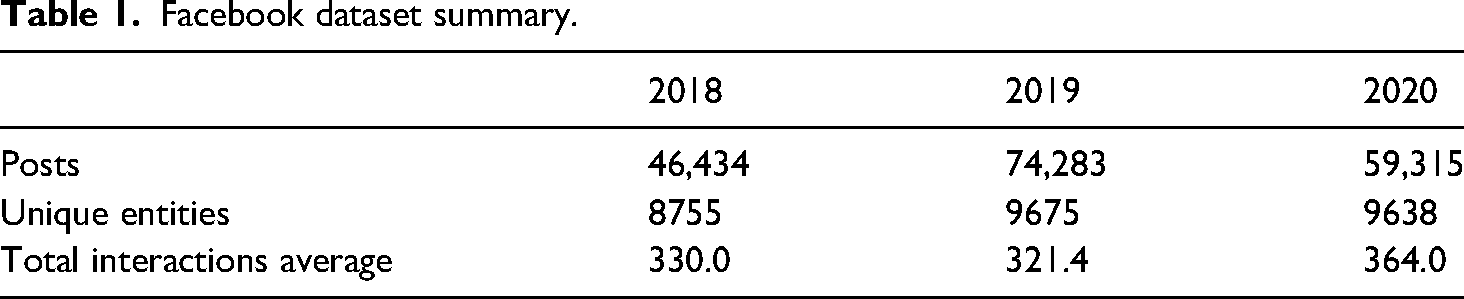
In order to verify our research hypotheses, this study intends to investigate the dynamics of the discussion about corruption and anticorruption on social media in Italy during a period in which political corruption has been at the center of political, media, and citizens agendas (Bentivegna et al., 2022). We selected all the posts published by public Facebook pages mentioning at least one of a set of corruption-related keywords 1 between 2018 and 2020. We collected 180,032 Facebook pages’ posts, which generated a total of 60,794,090 interactions, through CrowdTangle 2 (Table 1).
Facebook dataset summary.
Considering our interest in actors who intervene in corruption issues, from the entire corpus, we selected a sample consisting of only Facebook pages that published posts that have gained the 15th percentile of total interactions. 3 From this sample, then, we have identified three peaks of a wider discussion, one for each of the analyzed years (Figure 1). The choice of peaks to be analyzed was made considering the number of published posts and interactions received from the collected posts each week and the results of exploratory content analysis through topic modeling aimed to identify the main types of corruption discussed in each peak 4 performed in a previous study (Mancini et al., 2024). In particular, the first two peaks represent the weeks that recorded the highest number of interactions for 2018 and 2019. The third peak, the one related to 2020, however, was chosen because in this period users have discussed different types of corruption, like petty corruption and not only grand corruption or corruption in general, as emerged in the other peaks (see supplemental materials). In addition, peak 3 is also characterized by the pandemic, the absence of electoral appointments, and by the resize of the role of 5SM in Italian politics (Mosca and Tronconi, 2021).
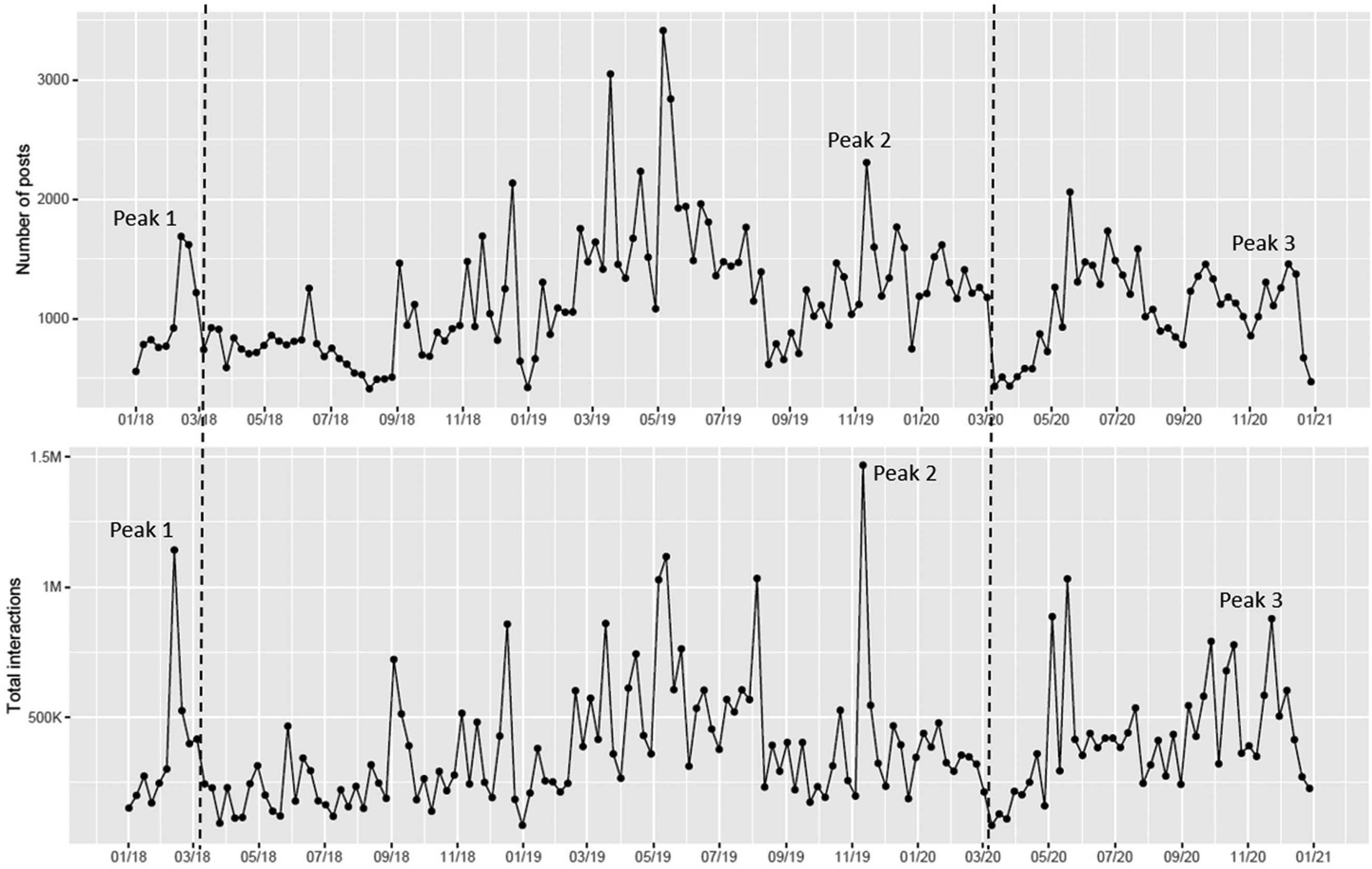
Facebook pages: posts and total interactions per week*.
Posts produced in three weeks close to each peak were analyzed 5 . In total, we analyzed 1506 posts.
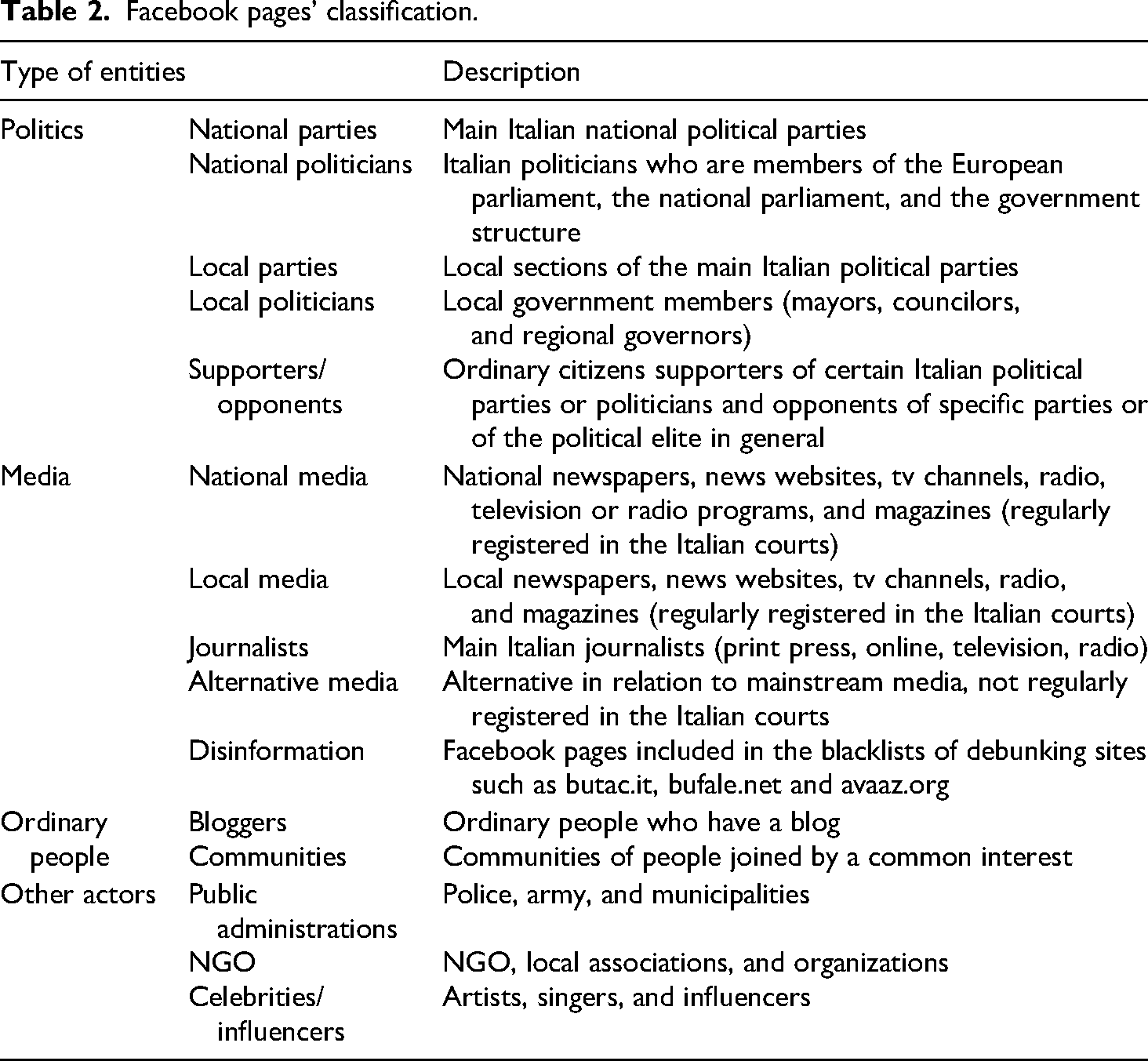
To verify if social media offers suitable chances to actors who usually have no standing in legacy media to intervene in the public debate (H1), it was necessary to classify all the unique entities that have published corruption-related posts in the considered period. Four macrocategories (politics, media, ordinary people, and other actors) have been identified for a total of 15 categories of actors (Table 2). Within these categories, we then have distinguished between actors who would easily have a standing in the media and actors who, on the other hand, would not have the same status (in grey in Table 2).
Facebook pages’ classification.
“Politics” entities have also been classified according to their political orientation: a qualitative analysis of the description, the user name, and the cover photo has been conducted to identify references to different political parties.
To verify if social media favor the polarization of corruption for different purposes by different types of actors (H2), we focused exclusively on the two most productive, in terms of published posts and engagement, categories of actors (political and media actors), those who have influenced more the public debate on the corruption issue. Political and media actors published respectively in the three peaks 84%, 82%, and 73% of total posts, that received respectively 93.7%, 87.8%, and 86.8% of total interactions. To do so, it was necessary to identify the frames contained in each of the analyzed posts and the presence of attack/defense. In our analysis, framing can be understood as “a discursive process that aims at determining an issue, in the sense that it gives it an interpretative framework through a process of focusing on some elements that compose it” (Forgione, 2012: 253). We adopted an inductive and deductive approach to frame analysis. We began with an inductive, data-driven method, with no predefined categories of study to identify issue-specific frames (de Vreese, 2005). In this first phase, it was possible to identify some issue-specific frames (frames linked to specific events, statements, or topics). During the deductive phase, these frames were subsumed under more broad categories via a two-step process of synthesis and comparison with generic frames from the literature. This mixed approach has the advantage of avoiding both the dispersion of inductive logic typical of textual materials (each case could potentially be classified as a unique and unrepeatable frame) and the excessive rigidity of deductive logic (which allows the researcher to find only the frames defined prior to the analysis).
The inductive analysis was carried out by extracting the most frequently occurring words and phrases using WordStat, and cluster analysis using QDA Miner (Entman, 2010; LaPan, 2013). We created an initial analysis sheet that was later combined with generic frames mentioned in the literature (deductive analysis). Documents (divided into segments) were classified into one or several predefined categories based on an inductive learning process performed on a set of previously classified documents. Two different researchers manually classified a random sample composed of 10% of the corpus (n = 150 posts) and assigned the codes listed in the codebook. The inter-coder reliability was measured using Krippendorff's alpha. 6 Then, researchers used two “search and retrieval” tools (“Query by example” and “Code similarity”) 7 .
Besides identifying the frames, we also identified the presence of attack/defense within each post. We consider as an attack any criticism or rhetorical means used to highlight the negative characteristics of the subjects in question up to the ad personam attack. Finally, the frames and the political orientation of the accounts were analyzed through correspondence analysis (Lebart et al., 1997).
Findings
The expansions of actors
Some hints regarding the first hypothesis, actor expansion, arise from the data reported in the preceding paragraph (Table 1). The discussion on Facebook about corruption has grown in recent years, both in terms of entities and posting activity. Although it may seem obvious that there is an expansion of the actors in the discussions on Facebook, in particular, compared with print press (Mancini et al., 2017), it is important to see who these actors are because “who says what” is also important to interpret the shared messages. In fact, a text can assume a different meaning depending on the type of user and the interests that move the different actors. In other words, the same message published by a politician, a media outlet, or a citizen can have different meanings. According to the classification of actors (Table 2), the types of actors who intervene in corruption and anticorruption issues are expanding. Facebook pages are not only actors with a standing in the media, but also different types of actors (in grey in Table) who produced 29.5%, 36.4%, and 49.9% of the total posts published by Facebook pages in the three analyzed peaks, respectively (Table 3).
Facebook pages classification: posting activity by peak (%).
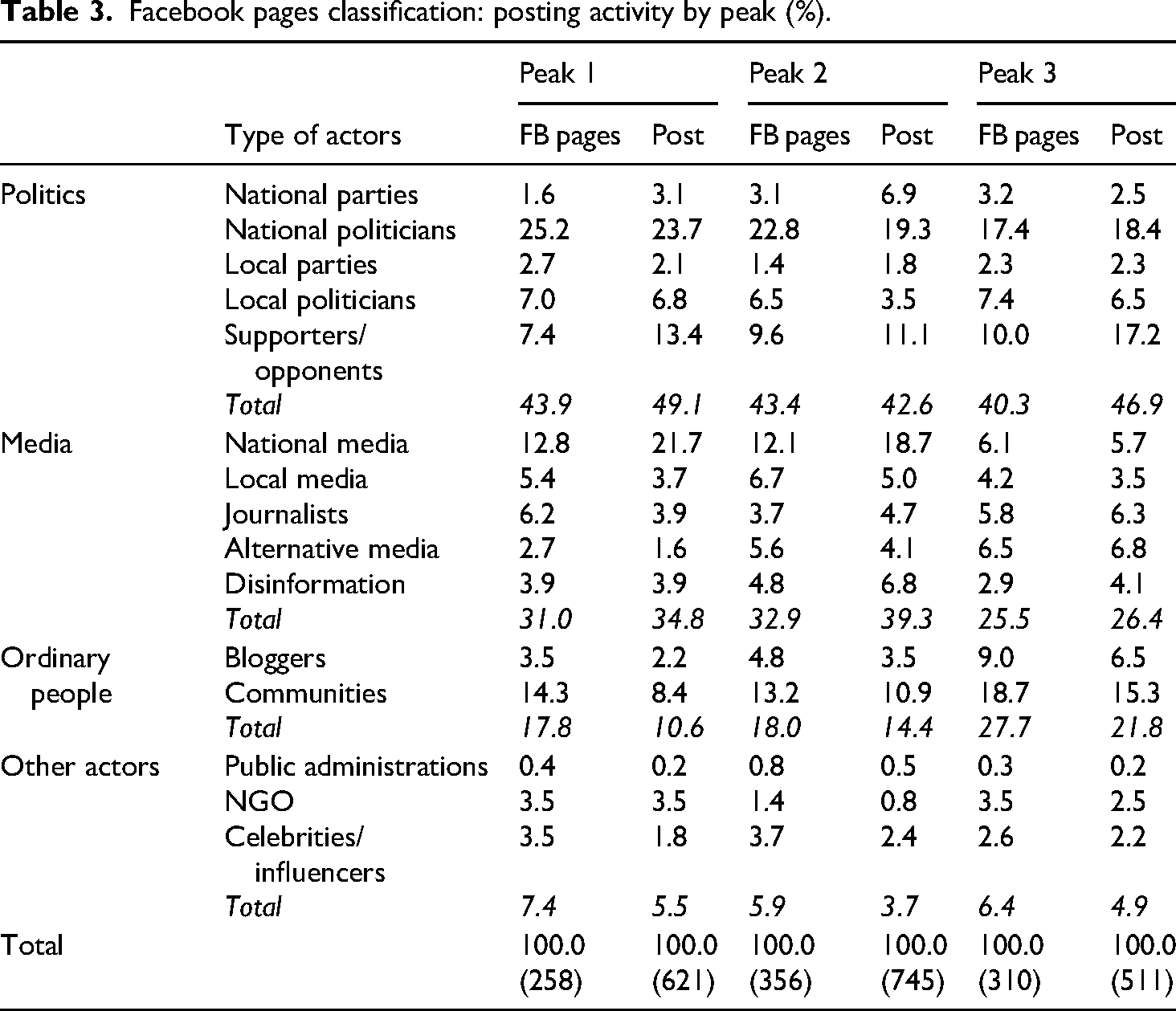
Then, our data imply that Facebook really allows for a widening of the types of actors (H1), specifically noninstitutionalized actors (in grey in Table 3) who would not easily have had the opportunity to express their thoughts regarding corruption-related issues in the context of legacy media.
However, increasing the number and diversifying the type of actors does not inevitably result in increased public engagement in the fight against corruption. This too-optimistic view may depend on emphasizing the presence within social media of citizens who, thanks to them, can more easily come into contact with each other and produce content themselves (boyd and Ellison, 2007). Today, however, alongside social media appeared public institutions, newspapers, newscasts, companies, political actors, NGOs, disinformation accounts, and influencers, in addition to citizens (Sloan and Quan-Haase, 2017). In short, actors operate according to different interests and adopt strategies aimed at different purposes. As we will see in the next pages, the diversity of these new actors is not as great as it appears at first glance.
The classification of the political orientation of Facebook pages traceable to politics, in fact, has shown that many of these new actors belong to a certain political side and hence strive to frame the argument in favor of that side, replicating the same dynamics that partisan legacy media established. These results, as we shall see better with the frame analysis, show, in line with the nature and the affordances of social media, a polarization of the corruption issue, that acquires the traits of social identity, with users from opposing fields exhibiting characteristics of in-group/out-group behavior: loyal to their own group and hostile to others (Peterson and Iyengar, 2021). Specifically, the discussion on Facebook about corruption is monopolized by actors close to the 5SM (“politics” entities are 80% 5SM oriented) (see supplemental materials). This great attention to corruption on the part of these entities can be traced to the fact that the 5SM in the analyzed period won the 2018 Italian General Elections and made corruption one of its main campaign themes, even going so far as to approve a new anticorruption law.
The polarization of corruption issue
As anticipated, in an attempt to verify if social media favor polarization of the discussions on corruption for partisan purposes by the different types of actors involved in the debate motivated by different partisan purposes (H2), we focused exclusively on the two most productive, in terms of published posts and engagement, categories of actors: political and media actors, those who have influenced more the public debate on the corruption issue.
The frame analysis led to the identification of six main frames and thirteen subframes (Table 4). The debate on corruption and anticorruption was focused, on one side, on the identification of honest and guilty people and, on the other, on the criticism of the corruptive phenomenon itself and on the identification of measures to fight it. The frame “Allocation of responsibilities” sees users identifying one or more responsible actors (political actors, parties, or nonpolitical actors) for certain cases of corruption that have occurred over time. The frame “Media role”, instead, consists of user criticism of legacy media for not doing their job as they should and, at the same time, in an exaltation of investigative journalism. Following the dynamics of affective polarization, the “In-group logic” frame consists of the defense of one's own party or politicians and of the exaltation of the work of one's own party (at the local and national level) during the government experience.
Frames and subframes.
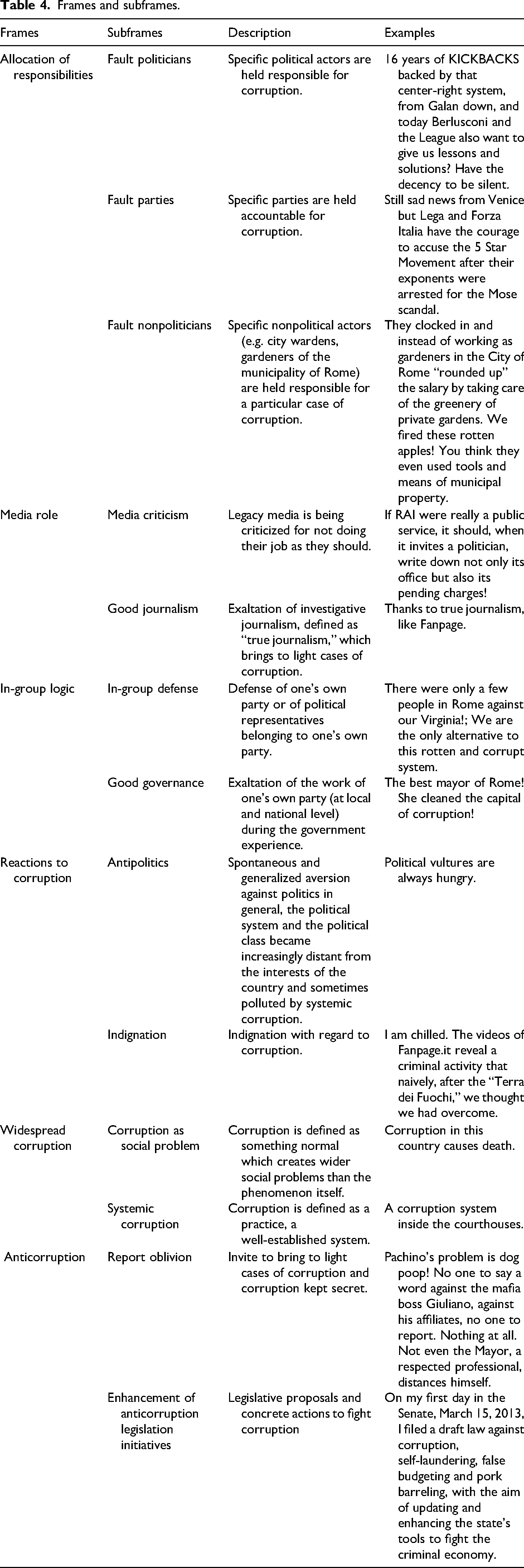
The last three frames focus more generally on corruption. In the case of “Reactions to corruption,” we recorded both the users’ indignation about corruption and the users’ spontaneous and generalized aversion against politics in general, the political system and the political class. In the “Widespread corruption” frame corruption is defined as a practice, something normal which creates wider social problems than the phenomenon itself. Finally, the “Anti-corruption” frame covers all legislative proposals and concrete actions to fight corruption, as well as the invitation from users to bring to light cases of corruption and stop being silent.
To get a more synthetic two-dimensional mapping of discussions on corruption on Facebook by political and media actors (that include both institutionalized and noninstitutionalized actors) and to explore the relationships between the frames, the type of actors, the political orientation of the actors who took part in the debate, and the presence of attack/defense, we decided to use the projection of frames on a factorial plane (Figure 2). The correspondence analysis allowed us to extract two main dimensions that reproduce about 25% of total inertia.
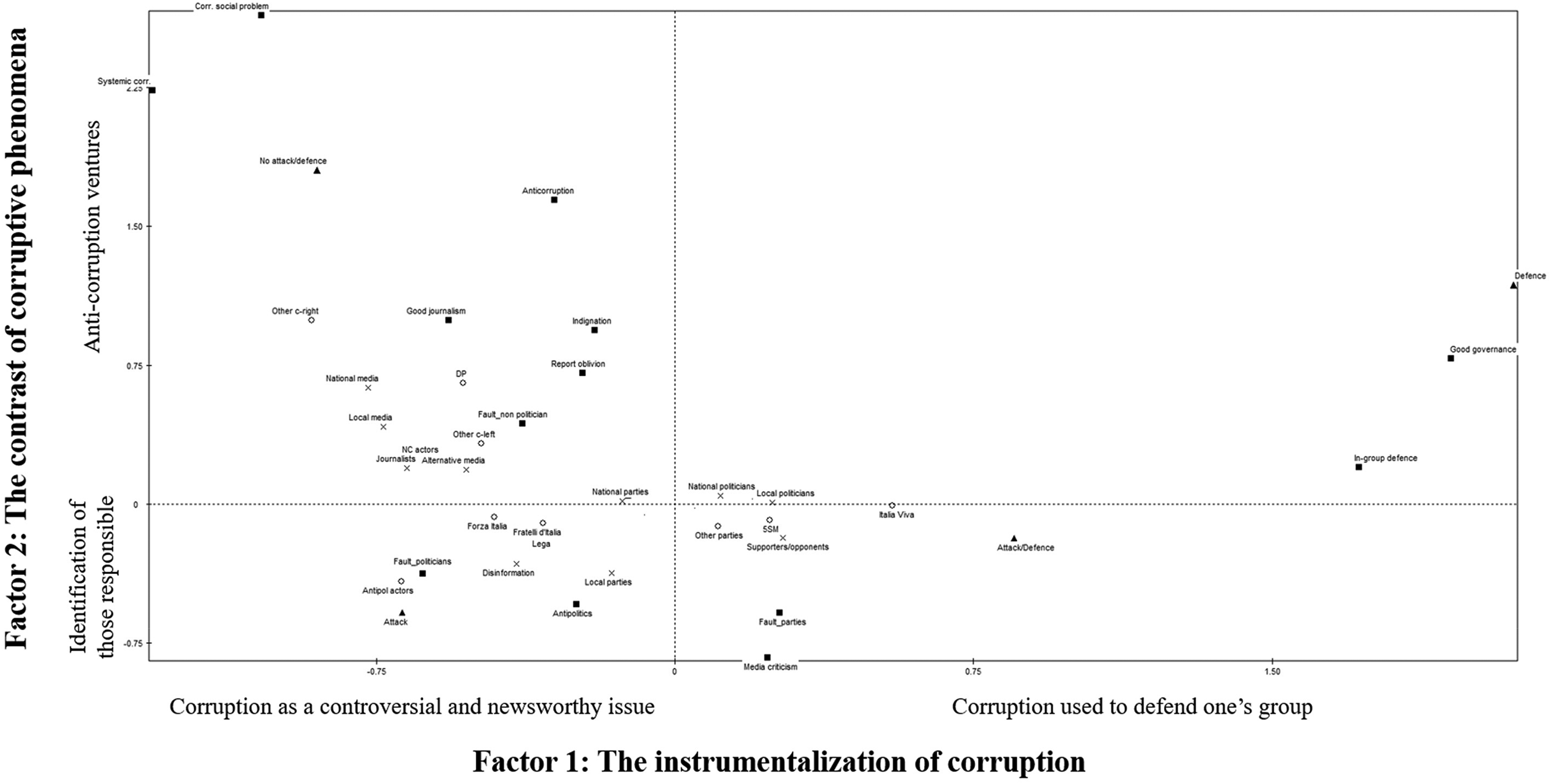
Projection of frames, type of actors, political leaning, and attack/defense into dimensions 1 and 2.
The first dimension (the instrumentalization of corruption) perfectly fits with our second research hypothesis, according to which within social media platforms coexist a multiplicity of different actors acting according to different logics and interests (Figure 2). In particular, the positive half-plane shows a polarization of the issue of corruption that can be triggered by in-group/out-group dynamics (Peterson and Iyengar, 2021). In this case, the political actors, which, as we have seen before, are about 80% attributable to 5SM, discuss corruption essentially on the opposition of pure people/corrupt elites and, consequently, on the anti-establishment character (Mosca and Tronconi, 2021). The posts that fall under this semiplan highlight the presence of “attack/defense” of their political side and “in-group defense”, but also the “defense” of their faction united to the exaltation of the good done during their government experience, “good governance,” as emerged from the example reported below: Let's hear it! The League has been insulting us for years and shouting ‘Rome thief’. […] There were only a few people in Rome against our Virginia
8
! Come on, mojitos for everyone ♥️. (W IL M5S, November 16, 2019).
The 5SM actors thus contribute to the polarization of the electorate not through the divisions on the corruption issue itself, but rather through communication that creates a macro line of moralistic division between pure people (us) and the corrupt elite (them) that stimulates affective polarization (West and Iyengar, 2020).
The negative half-plan, however, is characterized by discussions on the corruption of media actors (national and local news outlets, journalists together with alternative media and disinformation accounts) who ride the polarization and the opposition “us versus them” looking for culprits that make the news newsworthy and therefore attractive to the public. The posts that fall under this semiplan, in fact, highlight the presence of “attack” and identify a culprit of corruption cases, specifically “fault politicians”: Venice submerged. For the convicted Galan
9
is ‘all the fault of Rome’, listen to his reasoning. (Il Fatto Quotidiano, November 14, 2019)
This dimension, therefore, shows, on the one hand, how corruption is treated as a controversial and newsworthy issue by political and media actors. The leaders and elites’ communication strategies are supported by noninstitutionalized actors (such as citizens more or less interested in politics) who convey through social media a type of communication strategy aimed at strengthening a social identification with the party, thus increasing the affective polarization (West and Iyengar, 2020), and on the other hand, the media who ride this “us versus them” rift in order to generate consensus and reach the audience (McCoy et al., 2018).
The second dimension extracted by the analysis (Figure 2) concerns “the contrast of corruptive phenomena,” understood both as “anticorruption initiatives” (positive half-plane) and as “identification of those responsible” (negative half-plane) for corruption. In particular, in the positive half-plane, corruption is treated as a pervasive problem, with frames such as “corruption as a social problem” and “systemic corruption.” The discussion also focuses on concrete initiatives to fight the problem, “enhancement of anticorruption legislation initiatives,” and the exaltation of “good journalism,” that is the journalism that investigates and brings to light cases of corruption that up to that moment had remained hidden: Corruption is not fought with silence. We must talk about it, denounce its evils, and understand it. Let us pray together that those who have power will not let themselves be dominated. (Famiglia Cristiana, February 5, 2018) This is the first report of an extraordinary journalistic investigation by Fanpage on corruption related to waste disposal in Campania, with bribes and regional politicians investigated. […] I’m outraged, I’m sick of people using our land for their dirty business. Thanks to real journalism, like Fanpage's. (Valeria Ciarambino
10
, February 16, 2018)
The negative half-plane, however, sees political and media actors (especially disinformation pages that in many cases express once again ideas close to 5SM) reacting to the problem of corruption, not in a constructive way but identifying those responsible to blame for the rampant corruption, specifically “fault parties” and “fault politicians.” The posts attributable to this half-plane, moreover, are distinguished by the presence of “attack” and a “media criticism”: Will the newscast talk about it obsessively as they did for the 5SM ‘refunds’ case? Will we see some service to Le Iene
11
? What will Renzi
12
say? To you the answers …. (Quello che i TG non dicono, February 16, 2018)
This dimension, therefore, sees the discussions focused on the fight against corruption phenomena taking two diametrically different paths, on the one hand with concrete actions aimed at combating corruption and, on the other hand, by identifying those responsible for the spread of corruption.
Conclusions
Our analysis shows an expansion of the actors in terms of range and type. Noninstitutionalized actors who did not have access to or had limited access to public debate through legacy media, as alternative sources of news, citizens in more or less organized forms and more or less interested in politics, together with disinformation sources, contribute to the debate on corruption thanks to the ongoing processes of disintermediation, produce a large number of posts, and appear to be gaining more weight in corruption and anticorruption issues compared to traditional news outlets. These findings appear to be consistent with previous research that found that social media may aid in broadening the public debate on corruption because a larger number of social media users imply a larger audience for victims of corruption, and individuals may feel more inclined to act on such information in order to stand in solidarity with their friends and family. However, their novelty potential appears to be limited, and their inclusion in the public debate may indicate an overly positive picture of the discussion on corruption and anticorruption on Facebook. Indeed, it is almost impossible to give a single opinion about the role of social media platforms in dealing with corruption. Our data show that the multiplicity of actors who discuss corruption and the diversity of interests that characterize their actions make online discussion spaces complex and adaptable to different goals.
Corruption, and in particular grand corruption cases along with anticorruption initiatives, has been widely debated and highly politicized on Facebook in Italy during the analyzed period (years when the 5 Star Movement was part of the government). Political actors, especially those close to 5SM, have fueled the discourse on corruption on the social media platform (they set the agenda), attacking political opponents, defending their party colleagues on scandals in which they were involved and extolling the legislative actions to fight corruption of which they were promoters. They did this by replicating very well-known dynamics typical of the debate on corruption that already emerged in traditional media and adapting to the peculiarities of the used media (Facebook), with the result of generating polarized discussions between the different positions in the field. On the other side, the media, at national and local levels, and journalists, through their personal pages, have fed the debate following similar criteria. Traditional actors (political and media) also play a central role in social media, whose content is far from being marginal or antithetical to what we find in the agendas of traditional media, adapting to the peculiarities of platforms that partially change the criteria of newsworthiness that guide their choices (e.g., click-baiting news). The data that emerged from the frame analysis reveal a partisan discussion on corruption and anticorruption on Facebook, that is to say, that social media affordances favor the political instrumentalization of corruption for different purposes by the political actors (to win votes, to mobilize supporters, to discredit opponents, etc.) and media actors (to reach the audience and to feed the information disorder).
In conclusion, it is necessary to downsize previous studies that suggest a too-optimistic view of the discussion on corruption and anticorruption on social media and, in some cases, conditioned by a too technodeterministic approach. While it is true that social media, thanks to low-cost and rapid means of sharing information and reaching a larger audience, allows citizens to organize more easily public actions against corrupt government officials and politicians (Kossow and Kukutschka, 2017) and that social media has the potential to wrest the monopoly of debate from the institutionalized actors and that there is a diversification of the actors involved in the debate by bringing to light cases of corruption that would otherwise be kept secret, at the same time increasing the number and diversifying the type of actors does not inevitably result in increased public engagement in the fight against corruption. Indeed, what happens within social media platforms is not immune from the characteristics of the national political and media context in which the platforms themselves are used. Social media platforms today are no longer just for ordinary citizens, either individually or in an organized way (Sloan and Quan-Haase, 2017). Alongside them appeared public institutions, newspapers, newscasts, companies, political actors, NGOs, celebrities, and influencers. In short, actors operate according to different interests and adopt strategies aimed at different purposes. Accordingly, then, not necessarily social media platforms can contribute to the contrast of corruptive phenomena but can even be dysfunctional in some cases, fueling the exploitation of the corruption issue by different actors who aim to pursue their own partisan interests. Social media includes a set of tools that, while increasing the chances of participating in the debate, also reproduce all the contradictions and problems that have long been documented in legacy media studies, including the bias driven by platform affordances.
Supplemental Material
sj-docx-1-ejc-10.1177_02673231241253942 - Supplemental material for Politicizing corruption on social media
Supplemental material, sj-docx-1-ejc-10.1177_02673231241253942 for Politicizing corruption on social media by Rita Marchetti and Anna Stanziano in European Journal of Communication
Footnotes
Authors’ contribution
All authors contributed to the study conception, design, and writing of the article. All authors read and approved the final manuscript.
Funding
The authors disclosed receipt of the following financial support for the research, authorship, and/or publication of this article: This study is supported by the Horizon Europe research project 101132483: BRIDGEGAP. Bridging the Gaps in Evidence, Regulation and Impact of Anticorruption Policies, and by the research project PRIN 2022 PNRR - P2022YRFWS: SOMMOSSA. SOcial media and civic Mobilization as MOnitoring toolS in the SociAl construction of corruption.

Supplemental material
Supplemental material for this article is available online.
Notes
References
Supplementary Material
Please find the following supplemental material available below.
For Open Access articles published under a Creative Commons License, all supplemental material carries the same license as the article it is associated with.
For non-Open Access articles published, all supplemental material carries a non-exclusive license, and permission requests for re-use of supplemental material or any part of supplemental material shall be sent directly to the copyright owner as specified in the copyright notice associated with the article.
