




Abstract
This article investigates how four Finnish media outlets, Helsingin Sanomat, YLE, Iltalehti and STT, framed the discussions about austerity policies and their impacts on Finland's national identity from 1998 to 2019. Using historical discourse analysis, the article shows the arc of austerity reporting and how Finland's position and role in the Euro crisis changed during the years. The analysis reveals something about the national self-understanding of Finland, as presented in the media in relation to other European countries. The article addresses three research questions. (1) How did the journalistic treatment of austerity change over time and what were the key turning points? (2) What kinds of perspectives and narratives did journalism construct in the coverage of austerity? (3) How was Finland as a nation represented and compared to other nations in the context of the Euro crisis and austerity? The article shows that the journalistic coverage of austerity evolved from a local issue affecting municipal economies to a global issue linked to the Euro crisis, and that Finland's national identity was constructed through a contrastive comparison with other Northern and Southern European countries. The article contributes to the discussion on media coverage of austerity by providing a longitudinal comparative analysis.
Introduction: Austerity and the history of Finnish economic policy
In the parliamentary elections of March 2023, Finnish people voted for budget cuts, as the young and famous Prime Minister Sanna Marin, and her Social Democrat party, did not receive enough votes to form a new government. Instead, the government was formed around the National Coalition, who campaigned fiercely for spending cuts and demanded reductions of public debt. Finland has had a special stance towards austerity, as in the 1990s the country faced an exceptionally deep recession affecting the economy, resulting in many societal changes and shifts in the mindset of the nation (Kiander, 2001). In this recession the GDP shrank by 10% in a matter of years, employment decreased by 20%, and the unemployment rate rose significantly (Kiander, 2005: 87). Significant budgetary cuts were made, which were not popular, but they were accepted by the people to save the welfare state (Kiander, 2005: 102).
This qualitative study examines the ways in which Finland, as a nation, is represented in national journalism in relation to other nations in the specific context of austerity reporting. The article investigates the perspective of austerity coverage in Finnish journalism across four different media outlets in the past 20 years and connects to the debates on the role media has played in the construction of austerity as the only legitimate narrative in framing the financial crisis (Basu et al., 2018: 1; Harjuniemi, 2019). This work also looks – through a historical discourse analysis and a close reading of the journalistic texts – into the contexts in which austerity (‘talouskuri’ in Finnish) is mentioned, and the ways in which the idea of austerity evolved through time as a ‘grand narrative of austerity in Finnish media’. The historical discourse analysis attempts to contextualise discourse, in this case, news articles. According to Jóhannesson (2010), historical discourse analysis aims to capture historical conjunctures from a chosen set of research materials, and to construct a ‘critical narrative’ of the ideas, practices and arguments present in the material, revealing contradictions in social and political struggles.
Austerity has been an influential idea in the economic policies of the 20th century, especially after the global financial crisis of 2008–2009 (Blyth, 2013), becoming even a global buzzword (Pi Ferrer and Alasuutari, 2019). As Timo Harjuniemi (2019) has argued, the scholarship of austerity lacks historical perspective on the relationship of journalism and austerity. Our analysis may give insight about the stance of Finland in economic issues as part of the international economic community. Within the timeframe covered, the markets and the economy in Finland have opened (Kiander, 2001: 67), and economic development has been towards a more globalised economy (Lounasmeri, 2017). Finland joined the euro currency in 1999, and as part of the Eurozone, the country was involved in the Euro crisis, the European debt crisis from 2009 onwards, and its aftermath, which was a prolonged crisis and a watershed moment for the European economies (Harjuniemi, 2020: 4). Since then, austerity became a shared cause for the interconnected economies of the Eurozone countries. The EU's political response to the crisis has been strict austerity, and as such, the handling of the Euro crisis was dominated by the austerity paradigm (Wallaschek, 2020).
Journalistic choice of words and the editorial policies of the media perform ideological work in journalism (Lounasmeri, 2017), and journalism is also involved in constructing imagined communities of nations (Anderson, 1983), shared understandings of nationhood and identification in this nation, thereby building also national self-understanding. This study builds on the discussions of the recent 15 years about mediatisation (e.g. Strömbäck and Esser, 2014), which acknowledges the intertwined relations of politics and media and the capacity of media to accentuate or bypass certain issues.
Austerity can – depending on the perspective – be defined as a political programme, a site of discursive struggle, or a political discourse (Bramall, 2013: 10–12; Jensen, 2018: 141). Usually, austerity refers to economic policies by which a government drastically reduces the amount of money it spends. Austerity, which is the quality or state of being austere and the condition of an enforced economy, relates to various economic policies that aim at reducing deficits and public spending as well as diminishing welfare benefits (Jensen, 2018: 119). Rebecca Bramall (2013) studied the meanings of austerity in the British context and saw it especially as a platform of discursive struggle amongst different visions of the future. The global financial crisis of 2008–2009 and the resulting recession made austerity a popular economic policy in many European countries. In his study on the journalistic coverage of austerity policies, Timo Harjuniemi (2020: 15) found that journalism worked to legitimise austerity as the only response to the economic crisis. Harjuniemi (2019) found that such a measure was often justified by market demands and economic facts. Furthermore, those ideas that challenged austerity policies were depicted as either irrational or driven by ideologies or political pressures.
The aim of this article is to depict the journalistic treatment of austerity – or strict economy – in Finnish media across two decades, focusing especially on the journalistic point-of-view towards European issues. The research task here is to find out how journalism constructs national self-definition in relation to austerity and what kinds of ideological positions to austerity the historical discourse analysis reveals. The following specific research questions are posed. (1) How did the journalistic treatment of austerity develop between 1998 and 2019, and what kinds of transitions occurred? (2) What kinds of perspectives does journalism construct in the coverage of austerity? and (3) How is Finland as a nation positioned in the Euro crisis and austerity reporting in relation to other nations? The idea is to show, through a historical discourse analysis from journalistic stories, how austerity is developed through Finnish journalism as an ideological construct, and how the journalistic point-of-view is constructed in relation to austerity. 1
Materials and methods
The data dump used in this project consists of all journalistic content from four different media outlets that were chosen to represent widely read news sources with different profiles: Helsingin Sanomat (the largest national newspaper), YLE (public broadcasting company), STT (news agency), and Iltalehti (a national tabloid newspaper 2 ). The media outlets gave the articles from timeframes specified in Table 1, directly to our use. 3
Material.
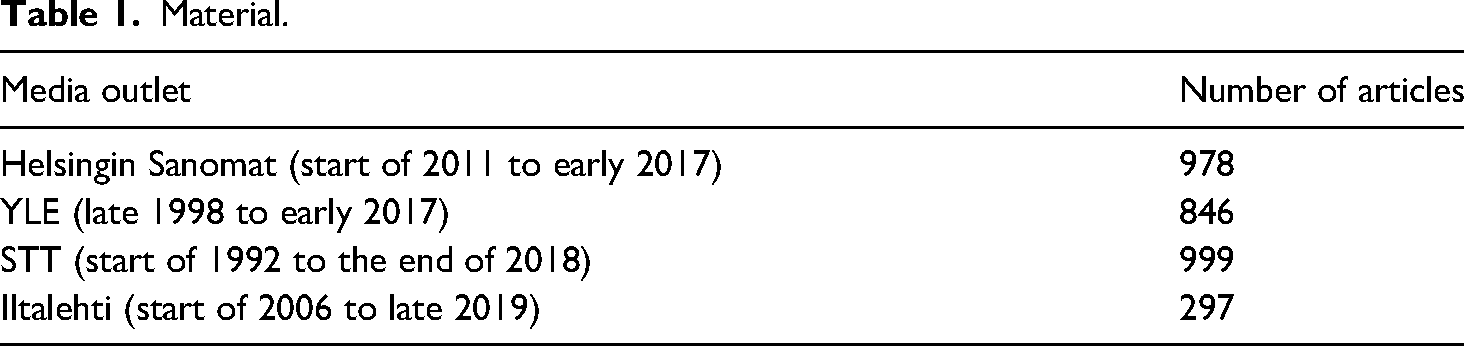
The Finnish word ‘talouskuri’ (austerity) in its different inflectional forms was then searched from the full data dump of these four publications. Table 1 depicts the total number of articles where ‘talouskuri’ was mentioned. 4 From this dataset a random sample of 500 articles was taken as material for the qualitative analysis. Our dataset had significantly less articles before 2010 than after that, so we wanted to utilise all data published between 1998 and 2009. To complement the sample, all articles mentioning the term ‘austerity’ from the beginning of each publication's timeframe until the end of 2009 from all four media outlets were thus collected and analysed, comprising a total of 118 journalistic articles, 18 of them included also in the whole timeframe sample. These datasets of altogether 600 journalistic stories were then compiled into an Excel file, which included for example the links to original articles, headline of the story and the context in which the word ‘talouskuri’ appeared. The articles were subjected to a close reading and a historical discourse analysis, identifying the main theme of each story (Table 2). Our methodology consisted of first reading through all articles in the sample and identifying themes of the article as well as the contexts in which the expression ‘talouskuri’ was used. We also collected a list of verbs used together with the expression austerity, which reveal arguments and viewpoints in the journalistic articles. The articles with only a brief mention of ‘talouskuri’ were given less attention, but the one's focusing more closely on economic policy were subjected to a closer qualitative analysis. By reading chronologically the articles, most of which were connected to European economic policy, we were able to construct an arc of the austerity coverage in twenty years. This reading revealed the historical conjunctures of austerity and the ideological aspects of the language used.
Most common main topics identified from the random sample of 500 stories.
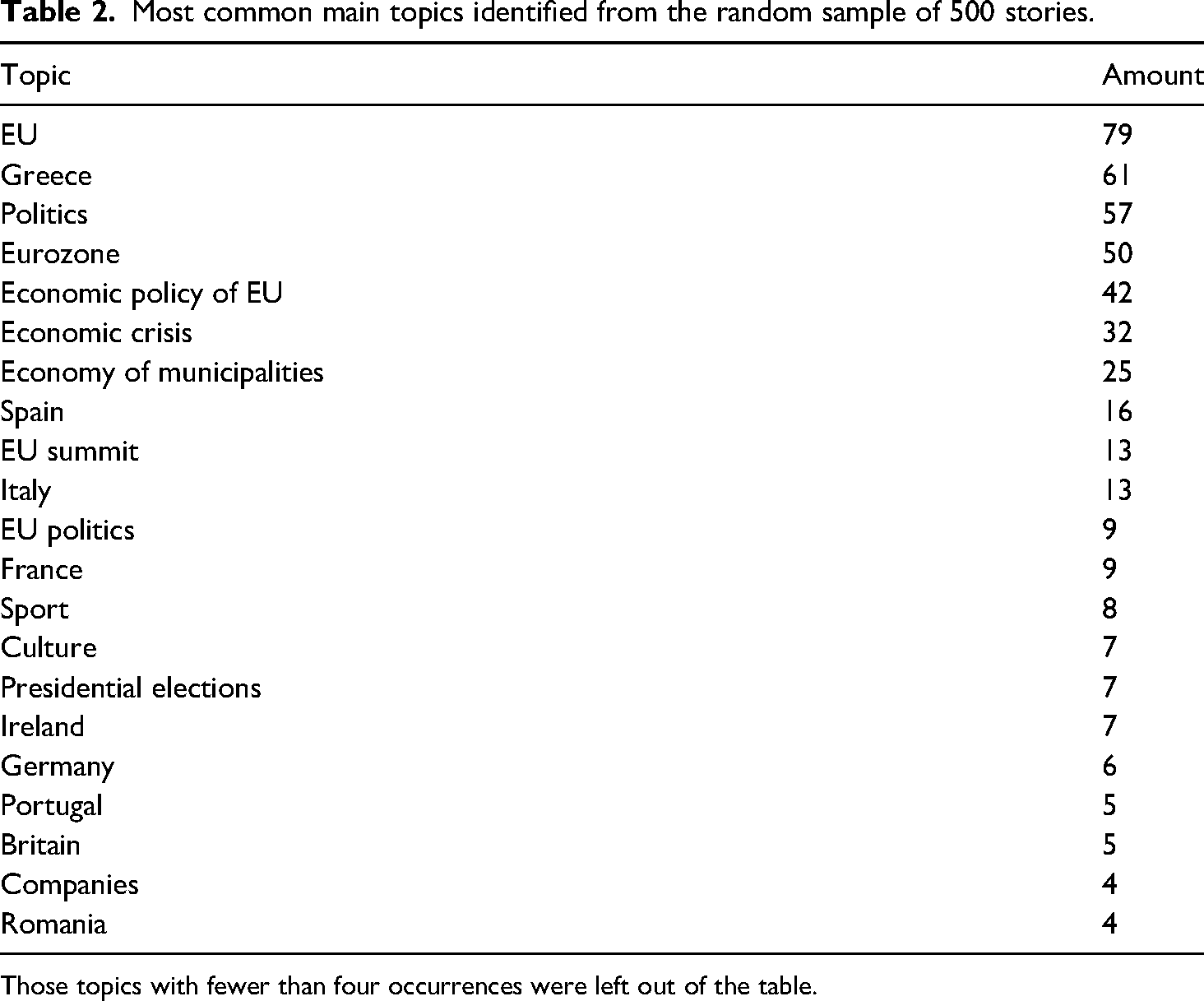
Those topics with fewer than four occurrences were left out of the table.
Table 1 shows the total number of articles in which ‘talouskuri’ (austerity) was mentioned between 1998 and 2019. The random sample of 500 articles was taken from the combined dataset of all articles. However, for Yle, online news output starts only in 2009, and before that the data dump included, for example, information about the television and radio programming of YLE. As the research material of this study consists of a broad sample of journalistic texts from four different media representing public broadcasting, commercial mainstream media, and tabloid news journalism, the material provides an extensive view into how austerity has been covered in Finnish media.
The research material is translated from the Finnish language into English; therefore, it is important to note that the two expressions have both similarities and some differences. In English, the noun ‘austerity’ or adjective ‘austere’ refers to a state of severe reduction of the amount of money spent in a way that is likely to produce unpleasant effects. In Finnish, the word austerity is systematically translated as ‘talouskuri’, which translates directly as ‘economic discipline’, thus referring to strictness, force, discipline, and even punishment. This is important to keep in mind when reading the journalistic coverage of the financial crisis through a historical discourse analysis. The word ‘talouskuri’ also invokes adjectives, such as ‘tough’ and ‘strict’, as we will later see. Thus, talouskuri is a normative concept that can be imposed on people, communities, and states from the outside.
Analysis: Unpacking the anatomy of austerity
Before 2010 in our dataset, austerity was not a markedly European cause, but only emerged in relation to the Asian and Argentinian economic crises and, for example, to the economic difficulties of African countries, namely, Ethiopia and Tanzania. Between 1999 and 2009, the term ‘talouskuri’ appeared in articles discussing various countries around the world, such as Russia, Argentina, Cuba, Poland, Austria, Japan, Switzerland, Tanzania and Ethiopia. Some of the articles before 2010 touched on the economic situations of Finnish municipalities, of sports clubs, or cultural events and festivals facing financial trouble. In Finland, before 2010, austerity was not only connected to the EU but also to the economies of Finnish municipalities, culture and some companies. When related to the economy and local government, austerity presented itself either as a reigning condition or a demand; austerity can ‘fail’, it ‘should be maintained’, it should be ‘held onto’, or it ‘is demanded’.
In the sample of 500 journalistic stories in this study, austerity is mostly connected to articles covering the Eurozone and European economic policy. The number of mentions of austerity exploded in Finnish media in the 2010s, and as Pi Ferrer and Alasuutari (2019) have shown, austerity became a global buzzword. The economic policy journalism of the 2010s in Europe was dominated by Euro crisis reporting, and the term ‘talouskuri’ was especially connected to Greece, a country that sustained the greatest impact from the economic crisis that resulted in the Greek debt crisis.
The European growth and stability mechanism was established in 1996 by suggestions of Germany to control European economic policy. As early as 2001 and 2005, austerity already appeared in articles about the growth and stability pact, which was described as ‘a watchdog for austerity in the Eurozone’ (Helsingin Sanomat 11.9.2001; YLE 20.3.2005; STT 23.3.2005). However, between 1998 and 2008, many European countries, including Germany, were breaking the economic rules of the EU, and going over the public deficit limit of 3% set in the growth and stability pact.
The language in austerity articles from the first decade (1998–2008) was not as tough as it was in the subsequent Euro crisis coverage. Sanctions, fines, and warnings were all mentioned instead of punishments. Moreover, such verbs as ‘reprimand’, ‘order’, or ‘persuade’ were used instead of ‘demand’ or ‘punish’, as in the following examples: ‘Ireland was rebuked by the EU commission’ and ‘The stability pact is leading to the first reprimand for loose economic discipline’ (HS 25.1.2001).
Finland is positioned here as a model pupil of the EU, following the rules agreed: Finland has met the [agreed-upon] goals like a model pupil. Germany, Italy, France and Portugal have neglected the goals [–] Italy has announced that it will not even try to balance their economy by 2003. Last Thursday, EU Economic Commissioner Pedro Solbes tried in vain to persuade Italy into discipline. (HS 13.7.2002)
In the following sections, we study the journalistic treatment of austerity from 2010 onwards through the contexts in which the word ‘talouskuri’ appears in the sample of media coverage. The aims of the analysis are to interpret the ideological narrative of austerity through a historical discourse analysis (Jóhannesson, 2010), and to unpack the contexts and connotations of the word ‘talouskuri’ as well as the broader ideology behind austerity in the Finnish context by focusing especially on the journalistic perspective and national self-understanding.
Results: Building European austerity
The Greek debt crisis dominated media reporting in the 2010s. At that point, austerity was most often connected to Greece, and more rarely – but still often – to Spain, Italy, or Ireland, countries heavily affected by the European financial crisis. The word ‘talouskuri’ occurred most often together with topics, such as European politics and decision-making in the EU and the Eurozone. The following table depicts the most often occurring themes in relation to austerity.
In a news piece by STT, the then Minister of Finance in Finland, Jyrki Katainen, estimated that ‘the stance of European countries towards enforced austerity has turned more positive than before’ (STT 8.6.2010). We interpret that the era of austerity had begun in Europe around this time. In the articles from 2010 onwards, austerity was a shared cause for the EU countries.
In 2012, there were disputes about the economy and even hostility and conflict amongst EU countries. In Greece, the political situation was turbulent due to the ongoing debt crisis. Riots and protests were taking place. In the Finnish media, the Eurozone countries were set against each other as parties in a conflict. For example, an article from YLE in February 2012 asked, ‘Is there hate against Finland brewing in Greece’? (YLE 13.2.2012). At the same time, Finns were interested in how they were perceived by their fellow Europeans. The article prompted readers to discuss this question in the comments section and continued: ‘Finland and Germany have become unpopular in Greece, after demanding strict austerity in the country. Will Finland get its share in the Greek riots’? (YLE 13.2.2012). An article from Iltalehti emphasised the negative views in Italy towards Finland: ‘In Italy, Finland rose next to Germany and even beyond it, as the front of the stone-hearted group of countries demanding austerity, called “the hawks of the North”’ (IL 27.3.2013).
In reporting on the European financial crisis, Greece and Germany were especially set against each other. Another dividing line that prevailed in journalism in 2012 was related to the differing policies of Germany and France, as Angela Merkel of Germany and Francois Hollande of France had very different views towards austerity. As Helsingin Sanomat reported, ‘Growth-Hollande is facing discipline-Merkel’ (HS 18.6.2012).
In the first stages of European austerity, Finland looked down on the ‘weak countries’, such as Greece or Italy. In the journalistic coverage of 2011–2012, Finland was positioned together with ‘strong’ countries, such as Germany and Holland, which possessed AAA credit ratings: Headline: ‘The quarrelling between weak and strong euro countries continues’. The division of Eurozone countries into those treasuring austerity and those pleading for extra help was once again clear Friday evening, when the leaders of 17 Eurozone countries gathered in Brussels. (HS 12.3.2011)
Austerity was also considered a German idea. For example, according to Helsingin Sanomat: ‘German austerity will soon be followed throughout Europe’ (HS 1.3.2012). Finland lined itself with the ‘tough’ countries, the ones who took a tough approach to austerity, as opposed to the ‘softer’ approaches of France and the Southern European countries. The ‘strong’ countries were still economically strong; thus, they had some power against other countries. Before 2010, there were several instances in which Germany broke the economic rules of the Eurozone. However, a decade later, this rule-breaking was forgotten, and austerity became the dominant agenda pushed forcefully by Germany and its allies, as shown in the following passage: ‘Resuscitation or discipline? The voices demanding resuscitation have grown strong by the lead of France, whereas Germany is pushing a line of strict austerity’ (HS 3.6.2012).
The toughening language of discipline and punishments
Force and punishments co-occurred in the journalistic language related to austerity. There were also references to ‘hard’ and ‘soft’ approaches to economic policy. Punishments were related to discipline, and on February 18, 2011, the Finnish member of European parliament, Carl Haglund, proposed punishments in the form of fines for the countries breaking economic rules, stating that ‘a tough crisis requires tough measures’ (STT 18.2.2011).
The discourse of shared rules and punishments for breaking the rules was repeated later by other politicians. The language of punishments and restoration of discipline became a central part of the austerity discourse of 2010–2011. The former Prime Minister of Finland, Paavo Lipponen (SDP), was critical towards the conservative leaders of the EU: ‘Lipponen names the conservatives the punishment company, whose only guiding principle is enforcing austerity. The Minister of Finance Jyrki Katainen (National Coalition) also gets his share, Lipponen calls him the leader of the punishment company’ (YLE 5.3.2011).
In Finnish journalism, austerity was not approached through the virtues of thrift and restraint (cf. Jensen, 2018: 125–138), but through the principles of toughness, discipline, and punishments. The tough language of discipline was also an act of discursive power, and the news media adopted the language of politics and complied with the ideas of austerity. Autto et al. (2022) have examined how fear and insecurity have been deployed in disputes over austerity and according to them, even though fear plays a part in the politics of austerity, politics of fear is rarely mentioned in the context of austerity, but rather it is regarded as a result from austerity. Fear can also be a motivator for discipline, working as a booster for economic discipline and austerity measures.
When compared to the pre-2011 articles regarding the economies of Finnish municipalities, there ‘talouskuri’ served as a more neutral practical tool, something used to reach practical goals, or a temporary condition. When connected to the Euro crisis, ‘talouskuri’ as austerity became more politicised, evoking conflicts and blaming amongst EU countries. As Stefan Wallaschek (2020) presented, the creditor and debtor dynamic amongst the Euro countries has turned into a question of solidarity. Before 2010, many countries broke the European economic rules. However, in the beginning of the 2010s, the ordoliberal approach promoted by Germany was adopted as the guiding principle of European economic policy due to the crisis. Furthermore, in Finnish journalism, conflicts amongst Eurozone countries were often emphasised.
In the first stages of European austerity policies, the perspective towards austerity seemed to be supportive of the German agenda and reached towards other prosperous Northern European Eurozone countries. The Nordic perspective was markedly absent from the austerity reporting, as Sweden, Norway, and Denmark did not figure in the austerity coverage, Finland being the only Nordic country in the Eurozone. The absence of the Nordic perspective also revealed something about the construction of the self-understanding of Finland: Finland aspired to connect with other European countries directly without the Nordic community as a primary reference group. ‘The Greek are raging’: Reporting the public protests
Public protests have at least two sides: the actual protest events taking place in the streets, and the ways in which the events are reported and circulated in the media as images, videos and texts (Cottle, 2008). Public protests against austerity policies were reported around Europe, such as the ones that occurred by the end of 2012 in Spain: Hundreds of thousands were marching in the evening's protests against the government's austerity politics and privatization of public services in Spain. In addition to Spain, workers have also gone to the streets in other parts of Europe in a rare unified show of force for workers’ rights and for creating jobs, and against the austerity aiming to control the Euro crisis. (HS 15.11.2012)
The protests happening in Europe at that time were depicted mostly in a reportage style. The journalistic voice covered the events from a distance by informing the public of what was happening in a matter-of-fact manner. The protesters were quite often depicted as crowds (i.e. ‘thousands were marching’). The coverage reported the fury of the people but maintained distance and did not relate the events to Finnish readers: ‘[–] the Greek are raging’ (YLE 13.2.2012) and ‘Europe's dissatisfied workers went to the streets’ (HS 15.11.2012). This distancing effect thus kept the events far from the daily lives of Finns.
According to research on political protests, the media often tends to trivialise, polarise and marginalise the protesters and their aims (Cottle, 2008; Lounasmeri, 2017). For example, one Helsingin Sanomat story (15.11.2012) about the general strike in Spain adopted quite an ideological wording towards the Spanish protesters by depicting them as ‘disorderly rioters’ and by framing the brutal force used by the police towards citizens as a fight or a combat: After the march had ended, the riot police combatted the protesters in front of the parliament house and at the stock of Madrid. In Barcelona, too, the protest escalated into a brawl. According to news reports, the police fired the fleeing disorderly rioters with rubber bullets. (HS 15.11.2012)
By 2013, critical voices towards austerity had increased, and they were emerging from various directions. The president of the European Commission, José Manuel Barroso, was quoted saying that the European policy of strict austerity has ‘in many senses come to the end of its road’ (HS 23.4.2013). Barroso did not say directly that the policy was wrong, but he referred to strong protests against it.
There was also a change in the views of EU Economics Commissioner Olli Rehn, who stated that, ‘According to many, spending cuts and raises in taxes have started to turn against itself’ (HS 26.4.2013). The phrase ‘according to many’ hinted that public opinion towards austerity seemed to be changing. Whereas austerity was initially taken as an almost inevitable development, critical views began to emerge, as austerity policies largely failed to produce the desired results. As one article read, ‘According to the Left Youth of Finland, European politics of the right is getting even more authoritarian and violent forms. The Left Youth of Finland are calling for the right to protest against austerity politics of the right’ (YLE 28.5.2012). In Finland, the criticism of austerity policies came primarily from the political left (YLE 3.6.2013, YLE 21.5.2014).
In 2014–2015, popularity of the Greek left-wing Syriza Party rose because of the difficult economic situation. The Greek have, in their opinion, ‘suffered enough from austerity’ (HS 21.11.2014). The Greek resistance towards austerity policies was widely reported: ‘No to Germany, no to austerity’! (YLE 6.7.2015). Anna Agathangelou (2016: 207, 213–214) noted how popular discourses about Greece have depicted the Greek as, for example, lazy, swindlers, abusers, and traitors in the European family and that Germany is represented in newspaper articles as visionary because of its economic policies. Finnish journalism seemed to repeat the dichotomies of chaos and order in relation to Greece (cf. Agathangelou, 2016: 208) and Spain, at least as it framed the protesters as disorderly hooligans and emphasised the violent rage of the Greek.
The critical voices of economists were also raised in the journalistic coverage in 2014–2016, as the general view on austerity shifted towards critical views. In the early years of the European austerity policies, the critical views of economists were not present. Was it, perhaps, due to the dominant Northern European need to build consensus around strict austerity in countries, such as Finland, Germany, and Holland? At that point, the media followed the views of political and economic elites and did not promote views that were critical of austerity measures. The critical voices of economists, however, began to appear more often in the media after 2013, as shown in the following passage: ‘[Finnish economist] Korkman longs for resuscitation and snipes at the guardians of strict austerity’ (YLE 31.10.2014).
YLE, the public broadcaster, published an interview with the British economist Jonathan Portes in which he shared his very critical views of austerity: ‘According to Jonathan Portes, the strict austerity and wage reductions in Finland are false moves which cause unnecessary suffering’ (YLE 15.4.2016). As has been shown in media research, elite-led, rather than grassroots, criticism is more successful at influencing debate in the media (Lounasmeri, 2017). Therefore, it came as no surprise that the critical views against austerity were heard first from politicians of the left and, eventually, from leading economists.
Discussion: From an outsider to a subject of austerity
In its reporting, Finnish journalism aligned ‘us’ against ‘the others’ (i.e. Greek and other Southern European countries in economic difficulties) by setting Finland together as a good friend of Germany. Austerity was thus used as a means of national and political self-understanding, building an imagined community of a nation of strict economy. European solidarity did not figure here; rather, the weak countries were portrayed as ‘slacking’, and the local protesters were portrayed unemphatically and in a distancing manner.
Only a few articles have attempted to portray how the reality of austerity affects the lives of citizens. It is possible to presume that the agency in journalism in relation to the economy is mostly dominated by elite sources, as shown in many studies (Arrese and Vara, 2018; Berry, 2016; Harjuniemi, 2020: 15; Mercille, 2014). Thus, the reporting most probably only rarely touched regular citizens and the effects of austerity on their everyday lives. The Helsingin Sanomat article (HS 25.6.2015) is one of the few which illustrated what austerity measures would mean for the citizens. The article presented measures taken in Greece and reflected on what these measures would mean if they were implemented in Finland. Thus, the article produced an imaginary alternative vision for the future in which the economic situation would be the same as in Greece: ‘If Finland had experienced the drastic cure of Greece, the average salary would be approximately 2000 euros’ (HS 25.6.2015).
From the journalistic articles studied here, it can be considered that austerity was dealt with mostly as a European cause, connecting especially to the countries in financial crisis, but related to Finland only by proxy. Therefore, the Finnish perspective regarding European austerity was distancing, dealing with it from the side-lines and from above, especially in the first years of the crisis. In austerity journalism, European countries were divided into those that behaved well or badly, those who either followed or did not follow austerity policies, and those who took a harder or a softer approach to austerity.
A Helsingin Sanomat story (HS 23.3.2011) headlined ‘The euro party turned into a battle for existence in ten years’ reflects the situation of the EU and the Eurozone in its past and history. The article mentioned austerity as a shared rule: ‘Austerity was meant to be secured so that everyone followed the conditions which were agreed together’. The article already noted disagreements amongst countries about supporting one another and even the disintegration of the Eurozone was mentioned. Wallaschek (2020) noted that in the political discussion about the Euro crisis, solidarity was an important issue, which can also be seen as oppositional to austerity. Thus, the solidarity of the Eurozone was beginning to crack at that point: ‘The position of Finland is shown as being turned away from the centre of the Eurozone: The Eurozone is changing, Finland looks away’ (HS, editorial 18.8.2011).
This brings us to the critical point of the Helsingin Sanomat editorial (HS 18.8.2011): at the same time as the Eurozone was apparently moving towards a federation through Eurobonds, in Finland, the public debate only revolved around the collateral allowed for Greece. This editorial was largely critical of the narrow point-of-view in the Finnish public debate. Finland first demanded collateral for the debt from Greece in autumn 2011 and settled into the same approach to austerity as Germany, emphasising compliance with the rules.
In the narrative of austerity, Finland was initially an outsider of austerity, but as the competitiveness of the country faded in the aftermath of the global financial crisis, Finland itself became a subject of austerity. In 2015, there was a turn of events when Finland also slipped from strict economic discipline. Specifically, in May 2015, Finland received a serious warning from the European Commission for breaking the austerity rules. Thus, the model ‘student’ and one of the ‘strong countries’ was now behaving badly: ‘The European Commission is expected to give Finland today a serious warning for breaking the austerity rules’ (STT 13.5.2015).
In 2015, the Finnish government launched a Competitiveness Pact, a policy measure that aimed to increase the competitiveness of the economy by lowering labour costs. The competitiveness measures, however, caused a conflict between the government and labour market parties (Kylä-Laaso and Koskinen-Sandberg, 2020), which escalated into a prolonged crisis between the government and trade unions, and captured the interest of citizens who faced wage freezes and extensions of annual working time (Vainikka et al., 2020). The proposed austerity measures prompted a wave of protests. While those hardest hit by the cuts were the unemployed, families with children and students, it was the unions which staged the most visible opposition (Autto and Törrönen, 2019).
Conclusion
The aim of this article was to construct a historical discourse analysis of the journalistic coverage of austerity, and determine, how the journalistic treatment of austerity emerged in the Finnish media in a twenty-year time span. Special focus was placed on the journalistic point-of-view of austerity coverage. From our analysis of the chronological arc of austerity reporting, emerged the historical conjunctures of austerity in the media; first, the connection with the European growth and stability pact, then the toughening language of the European debt crisis, especially toward the Southern European countries, the reporting of protests in Europe in a distancing way, and, finally, emergence of critical voices towards austerity measures. The findings prior to 2010 (1998–2009) showed that the concept of austerity or ‘talouskuri’ was not as commonly used in journalism. When the word ‘talouskuri’ (economic discipline) was used, it was mostly connected to the economy of municipalities, sports organisations, or other countries in economic difficulties. Before 2010, the journalistic language in relation to the economy and breaking the rules of the European growth and stability pact was also softer. After 2010, austerity appeared more in journalism across different media as an idea closely connected to the ongoing Euro crisis, and as austerity became a global buzzword (Pi Ferrer and Alasuutari, 2019).
To draw some general conclusions about austerity reporting in the four media outlets studied here, Helsingin Sanomat covered most of the more nuanced and profound articles about austerity, although this was dominated by its own elite-led perspective. YLE, the public broadcasting company, seemed to have a slightly more citizen-oriented approach than Helsingin Sanomat. STT, as a news agency, had a more matter-of-fact approach and was not so colourful in its austerity coverage. As previously noted, Helsingin Sanomat and YLE are the two main news sources at the core of the Finnish public sphere (Lounasmeri, 2017). As for the daily tabloid Iltalehti, there were significantly fewer articles mentioning austerity than in the other sources. The coverage by Iltalehti was not particularly colourful, nor did it include in-depth analyses of the contexts of the Euro crisis. Rather, it stuck to conventional reporting about political events, wherein austerity was mostly mentioned as a contextual fact. The tone in these four publications was surprisingly uniform.
Journalism has often been criticised for emphasising conflicts and tensions (Carter et al., 2011) and for its simplified and narrow elite-based views of economic phenomena (Harjuniemi, 2020: 15; Mercille, 2014; Berry, 2016). These criticisms also seem to be evident in the case of Finnish austerity journalism. The journalistic coverage of austerity emphasises conflicts and tensions between European nations and decision-makers. The presentation of the perspectives of citizens affected by austerity is narrow, especially in the first years of reporting on the European financial crisis.
To conclude, this work characterises how austerity has been presented in Finnish journalism, and thus presents the narrative arc of austerity in Finland in the past 20 years. In the 2010s, the word austerity was almost exclusively related to the Euro crisis in Finnish journalism across different publications. After the financial crisis, a dividing line appeared between Northern and Southern Europe, along with the emergence of the harder and softer approaches towards austerity. There were practically no differing voices, and austerity measures were, for a while, the only choice in economic policy.
In Finnish journalism, austerity was used as a tool for self-understanding as part of the European monetary union. Finland was not depicted as being part of the Nordic countries that were mostly excluded from the austerity reporting. Rather, Finland was positioned together with other Northern European countries, namely, Germany and Holland, which supported strict austerity. However, in some Eurozone countries, mostly in Southern Europe, the austerity rules and measures were not supported, resulting in conflicts that were emphasised in journalism, as the countries were set against each other, thereby weakening the solidarity amongst the Eurozone countries (Wallaschek, 2020).
First, the lack of critical voices towards austerity was apparent, and there was perhaps some consensus in Finland about austerity measures. Reading from the coverage of austerity, Finland was looking into austerity measures and the Euro crisis from the side-lines, distancing itself from austerity and expressing a strong need to be part of Northern Europe's ‘strong countries’. After a few years of austerity policies, critical voices started to emerge in journalism, and criticism came especially from left-wing parties and well-known critical economists.
Methodologically, this study shows that in a case where a very specific word, ‘talouskuri’ (austerity), is connected to a specific process, namely, the European financial crisis, it is possible to easily dig from a big dataset a sample from which both the story of austerity and the story of the financial crisis can be read together forming a ‘critical narrative’ based on a historical discourse analysis. The results of this study mirror the approach of Finland to austerity measures and public debt. It seems that in Finland the fear of public debt remains strong, which may reflect on the decisions and actions of the country as part of the global and European economic communities.
Footnotes
Acknowledgements
The authors want to thank Dr Laura Saarenmaa (University of Turku) and University Instructor Jari Väliverronen (Tampere University) for their insights on the manuscript.
Declaration of conflicting interests
The authors declared no potential conflicts of interest with respect to the research, authorship and/or publication of this article.
Funding
The authors disclosed receipt of the following financial support for the research, authorship and/or publication of this article: This work was supported by the Research Council of Finland, Kulttuurin ja Yhteiskunnan Tutkimuksen Toimikunta (grant numbers 320286 and 320677).
