




Abstract
This article observes how developments in politics, society, the media, and journalistic ethos impact political journalism content in Finland between 1995 and 2015. The focus is on three newspapers: the dailies Helsingin Sanomat and Aamulehti, and the tabloid Iltalehti. Using a coding scheme developed by Benson and Hallin (2007) and utilizing earlier findings by Kunelius and Väliverronen (2012), the analysis indicates two different approaches to politics at story level: a neutral and policy-oriented style in the two dailies, and a more diverse take by Iltalehti. Within stories, journalistic interventionism increases in all papers until 2010 and then diminishes. Differences emerge between the dailies and Iltalehti in journalistic presence, reporting patterns and sources used. Notably, in recent years, Iltalehti’s approach has become more reminiscent of the dailies both at story level and within stories. The findings highlight the impact of the general journalistic ethos and the differing market considerations on the journalistic content.
Introduction
Since the 1990s, Finnish newspapers’ relations to politics have been in flux. Socio-political changes – for instance, Finland’s EU accession in 1995, a cultural shift to liquid modernity (Kantola, 2011), and the recent rise of populism (Niemi and Houni, 2018) – have forced newspapers to rethink their approach to politics. The traditional democratic corporatist media system (Hallin and Mancini, 2004) has evolved into a hybrid of liberal and democratic corporatist tendencies (Nord, 2008) as the state has greatly reduced its press subsidies (Ala-Fossi, 2020).
These changes have added to newspapers’ market and audience pressures, which have been accelerated by a deep recession in the 1990s, intensifying media competition, technological developments, and people’s evolving media use (Ahva, 2010; Grundström, 2020; Koljonen, 2013a). The impacts on journalists and journalistic practices have been notable. Journalists have increased differentiation from political actors (Herkman, 2009), diversified their approach (Koljonen, 2013a), and turned increasingly to audiences (Ahva, 2010). However, political journalists represent a special case with their somewhat distinctive values and practices (Väliverronen, 2018).
In recent years, financial pressures have mounted, and political journalists’ long-standing place of prestige in newsrooms (Kantola, 2013) and distinctive ways of working have been increasingly scrutinized by media managers (Grönvall, 2015). Although the press fares better financially in Finland than in many other parts of Europe (Björkroth and Grönlund, 2018), dwindling readerships and advertising income have led to lay-offs and organizational reforms (e.g. Grundström, 2020, 8–10), from which political journalists are no longer exempt (Väliverronen, 2017).
How these changes have impacted political journalism content over time has received somewhat limited research attention. Scholars have focused mainly on case studies (e.g. Harjuniemi et al., 2015). Longitudinal studies are few (e.g. Kivioja, 2008), they tend to have a narrow focus, and latest developments usually fall out of their scope. Moreover, comparability between studies is hindered by the different coding schemes. The present study aims to address these deficiencies by building on the framework developed by Benson and Hallin (2007) and later utilized by Kunelius and Väliverronen (2012) to observe changes and continuities in Finnish political journalism from the mid-1990s to 2015.
Historical Background
Developments in Finnish newspapers since the 1990s are connected to broader changes that Kantola (2011) describes as a shift from high to liquid modernity (see Bauman, 2000). Kantola (2011) estimates that high modernity peaked in Finland in the 1970s when planned economy and welfare state ideology dominated societal development, and politics was class-based and organized into parties and institutions governed in the spirit of democratic corporatism (see also Alasuutari, 1996; Kettunen, 2001; Mickelsson, 2007). The democratic corporatist spirit was also evident in the national media system (Hallin and Mancini, 2004). Newspapers – party press, and the rapidly-growing neutral commercial press (Nord, 2008) – and public service broadcasting connected to elite groups (Nieminen, 2001) and the welfare state project (Syvertsen, 2014), and state subsidies and legislation enabled journalists ample freedoms (Hallin and Mancini, 2004). In this system, journalism developed in a deferential and subservient position to politics and politicians. Journalists’ approach was strongly oriented towards the state, parties, and corporatist institutions, and based on neutral and factual policy reporting (Koljonen, 2013a, 117–8; Kunelius and Väliverronen, 2012; Salminen, 1988).
The tenets of high modernity began to change in the 1980s, which Kantola (2011) defines as the beginning of the liquefying modern era. In this period, the era of party politization (Mickelsson, 2007) and “Finlandization” (Forsberg and Pesu, 2016) ended, consensus became more challenged (Kantola, 2002), class differences began to fade (Melin, 2009), and Finnish society moved from planned to competitive economy (Alasuutari, 1996). Among others, these changes paved the way for a more diverse press output (Salminen, 1988) and a more critical and more independent mindset among political journalists (Aula, 1991). However, Finno-Soviet relations and foreign policy remained delicate matters for journalists (Lounasmeri, 2013).
In the 1990s, the pace of changes intensified. In politics, the end of the Cold War and Finland’s EU membership required a new framework of foreign policy, and a more parliamentary mode of governance was ushered in domestically (Paloheimo, 2017). As class differences further diminished (Melin, 2009), political parties’ membership decreased (FNES, 2020) and they turned into catch-all parties (Paloheimo, 2009, 40–41). The media opened up to increasing competition and political freedom, and the state’s cuts on press subsidies following a heavy recession (Ala-Fossi, 2020) had a notable impact. Television strengthened its position and the rise of neutral newspapers turned into decline (Herkman, 2009) while the party press faded into an insignificant position (Nord, 2008, 103). As newspapers adopted a more interpretative function and expanded their stylistic repertoire (Koljonen, 2013a) and journalists turned increasingly to audiences (Ahva, 2010), media-politics relations became more diverse and polarized. On one hand, political journalists sought further distance from politicians (e.g. Kanerva, 1994), and on the other hand, personalization and intimization of politicians gained ground in other journalistic genres (Niemi and Houni, 2018). Put together, all these changes resulted in the emergence of a new era. From a media systems perspective, Herkman (2009) times the structural transformation of the democratic corporatist model broadly to the 1990s. Kantola (2011, 168) talks about a sociocultural shift to liquid modernity at the turn of the millennium.
In the new era, changes have continued apace. In politics and economy, the European dimension has been strengthened by Finland’s adoption of the euro in 2002, EU expansions, and the aftermath of the financial crisis of 2007–2008. Domestically, wide and ideologically flexible government coalitions have become the focal point of politics (Paloheimo, 2017). Following increasing individualization in society (Kantola, 2011), political parties’ membership has further decreased. Party organizations have become increasingly centralized and professional, which has led to notions of managerialist politics. (Koskimaa, 2017.) New polarization is also emerging as the rural-urban or centre-periphery divide has appeared alongside the left-right distinction (Raunio, 2011). In the 2010s, the new cleavage structure has been embodied by the rise of the populist Finns Party, which has generated new ideological tensions by giving an outlet to Eurosceptic, xenophobic, and system-critical voices (Niemi and Houni, 2018).
The state has further reduced press subsidies and thus continued the systemic shift from a democratic corporatist media model into a hybrid of corporatist and liberal influences (Nord, 2008). Following the cuts, Finland’s commitment to the media welfare state ideology has been questioned (Ala-Fossi, 2020). Newspapers have been further encumbered by the rise of social media and online news (Grundström, 2020). Although newspapers’ readership remains high in international comparison and their financial situation is less dire than in many other European countries (Björkroth and Grönlund, 2018), they have increasingly resorted to lay-offs, newsroom mergers, and other reforms in the 2010s (Grundström, 2020).
Journalists’ attitudes have evolved. News reporters view politics as a rational undertaking, have a relatively neutral stance on political issues and actively distance themselves from political groups (Reunanen, 2014). Political journalists highlight the same principles, but with more intensity, and have a pronounced focus on critical analysis. They also maintain more distance to market and audience considerations than others to preserve their neutrality (Väliverronen, 2018). However, their values have been increasingly challenged in the 2010s. Media managers have demanded a more audience-oriented and commercial approach (Grönvall, 2015), and political journalists’ elevated status (Kantola, 2013) and privileges have been questioned in integrating newsrooms where non-specialists increasingly do political journalism in varying ways (Väliverronen, 2017). The changes have impacted different generations of political journalists in varying ways, which is reflected in differences in their practical ethos (Kantola, 2013).
Kantola’s observation about different generations of political journalists is important as it points to the gradual and uneven nature of evolution, and to the co-existence of styles and values from different periods in different combinations (Kantola, 2011, 168–169). This is also the case with journalistic practices in newspapers. Tabloids led the way in increasing distance to politics and adopting new styles in the 1990s, and dailies followed suit in the new century (Herkman, 2009; Kivioja, 2008). More recently, financial problems and the growing importance of online reporting have made newspapers reconsider their publication strategy, and different solutions have emerged in different outlets (Väliverronen, 2017).
For now, we know relatively little about the development of political journalism content in different newspapers in the new era, and about the impact of the changes described above. This is because of limitations in previous research: case studies, small samples, limited longitudinal scope, and differing coding schemes hinder generalizations and comparability. Existing studies’ findings follow international observations about growing media interventionism (Salgado, 2016, 51). Since the 1990s, political journalism in the Finnish newspapers studied has become more diverse in sources and output and more interpretative in style. Attribution of facts has increased (Kivioja, 2008, 147–196; Kunelius and Väliverronen 2012; Reunanen and Väliverronen 2020). Politicians’ private lives have come increasingly to the fore (Juntunen and Väliverronen, 2010; Kivioja, 2008, 162–187). However, there appears to be limits to interventionism. Despite some signs of increasing adversarialism and assertiveness, the neutral policy approach still reigns. (Kivioja, 2008, 147–196; Kunelius and Väliverronen, 2012). Similarly, the “audience turn” (Costera Meijer, 2020) is not highly evident in political journalism: the focus is on elites and citizens’ presence has remained marginal (Kivioja, 2008, 147–196; Kunelius and Väliverronen, 2012; Harjuniemi et al., 2015).
To fill some gaps in literature, this article observes what the changes described above have meant to political reporting content in three different types of publications from 1995 to 2015. The analysis is based on the model created by Benson and Hallin (2007), which is explicated below.
Methodology, Research Questions and Hypotheses
Revisiting Benson and Hallin is useful although its choice of variables is not as elaborated as in more recent works (e.g. De Vreese et al., 2016). Nonetheless, it enables an assessment of practical operationalizations of the journalistic ethos in some key questions, and the impact of different factors on these operationalizations. It also helps avoid two common problems in comparative media research: lack of temporal comparison and issues of incompatibility (De Vreese et al., 2016). Benson and Hallin originally focused on French and US press front pages from 1965 to 1997. Later, Kunelius and Väliverronen (2012) added Finland to the comparison and continued their study until 2005 for Finland. It remains the latest broad longitudinal analysis of developments in political reporting in the country. Given the changes since 2005, a look into recent developments is warranted. Moreover, to maintain comparability with Benson and Hallin, Kunelius and Väliverronen analysed only the national daily Helsingin Sanomat (HS) from the capital Helsinki. Although understandable internationally, this choice does not reflect the diversity of the Finnish newspaper market.
To tackle these problems at the national level, this article uses Benson and Hallin’s coding apparatus with authors’ permission. It adds two periods of observation to account for recent changes, and two newspapers to enable national comparison. The focus is on four periods of time: 1995–1997 and 2005 from the earlier works, and 2010 and 2015. The newspapers complementing HS are Helsinki-based tabloid Iltalehti (IL) and Tampere-based regional daily Aamulehti (AL). IL is published six days a week (Sundays excluded); the other two are issued every day. The dailies are mainly subscription papers while IL is only sold as single copies. Following Sparks’ categorisation (2000), the dailies can be labelled as semi-serious press, and IL qualifies as serious-popular press. All have been politically independent throughout the observation period, AL only just as it cut its ties to the conservative National Coalition in 1992.
The sampling policy follows Kunelius and Väliverronen (2012) who made slight adjustments to Benson and Hallin (2007) to account for some particularities of Finnish newspapers. For IL and AL, items introduced on the front page were eligible for selection. In HS, selection was made from the news front page as the front page proper is usually reserved for ads. Only political stories written by staffers were chosen. A political story was defined as a combination of a headline plus at least one paragraph of text, and it had to refer explicitly to at least one Finnish politician or to some phase of the political decision-making process. Both national- and local-level politics were taken into consideration. Visual elements (photos and graphs) were excluded. Although the focus was on news, commentary pieces were accepted if they fulfilled the other criteria. Stories were picked on random dates to prevent individual events from gaining undue influence. The sample consists of 2620 stories.
The analysis is operationalized at story and paragraph levels and uses two questions for each level. They are briefly presented here. For more on methodology, see Benson and Hallin (2007, 30–34). RQ1. What is the overall tone of the story?
The first question deals with political journalism’s overall attitude towards politics and/or politicians. To be non-neutral, a story has to include explicit judgements by the journalist. Thus, a story with a negative theme and quotations is also neutral until the journalist explicitly states their opinion. The tone of the journalist’s statements determines the story tone. Negative and positive stories are dominated by such statements. A mixed story has isolated negative or positive remarks, or a combination of both. Partisan stories offer support for a political party or actor. RQ2. What is the dominant schema of the story?
The second question observes how politics is understood in a story. Three main schemata are distinguished: policy (focus on the debate, or how to proceed, in a political issue), ideology (broader ideological aspects and differences beyond an issue), and political game (e.g. behind-the-scenes machinations or the horse-race aspect of politics). Stories with a connection to political decision-making but not falling into any of these categories – for instance, stories giving background information about politicians – belong to “Politics/Other”. Finally, “Other” indicates stories where the focus is unclear or outside of political decision-making (e.g. stories about politicians’ private lives). RQ3. Whose voice is heard in each paragraph?
The third question focuses on the attribution of viewpoints; mere factual statements are coded as having no viewpoint. Only one source per paragraph is coded. If there are multiple attributed viewpoints, the most prominent one is coded. Actors are divided into nine main groups: journalists and eight others. Altogether, there are 29 categories. RQ4. What primary function does each paragraph serve in the text?
The fourth question tests journalistic interventionism. Four main groups – each with several functions – are distinguished: reporting and description, background, interpretation, and opinion. Reporting consists of facts and statements, and description features depictions of character or setting. The main difference between them is the more frequent use of adjectives in description. Background differs from reporting by having a reference to the past. Interpretation focuses on speculation about e.g. motives and outcomes, and opinion indicates journalists’ judgemental statements. These groups are treated ordinally, with reporting representing the lowest and opinion the highest level of interventionism. If a paragraph features multiple functions, the most prominent one from the group with the highest level of interventionism is coded. In addition, “Other” includes journalists’ spelled-out questions and other explicit indications of their presence in the text. The level of interventionism for such manifestations is above reporting; their status vis-à-vis other journalistic interventions is decided by prominence in each paragraph.
Coding accuracy was checked in intercoder reliability tests which produced acceptable results for all research questions (Krippendorff’s αRQ1=.917, αRQ2=.863, αRQ3=.842, αRQ4=.831; for more on the method, see Hayes and Krippendorff, 2007). Based on the findings by Kunelius and Väliverronen (2012) and previous studies, the following hypotheses were made for the four research questions:
H1. Neutrality is the main tone throughout the observation period in all papers. Due to the increasingly critical journalistic ethos and diversification in print journalism, the proportion of other tones, particularly negative tones, increases over time. IL has the most variety in story diversity and tones. H2. Policy is the main schema in all papers, albeit less dominant at IL than in the dailies. Following the increase in ideological debates in politics and diversification in print journalism, non-policy schemata should feature more prominently in all papers over time. H3. Journalistic presence increases over time in all papers due to the diversification trend, and it is bigger at IL than in the two dailies. Owing to changes in politics and the journalistic ethos, attribution increases and sources become more diverse. H4. Reporting and description form the most prominent function in all papers, at IL less markedly than in the dailies. The proportion of other functions increases over time in all papers due to diversification and changes in journalists’ ethos.
The analysis is divided into four sections. The first two focus on story-level observations and the following two deal with paragraph-level changes. The concluding discussion summarizes the findings.
Results
Story Tone
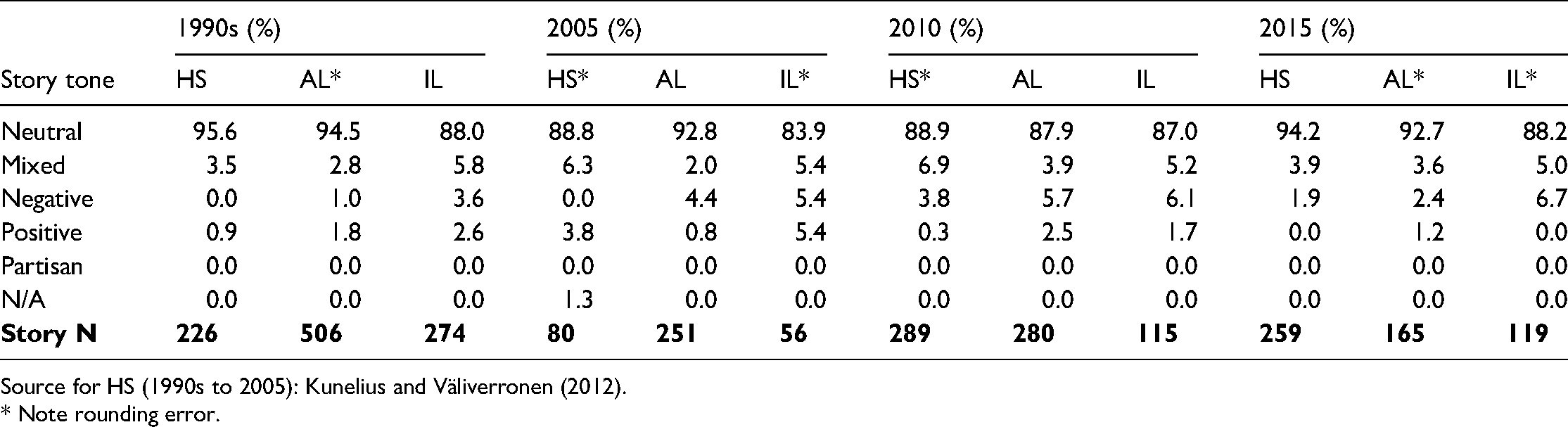
As posited in H1, neutrality is the most common tone in all three papers (see Table 1). It has a 92% share of the entire sample. Of the opinionated tones, the mixed stance was the most commonplace with a 4% share. Partisan stories were not found. These observations are largely akin to Kunelius and Väliverronen's (2012) earlier findings about HS. The similarities can be explained by two lasting tenets in post-war Finnish news journalism: a drive towards neutrality and non-partisanship (Koljonen, 2013a; Reunanen, 2014), and an Anglo-American presentation style in which news is separated from opinion (Salminen, 1988). Only 4% of news stories in the entire sample were non-neutral, which attests journalists’ adherence to this principle.
Story tone in political reporting, 1990s–2015.
Source for HS (1990s to 2005): Kunelius and Väliverronen (2012).
* Note rounding error.
The data also offer partial support for the diversification hypothesis. Commentary pieces become more commonplace after the 1990s, and with them, the proportion of other tones increases over time. However, contrary to expectations, from 2010 to 2015 there is a drop in the proportion of commentary, and other tones decrease. Both changes in tone are statistically significant (1990s to 2010: df = 2, X2 = 11.358, p = .003; 2010 to 2015: df = 1, X2 = 6.226, p = .012). The share of negative tones also increases from the 1990s to 2010 (df = 2, X2 = 17.314, p < .001) but decreases from 2010 to 2015 (not significant). One explanation for the recent change may be intensifying media competition online. It caught up with politics desks in the early 2010s, and by 2015, major outlets were increasingly publishing commentaries online first (Väliverronen, 2017). As paywalls’ impact on the three papers online in 2015 was small, it is likely that the switch online has decreased the share of commentary in print, and the negativity of the entire sample.
Contrary to H1, IL has no more commentaries than AL (8% each), and notably fewer than HS (12%; df = 1, X2 = 6.525, p = .012). However, as expected, IL has more non-neutral tones (13%) than the other two (8% each; comparison with HS: df = 1, X2 = 9.193, p = .002; with AL: df = 1, X2 = 11.158, p < .001). This happens for two reasons. First, opinionated news is more common in IL (7%) than in the dailies (3% each; comparison with AL: df = 1, X2 = 14.942, p < .001; with HS: df = 1, X2 = 13.156, p < .001), probably due to IL’s status as a newsstand tabloid that needs to distinguish itself from dailies (Kivioja, 2018). Secondly, commentary in HS is more neutral in tone than in IL and AL (comparison with IL: df = 1, X2 = 12.973, p < .001; with AL: df = 1, X2 = 5.679, p = .017), mainly because explanatory and neutral news analyses are a staple part of HS’s repertoire. AL uses them less frequently and at IL, they are practically non-existent.
Story Schema
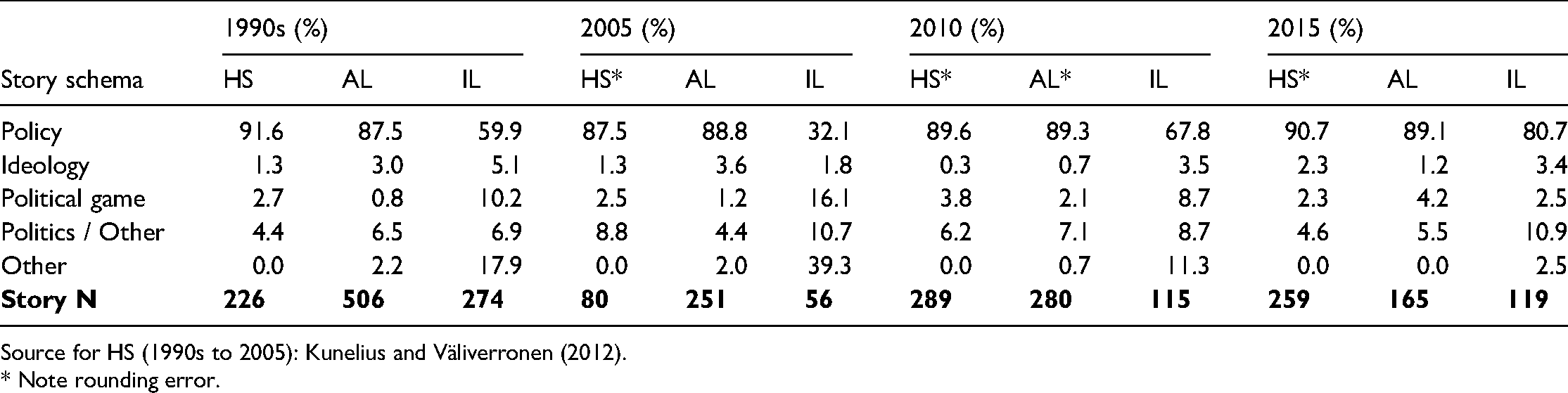
Following H2, policy is the main schema in all papers (see Table 2). In the entire sample, 84% of the stories focus on policy. Of the other schemata, Politics/Other is used most frequently (6%). Compared to Kunelius and Väliverronen (2012), non-policy schemata have a slightly bigger share in this sample because they feature more prominently in IL as expected. The differences between IL and the dailies are statistically significant (comparison with HS: df = 1, X2 = 153.628, p < .001; with AL: df = 1, X2 = 155.823, p < .001).
Story schemata in political reporting, 1990s–2015.
Source for HS (1990s to 2005): Kunelius and Väliverronen (2012).
* Note rounding error.
The findings indicate two very different basic approaches and adaptations to change. The dailies follow the democratic corporatist focus on policy implementation (Kantola, 2011) and avoid ideological matters. This approach aligns with history – it helped commercial papers’ rise in Finland (Salminen, 1988) – and journalists’ current professional demands of neutrality (Reunanen, 2014; Väliverronen, 2018). More recent developments – the rise of the Finns Party and the centre-periphery cleavage in politics, or the diversification trend and financial turmoil in journalism – have had an insignificant effect. Contrary to H2, the proportion of non-policy schemata remains stable over time in HS and AL.
IL’s approach is notably more diverse than that of the dailies to begin with, and it changes notably over time. Non-policy schemata first rise in popularity, particularly stories about politicians’ private lives (cf. Kivioja, 2008, 152–168). In 2005, such stories constitute most of the “Other” category, the most common schema that year. These developments support the diversification hypothesis more strongly than expected. However, and again contrary to H2, the policy schema regains popularity after 2005, and in 2015, IL’s approach bears greater resemblance to dailies. Both changes are statistically significant (1990s to 2005: df = 1, X2 = 14.435, p < .001; 2005 to 2015: df = 2, X2 = 45.023, p < .001). The quick turnaround indicates the importance of the general journalistic ethos and culture on individual outlets. Moreover, it echoes the changing position and approach of tabloids in the media market (Kivioja, 2018), which we will address later.
Paragraph Views
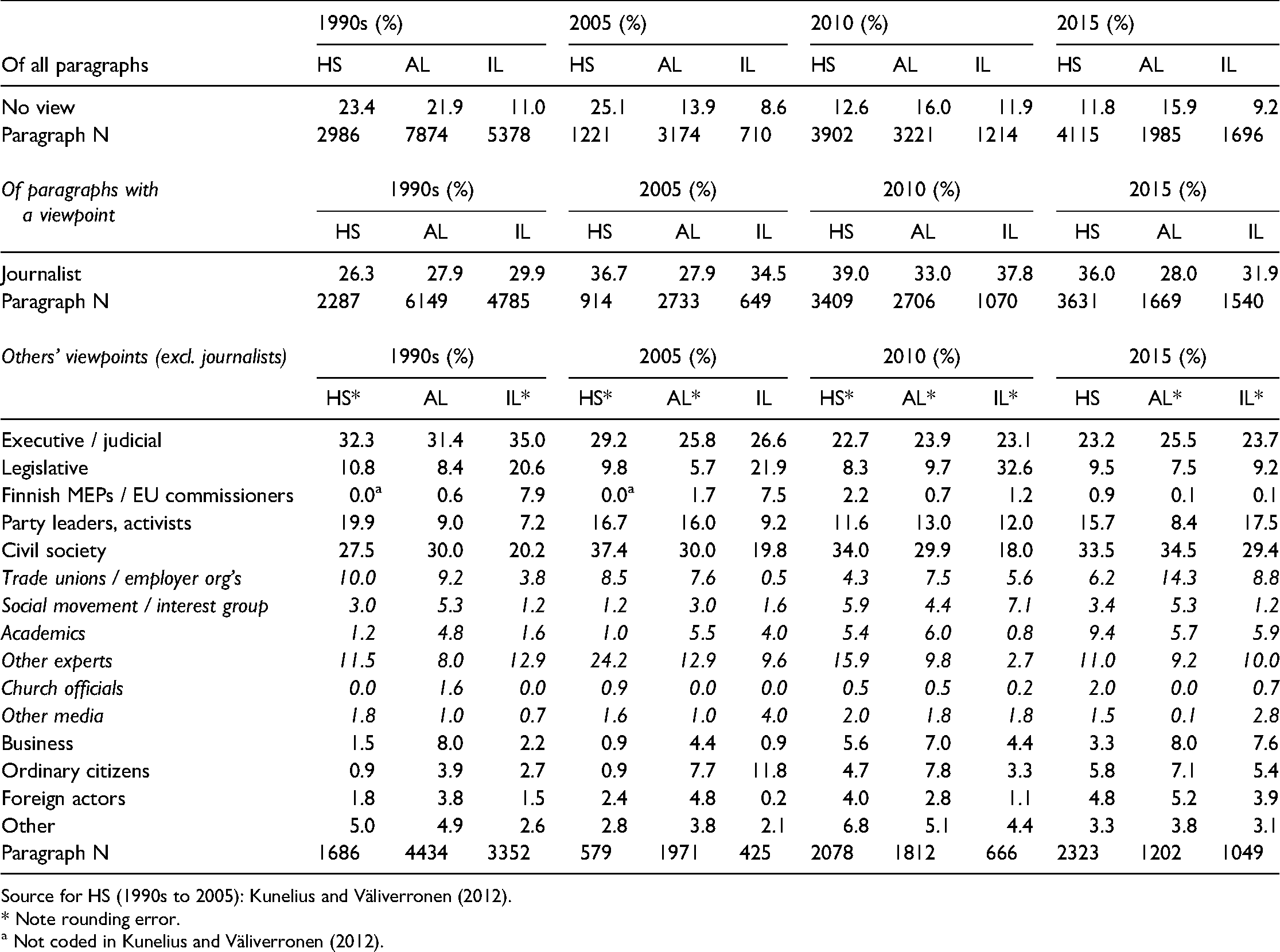
The first notable development confirms H3: political journalism has become more inclined towards attribution (see Table 3). In the entire sample, the share of paragraphs reporting facts without attribution falls from 19% in the 1990s to 12% in 2015 (df = 3, X2 = 192.140, p < .001). This echoes two developments observed in previous research. First, there is greater disagreement over facts among politicians, which requires more attribution by journalists (Reunanen and Väliverronen, 2020). Secondly, it supports the hypothesis of journalists’ increasingly critical ethos: they are less likely to view political actors as factual authorities whose statements can be presented without attribution (Kunelius and Väliverronen, 2012; see also Tuchman, 1978). Over time, attribution has been consistently more likely for IL than the dailies (comparison with AL: df = 1, X2 = 269.466, p < .001; with HS: df = 1, X2 = 137.276, p < .001), which corroborates the notion about tabloids as early adopters of new journalistic styles.
Paragraph views in stories, 1990s–2015.
Source for HS (1990s to 2005): Kunelius and Väliverronen (2012). * Note rounding error. a Not coded in Kunelius and Väliverronen (2012).
A closer look at viewpoints indicates partial support for H3. As expected, journalistic voices increase in the entire sample from the 1990s (28% of all paragraphs with a viewpoint) to 2010 (37%). However, they then decrease to 33% in 2015. Both changes are statistically significant (1990s to 2010: df = 2, X2 = 145.575, p < .001; 2010 to 2015: df = 1, X2 = 18.281, p < .001). One reason for the changes is the fluctuation in commentaries noted earlier. Also contrary to H3, HS has the biggest proportion of journalistic voices (35% of all paragraphs with a viewpoint) instead of IL (32%). This observation can largely be explained by HS’s frequent use of news analyses where journalistic viewpoints are dominant.
An analysis of other actors’ viewpoints further supports H3. In the new century, citizen voices have composed 6–7% of non-journalistic viewpoints in the entire sample – notably more than Kunelius and Väliverronen (2012) found for HS in the 1990s and 2005. This corroborates with diversifying source practices amongst younger political journalists (Kantola, 2013) and increasing audience considerations in newsrooms (Ahva, 2010). Speaking for H3 is also journalists’ expanding use of civil society sources. The share of civil society actors in non-journalistic viewpoints has increased continuously, from 26% in the 1990s to 33% in 2015 (df = 3, X2 = 74.307, p < .001). This development is not uniform, though. IL has only 22% civil society viewpoints, which constitutes a significantly different approach to HS (32%; comparison with IL: df = 1, X2 = 173.189, p < .001) and AL (31%; comparison with IL: df = 1, X2 = 138.988, p < .001). In developments over time, there is fluctuation across papers. The most notable change sees IL increase civil society tones from 2010 to 2015 (df = 1, X2 = 27.988, p < .001) and become – again – more reminiscent of the dailies.
A similar pattern emerges in executive and legislative viewpoints. IL concentrates heavily on especially MPs, and executive and legislative voices constitute 51% of its non-journalistic viewpoints. For HS and AL, the equivalent proportions are 36% and 35% respectively (IL vs. AL: df = 1, X2 = 308.106, p < .001; IL vs. HS: df = 1, X2 = 289.314, p < .001). IL’s approach thus indicates a more indexed view of politics (Bennett, 1990). However, from 2010 to 2015, IL changes tack by allowing less space to MPs (df = 1, X2 = 149.901, p < .001), and in 2015, all three papers have an equal share of executive and legislative viewpoints. Together, the findings on civil society and executive/legislative viewpoints further highlight the unifying pressures of the general journalistic ethos and culture.
Other changes have had a smaller impact on viewpoints. Although the increasing share of foreign voices hints at a more international outlook on politics (cf. Kivioja, 2018, 105), the focus of political journalism stays firmly in Finland. Of the recent developments in domestic politics, the only one clearly discernible is journalism’s increased focus on party leaders at the expense of party members (Koskimaa, 2017) in the 2010s.
Paragraph Function
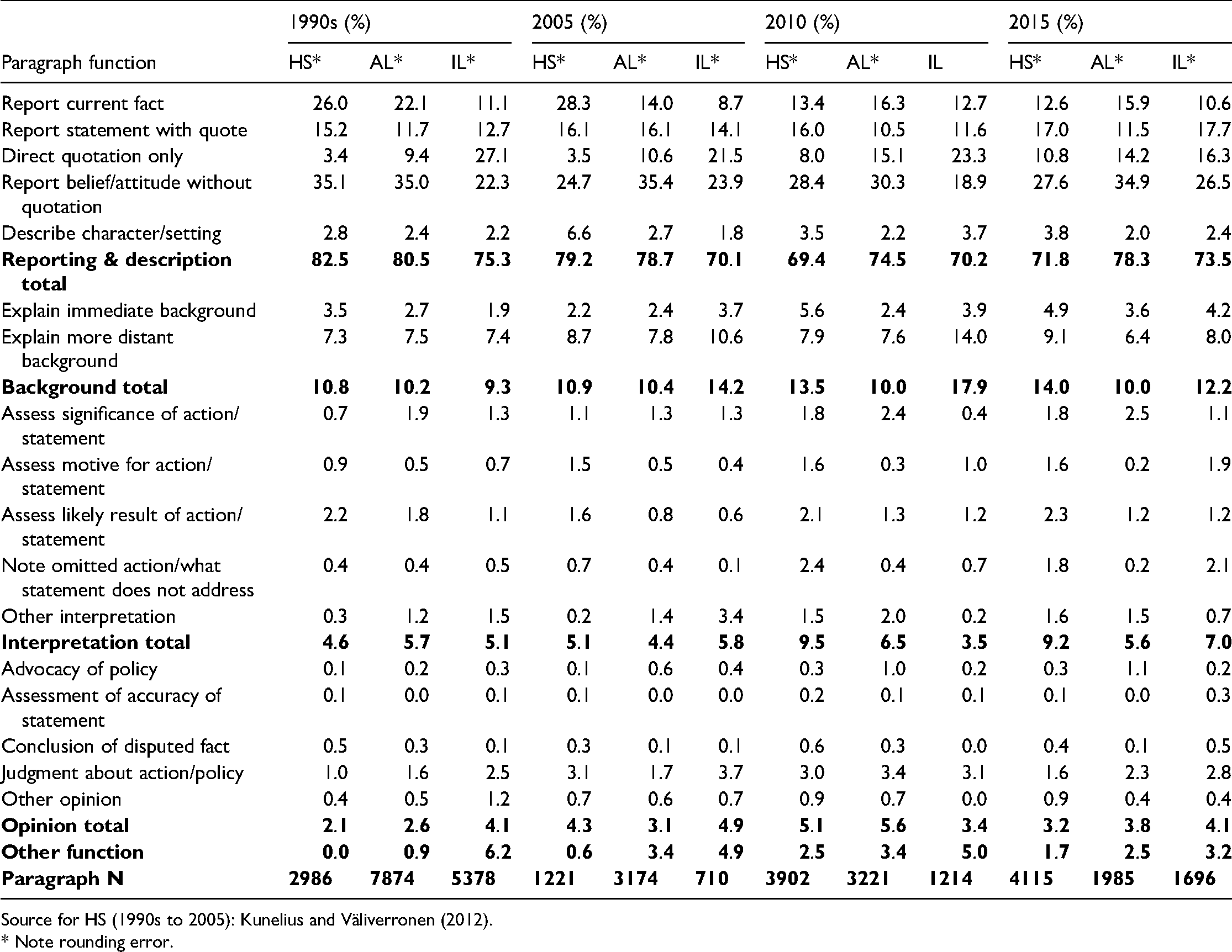
As expected in H4, reporting and description (henceforth reporting) is the most common function in all papers (see Table 4). In the entire sample, it has a 76% share, followed by background (11%). Following the findings on journalistic presence, reporting loses ground to more interventionist approaches from the 1990s (79% of all paragraphs) until 2010 (71%) as posited in H4 but picks up again in 2015 (74%). Both changes are statistically significant (1990s to 2010: df = 2, X2 = 185.090, p < .001; 2010 to 2015: df = 1, X2 = 11.361, p < .001). Again, the decrease in the number of commentaries explains this change. Following H4, non-reporting functions are most prominent in IL, although the difference to HS is very small: both have a 26% share.
Paragraph functions in stories, 1990s–2015.
Source for HS (1990s to 2005): Kunelius and Väliverronen (2012). * Note rounding error.
In a closer look at the reporting category, attribution increases over time in the entire sample in line with the analysis on paragraph voices (df = 3, X2 = 113.56, p < .001). Similarly, IL uses attribution significantly more than the dailies (comparison with AL: df = 1, X2 = 204.543, p < .001; with HS: df = 1, X2 = 188.299, p < .001). Of the different forms of attribution, paraphrasing is the most common one overall (53%). IL stands out from the dailies by employing direct quotations more frequently and by focusing less on paraphrasing. Its reporting style marks a different approach to the two dailies where journalists’ authorial presence is more clearly visible. The latter approach has been found more commonly in Finnish journalism (Haapanen, 2017; Reunanen and Väliverronen, 2020), and from 2010 to 2015, IL also changes towards it.
Of the non-reporting functions, background and interpretation enjoy growth over time – from 15% in the entire sample in the 1990s to 20% in 2015 (df = 1, X2 = 94.102, p < .001). This follows a general trend in newspaper journalism in Finland (Koljonen, 2013a), and in political journalism in the Nordic region (Strömbäck et al., 2008) and elsewhere (Cushion, 2015). The share of opinion and other functions also grows until 2010, but the recent decrease in commentaries reverses the trend (1990s to 2010: df = 2, X2 = 69.886, p < .001; 2010 to 2015: df = 1, X2 = 37.122, p < .001). In a comparison between papers, HS has more focus on background and interpretation (20% of paragraphs) than AL and IL (16% and 17% respectively). In turn, paragraphs that indicate journalists’ presence in the text in some way – category “Other”– are significantly more common in IL (5%) than in AL (2%) or HS (1%).
A notable feat about the interpretation and opinion categories is journalists’ rather cautious approach. Opinion concentrates on political actors’ individual actions, remarks, and appearances. The accuracy of their statements is practically never questioned, and advocacy of policy is also very rare. Similarly, interpretation is mainly rather mild speculation about the consequences and significance of different actions. Such an approach is based on professional values and practicalities. Political journalists highlight their detachment from political parties (Reunanen, 2014; Väliverronen, 2018) and are likely to rein in commentary when this stance could be jeopardized. Moreover, in a multi-party system with ideologically flexible governments, some caution is necessary for maintaining good source connections with all parties (Väliverronen, 2017).
Conclusions and Discussion
Finally, it is worth pondering how these observations relate more broadly to developments in politics, society, the media, and the journalistic ethos. An important overall finding in this respect is that there is no single linear or all-encompassing trajectory. Kantola’s notion about the gradual and uneven nature of evolution and the co-existence of different influences (2011, 168–169) also holds true for changes in political journalism content in different newspapers. However, without oversimplifying things, it is possible to distinguish two relatively distinct time periods and discuss the findings in light of general developments in those periods.
The first period runs from the 1990s to 2005. In line with earlier observations (Herkman, 2009; Kunelius and Väliverronen, 2012), the main changes in this period are characterized by newspapers’ growing political freedom and distancing from the political sphere. New forms of writing increasingly emerge to complement reporting. Sources become more diverse. Political journalism adopts a more interpretative and interventionist style that matches general changes in the journalistic ethos (Koljonen, 2013b) as well as newspapers’ changing market position under increasing competition by television. Growing diversity is particularly evident at IL, which was buoyed by a period of growth rare in the newspaper business at the time (Kivioja, 2018). Its approach to politics and politicians differs notably from dailies and earlier observations about Finnish political journalism content (Kunelius and Väliverronen, 2012). Differentiation between IL and the dailies grows until 2005.
The second period from 2010 onwards is marked by a trend towards greater similarity across newspapers. In the late 2000s, claims that political journalism content would become more tabloid-like in all Finnish media were common although research showed differences between outlets (Pernaa et al., 2009). The findings here indicate a change in the opposite direction. Dailies’ style remains rather constant while IL’s style takes a notable turn towards them. Consequently, a neutral, policy-orientated and increasingly analytical approach reigns everywhere. Sourcing has further diversified and become more uniform across papers.
These developments concur with journalists’ and political journalists’ increasingly analytical ethos (Kantola, 2013; Reunanen, 2014; Väliverronen, 2018), plus the domestic and international socio-political changes mentioned above that have required political journalists’ attention. Even more so, the findings point at the growing impact of both technology and markets. Since the mid-2000s, they have caused increasing trouble for newspapers, particularly tabloids (Björkroth and Grönlund, 2018; Kivioja, 2018). Dwindling resources, and the rise of online reporting that has made differentiation in print more difficult and pushed new innovations in political journalism more strongly to the Internet (Väliverronen, 2017), are likely to have contributed to the unifying trend in print. Moreover, unable to rely on subscriptions, tabloids have been forced to react to changes in market preferences and reader demographics more quickly than dailies. They have changed to a less extravagant and more conformist approach (Kivioja, 2018), which also explains the change in IL’s political journalism.
Overall, developments in political journalism content appear to be most strongly influenced by the journalistic ethos and commercial considerations, with different effects in the two periods. These findings expand earlier views of developments, especially regarding the tabloid press and evolution in the 2010s. Simultaneously, they indicate some limitations of the apparatus used, plus point avenues for further research. In this regard, two things are worth mentioning.
First, following the growth of political journalism online, future studies should broaden their scope to newspapers’ websites to help understand the whole picture and the interplay across platforms. Secondly, this study’s design could be elaborated (see e.g. De Vreese et al., 2016) and its focus re-thought in different ways. Adding non-front page political journalism and (audio)visuals would offer extra depth. In a media system where journalists avoid overt political opinions, a more nuanced focus on latent forms of presentation and other linguistic strategies (e.g. Haapanen, 2017) instead of manifest meanings might yield a clearer picture of political journalism’s output. A more concerted focus on different types of political journalism – such as differences between national-level and local-level political journalism, and their connection to journalists and their different values – could also be helpful to trace developments. Such undertakings would generate a better understanding of the nature of political journalism in a time of multiple concurrent changes.
