




Abstract
Professional economists wield considerable power as experts and policymakers. Consequently, economists frequently appear in the media, where they comment on current economic issues and assess economic policy options. Despite the status of economists, little is known about the relationship between economists and the media and how economists use the media to promote economic and political interests. Building on the scholarship on the mediatization of expertise, this article analyzes the mediatization of the economist profession. The article draws on 17 semi-structured interviews with Finnish economists who appear frequently in the news media. The findings reveal how institutions from private banks to research institutes use economists to advance their economic and political interests via the media. It is found that using social media and serving journalists are elemental parts of an economist's job description. Furthermore, economists work closely with communications professionals to advance organizational interests. This article argues that further research should analyze how mediatization intertwines with the work of economic experts.
Introduction
Economics is undoubtedly one of the most politically influential fields of the social sciences. The economic and social disasters of the twentieth century—The Great Depression and two world wars—increased the demand for economic ideas and knowledge worldwide (Fourcade, 2009; Hall, 1989; Markoff and Montecinos, 1993). As economic governance, data and indicators have become increasingly important for the management of nation states, economists have seen the prestige and relevance of their profession increase in both public and private administration (Davis, 2017; Fourcade, 2006). Economists and their ideas played key roles in post-World War II economic management and in the construction of welfare states and the global economic architecture (Mudge, 2018; Popp Berman, 2022). Economists were equally central in the neoliberal revolution that challenged many of the premises of Keynesian economic policy and welfare capitalism (Brandes, 2019; Petley, 2022).
Importantly, economists shape how non-economists see the world (Hirschman and Popp Berman, 2014). Such ideational power is wielded not only through formal channels of policy advice but also increasingly through the media, where economists from various institutions, such as private banks, ministries, research institutes, think tanks, and other interest groups, often appear as experts and commentators (Brandes, 2019; Chadwick et al., 2020; Petersen et al., 2010; Petley, 2022; Rafter, 2014; Walsh, 2020). Media scholarship has shown how, for example, during the Global Financial Crisis of 2008 and the Euro Crisis that ensued, economists were central sources used by political and economic journalists (Basu, 2019; Pühringer and Beyer, 2022).
Despite the ‘ubiquitous rise of the economists’ (Markoff and Montecinos, 1993) and the well-established prevalence of economists as important news sources and expert commentators in the media (Berry, 2016; Chadwick et al., 2020; Pühringer and Beyer, 2022), little is known about the relationship between economists and the media. Much of the scholarship has explored the dynamic from the perspective of journalists covering economic and financial issues. The work of Pedroso Neto and Undurraga (2018) reveals a professional affinity between elite Brazilian journalists and mainstream economists that helps journalists reach elite positions in Brazilian society. Doyle (2006) as well as Damstra and De Swert (2021) argue that journalists covering financial and economic issues rely on experts to explain news developments that are often highly technical in nature. Similarly, Berry (2019: 230) finds that UK journalists covering the Global Financial Crisis had difficulties grasping the complexity of the crisis, further contributing to the need to rely on economic experts. Harjuniemi (2022) argues that, from the perspective of economic journalists, there is a hierarchy of credibility among economists, and those who occupy the top positions are most likely to be treated as neutral and trustworthy commentators in economic journalism.
In this article, I analyze the relationship between economists and the media. I show how the media shapes the work of economists and how economists use the media to promote various economic and political interests. Theoretically, I build on the scholarship on the mediatization of expertise, where scholars have argued that expertise—like other fields of social life—is being mediatized, meaning that experts are adapting to media logics and resorting to promotional strategies to enhance their media visibility (Scheu, 2019; Väliverronen, 2021; Weingart, 2022). The media has become an increasingly important site for providing expert policy advice and affecting public opinion (Petersen et al., 2010; Stasiak et al., 2016).
Empirically, I build on 17 semi-structured interviews with Finnish economists who appear regularly in the Finnish news media. Through the interviews, I illustrate how the economist profession is mediatized. In particular, for economists who work for private banks and labor market organizations or other interest groups, the media is a central channel for political advocacy work and a major part of their job description. Economists often work in tandem with communications professionals to pursue media publicity. In addition to serving and networking with journalists to pursue media attention, economists use social media—especially Twitter (rebranded as X in summer 2023)—as a key tool in harnessing attention.
The rest of this article is structured as follows. First, I briefly discuss the rise of the economist and the literature on the mediatization of expertise. Second, I describe the empirical material as well as the method. Third, I present the results of the analysis. I conclude by discussing the relevance of this study to mediatization research and by arguing that studies in this field should further analyze the interactions between economists and the media.
The rise of the economist and the mediatization of expertise
Professional economists gradually established their influential position in the twentieth century. The Great Depression of the 1930s as well as the two world wars saw a rise in demand for ideas and tools that could help policymakers steer national economies (Hall, 1989). Fourcade (2006: 167) argues that economics has become central for nation states because ‘the nation has become more economic.’ Indeed, issues of economic policy, such as growth and employment, have become focal issues for policymakers, while the increasing complexity of policy issues has put experts at the center of governance and administration (Weingart, 1999). Thus, professional economists occupy key positions in the private and public sector worldwide (Davis, 2017; Fourcade, 2006, 2009; Markoff and Montecinos, 1993). Economists and their ideas have also played major roles in historical transformations of political parties (Mudge, 2018; Popp Berman, 2022).
The rise of economists in governance and politics has been accompanied by the rise of economics and economists in the media (Mata, 2011; Mata and Medema, 2013). Economic thinkers and their ideas were debated in the press from as early as the nineteenth century (Zevin, 2019). Keynesian ideas regarding economic management and the role of the state were circulated in the business press in the first half of the twentieth century (Butterick, 2015; Parsons, 1989). The economic abundance of post-war capitalism further increased the prevalence of economic policy issues in journalism (Yarrow, 2006). Consequently, the demand for social scientific expertise in the news media has steadily grown (Albæk et al., 2003), and economists have become prevalent media figures and authoritative expert sources on economic issues and policy (Brandes, 2019; Chadwick et al., 2020; Harjuniemi, 2022; Mata, 2011; Walsh, 2020). It has been argued that, since the 1960s, influential ideas of neoliberal economists, circulated by the press, have played a key role in undermining the Keynesian post-World War II sentiment (Petley, 2022).
In many ways, the economist profession, like other fields of expertise, is mediatized. The notion of mediatization refers to the growing relevance of media in various areas of social life as institutions and actors adapt to media logics to advance their interests (Hepp et al., 2015; Strömbäck, 2008; Thorbjørnsrud, 2015). The scholarship on the mediatization of expertise describes how the media has become an increasingly important field for experts and how media logics and promotional practices are embedded in contemporary expertise (Christensen, 2016; Laursen and Trapp, 2021; Stasiak et al., 2016; Weingart, 2022).
The mediatization of expertise is driven by two factors. First, experts face rising pressure to promote their work in the media (Petersen et al., 2010; Scheu, 2019; Stasiak et al., 2016). Väliverronen (2021) argues that in a competitive environment, where resources are scarce, experts are under pressure to use promotional strategies to enhance the visibility of their work and to market their research to policymakers and the wider public.
Second, modern governance relies on expert advice (Weingart, 1999), and the media has become an increasingly important communication channel for experts (Petersen et al., 2010; Stasiak et al., 2016). In addition to the established policy advisory arrangements, such as scientific councils, ‘mass-mediated expertise’ (Petersen et al., 2010) can affect the political process by, for example, providing decision-makers with expertise-based arguments and affecting public opinion (Mata and Medema, 2013). Therefore, various interest groups and think tanks aim to present science-based arguments in the media, blurring the lines between established forms of scientific expertise and policy advocacy (Laursen and Trapp, 2021).
Despite the prominent position of economists as policymakers and policy advisors (Markoff and Montecinos, 1993; Stasiak et al., 2016) as well as authoritative news media sources (Chadwick et al., 2020; Harjuniemi, 2022; Walsh, 2020), relatively little is known about the relationship between the media and economists and how economists adopt to and make use of the media in their work. Mata and Medema (2013) describe how, during the twentieth century, influential economists (such as John Maynard Keynes and Paul Samuelson) became notable public intellectuals who used the media to communicate their ideas. Brandes (2019) shows how the influential neoliberal economist Milton Friedman skillfully used television to popularize economics. Stasiak et al. (2016) find that advisory experts in economic policy in both the United States and Germany adapt to media logics in their advisory work by, for example, emphasizing newsworthy elements in their research. In this article, I contribute to the scholarship on the mediatization of economic expertise from the viewpoint of active media economists from various organizations. I analyze the effects of the media on economists’ work and how economists make use of the media in promoting political and economic interests.
Data and method
Empirically, I draw on 17 semi-structured interviews with professional economists who regularly appear in the Finnish news media. I used several sources to compile a list of 240 economists who work for various Finnish institutions and organizations. These sources included the web pages of Finnish economic research institutes; private banks; interest groups (such as the most important labor market organizations); and a Finnish economist panel that has compiled a public list of 90 leading Finnish academic economists (Ekonomistikone, 2023). Moreover, I drew on a previous study on the amount of media publicity gained by Finnish economists (Parviainen, 2014).
Once I had compiled the list, I did an individual search for every economist in the public archives of two influential Finnish news media organizations: the public broadcaster Yle and the biggest national daily newspaper Helsingin Sanomat. Politically, both news organizations occupy a centrist or neutral position, which is typical of a Nordic media system (Väliverronen, 2022). I included articles mentioning the economists—in the form of quotes or references—and any columns or op-eds written by the economists between 2020 and 2022. I then counted the number of publications in which each economist appeared to identify those who are featured most often in Helsingin Sanomat and Yle.
After identifying the economists most prevalent in the media, I contacted them via email, keeping in mind the balance between various institutional backgrounds. I contacted academic economists who work for Finnish universities; economic research institutes; private banks and interest groups, such as labor market organizations; and government agencies or ministries. I made contact with 28 economists, and 17 of them agreed to be interviewed. All interviewed economists were among the 50 most prominent economists in terms of appearances in Yle and Helsingin Sanomat.
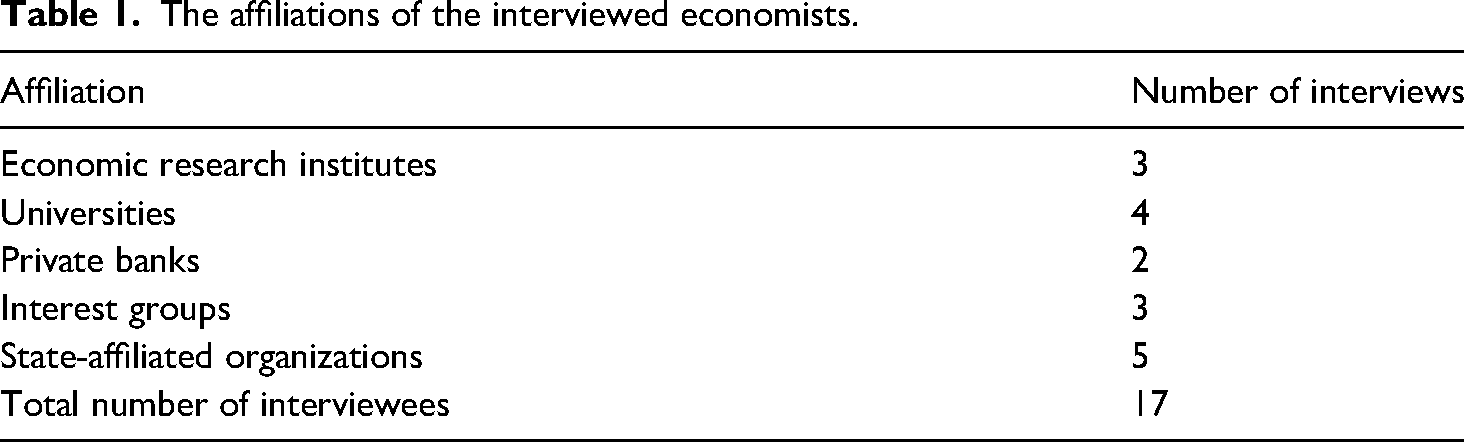
In this article, I refer to the interviewed economists anonymously and only through their affiliation (see Table 1). Many economists interviewed for this study have worked for various employers, which means that they often have experience from several types of organizations. Here, the affiliation mentioned refers to the current employment status or—in cases where the interviewed economist has already retired—to the most recent affiliation. Furthermore, some details concerning the descriptions of the interviewees have been slightly altered to ensure source anonymity. Of the 17 interviewees, only three were female. Such an imbalance reflects the gendered nature of public expertise (Howell and Singer, 2017) and the male-dominated nature of public economic expertise in Finland (Parviainen, 2014: 578). Moreover, some of the female economists who were contacted declined to be interviewed.
The affiliations of the interviewed economists.
I conducted the interviews both in person and online between March and April 2023. The median length of the interviews was 54 min. The interviews were semi-structured and included pre-determined themes and questions relating to the mediatization of expertise. The pre-determined themes included the economists’ motives for participating in the economic debate, contact with journalists, media training and communications practices, social media use, the differences between various kinds of institutions regarding media relations, and the relationship between economics and economic policy in Finland.
The interviews were recorded and transcribed. I then analyzed and coded the transcriptions using Atlas.ti coding software. For the analysis process, a thematic approach was chosen (Braun and Clarke, 2019). I ascribed codes that stemmed partly from the literature review and the interview questions and partly from the data. The coding process can thus be described as a combination of inductive and deductive approaches (Braun and Clarke, 2019). After the initial coding, the codes were categorized into a set of themes related to the relationship between economists and the media.
Findings
In this section, I present the results of the thematic analysis. First, I explain the overall importance of the media for the interviewed economists. Second, I describe how economists often work closely with communications professionals to attract public attention. Third, I detail the importance of economists serving journalists to gain media attention. Fourth, I address the necessity of active social media use in harnessing media publicity.
The Media as a site of influence for economists
Many of the economists interviewed explained how essential it is for them to appear in the media. As a testament to the powerful societal position of economists (Fourcade, 2009), various institutions wish to use economists to harness media attention. A chief economist for an interest group stated that media appearances are a core part of his job description. The goal of the interviewee's employer is to influence Finnish politics and policy, and the media is seen as a central sphere of debate and policy advocacy. Therefore, it is important for economists to appear in the media and to agree to comment when contacted by journalists. In Finland, the economic policy discussion is, to a substantial extent, based on public debate. That is where issues are framed—whether we talk about renewing EU economic rules, or the [Finnish] elections, or the budget […]. That is where the frames emerge, often through public discussion. And, of course, I am happy to contribute via public discussion. (Economist, interest group) In the [former job in interest group], it [the media] was a central part of the work. The point was to get attention to your employer, and through commenting, through media publicity, build the expert brand of the organization and push our policy goals in the debate. (Economist, state-affiliated organization) When I became a bank economist, it was self-evident, that it [engaging with the media] is a part of the job description. In a way, it is like asking a bus driver why he drives a bus [laughter]. And, unlike many people think, the point is not to pursue any agenda. (Economist, interest group) Well, I think of it [media publicity] as free advertising space. […] The bank gets to advertise itself as a credible expert organization. […] In no way would the bank tell you what to say. It is nothing like that. (Economist, state-affiliated organization) In my current job, I do not think I appear in the media too often. There are interviews every now and then, and we put out press releases on relevant matters. When compared to [previous employer, an interest group], the environment is quite different. We would put out press releases on every small issue, and we were much more involved in the media vortex or attached to the media all the time. (Economist, state-affiliated organization) When the council was established, one of the goals was to raise the level of economic policy debate, and that debate takes place in the public sphere. It [media publicity] is not a value per se, but if the council is simply happy with writing reports that no one ever reads, then it is just a waste of time. [Economist, research institute] We want to influence economic policy. We want to be part of the economic policy debate and have an influence, both on public opinion and on economic policy and policymakers. Whereas lobbyists want to influence certain details of legislation […], we want to influence the public debate. (Economist, research institute)
Working closely with communications professionals
As the demand for economists to appear in the media rises, cooperation between economists and communications professionals becomes more important. In line with the thesis on promotional culture (Davis, 2013), promotional practices, such as marketing and communication, increasingly shape the work of professional economists. Thus, the lines between different professional practices are blurred and, in many ways, economists become communications professionals themselves. Illustrating this, one interviewee compared the work of an economist to that of a ‘spokesperson.’ If you think of times following the financial crisis [of 2008] and look at different [organizations], the practice of the economist being the so-called spokesperson of the organization has become more common. That tells you that there is demand for media and communications skills. (Economist, interest group) Communications [people] do help us [regarding] how we should perform, what the style should be. […] In that sense, communication is an integral part of this [the work done by the research institute]. It is not just that they [communications professionals] send press releases. (Economist, research institute) Our small team of economists was under communications; it was part of communications. I worked very closely with them. (Economist, interest group) There has been training for different tools, not just for Twitter, but also for TikTok and LinkedIn. Communications does encourage us to use them. (Economist, interest group) I have been in media training and interview training at least a couple of times. There are training sessions that teach you how to give comments to the media. (Economist, state-affiliated organization) When I worked as the leader, we started investing resources in communication and hired a good press officer. She understood social media and was able to sort or sell our research to the media, meaning that our press releases became more alluring. (Economist, research institute)
Serving journalists
Economists are valuable and authoritative sources for journalists covering economic issues (Harjuniemi, 2022; Damstra and De Swert, 2021; Walsh, 2020). Sources need to foster connections with journalists to promote their interests in the media and gain visibility (Carlson, 2009; Gans, 2004; Laursen and Trapp, 2021). Economists are no exception, and they wish to make themselves useful in the eyes of journalists. While the interviewed economists working for universities or state-affiliated organizations expressed less willingness to comment on issues that are not their core expertise or mandate, economists working for banks or interest groups indicated a desire to serve journalists on all occasions. One interviewee working for an interest group makes every effort to appear in the media when contacted by journalists. I participate in everything that I have the time for. We also have internal prioritizing. If I have something else, I will skip it. (Economist, interest group) I think that from the viewpoint of the journalist, my role in [the interest group] was really good, because I did not have any restrictions regarding what I could comment on […] It is easier for journalists when they know that they can get comments regarding pretty much every issue. […] On every topical issue, journalists would get a comment. Surely, they must like that, and that way you get into their speed dials. (Economist, state-affiliated organization) You have journalists with a strong routine […]; we get things done fast. I will get two or three questions, give my answers, and know that they have written down my ideas well. You do not have to make many correction proposals either. (Economist, research institute) With some journalists, I do background work. I help them with statistical material and such. My name does not end up on television or in the newspaper. Some materials are difficult to grasp, as they require experience. Here, I do not seek publicity for myself; it is just valuable use of my knowledge. (Economist, university) When I worked [in a former workplace], I used to have lunches with journalists every now and then, but now, that is not necessary. Now, we get enough publicity and it is all about using and maintaining the channels we have. But face-to-face meetings, lunches, coffees, and those kinds of things are useful when you want to be heard and remind people that you exist. (Economist, research institute)
Using social media to gain media attention
Many interviewed economists actively use social media as a major part of their job description and are encouraged by communications professionals to do so. A key motive for social media use is that experts get attention from journalists for whom monitoring social media has become routine (Paulussen and Harder, 2014). One interviewee said that the use of Twitter often leads to journalistic coverage, and experts make use of journalists’ habit of following social media. A journalist is writing a story about inflation, and she thinks that she should call him [the expert] because he has commented on that [on Twitter]. Although there is no way to prove it, it is often clear. You tweet, and then, in half an hour, a journalist calls you. Co-incidence? Perhaps, but probably not. (Economist, interest group) I was commenting on the market turbulence, and the tweet went somewhere; it was in Helsingin Sanomat as a comment. I commented on Finnish economic growth, and that went to Kauppalehti [a Finnish business newspaper] as a comment […]. In the past, journalists would call different people when something occurred, but now they see the tweets and pick up the comments. […] It is easy to see that people who are active on social media are also prominent in the traditional media. (Economist, bank)
Discussion and conclusions
In this article, I identified a gap in the mediatization scholarship, namely the lack of literature on the mediatization of the economist profession and how economists use various media to promote political and economic interests. Indeed, despite the well-established position of economists as prominent sources for political and economic journalists (Chadwick et al., 2020; Pedroso Neto and Undurraga, 2018; Walsh, 2020), not much is known about the relationship between economists and the media (see, however, Brandes, 2019; Mata and Medema, 2014; Petley, 2022; Stasiak et al., 2016).
By building on the literature on the mediatization of expertise (Petersen et al., 2010; Stasiak et al., 2016; Väliverronen, 2021; Weingart, 2022) and drawing on 17 semi-structured interviews with economists who are frequently in the media, I have shown that the economist profession is mediatized in many ways. The economists interviewed for this study explained that various forms of media work—such as giving interviews to journalists and using social media—are integral parts of their job description and that they actively seek media attention. Economists often work closely with communications professionals, and in many cases, the job description of a professional economist resembles that of a spokesperson or communications professional. Economists’ motives are, to an extent, dictated by the economists’ institutional affiliations. Whereas bank economists and economists from interest groups have an incentive to promote their employers and their ideas, university economists display a more restrained attitude to the media and are more often motivated by the desire to popularize expert knowledge.
Political science, sociology, as well as media and communications scholars have described the power of economic experts and the epistemic authority of economics in contemporary societies (Davis, 2017; Fourcade, 2006, 2009; Hirschman and Popp Berman, 2014; Markoff and Montecinos, 1993; Mudge, 2018; Petley, 2022). Despite these critical analyses of ‘the econocracy’ (Earle et al., 2017) and the ‘economization’ (Popp Berman, 2014) of politics, critical mediatization scholars have neglected the interaction between economics, the mediatization of expertise, and the attempts of various organizations to build on the authority of expertise to advance their interests. Indeed, mediatization scholarship sometimes adopts an overtly media-centric perspective on social change and overlooks other structural factors that condition political processes (Deacon and Stanyer, 2014). Therefore, this article has sought to illustrate how the power wielded by economists interacts with the mediatization of expertise and various promotional practices (Davis, 2013; Väliverronen, 2021).
Certain pitfalls and shortcomings of this study must be taken into account. First, only economists who appear regularly in the media were interviewed. One could argue that for many economists who work for organizations such as universities, ministries, or private companies, media appearances are of little or no importance. Therefore, it would be interesting to study how economic experts who are not on the radar of journalists or on social media interact with various media and use it for professional purposes (see Davis, 2005; Thompson, 2015). Furthermore, it is essential to study the barriers that prevent some economists from appearing in the media. For example, gender imbalances in public expertise regarding economics should be studied more thoroughly (Parviainen, 2014).
Second, a central argument of this article is that many economists use the media to influence policy; however, the question of their audience should be studied further (Mata and Medema, 2013). The focus should be on determining whether contemporary economists use the media to popularize economic arguments among a general audience or to address an elite audience with the aim of influencing their thinking (Davis, 2003).
