



Abstract
As the wealthiest groups have emerged as increasingly significant in societies, this article explores society's wealth elites from the vantage point of media and communication studies. Bridging the literature on policy advocacy and mediatisation, the article examines the hidden and public advocacy strategies of the wealthy. Drawing from 90 interviews with the wealthiest 0.1% in Finland, this study shows the wealthy's highly strategic stance towards the media and journalism. Most of all, they prefer to avoid the media and journalism, while actively using hidden advocacy strategies and being confident in their ability to wield political influence. As a consequence, the wealth elites may remain hidden from the public eye, making them ‘shadow elites’, whose power and scrutinisation pose a challenge to society and journalists as well. The findings support the view that paradoxically, one reaction to mediatisation – the media's heightened powers – is the deliberate avoidance of it.
The increasingly wealthy groups in society have become significant subjects of research in social sciences as their growing affluence plays a central role in the widening inequalities across societies (Atkinson et al., 2011; Piketty, 2014). Burgeoning evidence also suggests that the wealthy play a substantial role in politics. The wealthiest individuals often hold commanding positions as owners of capital, top executives and successful entrepreneurs; in such capacity, they are often involved in policy advocacy. The wealthiest groups have policy preferences that favour the rich (Davis, 2017; Kantola, 2020; Kantola and Kuusela, 2019; Kuusela, 2018, 2020; López, 2013; Page et al., 2013; Reis, 2005; Suhay et al., 2021), and they also advocate their interests successfully. Growing evidence from the United States (Gilens, 2012; Gilens and Page, 2014; Goss, 2016) and Europe (Lefkofridi and Giger, 2020; Sayer, 2014; Schakel, 2019; Schakel et al., 2020; Author, 2018) suggests that policymaking is most responsive to the interests of the wealthiest and most resourceful groups. Many of the wealthy also have easy access to society's elites from business, politics and the military, who form a relatively well-connected realm of elite networks (Burris, 2005; Maclean et al., 2010; Maclean et al., 2015; Mills, 1956: 288–290; Mizruchi, 1992, 2013, 2017). The wealthiest groups can thus be examined as society's ‘wealth elites’ (Savage, 2015), whose power and activities extend from business to the realm of politics as they advocate their interests.
In this article, we approach the wealth elites from the vantage point of media and communication studies and argue that it is important to assess how transparent and publicly visible the wealthy groups’ political interests and advocacy efforts are. To build this argument, we bridge the literature on (1) advocacy strategies and (2) mediatisation. Studies on advocacy distinguish between inside strategies, which rely on direct and largely hidden contacts with policymakers, such as in lobbying, and outside strategies, which utilise public means, such as the media, to advance one's interests (e.g. Binderkrantz, 2003; Dür and Mateo, 2013). We argue that wealth elites prefer hidden strategies over publicly visible media strategies. Drawing from recent literature on defensive mediatisation (Nölleke et al., 2021), we further explain the reasons why wealth elites might aim to avoid the media and resort to other means of advocacy.
We demonstrate our point by empirically drawing from a project exploring the wealthiest 0.1% in Finland. We focus on the three largest groups of this segment: corporate executives, entrepreneurs and heirs of family businesses, who are all part of societal elites as ‘wealth elites’ (Savage, 2015) holding commanding positions in large businesses. Drawing from 90 semi-structured interviews among these three groups, as well as assessing their formal positions in business lobbies, we show how they utilise inside strategies advocating their policy interests. At the same time, they orientate predominantly reservedly towards the media as they feel that the media poses a substantial threat for them, and they are not dependent on media's publicity.
With this study, we contribute to communication studies by exploring the role of media in wealth elites’ political advocacy, a topic largely neglected in previous research. Our findings also add to recent debates on mediatisation; in line with the theory of defensive mediatisation (Nölleke et al., 2021: 740–742), we suggest that somewhat paradoxically, one reaction to mediatisation – the media's heightened powers – is the deliberate avoidance of it by those who can afford to stay away from the public eye. Consequently, the wealth elites may remain hidden from the public eye, making them ‘shadow elites’ (Wedel, 2009), whose power and scrutinisation pose a challenge to societies at large, and in particular, to journalists and the media.
Hidden and public means of advocacy
For a long time, studies on advocacy have divided policy advocacy into inside and outside strategies (e.g. Binderkrantz, 2003; Dür and Mateo, 2013; Kollman, 1998). The division originates from the literature on interest groups, but it can also be applied to the wealth elites, who are often active in business advocacy and hold commanding positions in business lobbies. Inside strategies target policymakers directly, for example, through phone calls and private meetings, and are thus largely hidden from the public eye. Outside strategies include a vast selection of more publicly visible tactics, of which the media strategy is of particular interest in the case of wealth elites. In a media strategy, advocacy groups and individuals advocate policy preferences through public communication, such as by giving interviews to journalists and ‘subsidising’ (Gandy, 1982) the media with press releases, tweets or letters to editors (see Vesa, 2020).
Based on earlier research, the wealth elites can be expected to make effective use of inside strategies. As part of society's business elites, the wealthy are also embedded in society's elite networks, which are often instrumental in policymaking (Burris, 2005; Maclean et al., 2010; Maclean et al., 2015; Mills, 1956: 288–290; Mizruchi, 1992, 2013, 2017) and inside lobbying (Dür and Mateo, 2013). Moreover, as policy advocacy also occurs through interest groups, wealth elites may exert power by holding positions of influence in business groups and lobbies, which figure prominently in policy advocacy (e.g. Binderkrantz et al., 2015; Vesa et al., 2018). Finally, due to their wealth, these elites are also able to hire public relations professionals or fund and support think tanks or other advocacy groups to promote their interests in the media on their behalf (e.g. Davis, 2002).
Furthermore, the recent literature on defensive mediatisation (Nölleke et al., 2021) provides a way to explore in more detail why wealth elites might aim to avoid the media and resort to other means of advocacy. The key claim of the mediatisation theory suggests that many institutions in society have become increasingly dependent on the media (e.g. Marcinkowski and Steiner, 2014; Mazzoleni and Schulz, 1999; Schulz, 2004; Strömbäck, 2008; Strömbäck and van Aelst, 2013) and that actors adapt their behaviour to the media logic because they seek to use media attention to their advantage (e.g. Blumler and Esser, 2019). However, research on defensive mediatisation has pointed out that the media may not be useful for all actors and that some actors may even regard mediatised communication as harmful for their interests (Nölleke et al., 2021; Spörer-Wagner and Marcinkowski, 2010). Thus, we employ this perspective with regard to wealth elites in order to understand their media orientations, meaning their attitudes towards the media – how relevant and important they view media's attention to and coverage of them (Jacobs and Wonneberger, 2017, 549). This ‘mental form of mediatisation’ (Jacobs and Wonneberger, 2016; Kohring et al., 2013) covers attitudes towards the media, publicity and journalism and might play a role for the wealth elites when choosing between inside and outside strategies. In particular, we examine wealth elites’ media orientation by focusing on three factors (adapted from Nölleke et al., 2021: 740–742): (1) perceived media logic, (2) presumed media effects and (3) dependency on media.
First, perceptions of media logic may affect actors’ orientation vis-à-vis the media (Maurer and Pfetsch, 2014; Nölleke et al., 2021: 742; Strömbäck and van Aelst, 2013). Media logic refers to the media's conventions on selecting and presenting information, such as news criteria and narrative styles (Altheide and Snow, 1979). Actors may try to avoid the media's spotlight (Nölleke et al., 2021: 742) if they are dissatisfied with its narrative practices. Earlier studies suggest that elites, in general, may view the media as hostile to them or biased against their views (Gunther and Schmitt, 2004; Matthes et al., 2017). Similarly, wealth elites may perceive the media as biased against or hostile towards them and their political goals, and they may prefer direct contacts and networks over public dialogue.
Second, presumed media effects, that is, actors’ perceptions on the consequences of media exposure and coverage, may influence their media orientation (Cohen et al., 2008; Gunther and Storey, 2003). Presumed positive effects prompt actors to step into the public arena, while expectancy of negative effects may lead to media avoidance. For wealth elites, media coverage may be a risk as the wealthy often experience anxiety in relation to the rest of society (Kantola, 2020; Paskov et al., 2013; Salverda and Grassiani, 2014; Sherman, 2017). This anxiety is echoed in political advocacy as their political goals may contradict those of other social groups (Kantola, 2020; Kantola and Kuusela, 2019; López, 2013; Page et al., 2013; Reis, 2005; Suhay et al., 2021). Studies suggest that groups whose goals conflict with public opinion may be inclined to lobby out of public view to avoid expanding political conflicts (Kollman, 1998). The media may also lead to a tarnished reputation, and scandals have increasingly become more common, forcing elites, including business elites, to step down from their positions (Kantola and Vesa, 2013; Pollack et al., 2018).
Third, it is important to investigate the extent to which a particular societal sector or institution is dependent on the media (Kunelius and Reunanen, 2016; Marcinkowski and Steiner, 2014). Regarding the wealthy groups, earlier research suggests that for businesses, mediatisation involves complex and strategic forms of corporate media work that takes place between business organisations and the media (Pallas and Fredriksson, 2013). Most notably, businesses differ in their dependency on the media, which may play a role in abstinence from the media. For instance, in consumer businesses, the media presents an opportunity to promote their business to consumers, while in business-to-business sectors, the media is substantially more insignificant. (Kantola, 2014; Ihlen and Karlsen, 2009; Ihlen and Pallas, 2014). Some companies also rely on the personal brands of their founders or chief executive officers (CEOs), which might make media more relevant for them (Kantola, 2014). Thus, it is important to assess the extent to which the actors are actually dependent on the media.
Data and analysis
The data for our analysis were collected in 2016–2017 in a research project on wealthy Finns. We compiled a list of the country's top 0.1% earners (5000 individuals) from public tax records by combining the 10-year taxed earned incomes and the capital incomes of the top 10,000 earners between 2007 and 2016. According to the official taxed incomes by Statistics Finland, the average yearly income of this group was 690,000 euros in 2016, and the top 5% of the group earned 1.8 million euros on average. However, these figures only included taxed incomes; for instance, including revenues in holding companies would substantially increase the incomes.
Next, we searched for the top 5000 earners’ primary sources of wealth using public records, such as the national trade register, company websites, media archives and social media. Four major groups were discovered: entrepreneurs; executive managers, who had accumulated their wealth from top-tier salaries and remuneration programmes; inheritors, whose wealth often came from a family business; and finally, a diverse group of professionals, such as lawyers, doctors and bankers. Approximately 900 names were untraceable.
We then conducted 90 semi-structured interviews among the three largest groups: 28 with heirs, 32 with business executives and 30 with entrepreneurs. These three groups also correspond to previous research findings that top executives (Piketty and Saez, 2006), heirs of old money (Piketty, 2014) and successful entrepreneurs (Kaplan and Rauh, 2010) are crucial groups among the wealthy. The individuals who were approached were chosen randomly, but so that various business sectors, families, geographical locations and genders were represented. All interviewees also belonged to the upper 50% of the top 0.1%.
The potential interviewees were contacted by email, and approximately half of them agreed to be interviewed. We found no clear indication of systemic bias in the refusals; most often, practical reasons were mentioned. The interviews varied in duration from 48 to 203 min; most lasted for 1–1.5 h. The interviewees discussed their personal lives and work, as well as their views about politics, their engagement in elite networks and policy advocacy, and finally, their relation to the media. Significantly, we provided the interviewees with full anonymity to free them from having to hide behind politically correct views, which can be a problem in elite interviews (Reis, 2005: 45), and we encouraged them to express their true thoughts.
In this article, we focus on the interview excerpts relating to (1) publicity, the media, journalism; (2) the practices of advocating business and political interests in policymaking; and (3) elite networks. The interviewees were asked to describe their activities and the questions were framed in a neutral way, asking ‘Do you appear in media?’ ‘Are you involved in policy advocacy?’ ‘Are you active in elite networks among business leaders or political decision makers?’ The interviewees were then asked to elaborate on the reasons for their activity or non-activity in each of these fields, as well as the importance of these activities.
All interviews were recorded and transcribed, with the exception of written notes in one case. The interviews were then coded first by focusing on the reasons for the activity or the non-activity in each field. Furthermore, we did secondary coding (adapted from Nölleke et al., 2021: 740–742), listing the reasons for each activity with regard to (1) perceived media logic, (2) presumed media effects and (3) dependency on media.
To further cross-validate the interviewees’ accounts of their policy advocacy activities, we examined how many of the top earners had held formal positions in business lobbies. We compiled a list of the board members of the 12 most important business lobbies in Finland from 2006 to 2018 and determined how many among the 5000 top earners appeared on the list (see also Figure 1).
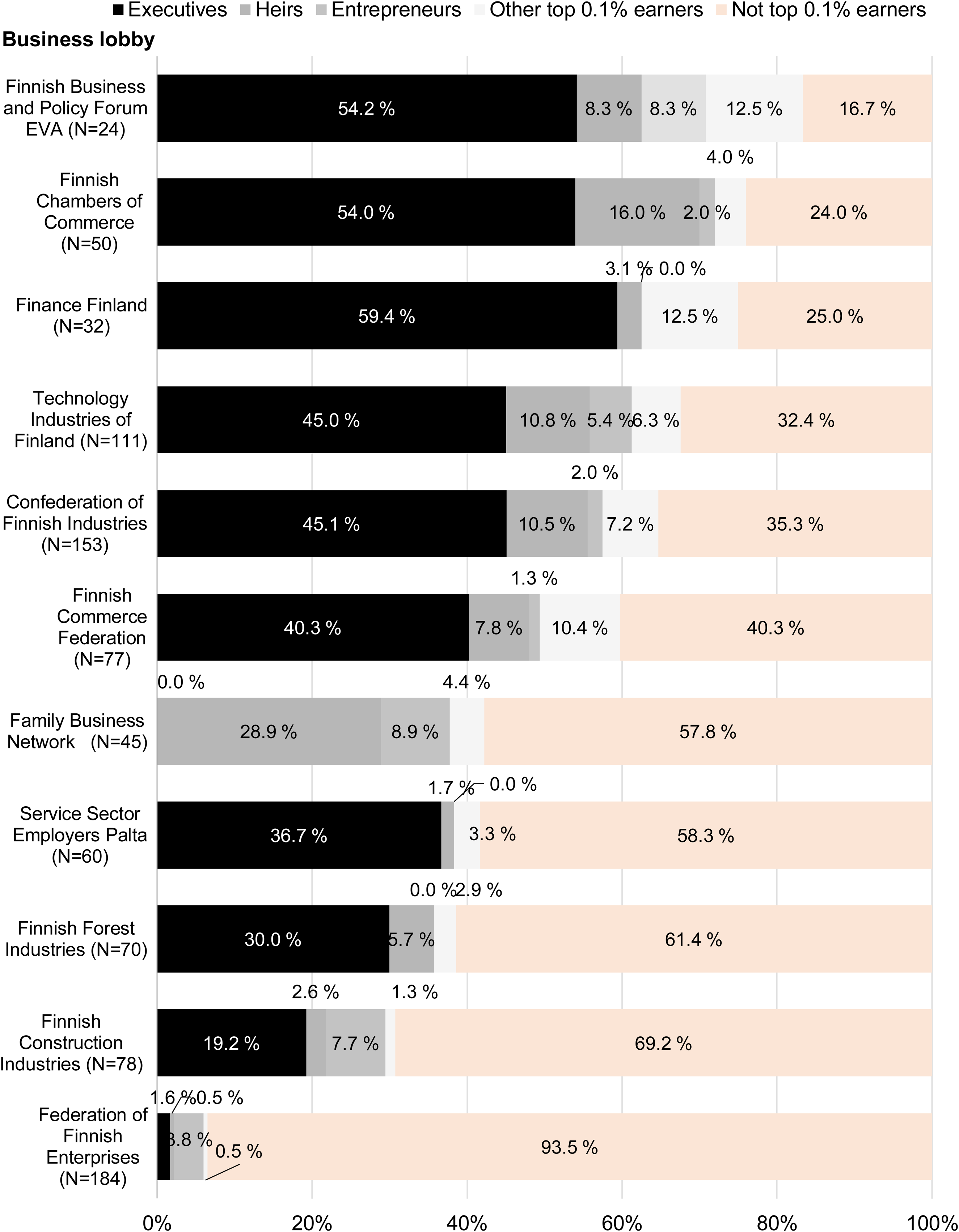
Top 0.1% on the boards of Finnish business lobbies (%, N = 884).
Results: The wealth elites’ advocacy strategies
In the interviews, the Finnish top earners exhibit multiple forms of policy advocacy that can be categorised as inside strategies, including contacts and networks with policymakers. Each of the three interviewed groups – business executives, heirs and entrepreneurs – highlight particular features in their advocacy strategies. The business executives stand out as active networkers for whom political influence is a crucial part of their work. As one executive claims, ‘When you think of political decision making, it is extremely important to network and try to influence things and increase awareness in political circles’ (BE3). Most of the executives are confident that they can have a voice in politics, and they believe that policymakers consider their viewpoints. As one executive states, if needed, he can manage to contact political decision makers as ‘Finnish ministers and civil servants are actually really easy to access for a dialogue’ (BE2). Another interviewee explains in an equally confident manner that it is easy to contact politicians, regardless of their party: ‘Our political decision makers, notwithstanding the party, are responsive to business, their operational environment, and things like that. That is not a problem, and it goes for everybody, including the leftist parties’ (BE25). Compared with the executives, the heirs have a slightly more focused strategy. The heirs also cultivate contacts with policymakers, yet most importantly, they have established their own interest group, the Family Business Network, which has successfully advocated the abolition of the wealth tax and the reduction of the inheritance tax. As an heir explains, ‘The lobby has accomplished a lot. The esteem for family businesses has increased. What every man thinks of family business today is totally different from what he thought 30 years ago’ (H14). Finally, the entrepreneurs also claim to maintain contacts with policymakers and government officials whenever there are issues that are crucial for their businesses. The entrepreneurs do not stand out as a group but employ a more individualised strategy. As one entrepreneur states:
I am not necessarily active in society unless there's an issue [that] touches me personally. I will not try to think about others’ problems, but if there are matters connected to my own activities or life, I might make a call or two. One law was probably turned down because of me. It was a totally insane law. (E23)
Thus, judging from the interviews, inside strategies for policy advocacy are important for the Finnish top earners.
An analysis of the top earners’ formal activities in business lobbies cross-validates these results. Business lobbies are at the heart of the corporatist policy within advocacy (e.g. Vesa et al., 2018) and activity in them signals active interest in policy advocacy. We thus counted the number of the top 0.1% earners on the boards of the 12 most important business lobbies in Finland from 2006 to 2018. The results are similar to the observations from the interviews. The top earners are active in advocacy, accounting for almost half (46.3%) of the board memberships in the business lobbies. Moreover, they have a clear overall majority in many important business lobbies, especially those that coordinate and represent the joint interests of business life (Figure 1).
As in the interviews, the executives comprise the most active group, accounting for almost every third board member or 30.5% of all board memberships. The executives also have a clear majority in the wide-ranging interest lobbies, which coordinate business interests, including chambers of commerce and the Finnish Business and Policy Forum EVA (Figure 1). For their part, the heirs account for 7.5% of all board memberships, yet they have the strongest standing (29% of board members) in the Family Business Network. In contrast, entrepreneurs comprise only 3% of the board members in all the business lobbies that were examined in our study. Thus, this finding confirms the results from interviews, suggesting that entrepreneurs often act alone and lobby policymakers selectively when they need to advocate particular goals.
Understanding outside strategies: Media orientation
Examining the outside strategies in advocacy shows that the Finnish wealth elites are much more reserved. Clearly, some of the top earners believe that the media is beneficial for them. For the CEOs of the listed companies, media visibility is a professional duty, and some also have positive experiences. A CEO recalls having ‘only positive experiences of publicity on the radio, on television and in the press’ (BE23). At the same time, many of the CEOs are also reserved to the extent that avoidance of the media appears as almost a norm among the executives. As one executive states, he is happy to speak to shareholders or retail investors but is ‘by no means [eager to] seek any kind of publicity at all’ (BE14). Another executive plainly states that the media is ‘quick to shoot you down’, so ‘we prefer to be anonymous as a group’ (BE5). A reserved orientation is also common among the heirs of family firms, who equally often describe their stance towards the media as aversive: ‘The principle is that we don’t appear in public. We don’t want to; we keep a low profile’ (H6). The majority of the entrepreneurs are also reserved towards publicity. As one of them recounts, ‘Since you can’t control publicity, you should avoid it’ (E8).
On closer analysis, the reasons for the reservations towards the media fall under the three main categories that we have identified based on research on mediatisation (Nölleke et al., 2021): (1) how the wealthy perceive media logic, (2) how they presume media effects and (3) how they are dependent on the media.
Media logic: Click-bite news criteria, biased and unpredictable reporting
In many cases, the wealthiest view media logic – especially news criteria and journalistic practices (Altheide and Snow, 1979) – as troublesome. Many interviewees accuse the media of tabloid criteria. An heir suggests that the issues raised by the media are often ‘completely trivial’ as journalists aim to create headlines because ‘[p]art of journalists’ salaries is determined by how many clicks their stories get. Today, people have a three-second attention span. It only takes about three seconds to ruin someone’ (H4). Another heir of a large family business accuses the media of ‘wanting to make a profit, even with fake headlines’ (H17). Some interviewees back their views with their own concrete negative experiences with the media (cf. Nölleke et al., 2021: 742). An executive states the need to ‘keep a close eye’ on reporters to ensure that ‘they really publish real things and don’t just bash whatever’ (BE10). Another executive warns, ‘You have to be careful; you really do. Today, if you screw up, it's on the cover of a tabloid really quickly – “Finnish top executive did this or did that”’ (BE20). A successful entrepreneur explains that the media's logic is plainly stupid:
I see publicity as detrimental and stupid, and it just creates misunderstandings. I increasingly think most journalists are complete idiots, which might really be the case; I’ve met quite a few. So, if you’re trying to go through the process and say something, that is actually really difficult. (E7)
Quite a few top earners also regard the media as politically hostile and biased against them (cf. Gunther and Schmitt, 2004; Matthes et al., 2017). As a CEO explains, ‘The media just wants to aggravate the basic setting of evil managers and sides with the trade unions and the poor employees who are being trampled on’ (BE28). Another executive recalls how a reporter conducted a friendly interview with him but subsequently published an exposé of the company's negligent attitude towards its employees’ work conditions (BE2). For many interviewees, the media also seems uncontrollable. As a CEO in the food industry claims, publicity is the gravest problem in his work because the media distorts the news deliberately:
It feels just like, I want to tell everyone that it's not true: ‘I didn’t say that; I didn’t say that’. You kind of want fairness, but then, fortunately, we have people in communications who say, ‘This is what we’re going to do: We’re going to be quiet. Sorry, you can’t change this. You just have to accept that this happened, and there will be new news tomorrow’. (BE22)
Negative media effects: Risks of public visibility
The results also show how the presumed media effects – actors’ perceptions on the consequences of media exposure and coverage (Cohen et al., 2008; Gunther and Storey, 2003; Nölleke et al., 2021: 741–742) – affect the will to appear in public. Accordingly, the Finnish wealthy dominantly anticipates negative effects of media publicity on themselves. As a CEO states, he stays away from the media, which poses a professional threat, resembling a court: ‘Media delivers sentences quite quickly but also quite fast and randomly, and executives who are targeted are often sidelined’ (BE5). The increasing number of public scandals (Kantola and Vesa, 2013; Pollack et al., 2018) has been noted by many interviewees. A CEO of a major company who has been dragged into a scandal has decided to avoid the media as far as he can: ‘It was a full-blown storm and hard to take’ (BE25). Similarly, an entrepreneur subjected to a major scandal felt that the media intentionally inflated and twisted the issue: ‘You realise the smallness of one person, and as media mishandles you, you at the same time know that it's useless to try to straighten up or explain things as it is just best to retreat and remain silent’ (E24).
In line with studies suggesting that the wealthy are often anxious about being singled out in the eyes of the rest of society (Kantola, 2020; Paskov et al., 2013; Salverda and Grassiani, 2014; Sherman, 2017), many also complain about ill will, anger and envy towards the wealthy, resulting in hate speech, threats, poison letters, identity theft or even kidnapping. All these are reasons to stay as invisible as they can. Especially the heirs are adamant regarding the negative consequences of publicity. As one heir recalls, he does not want to be a public figure: ‘Just because maybe [you’re] rich or something. I mean, that can annoy people to some extent. That's the kind of stuff I want to avoid’. (H13) Another heir would not even like to be known for his business successes: ‘Well, do you think it is fun when media says that you’ve just made 20 million, and the next day, you go to a local pub and try to act normally, like there's nothing special in that’ (H2). Publicity can result in blackmail and threatening calls; thus, as a rule, the wealthy people whom he knows are forced to go undercover and hide from the media.
Independence from media
Earlier studies also suggest that a particular societal sector's or institution's mediatisation is strongly linked to the extent of its dependence on the media (Kunelius and Reunanen, 2016; Marcinkowski and Steiner, 2014; Nölleke et al., 2021: 740). This also seems to be a relevant factor in the top earners’ reserved orientation towards the media because for most of them, the media does not figure as a salient platform to advance their business or policy interests.
For those who operate in consumer businesses, the media presents an opportunity to promote one's business to consumers (Kantola, 2014; Ihlen and Karlsen, 2009; Ihlen and Pallas, 2014). For instance, an heir of a large family business recalls public visibility as part of the family heritage:
My dad always told me that you should be in the public eye because that's how you sort of advertise the company and our products. So, yeah, I went along. Not that I particularly wanted to go. That's just how it was; you went there and posed for some photos. (H14)
Another heir explains how he took care of the press relations himself: ‘Then, you’d get reporters coming to do a story. When you managed it well, you got huge amounts of valuable publicity for free’ (H11). An interviewee from a high-profile consumer business has developed a personal brand, suggesting that otherwise he would be old-fashioned: ‘I have a lot of social media followers. And I see it as a massive opportunity’ (BE26).
However, among the Finnish wealthy, these positive accounts on media's importance are clearly exceptions. The large majority rather indicates that the media is not relevant for their business as they do not operate in the consumer business. Thus, for instance, heirs claim that media is ‘irrelevant’ (H19), ‘doesn’t interest me at all in any way’ (H24), or there is ‘no need to share anything with a larger group of people at all’ (H6). Similarly, CEOs and entrepreneurs do not see the point of publicity, as explained by an entrepreneur, ‘I don’t know what I’d do there’ (E2). Additionally, for those in globalised companies, the national media is irrelevant since they operate in international or global markets.
Summary of empirical results: Wealth elite culture of insiders
Overall, the results show how the Finnish top earners largely appear to prefer inside strategies to advocate their interests in business and politics. The wealthy heirs, executives and entrepreneurs feel confident that they are granted access to and will have their voices heard by policymakers when necessary. They are also active in business lobbies. At the same time, they dominantly perceive the media as biased and threatening, so they are reluctant to enter into public dialogue. While the negative effects of the media are often manifested as personal anxiety about exhibiting one's wealth, these fears also dampen top earners’ willingness to appear in public altogether, thus also perhaps inhibiting their public voice in societal and political matters. Furthermore, few top earners are dependent on media publicity; therefore, most of them can afford to skip such publicity. All this contributes to a wealth elite culture, where inside strategies for advocacy are preferred over outside strategies and public dialogue is not a favoured option.
Conclusions: Wealth elites as shadow elites
For a long time, silence and passivity have been options for the powerful (Crenson, 1971; Lukes, 1974), and our study demonstrates how present-day wealth elites prefer to actively avoid the media and public view (Nölleke et al., 2021). The wealthy in society comprise a powerful group, and our study suggests that they constitute an important subject in media and communication studies as well. While the Finnish top earners exercise multiple forms of active political advocacy, at the same time, they try to avoid public criticism and alerting political opponents. As wealth elites prefer forms of covert influence, this poses a significant challenge to democratic societies, which rely on openness and transparency of public dialogue, as well as to journalism, which aims to critically scrutinise elites and political advocacy.
Recent literature on defensive mediatisation (Nölleke et al., 2021) cites reasons why wealth elites might aim to avoid the media and resort to other means of advocacy. However, these results do not repeal the basic claim of mediatisation – the media's increasing salience in society. The wealth elites list a number of negative consequences of the media's extensive influence; thus, the media's growing powers can perhaps somewhat paradoxically lead to an increasing avoidance of the media. Indeed, in corporate communications, avoidance of media coverage is a significant strategy (e.g. Davis, 2000, 2007; Dreier, 1984; Ericson et al., 1989), media presence can be deemed risky with its critical coverage of elites or exposé of their scandals (Hunter et al., 2009), and media attention can even diminish business groups’ influence on policymaking (Culpepper, 2010). In particular, advocacy works better in terms of direct contact with policymakers (Binderkrantz, 2003; Christiansen and Rommetvedt, 1999; Rommetvedt et al., 2013). Thus, the wealth elites may have good reasons to avoid the media and choose another way, by being shadow elites (Wedel, 2009) who prefer to avoid the public eye, opting for other forms of participation that are hidden yet effective (e.g. Boyle and Kelly, 2010).
For theories of mediatisation, these results support the view that not all societal sectors are equally mediatised (Reunanen and Kunelius, 2021). While it may be tempting to perceive the media as pervading all institutions in society, the media works in the broader context of other institutions and logics, and we should juxtapose the public and the non-public practices of power and influence.
Finally, as this exploratory study is based on a single country, comparative studies are also needed because the relations between wealth elites and the media, as well as the policy influence of the wealthy, may vary across political systems. In particular, the corporatist advocacy system of Finland (see Vesa et al., 2018) may be conducive to the wealth elite's reliance on inside lobbying. Moreover, most of Finland's wealthiest are engaged in business-to-business sectors, which reduces their dependency on the media. As the globalised economy further enriches the wealthy around the world, it is important to conduct comparative studies that explore how the wealthy operate and participate in societal affairs in various countries. Thus, we could explore how open and public the wealth elites’ influence is, the media strategies they employ and the more hidden forms of influence and power they wield.
Footnotes
Declaration of conflicting interests
The author(s) declared no potential conflicts of interest with respect to the research, authorship and/or publication of this article.
Funding
The author(s) disclosed receipt of the following financial support for the research authorship, and/or publication of this article: This work was supported by the Koneen Säätiö, Strategic Research Council at the Academy of Finland (grant number 312710).
