




Abstract
This article discusses why households in Germany use the Internet and content distributed online instead of classic broadcasting or a printed paper for customising ideal media repertoires that match with their media-related interests in the domestic sphere. Following the domestication approach, home is understood as a relevant field for research on online-based media use because it is the place where people traditionally negotiate the meaning of media technologies and content against the background of an existing media repertoire. The article refers to empirical findings from qualitative ethnographic research on 16 German households. It was undertaken between 2015 and 2017. In summarising, the empirical research emphasises three distinct reasons why people choose the Internet for domestic media reception over classic mass media: a better integration of media use in everyday life, particular demands and interests in specific content, and the politics of identity and the moral economy of the household.
Introduction
This article discusses why households use the Internet and content distributed online instead of classic 1 broadcasting or a printed paper for customising ideal media repertoires (Hasebrink and Domeyer, 2012) that match with their media-related interests in the domestic sphere. 2 Home is regarded as the ideal context for understanding the rationale and conditioning which preferences Internet usage as the primary source of media reception over the recognised formats of classic analogous, mass media technologies, as both are potentially available and used there. The article analyses meaning production (i.e. why media reception through the Internet is relevant to the media users) as an outcome of appropriating digital technologies and services (Silverstone et al., 1992: 21). It assumes that their objectification and incorporation is strongly intertwined (Silverstone et al., 1992: 22–24) as media content distributed online is often – but not exclusively – used through mobile technologies. Thus, it argues that mobile media use supports the usage of media content distributed online and vice versa – and asks if practices of online-based media reception (Couldry, 2012) also lead to conversions concerning the domestic communication culture (Silverstone et al., 1992).
This article refers to empirical findings from qualitative ethnographic research on 16 German households. It was undertaken between 2015 and 2017 as a part of the research project ‘The Mediatised Home III: Contrasting Household Studies on Drivers of Dynamic Mediatisation’ 3 , and focuses on households that use moving images, radio programmes and other variations of sound broadcasting or journalistic texts routinely and exclusively through the Internet. Compared to other German media users, they form a special group, despite the growing importance of online media usage still not being taken up by the majority of German households (Koch and Frees, 2017: 419), because the usage of established media repertoires and the functions of classic media persists, as they still make sense behind the background of domestic everyday life (Müller and Röser, 2017: 66). Thus, the way they have domesticated and appropriated the Internet is specific and reveals new behaviours of media consumption that are expected to be an outcome of the incorporation of (mobile) online-based media technologies and a larger spectrum of options regarding streaming services and digital journalism. This specific background of convergent environments might reveal how domestic media use is going to develop broadly in the near future.
Analysing media use in convergent environments at home
During the last two decades, the range of media technologies and content that is available in everyday life has broadened profoundly due to the implementation of the digital transmission of multimedia. On one hand, content has become independent from specific media devices: moving images, radio, music or texts are no longer solely available through classic mass media but are transmitted through the same digital technologies. On the other hand, the availability of content has changed: using digital media means having flexible and time-independent access to multiple options. Consequently, ‘the set of media and information possibilities on which a typical social actor, at least in rich countries, can now draw is almost infinite’ (Couldry and Hepp, 2017: 56). This merging of formerly single media technologies and content can be subsumed as ‘the era of digital convergence’ (Couldry, 2012: 44). It is characteristic for media use in digitisation and an outcome of a meta-process that is called ‘mediatisation’ (Krotz, 2014), which means the user-driven implementation of online-based media into everyday life. Thus, media do not have a predefined purpose; the users define it according to the social situation in which the media are used. Furthermore, the meaning of media does not only refer to itself; following the concept of polymedia, users form an ‘environment of communicative opportunities that functions as an “integrated structure” within which each individual medium is defined in relational terms in the context of all other media’ (Madianou and Miller, 2012: 170) and where the meaning of media derives from the ‘affordances’ the users ascribe to them. In short, users decide against the background of existing technological potentials and the media environment how media are used. The aim of the study which is presented is to reconstruct the intentions and meanings that are ascribed to media repertoires in the era of digital convergence. Such reconstructions succeed empirically primarily in defined fields, for example, the domestic sphere. It is a decisive context of media consumption and selectivity which is mediatised through a broad spectrum of online-capable media (Peil and Röser, 2014). Furthermore, the majority of leisure-oriented media use takes place at home (Chambers, 2016: 6–7), where media users refer to a ‘complex media repertoire’ (Haddon, 2016), which is, nevertheless, ‘a reduced set of possibilities’ of media compared to ‘the many-dimensional media universe’ (Couldry and Hepp, 2017: 56). Media users negotiate the meaning of new media technologies and content there against the background of an existing media repertoire (Haddon, 2016). That is the reason why analysing online-based media use in the context of the domestic sphere allows it to be compared to the usage of classic mass media (Lee et al., 2016: 253). Using media content distributed online and digital technologies at home means deciding against established structures in order to create new ones and developing new ‘practices’ of domestic media use (Couldry, 2012: 33). 4 An analysis of online-oriented media use in the domestic sphere is, therefore, useful when explaining both why the Internet is preferred as a source of media content and identifying new developments. In addition, more research on these questions is required, as little is known about the meaning of using media distributed online, such as streaming services and TV networks’ media libraries, in the domestic sphere. Consequently, the major research question that this study pursues is: Why do people watch television, stream radio broadcasts, listen to music and read journalistic texts through the Internet instead of through classic mass media at home?
Using the Internet at home for media reception means to domesticate the medium as a source of media content (Müller and Röser, 2017: 59–60). Following the domestication approach, it is neither media institutions nor the mere existence of technological potentials that determine how people use the medium in everyday life but rather the meaning that the users ascribe to it (Haddon, 2007: 26), which derives from the ‘agency of adopters and users in engaging with ICTs [Information and Communications Technologies, addition by the author], albeit an agency that acted within social constraints’ 5 (Haddon, 2016: 20). Users appropriate the Internet according to their domestic needs and purposes and to the routines and time structures of everyday life at home (Haddon, 2016: 20). Hence, users negotiate the incorporation of the Internet as a source for moving images, music, radio, or written texts in relation to the living conditions in the domestic sphere in order to make sense of media use in this context. More precisely, the negotiation refers to two characteristics of the medium. Following the concept of ‘double articulation’ (Silverstone and Haddon, 1996: 62), people ascribe meaning to media-distributed content and to media technologies that people integrate as objects into everyday life in the domestication process (Couldry and Hepp, 2017: 33). Thus, we can argue that online-based media use derives from technological potentials and from the option of making choices regarding specific content that the Internet distributes exclusively. Both aspects are important for understanding why media users utilise the Internet for displaying moving images, radio or music at home and reading journalistic texts. In this context, we can refine the research question further by asking the following: Do people prefer the Internet for media reception in the domestic sphere because of specific technological characteristics? Furthermore, which kind of content do media users use online and is there differentiation in the content that classic mass media offer?
Aim of the study and methodology
An in-depth analysis was designed for empirical research to answer the research questions. It aims to determine under which conditions and for which purposes people primarily establish online-oriented habits and practices of domestic media use at home. Hence, data collection focused on reconstructing and understanding why people use the Internet for the reception of audio-visual content, music and written journalistic texts instead of classic mass media. The overarching aim was to identify shared practices of online-based domestic media usage and explain how they make sense to media users.
The author undertook ethnographically oriented household studies (Peil and Röser, 2014: 238–240) for data collection, as the former facilitate thick descriptions of Internet usage as a medium of domestic media consumption. The sample base was established using a pyramid scheme through personal contacts. They were asked to forward information about the study to their own networks. Announcements in social networks and through newsletters were also used to find potential respondents who could not be reached through the author’s network. A questionnaire was distributed through all these channels. It evaluated the relevance of online-based media use at home in order to find households that used the Internet for media reception predominantly. There was a total of 47 respondents, of these, 26 households fulfilled the criteria of recruitment as they were essentially primarily using media in the domestic sphere through the Internet, which means that they consumed professionally made and commercially distributed media content online that was offered by broadcasting companies, publishing houses and streaming services, such as Netflix and Spotify. 6 That is, each household streamed audio-visual content instead of watching linearly distributed television programmes, which are contributed at a given time through broadcasting companies. In addition, these households also used streaming services, such as Spotify and radio programmes, online or preferred to read articles and news on the Internet instead of in a printed paper form. Some of them used all media online; some of them were still using classic radio devices or a printed paper form. From this group, the author systematically selected 16 households of varying age ranges and educational backgrounds to represent the best cross-section of the sample.
Following the principle of theoretical sampling (Strauss and Corbin, 2015: 134), the author interviewed nine couples in the first phase of data collection. After analysing the data from those interviews, seven more couples were selected to deepen research interests that had become relevant during the earlier data analysis process. In addition, the author extended the sample to include an all-female and an all-male couple to expand the spectrum beyond heterosexual communities to incorporate an understanding and sociological meaning of gender relations. In addition, three couples with foreign-language backgrounds were added to assist in analysing the meaning of language for streaming, and two couples who were highly engaged in social media, because interests in the Internet culture also turned out to be relevant for the establishment of online-based domestic media use.
The respondents’ age demographic ranged from 23 to 71 years old and included a wide-spectrum of educational backgrounds, ranging from apprenticeships to a PhD. Furthermore, the respondents had different professional backgrounds (see Figure 1). Despite a comprehensive drive at target-oriented recruitment, it was still difficult to find respondents with a lower educational background and those who were 50 years old or older. This shortfall is reflected in members of only three households not having university degrees and only the members of one household being older than 50 years. Each respondent received a gratuity to acknowledge their participation in the study.
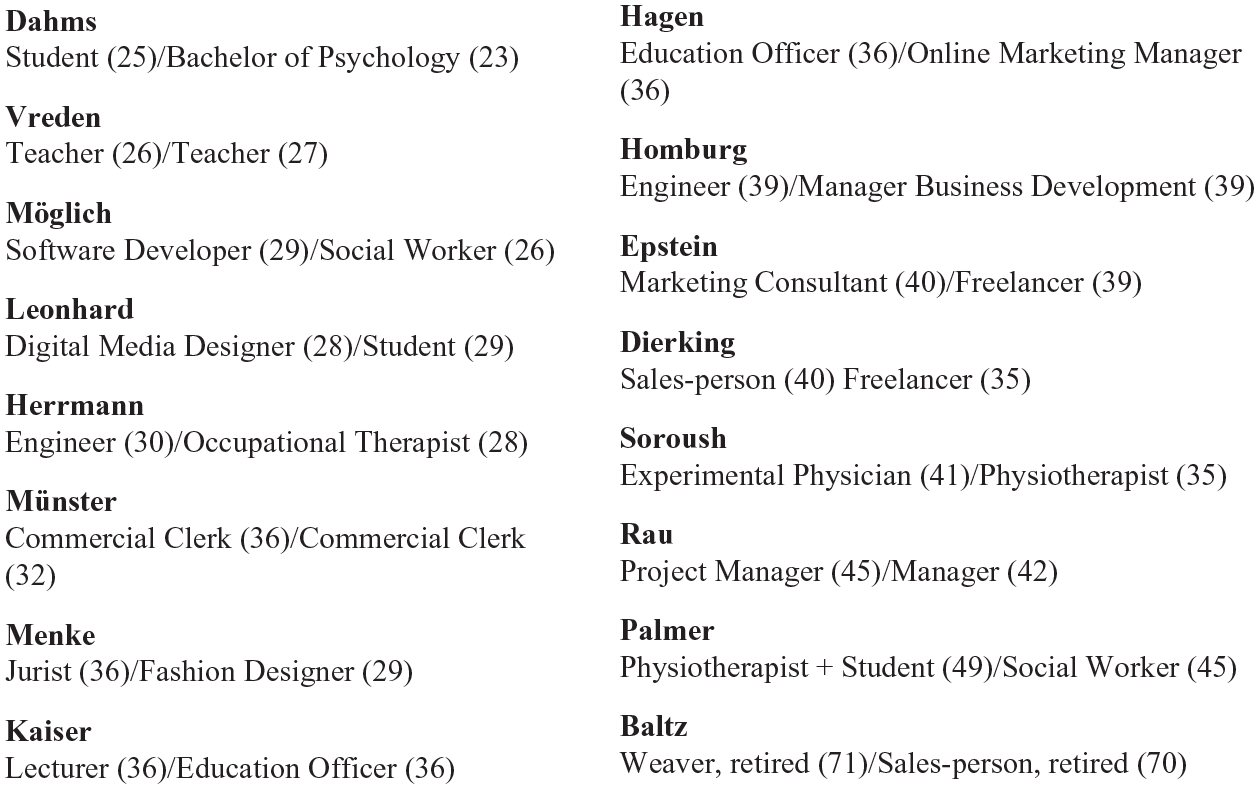
Overview (by the author): The sample, profession of the male respondent is mentioned first – except in the Kaisers (all-female) and Vredens (all-male couple). 7
Most of the data collection is based on qualitative interviews (Brinkmann and Kvale, 2018; Rubin and Rubin, 2005). The author undertook these interviews at the homes of the respondents to gain a comprehensive insight into their domestic living, media arrangements and social conditions of media use. The interviews lasted between 1.5 and 2.5 hours. Following an established empirical design that was used for data collection in three related studies, the author interviewed both participants together as a couple for a better understanding of their domestic communication culture (Röser et al., 2019: 67–68). They were asked to describe shared and individualised practices of using content distributed online. As media use is multidimensional (Couldry and Hepp, 2017: 56), the study aimed at realising a detailed and holistic collection of aspects that determined domestic media use to enrich the data (Hasebrink and Hölig, 2017). Collecting information from both partners was also extremely useful for reconstructing negotiations and meaning production that was linked to the usage of specific digital technologies and content distributed online. The author reconstructed both individualised and shared practices of media use during data interpretation. Nevertheless, as the couple is understood as a unit in this study, the main focus was on shared practices of media use which were regarded as typical of the individual household. Whether one partner had enforced his or her preferences when establishing new practices of domestic media use was also analysed. Based on the insights that the incorporation of domestic media is always gendered as,
the conflicts over ownership and control of (inter alia) information and communication technologies and the status of family or household members are all expressions of [. . .] the continuous work of social reproduction that provides the basis for the coherence of the household’s moral economy. (Silverstone et al., 1992: 25; see also Morley, 1986: 139–166)
How the partners handled conflicts concerning the selection and establishment of new, sometimes complex media technologies, choosing media content, the places where media use was accepted and the social situations that allowed media reception or not were examined to understand whether individual interests were put into practice against either partner’s will.
The following dimensions were part of the interviews in order to reconstruct what the couples do with the Internet concerning media reception and to understand the reasons why they preferred online-based technologies or content distributed online over classic mass media:
Online-based and classic media use of television and other moving images, radio and other ways of music broadcasting, podcasts and so on, printed paper and the reception of journalistic content online in domestic everyday life;
How the respondents typically use the Internet for media reception in the domestic sphere on a normal day;
Technologies that are used for media reception in the domestic sphere;
Rooms where media are used.
In addition, the author triangulated other methods. The partners used a chart for visualising the relevance of several online-based tasks and functions of the Internet. Furthermore, the author made home site inspections to observe where the couples placed the media technologies in the households. This included taking pictures of the media devices mentioned for documentation purposes.
The interviews were audio-recorded and transcribed at a later date. Subsequently, the author analysed the data using ethnographic household portraits, a qualitative method that was developed for ethnographic-oriented studies (Röser et al., 2019: 39–42). These portraits consist of a written text; a structured case study that derives from the data which the author collected during the interviews and which answered the research questions regarding the specific case. The portraits also include findings from transcripts and insights from memos and other empirical material, such as questionnaires and photographs.
The author compared, grouped and typified all case studies according to the research interests to generate generalised findings by discovering similarities, patterns and differences between the cases. In conclusion, the author was able to identify and document practices of online-based media use which allowed differentiation.
Results
Five central practices of online-based media use were identified in the data and are presented below.
Fitting media reception into the structures of domestic everyday life
The respondents stream moving images through tablets and laptops, as well as Internet connected television sets, instead of watching linear television. They use two specific potentials that online-capable technologies offer: temporally and spatially flexible media use that is experienced as comfortable (Peil and Sparviero, 2017: 9). Online-capable media allow an ideal integration of media reception into domestic time structures and different spaces in the home – especially for women. This collective practice means establishing watching moving images after finishing domestic duties, which does not always happen at the same time of the day because the respondents live with children and/or spend more time at work than at home. Both circumstances result in very packed evenings. Therefore, the respondents stream in order to become independent of the temporal structures of linear programmes and to access moving images at any time (Hasebrink, 2012: 49–51), hoping to realise as much satisfying media use as possible. Parents especially underline that fitting media use into spare time is a strong motive for streaming, because raising children means, as Mrs C. Kaiser, 36-year-old, raising two daughters with her female partner, underlines, ‘you can’t rely on having defined time for leisure’. Hence, the technical potentials of the Internet unfold against the background of the social situation at home (Haddon, 2016: 22), which does not allow the use of media at specific times – a typical problem female television users have faced before (Morley, 1986: 148; see also Gauntlett and Hill, 2001). Watching audio-visual content online results from integrating media use into time slots when no domestic duties have to be done. Video recording was used for the same purpose before the home was digitally mediatised (Gauntlett and Hill, 2001: 143–149; Gray, 1992), or – vice versa – domestic activities were scheduled in order to watch the television programme (Chambers, 2016: 35–36; Gauntlett and Hill, 2001: 30). Furthermore, watching moving images that were temporarily flexible allowed the partners to synchronise media use despite their domestic duties and, thus, to spend more time together as a couple, as they can choose time slots when both partners are available for media reception.
Using mobile devices, such as tablets and laptops, instead of stand-alone technologies opens up the possibility of utilising any content independent of space, as media use is not bound to stand-alone technologies, and integrating media use into several domestic settings. This allows the optimisation of domestic media use in two ways: on one hand, people use online-capable technologies for media consumption through a second screen in the case where the partner uses the main screen or device for pursuing his or her own media interests (see D’heer and Courtois, 2016). Mobile media, thus, restructure the home by allowing the creation of new places of media consumption. On the other hand, listening to music or watching films and series through laptops and tablets is combined with other domestic activities, such as cooking, eating or childcare: ‘I watch series and films additionally [for entertainment when she looks after her twins] while they play together’ (Mrs Dierking, 35 years). Watching moving images is, thus, often an in-between or ancillary activity.
Hence, using mobile media has changed the character of the home more than the implementation of the desktop personal computer (PC; see Bakardjieva, 2005: 137–164), as all rooms become spaces where domestic activities and media use are intermingled. As the ‘physical space’ of the home is now interwoven with plenty of ‘symbolic spaces’ (Rompaey and Roe, 2001: 365), it contains several capsules for separating from domestic life. Furthermore, the meaning of specific rooms, such as the kitchen or bathroom, becomes more comprehensive as their narrowly defined purposes are extended by media use.
Being up to date: Accessing the latest information
One relevant reason given for using online media through smartphones and laptops – especially journalistic platforms and social media – instead of classic mass media was to keep up to date and receive information as quickly as possible – often when spending time with one’s partner (see Struckmann and Karnowski, 2016: 315), which is an individualised and shared practice.
Twelve of the 16 households no longer subscribe to a printed newspaper as they think that the medium cannot compete with the speed and the amount of information transportation that the Internet offers. They have experienced that ‘when the newspaper arrived here, I had already read all the news online. Or, I had already got so much information from the internet that it was too much to read it again in the newspaper’ (Mr Hagen, 36 years).
On one hand, this necessity of accessing news quickly derives from a merging of news consumption and domestic activities. Frequent, often superficial news consumption can be done simultaneously with domestic work, childcare or while consuming other media in ‘niches in time and space’ (Struckmann and Karnowski, 2016: 309; see also Gauntlett and Hill, 2001: 73–76). Even though the respondents do not use the news extensively, they feel well-informed, because they access the latest information online constantly, immediately and comprehensively during the day. Frequency is, thus, regarded as a compensation for a lack of deepening information. When respondents feel pressed by other duties, they often access information in between other activities: ‘As soon as there is some time left, I look whether I can find anything interesting to read’ (Mr Menke, 36 years). On the other hand, the respondents have developed the practice of accessing information simultaneously through the Internet on mobile devices when severe incidents occur, because they think they are in need of being up to date in such a situation. That is why they are attempting to gather as much information as possible, especially through social media, for example, during a shooting rampage that occurred in Munich during the time frame of the data collection: ‘I follow lots of media services on Facebook. That means that I am aware of news very quickly. But in the case of urgency, then we change to Twitter because it provides information even more quickly’ (Mr Epstein, 39 years). Another respondent, who referred to the same incident, stressed, ‘If new insights are spread minute by minute, the internet is irreplaceable. It is hard to image how we kept up with the latest news earlier when we had to wait for the newspaper’ (Mr Menke, 36 years). Informing oneself minute by minute also fits well to the domestic sphere, where people can freely dispose of their time and, thus, can virtually be an eyewitness to newsworthy incidents through social media.
Hence, the practice of informing oneself has changed. It is not characterised by getting an overview of events that happened in the past but rather to follow their developments in real time. Informing oneself is more about participating than about reflection or collecting and connecting knowledge. The domestication of mobile online-capable devices and social media, that is, their comprehensive spatial and temporal integration into the home as a source for news consumption, is, thus, grounded in the fact that they fit well into domestic living conditions, which are characterised by multitasking and packed but controllable schedules (see also Gauntlett and Hill, 2001: 78). Consequently, printed newspapers are de-domesticated, which means that the respondents remove them from the domestic media repertoire by cancelling their subscriptions or not subscribing to a newspaper, behind the backdrop of the usage of the Internet as a source of news (Haddon, 2016: 22).
Informing oneself beyond mass media: Complementing the domestic media repertoire
Another shared practice of informing oneself online is to use the Internet for accessing content that is not available through classic mass media. Thirteen of the couples interviewed complement their domestic media repertoire by using content distributed exclusively online, usually through smartphones or through laptops. Twelve couples use blogs or vlogs regularly mostly for getting information concerning everyday life. Young parents read about raising their children, respondents inform themselves about new devices or software development, others read about their hobbies, such as crochet or gaming or other activities: ‘I watch food vlogs, particularly recipes and sometimes about cosmetics’ (Mrs Möglich, 26 years). Six couples also use blogs to get information on socio-political topics that classic broadcasting does not represent, ‘If it comes to a critical consideration of issues, blogs are more helpful to form one’s opinion than classic media’ (Mr Leonhard, 28 years). Thus, people use blogs for getting a holistic perspective on society and negotiating alternative and sometimes critical standpoints. Seven of the couples also use Twitter or other social media to participate in debates or promote topics that are important to them.
The reception of content distributed exclusively online, thus, enriches domestic media use, as it means accessing additional sources for information and entertainment (Jenkins, 2006). It also has democratic functions, as the couples inform themselves from additional sources beyond the mass media.
Quality: Choosing valuable entertainment
Convergent use (Müller and Röser, 2017: 57–59) of audio-visual content often derives from a high demand in the quality of entertainment and supply, which is a shared practice. Altogether, 9 out of 16 households argue that it is worth spending time on watching series or films on Netflix, Amazon Video or other (illegal) streaming services – often through television sets connected to the Internet – than on watching classic television programmes. 8 Comparing streaming audio-visual content distributed online to watching television, the respondents underline that streaming films and series is a guaranteed way of investing leisure time when choosing media formats that entertain them. They understand the television programme as the insufficient other: ‘Watching television is like switching off one’s brain. Television just washes over you. I do not appreciate that. No reception of television broadcasting for us, though’ (Mrs Epstein, 39 years). Seven couples prefer series over films and TV shows, because they like the genre better than the other formats. Respondents who refuse to use television broadcasting are extremely critical about mass media. They have internalised strict concepts of quality, which are not compatible with television shows or other forms of popular culture. Thus, they do not want to depend on the options that television broadcasting offers as these often consist of popular content. Instead, they want to pick films and series that they understand as more sophisticated, in order to use content they really want to watch.
This phenomenon is surprisingly class transcendent: Mrs Dierking and Mr Palmer, who do not have university degrees, appreciate the freedom of not having to: ‘depend on any head of programming. Instead, I can watch whatever I want to’ (Mrs Dierking, 35 years). This also applies to highly educated respondents. Mr Palmer (46 years) argues, ‘On the internet, you can choose what you want to consume. That is more interesting than having to watch what the television programme offers at a given time’. Interestingly, quality-driven households ascribe very positive meaning to streaming services, such as Netflix or Spotify, concerning the quality of supply.
Choosing valuable content is grounded in normative ideas about media use (Couldry, 2012: 34), as it expresses which content is worth watching. Furthermore, it is linked to the ‘moral economy of the household’ (Silverstone et al., 1992), as the respondents refer to a shared understanding of using media appropriately in everyday life. Altogether, streaming is a way of making social distinctions and identifying with a group of conscious media users.
Participating in everyday cultures: Following one’s interests instead of the mainstream
In addition to quality, the respondents also select audio-visual content, texts or music through a broad range of mobile and immobile devices to follow specific interests or tastes and for participating in different ‘subcultures’ (Jenks, 2005) that are not sufficiently represented in mass media. This is mostly an individualised practice. In four households, music is consumed beyond charts or radio programmes at home. Mr Soroush (41 years) prefers Metal, Hardcore Punk and Noise. He explains that he uses a private radio station from the United States to select music that he likes: ‘If it is important to you to listen to certain music, you have to use a specific radio station that offer this special kind of music. Thus, you look explicitly for these stations on the internet’. The data show that the respondents use Spotify in a similar way to select music according to their respective taste: ‘The linear radio programme is always based on a specific selection and is repeated very often. Thus, Spotify is the right choice if you want to listen to something particular’ (Mr Dahms, 25 years). Using specific music does not only mean informing oneself about new music and artists (Kjus, 2016). It is also a symbol of belonging to the linked subculture and, thus, being part of a particular group that distinguishes itself from average people (Hagen and Lüders, 2017). Couples also stream moving images – in this case, illegally – in order to participate in subcultural content. They watch censored films that are ‘not available via regular TV programmes’ (Mrs Menke, 29 years) or series, ‘I am not willing to wait for one year until Game of Thrones is also available legally in Germany’ (Mrs Möglich, 26 years).
Some respondents participate in specific national cultures by listening to radio programmes or watching films and series from other countries. Mrs Palmer, who is originally from England, enjoys listening to British Broadcasting Corporation (BBC) comedies or watching English TV series. In this way, she feels connected to home and participates in the English culture through the Internet. Another respondent uses the Internet to access Spanish media because she grew up in Paraguay. On one hand, using the Internet for media reception allows the use of native-language content, on the other hand, people can stay informed about the culture, politics and society in the country of interest. Hence, the Internet allows one to live out multiculturalism that is part of Germany’s society but not always adequately represented in mass media (see also Chambers, 2016: 139–140). Male respondents were also identified as having a particular interest in taking part in ‘techno-savvy’ subcultures through the Internet. Being an expert on technological questions (see also Bakardjieva, 2005: 102) is an important aspect of doing gender for them. This explains their need to read the latest news relating to technological developments, new devices and applications online. Likewise, in six households, at least one of the partners – with one exception, the male couple – is enthusiastic about gaming and participates in gaming culture online (see also Chambers, 2016: 94–96). These gamers are highly engaged in using boards and newsgroups to interconnect with like-minded people; by creating homepages that represent guilds, they consolidate their membership and regularly inform themselves about the other aspects of gaming. The respondents also use the Internet for communicating with other gamers: ‘Well, in fact, I got to know some of my close friends because we played online-games together. I have known them for almost twenty years now. I met them via newsgroups or when playing World of Warcraft’ (Mr Hagen, 36 years). Being a gamer means to participate in gaming-related content and social constellations in addition to the game itself. Gaming can, thus, be considered a specific male subculture that is – different from doing gender while watching television (Gauntlett and Hill, 2001: 218–238; Morley, 1986: 157–166) – practised mostly virtually and is based on the information and support of others through the Internet.
The practice of following one’s interest through the Internet instead of using mainstream media fosters the sense of belonging afforded by certain subcultures in everyday life. The respondents sharpen their selection of content guided by relevance that is influenced by the taste and norms of the said subculture. By choosing custom-made content, the respondents are distinguishing themselves from average media users. Thus, it mirrors identity politics and is regarded as the expression of ‘a fear of collectivity’ that includes being ‘wary of seeking out commonality with others’ (Jenks, 2005: 143).
Discussion
In summarising, the empirical research emphasises that both shared and individual practices that are facilitated by technological potentials and specific content foster the use of the Internet for domestic media reception. First, similar to television (Morley, 1986) and the Internet generally (Bakardjieva, 2005; Peil and Röser, 2014), using the Internet for media reception is based on the rationale of the domestic everyday life of couples. Content distributed online can be better integrated into the rhythms of living together, because the Internet and especially mobile online-capable technologies offer options that allow one to integrate media use into small temporal snippets and use media content on demand. People choose the Internet over classic mass media because it allows one to integrate shared screen time – which is important regarding the domestic communication culture of the couple (D’Heer and Courtois, 2016; Gauntlett and Hill, 2001; Müller and Röser, 2017) – against the affordances of domestic duties.
Using the Internet as a source of media content is ideal if the time that is spent at home is packed. Couples who need to individualise the temporal structures of media use benefit from the fact that audio-visual content distributed online is especially always available and can be interrupted and continued at any time. Online media reception, therefore, brings the principle of adapting media use to perfection, which was realised by using a video recorder in the pre-Internet era (Gauntlett and Hill, 2001: 143–149; Gray, 1992). Busy couples also condense domestic time, in a similar way to what mainly women did previously (Gauntlett and Hill, 2001: 214–218), by filling short breaks with media consumption (see also D’Heer and Courtois, 2016: 9). Thus, using the Internet for media reception allows one to establish routines that fit the needs of a couple, individual living conditions and temporal structures of the home perfectly. One can conclude that the relationship between the home and media has changed: formerly, domestic time structures partly adapted to the structures of television or radio programmes (Chambers, 2016: 35–36; Gauntlett and Hill, 2001: 30). Contrarily, media use is adapted to the structures of domestic life by using media content which is distributed online.
Second, the latter is used in order to sense and articulate identity and belonging. Both couples and individuals use content that is addressed to certain groups or subcultures with which they identify. Subsequently, they gravitate towards online content that fits their taste or sociological interests. Similar to findings on the use of media by migrants concerning the adoption of the Internet at home (Bakardjieva, 2005: 128–130; Chambers, 2016: 132–139) or the management of interpersonal relationships of transnational families (Madianou and Miller, 2012), respondents who have other cultural backgrounds beyond Germany participate in those national cultures through media content distributed online (see also Chambers, 2016: 139–140) – for experiencing a ‘transnational sense of belonging’ (Chambers, 2016: 145). The Internet is relevant for participating in subcultures, scenes and fandoms (Jenkins, 2006). Furthermore, using specific content is doing gender, for example, male respondents participating in ‘techno-savvy’ or gaming cultures online. Different to television (Gauntlett and Hill, 2001: 218–238; Morley, 1986: 157–166), media distributed online are used for not only articulating gender at home but also acting it out in cyberspace. Furthermore, some of the respondents identify with belonging to a group of comprehensively informed citizens who use a great variety of sources. Using a broad range of different media in order to be well-informed is a central reason for online-based media use. It is normatively motivated (Couldry, 2012: 34). Thus, media selection is also an answer to ‘the question of how we should live with media’ (Couldry, 2012: 34).
To sum up, media content distributed online allows one to follow specific interests and demands that classic mass media simply does not provide. Online users can choose content that is both meaningful to them and considered worthy of the personal investment of their time (Silverstone and Haddon, 1996: 62). Consequently, they exhibit ‘migratory behavior’ by going ‘almost everywhere in search of the kinds of entertainment experience they want’ (Jenkins, 2006: 2). Such individualised media use among couples seems to ‘transform the role of the moral economy of the household in defining a shared set of evaluations, styles, and tastes’ (D’Heer and Courtois, 2016: 10–11), because the partners tend to choose different content when online media are used. Consequently, partners do not necessarily share a consensus on the content that should be used. Thus, the core of ‘the moral economy of the household’ (Silverstone et al., 1992) seems to vanish. Contrarily, the other side of the coin is that the moral economy of the household has also had a renaissance in this context: in relation to the question of quality, many partners shared a common idea of an ideal usage of domestic media, that is, to watch films and series offered by streaming services, because they are more valuable than the content from classic television broadcasting. The respondents avoid content with which the majority of users engage. Instead, they use media texts that are meaningful to them; streaming implies aspects of sociality and identity constitution, because the couples regard themselves as a household that is critical of and choosy concerning mass media and its content.
Finally, the technological potential of (mobile) media unfolds against the background of cultural and subjective demands on media content. Such demand is not (yet) characteristic of the average German media user. We can conclude that frequent online-oriented media users form an online vanguard, because they share specific ideas about media use. Nevertheless, the insights into their online-based everyday media usage is useful as a fundamental outlook and impression regarding how the future media use in polymedia (Madianou and Miller, 2012) – where ‘new media’ have become ‘an environment of affordances’ – may develop.
It should be noted that findings on the streaming of music compared to the usage of TV, radio and reading the newspaper were not analysed in detail as the author analysed whole media repertoires in this study. Finally, any future research should ensure a much stronger focus on the characteristics of using specific media in the domestic sphere in order to clarify the meanings that users ascribe to them. Furthermore, it is advisable to include users from countries other than Germany to ascertain which of the findings are culturally specific and which can be generalised as applying to other cultural contexts (Madianou and Miller, 2012: 180–182).
