




Abstract
The media are central arenas for actors challenging government practice, as those who succeed in publicly defining issues can influence public perceptions and policy outcomes. Taking into account the widespread civic participation in health media coverage, this study explores actor influence on the media framing of a contentious health policy issue, before and after a policy change. By means of media texts analysis, it analyses the relation between actor frames and the dominant media frames on the issue of priority setting of innovative pharmaceuticals. While confirming that actors vary in their ability to influence the media, the findings contend traditional conceptions that representation equates media influence and shed light on factors that affect frame influence.
Introduction
Even in the digital age, the news media represent central strategic arenas for actors seeking to influence policies and challenge resource allocations (Pan and Kosicki, 2001; Powers, 2016). In particular, health care rationing can result in highly critical media coverage, often with individual patients criticizing cold bureaucrats for denying possibly life-saving treatment (see Abelson and Collins, 2009; Gabe et al., 2012; Hind et al., 2011). For journalists, such man-against-the-system narratives fulfil professional watchdog ideals while simultaneously attracting readers in a competitive media market (Schudson, 2003). The personalized media accounts often invoke moral imperatives to rescue innocent individuals (McKie and Richardson, 2003). By indicating victims, heroes and villains, they furthermore distribute agency and responsibility, potentially limiting the discursive opportunities of implicated actors (Seale, 2002). For instance, public officials seek to legitimize policy practices and avoid blame (Figenschou and Thorbjørnsrud, 2018; Hood, 2011; Weaver, 1986), but emotional accounts can be hard to counter due to professional, bureaucratic conventions (e.g. Ihlen et al., 2015). Studies indicate that the media can affect health care policy and allocations, such as the approval of particular medicines (Booth et al., 2007; Figenschou et al., 2019; Harrabin et al., 2003; MacKenzie et al., 2008).
How issues are presented, or framed, in the media is affected by interactions between journalists and their sources (Scheufele, 1999). A frame is the main angle in a text, affecting how issues are presented, classified or contextualized (Entman, 1993). Features such as headlines, illustrations and exemplars highlight some aspects and minimize others, thereby making some frames more salient (Baumgartner et al., 2008; Gamson and Modigliani, 1989). Consequently, news media can be seen as ‘forum[s] for framing contests in which policy actors compete by sponsoring their preferred definitions of issues’ (Carragee and Roefs, 2004: 216). Actors nevertheless differ in their ability to access the media. Official elites are thought to have superior access (e.g. Hall et al., 1978). Recent studies of health news find that ordinary citizens also have become central sources (Stroobant et al., 2018), likely reflecting commercialization, changing sourcing practices and the proliferation of digital, personal narratives (Paulussen and Harder, 2014; see Vromen, 2017). Others, however, find that rather than an expression of pluralism, patient exemplars are forwarded by strategic interests to gain media access (Thorbjørnsrud and Ytreberg, 2020).
Taking into account that citizens have become central sources in health-related media coverage, and the potential implications of personalized narratives for government counter-frame opportunities, this study explores the relative impact of different actors on the media presentation of a contentious policy issue; priority setting of innovative pharmaceuticals. The first research question is, hence, ‘Which actor’s frames are made salient by the media presentation?’ That is, which actor arguments do journalists actively promote through visual and textual cues, which are openly criticized, and which are buried, merely performing the journalistic norm of balance?
Frames are dynamic entities that interact with the societal context (Van Gorp, 2007). Taking advantage of a recent policy change on health care prioritization in Norway, the study explores actor and media frames, before and after the change. Consequently, the second research question is, ‘Does a policy change alter the actor or media frames, with what implications for actor framing power?’
The empirical objective is to describe which actors’ arguments dominate the media debates, while the analytical objective is to provide insights into the mechanisms that condition the ability of policy actors to influence the media discourse as sources. Contrary to much of the present literature, the study finds that neither source power, understood as resources or institutionalization, nor high media presence, automatically grants media influence. Rather, the results indicate that frame influence is dependent on framing expertise (Dan and Ihlen, 2011), cultural credibility and frame alliances. The article proceeds as follows. After a review of the literature and a brief outline of the analytical framework, the empirical context and methodology precedes the analysis of the media and actor frames before, finally, a discussion of the theoretical implications of the results.
Literature review
Within the framing literature, most attention has been dedicated to news media frames and the reception of these. The focus of this article, external influences on media frames, has received comparatively less attention. The following synthesizes relevant literatures on news media frames and competitive framing.
Within the fields of social movements (e.g. Snow et al., 1986) and political communication (e.g. Chong and Druckman, 2007; Shön and Rein, 1994), the media are seen as sites for frame competition, where strategic actors sponsor frames that support their interpretation of the issue at hand (e.g. Pan and Kosicki, 2001). Studies on actor influence largely treat media frames as dependent variables, typically finding that the media primarily reproduce the frames of powerful institutional actors (e.g. Entman, 2004; Hänggli and Kriesi, 2010). This is in line with indexing theory, which posits that the media cover issues according to levels of disagreement among political elites (Bennett, 1990). Accordingly, the news media primarily report civic dissent when it mirrors pre-existing disagreement among politicians. Others dispute the extent of source influence, finding that journalists exert independent framing (Strömbäck and Nord, 2006), such as making particular frames more prominent (Schnell and Callaghan, 2001) or reducing singular source dominance (Terkildsen et al., 1998). However, news production processes are believed to constrain journalistic independence (Bennett, 1990). While digital platforms facilitate access to alternative voices that can challenge elite accounts (Entman, 2004), Gerth and Siegert (2012) find that journalistic accounts continue to favour institutional actors.
Some studies suggest that frame influence depends on the ability to invoke culturally resonant meta-frames (Ihlen and Thorbjørnsrud, 2014; Ihlen and Nitz, 2008; Van Gorp, 2007), thereby subtly affecting the relevance of arguments within a debate (Pan and Kosicki, 2001). Consequently, the ability to define the boundaries of a debate can be more important for framing power than the degree of source presence in a text (Althaus et al., 1996). Similarly, adherence to news values is also seen as central for media coverage (e.g. Hall et al., 1978). Recent studies suggest that culturally resonant frames that comply with news values, comprised as ‘framing expertise’ (Dan and Ihlen, 2011), can be more important for media influence than a powerful, institutional position (Grömping, 2019). Furthermore, an emerging literature on lobbying coalitions finds that ‘frame alignment’ (Snow et al., 1986), where groups or individuals promote similar frames, is crucial for framing success (e.g. Fowler et al., 2012; Hänggli, 2012; Junk and Rasmussen, 2019). Discursive alliances have nevertheless received limited attention within the framing scholarship.
In contrast to the conscious framing practices implicated above, studies within media sociology conceptualize media frames as products of multi-level influences (Scheufele, 1999; Vliegenthart and van Zoonen, 2011; Shoemaker and Reese, 1996), where actor frame influence is increasingly analysed as one of multiple contextual influences (e.g. Doudaki et al., 2016; Ihlen and Thorbjørnsrud, 2014; Kostadinova and Dimitrova, 2012). Actor frame influence is, for instance, dependent on the type of media outlet (e.g. Kroon et al., 2016). Few, however, consider contextual factors on actor frames in depth (for an exception, see Ferree et al., 2002). Finally, frames are found to be interactive entities that develop over time (Baumgartner et al., 2008; Snow et al., 2007), where actors and journalists alike adjust their frames in response to the most prominent frames in the public discourse (Ferree et al., 2002; Miller and Riechert, 2001).
By means of an in-depth study of the frames in different media and by various sources, before and after a policy change, this study addresses how contextual influences condition actor framing power in the media. Whereas most studies focus on the frame dominance of institutional elites on the one hand and journalistic framing on the other, this article moves beyond the prevailing dichotomy by recognizing that ‘independent’ framing by journalists involves prioritizing among the frames of strategic sources.
Analytical framework
The literature often divides between generic and issue-specific media frames (de Vreese, 2005). 1 Generic frames are recurrent storylines, or scripts (Entman, 2004) within the news media, such as human interest or conflict (see Semetko and Valkenburg, 2000). Such frames can be applied to any topic and are founded on culturally resonant narratives (Pan and Kosicki, 2001). In contrast, issue-specific frames offer interpretations of a specific topic, such as highlighting innocence rather than cost in relation to the death penalty (Baumgartner et al., 2008). For this study, both concepts provide valuable analytical insights by illuminating that media texts offer interpretations of both issues and the involved actors. Similarly, actors contend on both issue facts and position within the prevailing media narratives (Terkildsen et al., 1998).
The case: priority setting of pharmaceuticals in Norway
Although the media often present new medicines as magic bullets (Carpenter, 2014), many offer limited clinical benefits over existing treatments (Cohen, 2017). Rising costs in health care increasingly force health care providers to limit access to high-tech pharmaceuticals (Sabik and Lie, 2008). In Norway, a northern-European welfare state with a tax-based, universal health care system (Saunes et al., 2020), health care prioritization first caught public attention during the general election in 2013. The initial rejection of an immunotherapy caused massive media criticism, resulting in the health minister approving the medication. Shortly afterwards, a new system for prioritizing new health technologies was established: ‘New Methods’. In line with other countries, the system delegates the responsibility for rationing new health technologies to semi-autonomous agencies – the regional health trusts (see Landwehr and Böhm, 2011). The Norwegian Parliament approved the prioritization criteria unanimously in 2016, and in the following general election year, 2017, the rejections of various (mostly cancer) medicines received extensive media coverage, though without apparent political intervention. Norwegian health care expenditure equals other high-income countries (Saunes et al., 2020). Traditional news consumption is in decline but relatively high and 87% of the population use online news weekly (Moe and Sakariassen, 2018). The Norwegian media system corresponds to the democratic, corporatist model (Hallin and Mancini, 2004), with a broad range of largely de-politicalized and professionalized media outlets.
Methodology
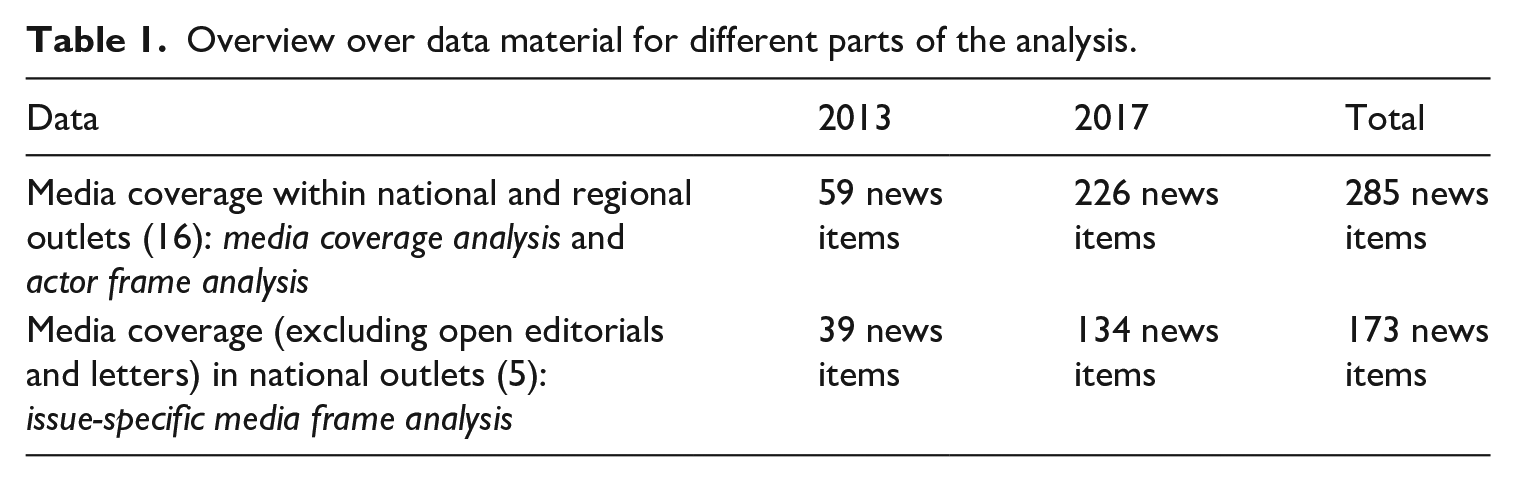
Through media content analysis, the study analyses the news media coverage of public prioritization of pharmaceuticals in Norway. It maps media and actor frames in 2013 and 2017, before and after a policy change. In line with the literature (e.g. Gabe et al., 2012), actors are categorized as (1) government officials (representing New Methods, health regulators, the health ministry), (2) medical experts (physicians and scientific researchers), (3) patients (patient groups and individuals), and (4) pharmaceutical industry. The data consist of relevant media coverage within 16 national and regional Norwegian news media, two national broadcasts and 14 newspapers. 2 Newspapers were primarily selected according to readership numbers, 3 whereas three were included to secure regional representation, and two to include independent, national news outlets. News items were gathered from an online subscription database (Retriever), web archives and the National Library. All items where the main or secondary topic concerned the availability of pharmaceuticals were included. Items on diagnostics, vaccines and medical devices were excluded. The total material consisted of 285 items. After a systematic analysis of the overall coverage, the issue-specific media frames and the actor frames were analysed qualitatively. The steps are specified in Table 1.
Overview over data material for different parts of the analysis.
The initial analysis served as a backdrop to interpret the ensuing analyses. To achieve an overview of sourcing practice and journalistic scripts, both years, publication, outlet genre, news item category, size, illustration, year and sources were systematically coded and registered in IBM SPSS®. Drawing on previous research on drug-funding debates (e.g. Gabe et al., 2012; MacKenzie et al., 2008), the intensity of conflict and human interest was also registered, in terms of presence, dominance or absence of these. Defining dominance versus mere presence of human interest and conflict in news items involved certain levels of interpretation. In practice, dominance was registered where conflict or human exemplars featured prominently in headlines, preamble or main picture and image text. The two frames were not, however, mutually exclusive and both could be dominant in the same news item.
To explore whether different outlets (print, TV) with varying editorial profiles (commercial, state, independent) stress different substantive aspects, the issue-specific frames were analysed within selected media: the largest national broadsheet (Aftenposten) and tabloid (VG) newspapers (in terms of print circulation), a smaller, independent newspaper (Dagsavisen), the commercial broadcaster (TV2), and the public broadcaster (NRK). This analysis centred on the journalistic and editorial content, excluding third-party contributions. Dominant issue-specific frames were identified through a close reading of headlines, preambles, main news text, excerpts and images, with close attention to framing devices, such as metaphors, exemplars, depictions and catchphrases (Gamson and Modigliani, 1989). The frames were categorized according to the definition of problem and responsibility. Due to the scope of the article, the analysis necessary involves some level of simplification of both media and actor frames. The analysis summarizes the frames within each outlet and further synthesizes them into one dominant frame for each year, across outlets. Finally, the actor frames were identified through a close reading of letters to the editor and open editorials (47), and direct quotes (665) within the coverage. As mentioned above, the analysis focused on both framing devices, such as metaphors and catchphrases, and the frame elements ‘problem definition’ and ‘attribution of responsibility’. The totality of frame elements and framing devices promoted by an individual actor were comprised to represent that particular actor’s frame. Then, all the frames promoted by actors pertaining to a specific group and year were synthesized into one, dominant frame representing than group. For instance, the dominant frames promoted by medical experts in 2013 were the basis for ‘medical expert frames 2013’. The individuals within the group categories varied across years; the health minister in 2017 was, for instance, a politician in the opposition in 2013.
Analysis
Increased human interest, decreased conflict intensity
The media coverage increases between the years. While most media outlets cover the issues, some cover particular debates more extensively. Public engagement and social media activity are frequently referred to. Consistent with other studies (e.g. Semetko and Valkenburg, 2000), frames vary between outlets; commercial news outlets and the public broadcaster largely focus on patient exemplars, whereas the (limited) coverage by elite broadsheet newspapers focuses on structural policies. Human interest and conflict frames were present in about half of the total coverage both years. When controlling for short briefs, their presence increased to about 60%. However, the intensity of the two frames changes: news items focusing on human interest increase from 35% to 45%, while items focusing on conflict decrease, from 40% to 25%. Although the total number of sources increases, representation levels are largely constant for government representatives and medical experts. Industry representatives and individual patients increase, while patient organizations decrease (see Table 2). While government authorities are cited frequently, patients are even more prevalent, confirming previous studies (e.g. Stroobant et al., 2018).
Source representation.
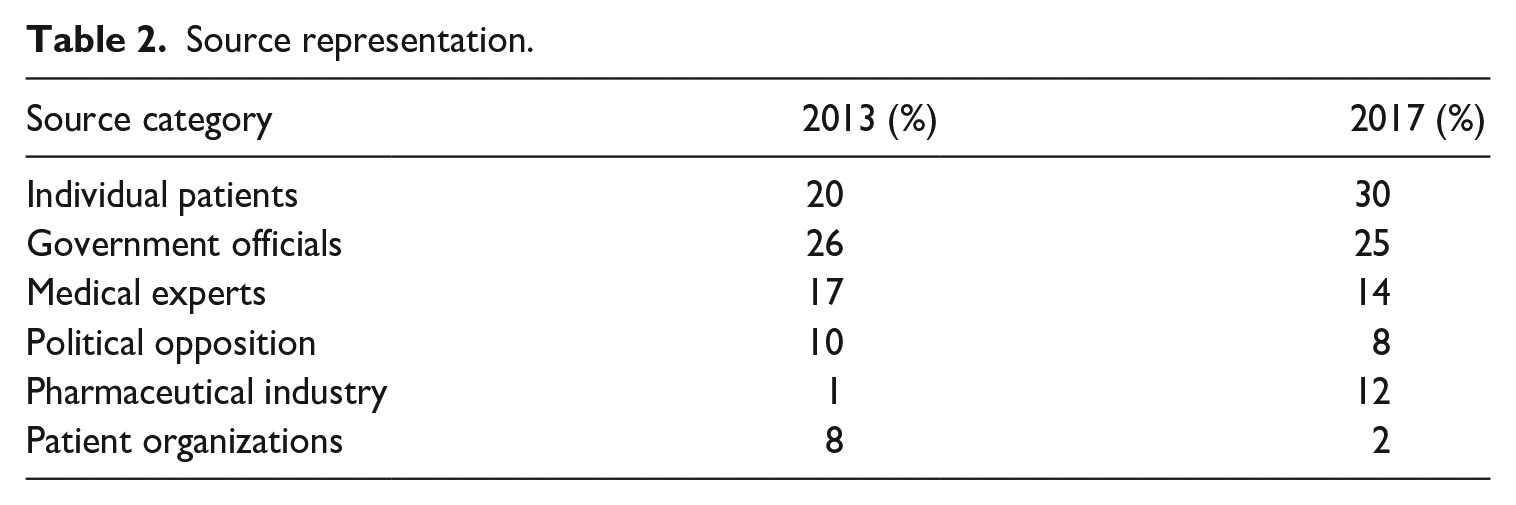
In sum, there is a decrease in conflict intensity and increase in human interest intensity. Although patient and government sources dominate both years, they are unlikely to exert equal influence, as journalists tend to position officials as authorized knowers (Schudson, 2003). The following examines which issue-specific frames dominate in the media.
Shifting problem definition and responsibility
Recognizing the dichotomy that characterizes media accounts of conflict, and the importance actors place on defining issues and diverting blame (Benford and Snow, 2000), the analysis of issue-specific frames focuses on problem definition and responsibility. 4 The findings are summarized in Table 3.
Issue-specific media framing of problem and responsibility in selected media.
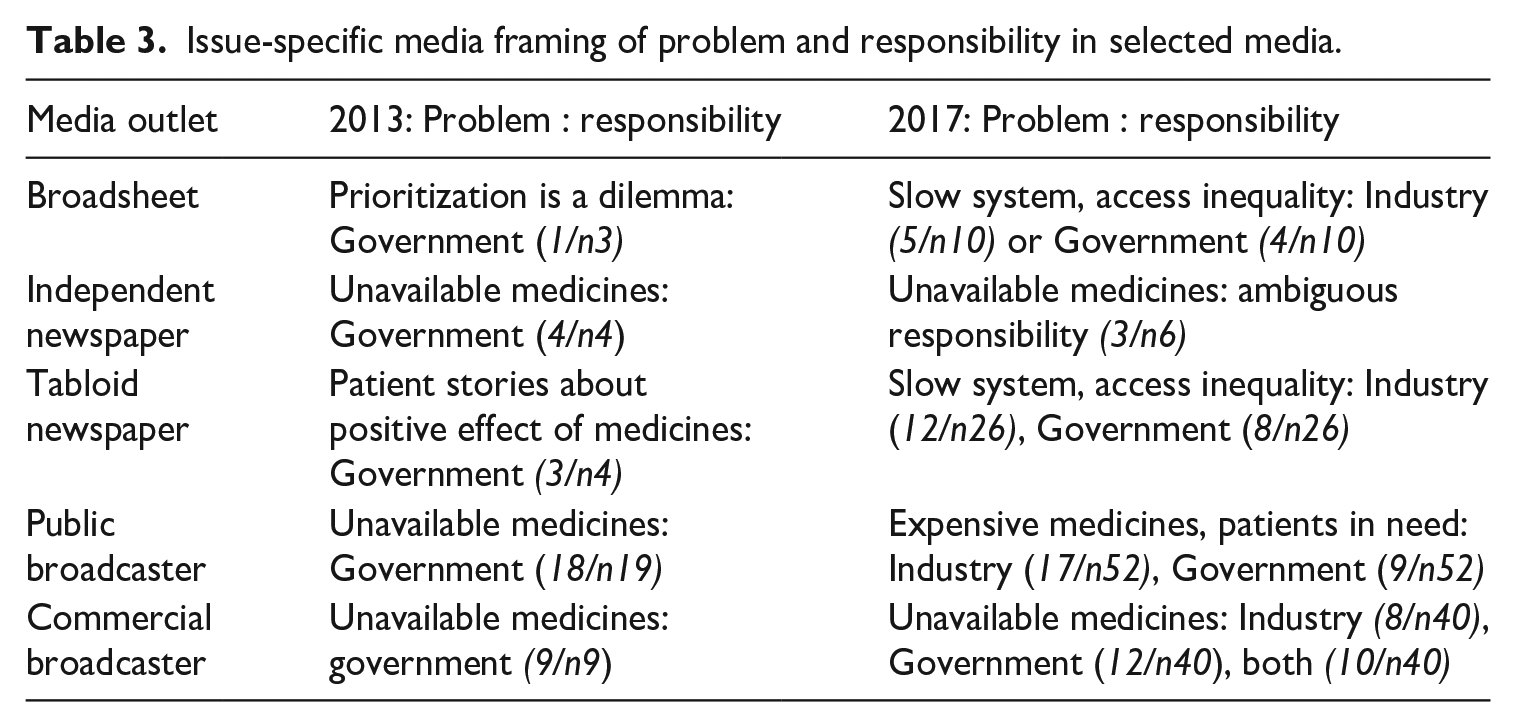
Although media frames vary between years and outlets, there are some general tendencies each year. In 2013, the coverage predominantly blames the government. The problem is lack of access to vital treatment, which ‘all’ other countries provide, and the near ubiquitous solution is to approve the medications. In 2017, however, there is an underlying acceptance across outlets of the need to prioritize health care resources, and problem definitions vary from ‘unethical’ prices, socially stratified health care and a slow bureaucracy. Government responsibility now primarily concerns system improvement rather than saving individual patients presented by the media. Several outlets also criticize the pharmaceutical industry, urging companies to adopt ‘decent’ pricing practices. Outlets describe a variety of solutions or present it as an unsolvable dilemma – a new social reality. Medical experts are generally presented as professional authorities and patients’ advocates, while patients are largely portrayed either as victims or as resourceful recipients of new and effective medicines that they have accessed through unconventional means. In sum, the overall definition of problem and responsibility changes between the years, shifting largely from government criticism towards a general acceptance of the need to prioritize and a dispersion of solutions and responsibility.
Framing contests and changing actor frames
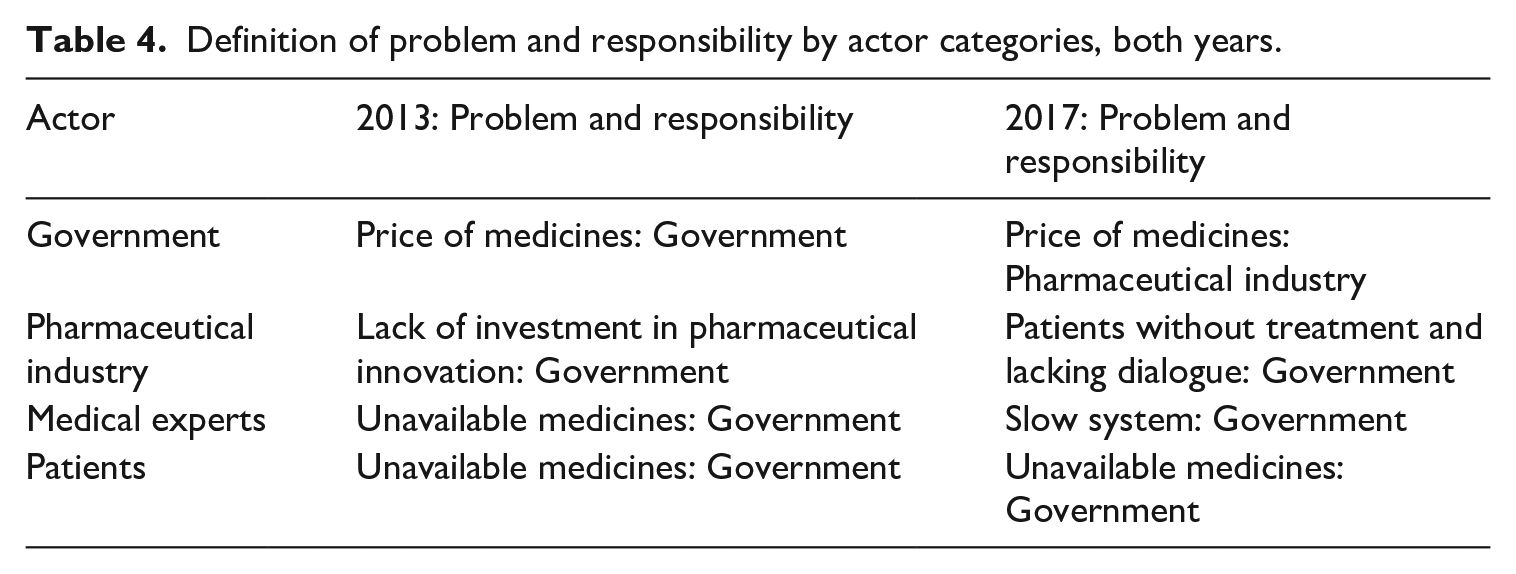
How do changes in the media relate to the frames promoted by different actors? The following presents the definition of problem and responsibility of central stakeholders: the government, the pharmaceutical industry, medical experts, and patients. The findings are summarized in Table 4.
Definition of problem and responsibility by actor categories, both years.
Government frames
Government representatives consistently argue that Norwegian health care is of high quality and that prioritization is imperative. In 2013, the problem is primarily that medicines are expensive and have limited documented effect and the solution is to ration these. In 2017, the problem is primarily high prices. The solution is price reduction. Spokespersons rarely mention pharmaceutical companies in 2013, but repeatedly criticize them in 2017. In an open editorial, the health minister writes, This is about unethical pricing and a company that is extremely greedy and that expects a revenue far beyond what other legal businesses take (. . .).
5
Representatives generally apply technical formulations. In 2013, the health director explains: ‘If we calculate the costs to costs per gained living year and in addition take into account that the patients’ life quality improves. . .’ 6 . In 2017, however, the language becomes more value laden, such as stressing personal and emotional support for the patients in question. The leader of New Methods states: ‘we think it is terribly sad [that] we cannot give [the medication]’ 7 . This is also evident when he in another instance attempts to rhetorically deflect agency after rejecting a controversial medicine: ‘we say yes to the medicine, but we have to say no to the price’ 8 . In line with conventional blame avoidance strategies (Weaver, 1986), the decision is presented as an inevitable act induced by the pharmaceutical company. By stressing personal and the emotional support, representatives are breaching from the bureaucratic codes that normally limit their ability to counter critical, personalized media frames (Figenschou and Thorbjørnsrud, 2018; Ihlen and Thorbjørnsrud, 2014).
Pharmaceutical industry frames
According to the industry in 2013, the problem is lack of government support in pharmaceutical innovation. In 2017, the problem is patients lacking access to vital medications and the solution is to improve government–industry dialogue. In line with professional conventions, the language is generally formal and precise, communicating through brief and controlled, pre-written replies while stressing their willingness to cooperate. However, companies that are repeatedly characterized unfavourably in the media appear to adapt to the media presentation by simplifying their messages, stressing personal feelings and their concerns for patients while redirecting blame and responsibility to the government: ‘we had hoped the government had decided to give the patients treatment (. . .but) this sadly did not happen. This is first and foremost sad for the patients’, one states. 9
Medical expert frames
In both years, medical experts stress their role as the patients’ advocates. In 2013, the problem is government prioritization and the solution is to approve the medicines. In 2017, the problem is predominantly social stratification in access to medicines and the solution is to improve the timeliness of the system. However, while the 2013 frame is largely coherent, with few dissenting voices, the 2017 coverage mobilizes more participants with dissenting views. In an open editorial, one physician writes that the public health care service is of high quality and uniquely equal and that the media presentation is more troubling to patients than the lack of medicines. 10
Patient frames
According to patients in 2013, the problem is the rejection of particular medicines, which is presented as price-tagging lives and removing last hope. In 2017, the problem is more fragmented: a slow system, government–industry negotiation games, socially stratified access to medicines or removing last hope. The solution is to improve the system or criteria, provide alternative funding, alter requirements or reach a price agreement. The government is by far the main culprit.
In sum, actor frames change in tandem with the media frames. There are clear elements of frame alignment within and between groups, in both years, such as the notions of a socially stratified health care (medical experts and patients), system timeliness (medical experts and patients) and unethical pharmaceutical companies (government: health minister and public officers). As more sources participate in 2017, definitions of problem/solution fragment within and across groups and debates, except for the consistent government frame in 2017. There are clear changes in rhetoric by both government and industry representatives in 2017, such as the increase in affective reasoning and personification over facts and technicalities.
Discussion
Issue-evolution and actor frame adaption
The increase in media coverage between the years likely relates to the rise in high-cost medicines, expanding the number of relevant stakeholders. Furthermore, the newly established prioritization system appears to reduce corporate opportunities for backstage influence, likely amplifying the strategic significance of the media (Binderkrantz, 2012). For instance, pharmaceutical companies, medical experts and patients in 2017 all address the government directly through the media, requesting involvement or lamenting the lack of dialogue. With increased coverage, the controversies expand, likely contributing to increased participation, complexity, and fragmentation of frame coherence within groups (Baumgartner et al., 2009). Consequently, groups in 2017 present a multitude of solutions, resulting in incoherent or contradictory arguments, with few clear solutions. The exception is the consistent 2017 government frame. Furthermore, some frames disappear between the years, such as ‘the worlds’ richest country’ and ‘invest in pharmaceutical development’. The changes in both actor and media frames are likely due to the political agreement on prioritization in 2016. According to policy feedback theory, policies can act as political forces that set agendas, shift interests and change beliefs (Pierson, 1993). The government argument about the need to prioritize, while strongly contested in 2013, is generally accepted in 2017. For instance, the political opposition is highly critical in 2013, but largely not in 2017. Furthermore, the general societal context likely influences the perceived viability of particular frames, the ‘discursive opportunity structures’ (Ferree et al., 2002). Whereas the pharmaceutical industry in Norway is of marginal significance, a central issue in 2013 was a specific national pharmaceutical innovation, which may have affected the perception of the nation’s role in relation to pharmaceutical development in general. In 2017, there was no similar product attention. Nevertheless, neither explain why attribution of responsibility changes. A more likely cause is actors responding to frames in the media by presenting ‘counter frames’ (Benford and Snow, 2000). In 2017, actors, for instance, actively use simplification and personal emotions to contest and claim labels such as ‘ethical’ and ‘hostage’. Actor framing contests are thus not confined to issue substance but involve struggles for legitimacy within the media narrative.
Frame alliances and hierarchies of framing power
The analysis shows that dominant media frames are dynamic patchworks of frame elements of different actors. In contrast to expectations in the literature, frame influence is not automatically due to superior media access by powerful sources. The government frame did not dominate the 2013 coverage and only partly succeeded in redirecting blame in 2017. Furthermore, although industry sources increase their presence in 2017, they are often placed at the end of articles, primarily responding to the statements of others – in practice, reducing their impact on the media narrative.
Different actors nevertheless dominate different levels of the media discourse. Whereas some actors’ frames are highly visible within the coverage, others exercise more subtle framing power. By invoking particular meta-cultural frames (Shön and Rein, 1994), some actors succeed in expanding issues that in effect only concern a minor subgroup of actors. Journalists, for instance, adopt some frame elements, applying it in coverage where the initial sponsors are not present, such as ‘socially stratified health care’ (medical experts and patients) and ‘unethical pharmaceutical companies’ (health minister and public officers). These ‘travelling frames’ (Lock et al., 2018) become accepted ‘facts’ in the coverage. Patients and medical experts thereby succeed in establishing that lacking access to particular medici` nes for specific sub-groups reduces the quality of the health care system at large. Tellingly, however, the frame element ‘socially stratified health care’ is only invoked in relation to cancer rather than, for instance, diseases affecting actually stigmatized groups, such as Hepatitis C. The implicit premise behind central conceptual constructs is brought to light through minor discursive breaches, such as individual physicians contesting the medical necessity of a particular medication, although such ‘dissenting’ views are not forwarded in the general journalistic coverage. On a deeper level yet, particular actors set the boundaries for the legitimacy of arguments. Close to all actors can be said to adhere to a culturally resonant techno-future frame that sees technological innovation as inherently beneficial (Carpenter, 2014), thereby limiting which perspectives are relevant at all. Prioritizations outside the field of pharmaceuticals are largely non-existent in general debate. In this sense, all actors can be said to adhere to a communal meta-frame on the importance of (predominantly cancer) pharmaceuticals.
Conclusion
This article analyses the influence of external actors on news media content and how societal context conditions their relative influence. The study is based on media text analysis, before and after a policy change. The following highlights four key findings with relevance for the literatures on competitive framing and news media sociology.
First, the study contributes to the understanding of source influence in the media. Whereas studies traditionally have equated source presence with influence, the study confirms previous findings that dominant sources not automatically determine the media presentation. For instance, government representatives are equally present in both years, while their frames are contested in one year and supported in the other. Furthermore, it finds that framing power is hierarchical: sources influence different levels of the coverage. On the overt level, some actors’ frame elements are salient, although at times contested. On a covert level, some actors’ frames are forwarded as undisputed facts or truthful characterizations. Framing power is in other words not confined to having one’s frames promoted within the media, but crucially concerns the ability to naturalize the debate boundaries (Pan and Kosicki, 2001).
Second, in contrast to the indexing theory, the study shows that institutional position does not appear to be sufficient for media influence. For example, despite general agreement on prioritization practice and criteria among political elites in 2017, there was widespread media coverage. Furthermore, taking into account that prioritization was an established practice prior to 2013, the sudden political disagreement in 2013 is more likely to have been induced by the media coverage than originating it.
Third, the study nuances existing knowledge of what constitutes successful strategic framing. Whereas framing expertise, combined with status or resources, is believed to be central for strategic frame influence (Dan et al., 2019), this study indicates that frame alliances with other stakeholders is also essential for frame influence. Accordingly, frame influence appears to be dependent on media competence, cultural credibility and collective issue definition (Junk and Rasmussen, 2019). For instance, although individual citizens in this study have high media access, appeal to media requirements and have high cultural legitimacy, their frames do not necessarily influence the dominant media framing of the problem or the solution unless their frames align with those of legitimate others, such as medical experts. Future studies should investigate whether such frame coherence result from actual backstage cooperation and how actors with overlapping interests negotiate frame coalitions. Finally, the study finds that actors do not push out static frames in the media, but actively interact with the media frames as these develop. In doing so, both industry representatives and public officers in 2017 breach with conventional professional codes for public communication by adapting to media demands for personalization, conflict, simplification and emotion.
There are several limitations to the study. First, focusing only on frames already present in the media misses the frames of stakeholders that either avoid or are unable to attract media attention. Furthermore, the actor frames in this study are confined to what they write and say in the media, and not on how they strategize, reflect and prioritize behind the scenes. Future studies should explore such concerns and evaluations. Finally, the study is based on a case study within a particular policy context. Further empirical studies will shed light on the relevance of the present findings in other institutional contexts.
Footnotes
Acknowledgements
I am thankful to Kjersti Thorbjørnsrud, Tine Ustad Figenschou, Espen Ytreberg and Daniel Hallin for comments on earlier drafts of this paper.
Funding
The author(s) disclosed receipt of the following financial support for the research, authorship, and/or publication of this article: This paper is a part of the research project Health Communication Regimes, funded by the Norwegian Research Council, project number 258993.
