




Abstract
Astroturf lobbying refers to the simulation of grassroots support for or against a public policy. The objective of this tactic is for private interests to pretend they have public support for their cause. However, omitting to disclose the real sponsor of a message renders the communication unauthentic and undermines democratic and pluralist values. This article seeks to develop a method to detect astroturf movements based on emphasis framing analysis. The hypothesis is that astroturf groups employ different frames than genuine grassroots movements to comply with the private interests they truly represent. The results of the case study on the shale gas exploration debate in the United States show that astroturf groups used frames that differed significantly from authentic non-governmental organizations, which allowed their detection.
The term lobbying is often associated with a pejorative connotation in the eyes of the public (McGrath, 2005). This can be explained by the numerous cases where lobbyists have used illegal or unethical strategies to exert influence on policymakers. Nonetheless, when following the letter of the law, lobbying is legal and is an accepted activity in democracy. Milbrath (1960) depicted lobbying as a communication process, as an exchange of information between governments and interest groups, here understood as a wide variety of organizations ranging from business groups to nonprofits. In light of the resource-exchange theory, the purpose of interest groups is thus to provide lawmakers with expert information regarding an issue to gain access to and influence the decision-making process (Bouwen, 2004). Interest groups have different options to do so. One of them is to simulate citizen support for or against a public policy. This process has been coined astroturfing as it refers to the manufacturing of grassroots movements. Due to the concealed identity of the true sponsor of such movements, astroturfing represents a threat to democratic and pluralist values. Indeed, when designing or revising pieces of legislation, policymakers supposedly tend to support policies that have broad support in the population, or at least in their constituencies. By masking their true identity, astroturf movements can lead a policymaker to overestimate private interests over public interests. The purpose of this article is to suggest an innovative method allowing the detection of astroturf groups and therefore helping to render public debates and policy-making processes more transparent.
This article is divided into four sections. The first one presents a literature review of astroturfing. There is a growing body of literature devoted to the phenomenon, but few studies are suggesting methods to detect astroturf movements (Keller et al., 2019). The second section develops the methodology that is based on emphasis framing analysis. The underlying assumption is that astroturf groups frame an issue differently than genuine grassroots movements. The third section summarizes the results of the case study. The research design includes a quantitative text analysis of documents published by 72 interest groups active on the hydraulic fracturing debate in the United States. The last section paves the way for a discussion about the threat of astroturf lobbying in democratic societies.
Astroturfing and astroturf lobbying
Researchers from various fields have contributed to the current knowledge of astroturfing. However, it appears that the term itself does not always designate the same reality. Depending on the field of research or on the geographical and political context, different meanings coexist.
It is only in 1986 that Lloyd Bentsen, then Senator of Texas, coined the term astroturfing to describe a manufactured public relations campaign. His staff had received an unusually high number of letters from citizens who expressed their concerns about a new policy proposal aiming to regulate the liquor business. However, it appeared that these public letters actually originated from the liquor industry itself. The Senator tried to reassure its constituency by saying he was able to “tell the difference between grassroots and AstroTurf” (Walker, 2014, p. 33). Bentsen cleverly qualified this fake grassroots movement as astroturfing in reference to the brand of synthetic grass AstroTurf. Originally, astroturfing thus refers to a communication campaign pretending to emanate spontaneously from concerned citizens while it is actually sponsored anonymously by corporate interests.
Yet, this phenomenon is not limited to political purposes and can take many different forms. It can refer to the fact of buying fake followers on Twitter, posting positive comments under a false identity on Tripadvisor, paying citizens to demonstrate in the street, creating front groups with misleading names, and the list goes on. Astroturf efforts have been studied from different fields: computer sciences (Ratkiewicz et al., 2011), economics (Lyon & Maxwell, 2004), ethics (Bowen, 2013), political communication (Lits, 2019a), public relations (Sisson, 2017), psychology (Cho et al., 2011), and sociology (Walker, 2014) notably. Consequently, many definitions of astroturfing exist. Two researchers have strived to suggest a comprehensive definition that could be applied when astroturfing is used either for political or commercial purposes. Berkman (2008) defined it as “an attempt by an organization group to spread a predetermined message, but to do so in a manner that makes each message appear authentic and original” (p. 7). Boulay’s (2012) definition is even more systematic as she identified two criteria to qualify a campaign or a movement as astroturf. According to her, “astroturfing is a communication strategy whose true source is hidden, and that pretends to emanate from a citizens’ initiative” (p. 61).
Building on the latter definition and applying it to political settings, astroturf lobbying refers to the simulation of citizen support for political purposes. This strategy is not new. Astroturf lobbying is reminiscent of old propaganda techniques and appeared long before the term was coined by Bentsen. However, the 1960s saw astroturf lobbying taking off. One of the reasons behind that is the explosion of citizen groups at that time in the US political arena. Those advocacy groups gained momentum with symbolic wins on issues such as civil rights or the protests against the Vietnam War. Those organizations often started as spontaneous grassroots movements and gained legitimacy in the political landscape. Their success attracted some attention from business groups who would have loved to gain the same respect and legitimacy as these movements. As Berry (1993) phrased it,
most business groups would love to have the respect that these citizen groups command in the press. For all the financial strength at the disposal of oil lobbyists, no representative of the oil industry has as much credibility with the public as a lobbyist for the Natural Resources Defense Council. (pp. 35–36)
First scholarly work about the astroturf lobbying started to really emerge in the 1990s under the impetus of Stauber and Rampton (1995) and Beder (1998). Even though they do not explicitly use the term, they shed light on the damn lies that are sometimes used by the public relations industry. Among them, the setting up of front groups and the publication of scientific reports written by controversial expert groups are examples of creative strategies created to influence public policy outcomes.
Interestingly, McNutt and Boland (2007) observed that environmental issues are more likely to be targeted by astroturfers. The research conducted by Cho et al. (2011) supports this assumption. Based on a psychological experiment on the issue of global warming, their findings suggest that “astroturf organizations are effective in creating the sought uncertainty in the minds of people exposed to their message” (p. 23). Along the same lines, the finding of a study conducted by Bsumek et al. (2014) demonstrated how the coal industry developed astroturf campaigns in the United States to defend their interests. The findings show that the coal industry’s strategy is to propose a multi-front corporate advocacy campaign, which includes the use of front groups. The authors define this strategy as corporate ventriloquism and explain how the industry has adapted its rhetoric to challenge and undermine the voice from genuine grassroots movements.
Even though most research has been conducted in the United States so far, scholars from other countries also had a look at the phenomenon, possibly due to the growing number of detected cases in recent years. For example, Wear (2014) analyzed the link between populism and astroturfing when deconstructing the campaign The convoy of no confidence that took place in Australia in 2011. The idea behind this campaign was to create a citizen movement, symbolized by a trucking convoy, to oppose the Australian government’s stand on carbon emissions. The rally was actually organized by the National Road Freighters Association but presented itself as a genuine citizen movement. In Europe, Laurens (2015) has published a paper after following the setting up of an astroturf group from the inside. He explained from a sociological perspective how the evolution of the European political structures and the need for the European institutions to regain trust from their citizens lead businesses to try and legitimate their actions through front groups to feed that need of institutional legitimacy. The presence of astroturf groups in Europe has also been studied by Lits (in press) who showed how the oil and gas industry deployed an astroturf campaign to influence two specific reports of the European Parliament.
The rationale behind astroturfing is for private actors to find an alternate way to convey their messages with more credibility. The goal is to capture the voice of civil society in political debates. In this regard, creating a front group, for instance, opens “avenues for businesses to influence policymakers and for wealthy donors to sway political campaigns and to leave few fingerprints” (Drinkard, 1997, p. 10). Because this strategy is based on deceiving policymakers and citizens, it raises concerns about the democratic aspect of the public policy process (Fitzpatrick & Palenchar, 2006). These concerns are all the more pressing that astroturf lobbying has developed as a distinct industry that sociologist Walker (2014) qualified as grassroots for hire to depict how easy it has become for public affairs consultants to manufacture public participation.
In sum, astroturf lobbying aims to manufacture citizen support for or against an issue to influence policymakers, the media, or public opinion. It can be done by setting up a bogus non-governmental organization (NGO), by paying people to demonstrate in the streets, by hiring actors to go to public hearings, by sending petitions signed with fake names, or by purchasing followers on Twitter. By keeping the identity of the actual sponsor of the strategy secret, astroturf lobbying raises ethical questions. It could indeed endanger the functioning of policy-making processes in democratic societies, which should be based on authentic communications. The next section outlines the method that has been designed to detect astroturf movements.
How to detect astroturf movements?
In an attempt to look like a grassroots movement, private interests not only violate most of the normative theories of communication and political science but also most codes of ethics of public relations and public affairs. A critical objective is thus to find a way to uncover them and ascribe them to their true origins and financial ties, despite the possible veracity of the content of the message. The objective of this article is, therefore, to design a method to reveal astroturf endeavors and make public debates and policy-making processes more transparent.
An underlying assumption based on emphasis framing
Scholars who have studied astroturfing acknowledge the problem of concealment, but few are suggesting solutions. In fact, according to Boulay (2015), astroturf activities are most often denounced by journalists in the course of their investigations rather than by academic researchers. There is an emerging academic focus on astroturf detection that focuses on computational propaganda and the use of bots on social networks. For example, Ratkiewicz et al. (2011) were pioneers in the field and designed a program called Truthy, which helps detect smear campaigns and astroturf cases on Twitter. Along the same lines, the Computational Propaganda Project at the University of Oxford also analyzes algorithms and automation on the microblogging website to find bots that relay misinformation and manipulate public opinion.
These initiatives are of course welcome and much needed in a time of political misinformation but solely take into consideration social media such as Facebook and Twitter. The question of uncovering alternate astroturf tactics, such as front groups, has however been overlooked by the scientific community. This study aims to fill that knowledge gap.
The method suggested in this study is based on the concept of framing, with the postulate that interest groups are framers (Baumgartner, 2007). Framing has a long and debated history. As from the 1970s and onwards, the concept of framing has been widely used and defined by an ever-growing number of scholars from various research traditions. Two main schools of thought have emerged over the years: the sociology-rooted and the psychology-rooted traditions. In this article, the concept of framing is understood and mobilized in light of the sociological tradition. Gitlin (1980) was one of the first scholars to introduce the concept of framing in communication and media research. He offers a definition of frames and media frames, which has led to the concept of emphasis framing that is used in this article:
Frames are principles of selection, emphasis, and presentation composed of little tacit theories about what exists, what happens, and what matters. Media frames, largely unspoken and unacknowledged, organize the world both for journalists who report it and, in some important degree, for us who rely on their reports. Media frames are persistent patterns of cognition, interpretation, and presentation, of selection, emphasis, and exclusion, by which symbol-handlers routinely organize discourse, whether verbal or visual. (pp. 6–7)
Subsequently, Gamson and Modigliani (1989) developed research on framing with a constructionist approach and applied it to the analysis of media discourse and public opinion on nuclear energy. Here, frames are perceived as “a central organizing idea or storyline that provides meaning to an unfolding strip of events. The frame suggests what the controversy is about the essence of the issue” (p. 143). Along the same line and more recently, Van Gorp (2007) advocated for considering the cultural dimension of framing that is often overlooked when studying framing effects. As the essence of framing is in social interaction, culture plays an integral part in how frames are built.
To influence policymakers, interest groups active on an issue thus have to define what is problematic and suggest a solution. They have to frame their position by selecting arguments and by omitting or discrediting others. Recent research has shown that different factors can explain how interest groups choose the frames to emphasize: the logic of influence and the logic of membership (Klüver & Mahoney, 2015; Schmitter & Streeck, 1999). The former means that interest groups behave in accordance with the target of their lobbying campaign. The same frames do not work as efficiently when trying to influence Democrat or Republican representatives for instance. The latter supposes that the interest groups mobilize frames in accordance with the members they represent. For example, corporate lobby groups would rely more on economic frames and citizen groups on public frames such as the environment or public health.
The case of astroturfing is interesting considering how framing is used strategically. In the public arena model, public attention is a scarce resource which leads to a competition between political actors to recognize what social problems deserve media and public attention (Hilgartner & Bosk, 1988). Public deliberation is here understood as a collective process where actors exchange views on a public policy, and where political actors use discursive devices in order to influence the deliberation. Framing therefore becomes a strategic action for interest groups to attract attention and to shift the focus of a debate (Pan & Kosicki, 2001).
However, there is a dilemma for astroturfers, that is, the way they will frame the issue at hand. Astroturf groups represent private interests while appearing like a genuine grassroots movement. Will they use the frames from the interests they truly represent? Will they try to counter-frame the ones suggested by genuine grassroots movements? Or will they try to reframe the issue entirely?
The assumption on which the method to detect astroturf has been designed is based on this paradox. The purpose is to determine whether framing strategies used by lobbyists resorting to astroturf differ significantly from those used by real grassroots movements so as to open the possibility to instrumentalize those differences to detect and unmask astroturfing. These differences can be observed and measured by looking at and mapping the interest groups depending on their framing, and to isolate the fake grassroots. In other words, the assumption is that astroturf movements rely on different frames than genuine civil society organizations.
Case study on hydraulic fracturing
The research design follows four steps, from the identification of a suitable issue to the identification of astroturf movements thanks to quantitative text analysis of interest groups’ positions.
Issue identification
Cobb and Elder (1971) defined an issue as “a conflict between two or more identifiable groups over procedural or substantive matters relating to the distribution of positions or resources” (p. 82). The selection of the issue for this case study has been guided by the literature review on the astroturf phenomenon. First, the literature tends to show that the United States is the cradle of astroturfing and is deemed a breeding ground for astroturf efforts, thus improving the likelihood of encountering them as, according to Financial Times journalist Fontanella-Khan (2013, June 26), astroturf has become the norm rather than the exception in the United States. Then, the observations from McNutt and Boland (2007) have been taken into consideration to focus on an environmental issue. That led to the divisive issue that is shale gas exploration. Indeed, over the years, two camps have formed regarding the use of hydraulic fracturing for supplying energy in the United States. On the one hand, interest groups advocate for the exploration of shale gas, given the favorable impact it can have on the US economy and industry. On the other hand, an opposing coalition has emerged and expresses environmental concerns regarding this technology.
Interest groups identification
According to how they present themselves on their websites, two major group types have emerged: the ones representing business or professional interests and the ones that are nonprofits. Different labels have been used by researchers to mark the differentiation between the two. Some prefer to separate groups with specific interests or with diffused interests (Gais & Walker, 1991; Kollman, 1998; Schlozman & Tierney, 1986). Others rather distinguish sectional groups from cause groups (Klüver, 2011; Stewart, 1958). Finally, Binderkrantz (2005) differentiates business groups and public interest groups. All these dichotomies refer to similar realities with slight semantic changes. As this study looks at astroturfing and the problem of faking citizen participation, the classification to describe interest groups in this article distinguishes business groups and grassroots groups. These terms allow emphasizing the differentiation between groups that are defending corporate interests and the ones having a bottom-up approach with the spontaneous implication of citizens.
To make up a corpus of relevant documents, the websites of the identified interest groups are scrutinized to find a page presenting the issue and suggesting a solution. The criteria for selecting the documents making up the corpus are thus that an interest group must have a website and must have a specific section on its website where it addresses the issue of shale gas and hydraulic fracturing. These sections often had titles such as “About Shale Gas,” “What is Fracking?” or “Position on the Hydraulic Fracturing Issue.” Based on these criteria, 72 interest groups have been kept for making up the corpus (30 business groups and 42 grassroots groups). The framing analysis of the documents is based on quantitative text analysis and is performed with the software package KH Coder, which processes data using R.
Frames identification
Interest groups are framers. They emphasize certain aspects of an issue in their messages while omitting others. To identify the frames used by the interest groups in this case study, a cluster analysis is performed on the corpus. As Klüver et al. (2015) explain, the underlying argument is that “words that co-occur in similar contexts tend to have similar meaning and documents that contain similar word patterns tend to have similar topics” (p. 488). By looking at the words forming a cluster, it is thus possible to interpret the clusters as frames (Schonhardt-Bailey, 2005). The software allows to find and analyze which groups of words have similar appearance patterns. Importantly, it is possible to assign the interest group documents to a single cluster. It means that the quantitative text analysis permits to identify the frames invoked by the interest groups and mention which frames have been most used by each interest group. Three clusters have been identified through this process. Table 1 shows a list of the 20 words that are likely to appear in an interest group document based on the frame that it has invoked.
Most prominent words distinguishing clusters in the US hydraulic fracturing debate.
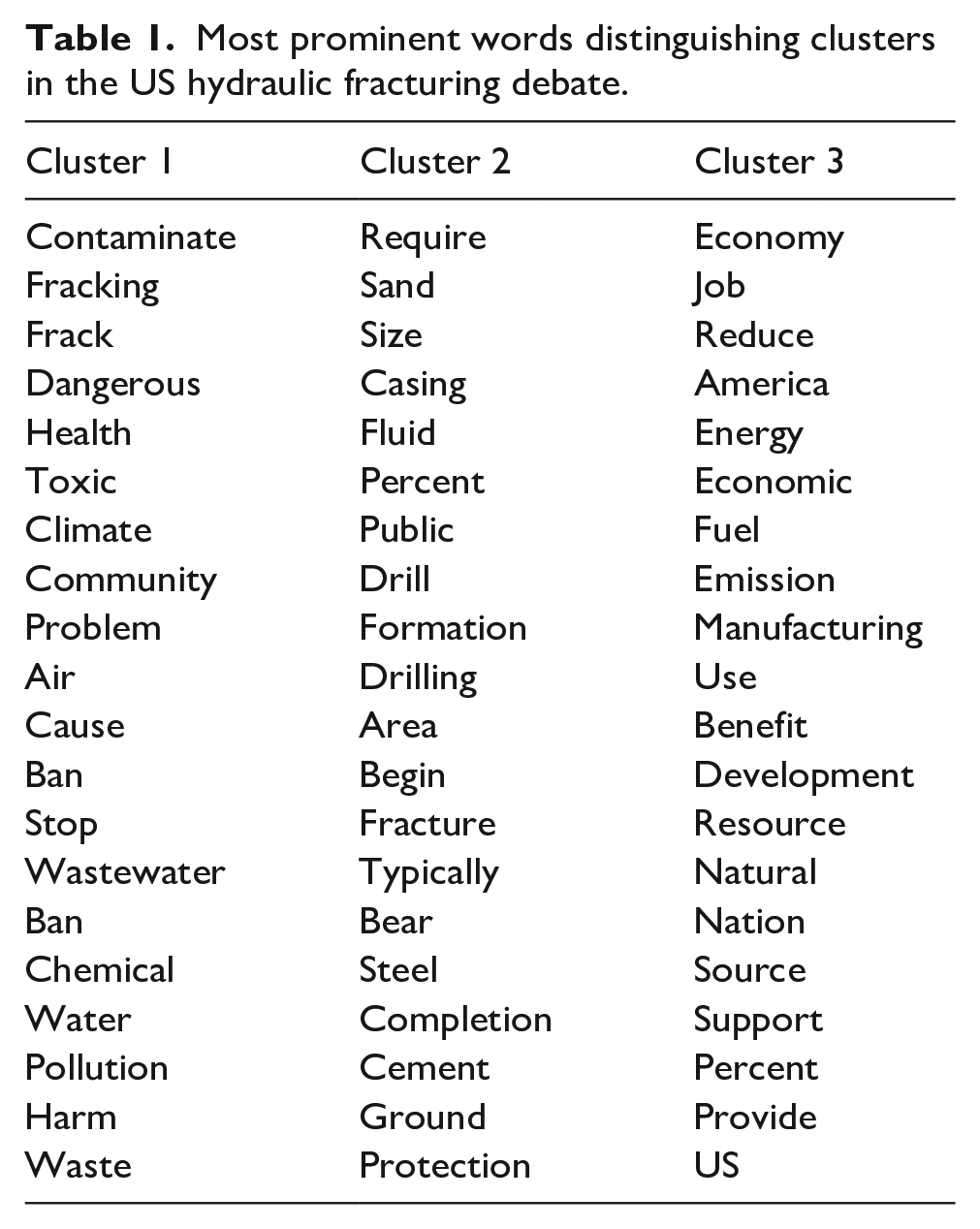
Cluster 1 contains words that refer mostly to the risks of hydraulic fracturing, or fracking, as the latter term is indeed highly prominent in the definition of this cluster. The words used by the interest groups show concerns regarding the technology: contaminate, dangerous, health, toxic, pollution, harm, and the list goes on. In light of this, it can be deduced that the interest groups relying on this cluster of words are invoking an environment frame. Cluster 2 comprises terms referring to the technology of hydraulic fracturing. These words are used to describe the process involved in exploiting gas: drilling, fluid, sand, fracture, ground, cement. This cluster of words can be interpreted as a technical frame used by interest groups to explain how hydraulic fracturing works from a scientific perspective. Cluster 3 is made up of words that revolve around the economic benefits of exploring shale gas in the United States. Indeed, specific interest groups highlight the economic consequences that hydraulic fracturing can have on American society. Terms like economy, job, benefit, and development are prominent in that cluster, which can be interpreted as an economic frame.
The environment and economic frames were expected to emerge in the discourse brought forward by different interest groups as it is the bone of contention of the issue. As explained earlier, camps are forming between interest groups who perceive shale gas as a modern-day gold rush, which includes clean energy, energy independence, and lower energy prices (Metze & Dodge, 2016), and others who frame the issue in terms of environmental risks, and a fight between David and Goliath (Bomberg, 2017).
The cluster analysis performed by KH Coder enables to find which documents contain similar words. In other words, for each cluster of words identified by the software, interest groups are automatically assigned to one of them. Table 2 shows the lists of interest groups for each cluster: 25 interest groups have been assigned to the environment frame, 17 to the technical frame, and 30 to the economic frame. All groups invoking an environment frame are grassroots groups (25). The 30 business groups identified previously are employing either the economic frame (19) or the technical frame (11). Interestingly, they do not have the monopoly of these frames since grassroots groups also invoke them, with 11 grassroots group using an economic frame, and six, a technical one.
List of interest groups classified by frames.
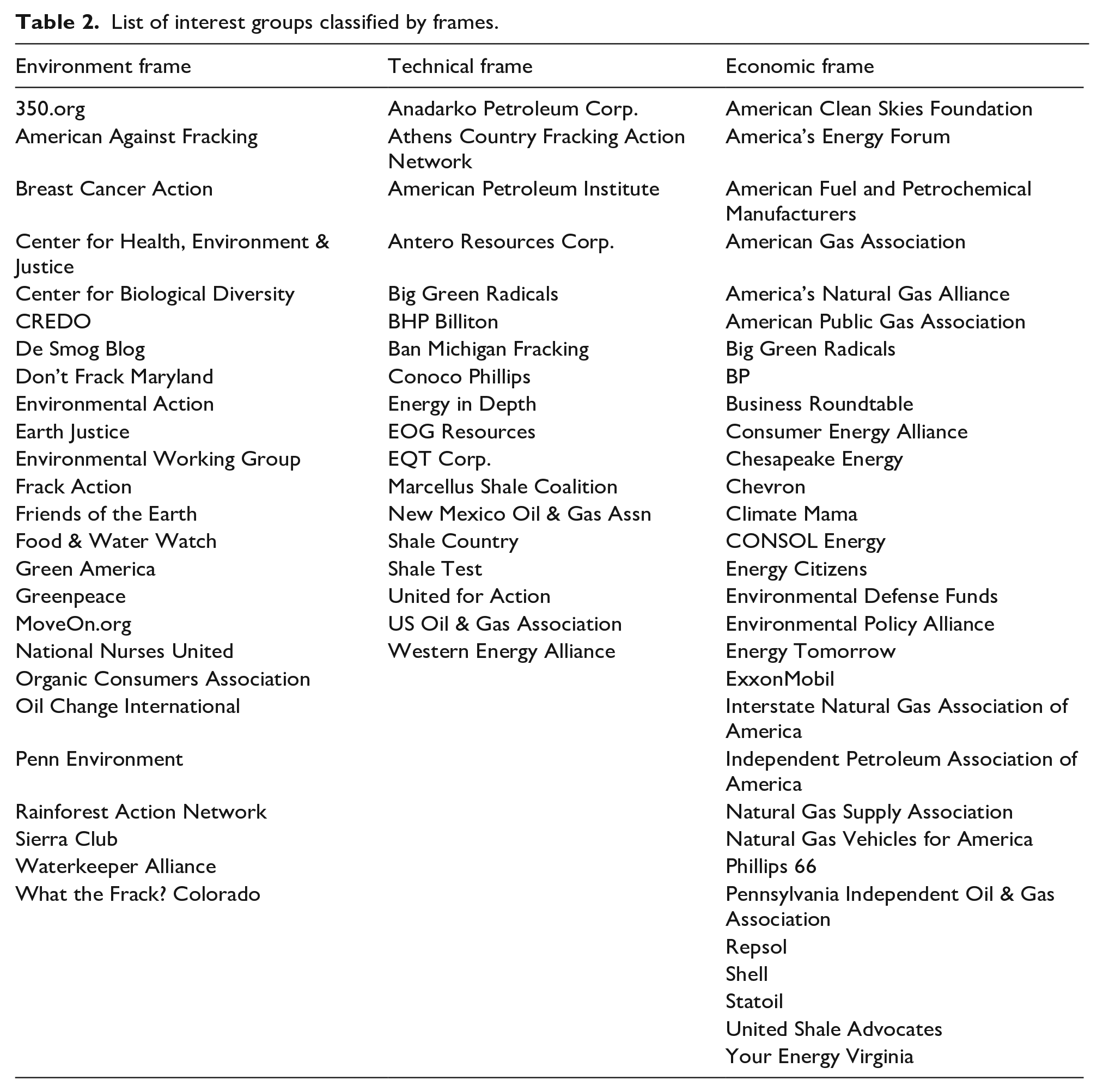
These results are interesting on different levels. First, as one could expect, the environmental arguments highlighting the risks of fracking are brought to light by grassroots organizations. This echoes Kollman’s (1998) observations on outside lobbying and grassroots mobilization. Spontaneous movements are set up to signal and expand conflict. In this case, the risks of fracking on public health are deemed concerning by citizen groups such as American Against Fracking or Greenpeace who call up for a ban on fracking.
The variety of interest groups using a technical frame can be understood from the data selection process of this study. Indeed, the documents were selected because they defined the issue of shale gas. However, hydraulic fracturing is a technical issue in essence. Therefore, an interest group, be it an NGO or a trade association, has to explain the technical process to communicate to their public. Moreover, the professionalization of interest representation has led non-profits organizations to develop their competencies on highly technical matters. The scientific debate of an issue is not the prerogative of the industry anymore. There is thus a certain logic to see grassroots and business groups framing the issue in terms of technical arguments.
The most surprising results come from the third cluster. Stressing the economic benefits of hydraulic fracturing in terms of jobs and growth is expected from business groups, as profits are their rationale. On the other hand, to see grassroots invoking economic reasons in the debate sounds paradoxical, or at least suspicious. This analysis seeks to see whether they could actually be backed up by the industry and act as astroturf groups.
Astroturf identification
Following the cluster analysis, a correspondence analysis is conducted to assess the dimensionality of the issue. Policy debates usually encompass different dimensions (Slapin & Proksch, 2014). In the case of the hydraulic fracturing debate in the United States, three main clusters of words have been identified and make up three frames: environmental, technical, and economic. Correspondence analysis is a multidimensional scaling technique permitting to represent spatially and visually the relationship between the frames on a two-dimension graph (Greenacre, 1984). To put it simply, KH Coder creates a matrix of words from the same text corpus as for the cluster analysis and provides a measure for each word depending on their frequency and their variance. Based on these data, KH Coder provides a two-axis graph presenting the most frequent words, excluding stop-words (Figure 1).
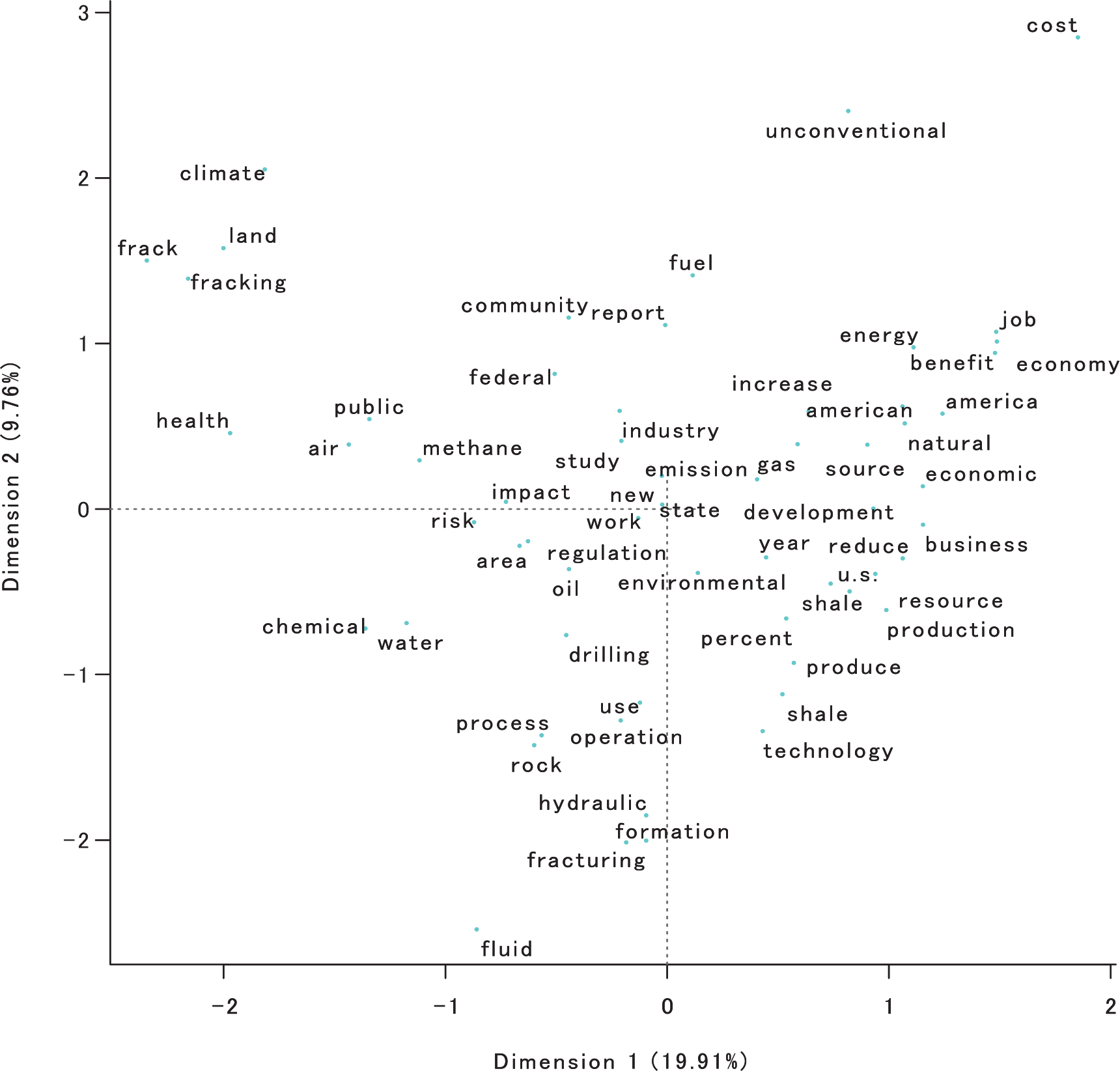
Correspondence analysis presenting the most frequent words in the US hydraulic fracturing debate.
In such a graph, words that tend to appear together in documents are placed near to each other, and the words that are rarely co-occurring are placed far away from each other. Also, the words that are close to the origin were not significant in defining clusters. It means that words like state, emissions, new, or, work were used by most interest groups, regardless of their type. On the other hand, words like cost, fracking, or fluid were highly significant in defining clusters.
The objective is now to use the information from the correspondence analysis to help in the detection of astroturf groups. The assumption is that astroturf groups, which by definition pretend to be grassroots groups, would use a different frame from genuine grassroots groups. This is explained by the logic of membership (Klüver & Mahoney, 2015; Schmitter & Streeck, 1999), which postulates that interest groups frame an issue in accordance with the members they represent. In the case of astroturf groups, the real interests they represent are private. Therefore, it is expected that astroturf groups invoke a framing close to the ones from business groups. It is in that sense that a correspondence analysis can help to identify potential astroturf groups.
A caveat that must be expressed at this stage is that the correspondence analysis does not allow to automatically identify a group as astroturf. In other words, the quantitative analysis provides results giving indications about where to look, but it is up to the researcher to conduct a subsequent analysis to say whether a group presents astroturf features or not. On this topic, it is important to define specific criteria before labeling a group as astroturf. In this study, the two criteria that are considered are the ones enunciated by Boulay (2015): the group pretends to emanate from a citizen’s initiative and the real identity of the sponsor is concealed.
Moreover, it is understood in this study that astroturfing must not be apprehended on a binary basis. Interest groups can also be described as hybrid, in the sense that they might present features from both grassroots and astroturf movements. It might start as a bogus campaign that attracts support from real citizens, or it might start as a genuine political communication campaign that is boosted by hiring actors for a demonstration for instance. The term astroturf is used in this study to describe the groups that are not entirely genuine grassroots.
The first step in the process is to identify the groups that are more likely to present astroturf features. For that purpose, a schematic representation of the correspondence analysis shows the interest groups according to their group types (Figure 2). The circles represent the groups presenting themselves as grassroots, and the diamonds represent the business groups.
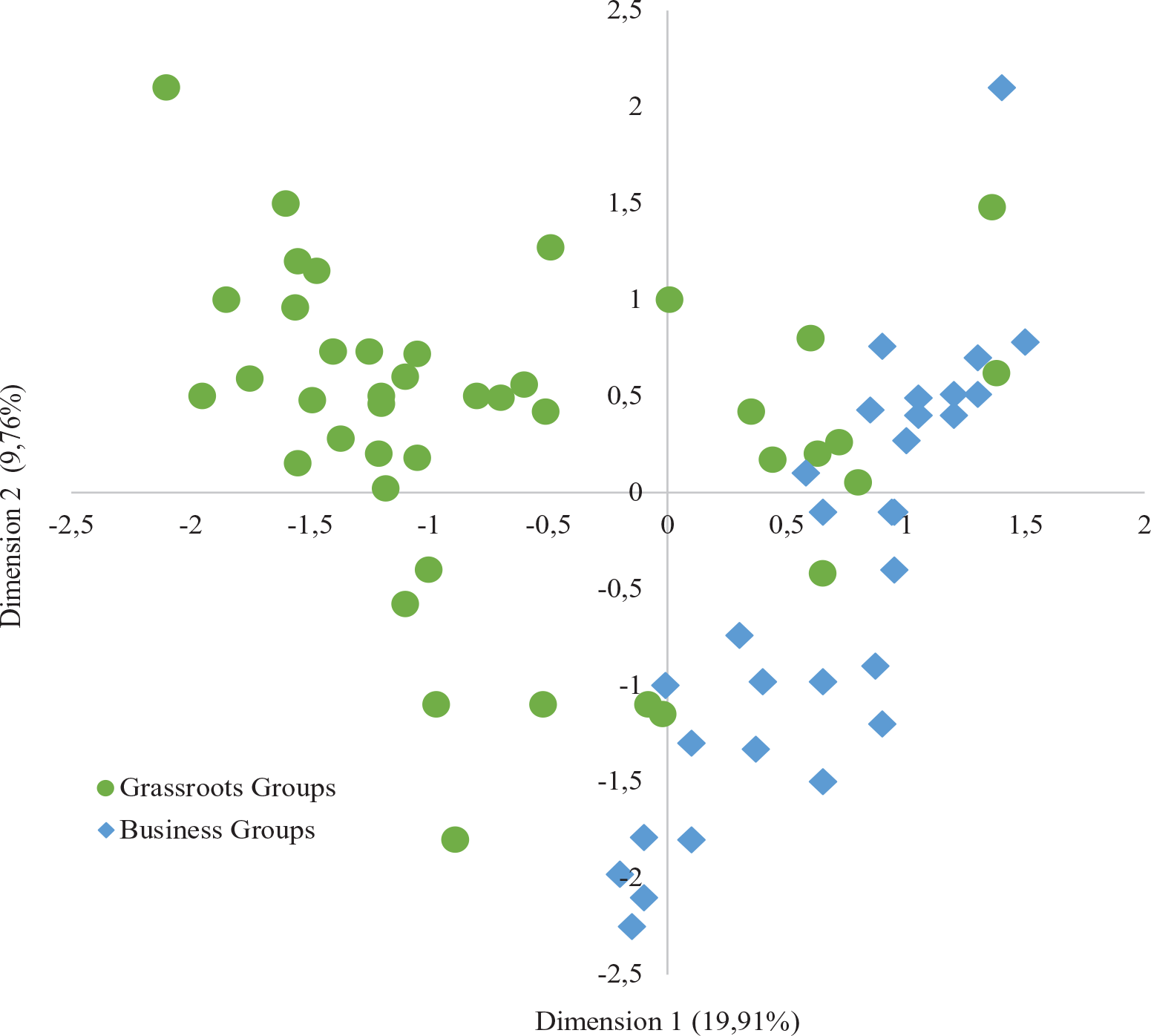
Mapping of the interest groups according to their type.
Based on that figure, different grassroots groups seem to frame the issue differently from the core on the left-hand side and their environmental frame. Ten grassroots groups are indeed positioned in the economic cluster and five in the technical cluster. It is thus these 15 groups that are investigated to see if they are astroturf or not. The investigation aims to confirm the two criteria that would qualify them as astroturf.
The process of confirming that these groups present themselves as emerging from a citizen initiative was already performed during the interest groups identification stage of this case study. Indeed, the website of each group has been scrutinized to categorize them between business or grassroots groups. The 15 grassroots groups that are outliers from the others thus fit the criterion of presenting themselves as such.
The method for confirming the second criterion involves an investigation from the researcher. The objective is to see if the group is actually financed by other interests than grassroots and if that sponsorship is hidden or concealed. For this purpose, the method that has proven more fruitful was to look at the financing sources of the groups. The process was helped by the previous work of investigative journalists and watchdog groups. As one can imagine, data on group funding is difficult to track down. For this purpose, a website such as https://www.opensecrets.org/ offers much data about money in US politics. Their work substantiated the investigation as they provided more evidence about certain groups for which conclusions were circumstantial at first.
The results from this investigation were outstanding as no less than 12 interest groups presenting themselves as grassroots movements were actually linked to private interests to a certain extent. Figure 3 shows the results on a graph, and it is apparent that all the grassroots who were on the right-hand side of the graph show astroturf features. Namely, the astroturf groups are American Clean Skies Foundation, America’s Energy Forum, Big Greens Radicals, Consumer Energy Alliance, Energy Citizens, Environmental Defense Fund, Energy in Depth, Environmental Policy Alliance, Energy Tomorrow, Shale Country, United Shale Advocates, and Your Energy Virginia. The position of these astroturf groups on the graph is therefore not coincidental, and it demonstrates an emphasis framing analysis can be helpful in detecting astroturf movements.
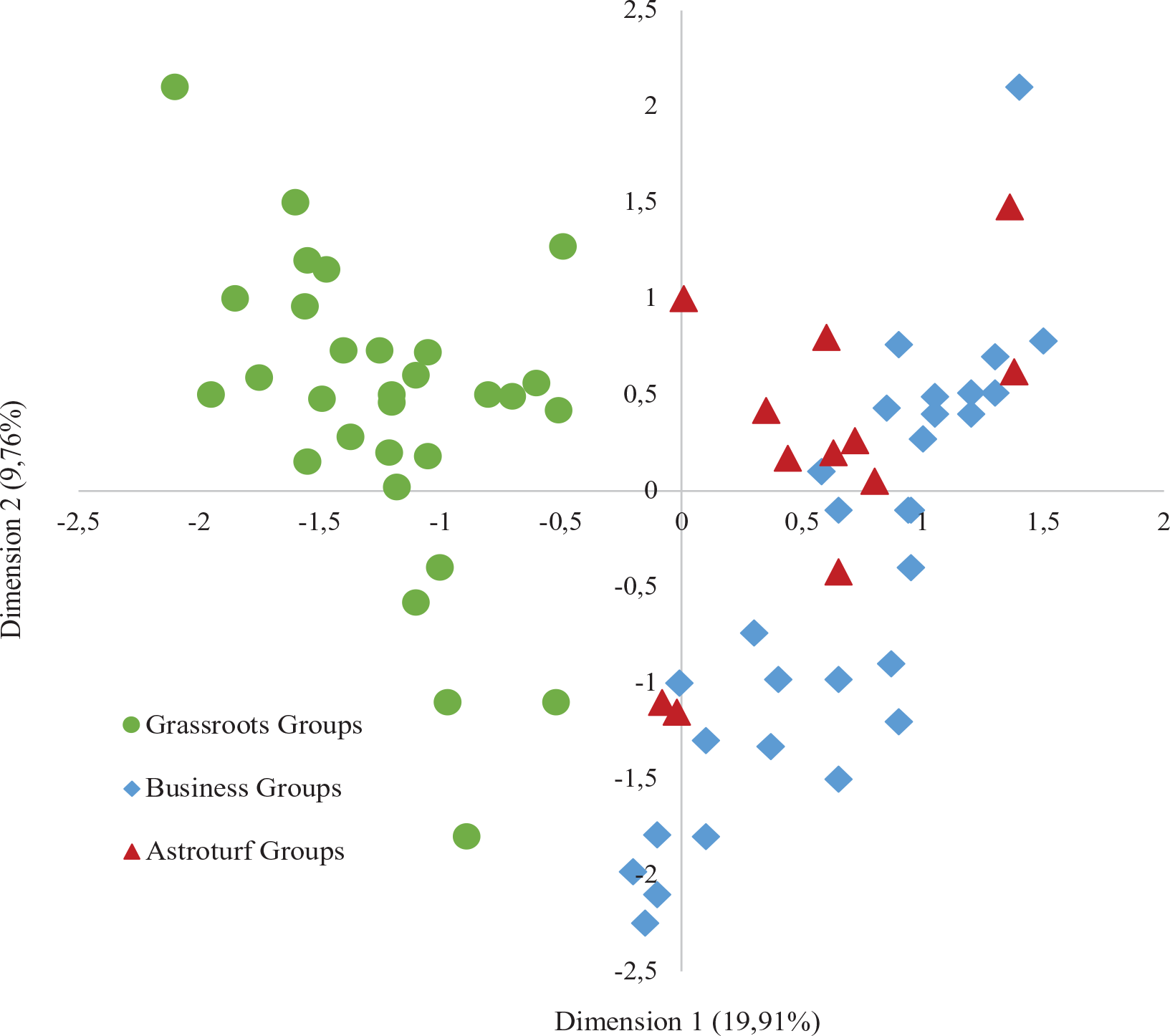
Astroturf groups in the US hydraulic fracturing debate.
Discussion
The objective of this article is to elaborate a method based on the framing theory to detect astroturf groups. The case study selected for this purpose was the issue of hydraulic fracturing in the United States. The reason behind this choice is that the literature tends to show that the US is the cradle of astroturfing and that environmental issues are deemed a breeding ground for astroturf efforts, thus improving the likelihood of encountering them. The outcome of the analysis confirms this assumption as among the 72 interest groups identified as active on the shale gas debate, 12 groups have been detected as astroturf. These results have implications on the understanding of the astroturfing phenomenon, and more globally from a theoretical and methodological perspective too.
The interpretation of the results produced with the framing analysis sheds light on the reasons why private interests set up astroturf groups in their lobbying strategies. The question of legitimacy and credibility is essential for an interest group to communicate and to persuade the public about their arguments. Genuine grassroots movements capitalize on this legitimacy as their network of volunteers defend public causes (i.e., the environment, human rights) by dedicating their own time and energy (Boulay, 2015). Private interests do not enjoy such credibility when communicating on a topic like hydraulic fracturing. Therefore, they create front groups that appear as NGOs to disseminate their messages. By so doing, these new voices are competing with the ones from genuine grassroots in the public sphere.
In this case study, the framing analysis shows the type of messages sent by the astroturf groups. On the one hand, groups like Energy Citizens, United Shale America, or Your Energy Virginia highlighted the economic benefits of exploring shale gas. The co-occurrence of words such as economy, creating jobs, growth, U.S., or benefits clearly shows an economic frame. Using astroturf to communicate this way can be perceived as a strategy by the industry to simulate a consensus about the benefits of hydraulic fracturing. They tried to make their coalition look bigger and more diverse, as to say that both the industry and environmental groups had agreed on that topic and shared a common position. On the other hand, groups like Energy in Depth and Shale Country aimed to downplay the risks assimilated with hydraulic fracturing by mobilizing a technical frame. Those groups represented another channel through which the industry could spread the studies corroborating their worldview and by so doing, trying to capture the scientific debate surrounding the issue.
The framing analysis is also telling about the nature of the competition between actors who are engaged in a discursive contestation. As explained earlier, framing is a strategic action to bring issues to the political agenda and to influence the public deliberation about a public policy (Pan & Kosicki, 2001). In this case, astroturfing is used as strategic framing by private interest in order to sponsor a specific frame or worldview, to make certain aspects of the issue more salient, and to contest opposing frames.
The results also have important methodological implications. Research on astroturfing is still at a nascent stage. One of the main obstacles lies in the collection of data. Interviewing astroturfers proves to be difficult, notwithstanding potential biases. This is why the method elaborated in this dissertation could prove helpful in collecting data on astroturf efforts on a larger scale. The results of the correspondence analysis were significant to raise a red flag on potential astroturf groups. However, one of the limits of this study is the generalization of the results, or the lack thereof. The hydraulic fracturing debate is considered as highly polarized, which could explain the results in terms of framing (Lits, 2019b). An emphasis framing analysis focusing on a less divisive issue could present results that are less significant. The replication of this model could therefore be interesting to further test the method of this article and to be able to generalize results across sectors and to build theories about the phenomenon.
Footnotes
Declaration of conflicting interests
The author(s) declared no potential conflicts of interest with respect to the research, authorship, and/or publication of this article.
