




Abstract
The concept of exposure diversity, the diversity of information that people actually access and use, has recently gained prominence in media policy debates. This aspect of media diversity, however, remains difficult to define, measure or implement in actual policy. In this article, we propose an empirical approach that operationalizes exposure diversity in terms of news and current affairs providers in the media repertoire of different social groups. This can be studied through cluster analysis of survey data on respondents’ combinations of use of different media providers and outlets. The article first discusses exposure diversity as a media policy aim. We then outline our proposal on how to take the debate a step further through empirical analysis of media repertoires, with an illustration of how such an analysis may be conducted using survey data from Norway.
Introduction
Policy and regulatory debates on media diversity have traditionally revolved around either structural diversity, which mostly refers to media ownership and the number of different outlets, or content diversity, understood as the range of content available to audiences. These dimensions are also associated with established regulatory practices and aims, operationalized in terms of market shares, number of outlets or the diversity of content types. In media environments characterized by abundant content and new distribution platforms, the dynamics between media producers, various intermediaries and users’ preferences are increasingly complex, which has uncovered the inadequacy of traditional approaches.
As a response, debates on media diversity have increasingly turned to the notion of exposure diversity, which refers to the diversity of information and viewpoints that people actually access and use, as opposed to all the content that is available in principle (Helberger, 2012; McQuail, 1992; Napoli, 1999). Approaching media diversity from the citizen’s perspective thus shifts attention to how different media are available for, and actually used by, different groups of people.
Discussions on exposure diversity have so far focused mostly on theoretical or conceptual discussions (Helberger, 2011a, 2018; Karppinen, 2013; Napoli, 1999, 2011) and the potential implications of specific providers or services, such as recommendation systems or social media, on users’ exposure (Helberger et al., 2018). Yet the concept of exposure diversity remains ambiguous and difficult to put in practice. First, it is difficult to agree normatively on what diverse exposure actually means and how that can be measured. Moreover, the shift to a user perspective challenges entrenched regulatory practices, and triggers fundamental issues with the limits of policy vis-a-vis individuals’ autonomy in the private sphere.
This article proposes an operationalization of exposure diversity as an actual policy measure. We employ the recent case of European and especially Norwegian policy debate to provide direction for such an operationalization. The approach we develop is founded on the normative ideal of deliberative democracy, focused on news and current affairs, and aimed at enabling citizens to make use of such content across media. On this basis, we operationalize exposure diversity as the degree of diversity of news and current affairs providers in the ‘media repertoire’ (Hasebrink and Popp, 2006) of different social groups.
We first provide a critical discussion of the merits and problems with exposure diversity as a concept. Second, we relate the case of Norway to other recent attempts to incorporate exposure diversity into actual media policy. Third, we outline our proposal on how to take the debate on exposure diversity a step further through operationalization based on the idea of media repertoires. Methodologically, we suggest that the assessment of exposure diversity can be pursued through cluster analysis of survey data on respondents’ combinations of use of different media providers and outlets. Finally, the article provides an illustration of how such an analysis can be performed, with a case of survey data from Norway.
The aim is neither to construct a ready-to-use analytical tool that can be universally applied to measure degrees of exposure diversity, nor to define what optimal media exposure would look like for any individual media user. Rather, we argue that the approach developed in this article can be valuable for media policy to help understand the preparedness of different audience groups to access different media sources, and how factors such as gender, age and education stratify media users. Furthermore, the analysis of media repertoires can be used to identify potentially vulnerable groups, with low levels of exposure diversity, which warrant policy attention and further research.
Exposure diversity and its problems
As a fundamental objective of media policy, it is commonly accepted that media diversity is a prerequisite for the effective use of freedom of speech and the functioning of democracy (e.g. Kenyon, 2016). The exact meaning of diversity as an analytical or normative concept, however, remains contested.
In academic debates, the concepts of diversity and pluralism are employed at a variety of levels, ranging from ownership structure to the framing of news items (e.g. Karppinen, 2013: 3, 2018; Napoli, 1999; Sjøvaag, 2016). As Loecherbach et al. (2020) note in their review of the media diversity literature, work in this area has often suffered from a lack of conceptual clarity and, in particular, a gap between theoretical and empirical research. Many studies also use the terms ‘pluralism’ and ‘diversity’ interchangeably, depending on the political context or academic discipline. For example, media pluralism is the umbrella term used in European Union (EU) media policies, while American media policy debates mostly refer to media diversity. Pluralism also tends to be used in political science and law, while diversity is used more in communication and computational sciences (Loecherbach et al., 2020). In order to avoid conflating the empirical measures of diversity with the broader political and ideological frameworks of pluralism, we adopt here a distinction where media diversity is understood as a more descriptive term that can be empirically operationalized, while pluralism as a more abstract notion refers to the normative recognition of diversity and multiplicity as desirable (Karppinen, 2018, also Raeijmaekers and Maeseele, 2015).
Several scholars have also attempted to break down the analytical dimensions through which diversity can be evaluated or empirically measured. In one frequently cited classification, Napoli (1999) makes the basic distinction between source, content and exposure diversity, with each having multiple subcomponents: source or structural diversity refers to the established media policy goal of promoting a diverse range of information sources or providers. Content diversity refers to the diversity of ideas, viewpoints or content options available either within a single outlet or across a media market. Finally, exposure diversity refers to the range of content that people actually consume.
Traditionally, the assumption has been that greater source diversity will lead to enhanced content diversity, which in turn will promote diversity of exposure as audiences have a greater range of options to choose from. According to Napoli (1999), the actual use was at the time in many ways a neglected dimension of diversity: the relationships between different dimensions of diversity were largely assumed, rather than based on empirical research, and the factors that affect the level of exposure diversity among audiences had received little attention from policy makers and policy analysts alike.
In audience studies, however, the distinction between the content that the audience actually selects as opposed to all the content that is available has a long history, as does the observation that diversity of supply does not automatically lead to diversity of reception (McQuail, 1992). The literature on ‘selective exposure’ to political communication is but one strand of research delving into this (e.g. Dahlgren, 2019). Since the rise of digital, on-demand distribution, this has become increasingly obvious also in media policy debates. Arguably, the crucial aspect of media diversity is not availability, but how people orient themselves, have access and make choices.
There is an emerging consensus among scholars that more focus needs to be placed on what information people actually consume, and the factors that influence these choices, rather than focusing on ownership structures or supply only (e.g. Helberger, 2012, 2018; Karppinen, 2013; Napoli, 2011; Sjøvaag, 2016). Concerns over the diversity of views people receive have also increasingly featured in public debates and politics. After the popularization of concepts like ‘filter bubbles’ (Pariser, 2011) and ‘echo chambers’ (e.g. Sunstein, 2007), we have witnessed an explosion of public and political interest in issues such as the structural power of digital platforms over attention, disinformation, the perceived decline of traditional public interest journalism and related concerns about narrowing exposure to different information sources. Issues related to exposure diversity are firmly on the agenda of broader public and political debates, as the proliferation of reports on the regulation of new media environment across the world attest (see, for example, Australian Competition & Consumer Commission (ACCC), 2019; Council of Europe, 2019; European Commission, 2018).
Despite the attention on exposure diversity, the impact of these debates in policymaking and regulation has been fairly limited. Compared with concerns over media ownership and issues of representation that have long interested policymakers like diversity of gender in workforces and content production, the question of how diverse media content reaches its audience has mostly been relegated to the margins of actual policymaking. Even when concerns over exposure diversity have reached the political agenda, they have often failed to acknowledge the existing academic research over the past decades. There are several conceptual problems that might help explain this.
The idea of exposure diversity as the diversity of information received is in itself easy enough to understand. Its distinction at an analytical level, however, does not yet give answers to more difficult questions about how exposure diversity could be empirically assessed, and how different information diets would be normatively assessed. What would be considered ‘optimal’ or even ‘diverse enough’, and what conditions and factors actually affect it?
A first problem, then, has to do with basic definitions. Concerns over exposure diversity involve an underlying emphasis on news and political viewpoints, but in principle, exposure diversity can refer to anything from cultural and linguistic diversity to the diversity of genres or media types. Even if we focus only on politics, the idea of political viewpoint diversity is difficult to define. Furthermore, different conceptions of the role of media in democracy lead to different criteria for assessing exposure diversity, and in turn different policy priorities (Helberger, 2019; Helberger et al., 2018; Karppinen, 2013): a liberal-individualist perspective might lead to a focus on free consumer choice, a deliberative democracy perspective emphasizes dialogue between viewpoints, and a radical democracy perspective would centre on the contestation of hegemonic truths and the availability of radical alternatives. Each of these perspectives would lead to different answers as to what exposure diversity is.
All this makes it difficult to even determine what the problem is: while some studies have affirmed the filter bubble hypothesis, others have reached the conclusions that, contrary to popular fears, the use of social media, aggregators and search engines may actually broaden exposure to different views (e.g. Borgesius et al., 2016; Boxell et al., 2017; Newman et al., 2017). Much of the discrepancy has to do with conflicting definitions of exposure diversity.
Second, the problems of operationalization might also help explain the lack of traction for exposure diversity in policymaking. The dynamics of the factors that influence what information people end up consuming are complex, involving interplay between human psychology, various algorithms, editorial choices, affordances of technological platforms, trends and fashions in media use, market structures, policy and regulatory choices, and sometimes intentional political manipulation. Understanding and conceptualizing these dynamics is clearly difficult.
A third problem has to do with the limits of public policy. Exposure diversity easily leads one to think of the famous scene in A Clockwork Orange where the protagonist Alex, with the aid of an inventive apparatus that keeps his eyelids open, is forced to watch violent film clips. In real life, debates on promoting exposure diversity have focused on slightly more innocuous mechanisms, typically ‘nudging’ users through ‘diversity sensitive design’ interfaces, such as electronic program guides, social media feeds, or news recommenders, improving their transparency, or utilizing existing institutions such as public service media to facilitate diverse exposure (Helberger, 2019; Helberger and Burri, 2015; Helberger et al., 2018; Van Den Bulck and Moe, 2017). Nevertheless, promoting exposure diversity might still be seen as unethical manipulation or intervention with media users’ autonomy or free choice. The idea of trying to influence media users’ choices even in a transparent and non-manipulative way does raise the need for further ethical reflections.
In connection with this, a final problem for exposure diversity in actual policy is the challenge to find potential policy solutions. Once sub-optimal practices have been identified, how to address them? Taken together, exposure diversity offers an intuitively important shift of perspective for media policy, but one that is hard to implement. This brings us to the level of actual media policy.
Exposure diversity in media policy
The idea of exposure diversity has increasingly emerged in media policy debates, at the European level as well as nationally.
The Media Pluralism Monitor (MPM), a tool funded by the European Commission and designed to identify potential risks to media pluralism in EU member states, notes in principle the dimension of exposure diversity. The study that introduced the indicators of the MPM, and its rationales, explicitly stated an aim to measure not only supply and structures, but also media use, including measurements of actual exposure as well as possible obstacles to exposure diversity (K. U. Leuven – ICRI, 2009). However, highlighting the practical difficulties of operationalizing exposure diversity, in the actual implementation of the tool, a simplified version was used, with little new data on threats that specifically relate to exposure diversity (Media Pluralism Monitor (MPM), 2016). More recently, a high-level expert group appointed by the European Commission to tackle online disinformation emphasized, among other measures, the need to empower citizens to receive diverse information and views from diverse sources both online and offline to fuel critical judgement and media literacy (European Commission, 2018).
The Council of Europe, which is not a regulatory body but, nevertheless, has a role in shaping and framing policy discourses in Europe, has repeatedly raised issues related to exposure diversity. A recent recommendation on media pluralism, for example, notes that:
States should encourage the development of open, independent, transparent and participatory initiatives by social media, media actors, civil society, academia and other relevant stakeholders that seek to improve effective exposure of users to the broadest possible diversity of media content. (Council of Europe, 2019)
British Ofcom has also noted the need to measure media consumption, arguing that an ideal plural outcome entails that ‘consumers actively multisource – such that the large majority of individuals consume a range of different news sources’ (Ofcom, 2012). In addition, several political actors across the world have raised the issues related to the gatekeeping power of new intermediaries, the transparency of their algorithms, and the threats related to fake news, filter bubbles and so forth (ACCC, 2019; Council of Europe, 2019; European Commission, 2018).
At the level of policy rhetoric, concerns over exposure diversity are thus increasingly prominent. However, the general acknowledgement of a problem that requires policy attention has proved hard to translate into actual regulations. In this regard, developments in Norway provide an interesting example.
The Norwegian media system is characterized by relatively well-functioning editorial freedom for the press, a popular and well-funded public service media organization (the NRK), egalitarian patterns of media use, high penetration of new media technologies such as smartphones and broadband in homes, and a history of active regulatory measures to subsidize journalism as well as content deemed important for national languages and culture (Hallin and Mancini, 2004; Syvertsen et al., 2014).
In 2015, a Commission on Media Diversity was announced and formally appointed by the government. 1 The Commission’s mandate took a formulation in the Constitution as its starting point: In the paragraph on freedom of expression, the last part requires the state to facilitate open and enlightenment public debate. While law scholars disagree on whether or not this should be regarded as ‘hard law’, the sentence is evoked routinely in policy debates and used explicitly in the formulations of the current government’s media policy.
The idea that an open and enlightened debate is needed, and that the state should take responsibility to secure it, is not unique to Norway. The European Court of Human Rights has interpreted the Article 10 of the European Convention on Human Rights to not only place restrictions on states, but to also create positive obligations for states to protect the conditions for freedom of expression. A number of other national jurisdictions also involve legal recognition for such as a principle of ‘positive free speech’ (Kenyon and Scott, 2020). In the Norwegian context, this idea explicitly stems from a model of deliberative democracy which posits discussion among citizens as a key component of democracy. Such discussion is well-served by media diversity, according to the legislative history of the paragraph on freedom of speech in Norway (NOU 1999: 27). It should, ideally, guarantee citizens access to the material they need to become informed, and at the same time promote channels or arenas for public debate. In this context, the Commission adopted the citizens’ perspective and promoted an understanding of media diversity in which exposure to diverse content – themes, perspectives and viewpoints – is key (NOU, 2017: 7).
This perspective is laid out in the report, building on the theoretical contributions discussed above. It is then followed up in the Committee’s recommendation for a new media policy aim: ‘To promote a shared, open, enlightened public debate, the state should enable all citizens to make use of a diversity of independent news and current affairs media’ (NOU, 2017: 7, 23). This formulation, and the attention given to exposure diversity, was adopted by the Norwegian Media Authority in a 2018 review of the contribution of licence-fee funded NRK to Norwegian media diversity. 2 However, the question left hanging is how to translate such general policy aims into actual regulatory practice.
An operationalization of exposure diversity through media repertoires
The case of Norwegian media policy provides direction for an operationalization of exposure diversity through (a) its founding in a normative idea of deliberative democracy (as opposed to, e.g. radical democracy) and (b) its explicit focus on news and current affairs (as opposed to a wider interest in, say, expressive cultural content). Moreover, the modest ambition of enabling citizens to make use of the content in question leads to (c) concentrate on providing access, facilitating the potential for use (as opposed to requiring demanding measures, e.g. time spent). Finally, it (d) signals a cross-media perspective (as opposed to a focus on, e.g. broadcasting only).
From the perspective of deliberative democracy, the point of media diversity is not only to provide choice for consumers, but also to promote exposure and dialogue between conflicting viewpoints. As such, the ideal would entail diversity in content, understood as not only form or content categories, but also perspectives or viewpoints. For an empirical study of exposure diversity, this first aspect means looking for combinations of content that are assumed, or confirmed through content analysis, to represent differences (Sjøvaag, 2016).
The second aspect concerns type of media content. While we know that mediated orientations to the political domain can be constituted by fictional genres and expressive culture more generally (e.g. Nærland, 2018), the delimitation to news and current affairs makes sense when we consider the aim of investigating exposure diversity empirically: knowledge about media use that could foster a citizenry capable of partaking in the rule of society.
The third aspect tackles the degree of intrusion into the private sphere of citizens implied by exposure diversity. Politically, the notion of media diversity at the user end is about facilitating, making realistically accessible. Rather than operating with a crude aim to gauge users’ actual consumption of specific news articles or television programmes, an operationalization of exposure diversity should conceive of news and current affairs as resources at hand for citizens, as part of their preparedness. This is in line with a normative idea of citizenship that highlights not the individual’s levels of ‘informedness’, but how a democratic system has been set up to allow for the sound use of experts (Holst and Molander, 2019), and an intellectual division of labour (Christiano, 2015), acknowledging that most citizens are not constantly monitoring the public sphere (Schudson, 1998), but should have resources at hand to engage when need be (Moe, 2020).
For an empirical analysis, this entails a focus on familiarity or regularity, but not necessarily overtly frequent use, of certain outlets which provide news and current affairs content. The question is not who watched a specific television news programme every day, or who read a specific news story in a concrete newspaper. Rather, we need to ask which groups of citizens report availability of broadcast radio or television channels with new and current affairs programming, newspaper reading offline or online, or uses of other media where the exposure to news and current affairs is a potential or a reserve to reach for.
Concerning the fourth aspect brought up in the Norwegian case, the basic insight that ‘audiences are inherently cross-media’ (Schrøder, 2011) has instigated a range of different approaches to empirical audience research over the past decade (Helles et al., 2015 for review). Hasebrink and colleagues developed the concept of ‘media repertoires’ to study ‘the entirety of media he or she regularly uses’ (Hasebrink and Domeyer, 2012: 758; Hasebrink and Popp, 2006; Taneja et al., 2012). The repertoire approach has brought new insights into how people compose their bouquet of media or genres, and how media use is integrated into everyday life (e.g. Kobbernagel and Schrøder, 2016). Metaphorically, ‘repertoire’ can also highlight an important nuance when discussing exposure diversity: it is more about the range of realistically available content than about what you constantly consume. Your repertoire is a potential or a resource. You can choose from your repertoire when need be, depending on the situation and setting.
Repertoire studies focus on individuals. For an operationalization of exposure diversity, which aims at mapping on a macro-level differences in how citizens make use of the diverse media content on offer, there is a need to move beyond an individualistic approach. Webster and Ksiazek’s (2012) study of the distribution of audiences between different outlets provides a cue here. Through a network analysis based on panel data, Webster and Ksiazek analyse the duplication of audiences for different providers, arguing against the widespread notion of fragmenting media use (also Hovden and Moe, 2017 and Ørmen, 2018 for more recent opposing arguments based on European empirical analysis). Conceptually, the idea is to include structural components of context of use, considering the supply side by describing the audiences of specific media providers, and at the same time grasp cross-media repertoires of users on an aggregate level (Fletcher and Nielsen, 2017a: 5). This resonates with the issues at stake in exposure diversity, yet the mere duplication versus fragmentation is less important than the identification and characterization of groups of users who share similar repertoires of news and current affairs providers within a specific media system. As Olsson et al. (2019: 40) argue, media repertoires can be ‘understood as outcomes of structural, positional and individual factors’. The structural factors include which media are actually available, and factors such as gender, age and degree of education, that position users in a social structure.
On this basis, we can operationalize exposure diversity as the degree of diversity of news and current affairs providers in the media repertoire of different groups of citizens.
The interesting issue is not to score people along an exposure diversity index to find the most ideal repertoire, or the optimal diversity. Rather, the operationalization we propose is helpful to identify those with low levels of exposure diversity – those with low degrees of diversity of news and current affairs providers in the media they routinely use or have at their disposal. This should resonate well with the aim of media policy in democratic societies, for which documentation of news junkies is less important than identifying potential risks; it should likewise help us better understand what characterizes those who are hard to reach and rarely exposed to news and current affairs.
The next step is to translate this operationalized definition into an approach for empirical analysis.
Measuring exposure diversity: Data, variables and methods
Data for the following analysis come from a nationally representative web panel 2017 survey of Norwegian citizens above 15 years of age (N = 2064). To build a statistical model of exposure diversity based on our operationalization, we selected five relevant groups of variables (coded as dummies):
Newspapers (read in the last 7 days): 13 Norwegian newspapers, 11 with national or major regional reach, and categories (one each) for local newspapers and foreign newspapers, no distinction between print or digital forms.
Additional news sites (‘read regularly’, online including apps): 8 news-oriented sites, including the two largest broadcasting channels’ websites (NRK, TV2), 3 dominant foreign news sites (CNN, BBC, The Guardian) and 4 news aggregators (including Google news).
Radio channels and podcasts (listened to in the last 7 days): 11 categories, including 9 Norwegian radio channels, and generic categories for listening to local or international channels.
Television, online video channels and streaming services (watched in the last 7 days): 25 categories, including most commonly used Norwegian and foreign television channels, and most common streaming services (e.g. Netflix, YouTube).
Other social media (used): Facebook, Instagram, Twitter and Snapchat.
These 61 variables were used as active variables in a multiple correspondence analysis (MCA 3 ). While there are some variations in the wording of the questions, we read all as indicators of regular use of a media brand. 4 A further 20 categories from the same group of variables were included as illustrative variables, together with additional indicators of media use (e.g. general characteristics of platform use) and social backgrounds (e.g. gender, age, education). The illustrative variables do not influence the factor or cluster models, but are used to provide a richer description of their media use and provide further characterization. Following the general logic of factor analysis, the MCA suggests three main axes of differences, explaining, respectively, 57%, 19% and 13% of the significant variance in the table – in sum 89.9% (Benzécri’s modified rates). 5
The first major difference in the data (the horizontal axis in Figure 1) is between users who – more than others – are characterized by their use of analogue media (above all, cable television) versus regular users of online services, in particular streaming services and social media. This divide generally follows generational and gender lines. The second difference (the vertical axis in Figure 1) separates those whose media use are more oriented towards the national mainstream television and radio channels (NRK1, TV2, NRK Radio P1) and local media (both newspaper and broadcasting), versus those oriented more towards national and foreign newspapers, foreign television channels and social media. This axis is related to age, but also to social position, geography and education. The third axis (not shown) appears as a variant of the two former axes, but emphasizing the divide between the use of news-related brands and the use of commercial television, tabloids and social media.
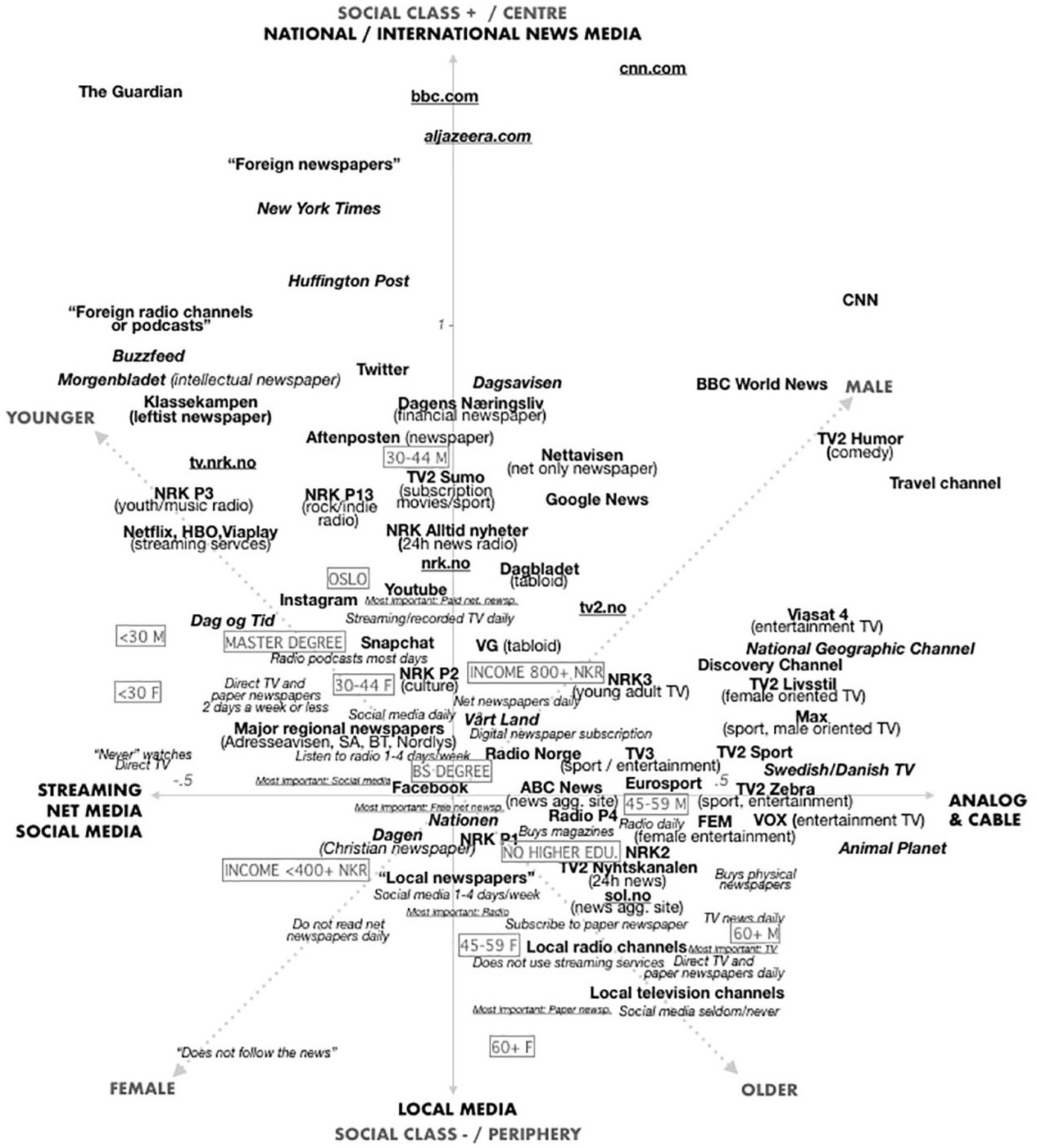
Exposure diversity in the Norwegian citizenry. MCA, axes 1–2.
While identifying important overarching differences between citizens’ exposure to different media brands, what we are interested in here is first and foremost how different groups in the population combine the use of various brands in specific ways. Rather than exploring brand use in predefined social categories (e.g. ‘educated men over 60’), we propose an inductive statistical approach, where groups are formed by those having similar regular use of brands (or not), whatever their other characteristics. For this analysis, we clustered citizens using hierarchical agglomerative clustering (Ward’s criterion) based on their positions on the first 10 axes of difference. 6 As a result, seven clusters of media users were identified. 7
Analysis: Seven clusters of media repertoires
The positions of the seven clusters are given in Figure 2. The size of the clusters indicates the spread in the geometrical space, not the size of the group (this information is given in Table 1). Large clusters indicate groups with relatively more varied use of media brands, and smaller distances and overlaps between clusters suggest groups which are more similar. Note, however, that the spread and relative placement of the groups might look slightly different when taking into consideration additional factors, so this interpretation should be restricted to the first 2 main dimensions shown in the map. Points in the figure show single respondents. As for the clusters, closeness suggests similar use of media brands among individuals.
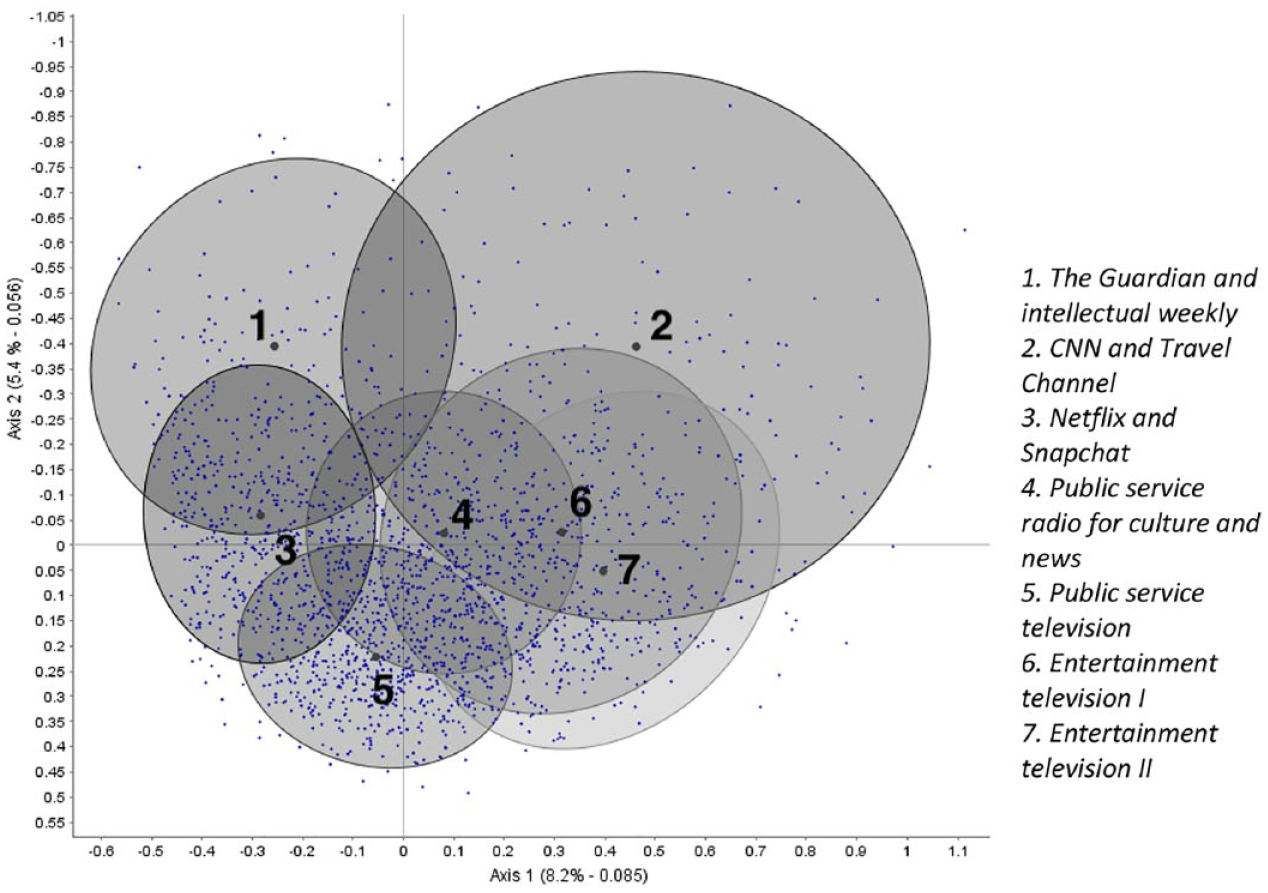
Exposure diversity in the Norwegian citizenry. Individuals and clusters following MCA/HCAP, axes 1–2.
Exposure diversity in the Norwegian citizenry. Cluster descriptions.
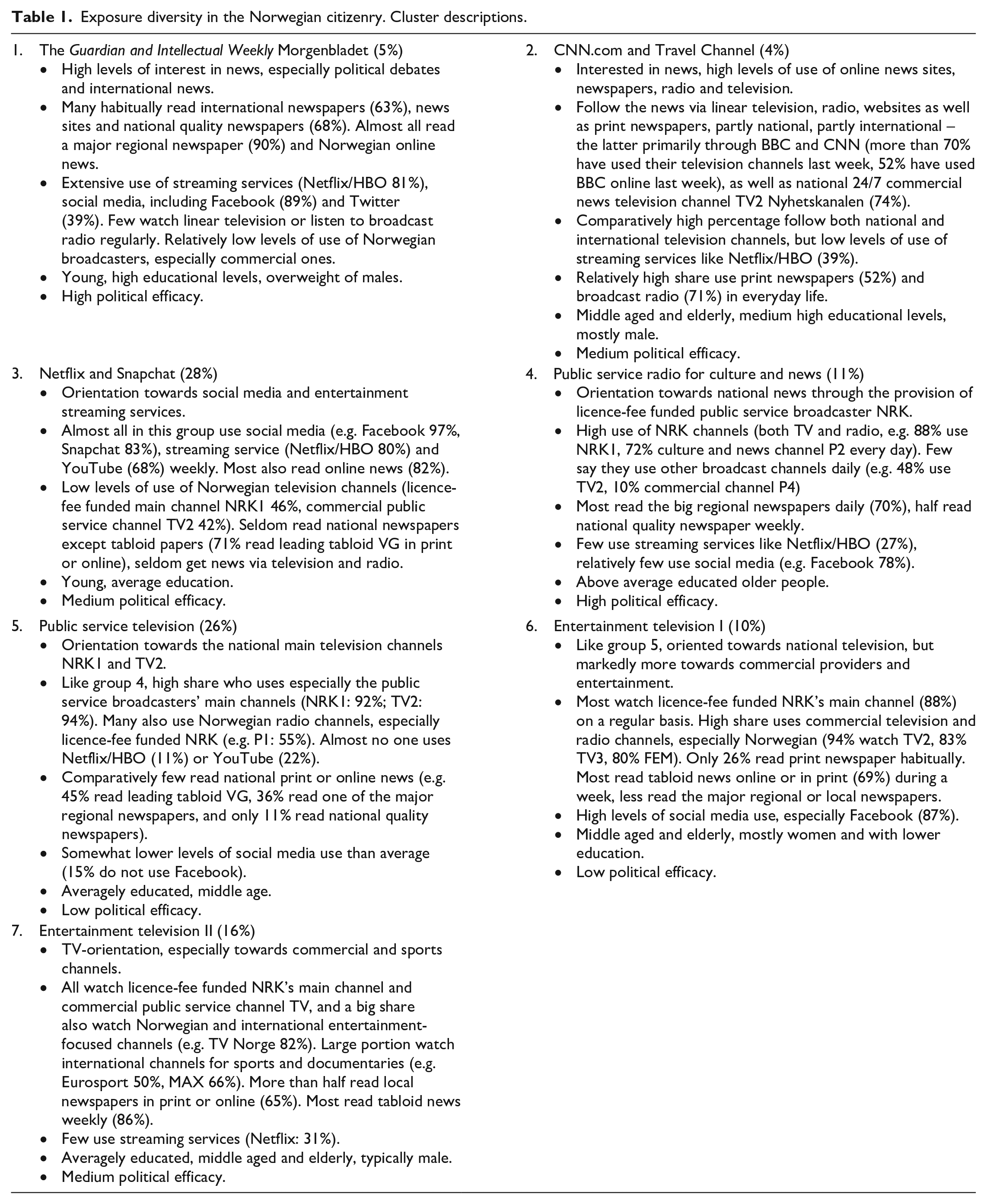
Based on the central characteristics of each cluster, we can label and describe them as groups in relation to each other, according to which brands are common and characteristic in the users’ media repertoires (Table 1). The most characteristic brands are used for naming the clusters. To add nuance and information, we also explore how these clusters differ in regard to other indicators for media use and in their social characteristics (Table 1 and online appendix).
Several of the seven clusters appear closely related, with a shared orientation through the same media platform (e.g. linear television) and content (e.g. news), but with providers differentiated between younger and older, or male and female, audiences. This is especially clear concerning television.
A case in point is Group 1 (Guardian.co.uk and Intellectual weekly Morgenbladet) compared to Group 2 (CNN.com and Travel Channel). Taken together, these two represent a small portion of respondents (less than 10%). They share a clear orientation towards international news and politics – which for the former is channelled through web sources, and for the latter through broadcast television. Both groups also read the major Norwegian newspapers and listen to radio. The groups also have a majority with high levels of education, and male members. What separates the two groups is age: Group 1 is fairly young (average 37 years old) compared with Group 2 (average 56 years old). The younger group also stands out with more use of national quality newspapers and streaming services, compared with local news and broadcast media for the older group. Such nuanced differences also surface when we look at the use of public service media: both groups use licence-fee funded NRK, but Group 2 relies more on the main radio and television channels.
We leave Group 3 aside for now, and observe that Group 4 (Public service radio for culture and news) is related to Groups 1 and 2 in being clearly news oriented, and with high educational levels among its members. A division, however, is Group 4’s weaker orientation towards international providers. In contrast, the members of this group focus their repertoire more on NRK’s offers (especially news and culture radio channel P2). They consume news and political debate content eagerly, but like Group 2, through broadcast television rather than streaming or websites. Although they are on average as old as Group 2, with a more even gender split.
Group 4 resembles Group 5 (Public service television) in its age profile and gender balance – as well as in the high levels of consumption of NRK’s television channels. But Group 5 is characterized by less use of radio (almost no one listens to the NRK’s cultural channel), and the members less often read regional or national quality newspapers. As a substitute, they use Norwegian commercial television channels (such as TV2 and TVNorge). The members also have lower education levels compared to Groups 2 and 4.
Two other groups with a lot in common are Group 6 (Entertainment television I) and 7 (Entertainment television II). Few are young in these groups (average age 45 and 53 years, respectively). The groups share an orientation through broadcast television, and combine NRK channels with commercial ones (domestic and international). The main difference between these two groups lies in the gender composition. Group 6 has a significant overrepresentation of women, and Group 7 of men. And both are evidently using media branded with a clear gendered profile – the names of two favoured entertainment television channels connotes such gender differences: FEM (‘a channel targeting women’ according to the owner) and MAX (‘the channel for you who like speed and excitement, action and reality!’ says the promotion).
The final group – number 3 (Netflix and Snapchat) – stands out from the rest. First, it is the youngest (33 years old on average), and the members’ media repertoires appear dominated by streaming services, especially entertainment-focused, social media, and for many also computer games. About half use NRK and TV2 on an everyday basis – but apart from these, few use television channels at all. Few listen to radio (one in four listens to NRK’s youth channel P3). As a group, it also appears low in newspaper reading. Two-thirds do read a tabloid once a week (mostly online), about half read a regional newspaper online or in print, and one in three read a local newspaper.
The analysis, then, shows nuanced differences in media repertoires between clusters of users. Concerning exposure diversity, the key interest lies in identifying robustness in news provision, a diverse repertoire of brands and providers who offer quality news across different media platforms. Groups 1, 2, 4 and 5 all come across with such robust and diverse menus of providers to potentially get news exposure from. Yet, their orientation is directed towards different issues, as seen in the distinctions between local, national and international focus. Also, what we know about the chances for incidental news exposure on different media (e.g. scheduled mixed content public service television vs websites) will also matter for differences in the groups’ specific news diets (e.g. Fletcher and Nielsen, 2017b).
Groups 1, 2, 4 and 5 all come across with robust and diverse menus of providers to potentially get news exposure from. Aside from group 5, they are also the groups which score the highest on indicators of political efficacy (see online appendix). Groups 3, 6 and 7 we find to have a less clear news profile in their repertories, focusing in different ways more on entertainment content. Yet, the importance of broadcast television for the repertoires of Groups 6 and 7, and specifically their high levels of use of public service broadcaster NRK’s main channel still provides them with a source for exposure to news. Here, Group 3 stands out. The group cannot be described as avoiding news, but their repertoire is clearly less oriented towards news and current affairs content. The individual components in their media repertoire show that they are best reached online, especially via social media and YouTube. Fewer news providers lead to a less diverse menu of news sources – many rely on free online news.
These findings can be interpreted against the Norwegian policy aim to ‘enable all citizens to make use of a diversity of independent news and current affairs media’ (our emphasis). A key takeaway is that the analysis of media repertoires can help us identify vulnerable groups that are currently in danger of being excluded from news and current affairs, or that in a situation when heightened attention is required, lack the readiness to connect to the public. The findings also suggest that potential policy solutions to promote exposure diversity may need to be considered in a more differentiated manner for particular groups. Traditional public service broadcasting policies or press support schemes, for example, may increase the perspectives available to those who already are exposed to a lot of news, but may not impact groups who do not have such established providers in their repertoires. Furthermore, exposure is not determined only by availability but also by broader structural, positional and individual factors that influence media use. To identify these factors and possible policy recommendations, we concur with the conclusions of Loecherbach et al. (2020) who argue that research into media diversity needs differentiated approaches focusing on different points in the information chain, and interdisciplinary collaboration involving a range of approaches including more qualitative approaches that can explain the findings in more detail and help build further normative interpretations.
Conclusion and outlook
The notion of exposure diversity remains a multifaceted media policy objective that cannot be reduced to any single empirical indicator. The approach proposed here that empirically operationalizes exposure diversity as the degree of diversity of news and current affairs providers in the media repertoire of different groups of citizens arguably brings discussions on exposure diversity forward, and closer to actual regulatory practice. But how can the insights into different clusters of media users and their repertoires be used in media policy?
The first challenge related to the policy relevance has to do with interpreting and evaluating the finding on different groups’ media repertoires. The findings reported above do not provide us with any obvious evidence of causal mechanisms that underlie different clusters’ media repertoires, or their implications for these groups’ engagement in public debates or other forms of democratic participation. Although we may hold assumptions about different media types’ (e.g. newspapers, public service media, or social media) potential to promote informed citizenship, we cannot automatically assume that failure to use particular media types, such as national newspapers, will lead to a lack of preparedness to monitor public affairs.
As noted above, the idea here is not to evaluate the value of specific media for their contribution to exposure diversity for any individual media user. The analysis can, however, provide a reasonable basis for identifying some groups of citizens with relatively lower levels of preparedness, or resources available for engaging with a diverse range of current affairs and news. The criteria used to identify such groups, however, are subject to discussion and depends, for example, on different conceptions of democracy and the public sphere. Based on our operationalization, we cannot conclude that these groups are disconnected from news or political communication, but they report overall fewer resources at hand for getting involved in current affairs. As such, they seem to have lower levels of readiness to engage with politics, whether it is getting informed during an election campaign, taking a stand after a controversial event, or forming an opinion on major, slow-moving political issues. As such, the analysis provides more information not just on media habits but on the demographic factors of the preparedness of such groups of citizens.
Second, the finding raises the question of how differences between social groups’ readiness to engage with diverse news sources can be addressed with media policy tools. Although we have not proposed any specific policy measures here, we argue that the information on media repertoires can provide stronger evidentiary basis for both discussing the impact of existing media policies and for imagining new policy approaches to promote exposure diversity. Furthermore, the analysis of exposure diversity in terms of media repertoires opens up opportunities for future research, involving comparisons across countries and over time, and in combination with other approaches. Such research can provide further insights into how structural characteristics of media systems or changes over time may influence media repertoires of different groups, and thus reveal more dimensions and substance to the widely shared but often unspecified concerns in current policy discourse about people’s narrowing exposure to news sources.
Supplemental Material
Table_appendix_revised – Supplemental material for Operationalizing exposure diversity
Supplemental material, Table_appendix_revised for Operationalizing exposure diversity by Hallvard Moe, Jan Fredrik Hovden and Kari Karppinen in European Journal of Communication
Footnotes
Funding
The author(s) disclosed receipt of the following financial support for the research, authorship, and/or publication of this article: J.F.H and H.M received financial support from the Research Council of Norway, grant no. 247617 and The Norwegian Media Authority.

Supplemental material
Supplemental material for this article is available online.
Notes
References
Supplementary Material
Please find the following supplemental material available below.
For Open Access articles published under a Creative Commons License, all supplemental material carries the same license as the article it is associated with.
For non-Open Access articles published, all supplemental material carries a non-exclusive license, and permission requests for re-use of supplemental material or any part of supplemental material shall be sent directly to the copyright owner as specified in the copyright notice associated with the article.
