




Abstract
This article focuses on equality, diversity and inclusion in the Irish media industry and how it can be improved. The need to develop these policies, tools and measures has become pertinent, considering that the Irish media workforce currently lacks diversity. The aims of this article are twofold: (i) examine the tools and measures from the international media industry that have been developed to improve equality, diversity and inclusion and (ii) interrogate how these tools and measures could work within the Irish context. Through sampling tools and measures developed in varying media industries in English language territories, this research used this analysis as the basis of semi-structured interviews with independent production companies and broadcasters in Ireland, to gauge how the media industry can develop equality, diversity and inclusion initiatives. This article identifies four central areas that would encourage further diversity in the Irish media sector: data gathering and monitoring, developing diversity standards, objective setting and incentivization and diverse recruitment for the industry.
Keywords
Introduction
As Irish society becomes increasingly diverse in its composition it is crucial that all political, economic and cultural institutions reflect the gender, class, sexual, racial and ethnic identities of its people, as well as their diverse abilities and creative capacities. For media industries in particular it is clear that diversity on screen is only created in an authentic and sustainable manner when there is diversity behind the scenes. Policy, tools and measures have been developed internationally, and to a lesser extent nationally in Ireland, for improving diversity and inclusion. The need to develop these EDI initiatives has become pertinent. From a state developmental perspective, diversity is perhaps the single most important determinant of success for the Irish screen production sector in future markets nationally and internationally. If Irish media content is to thrive in a domestic market, and if it is to prove viable as an export commodity for an international market, then it needs more diversity at its core in its workforce.
The need to develop policy, tools and measures has become crucial as Irish society has become more diverse. As of the 2016 National Census, the fastest growing ethnic group was those who did not identify as “white Irish.” While “white Irish” remains the largest group composing 82% of the population, the categories of “any other white background” (9.5%), “non-Chinese Asian” (1.7%) and “other including a mixed background” (1.5%) continues to grow. Irish travellers make up 0.7% of the population while the Chinese population stands at 0.4% (CSO, 2016). The same census indicates that 13.5% of the Irish population are disabled. These figures are expected to change in 2022 when the results of a more recent national census are released. In comparison to its European counterparts, Ireland has been touted by the Economic and Social Research Institute (ESRI) as one of the most diverse countries in the European Union, with an approximate 17% of the resident population born in another country (McGinnity et al., 2018). The increased diversity in Irish society has been connected to membership in the European Union which enables free travel (Fanning, 2018), along with the economic boom of the Celtic Tiger (Maher and O’Brien, 2014) and the rise of what has been referred to as Ireland’s tech boom and the development of the silicon docks, where Dublin's decaying docklands were transformed into a hub for tech companies wanting to expand in Europe, which has inadvertently attracted a diverse workforce globally. In terms of media industry statistics breakdowns, data on diversity in relation to gender, race, ethnicities, class, or disabilities in the Irish media workforce does not currently exist and are scant at best. This lack of data has been noted as a point of concern for developing sustainable diversity in media industries (Kerrigan, 2021; O’Brien, 2019a; O’Brien and Kerrigan, 2020a, 2020b; Liddy, 2020a, 2020b).
To that end, despite the lack of data, it has been noted by scholars and the industry more broadly that the Irish media workforce currently lacks diversity. Women still struggle to advance their careers in media industries in Ireland and globally. In 2011 the Global Report on the Status of Women in the News media, a 59-nation study, which included 13 EU Member States, using aggregated data from 522 companies, showed gender segregation by role. Men held three quarters of positions in top management and three quarters of all technical roles (Byerly, 2011). In 2021, the Reuters Institute analysed the gender breakdown of top editors in a strategic sample of 240 major online and offline news outlets in 12 different markets across four continents (Robertson et al., 2021:1). Only 22% of the 180 top editors across the 240 brands covered were women, even though on average, 40% of journalists in the 12 markets were female, “despite a greater focus on diversity, we find no significant evidence of change” (Robertson et al., 2021:5). While there is some research in Ireland pertaining to the inclusion of women (O’Brien, 2018, 2019b) and the LGBTQ community in the media (Kerrigan, 2019, 2021; Kerrigan & O’Brien, 2018, 2020), there is little research relating to people of colour, travellers and disabled people.
To interrogate how this diversity could be incubated within the Irish media industry, this article has fostered a two-pronged approach. Firstly, it will examine the tools and measures developed internationally within the media industry in English language territories and secondly, it will interrogate how these tools and measures could work within the Irish context. The article has engaged with various actors and stakeholders to “take the temperature” of the Irish media industry and where it is currently positioned in terms of embracing diversity and inclusion. It has extrapolated data to identify, within this context, what might work to generate and create significant change for diversity and inclusion and has identified four key areas where change can be generated: data monitoring and gathering, diversity standards, objective setting and incentivization and diverse recruitment for industry. The article focuses primarily on the film and television sector. The animation industry is not included in this sample due to it being somewhat separate to the mechanisms of film and television in Ireland. While the Irish case follows the contours of many of the policies developed internationally, there are specific permutations to these that would need to accommodate the contingent factors of the Irish media industry.
Literature review
Research pertaining to tools and measures in the media industry has emerged recently, with this often being centred around varying inequalities such as race, gender, class and sexual identity (Gray 2016; Nwonka, 2020a; O’Brien et al., 2016). Some research has noted the ways in which policy initiatives have been conceived as a mode of addressing these issues of inequality within the film industry (Nwonka, 2020a; Nwonka and Malik, 2018). The development of diversity policy has also seen some research, with a particular focus on moving on from the numerical inclusion of under-represented groups (O'Brien et al., 2017, 2021). The tools and measures that have been developed within the industry more broadly have also been an object of research, with Nwonka (2020b) focusing on the role of data in improving diversity and inclusion and how senior white men within the industry have the power on who can enter. Additionally, Nwonka criticizes the structure of data collection, its rigid identity categories and the absence of intersectional data, which often can result in further exclusions from the media industry for BAME women. While some research on tools and measures pertaining to EDI has emerged in the literature, the research has tended to focus on data gathering and broader cultural policy development. There have been some exceptions to this, which include the recently released UK Creative Majority report (Wreyford et al., 2021), which was designed around developing action for change in relation to diversity and inclusion in the media industry. The report calls for leadership and collective responsibility to support immediate and long-lasting change, recommending five benchmarks to help achieve this: ambition for EDI, developing allyship to ensure all voices are heard, focusing on accessibility to ensure fair and equitable participation in media, grounding adaptable tools for varying contexts and certifying accountability, to ensure that actions are incorporated and maintained for short-term and long-term success.
Outside of this focus on tools and measures, research has tended to focus on matters relating to under-representation. In the US context, annual studies continue to highlight significant and consistent underrepresentation for women and people of colour, these include Lauzen, the Annenberg Inclusion Initiative and the Geena Davis Institute. A recent study by Smith et al. (2021), commissioned by Netflix, examines on-screen inclusion of gender, race/ ethnicity, sexuality and disability as well as gender, race and ethnicity behind the camera. The study focuses on Netflix scripted-series and original films from 2018 to 2019. The overall findings suggest that more underrepresented groups have a voice on Netflix than in Hollywood, with the caveat that many groups still struggle for inclusion. For instance, ‘LGBTQ and disability communities are rarely seen or heard in storytelling’ (Smith et al., 2021: 29). Smith makes the link, already established for gender (Lauzen 2020), that the involvement of underrepresented groups behind the camera ‘telling stories’ has far reaching ramifications for content. The study found that there are ‘exponentially more’ leads, co-leads and main cast from marginalized communities when a person behind the camera is from a historically marginalized community (Smith et al., 2021). Smith states ‘that access is helping make people make decisions differently’ (Smith, cited in Ramos, 2021). Smith's tentatively optimistic findings chime with the 2020 Diversity Report by Hunt and Ramón. Hunt summarizes its results: ‘As of 2019, both women and minorities are within striking distance of proportionate representation when it comes to lead roles and total cast’ (cited in Wolf, 2020). However, Hunt echoes Smith's emphasis on the importance of behind the camera representation for onscreen diversity, which ‘begs the question: Are we actually seeing systematic change, or is Hollywood just appealing to diverse audiences through casting, but without fundamentally altering the way studios do business behind the camera?’ (cited in Wolf, 2020).
The collaboration between Smith at USC's Annenberg Inclusion Initiative and Netflix was a transparent and productive engagement and points to the potential value of industry/academic research partnerships. Smith explains ‘it was instigated by Netflix and demonstrates a commitment to self-reflection and a desire for transparency. These are critical steps to take on a journey toward inclusion’ (Smith et al. 2021: 31). Importantly, Netflix co-CEO, Ted Sarandos has committed to working towards closing existing representational gaps, and monitoring progress and ‘will release a report every two years, from now through 2026’ (Netflix, 2021). However, a key issue that the research with industry also highlights is that transformational interventions can prove controversial within industry as policy interventions require ‘uneasy coalitions of stakeholders and the forging of alliances to implement and run’ such initiatives (Newsinger and Eikhof, 2020: 57). Indeed, a key focus of this research is to ask to what extent transformative policies are welcomed or merely tolerated by industry and to what extent they can actually be implemented within the Irish screen production sector?
As Jeremy Ahearn has argued, cultural policy ‘can figure successively as a peripheral and as a central component of governmental strategy, as superficial and as fundamental, as decorative or substantial’ (2009: 2). In defining the parameters of what policy was to be included in this study, Ahearn's distinction between two broad categories of cultural policy, explicit or nominal cultural policy, and implicit or effective cultural policy, is instructive (2009: 143). Ahearne differentiates between policies that are explicitly directed towards culture and those that have an effect upon on culture, without being labelled as specifically ‘cultural’. This point has been developed by Newsinger and Eikhof (2020: 48) who note that, implicitly, labour market policy, education policy, NGO and company policies can all impact on diversity, even while not claiming to do so. However, it is beyond the scope of this research to adopt such a broad approach to policy and this review is limited only to policy that explicitly claims to address equality and diversity in media industries directly. Explicit interventions to increase workforce diversity can be divided into two further categories, empowering interventions that enhance the individual's capacity to participate and transforming interventions aimed at changing exclusionary practices and processes (Newsinger & Eikhof, 2020:56) There is some evidence that empowering interventions such as training schemes and mentorship programmes can provide ‘limited numbers of women, BAME people and disabled people with entry routes to the industry’ (CAMEo, 2018:9). Such interventions are undoubtedly worthwhile but do not address ‘systemic challenges to workforce diversity in the screen sector’ and therefore need to be supplemented by more ‘systemic initiatives’ (CAMEo, 2018: 46). Interventions in the second category seek to ‘transform sectoral practices, to remove barriers to equal participation and often operate at a policy level within individual organisations’ (such as reshaping recruitment processes or delivering unconscious bias training for decision-makers) as well as at industry levels (e.g., linking funding awards to practices that facilitate equal opportunity) (Newsinger and Eikhof 2020: 56).
Since 2015 a number of explicit policy changes have occurred across both gender equality and diversity agendas, within Screen Ireland, the Broadcasting Authority of Ireland and in RTÉ. Within a five-year period, Screen Ireland (formally the Irish Film Board (IFB)) issued a six-point plan, an enhanced production funding scheme and a POV production and training scheme as well as establishing a Diversity and Equality Subcommittee. Similarly, the BAI launched a Gender Action Plan in 2018 and added gender as a focus to its Sound and Vision round in 2019. RTÉ's 2018-22 Strategy was followed by a Diversity and Inclusion Charter in 2018. While the Irish policy approaches to gender equality, diversity and inclusion can be described in detail, there is as yet no clear analysis available as to how the measures have been received or applied on the ground within the film and television industries. It is to this gap in knowledge that this research project is addressed.
While the literature demonstrates research pertaining to representation and broader EDI issues in media industries, much of the research does not focus on tools to support action for change around EDI, particularly in terms of developing good and effective practices in recruiting, along with developing and ensuring sustainable diversity in the media industries. To begin to support and develop diversity in the Irish media industry, research must begin to focus on solution-centric measures that can be incorporated within national media industries.
Methodology
This research fostered a qualitative case study approach focusing on the Irish film and television industry. The film and television industry was selected as the object of this study due to the fact that this is where potential change can be developed from the ground up in improving diversity and inclusion. To gauge how the industry could develop this change, the research looked towards practice in other territories, given the lack of policy development within the Irish context. In doing so, the research examined policy documents relating tools and measures for diversity from the international media industry to identify actions, initiatives and interventions that exist in this area. Our interpretation of tools and measures in this context refers to resources and initiatives that have been developed with the aim of improving diversity and inclusion on and off screen in the television and film sector internationally. The search strategy for these tools and measures encompassed a number of different approaches, in order to maximize coverage and depth. Firstly, these were obtained through accessing a number of portal sites, which include aggregate listings of external resources. Secondly, through carrying out several web searches, to ensure that all relevant sources were located. Terms in these searched included ‘diversity’, ‘inclusion’ combined with ‘media’ and ‘film and television’ to narrow focus. Thirdly, through exploring the websites of broadcaster and film organizations, the approach yielded additional sources. A thematic analysis was performed on the documents to their contents. Thematic analysis looks for patterns in datasets and using this method of analysis enabled us to identify key themes and trends in these international tools and measures from English language territories (Braun and Clarke, 2006).
This analysis formed the basis of an interview schedule, with these tool and measures serving as potential lessons learned from the international context but also as a means of identifying how change might be encouraged in the Irish media industry. Semi-structured interviews were conducted with central figures and personnel across Irish broadcasters, independent production companies, professional organizations and individual activists regarding attitudes and approaches towards equality and diversity. From this, open-ended questions were included on the interview schedule that addressed tools and measures for EDI issues in the media industry. All interviews were recorded and transcribed. The data was coded with categories derivative of the literature and the analysis of the tools and measures. These codes were then analysed to generate themes and findings.
Each participating broadcaster, production company, professional organization and training provider was treated as an individual case and respondents were sampled from within each case. Only activist organizations directly concerned with media diversity were approached. Respondents’ positions in key roles concerned with implementing equality and diversity policy within their company or organization dictated their inclusion in the sample. For that reason Managing Directors, Senior Executives, Diversity Managers, Heads of Departments or their Deputies and Commissioning Editors across the sector were approached for interview. A small number of candidates in senior roles in broadcasting and in executive roles in large production companies did not respond to requests for interviews
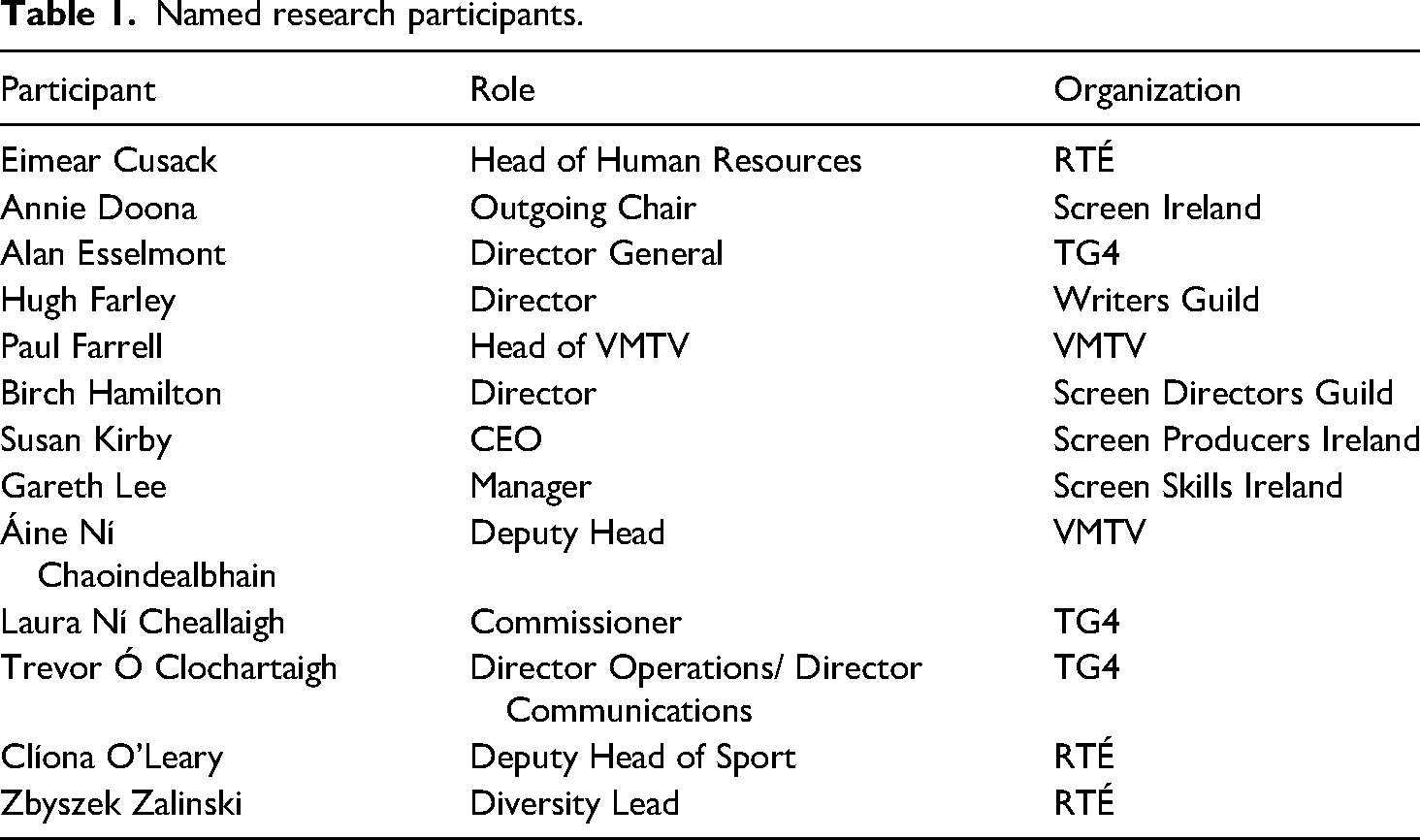
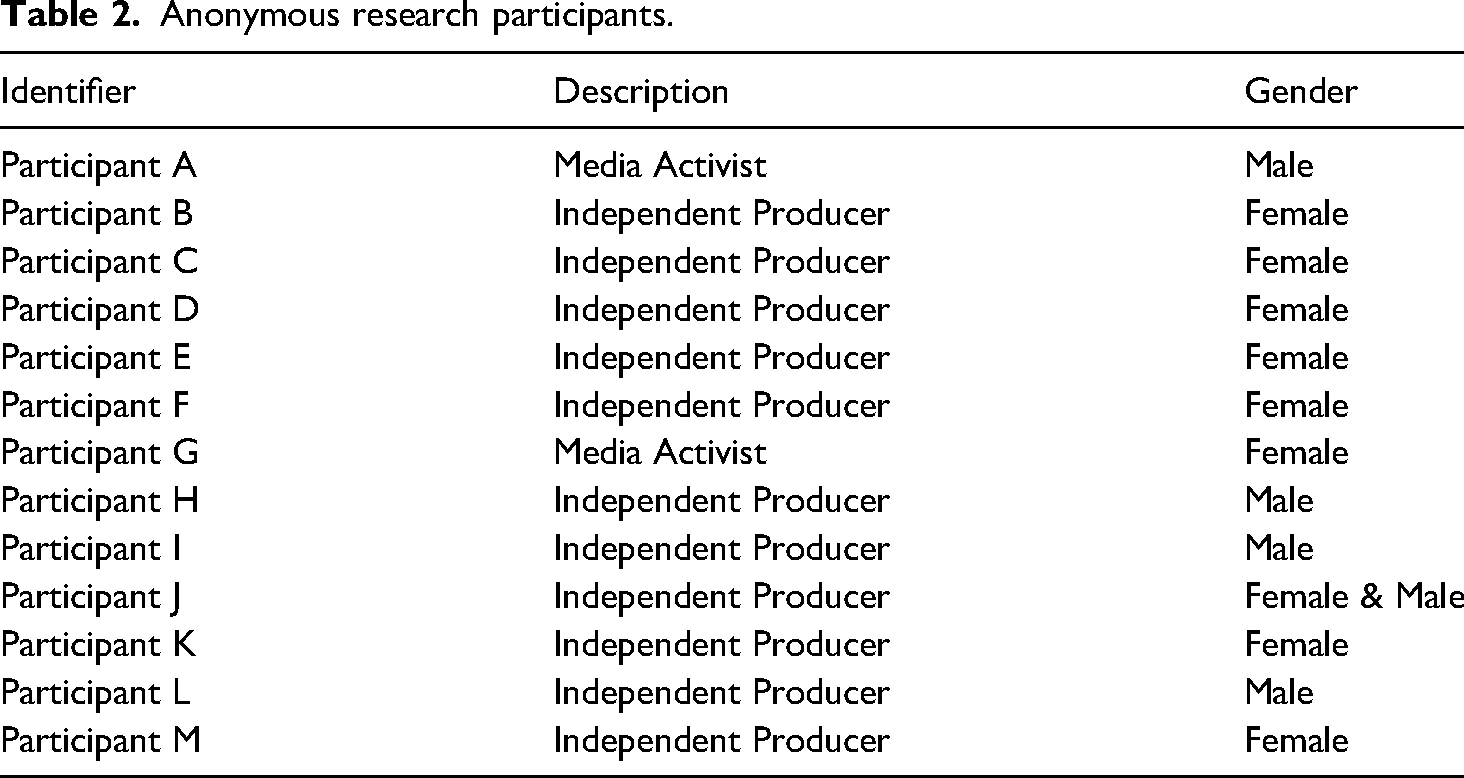
Respondents who worked for independent production companies were anonymized to ensure they were free to speak openly without fear of consequences to their working lives. All other respondents would be identifiable because of the specifics of their job title or industry role and so they gave consent to be named in the research. Participants are described further in Tables 1 and 2 below.
Named research participants.
Anonymous research participants.
Findings
Tools and measures for diversity and inclusion in English language territories
A range of tools and measures have been developed across Europe, the US and Australia, which focus on gender, race, age, sexual identity and disability, areas where there are significant under-representations. Many of these tools and measures were centred around four key areas: diversity standards, leadership objective setting and incentivization, targeted talent development and diversity monitoring. The development of these tools internationally generally came from production companies, activist organizations, broadcasters, communication regulators and government departments. These broad themes could prove as useful potential points of EDI development within the Irish media industry.
Diversity standards
One of the first tools developed have been diversity standards which have seen a strong emphasis across a range of broadcasters and bodies. Many of the standards vary, but generally share the same principles and have been issued by organizations such as the British Film Institute (BFI), Channel 4, the BBC, Ofcom, ITV, ABC (Australia) and ABC (America). For example, the BFI standards have focused on gender, race, age, sexual orientation and disability and were designed to ‘encourage equality of opportunity and address underrepresentation in the screen industries’ (BFI, 2019). Those who seek funding, mainly production companies, must expect to meet the criteria of at least two of four standards. The standards cover on-screen representation, creative leadership, industry access and training opportunities and audience development. The BFI notes that this is a flexible framework that can be used for feature films, television content produced for broadcast and online, as well as a range of audience-facing activities such as film festivals. Similarly in the UK, broadcaster Channel 4 set out their 360 degree diversity charter which applies to each of their commissions with independents, in which they commit to diversity both on and off screen through a ‘YES Scheme’ (Channel 4, 2015). The on-screen criteria relates to content/subject matter, where a series or single programme must reflect a variety of communities and backgrounds through their subject matter and roles, which refers mainly to ensuring diversity in casting actors for scripted programmes and contributors on factual programmes. The off-screen component requires a demonstration of diversity relating to staff/key creative roles, development/production team/crew component and the training, internship and career progression component (Channel 4, 2015). As part of this scheme, performance in meeting these measures is published against the diversity criteria on an annual basis, to ensure that progress is being made.
The BBC Diversity Commissioning Code of Practice sets out a number of equality, diversity and inclusion commitments within the UK's public service broadcaster. The code sets out the steps the BBC will take when commissioning content across all genres to ensure it accurately represents and authentically portrays the diverse communities of the whole UK (BBC, 2020a). The Code includes a commitment to diversity of age, disability, gender reassignment, race, religion and belief, sex, sexual orientation and socio-economic background. The focus of this diversity measure relates to the areas of representation and casting, workforce diversity within commissioning and production teams and expectations for content-makers working with the BBC (BBC, 2020b, 2021b). The Code of Practice notes that the BBC will only work with content makers outside of the organization who have diversity and inclusion policies in place, which for them is a contractual requirement. The Code also has an emphasis on increasing opportunities for diversity through recruitment at entry level, by seeking out candidates from a wide variety of backgrounds. A Creative Diversity Unit was established in the BBC in November 2019, which aims to develop key diversity and inclusion commitments through industry collaborations and events. Among these events was the recent 50:50 festival held in April 2021, a series of panels and discissions around best practice in increasing representation (BBC, 2021a)
ITV launched its Diversity Acceleration Plan in 2020 to accelerate change in equality, diversity and inclusion by creating more opportunities for those from Black, Asian, minority ethnic and other underrepresented groups. The plan aimed to ensure that measurable change would be implemented over 12 months, from July 2020 to July 2021. The plan has so far resulted in the creation of a Group Diversity and Inclusion Director, who sits on ITV's management board. In August 2020, Ade Rawcliffe was appointed to this role, which was orientated around developing ITV's EDI strategy to deliver its published targets, while also partnering with all management board leaders, commissioning teams and HR teams to deliver on the Acceleration Plan (ITV, 2020). ITV concurrently established a Cultural Advisory Council, a group of independent external advisers ‘ who will advise, challenge and counsel ITV on all of its inclusion and diversity activities’ (ITV, 2020). This group, along with the diversity director Rawcliffe, will lead and coordinate all of the EDI activities through a series of action plans, which will be developed and delivered by teams across ITV. While the composition of the board still remains unclear, ITV is keen to ensure that the board is made up of people from diverse backgrounds from outside of the organization (ITV, 2020). Other specific departmental initiatives have also been established within ITV. Comedy 50:50 aims to address gender imbalance in comedy on ITV and a database of over 450 female writers has been created for use across the industry. Commissioning terms for comedy have also changed so that all commissions must have male and female writers (ITV, 2020). ITV News Diversity Panels aims for each ITV news region to have its own diversity panel with representatives from community groups to enable editorial teams to gather feedback directly from community members on how they can better reflect and represent their region. In the case of UK broadcasters, the commitment to diversity is maintained (or challenged) through the establishment of external monitoring and consulting bodies, to coach and advise on EDI issues. The Diamond Project is one such monitoring initiative. This is a single online system used by the BBC, ITV, Channel 4, Channel 5 and Sky to obtain consistent diversity data on programme they commission. The specifics of the Diamond Project are discussed in more detail in the monitoring section below. In other jurisdictions, diversity standards are maintained through slightly different consultancy arrangements. Flemish public service broadcaster VRT has an institutional-level diversity board, made up of external representatives from civil society organizations and academia, to evaluate how the broadcaster televises diversity and also uses this board to inform news and current affairs programming and for consulting on the development of storylines on television fiction (Kerrigan and Vanlee, 2020; Vanlee and Kerrigan, 2021).
Leadership objective setting and incentivization
There was some emphasis broadly on the area of diversity interventions through leadership. Channel 4 had an initiative for senior managers and editorial staff to improve diversity. This initiative involved them developing specific, measurable targets in one or both of the following areas: (a) within the broadcaster, by increasing the representation of specific groups and leading a culture of inclusion, for example by implementing internal mentoring to specifically support underrepresented groups; and (b) by making more diverse creative output, that is by increasing the presence of underrepresented groups both on- and off-screen (Channel 4, 2015). ITV's Diversity Acceleration Plan also sees a focus on leadership objective setting, which includes the Step Up 60 initiative, whereby ITV will provide the opportunity for at least 60 people to step up and secure their first ITV senior editorial and production roles, including directing, writing or producing episodes. Similarly, EDI development amongst leadership was considered part of the plan, with inclusive leadership training, which included mandatory race and inclusion training and unconscious bias training. Additionally, their Race Forward development programme is aimed at creating a pipeline into ITV's leadership, with the programme seeking to develop minority ethnic talent and see them progress to more senior roles (ITV, 2020). Another measure to incentivize greater diversity has been applied in media award structures, with the aim of engendering change through encouraging productions to incorporate diversity if they wish to meet eligibility standards for awards. One recent example of this includes the Academy Awards and the British Academy of Film and Television (BAFTA) awards system. The Academy Award system has established a set of four categories where at least two standards must be met for a production to be eligible for an award nomination. Among these standards are diverse representation on screen in terms of race, nation, sexuality and gender, diversity in terms of creative leadership and department heads, overall crew competition, industry access and opportunities, including internship opportunities for underrepresented groups and diversity of representation in marketing, publicity and distribution (Oscars, 2020). Already these measures at the Oscars have brought some change, with 2021 seeing the highest number of nominations going to women across the top categories. People of colour also received the highest number of Oscars nominations ever. While these changes have been seen over the course of just one award season cycle, it indicates that the measures have the potential for success in supporting diversity and inclusion. Additionally, the Oscars are implementing new diversity measures for inclusion in the best picture category in 2024. At least 30% of secondary roles must be from underrepresented groups and there must be opportunities for training and advancement, as well as at least two leadership positions or department heads that are from underrepresented groups (The Guardian, 2020).
Targeted talent development
Talent development is used to promote diversity and inclusion in both Australia and the UK. Australia's Screen Diversity and Inclusion Network, along with Screen Industry Innovation, have developed Talentcamp, a nationwide skills development program for creatives from diverse backgrounds, designed to provide opportunities for emerging storytellers to create new content and be employment-ready. The South Australian Film Corporation offer a scheme know as Targeted Diversity Attachments. The scheme supports the increased participation of women, First Nations practitioners, deaf and disabled people, practitioners from culturally and linguistically diverse backgrounds, members of the LGBTQIA + community and those from regional and remote areas (South Australian Film Corporation, 2020). The scheme specifically offers paid work opportunities and attachment to a supervising crew member or department head, who is obliged to provide appropriate tasks, supervision and learning opportunities (South Australian Film Corporation, 2020). In the UK, the BBC's Creative Diversity Report from 2020 indicates a commitment to talent recruitment, through the delivery of the Experienced Diverse Talent Accelerator programme with its programme commissioners aiming to identify talent on and off air and screen and to provide resources to propel careers to the next level. This programme aims to ensure increased levels of diversity within commissioning teams and 20% diverse talent behind the camera. As this programme has only recently been put in place, its success is still to be determined. ITV's Acceleration Action Plan (2020) also has a focus on targeted recruitment, in particular delivering a positive action campaign to support under represented candidates. They have committed to advertise all permanent roles and to advertise externally, to advertise across a wide range of portals to ensure a diverse pool of candidates and to use a variety of candidate selection and assessment tools in order to reduce unconscious bias. While these are promising initiatives orientated around targeted talent development, it is too early to determine what impact they will have on generating long-term and sustainable diversity in the workforce.
Diversity monitoring: both on and off-screen
In a number of states there are monitoring bodies that gather statistical data on gender and diversity. For instance, in the US GLAAD (Gay and Lesbian Alliance against Defamation) gather data on the appearance and visibility of gay and lesbian people on screen. In the UK Diamond (Diversity Analysts Monitoring Data) examines the diversity profile of people making and appearing on television. The Diamond Project initiative originated from collaborations between the Creative Diversity Network and the BBC, Channel 4, ITV and Sky News. The aims of the Diamond project are to measure and capture diversity and inclusion data, while ensuring every part of the UK broadcasting supply chain understands the diversity and inclusivity landscape. Diamond monitoring is generally the responsibility of production management and is a single, standardized approach used across the industry. Diamond releases a series of reports annually to measure progress around diversity and inclusion. The Diamond report in particular measures gender, transgender, 50 s and over, Black, Asian and Minority ethnic, along with disabled and LGB populations, both on-screen and off-screen. In addition, the Diamond project aims to: i. ‘Unite: Uniting the industry by sharing best practice and creating forums for collaboration and celebrate the action that improve diversity and inclusion. ii. Support: Supporting the industry with honesty and openness to ensure that actions are undertaken for measurable progress’ (Creative Diversity Network, 2021). iii. The Diamond project has been subjected to some critiques in two main areas: disappointing response rates and an inability to report programme level data (Broadcast Now, 2019). While diversity monitoring offers useful quantitative materials to indicate where there are gaps in diversity, many of the measurement scales do not necessarily incorporate any solution-centric aspects. More recently however, Australia's Screen Diversity Network has established ‘The Everyone Project’, a significant new initiative that aims to help Australian screen industry companies and organizations track, boost and foster diversity in their screen productions, both in front of and behind the camera. The project is centred around a web application that invites media workers to self-identify on a set of diversity characteristics for talent and crews working in current projects. On the one hand, the tool is designed for organizations to understand the diversity of their workforces or crews and on the other hand, it is designed to also measure the impact of any diversity measures implemented in the workplace. The app has only been launched in the past year, so its success in supporting sustainable EDI has yet to be seen.
Industry response to tools and measures
Each of the tools and measures outlined above were discussed with participants. Most of the respondents considered these international examples as central to shaping the formation of EDI within the Irish media sector. The data was used to uncover how varying actors estimated what might work best within the specific dynamics of the Irish context. These findings have been generated under four headings: data monitoring and gathering; diversity standards; objective setting and incentivization and fourthly, diverse recruitment for the industry.
Data monitoring and gathering
Almost unanimously, respondents considered data gathering and monitoring to be central components in improving diversity within the industry. While there was overall enthusiasm for data gathering, there were differences in approach or emphasis amongst respondents, from broadcasters, to independent producers and activist groups. The power of data gathering was noted by larger organizations like RTÉ, who observed that it plays a significant role in ensuring that changes ‘are delivered consistently’ (Clíona O’Leary). These sentiments were shared quite strongly also by the commercial broadcaster VMTV, Paul Farrell noted that ‘data allows you to move in the right direction’ and to strategize. Extending from this, Farrell noted that ‘monitoring and data is paramount… you have to have it and then you know if you are doing good or doing bad…. Benchmarking, good data, profiling… it's definitely something we have to do’. In terms of actual data collected within the larger broadcasters, this was confined solely to gender and did not encompass other forms of diversity. As the Diversity Lead at RTÉ Zbyszek Zalinski noted ‘at the moment we are not collecting this data, but we would like to collect this data, we recognise the importance of collecting this data that will give us the information that we seek about the diversity and the makeup of our staff’.
Respondents from the independent production sector strongly supported diversity monitoring. One respondent saw it as vital. He described the industry as being dominated by a ‘macho culture’ and argued that data gathering was required in order to ‘dismantle’ this ‘lad culture’ (Participant H). That producer explained how ‘the macho culture permeates the broadcasters as well as the independent producers and [there are] certain commissioning editors you would never approach with a subject [or programme idea] on diversity’ (Participant H). He saw data gathering as key to generating greater inclusivity, which was key to dismantling the normative, dominant male power dynamics of the Irish media industry. Another independent producer noted the significance of data gathering when he asked ‘how many people of BAME background are actually available for work? No one can tell you that. People might self-identify as from a different background… but you absolutely need to start with the data’ (Participant L). He further remarked that at the very least data monitoring can provide ‘a sanity check that we’ve got the right balance on the team’ (Participant L). Another independent producer recognized the importance of data gathering, but pointed out that it was vitally important to also examine and analyse the data to understand and articulate ‘how these exclusions are occurring in the first place’ (Participant F).
The practicalities of data gathering were a concern for some organizations, particularly in the independent sector, who agree fundamentally in principle with data gathering, but noted that ‘the burden of admin’ could be a potential barrier in fully implementing data monitoring (Participant I). One respondent working in a large production company explained ‘when you are in production, everybody is flat out and it's not that we don’t want to collect statistical data, it's simply having somebody do that for us. I mean we could review all of our crew lists and just look at them in terms of who is working on what, but we’re being conscious of the fact that we want to try and diversify, and make sure that we are diverse and inclusive, but also doing it in a way that's not going to be too paperwork heavy’ (Participant K). Some respondents stated that data gathering was starting to happen through crew databases and that this could become mainstreamed as an industry norm at a broader level. In particular using a mobile phone application to gather data similar to that seen in Australia was well received. As Gareth Lee, manager of Screen Skills Ireland, commented ‘Our equivalent to a certain extent will be the crew database. We will hope, that that would work on an app format. More structure, more data, all of that is really positive. The other thing, the crew database will do so much’.
In sum, while data gathering was considered a central tool or measure that needed to be implemented by broadcasters, the medium to large production companies also considered data gathering an important tool for establishing benchmarks for diversity that could be improved upon, but caution was noted by smaller production companies that data gathering should not become a burden and that supports and incentives should be put in place to encourage it.
Diversity standards
Many of the respondents agreed that these examples of the application of diversity standards could be adapted to the Irish context. More specifically, many felt that the broadcasters should have diversity boards, composed of people with diverse backgrounds and/or expertise to guide broadcasters on intersectional issues of diversity. Some respondents proposed that diversity boards could inform diversity policy, others proposed that they could oversee and advise on diversity content, while more saw the boards as encompassing both policy and content. One independent producer noted ‘unless you have a board of diverse people who are talking through policies that you want to implement, how do you know that you are creating the right policies?’ (Participant K). Another respondent emphasized that if such a board was to be created, it needed to ensure that people from diverse communities, who were experts also, were placed on it, rather than industry standard bearers (Participant M). A diversity board was also considered by another producer as having the capacity to promote ‘positive associations’ with under-represented groups, which would give them a voice and a platform, but the respondent noted that the diversity board should not become editorial in its remit (Participant J). While there was generally a strong emphasis on the usefulness of diversity boards, some members of media activist groups were alert to the difficulties in creating the boards. As one activist put it ‘I think it's very good to have a board, but how would it be diverse? The issue is it's going to take time for diverse people to become senior and get to boards’ (Participant G). The latter point in particular speaks to the fact that some of the tools and measures can only be achieved if a pipeline of talent development is created or supported to participate.
While a diversity board was considered a valuable way of implementing some diversity measures, as mentioned in section 4, many of the respondents considered that leadership was needed from the top down specifically to implement diversity standards. As Paul Farrell from VMTV argued, this is a ‘top down piece and if you don’t have it at the start with the BAI, you don’t have it, they need to be leading with something that says best in class and here's how we can help you get there’. Many felt that regulators such as the BAI should take ownership and lead the way and foster something like the BFI Diversity Standards, adapting them to the Irish context, as Gareth Lee from Screen Skills Ireland noted ‘The BAI definitely have a place in all of this, even them adopting the BFI model, I think that's the big picture isn’t it?’. This was reflected by Annie Doona from Screen Ireland who stated ‘we don’t have the same rigour in terms of the questions that have to be filled in as a result of an application that the BFI have, but look at the positive actions that initiative has had, I think that's something we could look at’. Some respondents were fearful of putting an onus on production companies to meet certain criteria in order to access funding ‘I think you’d have to be careful around that, because obviously when you look at the population in the UK, it's hugely different and it's massively diverse compared to us’ (Participant C). Another independent producer agreed that while it was important for Ireland to strive to meet some diversity standards, it was important to recognize that Ireland was not the UK ‘I think the women's initiative is really good, having women-focused rounds, because gender is 50/50, but we don’t need to race to meet the EDI goals of our near and close neighbours [the UK] because their experience is different’ (Participant L).
Objective setting and incentivization
Objective setting and incentivization were recognized as useful tools and measures, if adapted to the Irish context, by respondents from mid- to large-sized production companies. They were seen as particularly appropriate to developing both diverse talent and a diverse workforce. Specifically, funding initiatives that embedded diversity and inclusion measures as a requirement within application processes were considered valuable. As Gareth Lee from Screen Skills stated ‘You get fifteen per cent extra funding when you tick these boxes, and we need to work out what those boxes are, that's a really direct, overnight way. Production companies want more money for their productions…’. Another respondent noted how this kind of incentivization would ‘specifically help female directors and different diverse groups’ and would make producers put money ‘where their mouth is’ (Participant E). Another independent producer commented that incentives should engage across a number of diversity categories such as ‘age, race, gender, sexual orientation, socioeconomic background…’ (Participant B). One respondent argued that funding calls such as the Sound and Vision Scheme could be expanded to include measures that would encourage applicants to actively incorporate diversity into productions. ‘If it's part of the application process, having some points given [to the application] if your crew has people from a BAME background, that starts the process, and that might get people conscious of when they are hiring, because it's a business decision and people will go to find people to meet a quota […] if it's part of the point scoring process, you will start seeing people gaming the system and saying well how can I make my application stronger and get funded’ (Participant L). Another production company noted how media organizations should need to demonstrate an EDI culture within their organization ‘Eventually they could have a section where you have to prove that you have an inclusion and diversity policy or that you implement an inclusion and diversity policy’ (Participant K).
At its core, mentoring was envisaged as a means through which more inexperienced voices could be incorporated into the industry. As one independent producer remarked ‘it's about recruitment and encouraging new talent into the industry from different places, with different voices. Mentoring is a good way to do that’ (Participant I). Birch Hamilton from the Screen Directors Guild noted that mentorship was vital to help directors get those all-important ‘flying hours’, as she put it ‘mentorship could be plugged in to the particular project. Like when the BAI give funding, you could say look an extra two thousand euro is attached to this because they’re a diverse director’. Another producer commented that they sought out LGBTQ interns to mentor in their production company as they were aware of struggles that some within the LGBTQ community had in terms of breaking into the industry (Participant H). That producer noted that a streamlining of these kinds of practices across the industry would be helpful in giving other under-represented groups a chance. Another producer added that the BAI or Screen Ireland could develop and lead on incentivization through mentorship schemes. ‘There needs to be BAI mentorship or Screen Ireland mentorship whereby it is a fund put aside, so you’ve a fund and a fund manager in Screen Ireland or the BAI who looks, finds top talent and schools them, and brings them in and then makes them part of productions and that includes placements, so part of a ticking for an extra fifteen per cent means I’m going to take two of the people from the shortlist of our acceleration plan, development plan. That's how you would do it so you’re not disempowering or disincentivising those who are already doing good work, it's hard enough making a living in TV for a lot of people. What you’re doing is you’re rewarding those who do it better, and who recognise and support diversity in actual, real and meaningful ways’ (Interview G). Many of the respondents acknowledged the usefulness of mentoring schemes for women in film and television, but recognized that schemes for racial diversity constituted a significant gap in the industry.
Many of the activists interviewed further noted that when diverse stories were being incentivized, members of the communities represented needed to be included on the crew or to be present in the writers room (Participant A; Participant G). Similarly, with casting. One production company noted how they had begun to implement colour blind casting on their own productions and suggested that this could work as an incentive on funding applications for drama series, ‘if they can demonstrate they will implement colour blind casting, then they get more points’ (Participant J). Áine Ní Chaoindealbhain of Virgin Media spotlighted casting as an overlooked element in drama production and as an area where salient diversity interventions could be made. ‘ …Most people look at diversity when they’re finished a project’, whereas it should be essential ‘that diversity is not only represented, but that we are conscious of diversity in our casting’. In sum various objectives were set to incentivize diversity and inclusion through funding, mentorship and casting.
Diverse recruitment for the industry
A major structural impediment to creating a more diverse media workforce is the nature of media work, which is characterized by high rates of short-term, temporary contracts and casualized working terms and conditions. These characteristics make it a difficult industry for people to enter who do not have the benefit of pre-existing contacts amongst networks of homophilic workers. In terms of “good work” (Banks et al., 2017) most full-time, permanent, openly advertised jobs are provided by a very small number of large employers, such as the broadcasters. As the Head of HR in RTÉ Eimear Cusack commented, steady and secure work in screen production ‘is rare in that sector, so I completely understand that RTÉ is attractive from that point of view’. However due to a low attrition rate, RTÉ is very constrained in terms of diversifying its workforce through new appointments. All of the RTÉ respondents commented on the very low attrition rate which meant that the organization was ‘relying on people to leave in order to bring new voices, or new perspectives’ (Eimear Cusack). For that reason, the independent sector is frequently thought of as the solution to the need for greater diversity amongst production workers. Some of the broadcasters were clear that work channelled through the independent sector was the best mechanism for addressing diversity and inclusion in recruitment. As one RTÉ respondent described ‘forty per cent of what we put on RTÉ One and RTÉ Two are made from the independent sector… so most production companies, it's kind of project based… they have a lot more leeway in terms of the type of people that they hire… diversity, you know, gender, everything comes into play there’ (Niamh O’Connor). Frequently the ‘solution’ to promoting equality and diversity in recruitment was the independent sector because as SMEs they had the potential to be agile in terms of recruitment. However, independent production companies mainly work from one commission to the next, recruit only as production requires and mostly on short term, temporary contracts. Because many independent companies are themselves precarious, they have solid rationales and structural challenges that mitigate against them acting as the driving force for innovation in recruitment for diversity and inclusion.
The point of view on recruitment from within a small production company was different to the point of view amongst broadcasters about them. As one producer put it succinctly ‘My concern is that the expectations of the broadcaster would not match with the feasibility of the producer’. As one producer explained ‘we’re a small company as most companies are in this business… and when you are in production, everybody is flat out’. The producer explained the precarity of working as a small company ‘It's difficult because we’re a gig economy, so you only get paid if you’re working on a gig and if you’re not working on a gig then you’re not getting paid… You’re working under those pressure all the time… so there's a lot of pressures and it's usually a small team’ (Participant K). While the producer in question was very open to the idea of inclusion and diversity in recruitment of workers, at the same time she could offer a solid logic as to why it would prove challenging for many independents. As she put it ‘I don’t want to come across saying that it's not a priority, because we feel that it is a priority, but sometimes you just don’t get the time to sit down and analyse the data properly’ (Participant K). Most small independents claimed to only have the capacity, time and resources to recruit a team of workers that were already heavily networked with the company and with each other. Most risk in production was referred down to the production company and so in terms of recruitment these companies tended to be conservative. The independent sector saw itself as structurally impeded from recruiting a diverse pool of unknown or untested candidates for roles; however, they were open to wider recruitment if those roles were subsidized. But the funding and resource supports for such an initiative needed to be in addition to funding currently available to the sector. Funding initiatives that were attached to content production have been successful, as demonstrated by Screen Ireland's gender equality initiatives (O” Brien, 2019) and should continue to be supported. But a more radical and additional intervention was required to create a diverse media workforce in Ireland. Part of that additionality is the recognition of the scale of the change project. A state-led scheme to attach increased funding for additional, long-term, sustainable and permanent jobs for diverse workers across media industries has the potential to transform the structure of the workforce. In terms of sectoral development a more diverse workforce has been shown to generate better outcomes in terms of content creation and growth and so more diverse jobs can serve to create a virtuous cycle of development for the media sector. Just as the digital transformation of Irish media in the last decade required strategic input from the Department of Communications, so too the human capital transformation of the media workforce in terms of diversity requires state-led strategic sponsorship at government departmental level. As one respondent concluded ‘the people who provide the money and who have a statutory responsibility to all citizens have a responsibility to adopt policies that, in a practical and measurable way, do deliver a changed situation’.
Conclusion
In response to these international tools and measures from English language territories, the Irish media industry is clearly in a position to follow some of the lessons learned from the international context, all the while adapting some of these EDI tools and measures to the specificities of the Irish screen industry. Across the film and television sector in Ireland, from production companies, broadcasters to professional organizations, there is a capacity and a desire within the industry to build change for sustainable EDI within the Irish media.
While this article focused on how the industry can build capacity for change in terms of EDI, it is also crucial that any tools and measures for creative diversity is done with allyship in mind, as recommend by the Creative Majority report (Wreyford et al., 2021). Speaking directly to issues affecting communities should involve engaged research with ethnic and racial minorities including people of colour and the Travelling community, the LGBTQ community and disabled people as well as with people from socio-economically disadvantaged backgrounds. Additionally, participatory action research with organizations and NGOs that represent these groups would provide more insights into how the Irish media industry can respond to community concerns. Further research should examine how pilot applications of tools or measures, are operationalized on the ground. This will ensure they benefit all communities equally or can be adapted to address the variation in identity that can often exist within minority groups. Research can make a valuable contribution to supporting greater diversity and inclusion in media and creative industries. It does this by tracking data on under-representation and by highlighting the structural and cultural impediments to greater participation by workers with a broad range of social identities. Developing tools and measures such as those recommended in this article is one such way to ensure a sustainable and long-term commitment to EDI in the Irish television and film sector.
Footnotes
Declaration of conflicting interests
The author(s) declared no potential conflicts of interest with respect to the research, authorship and/or publication of this article.
Funding
The author(s) disclosed receipt of the following financial support for the research, authorship, and/or publication of this article: The research was supported by the Broadcast Authority of Ireland.
