




Abstract
Building on theories of valuation and evaluation, we develop an analytical framework that outlines six elements of the process of consolidation of an idea in the public sphere. We then use the framework to analyse the process of consolidation of the idea of climate change mitigation between 1997 and 2013, focusing on the interplay between ecological and economic evaluations. Our content analysis of 1274 articles in leading newspapers in five countries around the globe shows that (1) ecological arguments increase over time, (2) economic arguments decrease over time, (3) the visibility of environmental nongovernmental organizations as carriers of ecological ideas increases over time, (4) the visibility of business actors correspondingly decreases, (5) ecological ideas are increasingly adopted by political and business elites and (6) a compromise emerges between ecological and economic evaluations, in the form of the argument that climate change mitigation boosts, rather than hinders economic growth.
Introduction
How are ideas consolidated in the public sphere? How does something like the idea that nature has a value in itself become generally accepted, to the point that it becomes sensible to argue that ecological values ought to be prioritized over other values, such as economic goods?
In his seminal 1972 paper Up and Down with Ecology, Anthony Downs argued that public attention to ecology had been on the rise since the 1960s, but was likely to wane. Downs’ argument was that ecology, like other issues, was to follow what he called the ‘issue attention cycle’, inevitably leading to decline of public interest once the costs of dealing with the problem have been discovered (even though for ecology, this might take somewhat longer than for some other issues; Downs, 1972: 40, 50). In this article, we argue that while public attention to ecology certainly has its ups and downs, the long-term trend is up. Recent studies have shown that public attention to climate change (Schmidt et al., 2013) and environmental issues in general (Djerf-Pierre, 2011: 502) has increased during the past decades, even though there have been short-term periodic fluctuations. We argue that this long-term increase in issue attention has been paralleled by discursive changes where ecological valuations have become more prominent within environment-related public discourses. Specifically, we suggest that ecology has become consolidated as an idea, as a principle of valuation and evaluation that competes with other similar principles, most notably with the principle of economic valuation. We do not claim that ecology will trump over economy in the long term – merely that it has become an idea that can compete with, or sometimes complement, economic evaluations in the public sphere.
This line of thinking follows the argument laid out by Lafaye and Thévenot (1993) concerning the rise of the ecological principle of valuation. The argument draws on the more general framework of theories of valuation and evaluation, based on the groundbreaking work by Luc Boltanski and Laurent Thévenot (2006/1991) and further developed by Lamont (2012) and Fourcade (2011).
Based on this theoretical approach, we sketch out a model outlining six elements of the process through which ideas become consolidated in the public sphere: (1) the increase in the frequency of references to the emerging idea, (2) a corresponding decrease in the frequency of references to opposing ideas, (3) the rise of a new group of actors as institutional carriers of the new idea, (4) a corresponding decline in the presence of actors opposed to the idea, (5) the adoption of the idea by institutionally established actors such as political elites and (6) the emergence of a compromise between the new idea and old ideas opposed to it, whereby the two become accepted as complementary rather than opposing principles of evaluation. We then use the model to develop hypotheses concerning the changes in what is perhaps the most central ecological debate of the recent decades, namely, the debate on climate change mitigation. To test the hypotheses, we use a dataset on climate change media coverage in the news media in five countries over almost two decades, 1997–2013.
Our work adds to the existing research on media coverage of climate change in several ways. First, most studies have been single-country cases or two-country comparisons (Carvalho and Burgess, 2005; Dirikx and Gelders, 2010; Shehata and Hoppman, 2012; Wagner and Payne, 2015), or in the cases where several countries are compared, the focus is most often on simple indicators such as the volume of coverage or studies only cover a short time period (e.g. Broadbent et al., 2016; Kunelius and Eide, 2012; Painter and Ashe, 2012; Schmidt et al., 2013; Schmidt and Schäfer, 2015). We are interested in a more in-depth analysis of global trends, so our sample includes material in four languages from five countries. The countries are the United States, Finland, France, Russia and India, ranging from major players to minor ones, developed to developing countries and covering much political, geographical and journalistic diversity. Second, we are interested in changes over time, so our sample covers a period starting from the early days of global climate change politics, the Kyoto COP in 1997, and ends in 2013. Not many earlier studies on media coverage of climate change have been both broadly comparative and longitudinal (Schäfer and Schmidt, 2014).
Third, and most important, we develop a model that focusses on the consolidation of the idea of climate change mitigation as a part of a more general conflict of ecological and economic evaluations. Most studies on media coverage of climate change have focused on the portrayal of climate science in the media, the dichotomy between ‘deniers’ and ‘believers’ and on how the well-organized and funded denier coalition and the logic of media reporting has produced the false picture in which a scientific controversy exists over whether climate change is real and caused by human activities (e.g. Boykoff and Boykoff, 2007; Painter and Ashe, 2012). The ideological underpinnings of the climate change debate and the values that participants promote in it have received much less attention (Corry and Jørgensen, 2015). Some important studies have analysed the moral dimension of the debate (Carvalho, 2007; Dirikx and Gelders, 2010; Laksa, 2014; Maeseele and Pepermans, 2017), but so far, these studies have focussed on only one or two countries or short periods of time.
Theoretical framework and hypotheses
In this article, we analyse the consolidation in the public sphere of a particular type of idea: a moral principle of evaluation, namely, the principle of ecological evaluation. Such principles are based on competing conceptions of the common good (Boltanski and Thévenot, 2006/1991; Lafaye and Thévenot, 1993). From this perspective, political debate is essentially about deciding which kinds of common good ought to be emphasized when making decisions. In the case of climate change politics, the most important competing conceptions of the common good are economic good and ecological good. At the core of this debate is the question: How much ecological good are we willing to sacrifice to produce more economic good? Or, are these two goods perhaps not competing but complementary? Perhaps we can keep up economic growth or even accelerate it and save the ecosystem from destructive warming of the climate at the same time?
Principles of evaluation coalesce into repertoires. This means that there is a relatively stable set – a repertoire – of consolidated evaluative principles. Principles of evaluation are consolidated when they are accepted, or at least understood, relatively widely by members of a society – indeed, creative use of the consolidated principles can be seen as a prerequisite to success in political debates (Boltanski and Thévenot, 2006/1991; Ylä-Anttila and Luhtakallio, 2016).
There is an emerging literature on the nature of repertoires of evaluation and their use in various social settings, from environmental conflicts (Thévenot et al., 2000) to political conflicts in cities (Luhtakallio, 2012), automobile associations (Lonkila, 2011), media debates on globalization (Ylä-Anttila, 2016) and the Not in My Backyard (NIMBY) phenomenon (Eranti, 2017). One thing that this literature has barely touched upon is the question of how new principles of evaluation become consolidated.
We argue that the process of consolidation of an idea in the public sphere consists of at least six elements (Figure 1). In the following, we ground each of the six elements in the theoretical literature on valuation and evaluation and the empirical literature on media coverage and politics of climate change. As a result, we present a corresponding set of six hypotheses concerning the changes over time in the media debate on climate change.
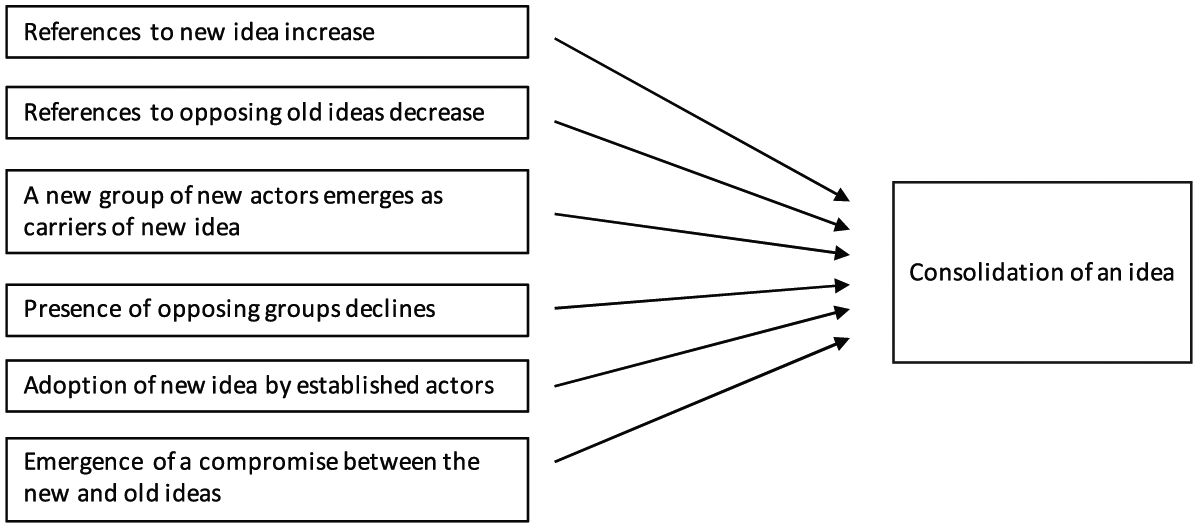
Analytical framework – consolidation of an idea in the public sphere.
We hypothesize that the first element of the consolidation of an idea is, quite simply, the increase in the frequency of references to it in the public sphere. Thus, we expect the use of ecological evaluations to increase over time. Earlier empirical research also suggests that this may be the case. The overall level of media attention to climate change has increased sharply over the years (Schmidt et al., 2013). One driver of this increase may be the wider use of ecological argumentation. Research has also shown that scientific consensus on climate change and its anthropocentric causes has strengthened (e.g. Oreskes, 2004), and the publication of the fourth report of the Intergovernmental Panel on Climate Change (IPCC) in 2007 was an important turning point in raising public awareness of this consensus (Schmidt et al., 2013). Around that time, a new discourse emerged globally, stressing the scope and severity of the problem (Risbey, 2008). Thus, our first hypothesis is
H1: The share of ecological evaluations has increased over time.
Second, principles of evaluation are often pitted against one another (Boltanski and Thévenot, 2006/1991: 223). In the case of environmental debates, the ecological is often opposed to the economic. As a new principle is evoked more often, old opposing ideas may be crowded out and consequently are referred to less often. Indeed, an earlier study found a decline of ‘economic counter frames’ in the US media from the Kyoto COP in 1997 to the Bali COP in 2007 (Shehata and Hoppman, 2012). In a parallel vein, while economic framing was relatively important in the side events of early COPs, other frames have overshadowed it in later years (Hjerpe and Buhr, 2014: 118). Thus, our second hypothesis is:
H2: The share of economic evaluations has decreased over time.
Third, we posit that new ideas are often carried by new groups of actors. In the case of environmentalist ideas, research has documented the important role of environmental nongovernmental organizations, especially international ones, in this respect (Hironaka, 2014). As regards climate change mitigation in particular, studies have detected an increase in the number of environmental nongovernmental organizations (ENGOs) organizing around the climate issue and attending the UN summits during past decades (Hanegraaff, 2015; Muñoz Cabré, 2011; Ylä-Anttila and Swarnakar, 2017). ENGOs have also been successful in utilizing ‘PR strategies and tactics to influence the direction and tone of the media and policy discussion’ (Greenberg et al., 2011: 77). They increasingly ‘co-produce’ news with journalists at the COPs, and this can result in media outlets adopting similar frames as the NGOs (Lück et al., 2016). The activities of international NGOs, especially, have been shown to be ‘important drivers of media attention for climate change’ (Schäfer et al., 2014). Thus, our third hypothesis is
H3: The share of claims made by NGOs has increased over time.
Fourth, we hypothesize that as a new idea becomes increasingly consolidated and organizations promoting it increasingly visible, the visibility of those organizations that oppose the new idea correspondingly decreases. In the case of the idea of climate change mitigation, the strongest opponents have been business organizations. Indeed, research has suggested that in the recent years, businesses have at least in some countries taken an approach of ‘strategic invisibility’ (Lester and Hutchins, 2012), withdrawing from mainstream media discourse and instead funding think tanks who focus on denying the scientific consensus on climate change (Dunlap and McCright, 2015). Thus, we hypothesize
H4: The share of claims made by business organizations has decreased over time.
A fifth element in the consolidation process, we posit, is that the idea spreads out from its original group of promoters and becomes adopted by established actors (cf. Ylä-Anttila, 2016: 252–253). Particularly important here is acceptance among those who have the power to make decisions that have direct consequences on levels of greenhouse gas emissions, that is, politicians and business organizations. Thus, we hypothesize:
H5: The share of ecological evaluations has increased over time more among established actors (governments, businesses) than among NGOs.
Sixth, one of the most important elements of the theories of valuation and evaluation is the notion of a compromise between two evaluative principles (Boltanski and Thévenot, 2006/1991: 277). Actors who disagree can always stick to their preferred principle of evaluation and just keep on trying to out-argue each other. Alternatively, they may attempt to forge a compromise between two principles, arguing that they are complementary instead of conflicting. Forging such a compromise is a further step in the process of consolidation of an idea. Compromises strengthen consolidation because they attract wider acceptance, new allies and weaken critiques based on other evaluative principles. In the case of climate change mitigation, the idea that ecological and economic objectives are compatible may find acceptance of the general public that wants to avoid guilt when driving a car to work, attract allies form business corporations making money off solar panels and electric cars and weaken critiques from those who still insist that growth must rely on fossil fuels.
In the environmental social sciences, the compromise between ecological and economic evaluative principles has long been promoted by the ecological modernization school (Jänicke, 2008; Mol, 2002). We expect this kind of thinking to have increased in the climate change debate as the idea of mitigation has become more strongly consolidated over time, at the same time as those economic evaluations that are explicitly opposed to ecology have declined. A further reason to expect such change in the media debate is that earlier studies have detected a similar development in policy discourses (Bäckstrand and Lövbrand, 2016: 8; Isaksen and Stokke, 2014). Thus, we hypothesize the following
H6: The share of eco-modern evaluations of all economic evaluations has increased over time.
Data and method
Our sample includes material from five countries: the United States, Finland, France, Russia and India. We began by selecting one leading quality newspaper from each country (Table 1). These are The New York Times (United States), Le Monde (France), Helsingin Sanomat (Finland), The Hindu (India) and Kommersant (Russia). Due to the labour-intensive nature of manual coding, we were faced with the choice of either selecting two newspapers from each country or including as many countries as coder resources allowed. We chose the latter, because we are interested in global trends, not in differences between countries. The two exceptions to this rule were India and Russia. Because data from The Hindu was not available electronically for 1997, we used data from the country’s other two major newspapers in English, The Times of India and The Economic Times for that year. After discovering that the level of coverage in Russia was so low that no meaningful results could have been produced by using just one newspaper, we added two others, Izvestya and Trud.
From each newspaper, we searched articles on climate change during the following United Nations Climate Conferences: Kyoto 1997, Copenhagen 2009 and Durban 2011 (for France and the United States) and Warsaw 2013 (for Finland, India and Russia). 1 These data points were chosen with the aim of looking at long-term trends in mind. We sampled a period beginning 7 days before each conference and ending 7 days after. Electronic archives were used to search for articles that mentioned ‘climate change’ or ‘global warming’ or ‘greenhouse effect’ or the name of the city where the current COP was taking place. From the search results, we removed duplicates and articles that did not deal with climate change. This resulted in a total of 1274 articles. There are marked differences in the number of articles published in different countries: for instance, we found 523 articles in India but only 30 in Russia (see Table 1). The low number of articles in Russia is in line with earlier research showing that the Russian media has paid little attention to climate change (Poberezhskaya, 2015).
Overview of empirical data.
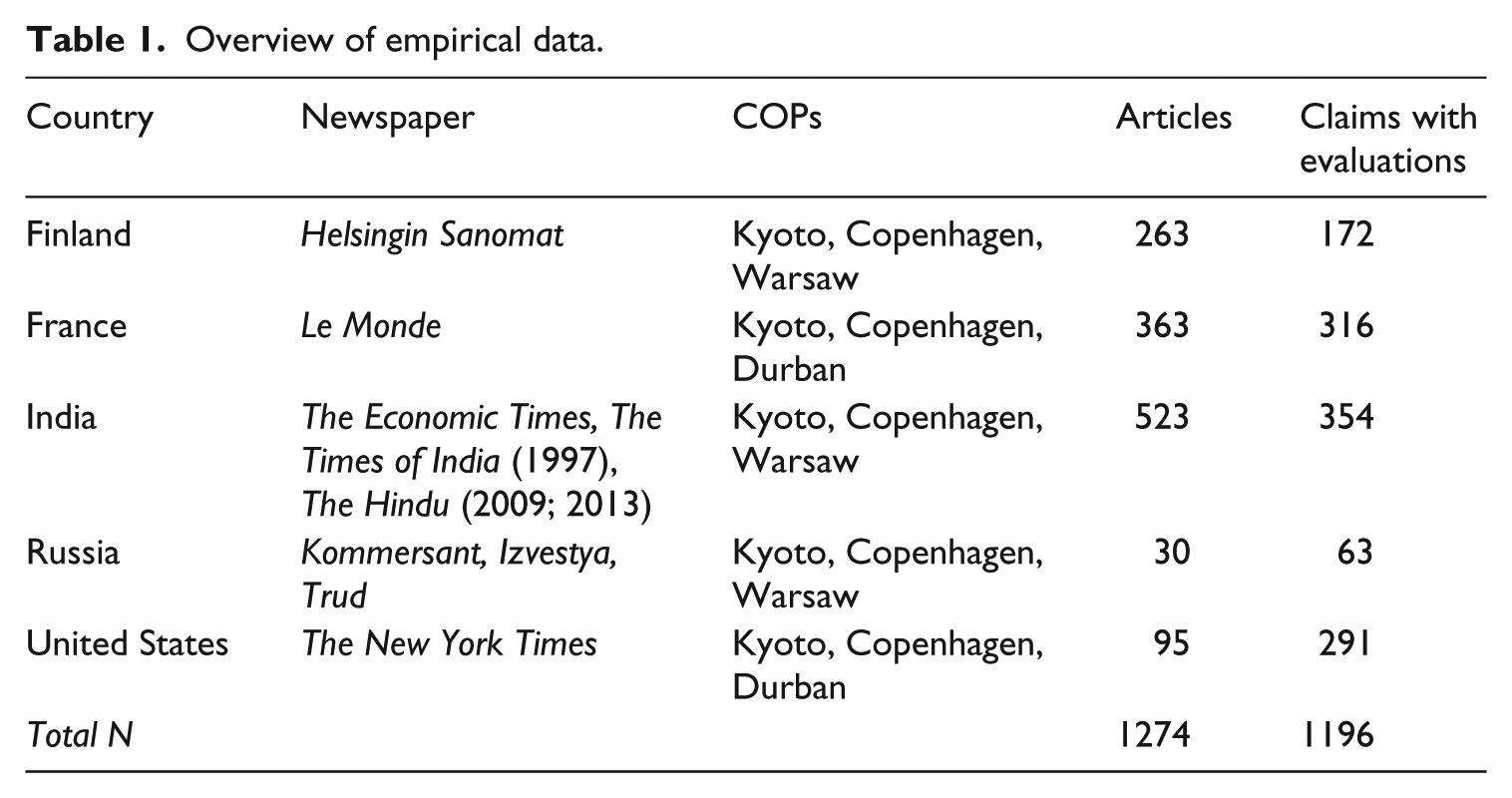
Our unit of analysis is a claim, defined as a ‘unit of action in the public sphere’ (Koopmans and Statham, 1999; Ylä-Anttila and Luhtakallio, 2016). It can be, for instance, a statement made in an interview, an op-ed, or the publication of a study that is reported in the media. One newspaper article may, therefore, contain several claims or none at all. In total, we found 1196 claims that included evaluations, and these claims constitute our final sample.
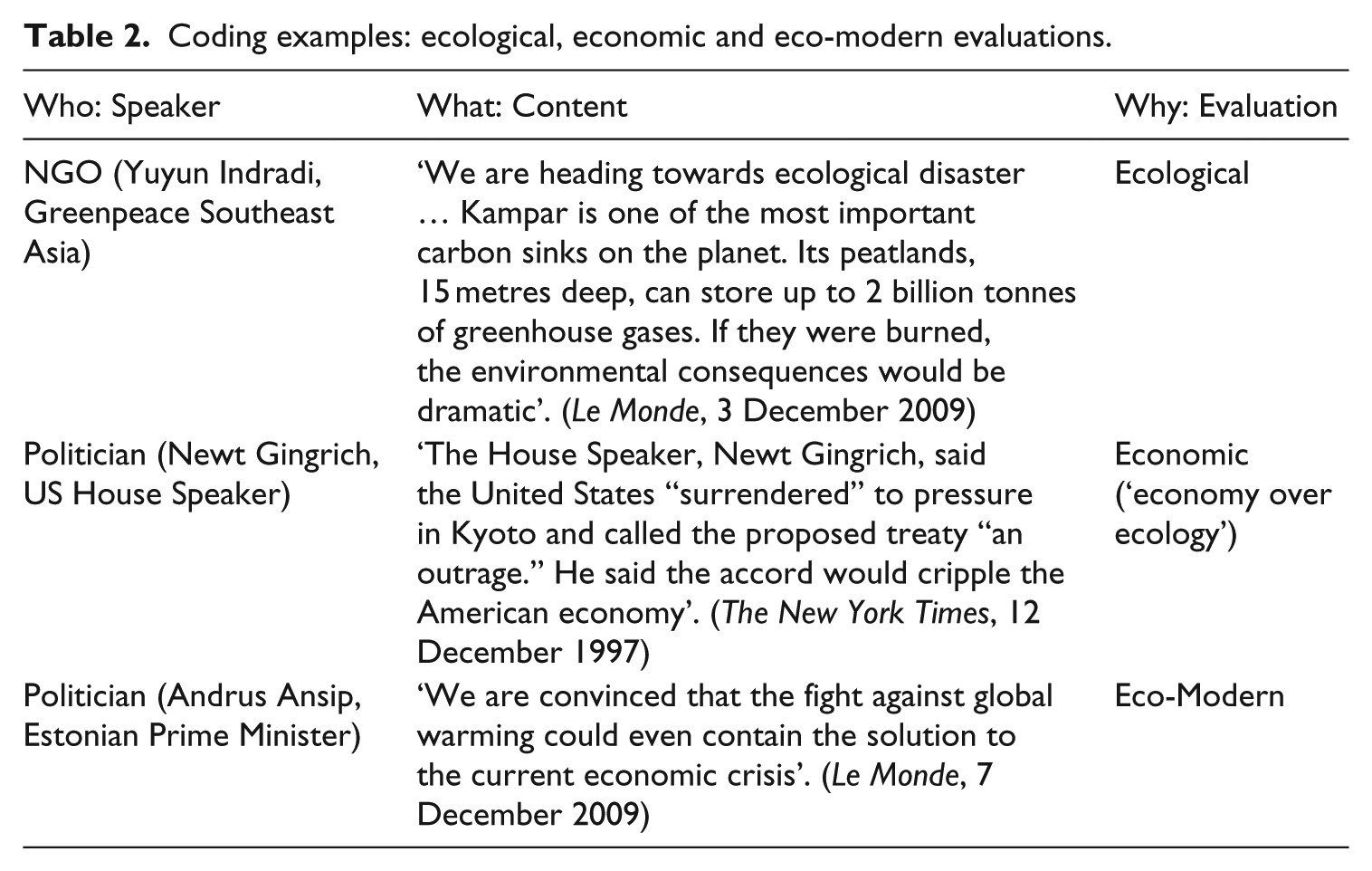
For each claim, we coded the type of the organization presenting the claim (see categories in Table 3) and the type of evaluation (ecological, economic, eco-modern and other). Within the category of economic evaluations, thus, we separated between those that resisted climate change mitigation on economic grounds (‘economy over ecology’) and those that saw climate change mitigation and economic growth as mutually supportive, rather than competing goals (‘eco-modern’ evaluations). 2 The evaluative component of the claim usually answers the question why something should or should not be done to curb climate change. Table 2 presents an example of each of the three main types of evaluations analysed in this article.
Coding examples: ecological, economic and eco-modern evaluations.
For the identification of claims, we used the codebook developed by Koopmans (2002). For identification of evaluations, we trained our coders and developed our own codebook through coding a sample of 71 articles reporting on the COP 14, that is, material not included in the sample analysed here. 3 We held five meetings, for which each of the six coders coded a set of 10–15 articles. Results were compared, and difficult coding decisions that were identified contributed to updating the rules written in our codebook. Thus, an updated version of the codebook was used for each new set of articles discussed in the consequent meeting. In the fifth meeting, we recorded the results from each coder and calculated intercoder reliability coefficients following the model used by Koopmans and Statham (2010: 53). Reliability easily satisfied conventional standards. The reliability coefficient for claim identification was 0.92 and for coding the evaluation category 0.95. 4
Results
Our first two hypotheses expected the share of ecological evaluations to rise and the share of economic evaluations to decline over time. Both are supported by the results. Figure 2 shows the share of claims including ecological and economic evaluations in the studied newspapers from 1997 to 2013. We observe a small but steady increase in the share of ecological evaluations, from 21% in 1997 to 25% in 2009 and 27% in 2011/2013. The decline in the share of economic evaluations is very strong, from 30% in 1997 to 12% in 2013. It is worth noting that this decline in the share of economic evaluations took place despite the economic recession that took hold of the entire world during the latter part of the time period analysed here, starting in 2008 (cf. Scruggs and Benegal, 2012).
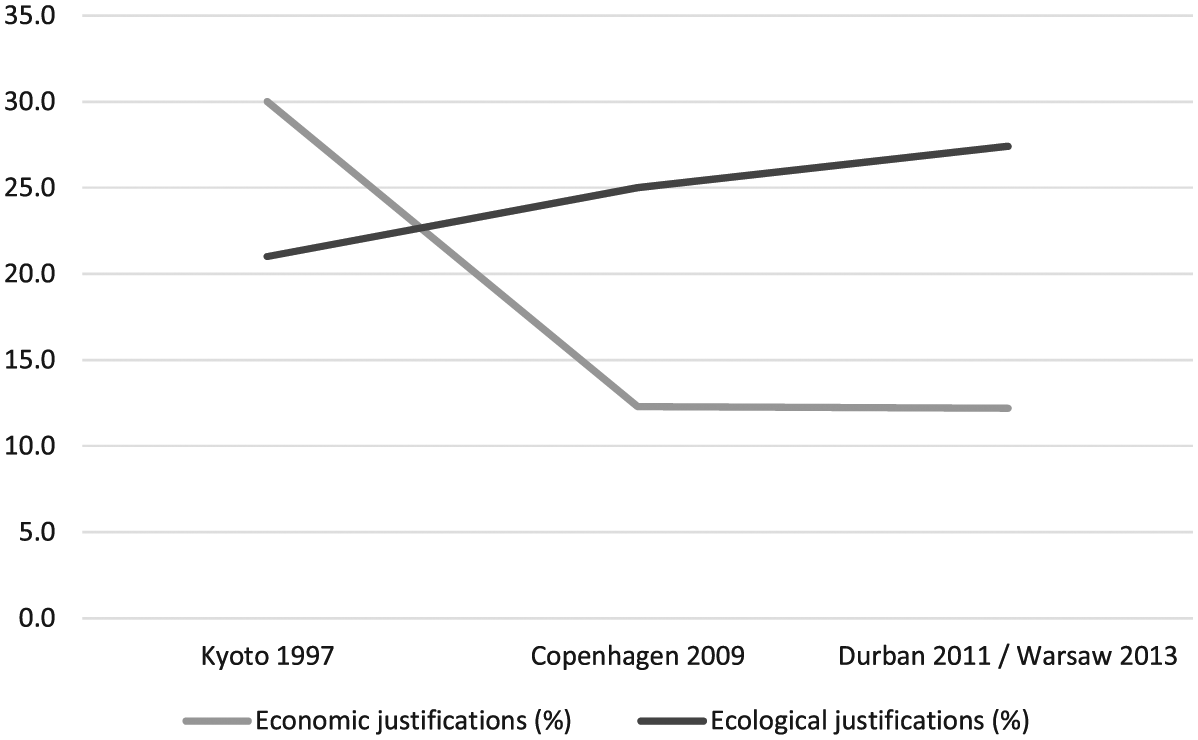
Share of economic and ecological evaluations, 1997–2013 (per cent of claims that included any evaluation, N = 1196).
Not only did ecological evaluations increase, but their content also changed. In 1997, climate change and its consequences were still something uncertain that loomed in the far future. ‘To the frustration of environmental activists, the still-distant risks from global warming have yet to grab the attention of Main Street’, wrote an expert in The New York Times (1 December 1997), while a reporter in The Times of India argued that ‘apocalyptic visions of rising seas, spreading deserts, extensive deforestation and swarms of disease-bearing insects are not likely to materialise in the near future’ (12 December 1997). By 2009, the tone had markedly changed. The consequences of climate change were now described as much more severe, tangible and immediate. In India, the Nepalese Cabinet is reported as announcing that ‘the Himalayas in Nepal are melting because of climate change’ (The Hindu, 4 December 2009), and in Finland, leaders of an ENGO describe climate change as ‘indisputably the biggest challenge of our era’ (Helsingin Sanomat, 26 November 2013). This change mirrors the increasing organizational institutionalization of climate science. The IPCC had been consolidated as an institution, and the reports it had produced between 1997 and 2009, particularly the 4th Assessment Report, had brought to light much new evidence on the already ongoing effects of climate change. This is clearly visible in the media debates around the world.
Our third and fourth hypotheses concerned the emergence of new actors as carriers of the new idea of climate change mitigation and the corresponding decline in the role of actors opposing the new idea in the public debate. More specifically, H3 expected the share of claims made by NGOs to rise and H4 expected to role of business actors to decline. Both of these hypotheses are supported. Figure 3 shows the changes over time in the share of claims made by NGOs and business organizations.
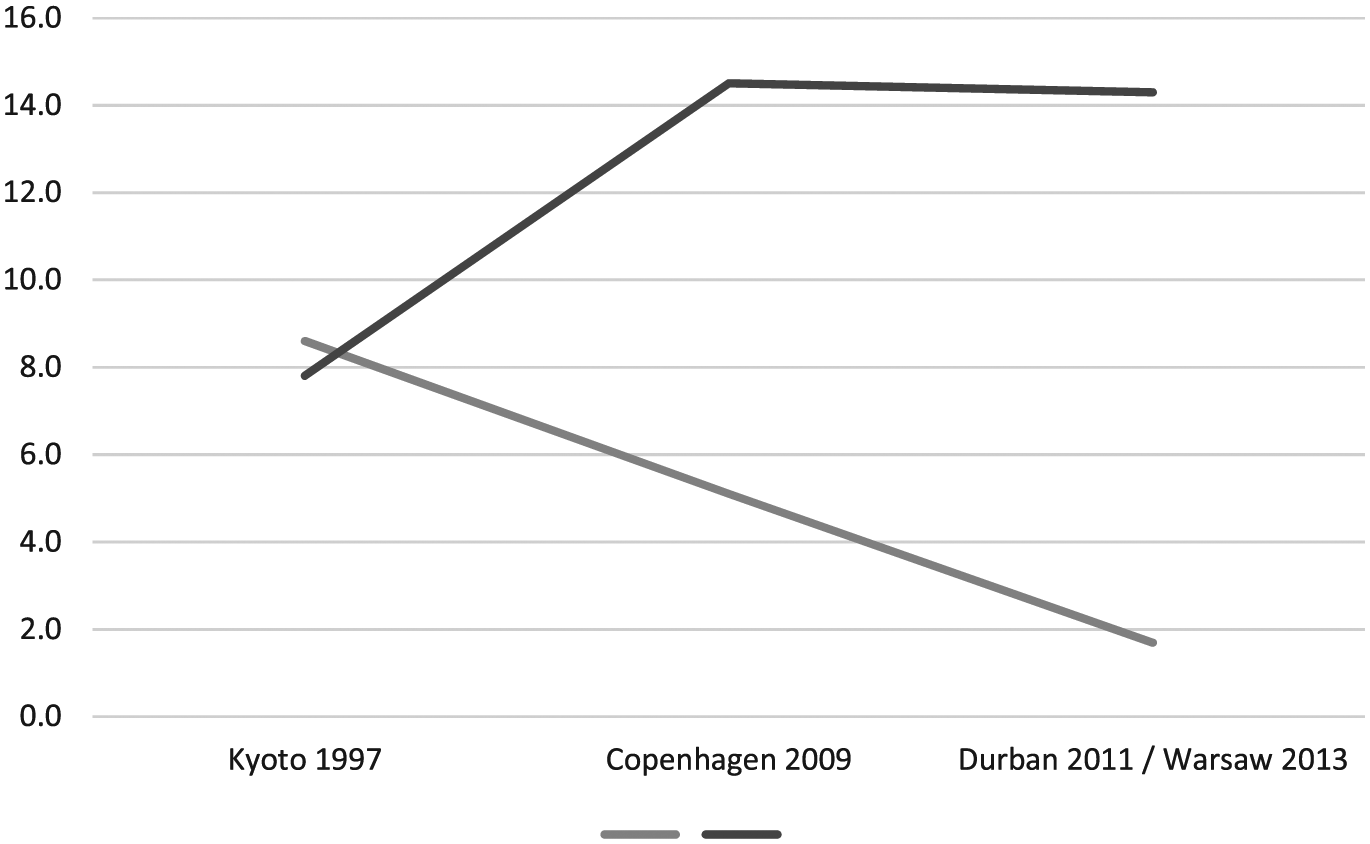
Share of claims made by business actors and NGOs, 1997–2013 (per cent of claims that included any evaluation, N = 1196).
The percentage of claims made by NGOs almost doubled between 1997 and 2013, from less than 8% to over 14%. Even more strikingly, the share of claims made by business organizations – individual firms, peak organizations or business lobbies – shrank from almost 9% to less than 2%. As our theoretical model leads us to expect, NGOs clearly act as carriers of ecological ideas; 55% of the claims they make during the entire time span use ecological evaluations (see Table 3). Similarly, business actors are by far the strongest proponent of economic evaluations, with 74% of all their claims evaluating things in economic terms.
Use of ecological arguments by different types of actors in 1997–2013 (per cent of claims with evaluations).
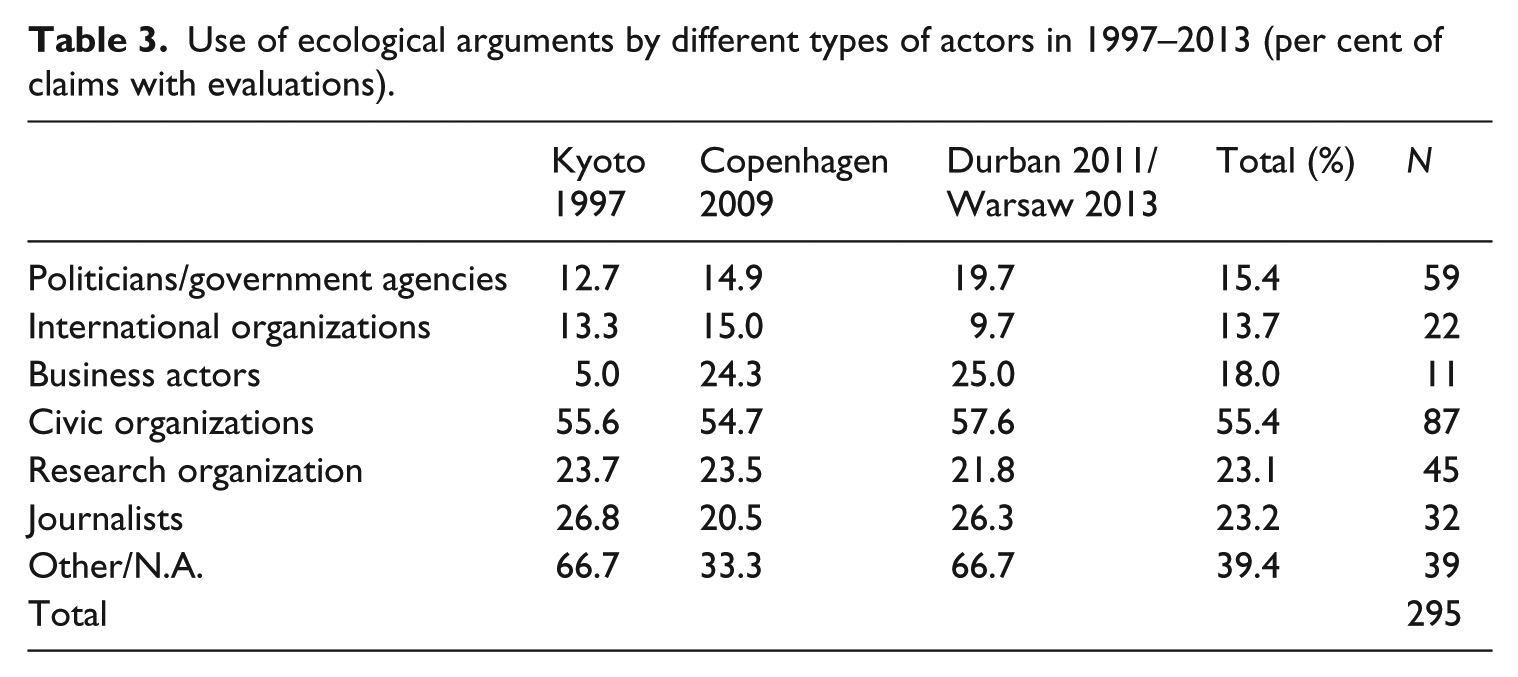
Our fifth hypothesis predicted that a further element in the process of consolidation of the idea of climate change mitigation would be the adoption of the idea by established organizations. Environmental organizations are obvious carriers of environmental ideas, but a further step would be that those with power to make policy and business decisions affecting the environment – politicians, government agencies and businesses – embrace the idea of environmental protection. This hypothesis is also supported. The use of ecological evaluations by politicians and government agencies increased from 13% in 1997 to 20% in 2013 (Table 3). The increase among business organizations was even greater, from 5% in 1997 to 25% in 2013. The use of ecological evaluations among other actor types remained relatively stable. Thus, at the same time, as the visibility of business organizations in the debate declined, those businesses that remained turned to greener argumentation. In sum, the increase in ecological evaluations that we observed earlier is the result of two trends: first, the increase in the visibility of environmental organizations in the media, and second, the adoption of ecological argumentation by politicians and businesses.
Our sixth hypothesis predicted that a compromise, in terms of Boltanski and Thévenot (2006/1991), would emerge between ecological and economic evaluations over time, resulting in a rising share of eco-modern evaluations. These evaluations see environmental protection and economic growth as compatible rather than opposites. The hypothesis is clearly supported by our evidence. Within the category of claims using economic evaluations, 30% of these were explicitly opposed to ecological evaluations in 1997. In 2009, only 8% and in 2012/2013 only 4% of economic evaluations were of this type. Thus, in 1997, it was fairly common to argue, like a member of the Russian delegation to the Kyoto negotiations, that ‘further cuts [in emissions] will cost a lot of money and could undermine hopes for a revival in industrial production’ (Izvestya, 16 December 1997). In the United States, the vice president of a consulting firm warned that the climate change treaty would result in ‘job losses in the millions’ and went on to argue that ‘the coal mining industry in this country will be wiped out’ and ‘farm incomes could be cut by as much as 50 percent’ (The New York Times, 12 December 1997). By 2013, this type of argumentation had all but disappeared, when looking at things from the point of view provided by quality newspapers around the world analysed here.
At the same time, as economic arguments against climate change mitigation faded away from the media discourse, we can observe a rise of eco-modern evaluations that see economic growth and environmental protection as mutually supportive rather than competing goals. Within the category of economic evaluations, the share of eco-modern evaluations rose from 17% in 1997 to 28% in 2009 and 43% in 2013. Eco-modern evaluations were used by all types of actors, from ENGOs to businesses to international financial institutions. Thus, in France, a group of ENGO representatives argued, In the current times of economic crisis, the wind sector creates local jobs; In Denmark, it is one of the main export sectors … Vestas, the leading Danish and global manufacturer of wind turbines, has as many employees (21,000) as Airbus in France. (Le Monde, 1 December 2009)
and a business lobby spokesman said, Fostering the virtual divide between industry and the environment is not only artificial but counterproductive. The maritime industry, for example, has not waited for Copenhagen or even Kyoto to reduce its CO2 emissions. Why? Because economic and ecological interests converge! (Le Monde, 21 December 2009)
In Russia, it was reported that The World Bank’s Investment Unit … published a study examining the potential of commercially attractive investments in renewable energy projects … and adaptation to climate change in the rapidly developing countries of Europe, the CIS, the Middle East and North Africa. (Kommersant, 6 November 2013)
The eco-modern compromise between ecological and economic evaluations thus provides a point of convergence for actors from different sectors. Not everyone, of course, accepts this compromise; there are still ENGOs who see the new compromise not being enough to save the planet and businesses and politicians who see climate change mitigation as a threat to the economy. Nevertheless, the emergence of the compromise further facilitates the consolidation of the idea of climate change mitigation because it allows for cross-sector alliances to defend the idea.
Discussion and conclusion
We set out to investigate the consolidation of an idea: the possibility that in the global media debate on climate change, the ecological way of evaluating things has gained prominence and permanence during the past two decades. Taken together, our results show a clear trend of up with ecology and an even stronger trend of down with economy. The share of ecological evaluations goes up (H1) and the share of economic evaluations goes down (H2) and the visibility of NGOs as carriers of the rising ecological ideas goes up (H3) and the visibility of business actors as proponents of opposing, economic evaluations goes down (H4). Moreover, established actors in politics and business increasingly adopt the rising idea of climate change mitigation (H5), and a compromise between the ideas of environmental protection and economic growth emerges (H6).
To conclude, we will briefly reflect on four things: the extent to which our analytical framework is generalizable, the extent to which our findings represent the global public sphere, the reasons for the decline in economic arguments against climate change mitigation and the possibility that such arguments might be making a comeback.
First, even though our empirical findings concern the specific idea of climate change mitigation, we have crafted the analytical framework with the intention of making it useful for understanding the process of consolidation of ideas in public communication more generally. We hypothesize, in other words, that the six elements of the process of consolidation we have outlined are present, to varying degrees, in the process of consolidation of other ideas as well. Furthermore, the process of consolidation of ideas in the public sphere that we have analysed is part of the wider process of institutionalization. The literature on institutionalization, following Berger and Luckmann (1967), has established that more formal institutions, such as laws and organizations, are built through processes where cultural ideas and discourses become consolidated, understood and accepted through repetition. Consolidation of new ideas in public discourse can eventually lead to changes in legislation and establishment of new organizations (Gronow, 2008; Schmidt, 2008). In the case of climate change mitigation analysed here, such process has, indeed, taken place: several formal institutions, such as international treaties and organizations, including the United Nations Framework Convention on Climate Change (UNFCCC) and countless governmental, scientific and NGOs have been formed to embody the new idea to further consolidate it. This interplay between consolidation of ideas and formal institutions, in the field of climate change politics as well as more generally, certainly merits further research.
Second, to what extent are our results representative of what we have called the global public sphere? How would they have changed had we included more countries? Some obvious candidates for countries to add would be China (the world’s largest polluter with a single-party controlled media system), Japan (another big polluter with very weak climate policies and culturally distinct from the countries studied here) and Canada or Australia (very carbon-dependent economies with weak climate policies but relatively free media systems). Based on the literature on the media coverage of climate change in these four countries, however, we have no particular reason to expect that they would deviate from the trends we have observed, at least to the extent that adding these countries into our analysis would have significantly changed our results (cf. Broadbent and et al., 2016; Kumpu and Kunelius, 2012: 320; Schmidt et al., 2013).
Third, where and why did the economic arguments against climate change mitigation disappear? It seems that at least the in the US case, resistance to climate change mitigation changed its content and moved to media platforms other than the quality newspapers studied here. Losing the battle of economy against ecology, the climate change countermovement mostly abandoned economic arguments and moved to the realm of scientific evaluations, either discrediting science entirely or claiming that current climate science is ‘bad science’ and climate change is not really happening. This type of argumentation began to take place increasingly in the social media and conservative mainstream media outlets (Dunlap and McCright, 2015; Farrell, 2015).
Fourth, contra Downs’s (1972) argument predicting a probable downtrend in ecological talk quite some time ago, we have observed a relatively long recent trend of up with ecology from 1997 to 2013. What are the prospects of such a trend continuing? It certainly looks like the economic arguments against climate change mitigation are making a comeback from social and conservative media to the mainstream. The election of openly denialist Donald Trump as the president of the United States, his announcement to pull the United States out of the Paris Agreement and the accompanying trend of making the anti-climate change position as part of the conservative political identity in the United States and to some degree in other countries certainly run counter to the long-term trend we have observed in this article. However, looking at our results on the consolidation of ecological argumentation as a part of the longer process of institutionalization of environmentalism suggests that as dramatic as recent trends may seem, they may not be the end of ecology.
Ann Hironaka (2014) has documented the global institutionalization of environmentalism from the 1960s to today. In 1967, no country of the world had a ministry of environment, today nearly all do. In 1967, there were next to no international environmental agreements, now there are almost a hundred. In 1967, the mechanism of global warming was known to the scientific community, but the problem was nowhere near to being put on the global political agenda. Granted, despite this institutionalization of environmentalism, environmental degradation does still take place, and the global growth of greenhouse gas emissions has only recently been decoupled from economic growth – a far cry from the 60% reduction by 2050 in emissions that is necessary for keeping global warming below 2°C (International Energy Agency, 2016, 2017). Nevertheless, in light of our results on the consolidation of ecological argumentation over the past 15 years, as a part of the wider institutionalization of environmentalism over the past five decades, it is well possible that the long-term trend of up with ecology will survive the recent upsurge of anti-environmentalism linked to the rise of conservative populism.
Footnotes
Funding
The author(s) disclosed receipt of the following financial support for the research, authorship, and/or publication of this article: This research was funded by the Academy of Finland (Grants 1266685 and 309934), the Kone Foundation (Grant 085319) and the University of Helsinki Research Funds.
