



Abstract
Using de Certeau's concepts of “tactics” and “strategies,” this study explores the everyday information seeking behavior of female sex workers (FSWs) in Bangladesh. This study also examined the effectiveness of informational programs on HIV/AIDS and STI in empowering FSWs to negotiate condom use during sex. A mixed method research design was employed in this study, which included face-to-face surveys with 116 female sex workers (FSWs) and four focus group discussions (FGDs) with 23 street based FSWs. The study finds that Bangladeshi female sex workers use “tactics” in meeting their information needs. They reported rarely using formal information sources such as government agencies and indicated sometimes being harassed by law enforcement agencies because of their professional status, creating a distance between formal information agencies and their everyday life information seeking. Furthermore, FSWs reported having significant unmet information needs. The findings regarding the effectiveness of HIV/AIDS and STI informational programs indicated that simply providing ‘information’ may not be sufficient to empower FSWs to negotiate safer sexual practices with their clients.
Keywords
Introduction
Female sex workers (FSWs), in particular, street based FSWs in Bangladesh, are highly vulnerable and marginalized. They suffer abuse, poverty, lack of education and healthcare, and face stigma (e.g., Hengartner et al., 2015; Huda et al., 2022; Shannon and Csete, 2010). FSWs are at high risk for HIV/AIDS and STIs. UNAIDS (2022) reported 38.4 million people living with HIV in 2021, with 1.5 million newly infected. Bangladesh is thought to have a low HIV prevalence, with key population groups (e.g., sex workers) comprising less than 1%. However, the HIV and AIDS Data Hub for Asia Pacific (2021) reported an increase in new HIV/AIDS infections, people living with HIV, and HIV/AIDS-related deaths.
Several studies conducted globally have highlighted the vulnerability of sex workers to HIV/AIDS and STIs, mental health issues, and abuse (e.g., Beattie et al., 2020; Millan-Alanis et al., 2021). However, their everyday information behavior and the challenges they face in meeting their information needs are not well understood by the academic community. In addition, while there are programs offered by various organizations, including the Government of Bangladesh and local NGOs, to improve knowledge of HIV/AIDS and STIs among key populations, the effectiveness of these informational programs in empowering sex workers to negotiate safe sexual practices with clients remains unclear. As part of a larger project on the information behavior of marginalized populations, this study, one of the few studies on the information behavior of female sex workers globally, aims to understand their everyday information behavior 1 and the effectiveness of informational programs in empowering FSWs to negotiate condom use with clients during sex.
Problem statement
Bangladeshi female sex workers are socially and economically marginalized. The stigma that surrounds sex work, particularly street-based sex work in Bangladesh, forbids FSWs access to information and services that mainstream, educated populations may enjoy (e.g., access to government information sources). Several studies have been conducted globally on FSWs who report mental health problems and sexual and physical abuse (e.g., Beattie et al., 2020; Hengartner et al., 2015; Millan-Alanis et al., 2021); HIV/AIDS and STI knowledge and awareness, and condom use (e.g., Ford et al., 2000; Kakchapati et al., 2018; Todd et al., 2011); health behavior, barriers and access to health services (e.g., Kurtz et al.,2005; Lazarus et al., 2012; Ma et al., 2017) and prevalence of HIV/AIDS and STIs among these populations (e.g., Linhart et al., 2008; Nessa et al., 2005). Despite several interdisciplinary studies on FSWs globally, except for Stilwell's (2002) study on the information seeking behavior of high-earning sex workers in South Africa, no published research to date has specifically investigated the everyday life information behavior of FSWs, a very vulnerable and marginalized population. In other words, very little is known about what information female sex workers need in their everyday life contexts and what information sources they utilize to meet their information needs. Further, there is a lack of understanding about whether socially and economically marginalized female sex workers are able to meet their information needs through their limited information channels. We also do not know whether informational programs offered to female sex workers by various agencies including local non-government organizations (NGOs), empower vulnerable female sex workers to negotiate condom use with their clients. Despite a recent increase in information behavior research on various equity-deserving groups, such as migrants (e.g., Mansour, 2018; Shuva, 2022); LGBTQ (e.g., Morris and Roberto, 2016), and rural dwellers (Benard et al., 2014; Mtega, 2012), in Library and Information Science (LIS) research, no recent study has so far been conducted that aimed at understanding the everyday life information behavior of female sex workers, in particular, street-based female sex workers. Using a mixed method approach (i.e., surveys and focus group discussions (FGDs)), this study aims to explore the everyday life information behavior of Bangladeshi female sex workers (largely street-based) and their HIV/AIDS and STIs knowledge/awareness along with their use of condoms during sex. This study aimed to address the following two major research questions:
Theoretical framework
The everyday life practices framework of French scholar and philosohpher de Certeau (1984) provides a lens to investigate the information behavior of marginalized populations such as female sex workers, who are not usually welcomed by social institutions such as various government agencies due to their socioeconomic status, often defined by poverty and illiteracy. Rothbauer (2005, 2010) mapped de Certeau's formulation of everyday life to everyday life information practices and wrote that, “De Certeau's analytical lens, therefore, focuses on “ways of operating” or on what he described as “the clandestine forms taken by the dispersed, tactical, and makeshift creativity of groups or individuals already caught in the nets of discipline” (de Certeau, 1984: xiv– xv cited in Rothbauer, 2005: 284). In this study context, Michel de Certeau's much cited concepts of “tactics” and “strategies” as everyday life ways of coping are useful in understanding the information behavior of FSWs. He defined “strategy” as “the calculus of force-relationships which becomes possible when a subject of will and power (a proprietor, an enterprise, a city, a scientific institution) can be isolated from an “environment.” (p. xix). On the other hand, de Certeau (1984) definied tactics as “a calculus which cannot count on a “proper” (a spatial or institutional localization), nor thus on a borderline distinguishing the other as a visible totality.” (p. xix).
In this paper, using de Certeau's concept of “tactics,” tactical information behavior refers to identification, seeking, utilizing, and sharing of everyday life information by marginalized populations as a form of resistance against the information policies of dominant, formal institutions (such as government ministry). Due to the unwelcoming and challenging information service environment at dominant, formal information agencies, ordinary people may rely solely on their interpersonal information networks such as friends and family for their information needs. The heavy reliance on tactical information seeking behavior may result in unmet information needs, or may be resolved with outdated, incomplete, or misinformation.
Literature review
Human information behavior is one of the most widely researched areas in LIS. Historically, information behavior research in LIS has focused on mainstream groups such as scientists, engineers, and other professionals (Case and Given, 2016; Harris and Dewdney, 1994). Despite the increase in the number of studies on various marginalized groups in recent years, to the best of our knowledge, no recent study has attempted to understand the information needs and seeking behavior of FSWs in developing countries. There have been some studies in the areas of health information seeking of sex workers (e.g., Baker et al., 2003; Basnyat, 2017; Lafort et al., 2016a, 2016b), however, few or no recent studies have investigated the everyday life information behavior of female sex workers and the effectiveness of informational programs in negotiating condom use with their clients. Although an early study by Stilwell (2002) reported on high-income sex workers requiring various information needs, including information related to income, planning for the future, health, childcare, and family, however, very little is known about the information behavior of socially and economically vulnerable FSWs in developing countries.
Given the lack of research on the information behavior of FSWs and the fact that many of these individuals in Dhaka City come from rural areas of Bangladesh, it is necessary to conduct a brief literature review on the information behavior of rural dwellers in developing nations. Therefore, the literature review of this study is intentionally confined to studies that discuss the information needs and seeking behaviors of rural dwellers, mainly in developing nations. The literature review is divided into two main categories: I. Information behavior of rural dwellers, including rural women and II. HIV/AIDS programs and barriers to condom use.
Information behavior of rural dwellers, including rural women
The information behavior of rural dwellers, including rural women, is further divided into the following three subcategories: i. Information needs of rural dwellers, ii. Informal information networks as core information sources, and iii. Barriers to information access
Information needs of rural dwellers
Several studies have been conducted on the information needs and seeking behavior of rural populations, reporting on the diverse needs and behaviors of agricultural workers, fisherfolk, and rural women (e.g., Benard et al., 2014; Kalusopa, 2005; Momodu, 2002; Mtega, 2012; Owolade and Kayode's, 2012; Patrick and Ferdinand, 2016; Shuva, 2017). The results of these studies indicate that rural residents have similar information needs and access (Islam and Ahmed, 2012).
A recent study by Yap et al. (2020) on rural dwellers in Malaysia found that participants required various types of information in their everyday lives, including information related to religion, health, and entertainment. An earlier study by Patrick and Ferdinand (2016) on rural women in Nigeria revealed that top information was related to occupation and childcare/family. Previous studies such as Momodu (2002) and Hossain and Islam (2012) reported that rural dwellers required occupational and non-occupational information. In Bangladesh, Hossain and Islam (2012) found that rural women mainly require information on agriculture, animal husbandry, food and nutrition, health, education, and religion. Unsurprisingly, occupations have been the key focus of some studies on the information needs of rural populations. For example, a study in Tanzania by Benard et al. (2014) found that rice farmers require information related to their occupation, including weather conditions, agricultural credit/loans, storage methods, and planting methods. In Bangladesh, a study on the information practices of fisherfolks by Shuva (2017) reported that participants required information related to buying and selling fish and weather regularly, among other everyday life information needs. Despite several studies reporting the information needs of rural dwellers globally, very little is known about the information behavior of sex workers. In other words, we do not know much about the information FSWs need in their everyday life contexts, the sources they use, and the challenges they face in meeting their information needs. This study attempts to fill some gaps in our understanding of the information behavior of a very vulnerable population in Bangladesh.
Informal information networks as core information sources
It is widely acknowledged that people rely heavily on informal information networks, such as family and friends, to meet their diverse information needs (Case and Given, 2016; Harris and Dewdney, 1994; Shuva, 2020, 2021a). Although there are no recent studies on the everyday life information needs and seeking of female sex workers, an early study by Stilwell (2002) reported that sex workers rely on interpersonal information sources to satisfy their information needs. Studies on sex workers’ health-related information seeking (e.g., Basnyat, 2017; Ma et al., 2017), also report informal information networks as a primary source of their health-related information needs. Similarly, studies on rural dwellers (e.g., Chen and Lu, 2020; Hossain and Islam, 2012; Naveed and Anwar, 2013; Patrick and Ferdinand, 2016; Shuva, 2017, 2021b; Superio et al., 2019; Zhang and Yu, 2009) have also shown a significant dependence on informal information sources to satisfy various information needs. Several factors, including illiteracy, ignorance of information providers, lack of ICT skills, poverty, and convenience, explain the heavy dependence on informal information sources among rural populations (e.g., Shuva, 2017, 2021b).
While studies on sex workers’ use of ICTs report the use of the Internet for various purposes, including occupational health and safety (Bernier et al., 2021; Hong et al., 2011; Jiao et al., 2021), there is limited knowledge about the use of the Internet among sex workers in developing countries to meet their everyday life information needs. Moreover, studies on rural dwellers in Bangladesh indicate a lack of access to ICT-mediated information sources, particularly among populations with limited education, such as fisherfolk and repatriated migrants (Shuva, 2017, 2021b). Understanding the information sources utilized by FSWs, who often migrate from rural to urban areas, is crucial. This study explored the information sources used by FSWs and investigated whether they utilize ICT-mediated sources to meet their everyday life information needs.
Barriers to information access
Several studies (e.g., Ikoja-Odongo and Ocholla, 2003; Njoku, 2004; Patrick and Ferdinand, 2016; Saleh and Lasisi, 2011; Shuva, 2017, 2021b) have reported illiteracy or lack of proper education as one of the core barriers to information access for rural dwellers in developing countries. A study on the information behavior of fisherfolks in Bangladesh by Shuva (2017) also reported a lack of education and access to the Internet as barriers to access to information. The author also believes that heavy dependence on the informal information networks (such as friends and family networks) created a barrier to receiving timely and accurate information from strategic information sources (such as government agencies) for the participants. Another recent study of the rural population in Bangladesh by Shuva (2021b) reported that repatriated migrants face challenges in accessing information regarding their migration. The study reports lack of education and access to the Internet as some of the barriers to accessing timely information to make informed decisions before attempting to move to another country via an irregular path. In Africa, a study by Patrick and Ferdinand (2016) on the information seeking behavior of rural women in Nigeria also reported illiteracy and language barriers as some of the core barriers to accessing information for rural women. Overall, although there have been several studies reporting barriers to information access for rural populations, no study that has reported the challenges faced by FSWs in meeting their information needs. This study attempts to shed some light on the information behavior of Bangladeshi FSWs, including the challenges they face in accessing information.
HIV/AIDS programs and barriers to condom use
Few studies have examined sex workers’ information behavior, but many have studied HIV/AIDS knowledge and condom use among female sex workers worldwide. This review focuses on studies that discuss factors associated with condom use and non-use among female sex workers.
Several studies (e.g., Amirzadeh et al., 2020; Ma et al., 2017) on the use of condoms among female sex workers globally have reported various factors that create barriers to condom use during sex. For example, a recent cross-sectional study of FSWs at hair salons in China by Ma et al. (2017) reported that approximately half of the study participants did not consistently use condoms with their clients. Some of the core reasons for not always using condoms were clients’ unwillingness and reduced pleasure as claimed by their clients. An important early study by Choi and Holroyd (2007) on female sex workers in mainland China found various factors, including poverty, lack of education and knowledge about the risk of having sex without condoms among clients, violence, and emotional attachments with clients as some of the core barriers to condom use among FSWs. In India, a large-scale study of mobile female sex workers in 22 districts of four states in southern India by Bharat et al. (2013) on their ability to negotiate condom use with male clients found that 60% of the participants had the ability to refuse clients for unprotected sex, while less than one-fifth reported their inability to convince an unwilling client to use a condom. The authors reported various factors such as age group, time in the profession, and additional income sources as some of the factors that play a role in their ability to negotiate condom use with their clients. In Iran, a study on condom use by FSWs by Amirzadeh et al. (2020) found that approximately 35% of the participants did not use condoms during sex. The authors found illiterate and married FSWs to be the most vulnerable to HIV/AIDS and sexually transmitted diseases and suggested educating vulnerable women to negotiate the use of condoms during sex. Using a qualitative approach another study in South Asia by Ghimire et al. (2011) reported low self-efficacy, client resistance, and a lack of negotiation capacity among FSWs in Nepal as barriers to condom use during sex.
Some studies (e.g., Kakchapati et al., 2018; Segosebe et al., 2023) have reported the value of various interventions (such as HIV awareness programs) in helping FSWs negotiate condom use with their clients. For example, an earlier study by Barrientos et al. (2007) in Chile on HIV prevalence, AIDS knowledge, and condom use among FSWs found the effectiveness of HIV/AIDS-related prevention work by NGOs and the government, particularly peer education, empowered FSWs to negotiate condom use with their clients. A recent systematic review by Segosebe et al. (2023) on the barriers to condom negotiation and use among FSWs in the United States and United States-Mexico border cities identified several barriers to condom use, including social-economic status vulnerability, violence and gendered power dynamics, and trust of regular clients. The authors suggest the need for intervention programs to promote condom use among sex workers and their clients. In Bangladesh, a study by Alam et al. (2013) on the factors associated with condom use negotiation by FSWs revealed the positive impact of behavior changes communication (BCC) programs on condom negotiations among FSWs. However, a recent study in Nepal on HIV awareness and safe sexual behavior among FSWs by Kakchapati et al. (2018) found a significant recent drop in HIV/AIDS-related knowledge among FSWs and suggested improvement in HIV/AIDS training.
In summary, although there have been several interdisciplinary studies on the use and non-use of condoms among sex workers and the value of intervention programs globally, no study has investigated the use and non-use of condoms and the power dynamics through the lens of library and information science; that is, whether access to HIV/AIDS/STI informational programs and awareness empowers vulnerable sex workers to negotiate condom use with their clients. This study, one of the few studies in LIS on the information behavior of FSWs in developing countries, aims to offer a fresh insight into the existing findings in the areas of information programs on HIV/AIDS and STI in Bangladesh and the abilities of FSWs to negotiate condom use with their clients.
Methodology
A large-scale study on the information behavior, health behavior, and HIV/AIDS knowledge of Bangladeshi female sex workers used a mixed method research approach. The study first conducted surveys with 116 sex workers in Mirpur and nearby areas of Dhaka, the capital city of Bangladesh, and then conducted four focus group discussions (FGDs) with 23 street-based female sex workers in Mirpur, Dhaka, Bangladesh. The data for this study was collected in July 2016. The participants of the study were recruited through a mixture of convenience and snowball sampling. Surveys and focus group discussions are widely used methods for data collection in studies in social sciences. Surveys are among the top methods of data collection in information behavior research globally (Case and Given, 2016; Julien et al., 2011; McKechnie et al., 2002, 2016). Interdisciplinary studies on sex workers (e.g., Glick et al., 2022; Ky-Zerbo et al., 2022; Lafort et al., 2016a, 2016b) have used surveys and FGDs to gather data from sex workers.
Surveys
Female sex workers in Bangladesh are very hard to reach population for research. Many street and hotel-based sex workers use Burka to hide their faces from the public. They do not usually talk to people unless they are known or their clients. The authors recruited two paid research associates with several years of experience in conducting surveys and interviews with sex workers and other marginalized populations (such as truck drivers and rickshaw pullers) for diverse local and international research and development organizations and institutions in Bangladesh. The research assistants had already established networks with female sex workers and their community leaders in Dhaka, Bangladesh. Although the research associates had established contact with leaders of FSWs through their previous research, the corresponding author of this study had to inform the local police stations about the study before beginning the one-on-one survey. Using a mixture of convenience and snowball sampling, the research assistants recruited 116 female sex workers for this study. The study participants were given a standard compensation (approximately USD $1) for their valuable time and participation in the study.
Before conducting the survey, the research associates met with the authors several times and assisted in drafting the questionnaire. Although the research associates of this study received training and several briefings on research ethics, the authors of this study briefed them on the ethical procedure to follow during the data collection. The reliability and validity of the survey method used in this study were ensured through various strategies. The face validity of the survey questionnaire was obtained from pilot testing, and through feedback on the questionnaire by some female sex workers and their leaders. Some corrections to the questions were made (e.g., adding a few options for some questions) after the pilot test. To achieve content validity, in addition to the reviews by the co-authors (trained in statistics and public health research), the research associates reviewed the phrasing and answering options available for each question. The internal consistency of the survey questionnaire was reached through pilot-testing and review by co-authors, research associates, and some female sex workers in Bangladesh and their community leaders to ensure that the questions in the survey were easy to understand and clear, and that the questions elicited consistent responses across all participants.
A 16-page survey questionnaire was prepared in Bengali for this large-scale study. The questionnaire was divided into the following seven sections.
1. Demographics 2. Media exposure 3. Internet use and social networking 4. Your rights 5. Health information needs 6. HIV/AIDS knowledge, and 7. Information behavior
In this paper, the authors report the findings from HIV/AIDS knowledge and Information behaviour sections with references to relevant data in other sections, when appropriate.
Ethical issues were duly considered during the survey and the focus group discussions. Before conducting the survey, each participant was given a two-page printed letter of information in Bengali outlining various aspects of the study, including the study purpose, potential outcomes, the risk involved, how the data will be stored and shared, and the authors’ background and contact information. Although the research associates distributed the letter of information to the participants, given the limited or no education of most of the participants, the research associates had to verbally readout/inform the participants the purpose of the study, the risk involved, data de-identification/anonymization, and the outcome of the study before conducting the surveys.
Participation in this study was completely voluntary. Participants were allowed to refuse to participate at any point or refuse to answer any questions of the study. Given their vulnerability, Bangladeshi research culture, and limited educational backgrounds, the authors decided not to ask participants to sign/thumbprint the informed consent form; instead, they were asked to verbally agree to participate in the study. Verbal consent protects the anonymity of respondents and is an accepted ethical measure for conducting research on marginalized populations (Castañeda and Smith, 2023). Previous studies on marginalized populations in Bangladesh (e.g., Shuva, 2017, 2021b) also obtained verbal informed consent, as Bangladeshi participants may be suspicious of signing documents and may not participate in the study. Moreover, in Bangladesh, asking to sign an informed consent form may trigger stress in vulnerable populations without sufficient education to understand what is in the document and the risk associated with signing the documents. Participants were given the option to choose a location for the face-to-face surveys. Face-to-face surveys were conducted on foot over the bridge, near shopping malls, footpaths, participants’ homes, and NGO office meeting rooms.
Focus group discussions (FGDs)
Focus group discussions are one of the most popular methods used globally to study sex workers (e.g., Glick et al., 2022; Ky-Zerbo et al., 2022; Lafort et al., 2016a, 2016b). With the help of research associates, the authors conducted four focus group discussions (FGDs) with 23 street-based sex workers in Mirpur, Dhaka, Bangladesh. The research associates shared information about the focus group discussions with their networks, community leaders of sex workers, and NGO workers working with sex worker communities. Although the research associates contacted 30 Bangladeshi female sex workers for the focus group discussions (FGDs), only 23 showed up during the FGDs. In consultation with the community leaders of sex workers, research associates, and participants, the authors conducted FGDs in the corresponding author's closed garage. Similar to the survey participants, the focus group discussion participants also received compensation for their participation (approximately $2). The FGD participants were given a two-page printed letter of information in Bengali outlining various aspects of the study, including the study purpose, potential outcomes, risk involved, how the data would be stored and shared, and the authors’ background and contact information. However, most of the participants of the FGDs had limited education and were not able to read the document. Although they were informed of the study when they were contacted, before the FGD began, the participants were briefed about the study, including the study purpose, risk involved in participating in the study, information about the FGDs being audio recorded, and how the data collected will be stored and shared. They were informed that no personal identifying information would be collected. The participants were also informed that they could refuse to participate and refuse to answer any questions. The participants were also asked not to share any information that they were uncomfortable sharing in the presence of others. The authors and the research associates answered some questions (such as the policy outcomes of the study) posed by some of the participants.
The participants were asked 14 questions, including why they could not continue their education, how they came to this profession, their rights, their information needs, and their use of condoms during sex. The focus group discussions were recorded using a Sony audio recorder, and the average duration of the FGD was 62 min. Before the FGDs, the research associates recorded the demographic information (age category and education) of the participants.
FGD recordings were selectively transcribed in Bengali and translated to complement the survey findings when appropriate. Given the time it will be required to fully transcribe the audio, the authors decided to transcribe answers to some questions (questions related to information needs and HIV knowledge and awareness) relevant to this study instead of transcribing verbatim. In support of selective transcription Ochs (1979) wrote, “A transcript that is too detailed is difficult to follow and assess. A more useful transcript is a more selective one. Selectivity, then, is to be encouraged” (p. 168). The benefits of selective transcriptions are also evident in other studies, such as Duranti (2006) and Shuva (2020, 2021a).
This study has some limitations. Because of the use of non-probability sampling techniques such as convenience sampling, the findings of the study are not generalizable. Despite its limitations, this study is the only recent study in LIS that attempted to understand the everyday life information behavior of a very vulnerable population in Bangladesh.
Results
The findings of this study are divided into five categories. This paper first presents the survey findings under each category and reports the FGD findings when appropriate.
Demographics
As evident in Table A1, most of the participants in this study were street-based female sex workers (83%) and the majority were between the ages of 20 and 29 years (56%; see Table A1). Regarding formal education, the majority of the sex workers reported having no education or not having completed elementary school. Approximately 43% of the participants were married at the time of the survey, and about 41% of the participants reported being divorced. Regarding monthly income, most of the participants reported earnings below BDT 15,000 or less (below USD$ 150). Although the majority of the participants reported having access to mobile phones, most participants (85%) reported never using the Internet.
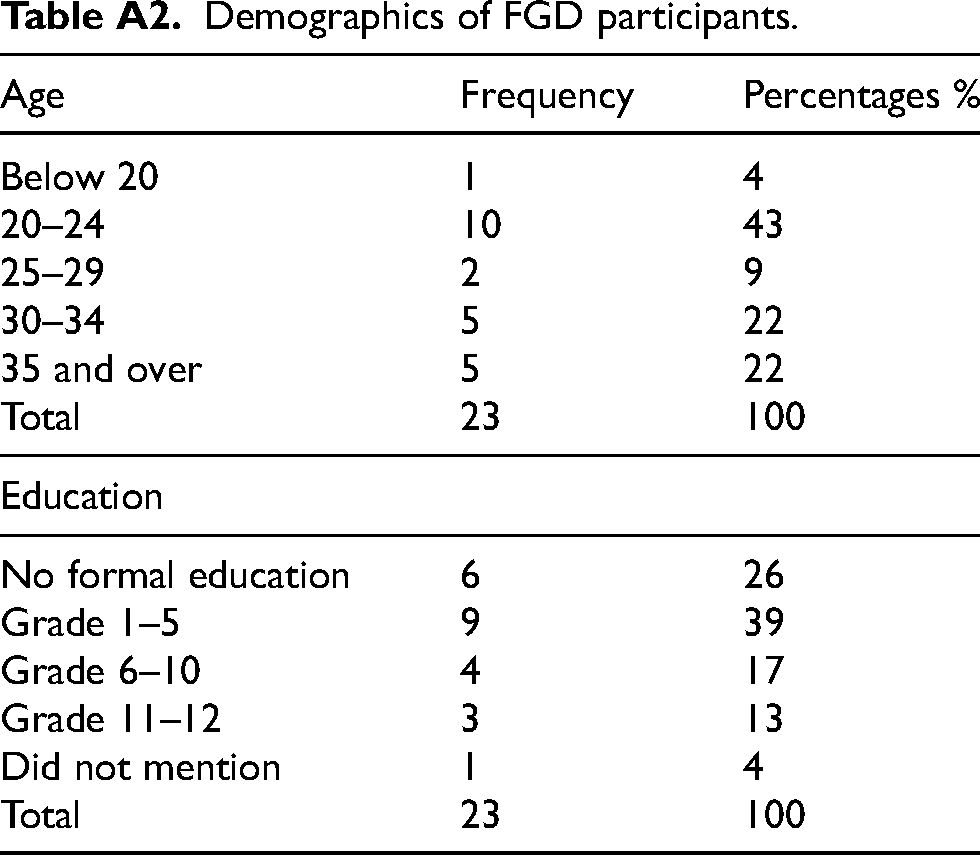
For FGDs, the authors asked for only the minimum demographic information (see Appendix 2). The participants were asked to report only their age and their education level. Most of the FGD participants were between the ages of 20 and 34, and the majority did not have any formal education or did not complete elementary education.
Everyday life information needs and sources
The survey participants were asked to report the information they needed in their everyday lives. The top three information needs reported by the participants were related to their personal safety and security (96%), country affairs (46%), and health-related information needs (46%, see Figure 1). Approximately one-fourth of the participants reported that they required information about their clients regularly. Although approximately 28% of the participants indicated that they required “other” information, some participants did not mention any information needs in “other” category. Instead, they questioned why they would have any information needs when they struggled for their survival and when they were not treated as human beings by some members of society. For example, survey participant 97 said: We are street girls! However, people do not consider us human beings. They beat us and ousted us. What information needs would we have?
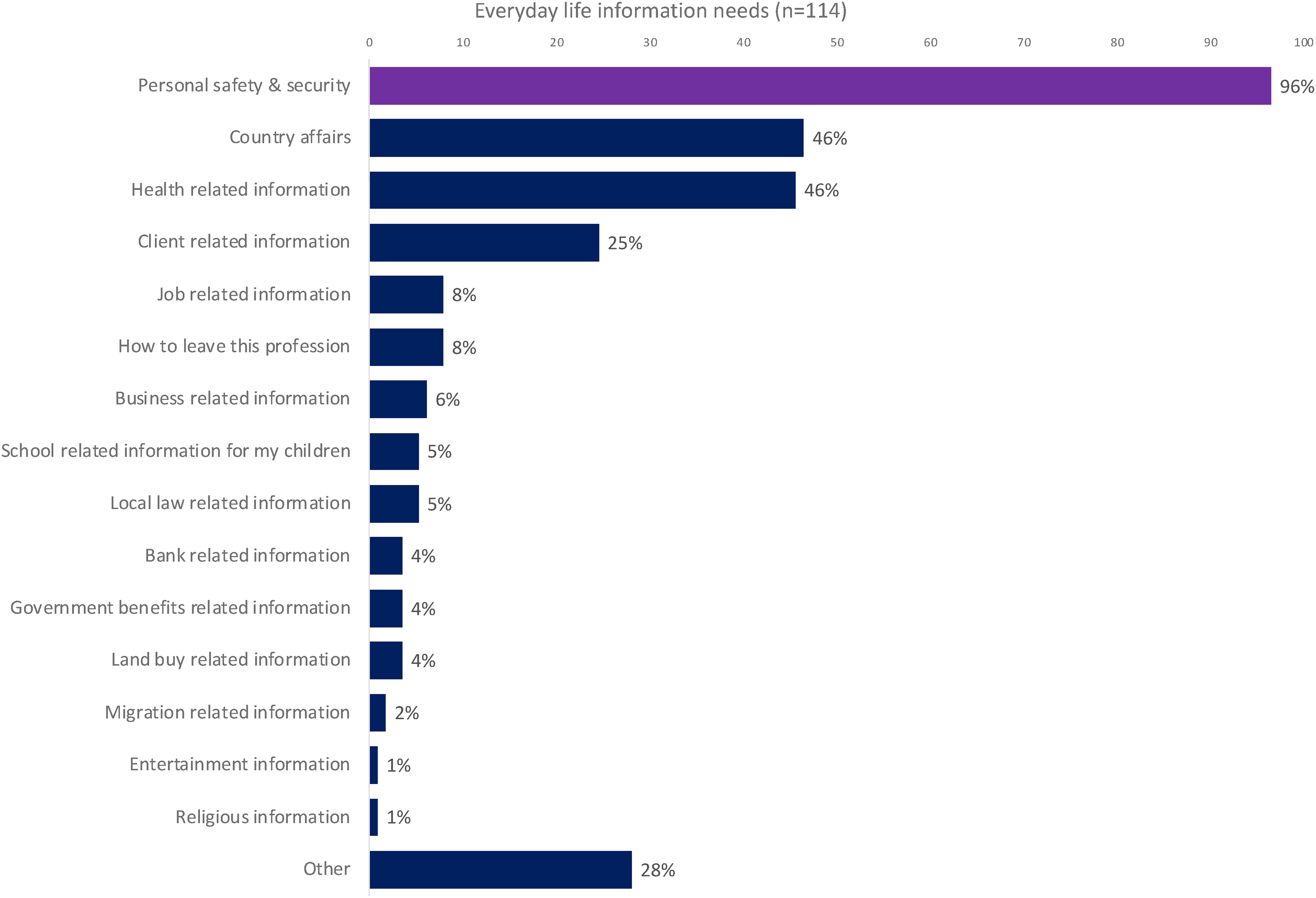
Everyday life information needs.
Another participant told the interviewer that they were more concerned about their survival than about information in their everyday lives: “We are street girls! What information needs would we have? We are happy if we can feed ourselves!” (Survey Participant, 9).
Those who mentioned “other” information needs reported requiring information related to protecting them from harassment by local pseudo-political and religious leaders, law enforcement authorities, and police administration.
The FGD participants also reported requiring information related to personal safety and security, country affairs, employment, and school-related information for their children.
The survey participants were asked to report the sources of information that they used to meet their information needs in everyday life contexts. Not surprisingly, most of the participants heavily depended on informal information networks (e.g., other sex workers, friends and family networks) for their everyday life information needs (see Figure 2). The top four information sources mentioned by the survey participants were other sex workers, friends, and family (65%), NGO workers (47%), hotel staff (23%), and clients (23%).
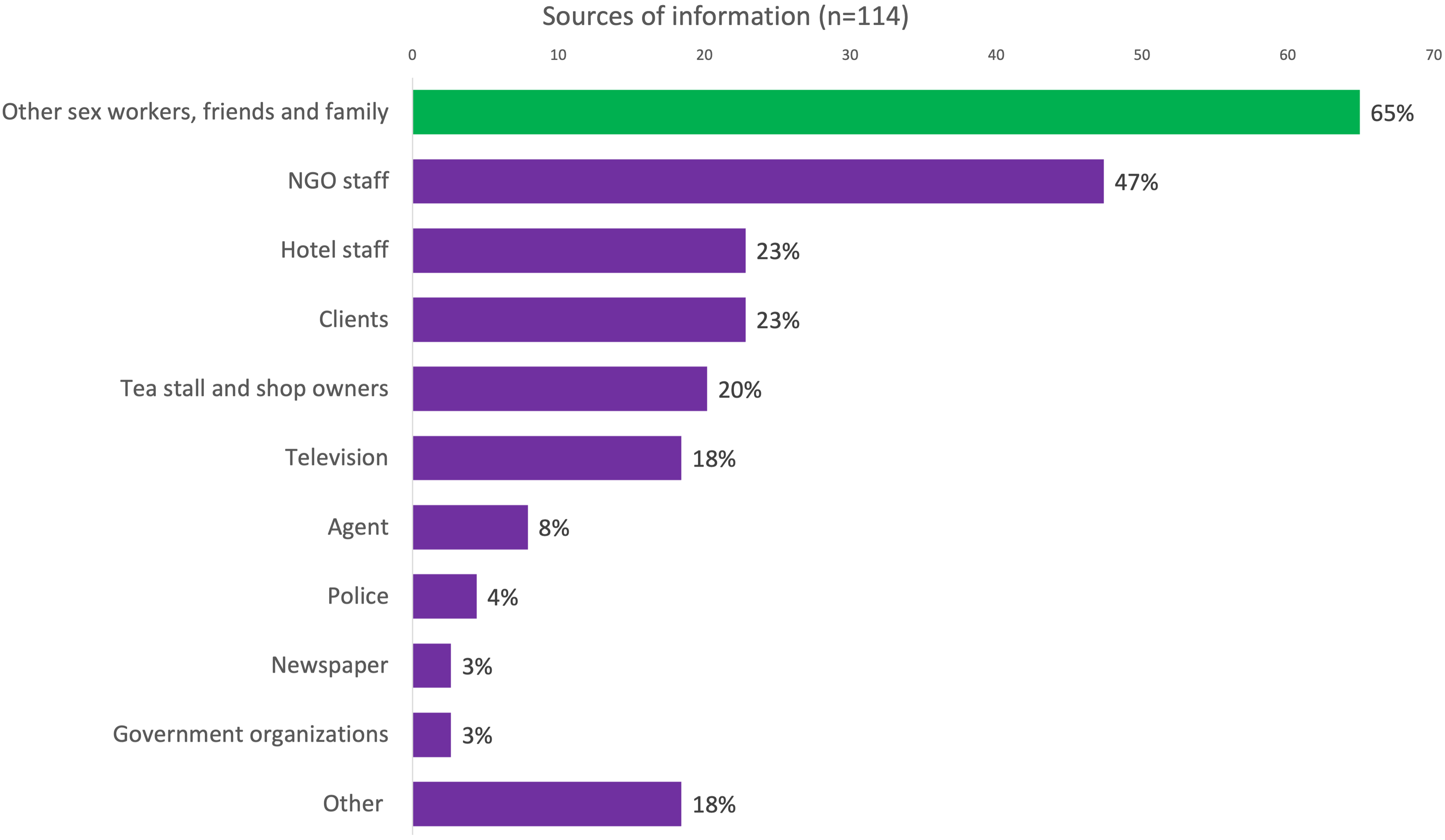
Sources of information.
The FGD participants also reported using several information sources to meet their information needs, including friends and family networks, NGO workers, husbands, clients, newspapers, and radio. Only one FGD participant reported obtaining information from Facebook.
Unmet information needs and barriers to information access
The survey participants were also asked to indicate whether they had received the information they needed. Most participants (87%) reported “rarely” or “occasionally” obtaining the information they sought (see Figure 3). The survey participants were also asked to report whether they faced any barriers to accessing the information they needed. The majority of the participants reported “illiteracy” as the core barrier to accessing information (See Figure 4). Some participants reported “other” barriers, including “no one values us as we are sex workers,” “we do not go anywhere,” “we do not go anywhere for information,” and “no one thinks about us.”
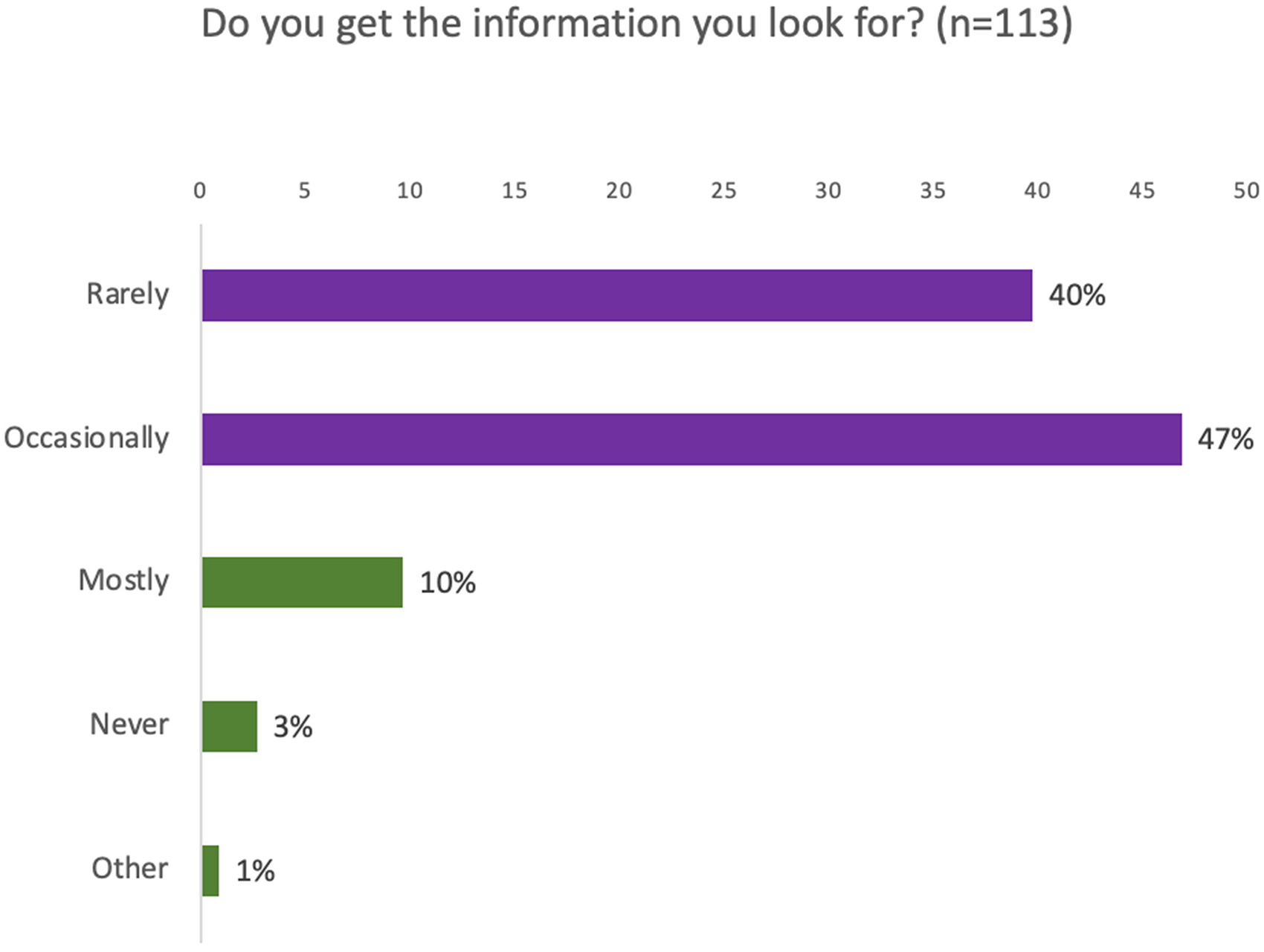
Do you get the information you look for?.
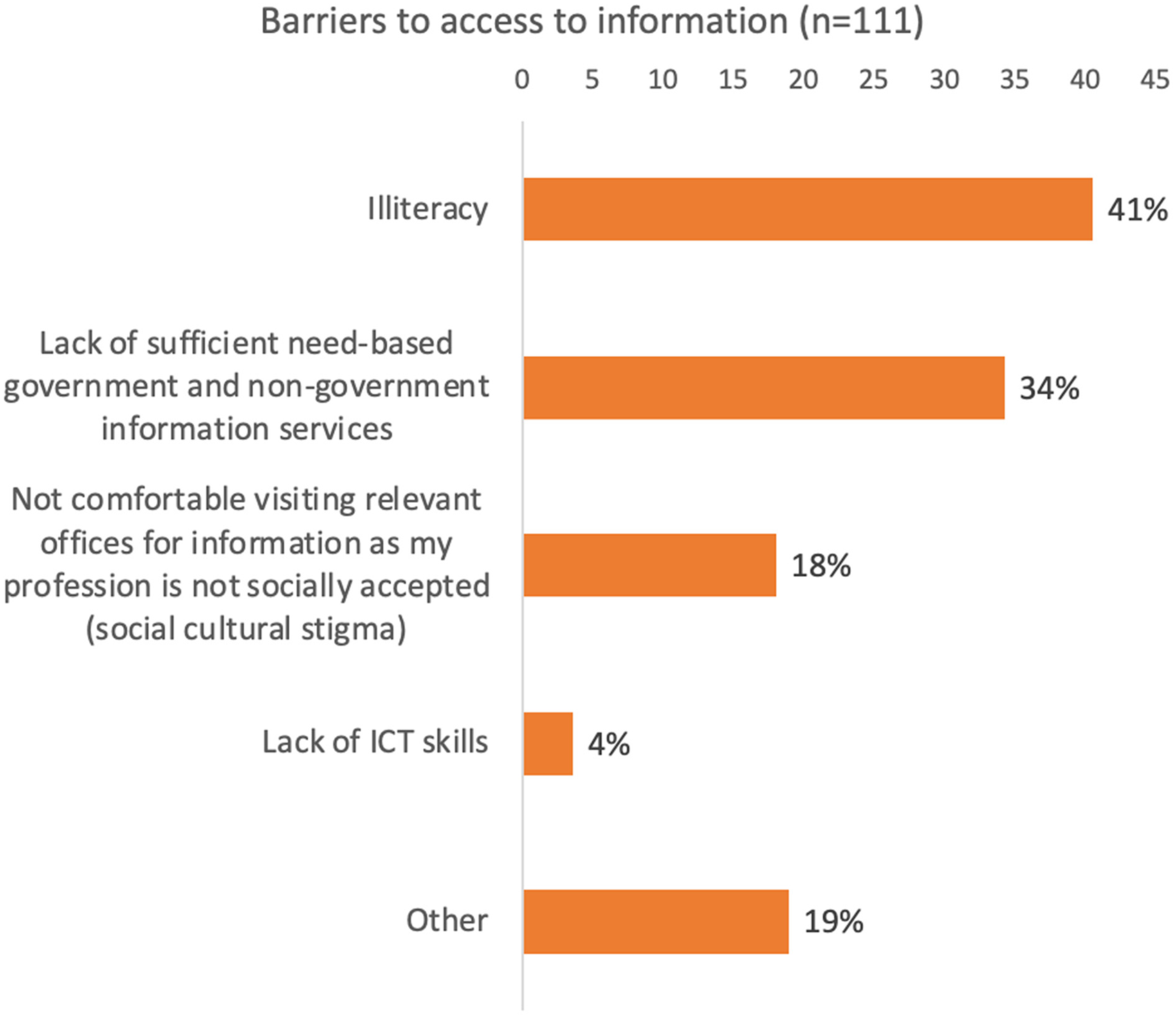
Barriers to access to information.
Some FGD participants also reported struggling to obtain the information they looked for or did not obtain at all. For example, in FGD 1, Participant 4 recalled looking for information about a school for her son for approximately six months. She tried all her informal information sources to obtain information but did not obtain the information from her information networks. I was looking for school information for my son for six months. I was looking for a school where my son would learn English as well as would become a Mawlana (a title used by religious leaders). I was searching, and searching, and searching for that piece of information. Do you know where I have received this information from? I was coming from [name of the street] and I saw a signboard advertising the type of school I was looking for. I obtained the school's phone numbers and contacted them. … Earlier, I asked people for that information but did not get it. They couldn’t find any piece of information. Even if we want to know [seek information], we will not know. They are [referring to a particular human information source] stupid [couldn’t fulfill my information needs].
Some participants reported looking for employment-related information but failed to locate them: I am looking for information related to the job but could not find it. (Focus Group Discussion 1, Participant 3). I did not find any job-related information. Whom should I consult? (Focus Group Discussion 3, Participant 5). I am looking for a job for my daughter. My daughter passed the S.S.C. (Secondary School Certificate) with “A” grade. She is currently studying at the college level. I want her to get a good job. If she gets a good job, I will leave this profession. I told my friends and family networks [about finding a job for her]. Ask many people [employment related information]. Some care and others do not. This way, it does not work [I do not get the information] (Focus Group Discussion 1, Participant 6).
Information about HIV/AIDS/STIs and the use of condoms
Condoms are considered highly effective in preventing HIV/AIDS and other STIs (Centers for Disease Control and Prevention (CDC), 2021; Feldblum et al., 2003; NHS, 2022). The authors asked several questions to explore whether Bangladeshi female sex workers are aware of the risk of having sex without condoms. In response to the question, “Did you know you can get HIV/AIDS & STI by having sex without a condom,” 100% of participants (n = 115) indicated “yes.” When asked whether they had received any HIV/AIDS and STI-related awareness program/information, 99% of FSWs claimed they had HIV/AIDS and STI-related awareness program/information.
The survey participants were also asked to report the sources of their HIV/AIDS and STI information and programs. Although not surprising, the study revealed that most of the survey participants (97%) received HIV/AIDS/STI-related awareness information/programs from NGOs (see Figure 5).
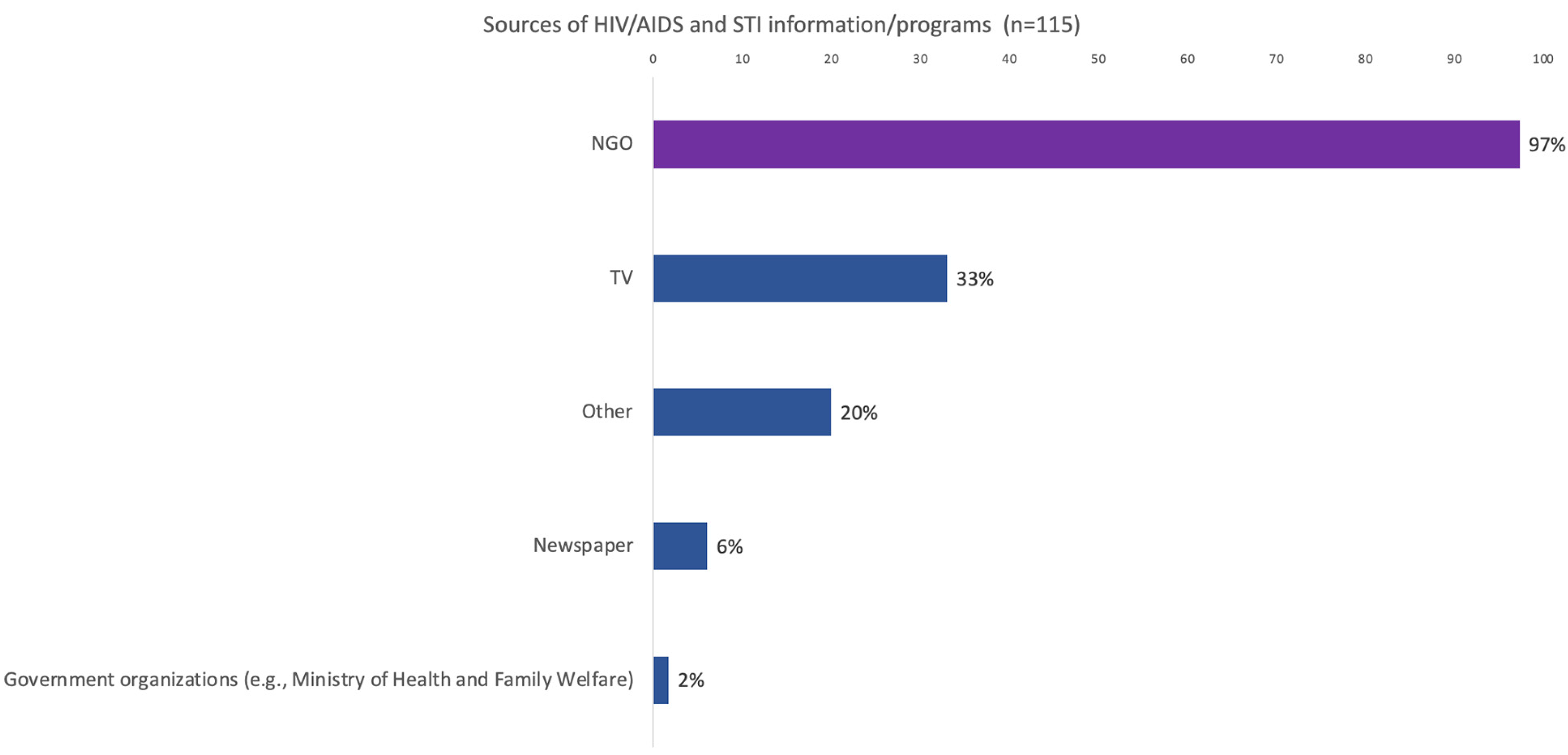
Sources of HIV/AIDS and STI information/programs.
Role of information in negotiating condom use with clients
Part of this large-scale information behavior study, the authors explored the effectiveness of informational programs on HIV/AIDS and STIs in empowering FSWs in negotiating the condom use with clients. Several questions were asked to survey and FGD participants to explore whether they had information about the risk of not using condoms during sex and whether they were empowered to negotiate with or motivate their clients to use condoms during sex.
Survey participants were asked to indicate whether they always use condoms during sex with their clients and whether they can say “No” to clients’ demand for sex without condoms. As is evident in Figure 6, the majority of the participants (77%) reported that they did not always use condoms. In response to the question, “Can you say “No” to customers’ demand for sex without condoms,” most of the participants (95 out of 113; 84%) claimed they cannot say “No” to their clients’ demand for sex without condoms.
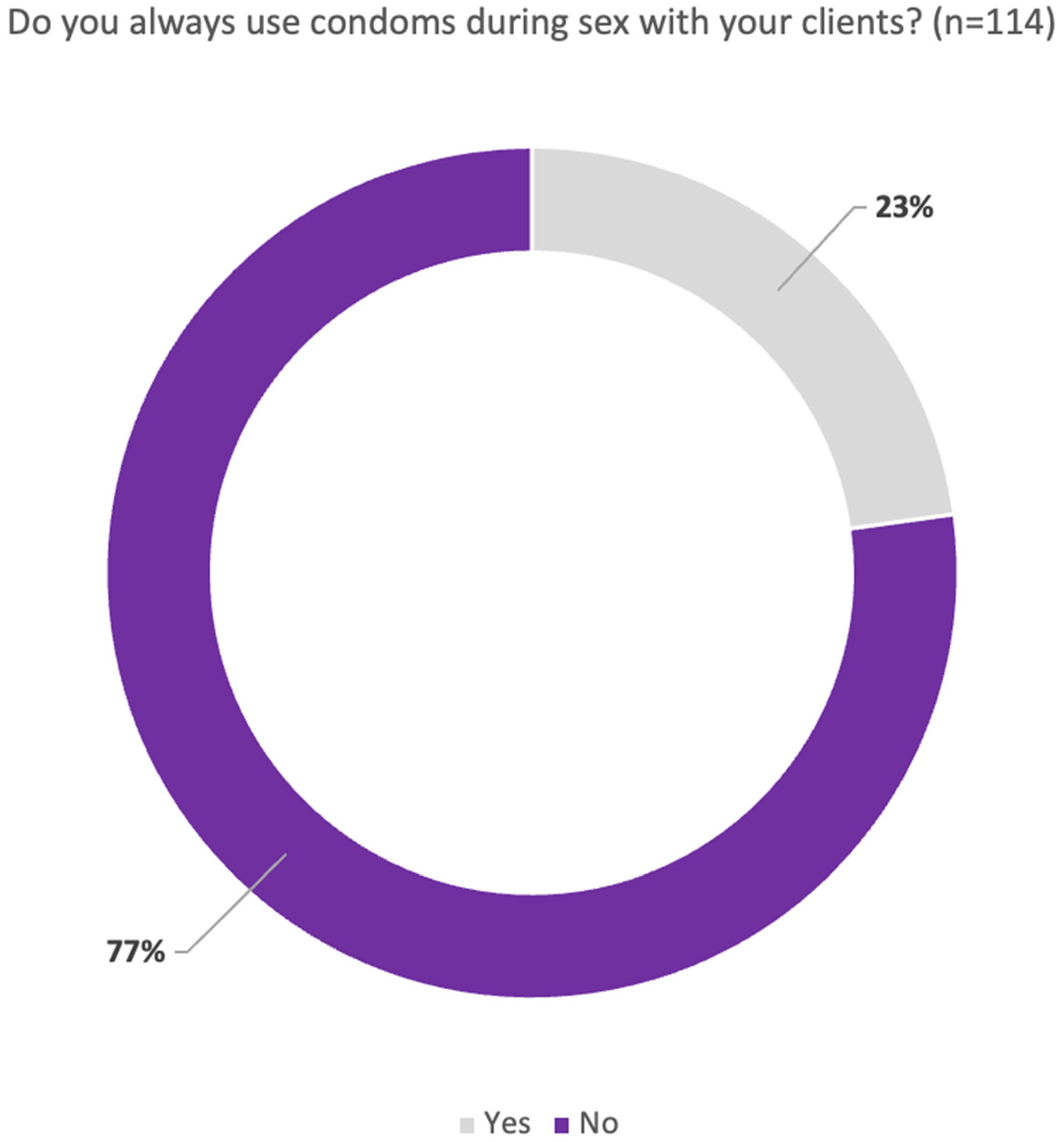
Do you always use condoms during sex with your clients?.
Those who claimed not to consistently use condoms (n = 85) during sex with their clients were asked to indicate the reasons behind them. Two major reasons for not always using condoms depended on customers (44%) and they agreed to work without condoms if they were offered more money (33%; see Figure 7). Those who reported “others” mentioned several reasons for not always using condoms, including not using condoms with friends and permanent clients, using birth control, and cannot use condoms with pseudo-political leaders and members of law enforcement agencies, and will lose clients if they ask for condom use.
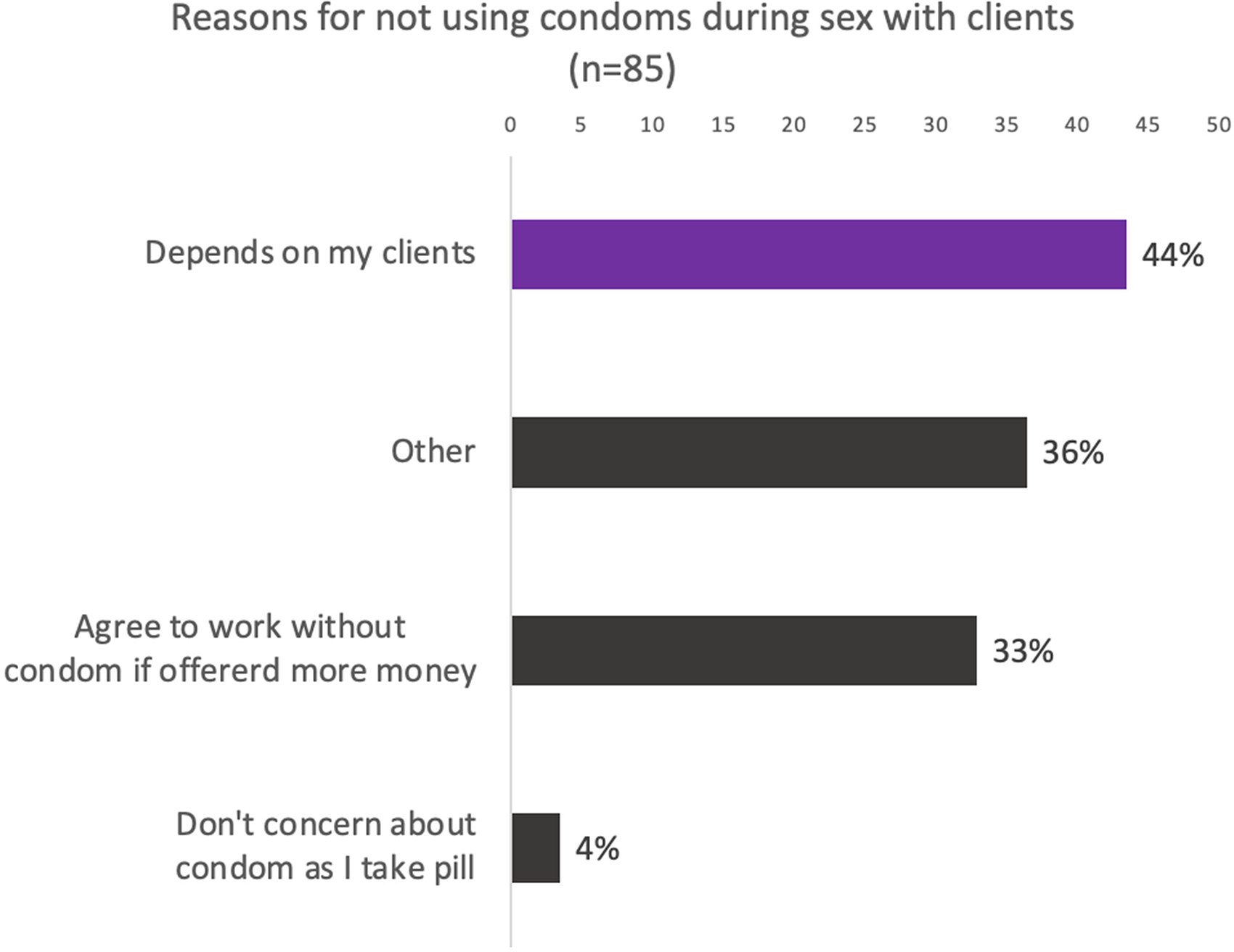
Reasons for not using condoms during sex with clients.
Similar to the survey participants, FGD participants also reported not being able to negotiate condom use with their clients despite being aware of the risk of having sex without condoms, mainly learned through the programs offered by local NGOs. For example, in FGD 4, Participant 1 thinks that if she asks her clients to use condoms during sex, her clients will leave her. [Clients claim] They do not enjoy sex with condoms. They enjoy it without any condoms. Probably, the guests (clients) will leave [if I ask them to use condoms], which is why I forced myself to have sex without condoms. They come to enjoy. If I allow them to have sex without condoms, they will return to me. They will ask for me.
Several participants expressed their vulnerability and helplessness in negotiating condom use with their clients: No, customers do not always wear condoms. Some clients say that they do not enjoy sex while wearing condoms. They say “We are paying for sex; we will not use condoms. We came here to enjoy.” (Focus Group Discussion 2, Participant 1). They do not want to use packets [condoms]. They tell me, “There is no problem” [having sex without condoms]. I want [to use condoms] so I do not suffer. I want to be healthy. However, they [clients] do not want to use condoms. When I try to make them understand, they do not. If someone does not understand, what can be done? (Focus Group Discussion 3, Participant 3).
Some participants claimed that their clients were unaware of the risk of having sex without a condom: Many of them do not know [why they should use condoms]. All sex workers are aware of the [risk] of having sex without condoms, whereas clients are not. They do not understand the consequences [of having sex without a condom]. They do not understand. Some people [clients] are foolish. They do not understand what packets are [condoms]. (Focus Group Discussion 1, Participant 4). They [clients] do not understand [why they should use condoms]. If you try to make them understand it thousands of times, they will not understand it. Looking at the money I will get, I cannot say “no” to my clients. I force myself [to have sex without condoms] (Focus Group Discussion 1, Participant 1).
Discussion
Tactical information behavior
The study finds that Bangladeshi female sex workers use “tactics” (de Certeau, 1984) in meeting their information needs. They reported rarely using formal information sources such as government agencies and indicated sometimes being harrassed by law enforcement agencies because of their professional status, creating a distance between formal information agencies and their everyday life information seeking. Their unique everyday life information needs (i.e., “information related to personal safety and security”) to protect them from law enforcement agencies, and local pseudo political and religious leaders, suggests Bangladeshi female sex workers’ vulnerability and everyday worries about their safety and security. Although not surprising, it is evident that the most of the FSWs relied on interpersonal information sources (e.g., friends, family, hotel staff, and clients) and reported huge unmet information needs. Their tactical information behavior is also evident in their statements related to the barriers to information access where a significant number of participants reported not being comfortable using formal information sources because of the social stigma associated with their profession.
As reported earlier in Shuva (2017), the information service culture of Bangladesh has not yet been welcoming enough to allow marginalized populations to seek information and services without barriers. The level of access to information in countries like Bangladesh may depend on the sociopolitical status of the information seekers and for ordinary people the information environment may be hostile. In Bangladesh contexts, it is very challenging for equity-deserving groups like Bangladeshi female sex workers to navigate through “strategic” information institutions such as various government agencies. Dominant social institutions in developing countries like Bangladesh may create unapproachable information environments that force marginalized populations to adopt tactical information behavior as a form of resistance to meet their everyday life information needs (Shuva, 2017).
This study also found that Bangladeshi female sex workers, especially street-based FSWs, are “information poor” (Chatman, 1996). Because of their tactical information seeking strategies, illiteracy, lack of access to the ICT mediated information sources such as Google to verify information create often insurmountable barriers for these groups. FSWs in this study have very constrained information needs, and mainly rely on interpersonal sources, primarily other sex workers, for information. Their reliance on interpersonal networks is consistent with previous studies on rural dwellers across the globe (e.g., Hossain and Islam, 2012; Naveed and Anwar, 2013; Njoku, 2004; Patrick and Ferdinand, 2016; Shuva, 2017, 2021b). The FSWs reported significant unmet information needs and challenges in accessing information in everyday life. Furthermore, due to extreme poverty and illiteracy, and lack of technological skills, anything published on the internet is also irrelevant as they cannot afford to buy technological devices to harness the benefits of the internet. Many FSWs due to their illiteracy are also unable to read local newspapers and other information materials, may soley rely on word of mouth for meeting their information needs resulting in both a limited “information horizon” (Sonnenwald, 1999) and “information resource base” (Yu, 2010). Because of their tactical information seeking, poverty, and illiteracy, FSWs have limited abilities and resources to verify the information they receive and are vulnerable to being trapped by misinformation and disinformation. Although previous studies (e.g., Ikoja-Odongo and Ocholla, 2003; Njoku, 2004; Patrick and Ferdinand, 2016; Saleh and Lasisi, 2011; Shuva, 2017, 2021b) reported illiteracy or limited education as the core barriers to information access, in this study, the “stigma” associated with their profession hindered FSWs in reaching out to information sources outside of their “comfort zone.” Future studies should explore the information experiences of marginalized populations such as sex workers using various formal and informal information sources and the role social information institutions such as public libraries can play in meeting their informational needs and helping them gain informational skills.
Informational programs on HIV/AIDS/STI and their effectiveness in empowering FSWs to negotiate condom use
The study found that, although all FSWs were aware of the risk of infecting with HIV/AIDS and STI by not using a condom during sex, a majority of FSWs reported not always using condoms during sex with their clients. Clients’ decisions and agreement to have sex without condoms if more money was offered are reported as two major factors not using condoms during sex among FSWs. The FGDs participants reported story after story of their lack of power in negotiating condom use during sex despite their knowledge associated with the risk of having sex with their clients without condoms. The findings question the effectiveness of informational programs on HIV/AIDS and STI in empowering sex workers to negotiate safe sexual practices with their clients. Although FSWs were informed and aware of the risk of developing chronic and potentially life-threatening conditions such as AIDS by not using condoms with their clients, in many cases, they were powerless in negotiating condom use with their clients because of power dynamics, their vulnerable financial status, and their emotions among other factors. Previous studies such as Bharat et al. (2013), Ma et al. (2017), and Ghimire et al. (2011) report poverty, power dynamics, client refusals, and emotional relationships creating barriers to sex workers’ ability to negotiate condom use. Through the lens of information science, this study offers new perspectives on the effectiveness of informational programs in ending HIV/AIDS by 2030, a goal set by the UNAIDS. As evident in this study, the informational programs on HIV/AIDS and STI did increase FSWs’ knowledge and awareness of the risks of unprotected sex. However, these programs were not always able to empower FSWs to negotiate condom use with their clients. Another important finding reported by some FGDs participants was related to clients’ negligence or lack of awareness of the risk of having sex without condoms despite FSWs informing them about the risks. Previous studies such as Choi and Holroyd (2007) also reported similar findings where clients of sex workers were unaware of the health risks of having sex without condoms or did not bother about using condoms. This was beyond the scope of this study to explore the HIV/AIDS and STI awareness and the knowledge of clients of FSWs. Future studies should investigate the information behavior of clients of sex workers, including their HIV/AIDS and STI knowledge and awareness and the factors that impact their decisions regarding risky sexual behavior. The authors believe that understanding clients’ behavior through informational terms may be useful in producing timely policies and improvements for informational programs on HIV/AIDS and STI.
Theoretical and policy implications
The present study makes some theoretical and policy contributions by utilizing the everyday life practices framework of de Certeau (1984) to investigate the information seeking behavior of female sex workers, a marginalized group in Bangladesh. The authors believe this study would encourage researchers to utilize the promising theoretical concepts of “tactics” and “strategy” in comprehensively understanding everyday life information behavior of equity-deserving groups (e.g., people with substance use disorders) globally. Although some previous LIS studies (e.g., Pawley, 2003; Ross, 2009; Rothbauer, 2007) draw from de Certeau's various theoretical concepts (e.g., reading as poaching) mainly in the context of reading practices, there is little work to date (e.g., Lingel, 2011; Shuva, 2017) that employed de Certeau's theorectical concepts in exploring the information behavior of diverse groups.
This study's findings have several policy implications. Most FSWs in this study reported having no or limited education and no access to smartphones and the Internet, leaving them very vulnerable in terms of their information access. Also, because of the stigma associated with the profession, the risk of being harassed by law enforcement agencies if asking for help, and the overall uninviting information services culture of Bangladesh, the FSWs in Bangladesh may not be comfortable in using “strategic” information service institutions such as local government organizations. The Bangladesh government, UNAIDS, donor agencies, and local NGOs should work to identify ways to connect vulnerable populations, such as sex workers, with mainstream information sources (e.g., information services offered by various government and non-government agencies). Although FSWs reported regularly using NGOs and their staff as their major information sources, their significant unmet information needs raise questions about the ability of the NGOs and their staff to meet the everyday life information needs of the FSWs. The authors believe that public libraries, both government and non-government, may collaborate with local NGOs to help marginalized populations such as FSWs access reliable and timely information and gain informational skills. Given the limited number of government public libraries available in Bangladesh (71 government public libraries; one library for about 2.4 million people) and the lack of government public libraries in every community, public libraries alone may not be able to provide services to FSW communities spread across the country. Local NGOs, in collaboration with UNAIDS, UNDP, and the Government of Bangladesh, may consider having partnerships with both government and non-government public libraries to regularly invite library professionals to their premises. Public libraries may work on designing appropriate and need-based informational services and sessions (e.g., health, human rights, and information literacy) for FSWs and may work on introducing ICT-mediated information sources. This study was not able to explore the role of local public libraries in helping marginalized populations access reliable information. Future studies should consider investigating the potential role of local public libraries in meeting the information needs of vulnerable communities, such as sex workers, who might not be comfortable consulting other formal information sources.
As evident in this study, HIV/AIDS and STI informational programs offered to FSWs alone may not be adequate to empower FSWs in protecting their health and safety. The participants reported power dynamics and their vulnerable financial status as major barriers to negotiating condom use with their clients. The Government of Bangladesh and agencies such as UNAIDS should work together to empower FSWs and other vulnerable groups socially and economically. It may be difficult for a conservative society such as Bangladesh to enact laws to protect the profession overnight. However, agencies such as UNAIDS, development partners, local self-help groups of FSWs, and NGOs may work to ensure that sex workers are not victims of abuse and harassment by local hooligans, pseudo-religious leaders, and law enforcement authorities because of their professional status. They should work to help sex workers report the harassments and abuse without any fear and consequences and protect their human rights. Programs to help FSWs find other income sources should also be considered so that FSWs do not have to rely solely on income from sex work and can negotiate condom use with clients without worrying about their survival. As indicated by many FGD participants in this study and reported earlier in studies such as Choi and Holroyd (2007) many clients of sex workers are not aware of the risk of infecting with HIV/AIDS and STI by having sex with FSWs without condoms. Although in a conservative society like Bangladesh, it may be difficult to reach the clients of FSWs (another vulnerable group to frequent harassment by law enforcement agencies) and offer them formal informational programs on HIV/AIDS and STI, the Government of Bangladesh, UNAIDS, and local NGOs should consider ways to offer mass informational programs on HIV/AIDS and STI that would inform current and future clients of FSWs about safe sexual practices. The authors believe that some culturally and locally appropriate informational awareness programs (such as local dramas and programs in relevant open public spaces such as local bazaars) may be useful for creating awareness about safer sex practices in the long run. The authors also contend that informational programs alone for sex workers and their clients may not play a significant role in empowering female sex workers to negotiate safe sexual practices unless measures are taken to protect their rights and help them generate income from sources other than sex work.
Conclusion
Utilizing the information science lens, the study on the information behavior of female sex workers in Bangladesh highlights the vulnerability of female sex workers in terms of their access to information. The FSWs in this study reported requiring limited information needs, consulting mainly informal information networks, and facing barriers to access to information mainly due to illiteracy, the stigma associated with their profession, and the lack of need-based official services. Because of their vulnerable economic status, they were also unable to harness the benefits of ICT-mediated sources such as Google and relied solely on interpersonal information networks such as other sex workers and hotel staff for their information, resulting in significant unmet everyday life information needs. The findings related to HIV/AIDS and STI awareness and the ability to negotiate condom use with clients further confirmed their socioeconomic vulnerability and reported their helplessness when it came to negotiating safe sexual practices with their clients despite being knowledgeable of the risks associated with having sex without condoms. It is clear that the HIV/AIDS and STI informational programs alone were not sufficient to empower FSWs to negotiate safer sex with clients. FSWs mentioned power dynamics and poverty as some of the factors in their inability to negotiate condom use with their clients. The findings underscore the need to review and evaluate the effectiveness of the existing informational programs on HIV/AIDS and STIs and suggest taking comprehensive measures (e.g., creating alternative income sources) to empower vulnerable female sex workers to protect their health and safety. The authors believe that the findings of this study have laid the groundwork for interdisciplinary research exploring the vulnerability of marginalized populations through information behavior studies. In addition to researchers in LIS, the findings of this study may be useful for researchers in economics, public health, psychology, and similar disciplines studying the effectiveness of HIV/AIDS and STI informational programs globally.
Footnotes
Acknowledgements
The authors would like to express their sincere gratitude to the editors and anonymous reviewers for their insightful and constructive comments on the original submission. Their constructive feedback led to significant improvements in the quality of this paper. This study was carried out when the authors NZS and RT were serving as assistant professors at the University of Dhaka, Bangladesh. The authors would like to extend their gratitude to the research associates, Md. Humayun Kabir and Rezaul Hossain Khan, for their valuable assistance in data collection, as without their help, this study would have been much more challenging to carry out.
Declaration of conflicting interests
The author(s) declared no potential conflicts of interest with respect to the research, authorship, and/or publication of this article.

Notes
Correction (November 2024):
Article has been updated to add the data collection information in “Research methods” section.
About the authors
Appendix 1
Demographics of survey participants.
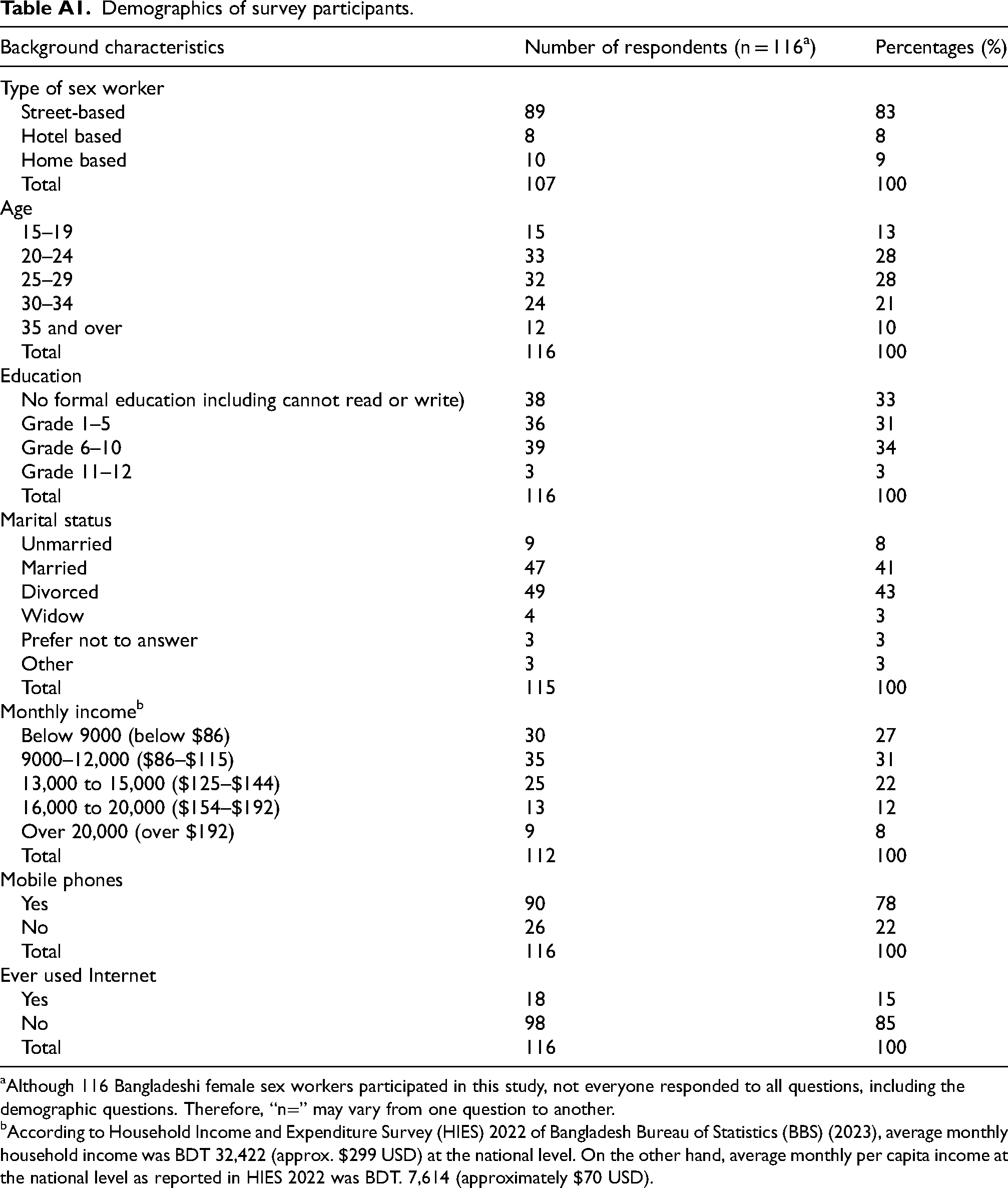
| Background characteristics | Number of respondents (n = 116 a ) | Percentages (%) |
|---|---|---|
| Type of sex worker | ||
| Street-based | 89 | 83 |
| Hotel based | 8 | 8 |
| Home based | 10 | 9 |
| Total | 107 | 100 |
| Age | ||
| 15–19 | 15 | 13 |
| 20–24 | 33 | 28 |
| 25–29 | 32 | 28 |
| 30–34 | 24 | 21 |
| 35 and over | 12 | 10 |
| Total | 116 | 100 |
| Education | ||
| No formal education including cannot read or write) | 38 | 33 |
| Grade 1–5 | 36 | 31 |
| Grade 6–10 | 39 | 34 |
| Grade 11–12 | 3 | 3 |
| Total | 116 | 100 |
| Marital status | ||
| Unmarried | 9 | 8 |
| Married | 47 | 41 |
| Divorced | 49 | 43 |
| Widow | 4 | 3 |
| Prefer not to answer | 3 | 3 |
| Other | 3 | 3 |
| Total | 115 | 100 |
| Monthly income b | ||
| Below 9000 (below $86) | 30 | 27 |
| 9000–12,000 ($86–$115) | 35 | 31 |
| 13,000 to 15,000 ($125–$144) | 25 | 22 |
| 16,000 to 20,000 ($154–$192) | 13 | 12 |
| Over 20,000 (over $192) | 9 | 8 |
| Total | 112 | 100 |
| Mobile phones | ||
| Yes | 90 | 78 |
| No | 26 | 22 |
| Total | 116 | 100 |
| Ever used Internet | ||
| Yes | 18 | 15 |
| No | 98 | 85 |
| Total | 116 | 100 |
Although 116 Bangladeshi female sex workers participated in this study, not everyone responded to all questions, including the demographic questions. Therefore, “n=” may vary from one question to another.
According to Household Income and Expenditure Survey (HIES) 2022 of Bangladesh Bureau of Statistics (BBS) (2023), average monthly household income was BDT 32,422 (approx. $299 USD) at the national level. On the other hand, average monthly per capita income at the national level as reported in HIES 2022 was BDT. 7,614 (approximately $70 USD).
Appendix 2
Demographics of FGD participants.
| Age | Frequency | Percentages % |
|---|---|---|
| Below 20 | 1 | 4 |
| 20–24 | 10 | 43 |
| 25–29 | 2 | 9 |
| 30–34 | 5 | 22 |
| 35 and over | 5 | 22 |
| Total | 23 | 100 |
| Education | ||
| No formal education | 6 | 26 |
| Grade 1–5 | 9 | 39 |
| Grade 6–10 | 4 | 17 |
| Grade 11–12 | 3 | 13 |
| Did not mention | 1 | 4 |
| Total | 23 | 100 |